
All Topics  
Marimba

 
Marimba

   Email Print
   Bookmark   Link


Marimba


:In some parts of Africa, the term "marimba" refers to the kalimba
Kalimba

The kalimba is an musical instrument in the percussion family. It is a modernized version of the African mbira. It is a sound box with metal keys attached to the top to give the different notes....
.

The marimba is a musical instrument
Musical instrument

A musical instrument is an object constructed or used for the purpose of making music. In principle, anything that produces sound can serve as a musical instrument....
 in the percussion
Percussion instrument

A percussion instrument is any object which produces a sound by being hit with an implement, shaken, rubbed, scraped, or by any other action which sets the object into vibration....
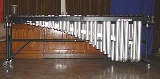
 family. Keys or bars (usually made of wood) are struck with mallets to produce musical tones. The keys are arranged as those of a piano, with the accidentals raised vertically and overlapping the natural keys to aid the performer both visually and physically.

modern marimba was developed by Japanese and American builders based on the Hispanic-American traditional marimba.

Modern uses of the marimba include solo performances, woodwind ensembles, marimba concertos, jazz ensembles, marching band (front ensembles), drum and bugle corps, and wind ensemble or orchestral compositions.


Discussion
Ask a question about 'Marimba'
Start a new discussion about 'Marimba'
Answer questions from other users
Full Discussion Forum


Encyclopedia


Marimba
:In some parts of Africa, the term "marimba" refers to the kalimba
Kalimba

The kalimba is an musical instrument in the percussion family. It is a modernized version of the African mbira. It is a sound box with metal keys attached to the top to give the different notes....
.

The marimba is a musical instrument
Musical instrument

A musical instrument is an object constructed or used for the purpose of making music. In principle, anything that produces sound can serve as a musical instrument....
 in the percussion
Percussion instrument

A percussion instrument is any object which produces a sound by being hit with an implement, shaken, rubbed, scraped, or by any other action which sets the object into vibration....
 family. Keys or bars (usually made of wood) are struck with mallets to produce musical tones. The keys are arranged as those of a piano, with the accidentals raised vertically and overlapping the natural keys to aid the performer both visually and physically.

Modern concert instrument

The modern marimba was developed by Japanese and American builders based on the Hispanic-American traditional marimba.

Modern uses of the marimba include solo performances, woodwind ensembles, marimba concertos, jazz ensembles, marching band (front ensembles), drum and bugle corps, and wind ensemble or orchestral compositions. Contemporary composers have utilized the unique sound of the marimba more and more in recent years, and it is common to find them in new music for wind ensemble, although less so for orchestra.

African marimba music sounds unfamiliar to North American audiences because most of the marimba music played in the Western Hemisphere has been South American. However, marimbas originated in Africa hundreds of years ago and were imported to South America in the sixteenth century. The original African sounds were incorporated into and changed by the music of the local American cultures.

Bars (keys)

The marimba bars, like xylophone
Xylophone

The xylophone is a musical instrument in the percussion instrument family which probably originated in Slovakia. It consists of wooden bars of various lengths that are struck by plastic, wooden, or rubber drum stick#Malletss....
 keys, are usually made of rosewood
Rosewood

Rosewood refers to any of a number of richly hued timbers, often brownish with darker veining but found in many different hues. All rosewoods are strong and heavy, taking an excellent polish, being suitable for Parquetry, furniture, Woodturning, musical instruments, John Parris, and chess piece ....
, but bars can also be made of padouk or various synthetic materials. Rosewood bars are preferred for concert playing, but synthetic bars are preferred for marching band use because they are more durable and less susceptible to pitch change due to weather. The bars are wider and longer at the lowest pitched notes, and gradually get narrower and shorter as the notes get higher. During the tuning process, wood is taken from the middle underside of the bar to lower the pitch. Because of this, the bars are also thinner near the bottom and thicker near the top.

In Africa, most marimbas are made by local artisans from locally available materials.

When playing the marimba it is preferred to strike in the center of the bar for the fullest tone, while striking the bar just off center or right on the edge produces a more focused tone. Playing on the node (the location where the string passes through the bars) is sonically very weak, so it is only used when the player or composer is looking for that particular muted sound.

Range

There is no standard range of the marimba, but the most common ranges are 4 octaves, 4.3 octaves, and 5 octaves; 4.5 and 5.5 octave sizes are also available.
4 octave: C3 to C7.
4.3 octave: A2 to C7. The 3 refers to three notes below the 4 octave instrument. This is probably the most common range.
4.5 octave: F2 to C7. The 5 means "half"; the instrument goes down a fifth below the 4 octave instrument.
4.6 octave: E2 to C7, one note below the 4.5. Useful for playing guitar literature.
5 octave: C2 to C7, one full octave below the 4 octave instrument.
The range of the marimba has been gradually expanding, with companies like Marimba One adding notes up to F above the normal high C (C7) on their 5.5 octave instrument, or marimba tuners adding notes lower than the low C on the 5 octave C2. Adding lower notes is somewhat impractical because as the bars become thinner (more fragile), the resonators become longer or larger, and the sixth overtone becomes more present than the fundamental tone.

The marimba is a non-transposing instrument with no octave displacement, unlike some other keyboard instruments, which are pitched one or two octaves higher than written.

Resonators

Part of the key to the marimba's rich sound is its resonator
Resonator

A resonator is a device or system that exhibits resonance or resonant behavior, that is, it naturally Oscillation at some frequency, called its Resonance frequency, with greater amplitude than at others....
s. These are metal tubes (usually aluminum) that hang below each bar. The length varies according to the frequency that the bar produces. Vibrations from the bars resonate as they pass through the tubes, which amplify the tone in a manner very similar to the way in which the body of a guitar or cello would. In instruments exceeding 4½ octaves, the length of tubing required for the bass
Bass (musical term)

Bass , when used as an adjective, is used to describe Pitch s of low frequency or range . Played in an musical ensemble/orchestra, such notes are frequently used to provide a counterpoint or counter-melody, in a harmony context either to outline or juxtapose the progression of the chord s, or with Percussion instrument to underline the rhyth...
 notes exceeds the height of the instrument. Some manufacturers, such as Malletech
Malletech

Malletech LLC is a manufacturer of Idiophone Musical instrument and Percussion mallet formed in 1982 by Leigh Howard Stevens#Marimba Productions, Inc The company sells its own line of Marimba, Xylophone, and Glockenspiel....
, compensate for this by bending the ends of the tubes. Others, such as Adams
Adams Musical Instruments

Adams Musical Instruments is a manufacturer of percussion Musical instrument based in the Netherlands. The company was founded by amateur musician Andr? Adams, who started repairing brass instruments in 1971....
 and Yamaha
Yamaha (manufacturer)

The is a multinational corporation and Conglomerate based in Japan with a wide range of products and services, predominantly musical instruments, motorcycles and powersports equipment, and electronics....
, expand the tubes into large box-shaped bottoms, resulting in the necessary amount of resonating space without having to extend the tubes. This result is achieved by the custom manufacturer Marimba One
Marimba One

Marimba One is a manufacturer of handmade marimbas based in Arcata, California. The company was founded by Ron Samuels in the 1980s. Each marimba is custom-made and tuned by hand....
 by widening the resonators into an oval shape, with the lowest ones reaching nearly a foot in width, and doubling the tube up inside the lowest resonators.

On many marimbas, decorative resonators are added to fill the gaps in the accidental resonator bank. In addition to this, the resonator lengths are sometimes altered to form a decorative arch, such as in the Musser M-250. This does not affect the resonant properties, because the end plugs in the resonators are still placed at their respective lengths.

Mallets

The mallet shaft is commonly made of wood, usually birch, but may also be rattan or fiberglass. The most common diameter of the shaft is around 5/16". Shafts made of rattan have a certain elasticity to them, while birch has almost no give. Professionals use both depending on their preferences, whether they are playing with two mallets or more, and which grip they use (if they are using a four-mallet grip).

Appropriate mallets for the instrument depend on the range. The material at the end of the shaft is almost always a type of rubber, usually wrapped with yarn. Softer mallets are used at the lowest notes, and harder mallets are used at the highest notes. Mallets that are too hard will damage the instrument, and mallets that might be appropriate for the upper range could damage the notes in the lower range (especially on a padouk or rosewood
Rosewood

Rosewood refers to any of a number of richly hued timbers, often brownish with darker veining but found in many different hues. All rosewoods are strong and heavy, taking an excellent polish, being suitable for Parquetry, furniture, Woodturning, musical instruments, John Parris, and chess piece ....
 instrument). On the lower notes, the bars are larger, and require a heavier mallet to bring out a strong fundamental. Because of the need to use different hardnesses of mallets, some players, when playing with four or more mallets, might use graduated mallets to match the bars that they are playing (softer on the left, harder on the right).

Some mallets, called "two-toned" or "multi-tonal", have a hard core, loosely wrapped with yarn. These are designed to sound articulate when playing at a loud dynamic, and broader at the quieter dynamics.

Mallet technique

Modern marimba music calls for simultaneous use of between two and four mallets (sometimes up to six), granting the performer the ability to play chords or music with large interval skips more easily. Multiple mallets are held in the same hand using any of a number of techniques or grips. For two mallets in each hand, the most common grips are the Burton grip
Burton grip

The Burton grip is a method of holding two Drum_stick#Mallets in each hand in order to play a mallet percussion instrument, such as a marimba or a vibraphone, using four mallets at once....
 (made popular by Gary Burton
Gary Burton

Gary Burton is an United States jazz vibraphone.A true original on the vibraphone, Burton developed a pianistic style of four-mallet technique as an alternative to the usual two-mallets....
), the traditional grip (or "cross grip") and the Musser-Stevens grip
Stevens technique

The Stevens technique is a method of playing Tuned percussion instruments with four mallets – two in each hand. It was developed by marimba player Leigh Howard Stevens during his studies at the Eastman School of Music in the 1970s, and codified in his 1979 book Method of Movement for Marimba....
 (made popular by Leigh Howard Stevens
Leigh Howard Stevens

Leigh Howard Stevens is a marimba artist best known for developing, codifying, and promoting the Stevens technique or Musser-Stevens grip, a method of independent four-mallet marimba performance based on the Musser grip....
). Each grip is perceived to have its own benefits and drawbacks. For example, the Musser-Stevens grip is more suitable for quick interval changes, while the Burton grip
Burton grip

The Burton grip is a method of holding two Drum_stick#Mallets in each hand in order to play a mallet percussion instrument, such as a marimba or a vibraphone, using four mallets at once....
 is more suitable for stronger playing or switching between chords and single-note melody lines. The choice of grip varies by region (the Musser-Stevens grip and the Burton grip are more popular in the United States
United States

The United States of America is a Federal government constitutional republic comprising U.S. state and a federal district. The country is situated mostly in central North America, where its Contiguous United States and Washington, D.C., the Capital districts and territories, lie between the Pacific Ocean and Atlantic Oceans, Borders of the U...
, while the traditional grip is more popular in Japan
Japan

Japan is an island country in East Asia. Located in the Pacific Ocean, it lies to the east of the Sea of Japan, People's Republic of China, North Korea, South Korea and Russia, stretching from the Sea of Okhotsk in the north to the East China Sea and Taiwan in the south....
), by instrument (the Burton grip is less likely to be used on marimba than on a vibraphone
Vibraphone

The vibraphone, sometimes called the vibraharp or simply the vibes, is a musical instrument in the mallet subfamily of the percussion instrument family....
) and by the preference of the individual performer. The six-mallet grip is normally based on the Stevens Grip. Kai Stengaard has written several pieces for this grip and it is becoming more and more popular to play with six mallets.

The traditional instrument

The term marimba is also applied to various traditional folk instruments, the precursors of which may have developed independently in West Africa
West Africa

West Africa or Western Africa is the westernmost region of the African continent. Geopolitically, the United Nations subregion of Western Africa includes the following 16 countries distributed over an area of approximately 5 million square km:...
  balafon
Balafon

The balafon is a resonated frame, wooden keyed percussion idiophone of West Africa; part of the idiophone family of Percussion instrument that includes the xylophone, marimba, glockenspiel, and the vibraphone....
. The tradition of the gourd-resonated and equal-ratio heptatonic-tuned Timbila
Music of Mozambique

Mozambique is a former Portugal colony, and its native folk musics have been highly influenced by Portuguese forms. The most popular style of modern dance music is marrabenta....
 of Mozambique is particularly well developed. This instrument is typically played in large ensembles in coordination with a choreographed dance performance, such as those depicting a historical dramatization.

Traditional marimba bands are especially popular in Guatemala
Guatemala

Guatemala is a country in Central America bordered by Mexico to the north and west, the Pacific Ocean to the southwest, Belize and the Caribbean to the northeast, and Honduras and El Salvador to the southeast....
 and southern Mexico
Mexico

The United Mexican States , commonly known as Mexico , is a federalism constitutionalism republic in North America. It is bordered on the north by the United States; on the south and west by the Pacific Ocean; on the southeast by Guatemala, Belize, and the Caribbean Sea; and on the east by the Gulf of Mexico....
, where they are the national symbol of culture, but are also found in Honduras
Honduras

Honduras is a democratic republic in Central America. It was formerly known as Spanish Honduras to differentiate it from British Honduras ....
, El Salvador
El Salvador

El Salvador is the smallest country in the Americas and Central America by size, and the most densely populated nation in Central America. It borders on the Pacific Ocean between Guatemala and Honduras....
 and Nicaragua
Nicaragua

Nicaragua officially the Republic of Nicaragua , is a representative democracy republic. It is the largest state in Central America with an area of 130,000 km2, about the size of the state of New York....
 as well as among Afro-Ecuadorians
Afro-Ecuadorian people

An Afro-Ecuadorian is a member of a group in Ecuador who are descendants of black African slaves brought by the Spanish during their conquest of Ecuador from the Incas....
; gyil
Gyil

The gyil is a pentatonic percussion instrument, common to the Gur-speaking populations in Ghana, Burkina Faso and C?te d'Ivoire. The Gyil is part of the xylophone family....
 duets are the traditional music of Dagara
Dagara

Dagara may refer to:*Dagara people, an African ethnic group*Dagara language*A district, or barangay, in Kabugao, Apayao, the Philippines...
 funerals in Ghana
Ghana

The Republic of Ghana is a country in West Africa. It borders C?te d'Ivoire to the west, Burkina Faso to the north, Togo to the east, and the Gulf of Guinea to the south....
.

Guatemalanmarimbagourds

Resonators

In the most traditional versions, various sizes of natural gourd
Gourd

A gourd is a plant of the family Cucurbitaceae, or a name given to the hollow, dried shell of a fruit in the Cucurbitaceae family of plants of the genus Lagenaria....
s are attached below the keys to act as resonators; in more sophisticated versions carved wooden resonators are substituted, allowing for more precise tuning of pitch. In Central America, a hole is often carved into the bottom of each resonator and then covered with thin sheep skin to add a characteristic "buzzing" or "rattling" sound known as charleo. , quoted in

In more contemporary-style marimbas, wood is replaced by PVC
Polyvinyl chloride

Polyvinyl chloride, commonly abbreviated PVC, is the third most widely used thermoplastic polymer after polyethylene and polypropylene....
 tubing. The holes in the bottoms of the tubes are covered with a thin layer of paper to produce the buzzing noise.

Zimbabwe


Progenitorial Zezuru Meaning Detail (ZMD) for Marimba: In chiZezuru(Shona), Zimbabwean Language, Marimba can be passed as -> marimba,zmd : Marimba is plural for Rimba.

According to Professor Andrew Tracey, marimbas were only introduced to Zimbabwe in 1960.

Zimbabwean
Music of Zimbabwe

Zimbabwean music includes folk music and popular music styles, much of it based on the well-known instrument the mbira which is also popular in many other African countries....
 marimba based upon Shona music
Shona music

Shona music is the music of the Shona people of Zimbabwe. There are several different types of traditional Shona music including mbira, singing, Hosho and drum ....
 has also become popular in the West, which adopted the original use of these instruments to play transcriptions of mbira
Mbira

In Music of Zimbabwe, the mbira is a musical instrument consisting of a wooden board to which staggered metal keys have been attached. It is often fitted into a deze that functions as a resonator....
 dzavadzimu (as well as nyunga nyunga and matepe) music. The first of these transcriptions had originally been used for music education in Zimbabwe. These Zimbabwean-style instruments are often made with a single row of keys (without the chromatic "black" notes on a second row) along a C major scale, which allows them to be played with a 'western-tuned' mbira (G nyamaropa). Frequently instruments are fashioned with the addition of an F# key placed inline between the F and G keys, which allows the playing of songs in G major, although the correspondence between mbira tunings and western keys is a much more complex issue. Other variations in tuning exist, and some musicians prefer the omission of the F# key.

In the United States, there are Zimbabwean marimba bands in particularly high concentration in Colorado, the Pacific Northwest, and New Mexico, but bands exist from the East Coast through California and even to Hawaii and Alaska. The main event for this community is ZimFest, the annual Zimbabwean Music Festival. The bands are composed of instruments from high sopranos, through to lower soprano, tenor, baritone, and bass. Resonators are usually made with holes covered by thin cellophane (similar to the balafon
Balafon

The balafon is a resonated frame, wooden keyed percussion idiophone of West Africa; part of the idiophone family of Percussion instrument that includes the xylophone, marimba, glockenspiel, and the vibraphone....
) to achieve the characteristic buzzing sound. As of 2006, the repertoires of United-States bands tends to have a great overlap, due to the common source of the Zimbabwean musician Dumisani Maraire
Dumisani Maraire

Abraham Dumisani Maraire , known to friends as "Dumi," was a master performer of the mbira, a traditional instrument of the Shona people ethnic group of Zimbabwe....
, who was one of the few key people who first brought Zimbawean music to the West, coming to the University of Washington in 1968.

Zambia

The marimba, shilimba, or shinjimba as the Nkoya people
Nkoya

The Nkoya people are found in the Central Western Part of Zambia, Africa. They are believed to be the oldest group to have arrived in present day Zambia with the exception of the Tonga People found on the Southern part of Zambia....
 of Western Zambia call it, are believed to have introduced the instrument to Southern Africa. The Nkoya people use the shilimba at their traditional royal ceremonies, like the famous Kazanga Nkoya Cultural Ceremony. That ceremony is held annually between June and July in the Nkoya homeland in Kaoma District, Western Zambia, under Mwene (King) Mutondo and his equal counterpart Mwene (King) Kahare of the Nkoya Royal Establishment (NRE) part of the Nkoya ancient State which was started around 1700AD.

The shilimba is now used in most parts of Zambia, although the roots of the instrument go back to Western Zambia among the Nkoya people.

Dscf1067

Bibliography

  • Helmut Brenner: Marimbas in Lateinamerika. Historische Fakten und Status quo der Marimbatraditionen in Mexiko, Guatemala, Belize, Honduras, El Salvador, Nicaragua, Costa Rica, Kolumbien, Ecuador und Brasilien (=Studien und Materialien zur Musikwissenschaft 43), Hildesheim–Zürich–New York: Georg Olms Verlag, 2007.
  • Robert Garfias: 'The Marimba of Central America and Mexico' Latin American Music Review. Vol. 4 No. 2 (1983) 203-227.
  • Dieter Lehnhoff
    Dieter Lehnhoff

    Dieter Lehnhoff is a composer, conductor, and musicologist....
    : Creación musical en Guatemala. Guatemala: Universidad Rafael Landívar and Fundación G&T Continental, Editorial Galería Guatemala, 2005. ISBN 99922704-7-0.


Classical works with the marimba

  • Olivier Messiaen
    Olivier Messiaen

    Olivier Messiaen was a French composer, organ , and ornithology. He entered the Conservatoire de Paris at the age of 11 and numbered Paul Dukas, Maurice Emmanuel, Charles-Marie Widor and Marcel Dupr? among his teachers....
    : La Transfiguration de Notre Seigneur Jésus-Christ
    La Transfiguration de Notre Seigneur Jésus-Christ

    La transfiguration de notre seigneur J?sus-Christ is a piece of music that was written between 1965 and 1969 by Olivier Messiaen. Its content is based on the event of Transfiguration of Jesus according to the report of the Synoptic Gospels....
     ("The Transfiguration of Our Lord Jesus Christ"), large 10-part chorus
    Choir

    A choir, chorale, or chorus is a musical ensemble of singers. Choral Music, in turn, is the music written specifically for a choir to perform....
    , piano
    Piano

    The piano is a musical instrument played by means of a keyboard instrument. Widely used in Western music for solo performance, ensemble use, chamber music, and accompaniment, the piano is also very popular as an aid to musical composition and rehearsal....
     solo, cello
    Cello

    The violoncello is a bowed string instrument. A person who plays a cello is called a cellist. The cello is used as a solo instrument, in chamber music, and as a member of the string section of an orchestra....
     solo, flute
    Flute

    The flute is a musical instrument of the woodwind family. Unlike other woodwind instruments, a flute is a reedless wind instrument that produces its sound from the flow of air against an edge....
     solo, clarinet
    Clarinet

    The clarinet is a musical instrument in the woodwind family. The name derives from adding the suffix -et meaning little to the Italian word clarino meaning a particular type of trumpet, as the first clarinets had a strident tone similar to that of a trumpet....
     solo, xylorimba
    Xylorimba

    The xylorimba is a pitched Percussion instrument musical instrument corresponding to a xylophone with an extended range .Like xylophone and marimba, the xylorimba consists of a series of wooden bars laid out like a musical keyboard with a compass sufficiently large to embrace the low-sounding bars of the marimba and the highest-sounding ba...
     solo, vibraphone
    Vibraphone

    The vibraphone, sometimes called the vibraharp or simply the vibes, is a musical instrument in the mallet subfamily of the percussion instrument family....
     solo, large orchestra (1965-69)
  • Olivier Messiaen
    Olivier Messiaen

    Olivier Messiaen was a French composer, organ , and ornithology. He entered the Conservatoire de Paris at the age of 11 and numbered Paul Dukas, Maurice Emmanuel, Charles-Marie Widor and Marcel Dupr? among his teachers....
    : Saint-François d'Assise
    Saint-François d'Assise

    Saint Fran?ois d'Assise is an opera in three acts and eight scenes by French composer and librettist Olivier Messiaen, written from 1975 to 1983....
     (Saint Francis of Assisi)
  • Hans Werner Henze
    Hans Werner Henze

    Hans Werner Henze is a German composing well known for his left-wing political convictions. He left Germany for Italy in 1953 because of a perceived intolerance towards his politics and homosexuality....
    : Five Scenes from the Snow Country
    Five Scenes from the Snow Country

    Five Scenes from the Snow Country is a composition by Hans Werner Henze for marimba solo. The work was written in 1978 for Japanese percussionist Michiko Takahashi....
     for Marimba solo (1978)
  • Paul Smadbeck: Rhythm Song (1984)
  • John Harbison
    John Harbison

    John Harris Harbison is a composer, best known for his operas and large choral works.Harbison won the prestigious BMI Foundation's Student Composer Awards for composition at the age of sixteen in 1954....
    : Concerto for Bass Viol (2005)
  • Paul Creston
    Paul Creston

    Paul Creston was an Italian American composer of European classical music.Born in New York City, Creston was self-taught as a composer. He was an honorary member of Phi Mu Alpha Sinfonia music fraternity, initiated into the national honorary Alpha Alpha chapter....
    : Concertino for Marimba (1940)
  • Darius Milhaud
    Darius Milhaud

    Darius Milhaud was a French composer and teacher. He was a member of Les Six - also known as the Groupe des Six - and one of the most prolific composers of the 20th century....
    : Concerto for Marimba, Vibraphone and Orchestre (1947)
  • Noah D. Taylor: Concerto No. 1, for Marimba and Orchestra (2003)
  • Carlos Rafael Rivera: Popol-Vuh (Four Mayan Scenes for Orchestra), Small Orchestra (2005)
  • Aisha Duo
    Aisha Duo

    Aisha Duo is the name for a jazz musical duo. The members are Andrea Dulbecco and Luca Gusella , Italian musicians who began working together after being in the same percussion class at the Conservatory of Milan....
    : Quiet Songs (2005)
  • Philip Glass
    Philip Glass

    Philip Glass is an American music composer. He is considered one of the most influential composers of the late-20th century and is widely acknowledged as a composer who has brought art music to the public ....
    : Opening, Shilohette's
  • Safri Duo
    Safri Duo

    Safri Duo is a Denmark percussion instrument duo composed of Uffe Savery and Morten Friis . Initially classically oriented, by 1999 they were discovered by a label executive working on classical music....
    : Baya Baya
  • Steve Reich
    Steve Reich

    File:Steve Reich2.jpgStephen Michael Reich is an United States composer who pioneered the style of minimalist music. His innovations include using tape loops to create phasing patterns , and the use of simple, audible processes to explore musical concepts ....
    : Six Marimbas (1986), Nagoya Marimbas (for two marimbas)(1994)
  • Ney Rosauro
    Ney Rosauro

    Ney Rosauro is a Brazilian composer and percussionist.His compositions include solos for marimba, vibraphone and multi-percussion setups, as well as music for percussion ensembles and orchestras....
    : Concerto For Marimba and Orchestra No.1(1986)
  • Thea Musgrave
    Thea Musgrave

    Thea Musgrave is a Scottish people-born, United States-based composer of opera and classical music....
    : Journey through a Japanese Landscape (1994)
  • Andrea Poggiali: Volution (2008)


The marimba in other Music

There have been numerous jazz vibraphonists
Vibraphone

The vibraphone, sometimes called the vibraharp or simply the vibes, is a musical instrument in the mallet subfamily of the percussion instrument family....
 who also played the marimba. Notable among them are John Ketelhut,Bobby Hutcherson
Bobby Hutcherson

Bobby Hutcherson is a jazz vibraphone and marimba player. His vibraphone playing is suggestive of the style of Milt Jackson in its free-flowing melodicism, but his sense of harmony and group interaction is thoroughly modern....
, Dave Pike
Dave Pike

David Samuel Pike is a jazz vibraphone player. He learned drums at the age of eight and is self taught on vibes. He has also played marimba, particularly with Herbie Mann....
, Gloria Parker
Gloria Parker

Glorious Gloria Parker is an United States entertainer and female icon during the Big Band or Swing Era, as an all girl bandleader. The Gloria Parker Show aired nightly coast to coast on WABC and Gloria entertained her audience playing the marimba, organ and the singing glasses or glass harp....
, Joe Locke
Joe Locke

Joseph Paul Locke is a United States jazz vibraphonist, composer and educator....
, Steve Nelson
Steve Nelson (vibraphonist)

Steve Nelson born in Pittsburgh, Pennsylvania, is an United States vibraphonist, and has been a member of Dave Holland's Quintet and Big Band for over a decade....
, and Stefon Harris
Stefon Harris

Stefon Harris is an United States jazz vibraphonist. In 1999, the Los Angeles Times called him "one of the most important young artists in jazz" and is "at the forefront of new New York City music" and "much in demand as a star sideman"....
. Marimba was played famously by Brian Jones
Brian Jones

Lewis Brian Hopkin Jones was an England guitarist and founding member of the England rock group The Rolling Stones. Jones was known for his use of multiple instruments, fashionable Mod image, Recreational drug use excesses and his 27 Club....
 in the Rolling Stones
The Rolling Stones

The Rolling Stones are an English rock music band formed in 1962 in London when multi-instrumentalist Brian Jones and pianist Ian Stewart were joined by vocalist Mick Jagger and guitarist Keith Richards....
' hit, "Under my Thumb
Under My Thumb

"Under My Thumb" is a song written by Mick Jagger and Keith Richards for The Rolling Stones. Its first appearance was as an album track on 1966 in music's Aftermath , and though it was never released as a single, it is one of the band's more popular songs from the period, appearing frequently on best-of compilations....
". Ruth Underwood played an electrically amplified marimba (as well as a vibraphone) in Frank Zappa's Mothers of Invention.John Ketelhut played rock marimba with 5 mallet on two of Mystic Fog Garden's albums, Fog on the Windshield (2005) - Lady in Red, also on Memories in the Attic (2005)- Redman & More than Just Friends.

See also

  • List of marimba performers
    List of marimba performers

    Particularly notable classical performers on the marimba include:*Keiko Abe*Evelyn Glennie*Amampondo*Bogdan Bacanu*Pedro Carneiro*Vida Chenoweth...
  • List of marimba manufacturers
    List of marimba manufacturers

    The following companies manufacture marimbas.* Malletech LLC * Adams Musical Instruments* Ludwig Drums, which owns the Musser brand* Premier Percussion...
  • Keyboard percussion
  • Front ensemble
    Front ensemble

    In a marching band or Drum and bugle corps , the front ensemble or pit is the stationary percussion instrument ensemble. This ensemble is typically placed in front of the football field, though some groups will work the front ensemble into a tight pod onto the marching field....
  • Xylophone
    Xylophone

    The xylophone is a musical instrument in the percussion instrument family which probably originated in Slovakia. It consists of wooden bars of various lengths that are struck by plastic, wooden, or rubber drum stick#Malletss....
  • Glass Marimba
    Glass marimba

    The glass marimba is a crystallophone that is similar to the marimba, but has bars of glass instead of wood. The bars, which the performer strikes with padded mallets, are perched on a glass box to provide the necessary resonance....
  • Glockenspiel
    Glockenspiel

    File:Glockenspiel-malletech.jpgFile:GlockenspielSousaphone.jpgThe glockenspiel is a musical instrument in the percussion instrument family....
  • Vibraphone
    Vibraphone

    The vibraphone, sometimes called the vibraharp or simply the vibes, is a musical instrument in the mallet subfamily of the percussion instrument family....
  • Xylorimba
    Xylorimba

    The xylorimba is a pitched Percussion instrument musical instrument corresponding to a xylophone with an extended range .Like xylophone and marimba, the xylorimba consists of a series of wooden bars laid out like a musical keyboard with a compass sufficiently large to embrace the low-sounding bars of the marimba and the highest-sounding ba...
  • Crotales
    Crotales

    Crotales , sometimes called antique cymbals, are percussion instruments consisting of small, Tuned percussion bronze or brass disks. Each is about 4 inches in diameter with a flat top surface and a nipple on the base....
  • Musical Stones of Skiddaw
    Musical Stones of Skiddaw

    The Musical Stones of Skiddaw is a lithophone made of a type of hornfels rock found in Cumbria, England. Constructed between 1827 and 1840, the instrument has entertained royalty; it is now housed at the Keswick Museum and Art Gallery in Cumbria....


External links

  • - Scientific aspects of its construction and performance
  • – Online sources for the prescribed music of the Royal Schools of Music practical exams
  • - Physics and construction with images, sounds, animations and data
  • - Information about marimba music