
|
|
|
|
Celesta
|
| |
|
| |
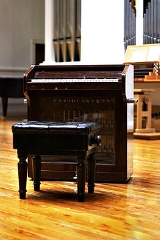
The celesta (pronounced ) or celeste (pronounced ) is a struck idiophone operated by a keyboard. Its appearance is similar to that of an upright piano (four- or five-octave) or of a large wooden music box (three-octave). The keys are connected to hammers which strike a graduated set of metal (usually steel) plates suspended over wooden resonators. On four or five octave models one pedal is usually available to sustain or dampen the sound.

Discussion
Ask a question about 'Celesta'
Start a new discussion about 'Celesta'
Answer questions from other users
|
Recent Posts

Encyclopedia
The celesta (pronounced ) or celeste (pronounced ) is a struck idiophone operated by a keyboard. Its appearance is similar to that of an upright piano (four- or five-octave) or of a large wooden music box (three-octave). The keys are connected to hammers which strike a graduated set of metal (usually steel) plates suspended over wooden resonators. On four or five octave models one pedal is usually available to sustain or dampen the sound. The three-octave instruments do not have a pedal, due to their small "table-top" design. One of the most well-known works that makes use of the celesta is Tchaikovsky's "Dance of the Sugarplum Fairy" from The Nutcracker.
The sound of the celesta is akin to that of the glockenspiel, but with a much softer and more subtle timbre. This quality gave rise to the instrument's name, celeste meaning "heavenly" in French.
The celesta is a transposing instrument; it sounds an octave higher than the written pitch. The original French instrument had a five-octave range, but as the lowest octave was considered somewhat unsatisfactory, it was omitted from later models. The standard French four-octave instrument is now gradually being replaced in symphony orchestras by a larger, five-octave German model. Although treated as a member of the percussion section in orchestral terms, it is almost always played by a pianist, the part being normally written on two bracketed staves, called a grand staff.
History
The celesta was invented in 1886 by the Parisian harmonium builder Auguste Mustel. His father, Victor Mustel, had developed the forerunner of the celesta, the typophone or the dulcitone, in 1860. This consisted of struck tuning forks instead of metal plates, but the sound produced was considered too small to be of use in an orchestral situation.
Pyotr Tchaikovsky is usually cited as the first major composer to use this instrument in a work for full symphony orchestra. He first used it in his symphonic poem The Voyevoda, Op. posth. 78, premiered in November 1891. The following year, he used the celesta in passages in his ballet The Nutcracker (Op. 71, 1892), most notably in the "Dance of the Sugarplum Fairy", which also appears in the derived Nutcracker Suite, Op. 71a.
Ernest Chausson preceded Tchaikovsky by employing the celesta in December 1888 in his incidental music, written for a small orchestra, for La tempęte (a French translation by Maurice Bouchor of Shakespeare's The Tempest).
Gustav Holst employed the instrument in his orchestral work "The Planets" (premiered 1918), with its most significant use in the final movement, "Neptune, the Mystic." Béla Bartók uses the instrument prominently in his 1936 Music for Strings, Percussion and Celesta.
Use in other musical genres
Jazz
Since its adoption by Earl Hines in 1928, the celesta has been used occasionally by jazz pianists as an alternative instrument. Fats Waller in the 1930's sometimes played the celesta with his right hand and the piano simultaneously with his left hand. Other notable jazz pianists who occasionally played the celesta include Willie "The Lion" Smith, Art Tatum, Duke Ellington, Thelonious Monk, Oscar Peterson, and Herbie Hancock.
Rock and pop
Numerous recordings made by Frank Sinatra for Columbia in the 40s feature prominent use of the celesta, notably "I'll Never Smile Again", although it was also used rather extensively in the 50s during his landmark tenure at Capitol. The instrument is a mainstay throughout In the Wee Small Hours, as well as Songs for Young Lovers and Close to You and More. Buddy Holly was probably the first of many rock musicians to occasionally use a celesta as an unusual texture on recordings ("Everyday", "Raining In My Heart".) Others include the Beatles ("Baby, It's You"), the Velvet Underground ("Sunday Morning") and more recently, 10,000 Maniacs and Radiohead.
Soundtrack
Composer John Williams featured the celesta playing the opening notes for "Hedwig's Theme" . The celesta melody opens the first three Harry Potter films.
See also
External links
|
| |
|
|