

Euphonium

Encyclopedia
The euphonium is a conical-bore
, tenor
-voiced brass instrument
. It derives its name from the Greek
word euphonos, meaning "well-sounding" or "sweet-voiced" (eu means "well" or "good" and phonos means "of sound", so "of good sound"). The euphonium is a valved instrument; nearly all current models are piston valve
d, though rotary valve
d models do exist.
A person who plays the euphonium is sometimes called a euphoniumist, euphophonist, or a euphonist, while British players often colloquially refer to themselves as euphists. Similarly, the instrument itself is often referred to as eupho or euph.
; see below for differences) is pitched in concert B, meaning that when no valve
s are in use the instrument will produce partials of the B harmonic series
. In North America, music for the instrument is usually written in the bass clef at concert pitch (that is, without transposition), though treble clef euphonium parts, transposing down a major ninth, are included in much concert band
music.These may be included for the sake of students who have recently switched from the trumpet, or who play trumpet and are doubling on euphonium. Alternatively, students who learn Euphonium in a British Brass Band may also take advantage of this transposed part. In the British-style brass band
tradition, euphonium music is always written this way. It can also be written in tenor clef at concert pitch, which is usually done to prevent too many ledger line
s in case it is a high part. In continental European music, parts for the euphonium are sometimes written in the bass clef a major second higher than sounding.
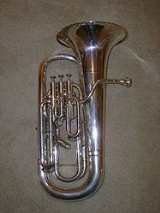
Professional models have three top-action valves, played with the first three fingers of the right hand, plus a "compensating" fourth valve, generally found midway down the right side of the instrument, played with the left index finger; such an instrument is shown in the above picture. Beginner models often have only the three top-action valves, while some intermediate "student" models may have a fourth top-action valve, played with the fourth finger of the right hand. Compensating systems are expensive to build, and there is in general a substantial difference in price between compensating and non-compensating models. For a thorough discussion of the valves and the compensation system, see the article on brass instruments.
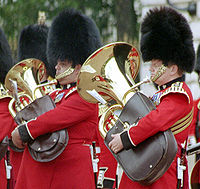 The euphonium has an extensive range, comfortably from E2 to about D5 for intermediate players (using scientific pitch notation
). In professional hands this may extend from B0 to as high as B5. The lowest notes obtainable depend on the valve set-up of the instrument. All instruments are chromatic down to E2, but 4-valved instruments extend that down to at least C2. Non-compensating four-valved instruments suffer from intonation problems from E2 down to C2 and cannot produce the low B1; compensating instruments do not have such intonation problems and can play the low B-natural.Thus, only on 4-valved, compensating instruments is a full chromatic scale from the pedal range up possible.
From B1 down lies the "pedal range", i.e. the fundamentals of the instrument's harmonic series. They are easily produced on the euphonium as compared to other brass instruments, and the extent of the range depends on the make of the instrument in exactly the same way as just described. Thus, on a compensating four-valved instrument, the lowest note possible is B0, sometimes called double pedal B, which is six ledger lines below the bass clef.
As with the other conical-bore instruments, the cornet
, flugelhorn
, horn
, and tuba
, the euphonium's tubing gradually increases in diameter throughout its length, resulting in a softer, gentler tone compared to cylindrical-bore instruments such as the trumpet
, trombone
, sudrophone
, and baritone horn
. While a truly characteristic euphonium sound is rather hard to define precisely, most players would agree that an ideal sound is dark, rich, warm, and velvety, with virtually no hardness to it. On the other hand, the desired sound varies geographically; European players, especially British ones, generally use a faster, more constant vibrato and a more veiled tone, while Americans tend to prefer a more straightforward, open sound with slower and less frequent vibrato. This also has to do with the different models preferred by British and American players.
Though the euphonium's fingerings are no different from those of the trumpet or tuba, beginning euphoniumists will likely experience significant problems with intonation, response, and range compared to other beginning brass players. In addition, it is very difficult for students, even of high-school age, to develop the rich sound characteristic of the euphonium, due partly to the instrument models used in schools and partly to the lack of awareness of good euphonium sound models.
Prestige and Sovereign models. The most popular in the United States are the Willson 2900 and 2950, shown in the picture at the top of this article. In both cases, these models have gained popularity through the use and sponsorship of extremely highly respected players and teachers; in Britain, by Steven Mead, and in America, by Dr. Brian Bowman. In recent years, the Yamaha YEP-842 Custom has gained popularity in the United States due to similar activities by Adam Frey. Most recently, Demondrae Thurman has worked in conjunction with Miraphone to develop the Ambassador 5050.
In recent years, the Besson company got into financial difficulties and various aspects of the business and name were acquired by Buffet Crampon of France. The remaining assets were acquired by the German company Schreiber-Keilwerth who lost no time in bringing rival instruments, with the York brand name, to market. In 2010, Schrieber-Keilwerth was also acquired by Buffet Crampon, and the York brand was dropped.
Other highly regarded professional models found around the world are the Yamaha
642, the Hirsbrunner Standard, Exclusive, and the Stealth, the Sterling Virtuoso, and the Meinl-Weston
451 and 551.
A well selling and school-inventoried intermediate-model horn in the United States is the Yamaha YEP-321 (and silver-plate 321S), which has four valves and is non-compensating (though a removable 5th valve was offered as an option early on, but discontinued pushing buyers to their "professional" instruments). Other similar models of euphonium are made by Besson, Willson, Jupiter, and under the names of many storied American manufacturers now within the Conn-Selmer
umbrella among others. Besson produces a four-valve non-compensating euphonium with the fourth valve on the side.
s and big bassoon
s" in "Seventy-six Trombones
", the signature song from The Music Man
(1957), many non-musician members of the general public in the United States do not recognize the name "euphonium" and confuse the instrument with the baritone horn
. The euphonium and the baritone differ in that the bore size of the baritone horn is smaller than that of the euphonium, and the baritone is predominately cylindrical bore, whereas the euphonium is predominately conical bore. The two instruments are easily interchangeable to the player, with some modification of breath and embouchure, since the two have essentially identical range and fingering. The cylindrical baritone offers the brighter sound and the conical euphonium offers the mellower sound.
The so-called American baritone, featuring three valves on the front of the instrument and a curved, forward-pointing bell, was dominant in American school bands throughout most of the twentieth century, its weight, shape and configuration conforming to the needs of the marching band. While this instrument is in reality a conical-cylindrical bore hybrid, neither fully euphonium nor baritone, it was almost universally labeled a "baritone" by both band directors and composers, thus contributing to the confusion of terminology in the United States.
Several late 19th century music catalogs (such as Pepper and Lyon & Healy) sold a euphonium-like instrument called the "Bb Bass" (to distinguish it from the Eb and BBb bass). In these catalog drawings, the Bb Bass had thicker tubing than the baritone; both had 3 valves. Along the same lines, drum and bugle corps
introduced the "Bass-baritone", and distinguished it from the baritone. The thicker tubing of the 3-valve Bb Bass allowed for production of strong false-tones, providing chromatic access to the pedal register.
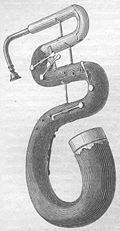 As a tenor/baritone-voiced brass instrument, the euphonium traces its ancestry to the ophicleide
and ultimately back to the serpent
. The search for a satisfactory foundational wind instrument that could support masses of sound above it took some time. While the serpent was used for over two centuries dating back to the late Renaissance
, it was notoriously difficult to control its pitch and tone quality due to its disproportionately small open finger holes. The ophicleide- which was used in bands and orchestras for a few decades in the early- to mid-nineteenth century- used a system of keys and was an improvement over the serpent but was still unreliable, especially in the high register.
With the invention of the piston valve system c. 1818, the construction of brass instruments with an even sound and facility of playing in all registers became possible. The euphonium is alleged to have been invented, as a "wide-bore, valved bugle of baritone range", by Ferdinand Sommer of Weimar in 1843, though Carl Moritz in 1838 and Adolphe Sax in 1843 have also been credited. While Sax's family of saxhorn
s were invented at almost the same time and the bass saxhorn looks very similar to a euphonium, they are constructed differently. Saxhorns have a nearly cylindrical bore and do not allow the fundamental to be produced; thus, the bass saxhorn is more closely related to the baritone
than the euphonium.
The "British-style" compensating euphonium was developed by David Blaikley in 1874, and has been in use in Britain ever since; since this time, the basic construction of the euphonium in Britain has changed little.
, featuring a second smaller bell in addition to the main one; the player could switch bells for certain passages or even for individual notes by use of an additional valve, operated with the left hand. Ostensibly, the smaller bell was intended to emulate the sound of a trombone (it was cylindrical-bore) and was possibly intended for performance situations in which trombones were not available. The extent to which the difference in sound and timbre was apparent to the listener, however, is up for debate. Harry Whittier of the Patrick S. Gilmore band introduced the instrument in 1888, and it was used widely in both school and service bands for several decades. Harold Brasch (see "List of important players" below) brought the British-style compensating euphonium to the United States c. 1939, but the double-belled euphonium may have remained in common use even into the 1950s and 60s. In any case, they have become rare (they were last in instrumental catalogues in the late 1960s), and are generally unknown to younger euphonium players. They are chiefly known now through their mention in the song "Seventy-Six Trombones
" from the musical The Music Man
by Meredith Willson
.
of the band", because of its similarity in timbre and ensemble role to the stringed instrument. Euphoniums typically have extremely important parts in many marches
(such as those by John Philip Sousa
), and in brass band music of the British tradition.
The euphonium may also be found in marching band
s, though it is often replaced by its smaller, easier-to-carry cousin, the marching baritone (which has a similar bell and valve configuration to a trumpet). A marching euphonium, similar to the marching baritone, although much larger, is used almost exclusively in drum and bugle corps
, and some corps (such as The Blue Devils
and Phantom Regiment) march all-euphonium sections. Depending on the manufacturer, the weight of these instruments can be straining to the average marcher and require great strength to hold during practice and a performance.
Another form of the marching euphonium is the convertible euphonium. Recently widely produced, the horn resembles a convertible tuba, being able to change from a concert upright to a marching forward bell on either the left or right shoulder. These are mainly produced by Jupiter or Yamaha, but other less expensive versions can be found.
 Other performance venues for the euphonium are the tuba-euphonium quartet or larger tuba-euphonium ensemble; the brass quintet
, where it can supply the tenor voice, though the trombone is much more common in this role; or in mixed brass ensembles. Though these are legitimate performance venues, paid professional jobs in these areas are almost non-existent; they are much more likely to be semi-professional or amateur in nature. Most of the United States's military service bands include a tuba-euphonium quartet made up of players from the band that occasionally performs in its own right.
The euphonium is not traditionally an orchestral instrument and has never been common in symphony orchestras. However, there are a handful of works, mostly from the late Romantic period, in which composers wrote a part for baryton (German) or tenor tuba, (most notably, Holst's Planets Suite, which has many solos for baritone and euphonium) and these are universally played on euphonium, frequently by a trombone player. In addition, the euphonium is sometimes used in older orchestral works as a replacement for its predecessors, such as the ophicleide, or, less correctly, the bass trumpet, or the Wagner tuba
, both of which are significantly different instruments, and still in use today. At the bottom of the article are some of the well-known orchestral works in which the euphonium is commonly used (whether or not the composer originally specified it).
Finally, while the euphonium was not historically part of the standard jazz big band
or combo, the instrument's technical facility and large range make it well-suited to a jazz solo role, and a jazz euphonium niche has been carved out over the last 40 or so years, largely starting with the pioneer Rich Matteson
(see "List of important players" below). The euphonium can also double on a trombone part in a jazz combo. Jazz euphoniums are most likely to be found in tuba-euphonium groups, though modern funk
or rock bands occasionally feature a brass player doubling on euphonium, and this trend is growing.
Due to this dearth of performance opportunities, aspiring euphonium players in the United States are in a rather inconvenient position when seeking future employment. Often, college players must either obtain a graduate degree and go on to teach at the college level, or audition for one of the major or regional military service bands. Because these bands are relatively few in number and the number of euphonium positions in the bands is small (2-4 in most service bands), job openings do not occur very often and when they do are highly competitive; before the current slate of openings in four separate bands, the last opening for a euphonium player in an American service band was in May 2004. A career strictly as a solo performer, unaffiliated with any university or performing ensemble, is a very rare sight, but some performers, such as Riki McDonnell, have managed to do it.
In Britain the strongest euphonium players are most likely to find a position in a brass band
, but ironically, even though they often play at world-class levels, the members of the top brass bands are in most cases unpaid amateurs. There are hundreds, if not thousands, of brass bands in Britain ranging in standard from world class to local bands. Almost all brass bands in Britain perform regularly, particularly during the summer months. A large number of bands also enter contests against other brass bands of a similar standard. Each band requries two euphoniums (principal and 2nd) and consequently there are considerable opportunities for euphonium players.
Due to limited vocational opportunities, there are a considerable number of relatively serious, quasi-professional avocational euphonium players participating in many higher-caliber unpaid ensembles.
German Ferdinand Sommer, in addition to being credited with inventing the euphonium as the Sommerhorn in 1843, as a soloist on the horn, qualifies as the first euphonium player to significantly advance and alter the understanding of the instrument. Below are a select few of the players most famous and influential in their respective countries, and whose contributions to the euphonium world are undeniable, in terms of recordings, commissions, pedagogy, and increased recognition of the instrument.
United Kingdom
United States
Japan
In the current age, there has been a huge number of new commissions and repertoire development and promotion through Steven Mead’s World of the Euphonium Series and the Beyond the Horizon series from Euphonium.com. There has also been a vast number of new commissions by more and more players and a proliferation of large scale Consortium Commissions that are occurring including current ones in 2008 and 2009 organized by Brian Meixner (Libby Larson), Adam Frey (The Euphonium Foundation Consortium), and Jason Ham (David Gillingham).
Upon its invention, it was clear that the euphonium had, compared to its predecessors the serpent and ophicleide, a wide range and had a consistently rich, pleasing sound throughout that range. It was flexible both in tone quality and intonation and could blend well with a variety of ensembles, gaining it immediate popularity with composers and conductors as the principal tenor-voices solo instrument in brass band
settings, especially in Britain
. It is no surprise, then, that when British composers – some of the same ones who were writing for brass bands – began to write serious, original music for the concert band in the early twentieth century, they used the euphonium in a very similar role.
When American composers also began writing for the concert band as its own artistic medium in the 1930s and '40's, they continued the British brass and concert band tradition of using the euphonium as the principal tenor-voiced solo.
This is not to say that composers, then and now, valued the euphonium only for its lyrical capabilities. Indeed, examination of a large body of concert band literature reveals that the euphonium functions as a "jack of all trades."
Though the euphonium was, as previously noted, embraced from its earliest days by composers and arrangers in band settings, orchestral composers have, by and large, not taken advantage of this capability. There are, nevertheless, several orchestral works, a few of which are standard repertoire, in which composers have called for instruments, such as the Wagner tuba, for which euphonium is commonly substituted today.
 In contrast to the long-standing practice of extensive euphonium use in wind bands and orchestras, there was until approximately forty years ago literally no body of solo literature written specifically for the euphonium, and euphoniumists were forced to borrow the literature of other instruments. Fortunately, given the instrument's multifaceted capabilities discussed above, solos for many different instruments are easily adaptable to performance on the euphonium.
The earliest surviving solo composition written specifically for euphonium or one of its saxhorn cousins is the Concerto per Flicorno Basso (1872) by Amilcare Ponchielli. For almost a century after this, the euphonium solo repertoire consisted of only a dozen or so virtuosic pieces, mostly light in character. However, in the 1960s and '70's, American composers began to write the first of the "new school" of serious, artistic solo works specifically for euphonium. Since then, there has been a virtual explosion of solo repertoire for the euphonium. In a mere four decades, the solo literature has expanded from virtually zero to thousands of pieces. More and more composers have become aware of the tremendous soloistic capabilities of the euphonium, and have constantly "pushed the envelope" with new literature in terms of tessitura, endurance, technical demands, and extended techniques.
Finally, the euphonium has, thanks to a handful of enterprising individuals, begun to make inroads in jazz, pop and other non-concert performance settings.
Bore (wind instruments)
The bore of a wind instrument is its interior chamber that defines a flow path through which air travels and is set into vibration to produce sounds. The shape of the bore has a strong influence on the instruments' timbre.-Bore shapes:...
, tenor
Tenor
The tenor is a type of male singing voice and is the highest male voice within the modal register. The typical tenor voice lies between C3, the C one octave below middle C, to the A above middle C in choral music, and up to high C in solo work. The low extreme for tenors is roughly B2...
-voiced brass instrument
Brass instrument
A brass instrument is a musical instrument whose sound is produced by sympathetic vibration of air in a tubular resonator in sympathy with the vibration of the player's lips...
. It derives its name from the Greek
Greek language
Greek is an independent branch of the Indo-European family of languages. Native to the southern Balkans, it has the longest documented history of any Indo-European language, spanning 34 centuries of written records. Its writing system has been the Greek alphabet for the majority of its history;...
word euphonos, meaning "well-sounding" or "sweet-voiced" (eu means "well" or "good" and phonos means "of sound", so "of good sound"). The euphonium is a valved instrument; nearly all current models are piston valve
Piston valve
A piston valve is a device used to control the motion of a fluid along a tube or pipe by means of the linear motion of a piston within a chamber or cylinder.Examples of piston valves are:...
d, though rotary valve
Rotary valve
A rotary valve is a type of valve in which the rotation of a passage or passages in a transverse plug regulates the flow of liquid or gas through the attached pipes. The common stopcock is the simplest form of rotary valve...
d models do exist.
A person who plays the euphonium is sometimes called a euphoniumist, euphophonist, or a euphonist, while British players often colloquially refer to themselves as euphists. Similarly, the instrument itself is often referred to as eupho or euph.
Construction and general characteristics
The euphonium (like the baritoneBaritone horn
The baritone horn is a member of the brass instrument family. The baritone horn has a predominantly cylindrical bore as do the trumpet and trombone. A baritone horn uses a large mouthpiece much like those of a trombone or euphonium, although it is a bit smaller. Some baritone mouthpieces will sink...
; see below for differences) is pitched in concert B, meaning that when no valve
Valve
A valve is a device that regulates, directs or controls the flow of a fluid by opening, closing, or partially obstructing various passageways. Valves are technically pipe fittings, but are usually discussed as a separate category...
s are in use the instrument will produce partials of the B harmonic series
Harmonic series (music)
Pitched musical instruments are often based on an approximate harmonic oscillator such as a string or a column of air, which oscillates at numerous frequencies simultaneously. At these resonant frequencies, waves travel in both directions along the string or air column, reinforcing and canceling...
. In North America, music for the instrument is usually written in the bass clef at concert pitch (that is, without transposition), though treble clef euphonium parts, transposing down a major ninth, are included in much concert band
Concert band
A concert band, also called wind band, symphonic band, symphonic winds, wind orchestra, wind symphony, wind ensemble, or symphonic wind ensemble, is a performing ensemble consisting of several members of the woodwind instrument family, brass instrument family, and percussion instrument family.A...
music.These may be included for the sake of students who have recently switched from the trumpet, or who play trumpet and are doubling on euphonium. Alternatively, students who learn Euphonium in a British Brass Band may also take advantage of this transposed part. In the British-style brass band
Brass band (British style)
A British-style brass band is a musical ensemble comprising a standardised range of brass and percussion instruments. The modern form of the brass band in the United Kingdom dates back to the 19th century, with a vibrant tradition of competition based around local industry and communities...
tradition, euphonium music is always written this way. It can also be written in tenor clef at concert pitch, which is usually done to prevent too many ledger line
Ledger line
A ledger line or leger line is musical notation to notate pitches above or below the lines and spaces of the regular musical staff. A line slightly longer than the note head is drawn parallel to the staff, above or below, spaced at the same distance as the lines within the staff .Notes more than...
s in case it is a high part. In continental European music, parts for the euphonium are sometimes written in the bass clef a major second higher than sounding.
Professional models have three top-action valves, played with the first three fingers of the right hand, plus a "compensating" fourth valve, generally found midway down the right side of the instrument, played with the left index finger; such an instrument is shown in the above picture. Beginner models often have only the three top-action valves, while some intermediate "student" models may have a fourth top-action valve, played with the fourth finger of the right hand. Compensating systems are expensive to build, and there is in general a substantial difference in price between compensating and non-compensating models. For a thorough discussion of the valves and the compensation system, see the article on brass instruments.
Scientific pitch notation
Scientific pitch notation is one of several methods that name the notes of the standard Western chromatic scale by combining a letter-name, accidentals, and a number identifying the pitch's octave...
). In professional hands this may extend from B0 to as high as B5. The lowest notes obtainable depend on the valve set-up of the instrument. All instruments are chromatic down to E2, but 4-valved instruments extend that down to at least C2. Non-compensating four-valved instruments suffer from intonation problems from E2 down to C2 and cannot produce the low B1; compensating instruments do not have such intonation problems and can play the low B-natural.Thus, only on 4-valved, compensating instruments is a full chromatic scale from the pedal range up possible.
From B1 down lies the "pedal range", i.e. the fundamentals of the instrument's harmonic series. They are easily produced on the euphonium as compared to other brass instruments, and the extent of the range depends on the make of the instrument in exactly the same way as just described. Thus, on a compensating four-valved instrument, the lowest note possible is B0, sometimes called double pedal B, which is six ledger lines below the bass clef.
As with the other conical-bore instruments, the cornet
Cornet
The cornet is a brass instrument very similar to the trumpet, distinguished by its conical bore, compact shape, and mellower tone quality. The most common cornet is a transposing instrument in B. It is not related to the renaissance and early baroque cornett or cornetto.-History:The cornet was...
, flugelhorn
Flugelhorn
The flugelhorn is a brass instrument resembling a trumpet but with a wider, conical bore. Some consider it to be a member of the saxhorn family developed by Adolphe Sax ; however, other historians assert that it derives from the valve bugle designed by Michael Saurle , Munich 1832 , thus...
, horn
Horn (instrument)
The horn is a brass instrument consisting of about of tubing wrapped into a coil with a flared bell. A musician who plays the horn is called a horn player ....
, and tuba
Tuba
The tuba is the largest and lowest-pitched brass instrument. Sound is produced by vibrating or "buzzing" the lips into a large cupped mouthpiece. It is one of the most recent additions to the modern symphony orchestra, first appearing in the mid-19th century, when it largely replaced the...
, the euphonium's tubing gradually increases in diameter throughout its length, resulting in a softer, gentler tone compared to cylindrical-bore instruments such as the trumpet
Trumpet
The trumpet is the musical instrument with the highest register in the brass family. Trumpets are among the oldest musical instruments, dating back to at least 1500 BCE. They are played by blowing air through closed lips, producing a "buzzing" sound which starts a standing wave vibration in the air...
, trombone
Trombone
The trombone is a musical instrument in the brass family. Like all brass instruments, sound is produced when the player’s vibrating lips cause the air column inside the instrument to vibrate...
, sudrophone
Sudrophone
The sudrophone is a brass instrument invented by François Sudre in Paris, its shape resembling that of an ophicleide. It was patented in 1892. It has a cylindrical bore and four Perinet valves. Its length is 86 cm and the bell diameter is 17 cm...
, and baritone horn
Baritone horn
The baritone horn is a member of the brass instrument family. The baritone horn has a predominantly cylindrical bore as do the trumpet and trombone. A baritone horn uses a large mouthpiece much like those of a trombone or euphonium, although it is a bit smaller. Some baritone mouthpieces will sink...
. While a truly characteristic euphonium sound is rather hard to define precisely, most players would agree that an ideal sound is dark, rich, warm, and velvety, with virtually no hardness to it. On the other hand, the desired sound varies geographically; European players, especially British ones, generally use a faster, more constant vibrato and a more veiled tone, while Americans tend to prefer a more straightforward, open sound with slower and less frequent vibrato. This also has to do with the different models preferred by British and American players.
Though the euphonium's fingerings are no different from those of the trumpet or tuba, beginning euphoniumists will likely experience significant problems with intonation, response, and range compared to other beginning brass players. In addition, it is very difficult for students, even of high-school age, to develop the rich sound characteristic of the euphonium, due partly to the instrument models used in schools and partly to the lack of awareness of good euphonium sound models.
Popular models of euphonium
Very generally speaking, the most popular professional models of euphonium in the United Kingdom are BessonBesson (company)
Besson is a manufacturer of brass musical instrument. It is owned by Buffet Crampon, which bought Besson in 2006 from The Music Group.The company was formed in 1837 by Gustave Auguste Besson, who at the age of 18 produced a revolutionary design of cornet which surpassed all contemporary models. His...
Prestige and Sovereign models. The most popular in the United States are the Willson 2900 and 2950, shown in the picture at the top of this article. In both cases, these models have gained popularity through the use and sponsorship of extremely highly respected players and teachers; in Britain, by Steven Mead, and in America, by Dr. Brian Bowman. In recent years, the Yamaha YEP-842 Custom has gained popularity in the United States due to similar activities by Adam Frey. Most recently, Demondrae Thurman has worked in conjunction with Miraphone to develop the Ambassador 5050.
In recent years, the Besson company got into financial difficulties and various aspects of the business and name were acquired by Buffet Crampon of France. The remaining assets were acquired by the German company Schreiber-Keilwerth who lost no time in bringing rival instruments, with the York brand name, to market. In 2010, Schrieber-Keilwerth was also acquired by Buffet Crampon, and the York brand was dropped.
Other highly regarded professional models found around the world are the Yamaha
Yamaha
Yamaha may refer to:* Yamaha Corporation, a Japanese company with a wide range of products and services** Yamaha Motor Company, a Japanese motorized vehicle-producing company...
642, the Hirsbrunner Standard, Exclusive, and the Stealth, the Sterling Virtuoso, and the Meinl-Weston
Meinl-Weston
Meinl-Weston is a leading manufacturer of brass instruments, based in Geretsried in Germany and formerly based in Graslitz.Their main brands are Melton and Meinl Weston, with current instruments bearing both logos...
451 and 551.
A well selling and school-inventoried intermediate-model horn in the United States is the Yamaha YEP-321 (and silver-plate 321S), which has four valves and is non-compensating (though a removable 5th valve was offered as an option early on, but discontinued pushing buyers to their "professional" instruments). Other similar models of euphonium are made by Besson, Willson, Jupiter, and under the names of many storied American manufacturers now within the Conn-Selmer
Conn-Selmer
Conn-Selmer, Inc. is a manufacturer and distributor of concert band, marching band, and orchestral instruments. It is a subsidiary of Steinway Musical Instruments and was formed after Steinway bought musical instrument manufacturers The Selmer Company and C.G. Conn.-Founding:In the late 1800s,...
umbrella among others. Besson produces a four-valve non-compensating euphonium with the fourth valve on the side.
Name recognition and misconceptions
In spite of the presence of "double bell euphoniumDouble bell euphonium
The double bell euphonium is an instrument based on the euphonium. Larger bell produces the mellow tone of a standard euphonium. The second smaller bell has a brighter tone, similar to a baritone horn or valve trombone...
s and big bassoon
Bassoon
The bassoon is a woodwind instrument in the double reed family that typically plays music written in the bass and tenor registers, and occasionally higher. Appearing in its modern form in the 19th century, the bassoon figures prominently in orchestral, concert band and chamber music literature...
s" in "Seventy-six Trombones
Seventy-Six Trombones
Seventy-six Trombones is the signature song from the musical play The Music Man , which was written by Meredith Willson. This song also appeared in the film The Music Man , and in the made-for-TV movie adaptation in 2003...
", the signature song from The Music Man
The Music Man
The Music Man is a musical with book, music, and lyrics by Meredith Willson, based on a story by Willson and Franklin Lacey. The plot concerns con man Harold Hill, who poses as a boys' band organizer and leader and sells band instruments and uniforms to naive townsfolk before skipping town with...
(1957), many non-musician members of the general public in the United States do not recognize the name "euphonium" and confuse the instrument with the baritone horn
Baritone horn
The baritone horn is a member of the brass instrument family. The baritone horn has a predominantly cylindrical bore as do the trumpet and trombone. A baritone horn uses a large mouthpiece much like those of a trombone or euphonium, although it is a bit smaller. Some baritone mouthpieces will sink...
. The euphonium and the baritone differ in that the bore size of the baritone horn is smaller than that of the euphonium, and the baritone is predominately cylindrical bore, whereas the euphonium is predominately conical bore. The two instruments are easily interchangeable to the player, with some modification of breath and embouchure, since the two have essentially identical range and fingering. The cylindrical baritone offers the brighter sound and the conical euphonium offers the mellower sound.
The so-called American baritone, featuring three valves on the front of the instrument and a curved, forward-pointing bell, was dominant in American school bands throughout most of the twentieth century, its weight, shape and configuration conforming to the needs of the marching band. While this instrument is in reality a conical-cylindrical bore hybrid, neither fully euphonium nor baritone, it was almost universally labeled a "baritone" by both band directors and composers, thus contributing to the confusion of terminology in the United States.
Several late 19th century music catalogs (such as Pepper and Lyon & Healy) sold a euphonium-like instrument called the "Bb Bass" (to distinguish it from the Eb and BBb bass). In these catalog drawings, the Bb Bass had thicker tubing than the baritone; both had 3 valves. Along the same lines, drum and bugle corps
Drum and bugle corps (modern)
A drum and bugle corps, also known as a drum corps, is a musical marching unit consisting of brass instruments, percussion instruments, and color guard. Typically operating as independent non-profit organizations, drum corps perform in competitions, parades, festivals, and other civic functions...
introduced the "Bass-baritone", and distinguished it from the baritone. The thicker tubing of the 3-valve Bb Bass allowed for production of strong false-tones, providing chromatic access to the pedal register.
History and development
Ophicleide
The ophicleide is a family of conical bore, brass keyed-bugles. It has a similar shape to the sudrophone.- History :The ophicleide was invented in 1817 and patented in 1821 by French instrument maker Jean Hilaire Asté as an extension to the keyed bugle or Royal Kent bugle family...
and ultimately back to the serpent
Serpent (instrument)
A serpent is a bass wind instrument, descended from the cornett, and a distant ancestor of the tuba, with a mouthpiece like a brass instrument but side holes like a woodwind. It is usually a long cone bent into a snakelike shape, hence the name. The serpent is closely related to the cornett,...
. The search for a satisfactory foundational wind instrument that could support masses of sound above it took some time. While the serpent was used for over two centuries dating back to the late Renaissance
Renaissance
The Renaissance was a cultural movement that spanned roughly the 14th to the 17th century, beginning in Italy in the Late Middle Ages and later spreading to the rest of Europe. The term is also used more loosely to refer to the historical era, but since the changes of the Renaissance were not...
, it was notoriously difficult to control its pitch and tone quality due to its disproportionately small open finger holes. The ophicleide- which was used in bands and orchestras for a few decades in the early- to mid-nineteenth century- used a system of keys and was an improvement over the serpent but was still unreliable, especially in the high register.
With the invention of the piston valve system c. 1818, the construction of brass instruments with an even sound and facility of playing in all registers became possible. The euphonium is alleged to have been invented, as a "wide-bore, valved bugle of baritone range", by Ferdinand Sommer of Weimar in 1843, though Carl Moritz in 1838 and Adolphe Sax in 1843 have also been credited. While Sax's family of saxhorn
Saxhorn
The saxhorn is a valved brass instrument with a conical bore and deep cup-shaped mouthpiece. The sound has a characteristic mellow quality, and blends well with other brass.-The saxhorn family:...
s were invented at almost the same time and the bass saxhorn looks very similar to a euphonium, they are constructed differently. Saxhorns have a nearly cylindrical bore and do not allow the fundamental to be produced; thus, the bass saxhorn is more closely related to the baritone
Baritone horn
The baritone horn is a member of the brass instrument family. The baritone horn has a predominantly cylindrical bore as do the trumpet and trombone. A baritone horn uses a large mouthpiece much like those of a trombone or euphonium, although it is a bit smaller. Some baritone mouthpieces will sink...
than the euphonium.
The "British-style" compensating euphonium was developed by David Blaikley in 1874, and has been in use in Britain ever since; since this time, the basic construction of the euphonium in Britain has changed little.
The double-belled euphonium
A creation unique to the United States was the double-bell euphoniumDouble bell euphonium
The double bell euphonium is an instrument based on the euphonium. Larger bell produces the mellow tone of a standard euphonium. The second smaller bell has a brighter tone, similar to a baritone horn or valve trombone...
, featuring a second smaller bell in addition to the main one; the player could switch bells for certain passages or even for individual notes by use of an additional valve, operated with the left hand. Ostensibly, the smaller bell was intended to emulate the sound of a trombone (it was cylindrical-bore) and was possibly intended for performance situations in which trombones were not available. The extent to which the difference in sound and timbre was apparent to the listener, however, is up for debate. Harry Whittier of the Patrick S. Gilmore band introduced the instrument in 1888, and it was used widely in both school and service bands for several decades. Harold Brasch (see "List of important players" below) brought the British-style compensating euphonium to the United States c. 1939, but the double-belled euphonium may have remained in common use even into the 1950s and 60s. In any case, they have become rare (they were last in instrumental catalogues in the late 1960s), and are generally unknown to younger euphonium players. They are chiefly known now through their mention in the song "Seventy-Six Trombones
Seventy-Six Trombones
Seventy-six Trombones is the signature song from the musical play The Music Man , which was written by Meredith Willson. This song also appeared in the film The Music Man , and in the made-for-TV movie adaptation in 2003...
" from the musical The Music Man
The Music Man
The Music Man is a musical with book, music, and lyrics by Meredith Willson, based on a story by Willson and Franklin Lacey. The plot concerns con man Harold Hill, who poses as a boys' band organizer and leader and sells band instruments and uniforms to naive townsfolk before skipping town with...
by Meredith Willson
Meredith Willson
Robert Meredith Willson was an American composer, songwriter, conductor and playwright, best known for writing the book, music and lyrics for the hit Broadway musical The Music Man...
.
Performance venues and professional job opportunities
The euphonium has historically been exclusively a band instrument (rather than an orchestra or jazz instrument), whether of the wind or brass variety, where it is frequently featured as a solo instrument. Because of this, the euphonium has been called the "king of band instruments", or the "celloCello
The cello is a bowed string instrument with four strings tuned in perfect fifths. It is a member of the violin family of musical instruments, which also includes the violin, viola, and double bass. Old forms of the instrument in the Baroque era are baryton and viol .A person who plays a cello is...
of the band", because of its similarity in timbre and ensemble role to the stringed instrument. Euphoniums typically have extremely important parts in many marches
March (music)
A march, as a musical genre, is a piece of music with a strong regular rhythm which in origin was expressly written for marching to and most frequently performed by a military band. In mood, marches range from the moving death march in Wagner's Götterdämmerung to the brisk military marches of John...
(such as those by John Philip Sousa
John Philip Sousa
John Philip Sousa was an American composer and conductor of the late Romantic era, known particularly for American military and patriotic marches. Because of his mastery of march composition, he is known as "The March King" or the "American March King" due to his British counterpart Kenneth J....
), and in brass band music of the British tradition.
The euphonium may also be found in marching band
Marching band
Marching band is a physical activity in which a group of instrumental musicians generally perform outdoors and incorporate some type of marching with their musical performance. Instrumentation typically includes brass, woodwinds, and percussion instruments...
s, though it is often replaced by its smaller, easier-to-carry cousin, the marching baritone (which has a similar bell and valve configuration to a trumpet). A marching euphonium, similar to the marching baritone, although much larger, is used almost exclusively in drum and bugle corps
Drum and bugle corps (modern)
A drum and bugle corps, also known as a drum corps, is a musical marching unit consisting of brass instruments, percussion instruments, and color guard. Typically operating as independent non-profit organizations, drum corps perform in competitions, parades, festivals, and other civic functions...
, and some corps (such as The Blue Devils
Blue Devils Drum and Bugle Corps
The Blue Devils Drum and Bugle Corps is a World Class drum and bugle corps based in Concord, California and founded in 1957 as a Drum and Bell corps, and is a member corps of Drum Corps International...
and Phantom Regiment) march all-euphonium sections. Depending on the manufacturer, the weight of these instruments can be straining to the average marcher and require great strength to hold during practice and a performance.
Another form of the marching euphonium is the convertible euphonium. Recently widely produced, the horn resembles a convertible tuba, being able to change from a concert upright to a marching forward bell on either the left or right shoulder. These are mainly produced by Jupiter or Yamaha, but other less expensive versions can be found.
Brass quintet
A brass quintet is a five-piece musical ensemble composed of brass instruments. The most common instrumentation is two trumpets or cornets, one horn, one trombone or euphonium/baritone horn, and one tuba or bass trombone....
, where it can supply the tenor voice, though the trombone is much more common in this role; or in mixed brass ensembles. Though these are legitimate performance venues, paid professional jobs in these areas are almost non-existent; they are much more likely to be semi-professional or amateur in nature. Most of the United States's military service bands include a tuba-euphonium quartet made up of players from the band that occasionally performs in its own right.
The euphonium is not traditionally an orchestral instrument and has never been common in symphony orchestras. However, there are a handful of works, mostly from the late Romantic period, in which composers wrote a part for baryton (German) or tenor tuba, (most notably, Holst's Planets Suite, which has many solos for baritone and euphonium) and these are universally played on euphonium, frequently by a trombone player. In addition, the euphonium is sometimes used in older orchestral works as a replacement for its predecessors, such as the ophicleide, or, less correctly, the bass trumpet, or the Wagner tuba
Wagner tuba
The Wagner tuba is a comparatively rare brass instrument that combines elements of both the French horn and the tuba. Also referred to as the "Bayreuth Tuba", it was originally created for Richard Wagner's operatic cycle Der Ring des Nibelungen. Since then, other composers have written for it, most...
, both of which are significantly different instruments, and still in use today. At the bottom of the article are some of the well-known orchestral works in which the euphonium is commonly used (whether or not the composer originally specified it).
Finally, while the euphonium was not historically part of the standard jazz big band
Big band
A big band is a type of musical ensemble associated with jazz and the Swing Era typically consisting of rhythm, brass, and woodwind instruments totaling approximately twelve to twenty-five musicians...
or combo, the instrument's technical facility and large range make it well-suited to a jazz solo role, and a jazz euphonium niche has been carved out over the last 40 or so years, largely starting with the pioneer Rich Matteson
Rich Matteson
Rich A. Matteson, was an American jazz artist, collegiate music educator, international jazz clinician, big band leader, and jazz composer/arranger...
(see "List of important players" below). The euphonium can also double on a trombone part in a jazz combo. Jazz euphoniums are most likely to be found in tuba-euphonium groups, though modern funk
Funk
Funk is a music genre that originated in the mid-late 1960s when African American musicians blended soul music, jazz and R&B into a rhythmic, danceable new form of music. Funk de-emphasizes melody and harmony and brings a strong rhythmic groove of electric bass and drums to the foreground...
or rock bands occasionally feature a brass player doubling on euphonium, and this trend is growing.
Due to this dearth of performance opportunities, aspiring euphonium players in the United States are in a rather inconvenient position when seeking future employment. Often, college players must either obtain a graduate degree and go on to teach at the college level, or audition for one of the major or regional military service bands. Because these bands are relatively few in number and the number of euphonium positions in the bands is small (2-4 in most service bands), job openings do not occur very often and when they do are highly competitive; before the current slate of openings in four separate bands, the last opening for a euphonium player in an American service band was in May 2004. A career strictly as a solo performer, unaffiliated with any university or performing ensemble, is a very rare sight, but some performers, such as Riki McDonnell, have managed to do it.
In Britain the strongest euphonium players are most likely to find a position in a brass band
Brass band (British style)
A British-style brass band is a musical ensemble comprising a standardised range of brass and percussion instruments. The modern form of the brass band in the United Kingdom dates back to the 19th century, with a vibrant tradition of competition based around local industry and communities...
, but ironically, even though they often play at world-class levels, the members of the top brass bands are in most cases unpaid amateurs. There are hundreds, if not thousands, of brass bands in Britain ranging in standard from world class to local bands. Almost all brass bands in Britain perform regularly, particularly during the summer months. A large number of bands also enter contests against other brass bands of a similar standard. Each band requries two euphoniums (principal and 2nd) and consequently there are considerable opportunities for euphonium players.
Due to limited vocational opportunities, there are a considerable number of relatively serious, quasi-professional avocational euphonium players participating in many higher-caliber unpaid ensembles.
College climate in the United States
Unlike a generation or two ago, many colleges with music programs now offer students the opportunity to major in euphonium. However, due to the small number of euphonium students at most schools (2-4 is common), it is possible, and even likely, that they will study with a professor whose major instrument is not the euphonium. Most often tubas and euphoniums will be combined into a studio taught by one professor, and at small schools they may be grouped with trombones as well, taught by one low brass professor. Dr. Brian Bowman, Demondrae Thurman, and Dr. Marc Dickman serve as the only three full time euphonium college professors in the US, with professors like Dr. Matt Tropman and Dr. Stephen Arthur Allen, also primarily euphonium players, teaching as lecturers. Other professors, such as Adam Frey, are adjunct faculty at multiple universities near one another. Universities will usually require professors in this situation to have a high level of proficiency on all the instruments they teach, and some of the best college euphonium studios are taught by non-euphonium players.Notable euphoniumists
The euphonium world is and has become more crowded than is commonly thought, and there have been many noteworthy players throughout the instrument's history. Traditionally, three main national schools of euphonium playing have been discernible: American, British, and Japanese. Now, euphoniumists are able to learn this specific art in many other countries around the world today.German Ferdinand Sommer, in addition to being credited with inventing the euphonium as the Sommerhorn in 1843, as a soloist on the horn, qualifies as the first euphonium player to significantly advance and alter the understanding of the instrument. Below are a select few of the players most famous and influential in their respective countries, and whose contributions to the euphonium world are undeniable, in terms of recordings, commissions, pedagogy, and increased recognition of the instrument.
United Kingdom
- Alfred James PhaseyAlfred James PhaseyAlfred James Phasey was a British bandsman and tenor brass artist in the mid-nineteenth century. As a euphonium player, he was cited as the master of the instrument in his time.-Life:...
(1834-1888), English ophicleide, baritone and euphonium artist credited with modifying the bore of the baritone saxhornSaxhornThe saxhorn is a valved brass instrument with a conical bore and deep cup-shaped mouthpiece. The sound has a characteristic mellow quality, and blends well with other brass.-The saxhorn family:...
, precursor of the baritone hornBaritone hornThe baritone horn is a member of the brass instrument family. The baritone horn has a predominantly cylindrical bore as do the trumpet and trombone. A baritone horn uses a large mouthpiece much like those of a trombone or euphonium, although it is a bit smaller. Some baritone mouthpieces will sink...
, to enlarge it and make it more reasonant thereby creating the first true euphonium which he went on to popularize as a performer and author of an early instructional method for tenor brass. - Steven MeadSteven MeadSteven Mead is an English virtuoso euphonium soloist and teacher who has played an important role in achieving worldwide recognition of the instrument....
, English euphonium soloist and professor at the Royal Northern College of MusicRoyal Northern College of MusicThe Royal Northern College of Music is a music school in Manchester, England. It is located on Oxford Road in Chorlton on Medlock, at the western edge of the campus of the University of Manchester and is one of four conservatories associated with the Associated Board of the Royal Schools of Music...
noted internationally for advancing the British euphonium sound. - David Thornton, principal euphonium of the Black Dyke BandBlack Dyke BandThe Black Dyke Band, formerly the Black Dyke Mills Band, is one of the oldest and best-known brass bands in the world. The band has won many prizes and competitions over the years...
and student of Steven MeadSteven MeadSteven Mead is an English virtuoso euphonium soloist and teacher who has played an important role in achieving worldwide recognition of the instrument....
noted for winning several prestigious international competitions and advancing the British euphonium sound through broadcast as well as recording media.
United States
- Simone MantiaSimone MantiaSimone Mantia was an American baritone horn/euphonium virtuoso and also trombone artist at the turn of the twentieth century. He was both a performer and administrator with many American band and orchestral ensembles...
(1873–1951), an Italian-born American baritone horn/euphonium virtuoso and also trombone artist at the turn of the twentieth century. Playing as soloist with the SousaJohn Philip SousaJohn Philip Sousa was an American composer and conductor of the late Romantic era, known particularly for American military and patriotic marches. Because of his mastery of march composition, he is known as "The March King" or the "American March King" due to his British counterpart Kenneth J....
and the PryorArthur PryorArthur Willard Pryor was a trombone virtuoso, bandleader, and soloist with the Sousa Band. In later life, he was an American Democratic Party politician from New Jersey, who served on the Monmouth County, New Jersey Board of Chosen Freeholders during the 1930s.Pryor was born on the second floor of...
Bands, Mantia was the first euphonium virtuoso to record and popularized this non-orchestral instrument in the United States. - Leonard FalconeLeonard FalconeLeonard Falcone was best known as Professor of Baritone and Euphonium at Michigan State University where he also served from 1927 to 1967 as Director of Bands. The school's Spartan Marching Band transitioned from an ROTC auxiliary to a nationally known Big-10 conference marching band during his...
(1899–1985), Italian-born American baritone/euphonium soloist, arranger, professor, Director of Bands at Michigan State UniversityMichigan State UniversityMichigan State University is a public research university in East Lansing, Michigan, USA. Founded in 1855, it was the pioneer land-grant institution and served as a model for future land-grant colleges in the United States under the 1862 Morrill Act.MSU pioneered the studies of packaging,...
, and teacher of many noted euphonium artits. Falcone advanced an operatic passionate baritone style and is the namesake of the Leonard Falcone International Tuba and Euphonium FestivalLeonard Falcone International Tuba and Euphonium FestivalThe is an amateur tuba and euphonium festival and competition, held annually the second week in August at the Blue Lake Fine Arts Camp at Twin Lake, Michigan.- Origin and goals of the festival :...
, the leading venue for the instrument in the United States. - Arthur W. LehmanArthur W. LehmanArthur W. 'Art' Lehman was a widely recorded American Euphonium virtuoso and soloist. He was noted for having radically changed the way the instrument was technically performed, and was a major influence on Euphonium soloists who followed him.Lehman retired as Euphonium soloist and section leader...
, (1917–2009), American euphonium soloist known as 'Art', Recording Artist, United States Marine Band, noted euphonium author of works such as The Art of Euphonium. Lehman was a student of Harold Brasch and Simone MantiaSimone MantiaSimone Mantia was an American baritone horn/euphonium virtuoso and also trombone artist at the turn of the twentieth century. He was both a performer and administrator with many American band and orchestral ensembles...
and advanced the concept of a rich resonant sound with no vibrato pioneered by Mantia. - Brian BowmanBrian BowmanBrian Bowman is a euphonium professor, performer and recording artist notable for having sat lead euphonium in the premier bands of both the United States Navy and the United States Air Force as well as having performed the first euphonium recital at Carnegie Hall.-Education:Brian Bowman was born...
, former soloist with the U.S. Navy Band (1971–75) and U.S. Air Force Band (1976–91); now professor of euphonium at the University of North Texas, co-editor of "Arban's Method for Trombone and Euphonium". Bowman innovated a fusion of the mellow British sound with deep passion heard in Falcone recordings, becoming the best known American artist at the end of the 20th century through recording, teaching and the first euphonium recital at Carnegie HallCarnegie HallCarnegie Hall is a concert venue in Midtown Manhattan in New York City, United States, located at 881 Seventh Avenue, occupying the east stretch of Seventh Avenue between West 56th Street and West 57th Street, two blocks south of Central Park....
.
Japan
- Toru MiuraToru Miura (musician)is a euphonium player and professor at Kunitachi College of Music. He is a founding member of the International Tuba Euphonium Association , formerly named Tubist Universal Brotherhood Association .-Education:...
, professor of euphonium at the Kunitachi College of MusicKunitachi College of MusicThe is a private music school in Tokyo, Japan. It was founded in 1926 as the Tokyo Conservatory of Music.It is located at Kashiwa-cho, Tachikawa, Tokyo.-Notable alumni:*Masamichi Amano, composer*Ahn Eak-tai, composer and conductor...
; soloist and clinician who was awarded a lifetime achievement award by the International Tuba Euphonium AssociationInternational Tuba Euphonium AssociationThe International Tuba Euphonium Association , founded in 1973 as the Tubists Universal Brotherhood Association , is an international organization dedicated to performers, teachers and friends of the tuba and euphonium....
(formerly TUBA) for his role in promoting the instrument.
Euphonium literature
The euphonium repertoire consists of solo literature and orchestral or, more commonly, band parts written for the euphonium. Since its invention in 1843, the euphonium has always had an important role in ensembles, but solo literature was slow to appear, consisting of only a handful of lighter solos until the 1960s. Since then, however, the breadth and depth of the solo euphonium repertoire has increased dramatically.In the current age, there has been a huge number of new commissions and repertoire development and promotion through Steven Mead’s World of the Euphonium Series and the Beyond the Horizon series from Euphonium.com. There has also been a vast number of new commissions by more and more players and a proliferation of large scale Consortium Commissions that are occurring including current ones in 2008 and 2009 organized by Brian Meixner (Libby Larson), Adam Frey (The Euphonium Foundation Consortium), and Jason Ham (David Gillingham).
Upon its invention, it was clear that the euphonium had, compared to its predecessors the serpent and ophicleide, a wide range and had a consistently rich, pleasing sound throughout that range. It was flexible both in tone quality and intonation and could blend well with a variety of ensembles, gaining it immediate popularity with composers and conductors as the principal tenor-voices solo instrument in brass band
Brass band (British style)
A British-style brass band is a musical ensemble comprising a standardised range of brass and percussion instruments. The modern form of the brass band in the United Kingdom dates back to the 19th century, with a vibrant tradition of competition based around local industry and communities...
settings, especially in Britain
United Kingdom
The United Kingdom of Great Britain and Northern IrelandIn the United Kingdom and Dependencies, other languages have been officially recognised as legitimate autochthonous languages under the European Charter for Regional or Minority Languages...
. It is no surprise, then, that when British composers – some of the same ones who were writing for brass bands – began to write serious, original music for the concert band in the early twentieth century, they used the euphonium in a very similar role.
When American composers also began writing for the concert band as its own artistic medium in the 1930s and '40's, they continued the British brass and concert band tradition of using the euphonium as the principal tenor-voiced solo.
This is not to say that composers, then and now, valued the euphonium only for its lyrical capabilities. Indeed, examination of a large body of concert band literature reveals that the euphonium functions as a "jack of all trades."
Though the euphonium was, as previously noted, embraced from its earliest days by composers and arrangers in band settings, orchestral composers have, by and large, not taken advantage of this capability. There are, nevertheless, several orchestral works, a few of which are standard repertoire, in which composers have called for instruments, such as the Wagner tuba, for which euphonium is commonly substituted today.
The earliest surviving solo composition written specifically for euphonium or one of its saxhorn cousins is the Concerto per Flicorno Basso (1872) by Amilcare Ponchielli. For almost a century after this, the euphonium solo repertoire consisted of only a dozen or so virtuosic pieces, mostly light in character. However, in the 1960s and '70's, American composers began to write the first of the "new school" of serious, artistic solo works specifically for euphonium. Since then, there has been a virtual explosion of solo repertoire for the euphonium. In a mere four decades, the solo literature has expanded from virtually zero to thousands of pieces. More and more composers have become aware of the tremendous soloistic capabilities of the euphonium, and have constantly "pushed the envelope" with new literature in terms of tessitura, endurance, technical demands, and extended techniques.
Finally, the euphonium has, thanks to a handful of enterprising individuals, begun to make inroads in jazz, pop and other non-concert performance settings.
See also
- William Bell (tuba player)William Bell (tuba player)William Bell was the premier player and teacher of the tuba in America during the first half of the 20th century. In 1921 He joined the band of John Philip Sousa, and from 1924 to 1937 he served as Principal Tuba with the Cincinnati Symphony Orchestra...
- Five valve euphoniumFive Valve EuphoniumThe Five valve euphonium is an extremely rare variation of the euphonium manufactured in the late 19th and early 20th centuries by Britain's Besson musical instrument company and Highams of Manchester Musical Instrument Company...
- Baritone and Euphonium ManufacturersBaritone and Euphonium ManufacturersA List of Baritone, Euphonium, Tenor Horn, Tenor Tuba and Marching Baritone manufacturers past and present. Most of these companies produce or produced tenor brass as part of an overall band instrument catalogue.-Active Manufacturers:...
External links
- Euphonium.com Focused on the IEI, new repertoire, a forum for the euphonium, and the activities of Adam Frey.
- Euphonium.net Steven Mead's personal website.
- The International Tuba-Euphonium Association, a professional organization for tubists and euphonists.
- Tuba News, a free monthly online publication for tuba and euphonium players.
- Tuba-Euphonium Press, publishing house for new euphonium and tuba music.
- Brass-Forum.co.uk, a UK-based brass discussion forum.
- Tuba-Euphonium Forum, a discussion forum for euphonium and tuba.
- Acoustics of Brass Instruments from Music Acoustics at the University of New South Wales.
- Euphonium fingering chart Compensating Euphonium/Baritone in Treble Clef
- Euphonium Music Guide A list of original euphonium literature.