

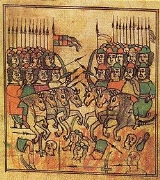
Battle of Kulikovo

Encyclopedia
The Battle of Kulikovo was a battle between Tatar
Mamai
and Muscovy Dmitriy
and portrayed by Russian historiography as a stand-off between Russians and the Golden Horde
. However, the political situation at the time was much more complicated and concerned the politics of the Northeastern Rus'. The battle took place on September 8, 1380, at the Kulikovo Field
near the Don River
(now Tula Oblast
) and resulted in a victory of Dmitri Donskoi
. The battle's site is commemorated by a memorial church built from a design by Aleksey Shchusev.
, the Golden Horde
, the center of which was established in the lower Volga region. The numerous Russian (or Ruthenian) principalities were not, however, fully integrated into the Empire, but were required to pay a tax. During that time the small regional principality of Moscow had grown into a well-respected political entity and often challenged its neighbors for territorial claims, particularly the Grand Duchy of Ryazan. The Moscow-Ryazan stand-off took place long before the Mongol-Tatar conquest, during the rise of regional powers within the Kievan Rus.
A civil war had arisen on the territory of the falling Golden Horde
and new political powers were appearing, such as the Grand Duchy of Lithuania
, the Grand Duchy of Moscow
, the Grand Duchy of Ryazan and others. In 1370, after the mysterious death of Khan Abdulla the Tatar, warlord
(temnik) Mamai
took control of the Golden Horde
as a regent appointed to oversee over the immature Khan Muhammad Bolak. The growing Grand Duchy of Lithuania
was gaining momentum, taking over former territories of the Golden Horde and, after the Battle of Blue Waters
, securing power not only over Kiev
but also parts of the northern Black Sea coast. As Mamai was not a Genghisid
, his position remained vulnerable since there were legal descendants of Genghis Khan who were in a position to lay claim to the throne. During that time the Prince of Moscow was denied the passing of a jarliq
for the Grand Duchy of Vladimir, which he possessed since 1362. In 1371 Mamai passed it to the Prince of Tver. The prince of Moscow, Dmitri Donskoi, refused to accept subordination to the new leadership. In 1377 a friend of Mamai Arpash raided Nizhniy Novgorod and Ryazan
after defeating the Suzdal-Moscow united army of Dmitri at the Battle on Pyana River
. Mamai sought to affirm his sovereignty over the tributary lands of the Golden Horde. In 1378 he sent forces led by warlord Murza Begich to ensure the Moscow prince's obedience. The Horde army was defeated at the Battle of the Vozha River
,howevewr, and Begich was killed. Simultaneously another khan Tokhtamysh
(in Middle Asia
) challenged the throne of the Golden Horde. Although unsuccessful at first, he managed to find more solid support to establish himself as the new khan of the Golden Horde
.
Two years later Mamai himself led his armies to Rus. Prior to invading, he conducted negotiations with Prince Jogaila
of Lithuania and Russian prince Oleg of Ryazan, a fierce enemy of Dmitry. The armies of Lithuania and Ryazan were sent to join the Tatars. Mamai established his camp on the shore of Don, waiting for allies.
Dmitry mobilised his troops and allies in Kolomna
to resist the invasion. In Troitse-Sergieva Lavra he met St. Sergius of Radonezh
, who blessed the Russian armies before the battle . Dmitri knew about the approaching armies of Lithuania and Ryazan, and decided not to wait but to attack Mamai immediately, before he could be reinforced. On September 7, 1380, the Russians crossed the Don.
 Combined Russian armies
under the command of the Grand Prince of Vladimir
, Dmitri Ivanovich of Moscow
(called "Dmitry of the Don", in Russian "Donskoy", afterwards) faced a much larger Tatar force under the command of Mamai
, a strongman of the Golden Horde
. Mamai's allies, Grand Prince Oleg of Ryazan
and Grand Prince Jogaila
of Lithuania
, were late to the battle. The old Russian poem Zadonshchina
lists 150,000 Russians and 300,000 Tartaro-Mongols as taking part in the battle, but the actual size of the Kulikovo Field would not allow such a quantity of troops. The figures were more likely closer to 60,000 Russians, including 7,000 rebel Lithuanians, and 125,000 Tatars.
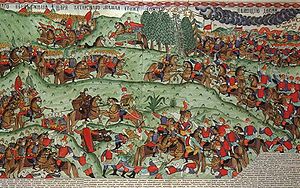
 On the morning of September 8, a thick fog covered the Kulikovo field. The fog cleared around 11 a.m., at which point both armies began advancing on each other.
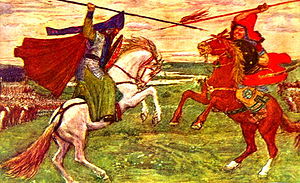
The battle was opened by a single combat of two champions. The Russian champion was Alexander Peresvet
, a monk from the Trinity Abbey
sent to the battle by Saint Sergius. The Horde champion was Temir-murza (also Chelubey or Cheli-bey). The champions killed each other in the first run, though. According to Russian sources, Peresvet did not fall from the saddle
, while Temir-murza did.
Dmitry exchanged his armor with young Moscow boyar
in Mikhail Brenok, in order to pretend to be an ordinary knight. Brenok was to imitate the Prince himself, bearing his banner and wearing his armor. The trick was successful: Tatars aimed at Dmitry's banner and ultimately killed Brenok, believing he was the Prince. Dmitry himself survived, although wounded while fighting, and immediately after the battle fainted from bleeding and exhaustion.
After approximately three hours of battle (from noon to 3 p.m.) the Russian forces were successful, despite great casualties, in holding off the Horde's attack. The cavalry of Vladimir, Prince of Serpukhov
(Dmitri's cousin), led by Dmitri Bobrok, Prince of Volynia, launched a flanking surprise counterstrike and achieved victory over the Horde forces. Mamai
escaped to Crimea
, where he was assassinated by his enemies, leaving the Horde under the command of Tokhtamysh
.
as a part of his general revisionist New Chronology
program.
a century later. Its spiritual importance for the unification of the Russian lands was even more important. As Nikolay Karamzin said, the Russians went to the Kulikovo field as citizens of various principalities and returned as a united Russian nation.
A minor planet
2869 Nepryadva
discovered in 1980 by Soviet
astronomer Nikolai Stepanovich Chernykh
was named to honor the Russian victory over Tataro
-Mongols
in the battle at Kulikovo near Nepryadva River on September 8, 1380.
Tatars
Tatars are a Turkic speaking ethnic group , numbering roughly 7 million.The majority of Tatars live in the Russian Federation, with a population of around 5.5 million, about 2 million of which in the republic of Tatarstan.Significant minority populations are found in Uzbekistan, Kazakhstan,...
Mamai
Mamai
Mamai of Borjigin kin, was a powerful military commander of the Blue Horde in the 1370s which is now the Southern Ukrainian Steppes and the Crimean Peninsula....
and Muscovy Dmitriy
Dmitri Donskoi
Saint Dmitry Ivanovich Donskoy , or Dmitry of the Don, sometimes referred to as Dmitry I , son of Ivan II the Meek of Moscow , reigned as the Prince of Moscow from 1359 and Grand Prince of Vladimir from 1363 to his death. He was the first prince of Moscow to openly challenge Mongol authority in...
and portrayed by Russian historiography as a stand-off between Russians and the Golden Horde
Golden Horde
The Golden Horde was a Mongol and later Turkicized khanate that formed the north-western sector of the Mongol Empire...
. However, the political situation at the time was much more complicated and concerned the politics of the Northeastern Rus'. The battle took place on September 8, 1380, at the Kulikovo Field
Kulikovo Field
Kulikovo Field is a field in Tula Oblast in Russia, where the famous Battle of Kulikovo took place on September 8 of 1380.As established by Stepan Nechayev, the battlefield is located between the rivers of Nepryadva, Krasivaya Mecha, and Don some 140 km away from Tula and 23 km away from...
near the Don River
Don River (Russia)
The Don River is one of the major rivers of Russia. It rises in the town of Novomoskovsk 60 kilometres southeast from Tula, southeast of Moscow, and flows for a distance of about 1,950 kilometres to the Sea of Azov....
(now Tula Oblast
Tula Oblast
Tula Oblast is a federal subject of Russia with its present borders formed on September 26, 1937. Its administrative center is the city of Tula. The oblast has an area of and a population of 1,553,874...
) and resulted in a victory of Dmitri Donskoi
Dmitri Donskoi
Saint Dmitry Ivanovich Donskoy , or Dmitry of the Don, sometimes referred to as Dmitry I , son of Ivan II the Meek of Moscow , reigned as the Prince of Moscow from 1359 and Grand Prince of Vladimir from 1363 to his death. He was the first prince of Moscow to openly challenge Mongol authority in...
. The battle's site is commemorated by a memorial church built from a design by Aleksey Shchusev.
Background
Upon the Mongol-Tatar conquest the territories of disintegrating Kievan Rus became part of the western region of the Mongol EmpireMongol Empire
The Mongol Empire , initially named as Greater Mongol State was a great empire during the 13th and 14th centuries...
, the Golden Horde
Golden Horde
The Golden Horde was a Mongol and later Turkicized khanate that formed the north-western sector of the Mongol Empire...
, the center of which was established in the lower Volga region. The numerous Russian (or Ruthenian) principalities were not, however, fully integrated into the Empire, but were required to pay a tax. During that time the small regional principality of Moscow had grown into a well-respected political entity and often challenged its neighbors for territorial claims, particularly the Grand Duchy of Ryazan. The Moscow-Ryazan stand-off took place long before the Mongol-Tatar conquest, during the rise of regional powers within the Kievan Rus.
A civil war had arisen on the territory of the falling Golden Horde
Golden Horde
The Golden Horde was a Mongol and later Turkicized khanate that formed the north-western sector of the Mongol Empire...
and new political powers were appearing, such as the Grand Duchy of Lithuania
Grand Duchy of Lithuania
The Grand Duchy of Lithuania was a European state from the 12th /13th century until 1569 and then as a constituent part of Polish-Lithuanian Commonwealth until 1791 when Constitution of May 3, 1791 abolished it in favor of unitary state. It was founded by the Lithuanians, one of the polytheistic...
, the Grand Duchy of Moscow
Grand Duchy of Moscow
The Grand Duchy of Moscow or Grand Principality of Moscow, also known in English simply as Muscovy , was a late medieval Rus' principality centered on Moscow, and the predecessor state of the early modern Tsardom of Russia....
, the Grand Duchy of Ryazan and others. In 1370, after the mysterious death of Khan Abdulla the Tatar, warlord
Warlord
A warlord is a person with power who has both military and civil control over a subnational area due to armed forces loyal to the warlord and not to a central authority. The term can also mean one who espouses the ideal that war is necessary, and has the means and authority to engage in war...
(temnik) Mamai
Mamai
Mamai of Borjigin kin, was a powerful military commander of the Blue Horde in the 1370s which is now the Southern Ukrainian Steppes and the Crimean Peninsula....
took control of the Golden Horde
Golden Horde
The Golden Horde was a Mongol and later Turkicized khanate that formed the north-western sector of the Mongol Empire...
as a regent appointed to oversee over the immature Khan Muhammad Bolak. The growing Grand Duchy of Lithuania
Grand Duchy of Lithuania
The Grand Duchy of Lithuania was a European state from the 12th /13th century until 1569 and then as a constituent part of Polish-Lithuanian Commonwealth until 1791 when Constitution of May 3, 1791 abolished it in favor of unitary state. It was founded by the Lithuanians, one of the polytheistic...
was gaining momentum, taking over former territories of the Golden Horde and, after the Battle of Blue Waters
Battle of Blue Waters
The Battle of Blue Waters was a medieval battle fought at some time between 24 September and 25 December 1362 near the Syni Vody of the Southern Bug between the armies of the Grand Duchy of Lithuania and the Golden Horde....
, securing power not only over Kiev
Kiev
Kiev or Kyiv is the capital and the largest city of Ukraine, located in the north central part of the country on the Dnieper River. The population as of the 2001 census was 2,611,300. However, higher numbers have been cited in the press....
but also parts of the northern Black Sea coast. As Mamai was not a Genghisid
Descent from Genghis Khan
Descent from Genghis Khan is traceable primarily in Central Asia. His four sons and other immediate descendants are famous by names and by deeds. Later Asian potentates attempted to claim descent from the House of Borjigin even on flimsy grounds. In the 14th century, valid sources all but dried...
, his position remained vulnerable since there were legal descendants of Genghis Khan who were in a position to lay claim to the throne. During that time the Prince of Moscow was denied the passing of a jarliq
Jarliq
In the Mongol Empire, Jarlig was one of three types of non-fundamental law pronouncements that had the effect of a regulation or ordinance, the other two being debter and bilig In the Mongol Empire, Jarlig (Mongolian: зарлиг; Russian: iarlyk, also transliterated yarlyk and the Tartar: yarligh)...
for the Grand Duchy of Vladimir, which he possessed since 1362. In 1371 Mamai passed it to the Prince of Tver. The prince of Moscow, Dmitri Donskoi, refused to accept subordination to the new leadership. In 1377 a friend of Mamai Arpash raided Nizhniy Novgorod and Ryazan
Ryazan
Ryazan is a city and the administrative center of Ryazan Oblast, Russia. It is located on the Oka River southeast of Moscow. Population: The strategic bomber base Dyagilevo is just west of the city, and the air base of Alexandrovo is to the southeast as is the Ryazan Turlatovo Airport...
after defeating the Suzdal-Moscow united army of Dmitri at the Battle on Pyana River
Battle on Pyana River
The Battle on Pyana River took place on August 2, 1377 between the Blue Horde Khan Arapsha and joint Russian troops under Knyaz Ivan Dmitriyevich, made up of the Pereyaslavl, Yaroslavl, Yuryev, Nizhny Novgorod and Murom warlords....
. Mamai sought to affirm his sovereignty over the tributary lands of the Golden Horde. In 1378 he sent forces led by warlord Murza Begich to ensure the Moscow prince's obedience. The Horde army was defeated at the Battle of the Vozha River
Battle of the Vozha River
Battle of the Vozha River was a battle fought between the Grand Duchy of Moscow and the Golden Horde on August 11, 1378. Mamai sought to punish the Russians for disobedience....
,howevewr, and Begich was killed. Simultaneously another khan Tokhtamysh
Tokhtamysh
Tokhtamysh was the prominent khan of the White Horde, who briefly unified the White Horde and Blue Horde subdivisions of the Golden Horde into a single state. He was a descendant of Genghis Khan's eldest grandson, Orda Khan or his brother Tuqa-Timur...
(in Middle Asia
Middle Asia
Middle Asia is a region of Asia from the Caspian Sea in the west, to Mongolia in the east, Afghanistan in the south, and Russia in the north. The geographical term has appeared sometime prior to the 20th century in the Russian Empire and was closely associated with the Russian Turkestan and the...
) challenged the throne of the Golden Horde. Although unsuccessful at first, he managed to find more solid support to establish himself as the new khan of the Golden Horde
Golden Horde
The Golden Horde was a Mongol and later Turkicized khanate that formed the north-western sector of the Mongol Empire...
.
Two years later Mamai himself led his armies to Rus. Prior to invading, he conducted negotiations with Prince Jogaila
Jogaila
Jogaila, later 'He is known under a number of names: ; ; . See also: Jogaila : names and titles. was Grand Duke of Lithuania , king consort of Kingdom of Poland , and sole King of Poland . He ruled in Lithuania from 1377, at first with his uncle Kęstutis...
of Lithuania and Russian prince Oleg of Ryazan, a fierce enemy of Dmitry. The armies of Lithuania and Ryazan were sent to join the Tatars. Mamai established his camp on the shore of Don, waiting for allies.
Dmitry mobilised his troops and allies in Kolomna
Kolomna
Kolomna is an ancient city and the administrative center of Kolomensky District of Moscow Oblast, Russia, situated at the confluence of the Moskva and Oka Rivers, southeast of Moscow. The area of the city is about . The city was founded in 1177...
to resist the invasion. In Troitse-Sergieva Lavra he met St. Sergius of Radonezh
Sergius of Radonezh
Venerable Sergius of Radonezh , also transliterated as Sergey Radonezhsky or Serge of Radonezh, was a spiritual leader and monastic reformer of medieval Russia. Together with Venerable Seraphim of Sarov, he is one of the Russian Orthodox Church's most highly venerated saints.-Early life:The date of...
, who blessed the Russian armies before the battle . Dmitri knew about the approaching armies of Lithuania and Ryazan, and decided not to wait but to attack Mamai immediately, before he could be reinforced. On September 7, 1380, the Russians crossed the Don.
Forces
Army
An army An army An army (from Latin arma "arms, weapons" via Old French armée, "armed" (feminine), in the broadest sense, is the land-based military of a nation or state. It may also include other branches of the military such as the air force via means of aviation corps...
under the command of the Grand Prince of Vladimir
Vladimir
Vladimir is a city and the administrative center of Vladimir Oblast, Russia, located on the Klyazma River, to the east of Moscow along the M7 motorway. Population:...
, Dmitri Ivanovich of Moscow
Dmitri Donskoi
Saint Dmitry Ivanovich Donskoy , or Dmitry of the Don, sometimes referred to as Dmitry I , son of Ivan II the Meek of Moscow , reigned as the Prince of Moscow from 1359 and Grand Prince of Vladimir from 1363 to his death. He was the first prince of Moscow to openly challenge Mongol authority in...
(called "Dmitry of the Don", in Russian "Donskoy", afterwards) faced a much larger Tatar force under the command of Mamai
Mamai
Mamai of Borjigin kin, was a powerful military commander of the Blue Horde in the 1370s which is now the Southern Ukrainian Steppes and the Crimean Peninsula....
, a strongman of the Golden Horde
Golden Horde
The Golden Horde was a Mongol and later Turkicized khanate that formed the north-western sector of the Mongol Empire...
. Mamai's allies, Grand Prince Oleg of Ryazan
Ryazan
Ryazan is a city and the administrative center of Ryazan Oblast, Russia. It is located on the Oka River southeast of Moscow. Population: The strategic bomber base Dyagilevo is just west of the city, and the air base of Alexandrovo is to the southeast as is the Ryazan Turlatovo Airport...
and Grand Prince Jogaila
Jogaila
Jogaila, later 'He is known under a number of names: ; ; . See also: Jogaila : names and titles. was Grand Duke of Lithuania , king consort of Kingdom of Poland , and sole King of Poland . He ruled in Lithuania from 1377, at first with his uncle Kęstutis...
of Lithuania
Lithuania
Lithuania , officially the Republic of Lithuania is a country in Northern Europe, the biggest of the three Baltic states. It is situated along the southeastern shore of the Baltic Sea, whereby to the west lie Sweden and Denmark...
, were late to the battle. The old Russian poem Zadonshchina
Zadonshchina
Zadonshchina is a Russian literary monument of the late 14th century, which tells of the Battle of Kulikovo in 1380.- Redactions and the Prototext :Zadonshina exists in 2 redactions:...
lists 150,000 Russians and 300,000 Tartaro-Mongols as taking part in the battle, but the actual size of the Kulikovo Field would not allow such a quantity of troops. The figures were more likely closer to 60,000 Russians, including 7,000 rebel Lithuanians, and 125,000 Tatars.
The battle
The battle was opened by a single combat of two champions. The Russian champion was Alexander Peresvet
Alexander Peresvet
Alexander Peresvet, also spelled Peresviet , was a Russian Orthodox Christian monk who fought in a single combat with the Tatar champion Temir-murza at the opening of the Battle of Kulikovo , where they killed each other.He is believed to have hailed from the Bryansk area and took...
, a monk from the Trinity Abbey
Troitse-Sergiyeva Lavra
The Trinity Lavra of St. Sergius is the most important Russian monastery and the spiritual centre of the Russian Orthodox Church. The monastery is situated in the town of Sergiyev Posad, about 70 km to the north-east from Moscow by the road leading to Yaroslavl, and currently is home to...
sent to the battle by Saint Sergius. The Horde champion was Temir-murza (also Chelubey or Cheli-bey). The champions killed each other in the first run, though. According to Russian sources, Peresvet did not fall from the saddle
Saddle
A saddle is a supportive structure for a rider or other load, fastened to an animal's back by a girth. The most common type is the equestrian saddle designed for a horse, but specialized saddles have been created for camels and other creatures...
, while Temir-murza did.
Dmitry exchanged his armor with young Moscow boyar
Boyar
A boyar, or bolyar , was a member of the highest rank of the feudal Moscovian, Kievan Rus'ian, Bulgarian, Wallachian, and Moldavian aristocracies, second only to the ruling princes , from the 10th century through the 17th century....
in Mikhail Brenok, in order to pretend to be an ordinary knight. Brenok was to imitate the Prince himself, bearing his banner and wearing his armor. The trick was successful: Tatars aimed at Dmitry's banner and ultimately killed Brenok, believing he was the Prince. Dmitry himself survived, although wounded while fighting, and immediately after the battle fainted from bleeding and exhaustion.
After approximately three hours of battle (from noon to 3 p.m.) the Russian forces were successful, despite great casualties, in holding off the Horde's attack. The cavalry of Vladimir, Prince of Serpukhov
Vladimir the Bold
Vladimir Andreyevich the Bold was the most famous prince of Serpukhov. His moniker alludes to his many military exploits committed in the wars waged by his cousin, Dmitri Donskoi of Moscow....
(Dmitri's cousin), led by Dmitri Bobrok, Prince of Volynia, launched a flanking surprise counterstrike and achieved victory over the Horde forces. Mamai
Mamai
Mamai of Borjigin kin, was a powerful military commander of the Blue Horde in the 1370s which is now the Southern Ukrainian Steppes and the Crimean Peninsula....
escaped to Crimea
Crimea
Crimea , or the Autonomous Republic of Crimea , is a sub-national unit, an autonomous republic, of Ukraine. It is located on the northern coast of the Black Sea, occupying a peninsula of the same name...
, where he was assassinated by his enemies, leaving the Horde under the command of Tokhtamysh
Tokhtamysh
Tokhtamysh was the prominent khan of the White Horde, who briefly unified the White Horde and Blue Horde subdivisions of the Golden Horde into a single state. He was a descendant of Genghis Khan's eldest grandson, Orda Khan or his brother Tuqa-Timur...
.
The Location
Ancient sources do not give a precise description of the place of the battle. As a result, until the 19th century the precise location of the battle was unknown. In the 19th century Stepan Nechaev came up with what he believed was the exact location of the battle and his hypothesis was accepted. In the 20th century Anatoly Fomenko offered a hypothesis that the battle took place in the centre of Moscow on Taganka SquareTaganka Square
Taganka Square or Taganskaya Square is a city square at the south-eastern corner of the Garden Ring in central Moscow, formed in 1963 by merging two historic squares, Upper Taganka and Lower Taganka. In 1813 the district of Taganka was reconstructed by Joseph Bové, who built a market there...
as a part of his general revisionist New Chronology
New Chronology
The term "New Chronology" can refer to any of a number of attempts to rewrite a conventional chronology :-Egyptian chronology:...
program.
Legacy
This victory was an early signal of the end of the "Mongol yoke" (vassalage), which officially ended with the great standing on the Ugra RiverGreat standing on the Ugra river
The Great Standoff on the Ugra river The Great Standoff on the Ugra river The Great Standoff on the Ugra river ( in Russian, also (Ugorschina in English, derived from Ugra) was a standoff between the forces of Akhmat, Khan of the Great Horde, and the Grand Prince Ivan III of Russia in 1480, which...
a century later. Its spiritual importance for the unification of the Russian lands was even more important. As Nikolay Karamzin said, the Russians went to the Kulikovo field as citizens of various principalities and returned as a united Russian nation.
A minor planet
Minor planet
An asteroid group or minor-planet group is a population of minor planets that have a share broadly similar orbits. Members are generally unrelated to each other, unlike in an asteroid family, which often results from the break-up of a single asteroid...
2869 Nepryadva
2869 Nepryadva
2869 Nepryadva is a main-belt asteroid discovered on September 7, 1980 by N. Chernykh at Nauchnyj. It is named after Russian river Nepryadva, where Battle of Kulikovo was fought.- External links :*...
discovered in 1980 by Soviet
Soviet Union
The Soviet Union , officially the Union of Soviet Socialist Republics , was a constitutionally socialist state that existed in Eurasia between 1922 and 1991....
astronomer Nikolai Stepanovich Chernykh
Nikolai Stepanovich Chernykh
Nikolay Stepanovich Chernykh was a Soviet and Russian astronomer.Chernykh was born in the city of Usman' in Voronezh Oblast...
was named to honor the Russian victory over Tataro
Tatars
Tatars are a Turkic speaking ethnic group , numbering roughly 7 million.The majority of Tatars live in the Russian Federation, with a population of around 5.5 million, about 2 million of which in the republic of Tatarstan.Significant minority populations are found in Uzbekistan, Kazakhstan,...
-Mongols
Mongols
Mongols ) are a Central-East Asian ethnic group that lives mainly in the countries of Mongolia, China, and Russia. In China, ethnic Mongols can be found mainly in the central north region of China such as Inner Mongolia...
in the battle at Kulikovo near Nepryadva River on September 8, 1380.
Perspectives
The historical evaluation of the battle has many theories of what the event represented in the course of history.- The traditionally Russian point of view sees the battle as the first step in the liberation of the Russian lands from the Golden Horde dependency.
- Some analysts of the Eastern Orthodox approach portray the battle as a stand-off between the Christian Rus and steppe non-Christians.
- Russian historian Sergey SolovyovSergey SolovyovSergey Mikhaylovich Solovyov was one of the greatest Russian historians whose influence on the next generation of Russian historians was paramount. His son Vladimir Solovyov was one of the most influential Russian philosophers...
saw the battle as critical for the history of Eastern Europe in stopping another invasion from the Asia, similar to the Battle of Châlons of the 5th century and the Battle of ToursBattle of ToursThe Battle of Tours , also called the Battle of Poitiers and in Battle of the Court of the Martyrs, was fought in an area between the cities of Poitiers and Tours, located in north-central France, near the village of Moussais-la-Bataille, about northeast of Poitiers...
of the 8th century in Western Europe. - Some critical analysts believe that the meaning of the battle is overevaluated and represents nothing more than a simple regional conflict within the Golden HordeGolden HordeThe Golden Horde was a Mongol and later Turkicized khanate that formed the north-western sector of the Mongol Empire...
. - Another Russian historian, Lev GumilevLev GumilevLev Nikolayevich Gumilev , was a Soviet historian, ethnologist and anthropologist. His unorthodox ideas on the birth and death of ethnic groups have given rise to the political and cultural movement known as "Neo-Eurasianism".-Life:His parents were two prominent poets Nikolay Gumilev and Anna...
, sees in Mamai a representative of economic and political interests from outside, particularly Western Europe, which in the battle were represented by numerous Genoese mercenaries, while the Moscow army stood in support of the rightful ruler of the Golden HordeGolden HordeThe Golden Horde was a Mongol and later Turkicized khanate that formed the north-western sector of the Mongol Empire...
Tuqtamış xanTokhtamyshTokhtamysh was the prominent khan of the White Horde, who briefly unified the White Horde and Blue Horde subdivisions of the Golden Horde into a single state. He was a descendant of Genghis Khan's eldest grandson, Orda Khan or his brother Tuqa-Timur...
.
See also
Persons
- Dmitri DonskoiDmitri DonskoiSaint Dmitry Ivanovich Donskoy , or Dmitry of the Don, sometimes referred to as Dmitry I , son of Ivan II the Meek of Moscow , reigned as the Prince of Moscow from 1359 and Grand Prince of Vladimir from 1363 to his death. He was the first prince of Moscow to openly challenge Mongol authority in...
- Alexander PeresvetAlexander PeresvetAlexander Peresvet, also spelled Peresviet , was a Russian Orthodox Christian monk who fought in a single combat with the Tatar champion Temir-murza at the opening of the Battle of Kulikovo , where they killed each other.He is believed to have hailed from the Bryansk area and took...
- OslyabyaOslyabyaRodion Oslyabya was a Russian monk from Saint Sergius's Trinity Abbey who became famous for his part in the Battle of Kulikovo. According to Oleg N. Trubachev, the nickname "Oslyabya" is a hypocoristic for "donkey". His Christian name has been given in various sources as Roman, Rodion, Andrian and...
- Kulikovo FieldKulikovo FieldKulikovo Field is a field in Tula Oblast in Russia, where the famous Battle of Kulikovo took place on September 8 of 1380.As established by Stepan Nechayev, the battlefield is located between the rivers of Nepryadva, Krasivaya Mecha, and Don some 140 km away from Tula and 23 km away from...
- Stepan Nechaev
Related battles
- Battle of the Vozha RiverBattle of the Vozha RiverBattle of the Vozha River was a battle fought between the Grand Duchy of Moscow and the Golden Horde on August 11, 1378. Mamai sought to punish the Russians for disobedience....
- Great stand on the Ugra River
- Tatar invasionsTatar invasionsThe Mongol invasion of Europe from the east took place over the course of three centuries, from the Middle Ages to the early modern period.The terms Tatars or Tartars are applied to nomadic Turkic peoples who, themselves, were conquered by Mongols and incorporated into their horde...
- Russo-Kazan WarsRusso-Kazan Warsthumb|300px|[[St. Basil's Cathedral]] is a monument to the Russian conquest of Kazan in 1552.The Russo-Kazan Wars was a series of wars fought between the Khanate of Kazan and Muscovite Russia from 1438, until Kazan was finally captured by Ivan the Terrible and absorbed into Russia in 1552.- Wars of...
- Mongol invasion of RusMongol invasion of RusThe Mongol invasion of Russia was resumed on 21 December 1237 marking the resumption of the Mongol invasion of Europe, during which the Mongols attacked the medieval powers of Poland, Kiev, Hungary, and miscellaneous tribes of less organized peoples...
- Timeline of the Tataro-Mongol Yoke in Russia