


Northern Sea Route

Encyclopedia
The Northern Sea Route is a shipping
lane officially defined by Russian legislation from the Atlantic Ocean
to the Pacific Ocean
specifically running along the Russia
n Arctic coast from Murmansk
on the Barents Sea
, along Siberia
, to the Bering Strait and Far East
. The entire route lies in Arctic
waters and parts are free of ice
for only two months per year. Before the beginning of the 20th century it was known as the Northeast Passage, and is still sometimes referred to by that name.
in 1525. However, Russian settlers and traders on the coast of the White Sea
, the Pomors, had been exploring parts of the route as early as the 11th century.
During a voyage across the Barents Sea
in search of the North East Passage in 1553, English explorer Hugh Willoughby thought he saw islands to the north, and islands called Willoughby's Land
were shown on maps published by Plancius
and Mercator
in the 1590s and they continued to appear on maps by Jan Janssonius
and Willem Blaeu
into the 1640s.
By the 17th century, traders had established a continuous sea route from Arkhangelsk
to the Yamal Peninsula
, where they portaged to the Gulf of Ob
. This route, known as the "Mangazeya seaway", after its eastern terminus, the trade depot of Mangazeya
, was an early precursor to the Northern Sea Route.
East of the Yamal, the route north of the Taimyr Peninsula proved impossible or impractical. East of the Taimyr, from the 1630s, Russians began to sail the Arctic coast from the mouth of the Lena River
to a point beyond the mouth of the Kolyma River
. Both Vitus Bering
(in 1728) and James Cook
(n 1778) entered the Bering Strait from the south and sailed some distance northwest, but from 1648 (Semyon Dezhnev
) to 1879 (Adolf Erik Nordenskiöld
) no one is recorded as having sailed eastward between the Kolyma and Bering Strait.
The western parts of the passage were explored by northern European countries such as England
, the Netherlands
, Denmark
, and Norway
, looking for an alternative seaway to China
and India
. Although these expeditions failed, new coasts and islands were discovered. The most notable was the 1596 expedition led by Dutch navigator Willem Barentsz, who discovered Spitsbergen
and Bear Island and rounded the north of Novaya Zemlya
.
Fearing English and Dutch penetration into Siberia, Russia
closed the Mangazeya seaway in 1619. Pomor activity in Northern Asia declined and the bulk of exploration in the 17th century was carried out by Siberian Cossack
s, sailing from one river mouth to another in their Arctic-worthy kochs
. In 1648 the most famous of these expeditions, led by Fedot Alekseev and Semyon Dezhnev
, sailed east from the mouth of the Kolyma to the Pacific and rounded the Chukchi Peninsula
, thus proving that no land connection between Asia and North America exists.
Eighty years after Dezhnev, in 1728, another Russian explorer, Danish
-born Vitus Bering
on Svyatoy Gavriil (Saint Gabriel) made a similar voyage in reverse, starting in Kamchatka
and going north to the passage that now bears his name (Bering Strait
). It was Bering who gave their current names to Diomede Islands
, vaguely mentioned by Dezhnev.
Bering's explorations of 1725–30 were part of a larger scheme initially devised by Peter the Great
and known as the "Great Northern Expedition
".
The "Second Kamchatka Expedition" took place in 1735–42. This time there were two ships, Svyatoy Pyotr and Svyatoy Pavel, the latter commanded by Bering's deputy in the first expedition, Captain Aleksey Chirikov. During the Second Expedition Bering became the first Westerner to sight the coast of north-western North America, and Chirikov the first to land there. (A storm had separated the two ships earlier.) On his way back Bering discovered the Aleutian Islands but fell ill, and Svyatoy Pyotr had to take shelter on an island off Kamchatka, where Bering died (Bering Island
).
Independent of Bering and Chirikov, other Russian Imperial Navy parties took part in the Second Great Northern Expedition. One of these, led by Semyon Chelyuskin, in May 1742 reached Cape Chelyuskin
, the northernmost point of both the North East Passage and the Eurasian continent.
Later expeditions to explore the North East Passage took place in the 1760s (Vasiliy Chichagov), 1785–95 (Joseph Billings
and Gavril Sarychev
), the 1820s and 1830s (Ferdinand Petrovich Wrangel, Pyotr Fyodorovich Anjou, Count Fyodor Litke
and others). The possibility of navigation of the whole length of the passage was proved by the mid-19th century.
However, it was only in 1878 that Finnish
-Swedish
explorer Nordenskiöld
made the first complete passage of the North East Passage from west to east, in the Vega
expedition. The ship's captain on this expedition was Lieutenant Louis Palander
of the Swedish Royal Navy.
One year before Nordenskiöld's voyage, commercial exploitation of a section of the route started with the so-called Kara expeditions, exporting Siberian agricultural produce via the Kara Sea
. Of 122 convoys between 1877 and 1919 only 75 succeeded, transporting as little as 55 tons of cargo. From 1911 the "Kolyma steamboats" ran from Vladivostok
to the Kolyma once a year.
In 1912 two Russian expeditions set out; Captain Georgy Brusilov
and the Brusilov Expedition
in the Santa Anna, and Captain Alexander Kuchin
with Vladimir Rusanov
in the Gerkules; each with a woman on board. Both expeditions were hastily arranged, and both disappeared.
In 1915 a Russian expedition led by Boris Vilkitskiy made the passage from east to west with the icebreaker
s Taymyr
and Vaygach
.
Nordenskiöld, Nansen
, Amundsen
, DeLong
, Makarov
and others also led expeditions; mainly for scientific and cartographic purposes.
, steamboats and icebreakers made running the Northern Sea Route viable. After the Russian Revolution of 1917
, the Soviet Union
was isolated from the western powers, which made it imperative to use this route. Besides being the shortest seaway between the western and far eastern USSR, it was the only one which lay inside Soviet internal waters and did not impinge upon those which belonged to nearby opposing countries.
In 1932 a Soviet expedition led by Professor Otto Yulievich Schmidt was the first to sail all the way from Arkhangelsk to the Bering Strait in the same summer without wintering en route. After a couple more trial runs, in 1933 and 1934, the "Northern Sea Route" was officially defined and open and commercial exploitation began in 1935. The next year, part of the Baltic Fleet
made the passage to the Pacific where armed conflict with Japan
was looming.
A special governing body Glavsevmorput (Chief Directorate of the Northern Sea Route
) was set up in 1932, and Otto Schmidt became its first director. It supervised navigation and built Arctic ports.
During the early part of World War II
, the Soviets allowed the German auxiliary cruiser Komet
to use the Northern Sea Route in the summer of 1940 to evade the British Royal Navy
and break out into the Pacific Ocean. Komet was escorted by Soviet icebreakers during her journey. After the start of the Soviet-German War the Soviets transferred several destroyers from the Pacific Fleet to the Northern Fleet via the Arctic. The Soviets also used the Northern Sea Route to transfer materials from the Soviet Far East to European Russia and the Germans launched Operation Wunderland
in order to interdict this traffic.
After the breakup of the Soviet Union in the early 1990s, commercial navigation in the Siberian Arctic went into decline. More or less regular shipping is to be found only from Murmansk
to Dudinka
in the west and between Vladivostok
and Pevek
in the east. Ports between Dudinka and Pevek see virtually no shipping. Logashkino
and Nordvik
were abandoned and are now ghost towns.
Renewed interest led to several demonstration voyages in 1997 including the passage of M/T Uikku
.
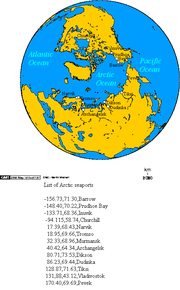 Several seaports along the route are ice-free all year round. They are, west to east, Murmansk
on the Kola Peninsula
, and on Russia's Pacific seaboard Petropavlovsk in Kamchatka
, Vanino
, Nakhodka
, and Vladivostok
. Arctic ports are generally usable July to October, or, such as Dudinka
, are served by nuclear powered icebreaker
s.
sailor Eric Brossier made the first passage by sailboat in only one season in the summer of 2002. He returned to Europe the following summer by the Northwest Passage
.
The Northern Sea Route was opened by receding ice in 2005 but was closed by 2007. The amount of polar ice had receded to 2005 levels in August 2008. In late August 2008, it was reported that images from the NASA
Aqua satellite
had revealed that the last ice blockage of the Northern Sea Route in the Laptev Sea
had melted. This would have been the first time since satellite records began that both the Northwest Passage and Northern Sea Route had been open simultaneously. However, other scientists suggested that the satellite images may have been misread and that the sea route was not yet passable.
The Bremen
-based Beluga Group claimed in 2009 to be the first Western company to attempt to cross the Northern Sea Route for shipping without assistance from icebreakers, cutting 4000 nautical mile
s off the journey between Ulsan
, Korea
and Rotterdam
.
However, the new (2008) ice-strengthened heavy lift vessels Beluga Fraternity
and Beluga Foresight commenced an East-to-West passage of the Northern Sea Route in August 2009
as part of a small convoy escorted by the Russian nuclear icebreaker NS 50 Let Pobedy, westward through the Bering, Sannikov, and Vilkitskiy Straits. The two vessels embarked Russian ice pilots for the voyage to the western Siberian port of Novyy, in the Yamburg region in the delta of the Ob River. The ships arrived at Novvy on 7 September, discharged their cargo to barges and departed on 12 September, bound for the Kara Gates and Rotterdam.
They were the first non-Russian commercial vessels to complete this journey, but not without Russian assistance. The captain of the Beluga Foresight, Valeriy Durov, described the achievement as "great news for our industry".
The president of Beluga Shipping claimed the voyage saved each vessel about 300,000 euros, compared to the normal Korea-to-Rotterdam route by way of the Suez Canal
. The company did not disclose how much they paid for the escort service and the Russian pilots. An 18 September 2009 press release stated that the company is already planning for six vessels to make Arctic deliveries in 2010.
In September 2010, two yachts completed circumnavigation of the Arctic: Børge Ousland
's team aboard "The Northern Passage" http://www.barentsobserver.com/around-the-north-pole-in-less-than-three-months.4822563-16334.html, and Sergei Murzayev's team in the "Peter I". These were the first recorded instances of the circumnavigation of the Arctic by sailing yachts in one season.
In 2009, the first two international commercial cargo vessels traveled north of Russia between Europe and Asia. In 2011, 18 ships have made the now mostly ice-free crossing.
compared to coastal route alternatives, with vessel draught and beam limitation. Environmental demands faced by the maritime shipping industry may emerge as one of the drivers for developing the Northern Sea Route. Increased knowledge about environmental benefits and costs for both the Northern Sea Route and Suez routes will probably be important factors in this respect.
 In 2007, Finland
issued a €10 Adolf Erik Nordenskiöld and Northeast Passage commemorative coin. This issue celebrates the 175th anniversary of Nordenskiöld's birth and his discovery of the Northern Sea Route. The obverse features an abstract portrait of Nordenskiöld at the helm of his ship. The reverse is dominated by a pattern resembling the labyrinth formed by adjacent ice floes.
The coin is one of the Europa Coins 2007
series, which celebrates European achievements in history.
Shipping
Shipping has multiple meanings. It can be a physical process of transporting commodities and merchandise goods and cargo, by land, air, and sea. It also can describe the movement of objects by ship.Land or "ground" shipping can be by train or by truck...
lane officially defined by Russian legislation from the Atlantic Ocean
Atlantic Ocean
The Atlantic Ocean is the second-largest of the world's oceanic divisions. With a total area of about , it covers approximately 20% of the Earth's surface and about 26% of its water surface area...
to the Pacific Ocean
Pacific Ocean
The Pacific Ocean is the largest of the Earth's oceanic divisions. It extends from the Arctic in the north to the Southern Ocean in the south, bounded by Asia and Australia in the west, and the Americas in the east.At 165.2 million square kilometres in area, this largest division of the World...
specifically running along the Russia
Russia
Russia or , officially known as both Russia and the Russian Federation , is a country in northern Eurasia. It is a federal semi-presidential republic, comprising 83 federal subjects...
n Arctic coast from Murmansk
Murmansk
Murmansk is a city and the administrative center of Murmansk Oblast, Russia. It serves as a seaport and is located in the extreme northwest part of Russia, on the Kola Bay, from the Barents Sea on the northern shore of the Kola Peninsula, not far from Russia's borders with Norway and Finland...
on the Barents Sea
Barents Sea
The Barents Sea is a marginal sea of the Arctic Ocean, located north of Norway and Russia. Known in the Middle Ages as the Murman Sea, the sea takes its current name from the Dutch navigator Willem Barents...
, along Siberia
Siberia
Siberia is an extensive region constituting almost all of Northern Asia. Comprising the central and eastern portion of the Russian Federation, it was part of the Soviet Union from its beginning, as its predecessor states, the Tsardom of Russia and the Russian Empire, conquered it during the 16th...
, to the Bering Strait and Far East
Russian Far East
Russian Far East is a term that refers to the Russian part of the Far East, i.e., extreme east parts of Russia, between Lake Baikal in Eastern Siberia and the Pacific Ocean...
. The entire route lies in Arctic
Arctic
The Arctic is a region located at the northern-most part of the Earth. The Arctic consists of the Arctic Ocean and parts of Canada, Russia, Greenland, the United States, Norway, Sweden, Finland, and Iceland. The Arctic region consists of a vast, ice-covered ocean, surrounded by treeless permafrost...
waters and parts are free of ice
Ice
Ice is water frozen into the solid state. Usually ice is the phase known as ice Ih, which is the most abundant of the varying solid phases on the Earth's surface. It can appear transparent or opaque bluish-white color, depending on the presence of impurities or air inclusions...
for only two months per year. Before the beginning of the 20th century it was known as the Northeast Passage, and is still sometimes referred to by that name.
History
The motivation to navigate the North East Passage was initially economic. In Russia the idea of a possible seaway connecting the Atlantic and the Pacific was first put forward by the diplomat GerasimovDmitry Gerasimov
Dmitry Gerasimov , was a Russian translator, diplomat and philologist; he also provided some of the earliest information on Muscovy to Renaissance scholars such as Paolo Giovio and Sigismund von Herberstein....
in 1525. However, Russian settlers and traders on the coast of the White Sea
White Sea
The White Sea is a southern inlet of the Barents Sea located on the northwest coast of Russia. It is surrounded by Karelia to the west, the Kola Peninsula to the north, and the Kanin Peninsula to the northeast. The whole of the White Sea is under Russian sovereignty and considered to be part of...
, the Pomors, had been exploring parts of the route as early as the 11th century.
During a voyage across the Barents Sea
Barents Sea
The Barents Sea is a marginal sea of the Arctic Ocean, located north of Norway and Russia. Known in the Middle Ages as the Murman Sea, the sea takes its current name from the Dutch navigator Willem Barents...
in search of the North East Passage in 1553, English explorer Hugh Willoughby thought he saw islands to the north, and islands called Willoughby's Land
Willoughby's Land
During his 1553 voyage across the Barents Sea, English explorer Hugh Willoughby thought he saw islands to the north. Based on his description, these islands were subsequently depicted and named "Willoughby's Land" and "Macsinof Island" on maps published by Petrus Plancius in 1592 and 1594 ....
were shown on maps published by Plancius
Petrus Plancius
Petrus Plancius was a Dutch astronomer, cartographer and clergyman. He was born as Pieter Platevoet in Dranouter, now in Heuvelland, West Flanders. He studied theology in Germany and England...
and Mercator
Gerardus Mercator
thumb|right|200px|Gerardus MercatorGerardus Mercator was a cartographer, born in Rupelmonde in the Hapsburg County of Flanders, part of the Holy Roman Empire. He is remembered for the Mercator projection world map, which is named after him...
in the 1590s and they continued to appear on maps by Jan Janssonius
Jan Janssonius
Johannes Janssonius was a Dutch cartographer who lived and worked in Amsterdam in the 17th century....
and Willem Blaeu
Willem Blaeu
Willem Janszoon Blaeu , also abbreviated to Willem Jansz. Blaeu, was a Dutch cartographer, atlas maker and publisher....
into the 1640s.
By the 17th century, traders had established a continuous sea route from Arkhangelsk
Arkhangelsk
Arkhangelsk , formerly known as Archangel in English, is a city and the administrative center of Arkhangelsk Oblast, Russia. It lies on both banks of the Northern Dvina River near its exit into the White Sea in the north of European Russia. The city spreads for over along the banks of the river...
to the Yamal Peninsula
Yamal Peninsula
The Yamal Peninsula , located in Yamal-Nenets autonomous district of northwest Siberia, Russia, extends roughly 700 km and is bordered principally by the Kara Sea, Baydaratskaya Bay on the west, and by the Gulf of Ob on the east...
, where they portaged to the Gulf of Ob
Gulf of Ob
The Gulf of Ob is a gigantic bay of the Arctic Ocean, located in Northern Russia at the head the mouth of the Ob River....
. This route, known as the "Mangazeya seaway", after its eastern terminus, the trade depot of Mangazeya
Mangazeya
Mangazeya was a Northwest Siberian trans-Ural trade colony and later city in the 16-17th centuries. Founded in 1600, it was situated on the Taz River, between the lower courses of the Ob and Yenisei Rivers flowing into the Arctic Ocean....
, was an early precursor to the Northern Sea Route.
East of the Yamal, the route north of the Taimyr Peninsula proved impossible or impractical. East of the Taimyr, from the 1630s, Russians began to sail the Arctic coast from the mouth of the Lena River
Lena River
The Lena is the easternmost of the three great Siberian rivers that flow into the Arctic Ocean . It is the 11th longest river in the world and has the 9th largest watershed...
to a point beyond the mouth of the Kolyma River
Kolyma River
The Kolyma River is a river in northeastern Siberia, whose basin covers parts of the Sakha Republic, Chukotka Autonomous Okrug, and Magadan Oblast of Russia. Itrises in the mountains north of Okhotsk and Magadan, in the area of and...
. Both Vitus Bering
Vitus Bering
Vitus Jonassen Bering Vitus Jonassen Bering Vitus Jonassen Bering (also, less correNavy]], a captain-komandor known among the Russian sailors as Ivan Ivanovich. He is noted for being the first European to discover Alaska and its Aleutian Islands...
(in 1728) and James Cook
James Cook
Captain James Cook, FRS, RN was a British explorer, navigator and cartographer who ultimately rose to the rank of captain in the Royal Navy...
(n 1778) entered the Bering Strait from the south and sailed some distance northwest, but from 1648 (Semyon Dezhnev
Semyon Dezhnev
Semyon Ivanovich Dezhnyov was a Russian explorer of Siberia and the first European to sail through the Bering Strait. In 1648 he sailed from the Kolyma River on the Arctic Ocean to the Anadyr River on the Pacific...
) to 1879 (Adolf Erik Nordenskiöld
Adolf Erik Nordenskiöld
Freiherr Nils Adolf Erik Nordenskiöld , also known as A. E. Nordenskioeld was a Finnish baron, geologist, mineralogist and arctic explorer of Finnish-Swedish origin. He was a member of the prominent Finland-Swedish Nordenskiöld family of scientists...
) no one is recorded as having sailed eastward between the Kolyma and Bering Strait.
The western parts of the passage were explored by northern European countries such as England
England
England is a country that is part of the United Kingdom. It shares land borders with Scotland to the north and Wales to the west; the Irish Sea is to the north west, the Celtic Sea to the south west, with the North Sea to the east and the English Channel to the south separating it from continental...
, the Netherlands
Netherlands
The Netherlands is a constituent country of the Kingdom of the Netherlands, located mainly in North-West Europe and with several islands in the Caribbean. Mainland Netherlands borders the North Sea to the north and west, Belgium to the south, and Germany to the east, and shares maritime borders...
, Denmark
Denmark
Denmark is a Scandinavian country in Northern Europe. The countries of Denmark and Greenland, as well as the Faroe Islands, constitute the Kingdom of Denmark . It is the southernmost of the Nordic countries, southwest of Sweden and south of Norway, and bordered to the south by Germany. Denmark...
, and Norway
Norway
Norway , officially the Kingdom of Norway, is a Nordic unitary constitutional monarchy whose territory comprises the western portion of the Scandinavian Peninsula, Jan Mayen, and the Arctic archipelago of Svalbard and Bouvet Island. Norway has a total area of and a population of about 4.9 million...
, looking for an alternative seaway to China
China
Chinese civilization may refer to:* China for more general discussion of the country.* Chinese culture* Greater China, the transnational community of ethnic Chinese.* History of China* Sinosphere, the area historically affected by Chinese culture...
and India
India
India , officially the Republic of India , is a country in South Asia. It is the seventh-largest country by geographical area, the second-most populous country with over 1.2 billion people, and the most populous democracy in the world...
. Although these expeditions failed, new coasts and islands were discovered. The most notable was the 1596 expedition led by Dutch navigator Willem Barentsz, who discovered Spitsbergen
Spitsbergen
Spitsbergen is the largest and only permanently populated island of the Svalbard archipelago in Norway. Constituting the western-most bulk of the archipelago, it borders the Arctic Ocean, the Norwegian Sea and the Greenland Sea...
and Bear Island and rounded the north of Novaya Zemlya
Novaya Zemlya
Novaya Zemlya , also known in Dutch as Nova Zembla and in Norwegian as , is an archipelago in the Arctic Ocean in the north of Russia and the extreme northeast of Europe, the easternmost point of Europe lying at Cape Flissingsky on the northern island...
.
Fearing English and Dutch penetration into Siberia, Russia
Russia
Russia or , officially known as both Russia and the Russian Federation , is a country in northern Eurasia. It is a federal semi-presidential republic, comprising 83 federal subjects...
closed the Mangazeya seaway in 1619. Pomor activity in Northern Asia declined and the bulk of exploration in the 17th century was carried out by Siberian Cossack
Cossack
Cossacks are a group of predominantly East Slavic people who originally were members of democratic, semi-military communities in what is today Ukraine and Southern Russia inhabiting sparsely populated areas and islands in the lower Dnieper and Don basins and who played an important role in the...
s, sailing from one river mouth to another in their Arctic-worthy kochs
Koch (boat)
The Koch was a special type of small one or two mast wooden sailing ships designed and used in Russia for transpolar voyages in ice conditions of the Arctic seas, popular among the Pomors....
. In 1648 the most famous of these expeditions, led by Fedot Alekseev and Semyon Dezhnev
Semyon Dezhnev
Semyon Ivanovich Dezhnyov was a Russian explorer of Siberia and the first European to sail through the Bering Strait. In 1648 he sailed from the Kolyma River on the Arctic Ocean to the Anadyr River on the Pacific...
, sailed east from the mouth of the Kolyma to the Pacific and rounded the Chukchi Peninsula
Chukchi Peninsula
The Chukchi Peninsula, Chukotka Peninsula or Chukotski Peninsula , at about 66° N 172° W, is the northeastern extremity of Asia. Its eastern end is at Cape Dezhnev near the village of Uelen. It is bordered by the Chukchi Sea to the north, the Bering Sea to the south, and the Bering Strait to the...
, thus proving that no land connection between Asia and North America exists.
Eighty years after Dezhnev, in 1728, another Russian explorer, Danish
Denmark
Denmark is a Scandinavian country in Northern Europe. The countries of Denmark and Greenland, as well as the Faroe Islands, constitute the Kingdom of Denmark . It is the southernmost of the Nordic countries, southwest of Sweden and south of Norway, and bordered to the south by Germany. Denmark...
-born Vitus Bering
Vitus Bering
Vitus Jonassen Bering Vitus Jonassen Bering Vitus Jonassen Bering (also, less correNavy]], a captain-komandor known among the Russian sailors as Ivan Ivanovich. He is noted for being the first European to discover Alaska and its Aleutian Islands...
on Svyatoy Gavriil (Saint Gabriel) made a similar voyage in reverse, starting in Kamchatka
Kamchatka Peninsula
The Kamchatka Peninsula is a peninsula in the Russian Far East, with an area of . It lies between the Pacific Ocean to the east and the Sea of Okhotsk to the west...
and going north to the passage that now bears his name (Bering Strait
Bering Strait
The Bering Strait , known to natives as Imakpik, is a sea strait between Cape Dezhnev, Chukotka Autonomous Okrug, Russia, the easternmost point of the Asian continent and Cape Prince of Wales, Alaska, USA, the westernmost point of the North American continent, with latitude of about 65°40'N,...
). It was Bering who gave their current names to Diomede Islands
Diomede Islands
The Diomede Islands , also known in Russia as Gvozdev Islands , consist of two rocky, tuya-like islands:* The U.S. island of Little Diomede or, in its native language, Ignaluk , and* The Russian island of Big Diomede , also known as Imaqliq,...
, vaguely mentioned by Dezhnev.
Bering's explorations of 1725–30 were part of a larger scheme initially devised by Peter the Great
Peter I of Russia
Peter the Great, Peter I or Pyotr Alexeyevich Romanov Dates indicated by the letters "O.S." are Old Style. All other dates in this article are New Style. ruled the Tsardom of Russia and later the Russian Empire from until his death, jointly ruling before 1696 with his half-brother, Ivan V...
and known as the "Great Northern Expedition
Great Northern Expedition
The Great Northern Expedition or Second Kamchatka expedition was one of the largest organised exploration enterprises in history, resulting in mapping of the most of the Arctic coast of Siberia and some parts of the North America coastline, greatly reducing the "white areas" on the maps...
".
The "Second Kamchatka Expedition" took place in 1735–42. This time there were two ships, Svyatoy Pyotr and Svyatoy Pavel, the latter commanded by Bering's deputy in the first expedition, Captain Aleksey Chirikov. During the Second Expedition Bering became the first Westerner to sight the coast of north-western North America, and Chirikov the first to land there. (A storm had separated the two ships earlier.) On his way back Bering discovered the Aleutian Islands but fell ill, and Svyatoy Pyotr had to take shelter on an island off Kamchatka, where Bering died (Bering Island
Bering Island
Bering Island is located off the Kamchatka Peninsula in the Bering Sea. At long by wide, it is the largest of the Commander Islands with the area of ....
).
Independent of Bering and Chirikov, other Russian Imperial Navy parties took part in the Second Great Northern Expedition. One of these, led by Semyon Chelyuskin, in May 1742 reached Cape Chelyuskin
Cape Chelyuskin
Cape Chelyuskin is the northernmost point of the Eurasian continent , and the northernmost point of mainland Russia. It is situated at the tip of the Taymyr Peninsula, south of Severnaya Zemlya archipelago, in Krasnoyarsk Krai, Russia...
, the northernmost point of both the North East Passage and the Eurasian continent.
Later expeditions to explore the North East Passage took place in the 1760s (Vasiliy Chichagov), 1785–95 (Joseph Billings
Joseph Billings
Joseph Billings was an English navigator and explorer who spent the most significant part of his life in Russian service.In 1785, the Russian government of Catherine II commissioned a new expedition in search for the Northeast Passage, led by English officer Joseph Billings, who had previously...
and Gavril Sarychev
Gavril Sarychev
Gavril Andreyevich Sarychev , spelt "Sarichef" in the United States, was a Russian navigator, hydrographer, admiral and Honorable Member of the Russian Academy of Sciences in Saint Petersburg.Sarychev started his career in the Imperial Russian Navy in 1775...
), the 1820s and 1830s (Ferdinand Petrovich Wrangel, Pyotr Fyodorovich Anjou, Count Fyodor Litke
Fyodor Petrovich Litke
Count Fyodor Petrovich Litke , born Friedrich Benjamin Lütke, was a Russian navigator, geographer, and Arctic explorer. He became a count in 1866, and an admiral in 1855. He was a Corresponding Member , Honorable Member , and President of the Russian Academy of Science in St.Petersburg...
and others). The possibility of navigation of the whole length of the passage was proved by the mid-19th century.
However, it was only in 1878 that Finnish
Finland
Finland , officially the Republic of Finland, is a Nordic country situated in the Fennoscandian region of Northern Europe. It is bordered by Sweden in the west, Norway in the north and Russia in the east, while Estonia lies to its south across the Gulf of Finland.Around 5.4 million people reside...
-Swedish
Sweden
Sweden , officially the Kingdom of Sweden , is a Nordic country on the Scandinavian Peninsula in Northern Europe. Sweden borders with Norway and Finland and is connected to Denmark by a bridge-tunnel across the Öresund....
explorer Nordenskiöld
Adolf Erik Nordenskiöld
Freiherr Nils Adolf Erik Nordenskiöld , also known as A. E. Nordenskioeld was a Finnish baron, geologist, mineralogist and arctic explorer of Finnish-Swedish origin. He was a member of the prominent Finland-Swedish Nordenskiöld family of scientists...
made the first complete passage of the North East Passage from west to east, in the Vega
Vega (ship)
SS Vega was a Swedish barque, built in Bremerhaven Germany in 1872. She was the first ship to complete a voyage through the Northeast Passage, and the first vessel to circumnavigate the Eurasian continent.-Construction:...
expedition. The ship's captain on this expedition was Lieutenant Louis Palander
Louis Palander
Adolf Arnold Louis Palander af Vega was a Swedish naval officer, mostly remembered as the captain on Adolf Erik Nordenskiöld's Vega expedition, the first successful attempt to navigate the Northeast Passage....
of the Swedish Royal Navy.
One year before Nordenskiöld's voyage, commercial exploitation of a section of the route started with the so-called Kara expeditions, exporting Siberian agricultural produce via the Kara Sea
Kara Sea
The Kara Sea is part of the Arctic Ocean north of Siberia. It is separated from the Barents Sea to the west by the Kara Strait and Novaya Zemlya, and the Laptev Sea to the east by the Severnaya Zemlya....
. Of 122 convoys between 1877 and 1919 only 75 succeeded, transporting as little as 55 tons of cargo. From 1911 the "Kolyma steamboats" ran from Vladivostok
Vladivostok
The city is located in the southern extremity of Muravyov-Amursky Peninsula, which is about 30 km long and approximately 12 km wide.The highest point is Mount Kholodilnik, the height of which is 257 m...
to the Kolyma once a year.
In 1912 two Russian expeditions set out; Captain Georgy Brusilov
Georgy Brusilov
Georgy Lvovich Brusilov or Hryhoriy Brusylov was a Ukrainian Russian naval officer of the Imperial Russian Navy and an Arctic explorer...
and the Brusilov Expedition
Brusilov Expedition
The Brusilov Expedition was a Russian maritime expedition to the Arctic led by Captain Georgy Brusilov, which set out in 1912 to explore and map a route from the Atlantic Ocean to the Pacific via a northeast passage known as the Northern Sea Route. The expedition was ill-planned and ill-executed...
in the Santa Anna, and Captain Alexander Kuchin
Alexander Kuchin
Alexander Stepanovich Kuchin was a young Russian oceanographer and Arctic explorer....
with Vladimir Rusanov
Vladimir Rusanov
Vladimir Alexandrovich Rusanov was an experienced Russian geologist who specialized in the Arctic.In 1909–1911 V. A. Rusanov carried out explorations in Novaya Zemlya. He was helped by Tyko Vylka, his guide, who later became the Chairman of the Novaya Zemlya Soviet.In 1912 Rusanov had been...
in the Gerkules; each with a woman on board. Both expeditions were hastily arranged, and both disappeared.
In 1915 a Russian expedition led by Boris Vilkitskiy made the passage from east to west with the icebreaker
Icebreaker
An icebreaker is a special-purpose ship or boat designed to move and navigate through ice-covered waters. Although the term usually refers to ice-breaking ships, it may also refer to smaller vessels .For a ship to be considered an icebreaker, it requires three traits most...
s Taymyr
Icebreaker Taymyr
Icebreaker Taymyr was an icebreaking steamer of 1200 tons built for the Russian Imperial Navy at St. Petersburg in 1909. It was named after the Taymyr Peninsula....
and Vaygach
Icebreaker Vaygach
Icebreaker Vaygach was an icebreaking steamer of moderate size built for the Russian Imperial Navy at St. Petersburg in 1909. It was named after Vaygach Island in the Russian Arctic....
.
Nordenskiöld, Nansen
Fridtjof Nansen
Fridtjof Wedel-Jarlsberg Nansen was a Norwegian explorer, scientist, diplomat, humanitarian and Nobel Peace Prize laureate. In his youth a champion skier and ice skater, he led the team that made the first crossing of the Greenland interior in 1888, and won international fame after reaching a...
, Amundsen
Roald Amundsen
Roald Engelbregt Gravning Amundsen was a Norwegian explorer of polar regions. He led the first Antarctic expedition to reach the South Pole between 1910 and 1912 and he was the first person to reach both the North and South Poles. He is also known as the first to traverse the Northwest Passage....
, DeLong
George W. DeLong
George Washington DeLong was a United States Navy officer and explorer.- Biography :Born in New York City, he was educated at the United States Naval Academy in Newport, Rhode Island...
, Makarov
Stepan Makarov
Stepan Osipovich Makarov was a Ukrainian - born Russian vice-admiral, a highly accomplished and decorated commander of the Imperial Russian Navy, an oceanographer, awarded by the Russian Academy of Sciences, and author of several books. Makarov also designed a small number of ships...
and others also led expeditions; mainly for scientific and cartographic purposes.
After the Russian Revolution
The introduction of radioRadio
Radio is the transmission of signals through free space by modulation of electromagnetic waves with frequencies below those of visible light. Electromagnetic radiation travels by means of oscillating electromagnetic fields that pass through the air and the vacuum of space...
, steamboats and icebreakers made running the Northern Sea Route viable. After the Russian Revolution of 1917
Russian Revolution of 1917
The Russian Revolution is the collective term for a series of revolutions in Russia in 1917, which destroyed the Tsarist autocracy and led to the creation of the Soviet Union. The Tsar was deposed and replaced by a provisional government in the first revolution of February 1917...
, the Soviet Union
Soviet Union
The Soviet Union , officially the Union of Soviet Socialist Republics , was a constitutionally socialist state that existed in Eurasia between 1922 and 1991....
was isolated from the western powers, which made it imperative to use this route. Besides being the shortest seaway between the western and far eastern USSR, it was the only one which lay inside Soviet internal waters and did not impinge upon those which belonged to nearby opposing countries.
In 1932 a Soviet expedition led by Professor Otto Yulievich Schmidt was the first to sail all the way from Arkhangelsk to the Bering Strait in the same summer without wintering en route. After a couple more trial runs, in 1933 and 1934, the "Northern Sea Route" was officially defined and open and commercial exploitation began in 1935. The next year, part of the Baltic Fleet
Baltic Fleet
The Twice Red Banner Baltic Fleet - is the Russian Navy's presence in the Baltic Sea. In previous historical periods, it has been part of the navy of Imperial Russia and later the Soviet Union. The Fleet gained the 'Twice Red Banner' appellation during the Soviet period, indicating two awards of...
made the passage to the Pacific where armed conflict with Japan
Japan
Japan is an island nation in East Asia. Located in the Pacific Ocean, it lies to the east of the Sea of Japan, China, North Korea, South Korea and Russia, stretching from the Sea of Okhotsk in the north to the East China Sea and Taiwan in the south...
was looming.
A special governing body Glavsevmorput (Chief Directorate of the Northern Sea Route
Chief Directorate of the Northern Sea Route
The Chief Directorate of the Northern Sea Route , also known as Glavsevmorput, was a Soviet government organization in charge of the naval Northern Sea Route, established in January 1932 and dissolved in 1964.-History:The organization traces its roots to AO Komseveroput, a shipping company...
) was set up in 1932, and Otto Schmidt became its first director. It supervised navigation and built Arctic ports.
During the early part of World War II
World War II
World War II, or the Second World War , was a global conflict lasting from 1939 to 1945, involving most of the world's nations—including all of the great powers—eventually forming two opposing military alliances: the Allies and the Axis...
, the Soviets allowed the German auxiliary cruiser Komet
German auxiliary cruiser Komet
Komet was an auxiliary cruiser of the German Kriegsmarine in the Second World War, intended for service as a commerce raider...
to use the Northern Sea Route in the summer of 1940 to evade the British Royal Navy
Royal Navy
The Royal Navy is the naval warfare service branch of the British Armed Forces. Founded in the 16th century, it is the oldest service branch and is known as the Senior Service...
and break out into the Pacific Ocean. Komet was escorted by Soviet icebreakers during her journey. After the start of the Soviet-German War the Soviets transferred several destroyers from the Pacific Fleet to the Northern Fleet via the Arctic. The Soviets also used the Northern Sea Route to transfer materials from the Soviet Far East to European Russia and the Germans launched Operation Wunderland
Operation Wunderland
Operation Wunderland was a large-scale operation undertaken in summer 1942 by the Kriegsmarine during World War II in the waters of the Northern Sea Route close to the Arctic Ocean...
in order to interdict this traffic.
After the breakup of the Soviet Union in the early 1990s, commercial navigation in the Siberian Arctic went into decline. More or less regular shipping is to be found only from Murmansk
Murmansk
Murmansk is a city and the administrative center of Murmansk Oblast, Russia. It serves as a seaport and is located in the extreme northwest part of Russia, on the Kola Bay, from the Barents Sea on the northern shore of the Kola Peninsula, not far from Russia's borders with Norway and Finland...
to Dudinka
Dudinka
Dudinka is a town and the administrative center of Taymyrsky Dolgano-Nenetsky District of Krasnoyarsk Krai, Russia. It was the administrative center of Taymyr Autonomous Okrug, which was merged into Krasnoyarsk Krai on January 1, 2007. It is a port in the lower reaches of the Yenisei River,...
in the west and between Vladivostok
Vladivostok
The city is located in the southern extremity of Muravyov-Amursky Peninsula, which is about 30 km long and approximately 12 km wide.The highest point is Mount Kholodilnik, the height of which is 257 m...
and Pevek
Pevek
Pevek is a town and Arctic port in Chaunsky District, part of the Chukotka Autonomous Okrug, Russia. After Anadyr and Bilibino it is the third largest town in Chukotka. Population: Municipally, the town is subordinated to Chaunsky Municipal district and together with Apapelgino and Yanranay, is...
in the east. Ports between Dudinka and Pevek see virtually no shipping. Logashkino
Logashkino
Logashkino was a settlement in Nizhnekolymsky Ulus of the Sakha Republic, Russia, which was abolished in 1998. It was a trading post on the shores of the Kolyma Bay, East Siberian Sea, located in the Logashkino harbor. Elevation: ....
and Nordvik
Nordvik (Laptev Sea)
Nordvik was a harbor-port in the Khatanga Gulf at the mouth of the Khatanga River. It was located on the Uryung Tumus Peninsula, west of a bay called Nordvik Bay . Formerly there was a small town and a penal colony next to the harbour, called Nordvik...
were abandoned and are now ghost towns.
Renewed interest led to several demonstration voyages in 1997 including the passage of M/T Uikku
MT Varzuga
MT Varzuga is a Russian product tanker operated by Murmansk Shipping Company. After her modernization in 1993 she became the first merchant ship to be equipped with an electric azimuth thruster, Azipod.-History:...
.
Ice-free ports
Murmansk
Murmansk is a city and the administrative center of Murmansk Oblast, Russia. It serves as a seaport and is located in the extreme northwest part of Russia, on the Kola Bay, from the Barents Sea on the northern shore of the Kola Peninsula, not far from Russia's borders with Norway and Finland...
on the Kola Peninsula
Kola Peninsula
The Kola Peninsula is a peninsula in the far northwest of Russia. Constituting the bulk of the territory of Murmansk Oblast, it lies almost completely to the north of the Arctic Circle and is washed by the Barents Sea in the north and the White Sea in the east and southeast...
, and on Russia's Pacific seaboard Petropavlovsk in Kamchatka
Kamchatka Oblast
Kamchatka Oblast was, until being incorporated into Kamchatka Krai on July 1, 2007, a federal subject of Russia . To the north, it bordered Magadan Oblast and Chukotka Autonomous Okrug. Koryak Autonomous Okrug was located in the northern part of the oblast...
, Vanino
Vanino, Khabarovsk Krai
Vanino is an urban-type settlement and the administrative center of Vaninsky District of Khabarovsk Krai, Russia. It is an important port on the Strait of Tartary , served by the BAM railway line...
, Nakhodka
Nakhodka
Nakhodka is a port city in Primorsky Krai, Russia, situated on the Trudny Peninsula jutting into the Nakhodka Bay of the Sea of Japan, about east of Vladivostok...
, and Vladivostok
Vladivostok
The city is located in the southern extremity of Muravyov-Amursky Peninsula, which is about 30 km long and approximately 12 km wide.The highest point is Mount Kholodilnik, the height of which is 257 m...
. Arctic ports are generally usable July to October, or, such as Dudinka
Dudinka
Dudinka is a town and the administrative center of Taymyrsky Dolgano-Nenetsky District of Krasnoyarsk Krai, Russia. It was the administrative center of Taymyr Autonomous Okrug, which was merged into Krasnoyarsk Krai on January 1, 2007. It is a port in the lower reaches of the Yenisei River,...
, are served by nuclear powered icebreaker
Nuclear powered icebreaker
A nuclear powered icebreaker is a purpose-built ship for use in waters continuously covered with ice. Icebreakers are ships capable of cruising on ice-covered water by breaking through the ice with their strong, heavy, steel bows...
s.
Ice-free navigation
FrenchFrance
The French Republic , The French Republic , The French Republic , (commonly known as France , is a unitary semi-presidential republic in Western Europe with several overseas territories and islands located on other continents and in the Indian, Pacific, and Atlantic oceans. Metropolitan France...
sailor Eric Brossier made the first passage by sailboat in only one season in the summer of 2002. He returned to Europe the following summer by the Northwest Passage
Northwest Passage
The Northwest Passage is a sea route through the Arctic Ocean, along the northern coast of North America via waterways amidst the Canadian Arctic Archipelago, connecting the Atlantic and Pacific Oceans...
.
The Northern Sea Route was opened by receding ice in 2005 but was closed by 2007. The amount of polar ice had receded to 2005 levels in August 2008. In late August 2008, it was reported that images from the NASA
NASA
The National Aeronautics and Space Administration is the agency of the United States government that is responsible for the nation's civilian space program and for aeronautics and aerospace research...
Aqua satellite
Aqua (satellite)
Aqua is a multi-national NASA scientific research satellite in orbit around the Earth, studying the precipitation, evaporation, and cycling of water. It is the second major component of the Earth Observing System preceded by Terra and followed by Aura .The name "Aqua" comes from the Latin word...
had revealed that the last ice blockage of the Northern Sea Route in the Laptev Sea
Laptev Sea
The Laptev Sea is a marginal sea of the Arctic Ocean. It is located between the northern coast of Siberia, the Taimyr Peninsula, Severnaya Zemlya and the New Siberian Islands. Its northern boundary passes from the Arctic Cape to a point with co-ordinates of 79°N and 139°E, and ends at the Anisiy...
had melted. This would have been the first time since satellite records began that both the Northwest Passage and Northern Sea Route had been open simultaneously. However, other scientists suggested that the satellite images may have been misread and that the sea route was not yet passable.
The Bremen
Bremen
The City Municipality of Bremen is a Hanseatic city in northwestern Germany. A commercial and industrial city with a major port on the river Weser, Bremen is part of the Bremen-Oldenburg metropolitan area . Bremen is the second most populous city in North Germany and tenth in Germany.Bremen is...
-based Beluga Group claimed in 2009 to be the first Western company to attempt to cross the Northern Sea Route for shipping without assistance from icebreakers, cutting 4000 nautical mile
Nautical mile
The nautical mile is a unit of length that is about one minute of arc of latitude along any meridian, but is approximately one minute of arc of longitude only at the equator...
s off the journey between Ulsan
Ulsan
Ulsan , officially the Ulsan Metropolitan City, is South Korea's seventh largest metropolis with a population of over 1.1 million. It is located in the south-east of the country, neighboring Busan to the south and facing Gyeongju to the north and the Sea of Japan to the east.Ulsan is the...
, Korea
Korea
Korea ) is an East Asian geographic region that is currently divided into two separate sovereign states — North Korea and South Korea. Located on the Korean Peninsula, Korea is bordered by the People's Republic of China to the northwest, Russia to the northeast, and is separated from Japan to the...
and Rotterdam
Rotterdam
Rotterdam is the second-largest city in the Netherlands and one of the largest ports in the world. Starting as a dam on the Rotte river, Rotterdam has grown into a major international commercial centre...
.
However, the new (2008) ice-strengthened heavy lift vessels Beluga Fraternity
Beluga Fraternity
The Beluga Fraternity is a German heavy-lift vessel operated by the Beluga Group.The Beluga Fraternity, and her sister ship, the Beluga Foresight, have been described the first non-Russian commercial vessels to traverse the Northern Sea Route....
and Beluga Foresight commenced an East-to-West passage of the Northern Sea Route in August 2009
as part of a small convoy escorted by the Russian nuclear icebreaker NS 50 Let Pobedy, westward through the Bering, Sannikov, and Vilkitskiy Straits. The two vessels embarked Russian ice pilots for the voyage to the western Siberian port of Novyy, in the Yamburg region in the delta of the Ob River. The ships arrived at Novvy on 7 September, discharged their cargo to barges and departed on 12 September, bound for the Kara Gates and Rotterdam.
They were the first non-Russian commercial vessels to complete this journey, but not without Russian assistance. The captain of the Beluga Foresight, Valeriy Durov, described the achievement as "great news for our industry".
The president of Beluga Shipping claimed the voyage saved each vessel about 300,000 euros, compared to the normal Korea-to-Rotterdam route by way of the Suez Canal
Suez Canal
The Suez Canal , also known by the nickname "The Highway to India", is an artificial sea-level waterway in Egypt, connecting the Mediterranean Sea and the Red Sea. Opened in November 1869 after 10 years of construction work, it allows water transportation between Europe and Asia without navigation...
. The company did not disclose how much they paid for the escort service and the Russian pilots. An 18 September 2009 press release stated that the company is already planning for six vessels to make Arctic deliveries in 2010.
In September 2010, two yachts completed circumnavigation of the Arctic: Børge Ousland
Børge Ousland
Børge Ousland is a Norwegian polar explorer, photographer and writer. He made the first unassisted Antarctic solo crossing, finishing on 18 January 1997. He ventured to the South Pole on 8 December 2005...
's team aboard "The Northern Passage" http://www.barentsobserver.com/around-the-north-pole-in-less-than-three-months.4822563-16334.html, and Sergei Murzayev's team in the "Peter I". These were the first recorded instances of the circumnavigation of the Arctic by sailing yachts in one season.
In 2009, the first two international commercial cargo vessels traveled north of Russia between Europe and Asia. In 2011, 18 ships have made the now mostly ice-free crossing.
Commercial value
The gains from shipping operations on an ice-free Northern Sea Route appear to be reduced number of days at sea and more than doubling of the vessel fuel efficiency if shipping from northern European to northern Pacific ports. For the corporate players in bulk shipping of relative low value raw materials, cost savings for fuel may appear as a driver to explore the Northern Sea Route for commercial transits, and not necessarily reduced lead time. The Northern Sea Route allows economies of scaleEconomies of scale
Economies of scale, in microeconomics, refers to the cost advantages that an enterprise obtains due to expansion. There are factors that cause a producer’s average cost per unit to fall as the scale of output is increased. "Economies of scale" is a long run concept and refers to reductions in unit...
compared to coastal route alternatives, with vessel draught and beam limitation. Environmental demands faced by the maritime shipping industry may emerge as one of the drivers for developing the Northern Sea Route. Increased knowledge about environmental benefits and costs for both the Northern Sea Route and Suez routes will probably be important factors in this respect.
Commemoration
Finland
Finland , officially the Republic of Finland, is a Nordic country situated in the Fennoscandian region of Northern Europe. It is bordered by Sweden in the west, Norway in the north and Russia in the east, while Estonia lies to its south across the Gulf of Finland.Around 5.4 million people reside...
issued a €10 Adolf Erik Nordenskiöld and Northeast Passage commemorative coin. This issue celebrates the 175th anniversary of Nordenskiöld's birth and his discovery of the Northern Sea Route. The obverse features an abstract portrait of Nordenskiöld at the helm of his ship. The reverse is dominated by a pattern resembling the labyrinth formed by adjacent ice floes.
The coin is one of the Europa Coins 2007
Europa Coins 2007
In 2007, the common theme for the Europa coins was European Realisation. At least 11 countries have participated:*Austria - Reform of Voting Rights 1907*Belgium - Treaty of Rome*Finland - Adolf Erik Nordenskiöld and the finding of the North-East Passage...
series, which celebrates European achievements in history.
See also
- Great Northern ExpeditionGreat Northern ExpeditionThe Great Northern Expedition or Second Kamchatka expedition was one of the largest organised exploration enterprises in history, resulting in mapping of the most of the Arctic coast of Siberia and some parts of the North America coastline, greatly reducing the "white areas" on the maps...
- Northwest PassageNorthwest PassageThe Northwest Passage is a sea route through the Arctic Ocean, along the northern coast of North America via waterways amidst the Canadian Arctic Archipelago, connecting the Atlantic and Pacific Oceans...
- Arctic BridgeArctic bridgeThe Arctic Bridge or Arctic Sea Bridge is a seasonal sea route linking Russia to Canada, specifically the Russian port of Murmansk to the Hudson Bay port of Churchill, Manitoba. Churchill is the principal seaport on Canada's northern coast and has rail and air connections to the rest of Canada...
- Arctic policy of RussiaArctic policy of RussiaThe Arctic policy of Russia is the domestic and foreign policy of the Russian Federation with respect to the Russian region of the Arctic. The Russian region of the Arctic is defined in the "Russian Arctic Policy" as all Russian possessions located north of the Arctic Circle...
- Territorial claims in the ArcticTerritorial claims in the ArcticUnder international law, no country currently owns the North Pole or the region of the Arctic Ocean surrounding it. The five surrounding Arctic states, Russia, the United States, Canada, Norway and Denmark , are limited to an exclusive economic zone of adjacent to their coasts.Upon ratification...
- List of Russian explorers
External links
- International Northern Sea Route Programme]
- Russian State Museum of the Arctic and Antarctic, The discovery and history of exploration of the Northern Sea Route
- Pictures - during NE passage
- Tanker Vladimir Tikhonov Completes Successful Northern Sea Route Transit in a Week
- Armstrong, Terence. The Northern Sea Route (Cambridge: Cambridge University Press, 1952)
- Belov, M. I. Istoriia otkrytiia i osveniia Severnogo Morskogo Puti, 4 vols. (Leningrad, 1956–1969)
- Horensma, Piers. The Soviet Arctic (London: Routledge, 1991)
- McCannon, John. Red Arctic (New York: Oxford University Press, 1998)