

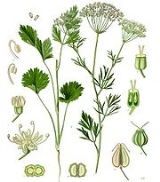
Anise

Encyclopedia
Anise Pimpinella anisum, also called aniseed, is a flowering plant
in the family Apiaceae
native to the eastern Mediterranean region and Southwest Asia
. Its flavor resembles that of liquorice, fennel
, and tarragon
.
annual plant
growing to 3 ft (0.9144 m) tall. The leaves
at the base of the plant are simple, 0.5–2 in (1.3–5.1 cm) long and shallowly lobed, while leaves higher on the stems are feathery pinnate, divided into numerous leaves. The flower
s are white, approximately 3 mm diameter, produced in dense umbel
s. The fruit
is an oblong dry schizocarp
, 3 – 5 mm long. It is these seed pods that are referred to as "aniseed".
Anise is a food plant for the larva
e of some Lepidoptera
species (butterflies and moth
s), including the lime-speck pug
and wormwood pug
.
, they do not transplant well after being established, so they should be started either in their final location or transplanted while the seedlings are still small.
of anise, anethole
, is found in both anise and an unrelated spice called star anise (Illicium verum) that features prominently in South Asian, Southeast Asian, and East Asian dishes. Star anise is considerably less expensive to produce, and has gradually displaced Pimpinella anisum in Western markets. While formerly produced in larger quantities, by 1999 world production of the essential oil of anise was only 8 tonnes, compared to 400 tonnes from star anise
.
Essential oil yielded by distillation is generally around 2-3% and anethole
makes up 80-90% of this.
s, Australian humbugs, New Zealand aniseed wheels, Italian pizzelle
, German Pfeffernusse
and Springerle
, Austrian Anisebögen,
Netherland muisjes
, Norwegian knotts, New Mexican Bizcochitos, and Peruvian picarones
. It is a key ingredient in Mexican atole
de anís or champurrado
, which is similar to hot chocolate
, and it is taken as a digestive after meals in India
.
, Colombian aguardiente
, French spirits absinthe
, anisette
and pastis
, Greek ouzo
, Bulgarian mastika
, German Jägermeister
, Italian sambuca
, Dutch Brokmöpke, Peruvian and Spanish anís
, Mexican Xtabentún
and Turkish raki
. In these liquors, it is clear, but on addition of water becomes cloudy, a phenomenon known as the ouzo effect
. It is believed to be one of the secret ingredients in the French liqueur Chartreuse
. It is also used in some root beer
s, such as Virgil's
in the United States.
Flowering plant
The flowering plants , also known as Angiospermae or Magnoliophyta, are the most diverse group of land plants. Angiosperms are seed-producing plants like the gymnosperms and can be distinguished from the gymnosperms by a series of synapomorphies...
in the family Apiaceae
Apiaceae
The Apiaceae , commonly known as carrot or parsley family, is a group of mostly aromatic plants with hollow stems. The family is large, with more than 3,700 species spread across 434 genera, it is the sixteenth largest family of flowering plants...
native to the eastern Mediterranean region and Southwest Asia
Southwest Asia
Western Asia, West Asia, Southwest Asia or Southwestern Asia are terms that describe the westernmost portion of Asia. The terms are partly coterminous with the Middle East, which describes a geographical position in relation to Western Europe rather than its location within Asia...
. Its flavor resembles that of liquorice, fennel
Fennel
Fennel is a plant species in the genus Foeniculum . It is a member of the family Apiaceae . It is a hardy, perennial, umbelliferous herb, with yellow flowers and feathery leaves...
, and tarragon
Tarragon
Tarragon or dragon's-wort is a perennial herb in the family Asteraceae related to wormwood. Corresponding to its species name, a common term for the plant is "dragon herb". It is native to a wide area of the Northern Hemisphere from easternmost Europe across central and eastern Asia to India,...
.
Biology
Anise is a herbaceousHerbaceous
A herbaceous plant is a plant that has leaves and stems that die down at the end of the growing season to the soil level. They have no persistent woody stem above ground...
annual plant
Annual plant
An annual plant is a plant that usually germinates, flowers, and dies in a year or season. True annuals will only live longer than a year if they are prevented from setting seed...
growing to 3 ft (0.9144 m) tall. The leaves
Leaf
A leaf is an organ of a vascular plant, as defined in botanical terms, and in particular in plant morphology. Foliage is a mass noun that refers to leaves as a feature of plants....
at the base of the plant are simple, 0.5–2 in (1.3–5.1 cm) long and shallowly lobed, while leaves higher on the stems are feathery pinnate, divided into numerous leaves. The flower
Flower
A flower, sometimes known as a bloom or blossom, is the reproductive structure found in flowering plants . The biological function of a flower is to effect reproduction, usually by providing a mechanism for the union of sperm with eggs...
s are white, approximately 3 mm diameter, produced in dense umbel
Umbel
An umbel is an inflorescence which consists of a number of short flower stalks which are equal in length and spread from a common point, somewhat like umbrella ribs....
s. The fruit
Fruit
In broad terms, a fruit is a structure of a plant that contains its seeds.The term has different meanings dependent on context. In non-technical usage, such as food preparation, fruit normally means the fleshy seed-associated structures of certain plants that are sweet and edible in the raw state,...
is an oblong dry schizocarp
Schizocarp
A schizocarp is a dry fruit that develops from multiple carpels. When mature it splits up into mericarps. Mericarps are often 1-seeded as in, for example, Malva, Malvastrum, and Sida...
, 3 – 5 mm long. It is these seed pods that are referred to as "aniseed".
Anise is a food plant for the larva
Larva
A larva is a distinct juvenile form many animals undergo before metamorphosis into adults. Animals with indirect development such as insects, amphibians, or cnidarians typically have a larval phase of their life cycle...
e of some Lepidoptera
Lepidoptera
Lepidoptera is a large order of insects that includes moths and butterflies . It is one of the most widespread and widely recognizable insect orders in the world, encompassing moths and the three superfamilies of butterflies, skipper butterflies, and moth-butterflies...
species (butterflies and moth
Moth
A moth is an insect closely related to the butterfly, both being of the order Lepidoptera. Moths form the majority of this order; there are thought to be 150,000 to 250,000 different species of moth , with thousands of species yet to be described...
s), including the lime-speck pug
Lime-speck Pug
The Lime-speck Pug is a moth of the family Geometridae. It is a common species throughout the Palearctic region, the Near East and North Africa....
and wormwood pug
Wormwood Pug
The Wormwood Pug is a moth of the family Geometridae. It is a common species across the Palearctic region and the Near East, as well as North America....
.
Cultivation
Anise plants grow best in light, fertile, well drained soil. The seeds should be planted as soon as the ground warms up in spring. Because the plants have a taprootTaproot
A taproot is an enlarged, somewhat straight to tapering plant root that grows vertically downward. It forms a center from which other roots sprout laterally.Plants with taproots are difficult to transplant...
, they do not transplant well after being established, so they should be started either in their final location or transplanted while the seedlings are still small.
Production
Western cuisines have long used anise as a moderately popular herb to flavor some dishes, drinks, and candies, and so the word has come to connote both the species of herb and the licorice-like flavor. The most powerful flavor component of the essential oilEssential oil
An essential oil is a concentrated hydrophobic liquid containing volatile aroma compounds from plants. Essential oils are also known as volatile oils, ethereal oils or aetherolea, or simply as the "oil of" the plant from which they were extracted, such as oil of clove...
of anise, anethole
Anethole
Anethole is a phenylpropene, a type of aromatic compound that occurs widely in nature, in essential oils...
, is found in both anise and an unrelated spice called star anise (Illicium verum) that features prominently in South Asian, Southeast Asian, and East Asian dishes. Star anise is considerably less expensive to produce, and has gradually displaced Pimpinella anisum in Western markets. While formerly produced in larger quantities, by 1999 world production of the essential oil of anise was only 8 tonnes, compared to 400 tonnes from star anise
Star anise
Illicium verum, commonly called Star anise, star aniseed, or Chinese star anise, is a spice that closely resembles anise in flavor, obtained from the star-shaped pericarp of Illicium verum, a small native evergreen tree of northeast Vietnam and southwest China...
.
Composition
As with all spices, the composition of anise varies considerably with origin and cultivation method. These are typical values for the main constituents.- Moisture: 9-13%
- Protein: 18%
- Fatty oil: 8-23%
- Essential oil: 2-7%
- Starch: 5%
- N-free extract: 22-28%
- Crude fibre: 12-25%
Essential oil yielded by distillation is generally around 2-3% and anethole
Anethole
Anethole is a phenylpropene, a type of aromatic compound that occurs widely in nature, in essential oils...
makes up 80-90% of this.
Culinary
Anise is sweet and very aromatic, distinguished by its licorice-like flavor. The seeds, whole or ground, are used in a wide variety of regional and ethnic confectioneries, including the black jelly bean, British aniseed ballAniseed ball
Aniseed balls are a type of hard round sweet sold in the UK, New Zealand and Australia. They are shiny and dark brownish red, and hard like Gobstoppers, but generally only 1cm across. They are generally sold by weight- traditionally, for example, they were sold by quarter pound...
s, Australian humbugs, New Zealand aniseed wheels, Italian pizzelle
Pizzelle
Pizzelle are traditional Italian waffle cookies made from flour, eggs, sugar, butter or vegetable oil, and flavoring . Pizzelle can be hard and crisp or soft and chewy depending on the ingredients and method of preparation.Pizzelle were originally made in the Abruzzo region of south-central Italy...
, German Pfeffernusse
Pfeffernüsse
Pfeffernüsse are small, firm, round biscuits, sometimes with ground nuts....
and Springerle
Springerle
Springerle is a type of German biscuit with an embossed design made by pressing a mold onto rolled dough and allowing the impression to dry before baking. This preserves the detail of the surface pattern. They are most commonly seen during the Christmas season.The name springerle means "little...
, Austrian Anisebögen,
Netherland muisjes
Muisjes
Muisjes are a traditional Dutch open-faced sandwich topping, very similar to nonpareils. While customary on bread, their most typical use is on beschuit, or rusk. Muisjes are made of aniseed sprinkles with a sugared and colored outer layer...
, Norwegian knotts, New Mexican Bizcochitos, and Peruvian picarones
Picarones
Picarones is a peruvian dessert originated in the colonial period. Its principal ingredients are squash and sweet potato. It is served in a doughnut form and covered with syrup, made from chancaca...
. It is a key ingredient in Mexican atole
Atole
Atole is a traditional masa-based Mexican and Central American hot drink. Chocolate atole is known as champurrado or atole...
de anís or champurrado
Champurrado (beverage)
Champurrado is a chocolate-based atole, a warm and thick Mexican drink, based on masa , piloncillo, water or milk and occasionally containing cinnamon, anise seed and or vanilla bean. Atole drinks are whipped up using a wooden whisk called a molinillo...
, which is similar to hot chocolate
Hot chocolate
Hot chocolate is a heated beverage typically consisting of shaved chocolate, melted chocolate or cocoa powder, heated milk or water, and sugar...
, and it is taken as a digestive after meals in India
India
India , officially the Republic of India , is a country in South Asia. It is the seventh-largest country by geographical area, the second-most populous country with over 1.2 billion people, and the most populous democracy in the world...
.
Liquor
Anise is used to flavor Middle Eastern arakArak (distilled beverage)
Arak or Araq , is a highly alcoholic spirit from the anis drinks family. It is a clear, colorless, unsweetened anise-flavoured distilled alcoholic drink...
, Colombian aguardiente
Aguardiente
Aguardiente , aiguardent , aguardente , and augardente are generic terms for alcoholic beverages that contain between 29% and 60% alcohol by volume...
, French spirits absinthe
Absinthe
Absinthe is historically described as a distilled, highly alcoholic beverage. It is an anise-flavoured spirit derived from herbs, including the flowers and leaves of the herb Artemisia absinthium, commonly referred to as "grande wormwood", together with green anise and sweet fennel...
, anisette
Anisette
Anisette is an anise-flavored liqueur that is consumed mainly in France, Italy, Portugal, and Spain. It is colorless and, unlike some other anise-based liqueurs, contains no licorice.True anisette is produced by means of distilling aniseed...
and pastis
Pastis
Pastis is an anise-flavored liqueur and apéritif from France, typically containing 40–45% alcohol by volume, although alcohol-free varieties exist.-Origins:...
, Greek ouzo
Ouzo
Ouzo is an anise-flavored aperitif that is widely consumed in Greece and Cyprus, and a symbol of Greek culture.-History:Traditionally, tsipouro is said to have been the pet project of a group of 14th century monks living in a monastery on holy Mount Athos. One version of it is flavored with anise...
, Bulgarian mastika
Mastika
Mastika , mastícha; is a liquor seasoned with mastic, a resin gathered from the mastic tree, a small evergreen tree native to the Mediterranean region...
, German Jägermeister
Jägermeister
Jägermeister is a German 70-proof digestif made with 56 different herbs and spices. It is the flagship product of Mast-Jägermeister SE, headquartered in Wolfenbüttel, south of Braunschweig, Lower Saxony, Germany.- History :...
, Italian sambuca
Sambuca
Sambuca is an Italian anise-flavoured, usually colourless, liqueur. Its most common variety is often referred to as white sambuca to differentiate it from other varieties that are deep blue in colour or bright red ....
, Dutch Brokmöpke, Peruvian and Spanish anís
Anisette
Anisette is an anise-flavored liqueur that is consumed mainly in France, Italy, Portugal, and Spain. It is colorless and, unlike some other anise-based liqueurs, contains no licorice.True anisette is produced by means of distilling aniseed...
, Mexican Xtabentún
Xtabentún (liqueur)
Xtabentún is an anise liqueur made in Mexico's Yucatán region from anise seed, and fermented honey produced by bees from the nectar of xtabentún flowers. Rum is then added to the anise and honey mixture...
and Turkish raki
Raki (alcoholic beverage)
Raki is a Turkish unsweetened, anise-flavored hard alcoholic drink that is popular in Turkey, Greece, Serbia, and other Balkan countries as an apéritif. It is often served with seafood or meze...
. In these liquors, it is clear, but on addition of water becomes cloudy, a phenomenon known as the ouzo effect
Ouzo effect
The ouzo effect is a phenomenon observed when water is added to ouzo and other anise-flavored liqueurs and spirits, such as pastis, raki, arak and absinthe, forming a milky oil-in-water microemulsion...
. It is believed to be one of the secret ingredients in the French liqueur Chartreuse
Chartreuse (liqueur)
Chartreuse is a French liqueur made by the Carthusian Monks since the 1740s. It is composed of distilled alcohol aged with 130 herbal extracts. The liqueur is named after the Monks' Grande Chartreuse monastery, located in the Chartreuse Mountains in the general region of Grenoble in France...
. It is also used in some root beer
Root beer
Root beer is a carbonated, sweetened beverage, originally made using the root of a sassafras plant as the primary flavor. Root beer, popularized in North America, comes in two forms: alcoholic and soft drink. The historical root beer was analogous to small beer in that the process provided a drink...
s, such as Virgil's
Virgil's Root Beer
Developed by Jill Fraser Crowley and Edward Crowley, Virgil's Root Beer is a microbrewed gourmet root beer. The company was sold in 1999 and Virgil's is now made in Los Angeles, California by Reed's, Inc. It is sold in 12-oz...
in the United States.
Medicinal
- Anise, like fennelFennelFennel is a plant species in the genus Foeniculum . It is a member of the family Apiaceae . It is a hardy, perennial, umbelliferous herb, with yellow flowers and feathery leaves...
, contains anetholeAnetholeAnethole is a phenylpropene, a type of aromatic compound that occurs widely in nature, in essential oils...
, a phytoestrogen. - Anise has been used to treat menstrual cramps.
- The main use of anise in European herbal medicine was for its carminativeCarminativeA carminative, also known as carminativum , is a herb or preparation that either prevents formation of gas in the gastrointestinal tract or facilitates the expulsion of said gas, thereby combating flatulence...
effect, as noted by John GerardJohn GerardJohn Gerard aka John Gerarde was an English herbalist notable for his herbal garden and botany writing. In 1597 he published a large and heavily illustrated "Herball, or Generall Historie of Plantes", which went on to be the most widely circulated botany book in English in the 17th century...
in his "Great Herball," an early encyclopedia of herbal medicine. - The essential oil has reportedly been used as an insecticide against head-lice and mites.
Miscellaneous
- In the 1860s, American Civil War nurse Maureen Hellstrom used anise seeds as an early form of antiseptic. This method was later found to have caused high levels of toxicity in the blood and was discontinued shortly thereafter.
- According to Pliny the ElderPliny the ElderGaius Plinius Secundus , better known as Pliny the Elder, was a Roman author, naturalist, and natural philosopher, as well as naval and army commander of the early Roman Empire, and personal friend of the emperor Vespasian...
, anise was used as a cure for sleeplessness, chewed with alexandersAlexandersAlexanders is a cultivated flowering plant, Smyrnium olusatrum, belonging to the family Umbelliferae. It is also known as alisanders, horse parsley and smyrnium. It was known to Theophrastus and Pliny the Elder ....
and a little honeyHoneyHoney is a sweet food made by bees using nectar from flowers. The variety produced by honey bees is the one most commonly referred to and is the type of honey collected by beekeepers and consumed by humans...
in the morning to freshen the breath, and, when mixed with wine, as a remedy for aspAsp (reptile)Asp is the modern Anglicisation of the word aspis, which in antiquity referred to any one of several venomous snake species found in the Nile region. It is believed that the aspis referred to in Egyptian mythology is the modern Egyptian cobra....
bites (N.H. 20.72). - In Pakistani and Indian cuisineIndian cuisineIndian cuisine consists of thousands of regional cuisines which date back thousands of years. The dishes of India are characterised by the extensive use of various Indian spices, herbs, vegetables and fruit. Indian cuisine is also known for the widespread practice of vegetarianism in Indian society...
, no distinction is made between anise and fennelFennelFennel is a plant species in the genus Foeniculum . It is a member of the family Apiaceae . It is a hardy, perennial, umbelliferous herb, with yellow flowers and feathery leaves...
. Therefore, the same name (saunf) is usually given to both of them. Some use the term patli (thin) saunf or velayati (foreign) saunf to distinguish anise from fennel, although GujaratiGujarati languageGujarati is an Indo-Aryan language, and part of the greater Indo-European language family. It is derived from a language called Old Gujarati which is the ancestor language of the modern Gujarati and Rajasthani languages...
has the term anisi. - In the Middle EastMiddle EastThe Middle East is a region that encompasses Western Asia and Northern Africa. It is often used as a synonym for Near East, in opposition to Far East...
, water is boiled with about a tablespoon of aniseed per teacup to make a special hot teaTeaTea is an aromatic beverage prepared by adding cured leaves of the Camellia sinensis plant to hot water. The term also refers to the plant itself. After water, tea is the most widely consumed beverage in the world...
called yansoon. This tea is given to mothers in Egypt when they are nursing. - Builders of steam locomotiveSteam locomotiveA steam locomotive is a railway locomotive that produces its power through a steam engine. These locomotives are fueled by burning some combustible material, usually coal, wood or oil, to produce steam in a boiler, which drives the steam engine...
s in Britain incorporated capsules of aniseed oil into white metalWhite metalThe white metals are any of several light-colored alloys used as a base for plated silverware, ornaments or novelties, as well as any of several lead-base or tin-base alloys used for things like bearings, jewellery, miniature figures, fusible plugs, some medals and metal type.Some of the metals...
plain bearingPlain bearingA plain bearing, also known as a plane bearing or a friction bearing is the simplest type of bearing, comprising just a bearing surface and no rolling elements. Therefore the journal slides over the bearing surface. The simplest example of a plain bearing is a shaft rotating in a hole...
s, so the distinctive smell would give warning in case of overheating. - Anise can be made into a liquid scent and is used for both drag huntingDrag huntingDrag hunting is a sport in which a group of dogs chase a scent that has been laid over a terrain before the hunt...
and fishingFishingFishing is the activity of trying to catch wild fish. Fish are normally caught in the wild. Techniques for catching fish include hand gathering, spearing, netting, angling and trapping....
. It is put on fishing lureFishing lureA fishing lure is an object attached to the end of a fishing line which is designed to resemble and move like the prey of a fish. The purpose of the lure is to use movement, vibration, and colour to catch the fish's attention so it bites the hook...
s to attract fishFishFish are a paraphyletic group of organisms that consist of all gill-bearing aquatic vertebrate animals that lack limbs with digits. Included in this definition are the living hagfish, lampreys, and cartilaginous and bony fish, as well as various extinct related groups...
.