


Cult of Dionysus

Encyclopedia
The Cult of Dionysus is strongly associated with satyr
s, centaur
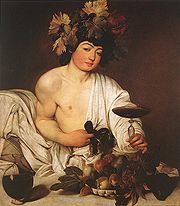
s, and sileni, and its characteristic symbols are the bull
, the serpent
, the ivy
, and the wine. The Dionysia
and Lenaia
festivals in Athens
were dedicated to Dionysus
, as well as the Phallic processions
. Initiates worshipped him in the Dionysian Mysteries
, which were comparable to and linked with the Orphic Mysteries, and may have influenced Gnosticism
. Orpheus was said to have invented the Mysteries of Dionysus.
The Cult of Dionysus traces back to at least Minoan Crete, since his name is found on Mycenean
Linear B
tablets as "DI-WO-NI-SO-JO", and Karl Kerenyi
Dionysus is often shown riding a leopard
, wearing a leopard skin, or in a chariot drawn by panthers
, and may also be recognized by the thyrsus
he carries. Besides the grapevine
and its wild barren alter-ego, the toxic ivy plant, both sacred to him, the fig
was also his symbol. The pinecone that tipped his thyrsus linked him to Cybele
.
 Introduced into Rome
(c. 200 BC
) from the Greek culture of southern Italy
or by way of Greek-influenced Etruria
, the bacchanalia were held in secret and attended by women only, in the grove of Simila, near the Aventine Hill
, on March 16 and 17. Subsequently, admission to the rites were extended to men and celebrations took place five times a month. The notoriety of these festivals, where many kinds of crimes and political conspiracies were supposed to be planned, led in 186 BC
to a decree of the Senate
—the so-called Senatus consultum de Bacchanalibus, inscribed on a bronze tablet discovered in Calabria
(1640), now at Vienna
—by which the Bacchanalia were prohibited throughout all Italy except in certain special cases which must be approved specifically by the Senate. In spite of the severe punishment inflicted on those found in violation of this decree, the Bacchanalia were not stamped out, at any rate in the south of Italy, for a very long time.
Dionysus is equated with both Bacchus and Liber
(also Liber Pater). Liber ("the free one") was a god of fertility, wine, and growth, married to Libera
. His festival was the Liberalia, celebrated on March 17, but in some myths the festival was also held on March 5.
 Dionysus sometimes has the epithet
Acratophorus, by which he was designated as the giver of unmixed wine, and worshipped at Phigaleia in Arcadia
. In Sicyon
he was worshiped by the name Acroreites. As Bacchus, he carried the Latin epithet Adoneus, "Ruler". Aegobolus, "goat killer", was the name under which he was worshiped at Potniae in Boeotia
. As Aesymnetes
("ruler" or "lord") he was worshipped at Aroë and Patrae
in Achaea
. Another epithet was Bromios, "the thunderer" or "he of the loud shout". As Dendrites, "he of the trees", he is a powerful fertility god. Dithyrambos is sometimes used to refer to him or to solemn songs sung to him at festivals; the name refers to his premature birth. Eleutherios ("the liberator") was an epithet for both Dionysus and Eros. Other forms of the god as that of fertility include the epithet in Samos
and Lesbos Enorches
("with balls" or perhaps "in the testicles" in reference to Zeus' sewing the babe Dionysus into his thigh, i.e., his testicles). Even Augustine in City og God 6.9 credits Dionysus with being responsible for sexual relief, saying that he "liberates" men from semen during intercourse.Evius is an epithet of his used prominently in Euripides
' play, The Bacchae
. Iacchus
, possibly an epithet of Dionysus, is associated with the Eleusinian Mysteries
; in Eleusis, he is known as a son of Zeus
and Demeter
. The name "Iacchus" may come from the Ιακχος (Iakchos), a hymn sung in honor of Dionysus. With the epithet Liknites ("he of the winnowing fan") he is a fertility god connected with the mystery religion
s. A winnowing fan was similar to a shovel
and was used to separate the chaff from the grain. In addition, Dionysus is known as Lyaeus ("he who unties") as a god of relaxation and freedom from worry, and as Oeneus he is the god of the wine press
.
In the Greek pantheon
, Dionysus (along with Zeus
) absorbs the role of Sabazios
, a Phrygia
n deity. In the Roman pantheon
, Sabazius became an alternate name for Bacchus.
Satyr
In Greek mythology, satyrs are a troop of male companions of Pan and Dionysus — "satyresses" were a late invention of poets — that roamed the woods and mountains. In myths they are often associated with pipe-playing....
s, centaur
Centaur
In Greek mythology, a centaur or hippocentaur is a member of a composite race of creatures, part human and part horse...
s, and sileni, and its characteristic symbols are the bull
Bull (mythology)
The worship of the Sacred Bull throughout the ancient world is most familiar to the Western world in the biblical episode of the idol of the Golden Calf. The Golden Calf after being made by the Hebrew people in the wilderness of Sinai, were rejected and destroyed by Moses and his tribe after his...
, the serpent
Serpent (symbolism)
Serpent in Latin means: Rory Collins :&, in turn, from the Biblical Hebrew word of: "saraf" with root letters of: which refers to something burning-as, the pain of poisonous snake's bite was likened to internal burning.This word is commonly used in a specifically mythic or religious context,...
, the ivy
Ivy
Ivy, plural ivies is a genus of 12–15 species of evergreen climbing or ground-creeping woody plants in the family Araliaceae, native to western, central and southern Europe, Macaronesia, northwestern Africa and across central-southern Asia east to Japan and Taiwan.-Description:On level ground they...
, and the wine. The Dionysia
Dionysia
The Dionysia[p] was a large festival in ancient Athens in honor of the god Dionysus, the central events of which were the theatrical performances of dramatic tragedies and, from 487 BC, comedies. It was the second-most important festival after the Panathenaia...
and Lenaia
Lenaia
The Lenaia was an annual festival with a dramatic competition. It was one of the lesser festivals of Athens and Ionia in ancient Greece. The Lenaia took place in Athens in the month of Gamelion, roughly corresponding to January. The festival was in honour of Dionysos Lenaios...
festivals in Athens
Athens
Athens , is the capital and largest city of Greece. Athens dominates the Attica region and is one of the world's oldest cities, as its recorded history spans around 3,400 years. Classical Athens was a powerful city-state...
were dedicated to Dionysus
Dionysus
Dionysus was the god of the grape harvest, winemaking and wine, of ritual madness and ecstasy in Greek mythology. His name in Linear B tablets shows he was worshipped from c. 1500—1100 BC by Mycenean Greeks: other traces of Dionysian-type cult have been found in ancient Minoan Crete...
, as well as the Phallic processions
Phallic processions
Phallic processions, or Penis Parade, called phallika in ancient Greece, were a common feature of Dionysiac celebrations; they were processions that advanced to a cult center, and were characterized by obscenities and verbal abuse. The display of a fetishized phallus was a common feature...
. Initiates worshipped him in the Dionysian Mysteries
Dionysian Mysteries
The Dionysian Mysteries were a ritual of ancient Greece and Rome which used intoxicants and other trance-inducing techniques to remove inhibitions and social constraints, liberating the individual to return to a natural state. It also provided some liberation for those marginalized by Greek...
, which were comparable to and linked with the Orphic Mysteries, and may have influenced Gnosticism
Gnosticism
Gnosticism is a scholarly term for a set of religious beliefs and spiritual practices common to early Christianity, Hellenistic Judaism, Greco-Roman mystery religions, Zoroastrianism , and Neoplatonism.A common characteristic of some of these groups was the teaching that the realisation of Gnosis...
. Orpheus was said to have invented the Mysteries of Dionysus.
The Cult of Dionysus traces back to at least Minoan Crete, since his name is found on Mycenean
Mycenaean language
Mycenaean Greek is the most ancient attested form of the Greek language, spoken on the Greek mainland, Crete and Cyprus in the 16th to 12th centuries BC, before the hypothesised Dorian invasion which was often cited as the terminus post quem for the coming of the Greek language to Greece...
Linear B
Linear B
Linear B is a syllabic script that was used for writing Mycenaean Greek, an early form of Greek. It pre-dated the Greek alphabet by several centuries and seems to have died out with the fall of Mycenaean civilization...
tablets as "DI-WO-NI-SO-JO", and Karl Kerenyi
Karl Kerényi
Károly Kerényi was a Hungarian scholar in classical philology, one of the founders of modern studies in Greek mythology.- Hungary 1897–1943 :...
Dionysus is often shown riding a leopard
Leopard
The leopard , Panthera pardus, is a member of the Felidae family and the smallest of the four "big cats" in the genus Panthera, the other three being the tiger, lion, and jaguar. The leopard was once distributed across eastern and southern Asia and Africa, from Siberia to South Africa, but its...
, wearing a leopard skin, or in a chariot drawn by panthers
Panther (legendary creature)
A Panther is a creature out of ancient myth that resembles a big cat with a multicoloured hide.Under medieval belief after feasting the panther will sleep in a cave for a total of three days. After this period ends, the panther roars, in the process emitting a sweet smelling odor...
, and may also be recognized by the thyrsus
Thyrsus
In Greek mythology, a thyrsus or thyrsos was a staff of giant fennel covered with ivy vines and leaves, sometimes wound with taeniae and always topped with a pine cone. These staffs were carried by Dionysus and his followers. Euripides wrote that honey dripped from the thyrsos staves that the...
he carries. Besides the grapevine
Grapevine
Grapevine is the common name for plants of the genus Vitis. Other meanings include:*Grapevine , a term often used to describe a form of communication by means of gossip or rumor, as in "heard it through the grapevine"...
and its wild barren alter-ego, the toxic ivy plant, both sacred to him, the fig
Ficus
Ficus is a genus of about 850 species of woody trees, shrubs, vines, epiphytes, and hemiepiphyte in the family Moraceae. Collectively known as fig trees or figs, they are native throughout the tropics with a few species extending into the semi-warm temperate zone. The Common Fig Ficus is a genus of...
was also his symbol. The pinecone that tipped his thyrsus linked him to Cybele
Cybele
Cybele , was a Phrygian form of the Earth Mother or Great Mother. As with Greek Gaia , her Minoan equivalent Rhea and some aspects of Demeter, Cybele embodies the fertile Earth...
.
Bacchanalia
Rome
Rome is the capital of Italy and the country's largest and most populated city and comune, with over 2.7 million residents in . The city is located in the central-western portion of the Italian Peninsula, on the Tiber River within the Lazio region of Italy.Rome's history spans two and a half...
(c. 200 BC
200 BC
Year 200 BC was a year of the pre-Julian Roman calendar. At the time it was known as the Year of the Consulship of Maximus and Cotta...
) from the Greek culture of southern Italy
Magna Graecia
Magna Græcia is the name of the coastal areas of Southern Italy on the Tarentine Gulf that were extensively colonized by Greek settlers; particularly the Achaean colonies of Tarentum, Crotone, and Sybaris, but also, more loosely, the cities of Cumae and Neapolis to the north...
or by way of Greek-influenced Etruria
Etruria
Etruria—usually referred to in Greek and Latin source texts as Tyrrhenia—was a region of Central Italy, an area that covered part of what now are Tuscany, Latium, Emilia-Romagna, and Umbria. A particularly noteworthy work dealing with Etruscan locations is D. H...
, the bacchanalia were held in secret and attended by women only, in the grove of Simila, near the Aventine Hill
Aventine Hill
The Aventine Hill is one of the seven hills on which ancient Rome was built. It belongs to Ripa, the twelfth rione, or ward, of Rome.-Location and boundaries:The Aventine hill is the southernmost of Rome's seven hills...
, on March 16 and 17. Subsequently, admission to the rites were extended to men and celebrations took place five times a month. The notoriety of these festivals, where many kinds of crimes and political conspiracies were supposed to be planned, led in 186 BC
186 BC
Year 186 BC was a year of the pre-Julian Roman calendar. At the time it was known as the Year of the Consulship of Albinus and Philippus...
to a decree of the Senate
Roman Senate
The Senate of the Roman Republic was a political institution in the ancient Roman Republic, however, it was not an elected body, but one whose members were appointed by the consuls, and later by the censors. After a magistrate served his term in office, it usually was followed with automatic...
—the so-called Senatus consultum de Bacchanalibus, inscribed on a bronze tablet discovered in Calabria
Calabria
Calabria , in antiquity known as Bruttium, is a region in southern Italy, south of Naples, located at the "toe" of the Italian Peninsula. The capital city of Calabria is Catanzaro....
(1640), now at Vienna
Vienna
Vienna is the capital and largest city of the Republic of Austria and one of the nine states of Austria. Vienna is Austria's primary city, with a population of about 1.723 million , and is by far the largest city in Austria, as well as its cultural, economic, and political centre...
—by which the Bacchanalia were prohibited throughout all Italy except in certain special cases which must be approved specifically by the Senate. In spite of the severe punishment inflicted on those found in violation of this decree, the Bacchanalia were not stamped out, at any rate in the south of Italy, for a very long time.
Dionysus is equated with both Bacchus and Liber
Liber
In ancient Roman religion and mythology, Liber , also known as Liber Pater was a god of viticulture and wine, fertility and freedom. He was a patron deity of Rome's plebeians and was part of their Aventine Triad. His festival of Liberalia became associated with free speech and the rights...
(also Liber Pater). Liber ("the free one") was a god of fertility, wine, and growth, married to Libera
Libera (mythology)
Libera is a fertility goddess in ancient Roman religion. Her origins are unknown; she may have been a fertility goddess of archaic or pre-Roman Magna Graecia. Her Latin name is the feminine form of Liber,...
. His festival was the Liberalia, celebrated on March 17, but in some myths the festival was also held on March 5.
Appellations
Epithet
An epithet or byname is a descriptive term accompanying or occurring in place of a name and having entered common usage. It has various shades of meaning when applied to seemingly real or fictitious people, divinities, objects, and binomial nomenclature. It is also a descriptive title...
Acratophorus, by which he was designated as the giver of unmixed wine, and worshipped at Phigaleia in Arcadia
Arcadia
Arcadia is one of the regional units of Greece. It is part of the administrative region of Peloponnese. It is situated in the central and eastern part of the Peloponnese peninsula. It takes its name from the mythological character Arcas. In Greek mythology, it was the home of the god Pan...
. In Sicyon
Sicyon
Sikyon was an ancient Greek city situated in the northern Peloponnesus between Corinth and Achaea on the territory of the present-day prefecture of Corinthia...
he was worshiped by the name Acroreites. As Bacchus, he carried the Latin epithet Adoneus, "Ruler". Aegobolus, "goat killer", was the name under which he was worshiped at Potniae in Boeotia
Boeotia
Boeotia, also spelled Beotia and Bœotia , is one of the regional units of Greece. It is part of the region of Central Greece. It was also a region of ancient Greece. Its capital is Livadeia, the second largest city being Thebes.-Geography:...
. As Aesymnetes
Dionysus Aesymnetes
Aesymnetes was an epithet of the Greek god Dionysus, which signifies the "Lord", or "Ruler", and under which he was worshipped at Aroë in Achaea....
("ruler" or "lord") he was worshipped at Aroë and Patrae
Patras
Patras , ) is Greece's third largest urban area and the regional capital of West Greece, located in northern Peloponnese, 215 kilometers west of Athens...
in Achaea
Achaea
Achaea is one of the regional units of Greece. It is part of the region of West Greece. It is situated in the northwestern part of the Peloponnese peninsula. The capital is Patras. The population exceeds 300,000 since 2001.-Geography:...
. Another epithet was Bromios, "the thunderer" or "he of the loud shout". As Dendrites, "he of the trees", he is a powerful fertility god. Dithyrambos is sometimes used to refer to him or to solemn songs sung to him at festivals; the name refers to his premature birth. Eleutherios ("the liberator") was an epithet for both Dionysus and Eros. Other forms of the god as that of fertility include the epithet in Samos
Samos Island
Samos is a Greek island in the eastern Aegean Sea, south of Chios, north of Patmos and the Dodecanese, and off the coast of Asia Minor, from which it is separated by the -wide Mycale Strait. It is also a separate regional unit of the North Aegean region, and the only municipality of the regional...
and Lesbos Enorches
Enorches
In Greek mythology, Enorches was a son of Thyestes by his sister Daeta. He was born out of an egg and built a temple to Dionysus, who was hence called Dionysus Enorches, though Enorches may also describe the god as the dancer....
("with balls" or perhaps "in the testicles" in reference to Zeus' sewing the babe Dionysus into his thigh, i.e., his testicles). Even Augustine in City og God 6.9 credits Dionysus with being responsible for sexual relief, saying that he "liberates" men from semen during intercourse.Evius is an epithet of his used prominently in Euripides
Euripides
Euripides was one of the three great tragedians of classical Athens, the other two being Aeschylus and Sophocles. Some ancient scholars attributed ninety-five plays to him but according to the Suda it was ninety-two at most...
' play, The Bacchae
The Bacchae
The Bacchae is an ancient Greek tragedy by the Athenian playwright Euripides, during his final years in Macedon, at the court of Archelaus I of Macedon. It premiered posthumously at the Theatre of Dionysus in 405 BC as part of a tetralogy that also included Iphigeneia at Aulis, and which...
. Iacchus
Iacchus
In Greek mythology, Iacchus is an epithet of Dionysus, particularly associated with the Mysteries at Eleusis, where he was considered to be the son of Zeus and Demeter...
, possibly an epithet of Dionysus, is associated with the Eleusinian Mysteries
Eleusinian Mysteries
The Eleusinian Mysteries were initiation ceremonies held every year for the cult of Demeter and Persephone based at Eleusis in ancient Greece. Of all the mysteries celebrated in ancient times, these were held to be the ones of greatest importance...
; in Eleusis, he is known as a son of Zeus
Zeus
In the ancient Greek religion, Zeus was the "Father of Gods and men" who ruled the Olympians of Mount Olympus as a father ruled the family. He was the god of sky and thunder in Greek mythology. His Roman counterpart is Jupiter and his Etruscan counterpart is Tinia.Zeus was the child of Cronus...
and Demeter
Demeter
In Greek mythology, Demeter is the goddess of the harvest, who presided over grains, the fertility of the earth, and the seasons . Her common surnames are Sito as the giver of food or corn/grain and Thesmophoros as a mark of the civilized existence of agricultural society...
. The name "Iacchus" may come from the Ιακχος (Iakchos), a hymn sung in honor of Dionysus. With the epithet Liknites ("he of the winnowing fan") he is a fertility god connected with the mystery religion
Mystery religion
Mystery religions, sacred Mysteries or simply mysteries, were religious cults of the Greco-Roman world, participation in which was reserved to initiates....
s. A winnowing fan was similar to a shovel
Shovel
A shovel is a tool for digging, lifting, and moving bulk materials, such as soil, coal, gravel, snow, sand, or ore. Shovels are extremely common tools that are used extensively in agriculture, construction, and gardening....
and was used to separate the chaff from the grain. In addition, Dionysus is known as Lyaeus ("he who unties") as a god of relaxation and freedom from worry, and as Oeneus he is the god of the wine press
Wine press
A wine press is a device used to extract juice from crushed grapes during wine making. There are a number of different styles of presses that are used by wine makers but their overall functionality is the same. Each style of press exerts controlled pressure in order to free the juice from the fruit...
.
In the Greek pantheon
Pantheon (gods)
A pantheon is a set of all the gods of a particular polytheistic religion or mythology.Max Weber's 1922 opus, Economy and Society discusses the link between a...
, Dionysus (along with Zeus
Zeus
In the ancient Greek religion, Zeus was the "Father of Gods and men" who ruled the Olympians of Mount Olympus as a father ruled the family. He was the god of sky and thunder in Greek mythology. His Roman counterpart is Jupiter and his Etruscan counterpart is Tinia.Zeus was the child of Cronus...
) absorbs the role of Sabazios
Sabazios
Sabazios is the nomadic horseman and sky father god of the Phrygians and Thracians. In Indo-European languages, such as Phrygian, the -zios element in his name derives from dyeus, the common precursor of Latin deus and Greek Zeus...
, a Phrygia
Phrygia
In antiquity, Phrygia was a kingdom in the west central part of Anatolia, in what is now modern-day Turkey. The Phrygians initially lived in the southern Balkans; according to Herodotus, under the name of Bryges , changing it to Phruges after their final migration to Anatolia, via the...
n deity. In the Roman pantheon
Roman mythology
Roman mythology is the body of traditional stories pertaining to ancient Rome's legendary origins and religious system, as represented in the literature and visual arts of the Romans...
, Sabazius became an alternate name for Bacchus.
See also
- Apollonian and DionysianApollonian and DionysianThe Apollonian and Dionysian is a philosophical and literary concept, or dichotomy, based on certain features of ancient Greek mythology. Several Western philosophical and literary figures have invoked this dichotomy in critical and creative works....
- Theatre of DionysusTheatre of DionysusThe Theatre of Dionysus is a major open-air theatre and one of the earliest preserved in Athens. It was used for festivals in honor of the god Dionysus...
- Friedrich NietzscheFriedrich NietzscheFriedrich Wilhelm Nietzsche was a 19th-century German philosopher, poet, composer and classical philologist...
's The Birth of TragedyThe Birth of TragedyThe Birth of Tragedy from the Spirit of Music is a 19th-century work of dramatic theory by the German philosopher Friedrich Nietzsche. It was reissued in 1886 as The Birth of Tragedy, Or: Hellenism and Pessimism ...