

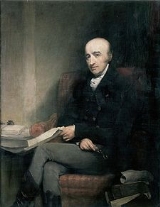
William Hyde Wollaston

Encyclopedia
William Hyde Wollaston FRS
(6 August 1766 – 22 December 1828) was an English
chemist
and physicist who is famous for discovering two chemical element
s and for developing a way to process platinum
ore.
, the son of the priest-astronomer Francis Wollaston (1737–1815) and his wife Mary Farquier. He was educated at Gonville and Caius College, Cambridge
: in 1793 William obtained a doctorate in medicine
from Cambridge University
and was a fellow of his college from 1787 to 1828. During his studies he became interested in chemistry
, crystallography
, metallurgy
and physics
. The mineral wollastonite
is named after him. In 1800 he left medicine and concentrated on pursuing these interests instead of his trained vocation.
Wollaston died in London
in 1828 and was buried in Chislehurst
, England.
(symbol Pd) in 1803 and rhodium
(symbol Rh) in 1803.
Anders Gustav Ekeberg discovered tantalum in 1802, however, William Hyde Wollaston declared it was identical with niobium (then known as columbium). Due to Wollaston's influence the existence of columbium was temporarily denied. Later Heinrich Rose
proved in 1846 that columbium and tantalum were indeed different elements and he renamed columbium "niobium
".
Wollaston also performed important work in electricity. In 1801, he performed an experiment showing that the electricity
from friction
was identical to that produced by voltaic pile
s. During the last years of his life he performed electrical experiments that would pave the way to the eventual design of the electric motor
. Controversy erupted when Michael Faraday
constructed the first working electric motor and hastily published his results without acknowledging Wollaston's previous work. Wollaston, however, saw nothing wrong with Faraday's action. Wollaston also invented a battery that allowed the zinc plates in the battery to be raised out of the acid, so that the zinc wouldn't be dissolved as quickly as it would if it were in the battery all the time.
His optical work was important as well, where he is remembered for his observations of dark Fraunhofer lines
in the solar spectrum (1802) which eventually led to the discovery of the elements in the Sun. He invented the camera lucida
(1807), the reflecting goniometer
(1809), and the Wollaston prism
. He also developed the first lens specifically for camera lens called Wollaston's meniscus lens, or just meniscus lens, in 1812. The lens was designed to improve the image projected by the camera obscura
. By changing the shape of the lens, Wollaston was able to project a flatter image, eliminating much of the distortion that was a problem with many of that day's biconvex lenses.
Wollaston used his Bakerian lecture
in 1805, On the Force of Percussion, to defend Gottfried Leibniz
's principle of vis viva
, an early formulation of the conservation of energy
. Wollaston was too ill to deliver his final Bakerian in 1828 and dictated it to Henry Warburton
who read it on 20 November.
Wollaston's attempt to demonstrate the presence of glucose
in the blood serum of diabetics was unsuccessful due to the limited means of detection available to him. His 1811 paper "On the non-existence of sugar in the blood of persons labouring under diabetes mellitus" concluded that sugar must travel via lymphatic channels from the stomach directly to the kidneys, without entering the bloodstream. Wollaston supported this theory by referring to the thesis of a young medical student at Edinburgh, Charles Darwin
, "Experiments establishing a criterion between mucaginous and purulent matter. And an account of the retrograde motions of the absorbent vessels of animal bodies in some diseases." This Charles Darwin was the eldest son of Erasmus Darwin
and not his more famous nephew, Charles Robert Darwin.
Wollaston also served on a royal commission
that opposed adoption of the metric system
(1819), and one that created the imperial gallon.
Legacy
Royal Society
The Royal Society of London for Improving Natural Knowledge, known simply as the Royal Society, is a learned society for science, and is possibly the oldest such society in existence. Founded in November 1660, it was granted a Royal Charter by King Charles II as the "Royal Society of London"...
(6 August 1766 – 22 December 1828) was an English
English people
The English are a nation and ethnic group native to England, who speak English. The English identity is of early mediaeval origin, when they were known in Old English as the Anglecynn. England is now a country of the United Kingdom, and the majority of English people in England are British Citizens...
chemist
Chemist
A chemist is a scientist trained in the study of chemistry. Chemists study the composition of matter and its properties such as density and acidity. Chemists carefully describe the properties they study in terms of quantities, with detail on the level of molecules and their component atoms...
and physicist who is famous for discovering two chemical element
Chemical element
A chemical element is a pure chemical substance consisting of one type of atom distinguished by its atomic number, which is the number of protons in its nucleus. Familiar examples of elements include carbon, oxygen, aluminum, iron, copper, gold, mercury, and lead.As of November 2011, 118 elements...
s and for developing a way to process platinum
Platinum
Platinum is a chemical element with the chemical symbol Pt and an atomic number of 78. Its name is derived from the Spanish term platina del Pinto, which is literally translated into "little silver of the Pinto River." It is a dense, malleable, ductile, precious, gray-white transition metal...
ore.
Biography
Wollaston was born in East Dereham, NorfolkNorfolk
Norfolk is a low-lying county in the East of England. It has borders with Lincolnshire to the west, Cambridgeshire to the west and southwest and Suffolk to the south. Its northern and eastern boundaries are the North Sea coast and to the north-west the county is bordered by The Wash. The county...
, the son of the priest-astronomer Francis Wollaston (1737–1815) and his wife Mary Farquier. He was educated at Gonville and Caius College, Cambridge
Gonville and Caius College, Cambridge
Gonville and Caius College is a constituent college of the University of Cambridge in Cambridge, England. The college is often referred to simply as "Caius" , after its second founder, John Keys, who fashionably latinised the spelling of his name after studying in Italy.- Outline :Gonville and...
: in 1793 William obtained a doctorate in medicine
Medicine
Medicine is the science and art of healing. It encompasses a variety of health care practices evolved to maintain and restore health by the prevention and treatment of illness....
from Cambridge University
University of Cambridge
The University of Cambridge is a public research university located in Cambridge, United Kingdom. It is the second-oldest university in both the United Kingdom and the English-speaking world , and the seventh-oldest globally...
and was a fellow of his college from 1787 to 1828. During his studies he became interested in chemistry
Chemistry
Chemistry is the science of matter, especially its chemical reactions, but also its composition, structure and properties. Chemistry is concerned with atoms and their interactions with other atoms, and particularly with the properties of chemical bonds....
, crystallography
Crystallography
Crystallography is the experimental science of the arrangement of atoms in solids. The word "crystallography" derives from the Greek words crystallon = cold drop / frozen drop, with its meaning extending to all solids with some degree of transparency, and grapho = write.Before the development of...
, metallurgy
Metallurgy
Metallurgy is a domain of materials science that studies the physical and chemical behavior of metallic elements, their intermetallic compounds, and their mixtures, which are called alloys. It is also the technology of metals: the way in which science is applied to their practical use...
and physics
Physics
Physics is a natural science that involves the study of matter and its motion through spacetime, along with related concepts such as energy and force. More broadly, it is the general analysis of nature, conducted in order to understand how the universe behaves.Physics is one of the oldest academic...
. The mineral wollastonite
Wollastonite
Wollastonite is a calcium inosilicate mineral that may contain small amounts of iron, magnesium, and manganese substituting for calcium. It is usually white. It forms when impure limestone or dolostone is subjected to high temperature and pressure sometimes in the presence of silica-bearing fluids...
is named after him. In 1800 he left medicine and concentrated on pursuing these interests instead of his trained vocation.
Wollaston died in London
London
London is the capital city of :England and the :United Kingdom, the largest metropolitan area in the United Kingdom, and the largest urban zone in the European Union by most measures. Located on the River Thames, London has been a major settlement for two millennia, its history going back to its...
in 1828 and was buried in Chislehurst
Chislehurst
Chislehurst is a suburban district in south-east London, England, and an electoral ward of the London Borough of Bromley. It is south-east of Charing Cross.-Toponymy:...
, England.
Work
Wollaston became wealthy by developing the first physico-chemical method for processing platinum ore in practical quantities, and in the process of testing the device he discovered the elements palladiumPalladium
Palladium is a chemical element with the chemical symbol Pd and an atomic number of 46. It is a rare and lustrous silvery-white metal discovered in 1803 by William Hyde Wollaston. He named it after the asteroid Pallas, which was itself named after the epithet of the Greek goddess Athena, acquired...
(symbol Pd) in 1803 and rhodium
Rhodium
Rhodium is a chemical element that is a rare, silvery-white, hard and chemically inert transition metal and a member of the platinum group. It has the chemical symbol Rh and atomic number 45. It is composed of only one isotope, 103Rh. Naturally occurring rhodium is found as the free metal, alloyed...
(symbol Rh) in 1803.
Anders Gustav Ekeberg discovered tantalum in 1802, however, William Hyde Wollaston declared it was identical with niobium (then known as columbium). Due to Wollaston's influence the existence of columbium was temporarily denied. Later Heinrich Rose
Heinrich Rose
Heinrich Rose was a German mineralogist and analytical chemist. He was the brother of the mineralogist Gustav Rose and a son of Valentin Rose....
proved in 1846 that columbium and tantalum were indeed different elements and he renamed columbium "niobium
Niobium
Niobium or columbium , is a chemical element with the symbol Nb and atomic number 41. It's a soft, grey, ductile transition metal, which is often found in the pyrochlore mineral, the main commercial source for niobium, and columbite...
".
Wollaston also performed important work in electricity. In 1801, he performed an experiment showing that the electricity
Electricity
Electricity is a general term encompassing a variety of phenomena resulting from the presence and flow of electric charge. These include many easily recognizable phenomena, such as lightning, static electricity, and the flow of electrical current in an electrical wire...
from friction
Friction
Friction is the force resisting the relative motion of solid surfaces, fluid layers, and/or material elements sliding against each other. There are several types of friction:...
was identical to that produced by voltaic pile
Voltaic pile
A voltaic pile is a set of individual Galvanic cells placed in series. The voltaic pile, invented by Alessandro Volta in 1800, was the first electric battery...
s. During the last years of his life he performed electrical experiments that would pave the way to the eventual design of the electric motor
Electric motor
An electric motor converts electrical energy into mechanical energy.Most electric motors operate through the interaction of magnetic fields and current-carrying conductors to generate force...
. Controversy erupted when Michael Faraday
Michael Faraday
Michael Faraday, FRS was an English chemist and physicist who contributed to the fields of electromagnetism and electrochemistry....
constructed the first working electric motor and hastily published his results without acknowledging Wollaston's previous work. Wollaston, however, saw nothing wrong with Faraday's action. Wollaston also invented a battery that allowed the zinc plates in the battery to be raised out of the acid, so that the zinc wouldn't be dissolved as quickly as it would if it were in the battery all the time.
His optical work was important as well, where he is remembered for his observations of dark Fraunhofer lines
Fraunhofer lines
In physics and optics, the Fraunhofer lines are a set of spectral lines named for the German physicist Joseph von Fraunhofer . The lines were originally observed as dark features in the optical spectrum of the Sun....
in the solar spectrum (1802) which eventually led to the discovery of the elements in the Sun. He invented the camera lucida
Camera lucida
A camera lucida is an optical device used as a drawing aid by artists.The camera lucida performs an optical superimposition of the subject being viewed upon the surface upon which the artist is drawing. The artist sees both scene and drawing surface simultaneously, as in a photographic double...
(1807), the reflecting goniometer
Goniometer
A goniometer is an instrument that either measures an angle or allows an object to be rotated to a precise angular position. The term goniometry is derived from two Greek words, gōnia, meaning angle, and metron, meaning measure....
(1809), and the Wollaston prism
Wollaston prism
A Wollaston prism is an optical device, invented by William Hyde Wollaston, that manipulates polarized light. It separates randomly polarized or unpolarized light into two orthogonal linearly polarized outgoing beams....
. He also developed the first lens specifically for camera lens called Wollaston's meniscus lens, or just meniscus lens, in 1812. The lens was designed to improve the image projected by the camera obscura
Camera obscura
The camera obscura is an optical device that projects an image of its surroundings on a screen. It is used in drawing and for entertainment, and was one of the inventions that led to photography. The device consists of a box or room with a hole in one side...
. By changing the shape of the lens, Wollaston was able to project a flatter image, eliminating much of the distortion that was a problem with many of that day's biconvex lenses.
Wollaston used his Bakerian lecture
Bakerian Lecture
The Bakerian Lecture is a prize lecture of the Royal Society, a lecture on physical sciences.In 1775 Henry Baker left £100 for a spoken lecture by a Fellow on such part of natural history or experimental philosophy as the Society shall determine....
in 1805, On the Force of Percussion, to defend Gottfried Leibniz
Gottfried Leibniz
Gottfried Wilhelm Leibniz was a German philosopher and mathematician. He wrote in different languages, primarily in Latin , French and German ....
's principle of vis viva
Vis viva
In the history of science, vis viva is an obsolete scientific theory that served as an elementary and limited early formulation of the principle of conservation of energy...
, an early formulation of the conservation of energy
Conservation of energy
The nineteenth century law of conservation of energy is a law of physics. It states that the total amount of energy in an isolated system remains constant over time. The total energy is said to be conserved over time...
. Wollaston was too ill to deliver his final Bakerian in 1828 and dictated it to Henry Warburton
Henry Warburton
Henry Warburton was an English merchant and politician, and also an enthusiastic amateur scientist....
who read it on 20 November.
Wollaston's attempt to demonstrate the presence of glucose
Glucose
Glucose is a simple sugar and an important carbohydrate in biology. Cells use it as the primary source of energy and a metabolic intermediate...
in the blood serum of diabetics was unsuccessful due to the limited means of detection available to him. His 1811 paper "On the non-existence of sugar in the blood of persons labouring under diabetes mellitus" concluded that sugar must travel via lymphatic channels from the stomach directly to the kidneys, without entering the bloodstream. Wollaston supported this theory by referring to the thesis of a young medical student at Edinburgh, Charles Darwin
Charles Darwin
Charles Robert Darwin FRS was an English naturalist. He established that all species of life have descended over time from common ancestry, and proposed the scientific theory that this branching pattern of evolution resulted from a process that he called natural selection.He published his theory...
, "Experiments establishing a criterion between mucaginous and purulent matter. And an account of the retrograde motions of the absorbent vessels of animal bodies in some diseases." This Charles Darwin was the eldest son of Erasmus Darwin
Erasmus Darwin
Erasmus Darwin was an English physician who turned down George III's invitation to be a physician to the King. One of the key thinkers of the Midlands Enlightenment, he was also a natural philosopher, physiologist, slave trade abolitionist,inventor and poet...
and not his more famous nephew, Charles Robert Darwin.
Wollaston also served on a royal commission
Royal Commission
In Commonwealth realms and other monarchies a Royal Commission is a major ad-hoc formal public inquiry into a defined issue. They have been held in various countries such as the United Kingdom, Australia, Canada, New Zealand, and Saudi Arabia...
that opposed adoption of the metric system
Metric system
The metric system is an international decimalised system of measurement. France was first to adopt a metric system, in 1799, and a metric system is now the official system of measurement, used in almost every country in the world...
(1819), and one that created the imperial gallon.
Honours and awards
Honours and awards- Fellow of the Royal SocietyRoyal SocietyThe Royal Society of London for Improving Natural Knowledge, known simply as the Royal Society, is a learned society for science, and is possibly the oldest such society in existence. Founded in November 1660, it was granted a Royal Charter by King Charles II as the "Royal Society of London"...
, 1793.- Secretary, 1804-1816.
- President, briefly in 1820.
- Royal MedalRoyal MedalThe Royal Medal, also known as The Queen's Medal, is a silver-gilt medal awarded each year by the Royal Society, two for "the most important contributions to the advancement of natural knowledge" and one for "distinguished contributions in the applied sciences" made within the Commonwealth of...
, 1828.
- Member of the Royal Swedish Academy of SciencesRoyal Swedish Academy of SciencesThe Royal Swedish Academy of Sciences or Kungliga Vetenskapsakademien is one of the Royal Academies of Sweden. The Academy is an independent, non-governmental scientific organization which acts to promote the sciences, primarily the natural sciences and mathematics.The Academy was founded on 2...
, 1813.
Legacy
- Wollaston MedalWollaston MedalThe Wollaston Medal is a scientific award for geology, the highest award granted by the Geological Society of London.The medal is named after William Hyde Wollaston, and was first awarded in 1831...
- WollastoniteWollastoniteWollastonite is a calcium inosilicate mineral that may contain small amounts of iron, magnesium, and manganese substituting for calcium. It is usually white. It forms when impure limestone or dolostone is subjected to high temperature and pressure sometimes in the presence of silica-bearing fluids...
, a chain silicate mineral - WollastonWollaston (crater)Wollaston is a relatively small lunar impact crater located in the Oceanus Procellarum. To the northwest is the similar Nielsen. To the southeast is the somewhat larger Krieger. There are several small rilles to the southwest of Wollaston, forming part of the Rimae Prinz.This is a circular,...
, a lunar impact crater
Further reading
- Kipnis, Alexander. (1993) "The Man Who Discovered Rhodium". Rhodium Express. No 0: 30 - 34; "Discovery of Rhodium". Loc. cit. No 1: 30 - 34. ISSN 0869 - 7876