

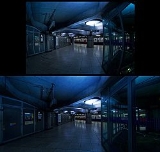
Fisheye lens

Encyclopedia
In photography
, a fisheye lens is a wide-angle lens
that takes in a broad, panoramic and hemispherical
image. Originally developed for use in meteorology
to study cloud formation and called "whole-sky lenses", fisheye lenses quickly became popular in general photography for their unique, distorted appearance. They are often used by photographers shooting broad landscapes to suggest the curve of the Earth. Hemispherical photography
is used for various scientific purposes to study plant canopy geometry and to calculate near-ground solar radiation.
The focal length
s of fisheye lenses depend on the film format
. For the popular 35 mm film
format, typical focal lengths of fisheye lenses are between 8 mm and 10 mm for circular images, and 15–16 mm for full-frame images. For digital cameras using smaller electronic imagers such as 1/4" and 1/3" format CCD or CMOS sensors, the focal length of "miniature" fisheye lenses can be as short as 1 to 2mm.
All the ultra-wide angle lenses suffer from some amount of barrel distortion
. While this can easily be corrected for moderately wide angles of view
, rectilinear
ultra-wide angle lenses with angles of view greater than 90 degrees are difficult to design. Fisheye lenses achieve extremely wide angles of view by forgoing a rectilinear image, opting instead for a special mapping (for example: equisolid angle
), which gives images a characteristic convex appearance.
is inscribed in the film or sensor area; in a full-frame fisheye lens the image circle is circumscribed around the film or sensor area.
Further, different fisheye lenses distort images differently, and the manner of distortion is referred to as their mapping function. A common type for consumer use is equisolid angle
.
models for scientific applications. These have a 180° vertical angle of view
, and the horizontal and diagonal angle of view are also 180°. Most circular fisheye lenses cover a smaller image circle than rectilinear lenses, so the corners of the frame will be completely dark.
The picture angle produced by these lenses only measures 180 degrees when measured from corner to corner: these have a 180° diagonal angle of view
, while the horizontal and vertical angles of view will be smaller; for an equisolid angle-type 15 mm full-frame fisheye, the horizontal FOV will be 147°, and the vertical FOV will be 94°.
The first full-frame fisheye lens to be mass-produced was a 16 mm lens made by Nikon
in the early 1970s. Digital cameras with APS-C
sized sensors require a 10.5 mm lens to get the same effect as a 16 mm lens on a camera with full-frame sensor.
With the kind of digital technology widely available, the full-frame fisheye effect can be obtained in-camera. Selected images can be digitally changed so as to become full-frame fisheye images without the need for special lenses.
Sunex also makes a 5.6mm fisheye lens that captures a circular 185 degree field of view on a 1.5x Nikon and 1.6x Canon DSLR cameras.
Nikon
produced a 6 mm circular fisheye lens that was initially designed for an expedition to Antarctica. It featured a 220-degree field of view, designed to capture the entire sky and surrounding ground when pointed straight up. This lens is no longer manufactured by Nikon, and is used nowadays to produce interactive virtual-reality images such as QuickTime VR
and IPIX
. Because of its very wide field of view, it is very large and cumbersome — weighing 5.2 kilograms (11.5 lb) and having a diameter of 236 millimetres (9.3 in). It dwarfs a regular 35 mm SLR camera and has its own tripod mounting point, a feature normally seen in large long-focus or telephoto lens
es to reduce strain on the lens mount
because the lens is heavier than the camera.
An 8 mm fisheye lens, also made by Nikon
, has proven useful for scientific purposes because of its equidistant (equiangular) projection, in which distance along the radius of the circular image is proportional to zenith angle
.
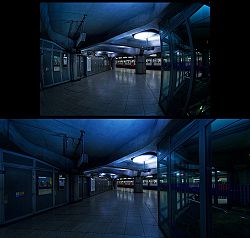
Normal (non-fisheye) lens:
Fisheye lenses can have many different mapping functions:
All types of fisheye lens bend straight lines. Aperture angles of 180° or more are possible only with large amounts of barrel distortion
.
Photography
Photography is the art, science and practice of creating durable images by recording light or other electromagnetic radiation, either electronically by means of an image sensor or chemically by means of a light-sensitive material such as photographic film...
, a fisheye lens is a wide-angle lens
Wide-angle lens
From a design perspective, a wide angle lens is one that projects a substantially larger image circle than would be typical for a standard design lens of the same focal length; this enables either large tilt & shift movements with a view camera, or lenses with wide fields of view.More informally,...
that takes in a broad, panoramic and hemispherical
Sphere
A sphere is a perfectly round geometrical object in three-dimensional space, such as the shape of a round ball. Like a circle in two dimensions, a perfect sphere is completely symmetrical around its center, with all points on the surface lying the same distance r from the center point...
image. Originally developed for use in meteorology
Meteorology
Meteorology is the interdisciplinary scientific study of the atmosphere. Studies in the field stretch back millennia, though significant progress in meteorology did not occur until the 18th century. The 19th century saw breakthroughs occur after observing networks developed across several countries...
to study cloud formation and called "whole-sky lenses", fisheye lenses quickly became popular in general photography for their unique, distorted appearance. They are often used by photographers shooting broad landscapes to suggest the curve of the Earth. Hemispherical photography
Hemispherical photography
Hemispherical photography, also known as fisheye or canopy photography, is a technique to estimate solar radiation and characterize plant canopy geometry using photographs taken looking upward through an extreme wide-angle lens . Typically, the viewing angle approaches or equals 180-degrees, such...
is used for various scientific purposes to study plant canopy geometry and to calculate near-ground solar radiation.
The focal length
Focal length
The focal length of an optical system is a measure of how strongly the system converges or diverges light. For an optical system in air, it is the distance over which initially collimated rays are brought to a focus...
s of fisheye lenses depend on the film format
Film format
A film format is a technical definition of a set of standard characteristics regarding image capture on photographic film, for either stills or movies. It can also apply to projected film, either slides or movies. The primary characteristic of a film format is its size and shape.In the case of...
. For the popular 35 mm film
135 film
The term 135 was introduced by Kodak in 1934 as a designation for cartridge film wide, specifically for still photography. It quickly grew in popularity, surpassing 120 film by the late 1960s to become the most popular photographic film format...
format, typical focal lengths of fisheye lenses are between 8 mm and 10 mm for circular images, and 15–16 mm for full-frame images. For digital cameras using smaller electronic imagers such as 1/4" and 1/3" format CCD or CMOS sensors, the focal length of "miniature" fisheye lenses can be as short as 1 to 2mm.
All the ultra-wide angle lenses suffer from some amount of barrel distortion
Barrel distortion
In geometric optics and cathode ray tube displays, distortion is a deviation from rectilinear projection, a projection in which straight lines in a scene remain straight in an image...
. While this can easily be corrected for moderately wide angles of view
Angle of view
In photography, angle of view describes the angular extent of a given scene that is imaged by a camera. It is used interchangeably with the more general term field of view....
, rectilinear
Rectilinear lens
In photography, a rectilinear lens is a photographic lens that yields images where straight features, such as the walls of buildings, appear with straight lines, as opposed to being curved. In other words, it is a lens with little or no barrel or pincushion distortion...
ultra-wide angle lenses with angles of view greater than 90 degrees are difficult to design. Fisheye lenses achieve extremely wide angles of view by forgoing a rectilinear image, opting instead for a special mapping (for example: equisolid angle
Solid angle
The solid angle, Ω, is the two-dimensional angle in three-dimensional space that an object subtends at a point. It is a measure of how large that object appears to an observer looking from that point...
), which gives images a characteristic convex appearance.
Types of fisheye lenses
In a circular fisheye lens, the image circleImage circle
The image circle, or circle of illumination, of a lens is the circular area in the image plane formed by the cone of light transmitted by the lens . Within this circle is the smaller circle for which image definition is acceptable, the circle of good definition ; however, some authors make no...
is inscribed in the film or sensor area; in a full-frame fisheye lens the image circle is circumscribed around the film or sensor area.
Further, different fisheye lenses distort images differently, and the manner of distortion is referred to as their mapping function. A common type for consumer use is equisolid angle
Solid angle
The solid angle, Ω, is the two-dimensional angle in three-dimensional space that an object subtends at a point. It is a measure of how large that object appears to an observer looking from that point...
.
Circular
The first types of fisheye lenses to be developed were "circular fisheyes" — lenses which took in a 180° hemisphere and projected this as a circle within the film frame. Some circular fisheyes were available in orthographic projectionOrthographic projection (cartography)
An orthographic projection is a map projection of cartography. Like the stereographic projection and gnomonic projection, orthographic projection is a perspective projection, in which the sphere is projected onto a tangent plane or secant plane. The point of perspective for the orthographic...
models for scientific applications. These have a 180° vertical angle of view
Angle of view
In photography, angle of view describes the angular extent of a given scene that is imaged by a camera. It is used interchangeably with the more general term field of view....
, and the horizontal and diagonal angle of view are also 180°. Most circular fisheye lenses cover a smaller image circle than rectilinear lenses, so the corners of the frame will be completely dark.
Full-frame
As fisheye lenses gained popularity in general photography, camera companies began manufacturing fisheye lenses that enlarged the image circle to cover the entire 35 mm film frame, and this is the type of fisheye most commonly used by photographers.The picture angle produced by these lenses only measures 180 degrees when measured from corner to corner: these have a 180° diagonal angle of view
Angle of view
In photography, angle of view describes the angular extent of a given scene that is imaged by a camera. It is used interchangeably with the more general term field of view....
, while the horizontal and vertical angles of view will be smaller; for an equisolid angle-type 15 mm full-frame fisheye, the horizontal FOV will be 147°, and the vertical FOV will be 94°.
The first full-frame fisheye lens to be mass-produced was a 16 mm lens made by Nikon
Nikon
, also known as just Nikon, is a multinational corporation headquartered in Tokyo, Japan, specializing in optics and imaging. Its products include cameras, binoculars, microscopes, measurement instruments, and the steppers used in the photolithography steps of semiconductor fabrication, of which...
in the early 1970s. Digital cameras with APS-C
APS-C
Advanced Photo System type-C is an image sensor format approximately equivalent in size to the Advanced Photo System "classic" size negatives...
sized sensors require a 10.5 mm lens to get the same effect as a 16 mm lens on a camera with full-frame sensor.
With the kind of digital technology widely available, the full-frame fisheye effect can be obtained in-camera. Selected images can be digitally changed so as to become full-frame fisheye images without the need for special lenses.
Miniature fisheye lenses
Miniature fisheye lenses are designed for small-format CCD/CMOS imagers commonly used in consumer and security cameras. Popular format sizes are 1/4" (active area 3.6mmx2.7mm), 1/3" (active area 4.8mmx3.6mm) and 1/2" (active area 6.6mmx4.8mm). Depending on the imager active area, the same lens can form a circular image on one imager (e.g. 1/2"), and a full frame on the other (e.g. 1/4").Focal length
Sigma currently makes a 4.5mm fisheye lens that captures a 180 degree field of view on a crop body.Sunex also makes a 5.6mm fisheye lens that captures a circular 185 degree field of view on a 1.5x Nikon and 1.6x Canon DSLR cameras.
Nikon
Nikon
, also known as just Nikon, is a multinational corporation headquartered in Tokyo, Japan, specializing in optics and imaging. Its products include cameras, binoculars, microscopes, measurement instruments, and the steppers used in the photolithography steps of semiconductor fabrication, of which...
produced a 6 mm circular fisheye lens that was initially designed for an expedition to Antarctica. It featured a 220-degree field of view, designed to capture the entire sky and surrounding ground when pointed straight up. This lens is no longer manufactured by Nikon, and is used nowadays to produce interactive virtual-reality images such as QuickTime VR
QuickTime VR
QuickTime VR is a type of image file format developed by Apple Inc. for QuickTime. It allows the creation and viewing of photographically-captured panoramas and the exploration of objects through images taken at multiple viewing angles...
and IPIX
IPIX
IPIX was an imaging technology company headquartered in Reston, Virginia. One of its products was visual technology allowing the stitching of panoramic images into 360°x 180° field of view video and photography. The company's stock was traded on NASDAQ .Their .ipx format was for a time a widely...
. Because of its very wide field of view, it is very large and cumbersome — weighing 5.2 kilograms (11.5 lb) and having a diameter of 236 millimetres (9.3 in). It dwarfs a regular 35 mm SLR camera and has its own tripod mounting point, a feature normally seen in large long-focus or telephoto lens
Telephoto lens
In photography and cinematography, a telephoto lens is a specific type of a long-focus lens in which the physical length of the lens is shorter than the focal length. This is achieved by incorporating a special lens group known as a telephoto group that extends the light path to create a long-focus...
es to reduce strain on the lens mount
Lens mount
A lens mount is an interface — mechanical and often also electrical — between a photographic camera body and a lens. It is confined to cameras where the body allows interchangeable lenses, most usually the single lens reflex type or any movie camera of 16 mm or higher gauge...
because the lens is heavier than the camera.
An 8 mm fisheye lens, also made by Nikon
Nikon
, also known as just Nikon, is a multinational corporation headquartered in Tokyo, Japan, specializing in optics and imaging. Its products include cameras, binoculars, microscopes, measurement instruments, and the steppers used in the photolithography steps of semiconductor fabrication, of which...
, has proven useful for scientific purposes because of its equidistant (equiangular) projection, in which distance along the radius of the circular image is proportional to zenith angle
Zenith Angle
Zenith Angle can refer to:* In astronomy, the angle made between the surface of the Earth and a line between the observer and the observed * The Zenith Angle is a science fiction novel authored by Bruce Sterling...
.
Other uses
- With appropriate software, the curvilinear images produced by a fisheye lens can be remapped to a conventional rectilinearRectilinear lensIn photography, a rectilinear lens is a photographic lens that yields images where straight features, such as the walls of buildings, appear with straight lines, as opposed to being curved. In other words, it is a lens with little or no barrel or pincushion distortion...
projection. Although this entails some loss of detail at the edges of the frame, the technique can produce an image with a field of view greater than that of a conventional rectilinear lens. This is particularly useful for creating panoramic imagesPanoramic photographyPanoramic photography is a technique of photography, using specialized equipment or software, that captures images with elongated fields of view. It is sometimes known as wide format photography. The term has also been applied to a photograph that is cropped to a relatively wide aspect ratio...
. - Some planetariumPlanetariumA planetarium is a theatre built primarily for presenting educational and entertaining shows about astronomy and the night sky, or for training in celestial navigation...
s use a form of fisheye lens to project a two-dimensional film image of the night sky onto the interior of a dome. The NavitarNavitarFounded1973 TypePrivateHeadquartersRochester, New YorkKey PeopleCo-President:Jeremy Goldstein,Co-President: Julian GoldsteinIndustrySemiconductor, Biotechnology, Homeland Security, Food & Beverage, Metrology, Simulation, Presentation Products...
HemiStar 6.75 mm Fisheye lens is used for dome projection. - Flight simulators and visual combat simulators use fisheye lenses like the NavitarNavitarFounded1973 TypePrivateHeadquartersRochester, New YorkKey PeopleCo-President:Jeremy Goldstein,Co-President: Julian GoldsteinIndustrySemiconductor, Biotechnology, Homeland Security, Food & Beverage, Metrology, Simulation, Presentation Products...
HemiStar in order to create an immersive environment for pilots, air traffic controllers, or military personnel to train in. - Similarly, the IMAX Dome (previously 'OMNIMAX') motion-picture format involves photography through a circular fisheye lens, and projection through the same onto a hemispherical screen.
- Scientists and resource managers (e.g., biologists, foresters, and meteorologists) use fisheye lenses for hemispherical photographyHemispherical photographyHemispherical photography, also known as fisheye or canopy photography, is a technique to estimate solar radiation and characterize plant canopy geometry using photographs taken looking upward through an extreme wide-angle lens . Typically, the viewing angle approaches or equals 180-degrees, such...
to calculate plant canopy indices and near-ground solar radiation. Applications include evaluation of forest health, characterization of monarch butterflyMonarch butterflyThe Monarch butterfly is a milkweed butterfly , in the family Nymphalidae. It is perhaps the best known of all North American butterflies. Since the 19th century, it has been found in New Zealand, and in Australia since 1871 where it is called the Wanderer...
winter roosting sites, and management of vineyards. - Photographers and videographers use fisheye lenses so they can get the camera as close as possible for action shots whilst also capturing context, for example in skateboardingSkateboardingSkateboarding is an action sport which involves riding and performing tricks using a skateboard.Skateboarding can be a recreational activity, an art form, a job, or a method of transportation. Skateboarding has been shaped and influenced by many skateboarders throughout the years. A 2002 report...
to focus on the board and still retain an image of the skater. - The peepholePeepholeA peephole is a small opening through which one may look.In a door, a peephole allows people inside the security of seeing outside without opening the door...
s used in doors generally contain fisheye lenses, so as to give a wide field of view. Security cameras often tend to have such lenses for similar reasons. - The first music video to be shot completely with fisheye lens was for the Beastie BoysBeastie BoysBeastie Boys are an American hip hop trio from New York City. The group consists of Mike D who plays the drums, MCA who plays the bass, and Ad-Rock who plays the guitar....
song "Shake Your RumpShake Your Rump"Shake Your Rump" is the second track on Beastie Boys' second studio album Paul's Boutique, released July 25, 1989.* Produced & written by the Beastie Boys and the Dust Brothers.* Engineered by Mario Caldato and Allen Abrahamson.-Samples:...
" in 1989. - In Computer GraphicsComputer graphicsComputer graphics are graphics created using computers and, more generally, the representation and manipulation of image data by a computer with help from specialized software and hardware....
, circular fisheye images can be used to create environment map from physical world. One complete 180-degree wide angle fisheye image will fit to half of cubic mapping space if proper algorithm applies on. Environment maps can be used to render 3D object and virtual panoramic scene.
Circular fisheye
- PelengPeleng LensThis lens is a super-wideangle circular fisheye photographic lens, and is designed as a interchangeable lens for Canon, Nikon, Pentax, Olympus digital or film cameras which have or don't have the instant-return diaphragm automatic control device. The lens has a variable diaphragm from f/3.5 to...
8 mm 3.5 - Canon FD 7.5 mm 5.6 (note: not EF mount) (not in production)
- Minolta Fisheye-Rokkor 7.5mm f4.0
- NikkorNikkorNikkor is the brand of lenses produced by Nikon Corporation, including camera lenses for the Nikon F-mount.thumb|right|Nikko parent company brand, from which the Nikkor brand evolved....
8mm 8 lens (not in production) - NikkorNikkorNikkor is the brand of lenses produced by Nikon Corporation, including camera lenses for the Nikon F-mount.thumb|right|Nikko parent company brand, from which the Nikkor brand evolved....
7.5mm 5.6 lens (not in production)
- NikkorNikkorNikkor is the brand of lenses produced by Nikon Corporation, including camera lenses for the Nikon F-mount.thumb|right|Nikko parent company brand, from which the Nikkor brand evolved....
8mm 2.8 lens (not in production) - NikkorNikkorNikkor is the brand of lenses produced by Nikon Corporation, including camera lenses for the Nikon F-mount.thumb|right|Nikko parent company brand, from which the Nikkor brand evolved....
6mm 2.8 lens (not in production) - Sigma 8 mm 3.5 EX DGSigma 8mm f/3.5 EX DG lensThe Sigma 8mm f/3.5 EX DG is a photographic lens introduced on 9 August 2006. It is a circular fisheye lens, designed to project a 180-degree field of view in all directions onto a circular image when used on a full-frame camera. The lens is available in Canon, Nikon, and Sigma mounts.- External...
(replaces the Sigma 8 mm 4 EX DGSigma 8mm f/4 EX DG lensThe Sigma 8mm f/4 EX DG is a photographic lens made by the Sigma Corporation. It is a circular fisheye lens for full-frame cameras, and has been replaced by the Sigma 8mm 3.5 EX DG.- External links :* official page...
) - Sigma 4.5 mm 2.8 EX DC Circular Fisheye HSMSigma 4.5mm F2.8 EX DC Circular Fisheye HSM lensThe Sigma 4.5mm f/2.8 EX DC circular fisheye is a photographic lens manufactured by Sigma Corporation. It is a circular fisheye lens, designed to project a 180-degree field of view in all directions onto a circular image. It is the first such lens to be provide the complete circular fisheye effect...
for APS-CAPS-CAdvanced Photo System type-C is an image sensor format approximately equivalent in size to the Advanced Photo System "classic" size negatives...
sensors - Sunex 185 deg SuperFisheye 5.6mm 5.6 for DSLRs
- Vemar 12mm 5.6 Fish-Eye / Ultra-Wideangle—circular image on full-frame 135 cameras if the integral hood is in place, 160 degree view. Usually available as a T2 mount for various cameras, but no longer in production.
- Canon EF 8-15mm 4L (This lens can be used as both a Circular Fisheye and an Full Frame Fisheye on a 35mm, Full Frame camera)
- Coastalopt 4.88 mm circular fisheye for Nikon F-mount or Canon EOS mount. Lens is produced by JENOPTIK Optical Systems
Full-frame fisheye
- AF DX Fisheye-Nikkor 10.5mm 2.8G ED (full frame on DX sensors, almost circular on FX sensors if integral hood is removed -- the image circle is slightly bigger than the frame and there is some cropping at the top and bottom).¨
- MC ZenitarZenitarZenitar is a series of Soviet/Russian prime lenses. They were developed and are currently produced by JSC S. A. Zverev Krasnogorskiy Mekhanicheskiy Zavod . The series is most commonly known for the 1:2.8 16 mm fisheye lens....
16mm 2.8 (Models available: MC Zenitar-K - Pentax mount; MC Zenitar-M - M42 screwmount; MC Zenitar-H - Nikon mount) - Sigma 15 mm 2.8 EX DG Diagonal Fisheye
- Sigma 10 mm 2.8 EX DC Fisheye HSMSigma 10mm F2.8 EX DC Fisheye HSM lensThe Sigma 10m f/2.8 EX DC fisheye is a photographic lens manufactured by Sigma Corporation. It is a diagonal fisheye lens. Unlike most fisheye lenses, this lens is designed for digital SLR cameras that do not have a full 36x24mm sensor...
for APS-CAPS-CAdvanced Photo System type-C is an image sensor format approximately equivalent in size to the Advanced Photo System "classic" size negatives...
sensors. - Zoom TokinaTokinais a Japanese manufacturer of photographic lenses and CCTV security equipment.-History:Tokina, become a partner of Pentax, division of Hoya Corporation and jointly developed some lenses. These will be available under the Pentax and Schneider Kreuznach D-Xenon and D-Xenogon brands in Pentax K mount...
10-17mm 3.5-4.5 fisheye lens for APS-C sensors - Canon EF 15mm 2.8Canon EF 15mm lensThe Canon EF 15mm 2.8 is Canon's only production prime fisheye lens; other companies make fisheye lenses for Canon though ....
- Canon EF 8-15mm f/4 USM fisheye zoom
- Minolta/Sony AF 16mm 2.8 Fisheye
- Olympus Zuiko Digital ED 8mm 3.5 Fisheye] for Four Thirds cameras
- PentaxPentaxPentax is a brand name used by Hoya Corporation for its medical-related products & services and Pentax Ricoh Imaging Company for cameras, sport optics , etc. Hoya purchased and merged with the Japanese optics company on March 31, 2008. Hoya's Pentax imaging business was sold to Ricoh Company, Ltd...
DA 10-17mm 3.5-4.5 ED(IF) -- full-frame image for APS-C sensors on K-mount cameras - Samyang OpticsSamyang OpticsSamyang Optics Company Limited is a Korean company founded in 1972, manufacturing optical equipment, CCTV and photographic accessories. All Samyang lenses are produced in the company's plant in Masan, South Korea...
8 mm 3.5 Fisheye CS for APS-C sensors - also marketed as Bower, Polar, Falcon, Rokinon and the same as the Vivitar 7mm and Opteka 6.5mm lenses. This lens is manual focus and is reported to use stereographic projection - Canon EF 8-15mm 4L (This lens can be used as both a Full Frame Fisheye and a Circular Fisheye on a 35mm, Full Frame camera but can only be used as a Full Frame Fisheye on EOS DSLRs with APS-C/H size sensors)
- MC Arsat 1:3.5 30 mm for Kiev 88 screw mount and Pentacon Six mountPentacon Six mountThe Pentacon Six mount is a breech-lock bayonet lens mount originally used by several medium format single-lens reflex cameras from East Germany....
- Carl Zeiss 30 mm Distagon for HasselbladHasselbladVictor Hasselblad AB is a Swedish manufacturer of medium-format cameras and photographic equipment based in Gothenburg, Sweden.The company is best known for the medium-format cameras it has produced since World War II....
Mapping function
The mapping of a sideways object leads to a picture position displacement from the image center. The manner of this conversion is the mapping function. The distance of a point from the image center 'r' is dependent on the focal length of the optical system 'f', and the angle from the optical axis 'θ'.Normal (non-fisheye) lens:
- Gnomonical or perspective:
 . Works like the pinhole camera. Straight lines remain straight (distortion free). "θ" has to be smaller than 90°. The aperture angle is gaged symmetrically to the optical axis and has to be smaller than 180°. Large aperture angles are difficult to design and lead to high prices.
Fisheye lenses can have many different mapping functions:
- Linear scaled (equidistant):
 , where θ is in radianRadianRadian is the ratio between the length of an arc and its radius. The radian is the standard unit of angular measure, used in many areas of mathematics. The unit was formerly a SI supplementary unit, but this category was abolished in 1995 and the radian is now considered a SI derived unit...
s. Practical for angle measurement e.g., star maps. PanoToolsPanorama Tools (software)Panorama Tools are a suite of programs and libraries originally written by the German physics and mathematics professor Helmut Dersch. Panorama Tools provides a powerful framework for re-projecting and blending multiple source images into immersive panoramics of many types...
uses this type. - Orthographic:
 . Looks like an orb with the surroundings lying on < max. 180° aperture angle.
 - Equal area (equisolid angle):
 . Every pixel subtends an equal solid angleSolid angleThe solid angle, Ω, is the two-dimensional angle in three-dimensional space that an object subtends at a point. It is a measure of how large that object appears to an observer looking from that point...
, or an equal area on the unit sphereUnit sphereIn mathematics, a unit sphere is the set of points of distance 1 from a fixed central point, where a generalized concept of distance may be used; a closed unit ball is the set of points of distance less than or equal to 1 from a fixed central point...
. Looks like a mirror image on a ball, best special effect (unsophisticated distances), suitable for area comparison (clouds grade determination). This type is popular but it compresses marginal objects. The prices of these lenses are high, but not extreme. - Stereographic (conform):
 . This mapping would be ideal for photographers because it doesn't compress marginal objects as much. SamyangSamyang OpticsSamyang Optics Company Limited is a Korean company founded in 1972, manufacturing optical equipment, CCTV and photographic accessories. All Samyang lenses are produced in the company's plant in Masan, South Korea...
is the only manufacturer ever to be making this kind of fisheye lens. This lens is available under different brandnames. This mapping is easily implemented by software. - Other mapping functions (for example Tailored Distortion lenses) are also possible for enhancing the off-axis resolution of fisheye lenses.
All types of fisheye lens bend straight lines. Aperture angles of 180° or more are possible only with large amounts of barrel distortion
Barrel distortion
In geometric optics and cathode ray tube displays, distortion is a deviation from rectilinear projection, a projection in which straight lines in a scene remain straight in an image...
.