

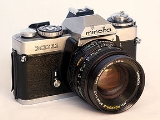
Single-lens reflex camera

Encyclopedia
Camera
A camera is a device that records and stores images. These images may be still photographs or moving images such as videos or movies. The term camera comes from the camera obscura , an early mechanism for projecting images...
that typically uses a semi-automatic moving mirror system (hence the name "reflex", from the mirror's reflection) that permits the photographer to see exactly what will be captured by the film or digital imaging system, as opposed to pre-SLR cameras where the view through the viewfinder
Viewfinder
In photography, a viewfinder is what the photographer looks through to compose, and in many cases to focus, the picture. Most viewfinders are separate, and suffer parallax, while the single-lens reflex camera lets the viewfinder use the main optical system. Viewfinders are used in many cameras of...
could be significantly different from what was captured on film.
Prior to the development of SLR, all cameras with viewfinders had two optical light paths: one path through the lens to the film, and another path positioned above (TLR or twin-lens reflex
Twin-lens reflex camera
A twin-lens reflex camera is a type of camera with two objective lenses of the same focal length. One of the lenses is the photographic objective or "taking lens" , while the other is used for the viewfinder system, which is usually viewed from above at waist level...
) or to the side (rangefinder
Rangefinder camera
A rangefinder camera is a camera fitted with a rangefinder: a range-finding focusing mechanism allowing the photographer to measure the subject distance and take photographs that are in sharp focus...
). Because the viewfinder and the film lens cannot share the same optical path, the viewing lens is aimed to intersect with the film lens at a fixed point somewhere in front of the camera. This is not problematic for pictures taken at a middle or longer distance, but parallax
Parallax
Parallax is a displacement or difference in the apparent position of an object viewed along two different lines of sight, and is measured by the angle or semi-angle of inclination between those two lines. The term is derived from the Greek παράλλαξις , meaning "alteration"...
causes framing errors in close-up shots. Moreover, focusing the lens of a fast reflex camera when it is opened to wider aperture
Aperture
In optics, an aperture is a hole or an opening through which light travels. More specifically, the aperture of an optical system is the opening that determines the cone angle of a bundle of rays that come to a focus in the image plane. The aperture determines how collimated the admitted rays are,...
s (such as in low light or while using low-speed film) is not easy.
Most SLR cameras permit upright and laterally correct viewing through use of a roof pentaprism
Pentaprism
A pentaprism is a five-sided reflecting prism used to deviate a beam of light by 90°. The beam reflects inside the prism twice, allowing the transmission of an image through a right angle without inverting it as an ordinary right-angle prism or mirror would.The reflections inside the prism are not...
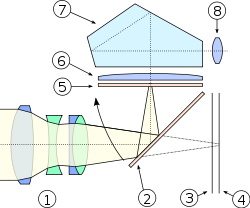
situated in the optical path between the reflex mirror and viewfinder. Light, which comes both horizontally and vertically inverted after passing through the lens, is reflected upwards by the reflex mirror, into the pentaprism where it is reflected several times to correct the inversions caused by the lens, and align the image with the viewfinder
Viewfinder
In photography, a viewfinder is what the photographer looks through to compose, and in many cases to focus, the picture. Most viewfinders are separate, and suffer parallax, while the single-lens reflex camera lets the viewfinder use the main optical system. Viewfinders are used in many cameras of...
. When the shutter
Shutter (photography)
In photography, a shutter is a device that allows light to pass for a determined period of time, for the purpose of exposing photographic film or a light-sensitive electronic sensor to light to capture a permanent image of a scene...
is released, the mirror moves out of the light path, and the light shines directly onto the film (or in the case of a DSLR
Digital single-lens reflex camera
Most digital single-lens reflex cameras are digital cameras that use a mechanical mirror system and pentaprism to direct light from the lens to an optical viewfinder on the back of the camera....
, the CCD
Charge-coupled device
A charge-coupled device is a device for the movement of electrical charge, usually from within the device to an area where the charge can be manipulated, for example conversion into a digital value. This is achieved by "shifting" the signals between stages within the device one at a time...
or CMOS
CMOS
Complementary metal–oxide–semiconductor is a technology for constructing integrated circuits. CMOS technology is used in microprocessors, microcontrollers, static RAM, and other digital logic circuits...
imaging sensor). The Canon Pellix film camera was an exception to the moving mirror system, wherein the mirror was a fixed beamsplitting
Beam splitter
A beam splitter is an optical device that splits a beam of light in two. It is the crucial part of most interferometers.In its most common form, a rectangle, it is made from two triangular glass prisms which are glued together at their base using Canada balsam...
pellicle
Pellicle mirror
right|thumb|The pellicle mirror of the [[Canon EOS RT]]A pellicle mirror is an ultra-thin, ultra-lightweight semi-transparent mirror employed in the light path of an optical instrument, splitting the light beam into two separate beams, both of reduced light intensity...
.
Focus can be adjusted manually by the photographer or automatically by an autofocus
Autofocus
An autofocus optical system uses a sensor, a control system and a motor to focus fully automatic or on a manually selected point or area. An electronic rangefinder has a display instead of the motor; the adjustment of the optical system has to be done manually until indication...
system. The viewfinder can include a matte focusing
Focus (optics)
In geometrical optics, a focus, also called an image point, is the point where light rays originating from a point on the object converge. Although the focus is conceptually a point, physically the focus has a spatial extent, called the blur circle. This non-ideal focusing may be caused by...
screen located just above the mirror system to diffuse the light. This permits accurate viewing, composing and focusing, especially useful with interchangeable lenses.
Up until the 1990s, SLR was the most advanced photographic preview system available, but the recent development and refinement of digital imaging technology with an on-camera live LCD preview screen has overshadowed SLR's popularity. Nearly all inexpensive compact digital cameras now include an LCD preview screen allowing the photographer to see what the CCD is capturing. However, SLR is still popular in high-end and professional cameras because they are system camera
System camera
A system camera is a camera with interchangeable components that constitutes the core of a system. Early representatives include Leica I Schraubgewinde , Exakta and the Nikon F...
s with interchangeable parts, allowing customization. They also have far less shutter lag
Shutter lag
In photography, shutter lag is the delay between triggering the shutter and when the photograph is actually recorded. This is a common problem in the photography of fast-moving objects or people in motion...
, allowing photographs to be timed more precisely. Also the pixel
Pixel
In digital imaging, a pixel, or pel, is a single point in a raster image, or the smallest addressable screen element in a display device; it is the smallest unit of picture that can be represented or controlled....
resolution, contrast ratio
Contrast ratio
The contrast ratio is a property of a display system, defined as the ratio of the luminance of the brightest color to that of the darkest color that the system is capable of producing...
, refresh rate
Refresh rate
The refresh rate is the number of times in a second that a display hardware draws the data...
, and color gamut
Gamut
In color reproduction, including computer graphics and photography, the gamut, or color gamut , is a certain complete subset of colors. The most common usage refers to the subset of colors which can be accurately represented in a given circumstance, such as within a given color space or by a...
of an LCD preview screen cannot compete with the clarity and shadow detail of a direct-viewed optical SLR viewfinder.
Optical components
Focusing screen
A focusing screen is a flat translucent material, usually ground glass, found in a system camera that allows the user of the camera to preview the framed image in a viewfinder. Often, focusing screens are available in variants with different etched markings for various purposes...
(5). Via a condensing lens (6) and internal reflections in the roof pentaprism (7) the image appears in the eyepiece (8). When an image is taken, the mirror moves upwards from its resting position in the direction of the arrow, the focal plane shutter (3) opens, and the image is projected onto the film
Photographic film
Photographic film is a sheet of plastic coated with an emulsion containing light-sensitive silver halide salts with variable crystal sizes that determine the sensitivity, contrast and resolution of the film...
or sensor
Charge-coupled device
A charge-coupled device is a device for the movement of electrical charge, usually from within the device to an area where the charge can be manipulated, for example conversion into a digital value. This is achieved by "shifting" the signals between stages within the device one at a time...
(4) in exactly the same manner as on the focusing screen.
This feature distinguishes SLRs from other cameras as the photographer sees the image composed exactly as it will be captured on the film or sensor
Charge-coupled device
A charge-coupled device is a device for the movement of electrical charge, usually from within the device to an area where the charge can be manipulated, for example conversion into a digital value. This is achieved by "shifting" the signals between stages within the device one at a time...
(see Advantages below).
Pentaprisms and penta-mirrors

Pentaprism
A pentaprism is a five-sided reflecting prism used to deviate a beam of light by 90°. The beam reflects inside the prism twice, allowing the transmission of an image through a right angle without inverting it as an ordinary right-angle prism or mirror would.The reflections inside the prism are not...
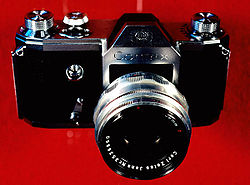
or penta-mirror to direct the light to the eyepiece, first used on the 1949 Contax S from East Germany. The first Japanese pentaprism SLR was the 1955 Miranda T
Miranda T (camera)
The original Miranda T 35mm SLR camera was launched by the newly established Japanese Orion Camera Co. in 1955. It is the first Japanese 35mm SLR camera to have an eyelevel Pentaprism finder...
, followed by the Asahi Pentax, Zunow, Nikon F, and the Yashica
Yashica
Yashica was a Japanese manufacturer of cameras.-History:The company began in December, 1949 in Nagano, Japan, when the Yashima Seiki Company was founded with an initial investment of $566. Its eight employees originally manufactured components for electric clocks...
Pentamatic. Some SLRs offered removable pentaprisms with optional viewfinder capabilities, such as the waist-level finder
Waist-level finder
The waist-level finder is a type of viewfinder that can be used on twin lens and single lens reflex cameras. While it is typically found on older medium format cameras, some newer and/or 35 mm cameras have this type of finder ....
, the interchangeable sports finders used on the Canon F1, F1n and F1; the Nikon
Nikon
, also known as just Nikon, is a multinational corporation headquartered in Tokyo, Japan, specializing in optics and imaging. Its products include cameras, binoculars, microscopes, measurement instruments, and the steppers used in the photolithography steps of semiconductor fabrication, of which...
F, F2, F3, F4 and F5; and the Pentax LX.
Another prism design was the porro prism
Porro prism
In optics, a Porro prism, named for its inventor Ignazio Porro, is a type of reflection prism used in optical instruments to alter the orientation of an image....
system used in the Olympus Pen F
Olympus Pen F
The Olympus Pen F, Pen FT and Pen FV were very similar half-frame 35 mm single-lens reflex cameras with interchangeable lenses produced by Olympus of Japan between 1963-1966 , 1966-1972 and 1967-1970...
, the Pen FT, the Pen FV half-frame 35 mm SLR cameras. This was later used on the Olympus EVOLT E-3x0
Olympus E-300
The Olympus E-300 is an 8 megapixel digital SLR manufactured by Olympus of Japan and based on the Four Thirds System. Announced at Photokina 2004, it became available at the end of 2004...
series, the Leica Digilux 3 and the Panasonic DMC-L1
Panasonic Lumix DMC-L1
The Lumix DMC-L1 was Panasonic's first digital single-lens reflex camera, and was announced in February 2006. This camera adheres to the Four Thirds System lens mount standard, making it the first non-Olympus Four Thirds camera, and thus confirming that the Four Thirds System is a semi-open...
.
A right-angle finder is available that slips onto the eyepiece of most SLRs and D-SLRs and allows viewing through a waist-level viewfinder. There is also a finder that provides EVF remote capability.
Focal-plane shutters
Almost all contemporary SLRs use a focal-plane shutterFocal-plane shutter
In camera design, a focal-plane shutter is a type of photographic shutter that is positioned immediately in front of the focal plane of the camera, that is, right in front of the photographic film or image sensor.-Two-curtain shutters:...
located in front of the film plane, which prevents the light from reaching the film even if the lens is removed, except when the shutter is actually released during the exposure. There are various designs for focal plane shutters. Early focal-plane shutters designed from the 1930s onwards usually consisted of two curtains that travelled horizontally across the film gate: an opening shutter curtain followed by a closing shutter curtain. During fast shutter speeds, the focal-plane shutter would form a 'slit' whereby the second shutter curtain was closely following the first opening shutter curtain to produce a narrow, vertical opening, with the shutter slit moving horizontally. The slit would get narrower as shutter speeds were increased. Initially these shutters were made from a cloth material (which was in later years often rubberised), but some manufacturers used other materials instead. Nippon Kōgaku (now Nikon Corporation), for example, used titanium
Titanium
Titanium is a chemical element with the symbol Ti and atomic number 22. It has a low density and is a strong, lustrous, corrosion-resistant transition metal with a silver color....
foil shutters for several of their flagship SLR cameras, including the Nikon F
Nikon F
The Nikon F camera, introduced in 1959, was Nikon's first SLR camera. It was one of the most advanced cameras of its day. Although most of its concepts had already been introduced elsewhere, it was the first camera to combine them all in one camera. It was produced until October 1973 and was...
, F2
Nikon F2
The Nikon F2 is a professional level, interchangeable lens, 35 mm film, single-lens reflex camera. It was manufactured by the Japanese optics company Nippon Kogaku K. K. in Japan from September 1971 to June 1980...
, and F3
Nikon F3
The Nikon F3 was Nikon's third professional single-lens reflex camera body, preceded by the F and F2. Introduced in 1980, it had manual and semi-automatic exposure control whereby the camera would select the correct shutter speed . The Nikon F3 series cameras had the most model variations of any...
. Nowadays these shutters are very rarely found in new SLRs, though Leica continues to use them in their M-System rangefinders
Rangefinder camera
A rangefinder camera is a camera fitted with a rangefinder: a range-finding focusing mechanism allowing the photographer to measure the subject distance and take photographs that are in sharp focus...
.
Other focal-plane shutter designs, such as the Copal
Nidec Copal Corporation
The , or Copal, is a Japanese manufacturer of optical, electronic and mechanical equipment, primarily for the photographic industry. It has been a subsidiary of Nidec Corporation since 1998, and was formerly known as the Copal Corporation...
Square, travelled vertically - the shorter travelling distance of 24 millimetres (as opposed to 36 mm horizontally) meant that minimum exposure and flash synchronisation times could be reduced. These shutters are usually manufactured from metal, and use the same moving-slit principle as horizontally travelling shutters. They differ, though, in usually being formed of several slats or blades, rather than single curtains as with horizontal designs, as there is rarely enough room above and below the frame for a one-piece shutter. Vertical shutters became very common in the 1980s (though Konica
Konica
was a Japanese manufacturer of, among other products, film, film cameras, camera accessories, photographic and photo-processing equipment, photocopiers, fax machines and laser printers.- History :...
, Mamiya
Mamiya
is a Japanese company that today manufactures high-end cameras and other related photographic and optical equipment. With headquarters in Tokyo, it has two manufacturing plants and a workforce of over 200 people...
, and Copal first pioneered their use in the 1950s and 1960s, and are almost exclusively used for new cameras. Nikon used Copal-made vertical plane shutters in their Nikomat/Nikkormat -range, enabling x-sync speeds from 1/30 to 1/125 while the only choice for focal plane shutters at that time was 1/60. Later, Nikon again pioneered the use of titanium for vertical shutters, using a special honeycomb pattern on the blades to reduce their weight and achieve world-record speeds in 1982 of 1/4000 second for non-sync shooting, and 1/250 with x-sync. Nowadays most such shutters are manufactured from cheaper aluminium
Aluminium
Aluminium or aluminum is a silvery white member of the boron group of chemical elements. It has the symbol Al, and its atomic number is 13. It is not soluble in water under normal circumstances....
(though some high-end cameras use materials such as carbon-fibre and Kevlar
Kevlar
Kevlar is the registered trademark for a para-aramid synthetic fiber, related to other aramids such as Nomex and Technora. Developed at DuPont in 1965, this high strength material was first commercially used in the early 1970s as a replacement for steel in racing tires...
).
Rotary focal-plane shutter
One unusual design, the Olympus PenOlympus Pen
The Pen series is a family of half-frame cameras made by Olympus from 1959 to the beginning of the 1980s, and from 2009. Aside from the Pen F series of half-frame SLRs, they are fixed-lens viewfinder cameras....
half-frame 35 mm SLR system, manufactured by Olympus in Japan, used a rotary focal-plane shutter mechanism that was extremely simple and elegant in design. This shutter used titanium foil but consisted of one piece of metal with a fixed opening, which allowed electronic flash synchronisation up to and including its maximum speed of 1/500 of a second – rivalling the capabilities of leaf-shutter systems
Another 35 mm camera system that used a rotary shutter, was the Robot Royal cameras, most of which were rangefinder 35 mm cameras. Some of these cameras were full-frame; some were half-frame, and at least one Robot camera produced an unusual square-sized image on the 35 mm frame.
The Mercury II, produced in 1946, also used a rotary shutter. This was a half-frame 35mm camera.
Leaf shutters
Another shutter system is the leaf shutter, whereby the shutter is constructed of diaphragm-like blades and can be situated either between the lens or behind the lens. If the shutter is part of a lens assembly some other mechanism is required to ensure that no light reaches the film between exposures.An example of a behind-the-lens leaf shutter is found in the 35 mm SLRs produced by Kodak, with their Retina Reflex camera line; Topcon, with their Auto 100; and Kowa with their SE-R and SET-R reflexes.
A primary example of a medium-format SLR with a between-the-lens leaf shutter system would be Hasselblad
Hasselblad
Victor Hasselblad AB is a Swedish manufacturer of medium-format cameras and photographic equipment based in Gothenburg, Sweden.The company is best known for the medium-format cameras it has produced since World War II....
, with their 500C, 500CM, 500 EL-M (a motorized Hasselblad) and other models (producing a 6 cm square negative). Hasselblads use an auxiliary shutter blind situated behind the lens mount and the mirror system to prevent the fogging of film.
Other medium-format SLRs also using leaf shutters include the now discontinued Zenza-Bronica camera system lines such as the Bronica ETRs, the ETRs'i (both producing a 6 × 4.5 cm. image), the SQ and the SQ-AI (producing a 6 × 6 cm image like the Hasselblad), and the Zenza-Bronica G system (6 × 7 cm). Certain Mamiya medium-format SLRs, discontinued camera systems such as the Kowa 6 and a few other camera models also used between-the-lens leaf shutters in their lens systems.
Thus, any time a photographer purchased one of these lenses, that lens included a leaf shutter in its lens mount.
Because leaf shutters synchronized electronic flash at all shutter speeds especially at fast shutter speeds of 1/500 of a second or faster, cameras using leaf shutters were more desirable to studio photographers who used sophisticated studio electronic flash systems.
Some manufacturers of medium-format 120 film
120 film
120 is a film format for still photography introduced by Kodak for their Brownie No. 2 in 1901. It was originally intended for amateur photography but was later superseded in this role by 135 film...
SLR cameras also made leaf-shutter lenses for their focal-plane-shutter models. Rollei made at least two such lenses for their Rolleiflex SL-66 medium format which was a focal-plane shutter SLR. Rollei later switched to a camera system of leaf-shutter design, (i.e., the 6006 and 6008 reflexes to name a few) and their current medium-format SLRs are now all of the between-the-lens shutter design.
Further developments
Since the technology became widespread in the 1970s, SLRs have become the main photographic instrument used by dedicated amateur photographers and professionals. Some photographers of static subjects (such as architecture, landscape, and some commercial subjects), however, prefer view cameraView camera
The view camera is a type of camera first developed in the era of the Daguerreotype and still in use today, though with many refinements. It comprises a flexible bellows which forms a light-tight seal between two adjustable standards, one of which holds a lens, and the other a viewfinder or a...
s because of the capability to control perspective. With a triple-extension bellows 4" × 5" camera such as the Linhof SuperTechnika V, the photographer can correct certain distortions such as 'keystoning', where the image 'lines' converge (i.e., photographing a building by pointing a typical camera upward to include the top of the building). Perspective correction lens
Perspective correction lens
In photography, a perspective control lens allows the photographer to control the appearance of perspective in the image; the lens can be moved parallel to the film or sensor, providing the equivalent of corresponding view camera movements...
es are available in the 35 mm and medium formats to correct this distortion with film cameras, and it can also be corrected after the fact with photo software when using digital cameras. The photographer can also extend the bellows to its full length, tilt the front standard and perform photomacrography (commonly known as 'macro photography
Macro photography
Macrophotography is close-up photography, usually of very small subjects. Classically a macrophotograph is one in which the size of the subject on the negative is greater than life size. However in modern use it refers to a finished photograph of a subject at greater than life size...
'), producing a sharp image with depth-of-field without stopping down the lens diaphgram.
History
Large formatLarge format
Large format refers to any imaging format of 4×5 inches or larger. Large format is larger than "medium format", the 6×6 cm or 6×9 cm size of Hasselblad, Rollei, Kowa, Pentax etc cameras , and much larger than the 24×36 mm frame of 35 mm format.The main advantage...
SLR cameras were probably first marketed with the introduction of C.R. Smith's Monocular Duplex (USA, 1884). SLRs for smaller exposure formats were launched in the 1920s by several camera makers. The first 35 mm SLR available to the mass market, Leica's PLOOT reflex housing along with a 200mm f4.5 lens paired to a 35mm rangefinder camera body, debuted in 1935. The Soviet
Soviet Union
The Soviet Union , officially the Union of Soviet Socialist Republics , was a constitutionally socialist state that existed in Eurasia between 1922 and 1991....
Спорт (“Sport”), also a 24mm by 36mm image size, was prototyped in 1934 and went to market in 1937. K. Nüchterlein's Kine Exakta
Kine Exakta
The Kine Exakta was the first 35mm SLR still camera. It was presented by Ihagee Kamerawerk Steenbergen GmbH, Dresden at the Leipziger Frühjarmesse in March 1936. The Exakta name was already used by Ihagee on a roll film SLR camera line since 1933, among these the Vest Pocket Exakt Model B from...
(Germany, 1936) was the first integrated 35mm SLR to enter the market. Additional Exakta
Exakta
The Exakta is a pioneer brand camera produced by the Ihagee Kamerawerk in Dresden, Germany, founded as the Industrie und Handels-Gesellschaft mbH, in 1912.- Characteristics :Highlights of Exakta cameras include:...
models, all with waist-level finders, were produced up to and during World War II
World War II
World War II, or the Second World War , was a global conflict lasting from 1939 to 1945, involving most of the world's nations—including all of the great powers—eventually forming two opposing military alliances: the Allies and the Axis...
. Another ancestor of the modern SLR camera was the Swiss-made Alpa
Alpa
Alpa was formerly a Swiss camera design company and manufacturer of 35 mm SLR cameras. The current owners bought the company name after bankruptcy of the original company and the company exists today as a designer and manufacturer of high-end medium-format cameras.-History:Alpa was an offshoot of...
, which was innovative, and influenced the later Japanese cameras. The first eye-level SLR viewfinder was patented in Hungary
Hungary
Hungary , officially the Republic of Hungary , is a landlocked country in Central Europe. It is situated in the Carpathian Basin and is bordered by Slovakia to the north, Ukraine and Romania to the east, Serbia and Croatia to the south, Slovenia to the southwest and Austria to the west. The...
on August 23, 1943 by Jenő Dulovits, who then designed the first 35 mm camera with one, the Duflex, which used a system of mirrors to provide a laterally correct, upright image in the eye-level viewfinder. The Duflex, which went into serial production in 1948, was also the world's first SLR with an instant-return (a.k.a. autoreturn) mirror.
The first commercially produced SLR that employed a roof pentaprism
Pentaprism
A pentaprism is a five-sided reflecting prism used to deviate a beam of light by 90°. The beam reflects inside the prism twice, allowing the transmission of an image through a right angle without inverting it as an ordinary right-angle prism or mirror would.The reflections inside the prism are not...
was the Zeiss Ikon VEB Contax S
Contax
Contax was a camera brand noted for its unique technical innovation and a wide range of Zeiss lenses, noted for their high optical quality. Its final incarnation was a line of 35 mm, medium format and digital cameras engineered and manufactured by Kyocera, and featuring modern Zeiss optics...
, announced on May 20, 1949.
The Japan
Japan
Japan is an island nation in East Asia. Located in the Pacific Ocean, it lies to the east of the Sea of Japan, China, North Korea, South Korea and Russia, stretching from the Sea of Okhotsk in the north to the East China Sea and Taiwan in the south...
ese adopted and further developed the SLR. In 1952, Asahi
Pentax
Pentax is a brand name used by Hoya Corporation for its medical-related products & services and Pentax Ricoh Imaging Company for cameras, sport optics , etc. Hoya purchased and merged with the Japanese optics company on March 31, 2008. Hoya's Pentax imaging business was sold to Ricoh Company, Ltd...
developed the Asahiflex
Asahiflex
The Asahiflex was a 35mm single-lens reflex camera built by the Asahi Optical Corporation . It was the first SLR camera built in Japan....
and in 1954, the Asahiflex IIB. In 1957, the Asahi Pentax
Asahi Pentax
The Asahi Pentax series, by the , was a pivotal development in modern photography. It was the first model of Pentax camera.- Background :In 1957, the Asahi Optical Company introduced the Pentax, a 35 mm Single-lens reflex camera camera which was so well received that it influenced the design...
combined the fixed pentaprism and the right-hand thumb wind lever. Nikon, Canon
Canon Inc.
is a Japanese multinational corporation that specialises in the manufacture of imaging and optical products, including cameras, camcorders, photocopiers, steppers and computer printers. Its headquarters are located in Ōta, Tokyo, Japan.-Origins:...
and Yashica
Yashica
Yashica was a Japanese manufacturer of cameras.-History:The company began in December, 1949 in Nagano, Japan, when the Yashima Seiki Company was founded with an initial investment of $566. Its eight employees originally manufactured components for electric clocks...
introduced their first SLRs in 1959 (the F
Nikon F
The Nikon F camera, introduced in 1959, was Nikon's first SLR camera. It was one of the most advanced cameras of its day. Although most of its concepts had already been introduced elsewhere, it was the first camera to combine them all in one camera. It was produced until October 1973 and was...
, Canonflex
Canon Canonflex
The Canonflex is a Canon 35 mm film single-lens reflex camera introduced in May 1959. Its standard lens is the Canon Camera Co. Super-Canomatic R 50mm lens 1.8. The camera was in production for one year before it was replaced by the Canonflex R2000, adding a 1/2000 sec...
, and Pentamatic, respectively).
Through-the-lens light metering
As a small matter of history, the first 35 mm camera (non-SLR) to feature through the lens light metering may have been Nikon, with a prototype rangefinder camera, the SPX. According to the below website, the camera used Nikon 'S' type rangefinder lenses.Through-the-lens light metering is also known as "behind-the-lens metering". In the SLR design scheme, there were various placements made for the metering cells, all of which used CdS (Cadmium sulfide
Cadmium sulfide
Cadmium sulfide is the inorganic compound with the formula CdS. Cadmium sulfide is a yellow solid. It occurs in nature with two different crystal structures as the rare minerals greenockite and hawleyite, but is more prevalent as an impurity substituent in the similarly structured zinc ores...
) photocells. The cells were either located in the pentaprism housing, where they metered light transmitted through the focusing screen; underneath the reflex mirror glass itself, which was Topcon's design; or in front of the shutter mechanism, which was the design used by Canon with their Canon Pellix.
Pentax was the first manufacturer to show an early prototype 35 mm behind-the-lens metering SLR camera, which was named the Pentax Spotmatic
Pentax Spotmatic
The Pentax Spotmatic is a range of 35mm single-lens reflex cameras manufactured by the Asahi Optical Co. Ltd., later known as Pentax Corporation, between 1964 and 1976. The original 1964 Spotmatic was one of the first SLRs to offer a through-the-lens exposure metering system, initially using...
. The camera was shown at the 1960 Photokina show. However, the first Through-the-lens
Through-the-lens
Through-the-lens metering is a photographic term describing a feature of cameras capable of measuring light levels in a scene through their taking lenses, as opposed to a separate metering window...
(TTL) light meter
Light meter
A light meter is a device used to measure the amount of light. In photography, a light meter is often used to determine the proper exposure for a photograph...
ing SLR on the market was the 1963 Topcon RE Super
Topcon RE-Super
Tokyo Kogaku KK launched their first 35mm SLR camera in 1957, about two years before the Nikon F and the Canonflex. This was the Topcon R that acquired the bayonet lens mount from the Exakta Varex camera from Ihagee in Dresden, successor to the Kine Exakta of 1936...
, which had the CdS metering cell placed behind the reflex mirror. The mirror had narrow slits cut into the surface to let the light reach the cell providing average metering. Late in the following year, a production model of the Pentax Spotmatic was shown whose CdS light meter cells were on the pentaprism, reading the light off the focusing screen providing average reading, yet keeping the Spotmatic name, but now written in one word. Another clever design appeared in 1965, the Canon Pellix employing a pellicle mirror
Pellicle mirror
right|thumb|The pellicle mirror of the [[Canon EOS RT]]A pellicle mirror is an ultra-thin, ultra-lightweight semi-transparent mirror employed in the light path of an optical instrument, splitting the light beam into two separate beams, both of reduced light intensity...
that is semi-transparent, placing the meter cell on an arm swinging into the lightpass behind the mirror for meter reading.
Mamiya Sekor came out with cameras such as the Mamiya Sekor TL and various other versions. Yashica introduced the TL Super. Both of these cameras used M42 screw thread lenses as did the Pentax Spotmatic. Later on Fujica introduced their ST-701, then ST-801 and ST-901 cameras. The ST-701 was the first SLR to use a silicon cell photodiode, which was more sensitive than CdS and was immune to the memory effect that the CdS cell suffered from in bright sunlight. Gradually, other 35 mm SLR camera manufacturers changed their behind-the-lens meters from CdS cells to Silicon Diode photocells.
Other manufacturers responded and introduced their own behind-the-lens metering cameras. Nikon and Miranda, at first, simply upgraded their interchangeable pentaprisms to include behind-the-lens metering (for Nikon F, and Miranda D, F, Fv and G models) and these manufacturers also bought out other camera models with built-in behind-the-lens metering capability, such as the Nikkormat FT and the Miranda Sensorex (which used an external coupling diaphragm). Minolta introduced the SRT-101, which used Minolta's proprietary system they referred to as "CLC", which was an acronym for "contrast light compensation", which metered differently from an average metering behind-the-lens camera.
Some German manufacturers also introduced cameras such as the Zeiss Ikon Contarex
Contarex
Zeiss Ikon was the result of several German lens and camera manufacturers joining forces in 1926 to survive the depression in Germany during the 1920s...
family, which was one of very few 35 mm SLR to use interchangeable film backs.
Inexpensive leaf-shutter cameras also benefited from behind-the-lens metering as, Topcon introduced the Auto 100 with front-mount interchangeable lenses designed only for that camera, and one of the Zeiss Ikon Contaflex leaf shutter cameras. Kowa manufactured their SET-R, which had similar specifications.
Within months, manufacturers decided to bring out models that provided limited area metering, such as Nikon's Photomic Tn finder, which concentrated 60% of the CdS cells sensitivity on the inner circle of the focusing screen and 30% on the surrounding area. Canon used spot metering in the unusual Canon Pellix camera, which also had a stationary mirror system that allowed approximately 70% of the light to travel to the film plane and 30% to the photographer's eye. This system, unfortunately, degraded the native resolution of the attached lens and provided less illumination to the eyepiece. It did have the advantage of having less vibration than other SLR cameras but this was not sufficient to attract professionals to the camera in numbers.
Semi-automatic exposure capabilities
While auto-exposure was commonly used in the early 1960s with various 35 mm fixed lens rangefinder cameras such as the Konica Auto 'S', and other cameras such as the Polaroid Land cameras whose early models used selenium cell meters, auto-exposure for interchangeable lens SLRs was a feature that was largely absent, except for a few early leaf-shutter SLRs such as the Kowa SE-R and Topcon Auto 100.The types of automation found in some of these cameras consisted of the simple programmed shutter, whereby the camera's metering system would select a mechanically set series of apertures with shutter speeds, one setting of which would be sufficient for the correct exposure. In the case of the above-mentioned Kowa and Topcon, automation was semi-automatic, where the camera's CDs meter would select the correct aperture only.
Autoexposure, technically known as semi-automatic exposure, where the camera's metering system chooses either the shutter speed or the aperture, was finally introduced by the Savoyflex and popularized by Konishiroku
Konica
was a Japanese manufacturer of, among other products, film, film cameras, camera accessories, photographic and photo-processing equipment, photocopiers, fax machines and laser printers.- History :...
in the 1965 Konica
Konica
was a Japanese manufacturer of, among other products, film, film cameras, camera accessories, photographic and photo-processing equipment, photocopiers, fax machines and laser printers.- History :...
Auto-Reflex. This camera was of the 'shutter-priority' type automation, which meant that the camera selected the correct aperture automatically. This model also had the interesting ability to photograph in 35 mm full-frames or half-frames, all selected by a lever.
Other SLRs soon followed, but because of limitations with their lens mounts, the manufacturers of these cameras had to choose 'aperture-priority' automation, where the camera's metering system selects the correct shutter speed. As one example, Pentax introduced the Electro Spotmatic, which was able to use the then considerable bulk of 42 mm screw-mount lenses produced by various manufacturers. Yashica, another screw-mount camera manufacturer, soon followed.
Canon, which produced the FD lens mount (known as the breech-mount; a unique lens mounting system that combines the advantages of screw-mount and bayonet-mount) introduced their shutter priority 35 mm SLR, the Canon EF in 1976 or so. This camera's build quality was almost the equal of their flagship camera, the Canon F1, and featured a copal-square vertically travelling focal plane shutter that could synchronize electronic flash at shutter speeds up to and including 1/125 of a second, thus making this a good second-body camera for the professional photographer.
Nikon at first produced an aperture-priority camera, but later made subtle changes on the inside of their bayonet mount, which allowed for shutter-priority automation without obsoleting the photographers lenses.
Full-program auto-exposure
Full-program auto-exposure soon followed with the advent of the Minolta X-700 in 1981. This SLR had a 'P' mode on the shutter speed dial, and a lock on the aperture ring to allow the lens to be put on 'Auto' mode. Other manufacturers soon followed with Nikon introducing the FA, Canon introducing the A1, and Pentax introducing the Super Program. Olympus, however, continued with 'aperture-priority' automation in their OM system line.The 1970s and 1980s saw steadily increasing use of electronics, automation, and miniaturization, including integrated motor drive
Motor drive
A motor drive, in the field of photography, is a powered film transport mechanism. Historically, film loading, advancing, and rewinding were all manually driven functions...
n film advance with the Konica FS-1 in 1979, and motor rewind functions.
Autofocus
The first autofocusAutofocus
An autofocus optical system uses a sensor, a control system and a motor to focus fully automatic or on a manually selected point or area. An electronic rangefinder has a display instead of the motor; the adjustment of the optical system has to be done manually until indication...
35 mm SLR was the Pentax ME-F
Pentax ME F
The Pentax ME F was an amateur level, interchangeable lens, 35 mm film, single-lens reflex camera. It was manufactured by Asahi Optical Co., Ltd. of Japan from November 1981 to 1984...
released in 1981.
The Minolta Maxxum 7000
Minolta Maxxum 7000
The Minolta MAXXUM 7000 35mm SLR camera was introduced in 1985. It marked a significant milestone in photography as it was the first camera to feature both integrated autofocus and motorised film advance, the standard configuration for later amateur and professional single lens reflex...
, released in 1985, was the first 35 mm SLR with integrated autofocus and motorized film-advance winder, which became the standard configuration for SLR cameras from then on. This development had significant impact on the photographic industry.
Some manufacturers discarded their existing lens systems to compete with other manufacturer's autofocus capability in their new cameras. This was the case for Canon, with its new EOS lens line. Other manufacturers chose to adapt their existing lens systems for autofocus capability, as was the case with Nikon and Pentax. This allowed photographers to continue using their existing lenses, which greatly reduced the cost of upgrading. For example, almost all Nikon lenses from the 1960s and later still function on the current Nikon bodies, only lacking autofocus. Still some manufacturers, notably Leica with its R-system lenses, and Contax with its Zeiss lenses, decided to keep their lens mounts non-autofocus.
Liquid crystal display
A liquid crystal display is a flat panel display, electronic visual display, or video display that uses the light modulating properties of liquid crystals . LCs do not emit light directly....
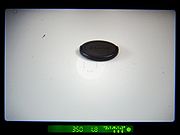
s (LCDs) both in the SLR viewfinder and externally on the cameras' top plate using an LCD screen. Wheels and buttons replaced the shutter dial on the camera and the aperture ring on the lens on many models, although some photographers still prefer shutter dials and aperture rings. Some manufacturers introduced image stabilization
Image stabilization
Image stabilization is a family of techniques used to reduce blurring associated with the motion of a camera during exposure. Specifically, it compensates for pan and tilt of a camera or other imaging device. It is used in image-stabilized binoculars, still and video cameras, and astronomical...
on certain lenses to combat camera shake and to allow longer hand-held exposures without using a tripod. This feature is especially useful with long telephoto lenses.
Digital SLRs (DSLRs)
Canon, Nikon and PentaxPentax
Pentax is a brand name used by Hoya Corporation for its medical-related products & services and Pentax Ricoh Imaging Company for cameras, sport optics , etc. Hoya purchased and merged with the Japanese optics company on March 31, 2008. Hoya's Pentax imaging business was sold to Ricoh Company, Ltd...
have all developed digital SLR cameras using the same lens mounts as on their respective film SLR cameras. Konica Minolta did the same, but in 2006 sold their camera technology to Sony, who now builds DSLRs based on the Minolta lens mount. Samsung builds DSLRs based on the Pentax
Pentax
Pentax is a brand name used by Hoya Corporation for its medical-related products & services and Pentax Ricoh Imaging Company for cameras, sport optics , etc. Hoya purchased and merged with the Japanese optics company on March 31, 2008. Hoya's Pentax imaging business was sold to Ricoh Company, Ltd...
lens mount. Olympus, on the other hand, chose to create a new digital-only Four Thirds System
Four Thirds System
The Four Thirds system is a standard created by Olympus and Kodak for digital single-lens reflex camera design and development.The system provides a standard that, with digital cameras and lenses available from multiple manufacturers, allows for the interchange of lenses and bodies from different...
SLR standard, adopted later by Panasonic and Leica.
Contax came out with a DSLR model, the Contax N-Digital
Contax N Digital
The Contax N Digital was a six-megapixel digital SLR camera produced by Contax in Japan. The camera was announced in late 2000, and began to be sold in spring 2002, after several delays...
. Unfortunately this model was too late and too expensive for competition with other camera manufacturers. The Contax N-digital was the last Contax to use that maker's lens system, and the camera, while having impressive features such as a full-frame sensor, was expensive and lacked sufficient write-speed to the memory card for it to be seriously considered by some professional photographers.
Film formats
Early SLRs were built for large formatLarge format
Large format refers to any imaging format of 4×5 inches or larger. Large format is larger than "medium format", the 6×6 cm or 6×9 cm size of Hasselblad, Rollei, Kowa, Pentax etc cameras , and much larger than the 24×36 mm frame of 35 mm format.The main advantage...
photography, but this film format has largely lost favor among professional photographers. SLR film-based cameras have been produced for most film format
Film format
A film format is a technical definition of a set of standard characteristics regarding image capture on photographic film, for either stills or movies. It can also apply to projected film, either slides or movies. The primary characteristic of a film format is its size and shape.In the case of...
s as well as for digital formats. These film-based SLRs use the 35 mm format
135 film
The term 135 was introduced by Kodak in 1934 as a designation for cartridge film wide, specifically for still photography. It quickly grew in popularity, surpassing 120 film by the late 1960s to become the most popular photographic film format...
as, this film format offers a variety of emulsions and film sensitivity speeds, usable image quality and a good market cost. 35 mm film comes in a variety of exposure lengths: 20 exposure, 24 exposure and 36 exposure rolls. Medium format SLRs provide a higher-quality image with a negative that can be more easily retouched than the smaller 35 mm negative, when this capability is required.
A small number of SLRs were built for APS
Advanced Photo System
Advanced Photo System is a film format for still photography first produced in 1996. It was marketed by Eastman Kodak under the brand name Advantix, by FujiFilm under the name Nexia, by AgfaPhoto under the name Futura and by Konica as Centuria.- Design :The film is 24 mm wide, and has three...
such as the Canon IX series and the Nikon Pronea cameras. SLRs were also introduced for film formats as small as Kodak's 110
110 film
110 is a cartridge-based film format used in still photography. It was introduced by Kodak in 1972. 110 is a miniaturised version of Kodak's earlier 126 film format. Each frame is , with one registration hole....
, such as the Pentax Auto 110
Pentax Auto 110
The Pentax Auto 110 and Pentax Auto 110 Super are single-lens reflex cameras made by Asahi Pentax that use Kodak's 110 film cartridge. The Auto 110 was introduced with three interchangeable lenses in 1978. Three more lenses were introduced in 1981, and then the Super model was released in 1982....
, which had interchangeable lenses.
Common features
Other features found on many SLR cameras include through-the-lens (TTL) meteringThrough-the-lens metering
Through-the-lens metering is a photographic term describing a feature of cameras capable of measuring light levels in a scene through their taking lenses, as opposed to a separate metering window...
and sophisticated flash control referred to as 'dedicated electronic flash'. In a dedicated system, once the dedicated electronic flash is inserted into the camera's hot shoe and turned on, there is then communication between camera and flash. The camera's synchronization speed is set, along with the aperture. Many camera models on the market today actually measure the light that reflects off of the film plane, controls the flash duration of the electronic flash (some flash units have a flash duration range of 1/1000 of a second to 1/50,000 of a second), and then terminate exposure when the camera has received enough light for the exposure.
Some electronic flash units can send out several short bursts of flash to measure the distance, use the camera's inboard sensor(s) to determine the amount of light that is reflected from the subject, then send out a main pulse of light of just the right amount of light energy for a perfectly exposed photograph. Sophisticated cameras can even make it easy for the photographer to balance electronic flash and available light for an evenly balanced scene. While these capabilities are hardly unique to the SLR, manufacturers included them early on in the top models, whereas the best rangefinder cameras adopted such features later.
Advantages
Many of the advantages of SLR cameras derive from viewing and focusing the image through the attached lens. Most other types of cameras do not have this function; subjects are seen through a viewfinder that is near the lens, making the photographer's view different from that of the lens. SLR cameras provide photographers with precision; they provide a viewing image that will be exposed onto the negative exactly as it is seen through the lens. There is no parallaxParallax
Parallax is a displacement or difference in the apparent position of an object viewed along two different lines of sight, and is measured by the angle or semi-angle of inclination between those two lines. The term is derived from the Greek παράλλαξις , meaning "alteration"...
error, and exact focus can be confirmed by eye — especially in macro photography
Macro photography
Macrophotography is close-up photography, usually of very small subjects. Classically a macrophotograph is one in which the size of the subject on the negative is greater than life size. However in modern use it refers to a finished photograph of a subject at greater than life size...
and when photographing using long focus lenses. The depth of field
Depth of field
In optics, particularly as it relates to film and photography, depth of field is the distance between the nearest and farthest objects in a scene that appear acceptably sharp in an image...
may be seen by stopping down to the attached lens aperture
Aperture
In optics, an aperture is a hole or an opening through which light travels. More specifically, the aperture of an optical system is the opening that determines the cone angle of a bundle of rays that come to a focus in the image plane. The aperture determines how collimated the admitted rays are,...
, which is possible on most SLR cameras except for the least expensive models. Because of the SLR's versatility, most manufacturers have a vast range of lenses and accessories available for them.
Compared to most fixed-lens compact cameras, the most commonly used and inexpensive SLR lenses offer a wider aperture range and larger maximum aperture (typically to for a 50 mm lens). This allows photographs to be taken in lower light conditions without flash, and allows a narrower depth of field, which is useful for blurring the background behind the subject, making the subject more prominent. 'Fast' lenses are commonly used in theater photography, portrait photography, surveillance photography, and all other photography requiring a large maximum aperture.
The variety of lenses also allows for the camera to be used and adapted in many different situations. This provides the photographer with considerably more control (i.e., how the image is viewed and framed) than would be the case with a view camera. In addition, some SLR lenses are manufactured with extremely long focal lengths, allowing a photographer to be a considerable distance away from the subject and yet still expose a sharp, focused image. This is particularly useful if the subject includes dangerous animals (e.g., wildlife); the subject prefers anonymity to being photographed; or else, the photographer's presence is unwanted (e.g., celebrity photography or surveillance photography). Practically all SLR and DSLR camera bodies can also be attached to telescopes and microscopes via an adapter tube to further enhance their imaging capabilities.
Disadvantages
In most cases, single-lens reflex cameras cannot be made as small or as light as other camera designs — such as rangefinder cameraRangefinder camera
A rangefinder camera is a camera fitted with a rangefinder: a range-finding focusing mechanism allowing the photographer to measure the subject distance and take photographs that are in sharp focus...
s, autofocus compact cameras and digital cameras with electronic viewfinder
Electronic viewfinder
An electronic viewfinder or EVF is a viewfinder where the image captured by the lens is projected electronically onto a miniature display. The image on this display is used to assist in aiming the camera at the scene to be photographed.-Operation:...
s (EVF) — owing to the mirror box and pentaprism/pentamirror. The mirror box also prevents lenses with deeply recessed rear elements from being mounted close to the film or sensor unless the camera has a mirror lockup feature; this means that simple designs for wide angle lenses cannot be used. Instead, larger and more complex retrofocus designs are required.

Canon Pellix
In the mid 1960s through the lens exposure metering was the new technology entering the SLR camera market. The Pellix was Canon's answer to that challenge. This technology was first successfully realised in a 35mm SLR camera in the remarkable Tokyo Kogaku KK Topcon RE-Super, launched in 1963, but...
and the Canon EOS-1N RS, but these designs introduce their own problems. These pellicle mirrors reduce the amount of light travelling to the film plane or sensor and also can distort the light passing through them, resulting in a less-sharp image. To avoid the noise and vibration, many professional cameras offer a mirror lock-up
Mirror lock-up
Mirror lock-up is a feature employed in many Single Lens Reflex cameras. It allows the operator to reduce vibration-induced motion blur during exposure...
feature, however, this feature totally disables the SLR's automatic focusing ability. Electronic viewfinders have the potential to give the 'viewing-experience' of a DSLR (through-the-lens viewing) without many of the disadvantages. More recently, Sony
Sony
, commonly referred to as Sony, is a Japanese multinational conglomerate corporation headquartered in Minato, Tokyo, Japan and the world's fifth largest media conglomerate measured by revenues....
have resurrected the pellicle mirror concept in their "single-lens translucent
Single-lens translucent camera
Single-Lens Translucent cameras stand in-between digital single-lens reflex cameras cameras and mirrorless interchangeable-lens cameras ....
" (SLT) range of cameras.
Reliability of SLRs
SLRs vary widely in their construction and typically have bodies made of plastic or magnesium. Most manufacturers don't cite durability specifications, but some report shutter life expectancies for professional models. For instance, the Canon EOS 1Ds MkII is rated for 200,000 shutter cycles and the newer Nikon D3 is rated for 300,000 with its exotic carbon fiber/kevlar shutter. Because many SLRs have interchangeable lenses, there is a tendency for dust, sand and dirt to get into the main body of the camera through the mirror box when the lens is removed, thus dirtying or even jamming the mirror movement mechanism or the shutter curtain mechanism itself. In addition, these particles can also jam or otherwise hinder the focusing feature of a lens if they enter into the focusing helicoid. The problem of sensor cleaning has been somewhat reduced in DSLRs as some cameras have a built-in sensor cleaning unit.Price and affordability
The price of SLRs in general also tends to be somewhat higher than that of other types of cameras, owing to their internal complexity. This is compounded by the expense of additional components, such as flashes or lenses. The initial investment in equipment can be prohibitive enough to keep some casual photographers away from SLRs, although the market for used SLRs has become larger particularly as photographers migrate to digital systems.Future of SLRs
For the foreseeable future, film-based SLRs will still be produced, as is still the case with the 35 mm film-based Nikon F6, and some other 35 mm SLR models. This is certainly true with the medium-format film-based SLRs, like the Pentax 6×7 family of cameras. Film has certain result advantages. It appears inevitable that the digital single-lens reflex cameraDigital single-lens reflex camera
Most digital single-lens reflex cameras are digital cameras that use a mechanical mirror system and pentaprism to direct light from the lens to an optical viewfinder on the back of the camera....
design will eclipse film SLR's design in convenience, sales and popularity. These cameras are currently the marketing 'favorite' among advanced amateur and professional photographers.
See also
- Asahi PentaxAsahi PentaxThe Asahi Pentax series, by the , was a pivotal development in modern photography. It was the first model of Pentax camera.- Background :In 1957, the Asahi Optical Company introduced the Pentax, a 35 mm Single-lens reflex camera camera which was so well received that it influenced the design...
- FujifilmFujifilmis a multinational photography and imaging company headquartered in Tokyo, Japan.Fujifilm's principal activities are the development, production, sale and servicing of color photographic film, digital cameras, photofinishing equipment, color paper, photofinishing chemicals, medical imaging...
- Lenses for SLR and DSLR camerasLenses for SLR and DSLR camerasThis article is about photographic lenses for single-lens reflex film cameras and digital single-lens reflex cameras .Furthermore, the emphasis is on modern lenses for 35 mm film SLRs and for DSLRs with sensor sizes less than or equal to 35 mm .-Interchangeable lenses:The major advantage...
- Scheimpflug principleScheimpflug principleThe Scheimpflug principle is a geometric rule that describes the orientation of the plane of focus of an optical system when the lens plane is not parallel to the image plane. It is commonly applied to the use of camera movements on a view camera...
- Zeiss Ikon
Further reading
- Spira, S. F. The History of Photography as Seen through the Spira Collection. New York: Aperture, 2001. ISBN 0-89381-953-0.
External links
- Photography in Malaysia's Contax History, Part II.
- 'Innovative Cameras' by Massimo Bertacchi