

Photographic lens design

Encyclopedia
The design of photographic lens
es (or photographic lens design) for use in still or cine
camera
s is intended to produce a lens that yields the most acceptable rendition of the subject being photographed
within a range of constraints that include cost, weight and materials. For many other optical devices such as telescope
s, microscope
s and theodolite
where the visual image is observed but often not recorded the design can often be significantly simpler than is the case in a camera where every image is captured on film
or image sensor
and can be subject to detailed scrutiny at a later stage. Photographic lenses also include those used in enlarger
s and projectors.
to capture sufficient light so that the camera can operate over a wide range of lighting conditions is important. Designing a lens that reproduces colour accurately is also important as is the production of an evenly lit and sharp image over the whole of the film or sensor plane.
For the lens designer, achieving these objectives will also involve ensuring that internal flare
, optical aberrations and weight are all reduced to the minimum whilst zoom
, focus
and aperture
functions all operate smoothly and predictably.
However, because photographic films and electronic sensors have a finite and measurable resolution, photographic lenses are not always designed for maximum possible resolution since the recording medium would not be able to record the level of detail that the lens could resolve. For this, and many other reasons, camera lenses are unsuited for use as projector
or enlarger
lenses.
The design of a fixed focal length lens (also known as prime lens
es) presents fewer challenges than the design of a zoom lens. A high quality prime lens whose focal length is about equal to the diameter of the film frame or sensor may be constructed from as few as four separate lens elements, often as matched pairs on either side of the aperture diaphragm. Good examples includes the Zeiss Tessar
or the Leitz Elmar.
ing or screw mounting
is to be located.
Photography is a highly competitive commercial business and both weight and cost constrain the production of lenses.
Refractive materials such as glass have physical limitations which limit the performance of lenses. In particular the range of refractive indices available in commercial glasses span a very narrow range. Since it is the refractive index
that determines how much the rays of light are bent at each interface and since it is the differences in refractive indices in paired plus and minus lenses that constrains the ability to minimise chromatic aberration
s, having only a narrow spectrum of indices is a major design constraint.
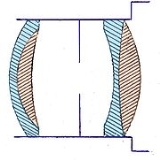
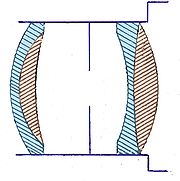 The lenses of the very earliest cameras were simple meniscus or simple bi convex lenses. It was not until 1840 that Chevalier in France introduced the achromatic lens formed by cementing a crown glass
bi-convex lens to a flint glass
plano-concave lens.
By 1841 Voigtländer
working with Joseph Petzval in Austria
developed the first true two element lens.
Carl Zeiss was an entrepreneur
who needed a competent designer to take his firm beyond just another optical workshop. In 1866, the service of Dr Ernst Abbe was enlisted. From then on novel products appeared in rapid succession which brought the Zeiss company to the forefront of optical technology.
Abbe was instrumental in the development of the famous Jena optical glass. When he was trying to eliminate astigmatism from microscopes, he realised that the range of optical glasses available was insufficient. After some calculations, he realised that performance of optical instruments would dramatically improve, if optical glasses of appropriate properties were available. His challenge to glass manufacturers was finally answered by Dr Otto Schott, who established the famous glassworks at Jena
from which new types of optical glass began to appear from 1888, and employed by Zeiss and other makers.
The new Jena optical glass also opened up the possibility of increased performance of photographic lenses. The first use of Jena glass in a photographic lens was by Voigtländer
, but as the lens was an old design its performance was not greatly improved. Subsequently the new glasses would demonstrate their value in correcting astigmatism
, and in the production of apochromatic lenses. Abbé started the design of a photographic lens of symmetrical design with five elements, but went no further.
Zeiss' innovative photographic lens design was due to Dr Paul Rudolph
. In 1890, Rudolph designed an asymmetrical lens with a cemented group at each side of the diaphragm, and appropriately named "Anastigmat". This lens was made in three series: Series III, IV and V, with maximum apertures of f/7.2, f/12.5, and f/18 respectively. In 1891, Series I, II and IIIa appeared with respective maximum apertures of f/4.5, f/6.3, and f/9 and in 1893 came Series IIa of f/8 maximum aperture. These lenses are now better known by the trademark "Protar" which was first used in 1900.
At the time, single combination lenses, which occupy one side of the diaphragm only, were still popular. Rudolph designed one with three cemented elements in 1893, with the option of fitting two of them together in a lens barrel as a compound lens, but it was found to be the same as the Dagor by C.P. Goerz, designed by Emil von Hoegh. Rudolph then came up with a single combination with four cemented elements, which can be considered as having all the elements of the Protar stuck together in one piece. Marketed in 1894, it was called the Protarlinse Series VII, the most highly corrected single combination lens with maximum apertures between f/11 and f/12.5, depending on its focal length.
But the important thing about this Protarlinse is that two of these lens units can be mounted in the same lens barrel to form a compound lens of even greater performance and larger aperture, between f/6.3 and f/7.7. In this configuration it was called the Double Protar Series VIIa. An immense range of focal lengths can thus be obtained by the various combination of Protarlinse units.
Rudolph also investigated the Double-Gauss
concept of a symmetrical design with thin positive meniscii enclosing negative elements. The result was the Planar Series Ia of 1896, with maximum apertures up to f/3.5, one of the fastest lenses of its time. Whilst it was very sharp, it suffered from coma
which limited its popularity. However, further developments of this configuration made it the design of choice for high-speed lenses of standard coverage.
Probably inspired by the Stigmatic lenses designed by Hugh Aldis for Dallmeyer of London, Rudolph designed a new asymmetrical lens with four thin elements, the Unar Series Ib, with apertures up to f/4.5. Due to its high speed it was used extensively on hand cameras.
The most important Zeiss lens by Rudolph was the Tessar
, first sold in 1902 in its Series IIb f/6.3 form. It can be said as a combination of the front half of the Unar with the rear half of the Protar. This proved to be a most valuable and flexible design, with tremendous development potential. Its maximum aperture was increased to f/4.7 in 1917, and reached f/2.7 in 1930. It is probable that every lens manufacturer has produced lenses of the Tessar configuration.
Rudolph left Zeiss after the First World War, but many other competent designers such as Merté, Wandersleb, etc. kept the firm at the leading edge of photographic lens innovations. One of the most significant designer was the ex-Ernemann man Dr Ludwig Bertele
, famed for his Ernostar high-speed lens.
With the advent of the Contax
by Zeiss-Ikon, the first serious challenge to the Leica in the field of professional 35 mm cameras, both Zeiss-Ikon and Carl Zeiss decided to beat the Leica in every possible way. Bertele's Sonnar
series of lenses designed for the Contax were the match in every respect for the Leica for at least two decades. Other lenses for the Contax included the Biotar, Biogon, Orthometar, and various Tessars and Triotars.
The last important Zeiss innovation before the Second World War was the technique of applying anti-reflective coating to lens surfaces. A lens so treated was marked with a red "T", short for "Transparent". The technique of applying multiple layers of coating was also described in the original patent writings in 1935.
After the partitioning of Germany, a new Carl Zeiss optical company was established in Oberkochen
, while the original Zeiss firm in Jena
continued to operate. At first both firms produced very similar lines of products, and extensively cooperated in product-sharing, but they drifted apart as time progressed. Jena's new direction was to concentrate on developing lenses for the 35 mm single-lens reflex camera, and many achievements were made, especially in ultra-wide angle designs. In addition to that, Oberkochen also worked on designing lenses for large format cameras, interchangeable front element lenses such as for the 35 mm single-lens reflex Contaflex, and other types of cameras.
Since the beginning of Zeiss as a photographic lens manufacturer, it has had a licensing programme which allows other manufacturers to produce its lenses. Over the years its licensees included Voigtländer
, Bausch & Lomb
, Ross, Koristka, Krauss, Kodak. etc. In the 1970s, the western operation of Zeiss-Ikon got together with Yashica to produce the new Contax
cameras, and many of the Zeiss lenses for this camera, among others, were produced by Yashica's optical arm, Tomioka. As Yashica's owner Kyocera
ended camera production in 2006, and Yashica lenses were then made by Cosina
, who also manufactured most of the new Zeiss designs for the new Zeiss Ikon coupled rangefinder camera. Another licensees active today is Sony
who uses the Zeiss name on lenses on its video and digital still cameras.
design and the second is a bi-concave design, it is relatively simple to achieve a good degree of convergence of different wavelengths in the visible spectrum
. Most lens designs do not attempt to bring infrared
wavelengths to the same common focus and it is therefore necessary to manually alter the focus when photographing in infrared light.
Most lens elements are made with curved surfaces with a spherical
profile. That is the curved shape would fit on the surface of a sphere. This is partly to do with the history of lens making but also because grinding and manufacturing of spherical surface lenses is relatively simple and cheap. However, spherical surfaces also give rise to lens aberrations and can lead to heavy lens designs. Achieving higher quality lenses and lower weights can be achieved by using aspheric lens
es in which the curved surfaces are not spherical.
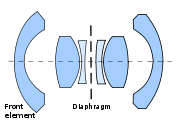
to produce wide-screen films where the projected image has a substantially different ratio of height to width than the image recorded on the film plane. This is achieved by the use of a specialised lens design which compresses the image laterally at the recording stage and the film is then projected through a similar lens in the cinema to recreate the wide-screen effect. Although in some cases the anamorphic effect is achieved by using an anamorphising attachment as a supplementary element on the front of a normal lens, most films shot in anamorphic formats use specially-designed anamorphic lenses, such as the Hawk lenses made by Vantage Film or Panavision's
anamorphic lenses. These lenses incorporate one or more aspheric elements
in their design.
and lanthanum
glass lenses are now in use because of their high refractive index
and very low dispersion properties. It is also likely that a number of other transition element glasses are in use but manufacturers often prefer to keep their material specification secret to retain a commercial or performance edge over their rivals.
cameras risks vignetting of the image in which the corners of the image are darker than the centre. A diaphragm too close to the image plane risks the diaphragm itself being recorded as a circular shape or at the very least causing diffraction patterns at small apertures. In most lens designs the aperture is positioned about mid-way between the front surface of the objective and the image plane. In some zoom lenses it is placed some distance away from the ideal location in order to accommodate the movement of floating lens elements needed to perform the zoom function.
Most modern lenses for 35mm format rarely provide a stop smaller than f22 because of the diffraction effects caused by light passing through a very small aperture. As diffraction is based on aperture width in absolute terms rather than the f-stop ratio, lenses for very small formats common in compact cameras rarely go above f/11 (1/1.8") or f/8 (1/2.5"), while lenses for medium- and large-format provide f/64 or f/128.
Very large aperture lenses designed to be useful in very low light conditions with apertures ranging from f1.2 to f0.9 are generally restricted to lenses of standard focal length because of the size and weight problems that would be encountered in telephoto lenses and the difficulty of building a very wide aperture wide angle lens with the refractive materials currently available. Very large aperture lenses are commonly made for other types of optical instruments such as microscopes but in such cases the diameter of the lens is very small and weight is not an issue.
Many very early cameras had diaphragms external to the lens often consisting of a rotating circular plate with a number of holes of increasing size drilled through the plate. Rotating the plate would bring an appropriate sized hole in front of the lens. All modern lenses use a multi-leaf diaphragm so that at the central intersection of the leaves a more or less circular aperture is formed; either a manual ring control or an electronic motor controls the angle of the diaphragm leaves and thus the size of the opening.
The placement of the diaphragm within the lens structure is constrained by the need to achieve even illumination over the whole film plane at all apertures and the requirement to not interfere with the movement of any movable lens element. Typically the diaphragm is situated at about the level of the optical centre of the lens.
controls the length of time light is allowed to pass through the lens onto the film plane. For any given light intensity, the more sensitive the film or detector or the wider the aperture the shorter the exposure
time need to be to maintain the optimal exposure.
In the earliest camera exposures were controlled by moving a rotating plate from in front of the lens and then replacing it. Such a mechanism only works effectively for exposures of several seconds or more and carries a considerable risk of inducing camera shake. By the end of the 19th century spring tensioned shutter mechanisms were in use operated by a lever or by a cable release. Some simple shutters continued to be placed in front of the lens but most were incorporated within the lens mount itself.
Such lenses with integral shutter mechanisms developed in the current Compur shutter as used in many non-reflex cameras such as Linhof
. These shutters have a number of metal leaves that spring open and then close after a pre-determined interval. The material and design constraints limit the shortest speed to about 0.002 second. Although such shutters cannot yield as short an exposure time as focal plane shutter they are able to offer flash synchronisation
at all speeds.
Incorporating a commercial made Compur type shutter required lens designers to accommodate the width of the shutter mechanism in the lens mount and provide for the means of triggering the shutter on the lens barrel or transferring this to the camera body by a series of levers as in the Minolta
twin lens cameras.
The need to accommodate the shutter mechanism within the lens barrel limited the design of wide-angle lenses and it was not until the widespread use of focal plane shutters that extreme wide-angle lenses were developed.
Later developments adopted designs in which internal elements were moved to achieve focus without affecting the outer barrel of the lens or the orientation of the front element.
Many modern cameras now use automatic focusing mechanisms which use ultrasonic motor
s to move internal elements in the lens to achieve optimum focus.
In addition the design of the lens is required to work effectively with light passing from near focus to far focus - exactly the reverse of a camera lens. This demands that internal light baffling within the lens is designed differently and that the individual lens elements are designed to maximise performance for this change of direction of incident light.
However, because projected images are almost always viewed at some distance, lack of very fine focus and slight unevenness of illumination is often acceptable. Projector lenses have to be very tolerant of prolonged high temperatures from the projector lamp and frequently have a focal length much longer than the taking lens. This allows the lens to be positioned at a greater distance from the illuminated film and allows an acceptable sized image with the projector some distance from the screen. It also permits the lens to be mounted in a relatively coarsely threaded focusing mount so that the projectionist can quickly correct any focusing errors.
Photographic lens
A camera lens is an optical lens or assembly of lenses used in conjunction with a camera body and mechanism to make images of objects either on photographic film or on other media capable of storing an image chemically or electronically.While in principle a simple convex lens will suffice, in...
es (or photographic lens design) for use in still or cine
Çine
Çine is a town and a district of Aydın Province, in the Aegean region of Turkey, from the city of Aydın, on the road to Muğla.- Geography :Formerly known as Kıroba, Çine is an attractive rural district in the southern part of the valley of the Büyük Menderes River, on the southern flank of Madran...
camera
Camera
A camera is a device that records and stores images. These images may be still photographs or moving images such as videos or movies. The term camera comes from the camera obscura , an early mechanism for projecting images...
s is intended to produce a lens that yields the most acceptable rendition of the subject being photographed
Photography
Photography is the art, science and practice of creating durable images by recording light or other electromagnetic radiation, either electronically by means of an image sensor or chemically by means of a light-sensitive material such as photographic film...
within a range of constraints that include cost, weight and materials. For many other optical devices such as telescope
Telescope
A telescope is an instrument that aids in the observation of remote objects by collecting electromagnetic radiation . The first known practical telescopes were invented in the Netherlands at the beginning of the 1600s , using glass lenses...
s, microscope
Microscope
A microscope is an instrument used to see objects that are too small for the naked eye. The science of investigating small objects using such an instrument is called microscopy...
s and theodolite
Theodolite
A theodolite is a precision instrument for measuring angles in the horizontal and vertical planes. Theodolites are mainly used for surveying applications, and have been adapted for specialized purposes in fields like metrology and rocket launch technology...
where the visual image is observed but often not recorded the design can often be significantly simpler than is the case in a camera where every image is captured on film
Film
A film, also called a movie or motion picture, is a series of still or moving images. It is produced by recording photographic images with cameras, or by creating images using animation techniques or visual effects...
or image sensor
Image sensor
An image sensor is a device that converts an optical image into an electronic signal. It is used mostly in digital cameras and other imaging devices...
and can be subject to detailed scrutiny at a later stage. Photographic lenses also include those used in enlarger
Enlarger
An enlarger is a specialized transparency projector used to produce photographic prints from film or glass negatives using the gelatin silver process, or from transparencies.-Construction:...
s and projectors.
Design requirements
From the perspective of the photographer, the ability of a lensLens (optics)
A lens is an optical device with perfect or approximate axial symmetry which transmits and refracts light, converging or diverging the beam. A simple lens consists of a single optical element...
to capture sufficient light so that the camera can operate over a wide range of lighting conditions is important. Designing a lens that reproduces colour accurately is also important as is the production of an evenly lit and sharp image over the whole of the film or sensor plane.
For the lens designer, achieving these objectives will also involve ensuring that internal flare
Lens flare
Lens flare is the light scattered in lens systems through generally unwanted image formation mechanisms, such as internal reflection and scattering from material inhomogeneities in the lens. These mechanisms differ from the intended image formation mechanism that depends on refraction of the image...
, optical aberrations and weight are all reduced to the minimum whilst zoom
Zoom lens
A zoom lens is a mechanical assembly of lens elements for which the focal length can be varied, as opposed to a fixed focal length lens...
, focus
Focus (optics)
In geometrical optics, a focus, also called an image point, is the point where light rays originating from a point on the object converge. Although the focus is conceptually a point, physically the focus has a spatial extent, called the blur circle. This non-ideal focusing may be caused by...
and aperture
Aperture
In optics, an aperture is a hole or an opening through which light travels. More specifically, the aperture of an optical system is the opening that determines the cone angle of a bundle of rays that come to a focus in the image plane. The aperture determines how collimated the admitted rays are,...
functions all operate smoothly and predictably.
However, because photographic films and electronic sensors have a finite and measurable resolution, photographic lenses are not always designed for maximum possible resolution since the recording medium would not be able to record the level of detail that the lens could resolve. For this, and many other reasons, camera lenses are unsuited for use as projector
Slide projector
A slide projector is an opto-mechanical device to view photographic slides. Slide projectors were common in the 1950s to the 1970s as a form of entertainment; family members and friends would gather to view slide shows...
or enlarger
Enlarger
An enlarger is a specialized transparency projector used to produce photographic prints from film or glass negatives using the gelatin silver process, or from transparencies.-Construction:...
lenses.
The design of a fixed focal length lens (also known as prime lens
Prime lens
In film and photography, a prime lens is either a photographic lens whose focal length is fixed, as opposed to a zoom lens, or it is the primary lens in a combination lens system....
es) presents fewer challenges than the design of a zoom lens. A high quality prime lens whose focal length is about equal to the diameter of the film frame or sensor may be constructed from as few as four separate lens elements, often as matched pairs on either side of the aperture diaphragm. Good examples includes the Zeiss Tessar
Tessar
The Tessar is a famous photographic lens design conceived by physicist Paul Rudolph in 1902 while he worked at the Zeiss optical company and patented by Zeiss; the lens type is usually known as the Zeiss Tessar....
or the Leitz Elmar.
Design constraints
To be useful in photography any lens must be able to fit the camera for which it is intended and this will physically limit the size where the bayonet mountBayonet mount
A bayonet mount or bayonet connector is a fastening mechanism consisting of a male side with one or more pins, and a female receptor with matching L slots and spring to keep the two parts locked together....
ing or screw mounting
Lens mount
A lens mount is an interface — mechanical and often also electrical — between a photographic camera body and a lens. It is confined to cameras where the body allows interchangeable lenses, most usually the single lens reflex type or any movie camera of 16 mm or higher gauge...
is to be located.
Photography is a highly competitive commercial business and both weight and cost constrain the production of lenses.
Refractive materials such as glass have physical limitations which limit the performance of lenses. In particular the range of refractive indices available in commercial glasses span a very narrow range. Since it is the refractive index
Refractive index
In optics the refractive index or index of refraction of a substance or medium is a measure of the speed of light in that medium. It is expressed as a ratio of the speed of light in vacuum relative to that in the considered medium....
that determines how much the rays of light are bent at each interface and since it is the differences in refractive indices in paired plus and minus lenses that constrains the ability to minimise chromatic aberration
Chromatic aberration
In optics, chromatic aberration is a type of distortion in which there is a failure of a lens to focus all colors to the same convergence point. It occurs because lenses have a different refractive index for different wavelengths of light...
s, having only a narrow spectrum of indices is a major design constraint.
History
Crown glass (optics)
Crown glass is type of optical glass used in lenses and other optical components. It has relatively low refractive index and low dispersion...
bi-convex lens to a flint glass
Flint glass
Flint glass is optical glass that has relatively high refractive index and low Abbe number. Flint glasses are arbitrarily defined as having an Abbe number of 50 to 55 or less. The currently known flint glasses have refractive indices ranging between 1.45 and 2.00...
plano-concave lens.
By 1841 Voigtländer
Voigtländer
Voigtländer is an optical company founded by Johann Christoph Voigtländer in Vienna in 1756 and is thus the oldest name in cameras. It produced the Petzval photographic lens in 1840, and the world's first all-metal daguerrotype camera in 1841, also bringing out plate cameras shortly afterwards...
working with Joseph Petzval in Austria
Austria
Austria , officially the Republic of Austria , is a landlocked country of roughly 8.4 million people in Central Europe. It is bordered by the Czech Republic and Germany to the north, Slovakia and Hungary to the east, Slovenia and Italy to the south, and Switzerland and Liechtenstein to the...
developed the first true two element lens.
Carl Zeiss was an entrepreneur
Entrepreneur
An entrepreneur is an owner or manager of a business enterprise who makes money through risk and initiative.The term was originally a loanword from French and was first defined by the Irish-French economist Richard Cantillon. Entrepreneur in English is a term applied to a person who is willing to...
who needed a competent designer to take his firm beyond just another optical workshop. In 1866, the service of Dr Ernst Abbe was enlisted. From then on novel products appeared in rapid succession which brought the Zeiss company to the forefront of optical technology.
Abbe was instrumental in the development of the famous Jena optical glass. When he was trying to eliminate astigmatism from microscopes, he realised that the range of optical glasses available was insufficient. After some calculations, he realised that performance of optical instruments would dramatically improve, if optical glasses of appropriate properties were available. His challenge to glass manufacturers was finally answered by Dr Otto Schott, who established the famous glassworks at Jena
Jena
Jena is a university city in central Germany on the river Saale. It has a population of approx. 103,000 and is the second largest city in the federal state of Thuringia, after Erfurt.-History:Jena was first mentioned in an 1182 document...
from which new types of optical glass began to appear from 1888, and employed by Zeiss and other makers.
The new Jena optical glass also opened up the possibility of increased performance of photographic lenses. The first use of Jena glass in a photographic lens was by Voigtländer
Voigtländer
Voigtländer is an optical company founded by Johann Christoph Voigtländer in Vienna in 1756 and is thus the oldest name in cameras. It produced the Petzval photographic lens in 1840, and the world's first all-metal daguerrotype camera in 1841, also bringing out plate cameras shortly afterwards...
, but as the lens was an old design its performance was not greatly improved. Subsequently the new glasses would demonstrate their value in correcting astigmatism
Astigmatism
An optical system with astigmatism is one where rays that propagate in two perpendicular planes have different foci. If an optical system with astigmatism is used to form an image of a cross, the vertical and horizontal lines will be in sharp focus at two different distances...
, and in the production of apochromatic lenses. Abbé started the design of a photographic lens of symmetrical design with five elements, but went no further.
Zeiss' innovative photographic lens design was due to Dr Paul Rudolph
Paul Rudolph (physicist)
Paul Rudolph was a German physicist who designed the first anastigmatic lens while working for Carl Zeiss. After World War I, he joined the Hugo Meyer optical company, where he designed most of their cine lenses. -Work:...
. In 1890, Rudolph designed an asymmetrical lens with a cemented group at each side of the diaphragm, and appropriately named "Anastigmat". This lens was made in three series: Series III, IV and V, with maximum apertures of f/7.2, f/12.5, and f/18 respectively. In 1891, Series I, II and IIIa appeared with respective maximum apertures of f/4.5, f/6.3, and f/9 and in 1893 came Series IIa of f/8 maximum aperture. These lenses are now better known by the trademark "Protar" which was first used in 1900.
At the time, single combination lenses, which occupy one side of the diaphragm only, were still popular. Rudolph designed one with three cemented elements in 1893, with the option of fitting two of them together in a lens barrel as a compound lens, but it was found to be the same as the Dagor by C.P. Goerz, designed by Emil von Hoegh. Rudolph then came up with a single combination with four cemented elements, which can be considered as having all the elements of the Protar stuck together in one piece. Marketed in 1894, it was called the Protarlinse Series VII, the most highly corrected single combination lens with maximum apertures between f/11 and f/12.5, depending on its focal length.
But the important thing about this Protarlinse is that two of these lens units can be mounted in the same lens barrel to form a compound lens of even greater performance and larger aperture, between f/6.3 and f/7.7. In this configuration it was called the Double Protar Series VIIa. An immense range of focal lengths can thus be obtained by the various combination of Protarlinse units.
Rudolph also investigated the Double-Gauss
Double-Gauss
The double Gauss lens is a compound lens used mostly in camera lenses that reduces optical aberrations over a large focal plane.-Design:The double Gauss lens consists of two back-to-back Gauss lenses making two positive meniscus lenses on the outside with two negative meniscus...
concept of a symmetrical design with thin positive meniscii enclosing negative elements. The result was the Planar Series Ia of 1896, with maximum apertures up to f/3.5, one of the fastest lenses of its time. Whilst it was very sharp, it suffered from coma
Coma (optics)
In optics , the coma in an optical system refers to aberration inherent to certain optical designs or due to imperfection in the lens or other components which results in off-axis point sources such as stars appearing distorted, appearing to have a tail like a comet...
which limited its popularity. However, further developments of this configuration made it the design of choice for high-speed lenses of standard coverage.
Probably inspired by the Stigmatic lenses designed by Hugh Aldis for Dallmeyer of London, Rudolph designed a new asymmetrical lens with four thin elements, the Unar Series Ib, with apertures up to f/4.5. Due to its high speed it was used extensively on hand cameras.
The most important Zeiss lens by Rudolph was the Tessar
Tessar
The Tessar is a famous photographic lens design conceived by physicist Paul Rudolph in 1902 while he worked at the Zeiss optical company and patented by Zeiss; the lens type is usually known as the Zeiss Tessar....
, first sold in 1902 in its Series IIb f/6.3 form. It can be said as a combination of the front half of the Unar with the rear half of the Protar. This proved to be a most valuable and flexible design, with tremendous development potential. Its maximum aperture was increased to f/4.7 in 1917, and reached f/2.7 in 1930. It is probable that every lens manufacturer has produced lenses of the Tessar configuration.
Rudolph left Zeiss after the First World War, but many other competent designers such as Merté, Wandersleb, etc. kept the firm at the leading edge of photographic lens innovations. One of the most significant designer was the ex-Ernemann man Dr Ludwig Bertele
Ludwig Bertele
Ludwig Jakob Bertele was a German optics constructor. His developments received universal recognition and serve as a basis for considerable part of optical designs, which are used in modern world.-Biography:...
, famed for his Ernostar high-speed lens.
With the advent of the Contax
Contax
Contax was a camera brand noted for its unique technical innovation and a wide range of Zeiss lenses, noted for their high optical quality. Its final incarnation was a line of 35 mm, medium format and digital cameras engineered and manufactured by Kyocera, and featuring modern Zeiss optics...
by Zeiss-Ikon, the first serious challenge to the Leica in the field of professional 35 mm cameras, both Zeiss-Ikon and Carl Zeiss decided to beat the Leica in every possible way. Bertele's Sonnar
Zeiss Sonnar
The Sonnar is a photographic lens originally designed by Dr. Ludwig Bertele in 1924 and patented by Zeiss Ikon. It was notable for its relatively light weight, simple design and fast aperture. The name "Sonnar" is derived from the German word "Sonne", meaning sun...
series of lenses designed for the Contax were the match in every respect for the Leica for at least two decades. Other lenses for the Contax included the Biotar, Biogon, Orthometar, and various Tessars and Triotars.
The last important Zeiss innovation before the Second World War was the technique of applying anti-reflective coating to lens surfaces. A lens so treated was marked with a red "T", short for "Transparent". The technique of applying multiple layers of coating was also described in the original patent writings in 1935.
After the partitioning of Germany, a new Carl Zeiss optical company was established in Oberkochen
Oberkochen
Oberkochen is a town in the Ostalbkreis, in Baden-Württemberg, Germany.-Economy:After WWII the allied troops moved parts of the Carl Zeiss Company in Jena to Oberkochen. Today the headquarter of the Carl Zeiss AG is located in Oberkochen...
, while the original Zeiss firm in Jena
Jena
Jena is a university city in central Germany on the river Saale. It has a population of approx. 103,000 and is the second largest city in the federal state of Thuringia, after Erfurt.-History:Jena was first mentioned in an 1182 document...
continued to operate. At first both firms produced very similar lines of products, and extensively cooperated in product-sharing, but they drifted apart as time progressed. Jena's new direction was to concentrate on developing lenses for the 35 mm single-lens reflex camera, and many achievements were made, especially in ultra-wide angle designs. In addition to that, Oberkochen also worked on designing lenses for large format cameras, interchangeable front element lenses such as for the 35 mm single-lens reflex Contaflex, and other types of cameras.
Since the beginning of Zeiss as a photographic lens manufacturer, it has had a licensing programme which allows other manufacturers to produce its lenses. Over the years its licensees included Voigtländer
Voigtländer
Voigtländer is an optical company founded by Johann Christoph Voigtländer in Vienna in 1756 and is thus the oldest name in cameras. It produced the Petzval photographic lens in 1840, and the world's first all-metal daguerrotype camera in 1841, also bringing out plate cameras shortly afterwards...
, Bausch & Lomb
Bausch & Lomb
Bausch & Lomb, an American company based in Rochester, New York, is one of the world's leading suppliers of eye health products, such as contact lenses and lens care products today. In addition to this main activity, in recent years the area of medical technology has been developed...
, Ross, Koristka, Krauss, Kodak. etc. In the 1970s, the western operation of Zeiss-Ikon got together with Yashica to produce the new Contax
Contax
Contax was a camera brand noted for its unique technical innovation and a wide range of Zeiss lenses, noted for their high optical quality. Its final incarnation was a line of 35 mm, medium format and digital cameras engineered and manufactured by Kyocera, and featuring modern Zeiss optics...
cameras, and many of the Zeiss lenses for this camera, among others, were produced by Yashica's optical arm, Tomioka. As Yashica's owner Kyocera
Kyocera
is a multinational manufacturer based in Kyoto, Japan. It was founded as in 1959 by Kazuo Inamori and renamed in 1982. The company has diversified its founding technology in ceramic materials through internal development as well as strategic mergers and acquisitions...
ended camera production in 2006, and Yashica lenses were then made by Cosina
Cosina
is a designer and manufacturer of cameras and lenses, and a glassmaker, based in Nakano, Nagano Prefecture, Japan.-History:Cosina is the successor to Nikō , a company set up as a manufacturer oflenses in 1959...
, who also manufactured most of the new Zeiss designs for the new Zeiss Ikon coupled rangefinder camera. Another licensees active today is Sony
Sony
, commonly referred to as Sony, is a Japanese multinational conglomerate corporation headquartered in Minato, Tokyo, Japan and the world's fifth largest media conglomerate measured by revenues....
who uses the Zeiss name on lenses on its video and digital still cameras.
Lens elements
Except for the most simple and inexpensive lenses, each complete lens is made up from a number of separate lens elements arranged along a common axis. The use of many lens elements is designed to minimise aberrations and to provide a sharp image, free from flare and other optical imperfections. To do this requires lens elements of different compositions and different shapes. To minimise chromatic aberrations, in which different wavelengths of light are refracted to different degrees, requires, at a minimum, a couplet of lens elements with a positive element having a high refractive index matched with a negative element of lower refractive index. If the front element is a meniscusMeniscus
The meniscus is the curve in the upper surface of a liquid close to the surface of the container or another object, caused by surface tension. It can be either convex or concave. A convex meniscus occurs when the molecules have a stronger attraction to each other than to the material of the...
design and the second is a bi-concave design, it is relatively simple to achieve a good degree of convergence of different wavelengths in the visible spectrum
Visible spectrum
The visible spectrum is the portion of the electromagnetic spectrum that is visible to the human eye. Electromagnetic radiation in this range of wavelengths is called visible light or simply light. A typical human eye will respond to wavelengths from about 390 to 750 nm. In terms of...
. Most lens designs do not attempt to bring infrared
Infrared
Infrared light is electromagnetic radiation with a wavelength longer than that of visible light, measured from the nominal edge of visible red light at 0.74 micrometres , and extending conventionally to 300 µm...
wavelengths to the same common focus and it is therefore necessary to manually alter the focus when photographing in infrared light.
Most lens elements are made with curved surfaces with a spherical
Sphere
A sphere is a perfectly round geometrical object in three-dimensional space, such as the shape of a round ball. Like a circle in two dimensions, a perfect sphere is completely symmetrical around its center, with all points on the surface lying the same distance r from the center point...
profile. That is the curved shape would fit on the surface of a sphere. This is partly to do with the history of lens making but also because grinding and manufacturing of spherical surface lenses is relatively simple and cheap. However, spherical surfaces also give rise to lens aberrations and can lead to heavy lens designs. Achieving higher quality lenses and lower weights can be achieved by using aspheric lens
Aspheric lens
An aspheric lens or asphere is a lens whose surface profiles are not portions of a sphere or cylinder. In photography, a lens assembly that includes an aspheric element is often called an aspherical lens....
es in which the curved surfaces are not spherical.
Types of lenses
The type of lens being designed is significant in setting the key parameters.- Prime lensPrime lensIn film and photography, a prime lens is either a photographic lens whose focal length is fixed, as opposed to a zoom lens, or it is the primary lens in a combination lens system....
- a photographic lens whose focal length is fixed, as opposed to a zoom lens, or it is the primary lens in a combination lens system. - Normal lensNormal lensIn photography and cinematography a normal lens, also called a standard lens, is a lens that reproduces perspective that generally looks "natural" to a human observer under normal viewing conditions, as compared with lenses with longer or shorter focal lengths which produce an expanded or...
- a lens with a focal length about equal to the diagonal size of the film or sensor format, or that reproduces perspective that generally looks "normal" to a human observer.
- Wide angle lens - a lens that reproduces perspective that generally looks "wider" then a Normal lens. The problem posed by the design of wide angle lenses is to bring an accurate focus light from a wide area without causing internal flare. Wide angle lenses therefore tend to have more elements than a normal lens to help refract the light sufficiently and still minimise aberrations whilst adding light-trapping baffles between each lens element.
- Extreme wide angle lens - a wide angle lens with an angle of view above 90 degrees. Extreme wide angle lenses share the same issues as ordinary wide angle lenses but the focal length of such lenses may be so short that there is insufficient physical space in front of the film or sensor plane to construct a lens. This problem is resolved by constructing the lens as an inverted telephoto, or retrofocusAngenieux retrofocusThe Angénieux retrofocus photographic lens is a wide-angle lens design that uses an inverted telephoto configuration. The popularity of this lens design made the name retrofocus synonymous with this type of lens...
with the front element having a very short focal length, often with a highly exaggerated convex front surface and behind it a strongly negative lens grouping that extends the cone of focused rays so that they can be brought to focus at a reasonable distance.
- Long focus lens - a lens with a focal length greater than the diagonal of the film frame or sensor. Long focus lenses are relatively simple to design, the challenges being comparable to the design of a prime lens. However, as the focal length increases the length of the lens and the size of the objective increase in size and length and weight quickly become significant design issues in retaining utility and practicality for the lens in use. In addition because the light path through the lens is long and glancing, the importance of baffles to control flare increases in importance.
- Telephoto lensTelephoto lensIn photography and cinematography, a telephoto lens is a specific type of a long-focus lens in which the physical length of the lens is shorter than the focal length. This is achieved by incorporating a special lens group known as a telephoto group that extends the light path to create a long-focus...
- an optically compressed version of the long focus lens. The design of telephoto lenses reduces some of the problems encountered by designers of long focus lenses. In particular, telephoto lenses are typically much shorter and may be lighter for equivalent focal length and aperture. However telephoto designs increase the number of lens elements and can introduce flare and exacerbate some optical aberrations. - Zoom lensZoom lensA zoom lens is a mechanical assembly of lens elements for which the focal length can be varied, as opposed to a fixed focal length lens...
es - variable focal length lenses. Zoom lenses cover a range of focal lengths by utilising movable elements within the barrel of the lens assembly. In early zoom lenses the focus also shifted as the lens focal length was changed. All modern zoom lenses are now confocal, meaning that the focus is maintained throughout the zoom range. Because of the need to operate over a range of focal lengths and maintain confocality, zoom lenses typically have very many lens elements. More significantly the front elements of the lens will always be a compromise in terms of its size, light-gathering capability and the angle of incidence of the incoming rays of light. For all these reasons, the optical performance of zoom lenses tends to be lower than fixed focal length lenses. - Catadioptric lens - catadioptric lenses are a form of telephoto lens but with a light path that doubles back on itself and with an objective that is a mirror combined some form aberration correcting lens (a catadioptric system) rather than just a lens. A centrally-placed secondary mirrorSecondary mirrorA secondary mirror is the second deflecting or focusing mirror element in a reflecting telescope. Light gathered by the primary mirror is directed towards a focal point typically past the location of the secondary. Secondary mirrors in the form of an optically flat diagonal mirror are used to...
and usually an additional small lens group bring the light to focus. Such lenses are very lightweight and can easily deliver very long focal lengths but they can only deliver a fixed aperture and have none of the benefits of being able to stop down the aperture to increase depth of field.
Specialist lenses
Anamorphic lenses are used principally in cinematographyCinematography
Cinematography is the making of lighting and camera choices when recording photographic images for cinema. It is closely related to the art of still photography...
to produce wide-screen films where the projected image has a substantially different ratio of height to width than the image recorded on the film plane. This is achieved by the use of a specialised lens design which compresses the image laterally at the recording stage and the film is then projected through a similar lens in the cinema to recreate the wide-screen effect. Although in some cases the anamorphic effect is achieved by using an anamorphising attachment as a supplementary element on the front of a normal lens, most films shot in anamorphic formats use specially-designed anamorphic lenses, such as the Hawk lenses made by Vantage Film or Panavision's
Panavision
Panavision is an American motion picture equipment company specializing in cameras and lenses, based in Woodland Hills, California. Formed by Robert Gottschalk as a small partnership to create anamorphic projection lenses during the widescreen boom in the 1950s, Panavision expanded its product...
anamorphic lenses. These lenses incorporate one or more aspheric elements
Aspheric lens
An aspheric lens or asphere is a lens whose surface profiles are not portions of a sphere or cylinder. In photography, a lens assembly that includes an aspheric element is often called an aspherical lens....
in their design.
Lens glass
The majority of photographic lenses have the lens elements made from glass although the use of high quality plastics is becoming more common in high quality lenses and has been common in more inexpensive cameras for some time. The design of photographic lenses is very demanding as designers push the limits of existing materials to make more versatile, better quality and lighter lenses. As a consequence many exotic glasses have been used in modern lens manufacturers. CaesiumCaesium
Caesium or cesium is the chemical element with the symbol Cs and atomic number 55. It is a soft, silvery-gold alkali metal with a melting point of 28 °C , which makes it one of only five elemental metals that are liquid at room temperature...
and lanthanum
Lanthanum
Lanthanum is a chemical element with the symbol La and atomic number 57.Lanthanum is a silvery white metallic element that belongs to group 3 of the periodic table and is the first element of the lanthanide series. It is found in some rare-earth minerals, usually in combination with cerium and...
glass lenses are now in use because of their high refractive index
Refractive index
In optics the refractive index or index of refraction of a substance or medium is a measure of the speed of light in that medium. It is expressed as a ratio of the speed of light in vacuum relative to that in the considered medium....
and very low dispersion properties. It is also likely that a number of other transition element glasses are in use but manufacturers often prefer to keep their material specification secret to retain a commercial or performance edge over their rivals.
Aperture control
The aperture control, usually a multi-leaf diaphragm, is critical to the performance of a lens. The role of the aperture is to control the amount of light passing through the lens to the film or sensor plane. An aperture placed outside of the lens, as in the case of some VictorianVictorian era
The Victorian era of British history was the period of Queen Victoria's reign from 20 June 1837 until her death on 22 January 1901. It was a long period of peace, prosperity, refined sensibilities and national self-confidence...
cameras risks vignetting of the image in which the corners of the image are darker than the centre. A diaphragm too close to the image plane risks the diaphragm itself being recorded as a circular shape or at the very least causing diffraction patterns at small apertures. In most lens designs the aperture is positioned about mid-way between the front surface of the objective and the image plane. In some zoom lenses it is placed some distance away from the ideal location in order to accommodate the movement of floating lens elements needed to perform the zoom function.
Most modern lenses for 35mm format rarely provide a stop smaller than f22 because of the diffraction effects caused by light passing through a very small aperture. As diffraction is based on aperture width in absolute terms rather than the f-stop ratio, lenses for very small formats common in compact cameras rarely go above f/11 (1/1.8") or f/8 (1/2.5"), while lenses for medium- and large-format provide f/64 or f/128.
Very large aperture lenses designed to be useful in very low light conditions with apertures ranging from f1.2 to f0.9 are generally restricted to lenses of standard focal length because of the size and weight problems that would be encountered in telephoto lenses and the difficulty of building a very wide aperture wide angle lens with the refractive materials currently available. Very large aperture lenses are commonly made for other types of optical instruments such as microscopes but in such cases the diameter of the lens is very small and weight is not an issue.
Many very early cameras had diaphragms external to the lens often consisting of a rotating circular plate with a number of holes of increasing size drilled through the plate. Rotating the plate would bring an appropriate sized hole in front of the lens. All modern lenses use a multi-leaf diaphragm so that at the central intersection of the leaves a more or less circular aperture is formed; either a manual ring control or an electronic motor controls the angle of the diaphragm leaves and thus the size of the opening.
The placement of the diaphragm within the lens structure is constrained by the need to achieve even illumination over the whole film plane at all apertures and the requirement to not interfere with the movement of any movable lens element. Typically the diaphragm is situated at about the level of the optical centre of the lens.
Shutter mechanism
A shutterShutter (photography)
In photography, a shutter is a device that allows light to pass for a determined period of time, for the purpose of exposing photographic film or a light-sensitive electronic sensor to light to capture a permanent image of a scene...
controls the length of time light is allowed to pass through the lens onto the film plane. For any given light intensity, the more sensitive the film or detector or the wider the aperture the shorter the exposure
Exposure (photography)
In photography, exposure is the total amount of light allowed to fall on the photographic medium during the process of taking a photograph. Exposure is measured in lux seconds, and can be computed from exposure value and scene luminance over a specified area.In photographic jargon, an exposure...
time need to be to maintain the optimal exposure.
In the earliest camera exposures were controlled by moving a rotating plate from in front of the lens and then replacing it. Such a mechanism only works effectively for exposures of several seconds or more and carries a considerable risk of inducing camera shake. By the end of the 19th century spring tensioned shutter mechanisms were in use operated by a lever or by a cable release. Some simple shutters continued to be placed in front of the lens but most were incorporated within the lens mount itself.
Such lenses with integral shutter mechanisms developed in the current Compur shutter as used in many non-reflex cameras such as Linhof
Linhof
Linhof is a German company, founded in Munich in 1887 by Valentin Linhof. The company is well known for making premium rollfilm and large format film cameras...
. These shutters have a number of metal leaves that spring open and then close after a pre-determined interval. The material and design constraints limit the shortest speed to about 0.002 second. Although such shutters cannot yield as short an exposure time as focal plane shutter they are able to offer flash synchronisation
Flash synchronization
In a camera, flash synchronization is defined as the firing of a photographic flash coinciding with the shutter admitting light to photographic film or electronic image sensor. It is often shortened to flash sync or flash synch....
at all speeds.
Incorporating a commercial made Compur type shutter required lens designers to accommodate the width of the shutter mechanism in the lens mount and provide for the means of triggering the shutter on the lens barrel or transferring this to the camera body by a series of levers as in the Minolta
Minolta
Minolta Co., Ltd. was a Japanese worldwide manufacturer of cameras, camera accessories, photocopiers, fax machines, and laser printers. Minolta was founded in Osaka, Japan, in 1928 as . It is perhaps best known for making the first integrated autofocus 35mm SLR camera system...
twin lens cameras.
The need to accommodate the shutter mechanism within the lens barrel limited the design of wide-angle lenses and it was not until the widespread use of focal plane shutters that extreme wide-angle lenses were developed.
Focus
Until recent years focusing of a camera lens to achieve a sharp image on the film plane was achieved by means of a very shallow helical thread in the lens mount through which the lens could be rotated moving it closer or further from the film plane. This arrangement whilst simple to design and construct has some limitations not least the rotation of the greater part of the lens assembly including the front element. This could be problematical if devices such as polarising filters were in use that require to maintain an accurate vertical orientation irrespective of focus distance.Later developments adopted designs in which internal elements were moved to achieve focus without affecting the outer barrel of the lens or the orientation of the front element.
Many modern cameras now use automatic focusing mechanisms which use ultrasonic motor
Ultrasonic motor
An ultrasonic motor is a type of electric motor powered by the ultrasonic vibration of a component, the stator, placedagainst another component, the rotor or slider depending on the scheme of operation...
s to move internal elements in the lens to achieve optimum focus.
Enlarger lenses
Lenses used in photographic enlargers are required to focus light passing through a relatively small film area and focus it on a larger area of photographic paper or film. Requirements for such lenses include- the ability to record even illumination over the whole field
- to record fine detail present in the film being enlarged
- to withstand frequent cycles of heating and cooling as the illumination lamp is turned on and off
- to be able to be operated in the dark - usually by means of click stops and some luminous controls
In addition the design of the lens is required to work effectively with light passing from near focus to far focus - exactly the reverse of a camera lens. This demands that internal light baffling within the lens is designed differently and that the individual lens elements are designed to maximise performance for this change of direction of incident light.
Projector lenses
Projector lenses share many of the design constraints as enlarger lenses but with some critical differences. Projector lenses are always used at full aperture and must produce an acceptably illuminated and acceptably sharp image at full aperture.However, because projected images are almost always viewed at some distance, lack of very fine focus and slight unevenness of illumination is often acceptable. Projector lenses have to be very tolerant of prolonged high temperatures from the projector lamp and frequently have a focal length much longer than the taking lens. This allows the lens to be positioned at a greater distance from the illuminated film and allows an acceptable sized image with the projector some distance from the screen. It also permits the lens to be mounted in a relatively coarsely threaded focusing mount so that the projectionist can quickly correct any focusing errors.