
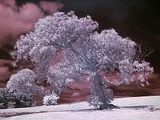
In
infrared photography, the
filmA film, also called a movie or motion picture, is a series of still or moving images. It is produced by recording photographic images with cameras, or by creating images using animation techniques or visual effects...
or
image sensorAn image sensor is a device that converts an optical image into an electronic signal. It is used mostly in digital cameras and other imaging devices...
used is sensitive to
infraredInfrared light is electromagnetic radiation with a wavelength longer than that of visible light, measured from the nominal edge of visible red light at 0.74 micrometres , and extending conventionally to 300 µm...
light. The part of the
spectrumThe visible spectrum is the portion of the electromagnetic spectrum that is visible to the human eye. Electromagnetic radiation in this range of wavelengths is called visible light or simply light. A typical human eye will respond to wavelengths from about 390 to 750 nm. In terms of...
used is referred to as near-infrared to distinguish it from far-infrared, which is the domain of thermal imaging.
WavelengthIn physics, the wavelength of a sinusoidal wave is the spatial period of the wave—the distance over which the wave's shape repeats.It is usually determined by considering the distance between consecutive corresponding points of the same phase, such as crests, troughs, or zero crossings, and is a...
s used for
photographyPhotography is the art, science and practice of creating durable images by recording light or other electromagnetic radiation, either electronically by means of an image sensor or chemically by means of a light-sensitive material such as photographic film...
range from about 700
nmA nanometre is a unit of length in the metric system, equal to one billionth of a metre. The name combines the SI prefix nano- with the parent unit name metre .The nanometre is often used to express dimensions on the atomic scale: the diameter...
to about 900 nm. Film is usually sensitive to visible light too, so an infrared-passing filter is used; this lets infrared (IR) light pass through to the
cameraA camera is a device that records and stores images. These images may be still photographs or moving images such as videos or movies. The term camera comes from the camera obscura , an early mechanism for projecting images...
, but blocks all or most of the visible light spectrum (the filter thus looks black or deep red). ("Infrared filter", confusingly, may refer either to such a filter, or to one that blocks infrared but passes other wavelengths.)
When these
filtersA band-pass filter is a device that passes frequencies within a certain range and rejects frequencies outside that range.Optical band-pass filters are of common usage....
are used together with infrared-sensitive film or sensors, very interesting "
in-camera effectAn in-camera effect is any special effect in a video or movie that is created solely by using techniques in and on the camera and/or its parts. The in-camera effect is defined by the fact that the effect exists on the original camera negative or video recording before it is sent to a lab or modified...
s" can be obtained;
false-colorA false-color image is an image that depicts a subject in colors that differ from those a full-color photograph would show.-True- and false-color:...
or
black-and-whiteBlack-and-white, often abbreviated B/W or B&W, is a term referring to a number of monochrome forms in visual arts.Black-and-white as a description is also something of a misnomer, for in addition to black and white, most of these media included varying shades of gray...
images with a dreamlike or sometimes lurid appearance known as the "Wood Effect," an effect mainly caused by foliage (such as tree leaves and grass) strongly reflecting in the same way visible light is reflected from
snowSnow is a form of precipitation within the Earth's atmosphere in the form of crystalline water ice, consisting of a multitude of snowflakes that fall from clouds. Since snow is composed of small ice particles, it is a granular material. It has an open and therefore soft structure, unless packed by...
. There is a small contribution from chlorophyll
fluorescenceFluorescence is the emission of light by a substance that has absorbed light or other electromagnetic radiation of a different wavelength. It is a form of luminescence. In most cases, emitted light has a longer wavelength, and therefore lower energy, than the absorbed radiation...
, but this is marginal and is not the real cause of the brightness seen in infrared photographs. The effect is named after the infrared photography pioneer
Robert W. WoodRobert Williams Wood was an American physicist and inventor. He is often cited as being a pivotal contributor to the field of optics and is best known for giving birth to the so-called "black-light effect"...
, and not after the material wood, which does not strongly reflect infrared.
The other attributes of infrared photographs include very dark skies and penetration of atmospheric haze, caused by reduced
Rayleigh scatteringRayleigh scattering, named after the British physicist Lord Rayleigh, is the elastic scattering of light or other electromagnetic radiation by particles much smaller than the wavelength of the light. The particles may be individual atoms or molecules. It can occur when light travels through...
and Mie scattering, respectively, compared to visible light. The dark skies, in turn, result in less infrared light in shadows and dark reflections of those skies from water, and clouds will stand out strongly. These wavelengths also penetrate a few millimeters into skin and give a milky look to portraits, although eyes often look black.
History
Until the early 20th century, infrared photography was not possible because
silver halideA silver halide is one of the compounds formed between silver and one of the halogens — silver bromide , chloride , iodide , and three forms of silver fluorides. As a group, they are often referred to as the silver halides, and are often given the pseudo-chemical notation AgX...
emulsions are not sensitive to longer wavelengths than that of blue light (and to a lesser extent, green light) without the addition of a dye to act as a color sensitizer. The first infrared photographs (as distinct from spectrographs) to be published appeared in the February 1910 edition of
The Century MagazineThe Century Magazine was first published in the United States in 1881 by The Century Company of New York City as a successor to Scribner's Monthly Magazine...
and in the October 1910 edition of the
Royal Photographic SocietyThe Royal Photographic Society is the world's oldest national photographic society. It was founded in London, United Kingdom in 1853 as The Photographic Society of London with the objective of promoting the Art and Science of Photography...
Journal to illustrate papers by
Robert W. WoodRobert Williams Wood was an American physicist and inventor. He is often cited as being a pivotal contributor to the field of optics and is best known for giving birth to the so-called "black-light effect"...
, who discovered the unusual effects that now bear his name.
The RPS is co-ordinating events to celebrate the centenary of this event in 2010. Wood's photographs were taken on experimental film that required very long exposures; thus, most of his work focused on landscapes. A further set of infrared landscapes taken by Wood in Italy in 1911 used plates provided for him by CEK Mees at Wratten & Wainwright. Mees also took a few infrared photographs in Portugal in 1910, which are now in the Kodak archives.
Infrared-sensitive photographic plates were developed in the United States during
World War IWorld War I , which was predominantly called the World War or the Great War from its occurrence until 1939, and the First World War or World War I thereafter, was a major war centred in Europe that began on 28 July 1914 and lasted until 11 November 1918...
for spectroscopic analysis, and infrared sensitizing dyes were investigated for improved haze penetration in aerial photography. After 1930, new emulsions from Kodak and other manufacturers became useful to
infrared astronomyInfrared astronomy is the branch of astronomy and astrophysics that studies astronomical objects visible in infrared radiation. The wavelength of infrared light ranges from 0.75 to 300 micrometers...
.
Infrared photography became popular with photography enthusiasts in the 1930s when suitable film was introduced commercially. The Times regularly published landscape and aerial photographs taken by their staff photographers using
IlfordIlford Photo is a manufacturer of photographic materials known worldwide for its black-and-white film and papers and chemicals, as well as its range of Ilfochrome and Ilfocolor colour printing materials. Ilfochrome was formerly called Cibachrome, developed in partnership with the Swiss company...
infrared film. By 1937 33 kinds of infrared film were available from five manufacturers including Agfa, Kodak and Ilford.
Infrared movie film also available and was used to create day-for-night effects in motion pictures,
a notable example being the pseudo-night aerial sequences in the James Cagney/Bette Davis movie The Bride Came COD.
False-color infrared photography became widely practiced with the introduction of Kodak Ektachrome Infrared Aero Film and Ektachrome Infrared EIR. The first version of this, known as Kodacolor Aero-Reversal-Film, was developed by Clark and others at the Kodak for camouflage detection in the 1940s. The film became more widely available in 35mm form in the 1960s but KODAK AEROCHROME III Infrared Film 1443 is their sole remaining infrared film.
Infrared photography became popular with a number of 1960s recording artists, because of the unusual results;
Jimi HendrixJames Marshall "Jimi" Hendrix was an American guitarist and singer-songwriter...
,
DonovanDonovan Donovan Donovan (born Donovan Philips Leitch (born 10 May 1946) is a Scottish singer-songwriter and guitarist. Emerging from the British folk scene, he developed an eclectic and distinctive style that blended folk, jazz, pop, psychedelia, and world music...
,
Frank ZappaFrank Vincent Zappa was an American composer, singer-songwriter, electric guitarist, record producer and film director. In a career spanning more than 30 years, Zappa wrote rock, jazz, orchestral and musique concrète works. He also directed feature-length films and music videos, and designed...
and the
Grateful DeadThe Grateful Dead was an American rock band formed in 1965 in the San Francisco Bay Area. The band was known for its unique and eclectic style, which fused elements of rock, folk, bluegrass, blues, reggae, country, improvisational jazz, psychedelia, and space rock, and for live performances of long...
all issued albums with infrared cover photos. The unexpected colors and effects that infrared film can produce fit well with the
psychedelicThe term psychedelic is derived from the Greek words ψυχή and δηλοῦν , translating to "soul-manifesting". A psychedelic experience is characterized by the striking perception of aspects of one's mind previously unknown, or by the creative exuberance of the mind liberated from its ostensibly...
aesthetic that emerged in the late 1960s.
For some, infrared photography can easily look gimmicky, but many photographers such as
Elio CiolElio Ciol is an Italian photographer and publisher who was born in Casarsa della Delizia in Friuli-Venezia Giulia, the region where he has principally lived and worked. His father was a photographer who kept a studio in their hometown and Elio was fascinated by the technical aspects and worked in...
and Martin Reeves have made subtle use of black-and-white infrared-sensitive film. With the advent of digital infrared photography, as a part of
full spectrum photographyFull-spectrum photography is a subset of full spectral imaging, defined currently among photography enthusiasts as imaging with consumer cameras the full, broad spectrum of a film or camera sensor bandwidth...
, the technique is gaining popularity and is being sold as fine art photographs in a variety of galleries worldwide.
Infrared light lies between the visible and microwave portions of the
electromagnetic spectrumThe electromagnetic spectrum is the range of all possible frequencies of electromagnetic radiation. The "electromagnetic spectrum" of an object is the characteristic distribution of electromagnetic radiation emitted or absorbed by that particular object....
. Infrared light has a range of wavelengths, just like visible light has wavelengths that range from red light to violet. "Near infrared" light is closest in wavelength to visible light and "far infrared" is closer to the microwave region of the electromagnetic spectrum. The longer, far infrared wavelengths are about the size of a pin head and the shorter, near infrared ones are the size of cells, or are microscopic.
Focusing infrared
Most
manual focusIn the field of photography, a manual focus camera is one in which the operator has to adjust the focus of the lens by hand. Before the advent of autofocus, all cameras had manually adjusted focusing; thus, the term is a retronym....
35 mm SLR and medium format SLR lenses have a red dot, line or diamond, often with a red "R" called the infrared index mark, that can be used to achieve proper infrared focus; many autofocus lenses no longer have this mark. When a
single-lens reflexA single-lens reflex camera is a camera that typically uses a semi-automatic moving mirror system that permits the photographer to see exactly what will be captured by the film or digital imaging system, as opposed to pre-SLR cameras where the view through the viewfinder could be significantly...
(SLR) camera is fitted with a filter that is opaque to visible light, the reflex system becomes useless for both framing and focusing, one must compose the picture without the filter and then attach the filter. This requires the use of a tripod to prevent the composition from changing. A sharp infrared photograph can be done with a tripod, a narrow aperture (like ) and a slow
shutter speedIn photography, shutter speed is a common term used to discuss exposure time, the effective length of time a camera's shutter is open....
without focus compensation, however wider apertures like can produce sharp photos only if the lens is meticulously refocused to the infrared index mark, and only if this index mark is the correct one for the filter and film in use. However, it should be noted that diffraction effects inside a camera are greater at infrared wavelengths so that stopping down the lens too far may actually reduce sharpness.
Most
apochromatAn apochromat, or apochromatic lens , is a photographic or other lens that has better correction of chromatic and spherical aberration than the much more common achromat lenses.-Explanation:...
ic ('APO') lenses do not have an Infrared index mark and do not need to be refocused for the
infrared spectrumInfrared spectroscopy is the spectroscopy that deals with the infrared region of the electromagnetic spectrum, that is light with a longer wavelength and lower frequency than visible light. It covers a range of techniques, mostly based on absorption spectroscopy. As with all spectroscopic...
because they are already optically corrected into the near-infrared spectrum.
CatadioptricA catadioptric optical system is one where refraction and reflection are combined in an optical system, usually via lenses and curved mirrors . Catadioptric combinations are used in focusing systems such as search lights, headlamps, early lighthouse focusing systems, optical telescopes,...
lenses do not require this adjustment because
mirrorA mirror is an object that reflects light or sound in a way that preserves much of its original quality prior to its contact with the mirror. Some mirrors also filter out some wavelengths, while preserving other wavelengths in the reflection...
s do not suffer from
chromatic aberrationIn optics, chromatic aberration is a type of distortion in which there is a failure of a lens to focus all colors to the same convergence point. It occurs because lenses have a different refractive index for different wavelengths of light...
.
Zoom lensA zoom lens is a mechanical assembly of lens elements for which the focal length can be varied, as opposed to a fixed focal length lens...
es may scatter more light through their more complicated optical systems than
prime lensIn film and photography, a prime lens is either a photographic lens whose focal length is fixed, as opposed to a zoom lens, or it is the primary lens in a combination lens system....
es, that is, lenses of fixed focal length; for example, an infrared photo taken with a 50 mm prime lens may look more contrasty than the same image taken at 50 mm with a 28–80 zoom.
Some lens manufacturers such as Leica never put IR index marks on their lenses. The reason for this is because any index mark is only valid for one particular IR filter and film combination, and may lead to user error. Even when using lenses with index marks, focus testing is advisable as there may be a large difference between the index mark and the subject plane.
Film cameras
Many conventional cameras can be used for infrared photography, where infrared is taken to mean light of a wavelength only slightly longer than that of visible light. Photography of rather longer wavelengths is normally termed
thermographyInfrared thermography, thermal imaging, and thermal video are examples of infrared imaging science. Thermal imaging cameras detect radiation in the infrared range of the electromagnetic spectrum and produce images of that radiation, called thermograms...
and requires special equipment.
With some patience and ingenuity, most film cameras can be used. However, some cameras of the 1990s that used
35mm filmThe term 135 was introduced by Kodak in 1934 as a designation for cartridge film wide, specifically for still photography. It quickly grew in popularity, surpassing 120 film by the late 1960s to become the most popular photographic film format...
have infrared sprocket-hole sensors that can fog infrared film (their manuals may warn against the use of infrared film for this reason). Other film cameras are not completely opaque to infrared light.
Black-and-white infrared film
Black-and-white infrared negative films are sensitive to wavelengths in the 700 to 900 nm
near infrared spectrumNear-infrared spectroscopy is a spectroscopic method that uses the near-infrared region of the electromagnetic spectrum...
, and most also have a sensitivity to blue light wavelengths. The notable halation effect or glow often seen in the highlights of infrared photographs is an artifact of Kodak High Speed Infrared (HIE) black-and-white
negative filmIn photography, a negative may refer to three different things, although they are all related.-A negative:Film for 35 mm cameras comes in long narrow strips of chemical-coated plastic or cellulose acetate. As each image is captured by the camera onto the film strip, the film strip advances so that...
and not an artifact of infrared light. The glow or blooming is caused by the absence of an
anti-halation layerAn anti-halation backing is a layer found in most photographic films. It is usually a coating on the back of the film base, but sometimes it is incorporated between the light-sensitive emulsion and the base. The light that passes through the emulsion is absorbed by the anti-halation layer...
on the back side of Kodak HIE film, this results in a scattering or blooming around the highlights that would usually be absorbed by the anti-halation layer in conventional films.
The majority of black-and-white infrared art, landscape, and
wedding photographyWedding photography is the photography of activities relating to weddings. It encompasses photographs of the couple before marriage as well as coverage of the wedding and reception...
is done using orange (15 or 21), red (23, 25, or 29) or visually opaque (72) filters over the lens to block the blue visible light from the exposure. The intent of filters in black-and-white infrared photography is to block blue wavelengths and allow infrared to pass through. Without filters, infrared negative films look much like conventional negative films because the blue sensitivity lowers the contrast and effectively counteracts the infrared look of the film. Some photographers use orange or red filters to allow slight amounts of blue wavelengths to reach the film, and thus lower the contrast. Very dark-red (29) filters block out almost all blue, and visually opaque (70, 89b, 87c, 72) filters block out all blue and also visible-red wavelengths, resulting in a more pure-infrared photo with a more pronounced contrast.
Certain infrared-sensitive films like Kodak HIE must only be loaded and unloaded in total darkness. Infrared black-and-white films require special development times but development is usually achieved with standard black-and-white film developers and chemicals (like D-76). Kodak HIE film has a
polyesterPolyester is a category of polymers which contain the ester functional group in their main chain. Although there are many polyesters, the term "polyester" as a specific material most commonly refers to polyethylene terephthalate...
film baseA film base is a transparent substrate which acts as a support medium for the photosensitive emulsion that lies atop it. Despite the numerous layers and coatings associated with the emulsion layer, the base generally accounts for the vast majority of the thickness of any given film stock...
that is very stable but extremely easy to scratch, therefore special care must be used in the handling of Kodak HIE throughout the development and printing/scanning process to avoid damage to the film.
As of November 2, 2007, "KODAK is preannouncing the discontinuance" of HIE Infrared 35 mm film stating the reasons that, "Demand for these products has been declining significantly in recent years, and it is no longer practical to continue to manufacture given the low volume, the age of the product formulations and the complexity of the processes involved."
At the time of this notice, HIE Infrared 135-36 was available at a street price of around $12.00 a roll at US mail order outlets.
Arguably the greatest obstacle to infrared film photography has been the increasing difficulty of obtaining infrared-sensitive film. However, despite the discontinuance of HIE, other newer infrared sensitive emulsions from EFKE, ROLLEI, and ILFORD are still available, but these formulations have differing sensitivity and specifications from the venerable KODAK HIE that has been around for at least two decades. Some of these infrared films are available in 120 and larger formats as well as 35 mm, which adds flexibility to their application. With the discontinuance of Kodak HIE, Efke's IR820 film has become the only IR film on the market with good sensitivity beyond 750 nm, the Rollei film does extend beyond 750 nm but IR sensitivity falls off very rapidly.
Color infrared film
Color infrared transparency films have three sensitized layers that, because of the way the dyes are coupled to these layers, reproduce infrared as red, red as green, and green as blue. All three layers are sensitive to blue so the film must be used with a yellow filter, since this will block blue light but allow the remaining colors to reach the film. The health of foliage can be determined from the relative strengths of green and infrared light reflected; this shows in color infrared as a shift from red (healthy) towards magenta (unhealthy). Early color infrared films were developed in the older
E-4 processThe E-4 process is a now outdated process for developing color reversal photographic film.The process is infamous for its use of the highly toxic reversal agent Tertiary Butyl-Amine Borane . The use of the reversal agent permits processing of the film without the manual reexposure that its...
, but Kodak later manufactured a color transparency film that could be developed in standard
E-6The E-6 process is a chromogenic photographic process for developing Ektachrome, Fujichrome and other color reversal photographic film....
chemistry, although more accurate results were obtained by developing using the AR-5 process. In general, color infrared does not need to be loaded in total darkness (despite what it says on the can), or refocused to the infrared index mark on the lens.
In 2007 Kodak announced that production of the 35 mm version of their color infrared film (Ektachrome Professional Infrared/EIR) would cease as there was insufficient demand. It is assumed that the 70 mm Aerographic format will continue.
There is no currently available digital camera that will produce the same results as Kodak color infrared film although the equivalent images can be produced by taking two exposures, one infrared and the other full-color, and combining in
post-productionPost-production is part of filmmaking and the video production process. It occurs in the making of motion pictures, television programs, radio programs, advertising, audio recordings, photography, and digital art...
. The color images produced by digital still cameras using infrared-pass filters are not equivalent to those produced on color infrared film. The colors result from varying amounts of infrared passing through the color filters on the photo sites, further amended by the Bayer filtering. While this makes such images unsuitable for the kind of applications for which the film was used, such as remote sensing of plant health, the resulting color tonality has proved popular artistically.
Color digital infrared, as part of
full spectrum photographyFull-spectrum photography is a subset of full spectral imaging, defined currently among photography enthusiasts as imaging with consumer cameras the full, broad spectrum of a film or camera sensor bandwidth...
is gaining popularity. The ease of creating a softly colored photo with infrared characteristics has found interest among hobbyists and professionals, with art work being sold in galleries since 2005.
Availability
Kodak color infrared film has been discontinued. It is still available in 120 medium format from a small supplier in Germany who cuts it down from fresh bulk stock. There is no other known supplier of fresh stock. Expired 35 mm rolls are still available on various sites.
Digital cameras
Digital cameraA digital camera is a camera that takes video or still photographs, or both, digitally by recording images via an electronic image sensor. It is the main device used in the field of digital photography...
sensors are inherently sensitive to infrared light, which would interfere with the normal photography by confusing the
autofocusAn autofocus optical system uses a sensor, a control system and a motor to focus fully automatic or on a manually selected point or area. An electronic rangefinder has a display instead of the motor; the adjustment of the optical system has to be done manually until indication...
calculations or softening the image (because infrared light is focused differently from visible light), or oversaturating the red channel. Also, some clothing is transparent in the infrared, leading to unintended (at least to the manufacturer) uses of
video cameraA video camera is a camera used for electronic motion picture acquisition, initially developed by the television industry but now common in other applications as well. The earliest video cameras were those of John Logie Baird, based on the electromechanical Nipkow disk and used by the BBC in...
s. Thus, to improve image quality and protect privacy, many digital cameras employ infrared
blockerBlocker can mean any of the following:*Blocker *The nickname of Steve Roach, Australian rugby league footballer*Blocker , slang for a defensive-minded batsman in cricket*The inverse of a filter...
s. Depending on the subject matter, infrared photography may not be practical with these cameras because the exposure times become overly long, often in the range of 30 seconds, creating noise and
motion blurMotion blur is the apparent streaking of rapidly moving objects in a still image or a sequence of images such as a movie or animation. It results when the image being recorded changes during the recording of a single frame, either due to rapid movement or long exposure.- Photography :When a camera...
in the final image. However, for some subject matter the long exposure does not matter or the motion blur effects actually add to the image. Some lenses will also show a 'hot spot' in the centre of the image as their
coatingsAn optical coating is one or more thin layers of material deposited on an optical component such as a lens or mirror, which alters the way in which the optic reflects and transmits light. One type of optical coating is an antireflection coating, which reduces unwanted reflections from surfaces, and...
are optimised for visible light and not for IR.
An alternative method of DSLR infrared photography is to remove the infrared blocker in front of the sensor and replace it with a filter that removes visible light. This filter is behind the mirror, so the camera can be used normally - handheld, normal shutter speeds, normal composition through the viewfinder, and focus, all work like a normal camera. Metering works but is not always accurate because of the difference between visible and infrared reflection. When the IR blocker is removed, many lenses which did display a hotspot cease to do so, and become perfectly usable for infrared photography. Additionally, because the red, green and blue micro-filters remain and have transmissions not only in their respective color but also in the infrared, enhanced infrared color may be recorded.
Since the
Bayer filterA Bayer filter mosaic is a color filter array for arranging RGB color filters on a square grid of photosensors. Its particular arrangement of color filters is used in most single-chip digital image sensors used in digital cameras, camcorders, and scanners to create a color image...
s in most digital cameras absorb a significant fraction of the infrared light, these cameras are sometimes not very sensitive as infrared cameras and can sometimes produce false colors in the images. An alternative approach is to use a
Foveon X3 sensorThe Foveon X3 sensor is a CMOSimage sensor for digital cameras, designed by Foveon, Inc. and manufactured by National Semiconductorand Dongbu Electronics....
, which does not have absorptive filters on it; the
Sigma SD10The Sigma SD10 is a digital SLR camera produced by the Sigma Corporation of Japan. It was announced on October 27, 2003 and is an evolution of the previous SD9 model, addressing many of the shortcomings of that camera...
DSLR has a removable IR blocking filter and dust protector, which can be simply omitted or replaced by a deep red or complete visible light blocking filter. The
Sigma SD14The Sigma SD14 is a digital single-lens reflex camera produced by the Sigma Corporation of Japan. It is fitted with a Sigma SA mount which takes Sigma SA lenses....
has an IR/UV blocking filter that can be removed/installed without tools. The result is a very sensitive digital IR camera.
While it is common to use a filter that blocks almost all visible light, the wavelength sensitivity of a digital camera without internal infrared blocking is such that a variety of artistic results can be obtained with more conventional filtration. For example, a very dark neutral density filter can be used (such as the Hoya ND400) which passes a very small amount of visible light compared to the near-infrared it allows through. Wider filtration permits an SLR viewfinder to be used and also passes more varied color information to the sensor without necessarily reducing the Wood effect. Wider filtration is however likely to reduce other infrared artefacts such as haze penetration and darkened skies. This technique mirrors the methods used by infrared film photographers where black-and-white infrared film was often used with a deep red filter rather than a visually opaque one.
Several
Sony, commonly referred to as Sony, is a Japanese multinational conglomerate corporation headquartered in Minato, Tokyo, Japan and the world's fifth largest media conglomerate measured by revenues....
cameras have the so-called Night Shot facility, which physically moves the blocking filter away from the light path, which makes the cameras very sensitive to infrared light. Soon after its development, this facility was 'restricted' by Sony to make it difficult for people to take photos that saw through clothing. To do this the iris is opened fully and exposure duration is limited to long times of more than 1/30 second or so. It is possible to shoot infrared but neutral density filters must be used to reduce the camera's sensitivity and the long exposure times mean that care must be taken to avoid camera-shake artifacts.
Fujiis a multinational photography and imaging company headquartered in Tokyo, Japan.Fujifilm's principal activities are the development, production, sale and servicing of color photographic film, digital cameras, photofinishing equipment, color paper, photofinishing chemicals, medical imaging...
have produced digital cameras for use in forensic criminology and medicine which have no infrared blocking filter. The first camera, designated the S3 PRO UVIR, also had extended
ultravioletUltraviolet light is electromagnetic radiation with a wavelength shorter than that of visible light, but longer than X-rays, in the range 10 nm to 400 nm, and energies from 3 eV to 124 eV...
sensitivity (digital sensors are usually less sensitive to UV than to IR). Optimum UV sensitivity requires special lenses, but ordinary lenses usually work well for IR. In 2007,
FujiFilmis a multinational photography and imaging company headquartered in Tokyo, Japan.Fujifilm's principal activities are the development, production, sale and servicing of color photographic film, digital cameras, photofinishing equipment, color paper, photofinishing chemicals, medical imaging...
introduced a new version of this camera, based on the Nikon D200/ FujiFilm S5 called the
IS ProThe FinePix IS Pro is a digital single lens reflex camera introduced by Fujifilm in 2007. It is based on a FinePix S5 Pro, which is in turn based on the Nikon D200. It has a Nikon F lens mount and can use most lenses made for 35 mm Nikon SLR cameras. It replaces the Fujifilm FinePix S3 Pro...
, also able to take Nikon lenses. Fuji had earlier introduced a non-SLR infrared camera, the IS-1, a modified version of the FujiFilm FinePix S9100. Unlike the S3 PRO UVIR, the IS-1 does not offer UV sensitivity. FujiFilm restricts the sale of these cameras to professional users with their EULA specifically prohibiting "unethical photographic conduct".
Phase One
digital camera backA digital camera back is a device that attaches to the back of a camera in place of a film holder and contains an electronic image sensor. This lets cameras that were designed to use film take digital photographs...
s can be ordered in an infrared modified form.
Remote sensingRemote sensing is the acquisition of information about an object or phenomenon, without making physical contact with the object. In modern usage, the term generally refers to the use of aerial sensor technologies to detect and classify objects on Earth by means of propagated signals Remote sensing...
and
thermographic cameraA thermographic camera or infrared camera is a device that forms an image using infrared radiation, similar to a common camera that forms an image using visible light...
s are sensitive to longer wavelengths of infrared. They may be multispectral and use a variety of technologies which may not resemble common camera or filter designs. Cameras sensitive to far infrared including those used in
infrared astronomyInfrared astronomy is the branch of astronomy and astrophysics that studies astronomical objects visible in infrared radiation. The wavelength of infrared light ranges from 0.75 to 300 micrometers...
often require cooling, since all objects at
room temperature-Comfort levels:The American Society of Heating, Refrigerating and Air-Conditioning Engineers has listings for suggested temperatures and air flow rates in different types of buildings and different environmental circumstances. For example, a single office in a building has an occupancy ratio per...
(including the camera body, optics, and the detector itself) are glowing all the time at these wavelengths (see
thermal radiationThermal radiation is electromagnetic radiation generated by the thermal motion of charged particles in matter. All matter with a temperature greater than absolute zero emits thermal radiation....
). Lower priced thermographic digital cameras extend the spectral range less far into infrared. These cameras are generally used for building inspection or preventative maintenance but can be used for artistic pursuits as well, such as this image of a cup of coffee.
External links
- A daily feed of infrared photography examples
- All you ever wanted to know about digital UV and IR photography, but could not afford to ask
- Digital infrared explanations, camera tests, conversion details and competition results
- Jeremy McCreary's infrared (IR) basics for digital photographers
- Infrared panoramic photography
- Infra-red kite aerial photography
- Gisle Hannemyr's Digital Infrared Resource Page will help you decide if your digital camera is IR-sensitive, and more
- Conversion instructions for the Canon G1
- The Billion Infrared Pixel Image Large-scale stitching and IR photography
- Digital Infrared Photography An introductory two-part article that also covers seldom discussed topics (e.g., diffraction, mirror lenses, polarizing filters, IR flash photography, etc.).
- List of cameras and their usefulness in digital infrared photography, and lenses that do and don't produce "ir hot-spots".
- Short video showing how to take infrared photographs
- Amazing demonstration of aerial haze penetration, "Visible vs. Infrared" photograph
- Make your own budget IR camera