

Pinhole camera

Encyclopedia
Camera
A camera is a device that records and stores images. These images may be still photographs or moving images such as videos or movies. The term camera comes from the camera obscura , an early mechanism for projecting images...
without a lens
Photographic lens
A camera lens is an optical lens or assembly of lenses used in conjunction with a camera body and mechanism to make images of objects either on photographic film or on other media capable of storing an image chemically or electronically.While in principle a simple convex lens will suffice, in...
and with a single small aperture
Aperture
In optics, an aperture is a hole or an opening through which light travels. More specifically, the aperture of an optical system is the opening that determines the cone angle of a bundle of rays that come to a focus in the image plane. The aperture determines how collimated the admitted rays are,...
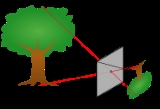
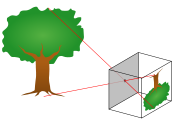
– effectively a light-proof box with a small hole in one side. Light from a scene passes through this single point and projects an inverted image on the opposite side of the box. The human eye in bright light acts similarly, as do cameras using small apertures.
Up to a certain point, the smaller the hole, the sharper the image, but the dimmer the projected image. Optimally, the size of the aperture should be 1/100 or less of the distance between it and the projected image.
Because a pinhole camera requires a lengthy exposure, its shutter
Shutter (photography)
In photography, a shutter is a device that allows light to pass for a determined period of time, for the purpose of exposing photographic film or a light-sensitive electronic sensor to light to capture a permanent image of a scene...
may be manually operated, as with a flap of light-proof material to cover and uncover the pinhole. Typical exposures range from 5 seconds to several hours.
A common use of the pinhole camera is to capture the movement of the sun over a long period of time. This type of photography is called Solargraphy.
The image may be projected onto a translucent screen for real-time viewing (popular for observing solar eclipses; see also camera obscura
Camera obscura
The camera obscura is an optical device that projects an image of its surroundings on a screen. It is used in drawing and for entertainment, and was one of the inventions that led to photography. The device consists of a box or room with a hole in one side...
), or can expose photographic film
Photographic film
Photographic film is a sheet of plastic coated with an emulsion containing light-sensitive silver halide salts with variable crystal sizes that determine the sensitivity, contrast and resolution of the film...
or a charge coupled device (CCD). Pinhole cameras with CCDs are often used for surveillance
Surveillance
Surveillance is the monitoring of the behavior, activities, or other changing information, usually of people. It is sometimes done in a surreptitious manner...
because they are difficult to detect.
Invention of pinhole camera
As far back as the 4th century BC, GreeksAncient Greece
Ancient Greece is a civilization belonging to a period of Greek history that lasted from the Archaic period of the 8th to 6th centuries BC to the end of antiquity. Immediately following this period was the beginning of the Early Middle Ages and the Byzantine era. Included in Ancient Greece is the...
such as Aristotle
Aristotle
Aristotle was a Greek philosopher and polymath, a student of Plato and teacher of Alexander the Great. His writings cover many subjects, including physics, metaphysics, poetry, theater, music, logic, rhetoric, linguistics, politics, government, ethics, biology, and zoology...
and Euclid
Euclid
Euclid , fl. 300 BC, also known as Euclid of Alexandria, was a Greek mathematician, often referred to as the "Father of Geometry". He was active in Alexandria during the reign of Ptolemy I...
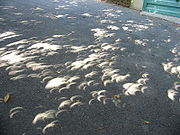
wrote on naturally-occurring rudimentary pinhole cameras. For example, light may travel through the slits of wicker baskets or the crossing of tree leaves. (The circular dapples on a forest floor, actually pinhole images of the sun, can be seen to have a bite taken out of them during partial solar eclipses opposite to the position of the moon's actual occultation of the sun because of the inverting effect of pinhole lenses.)
The 10th-century Ibn al-Haytham (Alhazen) published this idea in the Book of Optics
Book of Optics
The Book of Optics ; ; Latin: De Aspectibus or Opticae Thesaurus: Alhazeni Arabis; Italian: Deli Aspecti) is a seven-volume treatise on optics and other fields of study composed by the medieval Muslim scholar Alhazen .-See also:* Science in medieval Islam...
in 1021 AD. He improved on the camera after realizing that the smaller the pinhole, the sharper the image (though the less light). He provides the first clear description for construction of a camera obscura (Lat. dark chamber). As a side benefit of his invention, he was credited with being the first man to shift physics from a philosophical to an experimental basis.
In the 5th century BC, the Mohist philosopher Mo Jing
Mozi
Mozi |Lat.]] as Micius, ca. 470 BC – ca. 391 BC), original name Mo Di , was a Chinese philosopher during the Hundred Schools of Thought period . Born in Tengzhou, Shandong Province, China, he founded the school of Mohism, and argued strongly against Confucianism and Daoism...
(墨經) in ancient China mentioned the effect of an inverted image forming through a pinhole. The image of an inverted Chinese pagoda
Chinese pagoda
Chinese Pagodas are a traditional part of Chinese architecture. In addition to religious use, since ancient times Chinese pagodas have been praised for the spectacular views which they offer, and many famous poems in Chinese history attest to the joy of scaling pagodas.-History:The pagoda is...
is mentioned in Duan Chengshi
Duan Chengshi
Duan Chengshi was an author and scholar of the Tang Dynasty in China. He was born to a wealthy family in present day Zibo, Shandong. A descendant of the early Tang official Duan Zhixuan 段志玄 , and the son of Duan Wenchang 段文昌, a high official under Tang Xuanzong, his family background enabled him...
's (d. 863) book Miscellaneous Morsels from Youyang
Miscellaneous Morsels from Youyang
The Miscellaneous Morsels from Youyang is a miscellany of Chinese and foreign legends and hearsay, reports on natural phenomena, short anecdotes, and tales of the wondrous and mundane, as well as notes on such topics as medicinal herbs and tattoos....
written during the Tang Dynasty
Tang Dynasty
The Tang Dynasty was an imperial dynasty of China preceded by the Sui Dynasty and followed by the Five Dynasties and Ten Kingdoms Period. It was founded by the Li family, who seized power during the decline and collapse of the Sui Empire...
(618–907). Along with experimenting with the pinhole camera and the burning mirror
Burning-glass
A burning glass or burning lens is a large convex lens that can concentrate the sun's rays onto a small area, heating up the area and thus resulting in ignition of the exposed surface. Burning mirrors achieve a similar effect by using reflecting surfaces to focus the light...
of the ancient Mohists, the Song Dynasty
Song Dynasty
The Song Dynasty was a ruling dynasty in China between 960 and 1279; it succeeded the Five Dynasties and Ten Kingdoms Period, and was followed by the Yuan Dynasty. It was the first government in world history to issue banknotes or paper money, and the first Chinese government to establish a...
(960–1279 CE) Chinese
Chinese people
The term Chinese people may refer to any of the following:*People with Han Chinese ethnicity ....
scientist Shen Kuo
Shen Kuo
Shen Kuo or Shen Gua , style name Cunzhong and pseudonym Mengqi Weng , was a polymathic Chinese scientist and statesman of the Song Dynasty...
(1031–1095) experimented with camera obscura and was the first to establish geometrical and quantitative
Quantitative property
A quantitative property is one that exists in a range of magnitudes, and can therefore be measured with a number. Measurements of any particular quantitative property are expressed as a specific quantity, referred to as a unit, multiplied by a number. Examples of physical quantities are distance,...
attributes for it.
In the 13th century AD, Robert Grosseteste
Robert Grosseteste
Robert Grosseteste or Grossetete was an English statesman, scholastic philosopher, theologian and Bishop of Lincoln. He was born of humble parents at Stradbroke in Suffolk. A.C...
and Roger Bacon
Roger Bacon
Roger Bacon, O.F.M. , also known as Doctor Mirabilis , was an English philosopher and Franciscan friar who placed considerable emphasis on the study of nature through empirical methods...
commented on the pinhole camera. Between 1000 and 1600, men such as Ibn al-Haytham, Gemma Frisius
Gemma Frisius
Gemma Frisius , was a physician, mathematician, cartographer, philosopher, and instrument maker...
, and Giambattista della Porta
Giambattista della Porta
Giambattista della Porta , also known as Giovanni Battista Della Porta and John Baptist Porta, was an Italian scholar, polymath and playwright who lived in Naples at the time of the Scientific Revolution and Reformation....
wrote on the pinhole camera, explaining why the images are upside down. Pinhole devices provide safety for the eyes when viewing solar eclipses because the event is observed indirectly, the diminished intensity of the pinhole image being harmless compared with the full glare of the Sun
Sun
The Sun is the star at the center of the Solar System. It is almost perfectly spherical and consists of hot plasma interwoven with magnetic fields...
itself.
Around 1600 AD, Giambattista della Porta added a lens to the pinhole camera. It was not until 1850 AD that a Scottish
Scottish people
The Scottish people , or Scots, are a nation and ethnic group native to Scotland. Historically they emerged from an amalgamation of the Picts and Gaels, incorporating neighbouring Britons to the south as well as invading Germanic peoples such as the Anglo-Saxons and the Norse.In modern use,...
scientist by the name of Sir David Brewster
David Brewster
Sir David Brewster KH PRSE FRS FSA FSSA MICE was a Scottish physicist, mathematician, astronomer, inventor, writer and university principal.-Early life:...
actually took the first photograph with a pinhole camera. Up until recently it was believed that Brewster himself coined the term "Pinhole" in "The Stereoscope". The earliest reference to the term "Pinhole" has been traced back to almost a century before Brewster to James Ferguson's Lectures on select Subjects. Sir William Crookes
William Crookes
Sir William Crookes, OM, FRS was a British chemist and physicist who attended the Royal College of Chemistry, London, and worked on spectroscopy...
and William de Wiveleslie Abney
William de Wiveleslie Abney
William de Wiveleslie Abney FRS was an English astronomer, chemist, and photographer.-Biography:Abney was born in Derby, England, the son of Edward Abney vicar of St Alkmund's Derby, and owner of the Firs Estate...
were other early photographers to try the pinhole technique.
Selection of pinhole size
Image resolution
Image resolution is an umbrella term that describes the detail an image holds. The term applies to raster digital images, film images, and other types of images. Higher resolution means more image detail....
because the projected circle of confusion
Circle of confusion
In optics, a circle of confusion is an optical spot caused by a cone of light rays from a lens not coming to a perfect focus when imaging a point source...
at the image plane is practically the same size as the pinhole. An extremely small hole, however, can produce significant diffraction
Diffraction
Diffraction refers to various phenomena which occur when a wave encounters an obstacle. Italian scientist Francesco Maria Grimaldi coined the word "diffraction" and was the first to record accurate observations of the phenomenon in 1665...
effects and a less clear image due to the wave properties of light. Additionally, vignetting
Vignetting
In photography and optics, vignetting is a reduction of an image's brightness or saturation at the periphery compared to the image center. The word vignette, from the same root as vine, originally referred to a decorative border in a book. Later, the word came to be used for a photographic...
occurs as the diameter of the hole approaches the thickness of the material in which it is punched, because the sides of the hole obstruct the light entering at anything other than 90 degrees.
The best pinhole is perfectly round (since irregularities cause higher-order diffraction effects), and in an extremely thin piece of material. Industrially produced pinholes benefit from laser
Laser
A laser is a device that emits light through a process of optical amplification based on the stimulated emission of photons. The term "laser" originated as an acronym for Light Amplification by Stimulated Emission of Radiation...
etching, but a hobbyist can still produce pinholes of sufficiently high quality for photographic work.
Brass
Brass is an alloy of copper and zinc; the proportions of zinc and copper can be varied to create a range of brasses with varying properties.In comparison, bronze is principally an alloy of copper and tin...
shim or metal reclaimed from an aluminium drinks can or tin foil
Tin foil
Tin foil, also spelled tinfoil, is a thin foil made of tin. Actual tin foil was superseded by cheaper and more durable aluminium foil after World War II, and aluminium foil is sometimes confused with "tin foil" because of its similarity to the former material.-History:Foil made from a thin leaf of...
/aluminum foil, use fine sand paper to reduce the thickness of the centre of the material to the minimum, before carefully creating a pinhole with a suitably sized needle.
A method of calculating the optimal pinhole diameter was first attempted by Jozef Petzval
Jozef Maximilián Petzval
Joseph Petzval was a Hungarian / Slovak mathematician, inventor, and physicist of German origin, born in Upper Hungary .He is best known for his work in optics...
. The formula used today was evolved by Lord Rayleigh:

where d is pinhole diameter, f is focal length (distance from pinhole to image plane) and λ is the wavelength
Wavelength
In physics, the wavelength of a sinusoidal wave is the spatial period of the wave—the distance over which the wave's shape repeats.It is usually determined by considering the distance between consecutive corresponding points of the same phase, such as crests, troughs, or zero crossings, and is a...
of light.
For standard black-and-white film, a wavelength of light corresponding to yellow-green (550 nm
Nanometre
A nanometre is a unit of length in the metric system, equal to one billionth of a metre. The name combines the SI prefix nano- with the parent unit name metre .The nanometre is often used to express dimensions on the atomic scale: the diameter...
) should yield optimum results. (For a pinhole-to-film distance of 1 inches (25.4 mm), this works out to a pinhole 0.22 mm in diameter. For 5 cm, the appropriate diameter is 0.32 mm.
The depth of field
Depth of field
In optics, particularly as it relates to film and photography, depth of field is the distance between the nearest and farthest objects in a scene that appear acceptably sharp in an image...
is basically infinite, but this does not mean that no optical blurring occurs. The infinite depth of field means that image blur depends not on object distance, but on other factors, such as the distance from the aperture to the film plane
Film plane
A film plane is the area inside any image taking device with a lens and a digital sensor or film; such as a camera. The film plane varies in distance from the lens focal point in each manufacturer...
, the aperture size, and the wavelength(s) of the light source.
Pinhole camera construction
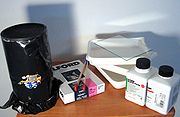
Pinhole cameras can be handmade by the photographer for a particular purpose. In its simplest form, the photographic pinhole camera can consist of a light-tight box with a pinhole in one end, and a piece of film or photographic paper wedged or taped into the other end.A flap of cardboard with a tape hinge can be used as a shutter.
The pinhole may be punched or drilled using a sewing needle or small diameter bit through a piece of tinfoil or thin aluminum or brass sheet.
This piece is then taped to the inside of the light tight box behind a hole cut through the box. A cylindrical oatmeal container may be made into a pinhole camera.
Pinhole cameras can be constructed with a sliding film holder or back so the distance between the film and the pinhole can be adjusted.
This allows the angle of view
Angle of view
In photography, angle of view describes the angular extent of a given scene that is imaged by a camera. It is used interchangeably with the more general term field of view....
of the camera to be changed and also the effective f-stop ratio of the camera. Moving the film closer to the pinhole will result in a wide angle field of view and a shorter exposure time.
Moving the film farther away from the pinhole will result in a telephoto or narrow angle view and a longer exposure time.
Pinhole cameras can also be constructed by replacing the lens assembly in a conventional camera with a pinhole. In particular, compact 35 mm cameras whose lens and focusing assembly has been damaged can be reused as pinhole cameras—maintaining the use of the shutter and film winding mechanisms. As a result of the enormous increase in f-number
F-number
In optics, the f-number of an optical system expresses the diameter of the entrance pupil in terms of the focal length of the lens; in simpler terms, the f-number is the focal length divided by the "effective" aperture diameter...
while maintaining the same exposure time, one must use a fast film in direct sunshine.
Pinholes (homemade or commercial) can be used in place of the lens on an SLR. Use with a digital SLR allows metering and composition by trial and error, and is effectively free, so is a popular way to try pinhole photography.
Unusual materials have been used to construct pinhole cameras, e.g., a Chinese roast duck.
Calculating the f-number & required exposure

Focal length
The focal length of an optical system is a measure of how strongly the system converges or diverges light. For an optical system in air, it is the distance over which initially collimated rays are brought to a focus...
) by the diameter of the pinhole. For example, a camera with a 0.02 inch (0.5 mm) diameter pinhole, and a 2 inch (50 mm) focal length would have an f-number of 2/0.02 (50/0.5), or 100 (f/100 in conventional notation).
Due to the large f-number of a pinhole camera, exposures will often encounter reciprocity
Reciprocity (photography)
In photography reciprocity refers to the inverse relationship between the intensity and duration of light that determines the reaction of light-sensitive material. Within a normal exposure range for film stock, for example, the reciprocity law states that the film response will be determined by the...
failure. Once exposure time has exceeded about 1 second for film or 30 seconds for paper, one must compensate for the breakdown in linear response of the film/paper to intensity of illumination by using longer exposures.
Other special features can be built into pinhole cameras such as the ability to take double images, by using multiple pinholes, or the ability to take pictures in cylindrical
Cylindrical perspective
Cylindrical perspective is a form of distortion caused by fisheye and panoramic lenses which reproduce straight horizontal lines above and below the lens axis level as curved while reproducing straight horizontal lines on lens axis level as straight...
or spherical perspective by curving the film plane.
These characteristics could be used for creative purposes.
Once considered as an obsolete technique from the early days of photography
Photography
Photography is the art, science and practice of creating durable images by recording light or other electromagnetic radiation, either electronically by means of an image sensor or chemically by means of a light-sensitive material such as photographic film...
, pinhole photography is from time to time a trend in artistic photography.
Related cameras, image forming devices, or developments from it include Franke's widefield pinhole camera, the pinspeck camera
Pinspeck camera
A pinspeck camera is the optical reverse of a pinhole camera: a small obstruction is placed in front of the film where the hole would be in a pinhole camera...
, and the pinhead mirror
Pinhead mirror
A pinhead mirror can be used to create a camera similar to a pinhole camera. Instead of passing through a tiny hole, the light to form the image is reflected by a small disc-shaped mirror...
.
NASA
NASA
The National Aeronautics and Space Administration is the agency of the United States government that is responsible for the nation's civilian space program and for aeronautics and aerospace research...
(via the NASA Institute for Advanced Concepts
NASA Institute for Advanced Concepts
right|200pxNASA Institute for Advanced Concepts was a NASA-funded program that was operated by the Universities Space Research Association for NASA from 1998 until its closure on 31 August 2007. NIAC sought proposals for revolutionary aeronautics and space concepts that could dramatically impact...
) has funded initial research into the New Worlds Mission project, which proposes to use a pinhole camera with a diameter of 10 m and focus length of 200,000 km to image earth sized planets in other star systems.
Coded apertures
A non-focusing coded-aperture optical system may be thought of as multiple pinhole cameras in conjunction. By adding pinholes, light throughput and thus sensitivity are increased. However, multiple images are formed, usually requiring computer deconvolutionDeconvolution
In mathematics, deconvolution is an algorithm-based process used to reverse the effects of convolution on recorded data. The concept of deconvolution is widely used in the techniques of signal processing and image processing...
.
See also
- Pinhole glassesPinhole glassesPinhole glasses, also known as stenopeic glasses, are eyeglasses with a series of pinhole-sized perforations filling an opaque sheet of plastic in place of each lens. Similar to the workings of a pinhole camera, each perforation allows only a very narrow beam of light to enter the eye which reduces...
- Spatial filterSpatial filterA spatial filter is an optical device which uses the principles of Fourier optics to alter the structure of a beam of coherent light or other electromagnetic radiation. Spatial filtering is commonly used to "clean up" the output of lasers, removing aberrations in the beam due to imperfect, dirty,...
- Zone plateZone plateA zone plate is a device used to focus light or other things exhibiting wave character. Unlike lenses or curved mirrors however, zone plates use diffraction instead of refraction or reflection. Based on analysis by Augustin-Jean Fresnel, they are sometimes called Fresnel zone plates in his honor...
- DirkonDirkonThe Dirkon is a paper camera kit that was first published in 1979 in the Communist Czechoslovakian magazine ABC mladých techniků a přírodovědců [translated as An ABC of Young Technicians and Natural Scientists]...
- Fox Talbot
- Wolf HowardWolf HowardWolf Howard is an English artist, poet and filmmaker living in Chatham, Kent and was a founder member of the Stuckists art group...
- Billy ChildishBilly ChildishBilly Childish is an English artist, painter, author, poet, photographer, film maker, singer and guitarist...
- Jesse RichardsJesse RichardsJesse Richards is a painter, filmmaker and photographer from New Haven, Connecticut and was affiliated with the international movement Stuckism.-Early life:...
- Pinhole camera modelPinhole camera modelThe pinhole camera model describes the mathematical relationship between the coordinates of a 3D point and its projection onto the image plane of an ideal pinhole camera, where the camera aperture is described as a point and no lenses are used to focus light...
- NautilusNautilusNautilus is the common name of marine creatures of cephalopod family Nautilidae, the sole extant family of the superfamily Nautilaceae and of its smaller but near equal suborder, Nautilina. It comprises six living species in two genera, the type of which is the genus Nautilus...
(its pinhole eye functions as a camera) - Pinhole occluderPinhole occluderA pinhole occluder is an opaque disk with one or more small holes through it, used by ophthalmologists and optometrists to test visual acuity. The occluder is a simple way to focus light, as in a pinhole camera, temporarily removing the effects of refractive errors such as myopia...
, a similar device used by ophthalmologists - Camera ObscuraCamera obscuraThe camera obscura is an optical device that projects an image of its surroundings on a screen. It is used in drawing and for entertainment, and was one of the inventions that led to photography. The device consists of a box or room with a hole in one side...
, uses the same principle as a Pinhole Camera. - The Great PictureThe Great Picture, The Great Picture holds the Guinness World Record for the largest print picture, and the camera with which it was made holds a record for being the largest. The picture was taken in 2006 as part of the , a photographic compilation and record of the airfield's history before it is transformed into...