


Diaphragm (optics)

Encyclopedia
Optics
Optics is the branch of physics which involves the behavior and properties of light, including its interactions with matter and the construction of instruments that use or detect it. Optics usually describes the behavior of visible, ultraviolet, and infrared light...
, a diaphragm is a thin opaque structure with an opening (aperture
Aperture
In optics, an aperture is a hole or an opening through which light travels. More specifically, the aperture of an optical system is the opening that determines the cone angle of a bundle of rays that come to a focus in the image plane. The aperture determines how collimated the admitted rays are,...
) at its center. The role of the diaphragm is to stop the passage of light, except for the light passing through the aperture. Thus it is also called a stop (an aperture stop, if it limits the brightness of light reaching the focal plane, or a field stop or flare stop for other uses of diaphragms in lenses). The diaphragm is placed in the light path of a lens
Lens (optics)
A lens is an optical device with perfect or approximate axial symmetry which transmits and refracts light, converging or diverging the beam. A simple lens consists of a single optical element...
or objective
Photographic lens
A camera lens is an optical lens or assembly of lenses used in conjunction with a camera body and mechanism to make images of objects either on photographic film or on other media capable of storing an image chemically or electronically.While in principle a simple convex lens will suffice, in...
, and the size of the aperture regulates the amount of light that passes through the lens. The centre of the diaphragm's aperture coincides with the optical axis
Optical axis
An optical axis is a line along which there is some degree of rotational symmetry in an optical system such as a camera lens or microscope.The optical axis is an imaginary line that defines the path along which light propagates through the system...
of the lens system.
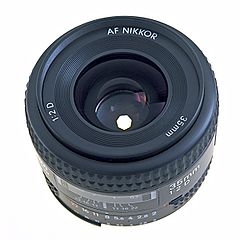
Most modern cameras use a type of adjustable diaphragm known as an iris diaphragm, and often referred to simply as an iris.
See the articles on aperture
Aperture
In optics, an aperture is a hole or an opening through which light travels. More specifically, the aperture of an optical system is the opening that determines the cone angle of a bundle of rays that come to a focus in the image plane. The aperture determines how collimated the admitted rays are,...
and f-number
F-number
In optics, the f-number of an optical system expresses the diameter of the entrance pupil in terms of the focal length of the lens; in simpler terms, the f-number is the focal length divided by the "effective" aperture diameter...
for the photographic effect and system of quantification of varying the opening in the diaphragm.
Iris diaphragms versus other types

Iris (anatomy)
The iris is a thin, circular structure in the eye, responsible for controlling the diameter and size of the pupils and thus the amount of light reaching the retina. "Eye color" is the color of the iris, which can be green, blue, or brown. In some cases it can be hazel , grey, violet, or even pink...
is the diaphragm, and the opening in the iris of the eye (the pupil) is the aperture. An analogous device in a photographic lens
Photographic lens
A camera lens is an optical lens or assembly of lenses used in conjunction with a camera body and mechanism to make images of objects either on photographic film or on other media capable of storing an image chemically or electronically.While in principle a simple convex lens will suffice, in...
is called an iris diaphragm.
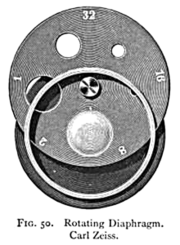
In the early years of photography, a lens could be fitted with one of a set of interchangeable diaphragms http://books.google.com/books?vid=0OrF3Gg18eOZGCnsbWwn&id=AN6d4zTjquwC&pg=PA83, often as brass strips known as Waterhouse stop
Waterhouse stop
The Waterhouse stop or Waterhouse diaphragm is an interchangeable diaphragm with an aperture for controlling the entry of light into a camera. A thin piece of metal is drilled with a hole ; a set of these with varying hole sizes makes up a set of Waterhouse stops, corresponding to what today we...
s or Waterhouse diaphragms. The iris diaphragm in most modern still and video cameras is adjusted by movable blades, simulating the iris of the eye.
The diaphragm usually has two to eight blades, depending on price and quality of the device in which it is used. Straight blades result in polygon
Polygon
In geometry a polygon is a flat shape consisting of straight lines that are joined to form a closed chain orcircuit.A polygon is traditionally a plane figure that is bounded by a closed path, composed of a finite sequence of straight line segments...
shape of the diaphragm opening, while curved blades improve the roundness of the iris opening. In a photograph, the number of blades that the iris diaphragm has can be guessed by counting the number of spikes converging from a light source or bright reflection. For an odd number of blades, there are twice as many spikes as there are blades.
In case of an even number of blades, the two spikes per blade will overlap each other, so the number of spikes visible will be the number of blades in the diaphragm used. This is most apparent in pictures taken in the dark with small bright spots, for example night cityscapes. Some cameras, such as the Olympus XA
Olympus XA
The Olympus XA was a 35 mm rangefinder camera built by Olympus of Japan. It was one of the smallest rangefinder cameras ever made, together with the Contax T.It was designed by Yoshihisa Maitani who had joined Olympus Optical Co Ltd in 1956...
or lenses such as the MC Zenitar-ME1, however, use a two-bladed diaphragm with right-angle blades creating a square aperture.
Similarly, out-of-focus points of light (circles of confusion
Circle of confusion
In optics, a circle of confusion is an optical spot caused by a cone of light rays from a lens not coming to a perfect focus when imaging a point source...
) appear as polygons with the same number of sides as the aperture
Aperture
In optics, an aperture is a hole or an opening through which light travels. More specifically, the aperture of an optical system is the opening that determines the cone angle of a bundle of rays that come to a focus in the image plane. The aperture determines how collimated the admitted rays are,...
has blades. If the blurred light is circular, then it can be inferred that the aperture is either round or the image was shot "wide-open" (with the blades recessed into the sides of the lens, allowing the interior edge of the lens barrel to effectively become the iris).
The shape of the iris opening has a direct relation with the appearance of the blurred out-of-focus areas in an image called Bokeh
Bokeh
In photography, bokeh is the blur, or the aesthetic quality of the blur, in out-of-focus areas of an image, or "the way the lens renders out-of-focus points of light."...
. A rounder opening produces softer and more natural out-of-focus areas.
Some modern automatic point-and-shoot cameras do not have a diaphragm at all, and simulate aperture changes by using an automatic ND filter. Unlike a real diaphragm, this has no effect on depth of field.
History
Leonhard Euler
Leonhard Euler was a pioneering Swiss mathematician and physicist. He made important discoveries in fields as diverse as infinitesimal calculus and graph theory. He also introduced much of the modern mathematical terminology and notation, particularly for mathematical analysis, such as the notion...
says with respect to telescopes that, "it is necessary likewise to furnish the inside of the tube with one or more diaphragms, perforated with a small circular aperture, the better to exclude all extraneous light."
In 1867, Dr. Désiré van Monckhoven
Désiré van Monckhoven
Désiré Charles Emanuel van Monckhoven was a Belgian chemist, physicist, and photographic researcher. He was also an inventor and author. He wrote several of the earliest books on photography and photographic optics...
, in one of the earliest books on photographic optics, draws a distinction betweens stops and diaphragms in photography, but not in optics, saying:
- "Let us see what takes place when the stop is removed from the lens to a proper distance. In this case the stop becomes a diaphragm.
- * In optics, stop and diaphragm are synonyms. But in photographic optics they are only so by an unfortunate confusion of language. The stop reduces the lens to its central aperture; the diaphragm, on the contrary, allows all the segments of the lens to act, but only on the different radiating points placed symmetrically and concentrically in relation to the axis of the lens, or of the system of lenses (of which the axis is, besides, in every case common)."
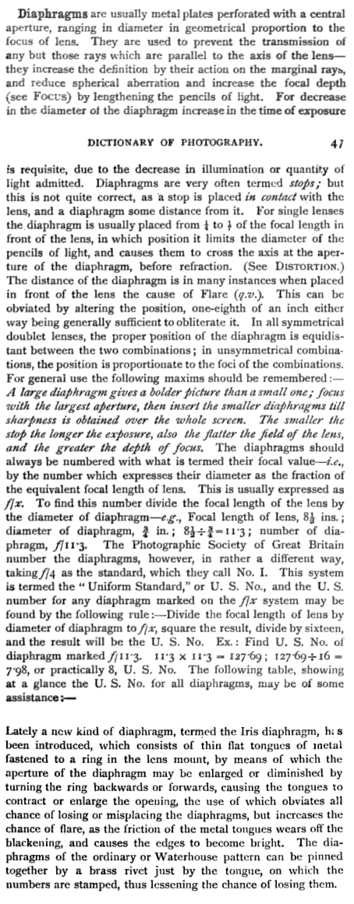
This distinction was maintained in Wall's 1889 Dictionary of Photography (see figure), but disappeared after Ernst Abbe's theory of stops unified these concepts.
According to Rudolph Kingslake, the inventor of the iris diaphragm is unknown. Others credit Joseph Nicéphore Niépce for this device, around 1820. Mr. J. H. Brown, a member of the Royal Microscopical Society
Royal Microscopical Society
The Royal Microscopical Society is an international scientific society for the promotion of microscopy. RMS draws members from all over the world and is dedicated to advancing science, developing careers and supporting wider understanding of science and microscopy through its Science and Society...
, appears to have invented a popular improved iris diaphragm by 1867.
Kingslake has more definite histories for some other diaphragm types, such as M. Noton's adjustable cat eye diaphragm of two sliding squares in 1856, and the Waterhouse stops of John Waterhouse in 1858.
See also
- ApertureApertureIn optics, an aperture is a hole or an opening through which light travels. More specifically, the aperture of an optical system is the opening that determines the cone angle of a bundle of rays that come to a focus in the image plane. The aperture determines how collimated the admitted rays are,...
- f-numberF-numberIn optics, the f-number of an optical system expresses the diameter of the entrance pupil in terms of the focal length of the lens; in simpler terms, the f-number is the focal length divided by the "effective" aperture diameter...
- Shutter (photography)Shutter (photography)In photography, a shutter is a device that allows light to pass for a determined period of time, for the purpose of exposing photographic film or a light-sensitive electronic sensor to light to capture a permanent image of a scene...
- Leaf shutter