


Macro photography

Encyclopedia

Close-up
In filmmaking, television production, still photography and the comic strip medium a close-up tightly frames a person or an object. Close-ups are one of the standard shots used regularly with medium shots and long shots . Close-ups display the most detail, but they do not include the broader scene...
photography
Photography
Photography is the art, science and practice of creating durable images by recording light or other electromagnetic radiation, either electronically by means of an image sensor or chemically by means of a light-sensitive material such as photographic film...
, usually of very small subjects. Classically a macrophotograph is one in which the size of the subject on the negative
Negative (photography)
In photography, a negative may refer to three different things, although they are all related.-A negative:Film for 35 mm cameras comes in long narrow strips of chemical-coated plastic or cellulose acetate. As each image is captured by the camera onto the film strip, the film strip advances so that...
is greater than life size. However in modern use it refers to a finished photograph of a subject at greater than life size. The ratio of the subject size on the film plane (or image sensor
Image sensor
An image sensor is a device that converts an optical image into an electronic signal. It is used mostly in digital cameras and other imaging devices...
plane) to the actual subject size is known as the reproduction ratio. Likewise, a macro lens is classically one lens capable of reproduction ratios greater than 1:1, although it now refers to any lens with a large reproduction ratio, despite rarely exceeding 1:1.
Outside of technical photography and film-based processes, where the size of the image on the negative
Negative (photography)
In photography, a negative may refer to three different things, although they are all related.-A negative:Film for 35 mm cameras comes in long narrow strips of chemical-coated plastic or cellulose acetate. As each image is captured by the camera onto the film strip, the film strip advances so that...
or image sensor
Image sensor
An image sensor is a device that converts an optical image into an electronic signal. It is used mostly in digital cameras and other imaging devices...
is the subject of discussion, the finished print or on-screen image more commonly lends a photograph its macro status. For example, when producing a 6×4 inch
Inch
An inch is the name of a unit of length in a number of different systems, including Imperial units, and United States customary units. There are 36 inches in a yard and 12 inches in a foot...
(15×10 cm) print using 135 format film or sensor, a life-size result is possible with a lens having only a 1:4 reproduction ratio.
Reproduction ratios much greater than 1:1 are considered to be the realm of photomicroscopy, often achieved with digital microscope
Digital microscope
A digital microscope is a variation of a traditional optical microscope that uses optics and a charge-coupled device camera to output a digital image to a monitor, sometimes by means of software running on a computer. A digital microscope differs from an optical microscope in that there is no...
.
Equipment and techniques
Microform
Microforms are any forms, either films or paper, containing microreproductions of documents for transmission, storage, reading, and printing. Microform images are commonly reduced to about one twenty-fifth of the original document size...
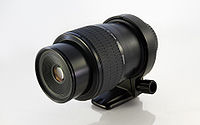
s, but most lens makers use the term "Macro" or "Makro.") These lenses are optimized for high reproduction ratios. Most modern macro lenses can focus continuously to infinity as well, using complex focusing mechanisms that alter the optical formula. In most cases these lenses provide excellent optical quality when used for normal photography, although a macro lens may be optimized to provide its best performance at its highest magnification. True macro lenses, such as the Canon MP-E 65 mm f/2.8
Canon MP-E 65mm f/2.8 1-5x Macro lens
The MP-E 65mm Macro f/2.8 is a photographic lens manufactured by Canon for use on the EOS photographic system. It is a manual focus lens for the EF mount and is specifically designed for macro photography...
, can achieve higher magnification than life size, enabling photography of the structure of small insect eyes, snowflakes, and other minuscule objects. Others, such as the Infinity Photo-Optical's TS-160 can achieve magnifications from 0-18x on sensor, focusing from infinity down to 18mm from the object. However, macro lenses with 1:1 or 1:2 ratios are more common, and many of these find frequent use for general photography because of their excellent optics.
Macro lenses of different focal lengths find different uses:
- Continuously Variable Focal Length — suitable for virtually all macro subjects
- 45–65 mm — product photography, small objects that can be approached closely without causing undesirable influence, and scenes requiring natural background perspective
- 90–105 mm — insects, flowers, and small objects from a comfortable distance
- 150–200 mm — insects and other small animals where additional working distance is required
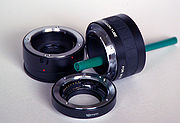
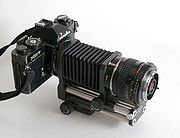
Extending the distance between the lens and the film or sensor, by inserting either extension tube
Extension tube
An extension tube is an accessory for cameras with interchangeable lenses, used primarily for macro photography. The tube contains no optical elements; its sole purpose is to move the lens farther from the image plane. The farther away the lens is, the closer the focus, the greater the...
s or a continuously adjustable bellows, is another equipment option for macrophotography. The further the lens is from the film or sensor, the closer the focusing distance, the greater the magnification, and the darker the image given the same aperture. Tubes of various lengths can be stacked, decreasing lens-to-subject distance and increasing magnification. Bellows or tubes eliminate infinity focus. They can be used in conjunction with some other techniques (e.g., reversing the lens).
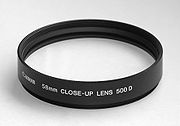
Placing an auxiliary close-up lens
Close-up lens
In photography, a close-up filter, close-up lens or macro filter is a simple secondary lens used to enable macro photography without requiring a specialised primary lens...
(or close-up "filter") in front of the camera's taking lens is another option. Inexpensive screw-in or slip-on attachments provide close focusing at very low cost. The possible quality is less than that of a dedicated macro lens or extension tubes, with some two-element versions being very good while many inexpensive single element lenses exhibit chromatic aberration
Chromatic aberration
In optics, chromatic aberration is a type of distortion in which there is a failure of a lens to focus all colors to the same convergence point. It occurs because lenses have a different refractive index for different wavelengths of light...
and reduced sharpness
Acutance
In photography, acutance is the edge contrast of an image. Acutance is related to the amplitude of the derivative of brightness with respect to space...
of the resulting image. This method works with cameras that have fixed lenses, and is commonly used with bridge cameras. These lenses add diopters to the optical power of the lens, decreasing the minimum focusing distance, and allowing the camera to get closer to the subject. They are typically designated by their diopter, and can be stacked (with an additional loss of quality) to achieve the desired magnification.
Photographers may employ view camera movements and the Scheimpflug principle
Scheimpflug principle
The Scheimpflug principle is a geometric rule that describes the orientation of the plane of focus of an optical system when the lens plane is not parallel to the image plane. It is commonly applied to the use of camera movements on a view camera...
to place an object close to the lens in focus, while maintaining selective background focus. This technique requires the use of a view camera
View camera
The view camera is a type of camera first developed in the era of the Daguerreotype and still in use today, though with many refinements. It comprises a flexible bellows which forms a light-tight seal between two adjustable standards, one of which holds a lens, and the other a viewfinder or a...
or perspective control lens with the ability to tilt the lens with respect to the film or sensor plane. Lenses such as the Nikon PC-E and Canon TS-E series, the Hartblei Super-Rotator, the Schneider Super Angulon, several Lensbaby models, the Zoerk Multi Focus System, and various tilt-shift adapters for medium format, allow the use of tilt in cameras with fixed lens mounts. Traditional view cameras permit such adjustment as part of their design.
Ordinary lenses can be used for macrophotography by using a "reversing ring." This ring attaches to the filter
Photographic filter
In photography and videography, a filter is a camera accessory consisting of an optical filter that can be inserted in the optical path. The filter can be a square or oblong shape mounted in a holder accessory, or, more commonly, a glass or plastic disk with a metal or plastic ring frame, which...
thread on the front of a lens and makes it possible to attach the lens in reverse. Excellent quality results up to 4x life-size magnification are possible. For cameras with all-electronic communications between the lens and the camera body, such as Canon EOS, specialty reversing rings are available which preserve these communications. When used with extension tubes or bellows, a highly versatile, true macro (greater than life size) system can be assembled. Since non-macro lenses are optimized to for small reproduction ratios, reversing the lens allows it to be used for reciprocally high ratios.
Macrophotography may also be accomplished by mounting a lens in reverse, in front of a normally mounted lens of greater focal length, using a macro coupler which screws into the front filter threads of both lenses. This method allows most cameras to maintain the full function of electronic and mechanical communication with the normally mounted lens, for features such as open-aperture metering. The magnification ratio is calculated by dividing the focal length of the normally mounted lens by the focal length of the reversed lens (e.g., when an 18 mm lens is reverse mounted on a 300 mm lens the reproduction ratio is 16:1). The use of automatic focus is not advisable if the first lens is not of the internal-focusing type, as the extra weight of the reverse-mounted lens could damage the autofocus mechanism. Working distance is significantly less than the first lens.
Depth of field
Depth of field
In optics, particularly as it relates to film and photography, depth of field is the distance between the nearest and farthest objects in a scene that appear acceptably sharp in an image...
is extremely small when focusing on close objects. A small aperture
Aperture
In optics, an aperture is a hole or an opening through which light travels. More specifically, the aperture of an optical system is the opening that determines the cone angle of a bundle of rays that come to a focus in the image plane. The aperture determines how collimated the admitted rays are,...
(high f-number
F-number
In optics, the f-number of an optical system expresses the diameter of the entrance pupil in terms of the focal length of the lens; in simpler terms, the f-number is the focal length divided by the "effective" aperture diameter...
) is often required to produce acceptable sharpness across a three-dimensional subject. This requires either a slow shutter speed, brilliant lighting, or a high ISO. Auxiliary lighting (such as from a flash unit
Flash (photography)
A flash is a device used in photography producing a flash of artificial light at a color temperature of about 5500 K to help illuminate a scene. A major purpose of a flash is to illuminate a dark scene. Other uses are capturing quickly moving objects or changing the quality of light...
) is sometimes used. Uniform lighting can be difficult with subjects very close to the lens, so a ring flash
Ring flash
A ring flash, invented by Lester A. Dine in 1952, originally for use in dental photography, is a circular photographic flash that fits around the lens, especially for use in macro photography...
is often used, especially when working distance is small. Good results can also be obtained by using a flash diffuser.
Depth of field
Limited depth of fieldDepth of field
In optics, particularly as it relates to film and photography, depth of field is the distance between the nearest and farthest objects in a scene that appear acceptably sharp in an image...
is an important consideration in macro photography. This makes it essential to focus
Focus (optics)
In geometrical optics, a focus, also called an image point, is the point where light rays originating from a point on the object converge. Although the focus is conceptually a point, physically the focus has a spatial extent, called the blur circle. This non-ideal focusing may be caused by...
critically on the most important part of the subject, as elements that are even a millimetre
Millimetre
The millimetre is a unit of length in the metric system, equal to one thousandth of a metre, which is the SI base unit of length....
closer or farther from the focal plane might be noticeably blurred. Due to this, the use of a microscope stage is highly recommended for precise focus with large magnification such as photographing skin cells. Alternatively, more shots of the same subject can be made with slightly different focusing lengths and joined afterwards with specialized focus stacking
Focus stacking
Focus stacking is a digital image processing technique which combines multiple images taken at different focus distances to give a resulting image with a greater depth of field than any of the individual source images...
software which picks out the sharpest parts of every image, artificially increasing depth of field.
Compact digital cameras and small-sensor bridge cameras have an incidental advantage in macro photography due to their inherently deeper depth of field. For instance, some popular bridge cameras produce the equivalent magnification of a 420 mm lens on 35-mm format
35 mm film
35 mm film is the film gauge most commonly used for chemical still photography and motion pictures. The name of the gauge refers to the width of the photographic film, which consists of strips 35 millimeters in width...
but only use a lens of actual focal length 89 mm (1/1.8″-type CCD
Charge-coupled device
A charge-coupled device is a device for the movement of electrical charge, usually from within the device to an area where the charge can be manipulated, for example conversion into a digital value. This is achieved by "shifting" the signals between stages within the device one at a time...
) or 72 mm (1/2.5″-type CCD). (See crop factor
Crop factor
In digital photography, a crop factor is related to the ratio of the dimensions of a camera's imaging area compared to a reference format; most often, this term is applied to digital cameras, relative to 35 mm film format as a reference. In the case of digital cameras, the imaging device would be a...
.) Since depth of field appears to decrease with the actual focal length of the lens, not the equivalent focal length, these bridge cameras can achieve the magnification of a 420 mm lens with the greater depth of field
Depth of field
In optics, particularly as it relates to film and photography, depth of field is the distance between the nearest and farthest objects in a scene that appear acceptably sharp in an image...
of a much shorter lens. High-quality auxiliary close-up lenses can be used to achieve the needed close focus; they function identically to reading glasses. This effect makes it possible to achieve very high quality macrophotographs with relatively inexpensive equipment, since auxiliary closeup lenses are cheaper than dedicated SLR macro lenses.
Lighting
The problem of sufficiently and evenly lighting the subject can be difficult to overcome. Some cameras can focus on subjects so close that they touch the front of the lens. It is impossible to place a light between the camera and a subject that close, making extreme close-up photography impractical. A normal-focal-length macro lens (50 mm on a 35 mm camera) can focus so close that lighting remains difficult. To avoid this problem, many photographers use telephotoTelephoto lens
In photography and cinematography, a telephoto lens is a specific type of a long-focus lens in which the physical length of the lens is shorter than the focal length. This is achieved by incorporating a special lens group known as a telephoto group that extends the light path to create a long-focus...
macro lenses, typically with focal lengths from about 100 to 200 mm. These are popular as they permit sufficient distance for lighting between the camera and the subject.
Ring flash
Ring flash
A ring flash, invented by Lester A. Dine in 1952, originally for use in dental photography, is a circular photographic flash that fits around the lens, especially for use in macro photography...
es, with flash tubes arranged in a circle around the front of the lens, can be helpful in lighting at close distances. Ring lights have emerged, using white LEDs
Light-emitting diode
A light-emitting diode is a semiconductor light source. LEDs are used as indicator lamps in many devices and are increasingly used for other lighting...
to provide a continuous light source for macrophotography.
Homemade flash diffusers made out of white Styrofoam or plastic attached to a camera's built-in flash can also yield surprisingly good results by diffusing and softening the light, eliminating specular reflection
Specular reflection
Specular reflection is the mirror-like reflection of light from a surface, in which light from a single incoming direction is reflected into a single outgoing direction...
s and providing more even lighting.
See also
- Close-upClose-upIn filmmaking, television production, still photography and the comic strip medium a close-up tightly frames a person or an object. Close-ups are one of the standard shots used regularly with medium shots and long shots . Close-ups display the most detail, but they do not include the broader scene...
- Digital microscopeDigital microscopeA digital microscope is a variation of a traditional optical microscope that uses optics and a charge-coupled device camera to output a digital image to a monitor, sometimes by means of software running on a computer. A digital microscope differs from an optical microscope in that there is no...
- Photomicroscopy
- Forensic photographyForensic photographyForensic photography, sometimes referred to as forensic imaging or crime scene photography, is the art of producing an accurate reproduction of a crime scene or an accident scene using photography for the benefit of a court or to aid in an investigation. It is part of the process of evidence...
External links
- Close Up and Macro Photography
- Macro Lenses — Special lenses for close-up work.
- Use of Microscope Stage for Microphotography
- Photo.net how-to — Guide to macro photography
- Make your own reversing ring out of a Pringles can by Haje Jan KampsHaje Jan KampsHaje Jan Kamps is a Dutch photographer, writer and journalist. He is best known for running the popular Photocritic photography blog, and for writing the book Macro Photography Photo Workshop...
- Information on inverted lenses
- Macro Photography Tutorial
- Insects-macrophotography Photos of insects
- Inexpensive Macro Photography DSLR with Manual Focus Lens
- Macro Photography Tips