

Alcinous

Encyclopedia

Greek mythology
Greek mythology is the body of myths and legends belonging to the ancient Greeks, concerning their gods and heroes, the nature of the world, and the origins and significance of their own cult and ritual practices. They were a part of religion in ancient Greece...
, a son of Nausithous
Nausithous
Nausithous or Nausithoös is a name that refers to the following characters in Greek mythology:*The king of the Phaeacians in the generation before Odysseus washed ashore on their home island of Scheria. He was the son of the god Poseidon and a Phaeacian woman named Periboia...
, or of Phaeax
Phaeax (mythology)
Phaeax , in Greek mythology, was a son of Poseidon and Cercyra, from whom the Phaeacians derived their name. Conon calls him the father of Alcinous and Locrus....
(son of Poseidon
Poseidon
Poseidon was the god of the sea, and, as "Earth-Shaker," of the earthquakes in Greek mythology. The name of the sea-god Nethuns in Etruscan was adopted in Latin for Neptune in Roman mythology: both were sea gods analogous to Poseidon...
and Corcyra), and father of Nausicaa
Nausicaa
Nausicaa is a character in Homer's Odyssey . She is the daughter of King Alcinous and Queen Arete of Phaeacia. Her name, in Greek, means "burner of ships".-Role in the Odyssey:...
, Halius, Clytoneus and Laodamas
Laodamas
In Greek mythology, Laódamas referred to five different people.-Laódamas, son of Eteocles:Laodamas, son of Eteocles, inherited Thebes from his father...
with Arete
Arete (mythology)
In Greek mythology, Queen Arete of Scheria was the wife of Alcinous and mother of Nausicaa and Laodamas. She welcomed Odysseus and treated him hospitably. Her name appears to be associated with the Ionic noun...
. His name literally means "mighty mind". He married his brother Rhexenor's daughter after Rhexenor was killed.
Mythography
In the myth of the JasonJason
Jason was a late ancient Greek mythological hero from the late 10th Century BC, famous as the leader of the Argonauts and their quest for the Golden Fleece. He was the son of Aeson, the rightful king of Iolcus...
and the Argonauts
Argonauts
The Argonauts ) were a band of heroes in Greek mythology who, in the years before the Trojan War, accompanied Jason to Colchis in his quest to find the Golden Fleece. Their name comes from their ship, the Argo, which was named after its builder, Argus. "Argonauts", therefore, literally means...
, Alcinous is represented as living with his wife Arete
Arete (mythology)
In Greek mythology, Queen Arete of Scheria was the wife of Alcinous and mother of Nausicaa and Laodamas. She welcomed Odysseus and treated him hospitably. Her name appears to be associated with the Ionic noun...
in Drepane. The Argonauts, on their return from Colchis
Colchis
In ancient geography, Colchis or Kolkhis was an ancient Georgian state kingdom and region in Western Georgia, which played an important role in the ethnic and cultural formation of the Georgian nation.The Kingdom of Colchis contributed significantly to the development of medieval Georgian...
, came to his island, and were not straight. When the Colchians, in their pursuit of the Argonauts, likewise arrived in Drepane, and demanded that Jason
Jason
Jason was a late ancient Greek mythological hero from the late 10th Century BC, famous as the leader of the Argonauts and their quest for the Golden Fleece. He was the son of Aeson, the rightful king of Iolcus...
's lover Medea
Medea
Medea is a woman in Greek mythology. She was the daughter of King Aeëtes of Colchis, niece of Circe, granddaughter of the sun god Helios, and later wife to the hero Jason, with whom she had two children, Mermeros and Pheres. In Euripides's play Medea, Jason leaves Medea when Creon, king of...
should be delivered up to them, Alcinous declared that if she was still a virgin she should be restored to them, but if she was already the wife of Jason, he would protect her and her husband against the Colchians. The Colchians were obliged, by the contrivance of Arete, to depart without their princess, and the Argonauts continued their voyage homeward, after they had received expensive presents from Alcinous.
According to Homer
Homer
In the Western classical tradition Homer , is the author of the Iliad and the Odyssey, and is revered as the greatest ancient Greek epic poet. These epics lie at the beginning of the Western canon of literature, and have had an enormous influence on the history of literature.When he lived is...
, Alcinous is the happy ruler of the Phaiakians in the island of Scheria
Scheria
Scheria –also known as Scherie or Phaeacia– was a geographical region in Greek mythology, first mentioned in Homer's Odyssey as the home of the Phaiakians and the last destination of Odysseus before returning home to Ithaca.-Odysseus meets Nausikaa:In the Odyssey, after Odysseus sails...
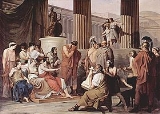
, who has by Arete five sons and one daughter, Nausicaa. The description of his palace and his dominions, the mode in which Odysseus
Odysseus
Odysseus or Ulysses was a legendary Greek king of Ithaca and the hero of Homer's epic poem the Odyssey. Odysseus also plays a key role in Homer's Iliad and other works in the Epic Cycle....
is received, the entertainments given to him, and the stories he related to the king about his own wanderings, occupy a considerable portion of Homer
Homer
In the Western classical tradition Homer , is the author of the Iliad and the Odyssey, and is revered as the greatest ancient Greek epic poet. These epics lie at the beginning of the Western canon of literature, and have had an enormous influence on the history of literature.When he lived is...
's Odyssey
Odyssey
The Odyssey is one of two major ancient Greek epic poems attributed to Homer. It is, in part, a sequel to the Iliad, the other work ascribed to Homer. The poem is fundamental to the modern Western canon, and is the second—the Iliad being the first—extant work of Western literature...
(from book vi. to xiii.), and form one of its most charming parts.