


Pome

Encyclopedia
Flowering plant
The flowering plants , also known as Angiospermae or Magnoliophyta, are the most diverse group of land plants. Angiosperms are seed-producing plants like the gymnosperms and can be distinguished from the gymnosperms by a series of synapomorphies...
s in the subfamily Maloideae
Maloideae
The Maloideae C.Weber are the apple subfamily, a grouping used by some taxonomists within the rose family, Rosaceae. Recent molecular phylogenetic evidence has shown that the traditional Spiraeoideae and Amygdaloideae form part of the same clade as the traditional Maloideae, and the correct name...
of the family Rosaceae
Rosaceae
Rosaceae are a medium-sized family of flowering plants, including about 2830 species in 95 genera. The name is derived from the type genus Rosa. Among the largest genera are Alchemilla , Sorbus , Crataegus , Cotoneaster , and Rubus...
.
A pome is an accessory fruit
Accessory fruit
An accessory fruit is a fruit in which some of the flesh is derived not from the ovary but from some adjacent tissue exterior to the carpel. Examples of accessory tissue are the receptacle of strawberries, figs, or mulberries, and the calyx of Gaultheria procumbens or Syzygium jambos...
composed of one or more carpel
Gynoecium
Gynoecium is most commonly used as a collective term for all carpels in a flower. A carpel is the ovule and seed producing reproductive organ in flowering plants. Carpels are derived from ovule-bearing leaves which evolved to form a closed structure containing the ovules...
s surrounded by accessory tissue. The accessory tissue is interpreted by some specialists as an extension of the receptacle and is then referred to as "fruit cortex", and by others as a fused hypanthium
Hypanthium
A hypanthium is a floral structure consisting of the bases of the sepals, petals, and stamens fused together. Its presence is diagnostic of many families, including the Rosaceae, Grossulariaceae, and Fabaceae...
or "torus"; it is the most edible part of this fruit.
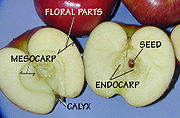
Although the exocarp, mesocarp, and endocarp of some other fruit types look very much like the skin, flesh, and core respectively of a pome, they are parts of the carpel (see diagram). The exocarp and mesocarp of a pome may be fleshy and difficult to distinguish from one another and from the hypanthial tissue. The endocarp forms a leathery or stony case around the seed
Seed
A seed is a small embryonic plant enclosed in a covering called the seed coat, usually with some stored food. It is the product of the ripened ovule of gymnosperm and angiosperm plants which occurs after fertilization and some growth within the mother plant...
, and corresponds to what is commonly called the core. The shriveled remains of the sepal
Sepal
A sepal is a part of the flower of angiosperms . Collectively the sepals form the calyx, which is the outermost whorl of parts that form a flower. Usually green, sepals have the typical function of protecting the petals when the flower is in bud...
s, style
Gynoecium
Gynoecium is most commonly used as a collective term for all carpels in a flower. A carpel is the ovule and seed producing reproductive organ in flowering plants. Carpels are derived from ovule-bearing leaves which evolved to form a closed structure containing the ovules...
and stamen
Stamen
The stamen is the pollen producing reproductive organ of a flower...
s can sometimes be seen at the end of a pome opposite the stem, and the ovary
Ovary (plants)
In the flowering plants, an ovary is a part of the female reproductive organ of the flower or gynoecium. Specifically, it is the part of the pistil which holds the ovule and is located above or below or at the point of connection with the base of the petals and sepals...
is therefore often described as inferior in these flowers.
Examples
The best-known example of a pome is the appleApple
The apple is the pomaceous fruit of the apple tree, species Malus domestica in the rose family . It is one of the most widely cultivated tree fruits, and the most widely known of the many members of genus Malus that are used by humans. Apple grow on small, deciduous trees that blossom in the spring...
. Other examples of plants that produce fruit classified as a pome are cotoneaster
Cotoneaster
Cotoneaster is a genus of woody plants in the rose family, Rosaceae, native to the Palaearctic region , with a strong concentration of diversity in the genus in the mountains of southwestern China and the Himalayas...
, hawthorn
Crataegus
Crataegus , commonly called hawthorn or thornapple, is a large genus of shrubs and trees in the rose family, Rosaceae, native to temperate regions of the Northern Hemisphere in Europe, Asia and North America. The name hawthorn was originally applied to the species native to northern Europe,...
, loquat
Loquat
The loquat , Eriobotrya japonica, is a fruit tree in the family Rosaceae, indigenous to southeastern China. It was formerly thought to be closely related to the genus Mespilus, and is still sometimes known as the Japanese medlar...
, medlar, pear
Pear
The pear is any of several tree species of genus Pyrus and also the name of the pomaceous fruit of these trees. Several species of pear are valued by humans for their edible fruit, but the fruit of other species is small, hard, and astringent....
, pyracantha
Pyracantha
Pyracantha is a genus of thorny evergreen large shrubs in the family Rosaceae, with common names Firethorn or Pyracantha. They are native to an area extending from Southeast Europe east to Southeast Asia, resemble and are related to Cotoneaster, but have serrated leaf margins and numerous thorns...
, toyon
Toyon
Heteromeles arbutifolia , and commonly known as Toyon, is a common perennial shrub native to California down to Baja California....
, quince
Quince
The quince , or Cydonia oblonga, is the sole member of the genus Cydonia and native to warm-temperate southwest Asia in the Caucasus region...
, rowan
Rowan
The rowans or mountain-ashes are shrubs or small trees in genus Sorbus of family Rosaceae. They are native throughout the cool temperate regions of the Northern Hemisphere, with the highest species diversity in the mountains of western China and the Himalaya, where numerous apomictic microspecies...
, and whitebeam
Whitebeam
The whitebeams are members of the Rosaceae family, comprising subgenus Aria of genus Sorbus, and hybrids involving species of this subgenus and members of subgenera Sorbus, Torminaria and Chamaemespilus. They are deciduous trees with simple or lobed leaves, arranged alternately...
.
Some pomes may have a mealy texture (e.g., some apples); others (e.g., Amelanchier) are berry-like with juicy flesh and a core that is not very noticeable.