

Trans-Iranian Railway

Encyclopedia
The Trans-Iranian Railway was a major railway building project started in 1927 and completed in 1938, under the direction of the Persian monarch, Reza Shah
, and entirely with indigenous capital. It links the capital Tehran
with the Persian Gulf
and Caspian Sea
. The railway connects Tehran to Shahi and Bandar Shah in the north, Semnan to Mashad in the east, Zanjan
to Tabriz
in the west, and to Ahwaz and Abadan
in the south of Iran. During the land reforms implemented by Mohammad Reza Shah in 1963 as part of the "White Revolution
" the Trans-Iranian railway was extended to link Tehran to Mashed, Tabriz, and Isfahan.
and India
was proposed by several private Russian promoters in 1889, 1900, and 1905. However, the Russian government declined such proposals, fearing that it would jeopardize Russia’s geographically enabled commercial dominance in Iran as well as complicate relations with the British. In 1889 Russia and the Shah agreed that no railways could be built in Iran without the mutual consensus of the Russians. However, by 1910 the agreement was vetoed in the Iranian Constitutional Revolution
. Fears that Russian interests were no longer primary, alongside the surfacing of anti-Russian political forces in the country, and the emergence of the German threat, made it more important than ever for the country to protect its commercial interests in Iran by building a railway.
In order for the railway to be built, the problem of raising enough capital to fund the project was discussed. The Russo-Japanese War
of 1905 was one of several factors leaving Russia on a tight budget, preventing Russia from providing the funds. The British were solicited as well, but the request could not be granted, pushing back initiation of the railway’s construction further. Nikolay Khomyakov
, President of the Duma
, and I.A. Zveginstov, supporters of the Anglo-Russian Entente
, promoted a private initiative for a railway connecting India and Europe, to counteract the economic threat Germany posed to the region. Germany’s influence over the region was enabled by the Baghdad Railway
, which connected Germany
and the Ottoman Empire
(modern-day Turkey
, Syria
and Iraq
), enabling Germany to begin plans for connecting the railway to Tehran to increase its commercial enterprise. Despite opposition from the Russian Ministry of Foreign Affairs and Ministry of Finance, there was also a great deal of support for the project.
A Trans-Iranian Railway Consortium was formed by December 1910, consisting of twelve major Russian banks. Nine of these banks came to an agreement with major French
banks in 1911, resulting in the crucial financial support needed to fund the railway. However, the final step needed to initiate the project was the support of the British, who wanted to restore financial stability in Iran but did not wish to be involved in the Trans-Iranian Railway Consortium through the proposed four to six million pound loan, proposed by Alexander Izvolsky, Imperial Foreign Minister 1906–10, and Sergey Sazonov
, Foreign Minister 1910–16. Sazonov continued to urge for the loan, believing it to be the solution to prevent Persia from bankruptcy. Lord Curzon
, British Viceroy of India, rejected the loan, suspicious that the Russians had an acquisitive eye on Britain’s precious Indian colony, provoking stark protest from Sazonov against the accusation. Finally, in 1912, the Russian, French, and British financiers formed a Société d'Etudes for the Trans-Iranian railway.
When Arthur von Gwinner, Chief Manager of Deutsche Bank
and the Baghdad Railway, announced plans to build a section of the railway connecting Baghdad to Khanaqin
by 1916, the Russians moved quickly to secure British support and French investments in the Société d'Etudes. The Russians were primarily concerned with the construction of the northern section of the line, extending from Astara to Tehran, while the British were more concerned with the southern section, since they already dominated the southern region and the Persian Gulf.
Meanwhile, the Balkan Wars
in the Ottoman Empire (1912–13) created an unstable situation in the country, again putting off the initiation of the application. Such instability caused investors in the Société d'Etudes to hesitate in investing in a bankrupt Iran. Sazonov suggested that appointing a strong Iranian leader would aid the financial aspect of the railway project. Sa’d Dawla, former minister under former Muhammad Ali Shah
, agreed to work with the two powers to use a grant from the Société d'Etudes and thus proceed with the construction of the Trans-Iranian Railway without the agreement of the newly formed parliament. However, Sir Edward Grey
, Britain's Secretary of State for Foreign Affairs, refused to force the Iranians to accept Sa’d Dawla as Prime Minister, because of his aversion to the Constitutional movement in Iran.
The outcome of the Balkan Wars caused Russian and Britain to accept the probability of war between the Central Powers in the near future, suggesting the necessity of strong Anglo-Russian relations. Sazonov grew frustrated with Britain’s inability to compromise on a route incorporating India, and threatened to proceed with the northern route. Fearing the implications of the impending war, Grey at last found it in Britain’s best interest to concede at last, and agreed to initiate application of the railway under the Balmoral
conditions. By this time Britain already had further consolidated its control over the Persian Gulf.
By June 1914 surveys for the Enzeli-Tehran section had begun, and by 1915 the results of the Astara-Tehran part of the railway were completed and published. Still, progress on the railway was slow. However, a few days after the outbreak of World War I
, Russia repudiated its obligation to build the Tehran-Khanaqin line under the Potsdam Agreement.
The first lines passed though formidable mountains. Long stretches have gradients of up to 1 in 36 and hillclimbing
techniques such as railway spirals. The line is 866 miles (1,394 km) long, has about 230 tunnels and 4100 bridges and its highest point is at Arak
, 7,270 feet (2,220 m) above sea level. However, Kampsax' contractors laid relatively lightweight rails, ranging from 67 to 75 lbs per yard, that restricted the axle loads that the line could carry.
The Three Golden Lines spiral
is on the Mazandaran branch in the Sewatcow County of Mazanderan. The line ascends or descends in a short distance by passing three times in the same area at different heights. Trains descend towards Sari or ascend in the opposite direction by going through the Dowgal twin tunnels.
2-8-4 + 4-8-2 articulated locomotive
s (works numbers 6787–6890). In 1938 these became class 86.01. Until the British and Empire invasion of Iran in 1941 (see below) these Garratts seem to have been the only standard gauge
British locomotives in Iran.
German manufacturers supplied 65 steam locomotives for the opening of the line in 1938. 49 were 2-8-0 Consolidations
: 24 from Krupp
forming class 41.11, 16 from Henschel und Sohn
forming class 41.35 and nine from Maschinenfabrik Esslingen
forming class 41.51. The other 16 were Henschel 2-10-0 Decapods
forming class 51.01.
The Trans-Iranian acquired 10 of the locomotives that Kampsax had used to build the line. These were Gölsdorf two-cylinder compound 0-10-0
freight locomotives built between 1909 and 1915 as Austrian State Railways
class 80 by Wiener Neustädter Lokomotivfabrik
, Lokomotivfabrik Floridsdorf
and Lokomotivfabrik der StEG
in Vienna and by Breitfeld-Daněk in Bohemia. When the Iranian railway introduced its new numbering system in 1938 the Gölsdorf 0-10-0s kept their original Austrian numbers.
While it may seem logical to attribute the reduction in transportation prices to the Trans-Iranian Railway, in reality it contributed minimally. Initially, British and Russian observers considered the implantation of railroads as the ultimate solution to the immense transportation problems Iran faced due to sparsely settled population, the lack of rivers, high mountains, and inhospitable desert regions of the country. Many Americans and British opposed the Trans-Iranian Railway, suggesting more efficient and less expensive modes of transportation, such as the U.S. Army’s Motor Transport Service, which hauled about a fourth of the volume hauled by the railroad to the Soviet border. Some British critics, including General Percy Sykes
, opposed the railway because it ran north to south, rather than from west to east. The west to east route was preferred because it would allow the British direct access to their military bases in India and Mesopotamia, and at the same time, avoiding the threat of commercial loss of profit to Russia and any foreign rival. There were also Iranians opposed to the building of the railway as well, believing that the money could instead be much more effectively used on roads. However, if a cabinet minister was caught criticizing the extensive tax burden the railway produced, he could be placed in prison on counts of being a British collaborator, decidedly attempting to keep Iran backwards for his own financial and strategic goals.
Although much opposition to the railway was politically and financially motivated, the railway was an expensive tax-burden, costing Iran 2,195,180,700 rials through 1938-1939. The majority of capital used to fund the railway was provided through taxes on goods such as sugar and tea, produced in plants set up by the industries ministry, as part of Reza Shah Pahlavi’s reform movement.
The British and Russians initially stated their reason for invading Iran was the Iranian government’s failure to rid the country of Germans, who supposedly were planning an eventual coup d’etat. Yet there were other reasons for the invasion, and the Trans-Iranian Railways key location as part of the so-called “Persian Corridor
” was one of the primary reasons for the Anglo-Soviet invasion of Iran
in World War II. Despite Reza Shah’s attempts to remain neutral, the allies decided it would be most effective to remove Reza Shah from the throne, using his young son, instead to assist in their use of the Trans-Iranian Railway to transport oil to Britain, and supplies to the Soviet Union.
invaded Iran to protect their oil supply in Iran and to secure the Persian Corridor
supply route from the Persian Gulf to the Central Asian republics of the Soviet Union
. In September 1941 the Allies took over operation of the Trans-Iranian Railway: British and Empire Royal Engineers
(RE) commanded by Brigadier Godfrey D. Rhodes
operating the Southern Division between Tehran and the port of Bandar Shahpur on the Persian Gulf and the Soviet Army operating the Northern Division between Tehran and the port of Bandar Shah on the Caspian Sea.
The RE expanded freight capacity by building new railway yards at Bandar Shahpur, Ahvaz
and Andimeshk
and a junction at Ahvaz for a new line to Khorramshahr
on the Shatt al-Arab. In order to increase the line's locomotive fleet the RE built a yard at Abadan to transfer locomotives from merchant ships to barges to take them up the River Karun
and a derrick on a jetty on the Karun at Ahwaz to unload them from the barges onto the railway. When the British first took over the southern part in 1941, the railway was only able to move one freight train per day. The railroad hauled a total volume of 978 tons a day in the first quarter of 1942. Yet by September 1943, they were able to move 5,400 tons per day, due to the import of new locomotives, wagons, and more skilled individuals.
The Southern Division locomotive depot at Ahvaz
had two German 2-10-0s, seven German 2-8-0s, two class 41.01 2-8-0s built by Beyer, Peacock & Co.
in 1934, two class 80.14 0-10-0s from an Austrian locomotive builder and seven smaller locomotives. The RE found that all except the 2-10-0s were in poor condition, as was some of the freight rolling stock. In December dozens of LMS
2-8-0 steam locomotives and 840 20 ton freight wagons started to arrive from Britain. 27 coal-burning LMS 2-8-0s, designated class 41.100 in the Iranian State Railways numbering system, were in service by February 1942. Once enough LMS 2-8-0s were in service some of the German locomotives were released to increase the fleet on the Northern Division that the Soviets were operating. From February until August 1942 96 oil-burning LMS 2-8-0s, designated class 41.150, entered service on the Southern Division and by December 1942 another 19 class 41.100 coal-burners had joined them. In the same year Davenport Locomotive Works
supplied 24 diesel-mechanical 0-4-0 switchers, designated class 20.01, that Iran had ordered before the Allied invasion.
1,000 horsepower Co-Co locomotive that was then operating on a US railroad or under construction. These totalled only 57 locomotives so initially they were used to operate only the southern part of the Southern Division between Bandar Shahpur and Andimeshk.
For traffic between Andimeshk and Tehran the USATC brought 91 S200 Class steam locomotives
, designated class 42.400 in the Iranian State Railways numbering system. The USATC also introduced another 3,000 freight cars. In April 1943 another 18 ALCO RSD-1's entered service, enabling the USATC to return some LMS 2-8-0s to the British Middle East Command
and extend diesel operation northwards, reaching Qom
by September 1943 and regularly serving Tehran by May 1944. The USATC further increased freight traffic so that in 1944 it averaged 6,489 tons per day.
"Aid to Russia" traffic ceased by May 1945 and in June the USATC withdrew its RSD-1's and returned control to the British authorities. Shortly afterwards the British restored the line to Iranian State Railways. Iranian State Railways is now Islamic Republic of Iran Railways
.
Reza Shah
Rezā Shāh, also known as Rezā Shāh Pahlavi and Rezā Shāh Kabir , , was the Shah of the Imperial State of Iran from December 15, 1925, until he was forced to abdicate by the Anglo-Soviet invasion of Iran on September 16, 1941.In 1925, Reza Shah overthrew Ahmad Shah Qajar, the last Shah of the Qajar...
, and entirely with indigenous capital. It links the capital Tehran
Tehran
Tehran , sometimes spelled Teheran, is the capital of Iran and Tehran Province. With an estimated population of 8,429,807; it is also Iran's largest urban area and city, one of the largest cities in Western Asia, and is the world's 19th largest city.In the 20th century, Tehran was subject to...
with the Persian Gulf
Persian Gulf
The Persian Gulf, in Southwest Asia, is an extension of the Indian Ocean located between Iran and the Arabian Peninsula.The Persian Gulf was the focus of the 1980–1988 Iran-Iraq War, in which each side attacked the other's oil tankers...
and Caspian Sea
Caspian Sea
The Caspian Sea is the largest enclosed body of water on Earth by area, variously classed as the world's largest lake or a full-fledged sea. The sea has a surface area of and a volume of...
. The railway connects Tehran to Shahi and Bandar Shah in the north, Semnan to Mashad in the east, Zanjan
Zanjan (city)
Zanjan is the capital of Zanjan Province in northwestern Iran. It is an Azeri inhabited city. It lies 298 km north-west of Tehran on the main highway to Tabriz and Turkey and approximately 125 km from the Caspian Sea...
to Tabriz
Tabriz
Tabriz is the fourth largest city and one of the historical capitals of Iran and the capital of East Azerbaijan Province. Situated at an altitude of 1,350 meters at the junction of the Quri River and Aji River, it was the second largest city in Iran until the late 1960s, one of its former...
in the west, and to Ahwaz and Abadan
Abadan
Abadan is a city in and the capital of Abadan County, Khuzestan Province, Iran. It lies on Abadan Island , from the Persian Gulf, near the Iraqi-Iran border. The civilian population of the city dropped to near zero during the eight-years Iran–Iraq War. In 1992, only 84,774 had returned to live...
in the south of Iran. During the land reforms implemented by Mohammad Reza Shah in 1963 as part of the "White Revolution
White Revolution
The White Revolution was a far-reaching series of reforms in Iran launched in 1963 by the Shah Mohammad Reza Pahlavi. Mohammad Reza Shah’s reform program was built especially to strengthen those classes that supported the traditional system...
" the Trans-Iranian railway was extended to link Tehran to Mashed, Tabriz, and Isfahan.
Before WWI: the Russian scheme
The idea of a railway connecting RussiaRussia
Russia or , officially known as both Russia and the Russian Federation , is a country in northern Eurasia. It is a federal semi-presidential republic, comprising 83 federal subjects...
and India
India
India , officially the Republic of India , is a country in South Asia. It is the seventh-largest country by geographical area, the second-most populous country with over 1.2 billion people, and the most populous democracy in the world...
was proposed by several private Russian promoters in 1889, 1900, and 1905. However, the Russian government declined such proposals, fearing that it would jeopardize Russia’s geographically enabled commercial dominance in Iran as well as complicate relations with the British. In 1889 Russia and the Shah agreed that no railways could be built in Iran without the mutual consensus of the Russians. However, by 1910 the agreement was vetoed in the Iranian Constitutional Revolution
Iranian Constitutional Revolution
The Persian Constitutional Revolution or Iranian Constitutional Revolution took place between 1905 and 1907...
. Fears that Russian interests were no longer primary, alongside the surfacing of anti-Russian political forces in the country, and the emergence of the German threat, made it more important than ever for the country to protect its commercial interests in Iran by building a railway.
In order for the railway to be built, the problem of raising enough capital to fund the project was discussed. The Russo-Japanese War
Russo-Japanese War
The Russo-Japanese War was "the first great war of the 20th century." It grew out of rival imperial ambitions of the Russian Empire and Japanese Empire over Manchuria and Korea...
of 1905 was one of several factors leaving Russia on a tight budget, preventing Russia from providing the funds. The British were solicited as well, but the request could not be granted, pushing back initiation of the railway’s construction further. Nikolay Khomyakov
Nikolay Khomyakov
Nikolay Alekseevich Khomyakov was a Russian politician.- Life :Khomyakov was the son of Aleksey Khomyakov, a well-known Slavophile and poet. He was a graduate of Moscow University and served in the Ministry of Agriculture....
, President of the Duma
State Duma of the Russian Empire
The State Duma of the Russian Empire was a legislative assembly in the late Russian Empire, which met in the Taurida Palace in St. Petersburg. It was convened four times between 1906 and the collapse of the Empire in 1917.-History:...
, and I.A. Zveginstov, supporters of the Anglo-Russian Entente
Anglo-Russian Entente
Signed on August 31, 1907, in St. Petersburg, Russia, the Anglo-Russian Convention of 1907 brought shaky British-Russian relations to the forefront by solidifying boundaries that identified respective control in Persia, Afghanistan, and Tibet...
, promoted a private initiative for a railway connecting India and Europe, to counteract the economic threat Germany posed to the region. Germany’s influence over the region was enabled by the Baghdad Railway
Baghdad Railway
The Baghdad Railway , was built from 1903 to 1940 to connect Berlin with the Ottoman Empire city of Baghdad with a line through modern-day Turkey, Syria, and Iraq....
, which connected Germany
German Empire
The German Empire refers to Germany during the "Second Reich" period from the unification of Germany and proclamation of Wilhelm I as German Emperor on 18 January 1871, to 1918, when it became a federal republic after defeat in World War I and the abdication of the Emperor, Wilhelm II.The German...
and the Ottoman Empire
Ottoman Empire
The Ottoman EmpireIt was usually referred to as the "Ottoman Empire", the "Turkish Empire", the "Ottoman Caliphate" or more commonly "Turkey" by its contemporaries...
(modern-day Turkey
Turkey
Turkey , known officially as the Republic of Turkey , is a Eurasian country located in Western Asia and in East Thrace in Southeastern Europe...
, Syria
Syria
Syria , officially the Syrian Arab Republic , is a country in Western Asia, bordering Lebanon and the Mediterranean Sea to the West, Turkey to the north, Iraq to the east, Jordan to the south, and Israel to the southwest....
and Iraq
Iraq
Iraq ; officially the Republic of Iraq is a country in Western Asia spanning most of the northwestern end of the Zagros mountain range, the eastern part of the Syrian Desert and the northern part of the Arabian Desert....
), enabling Germany to begin plans for connecting the railway to Tehran to increase its commercial enterprise. Despite opposition from the Russian Ministry of Foreign Affairs and Ministry of Finance, there was also a great deal of support for the project.
A Trans-Iranian Railway Consortium was formed by December 1910, consisting of twelve major Russian banks. Nine of these banks came to an agreement with major French
France
The French Republic , The French Republic , The French Republic , (commonly known as France , is a unitary semi-presidential republic in Western Europe with several overseas territories and islands located on other continents and in the Indian, Pacific, and Atlantic oceans. Metropolitan France...
banks in 1911, resulting in the crucial financial support needed to fund the railway. However, the final step needed to initiate the project was the support of the British, who wanted to restore financial stability in Iran but did not wish to be involved in the Trans-Iranian Railway Consortium through the proposed four to six million pound loan, proposed by Alexander Izvolsky, Imperial Foreign Minister 1906–10, and Sergey Sazonov
Sergey Sazonov
Sergei Dmitrievich Sazonov GCB was a Russian statesman who served as Foreign Minister from September 1910 to June 1916...
, Foreign Minister 1910–16. Sazonov continued to urge for the loan, believing it to be the solution to prevent Persia from bankruptcy. Lord Curzon
George Curzon, 1st Marquess Curzon of Kedleston
George Nathaniel Curzon, 1st Marquess Curzon of Kedleston, KG, GCSI, GCIE, PC , known as The Lord Curzon of Kedleston between 1898 and 1911 and as The Earl Curzon of Kedleston between 1911 and 1921, was a British Conservative statesman who was Viceroy of India and Foreign Secretary...
, British Viceroy of India, rejected the loan, suspicious that the Russians had an acquisitive eye on Britain’s precious Indian colony, provoking stark protest from Sazonov against the accusation. Finally, in 1912, the Russian, French, and British financiers formed a Société d'Etudes for the Trans-Iranian railway.
When Arthur von Gwinner, Chief Manager of Deutsche Bank
Deutsche Bank
Deutsche Bank AG is a global financial service company with its headquarters in Frankfurt, Germany. It employs more than 100,000 people in over 70 countries, and has a large presence in Europe, the Americas, Asia Pacific and the emerging markets...
and the Baghdad Railway, announced plans to build a section of the railway connecting Baghdad to Khanaqin
Khanaqin
Khanaqin is a city in Iraq. It is located at 34.3°N, 45.4°E in the Diyala Governorate, near the Iranian border on a tributary of the Diyala River...
by 1916, the Russians moved quickly to secure British support and French investments in the Société d'Etudes. The Russians were primarily concerned with the construction of the northern section of the line, extending from Astara to Tehran, while the British were more concerned with the southern section, since they already dominated the southern region and the Persian Gulf.
Meanwhile, the Balkan Wars
Balkan Wars
The Balkan Wars were two conflicts that took place in the Balkans in south-eastern Europe in 1912 and 1913.By the early 20th century, Montenegro, Bulgaria, Greece and Serbia, the countries of the Balkan League, had achieved their independence from the Ottoman Empire, but large parts of their ethnic...
in the Ottoman Empire (1912–13) created an unstable situation in the country, again putting off the initiation of the application. Such instability caused investors in the Société d'Etudes to hesitate in investing in a bankrupt Iran. Sazonov suggested that appointing a strong Iranian leader would aid the financial aspect of the railway project. Sa’d Dawla, former minister under former Muhammad Ali Shah
Muhammad Ali Shah
Muhammad Ali Shah was the third King of Oudh from 7 July 1837 to 17 May 1842.-Life:Muhammad Ali Shah was son of Saadat Ali brother of Ghaziuddin Haider and uncle of Nasiruddin Haider....
, agreed to work with the two powers to use a grant from the Société d'Etudes and thus proceed with the construction of the Trans-Iranian Railway without the agreement of the newly formed parliament. However, Sir Edward Grey
Edward Grey, 1st Viscount Grey of Fallodon
Edward Grey, 1st Viscount Grey of Fallodon KG, PC, FZL, DL , better known as Sir Edward Grey, Bt, was a British Liberal statesman. He served as Foreign Secretary from 1905 to 1916, the longest continuous tenure of any person in that office...
, Britain's Secretary of State for Foreign Affairs, refused to force the Iranians to accept Sa’d Dawla as Prime Minister, because of his aversion to the Constitutional movement in Iran.
The outcome of the Balkan Wars caused Russian and Britain to accept the probability of war between the Central Powers in the near future, suggesting the necessity of strong Anglo-Russian relations. Sazonov grew frustrated with Britain’s inability to compromise on a route incorporating India, and threatened to proceed with the northern route. Fearing the implications of the impending war, Grey at last found it in Britain’s best interest to concede at last, and agreed to initiate application of the railway under the Balmoral
Balmoral
- Australia :* Balmoral, New South Wales, a locality of Sydney* Balmoral, New South Wales * Balmoral, New South Wales * Balmoral, Queensland* Balmoral, Victoria* Balmoral, Western Australia- Canada :...
conditions. By this time Britain already had further consolidated its control over the Persian Gulf.
By June 1914 surveys for the Enzeli-Tehran section had begun, and by 1915 the results of the Astara-Tehran part of the railway were completed and published. Still, progress on the railway was slow. However, a few days after the outbreak of World War I
World War I
World War I , which was predominantly called the World War or the Great War from its occurrence until 1939, and the First World War or World War I thereafter, was a major war centred in Europe that began on 28 July 1914 and lasted until 11 November 1918...
, Russia repudiated its obligation to build the Tehran-Khanaqin line under the Potsdam Agreement.
Construction
From 1927 an international syndicate called "Sindicat du Chemin du Fer en Perse" consisting of the American Ulen and Company and a German "Konsortium für Bauausführungen in Persien" (formed by 3 German companies Philipp Holzmann, Julius Berger and Siemens Bauunion ) undertook the line's construction. American and German companies led the syndicate, but the parts of the project were contracted out to British, French, Swiss, Czech, Italian, and Belgian companies as well. In April 1933 Iran transferred the contract to the Danish firm Kampsax, which sub-let the project in 43 separate subsections to companies from the USA, Iran and 10 European countries. The contract required Kampsax to complete the line by May 1939. Kampsax completed the project under-budget and ahead of schedule, with it being formally opened throughout on 26 August 1938.The first lines passed though formidable mountains. Long stretches have gradients of up to 1 in 36 and hillclimbing
Hillclimbing (railway)
While railways have a great ability to haul very heavy loads, this advantage only really applies when the tracks are fairly level. As soon as the gradients stiffen, the tonnage that can be hauled is greatly diminished.- Techniques to overcome steep hills :...
techniques such as railway spirals. The line is 866 miles (1,394 km) long, has about 230 tunnels and 4100 bridges and its highest point is at Arak
Arak, Iran
-Industries:thumb|right|250px|wagon parsArak is one of the main industrial cities of Iran, possessing many plants for heavy industries especially for the metal and machinery industries, including:...
, 7,270 feet (2,220 m) above sea level. However, Kampsax' contractors laid relatively lightweight rails, ranging from 67 to 75 lbs per yard, that restricted the axle loads that the line could carry.
Engineering and geological challenges
Various geological problems were encountered, requiring abandonment of some tunnels and realignment of the route through different terrain:- A tunnel through a salt domeSalt domeA salt dome is a type of structural dome formed when a thick bed of evaporite minerals found at depth intrudes vertically into surrounding rock strata, forming a diapir....
was abandoned because the disrupted water table would erode away the salt. - A tunnel started through apparently solid rock was abandoned after it encountered powdery gypsumGypsumGypsum is a very soft sulfate mineral composed of calcium sulfate dihydrate, with the chemical formula CaSO4·2H2O. It is found in alabaster, a decorative stone used in Ancient Egypt. It is the second softest mineral on the Mohs Hardness Scale...
that filled the excavation as quickly as it was dug out. - A tunnel through pumicePumicePumice is a textural term for a volcanic rock that is a solidified frothy lava typically created when super-heated, highly pressurized rock is violently ejected from a volcano. It can be formed when lava and water are mixed. This unusual formation is due to the simultaneous actions of rapid...
could not be blasted and could not be dug as the picks and shovels became stuck. - A tunnel encountered a large "void" or cavern in the mountain that required a bridge within the tunnel.
- Poor fresh water supplies made mixing of long-lasting mortarMortar (masonry)Mortar is a workable paste used to bind construction blocks together and fill the gaps between them. The blocks may be stone, brick, cinder blocks, etc. Mortar becomes hard when it sets, resulting in a rigid aggregate structure. Modern mortars are typically made from a mixture of sand, a binder...
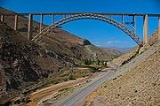
and concrete problematic. - Large bridges such as the Veresk BridgeVeresk BridgeThe Veresk bridge is a bridge in Iran, constructed during the reign of Reza Shah. It is located in Veresk district of Savadkuh County, in Mazandaran province....
were necessary to cross the AlborzAlborzAlborz , also written as Alburz, Elburz or Elborz, is a mountain range in northern Iran stretching from the borders of Azerbaijan and Armenia in the northwest to the southern end of the Caspian Sea, and ending in the east at the borders of Turkmenistan and Afghanistan...
mountains.
The Three Golden Lines spiral
Spiral
In mathematics, a spiral is a curve which emanates from a central point, getting progressively farther away as it revolves around the point.-Spiral or helix:...
is on the Mazandaran branch in the Sewatcow County of Mazanderan. The line ascends or descends in a short distance by passing three times in the same area at different heights. Trains descend towards Sari or ascend in the opposite direction by going through the Dowgal twin tunnels.
Locomotives
In 1936 Beyer Peacock supplied Iran with four GarrattGarratt
A Garratt is a type of steam locomotive that is articulated in three parts. Its boiler is mounted on the centre frame, and two steam engines are mounted on separate frames, one on each end of the boiler. Articulation permits larger locomotives to negotiate curves and lighter rails that might...
2-8-4 + 4-8-2 articulated locomotive
Articulated locomotive
Articulated locomotive usually means a steam locomotive with one or more engine units which can move independent of the main frame. This is done to allow a longer locomotive to negotiate tighter curves...
s (works numbers 6787–6890). In 1938 these became class 86.01. Until the British and Empire invasion of Iran in 1941 (see below) these Garratts seem to have been the only standard gauge
Standard gauge
The standard gauge is a widely-used track gauge . Approximately 60% of the world's existing railway lines are built to this gauge...
British locomotives in Iran.
German manufacturers supplied 65 steam locomotives for the opening of the line in 1938. 49 were 2-8-0 Consolidations
2-8-0
Under the Whyte notation for the classification of steam locomotives, 2-8-0 represents the wheel arrangement of two leading wheels on one axle , eight powered and coupled driving wheels on four axles, and no trailing wheels...
: 24 from Krupp
Krupp
The Krupp family , a prominent 400-year-old German dynasty from Essen, have become famous for their steel production and for their manufacture of ammunition and armaments. The family business, known as Friedrich Krupp AG Hoesch-Krupp, was the largest company in Europe at the beginning of the 20th...
forming class 41.11, 16 from Henschel und Sohn
Henschel & Son
Henschel & Son was a German company, situated in Kassel, best known during the 20th century as a maker of transportation equipment, including locomotives, trucks, buses and trolleybuses, and armoured fighting vehicles and weapons....
forming class 41.35 and nine from Maschinenfabrik Esslingen
Maschinenfabrik Esslingen
Maschinenfabrik Esslingen , was a German engineering firm that manufactured locomotives, tramways, railway wagons, roll-blocks, technical equipment for the railways, , bridges, steel structures, pumps and boilers.-Founding:...
forming class 41.51. The other 16 were Henschel 2-10-0 Decapods
2-10-0
Under the Whyte notation for the classification of steam locomotives, 2-10-0 represents the wheel arrangement of two leading wheels on one axle, ten powered and coupled driving wheels on five axles, and no trailing wheels...
forming class 51.01.
The Trans-Iranian acquired 10 of the locomotives that Kampsax had used to build the line. These were Gölsdorf two-cylinder compound 0-10-0
0-10-0
Under the Whyte notation for the classification of steam locomotives, 0-10-0 represents the wheel arrangement of no leading wheels, ten powered and coupled driving wheels on five axles, and no trailing wheels...
freight locomotives built between 1909 and 1915 as Austrian State Railways
Imperial Royal Privileged Austrian State Railway Company
The Imperial Royal Privileged Austrian State Railway Company , later the Privileged Austro-Hungarian State Railway Company was a private railway company in the Austro-Hungarian Empire...
class 80 by Wiener Neustädter Lokomotivfabrik
Wiener Neustädter Lokomotivfabrik
The Wiener Neustädter Lokomotivfabrik was the largest locomotive and engineering factory in the Austro-Hungarian Empire...
, Lokomotivfabrik Floridsdorf
Lokomotivfabrik Floridsdorf
Lokomotivfabrik Floridsdorf was an Austrian locomotive works founded on 6 September 1869 that achieved a pre-eminent place amongst European locomotive builders thanks to the quality and diversity of its designs....
and Lokomotivfabrik der StEG
Lokomotivfabrik der StEG
In 1839 the Lokomotivfabrik der StEG became the first Austro-Hungarian locomotive works to be founded and it produced many influential locomotive designs....
in Vienna and by Breitfeld-Daněk in Bohemia. When the Iranian railway introduced its new numbering system in 1938 the Gölsdorf 0-10-0s kept their original Austrian numbers.
After WWI
After the substantial interruption of World War I, the project for constructing a railway across Iran was initiated by Reza Shah Pahlavi as part of numerous reforms contributing to the drastic modernization of Iran that occurred over the decades between World War I and World War II. Although technically independent, Iran was still a financially devastated and weak country. Yet the decade of the thirties brought the emergence of an economic market, a drastic increase in modern industries, a rise in exports, and an increase in agricultural output.While it may seem logical to attribute the reduction in transportation prices to the Trans-Iranian Railway, in reality it contributed minimally. Initially, British and Russian observers considered the implantation of railroads as the ultimate solution to the immense transportation problems Iran faced due to sparsely settled population, the lack of rivers, high mountains, and inhospitable desert regions of the country. Many Americans and British opposed the Trans-Iranian Railway, suggesting more efficient and less expensive modes of transportation, such as the U.S. Army’s Motor Transport Service, which hauled about a fourth of the volume hauled by the railroad to the Soviet border. Some British critics, including General Percy Sykes
Percy Sykes
Brigadier-General Sir Percy Molesworth Sykes KCIE, CB, CMG was a soldier, diplomat and scholar, with a considerable literary output. He wrote historical, geographical, and biographical works, as well as describing his travels in Persia. Sykes was born in Brompton, Kent, England the only son of Rev...
, opposed the railway because it ran north to south, rather than from west to east. The west to east route was preferred because it would allow the British direct access to their military bases in India and Mesopotamia, and at the same time, avoiding the threat of commercial loss of profit to Russia and any foreign rival. There were also Iranians opposed to the building of the railway as well, believing that the money could instead be much more effectively used on roads. However, if a cabinet minister was caught criticizing the extensive tax burden the railway produced, he could be placed in prison on counts of being a British collaborator, decidedly attempting to keep Iran backwards for his own financial and strategic goals.
Although much opposition to the railway was politically and financially motivated, the railway was an expensive tax-burden, costing Iran 2,195,180,700 rials through 1938-1939. The majority of capital used to fund the railway was provided through taxes on goods such as sugar and tea, produced in plants set up by the industries ministry, as part of Reza Shah Pahlavi’s reform movement.
The British and Russians initially stated their reason for invading Iran was the Iranian government’s failure to rid the country of Germans, who supposedly were planning an eventual coup d’etat. Yet there were other reasons for the invasion, and the Trans-Iranian Railways key location as part of the so-called “Persian Corridor
Persian Corridor
The Persian Corridor is the name for a supply route through Iran into Soviet Azerbaijan by which British aid and American Lend-Lease supplies were transferred to the Soviet Union during World War II.-Background:...
” was one of the primary reasons for the Anglo-Soviet invasion of Iran
Anglo-Soviet invasion of Iran
The Anglo-Soviet invasion of Iran was the Allied invasion of the Imperial State of Iran during World War II, by British, Commonwealth, and Soviet armed forces. The invasion from August 25 to September 17, 1941, was codenamed Operation Countenance...
in World War II. Despite Reza Shah’s attempts to remain neutral, the allies decided it would be most effective to remove Reza Shah from the throne, using his young son, instead to assist in their use of the Trans-Iranian Railway to transport oil to Britain, and supplies to the Soviet Union.
British and Soviet operation 1941–42
In June 1941 Germany invaded the Soviet Union. In August 1941 Soviet, British and British Indian forcesBritish Indian Army
The British Indian Army, officially simply the Indian Army, was the principal army of the British Raj in India before the partition of India in 1947...
invaded Iran to protect their oil supply in Iran and to secure the Persian Corridor
Persian Corridor
The Persian Corridor is the name for a supply route through Iran into Soviet Azerbaijan by which British aid and American Lend-Lease supplies were transferred to the Soviet Union during World War II.-Background:...
supply route from the Persian Gulf to the Central Asian republics of the Soviet Union
Soviet Union
The Soviet Union , officially the Union of Soviet Socialist Republics , was a constitutionally socialist state that existed in Eurasia between 1922 and 1991....
. In September 1941 the Allies took over operation of the Trans-Iranian Railway: British and Empire Royal Engineers
Royal Engineers
The Corps of Royal Engineers, usually just called the Royal Engineers , and commonly known as the Sappers, is one of the corps of the British Army....
(RE) commanded by Brigadier Godfrey D. Rhodes
Godfrey D. Rhodes
Brigadier Sir Godfrey D. Rhodes CB, CBE, and DSO was a Canadian born and educated soldier who served with the British Army in Canada, Turkey, Bulgaria, Kenya, Uganda, Persia-Iraq and India.-Education:...
operating the Southern Division between Tehran and the port of Bandar Shahpur on the Persian Gulf and the Soviet Army operating the Northern Division between Tehran and the port of Bandar Shah on the Caspian Sea.
The RE expanded freight capacity by building new railway yards at Bandar Shahpur, Ahvaz
Ahvaz
-History:For a more comprehensive historical treatment of the area, see the history section of Khūzestān Province.-Ancient history:Ahvaz is the anagram of "Avaz" and "Avaja" which appear in Darius's epigraph...
and Andimeshk
Andimeshk
Andimeshk is a city in and the capital of Andimeshk County, Khuzestan Province, Iran. At the 2006 census, its population was 119,422, in 26,140 families....
and a junction at Ahvaz for a new line to Khorramshahr
Khorramshahr
Khorramshahr is a city in and the capital of Khorramshahr County, Khuzestan Province, Iran. At the 2006 census, its population was 123,866, in 26,385 families.Khorramshahr is a port city located approximately north of Abadan...
on the Shatt al-Arab. In order to increase the line's locomotive fleet the RE built a yard at Abadan to transfer locomotives from merchant ships to barges to take them up the River Karun
Karun
The Kārun is Iran's most effluent, and the only navigable, river. It is 450 miles long. It rises in the Zard Kuh mountains of the Bakhtiari district in the Zagros Range, receiving many tributaries, such as the Dez and the Kuhrang, before passing through the capital of the Khuzestan Province of...
and a derrick on a jetty on the Karun at Ahwaz to unload them from the barges onto the railway. When the British first took over the southern part in 1941, the railway was only able to move one freight train per day. The railroad hauled a total volume of 978 tons a day in the first quarter of 1942. Yet by September 1943, they were able to move 5,400 tons per day, due to the import of new locomotives, wagons, and more skilled individuals.
The Southern Division locomotive depot at Ahvaz
Ahvaz
-History:For a more comprehensive historical treatment of the area, see the history section of Khūzestān Province.-Ancient history:Ahvaz is the anagram of "Avaz" and "Avaja" which appear in Darius's epigraph...
had two German 2-10-0s, seven German 2-8-0s, two class 41.01 2-8-0s built by Beyer, Peacock & Co.
Beyer, Peacock and Company
Beyer, Peacock and Company was an English railway Locomotive manufacturer with a factory in Gorton, Manchester. Founded by Charles Beyer and Richard Peacock, it traded from 1854 until 1966...
in 1934, two class 80.14 0-10-0s from an Austrian locomotive builder and seven smaller locomotives. The RE found that all except the 2-10-0s were in poor condition, as was some of the freight rolling stock. In December dozens of LMS
LMS
LMS may refer to:* Lady Manners School, a seventeenth century comprehensive school in Bakewell, England.* Lancaster Mennonite School, a school located in Lancaster, PA.* Last man standing , a gametype featured in several computer and video games...
2-8-0 steam locomotives and 840 20 ton freight wagons started to arrive from Britain. 27 coal-burning LMS 2-8-0s, designated class 41.100 in the Iranian State Railways numbering system, were in service by February 1942. Once enough LMS 2-8-0s were in service some of the German locomotives were released to increase the fleet on the Northern Division that the Soviets were operating. From February until August 1942 96 oil-burning LMS 2-8-0s, designated class 41.150, entered service on the Southern Division and by December 1942 another 19 class 41.100 coal-burners had joined them. In the same year Davenport Locomotive Works
Davenport Locomotive Works
The Davenport Locomotive Works, of Davenport, Iowa, USA built locomotives from 1902 until 1956. The company acquired the locomotive business of H. K...
supplied 24 diesel-mechanical 0-4-0 switchers, designated class 20.01, that Iran had ordered before the Allied invasion.
US and Soviet operation 1942–45
In December 1942 the US Army Transportation Corps (USATC) replaced the British and Empire force operating the Southern Division. In 165 miles (266 km) the line has 144 tunnels, in which smoke and oil fumes created harsh working conditions for steam locomotive crews. A limited water supply throughout the route and the hot climate of the southern plains formed further difficulties for steam locomotive operation. The USATC therefore considered diesel-electric locomotives more suitable and requisitioned every ALCO RSD-1ALCO RSD-1
The ALCO RSD-1 was a diesel-electric locomotive built by American Locomotive Company . This model was a road switcher type rated at and rode on three-axle trucks, having a C-C wheel arrangement...
1,000 horsepower Co-Co locomotive that was then operating on a US railroad or under construction. These totalled only 57 locomotives so initially they were used to operate only the southern part of the Southern Division between Bandar Shahpur and Andimeshk.
For traffic between Andimeshk and Tehran the USATC brought 91 S200 Class steam locomotives
USATC S200 Class
The United States Army Transportation Corps S200 Class is a class of 2-8-2 steam locomotive. They were introduced in 1941 and lent-leased to the United Kingdom for use in the Middle East during the Second World War....
, designated class 42.400 in the Iranian State Railways numbering system. The USATC also introduced another 3,000 freight cars. In April 1943 another 18 ALCO RSD-1's entered service, enabling the USATC to return some LMS 2-8-0s to the British Middle East Command
Middle East Command
The Middle East Command was a British Army Command established prior to the Second World War in Egypt. Its primary role was to command British land forces and co-ordinate with the relevant naval and air commands to defend British interests in the Middle East and eastern Mediterranean region.The...
and extend diesel operation northwards, reaching Qom
Qom
Qom is a city in Iran. It lies by road southwest of Tehran and is the capital of Qom Province. At the 2006 census, its population was 957,496, in 241,827 families. It is situated on the banks of the Qom River....
by September 1943 and regularly serving Tehran by May 1944. The USATC further increased freight traffic so that in 1944 it averaged 6,489 tons per day.
"Aid to Russia" traffic ceased by May 1945 and in June the USATC withdrew its RSD-1's and returned control to the British authorities. Shortly afterwards the British restored the line to Iranian State Railways. Iranian State Railways is now Islamic Republic of Iran Railways
Islamic Republic of Iran Railways
The Islamic Republic of Iran Railways is the national state-owned railway system of Iran. is an associate of the IR and manages its passenger trains including international trains between Tehran and Istanbul and Tehran and Damascus...
.
See also
- International Rankings of Iran in Transportation
- Transport in IranTransport in IranTransport in Iran is inexpensive because of the government's subsidization of the price of gasoline. The downside is economic inefficiency because of highly wasteful consumption patterns, contraband with neighboring countries and air pollution...
- Islamic Republic of Iran RailwaysIslamic Republic of Iran RailwaysThe Islamic Republic of Iran Railways is the national state-owned railway system of Iran. is an associate of the IR and manages its passenger trains including international trains between Tehran and Istanbul and Tehran and Damascus...