
All Topics  
Tehran Conference

 
Tehran Conference

   Email Print
   Bookmark   Link


Tehran Conference


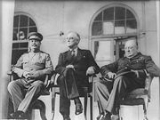
The Tehran Conference (codenamed EUREKA) was the meeting of Joseph Stalin
Joseph Stalin

Joseph Stalin was the General Secretary of the Communist Party of the Soviet Union's Central Committee of the Communist Party of the Soviet Union from 1922 until his death in 1953....
, Franklin D. Roosevelt and Winston Churchill
Winston Churchill

Sir Winston Leonard Spencer-Churchill, Order of the Garter, Order of Merit, Order of the Companions of Honour, Territorial Decoration, Fellow of the Royal Society, Her Majesty's Most Honourable Privy Council, Queen's Privy Council for Canada was a Politics of the United Kingdom known chiefly for his leadership of the United King...
 between November 28 and December 1, 1943 in Tehran
Tehran

Tehran is the capital and largest city of Iran, and the administrative center of Tehran Province. Tehran is a sprawling city at the foot of the Alborz mountain range with an immense network of highways unparalleled in Western Asia....
, Iran
Iran

Iran , officially the Islamic Republic of Iran and formerly known internationally as Persian Empire until 1935, is a country in Central Eurasia, located on the northeastern shore of the Persian Gulf and the southern shore of the Caspian Sea....
. It was the first World War II conference
List of World War II conferences

List of World War II conferences of the Allies of World War IIIn total Churchill attended 14 meetings, Roosevelt 12, Stalin 5.Code names for some of the major wartime conference meetings involving Roosevelt and later Truman had a partial naming sequence referring to devices or instruments which had an ordinal number as part of their mea...
 among the Big Three
Allies of World War II

The Allies of World War II were the countries officially opposed to the Axis powers of World War II during the World War II. Within the ranks of the Allies powers, the British Empire, the Soviet Union, and the United States of America were known as "The Big Three"....
 (the Soviet Union
Soviet Union

The Union of Soviet Socialist Republics was a Constitution of the Soviet Union socialist state that existed in Eurasia from 1922 to 1991.The name is a translation of the , romanization of Russian Soyuz Sovetskikh Sotsialisticheskikh Respublik, abbreviated ????, SSSR....
, the United States
United States

The United States of America is a Federal government constitutional republic comprising U.S. state and a federal district. The country is situated mostly in central North America, where its Contiguous United States and Washington, D.C., the Capital districts and territories, lie between the Pacific Ocean and Atlantic Oceans, Borders of the U...
, and the United Kingdom
United Kingdom

The United Kingdom of Great Britain and Northern Ireland, commonly known as the United Kingdom , the UK or Britain,is a sovereign state located off the northwestern coast of continental Europe....
) in which Stalin was present. It succeeded the Cairo Conference
Cairo Conference

The Cairo Conference of November 22 - 26 November 1943, held in Cairo, Egypt, addressed the Allies of World War II position against Japan during World War II and made decisions about postwar Asia....
 and was followed by the Yalta Conference
Yalta Conference

The Yalta Conference, sometimes called the Crimea Conference and Code name the Argonaut Conference, was the wartime meeting from 4 February 1945 to 11 February 1945 among the heads of government of the United States, the United Kingdom, and the Soviet Union?President of the United States Franklin D....
 and Potsdam Conference
Potsdam Conference

The Potsdam Conference was held at Cecilienhof, the home of William, German Crown Prince, in Potsdam, Germany, from July 16 to August 2, 1945....
. The chief discussion was centered on the opening of a second front in Western Europe. At the same time a separate protocol pledged the three countries to recognize Iran's independence:
"The Three Governments realize that the war has caused special economic difficulties for Iran, and they are agreed that they will continue to make available to the Government of Iran such economic assistance as may be possible, having regard to the heavy demands made upon them by their world-wide military operations, and to the world-wide shortage of transport, raw materials, and supplies for civilian consumption." (Declaration of the Three Powers Regarding Iran—December 1, 1943)


Most importantly the conference was organized to plan the final strategy for the war against Nazi Germany
Nazi Germany

Nazi Germany and the Third Reich are the colloquial English names for Germany under the regime of Adolf Hitler and the Nazi Party , which established a Totalitarianism dictatorship that existed from 1933 to 1945....
 and its allies.

  • An agreement was made stating that the Partisans
    Partisans (Yugoslavia)

    The Yugoslav Partisans, or simply the Partisans, were a communist-led World War II resistance movement engaged in the fight against Axis forces and their Collaboration during World War II in Socialist Federal Republic of Yugoslavia during the Yugoslav People's Liberation War from 1941 to 1945....
     of Yugoslavia
    Yugoslavia

    File:LocationYugoslavia2.pngYugoslavia is a term that describes three political entities that existed successively on the Balkan Peninsula in Europe, during most of the 20th century....
     should be supported by supplies and equipment and also by commando
    Commando

    In military science, the term commando denotes an individual soldier, a military unit, and a raid . Contemporarily, commando identifies ?lite light infantry and special forces units specialised in parachuting, rappelling, and amphibious warfare to conduct and effect attacks....
     operations.
  • It was agreed that it would be most desirable if Turkey
    Turkey

    Turkey , known officially as the Republic of Turkey , is a Eurasian country that stretches across the Anatolian peninsula in southwest Asia and Thrace in the Balkans region of Southern Europe....
     should come into war on the side of the Allies before the end of the year.
  • If Turkey found themselves at war, the Soviet Union was to support them.
  • Took note on November 30 that Operation Overlord
    Battle of Normandy

    The Invasion of Normandy was the invasion and establishment of Western Allies forces in Normandy, France, during Operation Overlord in World War II....
     would be launched during May 1944, in conjunction with an operation against southern France
    France

    France , officially the French Republic , is a country whose Metropolitan France is located in Western Europe and that also comprises various Overseas departments and territories of France....
    .
  • It was agreed that the military staff
    General Staff

    A military staff is a group of officers and enlisted personnel that provides a bi-directional flow of information between a Officer and subordinate military units....
     of the Three Powers should from then on keep in close touch with each other.
  • Britain and the U.S.


    Discussion
    Ask a question about 'Tehran Conference'
    Start a new discussion about 'Tehran Conference'
    Answer questions from other users
    Full Discussion Forum


    Encyclopedia


    The Tehran Conference (codenamed EUREKA) was the meeting of Joseph Stalin
    Joseph Stalin

    Joseph Stalin was the General Secretary of the Communist Party of the Soviet Union's Central Committee of the Communist Party of the Soviet Union from 1922 until his death in 1953....
    , Franklin D. Roosevelt and Winston Churchill
    Winston Churchill

    Sir Winston Leonard Spencer-Churchill, Order of the Garter, Order of Merit, Order of the Companions of Honour, Territorial Decoration, Fellow of the Royal Society, Her Majesty's Most Honourable Privy Council, Queen's Privy Council for Canada was a Politics of the United Kingdom known chiefly for his leadership of the United King...
     between November 28 and December 1, 1943 in Tehran
    Tehran

    Tehran is the capital and largest city of Iran, and the administrative center of Tehran Province. Tehran is a sprawling city at the foot of the Alborz mountain range with an immense network of highways unparalleled in Western Asia....
    , Iran
    Iran

    Iran , officially the Islamic Republic of Iran and formerly known internationally as Persian Empire until 1935, is a country in Central Eurasia, located on the northeastern shore of the Persian Gulf and the southern shore of the Caspian Sea....
    . It was the first World War II conference
    List of World War II conferences

    List of World War II conferences of the Allies of World War IIIn total Churchill attended 14 meetings, Roosevelt 12, Stalin 5.Code names for some of the major wartime conference meetings involving Roosevelt and later Truman had a partial naming sequence referring to devices or instruments which had an ordinal number as part of their mea...
     among the Big Three
    Allies of World War II

    The Allies of World War II were the countries officially opposed to the Axis powers of World War II during the World War II. Within the ranks of the Allies powers, the British Empire, the Soviet Union, and the United States of America were known as "The Big Three"....
     (the Soviet Union
    Soviet Union

    The Union of Soviet Socialist Republics was a Constitution of the Soviet Union socialist state that existed in Eurasia from 1922 to 1991.The name is a translation of the , romanization of Russian Soyuz Sovetskikh Sotsialisticheskikh Respublik, abbreviated ????, SSSR....
    , the United States
    United States

    The United States of America is a Federal government constitutional republic comprising U.S. state and a federal district. The country is situated mostly in central North America, where its Contiguous United States and Washington, D.C., the Capital districts and territories, lie between the Pacific Ocean and Atlantic Oceans, Borders of the U...
    , and the United Kingdom
    United Kingdom

    The United Kingdom of Great Britain and Northern Ireland, commonly known as the United Kingdom , the UK or Britain,is a sovereign state located off the northwestern coast of continental Europe....
    ) in which Stalin was present. It succeeded the Cairo Conference
    Cairo Conference

    The Cairo Conference of November 22 - 26 November 1943, held in Cairo, Egypt, addressed the Allies of World War II position against Japan during World War II and made decisions about postwar Asia....
     and was followed by the Yalta Conference
    Yalta Conference

    The Yalta Conference, sometimes called the Crimea Conference and Code name the Argonaut Conference, was the wartime meeting from 4 February 1945 to 11 February 1945 among the heads of government of the United States, the United Kingdom, and the Soviet Union?President of the United States Franklin D....
     and Potsdam Conference
    Potsdam Conference

    The Potsdam Conference was held at Cecilienhof, the home of William, German Crown Prince, in Potsdam, Germany, from July 16 to August 2, 1945....
    . The chief discussion was centered on the opening of a second front in Western Europe. At the same time a separate protocol pledged the three countries to recognize Iran's independence:
    "The Three Governments realize that the war has caused special economic difficulties for Iran, and they are agreed that they will continue to make available to the Government of Iran such economic assistance as may be possible, having regard to the heavy demands made upon them by their world-wide military operations, and to the world-wide shortage of transport, raw materials, and supplies for civilian consumption." (Declaration of the Three Powers Regarding Iran—December 1, 1943)


    Most importantly the conference was organized to plan the final strategy for the war against Nazi Germany
    Nazi Germany

    Nazi Germany and the Third Reich are the colloquial English names for Germany under the regime of Adolf Hitler and the Nazi Party , which established a Totalitarianism dictatorship that existed from 1933 to 1945....
     and its allies.

    Major conclusions

    1. An agreement was made stating that the Partisans
      Partisans (Yugoslavia)

      The Yugoslav Partisans, or simply the Partisans, were a communist-led World War II resistance movement engaged in the fight against Axis forces and their Collaboration during World War II in Socialist Federal Republic of Yugoslavia during the Yugoslav People's Liberation War from 1941 to 1945....
       of Yugoslavia
      Yugoslavia

      File:LocationYugoslavia2.pngYugoslavia is a term that describes three political entities that existed successively on the Balkan Peninsula in Europe, during most of the 20th century....
       should be supported by supplies and equipment and also by commando
      Commando

      In military science, the term commando denotes an individual soldier, a military unit, and a raid . Contemporarily, commando identifies ?lite light infantry and special forces units specialised in parachuting, rappelling, and amphibious warfare to conduct and effect attacks....
       operations.
    2. It was agreed that it would be most desirable if Turkey
      Turkey

      Turkey , known officially as the Republic of Turkey , is a Eurasian country that stretches across the Anatolian peninsula in southwest Asia and Thrace in the Balkans region of Southern Europe....
       should come into war on the side of the Allies before the end of the year.
    3. If Turkey found themselves at war, the Soviet Union was to support them.
    4. Took note on November 30 that Operation Overlord
      Battle of Normandy

      The Invasion of Normandy was the invasion and establishment of Western Allies forces in Normandy, France, during Operation Overlord in World War II....
       would be launched during May 1944, in conjunction with an operation against southern France
      France

      France , officially the French Republic , is a country whose Metropolitan France is located in Western Europe and that also comprises various Overseas departments and territories of France....
      .
    5. It was agreed that the military staff
      General Staff

      A military staff is a group of officers and enlisted personnel that provides a bi-directional flow of information between a Officer and subordinate military units....
       of the Three Powers should from then on keep in close touch with each other.
    6. Britain and the U.S. promised Stalin that they would send troops to Western Europe. It was agreed that they would arrive in the spring of 1944.
    7. At the insistence of Stalin, the borders of post-war Poland
      Poland

      Poland , officially the Republic of Poland , is a country in Central Europe. Poland is bordered by Germany to the west; the Czech Republic and Slovakia to the south; Ukraine, Belarus and Lithuania to the east; and the Baltic Sea and Kaliningrad Oblast, a Russian Enclave and exclave, to the north....
       were determined along the Oder and Neisse river
      Oder-Neisse line

      The Oder-Neisse line was drawn in the aftermath of World War II as the eastern border of Germany and the western border of Poland. The line is formed primarily by the Oder and Lusatian Neisse rivers, and meets the Baltic Sea west of the seaport cities of Szczecin and Swinoujscie ....
      s and the Curzon line
      Curzon Line

      The Curzon Line was a demarcation line between the Second Polish Republic and Bolshevik Russia, first proposed on December 8, 1919 at the Allied Supreme Council declaration....
      .
    8. A United Nations Organization was tentatively agreed to.
    9. The Soviet Union agreed to wage war against Japan once Germany was defeated.


    Overview

    The key Allied leaders—Roosevelt, Stalin, and Churchill—were known as the "Big Three" because of the might of the nations they represented and their peaceful collaboration during World War II. These three leaders met together only twice during World War II, but when they did confer, their decisions changed the course of history.

    The first of these two conferences, the Tehran Conference, took place in Tehran, Iran. It only came about after much pleading and threats from Roosevelt who wished to strengthen the cooperation between the United States, Great Britain, and the USSR. In fact, Roosevelt wanted this meeting so much that he was willing to make numerous concessions to Stalin, and the choice of the location itself was a place that was more convenient for Stalin. Stalin was afraid of flying and took an airplane only once, namely for this occasion. These leaders met regarding the war against Japan.

    Churchill and the British diplomats hoped to establish a method for dealing with Stalin before the conference, and therefore they arranged the Cairo Conference. However, the Cairo Conference did not go as planned. Roosevelt was withdrawn and edgy, ignoring the Stalin issue, and the conference was spent discussing mainly future policy with China
    China

    China is a Culture of China, an ancient civilization, and, depending on perspective, a national or multinational entity extending over a large area in East Asia....
     and Japan
    Japan

    Japan is an island country in East Asia. Located in the Pacific Ocean, it lies to the east of the Sea of Japan, People's Republic of China, North Korea, South Korea and Russia, stretching from the Sea of Okhotsk in the north to the East China Sea and Taiwan in the south....
    . From the Cairo Conference, it appeared that Roosevelt planned to deal with Stalin alone, but his health would not permit him to negotiate with Stalin from a strong, focused position. In fact, Roosevelt arrived in Tehran on November 28 1943 with little bargaining power and in poor physical condition. In contrast, Stalin arrived jubilant and swaggering because of the USSR’s most recent victories in Eastern Europe, and he clearly held the upper hand. Churchill was calm and focused, hoping to promote his Mediterranean plan.

    The Tehran Conference was the first three-power war conference of World War II, so the first thing the United States and Great Britain did was to ensure full cooperation and assistance from the Soviet Union for any and all war policies. Stalin agreed, but at a price: Roosevelt and Churchill would have to support his reign and the partisans in Yugoslavia, and also allow for the manipulation of the border between Poland and the USSR. Roosevelt, Churchill, and Stalin then moved on to more important matters, mainly Operation Overlord and general war policy. Operation Overlord was scheduled to begin in May 1944, in conjunction with the Soviet attack on Germany’s eastern border. The attacks would combine the force of Canada
    Canada

    Canada is a country occupying most of northern North America, extending from the Atlantic Ocean in the east to the Pacific Ocean in the west and northward into the Arctic Ocean....
    , the United Kingdom
    United Kingdom

    The United Kingdom of Great Britain and Northern Ireland, commonly known as the United Kingdom , the UK or Britain,is a sovereign state located off the northwestern coast of continental Europe....
    , the United States
    United States

    The United States of America is a Federal government constitutional republic comprising U.S. state and a federal district. The country is situated mostly in central North America, where its Contiguous United States and Washington, D.C., the Capital districts and territories, lie between the Pacific Ocean and Atlantic Oceans, Borders of the U...
    , and numerous other countries, and would later be known as "D-Day
    D-Day

    D-Day is a term often used in military parlance to denote the day on which a combat attack or operation is to be initiated. "D-Day" often represents a variable , designating the day upon which some significant event will occur or has occurred; see Military designation of days and hours for similar terms....
    ". The “Big Three” spent days wrangling about when Operation Overlord should take place, who should command it, and where operations should begin.

    Next, Roosevelt gave Stalin a pledge that he had been waiting for since June 1941: that the Anglo-Americans would open a second front in France in the spring of 1944. This was Stalin’s major political objective of the war, so he was well-satisfied. Churchill up to this point had been seeking a joint United Kingdom, United States and Commonwealth forces push through the Mediterranean that would have secured British interests in the Middle East and India. Roosevelt was determined to break up the British Empire
    British Empire

    The British Empire comprised the dominions, Crown colony, protectorates, League of Nations mandate, and other Dependent territory ruled or administered by the United Kingdom , that had originated with the overseas colonies and trading posts established by England in the late 16th and early 17th centuries....
     and so the concessions to Stalin served this purpose. Concerning general war policy, the Soviet Union requested backup troops in Western Europe, and it was agreed that these troops would arrive in the spring of 1944. It was also agreed that the Soviet Union would enter the war against Japan once Nazi Germany was defeated. Roosevelt, Churchill, and Stalin also concurred that the Axis powers would face unconditional terms of surrender, and that once defeated, the nations in league with the Axis powers would be divided into territories to be controlled by the USSR, the U.S., and the UK. In regard to common alliances and international relations, Iran and Turkey were mainly discussed. Roosevelt, Churchill, and Stalin all agreed to support Iran’s government, as addressed in the following declaration:

    The Three Governments realize that the war has caused special economic difficulties for Iran, and they all agreed that they will continue to make available to the Government of Iran such economic assistance as may be possible, having regard to the heavy demands made upon them by their world-wide military operations, and to the world-wide shortage of transport, raw materials, and supplies for civilian consumption.


    In addition, the Soviet Union was required to pledge support to Turkey if they found themselves at war, and Roosevelt, Churchill, and Stalin decided that it would also be most desirable if Turkey entered the war on the Allies’ side before the year was out. Despite being forced to accept the above arrangements of the conference, Stalin dominated, using the Soviet victory at the Battle of Kursk
    Battle of Kursk

    The Battle of Kursk refers to Nazi Germany and Soviet Union operations on the Eastern Front of World War II in the vicinity of the city of Kursk in July and August 1943....
     and military might, as well as key positions on the German front, to get his way. Roosevelt attempted to cope with the crushing onslaught of demands, but with few strategic positions and various other bargaining powers, he was able to do little except appease Stalin. Churchill mostly argued for his Mediterranean plan instead of Operation Overlord, something that annoyed all diplomats and officials. Therefore, Stalin plowed his way through the conference, checking off items on his to-do list. One of Roosevelt and Churchill's main concessions concerned post-war Poland. Stalin wished for an area in the Eastern part of Poland to be added to the USSR, and for the border to be lengthened elsewhere in the country. Roosevelt and Churchill agreed to this demand, and Poland’s borders were declared to lie along the Oder and Neisse rivers and the Curzon line, despite protests of the Polish government-in-exile in London
    London

    London is the capital of both England and the United Kingdom, and the most populous municipality in the European Union. An important settlement for two millennia, History of London goes back to its founding by the Roman Empire....
    . Churchill and Roosevelt also gave Stalin free rein in his own country, and allowed the USSR to set up puppet communist governments in Poland, Czech Republic
    Czech Republic

    The Czech Republic , is a landlocked country in Central Europe. The country borders Poland to the northeast, Germany to the west, Austria to the south and Slovakia to the east....
    , Slovakia
    Slovakia

    Slovakia . It was amended in September 1998 to allow direct election of the president and again in February 2001 due to EU admission requirements....
    , the Baltic states
    Baltic countries

    The Baltic states , Baltic Nations or Baltic countries are three countries in Northern Europe, all European Union member state of the European Union: Estonia, Latvia and Lithuania....
    , Romania
    Romania

    Romania is a country located in Southeastern Europe Central Europe, North of the Balkan Peninsula, on the Lower Danube, within and outside the Carpathian Mountains, bordering on the Black Sea....
    , and other Eastern European countries
    Eastern Europe

    Eastern Europe is a term that applies to the geopolitical region encompassing the easternmost part of the Europe. Throughout history and to a lesser extent today, parts of Eastern Europe has been distinguishable from Western Europe and other regions due to cultural, religious, economic, and historical reasons, even though there i...
     which would result in a loss of freedom by these countries for the next fifty years and would be the genesis of the Cold War
    Cold War

    The Cold War was the continuing state of conflict, tension and competition that existed between a number of world powers, including the United States, the Soviet Union, People's Republic of China, France, United Kingdom and those countries' respective allies from the mid-1940s to the early 1990s....
    . After the aforementioned conclusions were made, Roosevelt, Churchill, and Stalin returned to their own countries to carry out war policies, with the agreement that military leaders of the three countries would meet together often, for further discussion. So, thus ended the friendliest and most productive conference of World War II.

    Tripartite dinner meeting


    Before the dinner meeting Churchill presented Stalin with a specially commissioned ceremonial sword (the "Sword of Stalingrad") commemorating the victory in the battle of Stalingrad
    Battle of Stalingrad

    The Battle of Stalingrad was a battle between Nazi Germany and its allies and the Soviet Union for control of the city of Stalingrad in Southern Russia....
     as a gift from king George VI to the citizens of Stalingrad and the people of the Soviet Union. When Stalin received the sheathed sword
    Sword

    A sword is a long, edged piece of metal, used as a cutting, thrusting, and clubbing weapon in many civilizations throughout the world. The word sword comes from the Old English language wikt:sweord, cognate to Old High German swert, Middle Dutch swaert, Old Norse sver? Old Frisian and Old Saxon swerd and Dutch langua...
    , he took it with both hands, kissed the scabbard
    Scabbard

    A scabbard is a sheath for holding a sword or other large blade.Scabbards have been made of many materials over the millennia, including leather, wood, and metals such as brass or steel....
     and handed it to marshal
    Marshal

    Marshal is a word used in several official titles of various branches of society. The word derives from Old High German marah "horse" and schalh "servant", and originally meant "stable keeper"....
     Voroshilov
    Kliment Voroshilov

    , popularly known as Klim Voroshilov was a Soviet Union Military of the Soviet Union commander and Politics of the Soviet Union.Voroshilov was born in Dnipropetrovsk, near Yekaterinoslav , Ukraine, under the Russian Empire, to a railway worker's family of Russians ethnicity....
     who mishandled it causing the sword to fall to the ground.

    During the Tripartite Dinner Meeting at the Tehran Conference, Stalin who, according to the US report of the dinner, continuously needled Churchill for his perceived "affection" for the Germans, proposed executing 50,000–100,000 German staff officers. Roosevelt joked that perhaps 49,000 would do. Churchill denounced the idea of "the cold blooded execution of soldiers who fought for their country." He said that, "war criminals must pay for their crimes and individuals who had committed barbarous acts, and in accordance with the Moscow Document
    Moscow Declaration

    The Moscow Declaration was signed during the Moscow Conference on October 30 1943. The formal name of the declaration was "Declaration of the Four Nations on General Security"....
    , which he himself had written, they must stand trial at the places where the crimes were committed.
    " He objected vigorously, however, "to executions for political purposes."

    Declaration of the Three Powers

    Declaration of the Three Powers, December 1 1943 "We the President of the United States, the Prime Minister of Great Britain, and the Premier of the Soviet Union, have met these four days past, in this, the Capital of our Ally, Iran, and have shaped and confirmed our common policy."

    See also

    • Western betrayal
      Western betrayal

      Western betrayal or Yalta betrayal are popular terms in many Central European countries, especially in Poland and the Czech Republic which refers to the foreign policy of several Western countries which violated allied pacts and agreements during the period from the Treaty of Versailles in 1919 through World War II and to the Cold War,...
    • List of World War II conferences
      List of World War II conferences

      List of World War II conferences of the Allies of World War IIIn total Churchill attended 14 meetings, Roosevelt 12, Stalin 5.Code names for some of the major wartime conference meetings involving Roosevelt and later Truman had a partial naming sequence referring to devices or instruments which had an ordinal number as part of their mea...
    • Anglo-Soviet invasion of Iran
      Anglo-Soviet invasion of Iran

      The Anglo-Soviet invasion of Iran was the invasion of Iran by United Kingdom and the Soviet Union, codenamed Operation Countenance, from August 25, 1941 to September 17, 1941....
    • Iran-Britain relations
    • Iran-Russia relations
      Iran-Russia relations

      Relations between Russia and Persia , officially commenced in 1592, with the Safavids in power. Past and present contact between Russia and Iran has long been complicatedly multi-faceted; often wavering between collaboration and rivalry....


    Footnotes


    Bibliography


    • Best, Geoffrey. Churchill: A Study in Greatness. London: Hambledon and London, 2001.


    • Clemens, Diane S. "Yalta Conference." World Book. 2006 ed. vol. 21. 2006, 549.


    • "Cold War: Teheran Declaration." CNN. 1998. 26 March 2006. .


    • Meacham, John. Franklin and Winston: An Intimate Portrait of an Epic Friendship. New York: Random House Inc., 2003.


    • O’Neil, William L. World War II: a Student Companion. New York: Oxford UP, 1999.


    • Persico, Joseph E. Roosevelt’s Secret War. New York: Random House, 2001.


    • “Portraits of Presidents: Franklin D. Roosevelt.” School Arts Magazine Feb. 1999: 37. Student Research Center. EBSCO Host. Philadelphia. 2 April 2006. Keyword: FDR.


    • Snyder, Louis L. World War II. New York: Grolier Company, 1981.


    • Sulzberger, C L. American Heritage New History of World War II. Ed. Stephen E. Ambrose. New York: Viking Penguin, 1998.


    • "Tehran Conference." Wikipedia Encyclopedia. 24 March 2006. Wikipedia Foundation. 26 March 2006. .


    • "Western Betrayal." Wikipedia Encyclopedia. 29 March 2006. Wikipedia Foundation. 2 April 2006. < http://en.wikipedia.org/wiki/Western_betrayal>.


    • “Yalta Conference.” Funk and Wagnells New Encyclopedia. World Almanac Education Group, 2003. SIRS DISCOVER. Philadelphia. 2 April 2006. Keyword: Yalta Conference.


    • Miscellaneous No. 8 (1947) Military Conclusions of the Tehran Conference. Tehran, 1st December, 1943. British Parliamentary Papers. By Royal Command. CMD 7092 Presented by the Secretary of State for Foreign Affairs to Parliament by Command of His Majesty.


    External links

    • Online Documents Collection


  •