

Old City of Berne

Encyclopedia
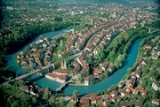
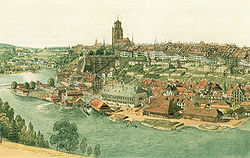
The Old City of Bern is the medieval city center of Bern, Switzerland. Built on a narrow hill surrounded on three sides by the Aare River, its compact layout has remained essentially unchanged since its construction during the 12th to the 15th century. Despite a major fire in 1405, after which much of the city was rebuilt in sandstone
, and substantial construction efforts in the 18th century, Bern's old city has retained its medieval character.
The Old City is home to Switzerland's tallest cathedral as well as other churches, bridges and a large collection of Renaissance fountains. In addition to many historical buildings, the seats of the federal, cantonal and municipal government are also situated in the Old City. It is a UNESCO
Cultural World Heritage Site
since 1983 due to the compact and generally intact medieval core and is an excellent example of incorporating the modern world into a medieval city. Numerous buildings in the Old City have been designated as Swiss Cultural Properties of National Significance
, as well as the entire Old City.
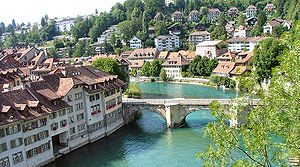
The earliest settlements in the Aare Valley date back to the Neolithic
period. During the 2nd century BCE the valley was settled by the Helvetii
. Following the Roman conquest
of Helvetia
a small Roman settlement was established near the Old City. This settlement was abandoned during the 2nd century AD. From that time until the founding of Bern the area remained sparsely settled.
 The history of the city of Bern proper begins with its founding by Duke
Berchtold V of Zähringen
in 1191. Local legend has it that the duke vowed to name the city after the first animal he met on the hunt, which turned out to be a bear. Both the name of the city (Bern can stand for Bär(e) n, bears) and its heraldic beast, come from this legend. At that time, much of today's Switzerland (then considered part of southern Burgundy
) was under the authority of the house of Zähringen. The Zähringer leaders, although with no actual duchy
of their own, were styled dukes by decree of the German king and exercised imperial power south of the Rhine. To establish their position there, they founded or expanded numerous settlements, including Fribourg
(in 1157), Bern, Burgdorf and Morat
.
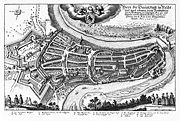
The area chosen by Berchtold V was a hilly peninsula
surrounded by the Aare river on three sides. This location made the city easy to defend and influenced the later development of the city. The long, narrow shape of the peninsula made the city develop as several long, parallel rows of houses. The only major cross streets (going north and south) developed along the city walls, which were moved to allow the city to expand. Therefore, the cross streets mark the stages of development in the Old City of Bern.
On the eastern end of the peninsula a small fort, called Castle Nydegg, was founded by Berchtold IV in the second half of the 12th century. Either when the fort was built or in 1191, the city of Bern was founded around the eastern end of the peninsula.
(Swiss German
: clock tower). The city was divided by three longitudinal streets, which stretched from the Castle to the city wall. Both the position of the town church and the shape of the eaves were typical for a Zähringer city.
During the first half of the 13th century two additional streets (Brunngasse and Herrengasse
) were added. Brunngasse was a semi-circular street on the north edge of the city, while Herrengasse was on the south side of the city. A wood bridge was built over the Aare River which allowed increased trade and limited settlements on the east bank of the river.
(German: Prison Tower).
Around 1268 Nydegg Castle was destroyed, and the city expanded into the area formerly occupied by the castle. In the south east part of the peninsula below the main hill that the rest of the Old City occupied, a section known as Matte grew up.
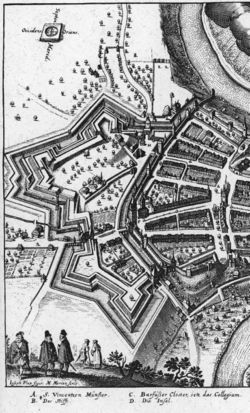 For almost a century the Käfigturm remained the western boundary of Bern. However, as the city grew, people began settling outside the city walls. In 1344 the city started to build a third wall to protect the growing population. By 1346 the project was finished and six new streets were protected by a wall and the Christoffelturm
(German: St. Christopher Tower). The Christoffelturm remained the western border of Bern until the 19th century. From 1622 to 1634 a series of defensive walls and strong points were added outside the Christoffelturm. These defensive walls, known as the Grosse Schanze and Kleine Schanze (large and small redoubt
s respectively) as well as the Schanzegraben (redoubt ditch or moat), were never used as living space for the city, though the Schanzengraben was used for a while to house the Bärengraben.
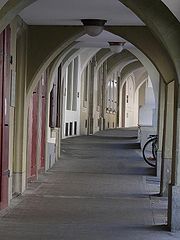 Bern was included in the UNESCO World Heritage Sites because of "an exceptionally coherent planning concept" and because "the medieval town...has retained its original character". Bern owes its coherent planning concept and its famous arcades
to a disaster. In 1405 a fire broke out in Bern, which was mostly wooden buildings at the time. The fire raced through the city and destroyed most of the buildings in town. In the wake of this disaster, the city was rebuilt with all stone houses in similar medieval styles. The arcades were added throughout the 15th century as houses expanded in the upper stories out into the street. Throughout the next three centuries houses were modified, but the essential elements (stone construction, arcades) remained.
In the 16th century, as Bern became a powerful and rich city-state, public fountains were added to Bern. A number of fountains were topped with large allegorical statues
, eleven of which are still visible in the city. The fountains served to show the power and wealth of the city, as well as providing fresh water for the citizens of the city. Overall, the city remained nearly unchanged for the next two centuries.
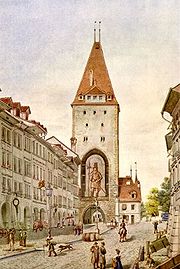 By the early 19th century Bern had expanded as far as it could within the old city walls. An increasing number of people were living outside the city walls in neighboring communities. Throughout the 19th century, this ring of modern cities grew up around the Old City without forcing it to demolish the medieval city core. However, the growth around the Old City did lead to several projects.
Within the Old City of Bern, many of the old stone buildings were renovated without changing the outer appearance. The bell tower was finally finished on the Münster (German: Minister or Cathedral), making it the tallest church in Switzerland. A new bridge was built across the Aare at Nydegg in 1842 to 1844. The new bridge was larger than the, still standing, old bridge which had been built in 1461 to 1487.
One of the biggest projects was the proposed destruction of the Christoffelturm
to open up the west end of the city. Following a very close vote the decision to remove the Christoffelturm and city wall was made on 15 December 1864. In the spring of the following year Gottlieb Ott
led the team that removed the tower. Currently, the former location of the Christoffelturm is a large road interchange, a major bus station and the central train station.
 Following the Sonderbundskrieg
(German:Separate Alliance War) in 1847, Switzerland established a federal constitution
and Bern was chosen as the capital
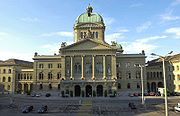
of the new Federal State. The vote to make Bern the federal city was met with little enthusiasm (419 vs 313 votes) in Bern due to concerns over the cost. The first Bundesrathaus or Parliament House was built in 1852–1857 by the city of Bern in a New-Renaissance style. The mirror image Bundeshaus Ost (East Federal Building) was built in 1884–1892. Then, in 1894–1902 the domed Parlamentsgebäudes or Parliament Building was built between the other two buildings. The three parliament buildings represent the majority of the new, federal construction in the Old City. Most of the other buildings that come with a national capital were placed outside the Old City or where incorporated into existing buildings.
For centuries the famous Bärengraben
(German: Bear Pits) were located in the Old City. According to the Bernese historian Valerius Anshelm
the first bears were kept on Bärenplatz (German: Bears' Plaza) in 1513. They were moved from the modern Bärenplatz to the Schanzengraben near the former Christoffelturm in 1764. However, the bears remained in the Old City until the expansion of the new capital forced them out. The bears and the Bärengraben were moved from the Old City across the Aare River on 27 May 1857.
In the 20th century, Bern has had to deal with incorporating the modern world into a medieval city. The plaza where the Christoffelturm used to be, has become the central bus stop for the city. The main train station was built under the plaza, and actually includes some of the foundations from the Christoffelturm and wall in the train station. However, one of the biggest challenges has been integrating automobile traffic into the Old City. Due to the number of important buildings in the Old City and the central location of the Old City, it was impossible to completely close off this area to vehicles. While some streets have remained pedestrian zones, most major streets carry city buses, trams or personal vehicles.
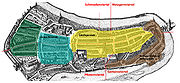 The old city was historically subdivided into four Viertel and four Quartiere. The Viertel were the city's official administrative districts
. They ware instituted for tax and defence purposes in the 13th century, and ceased to be used in 1798 after the fall of the Ancien Régime
in Bern.
Of greater practical importance were the Quartiere, the four traditional neighbourhoods in which people of similar social and economic rank congregated. They emerged in the late Middle Ages
, overlap the Viertel boundaries and remain easily identifiable in today's cityscape.
The central and oldest neighbourhood is the Zähringerstadt
(Zähringer town), which contained the medieval city's principal political, economic and spiritual institutions. These were strictly separated: official buildings were situated around the Kreuzgasse (Cross Alley), ecclesiastical buildings were located at the Münstergasse
(Cathedral Alley) and Herrengasse (Lords' Alley), while guilds and merchants' shops clustered around the central Kramgasse
(Grocers Alley) and Gerechtigkeitsgasse
(Justice Alley). Junkerngasse
(Junker
Lane), which is parallel to Gerechtigkeitsgasse, was originally known as Kilchgasse (Church Lane) but was renamed because of number of patricians or untitled nobility which lived on the southern side of the peninsula.
The second oldest neighbourhood, the Innere Neustadt
(Inner New City), was built during the city's first westward expansion in 1255, between the first western wall guarded by the Zytglogge
tower and the second wall, guarded by the Käfigturm
. Its central feature is the broad Marktgasse
(Market Alley).
 Situated in the northeast and southeast of the Aare peninsula, the Nydeggstalden
and the Mattequartier
together constitute medieval Bern's smallest neighbourhood. Workshop
s and mercantile activity prevailed in this area, and medieval sources tell of numerous complaints about the ceaseless and apparently nerve-wracking noise of machinery, carts and commerce. The Matte area at the riverside features three artificial channels, through which Aare water was diverted to power three city-owned watermill
s built in 1360. In the early 20th century, a small hydroelectric plant was built in that location. Nearby, the busy Schiffländte (ship landing-place) allowed for the reloading of goods transported by boat up and down the river.
The last neighbourhood to be built was the Äussere Neustadt
(Outer New City), which added a third and final layer to Bern's defences starting in 1343. All of these walls, gates and earthworks were demolished in the 19th century ending with the destruction of Bern's greatest of its three guard towers, the Christoffelturm
. Only the four central streets were lined with residential houses in late medieval times, while the rest of the area was devoted to agriculture and animal husbandry
.
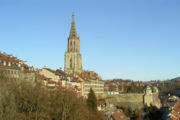 The Münster of Bern (German: Berner Münster) is a Protestant
Gothic
cathedral located on the south side of the peninsula
. Construction on the Münster began in 1421 and finished with the bell tower in 1893. The bell tower is 100 m (328 ft) and is the tallest in Switzerland. The largest bell in the bell tower is also the largest bell in Switzerland. This enormous bell, weighing about 10 ton
s and 247 cm (8.1 ft) in diameter, was cast in 1611 and is still rung every day. It is possible to stand next to the bell when it is rung, but one has to cover their ears to avoid hearing damage.
 Above the main portal is a rare complete collection of Gothic
sculpture. The collection represents the Christian belief in the Last Judgment
where the wicked will be separated from the righteous. The large 47 free-standing statues are replicas (the originals are in the Bern History Museum) and the 170 smaller statues are all original.
The interior is large, open and fairly empty. Nearly all the art and altars in the cathedral were removed in 1528 during the iconoclasm
of the Protestant Reformation. The paintings and statues were dumped in what became the Cathedral Terrace, making the terrace a rich archeological site. The only major pieces of art that survived the iconoclasm inside the cathedral are the stained glass windows and the choir stalls.
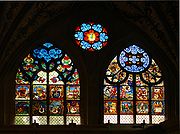 The stained glass windows date from 1441–1450 and are considered the most valuable in Switzerland. The windows include a number of heraldic symbols and religious images as well as an entire "Dance of Death
" window. This window shows death, as a skeleton, claiming people from all professions and social classes. A "Dance of Death" was intended as a reminder that death would come to everyone regardless of wealth or status, and may have been a comfort in a world filled with plagues
and wars.
The choir, in the eastern side of the Cathedral between the nave
and the sanctuary, houses the first Renaissance
choir stalls in Switzerland. The stalls are carved with life-like animals and images of daily life.
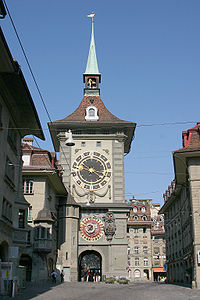 The Zytglogge is the landmark medieval clock tower
in the Old City of Bern. It has existed since about 1218–1220 and is one of the most recognisable symbols of Bern. The name Zyglogge is Bernese German
and translates as Zeitglocke in Standard German
or time bell in English. A "time bell" was one of the earliest public timekeeping devices, consisting of a clockwork
connected to a hammer that rang a small bell at every full hour. The Zytglogge clock is one of the three oldest clocks in Switzerland.
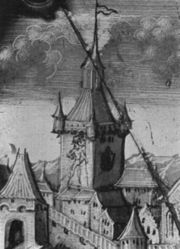 Following the first expansion of Bern the Zytglogge was the gate tower of the western fortifications. At this time, it was a squat tower of only about 16 m (52.5 ft) in height which was open in the back. During the second expansion, to the Käfigturm, the Ztyglogge wall was removed and the tower was relegated to second-line status. Around 1270–1275 an additional 7 m (23 ft) was added to the tower to allow it to overlook the surrounding houses. After the third expansion, to the Christoffelturm, the Zytglogge was converted into a women's prison. Most commonly it was used to house Pfaddendirnen – "priests' whores", women convicted of sexual relations with clerics. At this time, the Zytglogge also received its first slanted roof.
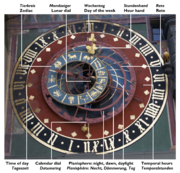 In the Great Fire of 1405, the tower was completely burned out. The structural damage would not be completely repaired until 1983. The prison cells were abandoned and a clock was installed above the gate. This clock, together with a bell cast in 1405, gave the tower the name of Zytglogge. In the late 15th century the tower was decorated with four decorative corner towerlets and heraldic symbols. The astronomical clock
was extended to its current state in 1527–1530. In addition to the astronomical clock, the Zytglogge features a group of mechanical figures. At three minutes before the hour the figures which include a rooster, a fool, a knight, a piper, a lion and bears, put on a show. The animals chase each other around, the fool rings his bells and the rooster caws. During the day it is common to see small crowds gathered around the foot of the Zytglogge waiting for the show to start.
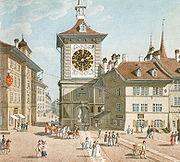 The Zytglogge's exterior was repainted by Gotthard Ringgli and Kaspar Haldenstein in 1607–10, who introduced the large clock faces that now dominate the east and west façades of the tower. The corner towerlets were removed again some time before 1603. In 1770–71, the Zytglogge was renovated by Niklaus Hebler and Ludwig Emanuel Zehnder, who refurbished the structure in order to suit the tastes of the late Baroque
, giving the tower its contemporary outline.
Both façades were again repainted in the Rococo
style by Rudolf von Steiger in 1890. The idealising historicism
of the design came to be disliked in the 20th century, and a 1929 competition produced the façade designs visible today: on the west façade, Viktor Surbek
's fresco "Beginning of Time" and on the east façade, a reconstruction of the 1770 design by Kurt Indermühle. In 1981–83, the Zytglogge was thoroughly renovated again and generally restored to its 1770 appearance.

 The Parliament Building (German: Bundeshaus, , , Latin
: Curia Confoederationis Helveticae) is built along the southern edge of the peninsula and straddles the location of the former Käfigturm wall. The building is the used by both the Swiss Federal Council
or Executive and Parliament or Federal Assembly of Switzerland. The complex includes the Bundeshaus West (built in 1852–57), the central Parliament Building (built in 1894–1902) and the Bundeshaus East (built in 1884–1892). The central plaza in front of the Parliament building was built into a fountain in 2004. The plaza was paved with granite slabs and 26 water jets, one for each canton, were hidden under the plaza. The design of the plaza has won two international awards
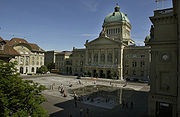 The central Parliament Building was built to be visible and is topped with several large copper domes. The interior was decorated by 38 artists from every corner of the country. Three major themes tied all the works together. The first theme, national history, is represented by events and persons from Swiss history. This includes the Rütlischwur
or the foundation of Switzerland in 1291 and figures such as William Tell
, Arnold von Winkelried
and Nicholas of Flüe
. The second theme is the fundamental principles that Switzerland was founded on; including independence
, freedom
, separation of government powers
, order
and security. The final theme is the cultural and material variety of Switzerland; including politically (represented by Canton flags), geographically and socially.
The two chambers where the National Council
and the Council of States
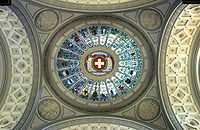
meet are separated by the Hall of the Dome. The dome itself has an external height of 64 m, and an internal height of 33 m. The mosaic in the center represents the Federal coat of arms
along with the Latin
motto
Unus pro omnibus, omnes pro uno
(One for all, and all for one), surrounded by the coat of arms of the 22 cantons that existed in 1902. The coat of arms of the Canton of Jura
, created in 1979, was placed outside of the mosaic.
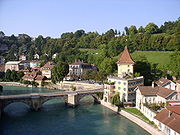 The Untertorbrücke (German: Lower Gate bridge) is the oldest bridge in Bern still in existence. The original bridge, most likely a wooden walkway, was built in 1256 and spanned the Aare river at the Nydegg Fortress. The bridge was destroyed in a flood in 1460. Within one year, construction began on a new stone bridge. The small Mariakapelle (Mary
's Chapel) located in the side of the bridge column on the city side was blessed in 1467. However the bridge wasn't finished until 1490. The new bridge was 52 metres (170.6 ft) long with the three arches spanning 13.5 m (44.3 ft), 15.6 m (51.2 ft) and 13.9 m (45.6 ft). The bridge was modified several times including the removal of the stone guard rails which were replaced with iron rails in 1818–19.
Until the construction of the Nydeggbrücke
in 1840, the Untertorbrücke was the only bridge crossing the Aare near Bern. See List of Aar bridges in Bern.
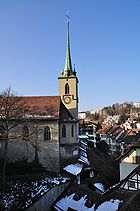 The original Nydegg Castle was built around 1190 by either Duke Berchtold V. von Zähringen or his father Berchtold IV. as part of the city defenses. Following the second expansion, the castle was destroyed by the citizens of Bern in 1268. The castle was located about where the Choir of the church now stands, with the church tower resting on the southern corner of the donjon.
From 1341 to 1346 a church with a small steeple
was built on the ruins of the castle. Then, between 1480 and 1483 a tower was added to the church. The central nave was rebuilt in 1493 to 1504. In 1529, following the Reformation, the Nydegg Church was used as a warehouse for wood and grain. Later, in 1566, the church was again used for religious services and in 1721 was placed under the Münster.
Nearly all the 16th century fountains, except the Zähringer fountain which was created by Hans Hiltbrand, are the work of the Fribourg
master Hans Gieng
.
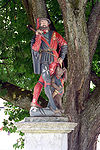 From east to west, the first fountain is the Läuferbrunnen (German: Runner fountain) near the Nydegg Church on Nydeggstalden. The trough was built in 1824, but the figure dates from 1545. The Runner has moved several times since its creation, and until about 1663 was known as the Brunnen beim unteren Tor (Fountain by the lower gate). Originally the Läuferbrunnen had an octagonal trough and a tall, round column. The trough was replaced with a rectangular trough before 1757 which was replaced in 1824. The round column was replaced with the current square limestone
pillar in the 18th or 19th century.
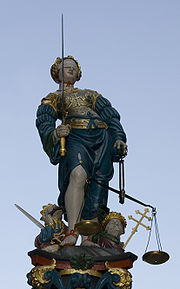 The next fountain is the Gerechtigkeitsbrunnen (German:Justice fountain) on Gerechtigkeitsgasse. Built in 1543 by Hans Gieng, the fountain is topped with a representation of Justice
. She stands with her eyes and ears bound, a sword
of truth one hand and the scales
in the other. On the pillar below her feet are four figures; the Pope
, a Sultan
, the Kaiser
or Emperor and the Schultheiß
or Lord Mayor. This represents the power of Justice over the rulers and political systems of the day; Theocracy
, Monarchy, Autocracy
and the Republic.
The statue has been widely copied in towns throughout Switzerland. Currently, eleven "fountains of Justice" remain in Switzerland, and several others have probably been destroyed. Direct copies exist in Solothurn
(1561), Lausanne
(1585), Boudry
, Cudrefin
and Neuchâtel; designs influenced by the Bernese statue are found in Aarau
(1643), Biel, Burgdorf, Brugg
, Zürich
and Luzern.
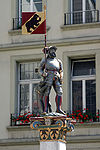 The Vennerbrunnen (German: Banner Carrier or Vexillum
) is located in front of the old city hall or Rathaus. The Venner was military-political title in medieval Switzerland. He was responsible for peace and protection in a section of a city and then to lead troops from that section in battle. In Bern the Venner was a very powerful position and was key in city's operations. Each Venner was connected to a guild
and chosen from the guild. Venner was one of only two positions from which the Schultheiß or Lord Mayor was chosen. The statue, built in 1542 shows a Venner in full armor with his banner.
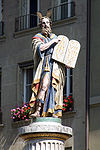 The Moses
fountain, located on Münsterplatz
(German: Cathedral Plaza) was rebuilt in 1790–1791. The Louis XVI style
basin was designed by Niklaus Sprüngli. The Moses figure dates from the 16th century. The statue represents Moses bringing the Ten Commandments
to the Tribes of Israel. Moses is portrayed with two rays of light projecting from his head, which represent which tells that after meeting with God the skin of Moses' face became radiant. The twin rays of light come from one longstanding tradition that Moses instead grew horns
.
This is derived from a misinterpretation of the Hebrew phrase . The root
(qoph
, resh
, nun
) may be read as either "horn" or "ray of light
", depending on vocalization. translates to "the skin of his face".
Interpreted correctly, these two words form an expression meaning that Moses was enlightened, that "the skin of his face shone" (as with a gloriole
), as the KJV has it.
The Septuagint properly translates the Hebrew phrase as , "his face was glorified"; but Jerome
translated the phrase into Latin
as cornuta esset facies sua "his face was horned".
With apparent Biblical authority, and the added convenience of giving Moses a unique and easily identifiable visual attribute
(something the other Old Testament prophets notably lacked), it remained standard in Western art to depict Moses with small horns until well after the mistranslation was realized by the Renaissance
. In this depiction of Moses, the error has been identified but the artist has chosen to place horns of light on Moses head to aid in identification.
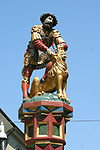 The Simsonbrunnen or Samson
fountain represents the Biblical story of Samson killing a lion
found in . According to the story, Samson was born to a sterile
Israelite couple on the conditions that his mother and her child (Samson) abstain from all Alcohol
and that he never shave or cut his hair. Because of his commitment to live under these conditions, Samson is granted great strength. As a young man he falls in love with a Philistine woman and decides to marry her. At this time, the Philistines ruled over the Israelites and Samson's decision to marry one causes great concern among his family. He calms their concerns and travels to marry his love. On the way he is attacked by the lion and with his incredible strength kills the lion. Later, he sees that bee
s have built a honeycomb
in the lion's body. He uses this event as the basis of a riddle, which when not answered, gives him a pretext to attack the Philistines and lead an unsuccessful rebellion.
The fountain, built in 1544 by Hans Gieng, is modeled after the Simsonbrunnen in Solothurn
.
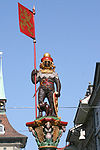 The Zähringerbrunnen was built in 1535 as a memorial to the founder of Bern, Berchtold von Zähringer. The statue is a bear in full armor, with another bear cub at his feet. The bear represents the bear, that according to legend, Berchtold shot on the Aare peninsula as he was searching for a site to build a city.
 One of the most interesting statues is the Kindlifresserbrunnen
(Bernese German: Child Eater Fountain but often translated Ogre
Fountain) which is located on Kornhausplatz. The fountain was built in 1545–46 on the site of an 15th century wooden fountain. Originally known as Platzbrunnen (German: Plaza Fountain), the current name dates to 1666. The statue is a seated giant
or ogre
swallowing a naked child. Several other children are visible in a sack at the figure's feet. There are several interpretations of what the statue represents; including that it is a Jew with a pointed Jewish hat or the Greek god Chronos
. However, the most likely explanation is that the statue represents a Fastnacht
figure that scares disobedient children
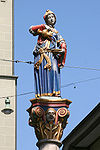 The Anna Seiler fountain, located at the upper end of Marktgasse memorializes the founder of the first hospital in Bern. Anna Seiler is represented by a woman in a blue dress, pouring water into a small dish. She stands on a pillar brought from the Roman
town of Aventicum
(modern Avenches
). On 29 November 1354 in her will
she asked the city to help found a hospital in her house which today stands on Zeughausgasse. The hospital initially had 13 beds and 2 attendants and was to be an ewiges Spital or a perpetual hospital. When Anna died around 1360 the hospital was renamed the Seilerin Spital. In 1531 the hospital moved to the empty Dominican Order
monastery St. Michaels Insel (St. Michael's Island) and was then known as the Inselspital, which still exists over 650 years after Anna Seiler founded it. The modern Inselspital has about 6,000 employees and treats about 220,000 individuals per year.
Sandstone
Sandstone is a sedimentary rock composed mainly of sand-sized minerals or rock grains.Most sandstone is composed of quartz and/or feldspar because these are the most common minerals in the Earth's crust. Like sand, sandstone may be any colour, but the most common colours are tan, brown, yellow,...
, and substantial construction efforts in the 18th century, Bern's old city has retained its medieval character.
The Old City is home to Switzerland's tallest cathedral as well as other churches, bridges and a large collection of Renaissance fountains. In addition to many historical buildings, the seats of the federal, cantonal and municipal government are also situated in the Old City. It is a UNESCO
UNESCO
The United Nations Educational, Scientific and Cultural Organization is a specialized agency of the United Nations...
Cultural World Heritage Site
World Heritage Site
A UNESCO World Heritage Site is a place that is listed by the UNESCO as of special cultural or physical significance...
since 1983 due to the compact and generally intact medieval core and is an excellent example of incorporating the modern world into a medieval city. Numerous buildings in the Old City have been designated as Swiss Cultural Properties of National Significance
Swiss Inventory of Cultural Property of National and Regional Significance
The Swiss Inventory of Cultural Property of National and Regional Significance is a register of some 8,300 items of cultural property in Switzerland...
, as well as the entire Old City.
History
The earliest settlements in the Aare Valley date back to the Neolithic
Neolithic
The Neolithic Age, Era, or Period, or New Stone Age, was a period in the development of human technology, beginning about 9500 BC in some parts of the Middle East, and later in other parts of the world. It is traditionally considered as the last part of the Stone Age...
period. During the 2nd century BCE the valley was settled by the Helvetii
Helvetii
The Helvetii were a Celtic tribe or tribal confederation occupying most of the Swiss plateau at the time of their contact with the Roman Republic in the 1st century BC...
. Following the Roman conquest
Gallic Wars
The Gallic Wars were a series of military campaigns waged by the Roman proconsul Julius Caesar against several Gallic tribes. They lasted from 58 BC to 51 BC. The Gallic Wars culminated in the decisive Battle of Alesia in 52 BC, in which a complete Roman victory resulted in the expansion of the...
of Helvetia
Helvetia
Helvetia is the female national personification of Switzerland, officially Confœderatio Helvetica, the "Helvetic Confederation".The allegory is typically pictured in a flowing gown, with a spear and a shield emblazoned with the Swiss flag, and commonly with braided hair, commonly with a wreath as...
a small Roman settlement was established near the Old City. This settlement was abandoned during the 2nd century AD. From that time until the founding of Bern the area remained sparsely settled.
Founding
Duke
A duke or duchess is a member of the nobility, historically of highest rank below the monarch, and historically controlling a duchy...
Berchtold V of Zähringen
Zähringen
Zähringen is the name of an old German family that founded a large number of cities in what are today Switzerland and Baden-Württemberg. While the junior line that first assumed the title Duke of Zähringen, a cadet branch of the House of Baden, became extinct in 1218, the senior line persists and...
in 1191. Local legend has it that the duke vowed to name the city after the first animal he met on the hunt, which turned out to be a bear. Both the name of the city (Bern can stand for Bär(e) n, bears) and its heraldic beast, come from this legend. At that time, much of today's Switzerland (then considered part of southern Burgundy
Duchy of Burgundy
The Duchy of Burgundy , was heir to an ancient and prestigious reputation and a large division of the lands of the Second Kingdom of Burgundy and in its own right was one of the geographically larger ducal territories in the emergence of Early Modern Europe from Medieval Europe.Even in that...
) was under the authority of the house of Zähringen. The Zähringer leaders, although with no actual duchy
Duchy
A duchy is a territory, fief, or domain ruled by a duke or duchess.Some duchies were sovereign in areas that would become unified realms only during the Modern era . In contrast, others were subordinate districts of those kingdoms that unified either partially or completely during the Medieval era...
of their own, were styled dukes by decree of the German king and exercised imperial power south of the Rhine. To establish their position there, they founded or expanded numerous settlements, including Fribourg
Fribourg
Fribourg is the capital of the Swiss canton of Fribourg and the district of Sarine. It is located on both sides of the river Saane/Sarine, on the Swiss plateau, and is an important economic, administrative and educational center on the cultural border between German and French Switzerland...
(in 1157), Bern, Burgdorf and Morat
Murten
Murten is a municipality in the See district of the canton of Fribourg in Switzerland.It is located on the southern shores of Lake Morat. Morat is situated between Bern and Lausanne and is the capital of the Lake District of the canton of Fribourg....
.
The area chosen by Berchtold V was a hilly peninsula
Peninsula
A peninsula is a piece of land that is bordered by water on three sides but connected to mainland. In many Germanic and Celtic languages and also in Baltic, Slavic and Hungarian, peninsulas are called "half-islands"....
surrounded by the Aare river on three sides. This location made the city easy to defend and influenced the later development of the city. The long, narrow shape of the peninsula made the city develop as several long, parallel rows of houses. The only major cross streets (going north and south) developed along the city walls, which were moved to allow the city to expand. Therefore, the cross streets mark the stages of development in the Old City of Bern.
On the eastern end of the peninsula a small fort, called Castle Nydegg, was founded by Berchtold IV in the second half of the 12th century. Either when the fort was built or in 1191, the city of Bern was founded around the eastern end of the peninsula.
First Expansion – 1191
The first expansion of Bern occurred as the city was founded. Most likely the first city started at Nydegg Castle and reached to the ZytgloggeZytglogge
The Zytglogge tower is a landmark medieval tower in Bern, Switzerland. Built in the early 13th century, it has served the city as guard tower, prison, clock tower, centre of urban life and civic memorial....
(Swiss German
Swiss German
Swiss German is any of the Alemannic dialects spoken in Switzerland and in some Alpine communities in Northern Italy. Occasionally, the Alemannic dialects spoken in other countries are grouped together with Swiss German as well, especially the dialects of Liechtenstein and Austrian Vorarlberg...
: clock tower). The city was divided by three longitudinal streets, which stretched from the Castle to the city wall. Both the position of the town church and the shape of the eaves were typical for a Zähringer city.
During the first half of the 13th century two additional streets (Brunngasse and Herrengasse
Herrengasse (Bern)
The Herrengasse is one of the streets in the Old City of Bern, the medieval city center of Bern, Switzerland. It was the southern most street of the old Zähringerstadt of Bern and ended at the first city wall....
) were added. Brunngasse was a semi-circular street on the north edge of the city, while Herrengasse was on the south side of the city. A wood bridge was built over the Aare River which allowed increased trade and limited settlements on the east bank of the river.
Second Expansion – 1255 to 1260
During the second half of the 13th century the river side foundation of Nydegg Castle was strengthened and connected to a new west city wall. This wall was added to protect the four streets, known as the New City or Savoy City, that had sprung up outside the Zytglogge. The new west wall included a gate known as the KäfigturmKäfigturm
The Käfigturm is a medieval tower in Bern, Switzerland. It is part of the UNESCO Cultural World Heritage Site of the Old City of Bern and the tower is a Cultural Property of National Significance The original tower was built as a gate house during the second expansion of Bern in 1256...
(German: Prison Tower).
Around 1268 Nydegg Castle was destroyed, and the city expanded into the area formerly occupied by the castle. In the south east part of the peninsula below the main hill that the rest of the Old City occupied, a section known as Matte grew up.
Third Expansion – 1344 to 1346
Christoffelturm
The Christoffelturm was a tower built between the years 1344 and 1346. It was located in the old part of the Swiss city of Bern, in the upper section of Spitalgasse, near Holy Spirit Church....
(German: St. Christopher Tower). The Christoffelturm remained the western border of Bern until the 19th century. From 1622 to 1634 a series of defensive walls and strong points were added outside the Christoffelturm. These defensive walls, known as the Grosse Schanze and Kleine Schanze (large and small redoubt
Redoubt
A redoubt is a fort or fort system usually consisting of an enclosed defensive emplacement outside a larger fort, usually relying on earthworks, though others are constructed of stone or brick. It is meant to protect soldiers outside the main defensive line and can be a permanent structure or a...
s respectively) as well as the Schanzegraben (redoubt ditch or moat), were never used as living space for the city, though the Schanzengraben was used for a while to house the Bärengraben.
Great Fire of 1405
Arcade (architecture)
An arcade is a succession of arches, each counterthrusting the next, supported by columns or piers or a covered walk enclosed by a line of such arches on one or both sides. In warmer or wet climates, exterior arcades provide shelter for pedestrians....
to a disaster. In 1405 a fire broke out in Bern, which was mostly wooden buildings at the time. The fire raced through the city and destroyed most of the buildings in town. In the wake of this disaster, the city was rebuilt with all stone houses in similar medieval styles. The arcades were added throughout the 15th century as houses expanded in the upper stories out into the street. Throughout the next three centuries houses were modified, but the essential elements (stone construction, arcades) remained.
In the 16th century, as Bern became a powerful and rich city-state, public fountains were added to Bern. A number of fountains were topped with large allegorical statues
Allegorical sculpture
Allegorical sculpture refers to sculptures that symbolize and particularly personify abstract ideas as in allegory.Common in the western world, for example, are statues of 'Justice', a female figure traditionally holding scales in one hand, as a symbol of her weighing issues and arguments, and a...
, eleven of which are still visible in the city. The fountains served to show the power and wealth of the city, as well as providing fresh water for the citizens of the city. Overall, the city remained nearly unchanged for the next two centuries.
Expansion and destruction of the Christoffelturm
Within the Old City of Bern, many of the old stone buildings were renovated without changing the outer appearance. The bell tower was finally finished on the Münster (German: Minister or Cathedral), making it the tallest church in Switzerland. A new bridge was built across the Aare at Nydegg in 1842 to 1844. The new bridge was larger than the, still standing, old bridge which had been built in 1461 to 1487.
One of the biggest projects was the proposed destruction of the Christoffelturm
Christoffelturm
The Christoffelturm was a tower built between the years 1344 and 1346. It was located in the old part of the Swiss city of Bern, in the upper section of Spitalgasse, near Holy Spirit Church....
to open up the west end of the city. Following a very close vote the decision to remove the Christoffelturm and city wall was made on 15 December 1864. In the spring of the following year Gottlieb Ott
Gottlieb Ott
Gottlieb Ott was a Swiss building contractor. Ott and his company are credited with planning and constructing many buildings and structures in and around Berne, including the church field bridge...
led the team that removed the tower. Currently, the former location of the Christoffelturm is a large road interchange, a major bus station and the central train station.
Federal Capital in the 20th century
Sonderbund
The Sonderbund War of November 1847 was a civil war in Switzerland. It ensued after seven Catholic cantons formed the Sonderbund in 1845 in order to protect their interests against a centralization of power...
(German:Separate Alliance War) in 1847, Switzerland established a federal constitution
Swiss Federal Constitution
The Federal Constitution of 18 April 1999 is the third and current federal constitution of Switzerland. It establishes the Swiss Confederation as a federal republic of 26 cantons , contains a catalogue of individual and popular rights , delineates the responsibilities of the...
and Bern was chosen as the capital
Federal City
The term Federal City is a title for certain cities in Germany, Switzerland and Russia, and a historic term in the United States.In Germany, Bonn has been designated as a Federal City...
of the new Federal State. The vote to make Bern the federal city was met with little enthusiasm (419 vs 313 votes) in Bern due to concerns over the cost. The first Bundesrathaus or Parliament House was built in 1852–1857 by the city of Bern in a New-Renaissance style. The mirror image Bundeshaus Ost (East Federal Building) was built in 1884–1892. Then, in 1894–1902 the domed Parlamentsgebäudes or Parliament Building was built between the other two buildings. The three parliament buildings represent the majority of the new, federal construction in the Old City. Most of the other buildings that come with a national capital were placed outside the Old City or where incorporated into existing buildings.
For centuries the famous Bärengraben
Bärengraben
The Bärengraben, or Bear Pit, is a well-known tourist attraction, an enclosure housing bears at the eastern edge of the Old City of Bern, next to the Nydeggbrücke and the Aare River. The bear is a symbol of Bern, both the city and canton, and is featured in Bern's coat of arms.The first records of...
(German: Bear Pits) were located in the Old City. According to the Bernese historian Valerius Anshelm
Valerius Anshelm
Valerius Anshelm , born as Valerius Rüd , was a Swiss chronicler working in Bern.Anshelm was born in Rottweil, a city in Swabia that was allied with the Old Swiss Confederacy. His grandfather „Boley der Rüd genannt Anshelm“ had fought on the side of the Eidgenossen in the Burgundy Wars...
the first bears were kept on Bärenplatz (German: Bears' Plaza) in 1513. They were moved from the modern Bärenplatz to the Schanzengraben near the former Christoffelturm in 1764. However, the bears remained in the Old City until the expansion of the new capital forced them out. The bears and the Bärengraben were moved from the Old City across the Aare River on 27 May 1857.
In the 20th century, Bern has had to deal with incorporating the modern world into a medieval city. The plaza where the Christoffelturm used to be, has become the central bus stop for the city. The main train station was built under the plaza, and actually includes some of the foundations from the Christoffelturm and wall in the train station. However, one of the biggest challenges has been integrating automobile traffic into the Old City. Due to the number of important buildings in the Old City and the central location of the Old City, it was impossible to completely close off this area to vehicles. While some streets have remained pedestrian zones, most major streets carry city buses, trams or personal vehicles.
Districts and neighbourhoods
Quarter (country subdivision)
A quarter is a section of an urban settlement.Its borders can be administratively chosen , and it may have its own administrative structure...
. They ware instituted for tax and defence purposes in the 13th century, and ceased to be used in 1798 after the fall of the Ancien Régime
Early Modern Switzerland
The early modern history of the Old Swiss Confederacy , lasting from formal independence in 1648 to the French invasion of 1798 came to be referred as Ancien Régime retrospectively, in post-Napoleonic Switzerland.The early modern period was characterized by an increasingly...
in Bern.
Of greater practical importance were the Quartiere, the four traditional neighbourhoods in which people of similar social and economic rank congregated. They emerged in the late Middle Ages
Late Middle Ages
The Late Middle Ages was the period of European history generally comprising the 14th to the 16th century . The Late Middle Ages followed the High Middle Ages and preceded the onset of the early modern era ....
, overlap the Viertel boundaries and remain easily identifiable in today's cityscape.
The central and oldest neighbourhood is the Zähringerstadt
Zähringerstadt
The Zähringerstadt is a historic section in the Old City of Bern in Bern, Switzerland.The first expansion of Bern occurred as the city was founded in 1191. This central and oldest neighbourhood was known as the Zähringerstadt after the founder, Duke Berthold V of Zähringen...
(Zähringer town), which contained the medieval city's principal political, economic and spiritual institutions. These were strictly separated: official buildings were situated around the Kreuzgasse (Cross Alley), ecclesiastical buildings were located at the Münstergasse
Münstergasse
The Münstergasse is one of the streets in the Old City of Bern, the medieval city center of Bern, Switzerland. It is part of the Zähringerstadt which was built during the foundation of the old city in 1191. However, until 1967 it was parts of several other streets...
(Cathedral Alley) and Herrengasse (Lords' Alley), while guilds and merchants' shops clustered around the central Kramgasse
Kramgasse
The Kramgasse is one of the principal streets in the Old City of Bern, the medieval city center of Bern, Switzerland. It was the center of urban life in Bern up until the 19th century. Today, it is a popular shopping street...
(Grocers Alley) and Gerechtigkeitsgasse
Gerechtigkeitsgasse
-External links:...
(Justice Alley). Junkerngasse
Junkerngasse
-External links:...
(Junker
Junker
A Junker was a member of the landed nobility of Prussia and eastern Germany. These families were mostly part of the German Uradel and carried on the colonization and Christianization of the northeastern European territories during the medieval Ostsiedlung. The abbreviation of Junker is Jkr...
Lane), which is parallel to Gerechtigkeitsgasse, was originally known as Kilchgasse (Church Lane) but was renamed because of number of patricians or untitled nobility which lived on the southern side of the peninsula.
The second oldest neighbourhood, the Innere Neustadt
Innere Neustadt (Bern)
The Innere Neustadt is a historic section in the Old City of Bern in Bern, Switzerland.As the population in the Zähringerstadt increased, the city expanded beyond the original city wall...
(Inner New City), was built during the city's first westward expansion in 1255, between the first western wall guarded by the Zytglogge
Zytglogge
The Zytglogge tower is a landmark medieval tower in Bern, Switzerland. Built in the early 13th century, it has served the city as guard tower, prison, clock tower, centre of urban life and civic memorial....
tower and the second wall, guarded by the Käfigturm
Käfigturm
The Käfigturm is a medieval tower in Bern, Switzerland. It is part of the UNESCO Cultural World Heritage Site of the Old City of Bern and the tower is a Cultural Property of National Significance The original tower was built as a gate house during the second expansion of Bern in 1256...
. Its central feature is the broad Marktgasse
Marktgasse
The Marktgasse is one of the streets in the Old City of Bern, the medieval city center of Bern, Switzerland. It is part of the Innere Neustadt which was built during the 13th Century. It runs from the Käfigturm between Waisenhausplatz and Bärenplatz in the west to the Zytglogge between...
(Market Alley).
Nydeggstalden
The Nydeggstalden is one of the streets in the Old City of Bern, the medieval city center of Bern, Switzerland. It is part of the Nydegg which was part of the medieval industrial section of Bern. It is a semi-circular road running from Gerechtigkeitsgasse toward the Aare river and the...
and the Mattequartier
Mattequartier
The Mattequartier is a historic section in the Old City of Bern in Bern, Switzerland.The first expansion of Bern occurred as the city was founded in 1191. The central and oldest neighbourhood was known as the Zähringerstadt after the founder, Duke Berthold V of Zähringen...
together constitute medieval Bern's smallest neighbourhood. Workshop
Workshop
A workshop is a room or building which provides both the area and tools that may be required for the manufacture or repair of manufactured goods...
s and mercantile activity prevailed in this area, and medieval sources tell of numerous complaints about the ceaseless and apparently nerve-wracking noise of machinery, carts and commerce. The Matte area at the riverside features three artificial channels, through which Aare water was diverted to power three city-owned watermill
Watermill
A watermill is a structure that uses a water wheel or turbine to drive a mechanical process such as flour, lumber or textile production, or metal shaping .- History :...
s built in 1360. In the early 20th century, a small hydroelectric plant was built in that location. Nearby, the busy Schiffländte (ship landing-place) allowed for the reloading of goods transported by boat up and down the river.
The last neighbourhood to be built was the Äussere Neustadt
Äussere Neustadt (Bern)
The Äussere Neustadt is a historic section in the Old City of Bern in Bern, Switzerland.For almost a century the Käfigturm remained the western boundary of Bern. However, as the city grew, people began settling outside the city walls. In 1344 the city started to build a third wall to protect the...
(Outer New City), which added a third and final layer to Bern's defences starting in 1343. All of these walls, gates and earthworks were demolished in the 19th century ending with the destruction of Bern's greatest of its three guard towers, the Christoffelturm
Christoffelturm
The Christoffelturm was a tower built between the years 1344 and 1346. It was located in the old part of the Swiss city of Bern, in the upper section of Spitalgasse, near Holy Spirit Church....
. Only the four central streets were lined with residential houses in late medieval times, while the rest of the area was devoted to agriculture and animal husbandry
Animal husbandry
Animal husbandry is the agricultural practice of breeding and raising livestock.- History :Animal husbandry has been practiced for thousands of years, since the first domestication of animals....
.
Significant buildings
While the entire old town of Bern is a UNESCO World Heritage Site, there are a number of buildings and fountains within the city that merit special mention. All of these buildings are also listed in the Swiss Inventory of Cultural Property of National and Regional Significance.Münster (Cathedral)
Protestant Reformation
The Protestant Reformation was a 16th-century split within Western Christianity initiated by Martin Luther, John Calvin and other early Protestants. The efforts of the self-described "reformers", who objected to the doctrines, rituals and ecclesiastical structure of the Roman Catholic Church, led...
Gothic
Gothic architecture
Gothic architecture is a style of architecture that flourished during the high and late medieval period. It evolved from Romanesque architecture and was succeeded by Renaissance architecture....
cathedral located on the south side of the peninsula
Peninsula
A peninsula is a piece of land that is bordered by water on three sides but connected to mainland. In many Germanic and Celtic languages and also in Baltic, Slavic and Hungarian, peninsulas are called "half-islands"....
. Construction on the Münster began in 1421 and finished with the bell tower in 1893. The bell tower is 100 m (328 ft) and is the tallest in Switzerland. The largest bell in the bell tower is also the largest bell in Switzerland. This enormous bell, weighing about 10 ton
Ton
The ton is a unit of measure. It has a long history and has acquired a number of meanings and uses over the years. It is used principally as a unit of weight, and as a unit of volume. It can also be used as a measure of energy, for truck classification, or as a colloquial term.It is derived from...
s and 247 cm (8.1 ft) in diameter, was cast in 1611 and is still rung every day. It is possible to stand next to the bell when it is rung, but one has to cover their ears to avoid hearing damage.
Gothic art
Gothic art was a Medieval art movement that developed in France out of Romanesque art in the mid-12th century, led by the concurrent development of Gothic architecture. It spread to all of Western Europe, but took over art more completely north of the Alps, never quite effacing more classical...
sculpture. The collection represents the Christian belief in the Last Judgment
Last Judgment
The Last Judgment, Final Judgment, Day of Judgment, Judgment Day, or The Day of the Lord in Christian theology, is the final and eternal judgment by God of every nation. The concept is found in all the Canonical gospels, particularly the Gospel of Matthew. It will purportedly take place after the...
where the wicked will be separated from the righteous. The large 47 free-standing statues are replicas (the originals are in the Bern History Museum) and the 170 smaller statues are all original.
The interior is large, open and fairly empty. Nearly all the art and altars in the cathedral were removed in 1528 during the iconoclasm
Iconoclasm
Iconoclasm is the deliberate destruction of religious icons and other symbols or monuments, usually with religious or political motives. It is a frequent component of major political or religious changes...
of the Protestant Reformation. The paintings and statues were dumped in what became the Cathedral Terrace, making the terrace a rich archeological site. The only major pieces of art that survived the iconoclasm inside the cathedral are the stained glass windows and the choir stalls.
Danse Macabre
Dance of Death, also variously called Danse Macabre , Danza de la Muerte , Dansa de la Mort , Danza Macabra , Dança da Morte , Totentanz , Dodendans , is an artistic genre of late-medieval allegory on the universality of death: no matter one's...
" window. This window shows death, as a skeleton, claiming people from all professions and social classes. A "Dance of Death" was intended as a reminder that death would come to everyone regardless of wealth or status, and may have been a comfort in a world filled with plagues
Black Death
The Black Death was one of the most devastating pandemics in human history, peaking in Europe between 1348 and 1350. Of several competing theories, the dominant explanation for the Black Death is the plague theory, which attributes the outbreak to the bacterium Yersinia pestis. Thought to have...
and wars.
The choir, in the eastern side of the Cathedral between the nave
Nave
In Romanesque and Gothic Christian abbey, cathedral basilica and church architecture, the nave is the central approach to the high altar, the main body of the church. "Nave" was probably suggested by the keel shape of its vaulting...
and the sanctuary, houses the first Renaissance
Renaissance
The Renaissance was a cultural movement that spanned roughly the 14th to the 17th century, beginning in Italy in the Late Middle Ages and later spreading to the rest of Europe. The term is also used more loosely to refer to the historical era, but since the changes of the Renaissance were not...
choir stalls in Switzerland. The stalls are carved with life-like animals and images of daily life.
Zytglogge
Clock tower
A clock tower is a tower specifically built with one or more clock faces. Clock towers can be either freestanding or part of a church or municipal building such as a town hall. Some clock towers are not true clock towers having had their clock faces added to an already existing building...
in the Old City of Bern. It has existed since about 1218–1220 and is one of the most recognisable symbols of Bern. The name Zyglogge is Bernese German
Bernese German
Bernese German is the dialect of High Alemannic German spoken in the Swiss plateau part of the canton of Bern and in some neighbouring regions.- Varieties :There is a lot of regional variation within Bernese German dialects...
and translates as Zeitglocke in Standard German
Standard German
Standard German is the standard variety of the German language used as a written language, in formal contexts, and for communication between different dialect areas...
or time bell in English. A "time bell" was one of the earliest public timekeeping devices, consisting of a clockwork
Clockwork
A clockwork is the inner workings of either a mechanical clock or a device that operates in a similar fashion. Specifically, the term refers to a mechanical device utilizing a complex series of gears....
connected to a hammer that rang a small bell at every full hour. The Zytglogge clock is one of the three oldest clocks in Switzerland.
Astronomical clock
An astronomical clock is a clock with special mechanisms and dials to display astronomical information, such as the relative positions of the sun, moon, zodiacal constellations, and sometimes major planets.-Definition:...
was extended to its current state in 1527–1530. In addition to the astronomical clock, the Zytglogge features a group of mechanical figures. At three minutes before the hour the figures which include a rooster, a fool, a knight, a piper, a lion and bears, put on a show. The animals chase each other around, the fool rings his bells and the rooster caws. During the day it is common to see small crowds gathered around the foot of the Zytglogge waiting for the show to start.
Baroque
The Baroque is a period and the style that used exaggerated motion and clear, easily interpreted detail to produce drama, tension, exuberance, and grandeur in sculpture, painting, literature, dance, and music...
, giving the tower its contemporary outline.
Both façades were again repainted in the Rococo
Rococo
Rococo , also referred to as "Late Baroque", is an 18th-century style which developed as Baroque artists gave up their symmetry and became increasingly ornate, florid, and playful...
style by Rudolf von Steiger in 1890. The idealising historicism
Historicism (art)
Historicism refers to artistic styles that draw their inspiration from copying historic styles or artisans. After neo-classicism, which could itself be considered a historicist movement, the 19th century saw a new historicist phase marked by a return to a more ancient classicism, in particular in...
of the design came to be disliked in the 20th century, and a 1929 competition produced the façade designs visible today: on the west façade, Viktor Surbek
Viktor Surbek
Viktor Surbek was a Swiss painter from Berne.After studies in Italy, Germany and Paris , he married fellow painter Marguerite Frey in 1914 and operated a painting school with her up until 1931. Surbek travelled widely and displayed his works at numerous expositions after 1905...
's fresco "Beginning of Time" and on the east façade, a reconstruction of the 1770 design by Kurt Indermühle. In 1981–83, the Zytglogge was thoroughly renovated again and generally restored to its 1770 appearance.
Parliament buildings
Latin
Latin is an Italic language originally spoken in Latium and Ancient Rome. It, along with most European languages, is a descendant of the ancient Proto-Indo-European language. Although it is considered a dead language, a number of scholars and members of the Christian clergy speak it fluently, and...
: Curia Confoederationis Helveticae) is built along the southern edge of the peninsula and straddles the location of the former Käfigturm wall. The building is the used by both the Swiss Federal Council
Swiss Federal Council
The Federal Council is the seven-member executive council which constitutes the federal government of Switzerland and serves as the Swiss collective head of state....
or Executive and Parliament or Federal Assembly of Switzerland. The complex includes the Bundeshaus West (built in 1852–57), the central Parliament Building (built in 1894–1902) and the Bundeshaus East (built in 1884–1892). The central plaza in front of the Parliament building was built into a fountain in 2004. The plaza was paved with granite slabs and 26 water jets, one for each canton, were hidden under the plaza. The design of the plaza has won two international awards
Rütlischwur
The Rütlischwur is a legendary oath of the Old Swiss Confederacy, taken on the Rütli, a meadow above Lake Lucerne near Seelisberg. The oath is notably featured in the Wilhelm Tell drama of 1804 by Friedrich Schiller.-Early accounts:...
or the foundation of Switzerland in 1291 and figures such as William Tell
William Tell
William Tell is a folk hero of Switzerland. His legend is recorded in a late 15th century Swiss chronicle....
, Arnold von Winkelried
Arnold von Winkelried
Arnold von Winkelried or Arnold Winkelried is a legendary hero of Swiss history.According to 16th century Swiss historiography, Winkelried's sacrifice brought about the victory of the Old Swiss Confederacy in the Battle of Sempach against the army of the Habsburg Duke Leopold III of Austria.-The...
and Nicholas of Flüe
Nicholas of Flue
Saint Nicholas of Flüe was a Swiss hermit and ascetic who is the patron saint of Switzerland. He is sometimes invoked as "Brother Klaus."...
. The second theme is the fundamental principles that Switzerland was founded on; including independence
Independence
Independence is a condition of a nation, country, or state in which its residents and population, or some portion thereof, exercise self-government, and usually sovereignty, over its territory....
, freedom
Freedom (political)
Political freedom is a central philosophy in Western history and political thought, and one of the most important features of democratic societies...
, separation of government powers
Separation of powers
The separation of powers, often imprecisely used interchangeably with the trias politica principle, is a model for the governance of a state. The model was first developed in ancient Greece and came into widespread use by the Roman Republic as part of the unmodified Constitution of the Roman Republic...
, order
Social order
Social order is a concept used in sociology, history and other social sciences. It refers to a set of linked social structures, social institutions and social practices which conserve, maintain and enforce "normal" ways of relating and behaving....
and security. The final theme is the cultural and material variety of Switzerland; including politically (represented by Canton flags), geographically and socially.
The two chambers where the National Council
National Council of Switzerland
The National Council of Switzerland is the lower house of the Federal Assembly of Switzerland. With 200 seats, it is the larger of the two houses....
and the Council of States
Swiss Council of States
The Council of States of Switzerland is the smaller chamber of the Federal Assembly of Switzerland, and is considered the Assembly's upper house. There are 46 Councillors....
meet are separated by the Hall of the Dome. The dome itself has an external height of 64 m, and an internal height of 33 m. The mosaic in the center represents the Federal coat of arms
Coat of arms
A coat of arms is a unique heraldic design on a shield or escutcheon or on a surcoat or tabard used to cover and protect armour and to identify the wearer. Thus the term is often stated as "coat-armour", because it was anciently displayed on the front of a coat of cloth...
along with the Latin
Latin
Latin is an Italic language originally spoken in Latium and Ancient Rome. It, along with most European languages, is a descendant of the ancient Proto-Indo-European language. Although it is considered a dead language, a number of scholars and members of the Christian clergy speak it fluently, and...
motto
Motto
A motto is a phrase meant to formally summarize the general motivation or intention of a social group or organization. A motto may be in any language, but Latin is the most used. The local language is usual in the mottoes of governments...
Unus pro omnibus, omnes pro uno
Unus pro omnibus, omnes pro uno
Unus pro omnibus, omnes pro uno is a Latin phrase that means "One for all, all for one" in English. It is known as being the motto of Alexandre Dumas' Three Musketeers and is also the traditional motto of Switzerland....
(One for all, and all for one), surrounded by the coat of arms of the 22 cantons that existed in 1902. The coat of arms of the Canton of Jura
Canton of Jura
The Republic and Canton of the Jura , also known as the Canton of Jura or Canton Jura, is one of the cantons of Switzerland. It is the newest of the 26 Swiss cantons, located in the northwestern part of Switzerland. The capital is Delémont...
, created in 1979, was placed outside of the mosaic.
Untertorbrücke
Mary (mother of Jesus)
Mary , commonly referred to as "Saint Mary", "Mother Mary", the "Virgin Mary", the "Blessed Virgin Mary", or "Mary, Mother of God", was a Jewish woman of Nazareth in Galilee...
's Chapel) located in the side of the bridge column on the city side was blessed in 1467. However the bridge wasn't finished until 1490. The new bridge was 52 metres (170.6 ft) long with the three arches spanning 13.5 m (44.3 ft), 15.6 m (51.2 ft) and 13.9 m (45.6 ft). The bridge was modified several times including the removal of the stone guard rails which were replaced with iron rails in 1818–19.
Until the construction of the Nydeggbrücke
Nydeggbrücke
The Nydeggbrücke is a bridge in Bern, Switzerland which connects the eastern part of the old city to the new part. It crosses over the Aare River and is located very close to the Bärengraben. It was built in parallel to the Untertorbrücke in 1840, which until then had been the only bridge crossing...
in 1840, the Untertorbrücke was the only bridge crossing the Aare near Bern. See List of Aar bridges in Bern.
Nydegg Church
- See also: :de:Nydeggkirche
From 1341 to 1346 a church with a small steeple
Steeple (architecture)
A steeple, in architecture, is a tall tower on a building, often topped by a spire. Steeples are very common on Christian churches and cathedrals and the use of the term generally connotes a religious structure...
was built on the ruins of the castle. Then, between 1480 and 1483 a tower was added to the church. The central nave was rebuilt in 1493 to 1504. In 1529, following the Reformation, the Nydegg Church was used as a warehouse for wood and grain. Later, in 1566, the church was again used for religious services and in 1721 was placed under the Münster.
Fountains
There are over 100 public fountains in the city of Bern of which eleven are crowned with Renaissance allegorical statues. The statues were created during the period of civic improvement that occurred as Bern became a major city-state during the 16th century. The fountains were originally built as a public water supply. As Bern grew in power, the original fountains were expanded and decorated but retained their original purpose.Nearly all the 16th century fountains, except the Zähringer fountain which was created by Hans Hiltbrand, are the work of the Fribourg
Fribourg
Fribourg is the capital of the Swiss canton of Fribourg and the district of Sarine. It is located on both sides of the river Saane/Sarine, on the Swiss plateau, and is an important economic, administrative and educational center on the cultural border between German and French Switzerland...
master Hans Gieng
Hans Gieng
Hans Gieng was a Swiss Renaissance sculptor best known for his public fountain figures in the Old Town of Bern as well as Fribourg.- Biography :...
.
- LäuferbrunnenLäuferbrunnenThe Läuferbrunnen is a fountain on Läuferplatz in the Old City of Bern, Switzerland. It is a Swiss Cultural Property of National Significance and is part of the UNESCO World Heritage Site of the Old City of Bern.-History:...
Limestone
Limestone is a sedimentary rock composed largely of the minerals calcite and aragonite, which are different crystal forms of calcium carbonate . Many limestones are composed from skeletal fragments of marine organisms such as coral or foraminifera....
pillar in the 18th or 19th century.
- Gerechtigkeitsbrunnen
Lady Justice
Lady Justice |Dike]]) is an allegorical personification of the moral force in judicial systems.-Depiction:The personification of justice balancing the scales of truth and fairness dates back to the Goddess Maat, and later Isis, of ancient Egypt. The Hellenic deities Themis and Dike were later...
. She stands with her eyes and ears bound, a sword
Sword
A sword is a bladed weapon used primarily for cutting or thrusting. The precise definition of the term varies with the historical epoch or the geographical region under consideration...
of truth one hand and the scales
Weighing scale
A weighing scale is a measuring instrument for determining the weight or mass of an object. A spring scale measures weight by the distance a spring deflects under its load...
in the other. On the pillar below her feet are four figures; the Pope
Pope
The Pope is the Bishop of Rome, a position that makes him the leader of the worldwide Catholic Church . In the Catholic Church, the Pope is regarded as the successor of Saint Peter, the Apostle...
, a Sultan
Sultan
Sultan is a title with several historical meanings. Originally, it was an Arabic language abstract noun meaning "strength", "authority", "rulership", and "dictatorship", derived from the masdar سلطة , meaning "authority" or "power". Later, it came to be used as the title of certain rulers who...
, the Kaiser
Kaiser
Kaiser is the German title meaning "Emperor", with Kaiserin being the female equivalent, "Empress". Like the Russian Czar it is directly derived from the Latin Emperors' title of Caesar, which in turn is derived from the personal name of a branch of the gens Julia, to which Gaius Julius Caesar,...
or Emperor and the Schultheiß
Schultheiß
In medieval Germany, the Schultheiß was the head of a municipality , a Vogt or an executive official of the ruler.As official it was...
or Lord Mayor. This represents the power of Justice over the rulers and political systems of the day; Theocracy
Theocracy
Theocracy is a form of organization in which the official policy is to be governed by immediate divine guidance or by officials who are regarded as divinely guided, or simply pursuant to the doctrine of a particular religious sect or religion....
, Monarchy, Autocracy
Autocracy
An autocracy is a form of government in which one person is the supreme power within the state. It is derived from the Greek : and , and may be translated as "one who rules by himself". It is distinct from oligarchy and democracy...
and the Republic.
The statue has been widely copied in towns throughout Switzerland. Currently, eleven "fountains of Justice" remain in Switzerland, and several others have probably been destroyed. Direct copies exist in Solothurn
Solothurn
The city of Solothurn is the capital of the Canton of Solothurn in Switzerland. The city also comprises the only municipality of the district of the same name.-Pre-roman settlement:...
(1561), Lausanne
Lausanne
Lausanne is a city in Romandy, the French-speaking part of Switzerland, and is the capital of the canton of Vaud. The seat of the district of Lausanne, the city is situated on the shores of Lake Geneva . It faces the French town of Évian-les-Bains, with the Jura mountains to its north-west...
(1585), Boudry
Boudry
Boudry is the capital of the district of Boudry in the canton of Neuchâtel in Switzerland.-History:Boudry is first mentioned in 1278 as Baudri.There are numerous prehistoric settlements around Boudry...
, Cudrefin
Cudrefin
Cudrefin is a municipality in the district of Broye-Vully in the canton of Vaud in Switzerland.-Geography:thumb|left|CudrefinCudrefin has an area, , of . Of this area, or 60.7% is used for agricultural purposes, while or 22.8% is forested...
and Neuchâtel; designs influenced by the Bernese statue are found in Aarau
Aarau
Aarau is the capital of the northern Swiss canton of Aargau. The city is also the capital of the district of Aarau. It is German-speaking and predominantly Protestant. Aarau is situated on the Swiss plateau, in the valley of the Aar, on the river's right bank, and at the southern foot of the Jura...
(1643), Biel, Burgdorf, Brugg
Brugg
Brugg or Brügg may refer to the following places:* In Switzerland:** Brugg, Aargau, in the Canton of Aargau*** FC Brugg, a Swiss football club, from the town of Brugg in Canton Aargau...
, Zürich
Zürich
Zurich is the largest city in Switzerland and the capital of the canton of Zurich. It is located in central Switzerland at the northwestern tip of Lake Zurich...
and Luzern.
- VennerbrunnenVennerbrunnenThe Vennerbrunnen is a fountain on Rathausplatz in the Old City of Bern, Switzerland. It is a Swiss Cultural Property of National Significance and is part of the UNESCO World Heritage Site of the Old City of Bern....
Vexillum
The vexillum was a flag-like object used in the Classical Era of the Roman Empire. The word is itself a diminutive for the Latin word, velum, sail, which confirms the historical evidence that vexilla were literally "little sails" i.e. flag-like standards...
) is located in front of the old city hall or Rathaus. The Venner was military-political title in medieval Switzerland. He was responsible for peace and protection in a section of a city and then to lead troops from that section in battle. In Bern the Venner was a very powerful position and was key in city's operations. Each Venner was connected to a guild
Guild
A guild is an association of craftsmen in a particular trade. The earliest types of guild were formed as confraternities of workers. They were organized in a manner something between a trade union, a cartel, and a secret society...
and chosen from the guild. Venner was one of only two positions from which the Schultheiß or Lord Mayor was chosen. The statue, built in 1542 shows a Venner in full armor with his banner.
- MosesbrunnenMosesbrunnenThe Mosesbrunnen is a fountain on Münsterplatz in the Old City of Bern, Switzerland. It is a Swiss Cultural Property of National Significance and is part of the UNESCO World Heritage Site of the Old City of Bern.-History:...
Moses
Moses was, according to the Hebrew Bible and Qur'an, a religious leader, lawgiver and prophet, to whom the authorship of the Torah is traditionally attributed...
fountain, located on Münsterplatz
Münsterplatz (Bern)
The Münsterplatz is a plaza in the Old City of Bern, the medieval city center of Bern, Switzerland. It is part of the Zähringerstadt which was built during the foundation of the old city in 1191...
(German: Cathedral Plaza) was rebuilt in 1790–1791. The Louis XVI style
Neoclassicism
Neoclassicism is the name given to Western movements in the decorative and visual arts, literature, theatre, music, and architecture that draw inspiration from the "classical" art and culture of Ancient Greece or Ancient Rome...
basin was designed by Niklaus Sprüngli. The Moses figure dates from the 16th century. The statue represents Moses bringing the Ten Commandments
Ten Commandments
The Ten Commandments, also known as the Decalogue , are a set of biblical principles relating to ethics and worship, which play a fundamental role in Judaism and most forms of Christianity. They include instructions to worship only God and to keep the Sabbath, and prohibitions against idolatry,...
to the Tribes of Israel. Moses is portrayed with two rays of light projecting from his head, which represent which tells that after meeting with God the skin of Moses' face became radiant. The twin rays of light come from one longstanding tradition that Moses instead grew horns
Horn (anatomy)
A horn is a pointed projection of the skin on the head of various animals, consisting of a covering of horn surrounding a core of living bone. True horns are found mainly among the ruminant artiodactyls, in the families Antilocapridae and Bovidae...
.
This is derived from a misinterpretation of the Hebrew phrase . The root
Triliteral
The roots of verbs and most nouns in the Semitic languages are characterized as a sequence of consonants or "radicals"...
(qoph
Qoph
Qoph or Qop is the nineteenth letter in many Semitic abjads, including Phoenician, Aramaic, Syriac, Hebrew and Arabic alphabet . Its sound value is an emphatic or . The OHED gives the letter Qoph a transliteration value of Q or a K and a final transliteration value as a ck...
, resh
Resh
Resh is the twentieth letter of many Semitic alphabets, including Phoenician, Aramaic, Hebrew and Arabic alphabet . Its sound value is one of a number of rhotic consonants: usually or , but also or in Hebrew....
, nun
Nun (letter)
Nun is the fourteenth letter of many Semitic abjads, including Phoenician, Aramaic, Hebrew and Arabic alphabet . It is the third letter in Thaana , pronounced as "noonu"...
) may be read as either "horn" or "ray of light
Halo (religious iconography)
A halo is a ring of light that surrounds a person in art. They have been used in the iconography of many religions to indicate holy or sacred figures, and have at various periods also been used in images of rulers or heroes...
", depending on vocalization. translates to "the skin of his face".
Interpreted correctly, these two words form an expression meaning that Moses was enlightened, that "the skin of his face shone" (as with a gloriole
Halo (religious iconography)
A halo is a ring of light that surrounds a person in art. They have been used in the iconography of many religions to indicate holy or sacred figures, and have at various periods also been used in images of rulers or heroes...
), as the KJV has it.
The Septuagint properly translates the Hebrew phrase as , "his face was glorified"; but Jerome
Jerome
Saint Jerome was a Roman Christian priest, confessor, theologian and historian, and who became a Doctor of the Church. He was the son of Eusebius, of the city of Stridon, which was on the border of Dalmatia and Pannonia...
translated the phrase into Latin
Latin
Latin is an Italic language originally spoken in Latium and Ancient Rome. It, along with most European languages, is a descendant of the ancient Proto-Indo-European language. Although it is considered a dead language, a number of scholars and members of the Christian clergy speak it fluently, and...
as cornuta esset facies sua "his face was horned".
With apparent Biblical authority, and the added convenience of giving Moses a unique and easily identifiable visual attribute
Emblem
An emblem is a pictorial image, abstract or representational, that epitomizes a concept — e.g., a moral truth, or an allegory — or that represents a person, such as a king or saint.-Distinction: emblem and symbol:...
(something the other Old Testament prophets notably lacked), it remained standard in Western art to depict Moses with small horns until well after the mistranslation was realized by the Renaissance
Renaissance
The Renaissance was a cultural movement that spanned roughly the 14th to the 17th century, beginning in Italy in the Late Middle Ages and later spreading to the rest of Europe. The term is also used more loosely to refer to the historical era, but since the changes of the Renaissance were not...
. In this depiction of Moses, the error has been identified but the artist has chosen to place horns of light on Moses head to aid in identification.
- SimsonbrunnenSimsonbrunnenThe Simsonbrunnen or Samson fountain is a fountain on the Kramgasse in the Old City of Bern, Switzerland. It is a Swiss Cultural Property of National Significance and is part of the UNESCO World Heritage Site of the Old City of Bern.-History:...
Samson
Samson, Shimshon ; Shamshoun or Sampson is the third to last of the Judges of the ancient Israelites mentioned in the Tanakh ....
fountain represents the Biblical story of Samson killing a lion
Asiatic Lion
The Asiatic lion also known as the Indian lion, Persian lion and Eurasian Lion is a subspecies of lion. The only place in the wild where the lion is found is in the Gir Forest of Gujarat, India...
found in . According to the story, Samson was born to a sterile
Infertility
Infertility primarily refers to the biological inability of a person to contribute to conception. Infertility may also refer to the state of a woman who is unable to carry a pregnancy to full term...
Israelite couple on the conditions that his mother and her child (Samson) abstain from all Alcohol
Alcoholic beverage
An alcoholic beverage is a drink containing ethanol, commonly known as alcohol. Alcoholic beverages are divided into three general classes: beers, wines, and spirits. They are legally consumed in most countries, and over 100 countries have laws regulating their production, sale, and consumption...
and that he never shave or cut his hair. Because of his commitment to live under these conditions, Samson is granted great strength. As a young man he falls in love with a Philistine woman and decides to marry her. At this time, the Philistines ruled over the Israelites and Samson's decision to marry one causes great concern among his family. He calms their concerns and travels to marry his love. On the way he is attacked by the lion and with his incredible strength kills the lion. Later, he sees that bee
Bee
Bees are flying insects closely related to wasps and ants, and are known for their role in pollination and for producing honey and beeswax. Bees are a monophyletic lineage within the superfamily Apoidea, presently classified by the unranked taxon name Anthophila...
s have built a honeycomb
Honeycomb
A honeycomb is a mass of hexagonal waxcells built by honey bees in their nests to contain their larvae and stores of honey and pollen.Beekeepers may remove the entire honeycomb to harvest honey...
in the lion's body. He uses this event as the basis of a riddle, which when not answered, gives him a pretext to attack the Philistines and lead an unsuccessful rebellion.
The fountain, built in 1544 by Hans Gieng, is modeled after the Simsonbrunnen in Solothurn
Solothurn
The city of Solothurn is the capital of the Canton of Solothurn in Switzerland. The city also comprises the only municipality of the district of the same name.-Pre-roman settlement:...
.
- ZähringerbrunnenZähringerbrunnenThe Zähringerbrunnen is a fountain on Kramgasse in the Old City of Bern, Switzerland. It is a Swiss Cultural Property of National Significance and is part of the UNESCO World Heritage Site of the Old City of Bern.-History:...
- KindlifresserbrunnenKindlifresserbrunnenThe Kindlifresserbrunnen is a fountain at the Kornhausplatz in Bern, Switzerland. It is one of the Old City of Bern's fountains from the 16th century....
Kindlifresserbrunnen
The Kindlifresserbrunnen is a fountain at the Kornhausplatz in Bern, Switzerland. It is one of the Old City of Bern's fountains from the 16th century....
(Bernese German: Child Eater Fountain but often translated Ogre
Ogre
An ogre is a large, cruel, monstrous, and hideous humanoid monster, featured in mythology, folklore, and fiction. Ogres are often depicted in fairy tales and folklore as feeding on human beings, and have appeared in many classic works of literature...
Fountain) which is located on Kornhausplatz. The fountain was built in 1545–46 on the site of an 15th century wooden fountain. Originally known as Platzbrunnen (German: Plaza Fountain), the current name dates to 1666. The statue is a seated giant
Giant (mythology)
The mythology and legends of many different cultures include monsters of human appearance but prodigious size and strength. "Giant" is the English word commonly used for such beings, derived from one of the most famed examples: the gigantes of Greek mythology.In various Indo-European mythologies,...
or ogre
Ogre
An ogre is a large, cruel, monstrous, and hideous humanoid monster, featured in mythology, folklore, and fiction. Ogres are often depicted in fairy tales and folklore as feeding on human beings, and have appeared in many classic works of literature...
swallowing a naked child. Several other children are visible in a sack at the figure's feet. There are several interpretations of what the statue represents; including that it is a Jew with a pointed Jewish hat or the Greek god Chronos
Chronos
In Greek mythology, Chronos in pre-Socratic philosophical works is said to be the personification of time. His name in Greek means "time" and is alternatively spelled Chronus or Khronos.Chronos was imagined as an incorporeal god, serpentine in form, with three heads—those of a man, a bull, and...
. However, the most likely explanation is that the statue represents a Fastnacht
Fastnacht
The Swabian–Alemannic Fastnacht is the pre-Lenten carnival in Alemannic folklore in Switzerland, southern Germany, Alsace and western Austria....
figure that scares disobedient children
- Anna Seiler BrunnenAnna-Seiler-BrunnenThe Anna-Seiler-Brunnen is a fountain on Marktgasse in the Old City of Bern, Switzerland. It is a Swiss Cultural Property of National Significance and is part of the UNESCO World Heritage Site of the Old City of Bern.-History:...
Roman Empire
The Roman Empire was the post-Republican period of the ancient Roman civilization, characterised by an autocratic form of government and large territorial holdings in Europe and around the Mediterranean....
town of Aventicum
Aventicum
Aventicum was the largest town and capital of Roman Switzerland . Its remains are beside the modern town of Avenches....
(modern Avenches
Avenches
Avenches is a Swiss municipality in the canton of Vaud, located in the district of Broye-Vully.-History:The roots of Avenches go back to the Celts...
). On 29 November 1354 in her will
Will (law)
A will or testament is a legal declaration by which a person, the testator, names one or more persons to manage his/her estate and provides for the transfer of his/her property at death...
she asked the city to help found a hospital in her house which today stands on Zeughausgasse. The hospital initially had 13 beds and 2 attendants and was to be an ewiges Spital or a perpetual hospital. When Anna died around 1360 the hospital was renamed the Seilerin Spital. In 1531 the hospital moved to the empty Dominican Order
Dominican Order
The Order of Preachers , after the 15th century more commonly known as the Dominican Order or Dominicans, is a Catholic religious order founded by Saint Dominic and approved by Pope Honorius III on 22 December 1216 in France...
monastery St. Michaels Insel (St. Michael's Island) and was then known as the Inselspital, which still exists over 650 years after Anna Seiler founded it. The modern Inselspital has about 6,000 employees and treats about 220,000 individuals per year.
See also
- List of World Heritage Sites in Europe
- Bern
- Swiss Federal CouncilSwiss Federal CouncilThe Federal Council is the seven-member executive council which constitutes the federal government of Switzerland and serves as the Swiss collective head of state....
- Herrengasse 23 (Bern)Herrengasse 23 (Bern)The von Wattenwyl house on Herrengasse 23 is a historic building in Bern, Switzerland, named after the von Wattenwyl family who owned it for over 200 years....