
|
|
|
|
Asiatic Lion
|
| |
|
| |
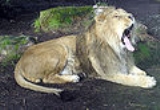
The Asiatic Lion (Panthera leo persica) is a subspecies of the lion which survives today only in India where it is also known as the Indian lion. They once ranged from the Mediterranean to India, covering most of Southwest Asia, and hence it is also known as the Persian lion.
The current wild population consists of 250-350 individuals restricted to the Gir Forest in the state of Gujarat, India.
The historic distribution included the Caucasus to Yemen and from Macedonia in Greece to present-day India through Iran, Afghanistan and Pakistan through to the borders of Bangladesh.
ared to their African cousins, Asiatic lions have shaggier coats, with a longer tassel on the end of the tail and longer tufts of hair on the elbows.

Discussion
Ask a question about 'Asiatic Lion'
Start a new discussion about 'Asiatic Lion'
Answer questions from other users
|
Recent Posts

Encyclopedia
The Asiatic Lion (Panthera leo persica) is a subspecies of the lion which survives today only in India where it is also known as the Indian lion. They once ranged from the Mediterranean to India, covering most of Southwest Asia, and hence it is also known as the Persian lion.
The current wild population consists of 250-350 individuals restricted to the Gir Forest in the state of Gujarat, India.
The historic distribution included the Caucasus to Yemen and from Macedonia in Greece to present-day India through Iran, Afghanistan and Pakistan through to the borders of Bangladesh.
Biology and behavior
Compared to their African cousins, Asiatic lions have shaggier coats, with a longer tassel on the end of the tail and longer tufts of hair on the elbows. Both sexes have a distinctive fold of skin that runs along the belly.
Considered the smallest of the subspecies, reach a weight of 160-190 Kg. (n=4) for the males and 110-120 Kg. (n=2) for the females.. The scientific record for the longest male is of 292 cm, while the maximum height to the shoulders reported is of 107 cm. The Captain Smee hunted a male of 268 cm long, which weight 222.3 kg, excluding the entrails. The largest known wild male, in the hunting records, was exactly 3 m (9.9 ft) in length.
Asian lions are highly social animals, living in units called prides. Asiatic lion prides are smaller than those of African lions, with an average of only two females, whereas an African pride has an average of four to six. The Asian males are less social and only associate with the pride when mating or on a large kill. It has been suggested that this may be because their prey animals are smaller than those in Africa, requiring fewer hunters to tackle them. Asiatic lions prey predominantly on sambar, chital, nilgai, chinkara, wild boar and livestock.
Status
The Gir Forest National Park of western India has about 359 lions (as of April 2006) which live in a 1,412 km˛ (558 square miles) sanctuary covered with scrub and open deciduous forest habitats. The population in 1907 was believed to consist of only 13 lions when the Nawab of Junagadh gave them complete protection. This figure however is highly controversial because the first census of lions in the Gir that was conducted in 1936 yielded a result of 234 animals.
The Bengal Tiger, along with the Indian leopard, until about 150 to 200 years ago shared most of the habitat where Asiatic Lion was found in large parts of west and central India along with the Asiatic Cheetah, now locally extinct in India. However, Asiatic Cheetahs preferred open grasslands more and Asiatic Lions prefer open forests interspersed with grasslands, also home to tigers and leopards.
These Indian big cats lost most of their open jungle and grassland habitat in India to the rising human population which almost completely converted their entire habitat in the plains of India into farmland. They frequently became targets of local and British colonial hunters.
Inbreeding concerns
The wild population, said to be about 350 Asiatic Lions, is thought to be derived from just 13 individuals and thus was widely thought to be highly inbred. Many studies have reported that the inbred populations could be susceptible to diseases due to weakening immune system, and their sperm were deformed leading to infertility. In earlier studies Stephen O'Brien, a geneticist, had suggested that "If you do a DNA fingerprint, Asiatic funny
actually would look like identical twins... because they descend from as few as a dozen individuals that was all left at the turn of the 20th century." This makes them especially vulnerable to diseases, and causes 70% to 80% of sperm to be deformed — a ratio that can lead to infertility when lions are further inbred in captivity.
A subsequent study suggested that the low genetic variability may have been a feature of the original population and not a result of inbreeding in recent times. They also show that the variability in immunotypes is close to that of the tiger population and that there are no spermatazoal abnormalities in the current population of Asiatic Lions. The results of the study have been questioned due the use of RAPD techniques which are unsuitable for population genetics research.
The population figure of 13 Asiatic lions at the turn of 1900s is inaccurate according to some reports and is said to have been publicized to discourage hunting. Census data from that time indicates that the population was closer to 100. Hunting of lions was a popular sport with the British Colonialists and Indian Royalty, and all other lions in India had been exterminated by then.
Threats to the subspecies Lions are poisoned for attacking livestock. Some of the other major threats include floods, fires and epidemics. Their restricted range makes them especially vulnerable.
Nearly 15,000 to 20,000 open wells dug by farmers in the area for irrigation have also acted as traps with many lions drowning. Suggestions for walls around the wells as well as the use of "Drilled Tube wells" have been made.
Farmers on the periphery of the Gir Forest frequently use crude and illegal electrical fences by powering them with high voltage overhead power lines. These are usually intended to protect their crops from Nilgai but lions and other wildlife are also killed.
The biggest threat faced by the Gir Forest is the presence of Maldharis. These communities are vegetarian and do not indulge in poaching because they are basically pasturalists, with an average of 50 cattle (mainly "Gir Cow") per family. The areas around Maldhari settlements, nesses, are overgrazed. This habitat destruction by the cattle and the firewood requirements of the populace reduces the natural prey base and endangers the lions. The lions are in turn forced by the lack of natural prey to shift to killing cattle and are in turn targeted by the people. Many Maldharis had been relocated outside the park by the forestry to make the lions to have a more natural surrounding and have more natural prey.
Genetic hybridization of captive Asiatic lions and African lions Native captive Asiatic Lions in Indian zoos until recently were interbred with African Lions confiscated from circuses. Once discovered, this led to the complete shut down of the European (EEP) and the American endangered species registered breeding programs (SSP) for Asiatic Lions as the founder animals originally imported from India were ascertained to be intraspecific hybrids of African and Asian lions. Since then India has corrected its mistake and now breeds only pure native Asiatic Lions, and has helped revive the European endangered species registered breeding program (EEP) for Asiatic Lions. However, the American SSP which completely shut down in early 1980s has yet to receive pure bred Asiatic Lions from India to form a new founder population for breeding in zoos on the American continent.
Reintroduction Work has been going on over the past decade to establish the world's second completely removed population of the wild free ranging Asiatic Lions. Wildlife Institute of India researchers confirmed that the Palpur-Kuno Wildlife Sanctuary is the most promising location to re-establish a free ranging population of the Asiatic lions and certified it ready to receive its first batch of translocated lions from Gir Wildlife Sanctuary where they are highly overpopulated. Kuno Wildlife Sanctuary was selected as the reintroduction site for critically endangered Asiatic lion because it is in the former range of the lions before it was hunted into extinction in about 1873..
Asiatic Lions in Europe and Southwest Asia Lions were once found in Europe. Aristotle and Herodotus wrote that lions were found in the Balkans. When King Xerxes of Persia advanced through Macedon in 480 BC, several of his baggage camels were killed by lions. Lions are believed to have died out within the borders of present-day Greece around AD 80-100. The Nemean Lion from Greek Mythology is widely associated with depictions of Heraklis/Hercules in Greek Mythological art.
The European population is sometimes considered part of the Asiatic lion (Panthera leo persica) group, but others consider it a separate subspecies, the European lion (Panthera leo europaea) or a last remnant of the Cave lion (Panthera leo spelaea).
Lions were found in the Caucasus until the 10th century. This was the northernmost population of lions and the only place in the former Soviet Union's territory that lions lived in historic times. These lions became extinct in Armenia around the year 100 and in Azerbaijan and southwest Russia during the 10th century. The region was also inhabited by the Caspian Tiger and the Persian leopard apart from Asiatic Cheetahs (Acinonyx jubatus venaticus) introduced by Armenian princes for hunting. The last tiger was shot in 1932 near Prishib village in Talis, Azerba?an Republic. The principal reasons for the disappearance of these cats was their extermination as predators. The prey for large cats in the region included the wisent, elk, aurochs, tarpan, deer and other ungulates.
Lions remained widespread elsewhere until the mid-19th century when the advent of firearms led to its extinction over large areas. The last sighting of a live Asiatic Lion in Iran was in 1941 (between Shiraz and Jahrom, Fars province). In 1944, the corpse of a lioness was found on the banks of Karun river, Khuzestan province, Iran. There are no subsequent reliable reports from Iran. By the late 19th century the lion had disappeared from Turkey.
The Barbary Lion
In 1968, a study of the skulls of the extinct Barbary (North African), extinct Cape, Asiatic, and African lions showed the same skull characteristics - the very narrow bar - that existed in the Barbary and Asiatic lion skulls. This shows that there may have been a close relationship between the lions from Northernmost Africa and Asia. It is also believed that the South European lion that became extinct around AD 80-100, could have represented the connecting link between the North African and Asiatic lions. It is believed that Barbary lions possessed the same belly fold (hidden under their manes) that are seen in the Asian lions today. Some Barbary lions may have been bred with the North African subspecies of Asiatic lion, thus producing hybrids that are bigger or smaller than their parents.
Asiatic Lion in Culture
- Found famously on numerous Flags and Coat of Arms all across Asia and Europe, the Asiatic Lions also stand firm on the National Emblem of India.
- Narasimha ("man-lion") (also spelt as Narasingh, Narasinga) is described as an incarnation (avatara) of Vishnu within the Puranic texts of Hinduism and is worshiped as "Lion God" thus Indian or Asiatic Lions which were commonly found throughout most of India in ancient times are considered sacred by all Hindus in India.
- Singh is an ancient Indian vedic name meaning "Lion" (Asiatic Lion), dating back over 2000 years to ancient India. It was originally only used by Rajputs a Hindu Kshatriya or military caste in India since the 7th Century. After the birth of the Khalsa brotherhood in 1699, the Sikhs also adopted the name "Singh" due to the wishes of Guru Gobind Singh. Along with millions of Hindu Rajputs today, it is also used by up to 10 million Sikhs worldwide.
- "Singhasana (lit., seat of a lion)" is the traditional Sanskrit name for the throne of a Hindu kingdom in India since antiquity.
- The island nation of Singapore (Singapura) derives its name from the Malay words (lion) and (city), which in turn is from the Sanskrit and . According to the Malay Annals, this name was given by a 14th century Sumatran Malay prince named Sang Nila Utama, who, on alighting the island after a thunderstorm, spotted an auspicious beast on shore that his chief minister identified as a lion (Asiatic Lion). Recent studies of Singapore indicate that lions have never lived there, and the beast seen by Sang Nila Utama was likely a tiger.
- The Asiatic lion is the basis of the lion dances that form part of the traditional Chinese New Year celebrations, and of similar customs in other Asian countries.
- Chinese guardian lions: Interestingly, the lion is not indigenous to China however Asiatic lions were quite common in neighboring India then. These Asiatic lions found in nearby India are the ones depicted in the Chinese culture. When Buddhist priests, or possibly traders, brought stories to China about stone Asiatic / Indian lions guarding the entry to Indian Buddhist temples, Chinese sculptors modeled statues after native dogs for use outside their temples as nobody in China had ever seen a real lion before. The mythic version of the animal, was known as the Lion of Fo, the word Fo ? being Chinese for Buddha. The Mandarin pronunciation of the word for lion is "Shi" derives from the Cantonese "Si" which is a shortened form adopted from their Sanskrit name "Sinh" in the neighboring India. The Buddhist version of the Lion was originally introduced to Han China as the protector of dharma and these lions have been found in religious art as early as 208 BC. Gradually they were incorporated as guardians of the Chinese Imperial dharm. Lions seemed appropriate regal beasts to guard the emperor's gates and have been used as such since.

See also
Cited references
Other references
- Kaushik, H. 2005. Wire fences death traps for big cats. Times of India, Thursday, October 27, 2005.
- Chellam, Ravi, and A. J. T. Johnsingh. "Management of Asiatic Lions in the Gir Forest, India" Symp. Zool. Soc. Lond. (1993), No. 65, 409-424.
External links
- from “ARKive images of life on Earth” website]
- from “Animal Diversity Web”]
-
-
|
| |
|
|