


Trichome

Encyclopedia

Trichomes (ˈtraɪkoʊmz, ˈtrɪkoʊmz; from the Greek
Greek language
Greek is an independent branch of the Indo-European family of languages. Native to the southern Balkans, it has the longest documented history of any Indo-European language, spanning 34 centuries of written records. Its writing system has been the Greek alphabet for the majority of its history;...
τρίχωμα - trikhoma meaning "growth of hair
Hair
Hair is a filamentous biomaterial, that grows from follicles found in the dermis. Found exclusively in mammals, hair is one of the defining characteristics of the mammalian class....
") are fine outgrowths or appendages on plant
Plant
Plants are living organisms belonging to the kingdom Plantae. Precise definitions of the kingdom vary, but as the term is used here, plants include familiar organisms such as trees, flowers, herbs, bushes, grasses, vines, ferns, mosses, and green algae. The group is also called green plants or...
s and certain protist
Protist
Protists are a diverse group of eukaryotic microorganisms. Historically, protists were treated as the kingdom Protista, which includes mostly unicellular organisms that do not fit into the other kingdoms, but this group is contested in modern taxonomy...
s. These are of diverse structure and function. Examples are hairs, glandular hairs, scales, and papillae.
Algal trichomes
Certain—usually filamentous—algae, have the terminal cellCell (biology)
The cell is the basic structural and functional unit of all known living organisms. It is the smallest unit of life that is classified as a living thing, and is often called the building block of life. The Alberts text discusses how the "cellular building blocks" move to shape developing embryos....
produced into an elongate "hair-like" structure called a trichome. The same term is applied to such structures in some cyanobacteria.
Aerial surface hairs
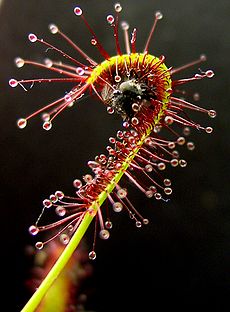
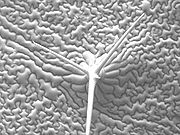
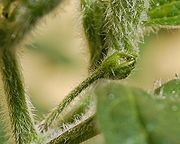
Trichomes on plants are epidermal outgrowths of various kinds. The terms emergences or prickles refer to outgrowths that involve more than the epidermis. This distinction is not always easily applied (see Wait-a-minute tree). Also, there are nontrichomatous epidermal cells that protrude from the surface.
A common type of trichome is a hair. Plant hairs may be unicellular or multicellular, branched or unbranched. Multicellular hairs may have one or several layers of cells. Branched hairs can be dendritic (tree-like), tufted, or stellate (star-shaped).
A common type of trichome is the scale or peltate hair: a plate or shield-shaped cluster of cells attached directly to the surface or borne on a stalk of some kind.
Any of the various types of hairs may be glandular.
In describing the surface appearance of plant organs, such as stems
Plant stem
A stem is one of two main structural axes of a vascular plant. The stem is normally divided into nodes and internodes, the nodes hold buds which grow into one or more leaves, inflorescence , conifer cones, roots, other stems etc. The internodes distance one node from another...
and leaves
Leaf
A leaf is an organ of a vascular plant, as defined in botanical terms, and in particular in plant morphology. Foliage is a mass noun that refers to leaves as a feature of plants....
, many terms are used in reference to the presence, form, and appearance of trichomes. The most basic terms used are glabrous—lacking hairs— and pubescent—having hairs. Details are provided by:
- glabrous, glabrate – lacking hairs or trichomes; surface smooth
- hirsute – coarsely hairy
- hispid – having bristly hairs
- downy – having an almost wool-like covering of long hairs
- pilose – pubescent with long, straight, soft, spreading or erect hairs
- puberulent – minutely pubescent; having fine, short, usually curly, hairs
- pubescent – bearing hairs or trichomes of any type
- strigillose – minutely strigose
- strigose – having straight hairs all pointing in more or less the same direction as along a margin or midrib
- tomentellous – minutely tomentose
- tomentose – covered with dense, matted, woolly hairs
- villosulous – minutely villous
- villous – having long, soft hairs, often curved, but not matted
Hairs on plants are extremely variable in their presence across species, location on plant organs, density (even within a species), and therefore functionality. However, several basic functions or advantages of having surface hairs can be listed. It is likely that in many cases, hairs interfere with the feeding of at least some small herbivores and, depending upon stiffness and irritability to the "palate", large herbivores as well. Hairs on plants growing in areas subject to frost keep the frost away from the living surface cells. In windy locations, hairs break-up the flow of air across the plant surface, reducing evaporation. Dense coatings of hairs reflect solar radiation, protecting the more delicate tissues underneath in hot, dry, open habitats. And in locations where much of the available moisture comes from cloud drip, hairs appear to enhance this process.
Root hairs
Root hairs, the rhizoidRhizoid
Rhizoids are thread-like growths from the base or bottom of a plant, found mainly in lower groups such as algae, fungi, bryophytes and pteridophytes, that function like roots of higher plants ....
s of many vascular plant
Vascular plant
Vascular plants are those plants that have lignified tissues for conducting water, minerals, and photosynthetic products through the plant. Vascular plants include the clubmosses, Equisetum, ferns, gymnosperms and angiosperms...
s, are tubular outgrowths of trichoblasts, the hair-forming cells on the epidermis of a plant root
Root
In vascular plants, the root is the organ of a plant that typically lies below the surface of the soil. This is not always the case, however, since a root can also be aerial or aerating . Furthermore, a stem normally occurring below ground is not exceptional either...
. That is, root hairs are lateral extensions of a single cell and only rarely branched. Just prior to the root hair development, there is a point of elevated phosphorylase
Phosphorylase
Phosphorylases are enzymes that catalyze the addition of a phosphate group from an inorganic phosphate to an acceptor.They include allosteric enzymes that catalyze the production of glucose-1-phosphate from a glucan such as glycogen, starch or maltodextrin. Phosphorylase is also a common name used...
activity.
Root hairs vary between 5 and 17 micrometres in diameter, and 80 to 1,500 micrometres in length (Dittmar, cited in Esau, 1965).
Root hairs can survive for 2 to 3 weeks and then die off. At the same time new root hairs are continually being formed at the top of the root. This way, the root hair coverage stays the same.
It is therefore understandable that repotting must be done with care, because the root hairs are being pulled off for the most part. This is why planting out may cause plants to wilt.