


Peristome

Encyclopedia
The word peristome is derived from the Greek
peri, meaning 'around' or 'about', and stoma, 'mouth'. It is a term used to describe various anatomical features that surround an opening to an organ or structure. The term is used in plant
s and invertebrate
animals, such as in describing the shells of gastropod molluscs, i.e. snail
s.
 In moss
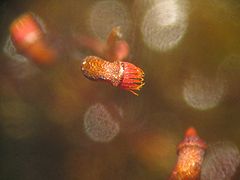
es, the peristome is a specialized structure in the sporangium
that allows for gradual spore
discharge, instead of releasing them all at once.
Most mosses produce a capsule with a lid (the operculum
) which falls off when the spore
s inside are mature and thus ready to be dispersed. The opening thus revealed is called the stoma (meaning "mouth") and is surrounded by one or two peristomes. Each peristome is a ring of triangular "teeth" formed from the remnants of specially thickened cell wall
s. There are usually 16 such teeth in a single peristome, separate from each other and able to both fold in to cover the stoma as well as fold back to open the stoma. This articulation of the teeth is termed arthrodontous and is found in the moss subclass Bryopsida
. In other groups of mosses, the capsule is either nematodontous with an attached operculum (as in the Polytrichopsida), or else splits open without operculum or teeth.
There are two subtypes of arthrodontous peristome. The first is termed haplolepidous and consists of a single circle of 16 peristome teeth. The second type is the diplolepidous peristome fround in subclass Bryidae
. In this type, there are two rings of peristome teeth—an inner endostome (short for endoperistome) and an exostome. The endostome is a more delicate membrane, and its teeth are aligned between the teeth of the exostome. There are a few mosses in the Bryopsida that have no peristome in their capsules. These mosses still undergo the same cell division patterns in capsule development, but the teeth do not fully develop.
 In pitcher plant
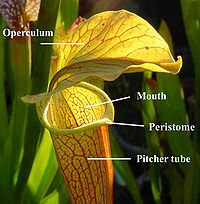
s, the peristome is a reflexed ring (or partial ring) of tissue that surrounds the entrance to the digestive tube in these plants. It often (for example in Cephalotus
and Nepenthes
) possesses sharp, overhanging 'teeth' which aid in prey retention. It is often studded with nectar secreting glands, hence its popular name, nectar roll.
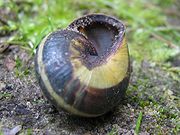
The peristome is the margin of the aperture
of a gastropod shell
. It is the edge of the lip of the shell. This part is sometimes reflected (turned back) or thickened once the snail reaches adult size, and these qualities of the peristome can be diagnostic features of the shell which may aid in identification of the species.
Greek language
Greek is an independent branch of the Indo-European family of languages. Native to the southern Balkans, it has the longest documented history of any Indo-European language, spanning 34 centuries of written records. Its writing system has been the Greek alphabet for the majority of its history;...
peri, meaning 'around' or 'about', and stoma, 'mouth'. It is a term used to describe various anatomical features that surround an opening to an organ or structure. The term is used in plant
Plant
Plants are living organisms belonging to the kingdom Plantae. Precise definitions of the kingdom vary, but as the term is used here, plants include familiar organisms such as trees, flowers, herbs, bushes, grasses, vines, ferns, mosses, and green algae. The group is also called green plants or...
s and invertebrate
Invertebrate
An invertebrate is an animal without a backbone. The group includes 97% of all animal species – all animals except those in the chordate subphylum Vertebrata .Invertebrates form a paraphyletic group...
animals, such as in describing the shells of gastropod molluscs, i.e. snail
Snail
Snail is a common name applied to most of the members of the molluscan class Gastropoda that have coiled shells in the adult stage. When the word is used in its most general sense, it includes sea snails, land snails and freshwater snails. The word snail without any qualifier is however more often...
s.
In mosses
Moss
Mosses are small, soft plants that are typically 1–10 cm tall, though some species are much larger. They commonly grow close together in clumps or mats in damp or shady locations. They do not have flowers or seeds, and their simple leaves cover the thin wiry stems...
es, the peristome is a specialized structure in the sporangium
Sporangium
A sporangium is an enclosure in which spores are formed. It can be composed of a single cell or can be multicellular. All plants, fungi, and many other lineages form sporangia at some point in their life cycle...
that allows for gradual spore
Spore
In biology, a spore is a reproductive structure that is adapted for dispersal and surviving for extended periods of time in unfavorable conditions. Spores form part of the life cycles of many bacteria, plants, algae, fungi and some protozoa. According to scientist Dr...
discharge, instead of releasing them all at once.
Most mosses produce a capsule with a lid (the operculum
Operculum (botany)
An operculum, in botany, is a term generally used to describe a structure within a plant, moss, or fungus acting as a cap, flap, or lid. In plants, it may also be called a bud cap.Examples of structures identified as opercula include:...
) which falls off when the spore
Spore
In biology, a spore is a reproductive structure that is adapted for dispersal and surviving for extended periods of time in unfavorable conditions. Spores form part of the life cycles of many bacteria, plants, algae, fungi and some protozoa. According to scientist Dr...
s inside are mature and thus ready to be dispersed. The opening thus revealed is called the stoma (meaning "mouth") and is surrounded by one or two peristomes. Each peristome is a ring of triangular "teeth" formed from the remnants of specially thickened cell wall
Cell wall
The cell wall is the tough, usually flexible but sometimes fairly rigid layer that surrounds some types of cells. It is located outside the cell membrane and provides these cells with structural support and protection, and also acts as a filtering mechanism. A major function of the cell wall is to...
s. There are usually 16 such teeth in a single peristome, separate from each other and able to both fold in to cover the stoma as well as fold back to open the stoma. This articulation of the teeth is termed arthrodontous and is found in the moss subclass Bryopsida
Bryopsida
The Bryopsida constitute the largest class of mosses, containing 95% of all moss species. It consists of approximately 11,500 species, common throughout the whole world....
. In other groups of mosses, the capsule is either nematodontous with an attached operculum (as in the Polytrichopsida), or else splits open without operculum or teeth.
There are two subtypes of arthrodontous peristome. The first is termed haplolepidous and consists of a single circle of 16 peristome teeth. The second type is the diplolepidous peristome fround in subclass Bryidae
Bryidae
Bryidae is an important subclass of Bryopsida. It is common throughout the whole world. Members have a double peristome with alternating tooth segments.-Classification:The classification of the Bryidae.Superorder: Bryanae...
. In this type, there are two rings of peristome teeth—an inner endostome (short for endoperistome) and an exostome. The endostome is a more delicate membrane, and its teeth are aligned between the teeth of the exostome. There are a few mosses in the Bryopsida that have no peristome in their capsules. These mosses still undergo the same cell division patterns in capsule development, but the teeth do not fully develop.
In pitcher plants
Pitcher plant
Pitcher plants are carnivorous plants whose prey-trapping mechanism features a deep cavity filled with liquid known as a pitfall trap. It has been widely assumed that the various sorts of pitfall trap evolved from rolled leaves, with selection pressure favouring more deeply cupped leaves over...
s, the peristome is a reflexed ring (or partial ring) of tissue that surrounds the entrance to the digestive tube in these plants. It often (for example in Cephalotus
Cephalotus
Cephalotus is a genus which contains one species, Cephalotus follicularis, a small carnivorous pitcher plant. The pit-fall traps of the modified leaves have inspired the common names for this plant, which include Albany Pitcher Plant, Western Australian Pitcher Plant, fly-catcher plant or...
and Nepenthes
Nepenthes
The Nepenthes , popularly known as tropical pitcher plants or monkey cups, are a genus of carnivorous plants in the monotypic family Nepenthaceae. The genus comprises roughly 130 species, numerous natural and many cultivated hybrids...
) possesses sharp, overhanging 'teeth' which aid in prey retention. It is often studded with nectar secreting glands, hence its popular name, nectar roll.
In shelled gastropods
The peristome is the margin of the aperture
Aperture (mollusc)
The aperture is an opening in certain kinds of mollusc shells: it is the main opening of the shell, where part of the body of the animal emerges for locomotion, feeding, etc....
of a gastropod shell
Gastropod shell
The gastropod shell is a shell which is part of the body of a gastropod or snail, one kind of mollusc. The gastropod shell is an external skeleton or exoskeleton, which serves not only for muscle attachment, but also for protection from predators and from mechanical damage...
. It is the edge of the lip of the shell. This part is sometimes reflected (turned back) or thickened once the snail reaches adult size, and these qualities of the peristome can be diagnostic features of the shell which may aid in identification of the species.