

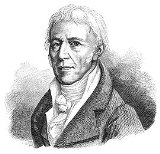
Jean-Baptiste Lamarck

Encyclopedia
Jean-Baptiste Pierre Antoine de Monet, Chevalier de la Marck (Bazentin
, Somme
, 1 August 1744 – Paris
, 18 December 1829), often known simply as Lamarck, was a French
naturalist
. He was a soldier
, biologist
, academic
, and an early proponent of the idea that evolution
occurred and proceeded in accordance with natural laws
.
Lamarck fought in the Pomeranian War
with Prussia
, and was awarded a commission for bravery on the battlefield. At his post in Monaco
, Lamarck became interested in natural history and resolved to study medicine. He retired from the army after being injured in 1766, and returned to his medical studies.
Lamarck developed a particular interest in botany, and later, after he published a three-volume work Flore françoise, he gained membership of the French Academy of Sciences
in 1779. Lamarck became involved in the Jardin des Plantes
and was appointed to the Chair of Botany in 1788. When the Muséum national d'Histoire naturelle
was founded in 1793, Lamarck was appointed as a professor of zoology.
In 1801, he published Système des animaux sans vertèbres, a major work on the classification of invertebrate
s, a term he coined. In an 1802 publication, he became one of the first to use the term biology
in its modern sense. Lamarck continued his work as a premier authority on invertebrate zoology
. He is remembered, at least in malacology
, as a taxonomist of considerable stature.
In the modern era, Lamarck is primarily remembered for a theory of inheritance of acquired characteristics, called soft inheritance
or Lamarckism
. However, his idea of soft inheritance was, perhaps, a reflection of the folk wisdom of the time, accepted by many natural historians. Lamarck's contribution to evolutionary theory consisted of the first truly cohesive theory of evolution, in which an alchemical complexifying force drove organisms up a ladder of complexity, and a second environmental force adapted them to local environments through use and disuse of characteristics, differentiating them from other organisms.
, Picardie
, northern France, as the eleventh child in an impoverished aristocratic family. Male members of the Lamarck family had traditionally served in the French army. Lamarck's eldest brother was killed in combat at the Siege of Bergen op Zoom
, and two other brothers were still in service when Lamarck was in his teenage years. Yielding to the wishes of his father, Lamarck enrolled in a Jesuit
college in Amiens
in the late 1750s.
After his father died in 1760, Lamarck bought himself a horse, and rode across the country to join the French army, which was in Germany at the time. Lamarck showed great physical courage on the battlefield in the Pomeranian War
with Prussia
, and he was even nominated for the lieutenancy. Lamarck's company was left exposed to the direct artillery fire of their enemies, and was quickly reduced to just fourteen men - with no officers. One of the men suggested that the puny, seventeen year-old volunteer should assume command and order a withdrawal from the field; but although Lamarck accepted command, he insisted they remain where they had been posted until relieved.
When their colonel reached the remains of their company, this display of courage and loyalty impressed him so much that Lamarck was promoted to officer on the spot. However, when one of his comrades playfully lifted him by the head, he sustained an inflammation in the lymphatic glands of the neck, and he was sent to Paris to receive treatment. He underwent a complicated operation, and continued his treatment for a year. He was awarded a commission and settled at his post in Monaco
. It was there that he encountered Traité des plantes usuelles, a botany book by James Francis Chomel.
 With a reduced pension of only 400 francs a year, Lamarck resolved to pursue a profession. He attempted to study medicine, and supported himself by working in a bank office. Lamarck studied medicine for four years, but gave it up under his elder brother's persuasion. He was interested in botany, especially after his visits to the Jardin du Roi
, and he became a student under Bernard de Jussieu
, a notable French naturalist. Under Jussieu, Lamarck spent ten years studying French flora.
After his studies, in 1778, he published some of his observations and results in a three-volume work, entitled Flore françoise. Lamarck's work was respected by many scholars, and it launched him into prominence in French science. On August 8, 1778, Lamarck married Marie Anne Rosalie Delaporte. Georges-Louis Leclerc, Comte de Buffon
, one of the top French scientists of the day, mentored Lamarck, and helped him gain membership to the French Academy of Sciences
in 1779 and a commission as a Royal Botanist in 1781, in which he traveled to foreign botanical gardens and museums. Lamarck's first son, André, was born on April 22, 1781, and he made colleague André Thouin
the child's godfather.
In his two years of travel, Lamarck collected rare plants that were not available in the Royal Garden, and also other objects of natural history, such as minerals and ores, that were not found in French museums. On January 7, 1786, his second son, Antoine, was born, and Lamarck chose Antoine Laurent de Jussieu
, Bernard de Jussieu's nephew, as the boy's godfather. On April 21 of the following year, Charles Rene, Lamarck's third son, was born. René Louiche Desfontaines
, a professor of botany at the Royal Garden, was the boy's godfather, and Lamarck's elder sister, Marie Charlotte Pelagie De Monet was the godmother. In 1788, Buffon's successor at the position of Intendant of the Royal Garden, Charles-Claude Flahaut de la Billaderie, comte d'Angiviller
, created a position for Lamarck, with a yearly salary of 1,000 francs, as the keeper of the herbarium
of the Royal Garden.
In 1790, at the height of the French Revolution
, Lamarck changed the name of the Royal Garden from Jardin du Roi to Jardin des Plantes
, a name that did not imply such a close association with King Louis XVI
. Lamarck had worked as the keeper of the herbarium for five years before he was appointed curator and professor of invertebrate
zoology at the Muséum national d'histoire naturelle
in 1793. During his time at the herbarium, Lamarck's wife gave birth to three more children before dying on September 27, 1792. With the official title of "Professeur d’Histoire naturelle des Insectes et des Vers", Lamarck received a salary of nearly 2,500 francs per year. The following year on October 9, he married Charlotte Reverdy, who was thirty years his junior. On September 26, 1794, Lamarck was appointed to serve as secretary of the assembly of professors for the museum for a period of one year. In 1797, his second wife Charlotte died, and he married Julie Mallet the following year; she died in 1819.
In his first six years as professor, Lamarck published only one paper, in 1798, on the influence of the moon on the Earth's atmosphere. Lamarck began as an essentialist who believed species
were unchanging; however, after working on the molluscs of the Paris Basin, he grew convinced that transmutation
or change in the nature of a species occurred over time. He set out to develop an explanation, and on 11 May 1800 (the 21st day of Floreal, Year VIII, in the revolutionary timescale
used in France at the time), he presented a lecture at the Muséum national d'histoire naturelle
in which he first outlined his newly developing ideas about evolution.
 In 1801, he published Système des Animaux sans Vertebres, a major work on the classification of invertebrates. In the work, he introduced definitions of natural groups among invertebrates. He categorized echinoderm
s, arachnid
s, crustacean
s and annelid
s, which he separated from the old taxon for worms known as Vermes. Lamarck was the first to separate arachnids from insect
s in classification, and he moved crustaceans into a separate class from insects.
In 1802 Lamarck published Hydrogéologie, and became one of the first to use the term biology
in its modern sense. In Hydrogéologie, Lamarck advocated a steady-state geology based on a strict uniformitarianism
. He argued that global currents tended to flow from east to west, and continents eroded on their eastern borders, with the material carried across to be deposited on the western borders. Thus, the Earth's continents marched steadily westward around the globe.
That year, he also published Recherches sur l'Organisation des Corps Vivants, in which he drew out his theory on evolution. He believed that all life was organized in a vertical chain, with gradation between the lowest forms and the highest forms of life, thus demonstrating a path to progressive developments in nature.
In his own work, Lamarck had favored the then-more traditional theory based on the Classical four elements. During Lamarck's lifetime he became controversial, attacking the more enlightened chemistry proposed by Lavoisier. He also came into conflict with the widely respected palaeontologist Georges Cuvier
, who was not a supporter of evolution. According to Peter J. Bowler
, Cuvier "ridiculed Lamarck's theory of transformation and defended the fixity of species." According to Martin J. S. Rudwick
:
Lamarck gradually turned blind and died in Paris
on December 18, 1829. When he died, his family was so poor they had to apply to the Academie for financial assistance. Lamarck's books and the contents of his home were sold at auction, and his body was buried in a temporary lime-pit.
After his death, Cuvier used the forum of a eulogy to denigrate Lamarck:
Although he was not the first thinker to advocate organic evolution, he was the first to develop a truly coherent evolutionary theory. He outlined his theories regarding evolution first in his Floreal lecture of 1800, and then in three later published works:
Lamarck employed several mechanisms as drivers of evolution, drawn from the common knowledge of his day and from his own belief in chemistry pre-Lavoisier. He used these mechanisms to explain the two forces he saw as comprising evolution; a force driving animals from simple to complex forms, and a force adapting animals to their local environments and differentiating them from each other. He believed that these forces must be explained as a necessary consequence of basic physical principles, favoring a materialistic attitude toward biology.
.
Lamarck ran against the modern chemistry promoted by Lavoisier (whose ideas he regarded with disdain), preferring to embrace a more traditional alchemical view of the elements as influenced primarily by earth, air, fire and water. He asserted that the natural movements of fluids in living organisms drove them toward ever greater levels of complexity:
He argued that organisms thus moved from simple to complex in a steady, predictable way based on the fundamental physical principles of alchemy. In this view, simple organisms never disappeared because they were constantly being created by spontaneous generation in what has been described as a 'steady-state biology'. Lamarck saw spontaneous generation as being ongoing, with the simple organisms thus created being transmuted over time becoming more complex. He is sometimes regarded as believing in a teleological
(goal-oriented) process where organisms became more perfect as they evolved, though as a materialist, he emphasized that these forces must originate necessarily from underlying physical principles.
This first law says little except "an exaggerated generalization of the belief that exercise develops an organ".
The last clause of this law introduces what is now called soft inheritance
. "The second law was widely accepted at the time..[but] has been decisively rejected by modern genetics."
However, in the field of epigenetics
, there is growing evidence that soft inheritance plays a part in the changing of some organisms' phenotypes: it leaves the DNA unaltered but affects DNA by preventing the expression of genes.
 Lamarck constructed one of the first theoretical frameworks of organic evolution
. While this theory was generally rejected during his lifetime, Stephen Jay Gould
argues that Lamarck was the "primary evolutionary theorist", in that his ideas, and the way in which he structured his theory set the tone for much of the subsequent thinking in evolutionary biology, through to the present day.
Lamarck is usually remembered for his belief in the inheritance of acquired characteristics, and the use and disuse model by which organisms developed their characteristics. Lamarck incorporated this belief into his theory of evolution, along with other more common beliefs of the time, such as spontaneous generation. The inheritance of acquired characteristics (also called the theory of adaptation or soft inheritance
) was rejected by August Weismann
in the 1880s when he developed a theory of inheritance in which germ plasm
(the sex cells, later redefined as DNA
), remained separate and distinct from the soma
(the rest of the body); thus nothing which happens to the soma may be passed on with the germ-plasm. This model underlies the modern understanding of inheritance.
Charles Darwin
allowed a role for use and disuse as an evolutionary mechanism subsidiary to natural selection, most often in respect of disuse. He praised Lamarck for "the eminent service of arousing attention to the probability of all change in the organic... world, being the result of law, not miraculous interposition". Lamarckism is also occasionally used to describe quasi-evolutionary concepts in societal contexts, though not by Lamarck himself. For example, the memetic theory of cultural evolution is sometimes described as a form of Lamarckian inheritance of non-genetic traits.
In contrast to the eventual general rejection of his proposed mechanism for evolution, Lamarck's seven-volume work on the natural history of invertebrates is recognised as a lasting contribution to zoology.
gives no fewer than 1,634 records. The Indo-Pacific Molluscan Database gives 1,781 records. Among these are some well-known families such as the ark clams (Arcidae), the sea hares (Aplysiidae
) and the cockles (Cardiidae). The International Plant Names Index gives 58 records, among including a number of well-known genera such as the mosquito fern (Azolla).
is named after Lamarck, as well as the Bluefire jellyfish (Cyaneia lamarckii). A number of plant species have also been named after him, including Amelanchier lamarckii
(Juneberry), Digitalis lamarckii
and Aconitum lamarckii
. The grass genus Lamarckia is named after him.
The International Plant Names Index gives 116 records of plant species named after Lamarck.
Among the marine species, no less than 103 species or genera carry the epithet "lamarcki", "lamarckii" or "lamarckiana", but many have since become synonyms. Marine species with valid names include:
On invertebrate
classification
:
The standard author abbreviation Lam. is used to indicate Lamarck as the author when citing
a botanical name
.
Bazentin
Bazentin is a commune in the Somme department in Picardie in northern France.-Geography:Situated between Amiens to the southwest and Arras to the north, on the D73 road.-Population:-External links:* * * *...
, Somme
Somme
Somme is a department of France, located in the north of the country and named after the Somme river. It is part of the Picardy region of France....
, 1 August 1744 – Paris
Paris
Paris is the capital and largest city in France, situated on the river Seine, in northern France, at the heart of the Île-de-France region...
, 18 December 1829), often known simply as Lamarck, was a French
France
The French Republic , The French Republic , The French Republic , (commonly known as France , is a unitary semi-presidential republic in Western Europe with several overseas territories and islands located on other continents and in the Indian, Pacific, and Atlantic oceans. Metropolitan France...
naturalist
Naturalist
Naturalist may refer to:* Practitioner of natural history* Conservationist* Advocate of naturalism * Naturalist , autobiography-See also:* The American Naturalist, periodical* Naturalism...
. He was a soldier
Soldier
A soldier is a member of the land component of national armed forces; whereas a soldier hired for service in a foreign army would be termed a mercenary...
, biologist
Biologist
A biologist is a scientist devoted to and producing results in biology through the study of life. Typically biologists study organisms and their relationship to their environment. Biologists involved in basic research attempt to discover underlying mechanisms that govern how organisms work...
, academic
Academia
Academia is the community of students and scholars engaged in higher education and research.-Etymology:The word comes from the akademeia in ancient Greece. Outside the city walls of Athens, the gymnasium was made famous by Plato as a center of learning...
, and an early proponent of the idea that evolution
Evolution
Evolution is any change across successive generations in the heritable characteristics of biological populations. Evolutionary processes give rise to diversity at every level of biological organisation, including species, individual organisms and molecules such as DNA and proteins.Life on Earth...
occurred and proceeded in accordance with natural laws
Naturalism (philosophy)
Naturalism commonly refers to the philosophical viewpoint that the natural universe and its natural laws and forces operate in the universe, and that nothing exists beyond the natural universe or, if it does, it does not affect the natural universe that we know...
.
Lamarck fought in the Pomeranian War
Seven Years' War
The Seven Years' War was a global military war between 1756 and 1763, involving most of the great powers of the time and affecting Europe, North America, Central America, the West African coast, India, and the Philippines...
with Prussia
Prussia
Prussia was a German kingdom and historic state originating out of the Duchy of Prussia and the Margraviate of Brandenburg. For centuries, the House of Hohenzollern ruled Prussia, successfully expanding its size by way of an unusually well-organized and effective army. Prussia shaped the history...
, and was awarded a commission for bravery on the battlefield. At his post in Monaco
Monaco
Monaco , officially the Principality of Monaco , is a sovereign city state on the French Riviera. It is bordered on three sides by its neighbour, France, and its centre is about from Italy. Its area is with a population of 35,986 as of 2011 and is the most densely populated country in the...
, Lamarck became interested in natural history and resolved to study medicine. He retired from the army after being injured in 1766, and returned to his medical studies.
Lamarck developed a particular interest in botany, and later, after he published a three-volume work Flore françoise, he gained membership of the French Academy of Sciences
French Academy of Sciences
The French Academy of Sciences is a learned society, founded in 1666 by Louis XIV at the suggestion of Jean-Baptiste Colbert, to encourage and protect the spirit of French scientific research...
in 1779. Lamarck became involved in the Jardin des Plantes
Jardin des Plantes
The Jardin des Plantes is the main botanical garden in France. It is one of seven departments of the Muséum national d'histoire naturelle. It is situated in the 5ème arrondissement, Paris, on the left bank of the river Seine and covers 28 hectares .- Garden plan :The grounds of the Jardin des...
and was appointed to the Chair of Botany in 1788. When the Muséum national d'Histoire naturelle
Muséum national d'histoire naturelle
The Muséum national d'Histoire naturelle is the National Museum of Natural History in Paris, France.- History :The museum was formally founded on 10 June 1793, during the French Revolution...
was founded in 1793, Lamarck was appointed as a professor of zoology.
In 1801, he published Système des animaux sans vertèbres, a major work on the classification of invertebrate
Invertebrate
An invertebrate is an animal without a backbone. The group includes 97% of all animal species – all animals except those in the chordate subphylum Vertebrata .Invertebrates form a paraphyletic group...
s, a term he coined. In an 1802 publication, he became one of the first to use the term biology
Biology
Biology is a natural science concerned with the study of life and living organisms, including their structure, function, growth, origin, evolution, distribution, and taxonomy. Biology is a vast subject containing many subdivisions, topics, and disciplines...
in its modern sense. Lamarck continued his work as a premier authority on invertebrate zoology
Invertebrate zoology
Invertebrate zoology is the biological discipline that consists of the study of invertebrate animals, i.e. animals without a backbone...
. He is remembered, at least in malacology
Malacology
Malacology is the branch of invertebrate zoology which deals with the study of the Mollusca , the second-largest phylum of animals in terms of described species after the arthropods. Mollusks include snails and slugs, clams, octopus and squid, and numerous other kinds, many of which have shells...
, as a taxonomist of considerable stature.
In the modern era, Lamarck is primarily remembered for a theory of inheritance of acquired characteristics, called soft inheritance
Soft inheritance
Soft inheritance is the term coined by Ernst Mayr to include such ideas as Lamarckism, that an organism can pass on characteristics that it acquired during its lifetime to its offspring. It contrasts with modern ideas of inheritance, which Mayr called hard inheritance...
or Lamarckism
Lamarckism
Lamarckism is the idea that an organism can pass on characteristics that it acquired during its lifetime to its offspring . It is named after the French biologist Jean-Baptiste Lamarck , who incorporated the action of soft inheritance into his evolutionary theories...
. However, his idea of soft inheritance was, perhaps, a reflection of the folk wisdom of the time, accepted by many natural historians. Lamarck's contribution to evolutionary theory consisted of the first truly cohesive theory of evolution, in which an alchemical complexifying force drove organisms up a ladder of complexity, and a second environmental force adapted them to local environments through use and disuse of characteristics, differentiating them from other organisms.
Biography
Lamarck was born in BazentinBazentin
Bazentin is a commune in the Somme department in Picardie in northern France.-Geography:Situated between Amiens to the southwest and Arras to the north, on the D73 road.-Population:-External links:* * * *...
, Picardie
Picardie
Picardy is one of the 27 regions of France. It is located in the northern part of France.-History:The historical province of Picardy stretched from north of Noyon to Calais, via the whole of the Somme department and the north of the Aisne department...
, northern France, as the eleventh child in an impoverished aristocratic family. Male members of the Lamarck family had traditionally served in the French army. Lamarck's eldest brother was killed in combat at the Siege of Bergen op Zoom
Siege of Bergen op Zoom (1747)
The Siege of Bergen op Zoom took place during the Austrian War of Succession, when a French army, under the command of Lowendal and the overall direction of Marshal Maurice de Saxe, laid siege and captured the strategic Dutch border fortress of Bergen op Zoom on the border of Brabant and Zealand...
, and two other brothers were still in service when Lamarck was in his teenage years. Yielding to the wishes of his father, Lamarck enrolled in a Jesuit
Society of Jesus
The Society of Jesus is a Catholic male religious order that follows the teachings of the Catholic Church. The members are called Jesuits, and are also known colloquially as "God's Army" and as "The Company," these being references to founder Ignatius of Loyola's military background and a...
college in Amiens
Amiens
Amiens is a city and commune in northern France, north of Paris and south-west of Lille. It is the capital of the Somme department in Picardy...
in the late 1750s.
After his father died in 1760, Lamarck bought himself a horse, and rode across the country to join the French army, which was in Germany at the time. Lamarck showed great physical courage on the battlefield in the Pomeranian War
Seven Years' War
The Seven Years' War was a global military war between 1756 and 1763, involving most of the great powers of the time and affecting Europe, North America, Central America, the West African coast, India, and the Philippines...
with Prussia
Prussia
Prussia was a German kingdom and historic state originating out of the Duchy of Prussia and the Margraviate of Brandenburg. For centuries, the House of Hohenzollern ruled Prussia, successfully expanding its size by way of an unusually well-organized and effective army. Prussia shaped the history...
, and he was even nominated for the lieutenancy. Lamarck's company was left exposed to the direct artillery fire of their enemies, and was quickly reduced to just fourteen men - with no officers. One of the men suggested that the puny, seventeen year-old volunteer should assume command and order a withdrawal from the field; but although Lamarck accepted command, he insisted they remain where they had been posted until relieved.
When their colonel reached the remains of their company, this display of courage and loyalty impressed him so much that Lamarck was promoted to officer on the spot. However, when one of his comrades playfully lifted him by the head, he sustained an inflammation in the lymphatic glands of the neck, and he was sent to Paris to receive treatment. He underwent a complicated operation, and continued his treatment for a year. He was awarded a commission and settled at his post in Monaco
Monaco
Monaco , officially the Principality of Monaco , is a sovereign city state on the French Riviera. It is bordered on three sides by its neighbour, France, and its centre is about from Italy. Its area is with a population of 35,986 as of 2011 and is the most densely populated country in the...
. It was there that he encountered Traité des plantes usuelles, a botany book by James Francis Chomel.
Jardin des Plantes
The Jardin des Plantes is the main botanical garden in France. It is one of seven departments of the Muséum national d'histoire naturelle. It is situated in the 5ème arrondissement, Paris, on the left bank of the river Seine and covers 28 hectares .- Garden plan :The grounds of the Jardin des...
, and he became a student under Bernard de Jussieu
Bernard de Jussieu
Bernard de Jussieu was a French naturalist, younger brother of Antoine de Jussieu.Bernard de Jussieu was born in Lyon...
, a notable French naturalist. Under Jussieu, Lamarck spent ten years studying French flora.
After his studies, in 1778, he published some of his observations and results in a three-volume work, entitled Flore françoise. Lamarck's work was respected by many scholars, and it launched him into prominence in French science. On August 8, 1778, Lamarck married Marie Anne Rosalie Delaporte. Georges-Louis Leclerc, Comte de Buffon
Georges-Louis Leclerc, Comte de Buffon
Georges-Louis Leclerc, Comte de Buffon was a French naturalist, mathematician, cosmologist, and encyclopedic author.His works influenced the next two generations of naturalists, including Jean-Baptiste Lamarck and Georges Cuvier...
, one of the top French scientists of the day, mentored Lamarck, and helped him gain membership to the French Academy of Sciences
French Academy of Sciences
The French Academy of Sciences is a learned society, founded in 1666 by Louis XIV at the suggestion of Jean-Baptiste Colbert, to encourage and protect the spirit of French scientific research...
in 1779 and a commission as a Royal Botanist in 1781, in which he traveled to foreign botanical gardens and museums. Lamarck's first son, André, was born on April 22, 1781, and he made colleague André Thouin
André Thouin
André Thouin was a French botanist who was born in Paris. He studied botany under Bernard de Jussieu . In 1793 Thouin attained the chair of horticulture at Muséum national d'histoire naturelle in Paris. Thouin was a good friend of U.S...
the child's godfather.
In his two years of travel, Lamarck collected rare plants that were not available in the Royal Garden, and also other objects of natural history, such as minerals and ores, that were not found in French museums. On January 7, 1786, his second son, Antoine, was born, and Lamarck chose Antoine Laurent de Jussieu
Antoine Laurent de Jussieu
Antoine Laurent de Jussieu was a French botanist, notable as the first to propose a natural classification of flowering plants; much of his system remains in use today.-Life:...
, Bernard de Jussieu's nephew, as the boy's godfather. On April 21 of the following year, Charles Rene, Lamarck's third son, was born. René Louiche Desfontaines
René Louiche Desfontaines
René Louiche Desfontaines was a French botanist.Desfontaines was born near Tremblay in Brittany. He attended the Collège de Rennes and in 1773 went to Paris to study medicine. His interest in botany originated from lectures at the Jardin des Plantes given by Louis Guillaume Lemonnier...
, a professor of botany at the Royal Garden, was the boy's godfather, and Lamarck's elder sister, Marie Charlotte Pelagie De Monet was the godmother. In 1788, Buffon's successor at the position of Intendant of the Royal Garden, Charles-Claude Flahaut de la Billaderie, comte d'Angiviller
Charles-Claude Flahaut de la Billaderie, comte d'Angiviller
Charles-Claude Flahaut de la Billaderie, comte d'Angiviller was the director of the Bâtiments du Roi, a forerunner of a minister of fine arts in charge of the royal building works, under Louis XVI of France, from 1775...
, created a position for Lamarck, with a yearly salary of 1,000 francs, as the keeper of the herbarium
Herbarium
In botany, a herbarium – sometimes known by the Anglicized term herbar – is a collection of preserved plant specimens. These specimens may be whole plants or plant parts: these will usually be in a dried form, mounted on a sheet, but depending upon the material may also be kept in...
of the Royal Garden.
In 1790, at the height of the French Revolution
French Revolution
The French Revolution , sometimes distinguished as the 'Great French Revolution' , was a period of radical social and political upheaval in France and Europe. The absolute monarchy that had ruled France for centuries collapsed in three years...
, Lamarck changed the name of the Royal Garden from Jardin du Roi to Jardin des Plantes
Jardin des Plantes
The Jardin des Plantes is the main botanical garden in France. It is one of seven departments of the Muséum national d'histoire naturelle. It is situated in the 5ème arrondissement, Paris, on the left bank of the river Seine and covers 28 hectares .- Garden plan :The grounds of the Jardin des...
, a name that did not imply such a close association with King Louis XVI
Louis XVI of France
Louis XVI was a Bourbon monarch who ruled as King of France and Navarre until 1791, and then as King of the French from 1791 to 1792, before being executed in 1793....
. Lamarck had worked as the keeper of the herbarium for five years before he was appointed curator and professor of invertebrate
Invertebrate
An invertebrate is an animal without a backbone. The group includes 97% of all animal species – all animals except those in the chordate subphylum Vertebrata .Invertebrates form a paraphyletic group...
zoology at the Muséum national d'histoire naturelle
Muséum national d'histoire naturelle
The Muséum national d'Histoire naturelle is the National Museum of Natural History in Paris, France.- History :The museum was formally founded on 10 June 1793, during the French Revolution...
in 1793. During his time at the herbarium, Lamarck's wife gave birth to three more children before dying on September 27, 1792. With the official title of "Professeur d’Histoire naturelle des Insectes et des Vers", Lamarck received a salary of nearly 2,500 francs per year. The following year on October 9, he married Charlotte Reverdy, who was thirty years his junior. On September 26, 1794, Lamarck was appointed to serve as secretary of the assembly of professors for the museum for a period of one year. In 1797, his second wife Charlotte died, and he married Julie Mallet the following year; she died in 1819.
In his first six years as professor, Lamarck published only one paper, in 1798, on the influence of the moon on the Earth's atmosphere. Lamarck began as an essentialist who believed species
Species
In biology, a species is one of the basic units of biological classification and a taxonomic rank. A species is often defined as a group of organisms capable of interbreeding and producing fertile offspring. While in many cases this definition is adequate, more precise or differing measures are...
were unchanging; however, after working on the molluscs of the Paris Basin, he grew convinced that transmutation
Transmutation of species
Transmutation of species was a term used by Jean Baptiste Lamarck in 1809 for his theory that described the altering of one species into another, and the term is often used to describe 19th century evolutionary ideas that preceded Charles Darwin's theory of natural selection...
or change in the nature of a species occurred over time. He set out to develop an explanation, and on 11 May 1800 (the 21st day of Floreal, Year VIII, in the revolutionary timescale
French Republican Calendar
The French Republican Calendar or French Revolutionary Calendar was a calendar created and implemented during the French Revolution, and used by the French government for about 12 years from late 1793 to 1805, and for 18 days by the Paris Commune in 1871...
used in France at the time), he presented a lecture at the Muséum national d'histoire naturelle
Muséum national d'histoire naturelle
The Muséum national d'Histoire naturelle is the National Museum of Natural History in Paris, France.- History :The museum was formally founded on 10 June 1793, during the French Revolution...
in which he first outlined his newly developing ideas about evolution.
Echinoderm
Echinoderms are a phylum of marine animals. Echinoderms are found at every ocean depth, from the intertidal zone to the abyssal zone....
s, arachnid
Arachnid
Arachnids are a class of joint-legged invertebrate animals in the subphylum Chelicerata. All arachnids have eight legs, although in some species the front pair may convert to a sensory function. The term is derived from the Greek words , meaning "spider".Almost all extant arachnids are terrestrial...
s, crustacean
Crustacean
Crustaceans form a very large group of arthropods, usually treated as a subphylum, which includes such familiar animals as crabs, lobsters, crayfish, shrimp, krill and barnacles. The 50,000 described species range in size from Stygotantulus stocki at , to the Japanese spider crab with a leg span...
s and annelid
Annelid
The annelids , formally called Annelida , are a large phylum of segmented worms, with over 17,000 modern species including ragworms, earthworms and leeches...
s, which he separated from the old taxon for worms known as Vermes. Lamarck was the first to separate arachnids from insect
Insect
Insects are a class of living creatures within the arthropods that have a chitinous exoskeleton, a three-part body , three pairs of jointed legs, compound eyes, and two antennae...
s in classification, and he moved crustaceans into a separate class from insects.
In 1802 Lamarck published Hydrogéologie, and became one of the first to use the term biology
Biology
Biology is a natural science concerned with the study of life and living organisms, including their structure, function, growth, origin, evolution, distribution, and taxonomy. Biology is a vast subject containing many subdivisions, topics, and disciplines...
in its modern sense. In Hydrogéologie, Lamarck advocated a steady-state geology based on a strict uniformitarianism
Uniformitarianism (science)
In the philosophy of naturalism, the uniformitarianism assumption is that the same natural laws and processes that operate in the universe now, have always operated in the universe in the past and apply everywhere in the universe. It has included the gradualistic concept that "the present is the...
. He argued that global currents tended to flow from east to west, and continents eroded on their eastern borders, with the material carried across to be deposited on the western borders. Thus, the Earth's continents marched steadily westward around the globe.
That year, he also published Recherches sur l'Organisation des Corps Vivants, in which he drew out his theory on evolution. He believed that all life was organized in a vertical chain, with gradation between the lowest forms and the highest forms of life, thus demonstrating a path to progressive developments in nature.
In his own work, Lamarck had favored the then-more traditional theory based on the Classical four elements. During Lamarck's lifetime he became controversial, attacking the more enlightened chemistry proposed by Lavoisier. He also came into conflict with the widely respected palaeontologist Georges Cuvier
Georges Cuvier
Georges Chrétien Léopold Dagobert Cuvier or Jean Léopold Nicolas Frédéric Cuvier , known as Georges Cuvier, was a French naturalist and zoologist...
, who was not a supporter of evolution. According to Peter J. Bowler
Peter J. Bowler
Peter J. Bowler is a historian of biology who has written extensively on the history of evolutionary thought, the history of the environmental sciences, and on the history of genetics. His 1984 book, Evolution: The History of an Idea is a standard textbook on the history of evolution, and was...
, Cuvier "ridiculed Lamarck's theory of transformation and defended the fixity of species." According to Martin J. S. Rudwick
Martin J. S. Rudwick
Martin John Spencer Rudwick is an emeritus professor of History at the University of California, San Diego and an affiliated research scholar at Cambridge University's Department of History and Philosophy of Science. His principal field of study is the history of the earth sciences, for which he...
:
Lamarck gradually turned blind and died in Paris
Paris
Paris is the capital and largest city in France, situated on the river Seine, in northern France, at the heart of the Île-de-France region...
on December 18, 1829. When he died, his family was so poor they had to apply to the Academie for financial assistance. Lamarck's books and the contents of his home were sold at auction, and his body was buried in a temporary lime-pit.
After his death, Cuvier used the forum of a eulogy to denigrate Lamarck:
Lamarckian evolution
Lamarck stressed two main themes in his biological work. The first was that the environment gives rise to changes in animals. He cited examples of blindness in moles, the presence of teeth in mammals and the absence of teeth in birds as evidence of this principle. The second principle was that life was structured in an orderly manner and that many different parts of all bodies make it possible for the organic movements of animals.Although he was not the first thinker to advocate organic evolution, he was the first to develop a truly coherent evolutionary theory. He outlined his theories regarding evolution first in his Floreal lecture of 1800, and then in three later published works:
- Recherches sur l'organisation des corps vivants, 1802.
- Philosophie ZoologiquePhilosophie ZoologiquePhilosophie zoologique ou exposition des considérations relatives à l'histoire naturelle des animaux is an 1809 book by Jean-Baptiste Lamarck in which he outlines his theory of evolution now known as Lamarckism.Lamarck proposed that :“as new modifications will necessarily continue...
, 1809. - Histoire naturelle des animaux sans vertèbres, (in seven volumes, 1815–1822).
Lamarck employed several mechanisms as drivers of evolution, drawn from the common knowledge of his day and from his own belief in chemistry pre-Lavoisier. He used these mechanisms to explain the two forces he saw as comprising evolution; a force driving animals from simple to complex forms, and a force adapting animals to their local environments and differentiating them from each other. He believed that these forces must be explained as a necessary consequence of basic physical principles, favoring a materialistic attitude toward biology.
Le pouvoir de la vie: The complexifying force
Lamarck referred to a tendency for organisms to become more complex, moving 'up' a ladder of progress. He referred to this phenomenon as Le pouvoir de la vie or la force qui tend sans cesse à composer l'organisation (The force that perpetually tends to make order). Like many natural historians, Lamarck believed that organisms arose in their simplest forms via spontaneous generationSpontaneous generation
Spontaneous generation or Equivocal generation is an obsolete principle regarding the origin of life from inanimate matter, which held that this process was a commonplace and everyday occurrence, as distinguished from univocal generation, or reproduction from parent...
.
Lamarck ran against the modern chemistry promoted by Lavoisier (whose ideas he regarded with disdain), preferring to embrace a more traditional alchemical view of the elements as influenced primarily by earth, air, fire and water. He asserted that the natural movements of fluids in living organisms drove them toward ever greater levels of complexity:
- The rapid motion of fluids will etch canals between delicate tissues. Soon their flow will begin to vary, leading to the emergence of distinct organs. The fluids themselves, now more elaborate, will become more complex, engendering a greater variety of secretions and substances composing the organs.
-
- - Histoire naturelle des animaux sans vertebres, 1815.
-
He argued that organisms thus moved from simple to complex in a steady, predictable way based on the fundamental physical principles of alchemy. In this view, simple organisms never disappeared because they were constantly being created by spontaneous generation in what has been described as a 'steady-state biology'. Lamarck saw spontaneous generation as being ongoing, with the simple organisms thus created being transmuted over time becoming more complex. He is sometimes regarded as believing in a teleological
Teleology
A teleology is any philosophical account which holds that final causes exist in nature, meaning that design and purpose analogous to that found in human actions are inherent also in the rest of nature. The word comes from the Greek τέλος, telos; root: τελε-, "end, purpose...
(goal-oriented) process where organisms became more perfect as they evolved, though as a materialist, he emphasized that these forces must originate necessarily from underlying physical principles.
L'influence des circonstances: The adaptive force
The second component of Lamarck's theory of evolution was the adaptation of organisms to their environment. This could move organisms upward from the ladder of progress into new and distinct forms with local adaptations. It could also drive organisms into evolutionary blind alleys, where the organism became so finely adapted that no further change could occur. Lamarck argued that this adaptive force was powered by the interaction of organisms with their environment, by the use and disuse of certain characteristics.- First Law: In every animal which has not passed the limit of its development, a more frequent and continuous use of any organ gradually strengthens, develops and enlarges that organ, and gives it a power proportional to the length of time it has been so used; while the permanent disuse of any organ imperceptibly weakens and deteriorates it, and progressively diminishes its functional capacity, until it finally disappears".
This first law says little except "an exaggerated generalization of the belief that exercise develops an organ".
- Second Law: All the acquisitions or losses wrought by nature on individuals, through the influence of the environment in which their race has long been placed, and hence through the influence of the predominant use or permanent disuse of any organ; all these are preserved by reproduction to the new individuals which arise, provided that the acquired modifications are common to both sexes, or at least to the individuals which produce the young.
The last clause of this law introduces what is now called soft inheritance
Soft inheritance
Soft inheritance is the term coined by Ernst Mayr to include such ideas as Lamarckism, that an organism can pass on characteristics that it acquired during its lifetime to its offspring. It contrasts with modern ideas of inheritance, which Mayr called hard inheritance...
. "The second law was widely accepted at the time..[but] has been decisively rejected by modern genetics."
However, in the field of epigenetics
Epigenetics
In biology, and specifically genetics, epigenetics is the study of heritable changes in gene expression or cellular phenotype caused by mechanisms other than changes in the underlying DNA sequence – hence the name epi- -genetics...
, there is growing evidence that soft inheritance plays a part in the changing of some organisms' phenotypes: it leaves the DNA unaltered but affects DNA by preventing the expression of genes.
Legacy
Evolution
Evolution is any change across successive generations in the heritable characteristics of biological populations. Evolutionary processes give rise to diversity at every level of biological organisation, including species, individual organisms and molecules such as DNA and proteins.Life on Earth...
. While this theory was generally rejected during his lifetime, Stephen Jay Gould
Stephen Jay Gould
Stephen Jay Gould was an American paleontologist, evolutionary biologist, and historian of science. He was also one of the most influential and widely read writers of popular science of his generation....
argues that Lamarck was the "primary evolutionary theorist", in that his ideas, and the way in which he structured his theory set the tone for much of the subsequent thinking in evolutionary biology, through to the present day.
Lamarck is usually remembered for his belief in the inheritance of acquired characteristics, and the use and disuse model by which organisms developed their characteristics. Lamarck incorporated this belief into his theory of evolution, along with other more common beliefs of the time, such as spontaneous generation. The inheritance of acquired characteristics (also called the theory of adaptation or soft inheritance
Soft inheritance
Soft inheritance is the term coined by Ernst Mayr to include such ideas as Lamarckism, that an organism can pass on characteristics that it acquired during its lifetime to its offspring. It contrasts with modern ideas of inheritance, which Mayr called hard inheritance...
) was rejected by August Weismann
August Weismann
Friedrich Leopold August Weismann was a German evolutionary biologist. Ernst Mayr ranked him the second most notable evolutionary theorist of the 19th century, after Charles Darwin...
in the 1880s when he developed a theory of inheritance in which germ plasm
Germ plasm
Germ plasm or polar plasm is a zone found in the cytoplasm of the egg cells of some model organisms , which contains determinants that will give rise to the germ cell lineage. As the zygote undergoes mitotic divisions the germ plasm is ultimately restricted to a few cells of the embryo...
(the sex cells, later redefined as DNA
DNA
Deoxyribonucleic acid is a nucleic acid that contains the genetic instructions used in the development and functioning of all known living organisms . The DNA segments that carry this genetic information are called genes, but other DNA sequences have structural purposes, or are involved in...
), remained separate and distinct from the soma
Soma
Soma , or Haoma , from Proto-Indo-Iranian *sauma-, was a ritual drink of importance among the early Indo-Iranians, and the subsequent Vedic and greater Persian cultures. It is frequently mentioned in the Rigveda, whose Soma Mandala contains 114 hymns, many praising its energizing qualities...
(the rest of the body); thus nothing which happens to the soma may be passed on with the germ-plasm. This model underlies the modern understanding of inheritance.
Charles Darwin
Charles Darwin
Charles Robert Darwin FRS was an English naturalist. He established that all species of life have descended over time from common ancestry, and proposed the scientific theory that this branching pattern of evolution resulted from a process that he called natural selection.He published his theory...
allowed a role for use and disuse as an evolutionary mechanism subsidiary to natural selection, most often in respect of disuse. He praised Lamarck for "the eminent service of arousing attention to the probability of all change in the organic... world, being the result of law, not miraculous interposition". Lamarckism is also occasionally used to describe quasi-evolutionary concepts in societal contexts, though not by Lamarck himself. For example, the memetic theory of cultural evolution is sometimes described as a form of Lamarckian inheritance of non-genetic traits.
In contrast to the eventual general rejection of his proposed mechanism for evolution, Lamarck's seven-volume work on the natural history of invertebrates is recognised as a lasting contribution to zoology.
Species and other taxa named by Lamarck
During his lifetime, Lamarck named a large number of species, many of which have become synonyms. The World Register of Marine SpeciesWorld Register of Marine Species
The World Register of Marine Species is a database that hopes to provide an authoritative and comprehensive list of names of marine organisms. The content of the registry is edited and maintained by scientific specialists on each group of organism. These taxonomists control the quality of the...
gives no fewer than 1,634 records. The Indo-Pacific Molluscan Database gives 1,781 records. Among these are some well-known families such as the ark clams (Arcidae), the sea hares (Aplysiidae
Aplysiidae
The superfamily Aplysioidea is a superfamily of mostly rather large sea slugs, marine gastropod mollusks in the clade Aplysiomorpha within the informal group Opisthobranchia.This superfamily contains only one family, the Aplysiidae; the sea hares...
) and the cockles (Cardiidae). The International Plant Names Index gives 58 records, among including a number of well-known genera such as the mosquito fern (Azolla).
Species named in his honour
The honeybee subspecies Apis mellifera lamarckiiApis mellifera lamarckii
Lamarck's honey bee or the Egyptian honey bee is a subspecies of honey bee native to the Nile valley of Egypt and Sudan, named after Jean-Baptiste Lamarck. It is considered defensive, low in honey yield and exhibiting good hygienic behavior. It is a dark honey bee with yellow abdomen, and is a...
is named after Lamarck, as well as the Bluefire jellyfish (Cyaneia lamarckii). A number of plant species have also been named after him, including Amelanchier lamarckii
Amelanchier lamarckii
Amelanchier lamarckii, commonly known as juneberry, is form of serviceberry shrub. It has white flowers that are star-shaped. Its young berry-like pome fruits are dark-red when young, but become dark-purple when ripe. The fruits are edible and have an apple and sweet flavor. It is widely cultivated...
(Juneberry), Digitalis lamarckii
Digitalis lanata
Digitalis lanata is a species of foxglove that is part of the Plantaginaceae family. It gets its name due to the texture of the leaves. Digitalis lanata, like some other foxglove species, is highly toxic in all parts of the plant...
and Aconitum lamarckii
Aconitum lamarckii
Aconitum lamarckii is a herbaceous plant species of the genus Aconitum in the family Ranunculaceae. It blooms early-late summer with yellow flowers produced on tall, thin, somewhat lax stems. It is native from Europe and sometimes cultivated in gardens in temperate zones for its showy flowers....
. The grass genus Lamarckia is named after him.
The International Plant Names Index gives 116 records of plant species named after Lamarck.
Among the marine species, no less than 103 species or genera carry the epithet "lamarcki", "lamarckii" or "lamarckiana", but many have since become synonyms. Marine species with valid names include:
- Acropora lamarcki Veron, 2002
- Agaricia lamarcki Milne Edwards & Haime, 1851
- Ascaltis lamarcki (Haeckel, 1870)
- Bursa lamarckiiBursa lamarckiiBursa lamarckii, common name : Lamarck's frog shell, is a species of sea snail, a marine gastropod mollusk in the family Bursidae, the frog shells.-Description:The shell size varies between 33mm and 80 mm.-Distribution:...
(Deshayes, 1853, a frog snail - Carinaria lamarckiiCarinaria lamarckiiCarinaria lamarckii is a species of sea gastropod, a holoplanktonic marine gastropod mollusk in the family Carinariidae.- Description :The maximum recorded length is 115 mm.-External links:* *...
Blainville, 1817, a small planktonic sea snail - Caligodes lamarcki Quidor, 1913
- Cyanea lamarckii Péron & Lesueur 1810
- Cyllene desnoyersi lamarcki Cernohorsky, 1975
- Erosaria lamarckiiErosaria lamarckiiErosaria lamarckii, common name the Lamarck's Cowrie, is a species of sea snail, a cowry, a marine gastropod mollusk in the family Cypraeidae, the cowries.-Description:...
(J. E. Gray, 1825), a cowrie - Genicanthus lamarck (Lacepède, 1802)
- Gorgonocephalus lamarckii (Müller & Troschel, 1842)
- Gyroidinoides lamarckiana (d´Orbigny, 1839)
- Lamarckdromia Guinot & Tavares, 2003
- Lamarckina Berthelin, 1881
- Lobophytum lamarcki Tixier-Durivault, 1956
- Marginella lamarckiMarginella lamarckiMarginella lamarcki is a species of sea snail, a marine gastropod mollusk in the family Marginellidae, the margin snails....
Boyer, 2004, a small sea snail - Megerlina lamarckiana (Davidson, 1852)
- Meretrix lamarckii Deshayes, 1853
- Morum lamarckiiMorum lamarckiiMorum lamarckii is a species of sea snail, a marine gastropod mollusk in the family Harpidae, the harp snails....
(Deshayes, 1844), a small sea snail - Mycetophyllia lamarckiana Milne Edwards & Haime, 1848
- Neotrigonia lamarckii (Gray, 1838)
- Olencira lamarckii Leach, 1818
- Petrolisthes lamarckii (Leach, 1820)
- Pomatoceros lamarcki (Quatrefages, 1866)
- Quinqueloculina lamarckiana d´Orbigny, 1839
- Raninoides lamarcki A. Milne-Edwards & Bouvier, 1923
- Rhizophora x lamarckii Montr.
- Siphonina lamarckana Cushman, 1927
- Solen lamarckii Chenu, 1843
- Spondylus lamarckii Chenu, 1845, a thorny oyster
- Xanthias lamarckii (H. Milne Edwards, 1834)
Major works
- 1809. Philosophie zoologique, ou Exposition des considérations relatives à l’histoire naturelle des animaux..., Paris.
On invertebrate
Invertebrate
An invertebrate is an animal without a backbone. The group includes 97% of all animal species – all animals except those in the chordate subphylum Vertebrata .Invertebrates form a paraphyletic group...
classification
Biological classification
Biological classification, or scientific classification in biology, is a method to group and categorize organisms by biological type, such as genus or species. Biological classification is part of scientific taxonomy....
:
- 1801. Système des animaux sans vertèbres, ou tableau général des classes, des ordres et des genres de ces animaux; présentant leurs caractères essentiels et leur distribution, d'après la considération de leurs..., Paris, Detreville, VIII : 1-432.
- 1815-1822. Histoire naturelle des animaux sans vertèbres, présentant les caractères généraux et particuliers de ces animaux..., Tome 1 (1815): 1-462; Tome 2 (1816): 1-568; Tome 3 (1816): 1-586; Tome 4 (1817): 1-603; Tome 5 (1818): 1-612; Tome 6, Pt.1 (1819): 1-343; Tome 6, Pt.2 (1822): 1-252; Tome 7 (1822): 1-711.
The standard author abbreviation Lam. is used to indicate Lamarck as the author when citing
Author citation (botany)
In botanical nomenclature, author citation refers to citing the person who validly published a botanical name, i.e. who first published the name while fulfilling the formal requirements as specified by the International Code of Botanical Nomenclature...
a botanical name
Botanical name
A botanical name is a formal scientific name conforming to the International Code of Botanical Nomenclature and, if it concerns a plant cultigen, the additional cultivar and/or Group epithets must conform to the International Code of Nomenclature for Cultivated Plants...
.
See also
- LamarckismLamarckismLamarckism is the idea that an organism can pass on characteristics that it acquired during its lifetime to its offspring . It is named after the French biologist Jean-Baptiste Lamarck , who incorporated the action of soft inheritance into his evolutionary theories...
- Acclimation
- ExaptationExaptationExaptation, cooption, and preadaptation are related terms referring to shifts in the function of a trait during evolution. For example, a trait can evolve because it served one particular function, but subsequently it may come to serve another. Exaptations are common in both anatomy and behaviour...
- EvolutionEvolutionEvolution is any change across successive generations in the heritable characteristics of biological populations. Evolutionary processes give rise to diversity at every level of biological organisation, including species, individual organisms and molecules such as DNA and proteins.Life on Earth...
- Gene-centered view of evolutionGene-centered view of evolutionThe gene-centered view of evolution, gene selection theory or selfish gene theory holds that evolution occurs through the differential survival of competing genes, increasing the frequency of those alleles whose phenotypic effects successfully promote their own propagation, with gene defined as...
- Intragenomic conflictIntragenomic conflictThe selfish gene theory postulates that natural selection will increase the frequency of those genes whose phenotypic effects ensure their successful replication...
- LysenkoismLysenkoismLysenkoism, or Lysenko-Michurinism, also denotes the biological inheritance principle which Trofim Lysenko subscribed to and which derive from theories of the heritability of acquired characteristics, a body of biological inheritance theory which departs from Mendelism and that Lysenko named...
- MaladaptationMaladaptationA maladaptation is a trait that is more harmful than helpful. It is a term used when discussing both humans and animals in fields such as evolutionary biology, biology, psychology , sociology, and other fields where adaptation and responsive change may occur...
- Neutral theory of molecular evolutionNeutral theory of molecular evolutionThe neutral theory of molecular evolution states that the vast majority of evolutionary changes at the molecular level are caused by random drift of selectively neutral mutants . The theory was introduced by Motoo Kimura in the late 1960s and early 1970s...
- Phenotypic plasticityPhenotypic plasticityPhenotypic plasticity is the ability of an organism to change its phenotype in response to changes in the environment. Such plasticity in some cases expresses as several highly morphologically distinct results; in other cases, a continuous norm of reaction describes the functional interrelationship...
- PreadaptationPreadaptationIn evolutionary biology, preadaptation describes a situation where a species evolves to use a preexisting structure or trait inherited from an ancestor for a potentially unrelated function...
- Society of the Friends of TruthSociety of the Friends of TruthThe Society of the Friends of Truth , also known as the Social Club, was a French revolutionary organization founded in 1790. It was "a mixture of revolutionary political club, the Masonic Lodge, and a literary salon"...
- SpandrelSpandrel (biology)In evolutionary biology, a Spandrel is a phenotypic characteristic that is a byproduct of the evolution of some other characteristic, rather than a direct product of adaptive selection.-Origin of Term:...
Further reading
- The Imaginary Lamarck: A Look at Bogus "History" in Schoolbooks by Michael GhiselinMichael GhiselinMichael T. Ghiselin is an American biologist, philosopher/historian of biology currently at the California Academy of Sciences.B.A., University of Utah ; Ph.D., Stanford University ; Postdoctoral Fellow, Harvard University ; Postdoctoral Fellow, Marine Biological Laboratory ; Assistant Professor of...
- Epigenetics: Genome, Meet Your Environment
- Science Revolution Followers of Lamarck
- Encyclopédie Méthodique: Botanique At: Biodiversity Heritage Library
- Jean-Baptiste Lamarck: works and heritage, online materials about Lamarck (23,000 files of Lamarck's herbarium, 11,000 manuscripts, books, etc.) edited online by Pietro Corsi (Oxford University) and realised by CRHST-CNRS in France.
- Jean-Baptiste Lamarck: Biography at Macroevolution.net
- Biography of Lamarck at University of California Museum of Paleontology
- Lamarck's writings are available in facsimile (PDF) and in Word format (in French) at www.lamarck.cnrs.fr. The search engine allows full text search.