

Muhammad as a diplomat

Encyclopedia
Muhammad
(c. 570–632) is documented as having engaged as a diplomat during his propagation of Islam
and leadership over the growing Muslim
Ummah
(community). He established a method of communication with other tribal or national leaders through letters, assigned envoys
, or by visiting them personally, such as at Ta’if
. Instances of written correspondence include letters to Heraclius
, the Negus
and Khosrau
. Although it is likely that Muhammad had initiated contact with other leaders within the Arabian Peninsula
, some have questioned whether letters had been sent beyond these boundaries.
When Muhammad arrived in Medina
in 622, local tribes
, mainly the Banu Aus
and Banu Khazraj
, had been feuding for several decades. Muhammad addressed this by establishing the Constitution of Medina
: a document which regulated interactions between the different factions, to which the respective parties agreed. This was a different role for him, as he had remained only a religious figure during his time in Mecca
. The result was the eventual formation of a united community in Medina
, as well as the political supremacy of Muhammad.
Muhammad also participated in agreements and pledges such as "Pledges of al-`Aqaba", the Treaty of Hudaybiyyah
, and the "Pledge of the Tree
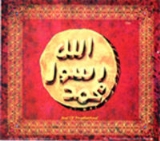
". He reportedly used a silver seal on letters sent to other notable leaders who were requested to convert to Islam
.
was an alliance created by Muhammad in the pre-Islamic
era.
of Mecca, the Quraysh. Although Muhammad himself was safe from persecution due to protection from his uncle, Abu Talib ibn ‘Abd al-Muttalib
(a leader of the Banu Hashim
), some of his followers were not in such a position. A number of Muslims were mistreated by the Quraysh, some reportedly beaten, imprisoned, or starved. It was then, in 615, that Muhammad resolved to send fifteen Muslims to emigrate to Abyssinia
to receive protection under the Christian
ruler, the Negus
, Aṣḥama ibn Abjar
. Emigration was a means through which some of the Muslims could escape the difficulties and persecution faced at the hands of the Quraysh, it also opened up new trading prospects.
The Quraysh, on hearing the attempted emigration, dispatched a group led by 'Amr ibn al-'As
and Abdullah ibn Abi Rabia ibn Mughira in order to pursue the fleeing Muslims. They were unsuccessful in their chase however as the Muslims had already reached safe territory, and so approached the Negus, appealing to him to return the Muslim migrants. Summoned to an audience with the Negus and his bishops as a representative of Muhammad and the Muslims, Ja`far ibn Abī Tālib spoke of Muhammad's achievements and quoted Qur'anic verses
related to Islam and Christianity
, including some from Surah Maryam
. Ja`far ibn Abī Tālib is quoted according to Islamic tradition
as follows:
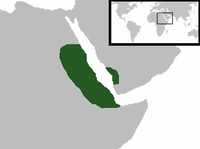 The Negus, seemingly impressed, consequently allowed the migrants to stay, sending back the emissaries of Quraysh. It is also thought that the Negus may have converted to Islam. The Christian subjects of the Negus were displeased with his actions, accusing him of leaving Christianity, although the Negus managed to appease them in a way which, according to Ibn Ishaq
, could be described as favourable towards Islam. Having established friendly relations with the Negus, it became possible for Muhammad to send another group of migrants, such that the number of Muslims living in Abyssinia totalled around one hundred.
in order to convene with its chieftains, and mainly those of Banu Thaqif
(such as Abd-Ya-Layl ibn Amr
). The main dialogue during this visit is thought to have been the invitation by Muhammad for them to accept Islam, while contemporary historian Montgomery Watt
observes the plausibility of an additional discussion about wresting Ta'if trade route
s from Meccan control. The reason for Muhammad directing his efforts towards Ta'if may have been due to the lack of positive response from the people of Mecca to his message until then.
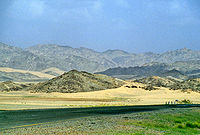 In rejection of his message, and fearing that there would be reprisals from Mecca for having hosted Muhammad, the groups involved in meeting with Muhammad began to incite townfolk to pelt him with stones. Having been beset and pursued out of Ta'if, the wounded Muhammad sought refuge in a nearby orchard
. Resting under a grape vine
, it is here that he invoked God
, seeking comfort and protection.
According to Islamic tradition, Muhammad on his way back to Mecca was met by the angel
Gabriel
and the angels of the mountains surrounding Ta'if, and was told by them that if he willed, Ta'if would be crushed between the mountains in revenge for his mistreatment. Muhammad is said to have rejected the proposition, saying that he would pray in the hopes of succeeding generations of Ta'if coming to accept Islamic monotheism
.
and attested belief in Muhammad as the messenger of God, the twelve men pledged to obey him and to stay away from a number of Islamically sinful acts. This was known as the "First Pledge of al-`Aqaba."
Following the pledge, Muhammad decided to send a Muslim "ambassador", Mus`ab ibn `Umair, to Medina in order to teach people about Islam and invite them to it.
Converts to Islam came from nearly all Arab tribes
present in Medina, such that by June of the subsequent year there were seventy-five Muslims coming to Mecca for pilgrimage and to meet Muhammad. Meeting him secretly by night, the group made what was known as the "Second Pledge of al-`Aqaba", or the "Pledge of War". Conditions of the pledge, many of which similar to the first, included obedience to Muhammad, "enjoining good and forbidding evil" as well as responding to the call to arms when required.
Some western academics are noted to have questioned whether or not a second pledge had taken place, although Watt argues that there must have been several meetings between the pilgrims and Muhammad on which the basis of his move to Medina could be agreed upon.
Arab tribes; the Banu Aus and the Banu Khazraj; and at least three Jewish
tribes: Qaynuqa
, Nadir
, and Qurayza
. Medinan society, for perhaps decades, had been scarred by feuds between the two main Arab tribes and their sub-clans. The Jewish tribes
had at times formed their own alliances with either one of the Arab tribes. The oppressive policy of the Khazraj who at the time had assumed control over Medina, forced the Jewish tribes, Nadir and Qurayza into an alliance with the Aus who had been significantly weakened. The culmination of this was the Battle of Bu'ath
in 617, in which the Khazraj and their allies, Qaynuqa, has been soundly defeated by the coalition of Aus and its supporters.
Although formal combat between the two clans had ended, hostilities between them continued even up until Muhammad's arrival in Medina. Muhammad had been invited by some Medinans, who had been impressed by his religious preaching and manifest trustworthiness, as an arbitrator to help reduce the prevailing factional discord. Muhammad's task would thus be to form a united community out of these heterogeneous elements, not only as a religious preacher, but as a political and diplomatic leader who could help resolve the ongoing disputes.
with a group of his followers
, having escaped the forces of Quraysh. They were given shelter by members of the indigenous community known as the Ansar
. After having established the first mosque
in Medina and obtaining residence with Abu Ayyub al-Ansari
, he then set about the establishment of a pact known as the Constitution of Medina. This document was a unilateral declaration by Muhammad, and deals almost exclusively with the civil and political relations of the citizens among themselves and with the outside.
The source of authority was transferred from public opinion to God. Bernard Lewis
writes the community at Medina became a new kind of tribe with Muhammad as its sheikh
, while at the same time having a religious character. Watt argues that Muhammad's authority had not extended over the entirety of Medina at this time, such that in reality he was only the religious leader of Medina, and his political influence would only become significant after the Battle of Badr
in 624. Lewis opines that Muhammad's assumption of the role of statesman was a means through which the objectives of prophethood
could be achieved. The constitution, although recently signed, was soon to be rendered obsolete due to the rapidly changing conditions in Medina, with certain tribes having been accused of breaching the terms of agreement.
of nomad
ic clans and tribes, as the signatories were bound together by solemn agreement. The community, however, now also had a religious basis. Extending this analogy, Watt argues that the functioning of the community resembled that of a tribe, such that it would not be incorrect to call the community a kind of "super-tribe". The signing of the constitution itself displayed a degree of diplomacy by Muhammad, as although he envisioned a society eventually based upon a religious outlook, practical consideration was needed to be inclusive instead of exclusive of the varying social elements.
Both the Aus and Khazraj had progressively converted to Islam, although the latter had been more enthusiastic than the former: at the second pledge of al-`Aqaba, the numbers of Khazraj to Aus present was 62:3; and at the Battle of Badr, 175:63. Subsequently, the hostility between the Aus and Khazraj gradually diminished and became unheard of after Muhammad's death. According to Muslim scholar al-Mubarakpuri, the 'spirit of brotherhood' as insisted by Muhammad amongst Muslims was the means through which a new society would be shaped.
The result was Muhammad's increasing influence in Medina, although he was most probably only considered a political force after the Battle of Badr, more so after the Battle of Uhud
where he was clearly in political ascendency. To attain complete control over Medina, Muhammad would have to exercise considerable political and military skills, as well as religious skills over the coming years.
(lesser pilgrimage), and so prepared to travel with his followers to Mecca in the hopes of fulfilling this vision. He set out
with a group of around 1,400 pilgrims (in the traditional Ihram garb
), although it was not soon until Mecca had discovered these arrangements. On hearing of the Muslims travelling to Mecca for pilgrimage, the Quraysh sent out a force of 200 fighters in order to halt the approaching party. In no position to fight, Muhammad evaded the cavalry by taking a more difficult route, thereby reaching al-Hudaybiyya, just outside of Mecca.
It was at Hudaybiyya that a number of envoys went to and fro in order to negotiate with the Quraysh. During the negotiations, Uthman ibn Affan was chosen as an envoy to convene with the leaders in Mecca, on account of his high regard amongst the Quraysh. On his entry into Mecca, rumours ignited that Uthman had subsequently been murdered by the Quraysh. Muhammad responded by calling upon the pilgrims to make a pledge not to flee (or to stick with Muhammad, whatever decision he made) if the situation descended into war with Mecca. This pledge became known as the "Pledge of Good Pleasure" (Arabic
: بيعة الرضوان, bay'at al-ridhwān) or the "Pledge under the Tree".
The incident was mentioned in the Qur'an
as follows:
The treaty was set to expire after 10 years, but was broken after only 10 months. According to the terms of the treaty of Hudaibiyah, the Arab tribes were given the option to join either of the parties, the Muslims or Quraish. Should any of these tribes face aggression, the party to which it was allied would have the right to retaliate. As a consequence, Banu Bakr
joined Quraish, and Khuza‘ah joined Muhammed. They thus lived in peace for sometime but ulterior motives stretching back to pre-Islamic period ignited by unabated fire of revenge triggered fresh hostilities. Banu Bakr, without caring a bit for the provisions of the treaty, attacked Banu Khuza'a
in a place called Al-Wateer in Sha‘ban, 8 A.H. Quraish helped Banu Bakr with men and arms taking advantage of the dark night. Pressed by their enemies, the tribesmen of Khuza‘ah sought the Holy Sanctuary, but here too, their lives were not spared, and, contrary to all accepted traditions, Nawfal, the chief of Banu Bakr, chasing them in the sanctified area — where no blood should be shed — massacred his adversaries.
), the Muqawqis
of Egypt
, Khosrau, Sassanid
King of Persia (Iran
). There has been great controversy amongst academic scholars as to their authenticity. According to Forward
, academics have treated some reports with scepticism
, although he argues that it is likely that Muhammad had assumed correspondence with leaders within the Arabian Peninsula. R.B. Serjeant opines that the letters are forgeries and were designed to promote both the 'notion that Muhammad conceived of Islam as a universal religion and to strengthen the Islamic position against Christian polemic.' He further argues the unlikelihood of Muhammad sending such letters when he had not yet mastered Arabia. Irfan Shahid, professor of Arabic and Islamic literature
at Georgetown University
, contends that dismissing the letters sent by Muhammad as forgeries is "unjustified", pointing to recent research establishing the historicity of the letter to Heraclius as an example.
, Heraclius, through the Muslim envoy Dihyah Kalbi
, although Shahid suggests that Heraclius may never have received it. He also advances that more positive sub-narratives surrounding the letter contain little credence. According to El-Cheikh, Arab historians and chroniclers generally did not doubt the authenticity of Heraclius' letter due to the documentation of such letters in the majority of both early and later sources. Furthermore, she notes that the formulation and the wordings of different sources are very close and the differences are ones of detail: They concern the date on which the letter was sent and its exact phrasing. Muhammad Hamidullah
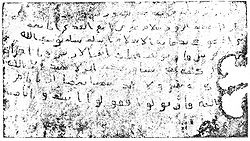
, an Islamic research scholar, argues for the authenticity of the letter sent to Heraclius, and in a later work reproduces what is claimed to be the original letter. The account as transmitted by Muslim historians reads as follows:
 Abu Sufyan ibn Harb
, at the time an adversary to Muhammad but a signatory to the, then recent, Treaty of Hudaybiyyah, was trading in Greater Syria
when he was summoned to the court of Heraclius. Asked by Heraclius about the man claiming to be a prophet, Abu Sufyan responded, speaking favorably of Muhammad's character and lineage and outlining some directives of Islam. Heraclius was seemingly impressed by what he was told of Muhammad, and felt that Muhammad's claim to prophethood was valid. Despite this incident, it seems that Heraclius was more concerned with the current rift between the various Christian churches
within his empire, and as a result did not convert to Islam.
or at a later date following the Treaty of Hudaibiyya. According to Hamidullah, the former may be more likely. The letter reads:
Having received the letter, the Negus was purported to accept Islam in a reply he wrote to Muhammad. According to Islamic tradition, the Muslims in Medina prayed the funeral prayer in absentia for the Negus on his death. It is possible that a further letter was sent to the successor of the late Negus.
consider the currently preserved copy to be a forgery, and Öhrnberg considers the whole narrative concerning the Muqawqis to be "devoid of any historical value". Muslim historians, in contrast, generally affirm the historicity of the reports. The purported text of the letter (sent by Hatib bin Abi Balta'a) according to Islamic tradition is as follows:
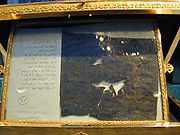
The Muqawqis responded by sending gifts to Muhammad, including two female slaves, Maria al-Qibtiyya
and Sirin. Maria became the concubine of Muhammad, with some sources reporting that she was later freed and married. The Muqawqis is reported in Islamic tradition as having presided over the contents of the parchment and storing it in an ivory casket, although he did not convert to Islam.
who, through the governor of Bahrain
, delivered it to the Khosrau. The account as transmitted by Muslim historians reads:
On receival, the Khosrau reportedly tore up the letter in outrage. This reaction of enmity contrasts with the responses of the other leaders, and was supposedly due to Muhammad having placed his own name before that of the Khosrau.
, the governor of Bahrain was apparently an addressee, with a letter having been delivered to him through Al-Ala'a Al-Hadrami
. Some subjects of the governor reportedly converted to Islam, whereas others did not. A similar letter was sent to Hauda bin Ali, the governor of Al-Yamama
, who replied that he would only convert if he were given a position of authority within Muhammad's government, a proposition which Muhammad was unwilling to accept. The then ruler of Damascus
, Harith ibn Abi Shamir al-Ghassani
, reportedly reacted less than favourably to Muhammad's correspondence, viewing it as an insult.
Jayfar and Abd, princes of the powerful ruling Azd
tribe which ruled Oman
in collaboration with Persian governance, were sons of the client king
Juland (frequently Al Julandā based on the Perso-Arabic
pronunciation). They embraced Islam peacefully on 630 AD upon receiving the letter sent from Muhammad through 'Amr ibn al-'As. The Azd subsequently played a major role in the ensuant Islamic conquests. They were one of the five tribal contingents that settled in the newly founded garrison city of Basra
at the head of the Persian Gulf
; under their great general Al Muhallab ibn Abi Suffrah and also took part in the conquest of Khurasan and Transoxania.
Muhammad
Muhammad |ligature]] at U+FDF4 ;Arabic pronunciation varies regionally; the first vowel ranges from ~~; the second and the last vowel: ~~~. There are dialects which have no stress. In Egypt, it is pronounced not in religious contexts...
(c. 570–632) is documented as having engaged as a diplomat during his propagation of Islam
Islam
Islam . The most common are and . : Arabic pronunciation varies regionally. The first vowel ranges from ~~. The second vowel ranges from ~~~...
and leadership over the growing Muslim
Muslim
A Muslim, also spelled Moslem, is an adherent of Islam, a monotheistic, Abrahamic religion based on the Quran, which Muslims consider the verbatim word of God as revealed to prophet Muhammad. "Muslim" is the Arabic term for "submitter" .Muslims believe that God is one and incomparable...
Ummah
Ummah
Ummah is an Arabic word meaning "community" or "nation." It is commonly used to mean either the collective nation of states, or the whole Arab world...
(community). He established a method of communication with other tribal or national leaders through letters, assigned envoys
Diplomacy
Diplomacy is the art and practice of conducting negotiations between representatives of groups or states...
, or by visiting them personally, such as at Ta’if
Ta’if
Ta’if is a city in the Mecca Province of Saudi Arabia at an elevation of on the slopes of the Sarawat Mountains . It has a population of 521,273 . Each summer the Saudi Government moves from the heat of Riyadh to Ta'if...
. Instances of written correspondence include letters to Heraclius
Heraclius
Heraclius was Byzantine Emperor from 610 to 641.He was responsible for introducing Greek as the empire's official language. His rise to power began in 608, when he and his father, Heraclius the Elder, the exarch of Africa, successfully led a revolt against the unpopular usurper Phocas.Heraclius'...
, the Negus
Negus
Negus is a title in Ge'ez, Tigrinya, Tigre and Amharic, used for a king and at times also a vassal ruler in pre-1974 Ethiopia and pre-1890 Eritrea. It is subsequently used to translate the word "king" in Biblical and other literature...
and Khosrau
Khosrau II
250px|thumb|Khosrau II 250px|thumb|Khosrau II 250px|thumb|Khosrau II (Khosrow II, Chosroes II, or Xosrov II in classical sources, sometimes called Parvez, "the Ever Victorious" – (in Persian: خسرو پرویز), was the twenty-second Sassanid King of Persia, reigning from 590 to 628...
. Although it is likely that Muhammad had initiated contact with other leaders within the Arabian Peninsula
Arabian Peninsula
The Arabian Peninsula is a land mass situated north-east of Africa. Also known as Arabia or the Arabian subcontinent, it is the world's largest peninsula and covers 3,237,500 km2...
, some have questioned whether letters had been sent beyond these boundaries.
When Muhammad arrived in Medina
Muhammad in Medina
The period of Muhammad in Medina started with the Hijra in 622 and ended with the conquest of Mecca in 630.-Hijra to Medina:...
in 622, local tribes
Arabian tribes that interacted with Muhammad
-Introduction:The most prominent of such Arabian tribes were the Banu Quraish which were in turn divided into several sub-clans. The Qur'aish sub-clan of Banu Hashim was the clan of Muhammad, while their sister sub-clan, the Banu Abd-Shams became known as his most staunch enemies...
, mainly the Banu Aus
Banu Aus
The Banū Aws or simply Aws was one of the main Arab tribes of Medina. The other was Khazraj, and the two, constituted the Ansar after the Hijra.Aws and Khazraj were known as Banū Qayla in pre-Islamic era.-Etymology:...
and Banu Khazraj
Banu Khazraj
-Early history:Abu Muhammad Al-hasan Ibn Ahmad Al-hamdani mentioned that The Banu Khazraj along with Banu Aws settled the area of Yathrib around the 2nd century ad as part of the PreIslamic Exodus of Yemen due to the Great Dam damage....
, had been feuding for several decades. Muhammad addressed this by establishing the Constitution of Medina
Constitution of Medina
The Constitution of Medina , also known as the Charter of Medina, was drafted by the Islamic prophet Muhammad. It constituted a formal agreement between Muhammad and all of the significant tribes and families of Yathrib , including Muslims, Jews, Christians and pagans. This constitution formed the...
: a document which regulated interactions between the different factions, to which the respective parties agreed. This was a different role for him, as he had remained only a religious figure during his time in Mecca
Mecca
Mecca is a city in the Hijaz and the capital of Makkah province in Saudi Arabia. The city is located inland from Jeddah in a narrow valley at a height of above sea level...
. The result was the eventual formation of a united community in Medina
Medina
Medina , or ; also transliterated as Madinah, or madinat al-nabi "the city of the prophet") is a city in the Hejaz region of western Saudi Arabia, and serves as the capital of the Al Madinah Province. It is the second holiest city in Islam, and the burial place of the Islamic Prophet Muhammad, and...
, as well as the political supremacy of Muhammad.
Muhammad also participated in agreements and pledges such as "Pledges of al-`Aqaba", the Treaty of Hudaybiyyah
Treaty of Hudaybiyyah
The Treaty of Hudaybiyyah is the treaty that took place between the state of Medina and the Quraishi tribe of Mecca in March 628CE .-Background:...
, and the "Pledge of the Tree
Pledge of the Tree
The Pledge of the Tree or Pledge of Pleasure or Pledge of Ridwan was a pledge that was sworn to the Islamic prophet Muhammad by his Sahaba prior to the Treaty of Hudaybiyyah...
". He reportedly used a silver seal on letters sent to other notable leaders who were requested to convert to Islam
Dawah
Da‘wah or Dawah usually denotes the preaching of Islam. Da‘wah literally means "issuing a summons" or "making an invitation", being the active participle of a verb meaning variously "to summon" or "to invite"...
.
Hilf al-Fudul
Hilf al-FudulHilf al-Fudul
Hilf al-Fudul was a 7th-century alliance created by various Meccans, including the prophet Muhammad, to establish fair commercial dealing. Because of Muhammad's role in its formation, the alliance plays a significant role in Islamic ethics...
was an alliance created by Muhammad in the pre-Islamic
Pre-Islamic Arabia
Pre-Islamic Arabia refers to the Arabic civilization which existed in the Arabian Plate before the rise of Islam in the 630s. The study of Pre-Islamic Arabia is important to Islamic studies as it provides the context for the development of Islam.-Studies:...
era.
Muslim migration to Abyssinia (615)
Muhammad's commencement of public preaching brought him stiff opposition from the leading tribeTribe
A tribe, viewed historically or developmentally, consists of a social group existing before the development of, or outside of, states.Many anthropologists use the term tribal society to refer to societies organized largely on the basis of kinship, especially corporate descent groups .Some theorists...
of Mecca, the Quraysh. Although Muhammad himself was safe from persecution due to protection from his uncle, Abu Talib ibn ‘Abd al-Muttalib
Abu Talib ibn ‘Abd al-Muttalib
Abi Tlib ibn ‘Abd al-Muttalib also known as Abu Talib ibn al-Muttalib.Talib was in reality the elder son of Abd Munāf and elder brother to Ali Ibn Abd Munāf. He was an head of Bani Hashim clan of Quraysh tribe of Mecca in Arabia. He was married to Fatima bint Asad and was an uncle of the...
(a leader of the Banu Hashim
Banu Hashim
Banū Hāshim was a clan in the Quraysh tribe. Muhammad, was a member of this clan; his great-grandfather was Hashim, for whom the clan is named. Members of this clan are referred to by the Anglicised version of their name as Hashemites, or Huseini or Hasani...
), some of his followers were not in such a position. A number of Muslims were mistreated by the Quraysh, some reportedly beaten, imprisoned, or starved. It was then, in 615, that Muhammad resolved to send fifteen Muslims to emigrate to Abyssinia
Ethiopia
Ethiopia , officially known as the Federal Democratic Republic of Ethiopia, is a country located in the Horn of Africa. It is the second-most populous nation in Africa, with over 82 million inhabitants, and the tenth-largest by area, occupying 1,100,000 km2...
to receive protection under the Christian
Christian
A Christian is a person who adheres to Christianity, an Abrahamic, monotheistic religion based on the life and teachings of Jesus of Nazareth as recorded in the Canonical gospels and the letters of the New Testament...
ruler, the Negus
Negus
Negus is a title in Ge'ez, Tigrinya, Tigre and Amharic, used for a king and at times also a vassal ruler in pre-1974 Ethiopia and pre-1890 Eritrea. It is subsequently used to translate the word "king" in Biblical and other literature...
, Aṣḥama ibn Abjar
Ashama ibn Abjar
According to Arabic sources, Aṣḥama ibn Abjar was Emperor or al-Najashi of Aksum at the time of Muhammad, and gave refuge to several Muslims in the Kingdom of Aksum. The term "al-Najashi" has the variant al-Negashi; it corresponds to the ancient Aksumite title Negus, with the variant Negash...
. Emigration was a means through which some of the Muslims could escape the difficulties and persecution faced at the hands of the Quraysh, it also opened up new trading prospects.
The Quraysh, on hearing the attempted emigration, dispatched a group led by 'Amr ibn al-'As
'Amr ibn al-'As
`Amr ibn al-`As was an Arab military commander who is most noted for leading the Muslim conquest of Egypt in 640. A contemporary of Muhammad, and one of the Sahaba , who rose quickly through the Muslim hierarchy following his conversion to Islam in the year 8 AH...
and Abdullah ibn Abi Rabia ibn Mughira in order to pursue the fleeing Muslims. They were unsuccessful in their chase however as the Muslims had already reached safe territory, and so approached the Negus, appealing to him to return the Muslim migrants. Summoned to an audience with the Negus and his bishops as a representative of Muhammad and the Muslims, Ja`far ibn Abī Tālib spoke of Muhammad's achievements and quoted Qur'anic verses
Ayah
Ayah or Aayah is the Arabic word for sign or proof:"These are the Ayat of Allah, which We recite to you with truth...
related to Islam and Christianity
Christianity
Christianity is a monotheistic religion based on the life and teachings of Jesus as presented in canonical gospels and other New Testament writings...
, including some from Surah Maryam
Maryam (sura)
Sura Maryam is the 19th sura of the Qur'an and is a Makkan sura with 98 ayat . It is named after Maryām, the actual name for Mary, Mother of Jesus . The popular variant of the name Maryam, Mary, is a Westernized or Anglicized version...
. Ja`far ibn Abī Tālib is quoted according to Islamic tradition
Hadith
The term Hadīth is used to denote a saying or an act or tacit approval or criticism ascribed either validly or invalidly to the Islamic prophet Muhammad....
as follows:
Ibn Ishaq
Muḥammad ibn Isḥaq ibn Yasār ibn Khiyār was an Arab Muslim historian and hagiographer...
, could be described as favourable towards Islam. Having established friendly relations with the Negus, it became possible for Muhammad to send another group of migrants, such that the number of Muslims living in Abyssinia totalled around one hundred.
Journey to Ta'if (619)
In early June 619, Muhammad set out from Mecca to travel to the town of Ta'ifMuhammad's visit to Ta'if
-Previous events:Initially the preaching of Islam by Muhammad had been confined to Mecca, and his success was rather modest, limited to 170 men and women in the city during a ten year period...
in order to convene with its chieftains, and mainly those of Banu Thaqif
Banu Thaqif
The Thaqif was one of the tribes of Arabia during Muhammad's era. Thaqif was the main tribe of the town of Taif, in present-day Saudi Arabia, and descendants of the tribe still live in that city today and so many names in Arab countries such as Syria, Lebanon, Egypt, Tunisia, Morocco, Hatay...
(such as Abd-Ya-Layl ibn Amr
Abd-Ya-Layl ibn Amr
Abd-Ya-Layl ibn Amr of the Banu Thaqif tribe was one of the chieftains of the city of Ta'if, a city hostile to Islam. However, in 631 or 632, he was included in a delegation that resulted in his tribe accepting Islam.-External links:...
). The main dialogue during this visit is thought to have been the invitation by Muhammad for them to accept Islam, while contemporary historian Montgomery Watt
William Montgomery Watt
William Montgomery Watt was a Scottish historian, an Emeritus Professor in Arabic and Islamic Studies at the University of Edinburgh...
observes the plausibility of an additional discussion about wresting Ta'if trade route
Trade route
A trade route is a logistical network identified as a series of pathways and stoppages used for the commercial transport of cargo. Allowing goods to reach distant markets, a single trade route contains long distance arteries which may further be connected to several smaller networks of commercial...
s from Meccan control. The reason for Muhammad directing his efforts towards Ta'if may have been due to the lack of positive response from the people of Mecca to his message until then.
Orchard
An orchard is an intentional planting of trees or shrubs that is maintained for food production. Orchards comprise fruit or nut-producing trees which are grown for commercial production. Orchards are also sometimes a feature of large gardens, where they serve an aesthetic as well as a productive...
. Resting under a grape vine
Vitis
Vitis is a genus of about 60 species of vining plants in the flowering plant family Vitaceae. The genus is made up of species predominantly from the Northern hemisphere. It is economically important as the source of grapes, both for direct consumption of the fruit and for fermentation to produce...
, it is here that he invoked God
God
God is the English name given to a singular being in theistic and deistic religions who is either the sole deity in monotheism, or a single deity in polytheism....
, seeking comfort and protection.
According to Islamic tradition, Muhammad on his way back to Mecca was met by the angel
Islamic view of angels
Angels are mentioned many times in the Qur'an and Hadith. Islam is clear on the nature of angels in that they are messengers of God. They have no free will, and can do only what God orders them to do...
Gabriel
Gabriel
In Abrahamic religions, Gabriel is an Archangel who typically serves as a messenger to humans from God.He first appears in the Book of Daniel, delivering explanations of Daniel's visions. In the Gospel of Luke Gabriel foretells the births of both John the Baptist and of Jesus...
and the angels of the mountains surrounding Ta'if, and was told by them that if he willed, Ta'if would be crushed between the mountains in revenge for his mistreatment. Muhammad is said to have rejected the proposition, saying that he would pray in the hopes of succeeding generations of Ta'if coming to accept Islamic monotheism
Tawhid
Tawhid is the concept of monotheism in Islam. It is the religion's most fundamental concept and holds God is one and unique ....
.
al-`Aqaba pledges (620—621)
In the summer of 620 during the pilgrimage season, six men travelling from Medina came into contact with Muhammad. Having been impressed by his message and character, and thinking that he could help bring resolution to the problems being faced in Medina, five of the six men returned to Mecca the following year bringing seven others. Following their conversion to IslamReligious conversion
Religious conversion is the adoption of a new religion that differs from the convert's previous religion. Changing from one denomination to another within the same religion is usually described as reaffiliation rather than conversion.People convert to a different religion for various reasons,...
and attested belief in Muhammad as the messenger of God, the twelve men pledged to obey him and to stay away from a number of Islamically sinful acts. This was known as the "First Pledge of al-`Aqaba."
Following the pledge, Muhammad decided to send a Muslim "ambassador", Mus`ab ibn `Umair, to Medina in order to teach people about Islam and invite them to it.
Converts to Islam came from nearly all Arab tribes
Tribes of Arabia
Tribes of Arabia refers to Arab clans hailing from the Arabian Peninsula.Much of the lineage provided before Ma'ad relies on biblical genealogy and therefore questions persist concerning the accuracy of this segment of Arab genealogy...
present in Medina, such that by June of the subsequent year there were seventy-five Muslims coming to Mecca for pilgrimage and to meet Muhammad. Meeting him secretly by night, the group made what was known as the "Second Pledge of al-`Aqaba", or the "Pledge of War". Conditions of the pledge, many of which similar to the first, included obedience to Muhammad, "enjoining good and forbidding evil" as well as responding to the call to arms when required.
Some western academics are noted to have questioned whether or not a second pledge had taken place, although Watt argues that there must have been several meetings between the pilgrims and Muhammad on which the basis of his move to Medina could be agreed upon.
Medinan society prior to Muslim migration
The demography of Medina before Muslim migration consisted mainly of two paganPaganism
Paganism is a blanket term, typically used to refer to non-Abrahamic, indigenous polytheistic religious traditions....
Arab tribes; the Banu Aus and the Banu Khazraj; and at least three Jewish
Jews
The Jews , also known as the Jewish people, are a nation and ethnoreligious group originating in the Israelites or Hebrews of the Ancient Near East. The Jewish ethnicity, nationality, and religion are strongly interrelated, as Judaism is the traditional faith of the Jewish nation...
tribes: Qaynuqa
Banu Qaynuqa
The Banu Qaynuqa was one of the three main Jewish tribes living in the 7th century of Medina, now in Saudi Arabia...
, Nadir
Banu Nadir
The Banu Nadir were a Jewish tribe who lived in northern Arabia until the 7th century at the oasis of Yathrib . The tribe challenged Muhammad as the leader of Medina. and planned along with allied nomads to attack Muhammad and were expelled from Medina as a result. The Banu Nadir then planned the...
, and Qurayza
Banu Qurayza
The Banu Qurayza were a Jewish tribe which lived in northern Arabia, at the oasis of Yathrib , until the 7th century, when their conflict with Muhammad led to their demise, after the Invasion of Banu Qurayza, took place in the Dhul Qa‘dah, 5 A.H i.e. in February/March, 627 AD...
. Medinan society, for perhaps decades, had been scarred by feuds between the two main Arab tribes and their sub-clans. The Jewish tribes
Jewish tribes of Arabia
The Arab Jewish tribes are the Arab tribes professing the Jewish faith that inhabited the Arabian Peninsula before and during the advent of Islam. It is not always clear whether they were originally Israelite in ancestry, genealogically Arab tribes that converted to Judaism, or a mixture of both...
had at times formed their own alliances with either one of the Arab tribes. The oppressive policy of the Khazraj who at the time had assumed control over Medina, forced the Jewish tribes, Nadir and Qurayza into an alliance with the Aus who had been significantly weakened. The culmination of this was the Battle of Bu'ath
Battle of Bu'ath
The Battle of Bu'ath was fought in 617 between Banu Aus and Banu Khazraj, the Arab tribes of Yathrib , in Saudi Arabia, in the south-eastern quarter of the Medinan oasis, belonging to the Jewish tribe of Banu Qurayza...
in 617, in which the Khazraj and their allies, Qaynuqa, has been soundly defeated by the coalition of Aus and its supporters.
Although formal combat between the two clans had ended, hostilities between them continued even up until Muhammad's arrival in Medina. Muhammad had been invited by some Medinans, who had been impressed by his religious preaching and manifest trustworthiness, as an arbitrator to help reduce the prevailing factional discord. Muhammad's task would thus be to form a united community out of these heterogeneous elements, not only as a religious preacher, but as a political and diplomatic leader who could help resolve the ongoing disputes.
Constitution of Medina
By 622, Muhammad had migrated to MedinaHijra (Islam)
The Hijra is the migration or journey of the Islamic prophet Muhammad and his followers from Mecca to Medina in 622 CE. Alternate spellings of this Arabic word are Hijrah, Hijrat or Hegira, the latter following the spelling rules of Latin.- Hijra of Muhammad :In September 622, warned of a plot to...
with a group of his followers
Muhajirun
Muhajirun are the early, initial Muslims who followed Muhammad on his Hijra . The early Muslims from Medina are called the Ansar .-List:*Muhammad*Ali*Umar *Abu Bakr .*Salman the Persian*Bilal ibn Ribah...
, having escaped the forces of Quraysh. They were given shelter by members of the indigenous community known as the Ansar
Ansar (Islam)
Ansar is an Islamic term that literally means "helpers" and denotes the Medinan citizens that helped Muhammad and the Muhajirun on the arrival to the city after the migration to Medina...
. After having established the first mosque
Mosque
A mosque is a place of worship for followers of Islam. The word is likely to have entered the English language through French , from Portuguese , from Spanish , and from Berber , ultimately originating in — . The Arabic word masjid literally means a place of prostration...
in Medina and obtaining residence with Abu Ayyub al-Ansari
Abu Ayyub al-Ansari
Abu Ayyub al-Ansari - born Khalid ibn Zayd ibn Kulayb in Yathrib - hailed from the tribe of Banu Najjar and was a close companion of Muhammad. Abu Ayyub was one among the Ansar of early Muslim history, or those who supported Muhammad after the hijra to Medina in 622...
, he then set about the establishment of a pact known as the Constitution of Medina. This document was a unilateral declaration by Muhammad, and deals almost exclusively with the civil and political relations of the citizens among themselves and with the outside.
The source of authority was transferred from public opinion to God. Bernard Lewis
Bernard Lewis
Bernard Lewis, FBA is a British-American historian, scholar in Oriental studies, and political commentator. He is the Cleveland E. Dodge Professor Emeritus of Near Eastern Studies at Princeton University...
writes the community at Medina became a new kind of tribe with Muhammad as its sheikh
Sheikh
Not to be confused with sikhSheikh — also spelled Sheik or Shaikh, or transliterated as Shaykh — is an honorific in the Arabic language that literally means "elder" and carries the meaning "leader and/or governor"...
, while at the same time having a religious character. Watt argues that Muhammad's authority had not extended over the entirety of Medina at this time, such that in reality he was only the religious leader of Medina, and his political influence would only become significant after the Battle of Badr
Battle of Badr
The Battle of Badr , fought Saturday, March 13, 624 AD in the Hejaz region of western Arabia , was a key battle in the early days of Islam and a turning point in Muhammad's struggle with his opponents among the Quraish in Mecca...
in 624. Lewis opines that Muhammad's assumption of the role of statesman was a means through which the objectives of prophethood
Prophethood
Prophethood is the word used to reference the institution by which God sends emissaries, or prophets, to guide mankind. Use of the word is almost always theological.-Islam:...
could be achieved. The constitution, although recently signed, was soon to be rendered obsolete due to the rapidly changing conditions in Medina, with certain tribes having been accused of breaching the terms of agreement.
Impact
The signing of the constitution could be seen as indicating the formation of a united community, in ways similar to a federationFederation
A federation , also known as a federal state, is a type of sovereign state characterized by a union of partially self-governing states or regions united by a central government...
of nomad
Nomad
Nomadic people , commonly known as itinerants in modern-day contexts, are communities of people who move from one place to another, rather than settling permanently in one location. There are an estimated 30-40 million nomads in the world. Many cultures have traditionally been nomadic, but...
ic clans and tribes, as the signatories were bound together by solemn agreement. The community, however, now also had a religious basis. Extending this analogy, Watt argues that the functioning of the community resembled that of a tribe, such that it would not be incorrect to call the community a kind of "super-tribe". The signing of the constitution itself displayed a degree of diplomacy by Muhammad, as although he envisioned a society eventually based upon a religious outlook, practical consideration was needed to be inclusive instead of exclusive of the varying social elements.
Both the Aus and Khazraj had progressively converted to Islam, although the latter had been more enthusiastic than the former: at the second pledge of al-`Aqaba, the numbers of Khazraj to Aus present was 62:3; and at the Battle of Badr, 175:63. Subsequently, the hostility between the Aus and Khazraj gradually diminished and became unheard of after Muhammad's death. According to Muslim scholar al-Mubarakpuri, the 'spirit of brotherhood' as insisted by Muhammad amongst Muslims was the means through which a new society would be shaped.
The result was Muhammad's increasing influence in Medina, although he was most probably only considered a political force after the Battle of Badr, more so after the Battle of Uhud
Battle of Uhud
The Battle of Uhud was fought on March 19, 625 at the valley located in front of Mount Uhud, in what is now northwestern Arabia. It occurred between a force from the Muslim community of Medina led by the Islamic prophet Muhammad, and a force led by Abu Sufyan ibn Harb from Mecca, the town from...
where he was clearly in political ascendency. To attain complete control over Medina, Muhammad would have to exercise considerable political and military skills, as well as religious skills over the coming years.
Events at Hudaybiyya (628)
In March 628, Muhammad saw himself in a dream performing the UmrahUmrah
The Umrah or is a pilgrimage to Mecca, Saudi Arabia, performed by Muslims that can be undertaken at any time of the year. In Arabic, Umrah means "to visit a populated place"...
(lesser pilgrimage), and so prepared to travel with his followers to Mecca in the hopes of fulfilling this vision. He set out
The first pilgrimage
The first pilgrimage or Umrah Dhu'l-Qada was the first pilgrimage that the Muslims made after the Migration to Medina. It happened in on the morning of the fourth day of Dhu al-Qi'dah 7 AH , after the Treaty of Hudaybiyyah 6 AH...
with a group of around 1,400 pilgrims (in the traditional Ihram garb
Ihram clothing
Ihram clothing includes men's and women's garments worn by Muslim people during the Ihram pilgrimage . Men's garments often consist of two white un-hemmed sheets and are universal in appearance. The top is draped over the torso and the bottom is secured by a belt; plus a pair of sandals...
), although it was not soon until Mecca had discovered these arrangements. On hearing of the Muslims travelling to Mecca for pilgrimage, the Quraysh sent out a force of 200 fighters in order to halt the approaching party. In no position to fight, Muhammad evaded the cavalry by taking a more difficult route, thereby reaching al-Hudaybiyya, just outside of Mecca.
It was at Hudaybiyya that a number of envoys went to and fro in order to negotiate with the Quraysh. During the negotiations, Uthman ibn Affan was chosen as an envoy to convene with the leaders in Mecca, on account of his high regard amongst the Quraysh. On his entry into Mecca, rumours ignited that Uthman had subsequently been murdered by the Quraysh. Muhammad responded by calling upon the pilgrims to make a pledge not to flee (or to stick with Muhammad, whatever decision he made) if the situation descended into war with Mecca. This pledge became known as the "Pledge of Good Pleasure" (Arabic
Arabic language
Arabic is a name applied to the descendants of the Classical Arabic language of the 6th century AD, used most prominently in the Quran, the Islamic Holy Book...
: بيعة الرضوان, bay'at al-ridhwān) or the "Pledge under the Tree".
The incident was mentioned in the Qur'an
Qur'an
The Quran , also transliterated Qur'an, Koran, Alcoran, Qur’ān, Coran, Kuran, and al-Qur’ān, is the central religious text of Islam, which Muslims consider the verbatim word of God . It is regarded widely as the finest piece of literature in the Arabic language...
as follows:
Treaty
Soon afterwards, with the rumour of Uthman's slaying proven untrue, negotiations continued and a treaty was eventually signed between the Muslims and Quraysh. Conditions of the treaty included the Muslims' postponement of the lesser pilgrimage until the following year, a pact of mutual non-aggression between the parties, and a promise by Muhammad to return any member of Quraysh (presumably a minor or woman) fleeing from Mecca without the permission of their parent or guardian, even if they be Muslim. Some of Muhammad's followers were upset by this agreement, as they had insisted that they should complete the pilgrimage they had set out for. Following the signing of the treaty, Muhammad and the pilgrims sacrificed the animals they had brought for it, and proceeded to return to Medina. It was only later that Muhammad's followers would realise the benefit behind this treaty. These benefits, according to Islamic historian Buhl, included the inducing of the Meccans to recognise Muhammad as an equal; a cessation of military activity, boding well for the future; and gaining the admiration of Meccans who were impressed by the incorporation of the pilgrimage rituals.The treaty was set to expire after 10 years, but was broken after only 10 months. According to the terms of the treaty of Hudaibiyah, the Arab tribes were given the option to join either of the parties, the Muslims or Quraish. Should any of these tribes face aggression, the party to which it was allied would have the right to retaliate. As a consequence, Banu Bakr
Banu Bakr
Banu Bakr ibn Wa'il or Banu Bakr, son of Wa'il were an Arabian tribe belonging to the large Rabi'ah branch of Adnanite tribes, which also included 'Anizzah, Taghlib, and Bani Hanifa. The tribe is reputed to have engaged in a 40-year war before Islam with its cousins from Taghlib, known as the War...
joined Quraish, and Khuza‘ah joined Muhammed. They thus lived in peace for sometime but ulterior motives stretching back to pre-Islamic period ignited by unabated fire of revenge triggered fresh hostilities. Banu Bakr, without caring a bit for the provisions of the treaty, attacked Banu Khuza'a
Banu Khuza'a
the Khuza'a or Banu Khuza'a form a branch of the South Arabian tribe of Azd-Origin:Most traditionalists trace the origins of the tribe to Amr ibn Lahi al-Khuza'i, and agree that with the other branches of the Azd they at some point left the Yemen and moved north. 'Amr ibn Luhay and his clan...
in a place called Al-Wateer in Sha‘ban, 8 A.H. Quraish helped Banu Bakr with men and arms taking advantage of the dark night. Pressed by their enemies, the tribesmen of Khuza‘ah sought the Holy Sanctuary, but here too, their lives were not spared, and, contrary to all accepted traditions, Nawfal, the chief of Banu Bakr, chasing them in the sanctified area — where no blood should be shed — massacred his adversaries.
Correspondence with other leaders
There are instances according to Islamic tradition where Muhammad is thought to have sent letters to other heads of state during the Medinan phase of his life. Personalities, amongst others, included the Negus of Abyssinia, Heraclius (emperor of the Byzantine EmpireByzantine Empire
The Byzantine Empire was the Eastern Roman Empire during the periods of Late Antiquity and the Middle Ages, centred on the capital of Constantinople. Known simply as the Roman Empire or Romania to its inhabitants and neighbours, the Empire was the direct continuation of the Ancient Roman State...
), the Muqawqis
Muqawqis
Al-Muqawqis is mentioned in Islamic history as a ruler of Egypt, who corresponded with the Islamic prophet Muhammad. He is often identified with Cyrus, Patriarch of Alexandria, who administered Egypt on behalf of the Byzantine Empire. However, this identification is challenged as being based on...
of Egypt
Egypt
Egypt , officially the Arab Republic of Egypt, Arabic: , is a country mainly in North Africa, with the Sinai Peninsula forming a land bridge in Southwest Asia. Egypt is thus a transcontinental country, and a major power in Africa, the Mediterranean Basin, the Middle East and the Muslim world...
, Khosrau, Sassanid
Sassanid Empire
The Sassanid Empire , known to its inhabitants as Ērānshahr and Ērān in Middle Persian and resulting in the New Persian terms Iranshahr and Iran , was the last pre-Islamic Persian Empire, ruled by the Sasanian Dynasty from 224 to 651...
King of Persia (Iran
Iran
Iran , officially the Islamic Republic of Iran , is a country in Southern and Western Asia. The name "Iran" has been in use natively since the Sassanian era and came into use internationally in 1935, before which the country was known to the Western world as Persia...
). There has been great controversy amongst academic scholars as to their authenticity. According to Forward
Martin Forward
Martin Forward is a British, Methodist Christian lecturer and author on religion and Professor of Religion at Aurora University, Illinois. He has taught Islam at the Universities of Leicester, Bristol and Cambridge, and had spent a period of time in India where he was ordained into the Church of...
, academics have treated some reports with scepticism
Skepticism
Skepticism has many definitions, but generally refers to any questioning attitude towards knowledge, facts, or opinions/beliefs stated as facts, or doubt regarding claims that are taken for granted elsewhere...
, although he argues that it is likely that Muhammad had assumed correspondence with leaders within the Arabian Peninsula. R.B. Serjeant opines that the letters are forgeries and were designed to promote both the 'notion that Muhammad conceived of Islam as a universal religion and to strengthen the Islamic position against Christian polemic.' He further argues the unlikelihood of Muhammad sending such letters when he had not yet mastered Arabia. Irfan Shahid, professor of Arabic and Islamic literature
Islamic literature
Islamic literature is literature written with an Islamic perspective, in any language.The most well known fiction from the Islamic world was The Book of One Thousand and One Nights , which was a compilation of many earlier folk tales told by the Persian Queen Scheherazade...
at Georgetown University
Georgetown University
Georgetown University is a private, Jesuit, research university whose main campus is in the Georgetown neighborhood of Washington, D.C. Founded in 1789, it is the oldest Catholic university in the United States...
, contends that dismissing the letters sent by Muhammad as forgeries is "unjustified", pointing to recent research establishing the historicity of the letter to Heraclius as an example.
Letter to Heraclius
A letter was sent from Muhammad to the emperor of ByzantiumByzantium
Byzantium was an ancient Greek city, founded by Greek colonists from Megara in 667 BC and named after their king Byzas . The name Byzantium is a Latinization of the original name Byzantion...
, Heraclius, through the Muslim envoy Dihyah Kalbi
Dihyah Kalbi
Dihyah Kalbi was the envoy who delivered prophet Muhammad's message to the Roman Emperor HeracliusAccording to Aisha, the Prophet's wife, he saw Jibril twice “in the shape that he was created” and on other occasions as a man resembling Dihyah ibn Khalifah al-Kalbi, an extraordinarily handsome...
, although Shahid suggests that Heraclius may never have received it. He also advances that more positive sub-narratives surrounding the letter contain little credence. According to El-Cheikh, Arab historians and chroniclers generally did not doubt the authenticity of Heraclius' letter due to the documentation of such letters in the majority of both early and later sources. Furthermore, she notes that the formulation and the wordings of different sources are very close and the differences are ones of detail: They concern the date on which the letter was sent and its exact phrasing. Muhammad Hamidullah
Muhammad Hamidullah
Muhammad Hamidullah or Muhammad Hameedullah, D. Phil., D. Litt., HI., was a Hyderabadi from Hyderabad State , Muhaddith, Faqih, scholar of Islam and International Law, and foremost a prolific academic author Muhammad Hamidullah or Muhammad Hameedullah, D. Phil., D. Litt., HI., (Urdu: محمد...
, an Islamic research scholar, argues for the authenticity of the letter sent to Heraclius, and in a later work reproduces what is claimed to be the original letter. The account as transmitted by Muslim historians reads as follows:
Abu Sufyan ibn Harb
Sakhr ibn Harb , more commonly known as Abu Sufyan was a leading man of the Quraish of Mecca. He was a staunch opponent of the Islamic prophet Muhammad before accepting Islam later in his life.-Opposition to Islam:...
, at the time an adversary to Muhammad but a signatory to the, then recent, Treaty of Hudaybiyyah, was trading in Greater Syria
Greater Syria
Greater Syria , also known simply as Syria, is a term that denotes a region in the Near East bordering the Eastern Mediterranean Sea or the Levant....
when he was summoned to the court of Heraclius. Asked by Heraclius about the man claiming to be a prophet, Abu Sufyan responded, speaking favorably of Muhammad's character and lineage and outlining some directives of Islam. Heraclius was seemingly impressed by what he was told of Muhammad, and felt that Muhammad's claim to prophethood was valid. Despite this incident, it seems that Heraclius was more concerned with the current rift between the various Christian churches
Christian Church
The Christian Church is the assembly or association of followers of Jesus Christ. The Greek term ἐκκλησία that in its appearances in the New Testament is usually translated as "church" basically means "assembly"...
within his empire, and as a result did not convert to Islam.
Deputation to Abyssinia
The letter inviting the Negus to Islam had been sent by Amr bin Omayah ad-Damari, although it is not known if the letter had been sent with Ja'far on migration to AbyssiniaMigration to Abyssinia
The migration known as the first Hijarat was made in two groups totalling more than a hundred persons. According to Islamic tradition, eleven male and five female Sahabah, the Muslims who originally converged in Mecca, sought refuge from Quraysh persecution in the Kingdom of Aksum in of in the...
or at a later date following the Treaty of Hudaibiyya. According to Hamidullah, the former may be more likely. The letter reads:
Having received the letter, the Negus was purported to accept Islam in a reply he wrote to Muhammad. According to Islamic tradition, the Muslims in Medina prayed the funeral prayer in absentia for the Negus on his death. It is possible that a further letter was sent to the successor of the late Negus.
Letter to Muqawqis
There has been conflict amongst scholars about the authenticity of aspects concerning the letter sent by Muhammad to Muqawqis. Some scholars such as NöldekeTheodor Nöldeke
Theodor Nöldeke was a German Semitic scholar, who was born in Harburg and studied in Göttingen, Vienna, Leiden and Berlin....
consider the currently preserved copy to be a forgery, and Öhrnberg considers the whole narrative concerning the Muqawqis to be "devoid of any historical value". Muslim historians, in contrast, generally affirm the historicity of the reports. The purported text of the letter (sent by Hatib bin Abi Balta'a) according to Islamic tradition is as follows:
The Muqawqis responded by sending gifts to Muhammad, including two female slaves, Maria al-Qibtiyya
Maria al-Qibtiyya
Maria al-Qibtiyya , or Maria the Copt, was an Egyptian Coptic Christian slave who was sent as a gift from Muqawqis, a Byzantine official, to the Islamic prophet Muhammad in 628. Some sources say she became his wife, taking the title "Mother of the Believers"...
and Sirin. Maria became the concubine of Muhammad, with some sources reporting that she was later freed and married. The Muqawqis is reported in Islamic tradition as having presided over the contents of the parchment and storing it in an ivory casket, although he did not convert to Islam.
Letter to Khosrau
The letter written by Muhammad addressing the Khosrau of Persia was carried by Abdullah ibn Hudhafah as-SahmiAbdullah ibn Hudhafah as-Sahmi
Abdullah ibn Hudhafah as-Sahmi was a close companion of the Islamic prophet Muhammad. He is best known in Islamic tradition for his role as the courier of a letter from Muhammad to Khusraw Parvez the King of Persia, and for his ordeal while imprisoned by Heraclius, the Byzantine emperor....
who, through the governor of Bahrain
Bahrain
' , officially the Kingdom of Bahrain , is a small island state near the western shores of the Persian Gulf. It is ruled by the Al Khalifa royal family. The population in 2010 stood at 1,214,705, including 235,108 non-nationals. Formerly an emirate, Bahrain was declared a kingdom in 2002.Bahrain is...
, delivered it to the Khosrau. The account as transmitted by Muslim historians reads:
On receival, the Khosrau reportedly tore up the letter in outrage. This reaction of enmity contrasts with the responses of the other leaders, and was supposedly due to Muhammad having placed his own name before that of the Khosrau.
Other personalities
Apart from the aforementioned personalities, there are other reported instances of correspondence. Munzir ibn Sawa Al TamimiMunzir ibn Sawa Al Tamimi
Munzir ibn Sawa Al Tamimi was the ruler of Bahrain and Qatar during the age of the Islamic prophet Muhammad. In the 7th century AD, when Muhammad and his companions started preaching Islam throughout the world, the message of Islam was sent by Muhammad to Munzir ibn Sawa Al Tamimi.Prior to Islam,...
, the governor of Bahrain was apparently an addressee, with a letter having been delivered to him through Al-Ala'a Al-Hadrami
Al-Ala'a Al-Hadrami
Al-Ala'a Al-Hadrami was an envoy sent by the Muslim prophet Muhammad in the 7th century AD, to spread the message of Islam to the region that is now Bahrain and Qatar....
. Some subjects of the governor reportedly converted to Islam, whereas others did not. A similar letter was sent to Hauda bin Ali, the governor of Al-Yamama
Al-Yamama
Al-Yamamah is an ancient district lying to the east of the plateau of Najd in modern-day Saudi Arabia, or sometimes more specifically, the now-extinct ancient village of Jaww Al-Yamamah, near Al-Kharj, after which the rest of the region was named...
, who replied that he would only convert if he were given a position of authority within Muhammad's government, a proposition which Muhammad was unwilling to accept. The then ruler of Damascus
Damascus
Damascus , commonly known in Syria as Al Sham , and as the City of Jasmine , is the capital and the second largest city of Syria after Aleppo, both are part of the country's 14 governorates. In addition to being one of the oldest continuously inhabited cities in the world, Damascus is a major...
, Harith ibn Abi Shamir al-Ghassani
Ghassanids
The Ghassanids were a group of South Arabian Christian tribes that emigrated in the early 3rd century from Yemen to Syria, Jordan, Lebanon and the Holy Land....
, reportedly reacted less than favourably to Muhammad's correspondence, viewing it as an insult.
Jayfar and Abd, princes of the powerful ruling Azd
Azd
The Azd or Al Azd, are an Arabian tribe. They were a branch of the Kahlan tribe, which was one of the two branches of Qahtan the other being Himyar.In the ancient times, they inhabited Ma'rib, the capital city of the Sabaean Kingdom in modern-day Yemen...
tribe which ruled Oman
Oman
Oman , officially called the Sultanate of Oman , is an Arab state in southwest Asia on the southeast coast of the Arabian Peninsula. It is bordered by the United Arab Emirates to the northwest, Saudi Arabia to the west, and Yemen to the southwest. The coast is formed by the Arabian Sea on the...
in collaboration with Persian governance, were sons of the client king
Client state
Client state is one of several terms used to describe the economic, political and/or military subordination of one state to a more powerful state in international affairs...
Juland (frequently Al Julandā based on the Perso-Arabic
Perso-Arabic script
The Persian or Perso-Arabic alphabet is a writing system based on the Arabic script. Originally used exclusively for the Arabic language, the Arabic alphabet was adapted to the Persian language, adding four letters: , , , and . Many languages which use the Perso-Arabic script add other letters...
pronunciation). They embraced Islam peacefully on 630 AD upon receiving the letter sent from Muhammad through 'Amr ibn al-'As. The Azd subsequently played a major role in the ensuant Islamic conquests. They were one of the five tribal contingents that settled in the newly founded garrison city of Basra
Basra
Basra is the capital of Basra Governorate, in southern Iraq near Kuwait and Iran. It had an estimated population of two million as of 2009...
at the head of the Persian Gulf
Persian Gulf
The Persian Gulf, in Southwest Asia, is an extension of the Indian Ocean located between Iran and the Arabian Peninsula.The Persian Gulf was the focus of the 1980–1988 Iran-Iraq War, in which each side attacked the other's oil tankers...
; under their great general Al Muhallab ibn Abi Suffrah and also took part in the conquest of Khurasan and Transoxania.
Further reading
- Al-Ismail, Tahia (1998). The Life of Muhammad: his life based on the earliest sources. Ta-Ha publishers Ltd, United Kingdom. ISBN 0907461646.