

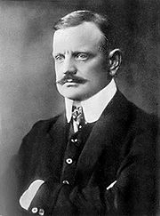
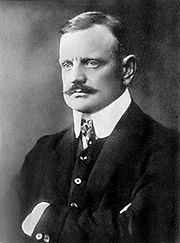
Jean Sibelius

Encyclopedia
Finland
Finland , officially the Republic of Finland, is a Nordic country situated in the Fennoscandian region of Northern Europe. It is bordered by Sweden in the west, Norway in the north and Russia in the east, while Estonia lies to its south across the Gulf of Finland.Around 5.4 million people reside...
composer of the later Romantic period
Romantic music
Romantic music or music in the Romantic Period is a musicological and artistic term referring to a particular period, theory, compositional practice, and canon in Western music history, from 1810 to 1900....
whose music played an important role in the formation of the Finnish national identity
National identity
National identity is the person's identity and sense of belonging to one state or to one nation, a feeling one shares with a group of people, regardless of one's citizenship status....
. His mastery of the orchestra has been described as "prodigious."
The core of Sibelius's oeuvre is his set of seven symphonies
Symphony
A symphony is an extended musical composition in Western classical music, scored almost always for orchestra. A symphony usually contains at least one movement or episode composed according to the sonata principle...
. Like Beethoven
Ludwig van Beethoven
Ludwig van Beethoven was a German composer and pianist. A crucial figure in the transition between the Classical and Romantic eras in Western art music, he remains one of the most famous and influential composers of all time.Born in Bonn, then the capital of the Electorate of Cologne and part of...
, Sibelius used each successive work to further develop his own personal compositional style. His works continue to be performed frequently in the concert hall and are often recorded.
In addition to the symphonies, Sibelius's best-known compositions include Finlandia
Finlandia
Finlandia is a symphonic poem by Jean Sibelius.Finlandia may also refer to:* Finlandia Hymn, a section of the Sibelius symphonic poem Finlandia* Finlandia University, a private university located in Hancock, Michigan, USA...
, the Karelia Suite
Karelia Suite
The Karelia Suite, Op. 11, is a collection of orchestral pieces composed by the Finnish composer Jean Sibelius.The pieces in this suite are drawn from several independent works he wrote in 1893 for a patriotic historical pageant to be presented by students of the University of Helsinki in Viipuri,...
, Valse triste
Valse triste (Sibelius)
Valse triste , Op. 44, No. 1, is a short orchestral work in waltz form by the Finnish composer Jean Sibelius. It was originally part of the incidental music he composed for his brother-in-law Arvid Järnefelt's 1903 play Kuolema , but is far better known as a separate concert piece.Sibelius wrote...
, the Violin Concerto in D minor
Violin Concerto (Sibelius)
The Violin Concerto in D minor, Op. 47, was written by Jean Sibelius in 1904.-History:Sibelius originally dedicated the concerto to the noted violinist Willy Burmester, who promised to play the concerto in Berlin...
and The Swan of Tuonela (one of the four movements of the Lemminkäinen Suite
Lemminkäinen Suite
The Lemminkäinen Suite is a work written by the Finnish composer Jean Sibelius in the early 1890s which forms his opus 22...
). Other works include pieces inspired by the Finnish national epic, the Kalevala
Kalevala
The Kalevala is a 19th century work of epic poetry compiled by Elias Lönnrot from Finnish and Karelian oral folklore and mythology.It is regarded as the national epic of Finland and is one of the most significant works of Finnish literature...
; over 100 songs for voice and piano; incidental music
Incidental music
Incidental music is music in a play, television program, radio program, video game, film or some other form not primarily musical. The term is less frequently applied to film music, with such music being referred to instead as the "film score" or "soundtrack"....
for 13 plays; the opera Jungfrun i tornet
Jungfrun i tornet
Jungfrun i tornet JS 101, is the only completed opera by the Finnish composer Jean Sibelius. Its Swedish libretto is by Rafael Hertzberg. It was first performed in a concert version during a fund-raising evening for the Helsinki Philharmonic Society on 7 November 1896...
(The Maiden in the Tower); chamber music
Chamber music
Chamber music is a form of classical music, written for a small group of instruments which traditionally could be accommodated in a palace chamber. Most broadly, it includes any art music that is performed by a small number of performers with one performer to a part...
; piano music
Piano Music
Piano Music is a suite of four short pieces composed by Alexina Louie in 1982 for the Alliance for Canadian New Music Projects. The four pieces are The Enchanted Bells, Changes, Distant Memories, and Once upon a time....
; Masonic
Freemasonry
Freemasonry is a fraternal organisation that arose from obscure origins in the late 16th to early 17th century. Freemasonry now exists in various forms all over the world, with a membership estimated at around six million, including approximately 150,000 under the jurisdictions of the Grand Lodge...
ritual music; and 21 separate publications of choral music.
Sibelius composed prolifically until the mid-1920s. However, after completing his Seventh Symphony
Symphony No. 7 (Sibelius)
The Symphony No. 7 in C major, Op. 105, was the final published symphony of Jean Sibelius. Completed in 1924, the Seventh is notable for being a one-movement symphony, in contrast to the standard symphonic formula of four movements...
(1924), the incidental music to The Tempest
The Tempest (Sibelius)
Incidental Music to Shakespeare’s The Tempest, Op. 109, was written by Jean Sibelius in 1925-26, at about the same time as he wrote his tone poem Tapiola. The music is said to display an astounding richness of imagination and inventive capacity, and is one of Sibelius's greatest achievements...
(1926), and the tone poem Tapiola
Tapiola (Sibelius)
Tapiola , Op. 112, is a tone poem by the Finnish composer Jean Sibelius, written in 1926. It was the product of a commission from Walter Damrosch for the New York Philharmonic Society...
(1926), he produced no large scale works for the remaining thirty years of his life. Although he is reputed to have stopped composing, he in fact attempted to continue writing, including abortive efforts to compose an eighth symphony
Symphony No. 8 (Sibelius)
Jean Sibelius's Symphony No. 8 was the last major work the composer worked on, and never completed. Today, virtually none of the score exists. The manuscript was probably burned by Sibelius in 1945...
. He wrote some Masonic music and re-edited some earlier works during this last period of his life, and retained an active interest in new developments in music, although he did not always view modern music favorably.
The Finnish 100 mark
Finnish mark
The Finnish markka was the currency of Finland from 1860 until 28 February 2002, when it ceased to be legal tender. The markka was replaced by the euro , which had been introduced, in cash form, on 1 January 2002....
bill featured his image until it was taken out of circulation in 2002.
Life and work
Johan Julius Christian Sibelius was born into a SwedishSwedish language
Swedish is a North Germanic language, spoken by approximately 10 million people, predominantly in Sweden and parts of Finland, especially along its coast and on the Åland islands. It is largely mutually intelligible with Norwegian and Danish...
-speaking family in Hämeenlinna
Hämeenlinna
Hämeenlinna is a city and municipality of about inhabitants in the heart of the historical province of Häme in the south of Finland and is the birthplace of composer Jean Sibelius. Today, it belongs to the region of Tavastia Proper, and until 2010 it was the residence city for the Governor of the...
in the Russian
Russian Empire
The Russian Empire was a state that existed from 1721 until the Russian Revolution of 1917. It was the successor to the Tsardom of Russia and the predecessor of the Soviet Union...
Grand Duchy of Finland
Grand Duchy of Finland
The Grand Duchy of Finland was the predecessor state of modern Finland. It existed 1809–1917 as part of the Russian Empire and was ruled by the Russian czar as Grand Prince.- History :...
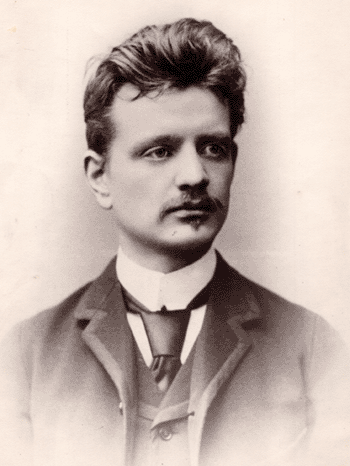
, the son of Christian Gustaf Sibelius and Maria Charlotta Sibelius. Although known as "Janne" to his family, during his student years he began using the French form of his name, "Jean", inspired by the business card of his seafaring uncle. He is now universally known as Jean Sibelius.
Given the rise of the Fennoman
Fennoman
The Fennomans were the most important political movement in the 19th century Grand Principality of Finland. They succeeded the fennophile interests of the 18th and early 19th century.-History:...
movement and its expressions of Romantic Nationalism
Romantic nationalism
Romantic nationalism is the form of nationalism in which the state derives its political legitimacy as an organic consequence of the unity of those it governs...
, his family decided to send him to a Finnish language
Finnish language
Finnish is the language spoken by the majority of the population in Finland Primarily for use by restaurant menus and by ethnic Finns outside Finland. It is one of the two official languages of Finland and an official minority language in Sweden. In Sweden, both standard Finnish and Meänkieli, a...
school, the Hämeenlinna Normal-Lycée
Hämeenlinna Normal-Lycée
The Hämeenlinna Normal-Lycée was the first Finnish language 'Normal-Lycée' in Finland. Its notable alumni include the composer Jean Sibelius....
, which he attended from 1876 to 1885. Romantic Nationalism was to become a crucial element in Sibelius's artistic output and his political leanings. From around the age of 15, he set his heart on becoming a great violin virtuoso, and he did become quite an accomplished player of the instrument, even publicly performing the last two movements of the Mendelssohn Violin Concerto
Violin Concerto (Mendelssohn)
Felix Mendelssohn's Violin Concerto in E minor, Op. 64 is his last large orchestral work. It forms an important part of the violin repertoire and is one of the most popular and most frequently performed violin concertos of all time...
in Helsinki.
University of Helsinki
The University of Helsinki is a university located in Helsinki, Finland since 1829, but was founded in the city of Turku in 1640 as The Royal Academy of Turku, at that time part of the Swedish Empire. It is the oldest and largest university in Finland with the widest range of disciplines available...
(now the University of Helsinki). However, he was more interested in music than in law, and he soon quit his studies. From 1885 to 1889 Sibelius studied music in the Helsinki music school (now the Sibelius Academy
Sibelius Academy
The Sibelius Academy is a university-level music school which operates in Helsinki and Kuopio, Finland. It also has an adult education centre in Järvenpää and a training centre in Seinäjoki. The Academy is the only music university in Finland. It is among the biggest European music universities...
). One of his teachers there was Martin Wegelius
Martin Wegelius
Martin Wegelius was a Finnish composer and musicologist, primarily remembered as the founder, in 1882, of the Helsinki Music Institute, now known as the Sibelius Academy.Wegelius studied in Leipzig, Vienna and Munich...
. Sibelius continued studying in Berlin (from 1889 to 1890 with Albert Becker
Albert Becker (composer)
Albert Ernst Anton Becker was a German composer and conductor of the Romantic period.Becker was born in Quedlinburg. In 1853–1856 he studied music composition under Siegfried Dehn in Berlin. He taught on the faculty of the Akademie der Künste where his famous pupils included Johan Halvorsen and...
) and in Vienna
Vienna
Vienna is the capital and largest city of the Republic of Austria and one of the nine states of Austria. Vienna is Austria's primary city, with a population of about 1.723 million , and is by far the largest city in Austria, as well as its cultural, economic, and political centre...
(from 1890 to 1891). It was around this time that he finally abandoned his cherished violin playing aspirations: "It was a very painful awakening when I had to admit that I had begun my training for the exacting career of a virtuoso too late".
On 10 June 1892, Jean Sibelius married Aino Järnefelt
Aino Sibelius
Aino Sibelius was the wife of Finnish composer Jean Sibelius. They lived most of their 65 years of married life at their home Ainola near Lake Tuusula, Järvenpää, Finland...
(1871–1969) at Maxmo. Their home, called Ainola
Ainola
Ainola, meaning "Aino's land", was the home of Jean Sibelius, his wife Aino and their family from the fall of 1904 until 1972. It stands on the scenic shores of Lake Tuusula in Järvenpää, 38 kilometers north of Helsinki, the Finnish capital. It was designed by the famous Finnish architect Lars Sonck...
, was completed at Lake Tuusula
Tuusulanjärvi
Lake Tuusula is a lake on the border of the municipalities of Tuusula and Järvenpää in Southern Finland. The lake has an area of 6.0 square kilometres. Since the beginning of the twentieth century the shores of Lake Tuusula has been an artist's colony...
, Järvenpää
Järvenpää
Järvenpää is a town and municipality of Finland.-History:Järvenpää was separated from its parent community Tuusula in 1951. Järvenpää was granted the status of a market town after the separation. Neighbouring districts Kellokoski and Nummenkylä were not added to the municipality of Järvenpää and...
in 1903. They had six daughters: Eva, Ruth, Kirsti (who died at a very young age), Katarina, Margareta and Heidi. Margareta married the conductor Jussi Jalas
Jussi Jalas
Jussi Jalas was a Finnish conductor and composer.-Biography:Jussi Jalas was born as Armas Jussi Veikko Blomstedt in Jyväskylä in 1908. His father was the architect Yrjö Blomstedt. He studied at the Helsingfors Conservatory 1923-30 , and then in Paris 1933-34, under Wladimir Pohl, Pierre Monteux...
.
In 1908, Sibelius underwent a serious operation for suspected throat cancer. The impact of this brush with death has been said to have inspired works that he composed in the following years, including Luonnotar
Luonnotar (Sibelius)
Luonnotar, Op. 70, is a tone-poem for soprano and orchestra, completed by Jean Sibelius in 1913. It was dedicated to Aino Ackté, who premiered the work at the Three Choirs Festival in Gloucester, England on 10 September 1913, with an orchestra conducted by Herbert Brewer...
and the Fourth Symphony
Symphony No. 4 (Sibelius)
The Symphony No. 4 in A minor, Op. 63, is one of seven completed symphonies composed by Jean Sibelius. Written between 1910 and 1911, it was premiered in Helsinki on 3 April 1911 by the Philharmonia Society, with Sibelius conducting....
.
Sibelius loved nature, and the Finnish landscape often served as material for his music. He once said of his Sixth Symphony
Symphony No. 6 (Sibelius)
Jean Sibelius's Symphony No. 6 in D minor, Op. 104, was completed in 1923. Although the symphony is usually described as being "in D minor" the score does not contain a key attribution. Much of the symphony is in fact in the Dorian mode....
, "[It] always reminds me of the scent of the first snow." The forests surrounding Ainola are often said to have inspired his composition of Tapiola. On the subject of Sibelius's ties to nature, one biographer of the composer, Erik W. Tawaststjerna
Erik W. Tawaststjerna
Erik Werner Tawaststjerna was the best known Finnish musicologist of his generation. He was also a pianist, pedagogue, critic, and biographer of Jean Sibelius....
, wrote the following:
Symphony No. 7 (Sibelius)
The Symphony No. 7 in C major, Op. 105, was the final published symphony of Jean Sibelius. Completed in 1924, the Seventh is notable for being a one-movement symphony, in contrast to the standard symphonic formula of four movements...
he only produced a few major works in the rest of his life. Arguably the two most significant were incidental music
The Tempest (Sibelius)
Incidental Music to Shakespeare’s The Tempest, Op. 109, was written by Jean Sibelius in 1925-26, at about the same time as he wrote his tone poem Tapiola. The music is said to display an astounding richness of imagination and inventive capacity, and is one of Sibelius's greatest achievements...
for Shakespeare's
William Shakespeare
William Shakespeare was an English poet and playwright, widely regarded as the greatest writer in the English language and the world's pre-eminent dramatist. He is often called England's national poet and the "Bard of Avon"...
The Tempest
The Tempest
The Tempest is a play by William Shakespeare, believed to have been written in 1610–11, and thought by many critics to be the last play that Shakespeare wrote alone. It is set on a remote island, where Prospero, the exiled Duke of Milan, plots to restore his daughter Miranda to her rightful place,...
and the tone poem Tapiola
Tapiola (Sibelius)
Tapiola , Op. 112, is a tone poem by the Finnish composer Jean Sibelius, written in 1926. It was the product of a commission from Walter Damrosch for the New York Philharmonic Society...
. For most of the last thirty years of his life, Sibelius even avoided talking about his music.
There is substantial evidence that Sibelius worked on an eighth numbered symphony
Symphony No. 8 (Sibelius)
Jean Sibelius's Symphony No. 8 was the last major work the composer worked on, and never completed. Today, virtually none of the score exists. The manuscript was probably burned by Sibelius in 1945...
. He promised the premiere of this symphony to Serge Koussevitzky
Serge Koussevitzky
Serge Koussevitzky , was a Russian-born Jewish conductor, composer and double-bassist, known for his long tenure as music director of the Boston Symphony Orchestra from 1924 to 1949.-Early career:...
in 1931 and 1932, and a London performance in 1933 under Basil Cameron
Basil Cameron
Basil Cameron, CBE was an English conductor. He was born in Reading, Berkshire, England, the son of a German immigrant family. His birth name was Basil George Cameron Hindenberg. -Career:...
was even advertised to the public. However, the only concrete evidence for the symphony's existence on paper is a 1933 bill for a fair copy of the first movement. Sibelius had always been quite self-critical; he remarked to his close friends, "If I cannot write a better symphony than my Seventh, then it shall be my last." Since no manuscript survives, sources consider it likely that Sibelius destroyed all traces of the score, probably in 1945, during which year he certainly consigned a great many papers to the flames. His wife Aino recalled,
"In the 1940s there was a great auto da féAuto Da FeAuto Da Fe were an Irish new wave musical group formed in Holland in 1980 by former Steeleye Span singer Gay Woods and Trevor Knight. The band's sound incorporated keyboards and electronics. Woods stated "It was the happiest musical time I ever had so far. I learned so much. I was ridding myself...
at Ainola. My husband collected a number of the manuscripts in a laundry basket and burned them on the open fire in the dining room. Parts of the Karelia Suite were destroyed – I later saw remains of the pages which had been torn out – and many other things. I did not have the strength to be present and left the room. I therefore do not know what he threw on to the fire. But after this my husband became calmer and gradually lighter in mood."
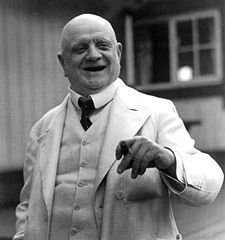
On 1 January 1939, Sibelius participated in an international radio broadcast which included the composer conducting his Andante Festivo. The performance was preserved on transcription discs and later issued on CD. This is probably the only surviving example of Sibelius interpreting his own music.
His 90th birthday, in 1955, was widely celebrated and both the Philadelphia Orchestra
Philadelphia Orchestra
The Philadelphia Orchestra is a symphony orchestra based in Philadelphia, Pennsylvania, in the United States. One of the "Big Five" American orchestras, it was founded in 1900...
under Eugene Ormandy
Eugene Ormandy
Eugene Ormandy was a Hungarian-born conductor and violinist.-Early life:Born Jenő Blau in Budapest, Hungary, Ormandy began studying violin at the Royal National Hungarian Academy of Music at the age of five...
and the Royal Philharmonic Orchestra
Royal Philharmonic Orchestra
The Royal Philharmonic Orchestra is a British orchestra based in London. It tours widely, and is sometimes referred to as "Britain's national orchestra"...
under Sir Thomas Beecham gave special performances of his music in Finland. The orchestras and their conductors also met the composer at his home; a series of memorable photographs were taken to commemorate the occasions. Both Columbia Records and EMI released some of the pictures with albums of Sibelius's music. Beecham was honored by the Finnish government for his efforts to promote Sibelius both in the United Kingdom and in the United States.
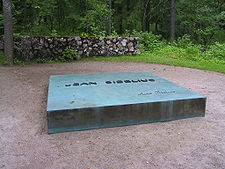
Tawaststjerna also related an endearing anecdote regarding Sibelius's death:
In 1972, Sibelius's surviving daughters sold Ainola to the State of Finland. The Ministry of Education and the Sibelius Society of Finland
Sibelius Society of Finland
The Sibelius Society of Finland is a society in Finland dedicated to the music of the Finnish composer Jean Sibelius. It was set up in December 1957. The Society and the Ministry of Education opened the composer's house Ainola as a museum in 1974....
opened it as a museum in 1974. In 2011, a fragment was discovered of what appeared to be an early draft of the missing eighth symphony.
Musical style
Like many of his contemporaries, Sibelius was initially enamored of the music of WagnerRichard Wagner
Wilhelm Richard Wagner was a German composer, conductor, theatre director, philosopher, music theorist, poet, essayist and writer primarily known for his operas...
. A performance of Parsifal
Parsifal
Parsifal is an opera in three acts by Richard Wagner. It is loosely based on Wolfram von Eschenbach's Parzival, the 13th century epic poem of the Arthurian knight Parzival and his quest for the Holy Grail, and on Chrétien de Troyes' Perceval, the Story of the Grail.Wagner first conceived the work...
at the Bayreuth Festival
Bayreuth Festival
The Bayreuth Festival is a music festival held annually in Bayreuth, Germany, at which performances of operas by the 19th century German composer Richard Wagner are presented...
had a strong effect on him, inspiring him to write to his wife shortly thereafter, "Nothing in the world has made such an impression on me, it moves the very strings of my heart." He studied the scores of Wagner's operas Tannhäuser
Tannhäuser (opera)
Tannhäuser is an opera in three acts, music and text by Richard Wagner, based on the two German legends of Tannhäuser and the song contest at Wartburg...
, Lohengrin
Lohengrin (opera)
Lohengrin is a romantic opera in three acts composed and written by Richard Wagner, first performed in 1850. The story of the eponymous character is taken from medieval German romance, notably the Parzival of Wolfram von Eschenbach and its sequel, Lohengrin, written by a different author, itself...
, and Die Walküre
Die Walküre
Die Walküre , WWV 86B, is the second of the four operas that form the cycle Der Ring des Nibelungen , by Richard Wagner...
intently. With this music in mind, Sibelius began work on an opera of his own, entitled Veneen luominen
Veneen luominen
Veneen luominen was composed by Jean Sibelius. It is an opera inspired by Wagner but the work was never finished as Sibelius became disenchanted with Wagner's compositional techniques.-History:...
(The Building of the Boat).
However, his appreciation for Wagner waned and Sibelius ultimately rejected Wagner's Leitmotif
Leitmotif
A leitmotif , sometimes written leit-motif, is a musical term , referring to a recurring theme, associated with a particular person, place, or idea. It is closely related to the musical idea of idée fixe...
compositional technique, considering it to be too deliberate and calculated. Departing from opera, he later used the musical material from the incomplete Veneen luominen in his Lemminkäinen Suite
Lemminkäinen Suite
The Lemminkäinen Suite is a work written by the Finnish composer Jean Sibelius in the early 1890s which forms his opus 22...
(1893). He did, however, compose a considerable number of songs for voice and piano, whose early interpreters included Aino Ackté
Aino Ackté
Aino Ackté was a Finnish soprano. She was the first international star of the Finnish opera scene after Alma Fohström, and a groundbreaker for the domestic field....
and particularly Ida Ekman
Ida Ekman
Ida Ekman was a Finnish soprano singer. She was also referred to as Ida Morduch-Ekman. Her career was mainly in oratorio and lieder, and she was a renowned interpreter of the songs of Jean Sibelius, many of which were dedicated to her and her husband Karl Ekman, with whose career her own was...
.
More lasting influences included Ferruccio Busoni
Ferruccio Busoni
Ferruccio Busoni was an Italian composer, pianist, editor, writer, piano and composition teacher, and conductor.-Biography:...
, Anton Bruckner
Anton Bruckner
Anton Bruckner was an Austrian composer known for his symphonies, masses, and motets. The first are considered emblematic of the final stage of Austro-German Romanticism because of their rich harmonic language, complex polyphony, and considerable length...
and Tchaikovsky
Pyotr Ilyich Tchaikovsky
Pyotr Ilyich Tchaikovsky Pyotr Ilyich Tchaikovsky Pyotr Ilyich Tchaikovsky (Russian: Пётр Ильи́ч Чайко́вский ; often "Peter Ilich Tchaikovsky" in English. His names are also transliterated "Piotr" or "Petr"; "Ilitsch", "Il'ich" or "Illyich"; and "Tschaikowski", "Tschaikowsky", "Chajkovskij"...
. Hints of Tchaikovsky's music are particularly evident in works such as Sibelius's First Symphony
Symphony No. 1 (Sibelius)
Jean Sibelius's Symphony No. 1 in E minor, Op. 39 was written in 1898, when Sibelius was 33. The work was first performed on 26 April 1899 by the Helsinki Philharmonic Orchestra, conducted by the composer, in an original version which has not survived. After the premiere, Sibelius made some...
(1899) and his Violin Concerto
Violin Concerto (Sibelius)
The Violin Concerto in D minor, Op. 47, was written by Jean Sibelius in 1904.-History:Sibelius originally dedicated the concerto to the noted violinist Willy Burmester, who promised to play the concerto in Berlin...
(1905). Similarities to Bruckner are most strongly felt in the 'unmixed' timbral palette and sombre brass chorales of Sibelius's orchestration, a fondness for pedal points, and in the underlying slow pace of the music.
Sibelius progressively stripped away formal markers of sonata form
History of sonata form
This article treats the history of sonata form in the Baroque, Classical, Romantic, and Modern eras. For a definition of sonata form, see sonata form. For an account of critical thought as it relates to sonata form, see Criticism and sonata form...
in his work and, instead of contrasting multiple themes, he focused on the idea of continuously evolving cells and fragments culminating in a grand statement. His later works are remarkable for their sense of unbroken development, progressing by means of thematic permutations and derivations. The completeness and organic feel of this synthesis has prompted some to suggest that Sibelius began his works with a finished statement and worked backwards, although analyses showing these predominantly three- and four-note cells and melodic fragments as they are developed and expanded into the larger "themes" effectively prove the opposite.
This self-contained structure stood in stark contrast to the symphonic style of Gustav Mahler
Gustav Mahler
Gustav Mahler was a late-Romantic Austrian composer and one of the leading conductors of his generation. He was born in the village of Kalischt, Bohemia, in what was then Austria-Hungary, now Kaliště in the Czech Republic...
, Sibelius's primary rival in symphonic composition. While thematic variation played a major role in the works of both composers, Mahler's style made use of disjunct, abruptly changing and contrasting themes, while Sibelius sought to slowly transform thematic elements. In November 1907 Mahler undertook a conducting tour of Finland, and the two composers had occasion to go on a lengthy walk together. Sibelius later reported that during the walk:
However, the two rivals did find common ground in their music. Like Mahler, Sibelius made frequent use both of folk music and of literature in the composition of his works. The Second Symphony
Symphony No. 2 (Sibelius)
Jean Sibelius's Symphony No. 2 in D major, Opus 43 was started in Winter 1900 in Rapallo, Italy, and finished in 1902 in Finland. It was first performed by the Helsinki Philharmonic Society on 8 March 1902, with the composer conducting...
's slow movement was sketched from the motive of Il Commendatore in Don Giovanni
Don Giovanni
Don Giovanni is an opera in two acts with music by Wolfgang Amadeus Mozart and with an Italian libretto by Lorenzo Da Ponte. It was premiered by the Prague Italian opera at the Teatro di Praga on October 29, 1787...
, while the stark Fourth Symphony
Symphony No. 4 (Sibelius)
The Symphony No. 4 in A minor, Op. 63, is one of seven completed symphonies composed by Jean Sibelius. Written between 1910 and 1911, it was premiered in Helsinki on 3 April 1911 by the Philharmonia Society, with Sibelius conducting....
combined work for a planned "Mountain" symphony with a tone poem based on Edgar Allan Poe
Edgar Allan Poe
Edgar Allan Poe was an American author, poet, editor and literary critic, considered part of the American Romantic Movement. Best known for his tales of mystery and the macabre, Poe was one of the earliest American practitioners of the short story and is considered the inventor of the detective...
's "The Raven
The Raven
"The Raven" is a narrative poem by American writer Edgar Allan Poe, first published in January 1845. It is often noted for its musicality, stylized language, and supernatural atmosphere. It tells of a talking raven's mysterious visit to a distraught lover, tracing the man's slow descent into madness...
". Sibelius also wrote several tone poems
Symphonic poem
A symphonic poem or tone poem is a piece of orchestral music in a single continuous section in which the content of a poem, a story or novel, a painting, a landscape or another source is illustrated or evoked. The term was first applied by Hungarian composer Franz Liszt to his 13 works in this vein...
based on Finnish poetry, beginning with the early En Saga
En Saga
En saga is a tone poem written by the Finnish composer Jean Sibelius in 1892. After hearing Sibelius' choral work Kullervo, the conductor Robert Kajanus encouraged Sibelius to compose a purely orchestral work, which turned out finally to be this work...
and culminating in the late Tapiola
Tapiola (Sibelius)
Tapiola , Op. 112, is a tone poem by the Finnish composer Jean Sibelius, written in 1926. It was the product of a commission from Walter Damrosch for the New York Philharmonic Society...
(1926), his last major composition.
Over time, he sought to use new chord
Chord (music)
A chord in music is any harmonic set of two–three or more notes that is heard as if sounding simultaneously. These need not actually be played together: arpeggios and broken chords may for many practical and theoretical purposes be understood as chords...
patterns, including naked tritone
Tritone
In classical music from Western culture, the tritone |tone]]) is traditionally defined as a musical interval composed of three whole tones. In a chromatic scale, each whole tone can be further divided into two semitones...
s (for example in the Fourth Symphony
Symphony No. 4 (Sibelius)
The Symphony No. 4 in A minor, Op. 63, is one of seven completed symphonies composed by Jean Sibelius. Written between 1910 and 1911, it was premiered in Helsinki on 3 April 1911 by the Philharmonia Society, with Sibelius conducting....
), and bare melodic structures to build long movements of music, in a manner similar to Joseph Haydn
Joseph Haydn
Franz Joseph Haydn , known as Joseph Haydn , was an Austrian composer, one of the most prolific and prominent composers of the Classical period. He is often called the "Father of the Symphony" and "Father of the String Quartet" because of his important contributions to these forms...
's use of built-in dissonance
Consonance and dissonance
In music, a consonance is a harmony, chord, or interval considered stable, as opposed to a dissonance , which is considered to be unstable...
s. Sibelius would often alternate melodic sections with noble brass
Brass instrument
A brass instrument is a musical instrument whose sound is produced by sympathetic vibration of air in a tubular resonator in sympathy with the vibration of the player's lips...
chords that would swell and fade away, or he would underpin his music with repeating figures which push against the melody and counter-melody.
Sibelius's melodies often feature powerful modal
Musical mode
In the theory of Western music since the ninth century, mode generally refers to a type of scale. This usage, still the most common in recent years, reflects a tradition dating to the middle ages, itself inspired by the theory of ancient Greek music.The word encompasses several additional...
implications: for example much of the Sixth Symphony
Symphony No. 6 (Sibelius)
Jean Sibelius's Symphony No. 6 in D minor, Op. 104, was completed in 1923. Although the symphony is usually described as being "in D minor" the score does not contain a key attribution. Much of the symphony is in fact in the Dorian mode....
is in the (modern) Dorian mode
Dorian mode
Due to historical confusion, Dorian mode or Doric mode can refer to three very different musical modes or diatonic scales, the Greek, the medieval, and the modern.- Greek Dorian mode :...
. Sibelius studied Renaissance polyphony
Polyphony
In music, polyphony is a texture consisting of two or more independent melodic voices, as opposed to music with just one voice or music with one dominant melodic voice accompanied by chords ....
, as did his contemporary, the Danish composer Carl Nielsen
Carl Nielsen
Carl August Nielsen , , widely recognised as Denmark's greatest composer, was also a conductor and a violinist. Brought up by poor but musically talented parents on the island of Funen, he demonstrated his musical abilities at an early age...
, and Sibelius's music often reflects the influence of this early music. He often varied his movements in a piece by changing the note values of melodies, rather than the conventional change of tempi
Tempo
In musical terminology, tempo is the speed or pace of a given piece. Tempo is a crucial element of any musical composition, as it can affect the mood and difficulty of a piece.-Measuring tempo:...
. He would often draw out one melody over a number of notes, while playing a different melody in shorter rhythm. For example, his Seventh Symphony
Symphony No. 7 (Sibelius)
The Symphony No. 7 in C major, Op. 105, was the final published symphony of Jean Sibelius. Completed in 1924, the Seventh is notable for being a one-movement symphony, in contrast to the standard symphonic formula of four movements...
comprises four movements without pause, where every important theme is in C major or C minor; the variation comes from the time and rhythm. His harmonic language was often restrained, even iconoclastic, compared to many of his contemporaries who were already experimenting with musical Modernism. As reported by Neville Cardus
Neville Cardus
Sir John Frederick Neville Cardus CBE was an English writer and critic, best known for his writing on music and cricket. For many years, he wrote for The Manchester Guardian. He was untrained in music, and his style of criticism was subjective, romantic and personal, in contrast with his critical...
in the Manchester Guardian
The Guardian
The Guardian, formerly known as The Manchester Guardian , is a British national daily newspaper in the Berliner format...
newspaper in 1958,
Reception
Sibelius exerted considerable influence on symphonic composers and musical life, at least in English-speaking and Nordic countries. Successful Finnish symphonist Leevi MadetojaLeevi Madetoja
Leevi Antti Madetoja was a Finnish composer.-Life and career:Born in Oulu, he was the son of Antti Madetoja and Anna Hyttinen...
was a pupil of Sibelius. In Britain, Vaughan Williams
Ralph Vaughan Williams
Ralph Vaughan Williams OM was an English composer of symphonies, chamber music, opera, choral music, and film scores. He was also a collector of English folk music and song: this activity both influenced his editorial approach to the English Hymnal, beginning in 1904, in which he included many...
and Arnold Bax
Arnold Bax
Sir Arnold Edward Trevor Bax, KCVO was an English composer and poet. His musical style blended elements of romanticism and impressionism, often with influences from Irish literature and landscape. His orchestral scores are noted for their complexity and colourful instrumentation...
both dedicated their 5th symphonies to Sibelius. Furthermore, Tapiola is prominently echoed in both Bax's Sixth Symphony
Symphony No. 6 (Bax)
The Symphony No.6 by Arnold Bax was completed on February 10, 1935. The symphony was dedicated to Sir Adrian Boult, who often conducted Arnold Bax's works but criticized them for being formally loose. Arnold Bax's main aim with this work was to maintain his style but revert to a more classical form...
and Moeran's Symphony in G Minor
Symphony in G minor (Moeran)
The Symphony in G minor was the only completed symphony written by Ernest John Moeran. He wrote it in 1934-37. It is in four movements.In 1926, the conductor of the Hallé Orchestra, Sir Hamilton Harty, commissioned a symphony from Moeran. He had already been working on a symphony since 1924, and...
. The influence of Sibelius's compositional procedures is also strongly felt in the First Symphony
Symphony No. 1 (Walton)
The Symphony No. 1 in B-flat minor by the English composer William Walton was commissioned by Sir Hamilton Harty, and completed in 1935.-Structure:The work is in four movements.# Allegro assai# Scherzo: Presto con malizia...
of William Walton
William Walton
Sir William Turner Walton OM was an English composer. During a sixty-year career, he wrote music in several classical genres and styles, from film scores to opera...
. When these and several other major British symphonic essays were being written in and around the 1930s, Sibelius's music was very much in vogue, with conductors like Beecham and Barbirolli
John Barbirolli
Sir John Barbirolli, CH was an English conductor and cellist. Born in London, of Italian and French parentage, he grew up in a family of professional musicians. His father and grandfather were violinists...
championing its cause both in the concert hall and on record. Walton's composer friend Constant Lambert even claimed that Sibelius was "the first great composer since Beethoven whose mind thinks naturally in terms of symphonic form". Earlier, Granville Bantock
Granville Bantock
Sir Granville Bantock was a British composer of classical music.-Biography:Granville Ransome Bantock was born in London. His father was a Scottish doctor. He was intended by his parents for the Indian Civil Service but was drawn into the musical world. His first teacher was Dr Gordon Saunders at...
had championed Sibelius, and the esteem was evidently mutual, since Sibelius dedicated his Third Symphony to the English composer and he went on to become the first President of the Bantock Society (in 1946). More recently, Sibelius was also one of the composers championed by Robert Simpson
Robert Simpson (composer)
Robert Simpson was an English composer and long-serving BBC producer and broadcaster.He is best known for his orchestral and chamber music , and for his writings on the music of Beethoven, Bruckner, Nielsen and Sibelius. He studied composition under Herbert Howells...
. Malcolm Arnold
Malcolm Arnold
Sir Malcolm Henry Arnold, CBE was an English composer and symphonist.Malcolm Arnold began his career playing trumpet professionally, but by age thirty his life was devoted to composition. He was ranked with Benjamin Britten as one of the most sought-after composers in Britain...
acknowledged his influence, and Arthur Butterworth
Arthur Butterworth
Arthur Butterworth MBE is an English composer, conductor and teacher.Butterworth attended the Royal Manchester College of Music , where he studied composition with Richard Hall and also learned the trumpet and conducting...
continues to see Sibelius's music as a source of inspiration in his own work.
Eugene Ormandy
Eugene Ormandy
Eugene Ormandy was a Hungarian-born conductor and violinist.-Early life:Born Jenő Blau in Budapest, Hungary, Ormandy began studying violin at the Royal National Hungarian Academy of Music at the age of five...
and, to a lesser extent, his predecessor Leopold Stokowski
Leopold Stokowski
Leopold Anthony Stokowski was a British-born, naturalised American orchestral conductor, well known for his free-hand performing style that spurned the traditional baton and for obtaining a characteristically sumptuous sound from many of the great orchestras he conducted.In America, Stokowski...
, were instrumental in bringing Sibelius's music to American audiences by programming his works often; the former developed a friendly relationship with Sibelius throughout his life. Later in life he was championed by critic Olin Downes
Olin Downes
Olin Downes was an American music critic.He studied piano, music theory, and music criticism in New York and Boston, and it was in those two cities that he made his career as a music critic—first with the Boston Post and then with the New York Times...
, who wrote a biography of the composer.
In 1938 Theodor Adorno wrote a critical essay about the composer, notoriously charging that "If Sibelius is good, this invalidates the standards of musical quality that have persisted from Bach
Johann Sebastian Bach
Johann Sebastian Bach was a German composer, organist, harpsichordist, violist, and violinist whose sacred and secular works for choir, orchestra, and solo instruments drew together the strands of the Baroque period and brought it to its ultimate maturity...
to Schoenberg
Arnold Schoenberg
Arnold Schoenberg was an Austrian composer, associated with the expressionist movement in German poetry and art, and leader of the Second Viennese School...
: the richness of inter-connectedness, articulation, unity in diversity, the 'multi-faceted' in 'the one'." Adorno sent his essay to Virgil Thomson, then music critic of the New York Herald Tribune
New York Herald Tribune
The New York Herald Tribune was a daily newspaper created in 1924 when the New York Tribune acquired the New York Herald.Other predecessors, which had earlier merged into the New York Tribune, included the original The New Yorker newsweekly , and the Whig Party's Log Cabin.The paper was home to...
, who was also critical of Sibelius; Thomson, while agreeing with the essay's sentiment, declared to Adorno that "the tone of it [was] more apt to create antagonism toward [Adorno] than toward Sibelius". Later, the composer, theorist and conductor René Leibowitz
René Leibowitz
René Leibowitz was a French composer, conductor, music theorist and teacher born in Warsaw, Poland.-Career:...
went so far as to describe Sibelius as "the worst composer in the world" in the title of a 1955 pamphlet.
Sibelius has sometimes been criticized as a reactionary or even incompetent figure in 20th century classical music. Despite the innovations of the Second Viennese School
Second Viennese School
The Second Viennese School is the group of composers that comprised Arnold Schoenberg and his pupils and close associates in early 20th century Vienna, where he lived and taught, sporadically, between 1903 and 1925...
, he continued to write in a strictly tonal
Tonality
Tonality is a system of music in which specific hierarchical pitch relationships are based on a key "center", or tonic. The term tonalité originated with Alexandre-Étienne Choron and was borrowed by François-Joseph Fétis in 1840...
idiom. Although Sibelius's music is considered by some critics to be insufficiently complex, he was immediately respected by even his more progressive peers. Critics who have sought to re-evaluate Sibelius's music have cited its self-contained internal structure, which distills everything down to a few motivic ideas and then permits the music to grow organically, as evidence of a previously under-appreciated radical bent to his work. The severe nature of Sibelius's orchestration is often noted as representing a "Finnish" character, stripping away the superfluous from music.
Perhaps one reason Sibelius has attracted both the praise and the ire of critics is that in each of his seven symphonies he approached the basic problems of form, tonality, and architecture in unique, individual ways. On the one hand, his symphonic (and tonal) creativity was novel, but others thought that music should be taking a different route. Sibelius's response to criticism was dismissive: "Pay no attention to what critics say. No statue has ever been put up to a critic."
In the latter decades of the twentieth century, Sibelius began to be re-assessed more favourably: Milan Kundera dubbed the composer's approach to be that of "antimodern modernism", standing outside the perpetual progression of the status quo. In 1990, the composer Thea Musgrave
Thea Musgrave
Thea Musgrave CBE is a Scottish composer of opera and classical music.-Biography:Born in Barnton, Edinburgh, Thea Musgrave studied at the University of Edinburgh and in Paris as a pupil of Nadia Boulanger...
was commissioned by the Helsinki Philharmonic Orchestra
Helsinki Philharmonic Orchestra
The Helsinki Philharmonic Orchestra is an orchestra based in Helsinki, Finland...
to write a piece in honour of the 125th anniversary of Sibelius's birth: Song of the Enchanter was premiered on 14 February 1991. In 1984, American avant-garde composer Morton Feldman
Morton Feldman
Morton Feldman was an American composer, born in New York City.A major figure in 20th century music, Feldman was a pioneer of indeterminate music, a development associated with the experimental New York School of composers also including John Cage, Christian Wolff, and Earle Brown...
gave a lecture in Darmstadt
Darmstadt
Darmstadt is a city in the Bundesland of Hesse in Germany, located in the southern part of the Rhine Main Area.The sandy soils in the Darmstadt area, ill-suited for agriculture in times before industrial fertilisation, prevented any larger settlement from developing, until the city became the seat...
, Germany, wherein he stated that "the people you think are radicals might really be conservatives – the people you think are conservatives might really be radical," whereupon he began to hum Sibelius' Fifth Symphony.
Sibelius has fallen in and out of fashion, but remains one of the most popular 20th century symphonists, with complete cycles of his symphonies continuing to be recorded. Sibelius had spent much time producing profitable chamber music for home use, salon music, occasional works for the stage and other incidental music, all of which has now been systematically recorded on BIS Records
BIS Records
BIS Records is a record label founded in 1973 by Robert von Bahr. It is located in Åkersberga, Sweden.BIS focuses on classical music, both contemporary and early, especially works that are not already well represented by existing recordings....
' complete Sibelius Edition. This major editorial project to record every note Sibelius left us also encompasses surviving sketches and early versions of the major works.
Selected works
These are ordered chronologically; the date is the date of composition rather than publication or first performance.Other works
- Viisi joululaulua, Op. 1, five Christmas songs (1895–1913)
- Seven SongsSeven Songs, Op. 17 (Sibelius)Seven Songs, op. 17 is a collection of compositions by Finnish composer Jean Sibelius for solo voice and piano. The music was written between 1891 and 1904. The songs are:...
, Op. 17, with lyrics by J. L. RunebergJohan Ludvig RunebergJohan Ludvig Runeberg was a Finnish poet, and is the national poet of Finland. He wrote in the Swedish language....
, K.A. Tavaststjerna, Oscar LevertinOscar LevertinOscar Ivar Levertin was a Swedish poet, critic and literary historian. Levertin was a dominant voice of the Swedish cultural scene from 1897, when he started writing influential high-profile essays and reviews in the daily paper Svenska Dagbladet...
, A.V. Forsman (Koskimies, Finnish surname), and Ilmari CalamniusIlmari KiantoIlmari Kianto , also known as Ilmari Calamnius and Ilmari Iki-Kianto, was a Finnish poet. He is best known for his books Punainen viiva and Ryysyrannan Jooseppi...
(Kianto, Finnish surname). Composed between 1891 and 1904. - Incidental musicIncidental musicIncidental music is music in a play, television program, radio program, video game, film or some other form not primarily musical. The term is less frequently applied to film music, with such music being referred to instead as the "film score" or "soundtrack"....
to Hjalmar Procopé's play Belshazzar's FeastBelshazzar's Feast (Sibelius)In 1906, Jean Sibelius wrote incidental music to Belshazzar's Feast , a play by his Finnish countryman, the journalist, poet and playwright Hjalmar Fredrik Eugen Procopé . The ten numbers were written for orchestra, with singers also being required in some numbers. The score was published as Op. 51...
, Op. 51 (1906) - Voces intimae, Op. 56, string quartetString quartetA string quartet is a musical ensemble of four string players – usually two violin players, a violist and a cellist – or a piece written to be performed by such a group...
(1909) - Jäger March (Jääkärimarssi) (1915)
Media
See also
- International Jean Sibelius Violin CompetitionInternational Jean Sibelius Violin CompetitionThe International Jean Sibelius Violin Competition, named after Finnish composer Jean Sibelius, is a competition for violinists up to age 30. It is held every five years in Helsinki and is considered to be one of the top 3 most appreciated violin competitions in the world. The first competition...
- Mozart and FreemasonryMozart and FreemasonryFor the last seven years of his life Wolfgang Amadeus Mozart was a Mason. The Masonic order played an important role in his life and work.-Mozart's lodges:...
- Sibelius monumentSibelius monumentThe Sibelius Monument is dedicated to the Finnish composer Jean Sibelius . The monument is located at the Sibelius Park in the district of Töölö in Helsinki, the capital city of Finland....
Further reading
- Ekman, Karl. "Jean Sibelius, His Life and Personality". New York, Tudor Publishing Co., 1945.
- Levas, Santeri. Sibelius: a personal portrait. London, Dent, 1972. ISBN 0460039784.
- Tawaststjerna, ErikErik W. TawaststjernaErik Werner Tawaststjerna was the best known Finnish musicologist of his generation. He was also a pianist, pedagogue, critic, and biographer of Jean Sibelius....
. "Sibelius" (transl. Layton, Robert). London, Faber & Faber, vol.1, 1865–1905 (1976), vol.2, 1904–1914 (1986), vol. 3, 1914–1957 2008). - de Gorog, Lisa (with the collaboration of Ralph de Gorog) "From Sibelius to Sallinen: Finnish Nationalism and the Music of Finland". New York, Greenwood Press, 1989.
- Layton, Robert. Sibelius. New York: Schirmer BooksSchirmer BooksSchirmer Books or Schirmer Publishing can refer to one of several descendants of the original G. Schirmer:* G. Schirmer Associated Music Publishers, a sheet music publisher now part of Music Sales Corporation...
, 1993. Master Musicians Series. ISBN 0-02-871322-2. - Rickards, Guy. Jean Sibelius. London and New York, Phaidon PressPhaidon PressPhaidon Press is a British publisher of books on the visual arts, including art, architecture, photography, and design worldwide.As of 2009, Phaidon's headquarters are in London, UK, though they were in Oxford for many years, with offices in New York City, Paris, Berlin, Milan, and Tokyo...
, 1997. ISBN 978-0-7148-4776-4. - Goss, Glenda Jean Sibelius: Guide to Research. New York: Garland Press, 1998. ISBN 0-8153-1171-0
- Tomi Mäkelä: "Poesie in der Luft. Jean Sibelius, Studien zu Leben und Werk". Wiesbaden, Breitkopf & HärtelBreitkopf & HärtelBreitkopf & Härtel is the world's oldest music publishing house. The firm was founded in 1719 in Leipzig by Bernhard Christoph Breitkopf . The catalogue currently contains over 1000 composers, 8000 works and 15,000 music editions or books on music. The name "Härtel" was added when Gottfried...
, 2007. 978-3-7651-0363-6 - Barnett, Andrew. Sibelius. New Haven and London: Yale University PressYale University PressYale University Press is a book publisher founded in 1908 by George Parmly Day. It became an official department of Yale University in 1961, but remains financially and operationally autonomous....
, 2007. ISBN 978-0-300-11159-0 - Minnesota Orchestra's showcase concert magazine, 6 May, page 44
- Goss, GlendaGlenda GossGlenda Goss is an author and music historian whose special interests are music and culture, early modernism, critical editing, and European-American points of cultural contact...
Sibelius: A Composer’s Life and the Awakening of Finland. Chicago and London: The University of Chicago PressUniversity of Chicago PressThe University of Chicago Press is the largest university press in the United States. It is operated by the University of Chicago and publishes a wide variety of academic titles, including The Chicago Manual of Style, dozens of academic journals, including Critical Inquiry, and a wide array of...
, 2009. ISBN 0-226-30477-9 - Mäkelä, Tomi. Jean Sibelius. Woodbridge, Suffolk and Rochester, NY: Boydell Press, 2011. ISBN 9781843836889
- Bullock, Philip Ross, ed. The Correspondence of Jean Sibelius and Rosa Newmarch, 1906-1939. Woodbridge, Suffolk and Rochester, NY: Boydell Press, 2011. ISBN 9781843836834
External links
- Jean Sibelius – the website (English)
- The Sibelius Society of Finland
- Fennica Gehrman's Sibelius page (publisher)
- Films on Jean Sibelius by director Christopher Nupen
- Jean Sibelius Museum
- Finlandia by Jean Sibelius, thisisFINLAND
- Ainola – The home of Aino and Jean Sibelius
- Jean Sibelius link collection
- Eugene Ormandy – Jean Sibelius: A Reminiscence
- Musical Finland in Brussels
- Veijo Murtomäki, Sibelius, Jean (1865–1957). National Biography of Finland, online collection. 16.9.1997. Finnish Literature Society.