

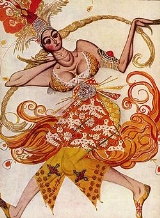
The Firebird

Encyclopedia
The Firebird is a 1910 ballet
created by the composer Igor Stravinsky
and choreographer Michel Fokine
. The ballet is based on Russian folk tales of the magical glowing bird of the same name
that is both a blessing and a curse to its captor.
The ballet has historic significance not only as Stravinsky's breakthrough piece — "Mark him well", said Diaghilev to Tamara Karsavina
, who was dancing the title role: "He is a man on the eve of celebrity..." — but also as the beginning of the collaboration between Diaghilev and Stravinsky that would also produce Petrushka and The Rite of Spring
.
Ballets Russes
productions to have an all-original score composed for it. Alexandre Benois
wrote in 1910 that he had two years earlier suggested to Diaghilev the production of a Russian nationalist ballet, an idea all the more attractive given both the newly awakened French passion for Russian dance and also the ruinously expensive costs of staging opera. The inspiration of mixing the mythical Firebird with the unrelated Russian tale of Kaschei the deathless
possibly came from a popular child's verse by Yakov Polonsky
, "A Winter's Journey" (Zimniy put, 1844), which includes the lines:
Benois collaborated with the choreographer Michel Fokine, drawing from several books of Russian fairy tales including the collection of Alexander Afanasyev
, to concoct a story involving the Firebird and the evil magician Kashchei.
Diaghilev famously approached the Russian composer Anatoly Lyadov (1855–1914) to write the music. There is no evidence, however, despite the much-repeated story that Lyadov was slow to start composing the work, that he ever accepted the commission. There is evidence to suggest that Nikolai Tcherepnin
had previously started composing music for the ballet—music which became The Enchanted Kingdom—but that Tcherepnin, for reasons unexplained, withdrew from the project. Diaghilev eventually transferred the commission to the 28-year old Stravinsky.
The ballet was premiered by the Ballets Russes in Paris on 25 June 1910 conducted by Gabriel Pierné
. Even before the first performance, the company sensed a huge success in the making; and every performance of the ballet in that first production, as Karsavina recalled, met a "crescendo" of success. The critics were ecstatic, praising the ballet for what they perceived as an ideal symbiosis between decor, choreography and music: "The old-gold vermiculatino of the fantastic back-cloth seems to have been invented to a formula identical with that of the shimmering web of the orchestra" enthused Henri Ghéon
in Nouvelle revue française
(1910).
For Stravinsky, it was a major breakthrough both with the public and with the critics, Calvocoressi
in particular hailing Stravinsky as the legitimate heir to The Mighty Handful
. The Firebirds success also secured Stravinsky's position as Diaghilev's star composer, and there were immediate talks of a sequel, leading to the composition of Petrushka and The Rite of Spring
.
, in a production staged in London, using the original decor and costumes from Diaghilev's company. The company subsequently performed the ballet in Australia, during the 1936-37 tour.
The ballet was staged by George Balanchine
for the New York City Ballet
in 1949 with Maria Tallchief
as the Firebird with scenery and costumes by Marc Chagall
, and was performed in repertory until 1965. The ballet was restaged by George Balanchine and Jerome Robbins
in 1970 for the New York City Ballet
with elaborated scenery by Chagall, and with new costumes by Karinska based on Chagall's for the 1972 Stravinsky Festival that introduced Gelsey Kirkland
as the Firebird.
The Mariinsky Ballet
performed the original choreography at Covent Garden
in August 2011 as part of their Fokine retrospective.
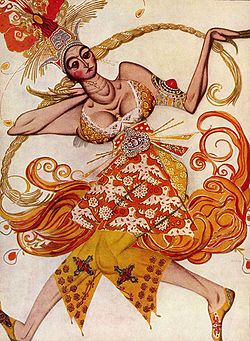 The ballet centers on the journey of its hero, Prince Ivan. Ivan enters the magical realm of Kashchei the Immortal; all of the magical objects and creatures of Kashchei are herein represented by a chromatic
descending motif
, usually in the strings. While wandering in the gardens, he sees and chases the Firebird. The Firebird, once caught by Ivan, begs for its life and ultimately agrees to assist Ivan in exchange for eventual freedom.
Next, Prince Ivan sees thirteen princesses, with one of whom he falls in love. The next day, Ivan chooses to confront Kashchei to ask to marry one of the princesses; the two talk and eventually begin quarreling. When Kashchei sends his magical creatures after Ivan, the Firebird, true to its pledge, intervenes, bewitching the creatures and making them dance an elaborate, energetic dance (the "Infernal Dance"). The creatures and Kashchei then fall asleep; however, Kashchei awakens and is then sent into another dance by the Firebird. While Kashchei is bewitched, the Firebird tells Ivan the secret to Kashchei's immortality – his soul is contained inside an enormous, magical egg. Ivan destroys the egg, killing Kashchei. With Kashchei gone and his spell broken, the magical creatures and the palace all disappear. All of the "real" beings (including the princesses) awaken and (with one final hint of the Firebird's music, though in Fokine's choreography she makes no appearance in that final scene on-stage), celebrate their victory.
There is no consensus for the precise naming of either the different versions, or of the movements, or the numbering of the movements. Different recordings tend to follow different naming conventions. While this partly might be due to the English translation from the original French names, some recordings of the orchestral suites even avoid referring to the tale by just calling the movements by their tempo markings (i.e., Adagio, Allegro, etc.) or the name of the musical form (i.e., Scherzo, Rondo, etc.).
Many adaptations of the Firebird Suite for concert band
, marching band
and drum corps
have been made throughout the years. There are also multiple versions of the choreography for The Firebird—for example, Graeme Murphy
's 2009 version.
Movements separated by Stravinsky himself
Orchestration: 4 flute
s (3rd & 4th also Piccolo
); 3 oboe
s; cor anglais
; 3 clarinet
s (3rd also D Clarinet); bass clarinet
; 3 bassoon
s (2nd also 2nd contrabassoon
); contrabassoon; 4 horns
; 3 trumpet
s; 3 trombone
s; tuba
; 3 trumpets (onstage); 4 Wagner tuba
s (two tenor and two bass, onstage); timpani
; bass drum
; cymbal
s; triangle
; tambourine
; tamtam
; tubular bells
; glockenspiel
; xylophone
; celesta
; 3 harp
s; pianoforte; strings.
The naming convention of the movements and their numberings may be slightly different from one recording to another. E.g., the three parts of the 2nd Tableau may—amongst several others—be seen as: Part II, No. 19a, "Disappearance of the Palace and Dissolution of Kashchei's Enchantments"; No. 19b, "Captive Warriors Emerge From Spell"; No. 19c, "General Thanksgiving". Besides, some CD recordings merge shorter movements with longer movements, so that trackseeking is easier for most listeners.
Orchestration: essentially as per the original ballet—the score was printed from the same plates, with only the new endings for the movements being newly engraved.
Some recordings will list movement no. 1) as three movements.
In 1928, Stravinsky conducted a group of Parisian musicians in a recording of this suite for Columbia Records
, which was released on a set of 12-inch 78-rpm discs.
The Kalmus orchestral score for this suite is dated "1910", while Luck's Music publishes this version as "1912"
The 2005 remastered edition on Sony with conductor Pierre Boulez calls it "Ballet suite for orchestra", while in 1991 Sony called it "Suite, 1910".
Orchestration: 2 Flutes (2nd also Piccolo); 2 Oboes (2nd also English Horn for one measure); 2 Clarinets; 2 Bassoons; 4 Horns; 2 Trumpets; 3 Trombones; Tuba; Timpani; Bass Drum; Tambourine; Cymbals; Triangle; Xylophone; Chimes (Tubular Bells); Harp; Pianoforte (also opt. Celesta); Strings.
Some recordings will list movement no. 1) as two or three movements. It is sometimes also referred to as a "Symphonic Suite".
Orchestration: 2 Flutes (2nd also Piccolo); 2 Oboes; 2 Clarinets; 2 Bassoons; 4 Horns; 2 Trumpets; 3 Trombones; Tuba; Timpani; Bass Drum; Snare Drum; Tambourine; Cymbals; Triangle; Xylophone; Harp; Pianoforte; Strings.
Once again, some recordings will list movement no. 1) as three movements or may refer to this as a "Symphonic Suite". Stravinsky recorded this suite in 1967, his last commercial recording for Columbia Records
.
film Fantasia 2000
based on Stravinsky's piece uses an abridged version (this can be evidenced by a shortened Infernal Dance) of the 1919 suite to tell the story of a spring sprite
and her companion elk
. After a long winter the sprite attempts to restore life to a forest but accidentally wakes the "Firebird" spirit of a nearby volcano. Angered, the Firebird proceeds to destroy the forest and seemingly the sprite. She is restored to life after the destruction and the forest life is reborn with her. The Fantasia 2000 Firebird chapter is considered an exercise in the theme of life-death-rebirth deities; the depiction of the Firebird in it as a violent, flaming volcanic spirit is not related to Stravinsky's original theme. Arguably, this depiction acts as a literal The Rite of Spring
, another Stravinsky ballet used by Disney in the previous Fantasia
film.
The chapter "The Princesses' Khorovod and The Infernal Dance of King Katscheï" in the animated
film Allegro non troppo
uses excerpts from Stravinsky's music, and tells a variant of the Adam and Eve story.
Graeme Murphy
and The Australian Ballet colloborated in 2009 on a new Firebird with set and costume designs by the young designer Leon Krasenstein.
Ballet
Ballet is a type of performance dance, that originated in the Italian Renaissance courts of the 15th century, and which was further developed in France and Russia as a concert dance form. The early portions preceded the invention of the proscenium stage and were presented in large chambers with...
created by the composer Igor Stravinsky
Igor Stravinsky
Igor Fyodorovich Stravinsky ; 6 April 1971) was a Russian, later naturalized French, and then naturalized American composer, pianist, and conductor....
and choreographer Michel Fokine
Michel Fokine
Michel Fokine was a groundbreaking Russian choreographer and dancer.-Biography:...
. The ballet is based on Russian folk tales of the magical glowing bird of the same name
Firebird (Russian folklore)
In Slavic folklore, the Firebird is a magical glowing bird from a faraway land, which is both a blessing and a bringer of doom to its captor....
that is both a blessing and a curse to its captor.
The ballet has historic significance not only as Stravinsky's breakthrough piece — "Mark him well", said Diaghilev to Tamara Karsavina
Tamara Karsavina
Tamara Platonovna Karsavina was a famous Russian ballerina, renowned for her beauty, who was most noted as a Principal Artist of the Imperial Russian Ballet and later the Ballets Russes of Serge Diaghilev...
, who was dancing the title role: "He is a man on the eve of celebrity..." — but also as the beginning of the collaboration between Diaghilev and Stravinsky that would also produce Petrushka and The Rite of Spring
The Rite of Spring
The Rite of Spring, original French title Le sacre du printemps , is a ballet with music by Igor Stravinsky; choreography by Vaslav Nijinsky; and concept, set design and costumes by Nicholas Roerich...
.
Genesis and premiere
The ballet was the first of Diaghilev'sSergei Diaghilev
Sergei Pavlovich Diaghilev , usually referred to outside of Russia as Serge, was a Russian art critic, patron, ballet impresario and founder of the Ballets Russes, from which many famous dancers and choreographers would arise.-Early life and career:...
Ballets Russes
Ballets Russes
The Ballets Russes was an itinerant ballet company from Russia which performed between 1909 and 1929 in many countries. Directed by Sergei Diaghilev, it is regarded as the greatest ballet company of the 20th century. Many of its dancers originated from the Imperial Ballet of Saint Petersburg...
productions to have an all-original score composed for it. Alexandre Benois
Alexandre Benois
Alexandre Nikolayevich Benois , an influential artist, art critic, historian, preservationist, and founding member of Mir iskusstva , an art movement and magazine...
wrote in 1910 that he had two years earlier suggested to Diaghilev the production of a Russian nationalist ballet, an idea all the more attractive given both the newly awakened French passion for Russian dance and also the ruinously expensive costs of staging opera. The inspiration of mixing the mythical Firebird with the unrelated Russian tale of Kaschei the deathless
Koschei
In Slavic folklore, Koschei is an archetypal male antagonist, described mainly as abducting the hero's wife. None of the existing tales actually describes his appearance, though in book illustrations, cartoons and cinema he has been most frequently represented as a very old and ugly-looking man...
possibly came from a popular child's verse by Yakov Polonsky
Yakov Polonsky
Yakov Petrovich Polonsky was a leading Pushkinist poet who tried to uphold the waning traditions of Russian Romantic poetry during the heyday of realistic prose....
, "A Winter's Journey" (Zimniy put, 1844), which includes the lines:
And in my dreams I see myself on a wolf's back
Riding along a forest path
To do battle with a sorcerer-tsar [i.e., Kaschei]
In that land where a princess sits under lock and key,
Pining behind massive walls.
There gardens surround a palace all of glass;
There Firebirds sing by night
And peck at golden fruit.
Benois collaborated with the choreographer Michel Fokine, drawing from several books of Russian fairy tales including the collection of Alexander Afanasyev
Alexander Afanasyev
Alexander Nikolayevich Afanasyev was a Russian folklorist who recorded and published over 600 Russian folktales and fairytales, by far the largest folktale collection by any one man in the world...
, to concoct a story involving the Firebird and the evil magician Kashchei.
Diaghilev famously approached the Russian composer Anatoly Lyadov (1855–1914) to write the music. There is no evidence, however, despite the much-repeated story that Lyadov was slow to start composing the work, that he ever accepted the commission. There is evidence to suggest that Nikolai Tcherepnin
Nikolai Tcherepnin
Nikolai Nikolayevich Tcherepnin was a Russian composer, pianist, and conductor. He was born in Saint Petersburg and studied under Nikolai Rimsky-Korsakov at the Saint Petersburg Conservatory...
had previously started composing music for the ballet—music which became The Enchanted Kingdom—but that Tcherepnin, for reasons unexplained, withdrew from the project. Diaghilev eventually transferred the commission to the 28-year old Stravinsky.
The ballet was premiered by the Ballets Russes in Paris on 25 June 1910 conducted by Gabriel Pierné
Gabriel Pierné
Henri Constant Gabriel Pierné was a French composer, conductor, and organist.-Biography:Gabriel Pierné was born in Metz in 1863. His family moved to Paris to escape the Franco-Prussian War. He studied at the Paris Conservatoire, gaining first prizes for solfège, piano, organ, counterpoint and fugue...
. Even before the first performance, the company sensed a huge success in the making; and every performance of the ballet in that first production, as Karsavina recalled, met a "crescendo" of success. The critics were ecstatic, praising the ballet for what they perceived as an ideal symbiosis between decor, choreography and music: "The old-gold vermiculatino of the fantastic back-cloth seems to have been invented to a formula identical with that of the shimmering web of the orchestra" enthused Henri Ghéon
Henri Ghéon
Henri Ghéon , born Henri Vangeon in Bray-sur-Seine, Seine-et-Marne, was a French playwright, novelist, poet and critic. Brought up by a devout Roman Catholic mother, he lost his faith in his early teens, while still at the Lycée in Sens...
in Nouvelle revue française
Nouvelle Revue Française
La Nouvelle Revue Française is a literary magazine founded in 1909 by a group of intellectuals, including André Gide, Jacques Copeau, and Jean Schlumberger...
(1910).
For Stravinsky, it was a major breakthrough both with the public and with the critics, Calvocoressi
Michel Dimitri Calvocoressi
Michel Dimitri Calvocoressi was a music writer and music critic of Greek descent....
in particular hailing Stravinsky as the legitimate heir to The Mighty Handful
The Five
The Five, also known as The Mighty Handful or The Mighty Coterie , refers to a circle of composers who met in Saint Petersburg, Russia, in the years 1856–1870: Mily Balakirev , César Cui, Modest Mussorgsky, Nikolai Rimsky-Korsakov and Alexander Borodin...
. The Firebirds success also secured Stravinsky's position as Diaghilev's star composer, and there were immediate talks of a sequel, leading to the composition of Petrushka and The Rite of Spring
The Rite of Spring
The Rite of Spring, original French title Le sacre du printemps , is a ballet with music by Igor Stravinsky; choreography by Vaslav Nijinsky; and concept, set design and costumes by Nicholas Roerich...
.
Subsequent ballet performances
The ballet was revived in 1934 by Colonel Wassily de Basil's company, the Ballets Russes de Monte-CarloOriginal Ballet Russe
The Original Ballet Russe was a ballet company established in 1932 by René Blum and Colonel Wassily de Basil as a successor to the Ballets Russes. The company assumed the new name Original Ballet Russe after a split between de Basil and Blum...
, in a production staged in London, using the original decor and costumes from Diaghilev's company. The company subsequently performed the ballet in Australia, during the 1936-37 tour.
The ballet was staged by George Balanchine
George Balanchine
George Balanchine , born Giorgi Balanchivadze in Saint Petersburg, Russia, to a Georgian father and a Russian mother, was one of the 20th century's most famous choreographers, a developer of ballet in the United States, co-founder and balletmaster of New York City Ballet...
for the New York City Ballet
New York City Ballet
New York City Ballet is a ballet company founded in 1948 by choreographer George Balanchine and Lincoln Kirstein. Leon Barzin was the company's first music director. Balanchine and Jerome Robbins are considered the founding choreographers of the company...
in 1949 with Maria Tallchief
Maria Tallchief
Maria Tallchief was the first native-American prima ballerina. From 1942 to 1947 she danced with the Ballet Russe de Monte Carlo, but she is best known for her time with the New York City Ballet from 1947 to 1965.-Early life:...
as the Firebird with scenery and costumes by Marc Chagall
Marc Chagall
Marc Chagall Art critic Robert Hughes referred to Chagall as "the quintessential Jewish artist of the twentieth century."According to art historian Michael J...
, and was performed in repertory until 1965. The ballet was restaged by George Balanchine and Jerome Robbins
Jerome Robbins
Jerome Robbins was an American theater producer, director, and choreographer known primarily for Broadway Theater and Ballet/Dance, but who also occasionally directed films and directed/produced for television. His work has included everything from classical ballet to contemporary musical theater...
in 1970 for the New York City Ballet
New York City Ballet
New York City Ballet is a ballet company founded in 1948 by choreographer George Balanchine and Lincoln Kirstein. Leon Barzin was the company's first music director. Balanchine and Jerome Robbins are considered the founding choreographers of the company...
with elaborated scenery by Chagall, and with new costumes by Karinska based on Chagall's for the 1972 Stravinsky Festival that introduced Gelsey Kirkland
Gelsey Kirkland
Gelsey Kirkland is an American ballerina. Kirkland joined the New York City Ballet in 1968 at age fifteen, at the invitation of George Balanchine. She was promoted to soloist in 1969 and principal in 1972...
as the Firebird.
The Mariinsky Ballet
Mariinsky Ballet
The Mariinsky Ballet is a classical ballet company based at the Mariinsky Theatre in Saint Petersburg, Russia. Founded in the 18th century and originally known as the Imperial Russian Ballet, the Mariinsky Ballet is one of the world's leading ballet companies...
performed the original choreography at Covent Garden
Royal Opera House
The Royal Opera House is an opera house and major performing arts venue in Covent Garden, central London. The large building is often referred to as simply "Covent Garden", after a previous use of the site of the opera house's original construction in 1732. It is the home of The Royal Opera, The...
in August 2011 as part of their Fokine retrospective.
Story
Chromatic scale
The chromatic scale is a musical scale with twelve pitches, each a semitone apart. On a modern piano or other equal-tempered instrument, all the half steps are the same size...
descending motif
Motif (music)
In music, a motif or motive is a short musical idea, a salient recurring figure, musical fragment or succession of notes that has some special importance in or is characteristic of a composition....
, usually in the strings. While wandering in the gardens, he sees and chases the Firebird. The Firebird, once caught by Ivan, begs for its life and ultimately agrees to assist Ivan in exchange for eventual freedom.
Next, Prince Ivan sees thirteen princesses, with one of whom he falls in love. The next day, Ivan chooses to confront Kashchei to ask to marry one of the princesses; the two talk and eventually begin quarreling. When Kashchei sends his magical creatures after Ivan, the Firebird, true to its pledge, intervenes, bewitching the creatures and making them dance an elaborate, energetic dance (the "Infernal Dance"). The creatures and Kashchei then fall asleep; however, Kashchei awakens and is then sent into another dance by the Firebird. While Kashchei is bewitched, the Firebird tells Ivan the secret to Kashchei's immortality – his soul is contained inside an enormous, magical egg. Ivan destroys the egg, killing Kashchei. With Kashchei gone and his spell broken, the magical creatures and the palace all disappear. All of the "real" beings (including the princesses) awaken and (with one final hint of the Firebird's music, though in Fokine's choreography she makes no appearance in that final scene on-stage), celebrate their victory.
Versions
Besides the complete 50-minute ballet score of 1909-10 (written for a very large orchestra including quadruple woodwind and three harps, as well as a piano), there are three shorter 'suites', arranged by the composer himself for concert performance. These date from 1911, 1919 and 1945. While the 1919 suite remains the most well known and often played, the 1945 version contains the most music from the original ballet score (partly motivated by the need to secure copyright in a USA that did not recognize European agreements).There is no consensus for the precise naming of either the different versions, or of the movements, or the numbering of the movements. Different recordings tend to follow different naming conventions. While this partly might be due to the English translation from the original French names, some recordings of the orchestral suites even avoid referring to the tale by just calling the movements by their tempo markings (i.e., Adagio, Allegro, etc.) or the name of the musical form (i.e., Scherzo, Rondo, etc.).
Many adaptations of the Firebird Suite for concert band
Concert band
A concert band, also called wind band, symphonic band, symphonic winds, wind orchestra, wind symphony, wind ensemble, or symphonic wind ensemble, is a performing ensemble consisting of several members of the woodwind instrument family, brass instrument family, and percussion instrument family.A...
, marching band
Marching band
Marching band is a physical activity in which a group of instrumental musicians generally perform outdoors and incorporate some type of marching with their musical performance. Instrumentation typically includes brass, woodwinds, and percussion instruments...
and drum corps
Drum and bugle corps (modern)
A drum and bugle corps, also known as a drum corps, is a musical marching unit consisting of brass instruments, percussion instruments, and color guard. Typically operating as independent non-profit organizations, drum corps perform in competitions, parades, festivals, and other civic functions...
have been made throughout the years. There are also multiple versions of the choreography for The Firebird—for example, Graeme Murphy
Graeme Murphy
Graeme Murphy is an Australian dance choreographer. Together with his fellow dancer Janet Vernon, he has guided Sydney Dance Company to become one of Australia's most successful and well-known dance companies....
's 2009 version.
1910 Ballet Score (aka "Fairy-tale ballet in two tableaux for orchestra")
Most common movement separation in most recordings- I. Introduction
- First Tableau
- II. Le Jardin enchanté de Kachtcheï (The Enchanted Garden of Kastchei)
- III. Apparition de l'Oiseau de feu, poursuivi par Ivan Tsarévitch (Appearance of the Firebird, Pursued by Prince Ivan)
- IV. Danse de l'Oiseau de feu (Dance of the Firebird)
- V. Capture de l'Oiseau de feu par Ivan Tsarévitch (Capture of the Firebird by Prince Ivan)
- VI. Supplications de l'Oiseau de feu (Supplication of the Firebird)
- VII. Apparition des treize princesses enchantées (Appearance of the Thirteen Enchanted Princesses)
- VIII. Jeu des princesses avec les pommes d'or (The Princesses' Game with the Golden Apples). Scherzo
- IX. Brusque apparition d'Ivan Tsarévitch (Sudden Appearance of Prince Ivan)
- X. Khorovode (Ronde) des princesses (KhorovodKhorovodKhorovod is a Slavic art form, a combination of a circle dance and chorus singing, similar to Chorea of ancient Greece.- External links :*...
(Round Dance) of the Princesses) - XI. Lever du jour (Daybreak)
- XII. Ivan Tsarévitch pénètre dans le palais de Kachtcheï (Prince Ivan Penetrates Kastchei's Palace)
- XIII. Carillon Féerique, apparition des monstres-gardiens de Kachtcheï et capture d'Ivan Tsarévitch (Magic Carillon, Appearance of Kastchei's Monster Guardians, and Capture of Prince Ivan)
- XIV. Arrivée de Kachtcheï l'Immortel (Arrival of Kastchei the Immortal)
- XV. Dialogue de Kachtcheï avec Ivan Tsarévitch (Dialogue of Kastchei and Prince Ivan)
- XVI. Intercession des princesses (Intercession of the Princesses)
- XVII. Apparition de l'Oiseau de feu (Appearance of the Firebird)
- XVIII. Danse de la suite de Kachtcheï, enchantée par l'Oiseau de feu (Dance of Kastchei' Retinue, Enchanted by the Firebird)
- XIX. Danse infernale de tous les sujets de Kachtcheï (Infernal Dance of All Kastchei's Subjects)
- XX. Berceuse (L'Oiseau de feu) (Lullaby)
- XXI. Réveil de Kachtcheï (Kastchei's Awakening)
- XXII. Mort de Kachtcheï (Kastchei's Death)
- XXIII. Profondes ténèbres (Profound Darkness)
- Second Tableau
- XXIV. Disparition du palais et des sortilèges de Kachtcheï, animation des chevaliers pétrifiés, allégresse générale (Disappearance of Kastchei's Palace and Magical Creations, Return to Life of the Petrified Knights, General Rejoicing)
Movements separated by Stravinsky himself
- I. Introduction
- First Tableau
- II. Le Jardin enchanté de Kachtcheï (The Enchanted Garden of Kastchei)
- III. Apparition de l'Oiseau de feu, poursuivi par Ivan Tsarévitch (Appearance of the Firebird, Pursued by Prince Ivan)
- IV. Danse de l'Oiseau de feu (Dance of the Firebird)
- V. Capture de l'Oiseau de feu par Ivan Tsarévitch (Capture of the Firebird by Prince Ivan)
- VI. Supplications de l'Oiseau de feu (Supplication of the Firebird) - Apparition des treize princesses enchantées (Appearance of the Thirteen Enchanted Princesses)
- VII. Jeu des princesses avec les pommes d'or (The Princesses' Game with the Golden Apples). Scherzo
- VIII. Brusque apparition d'Ivan Tsarévitch (Sudden Appearance of Prince Ivan)
- IX. Khorovode (Ronde) des princesses (KhorovodKhorovodKhorovod is a Slavic art form, a combination of a circle dance and chorus singing, similar to Chorea of ancient Greece.- External links :*...
(Round Dance) of the Princesses) - X. Lever du jour (Daybreak) - Ivan Tsarévitch pénètre dans le palais de Kachtcheï (Prince Ivan Penetrates Kastchei's Palace)
- XI. Carillon Féerique, apparition des monstres-gardiens de Kachtcheï et capture d'Ivan Tsarévitch (Magic Carillon, Appearance of Kastchei's Monster Guardians, and Capture of Prince Ivan) - Arrivée de Kachtcheï l'Immortel (Arrival of Kastchei the Immortal) - Dialogue de Kachtcheï avec Ivan Tsarévitch (Dialogue of Kastchei and Prince Ivan) - Intercession des princesses (Intercession of the Princesses) - Apparition de l'Oiseau de feu (Appearance of the Firebird)
- XII. Danse de la suite de Kachtcheï, enchantée par l'Oiseau de feu (Dance of Kastchei' Retinue, Enchanted by the Firebird)
- XIII. Danse infernale de tous les sujets de Kachtcheï (Infernal Dance of All Kastchei's Subjects) - Berceuse (L'Oiseau de feu) (Lullaby) - Réveil de Kachtcheï (Kastchei's Awakening) - Mort de Kachtcheï (Kastchei's Death) - Profondes ténèbres (Profound Darkness)
- Second Tableau
- XIV. Disparition du palais et des sortilèges de Kachtcheï, animation des chevaliers pétrifiés, allégresse générale (Disappearance of Kastchei's Palace and Magical Creations, Return to Life of the Petrified Knights, General Rejoicing)
Orchestration: 4 flute
Flute
The flute is a musical instrument of the woodwind family. Unlike woodwind instruments with reeds, a flute is an aerophone or reedless wind instrument that produces its sound from the flow of air across an opening...
s (3rd & 4th also Piccolo
Piccolo
The piccolo is a half-size flute, and a member of the woodwind family of musical instruments. The piccolo has the same fingerings as its larger sibling, the standard transverse flute, but the sound it produces is an octave higher than written...
); 3 oboe
Oboe
The oboe is a double reed musical instrument of the woodwind family. In English, prior to 1770, the instrument was called "hautbois" , "hoboy", or "French hoboy". The spelling "oboe" was adopted into English ca...
s; cor anglais
Cor anglais
The cor anglais , or English horn , is a double-reed woodwind instrument in the oboe family....
; 3 clarinet
Clarinet
The clarinet is a musical instrument of woodwind type. The name derives from adding the suffix -et to the Italian word clarino , as the first clarinets had a strident tone similar to that of a trumpet. The instrument has an approximately cylindrical bore, and uses a single reed...
s (3rd also D Clarinet); bass clarinet
Bass clarinet
The bass clarinet is a musical instrument of the clarinet family. Like the more common soprano B clarinet, it is usually pitched in B , but it plays notes an octave below the soprano B clarinet...
; 3 bassoon
Bassoon
The bassoon is a woodwind instrument in the double reed family that typically plays music written in the bass and tenor registers, and occasionally higher. Appearing in its modern form in the 19th century, the bassoon figures prominently in orchestral, concert band and chamber music literature...
s (2nd also 2nd contrabassoon
Contrabassoon
The contrabassoon, also known as the double bassoon or double-bassoon, is a larger version of the bassoon, sounding an octave lower...
); contrabassoon; 4 horns
Horn (instrument)
The horn is a brass instrument consisting of about of tubing wrapped into a coil with a flared bell. A musician who plays the horn is called a horn player ....
; 3 trumpet
Trumpet
The trumpet is the musical instrument with the highest register in the brass family. Trumpets are among the oldest musical instruments, dating back to at least 1500 BCE. They are played by blowing air through closed lips, producing a "buzzing" sound which starts a standing wave vibration in the air...
s; 3 trombone
Trombone
The trombone is a musical instrument in the brass family. Like all brass instruments, sound is produced when the player’s vibrating lips cause the air column inside the instrument to vibrate...
s; tuba
Tuba
The tuba is the largest and lowest-pitched brass instrument. Sound is produced by vibrating or "buzzing" the lips into a large cupped mouthpiece. It is one of the most recent additions to the modern symphony orchestra, first appearing in the mid-19th century, when it largely replaced the...
; 3 trumpets (onstage); 4 Wagner tuba
Wagner tuba
The Wagner tuba is a comparatively rare brass instrument that combines elements of both the French horn and the tuba. Also referred to as the "Bayreuth Tuba", it was originally created for Richard Wagner's operatic cycle Der Ring des Nibelungen. Since then, other composers have written for it, most...
s (two tenor and two bass, onstage); timpani
Timpani
Timpani, or kettledrums, are musical instruments in the percussion family. A type of drum, they consist of a skin called a head stretched over a large bowl traditionally made of copper. They are played by striking the head with a specialized drum stick called a timpani stick or timpani mallet...
; bass drum
Bass drum
Bass drums are percussion instruments that can vary in size and are used in several musical genres. Three major types of bass drums can be distinguished. The type usually seen or heard in orchestral, ensemble or concert band music is the orchestral, or concert bass drum . It is the largest drum of...
; cymbal
Cymbal
Cymbals are a common percussion instrument. Cymbals consist of thin, normally round plates of various alloys; see cymbal making for a discussion of their manufacture. The greater majority of cymbals are of indefinite pitch, although small disc-shaped cymbals based on ancient designs sound a...
s; triangle
Triangle (instrument)
The triangle is an idiophone type of musical instrument in the percussion family. It is a bar of metal, usually steel but sometimes other metals like beryllium copper, bent into a triangle shape. The instrument is usually held by a loop of some form of thread or wire at the top curve...
; tambourine
Tambourine
The tambourine or marine is a musical instrument of the percussion family consisting of a frame, often of wood or plastic, with pairs of small metal jingles, called "zils". Classically the term tambourine denotes an instrument with a drumhead, though some variants may not have a head at all....
; tamtam
TamTam
The tamtam is a percussion instrument that is similar to a gong. It is sometimes spelled tam-tam.TamTam, Tam-Tam, tamtam, or tam-tam may also refer to:* Tam-Tams, a weekly drum circle held Sundays in the summer in Montreal...
; tubular bells
Tubular Bells
Tubular Bells is the debut record album of English musician Mike Oldfield, released in 1973. It was the first album released by Virgin Records and an early cornerstone of the company's success...
; glockenspiel
Glockenspiel
A glockenspiel is a percussion instrument composed of a set of tuned keys arranged in the fashion of the keyboard of a piano. In this way, it is similar to the xylophone; however, the xylophone's bars are made of wood, while the glockenspiel's are metal plates or tubes, and making it a metallophone...
; xylophone
Xylophone
The xylophone is a musical instrument in the percussion family that consists of wooden bars struck by mallets...
; celesta
Celesta
The celesta or celeste is a struck idiophone operated by a keyboard. Its appearance is similar to that of an upright piano or of a large wooden music box . The keys are connected to hammers which strike a graduated set of metal plates suspended over wooden resonators...
; 3 harp
Harp
The harp is a multi-stringed instrument which has the plane of its strings positioned perpendicularly to the soundboard. Organologically, it is in the general category of chordophones and has its own sub category . All harps have a neck, resonator and strings...
s; pianoforte; strings.
The naming convention of the movements and their numberings may be slightly different from one recording to another. E.g., the three parts of the 2nd Tableau may—amongst several others—be seen as: Part II, No. 19a, "Disappearance of the Palace and Dissolution of Kashchei's Enchantments"; No. 19b, "Captive Warriors Emerge From Spell"; No. 19c, "General Thanksgiving". Besides, some CD recordings merge shorter movements with longer movements, so that trackseeking is easier for most listeners.
1911 Suite (aka "Concert suite for orchestra No. 1")
(1) Introduction – Kashchei's Enchanted Garden – Dance of the Firebird; (2) Supplication of the Firebird; (3) The Princesses’ Game with Apples; (4) The Princesses’ Khorovod (Rondo, round dance); (5) Infernal dance of all Kashchei's Subjects.Orchestration: essentially as per the original ballet—the score was printed from the same plates, with only the new endings for the movements being newly engraved.
Some recordings will list movement no. 1) as three movements.
In 1928, Stravinsky conducted a group of Parisian musicians in a recording of this suite for Columbia Records
Columbia Records
Columbia Records is an American record label, owned by Japan's Sony Music Entertainment, operating under the Columbia Music Group with Aware Records. It was founded in 1888, evolving from an earlier enterprise, the American Graphophone Company — successor to the Volta Graphophone Company...
, which was released on a set of 12-inch 78-rpm discs.
The Kalmus orchestral score for this suite is dated "1910", while Luck's Music publishes this version as "1912"
The 2005 remastered edition on Sony with conductor Pierre Boulez calls it "Ballet suite for orchestra", while in 1991 Sony called it "Suite, 1910".
1919 Suite (aka "Concert suite for orchestra No. 2")
(1) Introduction—The Firebird and its dance—The Firebird's variation; (2) The Princesses’ Khorovod (Rondo, round dance); (3) Infernal dance of King Kashchei; (4) Berceuse (Lullaby); (5) Finale.Orchestration: 2 Flutes (2nd also Piccolo); 2 Oboes (2nd also English Horn for one measure); 2 Clarinets; 2 Bassoons; 4 Horns; 2 Trumpets; 3 Trombones; Tuba; Timpani; Bass Drum; Tambourine; Cymbals; Triangle; Xylophone; Chimes (Tubular Bells); Harp; Pianoforte (also opt. Celesta); Strings.
Some recordings will list movement no. 1) as two or three movements. It is sometimes also referred to as a "Symphonic Suite".
1945 Suite (aka "Ballet suite for orchestra")
(1) Introduction—The Firebird and its dance—The Firebird's variation; (2) Pantomime I; (3) Pas de deux: Firebird and Ivan Tsarevich; (4) Pantomime II; (5) Scherzo: Dance of the Princesses; (6) Pantomime III; (7) The Princesses' Khorovod (Rondo, round dance); (8) Infernal dance of King Kashchei; (9) Berceuse (Lullaby); (10) Finale.Orchestration: 2 Flutes (2nd also Piccolo); 2 Oboes; 2 Clarinets; 2 Bassoons; 4 Horns; 2 Trumpets; 3 Trombones; Tuba; Timpani; Bass Drum; Snare Drum; Tambourine; Cymbals; Triangle; Xylophone; Harp; Pianoforte; Strings.
Once again, some recordings will list movement no. 1) as three movements or may refer to this as a "Symphonic Suite". Stravinsky recorded this suite in 1967, his last commercial recording for Columbia Records
Columbia Records
Columbia Records is an American record label, owned by Japan's Sony Music Entertainment, operating under the Columbia Music Group with Aware Records. It was founded in 1888, evolving from an earlier enterprise, the American Graphophone Company — successor to the Volta Graphophone Company...
.
In popular culture
The chapter in the animatedAnimation
Animation is the rapid display of a sequence of images of 2-D or 3-D artwork or model positions in order to create an illusion of movement. The effect is an optical illusion of motion due to the phenomenon of persistence of vision, and can be created and demonstrated in several ways...
film Fantasia 2000
Fantasia 2000
Fantasia 2000 is a 1999 American animated film produced by Walt Disney Feature Animation and released by Walt Disney Pictures. It was the 38th feature in the Walt Disney Animated Classics series and a sequel to 1940's Fantasia...
based on Stravinsky's piece uses an abridged version (this can be evidenced by a shortened Infernal Dance) of the 1919 suite to tell the story of a spring sprite
Sprite (creature)
The term sprite is a broad term referring to a number of preternatural legendary creatures. The term is generally used in reference to elf-like creatures, including fairies, and similar beings , but can also signify various spiritual beings, including ghosts. In Eoin Colfer's Artemis Fowl books,...
and her companion elk
Red Deer
The red deer is one of the largest deer species. Depending on taxonomy, the red deer inhabits most of Europe, the Caucasus Mountains region, Asia Minor, parts of western Asia, and central Asia. It also inhabits the Atlas Mountains region between Morocco and Tunisia in northwestern Africa, being...
. After a long winter the sprite attempts to restore life to a forest but accidentally wakes the "Firebird" spirit of a nearby volcano. Angered, the Firebird proceeds to destroy the forest and seemingly the sprite. She is restored to life after the destruction and the forest life is reborn with her. The Fantasia 2000 Firebird chapter is considered an exercise in the theme of life-death-rebirth deities; the depiction of the Firebird in it as a violent, flaming volcanic spirit is not related to Stravinsky's original theme. Arguably, this depiction acts as a literal The Rite of Spring
The Rite of Spring
The Rite of Spring, original French title Le sacre du printemps , is a ballet with music by Igor Stravinsky; choreography by Vaslav Nijinsky; and concept, set design and costumes by Nicholas Roerich...
, another Stravinsky ballet used by Disney in the previous Fantasia
Fantasia (film)
Fantasia is a 1940 American animated film produced by Walt Disney and released by Walt Disney Productions. The third feature in the Walt Disney Animated Classics series, the film consists of eight animated segments set to pieces of classical music conducted by Leopold Stokowski, seven of which are...
film.
The chapter "The Princesses' Khorovod and The Infernal Dance of King Katscheï" in the animated
Animation
Animation is the rapid display of a sequence of images of 2-D or 3-D artwork or model positions in order to create an illusion of movement. The effect is an optical illusion of motion due to the phenomenon of persistence of vision, and can be created and demonstrated in several ways...
film Allegro non troppo
Allegro non troppo
Allegro Non Troppo is a 1976 Italian animated film directed by Bruno Bozzetto. Featuring six pieces of classical music, the film is a parody of Disney's Fantasia, though possibly more of a challenge to Fantasia. The classical pieces are set to color animation, ranging from comedy to deep tragedy...
uses excerpts from Stravinsky's music, and tells a variant of the Adam and Eve story.
Graeme Murphy
Graeme Murphy
Graeme Murphy is an Australian dance choreographer. Together with his fellow dancer Janet Vernon, he has guided Sydney Dance Company to become one of Australia's most successful and well-known dance companies....
and The Australian Ballet colloborated in 2009 on a new Firebird with set and costume designs by the young designer Leon Krasenstein.
Complete ballet
Notable recordings of the complete ballet include:| Orchestra | Conductor | Record Company | Year of Recording | Format | Notes |
|---|---|---|---|---|---|
| London Symphony Orchestra London Symphony Orchestra The London Symphony Orchestra is a major orchestra of the United Kingdom, as well as one of the best-known orchestras in the world. Since 1982, the LSO has been based in London's Barbican Centre.-History:... |
Antal Doráti Antal Doráti Antal Doráti, KBE was a Hungarian-born conductor and composer who became a naturalized American citizen in 1947.-Biography:... |
Mercury Records Mercury Records Mercury Records is a record label operating as a standalone company in the UK and as part of the Island Def Jam Motown Music Group in the US; both are subsidiaries of Universal Music Group. There is also a Mercury Records in Australia, which is a local artist and repertoire division of Universal... |
1959 | CD | |
| Columbia Symphony Orchestra Columbia Symphony Orchestra The Columbia Symphony Orchestra was an orchestra formed by Columbia Records. It provided a vehicle for some of Columbia's better known recording artists to record using only company resources.-Bruno Walter:... |
Igor Stravinsky Igor Stravinsky Igor Fyodorovich Stravinsky ; 6 April 1971) was a Russian, later naturalized French, and then naturalized American composer, pianist, and conductor.... |
Columbia Masterworks | 1961 | CD / LP | |
| Royal Concertgebouw Orchestra Royal Concertgebouw Orchestra The Royal Concertgebouw Orchestra is a symphony orchestra of the Netherlands, based at the Concertgebouw in Amsterdam. In 1988, Queen Beatrix of the Netherlands conferred the "Royal" title upon the orchestra... |
Colin Davis Colin Davis Sir Colin Rex Davis, CH, CBE is an English conductor. His repertoire is broad, but among the composers with whom he is particularly associated are Mozart, Berlioz, Elgar, Sibelius, Stravinsky and Tippett.... |
Philips Philips Koninklijke Philips Electronics N.V. , more commonly known as Philips, is a multinational Dutch electronics company.... |
1978 | CD | |
| Royal Danish Orchestra Royal Danish Orchestra The Royal Danish Orchestra is a Danish orchestra based in Copenhagen. The Danish name for the orchestra indicates its original function as an ensemble geared to supplying the music for court events... |
Paul Jorgensen Paul Jorgensen Paul Jorgensen was a super featherweight professional boxer from Louisiana.-Personal life:Jorgenson was born in Tallulah, Louisiana and made his residence in Port Arthur, Texas.-Professional career:... |
Kultur | 1982 | DVD | |
| Detroit Symphony Orchestra Detroit Symphony Orchestra The Detroit Symphony Orchestra is an American orchestra based in Detroit, Michigan. Its main performance center is Orchestra Hall at the Max M. Fisher Music Center in Detroit's Midtown neighborhood... |
Antal Doráti Antal Doráti Antal Doráti, KBE was a Hungarian-born conductor and composer who became a naturalized American citizen in 1947.-Biography:... |
Decca Records Decca Records Decca Records began as a British record label established in 1929 by Edward Lewis. Its U.S. label was established in late 1934; however, owing to World War II, the link with the British company was broken for several decades.... |
1982 | CD | |
| Montreal Symphony Orchestra Montreal Symphony Orchestra Orchestre symphonique de Montréal is a symphony orchestra based in Montréal, Québec, Canada, with Montréal's Place des Arts as its home.-History:... |
Charles Dutoit Charles Dutoit Charles Édouard Dutoit, is a Swiss conductor, particularly noted for his interpretations of French and Russian 20th century music... |
Decca Records Decca Records Decca Records began as a British record label established in 1929 by Edward Lewis. Its U.S. label was established in late 1934; however, owing to World War II, the link with the British company was broken for several decades.... |
1984 | CD | |
| Chicago Symphony Orchestra Chicago Symphony Orchestra The Chicago Symphony Orchestra is an American orchestra based in Chicago, Illinois. It is one of the five American orchestras commonly referred to as the "Big Five". Founded in 1891, the Symphony makes its home at Orchestra Hall in Chicago and plays a summer season at the Ravinia Festival... |
Pierre Boulez Pierre Boulez Pierre Boulez is a French composer of contemporary classical music, a pianist, and a conductor.-Early years:Boulez was born in Montbrison, Loire, France. As a child he began piano lessons and demonstrated aptitude in both music and mathematics... |
Deutsche Grammophon Deutsche Grammophon Deutsche Grammophon is a German classical record label which was the foundation of the future corporation to be known as PolyGram. It is now part of Universal Music Group since its acquisition and absorption of PolyGram in 1999, and it is also UMG's oldest active label... |
1993 | CD | |
| Kirov Orchestra | Valeri Gergiev | Philips Classics Records Philips Classics Records Philips Classics Records was started in the 1980s as the new classics record label for Philips Records. It was successful with artists including Alfred Brendel, Sir John Eliot Gardiner, Sir Neville Marriner and the Academy of St... |
1995 | CD | |
| Philharmonia Orchestra Philharmonia Orchestra The Philharmonia Orchestra is one of the leading orchestras in Great Britain, based in London. Since 1995, it has been based in the Royal Festival Hall. In Britain it is also the resident orchestra at De Montfort Hall, Leicester and the Corn Exchange, Bedford, as well as The Anvil, Basingstoke... |
Robert Craft Robert Craft Robert Lawson Craft is an American conductor and writer. He is best known for his intimate working friendship with Igor Stravinsky, a relationship which resulted in a number of recordings and books.-Life:... |
Koch Records Koch Records E1 Music , the primary subsidiary of E1 Entertainment LP, is the largest independent record label in the United States. It is also distributed by the Universal Music Group in Europe under the name E1 Universal... / Naxos Records Naxos Records Naxos Records is a record label specializing in classical music. Through a number of imprints, Naxos also releases genres including Chinese music, jazz, world music, and early rock & roll. The company was founded in 1987 by Klaus Heymann, a German-born resident of Hong Kong.Naxos is the largest... |
1996 | CD | |
| Orchestre de Paris Orchestre de Paris The Orchestre de Paris is a French orchestra based in Paris. The orchestra performs most of its concerts at the Salle Pleyel.-History:In 1967, following the dissolution of the Orchestre de la Société des Concerts du Conservatoire, conductor Charles Munch was called on by the Minister of Culture,... |
Seiji Ozawa Seiji Ozawa is a Japanese conductor, particularly noted for his interpretations of large-scale late Romantic works. He is most known for his work as music director of the Boston Symphony Orchestra and principal conductor of the Vienna State Opera.-Early years:... |
EMI EMI The EMI Group, also known as EMI Music or simply EMI, is a multinational music company headquartered in London, United Kingdom. It is the fourth-largest business group and family of record labels in the recording industry and one of the "big four" record companies. EMI Group also has a major... |
1997 | CD | |
| San Francisco Symphony Orchestra | Michael Tilson Thomas Michael Tilson Thomas Michael Tilson Thomas is an American conductor, pianist and composer. He is currently music director of the San Francisco Symphony, and artistic director of the New World Symphony Orchestra.-Early years:... |
RCA RCA RCA Corporation, founded as the Radio Corporation of America, was an American electronics company in existence from 1919 to 1986. The RCA trademark is currently owned by the French conglomerate Technicolor SA through RCA Trademark Management S.A., a company owned by Technicolor... |
1998 | CD | |
| City of Birmingham Symphony Orchestra City of Birmingham Symphony Orchestra The City of Birmingham Symphony Orchestra is a British orchestra based in Birmingham, England. The Orchestra's current chief executive, appointed in 1999, is Stephen Maddock... |
Simon Rattle Simon Rattle Sir Simon Denis Rattle, CBE is an English conductor. He rose to international prominence as conductor of the City of Birmingham Symphony Orchestra and since 2002 has been principal conductor of the Berlin Philharmonic .... |
EMI EMI The EMI Group, also known as EMI Music or simply EMI, is a multinational music company headquartered in London, United Kingdom. It is the fourth-largest business group and family of record labels in the recording industry and one of the "big four" record companies. EMI Group also has a major... |
2008 | CD | |
| Los Angeles Philharmonic Orchestra | Esa-Pekka Salonen Esa-Pekka Salonen Esa-Pekka Salonen is a Finnish orchestral conductor and composer. He is currently Principal Conductor and Artistic Advisor of the Philharmonia Orchestra in London and Conductor Laureate of the Los Angeles Philharmonic.-Early career:... |
Deutsche Grammophon Deutsche Grammophon Deutsche Grammophon is a German classical record label which was the foundation of the future corporation to be known as PolyGram. It is now part of Universal Music Group since its acquisition and absorption of PolyGram in 1999, and it is also UMG's oldest active label... |
2008 | Digital download | |
Firebird Suite
- George SzellGeorge SzellGeorge Szell , originally György Széll, György Endre Szél, or Georg Szell, was a Hungarian-born American conductor and composer...
conducting the Cleveland OrchestraCleveland OrchestraThe Cleveland Orchestra is an American orchestra based in Cleveland, Ohio. It is one of the five American orchestras informally referred to as the "Big Five". Founded in 1918, the orchestra plays most of its concerts at Severance Hall...
(released on Epic RecordsEpic RecordsEpic Records is an American record label, owned by Sony Music Entertainment. Though it was originally conceived as a jazz imprint, it has since expanded to represent various genres. L.A...
as LC 3812 and BC 1149; the disc also includes William WaltonWilliam WaltonSir William Turner Walton OM was an English composer. During a sixty-year career, he wrote music in several classical genres and styles, from film scores to opera...
's Symphony No. 2) - Robert ShawRobert Shaw (conductor)Robert Shaw was an American conductor most famous for his work with his namesake Chorale, with the Cleveland Orchestra and Chorus, and the Atlanta Symphony Orchestra and Chorus. Shaw received 14 Grammy awards, four ASCAP awards for service to contemporary music, the first Guggenheim Fellowship...
conducting the Atlanta Symphony OrchestraAtlanta Symphony OrchestraThe Atlanta Symphony Orchestra is an American orchestra based in Atlanta, Georgia, USA. Robert Spano has been its music director since 2001...
(released on Telarc as CD-80039); the disc also includes [some of the] Music from Prince Igor, by Alexander BorodinAlexander BorodinAlexander Porfiryevich Borodin was a Russian Romantic composer and chemist of Georgian–Russian parentage. He was a member of the group of composers called The Five , who were dedicated to producing a specifically Russian kind of art music... - Pierre MonteuxPierre MonteuxPierre Monteux was an orchestra conductor. Born in Paris, France, Monteux later became an American citizen.-Life and career:Monteux was born in Paris in 1875. His family was descended from Sephardi Jews who came to France in the wake of the Spanish Inquisition. He studied violin from an early age,...
conducting the Paris Conservatoire Orchestra (released on Decca RecordsDecca RecordsDecca Records began as a British record label established in 1929 by Edward Lewis. Its U.S. label was established in late 1934; however, owing to World War II, the link with the British company was broken for several decades....
in 1972 as STS 15197; the disc also includes the complete PetrushkaPetrushkaPetrouchka or Petrushka is a ballet with music by Russian composer Igor Stravinsky, composed in 1910–11 and revised in 1947....
ballet) - Gennady RozhdestvenskyGennady RozhdestvenskyGennady Nikolayevich Rozhdestvensky is a Russian conductor.-Biography:Rozhdestvensky was born in Moscow. His parents were the noted conductor and pedagogue Nikolai Anosov and soprano Natalya Rozhdestvenskaya...
conducting the Concertgebouw Orchestra (broadcast by the Radio Nederland Transcription Service on the Dutch Concert Rostrum, Program 8319; not commercially released; the program also includes Wolfgang Amadeus MozartWolfgang Amadeus MozartWolfgang Amadeus Mozart , baptismal name Johannes Chrysostomus Wolfgangus Theophilus Mozart , was a prolific and influential composer of the Classical era. He composed over 600 works, many acknowledged as pinnacles of symphonic, concertante, chamber, piano, operatic, and choral music...
's Overture to The Marriage of FigaroThe Marriage of FigaroLe nozze di Figaro, ossia la folle giornata , K. 492, is an opera buffa composed in 1786 in four acts by Wolfgang Amadeus Mozart, with Italian libretto by Lorenzo Da Ponte, based on a stage comedy by Pierre Beaumarchais, La folle journée, ou le Mariage de Figaro .Although the play by...
(Rotterdam Philharmonic OrchestraRotterdam Philharmonic OrchestraThe Rotterdam Philharmonic Orchestra is a Dutch symphony orchestra based in Rotterdam. Its primary venue is the concert hall De Doelen. The RPhO is considered one of the Netherlands' two principal orchestras of international standing, second to the Royal Concertgebouw Orchestra of Amsterdam...
/Jean FournetJean FournetJean Fournet was a French conductor.Fournet’s father was a flutist who gave him some instruction on the flute and music theory. Fournet was then trained at the Conservatoire de Paris in flute by Gaston Blanquart and Marcel Moyse, and conducting by Philippe Gaubert...
) and Johannes BrahmsJohannes BrahmsJohannes Brahms was a German composer and pianist, and one of the leading musicians of the Romantic period. Born in Hamburg, Brahms spent much of his professional life in Vienna, Austria, where he was a leader of the musical scene...
's Variations on the Chorale St. Anthony, op. 56a (Concertgebouw Orchestra/Erich LeinsdorfErich LeinsdorfErich Leinsdorf was a naturalized American Austrian conductor. He performed and recorded with leading orchestras and opera companies throughout the United States and Europe, earning a reputation for exacting standards as well as an acerbic personality...
)) - Kazuhito YamashitaKazuhito Yamashitais a Japanese classical guitarist. His technique and expression are considered somewhat controversial.-Musical career:Yamashita began to study the guitar at the age of eight with his father, Toru Yamashita. In 1972, aged eleven, he won the Kyushu Guitar Competition. Four years later, he was awarded...
—arrangement for classical guitar (released on RCA RecordsRCA RecordsRCA Records is one of the flagship labels of Sony Music Entertainment. The RCA initials stand for Radio Corporation of America , which was the parent corporation from 1929 to 1985 and a partner from 1985 to 1986.RCA's Canadian unit is Sony's oldest label...
in 1989; the disc also includes a classical guitar arrangement of Antonín DvořákAntonín DvorákAntonín Leopold Dvořák was a Czech composer of late Romantic music, who employed the idioms of the folk music of Moravia and his native Bohemia. Dvořák’s own style is sometimes called "romantic-classicist synthesis". His works include symphonic, choral and chamber music, concerti, operas and many...
's Symphony No. 9) - Ivan FischerIván FischerIván Fischer is a Hungarian conductor and composer. Born in Budapest into a Jewish musical family, Fischer initially studied piano, violin, cello and composition in Budapest...
conducting the Budapest Festival OrchestraBudapest Festival OrchestraThe Budapest Festival Orchestra was formed in 1983 by Iván Fischer and Zoltán Kocsis, with musicians "drawn from the cream of Hungary's younger players", as The Times put it...
, 1919 version (released on HungarotonHungarotonHungaroton was the one and only record and music publisher company in Hungary for about 40 years.Hungaroton was founded in 1951, since then, its only competitors in the Hungarian music market were record labels like Melodiya, Supraphon and Eterna from other socialist countries. Previously called...
in 1990 as HCD 31095, recorded in 1988; the disc also includes the complete PetrushkaPetrushkaPetrouchka or Petrushka is a ballet with music by Russian composer Igor Stravinsky, composed in 1910–11 and revised in 1947....
ballet, 1946-47 version) - Neeme JärviNeeme JärviNeeme Järvi is an Estonian-born conductor.-Early life:Järvi studied music first in Tallinn, and later in Leningrad at the Leningrad Conservatory under Yevgeny Mravinsky, and Nikolai Rabinovich, among others...
conducting the London Symphony OrchestraLondon Symphony OrchestraThe London Symphony Orchestra is a major orchestra of the United Kingdom, as well as one of the best-known orchestras in the world. Since 1982, the LSO has been based in London's Barbican Centre.-History:...
, 1945 version recorded in 1988 and released on Chandos RecordsChandos RecordsChandos Records is an independent classical music recording company based in Colchester, Essex, in the United Kingdom, founded in 1979 by Brian Couzens.- Background :...
in 1989; also includes Nikolai Rimsky-KorsakovNikolai Rimsky-KorsakovNikolai Andreyevich Rimsky-Korsakov was a Russian composer, and a member of the group of composers known as The Five.The Five, also known as The Mighty Handful or The Mighty Coterie, refers to a circle of composers who met in Saint Petersburg, Russia, in the years 1856–1870: Mily Balakirev , César...
's Dubinushka, Op. 62 and Lyadov's Baba-Yaga op. 56, The Enchanted Lake Op. 62 and Kilimora Op. 63 - Jahni Mardjani conducting the Georgian Festival Orchestra. This disc also has a version of Claude DebussyClaude DebussyClaude-Achille Debussy was a French composer. Along with Maurice Ravel, he was one of the most prominent figures working within the field of impressionist music, though he himself intensely disliked the term when applied to his compositions...
's Nocturnes - Myung-whun ChungMyung-Whun ChungMyung-whun Chung is a South Korean pianist and conductor.His sisters, violinist Kyung-wha Chung, and cellist Myung-wha Chung, and he at one time performed together as the Chung Trio. He was a joined second-prize winner in the 1974 International Tchaikovsky Competition. Chung studied conducting at...
conducting the Orchestra of the Bastille Opera, coupled to Rimsky-Korsakov's ScheherazadeScheherazadeScheherazade , sometimes Scheherazadea, Persian transliteration Shahrazad or Shahrzād is a legendary Persian queen and the storyteller of One Thousand and One Nights.-Narration :...
. Recorded in 1992 and released in 1993 on Deutsche GrammophonDeutsche GrammophonDeutsche Grammophon is a German classical record label which was the foundation of the future corporation to be known as PolyGram. It is now part of Universal Music Group since its acquisition and absorption of PolyGram in 1999, and it is also UMG's oldest active label...
. - Leonard BernsteinLeonard BernsteinLeonard Bernstein August 25, 1918 – October 14, 1990) was an American conductor, composer, author, music lecturer and pianist. He was among the first conductors born and educated in the United States of America to receive worldwide acclaim...
has recorded it several times with various orchestras including the New York PhilharmonicNew York PhilharmonicThe New York Philharmonic is a symphony orchestra based in New York City in the United States. It is one of the American orchestras commonly referred to as the "Big Five"...
, the London Symphony OrchestraLondon Symphony OrchestraThe London Symphony Orchestra is a major orchestra of the United Kingdom, as well as one of the best-known orchestras in the world. Since 1982, the LSO has been based in London's Barbican Centre.-History:...
, and the Israel Philharmonic OrchestraIsrael Philharmonic OrchestraThe Israel Philharmonic Orchestra is the leading symphony orchestra in Israel. It was originally known as the Palestine Orchestra, and in Hebrew as התזמורת הסימפונית הארץ ישראלית The Israel Philharmonic Orchestra (abbreviation IPO; Hebrew: התזמורת הפילהרמונית הישראלית, ha-Tizmoret ha-Filharmonit...
. Each of these has been released on CD multiple times. - Leopold StokowskiLeopold StokowskiLeopold Anthony Stokowski was a British-born, naturalised American orchestral conductor, well known for his free-hand performing style that spurned the traditional baton and for obtaining a characteristically sumptuous sound from many of the great orchestras he conducted.In America, Stokowski...
recorded The Firebird Suite eight times, more than any other conductor ... with the Philadelphia Orchestra (acoustically) in 1924, and again (electrically) in 1927 and 1935; with the All-American Youth Orchestra in 1941 and the NBC Symphony Orchestra in 1942; with his own Symphony Orchestra in 1950; and in two stereo recordings, with the Berlin Philharmonic in 1957, and finally, at the age of 85, with the London Symphony Orchestra in 1967. - Isao TomitaIsao Tomita, often known simply as Tomita, is a Japanese music composer, regarded as one of the pioneers of electronic music and space music, and as one of the most famous producers of analog synthesizer arrangements...
recorded an electronic arrangement of "The Firebird" Suite in 1975 using a Moog IIIMoog modular synthesizerMoog modular synthesizer refers to any of a number of monophonic analog modular synthesizers designed by the late electronic instrument pioneer Dr. Robert Moog and manufactured by R.A Moog Co...
synthesizerSynthesizerA synthesizer is an electronic instrument capable of producing sounds by generating electrical signals of different frequencies. These electrical signals are played through a loudspeaker or set of headphones...
and other electronic instruments available at the time. - Vincent Montana, Jr, recorded a disco version in 1977 with the Salsoul OrchestraSalsoul OrchestraThe Salsoul Orchestra was the backing band for acts on Salsoul Records. Under their own name the group recorded several hit singles and albums between 1975 and 1981.-Group History:...
calling the piece "Magic Bird of Fire" on his album Magic Journey. - Col. John R. BourgeoisJohn R. BourgeoisColonel John R. Bourgeois was a conductor of the United States Marine Band from 1979 to 1996, as well as esteemed composer / arranger of American music. Bourgeois also currently serves as Vice President of the Board of Trustees of the Sinfonia Educational Foundation...
conducted the United States Marine BandUnited States Marine BandThe United States Marine Band is the premier band of the United States Marine Corps. Established by act of Congress on July 11, 1798, it is the oldest of the United States military bands and the oldest professional musical organization in the United States...
in the Thomas Knox symphonic band transcription in a concert at the 1991 Texas Music Educators AssociationTexas Music Educators AssociationTexas Music Educators Association, or TMEA, is an organization of over 9,000 Texas school music educators. Its stated goals are to provide professional growth opportunities, to encourage interaction among music education professionals, to foster public support for music in schools, to offer...
All-State Convention/Clinic. Mark Custom Recording Service TMEA91-MCD-1 - Experimental Progressive RockProgressive rockProgressive rock is a subgenre of rock music that developed in the late 1960s and early 1970s as part of a "mostly British attempt to elevate rock music to new levels of artistic credibility." John Covach, in Contemporary Music Review, says that many thought it would not just "succeed the pop of...
band The Stick Men released a rendition of the entire suite on their 2010 album Soup using only two Chapman StickChapman StickThe Chapman Stick is an electric musical instrument devised by Emmett Chapman in the early 1970s. A member of the guitar family, the Chapman Stick usually has ten or twelve individually tuned strings and has been used on music recordings to play bass lines, melody lines, chords or textures...
s and a drum set.
Excerpts from the Firebird Suite
- Berceuse: Lori SingerLori SingerLori Singer is an American actress. She is perhaps best known for her role as Ariel Moore, the female lead in the 1984 feature film Footloose, and as Julie Miller in the television series Fame.-Film and television career:...
, solo cello performance (included on the Short CutsShort CutsShort Cuts is a 1993 American drama film directed by Robert Altman. Filmed from a screenplay by Robert Altman and Frank Barhydt, it is inspired by nine short stories and a poem by Raymond Carver...
soundtrack) - Danse Infernal: Igor Stravinsky conducting the Columbia Symphony OrchestraColumbia Symphony OrchestraThe Columbia Symphony Orchestra was an orchestra formed by Columbia Records. It provided a vehicle for some of Columbia's better known recording artists to record using only company resources.-Bruno Walter:...
(released on Columbia RecordsColumbia RecordsColumbia Records is an American record label, owned by Japan's Sony Music Entertainment, operating under the Columbia Music Group with Aware Records. It was founded in 1888, evolving from an earlier enterprise, the American Graphophone Company — successor to the Volta Graphophone Company...
as MS 7094; disc includes five other Stravinsky compositions) - Firebird Suite (1919 version—excerpt): James Levine and the Chicago Symphony. Included on the "Fantasia 2000" soundtrack album.
- The progressive rockProgressive rockProgressive rock is a subgenre of rock music that developed in the late 1960s and early 1970s as part of a "mostly British attempt to elevate rock music to new levels of artistic credibility." John Covach, in Contemporary Music Review, says that many thought it would not just "succeed the pop of...
band, YesYes (band)Yes are an English rock band who achieved worldwide success with their progressive, art, and symphonic style of rock music. Regarded as one of the pioneers of the progressive genre, Yes are known for their lengthy songs, mystical lyrics, elaborate album art, and live stage sets...
used an excerpt from Firebird Suite to open concerts, and also appears as the first track on many live CDs and DVDs. - Many drum corpsDrum and bugle corps (modern)A drum and bugle corps, also known as a drum corps, is a musical marching unit consisting of brass instruments, percussion instruments, and color guard. Typically operating as independent non-profit organizations, drum corps perform in competitions, parades, festivals, and other civic functions...
have performed the Firebird Suite including: Phantom Regiment, Blue StarsBlue Stars Drum and Bugle CorpsThe Blue Stars Drum and Bugle Corps is a World Class drum and bugle corps based in La Crosse, Wisconsin and founded in 1964...
, and The CavaliersThe Cavaliers Drum and Bugle CorpsThe Cavaliers are a World Class drum and bugle corps based in Rosemont, Illinois and founded in 1948 by Donald Warren, and are a member corps of Drum Corps International, marching music's major league. The Cavaliers are currently under the direction of Adolph DeGrauwe...