


Russian Musical Society

Encyclopedia
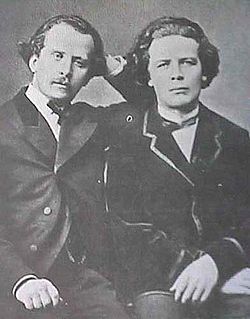
The Russian Musical Society (RMS) was an organisation founded in 1859 by the Grand Duchess Elena Pavlovna (a German-born aunt of Tsar
Alexander II
) and her protégé, pianist and composer Anton Rubinstein
, with the intent of raising the standard of music in the country and disseminating musical education.
Rubinstein and the Grand Duchess's travels together in Europe a decade earlier had prompted them to set up a permanent society to encourage both the study and performance of music in Russia. The Grand Duchess was the provider and driving force for the RMS, successfully obtaining her nephew's Imperial approval. Rubinstein provided the musical leadership. His presence lent the RMS a further appearance of prestige, given both his international career as a pianist and his reputation as a composer of distinction—qualities uncommon at that time for any native-born musician in Russia.
 The RMS's inaugural concert was given in November 1859, with Rubinstein playing one of his piano concerto
s. By the mid-1860s, concerts given by the RMS had introduced the general public to all the symphonies
, piano concerto
s and overture
s of Ludwig van Beethoven
. Audiences had also heard oratorio
s by George Frideric Handel
, cantata
s by Johann Sebastian Bach
, opera
s by Christoph Willibald von Gluck, as well as works by Robert Schumann
and Franz Schubert
. Russian music had also been performed. Opera
s by Russian composers which were presented included those of Mikhail Glinka
, Alexander Dargomyzhsky
and Anton Rubinstein
, among others.
Most important, however, were the music classes offered by the RMS, open to all students, which eventually gave rise to professorial education. These classes were held at the Grand Duchess's home, the Mikhailovsky Palace.
Until the inception of the RMS, there had been no music school in Russia to provide a basic professional training in music. Music instruction had been limited to the homes of the aristocracy and private schools. Consequently, native Russian musicians and performers were rare. Classical concerts were performed generally by foreign musicians, primarily from Germany.
In addition to the classes of the RMS, the Free Music School, which emphasised choral singing
, was also formed. Both the classes and the school quickly became popular. As surprising as the number of students who enrolled was their extreme diversity. Bureaucrats, merchants, tradesmen and university students attended, as well as many young women who lacked the means to study privately.
In 1860, helped and encouraged by his brother Anton, Nikolay Rubinstein and Prince Nikolai Petrovitch Troubetzkoy founded a Moscow
branch of the RMS in his own house. This branch proved so successful that Nikolay eventually relocated it into larger quarters and expanded his work there.
The RMS's formal successors were the St. Petersburg Conservatory
, which opened (also under the auspices of Anton Rubenstein), in September 1862, and the Moscow Conservatory
, founded by Nikolay Rubinstein and Prince Nikolai Petrovitch Troubetzkoy in September 1866.
The society was disbanded in 1917.
Tsar
Tsar is a title used to designate certain European Slavic monarchs or supreme rulers. As a system of government in the Tsardom of Russia and Russian Empire, it is known as Tsarist autocracy, or Tsarism...
Alexander II
Alexander II of Russia
Alexander II , also known as Alexander the Liberator was the Emperor of the Russian Empire from 3 March 1855 until his assassination in 1881...
) and her protégé, pianist and composer Anton Rubinstein
Anton Rubinstein
Anton Grigorevich Rubinstein was a Russian-Jewish pianist, composer and conductor. As a pianist he was regarded as a rival of Franz Liszt, and he ranks amongst the great keyboard virtuosos...
, with the intent of raising the standard of music in the country and disseminating musical education.
Rubinstein and the Grand Duchess's travels together in Europe a decade earlier had prompted them to set up a permanent society to encourage both the study and performance of music in Russia. The Grand Duchess was the provider and driving force for the RMS, successfully obtaining her nephew's Imperial approval. Rubinstein provided the musical leadership. His presence lent the RMS a further appearance of prestige, given both his international career as a pianist and his reputation as a composer of distinction—qualities uncommon at that time for any native-born musician in Russia.
Piano concerto
A piano concerto is a concerto written for piano and orchestra.See also harpsichord concerto; some of these works are occasionally played on piano...
s. By the mid-1860s, concerts given by the RMS had introduced the general public to all the symphonies
Symphony
A symphony is an extended musical composition in Western classical music, scored almost always for orchestra. A symphony usually contains at least one movement or episode composed according to the sonata principle...
, piano concerto
Piano concerto
A piano concerto is a concerto written for piano and orchestra.See also harpsichord concerto; some of these works are occasionally played on piano...
s and overture
Overture
Overture in music is the term originally applied to the instrumental introduction to an opera...
s of Ludwig van Beethoven
Ludwig van Beethoven
Ludwig van Beethoven was a German composer and pianist. A crucial figure in the transition between the Classical and Romantic eras in Western art music, he remains one of the most famous and influential composers of all time.Born in Bonn, then the capital of the Electorate of Cologne and part of...
. Audiences had also heard oratorio
Oratorio
An oratorio is a large musical composition including an orchestra, a choir, and soloists. Like an opera, an oratorio includes the use of a choir, soloists, an ensemble, various distinguishable characters, and arias...
s by George Frideric Handel
George Frideric Handel
George Frideric Handel was a German-British Baroque composer, famous for his operas, oratorios, anthems and organ concertos. Handel was born in 1685, in a family indifferent to music...
, cantata
Cantata
A cantata is a vocal composition with an instrumental accompaniment, typically in several movements, often involving a choir....
s by Johann Sebastian Bach
Johann Sebastian Bach
Johann Sebastian Bach was a German composer, organist, harpsichordist, violist, and violinist whose sacred and secular works for choir, orchestra, and solo instruments drew together the strands of the Baroque period and brought it to its ultimate maturity...
, opera
Opera
Opera is an art form in which singers and musicians perform a dramatic work combining text and musical score, usually in a theatrical setting. Opera incorporates many of the elements of spoken theatre, such as acting, scenery, and costumes and sometimes includes dance...
s by Christoph Willibald von Gluck, as well as works by Robert Schumann
Robert Schumann
Robert Schumann, sometimes known as Robert Alexander Schumann, was a German composer, aesthete and influential music critic. He is regarded as one of the greatest and most representative composers of the Romantic era....
and Franz Schubert
Franz Schubert
Franz Peter Schubert was an Austrian composer.Although he died at an early age, Schubert was tremendously prolific. He wrote some 600 Lieder, nine symphonies , liturgical music, operas, some incidental music, and a large body of chamber and solo piano music...
. Russian music had also been performed. Opera
Opera
Opera is an art form in which singers and musicians perform a dramatic work combining text and musical score, usually in a theatrical setting. Opera incorporates many of the elements of spoken theatre, such as acting, scenery, and costumes and sometimes includes dance...
s by Russian composers which were presented included those of Mikhail Glinka
Mikhail Glinka
Mikhail Ivanovich Glinka , was the first Russian composer to gain wide recognition within his own country, and is often regarded as the father of Russian classical music...
, Alexander Dargomyzhsky
Alexander Dargomyzhsky
Alexander Sergeyevich Dargomyzhsky was a 19th century Russian composer. He bridged the gap in Russian opera composition between Mikhail Glinka and the later generation of The Five and Tchaikovsky....
and Anton Rubinstein
Anton Rubinstein
Anton Grigorevich Rubinstein was a Russian-Jewish pianist, composer and conductor. As a pianist he was regarded as a rival of Franz Liszt, and he ranks amongst the great keyboard virtuosos...
, among others.
Most important, however, were the music classes offered by the RMS, open to all students, which eventually gave rise to professorial education. These classes were held at the Grand Duchess's home, the Mikhailovsky Palace.
Until the inception of the RMS, there had been no music school in Russia to provide a basic professional training in music. Music instruction had been limited to the homes of the aristocracy and private schools. Consequently, native Russian musicians and performers were rare. Classical concerts were performed generally by foreign musicians, primarily from Germany.
In addition to the classes of the RMS, the Free Music School, which emphasised choral singing
Choir
A choir, chorale or chorus is a musical ensemble of singers. Choral music, in turn, is the music written specifically for such an ensemble to perform.A body of singers who perform together as a group is called a choir or chorus...
, was also formed. Both the classes and the school quickly became popular. As surprising as the number of students who enrolled was their extreme diversity. Bureaucrats, merchants, tradesmen and university students attended, as well as many young women who lacked the means to study privately.
In 1860, helped and encouraged by his brother Anton, Nikolay Rubinstein and Prince Nikolai Petrovitch Troubetzkoy founded a Moscow
Moscow
Moscow is the capital, the most populous city, and the most populous federal subject of Russia. The city is a major political, economic, cultural, scientific, religious, financial, educational, and transportation centre of Russia and the continent...
branch of the RMS in his own house. This branch proved so successful that Nikolay eventually relocated it into larger quarters and expanded his work there.
The RMS's formal successors were the St. Petersburg Conservatory
Saint Petersburg Conservatory
The N. A. Rimsky-Korsakov Saint Petersburg State Conservatory is a music school in Saint Petersburg. In 2004, the conservatory had around 275 faculty members and 1,400 students.-History:...
, which opened (also under the auspices of Anton Rubenstein), in September 1862, and the Moscow Conservatory
Moscow Conservatory
The Moscow Conservatory is a higher musical education institution in Moscow, and the second oldest conservatory in Russia after St. Petersburg Conservatory. Along with the St...
, founded by Nikolay Rubinstein and Prince Nikolai Petrovitch Troubetzkoy in September 1866.
The society was disbanded in 1917.
Sources
- Brown, David, Tchaikovsky: The Early Years, 1840-1874 (New York: W.W. Norton & Company, Inc., 1978)
- Poznansky, Alexander, Tchaikovsky: The Quest for the Inner Man (New York: Schirmer Books, 1991)
- Struttle, Wilson, Tchaikovsky, His Music and Times (Speldhurst, Kent, United Kingdom: Midas Books, 1979)
- Warrack, John, Tchaikovsky (New York: Charles Scribner's Sons, 1973)