

Symphonic poem

Encyclopedia
A symphonic poem or tone poem is a piece of orchestra
l music in a single continuous section (a movement
) in which the content of a poem, a story or novel
, a painting
, a landscape
or another (non-musical) source is illustrated or evoked. The term was first applied by Hungarian composer Franz Liszt
to his 13 works in this vein
. In its aesthetic objectives, the symphonic poem is in some ways related to opera
; whilst it does not use a sung text, it seeks, like opera, a union of music and drama.
While many symphonic poems may compare in size and scale to symphonic movements (or even reach the length of an entire symphony), they are unlike traditional classical symphonic movements, in that their music is intended to inspire listeners to imagine or consider scenes, images, specific ideas or moods, and not to focus on following traditional patterns of musical form (e.g. sonata form
). This intention to inspire listeners was a direct consequence of Romanticism
, which encouraged literary, pictorial and dramatic associations in music. Musical works that attempt to inspire listeners in this way are often referred to as program music
, while music that has no such associations may be called absolute music
.
Some piano and chamber works, such as Arnold Schoenberg
's string sextet
Verklärte Nacht
, have similarities with symphonic poems in their overall intent and effect. However, the term symphonic poem is generally accepted to refer to orchestral works. A symphonic poem may stand on its own, or it can be part of a series combined into a symphonic suite
. For example, The Swan of Tuonela (1895) is a tone poem from Jean Sibelius
's Lemminkäinen Suite
. A symphonic poem can also be part of a group of interrelated works, such as Vltava (The Moldau) as part of the six-work cycle Má vlast
by Bedřich Smetana
. Also, while the terms "symphonic poem" and "tone poem" have often been used interchangeably, some composers such as Richard Strauss
and Jean Sibelius have preferred the latter term for pieces that were less symphonic in design and in which there is no special emphasis on thematic or tonal contrast.
According to Macdonald, the symphonic poem met three 19th century aesthetic goals: it related music to outside sources; it often combined or compressed multiple movements into a single principal section; and it elevated instrumental program music to an aesthetic level that could be regarded as equivalent to, or higher than opera. The symphonic poem remained popular from the 1840s until the 1920s, when the genre suffered a severe decline in popularity.
, Robert Schumann
and Niels Gade achieved successes with their symphonies, putting at least a temporary stop to the debate as to whether the genre was dead. Nevertheless, composers increasingly turned to the "more compact form" of the concert overture "as a vehicle within which to blend musical, narrative and pictoral ideas"; examples included Mendelssohn's overtures A Midsummer Night's Dream (1826) and The Hebrides
(1830).
Between 1845 and 1847, Franco-Belgian composer César Franck
wrote an orchestral piece based on Victor Hugo
's poem Ce qu'on entend sur le montagne. The work exhibits characteristics of a symphonic poem, and some musicologists, such as Norman Demuth
and Julien Tiersot, consider it the first of its genre, preceding Liszt's compositions. However, Franck did not publish or perform his piece; neither did he set about defining the genre. Liszt's determination to explore and promote the symphonic poem gained him recognition as the genre's inventor.
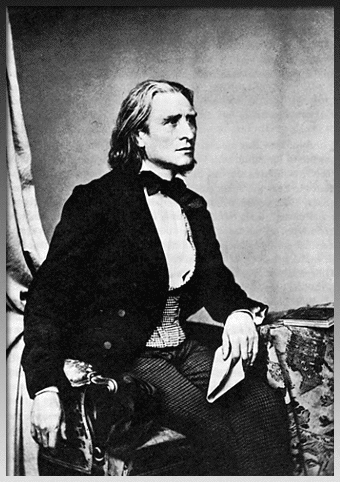
The Hungarian composer Franz Liszt
desired to expand single-movement works beyond the concert overture form. The music of overtures is to inspire listeners to imagine scenes, images, or moods; Liszt intended to combine those programmatic qualities with a scale and musical complexity normally reserved for the opening movement of classical symphonies. The opening movement, with its interplay of contrasting themes under sonata form
, was normally considered the most important part of the symphony. To achieve his objectives, Liszt needed a more flexible method of developing musical themes than sonata form would allow, but one that would preserve the overall unity of a musical composition.
Liszt found his method through two compositional practices, which he used in his symphonic poems. The first practice was cyclic form
, a procedure established by Beethoven in which certain movements are not only linked but actually reflect one another's content. Liszt took Beethoven's practice one step further, combining separate movements into a single-movement cyclic structure. Many of Liszt's mature works follow this pattern, of which Les Préludes
is one of the best-known examples. The second practice was thematic transformation
, a type of variation in which one theme is changed, not into a related or subsidiary theme but into something new, separate and independent. As musicologist Hugh Macdonald
wrote of Liszt's works in this genre, the intent was "to display the traditional logic of symphonic thought;" that is, to display a comparable complexity in the interplay of musical themes and tonal 'landscape' to those of the Romantic
symphony
.
Thematic transformation, like cyclic form, was nothing new in itself. It had been previously used by Mozart and Haydn. In the final movement of his Ninth Symphony
, Beethoven had transformed the theme of the "Ode to Joy" into a Turkish march. Weber and Berlioz
had also transformed themes, and Schubert used thematic transformation to bind together the movements of his Wanderer Fantasy
, a work that had a tremendous influence on Liszt. However, Liszt perfected the creation of significantly longer formal structures solely through thematic transformation, not only in the symphonic poems but in others works such as his Second Piano Concerto
and his Piano Sonata in B minor
. In fact, when a work had to be shortened, Liszt tended to cut sections of conventional musical development and preserve sections of thematic transformation.
While Liszt had been inspired to some extent by the ideas of Richard Wagner
in unifying ideas of drama and music via the symphonic poem, Wagner gave Liszt's concept only lukewarm support in his 1857 essay On the Symphonic Poems of Franz Liszt, and was later to break entirely with Liszt's Weimar circle over their aesthetic ideals.
ideas fomenting in their respective countries at this time. Bedřich Smetana
visited Liszt in Weimar in the summer of 1857, where he heard the first performances of the Faust Symphony
and the symphonic poem Die Ideale. Influenced by Liszt's efforts, Smetana began a series of symphonic works based on literary subjects—Richard III (1857-8), Wallenstein's Camp (1858-9) and Hakon Jarl (1860–61). A piano work dating from the same period, Macbeth a čarodějnice (Macbeth and the Witches, 1859), is similar in scope but bolder in style. Musicologist John Clapham writes that Smetana planned these works as "a compact series of episodes" drawn from their literary sources "and approached them as a dramatist rather than as a poet or philosopher." He used musical themes to represent specific characters; in this manner he more closely followed the practice of French composer Hector Berlioz
in his choral symphony
Roméo et Juliette
than that of Liszt. By doing so, Hugh Macdonald writes, Smetana followed "a straightforward pattern of musical description".
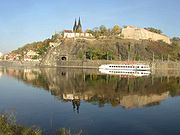 Smetana's set of six symphonic poems published under the general title of Má vlast
became his greatest achievements in the genre. Composed between 1872 and 1879, the cycle embodies its composer's personal belief in the greatness of the Czech nation while presenting selected episodes and ideas from Czech history. Two recurrent musical themes unify the entire cycle. One theme represents Vyšehrad, the fortress over the river Vltava whose course provides the subject matter for the second (and best-known) work in the cycle; the other is the ancient Czech hymn "Ktož jsú boží bojovníci" ("Ye who are God's warriors"), which unites the cycle's last two poems, Tábor and Blaník.
While expanding the form to a unified cycle of symphonic poems, Smetana created what Macdonald terms "one of the monuments of Czech music" and, Clapham writes, "extended the scope and purpose of the symphonic poem beyond the aims of any later composer". Clapham adds that in his musical depiction of scenery in these works, Smetana "established a new type of symphonic poem, which led eventually to Sibelius's Tapiola
". Also, in showing how to apply new forms for new purposes, Macdonald writes that Smetana "began a profusion of symphonic poems from his younger contemporaries in the Czech lands and Slovakia", including Antonín Dvořák
, Zdeněk Fibich
, Leoš Janáček
and Vítězslav Novák
.
Dvořák wrote two groups of symphonic poems, which date from the 1890s. The first, which Macdonald variously calls symphonic poems and overtures, forms a cycle similar to Má vlast, with a single musical theme running through all three pieces. Originally conceived as a trilogy to be titled Příroda, Život a Láska (Nature, Life and Love), they appeared instead as three separate works, V přírodě (In Nature's Realm), Carnival and Othello. The score for Othello contains notes from the Shakespeare play, showing that Dvořák meant to write it as a programmatic work; however, the sequence of events and characters portrayed does not correspond to the notes.
The second group of symphonic poems comprises five works. Four of them—The Water Goblin
, The Noon Witch
, The Golden Spinning Wheel and The Wild Dove—are based on poems from Karel Jaromír Erben
's Kytice
(Bouquet) collection of fairy tale
s. In these four poems, Dvořák assigns specific musical themes for important characters and events in the drama. For The Golden Spinning Wheel, Dvořák arrived at these themes by setting lines from the poems to music. He also follows Liszt and Smetana's example of thematic transformation, metamorphosing the king's theme in The Golden Spinning Wheel to represent the wicked stepmother and also the mysterious, kindly old man found in the tale. Macdonald writes that while these works may seem diffuse by symphonic standards, their literary sources actually define the sequence of events and the course of the musical action. Clapham adds that while Dvořák may follow the narrative complexities of The Golden Spinning Wheel too closely, "the lengthy repetition at the beginning of The Noon Witch shows Dvořák temporarily rejecting a precise representation of the ballad for the sake of an initial musical balance". The fifth poem, Heroic Song, is the only one not to have a detailed program.
or The Mighty Handful, went so far as to hail Mikhail Glinka
's Kamarinskaya as "a prototype of Russian descriptive music"; despite the fact that Glinka himself denied the piece had any program, he called the work, which is based entirely on Russian folk music, "picturesque music." In this Glinka was influenced by French composer Hector Berlioz
, whom he met in the summer of 1844.
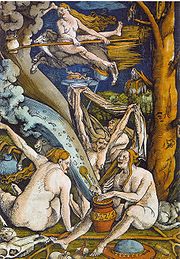 At least three of the Five fully embraced the symphonic poem. Mily Balakirev
's Tamara (1867–82) richly evokes the fairy-tale orient and, while remaining closely based on the poem by Mikhail Lermontov
, remains well-paced and full of atmosphere. Balakirev's other two symphonic poems, In Bohemia (1867, 1905) and Russia (1884 version) lack the same narrative content; they are actually looser collections of national melodies and were originally written as concert overtures. Macdonald calls Modest Mussorgsky
's Night on Bald Mountain
and Alexander Borodin
's In the Steppes of Central Asia
"powerful orchestral pictures, each unique in its composer's output". Titled a "musical portrait", In the Steppes of Central Asia evokes the journey of a caravan
across the steppe
s. Night on Bald Mountain, especially its original version, contains harmony
that is often striking, sometimes pungent and highly abrasive; its initial stretches especially pull the listener into a world of uncompromisingly brutal directness and energy.
Nikolai Rimsky-Korsakov
wrote only two orchestral works that rank as symphonic poems, his "musical tableau" Sadko
(1867–92) and Skazka (Legend, 1879–80), originally titled Baba-Yaga. While this may perhaps be surprising, considering his love for Russian folklore, both his symphonic suite
s Antar
and Sheherazade
are conceived in a similar manner to these works. Russian follklore also provided material for symphonic poems by Alexander Dargomyzhsky
, Anatoly Lyadov and Alexander Glazunov
. Glazunov's Stenka Razin and Lyadov's Baba-Yaga Kikimora and The Enchanted Lake are all based on national subjects. The Lyadov works' lack of purposeful harmonic rhythm (a absence less noticeable in Baba-Yaga and Kikimora due to a superficial but still exhilarating bustle and whirl) produces a sense of unreality and timelessness much like the telling of an oft-repeated and much loved fairy tale.
While none of Pyotr Ilyich Tchaikovsky
's symphonic poems has a Russian subject, they hold musical form and literary material in fine balance. (Tchaikovsky did not call Romeo and Juliet
a symphonic poem but rather a "fantasy-overture", and the work may actually be closer to a concert overture in its relatively stringent use of sonata form
. It was the suggestion of the work's musical mid-wife, Balakirev, to base Romeo structurally on his King Lear, a tragic overture in sonata form after the example of Beethoven
's overtures.)
Among later Russian symphonic poems, Sergei Rachmaninoff
's The Rock
shows as much the influence of Tchaikovsky's work as Isle of the Dead
(1909) does its independence from it. A similar debt to his teacher Rimsky-Korsakov imbues Igor Stravinsky
's The Song of the Nightingale, excerpted from his opera The Nightingale. Alexander Scriabin
's Poem of Ecstasy (1905–08) and Prometheus: The Poem of Fire (1908–10), in their projection of an egocentric theosophic world unequalled in other symphonic poems, are notable for their detail and advanced harmonic idiom.
Socialist realism
in the Soviet Union allowed program music to survive longer there than in western Europe, as typified by Dmitri Shostakovich
's symphonic poem October (1967).
 While France was less concerned than other countries with nationalism, it still had a well-established tradition of narrative and illustrative music reaching back to Berlioz and Félicien David
. For this reason, French composers were attracted to the poetic elements of the symphonic poem. In fact, César Franck
had written an orchestral piece based on Hugo's poem Ce qu'on entend sur le montagne before Liszt did so himself as his first numbered symphonic poem.
The symphonic poem came into vogue in France in the 1870s, supported by the newly-founded Société Nationale and its promotion of younger French composers. In the year after its foundation, 1872, Camille Saint-Saëns
composed his Le rouet d'Omphale, soon following it with three more, the most famous of which became the Danse macabre
(1874). In all four of these works Saint-Saëns experimented with orchestration
and thematic transformation
. La jeunesse d'Hercule (1877) was written closest in style to Liszt. The other three concentrate on some physical movement—spinning, riding, dancing—which is portrayed in musical terms. He had previously experimented with thematic transformation in his program overture Spartacus; he would later use it in his Fourth Piano Concerto
and Third Symphony
.
After Saint-Saëns came Vincent d'Indy
. While d'Indy called his trilogy Wallenstein (1873, 1879–81) "three symphonic overtures", the cycle is similar to Smetana's Má vlast in overall scope. Henri Duparc's Lenore (1875) displayed a Wagnerian warmth in its writing and orchestration. Franck wrote the delicately evocative Les Eolides, following it with the narrative Le chasseur maudit and the piano-and-orchestral tone poem Les Djinns, conceived in much the same manner as Liszt's Totentanz
. Ernest Chausson
's Vivane illustrates the penchant shown by the Franck circle for mythological subjects.
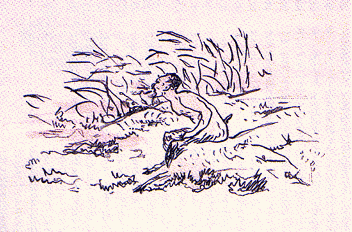 Claude Debussy
's Prélude à l'après-midi d'un faune
(1892-4), intended initially as part of a triptych
, is, in the composer's words, "a very free ... succession of settings through which the Faun's desires and dreams move in the afternoon heat." Paul Dukas
' The Sorcerer's Apprentice
follows the narrative vein of symphonic poem, while Maurice Ravel
's La Valse
(1921) is considered by some critics a parody of Vienna in an idiom no Viennese would recognize as his own. Albert Roussel
's first symphonic poem, based on Leo Tolstoy
's novel Resurrection (1903), was soon followed by Le Poème de forêt (1904-6), which is in four movements written in cyclic form
. Pour une fête de printemps (1920), initially conceived as the slow movement of his Second Symphony. Charles Koechlin
also wrote several symphonic poems, the best known of which are included in his cycle based on The Jungle Book
by Rudyard Kipling
. Through these works, he defended the viability of the symphonic poem long after it had gone out of vogue.
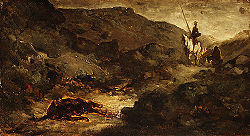
Both Liszt and Richard Strauss
worked in Germany, but while Liszt may have invented the symphonic poem and Strauss brought it to its highest point, overall the form was less well received there than in other countries. Johannes Brahms
and Richard Wagner
dominated the German musical scene, and neither man wrote symphonic poems; instead, they devoted themselves completely to music drama
(Wagner) and absolute music
(Brahms). Therefore, other than Strauss and numerous concert overtures by others, there are only isolated symphonic poems by German and Austrian composers—Hans von Bülow
's Nirwana (1866), Hugo Wolf
's Penthesilea (1883-5) and Arnold Schoenberg
's Pelleas und Melisande
(1902-3). Because of its clear relationship between poem and music, Schoenberg's Verklärte Nacht
(1899) for string sextet has been characterised as a non-orchestral 'symphonic poem'.
Alexander Ritter
, who himself composed six symphonic poems in the vein of Liszt's works, directly influenced Richard Strauss
in writing program music. Strauss wrote on a wide range of subjects, some of which had been previously considered unsuitable to be set to music, including literature, legend, philosophy and autobiography. The list includes Macbeth
(1886—7), Don Juan
(1888—9), Tod und Verklärung
(Death and Transfiguration, 1888–9), Till Eulenspiegels lustige Streiche
(Till Eulenspiegel's Merry Pranks, 1894–95), Also sprach Zarathustra
(Thus Spoke Zoroaster, 1896), Don Quixote
(1897), Ein Heldenleben
(A Hero's Life, 1897–98), Symphonia Domestica
(Domestic Symphony, 1902–03) and Eine Alpensinfonie
(An Alpine Symphony, 1911–1915).)
In these works, Strauss takes realism
in orchestral depiction to unprecedented lengths, widening the expressive functions of program music as well as extending its boundaries. Because of his virtuosic use of orchestration, the descriptive power and vividness of these works is extremely marked. He usually employs a large orchestra, often with extra instruments, and he often uses instrumental effects for sharp characterization, such as portraying the bleating of sheep with cuivré brass in Don Quixote. Strauss's handling of form is also worth noting, both in his use of thematic transformation
and his handling of multiple themes in intricate counterpoint
. His use of variation form in Don Quixote is handled exceptionally well, as is his use of rondo
form in Till Eulenspiegel. As Hugh Macdonald points out in the New Grove (1980), "Strauss liked to use a simple but descriptive theme—for instance the three-note motif at the opening of Also sprach Zarathustra, or striding, vigorous arpeggio
s to represent the manly qualities of his heroes. His love themes are honeyed and chromatic and generally richly scored, and he is often fond of the warmth and serenity of diatonic harmony
as balm after torrential chromatic
textures, notably at the end of Don Quixote, where the solo cello has a surpassingly beautiful D major transformation of the main theme."
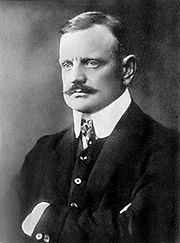 Jean Sibelius
showed a great affinity for the form, writing well over a dozen symphonic poems and numerous shorter works. These works span his entire career, from En Saga
(1892) to Tapiola
(1926), expressing more clearly than anything else his identification to Finland and its mythology. The Kalevala
provided ideal episodes and texts for musical setting; this coupled with Sibelius's natural aptitude for symphonic writing allowed him to write taut, organic structures for many of these works, especially Tapiola (1926). Pohjola's Daughter
(1906), which Sibelius called a "symphonic fantasy", is the most closely dependent on its program while also showing a sureness of outline rare in other composers. With the compositional approach he took from the Third Symphony
onward, Sibelius sought to overcome the distinction between symphony and tone poem to fuse their most basic principles—the symphony's traditional claims of weight, musical abstraction, gravitas and formal dialogue with seminal works of the past; and the tone poem's structural innovation and spontaneity, identifiable poetic content and inventive sonority. However, the stylistic distinction between symphony, "fantasy" and tone poem in Sibelius's late works becomes blurred since ideas first sketched for one piece ended up in another.
The symphonic poem did not enjoy as clear a sense of national identity in other countries, even though numerous works of the kind were written. Composers included Arnold Bax
and Frederick Delius
in Great Britain; Edward MacDowell
, Howard Hanson
, Ferde Grofe
and George Gershwin
in the United States; Carl Nielsen
in Denmark; and Ottorino Respighi
in Italy. Also, with the rejection of Romantic ideals in the 20th century and their replacement with ideals of abstraction and independence of music, the writing of symphonic poems went into decline.
's use of excerpts from Liszt's Mazeppa in the Errol Flynn
movie Captain Blood and a recurrent use of Les Préludes
in the Flash Gordon serial
. Other works used have included Richard Strauss's Also Sprach Zarathustra
(in 2001), and Paul Dukas
's The Sorcerer's Apprentice
(in Walt Disney
's Fantasia
).
Orchestra
An orchestra is a sizable instrumental ensemble that contains sections of string, brass, woodwind, and percussion instruments. The term orchestra derives from the Greek ορχήστρα, the name for the area in front of an ancient Greek stage reserved for the Greek chorus...
l music in a single continuous section (a movement
Movement (music)
A movement is a self-contained part of a musical composition or musical form. While individual or selected movements from a composition are sometimes performed separately, a performance of the complete work requires all the movements to be performed in succession...
) in which the content of a poem, a story or novel
Novel
A novel is a book of long narrative in literary prose. The genre has historical roots both in the fields of the medieval and early modern romance and in the tradition of the novella. The latter supplied the present generic term in the late 18th century....
, a painting
Painting
Painting is the practice of applying paint, pigment, color or other medium to a surface . The application of the medium is commonly applied to the base with a brush but other objects can be used. In art, the term painting describes both the act and the result of the action. However, painting is...
, a landscape
Landscape
Landscape comprises the visible features of an area of land, including the physical elements of landforms such as mountains, hills, water bodies such as rivers, lakes, ponds and the sea, living elements of land cover including indigenous vegetation, human elements including different forms of...
or another (non-musical) source is illustrated or evoked. The term was first applied by Hungarian composer Franz Liszt
Franz Liszt
Franz Liszt ; ), was a 19th-century Hungarian composer, pianist, conductor, and teacher.Liszt became renowned in Europe during the nineteenth century for his virtuosic skill as a pianist. He was said by his contemporaries to have been the most technically advanced pianist of his age...
to his 13 works in this vein
Symphonic Poems (Liszt)
The symphonic poems of Franz Liszt are a series of 13 orchestral works by the Hungarian composer and are numbered S.95–107. The first 12 were composed between 1848 and 1858 ; the last, Von der Wiege bis zum Grabe , followed in 1882...
. In its aesthetic objectives, the symphonic poem is in some ways related to opera
Opera
Opera is an art form in which singers and musicians perform a dramatic work combining text and musical score, usually in a theatrical setting. Opera incorporates many of the elements of spoken theatre, such as acting, scenery, and costumes and sometimes includes dance...
; whilst it does not use a sung text, it seeks, like opera, a union of music and drama.
While many symphonic poems may compare in size and scale to symphonic movements (or even reach the length of an entire symphony), they are unlike traditional classical symphonic movements, in that their music is intended to inspire listeners to imagine or consider scenes, images, specific ideas or moods, and not to focus on following traditional patterns of musical form (e.g. sonata form
Sonata form
Sonata form is a large-scale musical structure used widely since the middle of the 18th century . While it is typically used in the first movement of multi-movement pieces, it is sometimes used in subsequent movements as well—particularly the final movement...
). This intention to inspire listeners was a direct consequence of Romanticism
Romanticism
Romanticism was an artistic, literary and intellectual movement that originated in the second half of the 18th century in Europe, and gained strength in reaction to the Industrial Revolution...
, which encouraged literary, pictorial and dramatic associations in music. Musical works that attempt to inspire listeners in this way are often referred to as program music
Program music
Program music or programme music is a type of art music that attempts to musically render an extra-musical narrative. The narrative itself might be offered to the audience in the form of program notes, inviting imaginative correlations with the music...
, while music that has no such associations may be called absolute music
Absolute music
Absolute music is a concept in music that describes music as an art form separated from formalisms or other considerations; it is not explicitly about anything; it is non-representational. In contrast to program music, absolute music makes sense without accompanying words, images, drama, or...
.
Some piano and chamber works, such as Arnold Schoenberg
Arnold Schoenberg
Arnold Schoenberg was an Austrian composer, associated with the expressionist movement in German poetry and art, and leader of the Second Viennese School...
's string sextet
String sextet
In classical music, a string sextet is a composition written for six string instruments, or a group of six musicians who perform such a composition. Most string sextets have been written for an ensemble consisting of two violins, two violas, and two cellos....
Verklärte Nacht
Verklärte Nacht
Verklärte Nacht , Op. 4, is a string sextet in one movement composed by Arnold Schoenberg in 1899 and his earliest important work...
, have similarities with symphonic poems in their overall intent and effect. However, the term symphonic poem is generally accepted to refer to orchestral works. A symphonic poem may stand on its own, or it can be part of a series combined into a symphonic suite
Suite
In music, a suite is an ordered set of instrumental or orchestral pieces normally performed in a concert setting rather than as accompaniment; they may be extracts from an opera, ballet , or incidental music to a play or film , or they may be entirely original movements .In the...
. For example, The Swan of Tuonela (1895) is a tone poem from Jean Sibelius
Jean Sibelius
Jean Sibelius was a Finnish composer of the later Romantic period whose music played an important role in the formation of the Finnish national identity. His mastery of the orchestra has been described as "prodigious."...
's Lemminkäinen Suite
Lemminkäinen Suite
The Lemminkäinen Suite is a work written by the Finnish composer Jean Sibelius in the early 1890s which forms his opus 22...
. A symphonic poem can also be part of a group of interrelated works, such as Vltava (The Moldau) as part of the six-work cycle Má vlast
Má vlast
Má vlast is a set of six symphonic poems composed between 1874 and 1879 by the Czech composer Bedřich Smetana. While it is often presented as a single work in six movements and – with the exception of Vltava– is almost always recorded that way, the six pieces were conceived as individual works...
by Bedřich Smetana
Bedrich Smetana
Bedřich Smetana was a Czech composer who pioneered the development of a musical style which became closely identified with his country's aspirations to independent statehood. He is thus widely regarded in his homeland as the father of Czech music...
. Also, while the terms "symphonic poem" and "tone poem" have often been used interchangeably, some composers such as Richard Strauss
Richard Strauss
Richard Georg Strauss was a leading German composer of the late Romantic and early modern eras. He is known for his operas, which include Der Rosenkavalier and Salome; his Lieder, especially his Four Last Songs; and his tone poems and orchestral works, such as Death and Transfiguration, Till...
and Jean Sibelius have preferred the latter term for pieces that were less symphonic in design and in which there is no special emphasis on thematic or tonal contrast.
According to Macdonald, the symphonic poem met three 19th century aesthetic goals: it related music to outside sources; it often combined or compressed multiple movements into a single principal section; and it elevated instrumental program music to an aesthetic level that could be regarded as equivalent to, or higher than opera. The symphonic poem remained popular from the 1840s until the 1920s, when the genre suffered a severe decline in popularity.
Background
In the second quarter of the 19th century, the future of the symphonic genre came into doubt. While many composers continued to write symphonies during the 1820s and 30s, "there was a growing sense that these works were aesthetically far inferior to Beethoven's.... The real question was not so much whether symphonies could still be written, but whether the genre could continue to flourish and grow". Felix MendelssohnFelix Mendelssohn
Jakob Ludwig Felix Mendelssohn Barthóldy , use the form 'Mendelssohn' and not 'Mendelssohn Bartholdy'. The Grove Dictionary of Music and Musicians gives ' Felix Mendelssohn' as the entry, with 'Mendelssohn' used in the body text...
, Robert Schumann
Robert Schumann
Robert Schumann, sometimes known as Robert Alexander Schumann, was a German composer, aesthete and influential music critic. He is regarded as one of the greatest and most representative composers of the Romantic era....
and Niels Gade achieved successes with their symphonies, putting at least a temporary stop to the debate as to whether the genre was dead. Nevertheless, composers increasingly turned to the "more compact form" of the concert overture "as a vehicle within which to blend musical, narrative and pictoral ideas"; examples included Mendelssohn's overtures A Midsummer Night's Dream (1826) and The Hebrides
Hebrides Overture
The Hebrides Overture , Op. 26, also known as Fingal's Cave , is a concert overture composed by Felix Mendelssohn. Written in 1830, the piece was inspired by a cavern known as Fingal's Cave on Staffa, an island in the Hebrides archipelago located off the west coast of Scotland...
(1830).
Between 1845 and 1847, Franco-Belgian composer César Franck
César Franck
César-Auguste-Jean-Guillaume-Hubert Franck was a composer, pianist, organist, and music teacher who worked in Paris during his adult life....
wrote an orchestral piece based on Victor Hugo
Victor Hugo
Victor-Marie Hugo was a Frenchpoet, playwright, novelist, essayist, visual artist, statesman, human rights activist and exponent of the Romantic movement in France....
's poem Ce qu'on entend sur le montagne. The work exhibits characteristics of a symphonic poem, and some musicologists, such as Norman Demuth
Norman Demuth
Norman Demuth was an English composer and musicologist, remembered largely for his biographies of French composers....
and Julien Tiersot, consider it the first of its genre, preceding Liszt's compositions. However, Franck did not publish or perform his piece; neither did he set about defining the genre. Liszt's determination to explore and promote the symphonic poem gained him recognition as the genre's inventor.
Liszt
The Hungarian composer Franz Liszt
Franz Liszt
Franz Liszt ; ), was a 19th-century Hungarian composer, pianist, conductor, and teacher.Liszt became renowned in Europe during the nineteenth century for his virtuosic skill as a pianist. He was said by his contemporaries to have been the most technically advanced pianist of his age...
desired to expand single-movement works beyond the concert overture form. The music of overtures is to inspire listeners to imagine scenes, images, or moods; Liszt intended to combine those programmatic qualities with a scale and musical complexity normally reserved for the opening movement of classical symphonies. The opening movement, with its interplay of contrasting themes under sonata form
Sonata form
Sonata form is a large-scale musical structure used widely since the middle of the 18th century . While it is typically used in the first movement of multi-movement pieces, it is sometimes used in subsequent movements as well—particularly the final movement...
, was normally considered the most important part of the symphony. To achieve his objectives, Liszt needed a more flexible method of developing musical themes than sonata form would allow, but one that would preserve the overall unity of a musical composition.
Liszt found his method through two compositional practices, which he used in his symphonic poems. The first practice was cyclic form
Cyclic form
Cyclic form is a technique of musical construction, involving multiple sections or movements, in which a theme, melody, or thematic material occurs in more than one movement as a unifying device. Sometimes a theme may occur at the beginning and end Cyclic form is a technique of musical...
, a procedure established by Beethoven in which certain movements are not only linked but actually reflect one another's content. Liszt took Beethoven's practice one step further, combining separate movements into a single-movement cyclic structure. Many of Liszt's mature works follow this pattern, of which Les Préludes
Les Préludes (Liszt)
Les préludes is the third of Franz Liszt's thirteen symphonic poems. Directed by Liszt himself, in April 1856 the score, and in January 1865 the orchestral parts, were published by Breitkopf & Härtel, Leipzig. Among Liszt's symphonic poems, Les préludes is the most popular...
is one of the best-known examples. The second practice was thematic transformation
Thematic transformation
Thematic transformation is a technique of where a leitmotif, or theme, is developed by changing the theme by using Permutation , Augmentation, Diminution, and Fragmentation. It was primarily developed by Franz Liszt and his good friend Hector Berlioz...
, a type of variation in which one theme is changed, not into a related or subsidiary theme but into something new, separate and independent. As musicologist Hugh Macdonald
Hugh Macdonald
Hugh Macdonald is an English musicologist chiefly known for his work within the music of the 19th century, especially in France. He has been general editor of the Hector Berlioz: New Edition of the Complete Works since its inception in 1967 and has been particularly active in the revival of...
wrote of Liszt's works in this genre, the intent was "to display the traditional logic of symphonic thought;" that is, to display a comparable complexity in the interplay of musical themes and tonal 'landscape' to those of the Romantic
Romantic music
Romantic music or music in the Romantic Period is a musicological and artistic term referring to a particular period, theory, compositional practice, and canon in Western music history, from 1810 to 1900....
symphony
Symphony
A symphony is an extended musical composition in Western classical music, scored almost always for orchestra. A symphony usually contains at least one movement or episode composed according to the sonata principle...
.
Thematic transformation, like cyclic form, was nothing new in itself. It had been previously used by Mozart and Haydn. In the final movement of his Ninth Symphony
Symphony No. 9 (Beethoven)
The Symphony No. 9 in D minor, Op. 125, is the final complete symphony of Ludwig van Beethoven. Completed in 1824, the symphony is one of the best known works of the Western classical repertoire, and has been adapted for use as the European Anthem...
, Beethoven had transformed the theme of the "Ode to Joy" into a Turkish march. Weber and Berlioz
Hector Berlioz
Hector Berlioz was a French Romantic composer, best known for his compositions Symphonie fantastique and Grande messe des morts . Berlioz made significant contributions to the modern orchestra with his Treatise on Instrumentation. He specified huge orchestral forces for some of his works; as a...
had also transformed themes, and Schubert used thematic transformation to bind together the movements of his Wanderer Fantasy
Wanderer Fantasy
The Fantasie in C major, Op. 15 , popularly known as the Wanderer Fantasy, is a four-movement fantasy for solo piano composed by Franz Schubert in November 1822. It is considered Schubert's most technically demanding composition for the piano...
, a work that had a tremendous influence on Liszt. However, Liszt perfected the creation of significantly longer formal structures solely through thematic transformation, not only in the symphonic poems but in others works such as his Second Piano Concerto
Piano Concerto No. 2 (Liszt)
Franz Liszt wrote drafts for his Concerto for Piano and Orchestra No. 2 in A major, S.125, during his virtuoso period, in 1839 to 1840. He then put away the manuscript for a decade. When he returned to the concerto, he revised and scrutinized it repeatedly. The fourth and final period of revision...
and his Piano Sonata in B minor
Piano Sonata (Liszt)
The Piano Sonata in B minor , S.178, is a musical composition for solo piano by Franz Liszt, published in 1854 with a dedication to Robert Schumann. It is often considered Liszt's greatest composition for solo piano. The piece has been often analyzed, particularly regarding issues of form.-...
. In fact, when a work had to be shortened, Liszt tended to cut sections of conventional musical development and preserve sections of thematic transformation.
While Liszt had been inspired to some extent by the ideas of Richard Wagner
Richard Wagner
Wilhelm Richard Wagner was a German composer, conductor, theatre director, philosopher, music theorist, poet, essayist and writer primarily known for his operas...
in unifying ideas of drama and music via the symphonic poem, Wagner gave Liszt's concept only lukewarm support in his 1857 essay On the Symphonic Poems of Franz Liszt, and was later to break entirely with Liszt's Weimar circle over their aesthetic ideals.
Czech composers
Composers who developed the symphonic poem after Liszt were mainly Bohemian, Russian, and French; the Bohemians and Russians showed the potential of the form as a vehicle for the nationalistNationalism
Nationalism is a political ideology that involves a strong identification of a group of individuals with a political entity defined in national terms, i.e. a nation. In the 'modernist' image of the nation, it is nationalism that creates national identity. There are various definitions for what...
ideas fomenting in their respective countries at this time. Bedřich Smetana
Bedrich Smetana
Bedřich Smetana was a Czech composer who pioneered the development of a musical style which became closely identified with his country's aspirations to independent statehood. He is thus widely regarded in his homeland as the father of Czech music...
visited Liszt in Weimar in the summer of 1857, where he heard the first performances of the Faust Symphony
Faust Symphony
A Faust Symphony in three character pictures , S.108, or simply the "Faust Symphony", was written by Hungarian composer Franz Liszt and was inspired by Johann von Goethe's drama, Faust...
and the symphonic poem Die Ideale. Influenced by Liszt's efforts, Smetana began a series of symphonic works based on literary subjects—Richard III (1857-8), Wallenstein's Camp (1858-9) and Hakon Jarl (1860–61). A piano work dating from the same period, Macbeth a čarodějnice (Macbeth and the Witches, 1859), is similar in scope but bolder in style. Musicologist John Clapham writes that Smetana planned these works as "a compact series of episodes" drawn from their literary sources "and approached them as a dramatist rather than as a poet or philosopher." He used musical themes to represent specific characters; in this manner he more closely followed the practice of French composer Hector Berlioz
Hector Berlioz
Hector Berlioz was a French Romantic composer, best known for his compositions Symphonie fantastique and Grande messe des morts . Berlioz made significant contributions to the modern orchestra with his Treatise on Instrumentation. He specified huge orchestral forces for some of his works; as a...
in his choral symphony
Choral symphony
A choral symphony is a musical composition for orchestra, choir, sometimes with solo vocalists, which in its internal workings and overall musical architecture adheres broadly to symphonic musical form. The term "choral symphony" in this context was coined by Hector Berlioz when describing his...
Roméo et Juliette
Roméo et Juliette (symphony)
Roméo et Juliette is a "symphonie dramatique", a large-scale choral symphony by French composer Hector Berlioz, which was first performed on 24 November 1839. The libretto was written by Émile Deschamps and the completed work was assigned the catalogue numbers Op. 17 and H.79...
than that of Liszt. By doing so, Hugh Macdonald writes, Smetana followed "a straightforward pattern of musical description".
Má vlast
Má vlast is a set of six symphonic poems composed between 1874 and 1879 by the Czech composer Bedřich Smetana. While it is often presented as a single work in six movements and – with the exception of Vltava– is almost always recorded that way, the six pieces were conceived as individual works...
became his greatest achievements in the genre. Composed between 1872 and 1879, the cycle embodies its composer's personal belief in the greatness of the Czech nation while presenting selected episodes and ideas from Czech history. Two recurrent musical themes unify the entire cycle. One theme represents Vyšehrad, the fortress over the river Vltava whose course provides the subject matter for the second (and best-known) work in the cycle; the other is the ancient Czech hymn "Ktož jsú boží bojovníci" ("Ye who are God's warriors"), which unites the cycle's last two poems, Tábor and Blaník.
While expanding the form to a unified cycle of symphonic poems, Smetana created what Macdonald terms "one of the monuments of Czech music" and, Clapham writes, "extended the scope and purpose of the symphonic poem beyond the aims of any later composer". Clapham adds that in his musical depiction of scenery in these works, Smetana "established a new type of symphonic poem, which led eventually to Sibelius's Tapiola
Tapiola (Sibelius)
Tapiola , Op. 112, is a tone poem by the Finnish composer Jean Sibelius, written in 1926. It was the product of a commission from Walter Damrosch for the New York Philharmonic Society...
". Also, in showing how to apply new forms for new purposes, Macdonald writes that Smetana "began a profusion of symphonic poems from his younger contemporaries in the Czech lands and Slovakia", including Antonín Dvořák
Antonín Dvorák
Antonín Leopold Dvořák was a Czech composer of late Romantic music, who employed the idioms of the folk music of Moravia and his native Bohemia. Dvořák’s own style is sometimes called "romantic-classicist synthesis". His works include symphonic, choral and chamber music, concerti, operas and many...
, Zdeněk Fibich
Zdenek Fibich
Zdeněk Fibich was a Czech composer of classical music. Among his compositions are chamber works , symphonic poems, three symphonies, at least seven operas , melodramas including the substantial trilogy Hippodamia,...
, Leoš Janáček
Leoš Janácek
Leoš Janáček was a Czech composer, musical theorist, folklorist, publicist and teacher. He was inspired by Moravian and all Slavic folk music to create an original, modern musical style. Until 1895 he devoted himself mainly to folkloristic research and his early musical output was influenced by...
and Vítězslav Novák
Vítezslav Novák
Vítězslav Novák was one of the most well-respected Czech composers and pedagogues, almost singlehandedly founding a mid-century Czech school of composition...
.
Dvořák wrote two groups of symphonic poems, which date from the 1890s. The first, which Macdonald variously calls symphonic poems and overtures, forms a cycle similar to Má vlast, with a single musical theme running through all three pieces. Originally conceived as a trilogy to be titled Příroda, Život a Láska (Nature, Life and Love), they appeared instead as three separate works, V přírodě (In Nature's Realm), Carnival and Othello. The score for Othello contains notes from the Shakespeare play, showing that Dvořák meant to write it as a programmatic work; however, the sequence of events and characters portrayed does not correspond to the notes.
The second group of symphonic poems comprises five works. Four of them—The Water Goblin
The Water Goblin
The Water Goblin is a symphonic poem, Op. 107 , written by Antonín Dvořák in 1896.The source of inspiration for The Water Goblin was a poem found in a collection published by Karel Jaromír Erben under the title Kytice; while Dvořák composed six symphonic poems, four of these were inspired by works...
, The Noon Witch
The Noon Witch
The Noon Witch , Op. 108, B 196, is a symphonic poem written in 1896 by Antonín Dvořák inspired by the Karel Erben poem Polednice from the collection Kytice. Polednice is based on the noon demon "Lady Midday" of slavic mythology....
, The Golden Spinning Wheel and The Wild Dove—are based on poems from Karel Jaromír Erben
Karel Jaromír Erben
Karel Jaromír Erben was a Czech historian, poet and writer of the mid-19th century, best known for his collection Kytice , which contains poems based on traditional and folkloric themes....
's Kytice
Kytice
Kytice is a collection of ballads by the Czech author Karel Jaromír Erben, first published in 1853 and considered a classic...
(Bouquet) collection of fairy tale
Fairy tale
A fairy tale is a type of short story that typically features such folkloric characters, such as fairies, goblins, elves, trolls, dwarves, giants or gnomes, and usually magic or enchantments. However, only a small number of the stories refer to fairies...
s. In these four poems, Dvořák assigns specific musical themes for important characters and events in the drama. For The Golden Spinning Wheel, Dvořák arrived at these themes by setting lines from the poems to music. He also follows Liszt and Smetana's example of thematic transformation, metamorphosing the king's theme in The Golden Spinning Wheel to represent the wicked stepmother and also the mysterious, kindly old man found in the tale. Macdonald writes that while these works may seem diffuse by symphonic standards, their literary sources actually define the sequence of events and the course of the musical action. Clapham adds that while Dvořák may follow the narrative complexities of The Golden Spinning Wheel too closely, "the lengthy repetition at the beginning of The Noon Witch shows Dvořák temporarily rejecting a precise representation of the ballad for the sake of an initial musical balance". The fifth poem, Heroic Song, is the only one not to have a detailed program.
Russia
The development of the symphonic poem in Russia, as in the Czech lands, stemmed from an admiration for Liszt's music and a devotion to national subjects. Added to this was the Russian love of story-telling, for which the genre seemed expressly tailored, and which led critic Vladimir Stasov to write, "Virtually all Russian music is programmatic". Macdonald writes that Stasov and the patriotic group of composers known as The FiveThe Five
The Five, also known as The Mighty Handful or The Mighty Coterie , refers to a circle of composers who met in Saint Petersburg, Russia, in the years 1856–1870: Mily Balakirev , César Cui, Modest Mussorgsky, Nikolai Rimsky-Korsakov and Alexander Borodin...
or The Mighty Handful, went so far as to hail Mikhail Glinka
Mikhail Glinka
Mikhail Ivanovich Glinka , was the first Russian composer to gain wide recognition within his own country, and is often regarded as the father of Russian classical music...
's Kamarinskaya as "a prototype of Russian descriptive music"; despite the fact that Glinka himself denied the piece had any program, he called the work, which is based entirely on Russian folk music, "picturesque music." In this Glinka was influenced by French composer Hector Berlioz
Hector Berlioz
Hector Berlioz was a French Romantic composer, best known for his compositions Symphonie fantastique and Grande messe des morts . Berlioz made significant contributions to the modern orchestra with his Treatise on Instrumentation. He specified huge orchestral forces for some of his works; as a...
, whom he met in the summer of 1844.
Mily Balakirev
Mily Alexeyevich Balakirev ,Russia was still using old style dates in the 19th century, and information sources used in the article sometimes report dates as old style rather than new style. Dates in the article are taken verbatim from the source and therefore are in the same style as the source...
's Tamara (1867–82) richly evokes the fairy-tale orient and, while remaining closely based on the poem by Mikhail Lermontov
Mikhail Lermontov
Mikhail Yuryevich Lermontov , a Russian Romantic writer, poet and painter, sometimes called "the poet of the Caucasus", became the most important Russian poet after Alexander Pushkin's death in 1837. Lermontov is considered the supreme poet of Russian literature alongside Pushkin and the greatest...
, remains well-paced and full of atmosphere. Balakirev's other two symphonic poems, In Bohemia (1867, 1905) and Russia (1884 version) lack the same narrative content; they are actually looser collections of national melodies and were originally written as concert overtures. Macdonald calls Modest Mussorgsky
Modest Mussorgsky
Modest Petrovich Mussorgsky was a Russian composer, one of the group known as 'The Five'. He was an innovator of Russian music in the romantic period...
's Night on Bald Mountain
Night on Bald Mountain
Night on Bald Mountain is a composition by Modest Mussorgsky that exists in, at least, two versions—a seldom performed 1867 version or a later and very popular "fantasy for orchestra" arranged by Nikolai Rimsky-Korsakov, A Night on the Bare Mountain , based on the vocal score of the "Dream Vision...
and Alexander Borodin
Alexander Borodin
Alexander Porfiryevich Borodin was a Russian Romantic composer and chemist of Georgian–Russian parentage. He was a member of the group of composers called The Five , who were dedicated to producing a specifically Russian kind of art music...
's In the Steppes of Central Asia
In the Steppes of Central Asia
On the Steppes of Central Asia is the common English title for a "musical tableau" by Alexander Borodin, composed in 1880....
"powerful orchestral pictures, each unique in its composer's output". Titled a "musical portrait", In the Steppes of Central Asia evokes the journey of a caravan
Caravan (travellers)
A caravan is a group of people traveling together, often on a trade expedition. Caravans were used mainly in desert areas and throughout the Silk Road, where traveling in groups aided in defence against bandits as well as helped to improve economies of scale in trade.In historical times, caravans...
across the steppe
Steppe
In physical geography, steppe is an ecoregion, in the montane grasslands and shrublands and temperate grasslands, savannas, and shrublands biomes, characterized by grassland plains without trees apart from those near rivers and lakes...
s. Night on Bald Mountain, especially its original version, contains harmony
Harmony
In music, harmony is the use of simultaneous pitches , or chords. The study of harmony involves chords and their construction and chord progressions and the principles of connection that govern them. Harmony is often said to refer to the "vertical" aspect of music, as distinguished from melodic...
that is often striking, sometimes pungent and highly abrasive; its initial stretches especially pull the listener into a world of uncompromisingly brutal directness and energy.
Nikolai Rimsky-Korsakov
Nikolai Rimsky-Korsakov
Nikolai Andreyevich Rimsky-Korsakov was a Russian composer, and a member of the group of composers known as The Five.The Five, also known as The Mighty Handful or The Mighty Coterie, refers to a circle of composers who met in Saint Petersburg, Russia, in the years 1856–1870: Mily Balakirev , César...
wrote only two orchestral works that rank as symphonic poems, his "musical tableau" Sadko
Sadko (musical tableau)
Nikolai Rimsky-Korsakov wrote his "musical tableau" Sadko, Op. 5, in 1867 but revised the work in 1869 and 1892. It has sometimes been called the first symphonic poem written in Russia...
(1867–92) and Skazka (Legend, 1879–80), originally titled Baba-Yaga. While this may perhaps be surprising, considering his love for Russian folklore, both his symphonic suite
Suite
In music, a suite is an ordered set of instrumental or orchestral pieces normally performed in a concert setting rather than as accompaniment; they may be extracts from an opera, ballet , or incidental music to a play or film , or they may be entirely original movements .In the...
s Antar
Antar (Rimsky-Korsakov)
Antar is a composition for symphony orchestra in four movements by the Russian composer Nikolai Rimsky-Korsakov. He wrote the piece in 1868 but revised the work in 1875 and 1891. He initially called this work his Second Symphony. He later reconsidered and called it a symphonic suite...
and Sheherazade
Shéhérazade
Shéhérazade is the title of two works by the French composer Maurice Ravel.Shéhérazade, ouverture de féerie, written in 1898 but unpublished, is a work for orchestra intended as the overture for an opera of the same name...
are conceived in a similar manner to these works. Russian follklore also provided material for symphonic poems by Alexander Dargomyzhsky
Alexander Dargomyzhsky
Alexander Sergeyevich Dargomyzhsky was a 19th century Russian composer. He bridged the gap in Russian opera composition between Mikhail Glinka and the later generation of The Five and Tchaikovsky....
, Anatoly Lyadov and Alexander Glazunov
Alexander Glazunov
Alexander Konstantinovich Glazunov was a Russian composer of the late Russian Romantic period, music teacher and conductor...
. Glazunov's Stenka Razin and Lyadov's Baba-Yaga Kikimora and The Enchanted Lake are all based on national subjects. The Lyadov works' lack of purposeful harmonic rhythm (a absence less noticeable in Baba-Yaga and Kikimora due to a superficial but still exhilarating bustle and whirl) produces a sense of unreality and timelessness much like the telling of an oft-repeated and much loved fairy tale.
While none of Pyotr Ilyich Tchaikovsky
Pyotr Ilyich Tchaikovsky
Pyotr Ilyich Tchaikovsky Pyotr Ilyich Tchaikovsky Pyotr Ilyich Tchaikovsky (Russian: Пётр Ильи́ч Чайко́вский ; often "Peter Ilich Tchaikovsky" in English. His names are also transliterated "Piotr" or "Petr"; "Ilitsch", "Il'ich" or "Illyich"; and "Tschaikowski", "Tschaikowsky", "Chajkovskij"...
's symphonic poems has a Russian subject, they hold musical form and literary material in fine balance. (Tchaikovsky did not call Romeo and Juliet
Romeo and Juliet (Tchaikovsky)
Romeo and Juliet is an orchestral work composed by Pyotr Ilyich Tchaikovsky. It is styled an Overture-Fantasy, and is based on Shakespeare's play of the same name. Like other composers such as Berlioz and Prokofiev, Tchaikovsky was deeply inspired by Shakespeare and wrote works based on The...
a symphonic poem but rather a "fantasy-overture", and the work may actually be closer to a concert overture in its relatively stringent use of sonata form
Sonata form
Sonata form is a large-scale musical structure used widely since the middle of the 18th century . While it is typically used in the first movement of multi-movement pieces, it is sometimes used in subsequent movements as well—particularly the final movement...
. It was the suggestion of the work's musical mid-wife, Balakirev, to base Romeo structurally on his King Lear, a tragic overture in sonata form after the example of Beethoven
Ludwig van Beethoven
Ludwig van Beethoven was a German composer and pianist. A crucial figure in the transition between the Classical and Romantic eras in Western art music, he remains one of the most famous and influential composers of all time.Born in Bonn, then the capital of the Electorate of Cologne and part of...
's overtures.)
Among later Russian symphonic poems, Sergei Rachmaninoff
Sergei Rachmaninoff
Sergei Vasilievich Rachmaninoff was a Russian composer, pianist, and conductor. Rachmaninoff is widely considered one of the finest pianists of his day and, as a composer, one of the last great representatives of Romanticism in Russian classical music...
's The Rock
The Rock (Rachmaninoff)
The Rock, Op. 7 is a fantasia or symphonic poem for orchestra written by Sergei Rachmaninoff in the summer of 1893. It is dedicated to Nikolai Rimsky-Korsakov.- Inspiration :...
shows as much the influence of Tchaikovsky's work as Isle of the Dead
Isle of the Dead (Rachmaninoff)
Isle of the Dead, Op. 29, is a symphonic poem composed by Sergei Rachmaninoff. Rachmaninoff was inspired by Arnold Böcklin's painting, Isle of the Dead, which he saw in Paris in 1907. He concluded the composition while staying in Dresden in 1908...
(1909) does its independence from it. A similar debt to his teacher Rimsky-Korsakov imbues Igor Stravinsky
Igor Stravinsky
Igor Fyodorovich Stravinsky ; 6 April 1971) was a Russian, later naturalized French, and then naturalized American composer, pianist, and conductor....
's The Song of the Nightingale, excerpted from his opera The Nightingale. Alexander Scriabin
Alexander Scriabin
Alexander Nikolayevich Scriabin was a Russian composer and pianist who initially developed a lyrical and idiosyncratic tonal language inspired by the music of Frédéric Chopin. Quite independent of the innovations of Arnold Schoenberg, Scriabin developed an increasingly atonal musical system,...
's Poem of Ecstasy (1905–08) and Prometheus: The Poem of Fire (1908–10), in their projection of an egocentric theosophic world unequalled in other symphonic poems, are notable for their detail and advanced harmonic idiom.
Socialist realism
Socialist realism
Socialist realism is a style of realistic art which was developed in the Soviet Union and became a dominant style in other communist countries. Socialist realism is a teleologically-oriented style having its purpose the furtherance of the goals of socialism and communism...
in the Soviet Union allowed program music to survive longer there than in western Europe, as typified by Dmitri Shostakovich
Dmitri Shostakovich
Dmitri Dmitriyevich Shostakovich was a Soviet Russian composer and one of the most celebrated composers of the 20th century....
's symphonic poem October (1967).
France
Félicien-César David
Félicien-César David was a French composer.-Biography:Félicien David was born in Cadenet , France, and began to study music at five under his father, whose early death however left him an impoverished orphan...
. For this reason, French composers were attracted to the poetic elements of the symphonic poem. In fact, César Franck
César Franck
César-Auguste-Jean-Guillaume-Hubert Franck was a composer, pianist, organist, and music teacher who worked in Paris during his adult life....
had written an orchestral piece based on Hugo's poem Ce qu'on entend sur le montagne before Liszt did so himself as his first numbered symphonic poem.
The symphonic poem came into vogue in France in the 1870s, supported by the newly-founded Société Nationale and its promotion of younger French composers. In the year after its foundation, 1872, Camille Saint-Saëns
Camille Saint-Saëns
Charles-Camille Saint-Saëns was a French Late-Romantic composer, organist, conductor, and pianist. He is known especially for The Carnival of the Animals, Danse macabre, Samson and Delilah, Piano Concerto No. 2, Cello Concerto No. 1, Havanaise, Introduction and Rondo Capriccioso, and his Symphony...
composed his Le rouet d'Omphale, soon following it with three more, the most famous of which became the Danse macabre
Danse Macabre
Dance of Death, also variously called Danse Macabre , Danza de la Muerte , Dansa de la Mort , Danza Macabra , Dança da Morte , Totentanz , Dodendans , is an artistic genre of late-medieval allegory on the universality of death: no matter one's...
(1874). In all four of these works Saint-Saëns experimented with orchestration
Orchestration
Orchestration is the study or practice of writing music for an orchestra or of adapting for orchestra music composed for another medium...
and thematic transformation
Thematic transformation
Thematic transformation is a technique of where a leitmotif, or theme, is developed by changing the theme by using Permutation , Augmentation, Diminution, and Fragmentation. It was primarily developed by Franz Liszt and his good friend Hector Berlioz...
. La jeunesse d'Hercule (1877) was written closest in style to Liszt. The other three concentrate on some physical movement—spinning, riding, dancing—which is portrayed in musical terms. He had previously experimented with thematic transformation in his program overture Spartacus; he would later use it in his Fourth Piano Concerto
Piano Concerto No. 4 (Saint-Saëns)
Piano Concerto No. 4 in C minor , Op. 44 by Camille Saint-Saëns, is the composer's most structurally innovative piano concerto. It follows the typical concerto format of three movements, but the central Andante section is usually attached seamlessly to the preceding Allegro moderato. In fact, the...
and Third Symphony
Symphony No. 3 (Saint-Saëns)
The Symphony No. 3 in C minor, Op. 78, was completed by Camille Saint-Saëns in 1886 at what was probably the artistic zenith of his career. It is also popularly known as the "Organ Symphony", even though it is not a true symphony for organ, but simply an orchestral symphony where two sections out...
.
After Saint-Saëns came Vincent d'Indy
Vincent d'Indy
Vincent d'Indy was a French composer and teacher.-Life:Paul Marie Théodore Vincent d'Indy was born in Paris into an aristocratic family of royalist and Catholic persuasion. He had piano lessons from an early age from his paternal grandmother, who passed him on to Antoine François Marmontel and...
. While d'Indy called his trilogy Wallenstein (1873, 1879–81) "three symphonic overtures", the cycle is similar to Smetana's Má vlast in overall scope. Henri Duparc's Lenore (1875) displayed a Wagnerian warmth in its writing and orchestration. Franck wrote the delicately evocative Les Eolides, following it with the narrative Le chasseur maudit and the piano-and-orchestral tone poem Les Djinns, conceived in much the same manner as Liszt's Totentanz
Totentanz (Liszt)
Totentanz : Paraphrase on Dies irae , S.126, is the name of a symphonic piece for solo piano and orchestra by Franz Liszt, which is notable for being based on the Gregorian plainchant melody Dies Irae as well as for daring stylistic innovations...
. Ernest Chausson
Ernest Chausson
Amédée-Ernest Chausson was a French romantic composer who died just as his career was beginning to flourish.-Life:Ernest Chausson was born in Paris into a prosperous bourgeois family...
's Vivane illustrates the penchant shown by the Franck circle for mythological subjects.
Claude Debussy
Claude-Achille Debussy was a French composer. Along with Maurice Ravel, he was one of the most prominent figures working within the field of impressionist music, though he himself intensely disliked the term when applied to his compositions...
's Prélude à l'après-midi d'un faune
Prélude à l'après-midi d'un faune
Prélude à l'après-midi d'un faune , commonly known by its English title Prelude to the Afternoon of a Faun, is a symphonic poem for orchestra by Claude Debussy, approximately 10 minutes in duration...
(1892-4), intended initially as part of a triptych
Triptych
A triptych , from tri-= "three" + ptysso= "to fold") is a work of art which is divided into three sections, or three carved panels which are hinged together and can be folded shut or displayed open. It is therefore a type of polyptych, the term for all multi-panel works...
, is, in the composer's words, "a very free ... succession of settings through which the Faun's desires and dreams move in the afternoon heat." Paul Dukas
Paul Dukas
Paul Abraham Dukas was a French composer, critic, scholar and teacher. A studious man, of retiring personality, he was intensely self-critical, and he abandoned and destroyed many of his compositions...
' The Sorcerer's Apprentice
The Sorcerer's Apprentice (Dukas)
For the 2010 film produced by Jerry Bruckheimer, see The Sorcerer's Apprentice .The Sorcerer's Apprentice is a symphonic poem by the French composer Paul Dukas, written in 1896-97. Subtitled "Scherzo after a ballad by Goethe," the piece was inspired by Johann Wolfgang von Goethe's 1797 poem of the...
follows the narrative vein of symphonic poem, while Maurice Ravel
Maurice Ravel
Joseph-Maurice Ravel was a French composer known especially for his melodies, orchestral and instrumental textures and effects...
's La Valse
La Valse
La valse, un poème choréographique pour orchestre , is a work written by Maurice Ravel from February 1919 until 1920 ; it was conceived as a ballet but is now more often heard as a concert work...
(1921) is considered by some critics a parody of Vienna in an idiom no Viennese would recognize as his own. Albert Roussel
Albert Roussel
Albert Charles Paul Marie Roussel was a French composer. He spent seven years as a midshipman, turned to music as an adult, and became one of the most prominent French composers of the interwar period...
's first symphonic poem, based on Leo Tolstoy
Leo Tolstoy
Lev Nikolayevich Tolstoy was a Russian writer who primarily wrote novels and short stories. Later in life, he also wrote plays and essays. His two most famous works, the novels War and Peace and Anna Karenina, are acknowledged as two of the greatest novels of all time and a pinnacle of realist...
's novel Resurrection (1903), was soon followed by Le Poème de forêt (1904-6), which is in four movements written in cyclic form
Cyclic form
Cyclic form is a technique of musical construction, involving multiple sections or movements, in which a theme, melody, or thematic material occurs in more than one movement as a unifying device. Sometimes a theme may occur at the beginning and end Cyclic form is a technique of musical...
. Pour une fête de printemps (1920), initially conceived as the slow movement of his Second Symphony. Charles Koechlin
Charles Koechlin
Charles Louis Eugène Koechlin was a French composer, teacher and writer on music. He was a political radical all his life and a passionate enthusiast for such diverse things as medieval music, The Jungle Book of Rudyard Kipling, Johann Sebastian Bach, film stars , travelling, stereoscopic...
also wrote several symphonic poems, the best known of which are included in his cycle based on The Jungle Book
The Jungle Book
The Jungle Book is a collection of stories by British Nobel laureate Rudyard Kipling. The stories were first published in magazines in 1893–4. The original publications contain illustrations, some by Rudyard's father, John Lockwood Kipling. Kipling was born in India and spent the first six...
by Rudyard Kipling
Rudyard Kipling
Joseph Rudyard Kipling was an English poet, short-story writer, and novelist chiefly remembered for his celebration of British imperialism, tales and poems of British soldiers in India, and his tales for children. Kipling received the 1907 Nobel Prize for Literature...
. Through these works, he defended the viability of the symphonic poem long after it had gone out of vogue.
Germany
Both Liszt and Richard Strauss
Richard Strauss
Richard Georg Strauss was a leading German composer of the late Romantic and early modern eras. He is known for his operas, which include Der Rosenkavalier and Salome; his Lieder, especially his Four Last Songs; and his tone poems and orchestral works, such as Death and Transfiguration, Till...
worked in Germany, but while Liszt may have invented the symphonic poem and Strauss brought it to its highest point, overall the form was less well received there than in other countries. Johannes Brahms
Johannes Brahms
Johannes Brahms was a German composer and pianist, and one of the leading musicians of the Romantic period. Born in Hamburg, Brahms spent much of his professional life in Vienna, Austria, where he was a leader of the musical scene...
and Richard Wagner
Richard Wagner
Wilhelm Richard Wagner was a German composer, conductor, theatre director, philosopher, music theorist, poet, essayist and writer primarily known for his operas...
dominated the German musical scene, and neither man wrote symphonic poems; instead, they devoted themselves completely to music drama
Gesamtkunstwerk
A Gesamtkunstwerk is a work of art that makes use of all or many art forms or strives to do so...
(Wagner) and absolute music
Absolute music
Absolute music is a concept in music that describes music as an art form separated from formalisms or other considerations; it is not explicitly about anything; it is non-representational. In contrast to program music, absolute music makes sense without accompanying words, images, drama, or...
(Brahms). Therefore, other than Strauss and numerous concert overtures by others, there are only isolated symphonic poems by German and Austrian composers—Hans von Bülow
Hans von Bülow
Hans Guido Freiherr von Bülow was a German conductor, virtuoso pianist, and composer of the Romantic era. He was one of the most famous conductors of the 19th century, and his activity was critical for establishing the successes of several major composers of the time, including Richard...
's Nirwana (1866), Hugo Wolf
Hugo Wolf
Hugo Wolf was an Austrian composer of Slovene origin, particularly noted for his art songs, or lieder. He brought to this form a concentrated expressive intensity which was unique in late Romantic music, somewhat related to that of the Second Viennese School in concision but utterly unrelated in...
's Penthesilea (1883-5) and Arnold Schoenberg
Arnold Schoenberg
Arnold Schoenberg was an Austrian composer, associated with the expressionist movement in German poetry and art, and leader of the Second Viennese School...
's Pelleas und Melisande
Pelleas und Melisande
Pelleas und Melisande, a Symphonic Poem for orchestra, is composer Arnold Schoenberg's earliest completed orchestral work, and his opus 5. The work was completed in February 1903, when Schoenberg was 28, and was premiered on 25 January 1905 at the Musikverein in Vienna under the composer's...
(1902-3). Because of its clear relationship between poem and music, Schoenberg's Verklärte Nacht
Verklärte Nacht
Verklärte Nacht , Op. 4, is a string sextet in one movement composed by Arnold Schoenberg in 1899 and his earliest important work...
(1899) for string sextet has been characterised as a non-orchestral 'symphonic poem'.
Alexander Ritter
Alexander Ritter
Alexander Sascha Ritter was a German composer and violinist.He was born in Narva, Estonia. He studied in Frankfurt am Main under Joachim Raff. In 1854 he married Wagner's niece Franziska...
, who himself composed six symphonic poems in the vein of Liszt's works, directly influenced Richard Strauss
Richard Strauss
Richard Georg Strauss was a leading German composer of the late Romantic and early modern eras. He is known for his operas, which include Der Rosenkavalier and Salome; his Lieder, especially his Four Last Songs; and his tone poems and orchestral works, such as Death and Transfiguration, Till...
in writing program music. Strauss wrote on a wide range of subjects, some of which had been previously considered unsuitable to be set to music, including literature, legend, philosophy and autobiography. The list includes Macbeth
Macbeth (Strauss)
Macbeth is a symphonic poem written by Richard Strauss between 1886 and 1888. The work was his first tone poem, which Strauss described as "a completely new path" for him compositionally...
(1886—7), Don Juan
Don Juan (Strauss)
Don Juan, Op. 20 is a tone poem for large orchestra by the German composer Richard Strauss, written in 1888. The composer conducted its premiere on 11 November 1889 with the orchestra of the Weimar Opera, where he served as Court Kapellmeister....
(1888—9), Tod und Verklärung
Tod und Verklärung
Death and Transfiguration , Op. 24, is a tone poem for large orchestra by Richard Strauss. Strauss began composition in the late summer of 1888 and completed the work on November 18, 1889. The work is dedicated to the composer's friend Friedrich Rosch.Unusual for a composer of 25 years of age, the...
(Death and Transfiguration, 1888–9), Till Eulenspiegels lustige Streiche
Till Eulenspiegels lustige Streiche
Till Eulenspiegel's Merry Pranks , Op. 28, is a tone poem by Richard Strauss, chronicling the misadventures and pranks of the German peasant folk hero, Till Eulenspiegel. The two themes representing Till are played respectively by the horn and the D clarinet...
(Till Eulenspiegel's Merry Pranks, 1894–95), Also sprach Zarathustra
Also sprach Zarathustra (Richard Strauss)
Also sprach Zarathustra, Op. 30 is a tone poem by Richard Strauss, composed in 1896 and inspired by Friedrich Nietzsche's philosophical treatise of the same name. The composer conducted its first performance on 27 November 1896 in Frankfurt...
(Thus Spoke Zoroaster, 1896), Don Quixote
Don Quixote (Strauss)
Don Quixote, Op. 35, is a composition by Richard Strauss for cello, viola and large orchestra. Subtitled Phantastische Variationen über ein Thema ritterlichen Charakters , the work is based on the novel Don Quixote de la Mancha by Miguel de Cervantes. Strauss composed this work in Munich in 1897...
(1897), Ein Heldenleben
Ein Heldenleben
Ein Heldenleben, Op. 40, is a tone poem by Richard Strauss. The work was completed in 1898, and heralds the composer's more mature period in this genre...
(A Hero's Life, 1897–98), Symphonia Domestica
Symphonia Domestica
Symphonia Domestica, Op. 53 is a tone poem for large orchestra by Richard Strauss. The work is a musical reflection of the secure domestic life so valued by the composer himself and, as such, harmoniously conveys daily events and family life.-History and composition:In 1898, Strauss became the...
(Domestic Symphony, 1902–03) and Eine Alpensinfonie
Eine Alpensinfonie
Eine Alpensinfonie , Op. 64, is a tone poem written by German composer Richard Strauss in 1915. Though labelled as a symphony by the composer, this piece forgoes the conventions of the traditional multi-movement symphony and consists of twenty-two continuous sections of music...
(An Alpine Symphony, 1911–1915).)
In these works, Strauss takes realism
Realism (arts)
Realism in the visual arts and literature refers to the general attempt to depict subjects "in accordance with secular, empirical rules", as they are considered to exist in third person objective reality, without embellishment or interpretation...
in orchestral depiction to unprecedented lengths, widening the expressive functions of program music as well as extending its boundaries. Because of his virtuosic use of orchestration, the descriptive power and vividness of these works is extremely marked. He usually employs a large orchestra, often with extra instruments, and he often uses instrumental effects for sharp characterization, such as portraying the bleating of sheep with cuivré brass in Don Quixote. Strauss's handling of form is also worth noting, both in his use of thematic transformation
Thematic transformation
Thematic transformation is a technique of where a leitmotif, or theme, is developed by changing the theme by using Permutation , Augmentation, Diminution, and Fragmentation. It was primarily developed by Franz Liszt and his good friend Hector Berlioz...
and his handling of multiple themes in intricate counterpoint
Counterpoint
In music, counterpoint is the relationship between two or more voices that are independent in contour and rhythm and are harmonically interdependent . It has been most commonly identified in classical music, developing strongly during the Renaissance and in much of the common practice period,...
. His use of variation form in Don Quixote is handled exceptionally well, as is his use of rondo
Rondo
Rondo, and its French equivalent rondeau, is a word that has been used in music in a number of ways, most often in reference to a musical form, but also to a character-type that is distinct from the form...
form in Till Eulenspiegel. As Hugh Macdonald points out in the New Grove (1980), "Strauss liked to use a simple but descriptive theme—for instance the three-note motif at the opening of Also sprach Zarathustra, or striding, vigorous arpeggio
Arpeggio
An arpeggio is a musical technique where notes in a chord are played or sung in sequence, one after the other, rather than ringing out simultaneously...
s to represent the manly qualities of his heroes. His love themes are honeyed and chromatic and generally richly scored, and he is often fond of the warmth and serenity of diatonic harmony
Diatonic and chromatic
Diatonic and chromatic are terms in music theory that are most often used to characterize scales, and are also applied to intervals, chords, notes, musical styles, and kinds of harmony...
as balm after torrential chromatic
Chromaticism
Chromaticism is a compositional technique interspersing the primary diatonic pitches and chords with other pitches of the chromatic scale. Chromaticism is in contrast or addition to tonality or diatonicism...
textures, notably at the end of Don Quixote, where the solo cello has a surpassingly beautiful D major transformation of the main theme."
Other countries and decline
Jean Sibelius
Jean Sibelius was a Finnish composer of the later Romantic period whose music played an important role in the formation of the Finnish national identity. His mastery of the orchestra has been described as "prodigious."...
showed a great affinity for the form, writing well over a dozen symphonic poems and numerous shorter works. These works span his entire career, from En Saga
En Saga
En saga is a tone poem written by the Finnish composer Jean Sibelius in 1892. After hearing Sibelius' choral work Kullervo, the conductor Robert Kajanus encouraged Sibelius to compose a purely orchestral work, which turned out finally to be this work...
(1892) to Tapiola
Tapiola (Sibelius)
Tapiola , Op. 112, is a tone poem by the Finnish composer Jean Sibelius, written in 1926. It was the product of a commission from Walter Damrosch for the New York Philharmonic Society...
(1926), expressing more clearly than anything else his identification to Finland and its mythology. The Kalevala
Kalevala
The Kalevala is a 19th century work of epic poetry compiled by Elias Lönnrot from Finnish and Karelian oral folklore and mythology.It is regarded as the national epic of Finland and is one of the most significant works of Finnish literature...
provided ideal episodes and texts for musical setting; this coupled with Sibelius's natural aptitude for symphonic writing allowed him to write taut, organic structures for many of these works, especially Tapiola (1926). Pohjola's Daughter
Pohjola's Daughter
The tone poem Pohjola's Daughter, Op. 49, was composed by the Finnish composer Jean Sibelius in 1906. Originally, Sibelius intended to title the work Väinämöinen, after the character in the Kalevala . The publisher Robert Lienau insisted on the title Pohjola's Daughter, which Sibelius then...
(1906), which Sibelius called a "symphonic fantasy", is the most closely dependent on its program while also showing a sureness of outline rare in other composers. With the compositional approach he took from the Third Symphony
Symphony No. 3 (Sibelius)
The Symphony No. 3 in C major, Op. 52, by Jean Sibelius is a symphony in three movements composed in 1907. Coming between the romantic intensity of Sibelius's first two symphonies and the more austere complexity of his later symphonies, it is a good-natured, triumphal, and deceptively...
onward, Sibelius sought to overcome the distinction between symphony and tone poem to fuse their most basic principles—the symphony's traditional claims of weight, musical abstraction, gravitas and formal dialogue with seminal works of the past; and the tone poem's structural innovation and spontaneity, identifiable poetic content and inventive sonority. However, the stylistic distinction between symphony, "fantasy" and tone poem in Sibelius's late works becomes blurred since ideas first sketched for one piece ended up in another.
The symphonic poem did not enjoy as clear a sense of national identity in other countries, even though numerous works of the kind were written. Composers included Arnold Bax
Arnold Bax
Sir Arnold Edward Trevor Bax, KCVO was an English composer and poet. His musical style blended elements of romanticism and impressionism, often with influences from Irish literature and landscape. His orchestral scores are noted for their complexity and colourful instrumentation...
and Frederick Delius
Frederick Delius
Frederick Theodore Albert Delius, CH was an English composer. Born in the north of England to a prosperous mercantile family of German extraction, he resisted attempts to recruit him to commerce...
in Great Britain; Edward MacDowell
Edward MacDowell
Edward Alexander MacDowell was an American composer and pianist of the Romantic period. He was best known for his second piano concerto and his piano suites "Woodland Sketches", "Sea Pieces", and "New England Idylls". "Woodland Sketches" includes his most popular short piece, "To a Wild Rose"...
, Howard Hanson
Howard Hanson
Howard Harold Hanson was an American composer, conductor, educator, music theorist, and champion of American classical music. As director for 40 years of the Eastman School of Music, he built a high-quality school and provided opportunities for commissioning and performing American music...
, Ferde Grofe
Ferde Grofé
Ferde Grofé was a prominent American composer, arranger and pianist. During the 1920s and 1930s, he went by the name Ferdie Grofé.-Early life:...
and George Gershwin
George Gershwin
George Gershwin was an American composer and pianist. Gershwin's compositions spanned both popular and classical genres, and his most popular melodies are widely known...
in the United States; Carl Nielsen
Carl Nielsen
Carl August Nielsen , , widely recognised as Denmark's greatest composer, was also a conductor and a violinist. Brought up by poor but musically talented parents on the island of Funen, he demonstrated his musical abilities at an early age...
in Denmark; and Ottorino Respighi
Ottorino Respighi
Ottorino Respighi was an Italian composer, musicologist and conductor. He is best known for his orchestral "Roman trilogy": Fountains of Rome ; Pines of Rome ; and Roman Festivals...
in Italy. Also, with the rejection of Romantic ideals in the 20th century and their replacement with ideals of abstraction and independence of music, the writing of symphonic poems went into decline.
In the cinema
Many symphonic poems have entered popular culture through their use in media and film as early as the 1930s, with Erich Wolfgang KorngoldErich Wolfgang Korngold
Erich Wolfgang Korngold was an Austro-Hungarian film and romantic music composer. While his compositional style was considered well out of vogue at the time he died, his music has more recently undergone a reevaluation and a gradual reawakening of interest...
's use of excerpts from Liszt's Mazeppa in the Errol Flynn
Errol Flynn
Errol Leslie Flynn was an Australian-born actor. He was known for his romantic swashbuckler roles in Hollywood films, being a legend and his flamboyant lifestyle.-Early life:...
movie Captain Blood and a recurrent use of Les Préludes
Les Préludes (Liszt)
Les préludes is the third of Franz Liszt's thirteen symphonic poems. Directed by Liszt himself, in April 1856 the score, and in January 1865 the orchestral parts, were published by Breitkopf & Härtel, Leipzig. Among Liszt's symphonic poems, Les préludes is the most popular...
in the Flash Gordon serial
Flash Gordon (serial)
Flash Gordon is a 1936 science fiction film serial. Told in 13 installments, it was the first screen adventure for the comic-strip character Flash Gordon, and tells the story of his first visit to the planet Mongo and his encounter with the evil Emperor Ming the Merciless. Buster Crabbe, Jean...
. Other works used have included Richard Strauss's Also Sprach Zarathustra
Also sprach Zarathustra (Richard Strauss)
Also sprach Zarathustra, Op. 30 is a tone poem by Richard Strauss, composed in 1896 and inspired by Friedrich Nietzsche's philosophical treatise of the same name. The composer conducted its first performance on 27 November 1896 in Frankfurt...
(in 2001), and Paul Dukas
Paul Dukas
Paul Abraham Dukas was a French composer, critic, scholar and teacher. A studious man, of retiring personality, he was intensely self-critical, and he abandoned and destroyed many of his compositions...
's The Sorcerer's Apprentice
The Sorcerer's Apprentice
The Sorcerer's Apprentice is the English name of a poem by Goethe, Der Zauberlehrling, written in 1797. The poem is a ballad in fourteen stanzas.-Story:...
(in Walt Disney
Walt Disney
Walter Elias "Walt" Disney was an American film producer, director, screenwriter, voice actor, animator, entrepreneur, entertainer, international icon, and philanthropist, well-known for his influence in the field of entertainment during the 20th century. Along with his brother Roy O...
's Fantasia
Fantasia (film)
Fantasia is a 1940 American animated film produced by Walt Disney and released by Walt Disney Productions. The third feature in the Walt Disney Animated Classics series, the film consists of eight animated segments set to pieces of classical music conducted by Leopold Stokowski, seven of which are...
).