

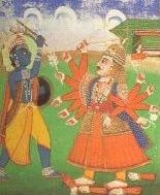
Parashurama

Encyclopedia
Parashurama is the sixth avatar of Vishnu
and belongs to the treta yuga
, and is the son of a Brahmin
father Jamadagni
and mother Renuka. He is considered one of the seven immortal (Chiranjeevi) human. He received an axe
after undertaking a terrible penance to please Shiva
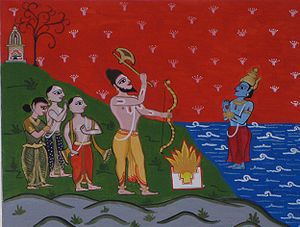
, from whom he learned the methods of warfare and other skills. He fought back the advancing seas thus saving the lands of Konkan
and Malabar
. The coastal area of Kerala State along with the Konkan region, which is the coastal region of Karnataka, Goa and Maharashtra States, is also sometimes called Parashurama Kshetra (Parashurama's country). Parashurama is said to be a Brahmakshatriya ("warrior Brahman"), the first warrior saint. Shri Parashurama is worshiped as a Founder (Mool Purush) of Chitpavan
and Daivadnya
Brahmin Communities.
, hence the name Parashurama literally means 'Rama with the axe'. He is also known as Parasurama, Bhṛgupati, Bhargava
, Bhargava Rāma, and Jāmdagni ( as Jamdagni's son). Variations of his name include the following.
. It appears that the Haihayas may have been enemies and at war with several groups including other Kshatriyas. For example the Haihayas sacked Kashi
during the reigns of King Haryaswa and King Sudeva (whom they killed), King Divodas and his son Pratarddana (who finally expelled them outside of the Vatsa Kingdom). All these kings were born in the Solar Dynasty and the Haihayas were a Lunar Dynasty.
The hostile Haihaya King Kartavirya Arjuna defeated the Nāga
Kshatiryas who were led by Karkotaka Naga. Kartavirya made Mahishmati (present day Maheshwar
) the capital of his own kingdom.
According to numerous Puranas, the military corporations of the Shakas, Yavanas, Kambojas, Pahlavas and Paradas, known as five hordes (pānca-ganah), had militarily supported the Haihaya and Talajunga Kshatriyas in depriving Ikshvaku
King Bahu (the 7th king in descent from Harishchandra
) of his Ayodhya kingdom
.
A generation later, Bahu's son, Sagara recaptured Ayodhya after totally destroying the Haihaya and Talajangha Kshatriyas in the battle. King Sagara had punished these foreign hordes by ordering their 'heads shaved' (a common practice used to humiliate and shame the enemy in the ancient world) and turning them into degraded Kshatriyas.
and the Bhargava
s is mentioned in the Mahabharata
Hindu text numerous times. In the Bhagavata Purana
SB 9.8.5-6, the Haihaya are mentioned as "the uncivilized".
Once, when Parashurama returned home, he found his mother crying hysterically. When asked why she was crying, she said his father had been killed mercilessly by Kartavirya Arjuna
. She beat her chest 21 times in sorrow and anguish at her husband's death. In a rage, Parashurama vowed to exterminate the world's Kshatriyas 21 times. He killed the entire clan of Kartavirya Arjuna (or Sahasrarjuna) and then conquered the entire earth. He then conducted the Ashvamedha
sacrifice, done only by sovereign kings, and gave the entire land he owned to the head-priest who performed at the yagya, viz. Kashyapa.
Parashurama then became responsible for killing the world's corrupted Haihaya kings and warriors who came to attack him in revenge for the killing of Kartavirya Arjuna, to prevent a Brahmin
from being emperor and threatening their position. The Ashvamedha demanded that the kings either submit to Parashurama's imperial position or thwart the sacrifice by defeating him in battle. They did neither and were killed. Parashurama exterminated the world's Haihaya-Kshatriyas 21 times, thus fulfilling his vow.
but the way was blocked by Ganesha
. Parashurama threw the axe at him and Ganesha, knowing it had been given by Shiva, allowed to cut off one of his tusk
s. The goddess Parvati (wife of Shiva), on finding her son's tusk being cut, filled with rage and declared that if Parashurama's thirst for Kshatriya's blood was still not over, she would put a stop to it and teach him a final lesson; she would sever both of his arms and kill him. The Goddess Parvati then took a form of Shakti (the Goddess Durga) and thus became the ultimate source of Power who no other divine power could resist or match. Luckily, Shiva
arrived at the scene and pacified Parvati after convincing not to harm Parashurama as he is also like her son in a way and she should forgive him as a Mother should forgive her child’s mistake. Parashurama also asked for her forgiveness. Parvati finally forgives Parashurama at the request of Ganesha
. Parashurama then gave his divine axe to Ganesha and blessed him.
There is another interesting legend with regards to Parashurama's beating back the seas. It is said that he fired an arrow from his mythical bow that landed in Goa
, at a place called Benaulim(Konkani
:Banavali or बाणावाली) creating what is known locally as "Salkache Tollem", literally meaning "lotus Lake".
There is an interesting side to Parashurama's conquest of Kshatriyas. After one of his conquests, he returns to Aihole (Badami Taluka, Bagalkot district in Karnataka) which, some say was where he lived. The river Malaprabha does a near 180 degree turn there. While Parashurama washed his blood soaked axe upriver, beyond the bend, there were village belles washing clothes downriver. The axe was so bloody that it turned the entire river red. This, the women washing clothes saw and exclaimed "Ai hole!" (oh, what a river!). The name stuck and the village is now known as Aihole
.
There is another legend that the Nairs and the Bunts (Nagas) of Kerala and Tulunadu removed their sacred thread and hid in the forests to avoid Parashurama's revenge upon the Kshatriyas. Parashurama donated the land to the Nambuthiri Brahmins and the Nambuthiris in turn denied the Nairs and Bunts Kshatriya status though they did Kshatriya duties and though some of the royal houses in Kerala arise from them.
(Mahabharata, Book 13, Chapter 153) The mighty Kshatriya Talajangala was destroyed by a single Brahmana. viz., Aurva. (Mahabharata, Book 1, Chapter 2) In the interval between the Treta and Dwapara Yugas, Rama (the son of Jamadagni) great among all who have borne arms, urged by impatience of wrongs, repeatedly smote the noble race of Kshatriyas. And when that fiery meteor, by his own valour, annihilated the entire tribe of the Kshatriyas, he formed at Samanta-panchaka five lakes of blood.
(Mahabharata, Book 1, Chapter 64) The son of Jamadagni (Parashurama), after twenty-one times making the earth bereft of Kshatriyas wended to that best of mountains Mahendra and there began his ascetic penances. Mahendra Mountains
are in central India, the northern end of the Eastern Ghats of India, situated in the western part of Orissa
. (Mahabharata, Book 1, Chapter 104) In olden days, Rama, the son of Jamadagni, in anger at the death of his father, slew with his battle axe the king of the Haihayas. Haiheya
was a central Indian kingdom in Madhya Pradesh
of India, on the banks of Narmada River
. Its capital was Mahishmati
, the modern day town named Maheswar. (Mahabharata, Book 3, Chapter 85) One proceeds to Surparaka, where Jamadagni’s son (Parashurama) had formerly dwelt. Surparaka
also is in western India, Maharashtra with the modern name Sopara
.
(Mahabharata, Book 3, Chapter 115) Akritavrana (a disciple of Parashurama) said, ‘With pleasure shall I recite that excellent history, of the godlike deeds of Rama, the son of Jamadagni, who traced his origin to Bhrigu’s race. I shall also relate the achievements of the great ruler of the Haihaya tribe. That king, Arjuna by name, the mighty lord of the Haihaya tribe was killed by Rama. By the favour of Dattatreya
he had a celestial car made of gold. (Mahabharata, Book 3, Chapter 117) Rama, the leader, thrice smote down all the Kashatriya followers of Kartavirya’s sons. And seven times did that powerful lord exterminate the military tribes of the earth.
The above shown extracts from Mahabharata
shows the conflict between the Bhargavas and the Kshatriyas spanning at least four generations.
, Parashurama came to the betrothal ceremony of the seventh Avatar
, Rama
, to the princess Sita
. As a test of worthiness the suitors were required to lift and string the bow of Shiva
, given to the King Janaka
by Parashurama. Rama successfully strung the bow, but in the process it broke in two, producing a tremendous noise that reached the ears of Parashurama.
In one such version, played in ramlilas across India, Parashurama arrived after hearing the sound of the bow of Shiva breaking. The Kshatriyas were advised by Brahmarishi Vasistha not to confront the sage, but Sita approached the sage. He blessed her, saying "Dheergha Sumangali bhavah", literally meaning "you will have your husband alive for your lifetime, you won't see his death". So when he turned to confront Rama, the destroyer of Shiva's bow, he could not pick up his axe to do so as he pacifies by the brilliance of Rama (Vishnu avatara). This was also because, as he blessed Sita with good luck, he could not cause any harm to her husband which was a part of his own (Shri Vishnu). After recognising Rama for what he truly was, namely the avatar of Vishnu, as his bow went flying in the hands of Lord Rama.
Parashurama ordering, "O son, never again engage in battle with Bhishma or any other Kshatriya
. Heroism and courage in battle are the qualities of a warrior (Kshatriya), and study of the Vedas and the practice of austerities are the wealth of the brahmanas. Previously you took up weapons to protect the brahmanas, but this is not the case now. Let this battle with Bhishma be your last". The sages once again spoke to Rama, "O son of the Bhrigu race, it is not possible to defeat Bhishma". In the end Pitris appeared on the scene and obstructed the chariot of Rama. They forbade him to fight any longer. In the end, all Gods and Parshuram himself showered praise on Bhishma and acknowledged that Bhishma is truly invincible. Parshurama then told Amba: "I have done all that I could and I have failed. Throw yourself on the mercy of Bhishma. That is the only course left to you."
Parashurama was giving away his earning and wealth of a lifetime to brahmanas, Drona approached him. Unfortunately by the time Drona arrived, Parashurama had given away all his belongings to other brahmanas. Taking pity upon the plight of Drona, Parashurama said "You can choose any of my weapons, which one would you like to have"? The clever Drona said "I will like to have your weapons with their mantras as and when I need them". Parashurama accepted. Drona decided to impart his knowledge of combat which made him supreme in the science of arms.
In the Mahabharata
, Parashurama was the instructor of the warrior Karna
, born to a Kshatriya mother but raised as the son of a charioteer, or lower class of Kshatriyas. Karna came to Parashurama after being rejected from the school of Drona
, who taught the five Pandava
and one hundred Kaurava
princes. Parashurama agreed to teach Karna, who said he was a brahmin, and gave him the knowledge of the extremely powerful Brahmastra
weapon. But an incident would render the Brahmastra almost useless to Karna.
One day, Parashurama was sleeping with his head resting on Karna's thigh, when a scorpion crawled up and bit Karna's thigh, boring into it. In spite of the bleeding and the pain, he neither flinched or uttered a cry so that his teacher could continue his rest. However, the blood trickled down, reaching Parashurama and awakening him. Convinced that only a Kshatriya could have borne such pain in silence and that Karna had therefore lied in order to receive instruction, he cursed Karna that his knowledge of the Brahmastra would fail him when he needed it most. Later, during the Kurukshetra war, Karna had a dream at night when he thought of his guru and asked him to take back the curse he had warranted years back. Parashurama explained that he knew that the day would come; he knew that Karna was a Kshatriya, but deemed him to be a worthy student and instructed him nevertheless. However, the outcome of the war would have left the world in ruins if Duryodhana
were to rule, as opposed to Yudhishthira. For that reason, Parashurama requested that Karna accept the curse and fall at the hands of Arjuna, inadvertently saving the world.
Parashurama was the guru of Bhishma
(Devavrata), Dronacharya and Karna
.
. They ruled these lands for many centuries. The Kingdoms like the Cheras, Pandyas, Dravida
, Mushika
, Karnata
and Konkana
were among them. Parashurama also beat back the advancing sea to retrieve a stretch of coastal-area between the foothills of the Western Ghats
and the Arabian Sea, giving rise to the myth of Parashurama, saving a part of the land of Kerala
from the sea. This had happened in Surparaka Kingdom
(Coastal Area Maharasthra). Also it is said that from here the myth spread to Kerala
, by migration. However, Kerala is also said to be given to Brahmin rulers. Dattatreya
initiated Parasurama into Tantric worship and their conversations gave rise to Tripura-rahasya, a treatise on Advaita Vedanta
. At last, Parasurama attained the liberation from the cycles of birth and death with the help of Guru Dattatreya
.
is considered by religious scholars to be to relieve the Earth's burden by exterminating the sinful, destructive and irreligious monarchs that pillaged its resources, and neglected their duties as kings.
Parashurama is of a martial Shraman ascetic. However unlike all other avatars Parashurama still lives on earth, even today according to Hindu belief. Therefore unlike Rama and Krishna Parashurama is not worshipped. But in South India
, at the holy place Pajaka
near Udupi, there exists one major temple commemorating Parashurama.
Parshurama, the savior of the Konkan
coast, is also worshipped in a temple at Parashurama, Chiplun
in Maharashtra's Ratnagiri district
.The people of the Konkan call their land 'Parshurama Bhoomi' or the land of Parashurama in accordance with the legend that the sage reclaimed the land from the sea.
There are several Parashurama temples throughout the western coast of India as well as North India, but especially more in the costal areas from Bharuch
(ancient name of Bharuch is Bhrugu Kutchchh) in the west Indian state of Gujarat right up to Kerala, the southern tip of India. One can see a Parashurama Temple with an Agni Mandir in Shivpuri
- Akkalkot
, Khopoli
in Maharashtra and Fort Songadh in Gujarat.
A temple of Parashurama is also situated at Akhnoor
, 18 km away from Jammu city, J&K.
Every year, in the month of May, an enormous fete in the form of a parade, referred as Parshuram Jayanti, with hundreds of tableaux, thronged through the main city of Jammu. Local community leaders and followers arrange for the celebrations and it is celebrated with great enthusiasm.
states Parashurama will be the martial guru
of Sri Kalki
, the 10th and final avatar of Lord Vishnu. It is he who instructs Kalki to perform a long penance to Shiva to receive celestial weaponry.
in Kanyakumari town, Parashurama installed the Idol made of blue stone. Parashurama installed the idol of Dharma Sastha (Ayyappa) on the peak on the Sabarimala Hill in the forest. Parashurama trained Ayyappa just as he had trained Karna in the Mahabharata and is believed will train the future Kalki.
He created a temple of worship right after he resurfaced parts of Coastal Kerala from the sea. He placed statues of various deities in 108 different places and introduced martial arts ("Kalari Payattu") to protect the temple from the evils.
Also, while the other pilgrimages created by Parashurama are devoted to Lord Shiva, Lord Subramanya
and Lord Ganesha, Kollur
is the only one devoted to Goddess Parvati
.
There are "Seven Mukti Sthalas" of Karnataka, which were created by Parashurama and some of the above such as Kollur
belong to them.
The most famous parasurama temple is in the suburbs of Trivandrum at Thiruvallam where all the trimoorthis are also worshipped. It is believed to be the place where parasurama's axe fell in the Arabian sea to claim Kerala
There is temple dedicated to Lord Parashurama in Khatti
, near Phagwara
in Punjab
, India
.
According to mythology Parashurama is a Chiranjeevi and still doing penance in Mahendragiri
in Eastern Ghats
.
There is a temple of Parashurama in Rajkot (Gujarat), India
.
Sree Parasurama Swamy Temple, Thiruvallam,near Thiruvananthapuram
.The temple is situated on the banks of the river Karamana
, 6km south of the city. This 2000 year old temple
is the only temple in kerala
dedicated to Sri Parasurama, the mythological creator of Kerala.
Many pilgrims visit this temple for 'Balitharpanam' (homage to the departed souls), when they make offerings to their ancestors, after taking a dip in the holy river. There is also a belief that the great monk Adi Shakara made the 'Bali' for his mother at this place.
There is a temple of Parashurama in Harpur, Zamania, Ghazipur
(Uttar Pradesh
)
There is a temple of Parashurama in the village of Painguinim in Canacona, Goa
.
Recently in 2010 a big statue of Bhagwan Parashurama is developed in Phalodi
(Jodhpur
-Rajasthan) near Shivsar Talao(POND).
his janmsthali (birthplace) is in Janapava indore
(madhya pradesh
)
There is a Kunda in Arunachal Pradesh, Tirap District, where it is believed Prashuram threw his axe after killing his mother by the order of his father.
"Seven Mukti Sthalas"
and plowed the land but mistakenly killed a serpent. However the serpent was a demon. To repent this sin King Rambhoja was directed by Lord Parashurama to build a big silver pedestal with the image of a serpent at each of its four corners and to worship Him who would be seated in spirit on the pedestal and also to distribute gold equal to his own weight (Tulabhara) to deserving persons. Rambhoja did likewise and performed the ashwamedha yajna successfully. At its conclusion Lord Parashurama appeared and declared that he was pleased with the Yajna and that henceforth the sacrificial land 'Roupya Peetha' (silver pedestal) ( present day Udupi ) would become a famous centre of pilgrimage. This land is also known as 'Thoulava
' land and because Rambhoja performed 'Tulabhara'.
 There is also the Panhala Fort founded by Raja Bhoja in the late 12th century which was used by Chhatrapati Shivaji and is said to be the only fort in which he stayed for 500 days. This fort is said to have a connection with Parashurama.
Konkan is the karmabhumi of Parashurama (the land founded by him), but very few people know about his janmabhumi (birthplace). there is one view that his birthplace was Mahoor gadh, which is at the border of Marathwada and Vidharbha in Maharastra. At Mahur
on the left hand side of main Renuka Mata temple there is a temple which is believed to be Parashurama's birthplace. However there is also one belief that the birthplace of Lord Parashurama is Janapao or Jaana pau in present day Madhya Pradesh, a central Indian State.
Parashurama had spent most of his childhood time in and around the Mandagni Parvath near Vajreshwari in Maharashtra. You can see a Bala Parashurama temple believed to be built by Bhima on the edge of the Mandagni Parvath.There is also a temple for Renuka devi and Sage Jamadagni.This makes us to believe that the birth place of Lord Parashurama could be around this place.
Vishnu
Vishnu is the Supreme god in the Vaishnavite tradition of Hinduism. Smarta followers of Adi Shankara, among others, venerate Vishnu as one of the five primary forms of God....
and belongs to the treta yuga
Treta Yuga
Treta Yuga is the second out of four yugas, or ages of mankind, in the religion of Hinduism, and follows the Satya Yuga of perfect morality and precedes the Dvapara Yuga. The most famous events in this yuga were Lord Vishnu's fifth, sixth and seventh incarnations as Vamana, Parashurama and...
, and is the son of a Brahmin
Brahmin
Brahmin Brahman, Brahma and Brahmin.Brahman, Brahmin and Brahma have different meanings. Brahman refers to the Supreme Self...
father Jamadagni
Jamadagni
Jamadagni is one of the Saptarishis in the seventh, i.e. the present Manvantara. He was a descendant of the sage Bhrigu, one of the Prajapatis created by Brahma, the God of Creation...
and mother Renuka. He is considered one of the seven immortal (Chiranjeevi) human. He received an axe
Axe
The axe, or ax, is an implement that has been used for millennia to shape, split and cut wood; to harvest timber; as a weapon; and as a ceremonial or heraldic symbol...
after undertaking a terrible penance to please Shiva
Shiva
Shiva is a major Hindu deity, and is the destroyer god or transformer among the Trimurti, the Hindu Trinity of the primary aspects of the divine. God Shiva is a yogi who has notice of everything that happens in the world and is the main aspect of life. Yet one with great power lives a life of a...
, from whom he learned the methods of warfare and other skills. He fought back the advancing seas thus saving the lands of Konkan
Konkan
The Konkan also called the Konkan Coast or Karavali is a rugged section of the western coastline of India from Raigad to Mangalore...
and Malabar
Malabar Coast
The Malabar Coast is a long and narrow coastline on the south-western shore line of the mainland Indian subcontinent. Geographically, it comprises the wettest regions of southern India, as the Western Ghats intercept the moisture-laden monsoon rains, especially on their westward-facing mountain...
. The coastal area of Kerala State along with the Konkan region, which is the coastal region of Karnataka, Goa and Maharashtra States, is also sometimes called Parashurama Kshetra (Parashurama's country). Parashurama is said to be a Brahmakshatriya ("warrior Brahman"), the first warrior saint. Shri Parashurama is worshiped as a Founder (Mool Purush) of Chitpavan
Chitpavan
The Chitpavan or Chitpawan, also known as Konkanastha Brahmins , are a Smarta Brahmin community of Konkan, the coastal region of western Maharashtra in India....
and Daivadnya
Daivadnya
*दाते पंचांग,गोत्रावळी "Gotravali" published by "Date Panchang", Date's Almanac Pvt Ltd, Solapur,India **"Genetics of Castes and Tribes of India:Indian Population Milieu" by M. K. Bhasin, Department of Anthropology, University of Delhi, Delhi 110 007, India...
Brahmin Communities.
Name
Parashu means axe in SanskritSanskrit
Sanskrit , is a historical Indo-Aryan language and the primary liturgical language of Hinduism, Jainism and Buddhism.Buddhism: besides Pali, see Buddhist Hybrid Sanskrit Today, it is listed as one of the 22 scheduled languages of India and is an official language of the state of Uttarakhand...
, hence the name Parashurama literally means 'Rama with the axe'. He is also known as Parasurama, Bhṛgupati, Bhargava
Bhargava
Bhargava is a common surname in Northern India and Maharashtra, mainly around Nashik. In Maharashtra, it is pronounced as Bhargave instead of Bhargava. It is also used as a first name in parts of southern India....
, Bhargava Rāma, and Jāmdagni ( as Jamdagni's son). Variations of his name include the following.
- KhmerKhmer languageKhmer , or Cambodian, is the language of the Khmer people and the official language of Cambodia. It is the second most widely spoken Austroasiatic language , with speakers in the tens of millions. Khmer has been considerably influenced by Sanskrit and Pali, especially in the royal and religious...
: Reamsor or Reameyso - ThaiThai languageThai , also known as Central Thai and Siamese, is the national and official language of Thailand and the native language of the Thai people, Thailand's dominant ethnic group. Thai is a member of the Tai group of the Tai–Kadai language family. Historical linguists have been unable to definitively...
: Ramasun - MalayMalay languageMalay is a major language of the Austronesian family. It is the official language of Malaysia , Indonesia , Brunei and Singapore...
: Pusparama
Haihaya-Kshatriya Background
Parashurama belonged to Srivatsa GotraGotra
In the Hindu society, the term Gotra broadly refers to people who are descendants in an unbroken male line from a common male ancestor. Panini defines gotra for grammatical purposes as apatyam pautraprabhrti gotram , which means "the word gotra denotes the progeny beginning with the son's son"...
. It appears that the Haihayas may have been enemies and at war with several groups including other Kshatriyas. For example the Haihayas sacked Kashi
Varanasi
-Etymology:The name Varanasi has its origin possibly from the names of the two rivers Varuna and Assi, for the old city lies in the north shores of the Ganga bounded by its two tributaries, the Varuna and the Asi, with the Ganges being to its south...
during the reigns of King Haryaswa and King Sudeva (whom they killed), King Divodas and his son Pratarddana (who finally expelled them outside of the Vatsa Kingdom). All these kings were born in the Solar Dynasty and the Haihayas were a Lunar Dynasty.
The hostile Haihaya King Kartavirya Arjuna defeated the Nāga
Naga
Naga or NAGA may refer to:* Nāga, a group of serpent deities in Hindu and Buddhist mythology.-People:* Nayan / Nayar/Nair people of Kerala Society* Naga people, a diverse ethnic identity in Northeast India...
Kshatiryas who were led by Karkotaka Naga. Kartavirya made Mahishmati (present day Maheshwar
Maheshwar
Maheshwar is a town in Khargone district of Madhya Pradesh state, in central India. It is located 13 km east of National Highway 3 and 91 km from Indore, the commercial capital of the state. The town lies on the north bank of the Narmada River.-Etymology:The name Maheshwar comes from...
) the capital of his own kingdom.
According to numerous Puranas, the military corporations of the Shakas, Yavanas, Kambojas, Pahlavas and Paradas, known as five hordes (pānca-ganah), had militarily supported the Haihaya and Talajunga Kshatriyas in depriving Ikshvaku
Ikshvaku
Ikshvaku pāli: Okkāka) was the first king of the Ikshvaku dynasty and founder of the Solar Dynasty of Kshatriyas in Vedic civilization in ancient India.-In Hinduism:He is remembered in Hindu scriptures as a righteous and glorious king...
King Bahu (the 7th king in descent from Harishchandra
Harishchandra
Harishchandra, in Hindu religious texts is the 36th king of the Solar Dynasty, Surya Maharishi Gothram . His legend is very popular and often told as a benchmark for an ideal life. He was renowned for his piety and justice. His name is Sanskrit for "having golden splendour".Harishchandra had two...
) of his Ayodhya kingdom
Monarchy
A monarchy is a form of government in which the office of head of state is usually held until death or abdication and is often hereditary and includes a royal house. In some cases, the monarch is elected...
.
A generation later, Bahu's son, Sagara recaptured Ayodhya after totally destroying the Haihaya and Talajangha Kshatriyas in the battle. King Sagara had punished these foreign hordes by ordering their 'heads shaved' (a common practice used to humiliate and shame the enemy in the ancient world) and turning them into degraded Kshatriyas.
Extermination of the Haihaya-kshatriya caste
The enmity between the HaihayaHeheya Kingdom
Heheya kingdom was one of the many kingdoms ruled by Chandravanshi Kshatriya kings in the central and western India. It was the strongest of the kingdoms and had the powerful ruler Kartavirya Arjuna who even defeated Rakshasa Ravana. Its capital was Mahishmati on the banks of river Narmada in...
and the Bhargava
Bhargava
Bhargava is a common surname in Northern India and Maharashtra, mainly around Nashik. In Maharashtra, it is pronounced as Bhargave instead of Bhargava. It is also used as a first name in parts of southern India....
s is mentioned in the Mahabharata
Mahabharata
The Mahabharata is one of the two major Sanskrit epics of ancient India and Nepal, the other being the Ramayana. The epic is part of itihasa....
Hindu text numerous times. In the Bhagavata Purana
Bhagavata purana
The Bhāgavata Purāṇa is one of the "Maha" Puranic texts of Hindu literature, with its primary focus on bhakti to the incarnations of Vishnu, particularly Krishna...
SB 9.8.5-6, the Haihaya are mentioned as "the uncivilized".
Once, when Parashurama returned home, he found his mother crying hysterically. When asked why she was crying, she said his father had been killed mercilessly by Kartavirya Arjuna
Kartavirya Arjuna
Kartavirya Arjuna , was a legendary king of an ancient kingdom during the Ramayana period with capital at Mahishamati which is on the banks of Narmada River in the current state of Madhya Pradesh. Kartavirya was son of Kritavirya, king of the Haihayas. This is his patronymic, by which he is best...
. She beat her chest 21 times in sorrow and anguish at her husband's death. In a rage, Parashurama vowed to exterminate the world's Kshatriyas 21 times. He killed the entire clan of Kartavirya Arjuna (or Sahasrarjuna) and then conquered the entire earth. He then conducted the Ashvamedha
Ashvamedha
The Ashvamedha was one of the most important royal rituals of Vedic religion, described in detail in the Yajurveda...
sacrifice, done only by sovereign kings, and gave the entire land he owned to the head-priest who performed at the yagya, viz. Kashyapa.
Parashurama then became responsible for killing the world's corrupted Haihaya kings and warriors who came to attack him in revenge for the killing of Kartavirya Arjuna, to prevent a Brahmin
Brahmin
Brahmin Brahman, Brahma and Brahmin.Brahman, Brahmin and Brahma have different meanings. Brahman refers to the Supreme Self...
from being emperor and threatening their position. The Ashvamedha demanded that the kings either submit to Parashurama's imperial position or thwart the sacrifice by defeating him in battle. They did neither and were killed. Parashurama exterminated the world's Haihaya-Kshatriyas 21 times, thus fulfilling his vow.
Legends
According to one legend Parashurama also went to visit ShivaShiva
Shiva is a major Hindu deity, and is the destroyer god or transformer among the Trimurti, the Hindu Trinity of the primary aspects of the divine. God Shiva is a yogi who has notice of everything that happens in the world and is the main aspect of life. Yet one with great power lives a life of a...
but the way was blocked by Ganesha
Ganesha
Ganesha , also spelled Ganesa or Ganesh, also known as Ganapati , Vinayaka , and Pillaiyar , is one of the deities best-known and most widely worshipped in the Hindu pantheon. His image is found throughout India and Nepal. Hindu sects worship him regardless of affiliations...
. Parashurama threw the axe at him and Ganesha, knowing it had been given by Shiva, allowed to cut off one of his tusk
Tusk
Tusks are elongated, continuously growing front teeth, usually but not always in pairs, that protrude well beyond the mouth of certain mammal species. They are most commonly canines, as with warthogs, wild boar, and walruses, or, in the case of elephants and narwhals, elongated incisors...
s. The goddess Parvati (wife of Shiva), on finding her son's tusk being cut, filled with rage and declared that if Parashurama's thirst for Kshatriya's blood was still not over, she would put a stop to it and teach him a final lesson; she would sever both of his arms and kill him. The Goddess Parvati then took a form of Shakti (the Goddess Durga) and thus became the ultimate source of Power who no other divine power could resist or match. Luckily, Shiva
Shiva
Shiva is a major Hindu deity, and is the destroyer god or transformer among the Trimurti, the Hindu Trinity of the primary aspects of the divine. God Shiva is a yogi who has notice of everything that happens in the world and is the main aspect of life. Yet one with great power lives a life of a...
arrived at the scene and pacified Parvati after convincing not to harm Parashurama as he is also like her son in a way and she should forgive him as a Mother should forgive her child’s mistake. Parashurama also asked for her forgiveness. Parvati finally forgives Parashurama at the request of Ganesha
Ganesha
Ganesha , also spelled Ganesa or Ganesh, also known as Ganapati , Vinayaka , and Pillaiyar , is one of the deities best-known and most widely worshipped in the Hindu pantheon. His image is found throughout India and Nepal. Hindu sects worship him regardless of affiliations...
. Parashurama then gave his divine axe to Ganesha and blessed him.
There is another interesting legend with regards to Parashurama's beating back the seas. It is said that he fired an arrow from his mythical bow that landed in Goa
Goa
Goa , a former Portuguese colony, is India's smallest state by area and the fourth smallest by population. Located in South West India in the region known as the Konkan, it is bounded by the state of Maharashtra to the north, and by Karnataka to the east and south, while the Arabian Sea forms its...
, at a place called Benaulim(Konkani
Konkani language
KonkaniKonkani is a name given to a group of several cognate dialects spoken along the narrow strip of land called Konkan, on the west coast of India. This is, however, somewhat an over-generalisation. Geographically, Konkan is defined roughly as the area between the river Damanganga to the north...
:Banavali or बाणावाली) creating what is known locally as "Salkache Tollem", literally meaning "lotus Lake".
There is an interesting side to Parashurama's conquest of Kshatriyas. After one of his conquests, he returns to Aihole (Badami Taluka, Bagalkot district in Karnataka) which, some say was where he lived. The river Malaprabha does a near 180 degree turn there. While Parashurama washed his blood soaked axe upriver, beyond the bend, there were village belles washing clothes downriver. The axe was so bloody that it turned the entire river red. This, the women washing clothes saw and exclaimed "Ai hole!" (oh, what a river!). The name stuck and the village is now known as Aihole
Aihole
Aihole is a temple complex in the Bagalkot district of Karnataka, India. It is a very popular tourist spot in north Karnataka. It lies to the east of Pattadakal, along the Malaprabha River, while Badami is to the west of both....
.
There is another legend that the Nairs and the Bunts (Nagas) of Kerala and Tulunadu removed their sacred thread and hid in the forests to avoid Parashurama's revenge upon the Kshatriyas. Parashurama donated the land to the Nambuthiri Brahmins and the Nambuthiris in turn denied the Nairs and Bunts Kshatriya status though they did Kshatriya duties and though some of the royal houses in Kerala arise from them.
Evidence in the Mahabharata of conflict spanning generations
Reflections of Aurva, the Great-Grandfather of Parashurama (Mahabharata, Book 1, Chapter 182) While lying unborn, I heard the doleful cries of my mother and other women of the Bhrigu race who were then being exterminated by the Kshatriyas. When those Kshatriyas began to exterminate the Bhrigus together with unborn children of their race, it was then that wrath filled my soul. My mother and the other women of our race, each in an advanced state of pregnancy, and my father, while terribly alarmed, found not in all the worlds a single protector. Then when the Bhrigu women found not a single protector, my mother held me in one of her thighs.(Mahabharata, Book 13, Chapter 153) The mighty Kshatriya Talajangala was destroyed by a single Brahmana. viz., Aurva. (Mahabharata, Book 1, Chapter 2) In the interval between the Treta and Dwapara Yugas, Rama (the son of Jamadagni) great among all who have borne arms, urged by impatience of wrongs, repeatedly smote the noble race of Kshatriyas. And when that fiery meteor, by his own valour, annihilated the entire tribe of the Kshatriyas, he formed at Samanta-panchaka five lakes of blood.
(Mahabharata, Book 1, Chapter 64) The son of Jamadagni (Parashurama), after twenty-one times making the earth bereft of Kshatriyas wended to that best of mountains Mahendra and there began his ascetic penances. Mahendra Mountains
Mahendra Mountains
Mahendra Mountains is a mountain range described in the epic Mahabharata. It is identified to be the part of the mountain ranges in the east coast of India , that falls in Orissa. It is the place where Bhargava Rama or Parashurama spending his days of life, as he is one of the chiranjeevi or having...
are in central India, the northern end of the Eastern Ghats of India, situated in the western part of Orissa
Orissa
Orissa , officially Odisha since Nov 2011, is a state of India, located on the east coast of India, by the Bay of Bengal. It is the modern name of the ancient nation of Kalinga, which was invaded by the Maurya Emperor Ashoka in 261 BC. The modern state of Orissa was established on 1 April...
. (Mahabharata, Book 1, Chapter 104) In olden days, Rama, the son of Jamadagni, in anger at the death of his father, slew with his battle axe the king of the Haihayas. Haiheya
Heheya Kingdom
Heheya kingdom was one of the many kingdoms ruled by Chandravanshi Kshatriya kings in the central and western India. It was the strongest of the kingdoms and had the powerful ruler Kartavirya Arjuna who even defeated Rakshasa Ravana. Its capital was Mahishmati on the banks of river Narmada in...
was a central Indian kingdom in Madhya Pradesh
Madhya Pradesh
Madhya Pradesh , often called the Heart of India, is a state in central India. Its capital is Bhopal and Indore is the largest city....
of India, on the banks of Narmada River
Narmada River
The Narmada , also called Rewa is a river in central India and the fifth largest river in the Indian subcontinent. It is the third largest river that completely flows within India after Ganges and Godavari...
. Its capital was Mahishmati
Mahishmati
Mahishmati was an ancient city mentioned in the epic Mahabharata. It was the capital of the kingdom named Heheya. Kartavirya Arjuna, a Yadava king, was the foremost ruler of Mahismati and Haiheya . He was killed by Bhargava Rama. Epic Ramayana mentions about the attack of Rakshasa king Ravana on...
, the modern day town named Maheswar. (Mahabharata, Book 3, Chapter 85) One proceeds to Surparaka, where Jamadagni’s son (Parashurama) had formerly dwelt. Surparaka
Surparaka Kingdom
The country of Surparaka was founded by Bhargava Rama near the Western sea, close to the mouth of river Narmada. This kingdom is mentioned in the epic Mahabharata. Parashurama gave this kingdom to the Brahmin rulers of Kashyapa clan....
also is in western India, Maharashtra with the modern name Sopara
Sopara
Sopara or Soparaka was an ancient port town and the capital of the ancient Aparanta. The site of this ancient town is located near the present day Nala Sopara town in the Thane district of the state Maharashtra, India.Nala Sopara is one of the busiest western suburbs of Mumbai city...
.
(Mahabharata, Book 3, Chapter 115) Akritavrana (a disciple of Parashurama) said, ‘With pleasure shall I recite that excellent history, of the godlike deeds of Rama, the son of Jamadagni, who traced his origin to Bhrigu’s race. I shall also relate the achievements of the great ruler of the Haihaya tribe. That king, Arjuna by name, the mighty lord of the Haihaya tribe was killed by Rama. By the favour of Dattatreya
Dattatreya
Dattatreya or Datta is a Hindu deity encompassing the trinity of Brahma, Vishnu and Shiva, collectively known as Trimurti. The name Dattatreya can be divided into two words - "Datta" and "Atreya" referring to the sage Atri, his physical father.Various Hindu sects worship him differently...
he had a celestial car made of gold. (Mahabharata, Book 3, Chapter 117) Rama, the leader, thrice smote down all the Kashatriya followers of Kartavirya’s sons. And seven times did that powerful lord exterminate the military tribes of the earth.
The above shown extracts from Mahabharata
Mahabharata
The Mahabharata is one of the two major Sanskrit epics of ancient India and Nepal, the other being the Ramayana. The epic is part of itihasa....
shows the conflict between the Bhargavas and the Kshatriyas spanning at least four generations.
Shiva's Bow
In the RamayanaRamayana
The Ramayana is an ancient Sanskrit epic. It is ascribed to the Hindu sage Valmiki and forms an important part of the Hindu canon , considered to be itihāsa. The Ramayana is one of the two great epics of India and Nepal, the other being the Mahabharata...
, Parashurama came to the betrothal ceremony of the seventh Avatar
Avatar
In Hinduism, an avatar is a deliberate descent of a deity to earth, or a descent of the Supreme Being and is mostly translated into English as "incarnation," but more accurately as "appearance" or "manifestation"....
, Rama
Rama
Rama or full name Ramachandra is considered to be the seventh avatar of Vishnu in Hinduism, and a king of Ayodhya in ancient Indian...
, to the princess Sita
SITA
SITA is a multinational information technology company specialising in providing IT and telecommunication services to the air transport industry...
. As a test of worthiness the suitors were required to lift and string the bow of Shiva
Shiva
Shiva is a major Hindu deity, and is the destroyer god or transformer among the Trimurti, the Hindu Trinity of the primary aspects of the divine. God Shiva is a yogi who has notice of everything that happens in the world and is the main aspect of life. Yet one with great power lives a life of a...
, given to the King Janaka
Janaka
Janaka or Raja Janaka were the kings of Videha Kingdom. Their capital was Mithila, which is believed to be present day Janakpur, Nepal...
by Parashurama. Rama successfully strung the bow, but in the process it broke in two, producing a tremendous noise that reached the ears of Parashurama.
In one such version, played in ramlilas across India, Parashurama arrived after hearing the sound of the bow of Shiva breaking. The Kshatriyas were advised by Brahmarishi Vasistha not to confront the sage, but Sita approached the sage. He blessed her, saying "Dheergha Sumangali bhavah", literally meaning "you will have your husband alive for your lifetime, you won't see his death". So when he turned to confront Rama, the destroyer of Shiva's bow, he could not pick up his axe to do so as he pacifies by the brilliance of Rama (Vishnu avatara). This was also because, as he blessed Sita with good luck, he could not cause any harm to her husband which was a part of his own (Shri Vishnu). After recognising Rama for what he truly was, namely the avatar of Vishnu, as his bow went flying in the hands of Lord Rama.
The Mahabharata
When Amba came to Parashurama for help because Bhishma refused to marry her he decided to slay Bhishma and fought with him for twenty three days. It was a long and fierce fight between the two greatest warriors of the age. Bhishma had knowledge of the divine deadly weapon: "Parshwapastra". Parashurama had no knowledge of this weapon. When Bhishma was about to use it against Parashurama, all Gods rushed to Bhishma and requested him not to use this weapon against Parshurama as it will humiliate Parshurama. Bhishma refrained from using it. Parashurama's father, Jamadagni and grandfather, Richika, then appeared beforeParashurama ordering, "O son, never again engage in battle with Bhishma or any other Kshatriya
Kshatriya
*For the Bollywood film of the same name see Kshatriya Kshatriya or Kashtriya, meaning warrior, is one of the four varnas in Hinduism...
. Heroism and courage in battle are the qualities of a warrior (Kshatriya), and study of the Vedas and the practice of austerities are the wealth of the brahmanas. Previously you took up weapons to protect the brahmanas, but this is not the case now. Let this battle with Bhishma be your last". The sages once again spoke to Rama, "O son of the Bhrigu race, it is not possible to defeat Bhishma". In the end Pitris appeared on the scene and obstructed the chariot of Rama. They forbade him to fight any longer. In the end, all Gods and Parshuram himself showered praise on Bhishma and acknowledged that Bhishma is truly invincible. Parshurama then told Amba: "I have done all that I could and I have failed. Throw yourself on the mercy of Bhishma. That is the only course left to you."
Parashurama was giving away his earning and wealth of a lifetime to brahmanas, Drona approached him. Unfortunately by the time Drona arrived, Parashurama had given away all his belongings to other brahmanas. Taking pity upon the plight of Drona, Parashurama said "You can choose any of my weapons, which one would you like to have"? The clever Drona said "I will like to have your weapons with their mantras as and when I need them". Parashurama accepted. Drona decided to impart his knowledge of combat which made him supreme in the science of arms.
In the Mahabharata
Mahabharata
The Mahabharata is one of the two major Sanskrit epics of ancient India and Nepal, the other being the Ramayana. The epic is part of itihasa....
, Parashurama was the instructor of the warrior Karna
Karna
Karna or Radheya is one of the central characters in the epic Mahābhārata, from ancient India. He was the King of Anga...
, born to a Kshatriya mother but raised as the son of a charioteer, or lower class of Kshatriyas. Karna came to Parashurama after being rejected from the school of Drona
Drona
In the epic Mahābhārata, Drona or Dronacharya was the royal guru to Kauravas and Pandavas. He was a master of advanced military arts, including the Devastras. Arjuna was his favorite student. Dronas love for Arjuna was second only to his love for his son Ashwatthama...
, who taught the five Pandava
Pandava
In the Hindu epic Mahābhārata, the Pandava are the five acknowledged sons of Pandu , by his two wives Kunti and Madri. Their names are Yudhisthira, Bhima, Arjuna, Nakula and Sahadeva. Although, Karna is told by Lord Krishna that according to the laws and ethics he is the first son of Kunti making...
and one hundred Kaurava
Kaurava
The term Kaurava is a Sanskrit term, that means the descendants of Kuru, a legendary king who is the ancestor of many of the characters of the Mahābhārata.The term is used in the Mahābhārata with two meanings:...
princes. Parashurama agreed to teach Karna, who said he was a brahmin, and gave him the knowledge of the extremely powerful Brahmastra
Brahmastra
In ancient Sanskrit writings, the Brahmastra was a weapon created by Brahma.-Features:It is sometimes known as the Brahma Astra . As described in a number of the Puranas, it was considered the deadliest weapon...
weapon. But an incident would render the Brahmastra almost useless to Karna.
One day, Parashurama was sleeping with his head resting on Karna's thigh, when a scorpion crawled up and bit Karna's thigh, boring into it. In spite of the bleeding and the pain, he neither flinched or uttered a cry so that his teacher could continue his rest. However, the blood trickled down, reaching Parashurama and awakening him. Convinced that only a Kshatriya could have borne such pain in silence and that Karna had therefore lied in order to receive instruction, he cursed Karna that his knowledge of the Brahmastra would fail him when he needed it most. Later, during the Kurukshetra war, Karna had a dream at night when he thought of his guru and asked him to take back the curse he had warranted years back. Parashurama explained that he knew that the day would come; he knew that Karna was a Kshatriya, but deemed him to be a worthy student and instructed him nevertheless. However, the outcome of the war would have left the world in ruins if Duryodhana
Duryodhana
In the Hindu epic the Mahābhārata, Duryodhana is the eldest son of the blind king Dhritarashtra by Queen Gandhari, the eldest of the one hundred Kaurava brothers, Emperor of the world at that time which means Emperor of India or Bharatvarsha as it was known at that time, cousin and the chief...
were to rule, as opposed to Yudhishthira. For that reason, Parashurama requested that Karna accept the curse and fall at the hands of Arjuna, inadvertently saving the world.
Parashurama was the guru of Bhishma
Bhishma
Bhishma or Bheeshma or Devavrata or 'Bhishma Pitamah' was the eighth son of Kuru King Shantanu who was blessed with wish-long life and had sworn to serve the ruling Kuru king. He was one of the most prominent characters of the great Indian epic, the Mahabharata. He was the grand uncle of both the...
(Devavrata), Dronacharya and Karna
Karna
Karna or Radheya is one of the central characters in the epic Mahābhārata, from ancient India. He was the King of Anga...
.
Later life
In the later life of Parashurama, he gave up violence, became an ascetic and practiced penances, mainly on the Mahendra Mountains. The territories he received from the Kshatriyas he slew, were distributed among a clan of Brahmins called the BhumiharBhumihar
Bhumihar or Babhan or Bhuin-har is a Brahmin Hindu community mainly found in the Indian states of Bihar, Jharkhand, Uttar Pradesh and Bundelkhand region of Madhya Pradesh.- Varna status :...
. They ruled these lands for many centuries. The Kingdoms like the Cheras, Pandyas, Dravida
Dravida Kingdom
During the time of Mahabharata Dravida was mentioned as one among the kingdoms ruled by non-Vedic tribes, in southern India. Its territories include the southern part of modern day Andhra Pradesh and the northern part of Tamil Nadu...
, Mushika
Mushika Kingdom
Mushika Kingdom was an ancient kingdom of the Tamil Sangam age in present day northern Kerala, India ruled by the Royal dynasty of the same name. They ruled the strip of land between Mangaluru in the north and Vadagara in the south...
, Karnata
Karnata Kingdom
Karnata was a southern kingdom ruled by non-Vedic rulers during the period of the epic Mahabharata. The Karnata tribe was a Dravidian tribe. They could have migrated from the Sindh-Baluchistan area...
and Konkana
Konkana Kingdom
Konkana was a southern kingdom populated by Brahmins during and after the period of Puranas. This kingdom is identified to be the Konkan region of Maharashtra. Other such Brahmin populated kingdoms includes Dravida, Andhra and Karnata...
were among them. Parashurama also beat back the advancing sea to retrieve a stretch of coastal-area between the foothills of the Western Ghats
Western Ghats
The Western Ghats, Western Ghauts or the Sahyādri is a mountain range along the western side of India. It runs north to south along the western edge of the Deccan Plateau, and separates the plateau from a narrow coastal plain along the Arabian Sea. The Western Ghats block rainfall to the Deccan...
and the Arabian Sea, giving rise to the myth of Parashurama, saving a part of the land of Kerala
Kerala
or Keralam is an Indian state located on the Malabar coast of south-west India. It was created on 1 November 1956 by the States Reorganisation Act by combining various Malayalam speaking regions....
from the sea. This had happened in Surparaka Kingdom
Surparaka Kingdom
The country of Surparaka was founded by Bhargava Rama near the Western sea, close to the mouth of river Narmada. This kingdom is mentioned in the epic Mahabharata. Parashurama gave this kingdom to the Brahmin rulers of Kashyapa clan....
(Coastal Area Maharasthra). Also it is said that from here the myth spread to Kerala
Kerala
or Keralam is an Indian state located on the Malabar coast of south-west India. It was created on 1 November 1956 by the States Reorganisation Act by combining various Malayalam speaking regions....
, by migration. However, Kerala is also said to be given to Brahmin rulers. Dattatreya
Dattatreya
Dattatreya or Datta is a Hindu deity encompassing the trinity of Brahma, Vishnu and Shiva, collectively known as Trimurti. The name Dattatreya can be divided into two words - "Datta" and "Atreya" referring to the sage Atri, his physical father.Various Hindu sects worship him differently...
initiated Parasurama into Tantric worship and their conversations gave rise to Tripura-rahasya, a treatise on Advaita Vedanta
Advaita Vedanta
Advaita Vedanta is considered to be the most influential and most dominant sub-school of the Vedānta school of Hindu philosophy. Other major sub-schools of Vedānta are Dvaita and ; while the minor ones include Suddhadvaita, Dvaitadvaita and Achintya Bhedabheda...
. At last, Parasurama attained the liberation from the cycles of birth and death with the help of Guru Dattatreya
Dattatreya
Dattatreya or Datta is a Hindu deity encompassing the trinity of Brahma, Vishnu and Shiva, collectively known as Trimurti. The name Dattatreya can be divided into two words - "Datta" and "Atreya" referring to the sage Atri, his physical father.Various Hindu sects worship him differently...
.
The Sixth Avatara
The purpose of the sixth incarnation of VishnuVishnu
Vishnu is the Supreme god in the Vaishnavite tradition of Hinduism. Smarta followers of Adi Shankara, among others, venerate Vishnu as one of the five primary forms of God....
is considered by religious scholars to be to relieve the Earth's burden by exterminating the sinful, destructive and irreligious monarchs that pillaged its resources, and neglected their duties as kings.
Parashurama is of a martial Shraman ascetic. However unlike all other avatars Parashurama still lives on earth, even today according to Hindu belief. Therefore unlike Rama and Krishna Parashurama is not worshipped. But in South India
South India
South India is the area encompassing India's states of Andhra Pradesh, Karnataka, Kerala and Tamil Nadu as well as the union territories of Lakshadweep and Pondicherry, occupying 19.31% of India's area...
, at the holy place Pajaka
Pajaka
Pajaka is a village in Udupi Taluk and district of Karnataka state in India. Pajaka is the place where Dvaita philosopher Sri Madhvacharya was born. Madhvacharya is also known by name "Poornaprajna" and "Anandathirta".The place is near Kunjarugiri Durga temple...
near Udupi, there exists one major temple commemorating Parashurama.
Parshurama, the savior of the Konkan
Konkan
The Konkan also called the Konkan Coast or Karavali is a rugged section of the western coastline of India from Raigad to Mangalore...
coast, is also worshipped in a temple at Parashurama, Chiplun
Chiplun
Chiplun is a city and a municipal council in Ratnagiri district in the state of Maharashtra, India. Located on the Mumbai–Goa highway in western India. The city is about 320 km south of Mumbai in the Konkan region of Maharashtra. It is a fast developing city in Konkan with a strong cultural...
in Maharashtra's Ratnagiri district
Ratnagiri District
Ratnagiri district is one of the 35 districts of Maharashtra state in western India. Ratnagiri is the district headquarters of the district. The district is 11.33% urban. The district is bounded by the Arabian Sea to the west, Sindhudurg district to the south, Raigad district to the north and...
.The people of the Konkan call their land 'Parshurama Bhoomi' or the land of Parashurama in accordance with the legend that the sage reclaimed the land from the sea.
There are several Parashurama temples throughout the western coast of India as well as North India, but especially more in the costal areas from Bharuch
Bharuch
Bharuch , also known as Broach, is the oldest city in Gujarat, situated at the mouth of the holy river Narmada. Bharuch is the administrative headquarters of Bharuch District and a municipality of more than 1,50,000 inhabitants. As Bharuch is a major seaport city, a number of trade activities have...
(ancient name of Bharuch is Bhrugu Kutchchh) in the west Indian state of Gujarat right up to Kerala, the southern tip of India. One can see a Parashurama Temple with an Agni Mandir in Shivpuri
Shivpuri
Shivpuri is a city and a municipality in Shivpuri district in the Indian state of Madhya Pradesh. It is in the Gwalior Division of northwest Madhya Pradesh and is the administrative headquarters of Shivpuri District. It is situated at an altitude of above sea level.-History:Shivpuri is an ancient...
- Akkalkot
Akkalkot
Akkalkot |ಅಕ್ಕಲಕೋಟೆ is a city and a municipal council in Solapur district in the Indian state of Maharashtra. It is situated 40 km southeast of Solapur and very close to the border between Maharashtra and Karnataka states...
, Khopoli
Khopoli
Khopoli is an industrial town in the Khalapur taluka of Raigad district, in the Indian state of Maharashtra, at the base of the Sahyadri mountains. Patalganga River which is the tailrace channel of Tata Hydroelectric Power station flows through Khopoli....
in Maharashtra and Fort Songadh in Gujarat.
A temple of Parashurama is also situated at Akhnoor
Akhnoor
Akhnoor is a town in Jammu district in the state of Jammu & Kashmir, India.Located from Jammu, Akhnoor is located in the foothills of the Himalayas. It is an extremely beautiful town...
, 18 km away from Jammu city, J&K.
Every year, in the month of May, an enormous fete in the form of a parade, referred as Parshuram Jayanti, with hundreds of tableaux, thronged through the main city of Jammu. Local community leaders and followers arrange for the celebrations and it is celebrated with great enthusiasm.
Kalki Purana
The Kalki PuranaKalki Purana
The Kalki Purana is a prophetic work in Sanskrit that details the life and times of Kalki, the tenth and final Dashavatara of the Hindu deity Lord Vishnu...
states Parashurama will be the martial guru
Guru
A guru is one who is regarded as having great knowledge, wisdom, and authority in a certain area, and who uses it to guide others . Other forms of manifestation of this principle can include parents, school teachers, non-human objects and even one's own intellectual discipline, if the...
of Sri Kalki
Kalki
In Hinduism, Kalki is the tenth and final Maha Avatar of Vishnu who will come to end the present age of darkness and destruction known as Kali Yuga. The name Kalki is often a metaphor for eternity or time...
, the 10th and final avatar of Lord Vishnu. It is he who instructs Kalki to perform a long penance to Shiva to receive celestial weaponry.
Temples
In the Kanyakumari TempleDevi Kanya Kumari
Devi Kanya Kumari, known as Kumari Amman is one of the forms of Devi. She is popularly known as "Bhagavathy Amman". Bhagavathy Amman Temple is located in Kanya Kumari on the confluence of the Bay of Bengal, the Arabian Sea, and the Indian Ocean...
in Kanyakumari town, Parashurama installed the Idol made of blue stone. Parashurama installed the idol of Dharma Sastha (Ayyappa) on the peak on the Sabarimala Hill in the forest. Parashurama trained Ayyappa just as he had trained Karna in the Mahabharata and is believed will train the future Kalki.
He created a temple of worship right after he resurfaced parts of Coastal Kerala from the sea. He placed statues of various deities in 108 different places and introduced martial arts ("Kalari Payattu") to protect the temple from the evils.
Also, while the other pilgrimages created by Parashurama are devoted to Lord Shiva, Lord Subramanya
Murugan
Murugan also called Kartikeya, Skanda and Subrahmanya, is a popular Hindu deity especially among Tamil Hindus, worshipped primarily in areas with Tamil influences, especially South India, Singapore, Sri Lanka, Malaysia, Mauritius and Reunion Island. His six most important shrines in India are the...
and Lord Ganesha, Kollur
Kollur
Kolluru is a tiny hamlet situated about from Kundapur Town, about away from Mangalore City in Karnataka state in the southern part of India...
is the only one devoted to Goddess Parvati
Parvati
Parvati is a Hindu goddess. Parvati is Shakti, the wife of Shiva and the gentle aspect of Mahadevi, the Great Goddess...
.
There are "Seven Mukti Sthalas" of Karnataka, which were created by Parashurama and some of the above such as Kollur
Kollur
Kolluru is a tiny hamlet situated about from Kundapur Town, about away from Mangalore City in Karnataka state in the southern part of India...
belong to them.
The most famous parasurama temple is in the suburbs of Trivandrum at Thiruvallam where all the trimoorthis are also worshipped. It is believed to be the place where parasurama's axe fell in the Arabian sea to claim Kerala
Kerala
or Keralam is an Indian state located on the Malabar coast of south-west India. It was created on 1 November 1956 by the States Reorganisation Act by combining various Malayalam speaking regions....
There is temple dedicated to Lord Parashurama in Khatti
Khatti
Khatti is a village near Khurampur, Tehsil Phagwara, Kapurthala district, in Punjab, India.-Demographics:According to the 2001 Census, Khatti has a population of 917 people. Neighbouring villages include Sr Hargobindgarh, Dhadday, Chak Prema, Gulabgarh, Wariah, Khurampur and Palahi...
, near Phagwara
Phagwara
Phagwara is a city and a municipal council in Kapurthala district in North India, in the central part of the Punjab.-Location:Phagwara lies on the Delhi–Amritsar national highway No.01 and is also served by the rail link between Delhi and Amritsar. It is located between the two big cities of...
in Punjab
Punjab (India)
Punjab ) is a state in the northwest of the Republic of India, forming part of the larger Punjab region. The state is bordered by the Indian states of Himachal Pradesh to the east, Haryana to the south and southeast and Rajasthan to the southwest as well as the Pakistani province of Punjab to the...
, India
India
India , officially the Republic of India , is a country in South Asia. It is the seventh-largest country by geographical area, the second-most populous country with over 1.2 billion people, and the most populous democracy in the world...
.
According to mythology Parashurama is a Chiranjeevi and still doing penance in Mahendragiri
Mahendragiri, Orissa
Mahendragiri, is a mountain peak at in the Paralakhemundi subdivision of the district of Gajapati, Orissa, India. It is situated amongst the Eastern Ghats at an elevation of .-Mythology:...
in Eastern Ghats
Eastern Ghats
The Eastern Ghats or Eastern Ghauts are a discontinuous range of mountains along India's eastern coast. The Eastern Ghats run from West Bengal state in the north, through Orissa and Andhra Pradesh to Tamil Nadu in the south passing some parts of Karnataka. They are eroded and cut through by the...
.
There is a temple of Parashurama in Rajkot (Gujarat), India
India
India , officially the Republic of India , is a country in South Asia. It is the seventh-largest country by geographical area, the second-most populous country with over 1.2 billion people, and the most populous democracy in the world...
.
Sree Parasurama Swamy Temple, Thiruvallam,near Thiruvananthapuram
Thiruvananthapuram
Thiruvananthapuram , formerly known as Trivandrum, is the capital of the Indian state of Kerala and the headquarters of the Thiruvananthapuram District. It is located on the west coast of India near the extreme south of the mainland...
.The temple is situated on the banks of the river Karamana
Karamana
Karamana is a suburb of Thiruvananthapuram , the capital city of Kerala, India. It is one of the most densely populated, but green part of Thiruvananthapuram. The land of Karamana is made fertile by the river, Karamana River which starts from the southern tip of the Western Ghats at "Agastyakoodam"...
, 6km south of the city. This 2000 year old temple
Temple
A temple is a structure reserved for religious or spiritual activities, such as prayer and sacrifice, or analogous rites. A templum constituted a sacred precinct as defined by a priest, or augur. It has the same root as the word "template," a plan in preparation of the building that was marked out...
is the only temple in kerala
Kerala
or Keralam is an Indian state located on the Malabar coast of south-west India. It was created on 1 November 1956 by the States Reorganisation Act by combining various Malayalam speaking regions....
dedicated to Sri Parasurama, the mythological creator of Kerala.
Many pilgrims visit this temple for 'Balitharpanam' (homage to the departed souls), when they make offerings to their ancestors, after taking a dip in the holy river. There is also a belief that the great monk Adi Shakara made the 'Bali' for his mother at this place.
There is a temple of Parashurama in Harpur, Zamania, Ghazipur
Ghazipur
Ghazipur , or Ghazipur City, previously spelt Ghazeepore, is a city/town and a municipal corporation and headquarter of Ghazipur district in the state of Uttar Pradesh, India. It is the administrative headquarters of Ghazipur Division and Sub-division...
(Uttar Pradesh
Uttar Pradesh
Uttar Pradesh abbreviation U.P. , is a state located in the northern part of India. With a population of over 200 million people, it is India's most populous state, as well as the world's most populous sub-national entity...
)
There is a temple of Parashurama in the village of Painguinim in Canacona, Goa
Goa
Goa , a former Portuguese colony, is India's smallest state by area and the fourth smallest by population. Located in South West India in the region known as the Konkan, it is bounded by the state of Maharashtra to the north, and by Karnataka to the east and south, while the Arabian Sea forms its...
.
Recently in 2010 a big statue of Bhagwan Parashurama is developed in Phalodi
Phalodi
Phalodi is a city and a municipality in Jodhpur district in the Indian state of Rajasthan. It is situated between latitude 27°-06 to 27°-09 north and 72°-20 to 72°-23east. It has an average elevation of 303 metres...
(Jodhpur
Jodhpur
Jodhpur , is the second largest city in the Indian state of Rajasthan. It is located west from the state capital, Jaipur and from the city of Ajmer. It was formerly the seat of a princely state of the same name, the capital of the kingdom known as Marwar...
-Rajasthan) near Shivsar Talao(POND).
his janmsthali (birthplace) is in Janapava indore
Indore
Indore is one of the major city in India, the largest city and commercial center of the state of Madhya Pradesh in central India. Indore is located 190 km west of the state capital Bhopal. According to the 2011 Indian census, Indore city has a population of 1,960,631...
(madhya pradesh
Madhya Pradesh
Madhya Pradesh , often called the Heart of India, is a state in central India. Its capital is Bhopal and Indore is the largest city....
)
There is a Kunda in Arunachal Pradesh, Tirap District, where it is believed Prashuram threw his axe after killing his mother by the order of his father.
Parashurama Kshetras
Nine kshetras are popularly known as Parashurama kshetras and a.k.a. 'Parashurama Srishti'."Seven Mukti Sthalas"
- Parshuram Ghat - Chiplun - Konkan Maharashtra
- MangaloreMangaloreMangalore is the chief port city of the Indian state of Karnataka. It is located about west of the state capital, Bangalore. Mangalore lies between the Arabian Sea and the Western Ghat mountain ranges, and is the administrative headquarters of the Dakshina Kannada district in south western...
- Udupi
- SubramanyaSubramanyaSubramanya is a commonly used Indian name. It is also another name for the Hindu deity Murugan. Other common spellings are Subrahmanya, Subramania and Subramaniam. The name may refer to:People...
- KollurKollurKolluru is a tiny hamlet situated about from Kundapur Town, about away from Mangalore City in Karnataka state in the southern part of India...
- ShankaranarayanaShankaranarayanaShankaranarayana is a village in Kundapura taluk of Udupi district in the state of Karnataka in India.It is situated in midst of coconut and arecanut plantations along with forests adjoining western ghats...
- KoteshwaraKoteshwaraKoteshwara, sometimes transcribed Koteshwar, is a village in the Indian state of Karnataka. It is located in Kundapura taluk of Udupi district. As of 2007 21,100 people lived in the village....
- GokarnaGokarna, IndiaGokarna is a village in the Uttara Kannada district of the Karnataka state, India. It is a Hindu pilgrimage centre as well as a tourist destination in India. Gokarna is a temple town and is referred to in a number of Hindu historical literature pieces. The main deity is Lord Mahabhaleshwara, a...
- Parashuram Kund(Arunachal Pradesh)
Further Kshetra legend
There is a legend that in one of the kshetras a King called 'Ramabhoja worshipped Lord' Parashurama He was the ruler of the lands between Gokarna and Kanyakumari and was proclaimed king of the entire Parashurama Kshetra. Once he decided to perform the aswamedha yajnaAshvamedha
The Ashvamedha was one of the most important royal rituals of Vedic religion, described in detail in the Yajurveda...
and plowed the land but mistakenly killed a serpent. However the serpent was a demon. To repent this sin King Rambhoja was directed by Lord Parashurama to build a big silver pedestal with the image of a serpent at each of its four corners and to worship Him who would be seated in spirit on the pedestal and also to distribute gold equal to his own weight (Tulabhara) to deserving persons. Rambhoja did likewise and performed the ashwamedha yajna successfully. At its conclusion Lord Parashurama appeared and declared that he was pleased with the Yajna and that henceforth the sacrificial land 'Roupya Peetha' (silver pedestal) ( present day Udupi ) would become a famous centre of pilgrimage. This land is also known as 'Thoulava
Tulu Nadu
Tulu Nadu is a Tulu-speaking region spread over to parts of present Karnataka and Kerala States of India. It consists of the Dakshina Kannada and Udupi districts of Karnataka and the northern parts of the Kasaragod district of Kerala up to the Payaswini River...
' land and because Rambhoja performed 'Tulabhara'.
Reclamation of Konkan and Kerala coasts
Konkan is the karmabhumi of Parashurama (the land founded by him), but very few people know about his janmabhumi (birthplace). there is one view that his birthplace was Mahoor gadh, which is at the border of Marathwada and Vidharbha in Maharastra. At Mahur
Mahur
Mahur or Mahurgad is a religious place in Maharashtra, India. Mahur is said to be the birth place of Hindu Goddess Renuka, mother of Lord Parshuram. The three and half Shakti Peethas of Maharashtra are Tuljapur enshrining Bhavani, Kolhapur enshrining Mahalakshmi, Mahur enshrining Mahamaya, and...
on the left hand side of main Renuka Mata temple there is a temple which is believed to be Parashurama's birthplace. However there is also one belief that the birthplace of Lord Parashurama is Janapao or Jaana pau in present day Madhya Pradesh, a central Indian State.
Parashurama had spent most of his childhood time in and around the Mandagni Parvath near Vajreshwari in Maharashtra. You can see a Bala Parashurama temple believed to be built by Bhima on the edge of the Mandagni Parvath.There is also a temple for Renuka devi and Sage Jamadagni.This makes us to believe that the birth place of Lord Parashurama could be around this place.
See also
- AvatarAvatarIn Hinduism, an avatar is a deliberate descent of a deity to earth, or a descent of the Supreme Being and is mostly translated into English as "incarnation," but more accurately as "appearance" or "manifestation"....
- Chiranjivins
- HaihayasHaihayasThe Haihayas were an ancient confederacy of five ganas , who claimed their common ancestry from Yadu. According to the Harivamsha Purana...
- Heheya KingdomHeheya KingdomHeheya kingdom was one of the many kingdoms ruled by Chandravanshi Kshatriya kings in the central and western India. It was the strongest of the kingdoms and had the powerful ruler Kartavirya Arjuna who even defeated Rakshasa Ravana. Its capital was Mahishmati on the banks of river Narmada in...
- Kalachuri KingdomKalachuriKalachuri Empire is this the name used by two kingdoms who had a succession of dynasties from the 10th-12th centuries, one ruling over areas in Central India and were called Chedi or Haihaya and the other southern Kalachuri who ruled over parts of Karnataka...
- VishnuVishnuVishnu is the Supreme god in the Vaishnavite tradition of Hinduism. Smarta followers of Adi Shankara, among others, venerate Vishnu as one of the five primary forms of God....