

Merry England

Encyclopedia
England
England is a country that is part of the United Kingdom. It shares land borders with Scotland to the north and Wales to the west; the Irish Sea is to the north west, the Celtic Sea to the south west, with the North Sea to the east and the English Channel to the south separating it from continental...
autostereotype, a utopia
Utopia
Utopia is an ideal community or society possessing a perfect socio-politico-legal system. The word was imported from Greek by Sir Thomas More for his 1516 book Utopia, describing a fictional island in the Atlantic Ocean. The term has been used to describe both intentional communities that attempt...
n conception of English society and culture based on an idyll
Idyll
An idyll or idyl is a short poem, descriptive of rustic life, written in the style of Theocritus' short pastoral poems, the Idylls....
ic pastoral
Pastoral
The adjective pastoral refers to the lifestyle of pastoralists, such as shepherds herding livestock around open areas of land according to seasons and the changing availability of water and pasturage. It also refers to a genre in literature, art or music that depicts such shepherd life in an...
way of life that was allegedly prevalent at some time between the Middle Ages
Middle Ages
The Middle Ages is a periodization of European history from the 5th century to the 15th century. The Middle Ages follows the fall of the Western Roman Empire in 476 and precedes the Early Modern Era. It is the middle period of a three-period division of Western history: Classic, Medieval and Modern...
and the onset of the Industrial Revolution
Industrial Revolution
The Industrial Revolution was a period from the 18th to the 19th century where major changes in agriculture, manufacturing, mining, transportation, and technology had a profound effect on the social, economic and cultural conditions of the times...
. More broadly, it connotes a putative essential
Essentialism
In philosophy, essentialism is the view that, for any specific kind of entity, there is a set of characteristics or properties all of which any entity of that kind must possess. Therefore all things can be precisely defined or described...
Englishness with nostalgic overtones, incorporating such cultural symbols as the thatched cottage, the country inn, the cup of tea
Tea
Tea is an aromatic beverage prepared by adding cured leaves of the Camellia sinensis plant to hot water. The term also refers to the plant itself. After water, tea is the most widely consumed beverage in the world...
and Sunday roast
Sunday roast
The Sunday roast is a traditional British main meal served on Sundays , consisting of roasted meat, roast potato or mashed potato, with accompaniments such as Yorkshire pudding, stuffing, vegetables and gravy....
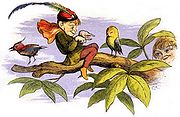
. Storybooks for children about fairytales written in the Victorian period often used this as a setting as it is seen as a mythical utopia. They often contain nature-loving mythological creatures such as elves and fairies, as well as Robin Hood
Robin Hood
Robin Hood was a heroic outlaw in English folklore. A highly skilled archer and swordsman, he is known for "robbing from the rich and giving to the poor", assisted by a group of fellow outlaws known as his "Merry Men". Traditionally, Robin Hood and his men are depicted wearing Lincoln green clothes....
. It may be treated both as a product of the sentimental nostalgic imagination and as an ideological or political construct (either of the left
Left-wing politics
In politics, Left, left-wing and leftist generally refer to support for social change to create a more egalitarian society...
or the right
Right-wing politics
In politics, Right, right-wing and rightist generally refer to support for a hierarchical society justified on the basis of an appeal to natural law or tradition. To varying degrees, the Right rejects the egalitarian objectives of left-wing politics, claiming that the imposition of equality is...
).
"Merry England" is not a wholly consistent vision, a revisited England of which the late Oxford folklorist Roy Judge observed that it is "a world that has never actually existed, a visionary, mythical landscape, where it is difficult to take normal historical bearings." By contrast, Ronald Hutton
Ronald Hutton
Ronald Hutton is an English historian who specializes in the study of Early Modern Britain, British folklore, pre-Christian religion and contemporary Paganism. A reader in the subject at the University of Bristol, Hutton has published fourteen books and has appeared on British television and radio...
's study of churchwardens' accounts places the creation of "Merry England" in the years between 1350 and 1520, with the newly-elaborative annual festive round of the liturgical year, with candles and pageants, processions and games, boy bishop
Boy bishop
Boy bishop was a name given to a custom very widespread in the Middle Ages, whereby a boy was chosen, for example among cathedral choristers, to parody the real Bishop, commonly on the feast of Holy Innocents...
s and decorated rood lofts. Hutton discovered that, far from being pagan survivals
Paganism
Paganism is a blanket term, typically used to refer to non-Abrahamic, indigenous polytheistic religious traditions....
, many of the activities of popular piety criticised by sixteenth-century reformers were actually creations of the later Middle Ages and that "Merry England" reflects historical aspects of rural English folklore that were lost during industrialization. Favorable perceptions of Merry England reveal a nostalgia for aspects of an earlier society that are missing in modern times.
Origins and themes
Utopia
Utopia is an ideal community or society possessing a perfect socio-politico-legal system. The word was imported from Greek by Sir Thomas More for his 1516 book Utopia, describing a fictional island in the Atlantic Ocean. The term has been used to describe both intentional communities that attempt...
n state of life that peasants aspired to lead (see Cockaigne
Cockaigne
Cockaigne or Cockayne is a medieval mythical land of plenty, an imaginary place of extreme luxury and ease where physical comforts and pleasures are always immediately at hand and where the harshness of medieval peasant life does not exist...
). Peasant revolts, such as those led by Wat Tyler
Wat Tyler
Walter "Wat" Tyler was a leader of the English Peasants' Revolt of 1381.-Early life:Knowledge of Tyler's early life is very limited, and derives mostly through the records of his enemies. Historians believe he was born in Essex, but are not sure why he crossed the Thames Estuary to Kent...
and Jack Straw
Jack Straw (rebel leader)
For other uses, see Jack Straw Jack Straw was one of the three leaders of the Peasants' Revolt of 1381, a major event in the history of England.-Biography:Little is known of the Rising's leaders. It been suggested that Jack Straw may have been a preacher...
invoked a visionary
Visionary
Defined broadly, a visionary, is one who can envision the future. For some groups this can involve the supernatural or drugs.The visionary state is achieved via meditation, drugs, lucid dreams, daydreams, or art. One example is Hildegard of Bingen, a 12th century artist/visionary and Catholic saint...
idea that was also egalitarian. Tyler's rebels wished to throw off the feudal aristocracy (though the term "Norman yoke
Norman yoke
The Norman yoke is a term that emerged in English nationalist discourse in the mid-17th century. It was a shorthand phrase, useful for attributing the oppressive aspects of feudalism in England to the impositions of William I of England, his retainers and their descendants.- History :The medieval...
" belongs to a later period) and return to a perceived time where the Saxons ruled in equality and freedom. The main arguments of Tyler's rebels were that there was no basis for aristocratic rule in the Bible, and that the plague had demonstrated by its indiscriminate nature that all people were equal under God. Thus they adopted the rhetoric of Norman
Normans
The Normans were the people who gave their name to Normandy, a region in northern France. They were descended from Norse Viking conquerors of the territory and the native population of Frankish and Gallo-Roman stock...
vs. Saxon
Anglo-Saxons
Anglo-Saxon is a term used by historians to designate the Germanic tribes who invaded and settled the south and east of Great Britain beginning in the early 5th century AD, and the period from their creation of the English nation to the Norman conquest. The Anglo-Saxon Era denotes the period of...
conflict as part of a much wider ideology. This idealized view of society was in any case an unrealistic version of life in the 14th and 15th centuries, although there was a period after the Black Death
Black Death
The Black Death was one of the most devastating pandemics in human history, peaking in Europe between 1348 and 1350. Of several competing theories, the dominant explanation for the Black Death is the plague theory, which attributes the outbreak to the bacterium Yersinia pestis. Thought to have...
when labour shortages meant that agricultural workers were in stronger positions, and the good harvests and gentle inflation of the thirteenth century had eased fixed burdens owed to landlords by smallholders.
Ronald Hutton's study of churchwarden's accounts, The Rise and Fall of Merrie England: The Ritual Year, 1400-1700 places the creation of "Merry England" in the years between 1350 and 1520. Hutton describes the collapse of the annual festal round in parish society with the English Reformation
English Reformation
The English Reformation was the series of events in 16th-century England by which the Church of England broke away from the authority of the Pope and the Roman Catholic Church....
. Official prohibitions suppressed the confraternities
Confraternity
A confraternity is normally a Roman Catholic or Orthodox organization of lay people created for the purpose of promoting special works of Christian charity or piety, and approved by the Church hierarchy...
that organized and supported church ales. A growing fashion for religious austerity forced maypole
Maypole
A maypole is a tall wooden pole erected as a part of various European folk festivals, particularly on May Day, or Pentecost although in some countries it is instead erected at Midsummer...
s and the like into the secular sphere, where they were attacked by the godly as disturbances; James I wrote a pamphlet against such sports. The Long Parliament
Long Parliament
The Long Parliament was made on 3 November 1640, following the Bishops' Wars. It received its name from the fact that through an Act of Parliament, it could only be dissolved with the agreement of the members, and those members did not agree to its dissolution until after the English Civil War and...
put an end to ales, the last of which was held in 1641, and drove Christmas
Christmas
Christmas or Christmas Day is an annual holiday generally celebrated on December 25 by billions of people around the world. It is a Christian feast that commemorates the birth of Jesus Christ, liturgically closing the Advent season and initiating the season of Christmastide, which lasts twelve days...
underground, where it was kept privately, as a form of protest. Hutton's work was criticized as "methodologically naive" by a reviewer.
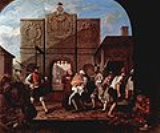
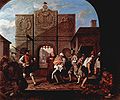
At various times since the Middle Ages, authors, propagandists, romanticists, poets and others have revived or co-opted the term. The celebrated Hogarth
William Hogarth
William Hogarth was an English painter, printmaker, pictorial satirist, social critic and editorial cartoonist who has been credited with pioneering western sequential art. His work ranged from realistic portraiture to comic strip-like series of pictures called "modern moral subjects"...
engraving illustrating the patriotic song "The Roast Beef of Old England
The Roast Beef of Old England
"The Roast Beef of Old England" is an English patriotic ballad. It was written by Henry Fielding for his play The Grub-Street Opera, which was first performed in 1731. The lyrics were added to over the next twenty years...
" (see illustration), is as anti-French as it is patriotic.
William Hazlitt
William Hazlitt
William Hazlitt was an English writer, remembered for his humanistic essays and literary criticism, and as a grammarian and philosopher. He is now considered one of the great critics and essayists of the English language, placed in the company of Samuel Johnson and George Orwell. Yet his work is...
's essay "Merry England", appended to his Lectures on the English Comic Writers (1819), popularised the specific term, introduced in tandem with an allusion
Allusion
An allusion is a figure of speech that makes a reference to, or representation of, people, places, events, literary work, myths, or works of art, either directly or by implication. M. H...
to the iconic figure of Robin Hood
Robin Hood
Robin Hood was a heroic outlaw in English folklore. A highly skilled archer and swordsman, he is known for "robbing from the rich and giving to the poor", assisted by a group of fellow outlaws known as his "Merry Men". Traditionally, Robin Hood and his men are depicted wearing Lincoln green clothes....
, under the epigraph
Epigraph (literature)
In literature, an epigraph is a phrase, quotation, or poem that is set at the beginning of a document or component. The epigraph may serve as a preface, as a summary, as a counter-example, or to link the work to a wider literary canon, either to invite comparison or to enlist a conventional...
"St George for merry England!":
The beams of the morning sun shining on the lonely glades, or through the idle branches of the tangled forest, the leisure, the freedom, 'the pleasure of going and coming without knowing where', the troops of wild deer, the sports of the chase, and other rustic gambols, were sufficient to justify the appelation of 'Merry Sherwood'Sherwood ForestSherwood Forest is a Royal Forest in Nottinghamshire, England, that is famous through its historical association with the legend of Robin Hood. Continuously forested since the end of the Ice Age, Sherwood Forest National Nature Reserve today encompasses 423 hectares surrounding the village of...
, and in like manner, we may apply the phrase to Merry England.
Hazlitt's subject was the traditional sports and rural diversions native to the English. In Die Lage der arbeitenden Klasse in England (1844: translated as The Condition of the Working Class in England), Friedrich Engels
Friedrich Engels
Friedrich Engels was a German industrialist, social scientist, author, political theorist, philosopher, and father of Marxist theory, alongside Karl Marx. In 1845 he published The Condition of the Working Class in England, based on personal observations and research...
wrote sarcastically of Young England
Young England
Young England was a Victorian era political group. The group was born on the playing fields of Cambridge and Eton. For the most part, its unofficial membership was confined to a splinter group of Tory aristocrats who had attended public school together, among them George Smythe, Lord John...
(a ginger-group of young aristocrats hostile to the new industrial order) that they hoped to restore "the old 'merry England' with its brilliant features and its romantic feudalism. This object is of course unattainable and ridiculous ..." The phrase "merry England" appears in English in the German text.
William Cobbett
William Cobbett
William Cobbett was an English pamphleteer, farmer and journalist, who was born in Farnham, Surrey. He believed that reforming Parliament and abolishing the rotten boroughs would help to end the poverty of farm labourers, and he attacked the borough-mongers, sinecurists and "tax-eaters" relentlessly...
provided conservative commentary on the rapidly changing look and mores of an industrialising nation by invoking the stable social hierarchy and prosperous working class of the pre-industrial country of his youth in his Rural Rides
Rural Rides
Rural Rides is the book for which the English journalist, agriculturist and political reformer William Cobbett is best known.At the time of writing in the early 1820s, Cobbett was a radical anti-Corn Law campaigner, newly returned to England from a spell of self-imposed political exile in the...
(1822–26, collected in book form, 1830). The later works of Samuel Taylor Coleridge
Samuel Taylor Coleridge
Samuel Taylor Coleridge was an English poet, Romantic, literary critic and philosopher who, with his friend William Wordsworth, was a founder of the Romantic Movement in England and a member of the Lake Poets. He is probably best known for his poems The Rime of the Ancient Mariner and Kubla...
also subscribed to some extent to the "Merry England" view. Thomas Carlyle
Thomas Carlyle
Thomas Carlyle was a Scottish satirical writer, essayist, historian and teacher during the Victorian era.He called economics "the dismal science", wrote articles for the Edinburgh Encyclopedia, and became a controversial social commentator.Coming from a strict Calvinist family, Carlyle was...
's Past and Present
Past and Present (book)
Past and Present is a book by Thomas Carlyle published in April 1843 in England and in May in the United States. It combines medieval history with criticism of 19th century British society. It was written in seven weeks, as a respite from the harassing labor of writing Cromwell...
also made the case for Merrie England; the conclusion of Crotchet Castle
Crotchet Castle
Crotchet Castle is the sixth novel by Thomas Love Peacock, first published in 1831.As in his earlier novel Headlong Hall, Peacock assembles a group of eccentrics, each with a single monomaniacal obsession, and derives humour and social satire from their various interactions and conversations.The...
by Thomas Love Peacock
Thomas Love Peacock
Thomas Love Peacock was an English satirist and author.Peacock was a close friend of Percy Bysshe Shelley and they influenced each other's work...
contrasts the mediaevalism of Mr. Chainmail to the contemporary social unrest. Barry Cornwall's patriotic poem. "Hurrah for Merry England", was set twice to music and printed in The Musical Times
The Musical Times
The Musical Times is an academic journal of classical music edited and produced in the United Kingdom. It is currently the oldest such journal that is still publishing in the UK, having been published continuously since 1844. It was published as The Musical Times and Singing Class Circular until...
, in 1861 and 1880.
In the 1830s, the Gothic revival promoted in England what once had been a truly international European style. Its stages, though, had been given purely English antiquarian labels—"Norman" for the Romanesque
Romanesque architecture
Romanesque architecture is an architectural style of Medieval Europe characterised by semi-circular arches. There is no consensus for the beginning date of the Romanesque architecture, with proposals ranging from the 6th to the 10th century. It developed in the 12th century into the Gothic style,...
, "Early English", etc.—and the revival was stretched to include also the succeeding, more specifically English style: a generic English Renaissance revival, later named "Jacobethan
Jacobethan
Jacobethan is the style designation coined in 1933 by John Betjeman to describe the mixed national Renaissance revival style that was made popular in England from the late 1820s, which derived most of its inspiration and its repertory from the English Renaissance , with elements of Elizabethan and...
". The revival was spurred by a series of lithographs by Joseph Nash
Joseph Nash
Joseph Nash was an English watercolour painter and lithographer, specialising in historical buildings...
(1839–1849), illustrating The Mansions of England in the Olden Time in picturesque and accurate detail. They were peopled with jolly figures in ruffs and farthingales, who personified a specific "Merry England" that was not Catholic (always an issue with the Gothic style in England), yet full of lively detail, in a golden pre-industrial land of Cockaigne. In popular culture, the adjective Dickensian is sometimes used in reference to this view, but Charles Dickens
Charles Dickens
Charles John Huffam Dickens was an English novelist, generally considered the greatest of the Victorian period. Dickens enjoyed a wider popularity and fame than had any previous author during his lifetime, and he remains popular, having been responsible for some of English literature's most iconic...
's view of the rural past evoked nostalgia
Nostalgia
The term nostalgia describes a yearning for the past, often in idealized form.The word is a learned formation of a Greek compound, consisting of , meaning "returning home", a Homeric word, and , meaning "pain, ache"...
, not fantasy
Fantasy
Fantasy is a genre of fiction that commonly uses magic and other supernatural phenomena as a primary element of plot, theme, or setting. Many works within the genre take place in imaginary worlds where magic is common...
. Mr. Pickwick's world was that of the 1820s and 1830s, of the stagecoach
Stagecoach
A stagecoach is a type of covered wagon for passengers and goods, strongly sprung and drawn by four horses, usually four-in-hand. Widely used before the introduction of railway transport, it made regular trips between stages or stations, which were places of rest provided for stagecoach travelers...
before the advent of the railways. The pseudo Old English carol "God Rest You Merry, Gentlemen
God Rest Ye Merry Gentlemen
God Rest You Merry, Gentlemen is an English traditional Christmas carol. The melody is in Aeolian mode. It was published by William B...
" first appeared in 1833, in Christmas Carols Ancient and Modern, a collection of seasonal carols gathered and apparently improvised by William B. Sandys
William B. Sandys
William B. Sandys , was an English solicitor, member of the Percy Society, fellow of the Society of Antiquaries of London, and remembered for his publication Christmas Carols Ancient and Modern , a collection of seasonal carols that Sandys had gathered and also apparently improvised...
; after its brief appearance in Dickens' "A Christmas Carol
A Christmas Carol
A Christmas Carol is a novella by English author Charles Dickens first published by Chapman & Hall on 17 December 1843. The story tells of sour and stingy Ebenezer Scrooge's ideological, ethical, and emotional transformation after the supernatural visits of Jacob Marley and the Ghosts of...
" (1843), it quickly developed its reputation for being 16th century or earlier.
The London-based Anglo-Catholic magazine of prose and verse Merry England began publication in 1879. Its issues bore a sonnet by William Wordsworth
William Wordsworth
William Wordsworth was a major English Romantic poet who, with Samuel Taylor Coleridge, helped to launch the Romantic Age in English literature with the 1798 joint publication Lyrical Ballads....
as epigraph, beginning "They called thee 'merry England' in old time" and characterizing Merry England "a responsive chime to the heart's fond belief":
-
-
...Can, I ask,
-
This face of rural beauty be a mask
For discontent, and poverty, and crime?—
These spreading towns a cloak for lawless will?—
Forbid it, Heaven! —that Merry England still
May be they rightful name, in prose or rhyme.
In the late Victorian era, the Tory Young England
Young England
Young England was a Victorian era political group. The group was born on the playing fields of Cambridge and Eton. For the most part, its unofficial membership was confined to a splinter group of Tory aristocrats who had attended public school together, among them George Smythe, Lord John...
set perhaps best reflected the vision of "Merry England" on the political stage. Today, in a form adapted to political conservatism, the vision of "Merry England" extends to embrace a few urban artisans and other cosmopolitans; a flexible and humane clergy
Clergy
Clergy is the generic term used to describe the formal religious leadership within a given religion. A clergyman, churchman or cleric is a member of the clergy, especially one who is a priest, preacher, pastor, or other religious professional....
; an interested and altruistic
Altruism
Altruism is a concern for the welfare of others. It is a traditional virtue in many cultures, and a core aspect of various religious traditions, though the concept of 'others' toward whom concern should be directed can vary among cultures and religions. Altruism is the opposite of...
squirearchy, aristocracy
Aristocracy
Aristocracy , is a form of government in which a few elite citizens rule. The term derives from the Greek aristokratia, meaning "rule of the best". In origin in Ancient Greece, it was conceived of as rule by the best qualified citizens, and contrasted with monarchy...
and royalty
Royal family
A royal family is the extended family of a king or queen regnant. The term imperial family appropriately describes the extended family of an emperor or empress, while the terms "ducal family", "grand ducal family" or "princely family" are more appropriate to describe the relatives of a reigning...
. Solidity and good cheer would be the values of yeoman farmers, whatever the foibles of those higher in the hierarchy.
The idea of Merry England became associated on one side with the Anglo-Catholics and Catholicism
Catholicism
Catholicism is a broad term for the body of the Catholic faith, its theologies and doctrines, its liturgical, ethical, spiritual, and behavioral characteristics, as well as a religious people as a whole....
, as a version of life's generosity; for example Wilfrid Meynell
Alice Meynell
Alice Christiana Gertrude Thompson Meynell was an English writer, editor, critic, and suffragist, now remembered mainly as a poet.-Biography:...
entitled one of his magazines Merrie England. The pastoral aspects of William Blake
William Blake
William Blake was an English poet, painter, and printmaker. Largely unrecognised during his lifetime, Blake is now considered a seminal figure in the history of both the poetry and visual arts of the Romantic Age...
, a Londoner and an actual craftsman, lack the same mellow quality. G. K. Chesterton
G. K. Chesterton
Gilbert Keith Chesterton, KC*SG was an English writer. His prolific and diverse output included philosophy, ontology, poetry, plays, journalism, public lectures and debates, literary and art criticism, biography, Christian apologetics, and fiction, including fantasy and detective fiction....
in part adapted it to urban conditions. William Morris
William Morris
William Morris 24 March 18343 October 1896 was an English textile designer, artist, writer, and socialist associated with the Pre-Raphaelite Brotherhood and the English Arts and Crafts Movement...
and the Arts and Crafts movement
Arts and Crafts movement
Arts and Crafts was an international design philosophy that originated in England and flourished between 1860 and 1910 , continuing its influence until the 1930s...
and other left-inclined improvers (whom Sir Hugh Casson
Hugh Casson
Sir Hugh Maxwell Casson, KCVO, RA, RDI, was a British architect, interior designer, artist, and influential writer and broadcaster on 20th century design. He is particularly noted for his role as director of architecture at the 1951 Festival of Britain on London's South Bank.Casson's family...
called "the herbivores") were also (partly) believers. Walter Crane
Walter Crane
Walter Crane was an English artist and book illustrator. He is considered to be the most prolific and influential children’s book creator of his generation and, along with Randolph Caldecott and Kate Greenaway, one of the strongest contributors to the child's nursery motif that the genre of...
's "Garland for May Day 1895" is lettered "Merrie England" together with progressive slogans ("Shorten Working Day & Lengthen Life", "The Land for the People", "No Child Toilers") with socialism ("Production for Use Not for Profit"). For a time, the Merry England vision was a common reference point for rhetorical Tories and utopian socialists, offering similar alternatives to an industrialising society, with its large-scale movement off the land to jerry-built cities and gross social inequality
Social inequality
Social inequality refers to a situation in which individual groups in a society do not have equal social status. Areas of potential social inequality include voting rights, freedom of speech and assembly, the extent of property rights and access to education, health care, quality housing and other...
.
Merry England did not really "decline" in the way that Storm Jameson
Storm Jameson
Margaret Storm Jameson was an English writer, known for her 45 novels, and criticism.She was born in Whitby, Yorkshire, and studied at the University of Leeds. She moved to London, where she earned an MA from King's College London in 1914 and then went on to teach before becoming a full-time writer...
said it did in her book The Decline of Merry England (1930), which has the significant subtitle an essay on Puritanism in England.
Deep England
"Deep England" refers to an idealised view of a rural, Southern England. The term is neutral, though it reflects what English cultural conservatives would wish to conserve. The term, which alludes to la France profondeFrance profonde
La France profonde is a phrase that denotes the existence of deep, and profoundly "French" aspects of the culture of French provincial towns, of French village life and rural agricultural culture, which escape the "dominant ideologies" and the hegemony of Paris...
, has been attributed to both Patrick Wright and Angus Calder
Angus Calder
Angus Lindsay Ritchie Calder was a Scottish academic, writer, historian, educator and literary editor with a background in English literature, politics and cultural studies.-Education:...
. The concept of Deep England may imply an explicit opposition to modernism
Modernism
Modernism, in its broadest definition, is modern thought, character, or practice. More specifically, the term describes the modernist movement, its set of cultural tendencies and array of associated cultural movements, originally arising from wide-scale and far-reaching changes to Western society...
and industrialisation
Industrialisation
Industrialization is the process of social and economic change that transforms a human group from an agrarian society into an industrial one...
; and may be connected to a ruralist viewpoint typified by the writer H. J. Massingham
H. J. Massingham
Harold John Massingham was a prolific British writer on matters to do with the countryside and agriculture. He was also a published poet.-Life:...
. Major artists whose work is associated with Deep England include: the writer Thomas Hardy
Thomas Hardy
Thomas Hardy, OM was an English novelist and poet. While his works typically belong to the Naturalism movement, several poems display elements of the previous Romantic and Enlightenment periods of literature, such as his fascination with the supernatural.While he regarded himself primarily as a...
, the painter John Constable
John Constable
John Constable was an English Romantic painter. Born in Suffolk, he is known principally for his landscape paintings of Dedham Vale, the area surrounding his home—now known as "Constable Country"—which he invested with an intensity of affection...
, the composer Ralph Vaughan Williams
Ralph Vaughan Williams
Ralph Vaughan Williams OM was an English composer of symphonies, chamber music, opera, choral music, and film scores. He was also a collector of English folk music and song: this activity both influenced his editorial approach to the English Hymnal, beginning in 1904, in which he included many...
, and the poets Rupert Brooke
Rupert Brooke
Rupert Chawner Brooke was an English poet known for his idealistic war sonnets written during the First World War, especially The Soldier...
and Sir John Betjeman. Examples of this conservative or village green
Village green
A village green is a common open area which is a part of a settlement. Traditionally, such an area was often common grass land at the centre of a small agricultural settlement, used for grazing and sometimes for community events...
viewpoint include the editorial line sometimes adopted by the British Daily Mail
Daily Mail
The Daily Mail is a British daily middle-market tabloid newspaper owned by the Daily Mail and General Trust. First published in 1896 by Lord Northcliffe, it is the United Kingdom's second biggest-selling daily newspaper after The Sun. Its sister paper The Mail on Sunday was launched in 1982...
newspaper, and the ideological outlook of magazines such as This England
This England
This England is a quarterly magazine published in England. It has a large readership among expatriates, especially the elderly. It concentrates on the traditional values and customs of the English people, particularly those of rural and small-town England....
.
Little England and propaganda
In Angus Calder's re-examination of the ideological constructs surrounding "Little EnglandLittle Englander
Little Englander is an epithet applied in criticisms of English people who are regarded as "xenophobic" and/or overly nationalistic and are often accused of being "ignorant" and "boorish". It is applied to opponents of globalism; for instance those who are against membership of the European Union...
" during World War II
World War II
World War II, or the Second World War , was a global conflict lasting from 1939 to 1945, involving most of the world's nations—including all of the great powers—eventually forming two opposing military alliances: the Allies and the Axis...
in The Myth of the Blitz, he puts forward the view that the story of Deep England was central to wartime propaganda
Propaganda
Propaganda is a form of communication that is aimed at influencing the attitude of a community toward some cause or position so as to benefit oneself or one's group....
operations within the United Kingdom
United Kingdom
The United Kingdom of Great Britain and Northern IrelandIn the United Kingdom and Dependencies, other languages have been officially recognised as legitimate autochthonous languages under the European Charter for Regional or Minority Languages...
, and then, as now, served a clearly defined political and cultural purpose in the hands of various interested agencies.
Calder cites the writer and broadcaster J.B. Priestley whom he considered to be a proponent of the Deep England world-view. Priestley's wartime BBC
BBC
The British Broadcasting Corporation is a British public service broadcaster. Its headquarters is at Broadcasting House in the City of Westminster, London. It is the largest broadcaster in the world, with about 23,000 staff...
radio "chats" described the beauty of the English natural environment, this at a time when rationing was at its height, and the population of London was sheltering from the Blitz
The Blitz
The Blitz was the sustained strategic bombing of Britain by Nazi Germany between 7 September 1940 and 10 May 1941, during the Second World War. The city of London was bombed by the Luftwaffe for 76 consecutive nights and many towns and cities across the country followed...
in its Underground
London Underground
The London Underground is a rapid transit system serving a large part of Greater London and some parts of Buckinghamshire, Hertfordshire and Essex in England...
stations. In reference to one of Priestley's bucolic broadcasts, Calder made the following point:
- Priestley, the socialist, gives this cottage no occupant, nor does he wonder about the size of the occupant's wage, nor ask if the cottage has internal sanitation and running water. His countryside only exists as spectacle, for the delectation of people with motor cars." (Angus Calder, The Myth of the Blitz, London 1991)
However, in Journey Through England, Priestley identified himself as a Little Englander
Little Englander
Little Englander is an epithet applied in criticisms of English people who are regarded as "xenophobic" and/or overly nationalistic and are often accused of being "ignorant" and "boorish". It is applied to opponents of globalism; for instance those who are against membership of the European Union...
because he despised imperialism and the effect that the capitalist industrial revolution had on the people and environment.
Part of the imagery of the 1940 patriotic song There'll Always Be an England
There'll Always Be an England
"There'll Always Be an England" is an English patriotic song, written and distributed in the summer of 1939, which became highly popular upon the outbreak of World War II...
seems to be derived from the same source:
- There'll always be an England
- While there's a country lane,
- Wherever there's a cottage small
- Beside a field of grain.
The continuation evokes, however, the opposite image of the modern industrialised society:
- There'll always be an England
- While there's a busy street,
- Wherever there's a turning wheel,
- A million marching feet.
The song seems therefore to offer a synthesis and combine the two Englands, the archaic bucolic one and the modern industrialised one, in the focus of patriotic loyalty and veneration.
Literature and the arts
The transition from a literary locus of Merry England to a more obviously political one cannot be placed before 1945, as the cited example of J. B. Priestley shows. Writers and artists described as having a Merry England viewpoint range from the radical visionary poet William BlakeWilliam Blake
William Blake was an English poet, painter, and printmaker. Largely unrecognised during his lifetime, Blake is now considered a seminal figure in the history of both the poetry and visual arts of the Romantic Age...
to the evangelical Christian Arthur Mee
Arthur Mee
Arthur Henry Mee was a British writer, journalist and educator. He is best known for The Harmsworth Self-Educator, The Children's Encyclopaedia, The Children's Newspaper, and The King's England...
. The Rudyard Kipling
Rudyard Kipling
Joseph Rudyard Kipling was an English poet, short-story writer, and novelist chiefly remembered for his celebration of British imperialism, tales and poems of British soldiers in India, and his tales for children. Kipling received the 1907 Nobel Prize for Literature...
of Puck of Pook's Hill
Puck of Pook's Hill
Puck of Pook's Hill is a historical fantasy book by Rudyard Kipling, published in 1906, containing a series of short stories set in different periods of English history. The stories are all narrated to two children living near Burwash, in the area of Kipling's own house Bateman's, by people...
is certainly one; when he wrote it, he was in transition towards his later, very conservative stance. Within art, the fabled long-lost merrie England was also a recurring theme in the Victorian-era paintings of the Pre-Raphaelite Brotherhood
Pre-Raphaelite Brotherhood
The Pre-Raphaelite Brotherhood was a group of English painters, poets, and critics, founded in 1848 by William Holman Hunt, John Everett Millais and Dante Gabriel Rossetti...
. The 1890 News from Nowhere
News from Nowhere
News from Nowhere is a classic work combining utopian socialism and soft science fiction written by the artist, designer and socialist pioneer William Morris...
by William Morris
William Morris
William Morris 24 March 18343 October 1896 was an English textile designer, artist, writer, and socialist associated with the Pre-Raphaelite Brotherhood and the English Arts and Crafts Movement...
portrays a future England that has reverted to a rural idyll following a socialist
Socialism
Socialism is an economic system characterized by social ownership of the means of production and cooperative management of the economy; or a political philosophy advocating such a system. "Social ownership" may refer to any one of, or a combination of, the following: cooperative enterprises,...
revolution.
Reference points might be taken as children's writer Beatrix Potter
Beatrix Potter
Helen Beatrix Potter was an English author, illustrator, natural scientist and conservationist best known for her imaginative children’s books featuring animals such as those in The Tale of Peter Rabbit which celebrated the British landscape and country life.Born into a privileged Unitarian...
, John Betjeman
John Betjeman
Sir John Betjeman, CBE was an English poet, writer and broadcaster who described himself in Who's Who as a "poet and hack".He was a founding member of the Victorian Society and a passionate defender of Victorian architecture...
(more interested in Victoriana
Victoriana
Victoriana refers to items or material from the Victorian period , especially those particularly evocative of the design style and outlook of the time....
), and the fantasy author J. R. R. Tolkien
J. R. R. Tolkien
John Ronald Reuel Tolkien, CBE was an English writer, poet, philologist, and university professor, best known as the author of the classic high fantasy works The Hobbit, The Lord of the Rings, and The Silmarillion.Tolkien was Rawlinson and Bosworth Professor of Anglo-Saxon at Pembroke College,...
, whose hobbit
Hobbit
Hobbits are a fictional diminutive race who inhabit the lands of Middle-earth in J. R. R. Tolkien's fiction.Hobbits first appeared in the novel The Hobbit, in which the main protagonist, Bilbo Baggins, is the titular hobbit...
characters' culture in The Shire
Shire (Middle-earth)
The Shire is a region of J. R. R. Tolkien's fictional Middle-earth, described in The Lord of the Rings and other works. The Shire refers to an area settled exclusively by Hobbits and largely removed from the goings-on in the rest of Middle-earth. It is located in the northwest of the continent, in...
embodied many aspects of the Merry England point of view.
In his essay "Epic Pooh
Epic Pooh
Epic Pooh is a 1978 article by the British science fiction writer Michael Moorcock, which reviews the field of epic fantasy, with a particular focus on epic fantasy written for children. The article has proven controversial amongst fans and writers of fantasy literature, particularly for Moorcock's...
", Michael Moorcock
Michael Moorcock
Michael John Moorcock is an English writer, primarily of science fiction and fantasy, who has also published a number of literary novels....
opined:
Here the shift has taken place: Tolkien was profoundly conservative with respect to cultural traditions, as Moorcock is quite aware, but not at all an imperialist. He set an area based upon the West Midlands
West Midlands (region)
The West Midlands is an official region of England, covering the western half of the area traditionally known as the Midlands. It contains the second most populous British city, Birmingham, and the larger West Midlands conurbation, which includes the city of Wolverhampton and large towns of Dudley,...
region within a Middle-earth
Middle-earth
Middle-earth is the fictional setting of the majority of author J. R. R. Tolkien's fantasy writings. The Hobbit and The Lord of the Rings take place entirely in Middle-earth, as does much of The Silmarillion and Unfinished Tales....
, but made it apparent that its perimeter was maintained by external allies. The Shire seems to represent the comfort of childhood which Tolkien's characters must leave in order to grow into maturity and wisdom. In addition, in The Fellowship of the Ring
The Fellowship of the Ring
The Fellowship of the Ring is the first of three volumes of the epic novel The Lord of the Rings by the English author J. R. R. Tolkien. It takes place in the fictional universe Middle-earth. It was originally published on July 29, 1954 in the United Kingdom...
, both Gandalf and Frodo express frustration with hobbits' staidness and dislike of anything foreign or out of the ordinary, and even in Concerning Hobbits the narrator shows a certain degree of impatience with hobbits' general narrow-mindedness. Rather than a celebration of a narrow, anachronistic idealism, Tolkien's works hinge upon his characters moving beyond that place of idealism into a broader, more complex interaction with the world.
The Pyrates
The Pyrates
The Pyrates is a comedic novel by George MacDonald Fraser, published in 1983. Written in arch, ironic style and containing a great deal of deliberate anachronism, it traces the adventures of a classic hero , multiple damsels in distress, and the six captains who lead the infamous Coast Brotherhood...
, the 1983 spoof historical novel by George MacDonald Fraser
George MacDonald Fraser
George MacDonald Fraser, OBE was an English-born author of Scottish descent, who wrote both historical novels and non-fiction books, as well as several screenplays.-Early life and military career:...
, sets its scene with a page-long sentence composed entirely of (immediately demolished) Merry England tropes:
The novel England, England
England, England
England, England is a satirical science fiction novel by Julian Barnes which was shortlisted for the Booker Prize. The novel is set in the Britain of the not-too-distant future, and chronicles the creation of a giant England themed amusement park, called "England, England", which also operates as...
by Julian Barnes
Julian Barnes
Julian Patrick Barnes is a contemporary English writer, and winner of the 2011 Man Booker Prize, for his book The Sense of an Ending...
describes an imaginary, though plausible, set of circumstances that cause modern England to return to the state of Deep England. The author's views are not made explicit, but the characters who choose to remain in the changed nation are treated more sympathetically than those who leave.
In Kingsley Amis
Kingsley Amis
Sir Kingsley William Amis, CBE was an English novelist, poet, critic, and teacher. He wrote more than 20 novels, six volumes of poetry, a memoir, various short stories, radio and television scripts, along with works of social and literary criticism...
's novel Lucky Jim
Lucky Jim
Lucky Jim is an academic satire written by Kingsley Amis, first published in 1954 by Victor Gollancz. It was Amis's first novel, and won the Somerset Maugham Award for fiction...
, Professor Welch and his friends are devotees of the Merry England legend, and Jim's "Merrie England" lecture somehow turns into a debunking of the whole concept (a position almost certainly reflecting that of Amis).
A few popular music artists have used elements of the Merry England story as recurring themes; The Kinks
The Kinks
The Kinks were an English rock band formed in Muswell Hill, North London, by brothers Ray and Dave Davies in 1964. Categorised in the United States as a British Invasion band, The Kinks are recognised as one of the most important and influential rock acts of the era. Their music was influenced by a...
and their leader Ray Davies
Ray Davies
Ray Davies, CBE is an English rock musician. He is best known as lead singer and songwriter for the Kinks, which he led with his younger brother, Dave...
crafted The Kinks are the Village Green Preservation Society
The Kinks Are the Village Green Preservation Society
The Kinks Are the Village Green Preservation Society is the sixth studio album by the English rock group The Kinks, released in November 1968. It was the last album by the original quartet, as bassist Pete Quaife left the group in early 1969...
as a homage to English country life and culture: it was described by Allmusic senior editor Stephen Thomas Erlewine
Stephen Thomas Erlewine
Stephen Thomas Erlewine is a senior editor for Allmusic. He is the author of many artist biographies and record reviews for Allmusic, as well as a freelance writer, occasionally contributing liner notes. He is also frontman and guitarist for the Ann Arbor-based band Who Dat?Erlewine is the nephew...
as an album "lamenting the passing of old-fashioned English traditions"; Arthur (Or the Decline and Fall of the British Empire)
Arthur (Or the Decline and Fall of the British Empire)
Arthur is the seventh studio album by English rock band The Kinks, released in October 1969. Kinks frontman Ray Davies constructed the concept album as the soundtrack to a Granada Television play and developed the storyline with novelist Julian Mitchell; however, the television programme was...
also contains similar elements. Ian Anderson
Ian Anderson (musician)
Ian Scott Anderson, MBE is a Scottish singer, songwriter and multi-instrumentalist, best known for his work as the leader and flautist of British rock band Jethro Tull.-Early life:...
of Jethro Tull
Jethro Tull (band)
Jethro Tull are a British rock group formed in 1967. Their music is characterised by the vocals, acoustic guitar, and flute playing of Ian Anderson, who has led the band since its founding, and the guitar work of Martin Barre, who has been with the band since 1969.Initially playing blues rock with...
has often alluded to an anti-modern, pre-industrial, agrarian vision of England in his songs (the band's namesake
Jethro Tull (agriculturist)
Jethro Tull was an English agricultural pioneer who helped bring about the British Agricultural Revolution. He perfected a horse-drawn seed drill in 1701 that economically sowed the seeds in neat rows, and later a horse-drawn hoe...
was himself an agrarian, the inventor of the seed drill).
Merrie England
Merrie England (opera)
Merrie England is an English comic opera in two acts by Edward German to a libretto by Basil Hood. The patriotic story concerns love and rivalries at the court of Queen Elizabeth I, who is portrayed as jealous of the affection of Sir Walter Raleigh for Bessie Throckmorton. Its sunny depiction of...
is a comic opera
Comic opera
Comic opera denotes a sung dramatic work of a light or comic nature, usually with a happy ending.Forms of comic opera first developed in late 17th-century Italy. By the 1730s, a new operatic genre, opera buffa, emerged as an alternative to opera seria...
by Edward German
Edward German
Sir Edward German was an English musician and composer of Welsh descent, best remembered for his extensive output of incidental music for the stage and as a successor to Arthur Sullivan in the field of English comic opera.As a youth, German played the violin and led the town orchestra, also...
.
Further reading
- Hutton, RonaldRonald HuttonRonald Hutton is an English historian who specializes in the study of Early Modern Britain, British folklore, pre-Christian religion and contemporary Paganism. A reader in the subject at the University of Bristol, Hutton has published fourteen books and has appeared on British television and radio...
(2001). The Rise and Fall of Merry England: The Ritual Year, 1400–1700. Oxford: Oxford Paperbacks. ISBN 0-19-285447-X. - Wright, Patrick (1985). On Living in an Old Country (ch 2, esp pp 81–7). Verso Books. ISBN 0-86091-833-5.
See also
- Middle EnglandMiddle EnglandThe phrase "Middle England" is a socio-political and geographical term which originally indicated the central region of England, now almost always referred to as the "Midlands"....
- C. S. LewisC. S. LewisClive Staples Lewis , commonly referred to as C. S. Lewis and known to his friends and family as "Jack", was a novelist, academic, medievalist, literary critic, essayist, lay theologian and Christian apologist from Belfast, Ireland...
- J. R. R. TolkienJ. R. R. TolkienJohn Ronald Reuel Tolkien, CBE was an English writer, poet, philologist, and university professor, best known as the author of the classic high fantasy works The Hobbit, The Lord of the Rings, and The Silmarillion.Tolkien was Rawlinson and Bosworth Professor of Anglo-Saxon at Pembroke College,...
- Civil religionCivil religionThe intended meaning of the term civil religion often varies according to whether one is a sociologist of religion or a professional political commentator...
- Norman YokeNorman yokeThe Norman yoke is a term that emerged in English nationalist discourse in the mid-17th century. It was a shorthand phrase, useful for attributing the oppressive aspects of feudalism in England to the impositions of William I of England, his retainers and their descendants.- History :The medieval...
- Tudor mythTudor mythThe "Tudor myth" is the tradition in English history, historiography and literature that presents the period of the 15th century, including the Wars of the Roses, in England as a dark age of anarchy and bloodshed. It is even claimed it was a punishment by God...
- Whig historyWhig historyWhig history is the approach to historiography which presents the past as an inevitable progression towards ever greater liberty and enlightenment, culminating in modern forms of liberal democracy and constitutional monarchy. In general, Whig historians stress the rise of constitutional government,...
- John MajorJohn MajorSir John Major, is a British Conservative politician, who served as Prime Minister of the United Kingdom and Leader of the Conservative Party from 1990–1997...
, sometimes identified as a believer in the vision of Merry England http://www.mirror.co.uk/news/tonyparsons/tm_column_date=30092002-name_index.html http://www.lrb.co.uk/v21/n07/letters.html http://www.publications.parliament.uk/pa/cm199798/cmhansrd/vo980407/debtext/80407-31.htm http://www.waitrose.com/food_drink/wfi/cooking/entertaining/0108058.asp http://www.britain.tv/ukpolitics_prime_ministers_john_major.shtml
External links
- "Epic Pooh" by Michael MoorcockMichael MoorcockMichael John Moorcock is an English writer, primarily of science fiction and fantasy, who has also published a number of literary novels....
, a critique of this world-view in fantasy fiction. - "Nostalgia Forum" Nostalgia and History
- Joseph Behar, "Citizenship and Control: The Case of St. Helenian Agricultural Workers in the UK, 1949-1951". Canadian Journal of History/Annales canadiennes d'histoire 33, April 1998, pp. 49–73. ISSN 0008-4107 http://www.usask.ca/history/cjh/f/iss/text/98/beha_498.shtml.
- Happy England as Painted by Helen Allingham, R.W.S. on Google Books