

Cockaigne

Encyclopedia
Cockaigne or Cockayne (icon) is a medieval mythical land of plenty
, an imaginary place of extreme luxury and ease where physical comforts and pleasures are always immediately at hand and where the harshness of medieval peasant
life does not exist. Specifically, in poems like The Land of Cockaigne, Cockaigne is a land of contraries, where all the restrictions of society are defied (abbots beaten by their monks), sexual liberty is open (nuns flipped over to show their bottoms), and food is plentiful (skies that rain cheeses). Writing about Cockaigne was a commonplace of Goliard
verse. It represented both wish fulfillment and resentment at the strictures of asceticism
and dearth.
(pays de) cocaigne "(land of) plenty," ultimately adapted or derived from a word for a small sweet cake sold to children at a fair (OED). In Italian
, the same place is called "Paese della Cuccagna"; the Dutch equivalent is Luilekkerland ("lazy luscious land"), and the German equivalent is Schlaraffenland (also known as "land of milk and honey"). In Spain an equivalent place is named Jauja
, after a rich mining region of the Andes, and País de Cucaña ("fools' paradise") may also signify such a place. From Swedish dialect lubber (fat lazy fellow) comes Lubberland, popularized in the ballad An Invitation to Lubberland
.
In the 1820s, the name Cockaigne came to be applied jocularly to London
, as the land of Cockney
s, and thus "Cockaigne", though the two are not linguistically connected otherwise. The composer Edward Elgar
used the title "Cockaigne" for his concert overture
and suite evoking the people of London, Cockaigne (In London Town)
(1901).
The Dutch villages of Kockengen
and Koekange were named after Cockaigne.
and El Dorado, the land of Cockaigne was an utopia, a fictional place where, in a parody of paradise, idleness and gluttony were the principal occupations. In Specimens of Early English Poets (1790), George Ellis printed a 13th century French poem called "The Land of Cockaigne" where
According to Herman Pleij, Dreaming of Cockaigne: Medieval Fantasies of the Perfect Life (2001):
Cockaigne was a "medieval peasant’s dream, offering relief from backbreaking labor and the daily struggle for meager food."
The Brothers Grimm
collected and retold the fairy tale
in Das Märchen vom Schlaraffenland (The Tale About the Land of Cockaigne).
 A Neapolitan
tradition, extended to other Latin-culture countries, is the Cockaigne pole, a horizontal or vertical pole with a prize (like a ham) at one end. The pole is covered with grease or soap and planted during a festival. Then, daring people try to climb the slippery pole to get the prize. The crowd laughs at the often failed attempts to hold to the pole.
Mythical place
Places which appear in mythology, folklore or religious texts or tradition, but which are not probably genuine places, include:...
, an imaginary place of extreme luxury and ease where physical comforts and pleasures are always immediately at hand and where the harshness of medieval peasant
Peasant
A peasant is an agricultural worker who generally tend to be poor and homeless-Etymology:The word is derived from 15th century French païsant meaning one from the pays, or countryside, ultimately from the Latin pagus, or outlying administrative district.- Position in society :Peasants typically...
life does not exist. Specifically, in poems like The Land of Cockaigne, Cockaigne is a land of contraries, where all the restrictions of society are defied (abbots beaten by their monks), sexual liberty is open (nuns flipped over to show their bottoms), and food is plentiful (skies that rain cheeses). Writing about Cockaigne was a commonplace of Goliard
Goliard
The Goliards were a group of clergy who wrote bibulous, satirical Latin poetry in the 12th and 13th centuries. They were mainly clerical students at the universities of France, Germany, Spain, Italy, and England who protested the growing contradictions within the Church, such as the failure of the...
verse. It represented both wish fulfillment and resentment at the strictures of asceticism
Asceticism
Asceticism describes a lifestyle characterized by abstinence from various sorts of worldly pleasures often with the aim of pursuing religious and spiritual goals...
and dearth.
Etymology
While the first recorded use of the name are the Latin "Cucaniensis", and the Middle English "Cokaygne", one line of reasoning has the name tracing to Middle FrenchMiddle French
Middle French is a historical division of the French language that covers the period from 1340 to 1611. It is a period of transition during which:...
(pays de) cocaigne "(land of) plenty," ultimately adapted or derived from a word for a small sweet cake sold to children at a fair (OED). In Italian
Italian language
Italian is a Romance language spoken mainly in Europe: Italy, Switzerland, San Marino, Vatican City, by minorities in Malta, Monaco, Croatia, Slovenia, France, Libya, Eritrea, and Somalia, and by immigrant communities in the Americas and Australia...
, the same place is called "Paese della Cuccagna"; the Dutch equivalent is Luilekkerland ("lazy luscious land"), and the German equivalent is Schlaraffenland (also known as "land of milk and honey"). In Spain an equivalent place is named Jauja
Jauja
Jauja is a city and capital of Jauja Province in Peru. It is situated in the fertile Mantaro Valley, to the northwest of Huancayo , at an altitude of . Its population according to the 2007 census was 16,424....
, after a rich mining region of the Andes, and País de Cucaña ("fools' paradise") may also signify such a place. From Swedish dialect lubber (fat lazy fellow) comes Lubberland, popularized in the ballad An Invitation to Lubberland
An Invitation to Lubberland
"An Invitation to Lubberland" was a broadside ballad first printed in 1685. Many believe that it inspired the hobo ballad which formed the basis of the song Big Rock Candy Mountain recorded in 1928 by Harry McClintock.-Lyrics:...
.
In the 1820s, the name Cockaigne came to be applied jocularly to London
London
London is the capital city of :England and the :United Kingdom, the largest metropolitan area in the United Kingdom, and the largest urban zone in the European Union by most measures. Located on the River Thames, London has been a major settlement for two millennia, its history going back to its...
, as the land of Cockney
Cockney
The term Cockney has both geographical and linguistic associations. Geographically and culturally, it often refers to working class Londoners, particularly those in the East End...
s, and thus "Cockaigne", though the two are not linguistically connected otherwise. The composer Edward Elgar
Edward Elgar
Sir Edward William Elgar, 1st Baronet OM, GCVO was an English composer, many of whose works have entered the British and international classical concert repertoire. Among his best-known compositions are orchestral works including the Enigma Variations, the Pomp and Circumstance Marches, concertos...
used the title "Cockaigne" for his concert overture
Symphonic poem
A symphonic poem or tone poem is a piece of orchestral music in a single continuous section in which the content of a poem, a story or novel, a painting, a landscape or another source is illustrated or evoked. The term was first applied by Hungarian composer Franz Liszt to his 13 works in this vein...
and suite evoking the people of London, Cockaigne (In London Town)
Cockaigne (In London Town)
Cockaigne , Op. 40, also known as the Cockaigne Overture, is a concert overture for full orchestra composed by the British composer Edward Elgar in 1900-01.-History:...
(1901).
The Dutch villages of Kockengen
Kockengen
Kockengen is a village in the Dutch province of Utrecht . It is a part of the municipality of Stichtse Vecht, and lies about 9 km northeast of Woerden.In 2001, the village of Kockengen had 2296 inhabitants...
and Koekange were named after Cockaigne.
Descriptions
Like AtlantisAtlantis
Atlantis is a legendary island first mentioned in Plato's dialogues Timaeus and Critias, written about 360 BC....
and El Dorado, the land of Cockaigne was an utopia, a fictional place where, in a parody of paradise, idleness and gluttony were the principal occupations. In Specimens of Early English Poets (1790), George Ellis printed a 13th century French poem called "The Land of Cockaigne" where
the houses were made of barley sugar and cakes, the streets were paved with pastry, and the shops supplied goods for nothing.
According to Herman Pleij, Dreaming of Cockaigne: Medieval Fantasies of the Perfect Life (2001):
roasted pigs wander about with knives in their backs to make carving easy, where grilled geese fly directly into one's mouth, where cooked fish jump out of the water and land at one's feet. The weather is always mild, the wine flows freely, sex is readily available, and all people enjoy eternal youth.
Cockaigne was a "medieval peasant’s dream, offering relief from backbreaking labor and the daily struggle for meager food."
The Brothers Grimm
Brothers Grimm
The Brothers Grimm , Jacob Grimm and Wilhelm Grimm , were German academics, linguists, cultural researchers, and authors who collected folklore and published several collections of it as Grimm's Fairy Tales, which became very popular...
collected and retold the fairy tale
Fairy tale
A fairy tale is a type of short story that typically features such folkloric characters, such as fairies, goblins, elves, trolls, dwarves, giants or gnomes, and usually magic or enchantments. However, only a small number of the stories refer to fairies...
in Das Märchen vom Schlaraffenland (The Tale About the Land of Cockaigne).
Traditions
Naples
Naples is a city in Southern Italy, situated on the country's west coast by the Gulf of Naples. Lying between two notable volcanic regions, Mount Vesuvius and the Phlegraean Fields, it is the capital of the region of Campania and of the province of Naples...
tradition, extended to other Latin-culture countries, is the Cockaigne pole, a horizontal or vertical pole with a prize (like a ham) at one end. The pole is covered with grease or soap and planted during a festival. Then, daring people try to climb the slippery pole to get the prize. The crowd laughs at the often failed attempts to hold to the pole.
In the arts
- Ego sum abbas Cucaniensis (I am the Abbot of Cockaigne) is one of the drinking songs (Carmina potatoria) found in the 13th century manuscript of Songs from BenediktbeuernCarmina BuranaCarmina Burana , Latin for "Songs from Beuern" , is the name given to a manuscript of 254 poems and dramatic texts mostly from the 11th or 12th century, although some are from the 13th century. The pieces were written principally in Medieval Latin; a few in Middle High German, and some with traces...
, better known for its inclusion in Carl OrffCarl OrffCarl Orff was a 20th-century German composer, best known for his cantata Carmina Burana . In addition to his career as a composer, Orff developed an influential method of music education for children.-Early life:...
's secular cantata, Carmina BuranaCarmina Burana (Orff)Carmina Burana is a scenic cantata composed by Carl Orff in 1935 and 1936. It is based on 24 of the poems found in the medieval collection Carmina Burana...
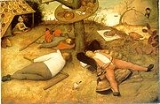
. - Cockaigne was depicted by Pieter Bruegel the Elder in The Land of Cockaigne (1567, above).
- The poem, The Land of Cokaygne, appears in BL Harley MS 913, ff. 3r-63v (The Kildare PoemsKildare PoemsThe Kildare Poems are a group of sixteen poems written in an Irish dialect of Middle English and dated to the mid-14th century. Together with a second, shorter set of poems in the so-called Loscombe Manuscript, they constitute the first and most important linguistic document of the early...
, #1); modern English translation. - The book, Dreaming of Cockaigne, by Herman Pleij (Columbia University Press, 2001) offers the most complete modern collection of information on the topic.
- The musical play, The Golden Dream, by Joe Syiek http://www.thegoldendream.com tells the story of oppressed peasants who yearn for, attain and ultimately lose their ideal of Cockaigne.
- The album Land of Cockayne by Soft MachineSoft MachineSoft Machine were an English rock band from Canterbury, named after the book The Soft Machine by William S. Burroughs. They were one of the central bands in the Canterbury scene, and helped pioneer the progressive rock genre...
, 1981. - Cockaigne is the name of the kingdom which Princess Narda in the comic strip Mandrake the MagicianMandrake the MagicianMandrake the Magician is a syndicated newspaper comic strip, created by Lee Falk , which began June 11, 1934. Phil Davis soon took over as the strip's illustrator, while Falk continued to script. The strip was distributed by King Features Syndicate.Davis worked on the strip until his death in 1964,...
comes from. - Cockaigne (In London Town)Cockaigne (In London Town)Cockaigne , Op. 40, also known as the Cockaigne Overture, is a concert overture for full orchestra composed by the British composer Edward Elgar in 1900-01.-History:...
is a concert overture composed by Edward ElgarEdward ElgarSir Edward William Elgar, 1st Baronet OM, GCVO was an English composer, many of whose works have entered the British and international classical concert repertoire. Among his best-known compositions are orchestral works including the Enigma Variations, the Pomp and Circumstance Marches, concertos...
in 1901. - "Bruegel in the Land of Cockaigne" is the heading of the second chapter of T. J. ClarkT. J. Clark (historian)Timothy James Clark often known as T.J. Clark, is an art historian and writer, born in 1943 in Bristol, England.-Life and work:Clark attended Bristol Grammar School. He completed his undergraduate studies at St. John's College, Cambridge University, he obtained a first-class honours degree in 1964....
's 2002 Tanner Lectures on Human ValuesTanner Lectures on Human ValuesThe Tanner Lectures on Human Values is a multi-university lecture series in the humanities, founded on July 1, 1978, at Clare Hall, Cambridge University, by the American scholar Obert Clark Tanner...
"Painting at Ground Level". - In the popular cookbook The Joy of CookingThe Joy of CookingJoy of Cooking, often known as "The Joy of Cooking" is one of the United States' most-published cookbooks, and has been in print continuously since 1936 and with more than 18 million copies sold. It was privately published in 1931 by Irma S. Rombauer, a homemaker in St. Louis, Missouri, who was...
, the author's favorite recipes include "Cockaigne" in the name, (e.g., "Fruit Cake Cockaigne"), explained in the foreword to the 1975 edition as after the name of the Becker country home in Anderson Township, near Cincinnati, Ohio. - Cockaigne is the name of a small Australian record label, run by musicians Dave GraneyDave GraneyDavid John "Dave" Graney is an Australian rock musician and singer-songwriter from Mount Gambier, South Australia. Since 1979, Graney is generally accompanied by drummer, Clare Moore...
and Clare MooreClare MooreClare Christina Moore is an Australian musician, songwriter, arranger, producer and performer whose principal instrument is the drums. She has also performed as a keyboard player, singer and vibraphone player...
. - "Big Rock Candy MountainBig Rock Candy MountainBig Rock Candy Mountain, first recorded by Harry McClintock in 1928, is a song about a hobo's idea of paradise, a modern version of the medieval concept of Cockaigne...
" is a song about a hobo's idea of paradise - a modern version of the medieval concept of Cockaigne. - British folk band Norcsalordie recorded a song about Cockaigne, "Goodbye Cockaigne" as the final track on their debut album "Post to Pillar".
- In Umberto Eco's The Name of the RoseThe Name of the RoseThe Name of the Rose is the first novel by Italian author Umberto Eco. It is a historical murder mystery set in an Italian monastery in the year 1327, an intellectual mystery combining semiotics in fiction, biblical analysis, medieval studies and literary theory...
, Salvatore's escape from his parents home "assumed the aspect of the land of Cockaigne." Umberto Eco, "The Name of the Rose", Warner Books 1986, page 220 - In Umberto Eco's The Island of the Day BeforeThe Island of the Day BeforeThe Island of the Day Before is a 1994 novel by Umberto Eco.It is the story of a 17th century Italian nobleman who is the only survivor of a shipwreck during a fierce storm. He finds himself washed up on an abandoned ship in a harbour through which, he convinces himself, runs the International...
, Cockaigne is evoked in a passage describing an ice-tipped mountain. "...an exquisite eruption in a land of Cockaigne." Umberto Eco, "The Island of the Day Before", Penguin Books 1996, page 64 - In Robert Penn WarrenRobert Penn WarrenRobert Penn Warren was an American poet, novelist, and literary critic and was one of the founders of New Criticism. He was also a charter member of the Fellowship of Southern Writers. He founded the influential literary journal The Southern Review with Cleanth Brooks in 1935...
's "World Enough and Time" - historical novelHistorical novelAccording to Encyclopædia Britannica, a historical novel is-Development:An early example of historical prose fiction is Luó Guànzhōng's 14th century Romance of the Three Kingdoms, which covers one of the most important periods of Chinese history and left a lasting impact on Chinese culture.The...
about the Beauchamp–Sharp Tragedy - Maria Jordan refers to her home state (VirginiaVirginiaThe Commonwealth of Virginia , is a U.S. state on the Atlantic Coast of the Southern United States. Virginia is nicknamed the "Old Dominion" and sometimes the "Mother of Presidents" after the eight U.S. presidents born there...
) as the Land of Cockayne. Robert Penn Warren, "World Enough and Time, 1950, page 48 - The painting, Cockaigne, is a painting by Vincent DesiderioVincent DesiderioVincent Desiderio is an American realist painter. He is currently the senior critic at the New York Academy of Art. He lives in Sleepy Hollow, New York, and works in Sleepy Hollow....
done in 2003 - In Raymond RousselRaymond RousselRaymond Roussel was a French poet, novelist, playwright, musician, and chess enthusiast. Through his novels, poems, and plays he exerted a profound influence on certain groups within 20th century French literature, including the Surrealists, Oulipo, and the authors of the nouveau...
s Impressions of Africa, The sculptor Fuxier throws blue pastilles into a river to produce images for his audience. The last of the images took the appearance of one half of a clock-face, which Fuxier described as "The wind-clock in the land of Cockaigne." Raymond Roussel, "Impressions of Africa", Calderand Boyars Ltd 1966, page 698 - The Cockaigne ski resortSki resortA ski resort is a resort developed for skiing and other winter sports. In Europe a ski resort is a town or village in a ski area - a mountainous area, where there are ski trails and supporting services such as hotels and other accommodation, restaurants, equipment rental and a ski lift system...
is located on the Chautauqua Ridge in the ski countrySki countrySki country is a term used to describe portions of the boundary between the Niagara Frontier and the Southern Tier of the western part of New York.-Weather:...
belt in Cherry CreekCherry Creek (town), New YorkCherry Creek is a town in Chautauqua County, New York, United States. The population was 1,152 at the 2000 census. The name is derived from that of a small stream that flows through the town amid many cherry trees....
, New YorkNew YorkNew York is a state in the Northeastern region of the United States. It is the nation's third most populous state. New York is bordered by New Jersey and Pennsylvania to the south, and by Connecticut, Massachusetts and Vermont to the east...
.http://www.cockaigne.com/ - The novel CandideCandideCandide, ou l'Optimisme is a French satire first published in 1759 by Voltaire, a philosopher of the Age of Enlightenment. The novella has been widely translated, with English versions titled Candide: or, All for the Best ; Candide: or, The Optimist ; and Candide: or, Optimism...
by VoltaireVoltaireFrançois-Marie Arouet , better known by the pen name Voltaire , was a French Enlightenment writer, historian and philosopher famous for his wit and for his advocacy of civil liberties, including freedom of religion, free trade and separation of church and state...
has a section where Candide travels to the "land of plenty", El DoradoEl DoradoEl Dorado is the name of a Muisca tribal chief who covered himself with gold dust and, as an initiation rite, dived into a highland lake.Later it became the name of a legendary "Lost City of Gold" that has fascinated – and so far eluded – explorers since the days of the Spanish Conquistadors...
, where the people live an extravagant life. - In Lawrence Durrell's 1982 novel,"Constance", part of his Avignon Quintet, there is reference to a painter called Clement who paints an old smoky masterpiece, a sort of Paradise Regained painting, called "Cockayne".
See also
- Arcadia (utopia)Arcadia (utopia)Arcadia refers to a vision of pastoralism and harmony with nature. The term is derived from the Greek province of the same name which dates to antiquity; the province's mountainous topography and sparse population of pastoralists later caused the word Arcadia to develop into a poetic byword for an...
- AtlantisAtlantisAtlantis is a legendary island first mentioned in Plato's dialogues Timaeus and Critias, written about 360 BC....
- Big Rock Candy MountainBig Rock Candy MountainBig Rock Candy Mountain, first recorded by Harry McClintock in 1928, is a song about a hobo's idea of paradise, a modern version of the medieval concept of Cockaigne...
- Fiddler's GreenFiddler's GreenFiddler's Green is a legendary imagined afterlife, where there is perpetual mirth, a fiddle that never stops playing, and dancers who never tire...
- Garden of EdenGarden of EdenThe Garden of Eden is in the Bible's Book of Genesis as being the place where the first man, Adam, and his wife, Eve, lived after they were created by God. Literally, the Bible speaks about a garden in Eden...
- Golden ageGolden AgeThe term Golden Age comes from Greek mythology and legend and refers to the first in a sequence of four or five Ages of Man, in which the Golden Age is first, followed in sequence, by the Silver, Bronze, and Iron Ages, and then the present, a period of decline...
- Oleanna (song)Oleanna (song)Oleanna is a Norwegian folk song that was translated into English and popularized by former Weavers member Pete Seeger. The song is a critique of Ole Bull's vision of a perfect society in America. Oleanna was actually the name of one of Ole Bull's settlements in the New Norway colony of Pennsylvania...
- UtopiaUtopiaUtopia is an ideal community or society possessing a perfect socio-politico-legal system. The word was imported from Greek by Sir Thomas More for his 1516 book Utopia, describing a fictional island in the Atlantic Ocean. The term has been used to describe both intentional communities that attempt...
- Shangri-LaShangri-LaShangri-La is a fictional place described in the 1933 novel Lost Horizon by British author James Hilton. Hilton describes Shangri-La as a mystical, harmonious valley, gently guided from a lamasery, enclosed in the western end of the Kunlun Mountains...
- List of city nicknames in the United Kingdom