
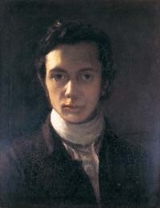
William Hazlitt was an English
writerA writer is a person who produces literature, such as novels, short stories, plays, screenplays, poetry, or other literary art. Skilled writers are able to use language to portray ideas and images....
, remembered for his humanistic
essayAn essay is a piece of writing which is often written from an author's personal point of view. Essays can consist of a number of elements, including: literary criticism, political manifestos, learned arguments, observations of daily life, recollections, and reflections of the author. The definition...
s and
literary criticismLiterary criticism is the study, evaluation, and interpretation of literature. Modern literary criticism is often informed by literary theory, which is the philosophical discussion of its methods and goals...
, and as a grammarian and philosopher. He is now considered one of the great critics and essayists of the
English languageEnglish is a West Germanic language that arose in the Anglo-Saxon kingdoms of England and spread into what was to become south-east Scotland under the influence of the Anglian medieval kingdom of Northumbria...
, placed in the company of
Samuel JohnsonSamuel Johnson , often referred to as Dr. Johnson, was an English author who made lasting contributions to English literature as a poet, essayist, moralist, literary critic, biographer, editor and lexicographer...
and
George OrwellEric Arthur Blair , better known by his pen name George Orwell, was an English author and journalist...
. Yet his work is currently little read and mostly out of print. During his lifetime he befriended many people who are now part of the 19th-century literary canon, including Charles and
Mary LambMary Ann Lamb , was an English writer, the sister and collaborator of Charles Lamb.-Biography:She was born on 3 December 1764. In 1796, Mary, who had suffered a breakdown from the strain of caring for her family, killed her mother with a kitchen knife, and from then on had to be kept under constant...
,
StendhalMarie-Henri Beyle , better known by his pen name Stendhal, was a 19th-century French writer. Known for his acute analysis of his characters' psychology, he is considered one of the earliest and foremost practitioners of realism in his two novels Le Rouge et le Noir and La Chartreuse de Parme...
,
Samuel Taylor ColeridgeSamuel Taylor Coleridge was an English poet, Romantic, literary critic and philosopher who, with his friend William Wordsworth, was a founder of the Romantic Movement in England and a member of the Lake Poets. He is probably best known for his poems The Rime of the Ancient Mariner and Kubla...
, and
William WordsworthWilliam Wordsworth was a major English Romantic poet who, with Samuel Taylor Coleridge, helped to launch the Romantic Age in English literature with the 1798 joint publication Lyrical Ballads....
.
Background
Hazlitt's fatherWilliam Hazlitt was a Unitarian minister and author, and the father of the writer of the same name. He was an important figure in eighteenth-century English dissent, and had a major influence on his son's work.- Biography :...
's family were
IrishIreland is an island to the northwest of continental Europe. It is the third-largest island in Europe and the twentieth-largest island on Earth...
Protestants who moved from the county of
AntrimCounty Antrim is one of six counties that form Northern Ireland, situated in the north-east of the island of Ireland. Adjoined to the north-east shore of Lough Neagh, the county covers an area of 2,844 km², with a population of approximately 616,000...
to
TipperaryTipperary is a town and a civil parish in South Tipperary in Ireland. Its population was 4,415 at the 2006 census. It is also an ecclesiastical parish in the Roman Catholic Archdiocese of Cashel and Emly, and is in the historical barony of Clanwilliam....
in the early 18th century. His father, also named William Hazlitt, attended the
University of GlasgowThe University of Glasgow is the fourth-oldest university in the English-speaking world and one of Scotland's four ancient universities. Located in Glasgow, the university was founded in 1451 and is presently one of seventeen British higher education institutions ranked amongst the top 100 of the...
(where he was taught by
Adam SmithAdam Smith was a Scottish social philosopher and a pioneer of political economy. One of the key figures of the Scottish Enlightenment, Smith is the author of The Theory of Moral Sentiments and An Inquiry into the Nature and Causes of the Wealth of Nations...
), receiving a master's degree in 1760. Not entirely content with his Presbyterian faith, he became a
UnitarianUnitarianism is a Christian theological movement, named for its understanding of God as one person, in direct contrast to Trinitarianism which defines God as three persons coexisting consubstantially as one in being....
minister in
EnglandEngland is a country that is part of the United Kingdom. It shares land borders with Scotland to the north and Wales to the west; the Irish Sea is to the north west, the Celtic Sea to the south west, with the North Sea to the east and the English Channel to the south separating it from continental...
. In 1764 he became pastor at
WisbechWisbech is a market town, inland port and civil parish with a population of 20,200 in the Fens of Cambridgeshire. The tidal River Nene runs through the centre of the town and is spanned by two bridges...
in
CambridgeshireCambridgeshire is a county in England, bordering Lincolnshire to the north, Norfolk to the northeast, Suffolk to the east, Essex and Hertfordshire to the south, and Bedfordshire and Northamptonshire to the west...
, where in 1766 he married Grace Loftus, daughter of a recently deceased ironmonger. Of their many children, only three survived infancy. The first of these, John (later known as a portrait painter) was born in 1767 at
MarshfieldMarshfield is a village in the local government area of South Gloucestershire, England, on the borders of the counties of Wiltshire and Somerset.- Location :...
in
GloucestershireGloucestershire is a county in South West England. The county comprises part of the Cotswold Hills, part of the flat fertile valley of the River Severn, and the entire Forest of Dean....
, where the Reverend William Hazlitt had accepted a new pastorate after his marriage. In 1770, the elder Hazlitt accepted yet another position and moved with his family to
MaidstoneMaidstone is the county town of Kent, England, south-east of London. The River Medway runs through the centre of the town linking Maidstone to Rochester and the Thames Estuary. Historically, the river was a source and route for much of the town's trade. Maidstone was the centre of the agricultural...
,
KentKent is a county in southeast England, and is one of the home counties. It borders East Sussex, Surrey and Greater London and has a defined boundary with Essex in the middle of the Thames Estuary. The ceremonial county boundaries of Kent include the shire county of Kent and the unitary borough of...
, where his first and only surviving daughter, Margaret (usually known as "Peggy"), was born that year.
Childhood
William, the youngest of the surviving Hazlitt children, was born in Mitre Lane, Maidstone, in 1778. In 1780, when he was two, his family began a migratory existence that was to last several years. From Maidstone his father took them to
Bandon, County CorkBandon is a town in County Cork, Ireland. With a population of 5,822 as of census 2006, Bandon lies on the River Bandon between two hills. The name in Irish means "Bridge of the Bandon", a reference to the origin of the town as a crossing-point on the river. In 2004 Bandon celebrated its...
, Ireland; and from Bandon in 1783 to the
United StatesThe United States of America is a federal constitutional republic comprising fifty states and a federal district...
, where the elder Hazlitt preached, lectured, and founded the First Unitarian Church at
BostonBoston is the capital of and largest city in Massachusetts, and is one of the oldest cities in the United States. The largest city in New England, Boston is regarded as the unofficial "Capital of New England" for its economic and cultural impact on the entire New England region. The city proper had...
. In 1786–87 the family returned to England and lived at
WemWem is a small market town in Shropshire, England. It is the administrative centre for the northern area committee of Shropshire Council, which has its headquarters at Edinburgh House in the centre of Wem. Wem railway station is on the Shrewsbury to Crewe railway line...
, in
ShropshireShropshire is a county in the West Midlands region of England. For Eurostat purposes, the county is a NUTS 3 region and is one of four counties or unitary districts that comprise the "Shropshire and Staffordshire" NUTS 2 region. It borders Wales to the west...
. William would remember little of his years in America, save the taste of barberries.
Education
Hazlitt was educated at home and at a local school until 1793, when his father sent him to a Unitarian seminary on what was then the outskirts of
LondonLondon is the capital city of :England and the :United Kingdom, the largest metropolitan area in the United Kingdom, and the largest urban zone in the European Union by most measures. Located on the River Thames, London has been a major settlement for two millennia, its history going back to its...
, the Unitarian
New College at HackneyThe New College at Hackney was a dissenting academy set up in Hackney, at that time a village on the outskirts of London, by Unitarians. It was in existence from 1786 to 1796...
(commonly referred to as Hackney College). Although Hazlitt stayed there for only about two years, its impact was enormous.
The curriculum at Hackney was very broad, including a grounding in the
GreekAncient Greek is the stage of the Greek language in the periods spanning the times c. 9th–6th centuries BC, , c. 5th–4th centuries BC , and the c. 3rd century BC – 6th century AD of ancient Greece and the ancient world; being predated in the 2nd millennium BC by Mycenaean Greek...
and
LatinLatin is an Italic language originally spoken in Latium and Ancient Rome. It, along with most European languages, is a descendant of the ancient Proto-Indo-European language. Although it is considered a dead language, a number of scholars and members of the Christian clergy speak it fluently, and...
classicsClassics is the branch of the Humanities comprising the languages, literature, philosophy, history, art, archaeology and other culture of the ancient Mediterranean world ; especially Ancient Greece and Ancient Rome during Classical Antiquity Classics (sometimes encompassing Classical Studies or...
,
mathematicsMathematics is the study of quantity, space, structure, and change. Mathematicians seek out patterns and formulate new conjectures. Mathematicians resolve the truth or falsity of conjectures by mathematical proofs, which are arguments sufficient to convince other mathematicians of their validity...
,
historyHistory is the discovery, collection, organization, and presentation of information about past events. History can also mean the period of time after writing was invented. Scholars who write about history are called historians...
,
governmentGovernment refers to the legislators, administrators, and arbitrators in the administrative bureaucracy who control a state at a given time, and to the system of government by which they are organized...
,
scienceScience is a systematic enterprise that builds and organizes knowledge in the form of testable explanations and predictions about the universe...
, and, of course,
religionReligion is a collection of cultural systems, belief systems, and worldviews that establishes symbols that relate humanity to spirituality and, sometimes, to moral values. Many religions have narratives, symbols, traditions and sacred histories that are intended to give meaning to life or to...
. Much of this was traditional; however, the tutelage having been strongly influenced by eminent
DissentingEnglish Dissenters were Christians who separated from the Church of England in the 16th, 17th and 18th centuries.They originally agitated for a wide reaching Protestant Reformation of the Established Church, and triumphed briefly under Oliver Cromwell....
thinkers of the day like
Richard PriceRichard Price was a British moral philosopher and preacher in the tradition of English Dissenters, and a political pamphleteer, active in radical, republican, and liberal causes such as the American Revolution. He fostered connections between a large number of people, including writers of the...
and
Joseph PriestleyJoseph Priestley, FRS was an 18th-century English theologian, Dissenting clergyman, natural philosopher, chemist, educator, and political theorist who published over 150 works...
, there was also much that was
nonconformistNonconformity is the refusal to "conform" to, or follow, the governance and usages of the Church of England by the Protestant Christians of England and Wales.- Origins and use:...
. Priestley, whom Hazlitt had read and who was also one of his teachers, was an impassioned commentator on
politicalPolitics is a process by which groups of people make collective decisions. The term is generally applied to the art or science of running governmental or state affairs, including behavior within civil governments, but also applies to institutions, fields, and special interest groups such as the...
issues of the day. This, along with the turmoil in the wake of the
French RevolutionThe French Revolution , sometimes distinguished as the 'Great French Revolution' , was a period of radical social and political upheaval in France and Europe. The absolute monarchy that had ruled France for centuries collapsed in three years...
, sparked in Hazlitt and his classmates lively debates on these issues, as they saw their world being transformed around them.
Changes were taking place within the young Hazlitt as well. While, out of respect for his father, Hazlitt never openly broke with his religion, he suffered a loss of faith, and left Hackney before completing his preparation for the ministry.
Although he rejected the Unitarian theology, Hazlitt's time at Hackney left him with much more than religious scepticism. He had read widely and formed habits of independent thought and respect for the truth that remained with him for life. He had thoroughly absorbed a belief in liberty and the rights of man, and of the mind as an active force which, by disseminating knowledge, through both the sciences and the arts, could reinforce the natural tendency in humanity toward the good. He had had impressed upon him the ability of the individual, working both alone and within a mutually supportive community, to effect beneficial change by adhering to strongly held principles. The belief of many Unitarian thinkers in the natural disinterestedness of the human mind had also laid a foundation for the young Hazlitt's own philosophical explorations along those lines. And, though harsh experience and disillusionment later compelled him to qualify some of his early ideas about human nature, he was left with a hatred of tyranny and persecution that he retained to his last days.
The young philosopher
Returning home, around 1795, his thoughts were directed in more secular channels, encompassing not only politics but, increasingly, modern
philosophyPhilosophy is the study of general and fundamental problems, such as those connected with existence, knowledge, values, reason, mind, and language. Philosophy is distinguished from other ways of addressing such problems by its critical, generally systematic approach and its reliance on rational...
, which he had begun to read with fascination at Hackney. He spent much of his time in intensive study of
EnglishEngland is a country that is part of the United Kingdom. It shares land borders with Scotland to the north and Wales to the west; the Irish Sea is to the north west, the Celtic Sea to the south west, with the North Sea to the east and the English Channel to the south separating it from continental...
,
ScottishScotland is a country that is part of the United Kingdom. Occupying the northern third of the island of Great Britain, it shares a border with England to the south and is bounded by the North Sea to the east, the Atlantic Ocean to the north and west, and the North Channel and Irish Sea to the...
, and
IrishIreland is an island to the northwest of continental Europe. It is the third-largest island in Europe and the twentieth-largest island on Earth...
thinkers like
John LockeJohn Locke FRS , widely known as the Father of Liberalism, was an English philosopher and physician regarded as one of the most influential of Enlightenment thinkers. Considered one of the first of the British empiricists, following the tradition of Francis Bacon, he is equally important to social...
,
David HartleyDavid Hartley was an English philosopher and founder of the Associationist school of psychology. -Early life and education:...
,
George BerkeleyGeorge Berkeley , also known as Bishop Berkeley , was an Irish philosopher whose primary achievement was the advancement of a theory he called "immaterialism"...
, and
David HumeDavid Hume was a Scottish philosopher, historian, economist, and essayist, known especially for his philosophical empiricism and skepticism. He was one of the most important figures in the history of Western philosophy and the Scottish Enlightenment...
, and
FrenchThe French are a nation that share a common French culture and speak the French language as a mother tongue. Historically, the French population are descended from peoples of Celtic, Latin and Germanic origin, and are today a mixture of several ethnic groups...
thinkers like
Claude Adrien HelvétiusClaude Adrien Helvétius was a French philosopher and littérateur.-Life:...
,
Étienne Bonnot de CondillacÉtienne Bonnot de Condillac was a French philosopher and epistemologist who studied in such areas as psychology and the philosophy of the mind.-Biography:...
, the
Marquis de CondorcetMarie Jean Antoine Nicolas de Caritat, marquis de Condorcet , known as Nicolas de Condorcet, was a French philosopher, mathematician, and early political scientist whose Condorcet method in voting tally selects the candidate who would beat each of the other candidates in a run-off election...
, and
Baron d'HolbachPaul-Henri Thiry, Baron d'Holbach was a French-German author, philosopher, encyclopedist and a prominent figure in the French Enlightenment. He was born Paul Heinrich Dietrich in Edesheim, near Landau in the Rhenish Palatinate, but lived and worked mainly in Paris, where he kept a salon...
. From then on Hazlitt's goal was to become a philosopher. His thoughts were focused on man as a social and political animal, and, even more intensely, on the philosophy of mind, what would later be called
psychologyPsychology is the study of the mind and behavior. Its immediate goal is to understand individuals and groups by both establishing general principles and researching specific cases. For many, the ultimate goal of psychology is to benefit society...
.
In this period he discovered
Jean-Jacques RousseauJean-Jacques Rousseau was a Genevan philosopher, writer, and composer of 18th-century Romanticism. His political philosophy influenced the French Revolution as well as the overall development of modern political, sociological and educational thought.His novel Émile: or, On Education is a treatise...
, who became one of the most important influences on the budding philosopher's thought, and
Edmund BurkeEdmund Burke PC was an Irish statesman, author, orator, political theorist and philosopher who, after moving to England, served for many years in the House of Commons of Great Britain as a member of the Whig party....
, whose writing style impressed him enormously. He was painstakingly working out a treatise on the "natural disinterestedness of the human mind", meant to disprove the idea that man is naturally selfish, a fundamental concept in most of the philosophy of the day. Hazlitt's treatise would not be published for a number of years, after further reading, and after other changes had occurred to alter the course of his career, but to the end of his life he would think of himself as a philosopher.
Around 1796, Hazlitt was encouraged and inspired by a retired clergyman who had become a reformer of note,
Joseph FawcettJoseph Fawcett was an 18th-century English Presbyterian minister and poet.Fawcett began his education at Reverend French's school in Ware, Hertfordshire and in 1774 entered the dissenting academy at Daventry. At the school, he practiced his preaching on thorn bushes...
. Hazlitt was awed by the enormous breadth of Fawcett's tastes. From Fawcett, in the words of biographer Ralph Wardle, he imbibed a love for "good fiction and impassioned writing," Fawcett being "a man of keen intelligence who did not scorn the products of the imagination or apologize for his tastes." They discussed the radical thinkers of their day, and, important for understanding the breadth and depth of Hazlitt's own taste in his later critical writings, everything literary from
John MiltonJohn Milton was an English poet, polemicist, a scholarly man of letters, and a civil servant for the Commonwealth of England under Oliver Cromwell...
's
Paradise LostParadise Lost is an epic poem in blank verse by the 17th-century English poet John Milton. It was originally published in 1667 in ten books, with a total of over ten thousand individual lines of verse...
to
Laurence SterneLaurence Sterne was an Irish novelist and an Anglican clergyman. He is best known for his novels The Life and Opinions of Tristram Shandy, Gentleman, and A Sentimental Journey Through France and Italy; but he also published many sermons, wrote memoirs, and was involved in local politics...
's
Tristram Shandy.
Somewhat earlier, he had also met
William GodwinWilliam Godwin was an English journalist, political philosopher and novelist. He is considered one of the first exponents of utilitarianism, and the first modern proponent of anarchism...
, the reformist thinker whose
Political JusticeEnquiry Concerning Political Justice and its Influence on Modern Morals and Manners outlines the political philosophy of the 18th-century philosopher William Godwin....
took the thinking world by storm at this time. Hazlitt was never to feel entirely in sympathy with Godwin's philosophy, but it gave him much food for thought.
Besides residing with his father while trying to find his voice and work out his thoughts as a philosopher, he often in these years stayed with his older brother John, who had studied under
Joshua ReynoldsSir Joshua Reynolds RA FRS FRSA was an influential 18th-century English painter, specialising in portraits and promoting the "Grand Style" in painting which depended on idealization of the imperfect. He was one of the founders and first President of the Royal Academy...
and was following a career as a portrait painter. He also spent delighted evenings at the theatre in London, but did not yet know how this too would be important to his later writing. Mostly at this time he led a contemplative existence, still feeling frustrated in being unable to express on paper the thoughts and feelings that churned within him. The course of this existence was now to be interrupted by a life-changing event that, with its aftermath, had an impact on his career as a writer that Hazlitt in retrospect believed to have been greater than any other.
"First acquaintance with poets"
In January 1798, Hazlitt encountered, preaching at the Unitarian chapel in
ShrewsburyShrewsbury is the county town of Shropshire, in the West Midlands region of England. Lying on the River Severn, it is a civil parish home to some 70,000 inhabitants, and is the primary settlement and headquarters of Shropshire Council...
, the minister
Samuel Taylor ColeridgeSamuel Taylor Coleridge was an English poet, Romantic, literary critic and philosopher who, with his friend William Wordsworth, was a founder of the Romantic Movement in England and a member of the Lake Poets. He is probably best known for his poems The Rime of the Ancient Mariner and Kubla...
, soon much better known as a
poetA poet is a person who writes poetry. A poet's work can be literal, meaning that his work is derived from a specific event, or metaphorical, meaning that his work can take on many meanings and forms. Poets have existed since antiquity, in nearly all languages, and have produced works that vary...
,
criticA critic is anyone who expresses a value judgement. Informally, criticism is a common aspect of all human expression and need not necessarily imply skilled or accurate expressions of judgement. Critical judgements, good or bad, may be positive , negative , or balanced...
, and philosopher. He was dazzled. "I could not have been more delighted if I had heard the music of the spheres", he wrote years later in his essay "My First Acquaintance with Poets". "Poetry and Philosophy had met together. Truth and Genius had embraced, under the eye and with the sanction of Religion."
Later still, long after they had parted ways, Hazlitt would speak of Coleridge as "the only person I ever knew who answered to the idea of a man of genius." That Hazlitt learned to express his thoughts "in motley imagery or quaint allusion," that his understanding "ever found a language to express itself, I owe to Coleridge", he later wrote. In conversation afterwards, Coleridge for his part expressed interest in the younger man's germinating philosophical ideas and offered encouragement.
In April Hazlitt joined Coleridge at his residence in
Nether StoweyNether Stowey is a large village in the Sedgemoor district of Somerset, South West England. It sits in the foothills of the Quantock Hills , just below Over Stowey...
, where they both spent time with the poet
William WordsworthWilliam Wordsworth was a major English Romantic poet who, with Samuel Taylor Coleridge, helped to launch the Romantic Age in English literature with the 1798 joint publication Lyrical Ballads....
. Again, Hazlitt was enraptured. While he was not immediately struck by Wordsworth's appearance, when he observed the look in Wordsworth's eye as he contemplated a sunset, he reflected, "With what eyes these poets see nature!" On that occasion given the opportunity to read the
Lyrical Ballads in manuscript, Hazlitt saw that Wordsworth had the mind of a true poet, and he had created something entirely new.
At that time, the three shared a passion for the ideas of liberty and rights of man. Tramping back and forth across the countryside, they talked of poetry, philosophy, and the political movements that were changing the earth. This unity of spirit was not to last, but it validated for Hazlitt, just twenty years old, the idea that there is much to be learned and appreciated in poetry as well as in the philosophy to which he was already devoted. These experiences also encouraged him to pursue his own thinking and writing. Coleridge, on his part, later revealed that he had been highly impressed by Hazlitt's promise as a thinker: "He sends well-headed and well-feathered Thoughts straight forwards to the mark with a Twang of the Bow-string."
The itinerant painter
Meanwhile, the fact remained that Hazlitt had chosen not to follow a pastoral career. Although he never abandoned his goal of writing a philosophical treatise on the disinterestedness of the human mind, it had to be put aside indefinitely. Still dependent on his father, he was now obliged to earn his own living. Artistic talent seemed to run on his mother's side of the family. Starting in 1798 he became increasingly fascinated by paintings. His brother, John, had by now become a successful painter of miniature portraits. So it occurred to William that he might earn a living similarly, and he began to take lessons from John.
Hazlitt also visited various picture galleries, and he began to get work doing portraits, painting somewhat in the style of
Rembrandt. And so he managed to make something of a living for a time, travelling back and forth between
LondonLondon is the capital city of :England and the :United Kingdom, the largest metropolitan area in the United Kingdom, and the largest urban zone in the European Union by most measures. Located on the River Thames, London has been a major settlement for two millennia, its history going back to its...
and the country, wherever he could get work. By 1802, his work was considered good enough that a portrait he had recently painted of his father was accepted for exhibition by the
Royal AcademyThe Royal Academy of Arts is an art institution based in Burlington House on Piccadilly, London. The Royal Academy of Arts has a unique position in being an independent, privately funded institution led by eminent artists and architects whose purpose is to promote the creation, enjoyment and...
.
Later in 1802, Hazlitt was commissioned to travel to
ParisParis is the capital and largest city in France, situated on the river Seine, in northern France, at the heart of the Île-de-France region...
and copy several works of the old masters hanging in the
LouvreThe Musée du Louvre – in English, the Louvre Museum or simply the Louvre – is one of the world's largest museums, the most visited art museum in the world and a historic monument. A central landmark of Paris, it is located on the Right Bank of the Seine in the 1st arrondissement...
. This was one of the great opportunities of his life. Over a period of three months, he spent long hours in rapture studying the paintings. He later thought long and hard about what he had seen, and this provided substance for a considerable body of art criticism some years afterward. He also had an opportunity to see
NapoleonNapoleon Bonaparte was a French military and political leader during the latter stages of the French Revolution.As Napoleon I, he was Emperor of the French from 1804 to 1815...
(at a distance), whom he idolized as the rescuer of the common man from the oppression of royal "
LegitimacyIn political science, legitimacy is the popular acceptance of a governing law or régime as an authority. Whereas “authority” denotes a specific position in an established government, the term “legitimacy” denotes a system of government — wherein “government” denotes “sphere of influence”...
". Eighteen years later, Hazlitt reviewed nostalgically the "pleasure in painting, which none but painters know", and all the delight he found in this art, in his essay "On the Pleasure of Painting".
Back in England, Hazlitt again travelled up into the country, having obtained more work painting portraits. One commission again proved fortunate, as it brought him back in touch with Coleridge and Wordsworth. He painted portraits of both, as well as of Coleridge's son
HartleyDavid Hartley Coleridge was an English poet, biographer, essayist, and teacher. He was the eldest son of the poet Samuel Taylor Coleridge. His sister Sara Coleridge was a poet and translator, and his brother Derwent Coleridge was a distinguished scholar and author...
. Always endeavouring to paint the best pictures he could, even if they failed to flatter their subjects, he produced results not found satisfactory by either poet. (And yet Wordsworth and their friend
Robert SoutheyRobert Southey was an English poet of the Romantic school, one of the so-called "Lake Poets", and Poet Laureate for 30 years from 1813 to his death in 1843...
thought his portrait of Coleridge a better likeness than one by the celebrated
James NorthcoteJames Northcote RA , was an English painter.-Biography:He was born at Plymouth, and was apprenticed to his father, a poor watchmaker. In his spare time, he drew and painted. In 1769 he left his father and set up as a portrait painter. Four years later he went to London and was admitted as a pupil...
.)
In this period also a mishap occurred that shadowed his life for many years. The young Hazlitt rarely felt comfortable in the society of women, especially those of the upper and middle classes. Tormented by sexual desires, he sought the company of prostitutes and "loose women" of lower social and economic strata. During his last stay in the
Lake DistrictThe Lake District, also commonly known as The Lakes or Lakeland, is a mountainous region in North West England. A popular holiday destination, it is famous not only for its lakes and its mountains but also for its associations with the early 19th century poetry and writings of William Wordsworth...
with Coleridge, his actions led to a near disastrous blunder, as a misunderstanding of the intentions of one local woman led to an altercation, followed by Hazlitt's precipitous retreat from the town under cover of darkness. This strained his relationship with Coleridge and Wordsworth, which was already coming apart at the seams for other reasons.
Marriage, family, and friends
In 1803, Hazlitt met Charles Lamb and his sister
MaryMary Ann Lamb , was an English writer, the sister and collaborator of Charles Lamb.-Biography:She was born on 3 December 1764. In 1796, Mary, who had suffered a breakdown from the strain of caring for her family, killed her mother with a kitchen knife, and from then on had to be kept under constant...
. There was an immediate sympathy between William and Charles, and they became fast friends. The friendship, though sometimes strained by Hazlitt's difficult ways, lasted until the end of Hazlitt's life. He was fond of Mary as well, and—ironically in view of her intermittent fits of insanity—he considered her the most reasonable woman he had ever met. (Coming from one whose view of women at times took a misogynistic turn, this was high praise indeed.)
Hazlitt frequented the society of the Lambs for the next several years. He was not getting much work as a painter, but now he finally found the opportunity to complete his philosophical treatise, which was published in 1805 as
An Essay on the Principles of Human Action: Being an Argument in favour of the Natural Disinterestedness of the Human Mind. This gained him little notice as an original thinker, and no money. Hazlitt's outrage at events then taking place in English politics in reaction to Napoleon's wars led to his writing and publishing, at his own expense (though he had almost no money), a political pamphlet,
Free Thoughts on Public Affairs (1806). Finally, he began to find enough work to support himself, if just barely. Although the treatise he valued above anything else he wrote was never, at least in his own lifetime, recognized for what he believed was its true worth, it brought him attention as one who had a grasp of contemporary philosophy. He therefore was commissioned to abridge and write a preface to a now obscure work of mental philosophy,
The Light of Nature Pursued by
Abraham TuckerAbraham Tucker was an English country gentleman, who devoted himself to the study of philosophy. He wrote The Light of Nature Pursued under the name of Edward Search.-Biography:...
(originally published in seven volumes from 1765 to 1777), which appeared in 1807 and may have had some influence on his own later thinking.
Hazlitt also contributed three letters to
William Cobbett'sWilliam Cobbett was an English pamphleteer, farmer and journalist, who was born in Farnham, Surrey. He believed that reforming Parliament and abolishing the rotten boroughs would help to end the poverty of farm labourers, and he attacked the borough-mongers, sinecurists and "tax-eaters" relentlessly...
Weekly Political Register at this time, all scathing critiques of
Thomas MalthusThe Reverend Thomas Robert Malthus FRS was an English scholar, influential in political economy and demography. Malthus popularized the economic theory of rent....
's
Essay on the Principle of PopulationThe book An Essay on the Principle of Population was first published anonymously in 1798 through J. Johnson . The author was soon identified as The Reverend Thomas Robert Malthus. While it was not the first book on population, it has been acknowledged as the most influential work of its era...
(1798 and later editions). Another project that came his way was a compilation of parliamentary speeches, released in 1807 as
The Eloquence of the British Senate. In the prefaces to the speeches, he began to show a skill he would later develop to perfection, the art of the pithy character sketch. He was able to get more work as a portrait painter as well.
In 1808, Hazlitt married Sarah Stoddart, a friend of Mary Lamb and sister of
John StoddartSir John Stoddart was a writer and lawyer, and editor of The Times.-Biography:Stoddart, eldest son of John Stoddart, lieutenant in the Royal Navy, was born at Salisbury. His only sister, Sarah, married, on 1 May 1808, William Hazlitt. He was educated at Salisbury grammar school, and matriculated...
. Although incompatibilities would later drive the couple apart, at first the union seemed to work well enough. Miss Stoddart was an unconventional woman who would be accepted by one as unconventional in his way as Hazlitt, and would in turn tolerate his eccentricities. It was hardly a match of love, but at first there were signs of a certain playful, affectionate behaviour between them. They made an agreeable social foursome with the Lambs, who visited them when they set up a household in
WinterslowWinterslow is a village with a population of around 2,000 people, located about 6 miles North East of Salisbury, Wiltshire, United Kingdom, just off the A30 London Road. It has a primary school, a pre-school group, a village shop and post office, doctor's surgery, two pubs, 5 churches, a large...
, a village a few miles from
SalisburySalisbury is a cathedral city in Wiltshire, England and the only city in the county. It is the second largest settlement in the county...
,
WiltshireWiltshire is a ceremonial county in South West England. It is landlocked and borders the counties of Dorset, Somerset, Hampshire, Gloucestershire, Oxfordshire and Berkshire. It contains the unitary authority of Swindon and covers...
, in southern England. The couple had three sons over the next few years, but only one survived infancy—
WilliamWilliam Hazlitt was an English author and translator, best known for his Classical Gazetteer and for overseeing the posthumous publication and republication of many of the works of his father, the critic William Hazlitt.The younger Hazlitt stayed on good terms with both parents despite their...
, born in 1811 (to be the father of
William Carew HazlittWilliam Carew Hazlitt was an English bibliographer.The son of barrister and registrar William Hazlitt and grandson of essayist and critic William Hazlitt, Hazlitt was educated at the Merchant Taylors' School and was called to the bar of the Inner Temple in 1861...
).
Now, as the head of a family, Hazlitt was more than ever in need of money. Through William Godwin, with whom he was frequently in touch, he obtained a commission to write an English grammar, published at the end of 1809 as
A New and Improved Grammar of the English Tongue. Another project that came his way was the work that was published as
Memoirs of the Late Thomas HolcroftThomas Holcroft was an English dramatist and miscellaneous writer.-Early life:He was born in Orange Court, Leicester Fields, London. His father had a shoemaker's shop, and kept riding horses for hire; but having fallen into difficulties was reduced to the status of hawking peddler...
, a compilation of autobiographical writing by the recently deceased playwright, novelist, and radical political activist, together with additional material by Hazlitt himself. Though completed in 1810, this work did not see the light of day until 1816, and so provided no financial gain to satisfy the needs of a young husband and father. But Hazlitt had not abandoned his ambitions as a painter. He found opportunities for landscape painting in the environs of Winterslow, and he spent considerable time in London getting commissions for portraits.
In January 1812 Hazlitt embarked on a sometime career as a lecturer, in this first instance in a series of talks on the British philosophers, at the Russell Institution in London. A central thesis of the talks was that Thomas Hobbes, rather than John Locke, had laid the foundations of modern philosophy. After a shaky beginning, Hazlitt gained some attention (as well as much-needed money) by these lectures, and they gave him an opportunity to expound some of his own ideas.
The year 1812 also seems to have been the last in which Hazlitt entertained serious ambitions to make a living as a painter. Although he had demonstrated some talent, the results of his most impassioned efforts always fell far short of the standards he had set for himself by comparison with such masters as Rembrandt,
Titian Tiziano Vecelli or Tiziano Vecellio Tiziano Vecelli or Tiziano Vecellio Tiziano Vecelli or Tiziano Vecellio (c. 1488/1490 – 27 August 1576 better known as Titian was an Italian painter, the most important member of the 16th-century Venetian school. He was born in Pieve di Cadore, near...
, and
RaphaelRaffaello Sanzio da Urbino , better known simply as Raphael, was an Italian painter and architect of the High Renaissance. His work is admired for its clarity of form and ease of composition and for its visual achievement of the Neoplatonic ideal of human grandeur...
. Nor did his commissioned portraits often please their subjects, as he obstinately refused to sacrifice to flattery what he considered truth.
But other opportunities awaited him.
The journalist
In October 1812, Hazlitt was hired by
The Morning ChronicleThe Morning Chronicle was a newspaper founded in 1769 in London, England, and published under various owners until 1862. It was most notable for having been the first employer of Charles Dickens, and for publishing the articles by Henry Mayhew which were collected and published in book format in...
as a parliamentary reporter. Soon he met John Hunt, publisher of
The ExaminerThe Examiner was a weekly paper founded by Leigh and John Hunt in 1808. For the first fifty years it was a leading intellectual journal expounding radical principles, but from 1865 it repeatedly changed hands and political allegiance, resulting in a rapid decline in readership and loss of...
, and his younger brother Leigh Hunt, the poet and essayist, who edited the weekly paper. Hazlitt admired both as champions of liberty, and befriended especially the younger Hunt, who found work for him. He began to contribute miscellaneous essays to
The Examiner in 1813, and the scope of his work for the
Chronicle was expanded to include
drama criticismTheatre criticism is a genre of art criticism, and the act of writing or speaking about the performing arts such as a play or opera.Most major national newspapers of first world countries cover the arts in some form and theatre criticism may be included as a part of this arts coverage.Specialist...
,
literary criticismLiterary criticism is the study, evaluation, and interpretation of literature. Modern literary criticism is often informed by literary theory, which is the philosophical discussion of its methods and goals...
, and political essays. In 1814
The Champion was added to the list of periodicals that accepted Hazlitt's by-now profuse output of literary and
political criticismPolitical criticism is criticism that is specific of or relevant to politics, including policies, politicians, political parties, and types of government.-Controversy:...
. A critique of
Joshua Reynolds'Sir Joshua Reynolds RA FRS FRSA was an influential 18th-century English painter, specialising in portraits and promoting the "Grand Style" in painting which depended on idealization of the imperfect. He was one of the founders and first President of the Royal Academy...
theories about art appeared there as well, one of Hazlitt's major forays into
art criticismArt criticism is the discussion or evaluation of visual art.Art critics usually criticize art in the context of aesthetics or the theory of beauty...
.
Having by 1814 become established as a
journalistA journalist collects and distributes news and other information. A journalist's work is referred to as journalism.A reporter is a type of journalist who researchs, writes, and reports on information to be presented in mass media, including print media , electronic media , and digital media A...
, Hazlitt had begun to earn a satisfactory living. A year earlier, with the prospect of a steady income, he had moved his family to a house at 19 York Street,
WestminsterWestminster is an area of central London, within the City of Westminster, England. It lies on the north bank of the River Thames, southwest of the City of London and southwest of Charing Cross...
, which had been occupied by the poet
John MiltonJohn Milton was an English poet, polemicist, a scholarly man of letters, and a civil servant for the Commonwealth of England under Oliver Cromwell...
, whom Hazlitt admired above all other English poets except
ShakespeareWilliam Shakespeare was an English poet and playwright, widely regarded as the greatest writer in the English language and the world's pre-eminent dramatist. He is often called England's national poet and the "Bard of Avon"...
. As it happened, Hazlitt's landlord was the philosopher and
social reformerA reform movement is a kind of social movement that aims to make gradual change, or change in certain aspects of society, rather than rapid or fundamental changes...
Jeremy BenthamJeremy Bentham was an English jurist, philosopher, and legal and social reformer. He became a leading theorist in Anglo-American philosophy of law, and a political radical whose ideas influenced the development of welfarism...
. Hazlitt was to write considerably about both Milton and Bentham over the next few years.
His circle of friends expanded, though he never seems to have been particularly close with any but the Lambs and to an extent Leigh Hunt and the painter
Benjamin Robert HaydonBenjamin Robert Haydon was an English historical painter and writer.-Biography:Haydon was born in Plymouth. His mother was the daughter of the Rev. Benjamin Cobley, rector of Dodbrooke, near Kingsbridge, Devon. Her brother, General Sir Thomas Cobley, was renowned for his part in the siege of Ismail...
. His poor tolerance for any who, he thought, had abandoned the cause of liberty, along with his frequent outspokenness, even tactlessness, in social situations made it difficult for many to feel close to him, and at times he tried the patience of even Charles Lamb. His criticism of Wordsworth's poem
The ExcursionThe Excursion: Being a portion of The Recluse, a poem is a long poem by Romantic poet William Wordsworth and was first published in 1814 . It was intended to be the second part of The Recluse, an unfinished larger work that was also meant to include The Prelude, Wordsworth's other long poem, which...
lavished extreme praise on the poet—and equally extreme censure. Wordsworth, who seems to have been unable to tolerate anything less than unqualified praise, was enraged, and relations between the two became cooler than ever.
Though Hazlitt continued to think of himself as a "metaphysician" (less often as a painter; he had by now given up his professional ambitions along those lines), he began to feel comfortable in the role of journalist. His self-esteem received an added boost when in early 1815 he began to contribute regularly to the quarterly
The Edinburgh ReviewThe Edinburgh Review, founded in 1802, was one of the most influential British magazines of the 19th century. It ceased publication in 1929. The magazine took its Latin motto judex damnatur ubi nocens absolvitur from Publilius Syrus.In 1984, the Scottish cultural magazine New Edinburgh Review,...
, the most distinguished periodical on the Whig side of the political fence (its rival
The Quarterly ReviewThe Quarterly Review was a literary and political periodical founded in March 1809 by the well known London publishing house John Murray. It ceased publication in 1967.-Early years:...
occupied the
ToryToryism is a traditionalist and conservative political philosophy which grew out of the Cavalier faction in the Wars of the Three Kingdoms. It is a prominent ideology in the politics of the United Kingdom, but also features in parts of The Commonwealth, particularly in Canada...
side). Writing for so highly respected a publication was considered a major step up from writing for weekly papers, and Hazlitt was proud of this connection.
On June 18, 1815, Napoleon was defeated at
WaterlooThe Battle of Waterloo was fought on Sunday 18 June 1815 near Waterloo in present-day Belgium, then part of the United Kingdom of the Netherlands...
. Having idolized Napoleon for years, Hazlitt took it as a personal blow. The event seemed to him to mark the end of hope for the common man against the oppression of "legitimate" monarchy. Profoundly depressed, he took up heavy drinking and was reported to have walked around unshaven and unwashed for weeks. He idolized and spoiled his son, William Jr., but in most respects his household grew increasingly disordered over the next year, his marriage deteriorated, and he spent more and more time away from home. As a part-time drama critic, he found an excuse to spend evening after evening at the theatre. Afterwards he spent time among those friends who could tolerate his irascibility, the number of whom dwindled as a result of his sometimes outrageous behaviour.
Hazlitt continued to produce articles on miscellaneous topics for
The Examiner and other periodicals, including political diatribes against any whom he felt ignored or minimized the needs and rights of the common man. Defection from the cause of liberty had become easier in light of the oppressive political atmosphere in England at that time, in reaction to the French Revolution and the
Napoleonic WarsThe Napoleonic Wars were a series of wars declared against Napoleon's French Empire by opposing coalitions that ran from 1803 to 1815. As a continuation of the wars sparked by the French Revolution of 1789, they revolutionised European armies and played out on an unprecedented scale, mainly due to...
. Opposing this tendency, the Hunts were his primary allies. Lamb, who tried to remain uninvolved politically, tolerated his abrasiveness, and that friendship managed to survive, if only just barely in the face of Hazlitt's growing bitterness, short temper, and propensity for hurling invective at friends and foes alike.
For relief from all that weighed on his mind, Hazlitt became a passionate player at a kind of racquet ball similar to the game of
FivesFives is a British sport believed to derive from the same origins as many racquet sports. In fives, a ball is propelled against the walls of a special court using gloved or bare hands as though they were a racquet.-Background:...
(a type of handball of which he was a fan) in that it was played against a wall. He played with savage intensity, dashing around the court like a madman, drenched in sweat, and was accounted a good player. More than just a distraction from his woes, this devotion led to musings on the value of competitive sports and on human skill in general, expressed in writings like his notice of the "Death of John Cavanagh" (a celebrated Fives player) in
The Examiner on February 9, 1817, and the essay "The Indian Jugglers" in
Table-Talk (1821).
Early in 1817, a series of Hazlitt's essays that had appeared in
The Examiner in a regular column called "The Round Table" was collected in book form, including a few contributions by Leigh Hunt. Hazlitt's contributions to
The Round Table were written somewhat in the manner of the periodical essays of the day, a genre defined by such eighteenth-century magazines as
The TatlerTatler has been the name of several British journals and magazines, each of which has viewed itself as the successor of the original literary and society journal founded by Richard Steele in 1709. The current incarnation, founded in 1901, is a glossy magazine published by Condé Nast Publications...
and
The SpectatorThe Spectator is a weekly British magazine first published on 6 July 1828. It is currently owned by David and Frederick Barclay, who also owns The Daily Telegraph. Its principal subject areas are politics and culture...
.
The range of topics typified his output in succeeding years: Shakespeare ("On the
Midsummer Night's DreamA Midsummer Night's Dream is a play that was written by William Shakespeare. It is believed to have been written between 1590 and 1596. It portrays the events surrounding the marriage of the Duke of Athens, Theseus, and the Queen of the Amazons, Hippolyta...
"), Milton ("On Milton's
Lycidas"Lycidas" is a poem by John Milton, written in 1637 as a pastoral elegy. It first appeared in a 1638 collection of elegies, entitled Justa Edouardo King Naufrago, dedicated to the memory of Edward King, a collegemate of Milton's at Cambridge who drowned when his ship sank in the Irish Sea off the...
"), art criticism ("On Hogarth's Marriage a-la-mode"), aesthetics ("On Beauty"), drama criticism ("On Mr. Kean's
IagoIago is a fictional character in Shakespeare's Othello . The character's source is traced to Giovanni Battista Giraldi Cinthio's tale "Un Capitano Moro" in Gli Hecatommithi . There, the character is simply "the ensign". Iago is a soldier and Othello's ancient . He is the husband of Emilia,...
"; Hazlitt was the first critic to champion the acting talent of
Edmund KeanEdmund Kean was an English actor, regarded in his time as the greatest ever.-Early life:Kean was born in London. His father was probably Edmund Kean, an architect’s clerk, and his mother was an actress, Anne Carey, daughter of the 18th century composer and playwright Henry Carey...
), social criticism ("On the Tendency of Sects", "On the Causes of
MethodismMethodism is a movement of Protestant Christianity represented by a number of denominations and organizations, claiming a total of approximately seventy million adherents worldwide. The movement traces its roots to John Wesley's evangelistic revival movement within Anglicanism. His younger brother...
", "On Different Sorts of Fame").
There was an article on
The Tatler itself. Mostly his political commentary was reserved for other vehicles, but included was a "Character of the Late
Mr. PittWilliam Pitt the Younger was a British politician of the late 18th and early 19th centuries. He became the youngest Prime Minister in 1783 at the age of 24 . He left office in 1801, but was Prime Minister again from 1804 until his death in 1806...
", a scathing characterisation of the recently deceased former Prime Minister. Written in 1806, Hazlitt liked it well enough to have already had it printed twice before (and it would appear again in a collection of political essays in 1819).
Some essays blend Hazlitt's social and psychological observations in a calculatedly thought-provoking way, presenting to the reader the "paradoxes" of human nature. The first of the collected essays, "On the Love of Life", explains, "It is our intention, in the course of these papers, occasionally to expose certain vulgar errors, which have crept into our reasonings on men and manners.... The love of life is ... in general, the effect not of our enjoyments, but of our passions".
Again, in "On Pedantry", Hazlitt declares that "The power of attaching an interest to the most trifling or painful pursuits ... is one of the greatest happinesses of our nature". In "On Different Sorts of Fame", "In proportion as men can command the immediate and vulgar applause of others, they become indifferent to that which is remote and difficult of attainment". And in "On Good-Nature", "Good nature, or what is often considered as such, is the most selfish of all the virtues...."
Many of the components of Hazlitt's style begin to take shape in these
Round Table essays. Some of his "paradoxes" are so
hyperbolicHyperbole is the use of exaggeration as a rhetorical device or figure of speech. It may be used to evoke strong feelings or to create a strong impression, but is not meant to be taken literally....
as to shock when encountered out of context: "All country people hate each other", for example, from the second part of "On Mr. Wordsworth's Excursion". He interweaves quotations from literature old and new. They help drive his points home, and (as some critics have felt) he used quotations as a device as well as anyone ever has, yet all too often he gets the quotes wrong. In one of his essays on Wordsworth he misquotes that very poet:
- Though nothing can bring back the hour
- Of glory in the grass, of splendour in the flower....
Though Hazlitt was still following the model of the older periodical essayists, these quirks, together with his keen social and psychological insights, began here to coalesce into a style very much his own.
Success—and trouble
In this period, the state of Hazlitt's marriage continued its downward spiral; he was writing furiously for several periodicals to make ends meet; waiting so far in vain for the collection
The Round Table to be issued as a book (which it finally was in February 1817); suffering bouts of illness; and making enemies by his venomous political diatribes. He found relief by a change of course, shifting his critical focus from the acting of Shakespeare's plays to the substance of them. The result was
Characters of Shakespear's PlaysCharacters of Shakespear's Plays is an 1817 book of criticism of Shakespeare's plays, written by early nineteenth century English essayist and literary critic William Hazlitt. Composed in reaction to the neoclassical approach to Shakespeare's plays typified by Dr. Johnson, it was among the first...
(1817), a collection of critical essays on the drama of William Shakespeare.
His approach was something new. There had been criticisms of Shakespeare before, but either they were not comprehensive or they were not aimed at the general reading public. As Ralph Wardle put it, before Hazlitt wrote this book, "no one had ever attempted a comprehensive study of all of Shakespeare, play by play, that readers could read and reread with pleasure as a guide to their understanding and appreciation". Somewhat loosely organized, and even rambling, the studies offer personal appreciations of the plays that are unashamedly enthusiastic. Hazlitt does not present a measured account of the plays' strengths and weaknesses, as did Dr. Johnson, or view them in terms of a "mystical" theory, as Hazlitt thought his contemporary A.W. Schlegel did (though he approves of many of Schlegel's judgements and quotes him liberally). Without apology, he addresses his readers as fellow lovers of Shakespeare and shares with them the beauties of what he thought the finest passages of the plays he liked best.
Readers took to it, the first edition selling out in six weeks. It received favourable reviews as well, not only by Leigh Hunt, a close friend who might have shown bias, but by Francis Jeffrey, the editor of
The Edinburgh Review, a notice that Hazlitt greatly appreciated. (Hazlitt had contributed to that quarterly, had exchanged business correspondence with Jeffrey, and held him in great respect, but they had never met and were in no sense personal friends.) Jeffrey saw the book not as a learned study of Shakespeare's plays but rather as a loving appreciation of them, and an insightful and eloquent one at that, "a book of considerable originality and genius".
Now looking at the prospect of being out of debt, and enjoying critical and popular acclaim, Hazlitt could relax a bit and bask in the light of his growing fame.
Meanwhile, however, Hazlitt's reputation in literary circles had become tarnished, apparently by retaliatory rumours spread by such as Wordsworth and Coleridge, whom he had continued to criticize openly for their personal failings in contrast to their earlier actual or potential accomplishments. And the worst was yet to come.
But Hazlitt soon found a new source of satisfaction, along with escape from his financial woes, in a return to the lecture hall. In early 1818 he delivered a series of talks on "the English Poets", from
ChaucerGeoffrey Chaucer , known as the Father of English literature, is widely considered the greatest English poet of the Middle Ages and was the first poet to have been buried in Poet's Corner of Westminster Abbey...
to his own time. His presentation was uneven in quality, but ultimately the lectures were judged a success. In making the arrangements for the lectures, he also met
Peter George PatmorePeter George Patmore was an English periodical writer active between the years of 1820 and 1825, known mainly for a series of articles in the New Monthly Magazine entitled "Picture Galleries of England", acting as a critical guide to the main aristocratic collections of Old Master paintings at the...
, Secretary of the
Surrey InstitutionThe Surrey Institution was an organisation devoted to scientific education and research, based in London. It was founded by private subscription in 1807, taking the Royal Institution - founded in 1799 - as a model...
, where the lectures were presented, and soon to become a friend and confidant of Hazlitt's in the most troubled period of the latter's life.
The Surrey Institution lectures were printed in book form, followed by a collection of his drama criticism,
A View of the English Stage, and the second edition of
Characters of Shakespear's Plays. Hazlitt's career as a lecturer gained some momentum, and his growing popularity allowed him to get a collection of his political writings published as well,
Political Essays, with Sketches of Public Characters. Lectures on "the English Comic Writers" soon followed, and these as well were published in book form. After them came lectures on dramatists who were Shakespeare's contemporaries, published as
Lectures on the Dramatic Literature of the Age of Elizabeth. The latter did not go over so well as lectures, but were reviewed enthusiastically after they were published.
More trouble was brewing, however. Hazlitt was attacked brutally in
The Quarterly Review and
Blackwood's Magazine, both Tory publications. One
Blackwood's article mocked him as "pimpled Hazlitt", accused him of ignorance, dishonesty, and obscenity, and incorporated vague physical threats. Though Hazlitt was rattled by these attacks, he sought legal advice and sued. The lawsuit against
Blackwood's was finally settled out of court in his favour. Yet the attacks did not entirely cease. The
Quarterly Review issued a review of Hazlitt's published lectures in which he was condemned as ignorant and his writing as unintelligible. Such partisan onslaughts brought spirited responses. One, unlike an earlier response to the
Blackwood's attack that never saw the light of day, was published, as
A Letter to William Gifford, Esq. (1819;
GiffordWilliam Gifford was an English critic, editor and poet, famous as a satirist and controversialist.-Life:Gifford was born in Ashburton, Devonshire to Edward Gifford and Elizabeth Cain. His father, a glazier and house painter, had run away as a youth with vagabond Bampfylde Moore Carew, and he...
was the editor of the
Quarterly). (Among other things, this pamphlet was notable for Hazlitt's use of the term "ultracrepidarian", which he might have coined; see
UltracrepidarianismUltracrepidarianism is the habit of giving opinions and advice on matters outside of one's knowledge.The term ultracrepidarian was first publicly recorded in 1819 by the essayist William Hazlitt in a letter to William Gifford, the editor of the Quarterly Review: "You have been well called an...
.) In this pamphlet Hazlitt presented what amounted to an
apologia for his life and work thus far and showed he was well able to defend himself. Yet Hazlitt's attackers had done their damage. Not only was he personally shaken, he found it more difficult to have his works published, and once more he had to struggle for a living.
Solitude and infatuation
His lecturing in particular had drawn to Hazlitt a small group of admirers. Best known today is the poet
John KeatsJohn Keats was an English Romantic poet. Along with Lord Byron and Percy Bysshe Shelley, he was one of the key figures in the second generation of the Romantic movement, despite the fact that his work had been in publication for only four years before his death.Although his poems were not...
, but there were others, such as the diarist and chronicler
Henry Crabb RobinsonHenry Crabb Robinson , diarist, was born in Bury St. Edmunds, England.He was articled to an attorney in Colchester. Between 1800 and 1805 he studied at various places in Germany, and became acquainted with nearly all the great men of letters there, including Goethe, Schiller, Johann Gottfried...
and the novelist
Mary Russell MitfordMary Russell Mitford , was an English author and dramatist. She was born at Alresford, Hampshire. Her place in English literature is as the author of Our Village...
. But the rumours that had been spread demonizing him, along with the vilifications of the Tory press, not only hurt his pride but seriously obstructed his ability to earn a living. Income from his lectures had also proved insufficient to keep him afloat.
His thoughts drifted to gloom and misanthropy. His mood was not improved by the fact that by now there was no pretence of keeping up appearances: his marriage had failed. Years earlier he had grown resigned to the lack of love between him and Sarah. He had been visiting prostitutes and displayed more idealized amorous inclinations toward a number of women whose names are lost to history. Now in 1819, he was unable to pay the rent on their rooms at 19 York Street and his family were evicted. That was the last straw for Sarah, who moved into rooms with their son and broke with Hazlitt for good, forcing him to find his own accommodation. He would sometimes see his son and even his wife, with whom he remained on speaking terms, but they were effectively separated.
For long periods, for solace and so he could concentrate on his writing, he frequently retreated to the country, staying at "The Hut", an inn at Winterslow, near where his wife had some property (he had come to love that countryside at the beginning of his marriage). He shut himself away like a hermit and returned to contributing to periodicals, including the recently reestablished (1820)
London Magazine, to which he contributed drama criticism and miscellaneous essays.
One idea that particularly bore fruit was that of a series of articles called "Table-Talk". (Many were written expressly for inclusion in the book of the same name,
Table-Talk; or, Original Essays, which appeared in different editions and forms over the next few years.) These were essays in the "familiar style" of the sort that had begun with
MontaigneLord Michel Eyquem de Montaigne , February 28, 1533 – September 13, 1592, was one of the most influential writers of the French Renaissance, known for popularising the essay as a literary genre and is popularly thought of as the father of Modern Skepticism...
two centuries earlier, and were greatly admired by Hazlitt. Here he brought his essay writing much closer to the model of the "familiar essay" as distinct from the eighteenth-century periodical essay. The personal "I" was now substituted for the editorial "we". In a preface to a later edition of the book, Hazlitt explained that rather than being scholarly and precise, these essays attempted to combine the "literary and the conversational". As in a conversation between friends, the discussion would often branch off into topics related only in a general way to the main theme, "but which often threw a curious and striking light upon it, or upon human life in general".
Though the essays were structured in the loose manner of conversations held at a table, this was a time when Hazlitt frequently secluded himself in isolation at Winterslow. His motivation is explained in one of the
Table-Talk essays, "On Living to One's-Self" (January 1821), as not wanting to withdraw completely but rather to become an invisible observer of society. Also here and elsewhere in the series he weaves personal material into more general reflections on life, frequently bringing in long recollections of happy days of his years as an apprentice painter (as in "On the Pleasure of Painting", written in December 1820) as well as other pleasurable recollections of earlier years, "hours ... sacred to silence and to musing, to be treasured up in the memory, and to feed the source of smiling thoughts thereafter" ("On Going a Journey", written January 1822).
Hazlitt also had to spend time in London in these years. In another violent contrast, a London lodging house was the stage on which the worst crisis of his life was to play itself out.
In August 1820, he rented a couple of rooms in 9 Southampton Buildings in London from a tailor named Micaiah Walker. Walker's 19-year-old daughter Sarah, who helped with the housekeeping, would bring the new lodger his breakfast. Immediately, Hazlitt became infatuated with Miss Walker, more than 22 years his junior. His brief conversations with Walker cheered him and alleviated the loneliness that he felt from his failed marriage. He dreamed of marrying her, but that would require a divorce from Sarah Hazlitt—no easy matter. Finally, his wife agreed to grant him a Scottish divorce, which would allow him to remarry (as he could not had he been divorced in England).
Sarah Walker was, as some of Hazlitt's friends could see, a fairly ordinary girl. She had aspirations to better herself, and a famous author seemed like a prize catch, but she never really understood Hazlitt. When another lodger named Tomkins came along, she entered into a romantic entanglement with him as well, leading each of her suitors to believe he was the sole object of her affection. With vague words, she evaded absolute commitment until she could decide which she liked better or was the more advantageous catch.
Hazlitt discovered the truth about Tomkins, and from then on his jealousy and suspicions of Sarah Walker's real character afforded him little rest. For months, during the preparations for the divorce and as he tried to earn a living, he alternated between rage and despair, on the one hand, and the comforting if unrealistic thought that she was really "a good girl" and would accept him at last. The divorce was finalized on July 17, 1822, and Hazlitt returned to London to see his beloved—only to find her cold and resistant. They then become involved in angry altercations of jealousy and recrimination. And it was over, though Hazlitt could not for some time persuade himself to believe so. His mind nearly snapped. At his emotional nadir, he contemplated suicide.
It was with some difficulty that he eventually recovered his equilibrium. In order to ascertain Sarah's true character, he persuaded an acquaintance to take lodgings in the Walkers' building and attempt to seduce Sarah. Hazlitt's friend reported that the attempt seemed to be about to succeed, but she prevented him from taking the ultimate liberty. Her behaviour was as it had been with several other male lodgers, not only Hazlitt, who now concluded that he had been dealing with, rather than an "angel", an "impudent whore", an ordinary "lodging house decoy". Eventually, though Hazlitt could not know this, she had a child by Tomkins and moved in with him.
By pouring out his tale of woe to anyone he happened to meet (including his friends Peter George Patmore and
James Sheridan KnowlesJames Sheridan Knowles , Irish dramatist and actor, was born in Cork.-Biography:His father was the lexicographer James Knowles , cousin of Richard Brinsley Sheridan. The family removed to London in 1793, and at the age of fourteen Knowles published a ballad entitled The Welsh Harper, which, set to...
), he was able to find a cathartic outlet for his misery. But catharsis was also provided by his recording the course of his love in a thinly disguised fictional account, published anonymously in May 1823 as
Liber Amoris; or, The New Pygmalion. (Enough clues were present so that the identity of the writer did not remain hidden for long.) Critics have been divided as to the literary merits of
Liber Amoris, which is quite unlike anything else Hazlitt ever wrote. Wardle suggests that it was compelling but marred by sickly sentimentality, and also proposes that Hazlitt might even have been anticipating some of the experiments in chronology made by later novelists.
One or two positive reviews appeared, such as the one in the
Globe, June 7, 1823: "The
Liber Amoris is unique in the English language; and as, possibly, the first book in its fervour, its vehemency, and its careless exposure of passion and weakness—of sentiments and sensations which the common race of mankind seek most studiously to mystify or conceal—that exhibits a portion of the most distinguishing characteristics of Rousseau, it ought to be generally praised".
However, such complimentary assessments were the rare exception. Whatever its ultimate merits,
Liber Amoris provided ample ammunition for Hazlitt's detractors, and even some of his closest friends were scandalized. For months he did not even have contact with the Lambs. And the strait-laced Robinson found the book "disgusting", "nauseous and revolting", "low and gross and tedious and very offensive", believing that "it ought to exclude the author from all decent society". As ever, peace of mind proved elusive for William Hazlitt.
The philosopher, again
Unsurprisingly, there were times in this turbulent period when Hazlitt could not focus on his work. But often, as in his self-imposed seclusion at Winterslow, he was able to achieve a "philosophic detachment", and he continued to turn out essays of remarkable variety and literary merit, most of them making up the two volumes of
Table-Talk. (A number were saved for later publication in
The Plain Speaker in 1826, while others remained uncollected.)
Some of these essays were in large part retrospectives on the author's own life ("On Reading Old Books" [1821], for example, along with others mentioned above). In others, he invites his readers to join him in gazing at the spectacle of human folly and perversity ("On Will-making" [1821], or "On Great and Little Things" [1821], for example). At times he scrutinizes the subtle workings of the individual mind (as in "On Dreams" [1823]); or he invites us to laugh at harmless eccentricities of human nature ("On People with One Idea" [1821]).
Other essays bring into perspective the scope and limitations of the mind, as measured against the vastness of the universe and the extent of human history ("Why Distant Objects Please" [1821/2] and "On Antiquity" [1821] are only two of many). Several others scrutinize the manners and morals of the age (such as "On Vulgarity and Affectation", "On Patronage and Puffing", and "On Corporate Bodies" [all 1821]).
Many of these "Table-Talk" essays display Hazlitt's interest in genius and artistic creativity. There are specific instances of literary or art criticism (for example "On a Landscape of Nicholas Poussin" [1821] and "On Milton's Sonnets" [1822]) but also numerous investigations of the psychology of creativity and genius ("On Genius and Common Sense" [1821], "Whether Genius Is Conscious of Its Powers" [1823], and others). In his manner of exploring an idea by antitheses (for example, "On the Past and the Future" [1821], "On the Picturesque and Ideal" [1821]), he contrasts the utmost achievements of human mechanical skill with the nature of artistic creativity in "The Indian Jugglers" [1821].
Hazlitt's fascination with the extremes of human capability in any field led to his writing "The Fight" (published in the February 1822
New Monthly MagazineThe New Monthly Magazine was a British monthly magazine published by Henry Colburn between 1814 and 1884.-History:Colburn and Frederic Shoberl established The New Monthly Magazine and Universal Register as a "virulently Tory" competitor to Sir Richard Phillips' Monthly Magazine in 1814...
). This essay never appeared in the Table-Talk series or anywhere else in the author's lifetime. A direct, personal account of a prize fight, it was controversial in its time as depicting too "low" a subject. Written at a dismal time in his life—Hazlitt's divorce was pending, and he was far from sure of being able to marry Sarah Walker—the article shows scarcely a trace of his agony. Not quite like any other essay by Hazlitt, it proved to be one of his most popular and was frequently reprinted after his death.
Another article written in this period, "On the Pleasure of Hating" (1823; included in
The Plain Speaker), is a pure outpouring of spleen, a distillation of all the bitterness of his life to that point. It concludes, "...have I not reason to hate and to despise myself? Indeed I do; and chiefly for not having hated and despised the world enough".
Not only do the "Table-Talk" essays frequently display "trenchant insights into human nature", they at times reflect on the vehicle of those insights and of the literary and art criticism that constitute some of the essays. "On Criticism" (1821) delves into the history and purposes of criticism itself; and "On Familiar Style" (1821 or 1822) reflexively explores at some length the principles behind its own composition, along with that of other essays of this kind by Hazlitt and some of his contemporaries, like Lamb and Cobbett.
In
Table-Talk, Hazlitt had found the most congenial format for this thoughts and observations. A broad panorama of the triumphs and follies of humanity, an exploration of the quirks of the mind, of the nobility but more often the meanness and sheer malevolence of human nature, the collection was knit together by a web of self-consistent thinking, a skein of ideas woven from a lifetime of close reasoning on life, art, and literature. He illustrated his points with bright imagery and pointed analogies, among which were woven pithy quotations drawn from the history of English literature, primarily the poets, from Chaucer to his contemporaries Wordsworth,
ByronGeorge Gordon Byron, 6th Baron Byron, later George Gordon Noel, 6th Baron Byron, FRS , commonly known simply as Lord Byron, was a British poet and a leading figure in the Romantic movement...
, and Keats. Most often, he quoted his beloved Shakespeare and to a lesser extent Milton. As he explained in "On Familiar Style", he strove to fit the exact words to the things he wanted to express and often succeeded—in a way that would bring home his meaning to any literate person of some education and intelligence.
These essays were not quite like anything ever done before. They attracted some admiration during Hazlitt's lifetime, but it was only long after his death that their reputation achieved full stature, increasingly often considered among the best essays ever written in English. Nearly two centuries after they were written, for example, biographer Stanley Jones deemed Hazlitt's
Table-Talk and
The Plain Speaker together to constitute "the major work of his life", and critic
David Bromwich-Career:Having graduated from Yale with a B.A. in 1973 and a Ph.D. four years later, he became an instructor at Princeton University, where he was promoted to Mellon Professor of English before returning to Yale in 1988. From 1995 he served as the Housum Professor of English at Yale...
called many of these essays "more observing, original, and keen-witted than any others in the language".
In 1823 Hazlitt also published anonymously
Characteristics: In the Manner of Rochefoucault's Maxims, a collection of aphorisms modeled explicitly, as Hazlitt noted in his preface, on the
Maximes (1665–1693) of the
Duc de La RochefoucauldFrançois VI, Duc de La Rochefoucauld, Prince de Marcillac was a noted French author of maxims and memoirs. The view of human conduct his writings describe has been summed up by the words "everything is reducible to the motive of self-interest", though the term "gently cynical" has also been applied...
. Never quite as cynical as La Rochefoucauld's, many, however, reflect his attitude of disillusionment at this stage of his life. Primarily, these 434 maxims took to an extreme his method of arguing by paradoxes and acute contrasts. For example, maxim "CCCCXXVIII":
There are some persons who never succeed, from being too indolent to undertake anything; and others who regularly fail, because the instant they find success in their power, they grow indifferent, and give over the attempt.
But they also lacked the benefit of Hazlitt's extended reasoning and lucid imagery, and were never included among his greatest works.
Recovery and second marriage
At the beginning of 1824, though worn out by thwarted passion and the venomous attacks on his character following
Liber Amoris, Hazlitt was beginning to recover his equilibrium. Pressed for money as always, he continued to write for various periodicals, including
The Edinburgh Review. To
The New Monthly Magazine he supplied more essays in the "Table-Talk" manner, and he produced some art criticism, published in that year as
Sketches of the Principal Picture Galleries of England.
He also found relief, finally, from the Sarah Walker imbroglio. In 1823, Hazlitt had met Isabella Bridgwater (
née Shaw), who married him in March or April 1824, of necessity in Scotland, as Hazlitt's divorce was not recognized in England. Little is known about this Scottish-born widow of a planter in the West Indies, or about her interaction with Hazlitt. She may have been attracted to the idea of marrying a well-known author. For Hazlitt, she offered an escape from loneliness and to an extent from financial worries, as she possessed an independent income. The arrangement seems to have had a strong element of convenience for both of them. Certainly Hazlitt nowhere in his writings suggests that this marriage was the love match he had been seeking, nor does he mention his new wife at all.
In any case, the union afforded the two of them the opportunity to travel. First, they toured parts of Scotland, then, later in 1824, began a European tour lasting over a year.
The Spirit of the Age
Before Hazlitt and his new bride set off for the continent, he submitted, among the miscellany of essays that year, one to the
New Monthly on "Jeremy Bentham", the first in a series entitled "Spirits of the Age". Several more of the kind followed over the next few months, at least one in the
Examiner. Together with some newly written, and one brought in from the "Table-Talk" series, they were collected in book form in 1825 as
The Spirit of the Age: Or, Contemporary Portraits.
These sketches of twenty-five men, prominent or otherwise notable as characteristic of the age, came easily to Hazlitt. In his days as a political reporter he had observed many of them at close range. Others he knew personally, and for years their philosophy or poetry had been the subject of his thoughts and lectures.
There were philosophers, social reformers, poets, politicians, and a few who did not fall neatly into any of these categories. Bentham, Godwin, and Malthus, Wordsworth, Coleridge, and Byron were some of the most prominent writers;
WilberforceWilliam Wilberforce was a British politician, a philanthropist and a leader of the movement to abolish the slave trade. A native of Kingston upon Hull, Yorkshire, he began his political career in 1780, eventually becoming the independent Member of Parliament for Yorkshire...
and
CanningGeorge Canning PC, FRS was a British statesman and politician who served as Foreign Secretary and briefly Prime Minister.-Early life: 1770–1793:...
were prominent in the political arena; and a few who were hard to classify, such as
The Rev. Edward Irving*For Edward Irving, the Canadian geologist, see Edward A. Irving.Edward Irving was a Scottish clergyman, generally regarded as the main figure behind the foundation of the Catholic Apostolic Church.-Youth:...
, the preacher, William Gifford, the satirist and critic, and the recently deceased
Horne TookeJohn Horne Tooke was an English politician and philologist.-Early life and work:He was born in Newport Street, Long Acre, Westminster, the third son of John Horne, a poulterer in Newport Market. As a youth at Eton College, Tooke described his father to friends as a "turkey merchant"...
, a lawyer, politician, grammarian, and wit.
Many of the sketches presented their subjects as seen in daily life. We witness, for example, Bentham "tak[ing] a turn in his garden" with a guest, espousing his plans for "a code of laws 'for some island in the watery waste'", or playing the organ as a relief from incessant musings on vast schemes to improve the lot of mankind. As Bentham's neighbor for some years, Hazlitt had had good opportunity to observe the reformer and philosopher at first hand.
He had already devoted years to pondering much of the thinking espoused by several of these figures. Thoroughly immersed in the Malthusian controversy, for example, Hazlitt had published
A Reply to the Essay on Population as early as 1807, and the essay on Malthus is a distillation of Hazlitt's earlier criticisms.
Where he finds it applicable, Hazlitt brings his subjects together in pairs, setting off one against the other. So here he points out that, for all the limitations of Godwin's reasoning, as given in that essay, Malthus comes off worse: "Nothing...could be more illogical...than the whole of Mr. Malthus's reasoning applied as an answer...to Mr. Godwin's book". Most distasteful to Hazlitt was the application of "Mr. Malthus's 'gospel'", greatly influential at the time. Many in positions of power had used Malthus's theory to deny the poor relief in the name of the public good, to prevent their propagating the species beyond the means to support it; while on the rich no restraints whatsoever were imposed.
Yet, softening the asperities of his critique, Hazlitt rounds out his sketch by conceding that "Mr. Malthus's style is correct and elegant; his tone of controversy mild and gentlemanly; and the care with which he has brought his facts and documents together, deserves the highest praise".
His portraits of such Tory politicians as
Lord EldonJohn Scott, 1st Earl of Eldon PC KC FRS FSA was a British barrister and politician. He served as Lord Chancellor of Great Britain between 1801 and 1806 and again between 1807 and 1827.- Background and education :...
are unrelenting, as might be expected. But elsewhere his characterisations are more balanced, more even-tempered, than similar accounts in past years. Notably, there are portraits of Wordsworth, Coleridge, and Southey, which are, to an extent, essences of his former thoughts about these poets—and those thoughts had been profuse. He had earlier directed some of his most vitriolic attacks against them for having replaced the humanistic and revolutionary ideas of their earlier years with staunch support of the Establishment. Now he goes out of his way to qualify his earlier assessments.
In "Mr. Wordsworth", for example, Hazlitt notes that "it has been said of Mr. Wordsworth, that 'he hates conchology, that he hates the Venus of Medicis.'..." (Hazlitt's own words in an article some years back). Indirectly apologising for his earlier tirade, Hazlitt here brings in a list of writers and artists, like Milton and Poussin, for whom Wordsworth did show appreciation.
Coleridge, whom Hazlitt had once idolized, gets special attention, but, again, with an attempt to moderate earlier criticisms. At an earlier time Hazlitt had dismissed most of Coleridge's prose as "dreary trash". Much of
The Friend was "sophistry". The
Statesman's Manual was not to be read "with any patience".
A Lay Sermon was enough to "make a fool...of any man". For betraying their earlier liberal principles, both Coleridge and Southey were "sworn brothers in the same cause of righteous apostacy".
Now, again, the harshness is softened, and the focus shifts to Coleridge's positive attributes. One of the most learned and brilliant men of the age, Coleridge may not be its greatest writer—but he is its "most impressive talker". Even his "apostacy" is somewhat excused by noting that in recent times, when "Genius stopped the way of Legitimacy...it was to be...crushed", regrettably but understandably leading many former liberals to protect themselves by siding with the powers that be.
Southey, whose political about-face was more blatant than that of the others, still comes in for a measure of biting criticism: "not truth, but self-opinion is the ruling principle of Mr. Southey's mind". Yet Hazlitt goes out of his way to admire where he can. For example, "Mr. Southey's prose-style can scarcely be too much praised", and "In all the relations and charities of private life, he is correct, exemplary, generous, just".
Hazlitt contrasts Scott and Byron; he skewers his nemesis Gifford; he praises—not without his usual strictures—Jeffrey; and goes on to portray, in one way or another, such notables as
MackintoshSir James Mackintosh was a Scottish jurist, politician and historian. His studies and sympathies embraced many interests. He was trained as a doctor and barrister, and worked also as a journalist, judge, administrator, professor, philosopher and politician.-Early life:Mackintosh was born at...
,
BroughamHenry Peter Brougham, 1st Baron Brougham and Vaux was a British statesman who became Lord Chancellor of Great Britain.As a young lawyer in Scotland Brougham helped to found the Edinburgh Review in 1802 and contributed many articles to it. He went to London, and was called to the English bar in...
, Canning, and Wilberforce.
His praise of the poet Thomas Campbell has been cited as one major instance where Hazlitt's critical judgement proved wrong. Hazlitt can scarcely conceal his enthusiasm for such poems as
Gertrude of WyomingGertrude of Wyoming; A Pennsylvanian Tale is a romantic epic in Spenserian stanza composed by Scottish poet Thomas Campbell . The poem was well received, but not a financial success for its author....
, but neither the poems nor Hazlitt's judgement of them have withstood the test of time. His friends Hunt and Lamb get briefer coverage, and—Hazlitt was never one to mince words—they come in for some relatively gentle chiding amid the praise. One American author makes an appearance,
Washington IrvingWashington Irving was an American author, essayist, biographer and historian of the early 19th century. He was best known for his short stories "The Legend of Sleepy Hollow" and "Rip Van Winkle", both of which appear in his book The Sketch Book of Geoffrey Crayon, Gent. His historical works...
, under his pen name of Geoffrey Crayon.
In this manner twenty-five character sketches combine to "form a vivid panorama of the age". Through it all, the author reflects on the Spirit of the Age as a whole, as, for example, "The present is an age of talkers, and not of doers; and the reason is, that the world is growing old. We are so far advanced in the Arts and Sciences, that we live in retrospect, and doat on past achievements".
Some critics have thought the essays in
The Spirit of the Age highly uneven in quality and somewhat hastily thrown together, at best "a series of perceptive but disparate and impressionistic sketches of famous contemporaries". It has also been noted, however, that the book is more than a mere portrait gallery. A pattern of ideas ties them together. No thesis is overtly stated, but some thoughts are developed consistently throughout.
Roy Park has noted in particular Hazlitt's critique of excessive abstraction as a major flaw in the period’s dominant philosophy and poetry. ("Abstraction", in this case, could be that of religion or mysticism as well as science.) This is the reason, according to Hazlitt, why neither Coleridge, nor Wordsworth, nor Byron could write effective drama. More representative of the finer spirit of the age was poetry that turned inward, focusing on individual perceptions, projections of the poets' sensibilities. The greatest of this type of poetry was Wordsworth's, and that succeeded as far as any contemporary writing could.
Even if it took a century and a half for many of the book's virtues to be realized, enough was recognized at the time to make the book one of Hazlitt's most successful. Unsurprisingly the Tory
Blackwood's Magazine lamented that the pillory had fallen into disuse and wondered what "adequate and appropriate punishment there is that we can inflict on this rabid caitiff". But the majority of the reviewers were enthusiastic. For example, the
Eclectic Review marveled at his ability to "hit off a likeness with a few artist-like touches" and
The Gentleman's MagazineThe Gentleman's Magazine was founded in London, England, by Edward Cave in January 1731. It ran uninterrupted for almost 200 years, until 1922. It was the first to use the term "magazine" for a periodical...
, with a few reservations, found his style "deeply impregnated with the spirit of the masters of our language, and strengthened by a rich infusion of golden ore...".
European tour
On September 1, 1824, Hazlitt and his wife began a tour of the
EuropeEurope is, by convention, one of the world's seven continents. Comprising the westernmost peninsula of Eurasia, Europe is generally 'divided' from Asia to its east by the watershed divides of the Ural and Caucasus Mountains, the Ural River, the Caspian and Black Seas, and the waterways connecting...
an continent, crossing the
English ChannelThe English Channel , often referred to simply as the Channel, is an arm of the Atlantic Ocean that separates southern England from northern France, and joins the North Sea to the Atlantic. It is about long and varies in width from at its widest to in the Strait of Dover...
by steamboat from
BrightonBrighton is the major part of the city of Brighton and Hove in East Sussex, England on the south coast of Great Britain...
to
DieppeDieppe is a commune in the Seine-Maritime department in France. In 1999, the population of the whole Dieppe urban area was 81,419.A port on the English Channel, famous for its scallops, and with a regular ferry service from the Gare Maritime to Newhaven in England, Dieppe also has a popular pebbled...
and proceeding from there by coach and sometimes on foot to
ParisParis is the capital and largest city in France, situated on the river Seine, in northern France, at the heart of the Île-de-France region...
and
LyonLyon , is a city in east-central France in the Rhône-Alpes region, situated between Paris and Marseille. Lyon is located at from Paris, from Marseille, from Geneva, from Turin, and from Barcelona. The residents of the city are called Lyonnais....
, crossing the
AlpsThe Alps is one of the great mountain range systems of Europe, stretching from Austria and Slovenia in the east through Italy, Switzerland, Liechtenstein and Germany to France in the west....
in
SavoySavoy is a region of France. It comprises roughly the territory of the Western Alps situated between Lake Geneva in the north and Monaco and the Mediterranean coast in the south....
, then continuing through
ItalyItaly , officially the Italian Republic languages]] under the European Charter for Regional or Minority Languages. In each of these, Italy's official name is as follows:;;;;;;;;), is a unitary parliamentary republic in South-Central Europe. To the north it borders France, Switzerland, Austria and...
to
FlorenceFlorence is the capital city of the Italian region of Tuscany and of the province of Florence. It is the most populous city in Tuscany, with approximately 370,000 inhabitants, expanding to over 1.5 million in the metropolitan area....
and
RomeRome is the capital of Italy and the country's largest and most populated city and comune, with over 2.7 million residents in . The city is located in the central-western portion of the Italian Peninsula, on the Tiber River within the Lazio region of Italy.Rome's history spans two and a half...
, the most southerly point on their route. Crossing the
ApenninesThe Apennines or Apennine Mountains or Greek oros but just as often used alone as a noun. The ancient Greeks and Romans typically but not always used "mountain" in the singular to mean one or a range; thus, "the Apennine mountain" refers to the entire chain and is translated "the Apennine...
, they traveled to
VeniceVenice is a city in northern Italy which is renowned for the beauty of its setting, its architecture and its artworks. It is the capital of the Veneto region...
,
VeronaVerona ; German Bern, Dietrichsbern or Welschbern) is a city in the Veneto, northern Italy, with approx. 265,000 inhabitants and one of the seven chef-lieus of the region. It is the second largest city municipality in the region and the third of North-Eastern Italy. The metropolitan area of Verona...
, and
MilanMilan is the second-largest city in Italy and the capital city of the region of Lombardy and of the province of Milan. The city proper has a population of about 1.3 million, while its urban area, roughly coinciding with its administrative province and the bordering Province of Monza and Brianza ,...
, then into
SwitzerlandSwitzerland name of one of the Swiss cantons. ; ; ; or ), in its full name the Swiss Confederation , is a federal republic consisting of 26 cantons, with Bern as the seat of the federal authorities. The country is situated in Western Europe,Or Central Europe depending on the definition....
to
VeveyVevey is a town in Switzerland in the canton Vaud, on the north shore of Lake Geneva, near Lausanne.It was the seat of the district of the same name until 2006, and is now part of the Riviera-Pays-d'Enhaut District...
and
GenevaGeneva In the national languages of Switzerland the city is known as Genf , Ginevra and Genevra is the second-most-populous city in Switzerland and is the most populous city of Romandie, the French-speaking part of Switzerland...
. Finally they returned via
GermanyGermany , officially the Federal Republic of Germany , is a federal parliamentary republic in Europe. The country consists of 16 states while the capital and largest city is Berlin. Germany covers an area of 357,021 km2 and has a largely temperate seasonal climate...
, the
NetherlandsThe Netherlands is a constituent country of the Kingdom of the Netherlands, located mainly in North-West Europe and with several islands in the Caribbean. Mainland Netherlands borders the North Sea to the north and west, Belgium to the south, and Germany to the east, and shares maritime borders...
,
BelgiumBelgium , officially the Kingdom of Belgium, is a federal state in Western Europe. It is a founding member of the European Union and hosts the EU's headquarters, and those of several other major international organisations such as NATO.Belgium is also a member of, or affiliated to, many...
, and
FranceThe French Republic , The French Republic , The French Republic , (commonly known as France , is a unitary semi-presidential republic in Western Europe with several overseas territories and islands located on other continents and in the Indian, Pacific, and Atlantic oceans. Metropolitan France...
again, arriving at
DoverDover is a town and major ferry port in the home county of Kent, in South East England. It faces France across the narrowest part of the English Channel, and lies south-east of Canterbury; east of Kent's administrative capital Maidstone; and north-east along the coastline from Dungeness and Hastings...
, England, on October 16, 1825.
There were two extended stops on this excursion: Paris, where the Hazlitts remained for three months; and Vevey, Switzerland, where they rented space in a farmhouse for three months. During those lengthy pauses, Hazlitt accomplished some writing tasks, primarily submitting an account of his trip in several installments to
The Morning Chronicle, which helped to pay for the trip. These articles were later collected and published in book form in 1826 as
Notes of a Journey through France and Italy (despite the title, there is also much about the other countries he visited, particularly Switzerland).
This was an escape for a time from all the conflicts, the bitter reactions to his outspoken criticisms, and the attacks on his own publications back in England. And, despite interludes of illness, as well as the miseries of coach travel and the dishonesty of some hotel keepers and coach drivers, Hazlitt managed to enjoy himself. He reacted to his sight of Paris like a child entering a fairyland: "The approach to the capital on the side of St. Germain's is one continued succession of imposing beauty and artificial splendour, of groves, of avenues, of bridges, of palaces, and of towns like palaces, all the way to Paris, where the sight of the
ThuilleriesThe Tuileries Palace was a royal palace in Paris which stood on the right bank of the River Seine until 1871, when it was destroyed in the upheaval during the suppression of the Paris Commune...
completes the triumph of external magnificence...."
He remained with his wife in Paris for more than three months, eagerly exploring the museums, attending the theatres, wandering the streets, and mingling with the people. He was especially glad to be able to return to the Louvre and revisit the masterpieces he had adored twenty years ago, recording for his readers all of his renewed impressions of canvases by
GuidoGuido Cagnacci was an Italian painter of the late-Baroque period, belonging to the Forlì painting school and to the Bolognese School....
, Poussin, and Titian, among others.
He also was pleased to meet and befriend Henri Beyle, now better known by his
nom de plume of
StendhalMarie-Henri Beyle , better known by his pen name Stendhal, was a 19th-century French writer. Known for his acute analysis of his characters' psychology, he is considered one of the earliest and foremost practitioners of realism in his two novels Le Rouge et le Noir and La Chartreuse de Parme...
, who had discovered much to like in Hazlitt's writings, as Hazlitt had in his.
Finally he and his wife resumed the journey to Italy. As they advanced slowly in those days of pre-railway travel (at one stage taking nearly a week to cover less than two hundred miles), Hazlitt registered a running commentary on the scenic points of interest. On the road between Florence and Rome, for example,
- Towards the close of the first day's journey ... we had a splendid view of the country we were to travel, which lay stretched out beneath our feet to an immense distance, as we descended into the little town of Pozzo Borgo. Deep valleys sloped on each side of us, from which the smoke of cottages occasionally curled: the branches of an overhanging birch-tree or a neighbouring ruin gave relief to the grey, misty landscape, which was streaked by dark pine-forests, and speckled by the passing clouds; and in the extreme distance rose a range of hills glittering in the evening sun, and scarcely distinguishable from the ridge of clouds that hovered near them.
Hazlitt, in the words of Ralph Wardle, "never stopped observing and comparing. He was an unabashed sightseer who wanted to take in everything available, and he could recreate vividly all he saw".
Yet frequently he showed himself to be more than a mere sightseer, with the painter, critic, and philosopher in him asserting their influence in turn or at once. A splendid scene on the shore of
Lake GenevaLake Geneva or Lake Léman is a lake in Switzerland and France. It is one of the largest lakes in Western Europe. 59.53 % of it comes under the jurisdiction of Switzerland , and 40.47 % under France...
, for example, viewed with the eye of both painter and art critic, inspired the following observation: "The lake shone like a broad golden mirror, reflecting the thousand dyes of the fleecy purple clouds, while
Saint GingolphSaint-Gingolph is a municipality in the district of Monthey in the canton of Valais in Switzerland.The municipality is the Swiss portion of the town of Saint-Gingolph, which straddles the Swiss-French border provided by the Morge river. The French side of the town is known as Saint-Gingolph,...
, with its clustering habitations, shewed like a dark pitchy spot by its side; and beyond the glimmering verge of the
JuraThe Jura Mountains are a small mountain range located north of the Alps, separating the Rhine and Rhone rivers and forming part of the watershed of each...
... hovered gay wreaths of clouds, fair, lovely, visionary, that seemed not of this world....No person can describe the effect; but so in
ClaudeClaude Lorrain, , traditionally just Claude in English Claude Lorrain, , traditionally just Claude in English (also Claude Gellée, his real name, or in French Claude Gellée, , dit le Lorrain) Claude Lorrain, , traditionally just Claude in English (also Claude Gellée, his real name, or in French...
's landscapes the evening clouds drink up the rosy light, and sink into soft repose!"
Likewise, the philosopher in Hazlitt emerges in his account of the following morning: "We had a pleasant walk the next morning along the side of the lake under the grey cliffs, the green hills and azure sky....the snowy ridges that seemed close to us at Vevey receding farther into a kind of lofty background as we advanced.... The speculation of Bishop Berkeley, or some other philosopher, that distance is measured by motion and not by the sight, is verified here at every step".
He was also constantly considering the manners of the people and the differences between the English and the French (and later, to a lesser extent, the Italians and Swiss). Did the French really have a "butterfly, airy, thoughtless, fluttering character"? He was forced to revise his opinions repeatedly. In some ways the French seemed superior to his countrymen. Unlike the English, he discovered, the French attended the theatre reverently, respectfully, "the attention ... like that of a learned society to a lecture on some scientific subject". And he found culture more widespread among the working classes: "You see an apple-girl in Paris, sitting at a stall with her feet over a stove in the coldest weather, or defended from the sun by an umbrella, reading Racine and Voltaire".
Trying to be honest with himself, and every day discovering something new about French manners that confounded his preconceptions, Hazlitt was soon compelled to retract some of his old prejudices. "In judging of nations, it will not do to deal in mere abstractions", he concluded. "In countries, as well as individuals, there is a mixture of good and bad qualities; yet we attempt to strike a general balance, and compare the rules with the exceptions".
As he had befriended Stendhal in Paris, so in Florence, besides visiting the picture galleries, he became friends with
Walter Savage LandorWalter Savage Landor was an English writer and poet. His best known works were the prose Imaginary Conversations, and the poem Rose Aylmer, but the critical acclaim he received from contemporary poets and reviewers was not matched by public popularity...
. He also spent much time with his old friend Leigh Hunt, now in residence there.
Hazlitt was ambivalent about Rome, the farthest point of his journey. His first impression was one of disappointment. He had expected primarily the monuments of antiquity. But, he asked, "what has a green-grocer's stall, a stupid English china warehouse, a putrid
trattoria, a barber's sign, an old clothes or old picture shop or a Gothic palace ... to do with ancient Rome?" Further, "the picture galleries at Rome disappointed me quite". Eventually he found plenty to admire, but the accumulation of monuments of art in one place was almost too much for him, and there were also too many distractions. There were the "pride, pomp, and pageantry" of the Catholic religion, as well as having to cope with the "inconvenience of a stranger's residence at Rome....You want some shelter from the insolence and indifference of the inhabitants....You have to squabble with every one about you to prevent being cheated, to drive a hard bargain in order to live, to keep your hands and your tongue within strict bounds, for fear of being stilettoed, or thrown into the Tower of St. Angelo, or remanded home. You have much to do to avoid the contempt of the inhabitants....You must run the gauntlet of sarcastic words or looks for a whole street, of laughter or want of comprehension in reply to all the questions you ask....
Venice presented fewer difficulties, and was a scene of special fascination for him: "You see Venice rising from the sea", he wrote, "its long line of spires, towers, churches, wharfs ... stretched along the water's edge, and you view it with a mixture of awe and incredulity". The palaces were incomparable: "I never saw palaces anywhere but at Venice". Of equal or even greater importance to him were the paintings. Here there were numerous masterpieces by his favorite painter Titian, whose studio he visited, as well as others by
VeronesePaolo Veronese was an Italian painter of the Renaissance in Venice, famous for paintings such as The Wedding at Cana and The Feast in the House of Levi...
,
GiorgioneGiorgione was a Venetian painter of the High Renaissance in Venice, whose career was cut off by his death at a little over thirty. Giorgione is known for the elusive poetic quality of his work, though only about six surviving paintings are acknowledged for certain to be his work...
,
TintorettoTintoretto , real name Jacopo Comin, was a Venetian painter and a notable exponent of the Renaissance school. For his phenomenal energy in painting he was termed Il Furioso...
, and more.
On the way home, crossing the Swiss Alps, Hazlitt particularly desired to see the town of Vevey, the scene of Rousseau's 1761 novel
La Nouvelle Héloïse, a love story that he associated with his disappointed love for Sarah Walker. He was so enchanted with the region even apart from its personal and literary associations that he remained there with his wife for three months, renting a floor of a farmhouse named "Gelamont" outside of town, where "every thing was perfectly clean and commodious". The place was for the most part an oasis of tranquility for Hazlitt. As he reported:
- Days, weeks, months, and even years might have passed on much in the same manner.... We breakfasted at the same hour, and the tea-kettle was always boiling...; a lounge in the orchard for an hour or two, and twice a week we could see the steam-boat creeping like a spider over the surface of the lake; a volume of the Scotch novels..., or M. Galignani
Giovanni Antonio Galignani was an Italian newspaper publisher born at Brescia.After living some time in London, he went to Paris, where he started in 1800 an English library, and in 1808 a monthly publication, the Repertory of English Literature...
's Paris and London Observer, amused us till dinner time; then tea and a walk till the moon unveiled itself, "apparent queen of the night," or the brook, swoln with a transient shower, was heard more distinctly in the darkness, mingling with the soft, rustling breeze; and the next morning the song of peasants broke upon refreshing sleep, as the sun glanced among the clustering vine-leaves, or the shadowy hills, as the mists retired from their summits, looked in at our windows.
Hazlitt's time at Vevey was not passed entirely in a waking dream. As at Paris, and sometimes other stopping points such as Florence, he continued to write, producing one or two essays later included in
The Plain Speaker, as well as some miscellaneous pieces. A side trip to Geneva during this period led him to a review of his
Spirit of the Age, by Francis Jeffrey, in which the latter takes him to task for striving too hard after originality. As much as Hazlitt respected Jeffrey, this hurt (perhaps the more because of his respect), and Hazlitt, to work off his angry feelings, dashed off the only verse from his pen that has ever come to light, "The Damned Author's Address to His Reviewers", published anonymously on September 18, 1825, in the
London and Paris Observer, and ending with the bitterly sardonic lines, "And last, to make my measure full,/Teach me, great J[effre]y, to be dull!"
Much of his time, however, was spent in a mellow mood. At this time he wrote "Merry England" (which appeared in the December 1825
New Monthly Magazine). "As I write this", he wrote, "I am sitting in the open air in a beautiful valley.... Intent upon the scene and upon the thoughts that stir within me, I conjure up the cheerful passages of my life, and a crowd of happy images appear before me".
The return to London in October was a letdown. The grey skies and bad food compared unfavorably with his recent retreat, and he was suffering from digestive problems (these recurred throughout much of his later life), though it was also good to be home. But he already had plans to return to Paris.
"The old age of artists"
As comfortable as Hazlitt was on settling in again to his home on Down Street in London in late 1825 (where he remained until about mid-1827), the reality of earning a living again stared him in the face. He continued to provide a stream of contributions to various periodicals, primarily
The New Monthly Magazine. The topics continued to be his favorites, including critiques of the "new school of reformers", drama criticism, and reflections on manners and the tendencies of the human mind. He gathered previously published essays for the collection
The Plain Speaker, writing a few new ones in the process. He also oversaw the publication in book form of his account of his recent Continental tour.
But what he most wanted was to write a biography of Napoleon. Now Sir Walter Scott was writing his own life of Napoleon, from a strictly conservative point of view, and Hazlitt wanted to produce one from a countervailing, liberal perspective. Really, his stance on Napoleon was his own, as he had idolized Napoleon for decades, and he prepared to return to Paris to undertake the research. First, however, he brought to fruition another favorite idea.
Always fascinated by artists in their old age (see "On the Old Age of Artists"), Hazlitt was especially interested in the painter James Northcote, student and later biographer of Sir Joshua Reynolds, and a Royal Academician. Hazlitt would frequently visit him—by then about 80 years old—and they conversed endlessly on men and manners, the illustrious figures of Northcote's younger days, particularly Reynolds, and the arts, particularly painting.
Northcote was at this time a crochety, slovenly old man who lived in wretched surroundings and was known for his misanthropic personality. Hazlitt was oblivious to the surroundings and tolerated the crotchetiness. Finding congeniality in Northcote's company, and feeling many of their views to be in alignment, he transcribed their conversations from memory and published them in a series of articles entitled "Boswell Redivivus" in
The New Monthly Magazine. (They were later collected under the title
Conversations of James Northcote, Esq., R.A.) But there was little in common between these articles and Boswell's life of Johnson. Hazlitt felt such a closeness to the old artist that in his conversations, Northcote was transformed into a kind of alter ego. Hazlitt made no secret of the fact that the words he ascribed to Northcote were not all Northcote's own but sometimes expressed the views of Hazlitt as much as Hazlitt's own words.
Some of the conversations were little more than gossip, and they spoke of their contemporaries without restraint. When the conversations were published, some of those contemporaries were outraged. Northcote denied the words were his; and Hazlitt was shielded from the consequences to a degree by his residing in Paris, where he was at work on what he thought would be his masterpiece.
The last conversation (originally published in
The Atlas on November 15, 1829, when Hazlitt had less than a year to live) is especially telling. Whether it really occurred more or less as given, or was a construct of Hazlitt's own imagination, it provides perspective on Hazlitt's own position in life at that time.
In words attributed to Northcote: "You have two faults: one is a
feud or quarrel with the world, which makes you despair, and prevents you taking all the pains you might; the other is a carelessness and mismanagement, which makes you throw away the little you actually do, and brings you into difficulties that way."
Hazlitt justifies his own contrary attitude at length: "When one is found fault with for nothing, or for doing one's best, one is apt to give the world their revenge. All the former part of my life I was treated as a cipher; and since I have got into notice, I have been set upon as a wild beast. When this is the case, and you can expect as little justice as candour, you naturally in self-defence take refuge in a sort of misanthropy and cynical contempt for mankind."
And yet on reflection, Hazlitt felt that his life was not so bad after all:
- The man of business and fortune ... is up and in the city by eight, swallows his breakfast in haste, attends a meeting of creditors, must read Lloyd's lists, consult the price of consols, study the markets, look into his accounts, pay his workmen, and superintend his clerks: he has hardly a minute in the day to himself, and perhaps in the four-and-twenty hours does not do a single thing that he would do if he could help it. Surely, this sacrifice of time and inclination requires some compensation, which it meets with. But how am I entitled to make my fortune (which cannot be done without all this anxiety and drudgery) who do hardly any thing at all, and never any thing but what I like to do? I rise when I please, breakfast at length, write what comes into my head, and after taking a mutton-chop and a dish of strong tea, go to the play, and thus my time passes.
He was perhaps overly self-disparaging in this self-portrait, but it opens a window on the kind of life Hazlitt was leading at this time, and how he evaluated it in contrast to the lives of his more overtly successful contemporaries.
Hero worship
In August 1826, Hazlitt and his wife set out for Paris again, so he could research what he hoped would be his masterpiece, a biography of Napoleon, seeking "to counteract the prejudiced interpretations of Scott's biography". Hazlitt "had long been convinced that Napoleon was the greatest man of his era, the apostle of freedom, a born leader of men in the old heroic mold: he had thrilled to his triumphs over 'legitimacy' and suffered real anguish at his downfall".
This did not work out quite as planned. His wife's independent income allowed them to take lodgings in a fashionable part of Paris; he was comfortable, but also distracted by visitors and far from the libraries he needed to visit. Nor did he have access to all the materials that Scott's stature and connections provided him with for his own life of Napoleon. Hazlitt's son also spent time with them, and there were conflicts between him and his father which also drove a wedge between Hazlitt and his second wife, and that marriage was now deteriorating rapidly.
None of his books were selling at all well, and thus time also had to be spent churning out more articles to pay expenses. Despite all the distractions, a few essays written at this time proved to be among his finest, such as "On the Feeling of Immortality in Youth", published in
The Monthly Magazine (not to be confused with the similarly named
New Monthly Magazine) in March 1827. The essay "On a Sun-Dial", which appeared late in 1827, may have been written on an interpolated second tour to Italy with his wife and son.
Finally, after Hazlitt returned to London with his son in August 1827, he was shocked to discover that his wife, still in Paris, was leaving him. He settled in modest lodgings on Half-Moon Street in London, and from then on fought a continual battle against poverty, regularly forced to grind out a stream of articles, mostly undistinguished, just to pay expenses. Relatively little is known of Hazlitt's other activities in this period. He spent as much time, apparently, at Winterslow as he did in London. Some meditative essays emerged from this stay in his favourite country retreat, and he also made progress with his life of Napoleon. But he also found himself struggling against bouts of illness, nearly dying at Winterslow in December 1827. Two volumes—the first half—of the Napoleon biography appeared in 1828, only to have the publisher fail soon thereafter. This meant even more financial difficulties for the author, and what little evidence we have of his activities at the time, apart from a stream of hastily written articles turned out to pay the bills, consists in large part of begging letters to publishers for advances of money.
The easy life he had spoken of to Northcote had largely vanished by the time that conversation was published about a year before his death. By then he was overwhelmed by the degradation of poverty, frequent bouts of physical as well as mental illness—depression caused by his failure to find find true love and by his inability to bring to fruition his defence of the man he worshipped as a hero of liberty and fighter of despotism.
Although Hazlitt retained a few devoted admirers, his reputation among the general public had been destroyed by the cadre of reviewers in Tory periodicals whose efforts Hazlitt had excoriated in "On the Jealousy and the Spleen of Party". According to John Wilson of
Blackwood's Magazine, for example, Hazlitt had already "been excommunicated from all decent society, and nobody would touch a dead book of his, any more than they would the body of a man who had died of the plague".
This dark period was marked by a stream of short articles for weekly magazines like
The Atlas, written to generate desperately needed cash. Nor has time been kind to the life of Napoleon itself. However much Hazlitt hoped it would be his masterpiece, it was not merely a financial failure. Although its four volumes represent his longest work, that work, as was eventually demonstrated, is a hodge-podge of mostly borrowed materials, poorly integrated, only about a fifth consisting of Hazlitt's own words. Here and there, a few inspired passages stand out, such as the following:
- I have nowhere in any thing I may have written declared myself to be a Republican; nor should I think it worth while to be a martyr and a confessor to any form or mode of government. But what I have staked health and wealth, name and fame upon, and am ready to do so again and to the last gasp, is this, that there is a power in the people to change its government and its governors.
Hazitt managed to complete
The Life of Napoleon Buonaparte shortly before his death, but did not live to see it published in its entirety.
Last years
Few details remain of Hazlitt's daily life in his last years. Much of his time was spent by choice in the bucolic setting of Winterslow. But he needed to be in London for business reasons. There, he seems to have exchanged visits with some of his old friends, but few details of these occasions were recorded. Often he was seen in the company of his son and son's fiancée. Otherwise, he continued to produce a stream of articles to make ends meet.
In 1828, Hazlitt found work reviewing for the theatre again (for
The Examiner). In playgoing he found one of his greatest consolations. One of his most notable essays, "The Free Admission", arose from this experience. As he explained there, attending the theatre was not merely a great solace in itself; the atmosphere was conducive to contemplating the past, not just memories of the plays themselves or his reviewing of past performances, but the course of his whole life. In words written within his last few months, the possessor of a free admission to the theatre, "ensconced in his favourite niche, looking from the 'loop-holes of retreat' in the second circle ... views the pageant of the world played before him; melts down years to moments; sees human life, like a gaudy shadow, glance across the stage; and here tastes of all earth's bliss, the sweet without the bitter, the honey without the sting, and plucks ambrosial fruits and amaranthine flowers (placed by the enchantress Fancy within his reach,) without having to pay a tax for it at the time, or repenting of it afterwards."
He found some time to return to his earlier philosophical pursuits, including popularized presentations of the thoughts expressed in earlier writings. Some of these, such as meditations on "Common Sense", "Originality", "The Ideal", "Envy", and "Prejudice", appeared in
The Atlas in early 1830. At some point in this period he summarized the spirit and method of his life's work as a philosopher, which he had never ceased to consider himself to be; but "The Spirit of Philosophy" was not published in his lifetime. He also began contributing once again to
The Edinburgh Review; paying better than the other journals, it helped stave off hunger.
After a brief stay on Bouvier Street in 1829, sharing lodgings with his son, Hazlitt moved into a small apartment at 6
Frith StreetFrith Street is in the Soho area of London, England. To the north is Soho Square and to the south is Shaftesbury Avenue. The street crosses Old Compton Street, Bateman Street and Romilly Street.- History :...
,
SohoSoho is an area of the City of Westminster and part of the West End of London. Long established as an entertainment district, for much of the 20th century Soho had a reputation for sex shops as well as night life and film industry. Since the early 1980s, the area has undergone considerable...
. He continued to turn out articles for
The Atlas,
The London Weekly Review, and now
The Court Journal. Plagued more frequently by painful bouts of illness, he began to retreat within himself. Even at this time, however, he turned out a few notable essays, primarily for
The New Monthly Magazine. Turning his suffering to advantage, he described the experience, with copious observations on the effects of illness and recovery on the mind, in "The Sick Chamber". In one of his last respites from pain, reflecting on his personal history, he wrote, "This is the time for reading. ... A cricket chirps on the hearth, and we are reminded of Christmas gambols long ago. ... A rose smells doubly sweet ... and we enjoy the idea of a journey and an inn the more for having been bed-rid. But a book is the secret and sure charm to bring all these implied associations to a focus. ... If the stage [alluding to his remarks in "The Free-Admission"] shows us the masks of men and the pageant of the world, books let us into their souls and lay open to us the secrets of our own. They are the first and last, the most home-felt, the most heart-felt of our enjoyments". At this time he was reading the novels of
Edward BulwerEdward George Earle Lytton Bulwer-Lytton, 1st Baron Lytton PC , was an English politician, poet, playwright, and novelist. He was immensely popular with the reading public and wrote a stream of bestselling dime-novels which earned him a considerable fortune...
in hopes of reviewing them for
The Edinburgh Review.
Such respites from pain did not last. Though a few visitors cheered these days, toward the end he was frequently too sick to see any of them. By September 1830, Hazlitt was confined to his bed, with his son in attendance, his pain so acute that his doctor kept him drugged on opium much of the time. His last few days were spent in delirium, obsessed with some woman, which in later years gave rise to speculation: was it Sarah Walker? Or was it, as biographer Stanley Jones believes, more likely to have been a woman he had met more recently at the theatre? Finally, with his son and a few others in attendance, he died on September 18. His last words were reported to have been "Well, I've had a happy life".
William Hazlitt was buried in the churchyard of St Anne's Church, Soho in London on September 23, 1830, with only his son William, Charles Lamb, P.G. Patmore, and possibly a few other friends in attendance.
Posthumous reputation
His works having fallen out of print, Hazlitt underwent a small decline, though in the late 1990s his reputation was reasserted by admirers and his works reprinted. Two major works then appeared,
The Day-Star of Liberty: William Hazlitt's Radical Style by
Tom PaulinThomas Neilson Paulin is a Northern Irish poet and critic of film, music and literature. He lives in England, where he is the GM Young Lecturer in English Literature at Hertford College, Oxford.- Life and work :...
in 1998 and
Quarrel of the Age: the life and times of William Hazlitt by
A. C. GraylingAnthony Clifford Grayling is a British philosopher. In 2011 he founded and became the first Master of New College of the Humanities, a private undergraduate college in London. Until June 2011, he was Professor of Philosophy at Birkbeck, University of London, where he taught from 1991...
in 2000.
In 2003, following a lengthy appeal, Hazlitt's gravestone was restored in St. Anne's Churchyard, and unveiled by
Michael FootMichael Mackintosh Foot, FRSL, PC was a British Labour Party politician, journalist and author, who was a Member of Parliament from 1945 to 1955 and from 1960 until 1992...
. A
Hazlitt Society was then inaugurated. The society publishes a bi-annual peer reviewed journal called
The Hazlitt Review.
One of Soho's fashionable hotels is named after the writer.
Hazlitt'sHazlitt's is a townhouse hotel located at 6 Frith Street, Soho Square, London, in very close proximity to Soho Theatre. The building is Georgian and dates back to 1718, four storeys, with typical long Georgian-bay windows painted stylishly in beige...
hotel located on
Frith StreetFrith Street is in the Soho area of London, England. To the north is Soho Square and to the south is Shaftesbury Avenue. The street crosses Old Compton Street, Bateman Street and Romilly Street.- History :...
is the last of the homes William lived in and today still retains much of the interior he would have known so well.
Books
Further reading
- Bate, Jonathan. The Cure for Love. New York: Picador, 1998.
- Haverty, Anne. The Far Side of a Kiss. New York: Chatto & Windus, 2000.
- The Hazlitt Review
- Natarajan, Uttara (ed. with T. Paulin and D. Wu). Metaphysical Hazlitt. London: Routledge, 2005.
- Natarajan, Uttara. Hazlitt and the Reach of Sense. Oxford: Clarendon Press, 1998.
External links
- Works by "Hazlitt, William, 1778-1830" in the Internet Archive
The Internet Archive is a non-profit digital library with the stated mission of "universal access to all knowledge". It offers permanent storage and access to collections of digitized materials, including websites, music, moving images, and nearly 3 million public domain books. The Internet Archive...
- Essays by William Hazlitt at Quotidiana.org
- Hazlitt Society official site
- Jazzing Up Hazlitt James Fenton
James Martin Fenton is an English poet, journalist and literary critic. He is a former Oxford Professor of Poetry.-Life and career:...
on Hazlitt, The New York Review of BooksThe New York Review of Books is a fortnightly magazine with articles on literature, culture and current affairs. Published in New York City, it takes as its point of departure that the discussion of important books is itself an indispensable literary activity...
, July 2009
- "Slang-Whanger", by Arthur Krystal, The New Yorker
The New Yorker is an American magazine of reportage, commentary, criticism, essays, fiction, satire, cartoons and poetry published by Condé Nast...
, May 18, 2009. (Review of Duncan Wu, William Hazlitt: the First Modern Man.)
- Spirit of the age, by Tom Paulin, The Guardian
The Guardian, formerly known as The Manchester Guardian , is a British national daily newspaper in the Berliner format...
, April 5, 2003.
- William Hazlitt (BBC Radio 4 In Our Time
In Our Time is a live BBC radio discussion series exploring the history of ideas, presented by Melvyn Bragg since 15 October 1998.. It is one of BBC radio's most successful discussion programmes, acknowledged to have "transformed the landscape for serious ideas at peak listening time"...
programme)