

Arts and Crafts movement

Encyclopedia
William Morris
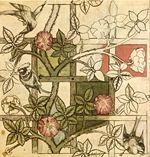
William Morris 24 March 18343 October 1896 was an English textile designer, artist, writer, and socialist associated with the Pre-Raphaelite Brotherhood and the English Arts and Crafts Movement...
(1834–1896) during the 1860s and inspired by the writings of John Ruskin
John Ruskin
John Ruskin was the leading English art critic of the Victorian era, also an art patron, draughtsman, watercolourist, a prominent social thinker and philanthropist. He wrote on subjects ranging from geology to architecture, myth to ornithology, literature to education, and botany to political...
(1819–1900), it had its earliest and most complete development in the British Isles but spread to Europe and North America. It was largely a reaction against the impoverished state of the decorative arts and the conditions by which they were produced.
The philosophy was an advocacy of traditional craftsmanship using simple forms and often medieval, romantic or folk styles of decoration. It also included advocacy of economic and social reform and has been considered as essentially anti-industrial.
Britain and Ireland
Pre-Raphaelite Brotherhood
The Pre-Raphaelite Brotherhood was a group of English painters, poets, and critics, founded in 1848 by William Holman Hunt, John Everett Millais and Dante Gabriel Rossetti...
, of which he had been a part, and from his reading of Ruskin. During 1861 Morris and some of his friends initiated a company, Morris, Marshall, Faulkner & Co., which, as supervised by the partners, designed and made decorative objects for homes, including wallpaper, textiles, furniture and stained glass. Later it was re-formed as Morris & Co. During 1890 Morris established the Kelmscott Press, for which he designed a typeface
Typeface
In typography, a typeface is the artistic representation or interpretation of characters; it is the way the type looks. Each type is designed and there are thousands of different typefaces in existence, with new ones being developed constantly....
based on Nicolas Jenson
Nicolas Jenson
Nicolas Jenson was a French engraver, pioneer printer and type designer who carried out most of his work in Venice. Jenson acted as Master of the French Royal Mint at Tours, and is accredited with being the creator of the first model roman type...
's letter forms of the fifteenth century. This printed fine and de-luxe editions of contemporary and historical English literature.
Red House
Red House (London)
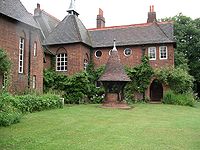
Red House in Bexleyheath in southeast London, England, is a major building of the history of the Arts and Crafts style and of 19th century British architecture. It was designed during 1859 by its owner, William Morris, and the architect Philip Webb, with wall paintings and stained glass by Edward...
, Bexleyheath
Bexleyheath
Bexleyheath is a main suburban district of Southeast London, England, in the London Borough of Bexley with a small percentage of the district itself being in the London Borough of Greenwich. Bexleyheath is located on the border of Inner London and Outer London. It is east south-east of Charing Cross...
, London (1859), designed for Morris by architect Philip Webb
Philip Webb
Another Philip Webb — Philip Edward Webb was the architect son of leading architect Sir Aston Webb. Along with his brother, Maurice, he assisted his father towards the end of his career....
, exemplifies the early Arts and Crafts style, with its well-proportioned solid forms, wide porches, steep roof, pointed window arches, brick fireplaces and wooden fittings. Webb rejected the grand classical style, based the design on British vernacular architecture and attempted to express the texture of ordinary materials, such as stone and tiles, with an asymmetrical and quaint building composition.
Morris's ideas spread during the late nineteenth and early twentieth centuries, and resulted in the establishment of many associations and craft communities, although Morris himself was not involved with them because of his preoccupation with socialism. A hundred and thirty Arts and Crafts organizations were formed in Britain, most of them between 1895 and 1905.
.jpg)
Eglantyne Louisa Jebb
Eglantyne Louisa Jebb was a social reformer. Born in Killiney, Ireland, she married her cousin Arthur Trevor Jebb , a barrister and landowner from Ellesmere, Shropshire. Her brother was the classicist Sir Richard Claverhouse Jebb...
, Mary Fraser Tytler
Mary Fraser Tytler
Mary Seton Fraser Tytler was a symbolist craftswoman, designer and social reformer.-Biography:...
and others initiated the Home Arts and Industries Association
Home Arts and Industries Association
The Home Arts and Industries Association was an organisation that functioned as a precursor to the Art Workers Guild in the development of the Arts and Crafts Movement in Britain. It was founded in 1884 by Eglantyne Louisa Jebb who was inspired by an initiative of Charles Godfrey Leland in...
to promote and protect rural handicrafts. During 1882, the architect A.H.Mackmurdo formed the Century Guild, a partnership of designers including Selwyn Image
Selwyn Image
Selwyn Image was a British clergyman, designer, including of stained glass windows and poet....
, Herbert Horne
Herbert Horne
Herbert Percy Horne was an English poet, architect, typographer and designer, art historian and antiquarian. He was an associate of the Rhymer's Club in London...
, Clement Heaton and Benjamin Creswick
Benjamin Creswick
-Life:Benjamin Creswick was born in Sheffield, the son of a spectacle-maker. He started his working life as a knife-grinder, but took up sculpture with the encouragement of John Ruskin. In 1887 he modelled a terracotta frieze showing the processes of knife-grinding for the exterior of Cutlers'...
. During 1884, the Art Workers Guild
Art Workers Guild
The Art Workers Guild or Art-Workers' Guild is an organisation established in 1884 by a group of British architects associated with the ideas of William Morris and the Arts and Crafts movement. The guild promoted the 'unity of all the arts', denying the distinction between fine and applied art...
was initiated by five young architects, William Lethaby
William Lethaby
William Richard Lethaby was an English architect and architectural historian whose ideas were highly influential on the late Arts and Crafts and early Modern movements in architecture, and in the fields of conservation and art education.-Early life:Lethaby was born in Barnstaple, Devon, the son of...
, Edward Prior
Edward Schroeder Prior
Edward Schroeder Prior was an architect who was instrumental in establishing the arts and crafts movement. He was one of the foremost theorists of the second generation of the movement, writing extensively on architecture, art, craftsmanship and the building process and subsequently influencing...
, Ernest Newton, Mervyn Macartney and Gerald C. Horsley, with the goal of integrating design and making. It was directed originally by George Blackall Simonds
George Blackall Simonds
George Blackall Simonds was an English sculptor and director of H & G Simonds Brewery in Reading in the English county of Berkshire....
. By 1890 the Guild had 150 members, representing the increasing number of practitioners of the Arts and Crafts style. At the same time the Arts and Craft aesthetic was copied by many designers of decorative products made by conventional industrial methods. The London department store
Department store
A department store is a retail establishment which satisfies a wide range of the consumer's personal and residential durable goods product needs; and at the same time offering the consumer a choice of multiple merchandise lines, at variable price points, in all product categories...
Liberty & Co., initiated during 1875, was a prominent retailer of goods of the style.
In 1885, the Birmingham School of Art
Birmingham School of Art
The Birmingham School of Art was a municipal art school based in the centre of Birmingham, England. Although the organisation was absorbed by Birmingham Polytechnic in 1971 and is now part of Birmingham City University's Birmingham Institute of Art and Design, its Grade I listed building on...
became the first Municipal School of Art. The school later became the leading centre for the Arts and Crafts Movement with the help of people such as Henry Payne
Henry Payne (artist)
Henry Arthur Payne RWS was an English stained glass artist, watercolourist and painter of frescoes.Payne was one of the Birmingham Group of Artist-Craftsmen who formed around Joseph Southall and the Birmingham School of Art in the late nineteenth century...
and Joseph Southall
Joseph Southall
Joseph Edward Southall RWS NEAC RBSA was an English painter associated with the Arts and Crafts movement.A leading figure in the nineteenth century revival of painting in tempera, Southall was the leader of the Birmingham Group of Artist-Craftsmen—one of the last outposts of Romanticism in...
.
During 1887 the Arts and Crafts Exhibition Society
Arts and Crafts Exhibition Society
The Arts and Crafts Exhibition Society was formed in London in 1887 to promote the exhibition of decorative arts alongside fine arts. Its exhibitions, held annually at the New Gallery from 1888–90, and roughly every three years thereafter, were important in the flowering of the British Arts and...
was formed with Walter Crane
Walter Crane
Walter Crane was an English artist and book illustrator. He is considered to be the most prolific and influential children’s book creator of his generation and, along with Randolph Caldecott and Kate Greenaway, one of the strongest contributors to the child's nursery motif that the genre of...
as president, holding its first exhibition in the New Gallery
New Gallery (London)
The New Gallery was an art gallery founded at 121 Regent Street W., London, in 1888 by J. Comyns Carr and Charles Edward Hallé. Carr and Hallé had been co-directors of Sir Coutts Lindsay's Grosvenor Gallery, but resigned from that troubled gallery in 1887....
, London, during November 1888. It was the first show of contemporary decorative arts in London since the Grosvenor Gallery
Grosvenor Gallery
The Grosvenor Gallery was an art gallery in London founded in 1877 by Sir Coutts Lindsay and his wife Blanche. Its first directors were J. Comyns Carr and Charles Hallé...
's Winter Exhibition of 1881. Morris & Co.
Morris & Co.
Morris, Marshall, Faulkner & Co. and its successor Morris & Co. were furnishings and decorative arts manufacturers and retailers founded by the Pre-Raphaelite artist and designer William Morris...
were well represented in the exhibition with furniture, fabrics, carpets and embroideries. Edward Burne-Jones
Edward Burne-Jones
Sir Edward Coley Burne-Jones, 1st Baronet was a British artist and designer closely associated with the later phase of the Pre-Raphaelite movement, who worked closely with William Morris on a wide range of decorative arts as a founding partner in Morris, Marshall, Faulkner, and Company...
observed, "here for the first time one can measure a bit the change that has happened in the last twenty years". The Society still exists as the Society of Designer Craftsmen.
During 1888, C.R.Ashbee
Charles Robert Ashbee
Charles Robert Ashbee was an English designer and entrepreneur who was a prime mover of the Arts and Crafts movement that took its craft ethic from the works of John Ruskin and its co-operative structure from the socialism of William Morris.-Early life:He was the son of businessman and erotic...
, a major late practitioner of the Arts and Crafts style in England, initiated the Guild and School of Handicraft in the East End of London. The Guild was a sort of craft co-operative modelled on the medieval guilds and intended to give working men the satisfactions of craftsmanship. Skilled craftsmen, working on the principles of Ruskin and Morris, were to produce hand-crafted goods and manage a school for young apprentices. The idea was greeted with enthusiasm by almost everyone except Morris himself, who was by now involved with promoting socialism and thought Ashbee's scheme trivial. From 1888 to 1902 it prospered, employing about fifty men. During 1902 Ashbee relocated the Guild out of London to begin an experimental community in Chipping Campden
Chipping Campden
Chipping Campden is a small market town within the Cotswold district of Gloucestershire, England. It is notable for its elegant terraced High Street, dating from the 14th century to the 17th century...
in the Cotswolds
Cotswolds
The Cotswolds are a range of hills in west-central England, sometimes called the Heart of England, an area across and long. The area has been designated as the Cotswold Area of Outstanding Natural Beauty...
. The Guild's work is characterized by plain surfaces of hammered silver, flowing wirework and colored stones in simple settings. Ashbee designed jewellery and silver tableware. At Chipping Campden it flourished creatively, but did not prosper and was liquidated during 1908. Some of the craftsmen stayed, contributing to the tradition of modern craftsmanship in the area.
Charles Francis Annesley Voysey (1857–1941) was an Arts and Crafts architect, also designing fabrics, tiles, ceramics, furniture and metalwork. His style combined simplicity with sophistication. His wallpapers and textiles, featuring stylised bird and plant forms in bold outlines with flat colors, were used widely. Curiously, he was not a craftsman of any of the materials for which he designed.
Morris's ideas were adopted by the New Education philosophy during the late 1880s, which incorporated handicraft work in schools such as Abbotsholme (1889) and Bedales (1892), and his influence has been noted in the social experiments of Dartington Hall
Dartington Hall
The Dartington Hall Trust, near Totnes, Devon, United Kingdom is a charity specialising in the arts, social justice and sustainability.The Trust currently runs 16 charitable programmes, including The Dartington International Summer School and Schumacher Environmental College...
during the mid twentieth century and in the formation of the Crafts Council
Crafts Council
The Crafts Council was established in the United Kingdom in 1971 as the national agency for crafts and was granted a Royal Charter in 1982. The Crafts Council’s vision is to position the UK as the global centre for the making, seeing and collecting of contemporary craft...
during 1973. Morris's thought also influenced the distributism
Distributism
Distributism is a third-way economic philosophy formulated by such Catholic thinkers as G. K...
of G. K. Chesterton
G. K. Chesterton
Gilbert Keith Chesterton, KC*SG was an English writer. His prolific and diverse output included philosophy, ontology, poetry, plays, journalism, public lectures and debates, literary and art criticism, biography, Christian apologetics, and fiction, including fantasy and detective fiction....
and Hilaire Belloc
Hilaire Belloc
Joseph Hilaire Pierre René Belloc was an Anglo-French writer and historian who became a naturalised British subject in 1902. He was one of the most prolific writers in England during the early twentieth century. He was known as a writer, orator, poet, satirist, man of letters and political activist...
. Morris & Co. traded until 1940. Its designs were vended by Sanderson and Co. and some are still in production.
Harry Clarke
Harry Clarke was an Irish stained glass artist and book illustrator. Born in Dublin, he was a leading figure in the Irish Arts and Crafts Movement.- History :...
the best-known artist and also Evie Hone
Evie Hone
Evie Hone was a Dublin born Irish painter and stained glass artist.She was related to Nathaniel Hone and Nathaniel Hone the Younger. Her most important works are probably the East Window for the Chapel at Eton College, Windsor and My Four Green Fields, now located in Government Buildings...
. Architects practicing in Ireland included Sir Edwin Lutyens (Heywood House in Co. Laois, Lambay Island and the Irish National War Memorial Gardens
Irish National War Memorial Gardens
The Irish National War Memorial Gardens is an Irish war memorial in Islandbridge, Dublin dedicated "to the memory of the 49,400 Irish soldiers who gave their lives in the Great War, 1914–1918", out of over 300,000 Irishmen who served in all armies....
in Dublin) and Frederick 'Pa' Hicks (Malahide Castle
Malahide Castle
Malahide Castle, parts of which date to the 12th century, lies, with over of remaining estate parkland , close to the village of Malahide, nine miles north of Dublin in Ireland.-History:...
estate buildings and round tower). Irish Celtic motifs were popular during the movement in silvercraft, carpet design, book illustrations and hand-carved furniture.
It also had an "extraordinary flowering" in Scotland where it was represented by the development of the 'Glasgow Style' which was based on the talent of the Glasgow School of Art
Glasgow School of Art
Glasgow School of Art is one of only two independent art schools in Scotland, situated in the Garnethill area of Glasgow.-History:It was founded in 1845 as the Glasgow Government School of Design. In 1853, it changed its name to The Glasgow School of Art. Initially it was located at 12 Ingram...
. Celtic revival also took hold here, and motifs such as the Glasgow rose became popularised. Charles Rennie Mackintosh
Charles Rennie Mackintosh
Charles Rennie Mackintosh was a Scottish architect, designer, watercolourist and artist. He was a designer in the Arts and Crafts movement and also the main representative of Art Nouveau in the United Kingdom. He had a considerable influence on European design...
and the Glasgow School of Art were to influence others worldwide.
North America
In the United States, the terms American CraftsmanAmerican Craftsman
The American Craftsman Style, or the American Arts and Crafts Movement, is an American domestic architectural, interior design, landscape design, applied arts, and decorative arts style and lifestyle philosophy that began in the last years of the 19th century. As a comprehensive design and art...
, or Craftsman style are often used to denote the style of architecture, interior design, and decorative arts that prevailed between the dominant eras of Art Nouveau
Art Nouveau
Art Nouveau is an international philosophy and style of art, architecture and applied art—especially the decorative arts—that were most popular during 1890–1910. The name "Art Nouveau" is French for "new art"...
and Art Deco
Art Deco
Art deco , or deco, is an eclectic artistic and design style that began in Paris in the 1920s and flourished internationally throughout the 1930s, into the World War II era. The style influenced all areas of design, including architecture and interior design, industrial design, fashion and...
, or approximately the period from 1910 to 1925.
In Canada, the term Arts and Crafts predominates, but the term Craftsman is also recognized.
While the Europeans tried to recreate the virtuous craft labor that was being replaced by industrialization, the Americans tried to establish a new type of virtue to replace heroic craft production: well-decorated middle-class homes. They claimed that the simple but refined aesthetics of Arts and Crafts decorative arts would ennoble the new experience of industrial consumerism, making individuals more rational and society more harmonious. The American Arts and Crafts philosophy was thus the aesthetic counterpart of its contemporary political philosophy, Progressivism
Progressivism
Progressivism is an umbrella term for a political ideology advocating or favoring social, political, and economic reform or changes. Progressivism is often viewed by some conservatives, constitutionalists, and libertarians to be in opposition to conservative or reactionary ideologies.The...
. Characteristically, when in Chicago the Arts and Crafts Society began during October 1897, it was at Hull House
Hull House
Hull House is a settlement house in the United States that was co-founded in 1889 by Jane Addams and Ellen Gates Starr. Located in the Near West Side of , Hull House opened its doors to the recently arrived European immigrants. By 1911, Hull House had grown to 13 buildings. In 1912 the Hull...
, one of the first American settlement houses for social reform.
In the United States, the Arts and Crafts style initiated a wide variety of attempts to reinterpret European Arts and Crafts ideals for Americans. These included the "Craftsman
American Craftsman
The American Craftsman Style, or the American Arts and Crafts Movement, is an American domestic architectural, interior design, landscape design, applied arts, and decorative arts style and lifestyle philosophy that began in the last years of the 19th century. As a comprehensive design and art...
"-style architecture, furniture, and other decorative arts such as the designs promoted by Gustav Stickley
Gustav Stickley
Gustav Stickley was a manufacturer of furniture and the leading proselytizer for the American Arts and Crafts movement, an extension of the British Arts and Crafts movement.-Biography:...
in his magazine, The Craftsman. A host of imitators of Stickley's furniture (the designs of which are often mislabelled the "Mission Style
American Craftsman
The American Craftsman Style, or the American Arts and Crafts Movement, is an American domestic architectural, interior design, landscape design, applied arts, and decorative arts style and lifestyle philosophy that began in the last years of the 19th century. As a comprehensive design and art...
") included three companies initiated by his brothers.
Arts and Crafts ideals disseminated in America through journal and newspaper writing were supplemented by societies that sponsored lectures and programs. The first such was organized in Boston during the late 1890s, when a group of influential architects, designers, and educators determined to bring to America the design reforms begun in Britain by William Morris; they met to organize an exhibition of contemporary craft objects. The first meeting was held on January 4, 1897, at the Museum of Fine Arts
Museum of Fine Arts, Boston
The Museum of Fine Arts in Boston, Massachusetts, is one of the largest museums in the United States, attracting over one million visitors a year. It contains over 450,000 works of art, making it one of the most comprehensive collections in the Americas...
(MFA) in Boston to organize an exhibition of contemporary crafts. When craftsmen, consumers, and manufacturers realized the aesthetic and technical potential of the applied arts, the process of design reform in Boston started. Present at this meeting were General Charles Loring, Chairman of the Trustees of the MFA; William Sturgis Bigelow and Denman Ross, collectors, writers and MFA trustees; Ross Turner, painter; Sylvester Baxter, art critic for the Boston Transcript; Howard Baker, A.W. Longfellow Jr.; and Ralph Clipson Sturgis, architect.
The first American Arts and Crafts Exhibition began on April 5, 1897, at Copley Hall featuring more than 1000 objects made by 160 craftsmen, half of whom were women. Some of the advocates of the exhibit were Langford Warren, initiator of Harvard's School of Architecture; Mrs. Richard Morris Hunt; Arthur Astor Carey and Edwin Mead, social reformers; and Will Bradley, graphic designer. The success of this exhibition resulted in the incorporation of The Society of Arts and Crafts, on June 28, 1897, with a mandate to "develop and encourage higher standards in the handicrafts." The 21 founders claimed to be interested in more than sales, and emphasized encouragement of artists to produce work with the best quality of workmanship and design. This mandate was soon expanded into a credo, possibly written by the SAC's first president, Charles Eliot Norton
Charles Eliot Norton
Charles Eliot Norton, was a leading American author, social critic, and professor of art. He was a militant idealist, a progressive social reformer, and a liberal activist whom many of his contemporaries considered the most cultivated man in the United States.-Biography:Norton was born at...
, which read:
This Society was incorporated for the purpose of promoting artistic work in all branches of handicraft. It hopes to bring Designers and Workmen into mutually helpful relations, and to encourage workmen to execute designs of their own. It endeavors to stimulate in workmen an appreciation of the dignity and value of good design; to counteract the popular impatience of Law and Form, and the desire for over-ornamentation and specious originality. It will insist upon the necessity of sobriety and restraint, or ordered arrangement, of due regard for the relation between the form of an object and its use, and of harmony and fitness in the decoration put upon it.
Also influential were the Roycroft
Roycroft
Roycroft was a reformist community of craft workers and artists which formed part of the Arts and Crafts movement in the USA. Elbert Hubbard founded the community in 1895 in the village of East Aurora, Erie County, New York, near Buffalo. Participants were known as Roycrofters...
community initiated by Elbert Hubbard
Elbert Hubbard
Elbert Green Hubbard was an American writer, publisher, artist, and philosopher. Raised in Hudson, Illinois, he met early success as a traveling salesman with the Larkin soap company. Today Hubbard is mostly known as the founder of the Roycroft artisan community in East Aurora, New York, an...
, Joseph Marbella, utopian communities like Byrdcliffe Colony
Byrdcliffe Colony
The Byrdcliffe Colony, also called the Byrdliffe Arts Colony or Byrdcliffe Historic District, was founded in 1902 near Woodstock, New York by Jane and Ralph Radcliffe Whitehead and colleagues, Bolton Brown and Hervey White...
in Woodstock, New York
Woodstock, New York
Woodstock is a town in Ulster County, New York, United States. The population was 5,884 at the 2010 census, down from 6,241 at the 2000 census.The Town of Woodstock is in the northern part of the county...
, and Rose Valley, Pennsylvania
Rose Valley, Pennsylvania
Rose Valley is a small but historic borough in Delaware County, Pennsylvania, United States. Its area is and the population was 944 at the 2000 census. It was settled by Quaker farmers in 1682, and later water mills along Ridley Creek drove manufacturing in the nineteenth century...
, developments such as Mountain Lakes, New Jersey
New Jersey
New Jersey is a state in the Northeastern and Middle Atlantic regions of the United States. , its population was 8,791,894. It is bordered on the north and east by the state of New York, on the southeast and south by the Atlantic Ocean, on the west by Pennsylvania and on the southwest by Delaware...
, featuring clusters of bungalow and chateau homes built by Herbert J. Hapgood, and the contemporary studio craft style. Studio pottery
Studio pottery
Studio pottery is made by modern artists working alone or in small groups, producing unique items of pottery in small quantities, typically with all stages of manufacture carried out by one individual. Much studio pottery is tableware or cookware but an increasing number of studio potters produce...
— exemplified by the Grueby Faience Company
Grueby Faience Company
The Grueby Faience Company, founded in 1894, was an American ceramics company that produced distinctive vases and tiles during America's Arts and Crafts Movement....
, Newcomb Pottery
Newcomb Pottery
Newcomb Pottery, also called Newcomb College Pottery, was a brand of American Arts & Crafts pottery produced from 1895 to 1940. The company grew out of the pottery program at H. Sophie Newcomb Memorial College, the women's' college now associated with Tulane University in New Orleans, Louisiana...
in New Orleans, Marblehead Pottery, Teco pottery
Teco pottery
The American Terra Cotta Tile and Ceramic Company was founded in 1881; originally as Spring Valley Tile Works; in Terra Cotta, Illinois, near Chicago by William Day Gates. It became the country's first manufactury of architectural terra cotta. The production consisted of drain tile, brick, chimney...
, Overbeck
Overbeck Sisters
The Overbeck Sisters were four women potters and artists of the Arts and Crafts Movement who worked in Cambridge City, Indiana, from 1911 until 1955....
and Rookwood pottery and Mary Chase Perry Stratton
Mary Chase Perry Stratton
Mary Chase Perry Stratton was an American ceramic artist. She was a co-founder, along with Horace James Caulkins, of Pewabic Pottery, a form of ceramic art used to make architectural tiles.-Early years:...
's Pewabic Pottery
Pewabic Pottery
Pewabic Pottery is a studio and school located in Detroit, Michigan and founded in 1903. The studio is known for its iridescent glazes, some of which grace notable buildings such as the Shedd Aquarium and Basilica of the National Shrine of the Immaculate Conception. Pewabic Pottery is on display...
in Detroit
Detroit, Michigan
Detroit is the major city among the primary cultural, financial, and transportation centers in the Metro Detroit area, a region of 5.2 million people. As the seat of Wayne County, the city of Detroit is the largest city in the U.S. state of Michigan and serves as a major port on the Detroit River...
, as well as the art tile
Tile
A tile is a manufactured piece of hard-wearing material such as ceramic, stone, metal, or even glass. Tiles are generally used for covering roofs, floors, walls, showers, or other objects such as tabletops...
s made by Ernest A. Batchelder
Ernest A. Batchelder
Ernest A. Batchelder was an artist and educator who made Southern California his home in the early 20th century. He is famous as a maker of art tiles and as a leader in the American Arts and Crafts Movement....
in Pasadena, California
Pasadena, California
Pasadena is a city in Los Angeles County, California, United States. Although famous for hosting the annual Rose Bowl football game and Tournament of Roses Parade, Pasadena is the home to many scientific and cultural institutions, including the California Institute of Technology , the Jet...
, and idiosyncratic furniture of Charles Rohlfs
Charles Rohlfs
Charles Rohlfs , was an American actor, stove designer and furniture maker. Rohlfs is a representative of the Arts and Crafts Movement, and is most famous for his skill as a furniture designer and maker.-Life and career:...
all demonstrate the influence of Arts and Crafts.
Architecture
The "Prairie School" of Frank Lloyd WrightFrank Lloyd Wright
Frank Lloyd Wright was an American architect, interior designer, writer and educator, who designed more than 1,000 structures and completed 500 works. Wright believed in designing structures which were in harmony with humanity and its environment, a philosophy he called organic architecture...
, George Washington Maher and other architects in Chicago, the Country Day School movement
Country Day School movement
The Country Day School movement is a movement in progressive education that originated in the United States in the late 19th century.Country Day schools seek to recreate the educational rigor, atmosphere, camaraderie and character-building aspects of the best college prep boarding schools while...
, the bungalow
Bungalow
A bungalow is a type of house, with varying meanings across the world. Common features to many of these definitions include being detached, low-rise , and the use of verandahs...
and ultimate bungalow
Ultimate bungalow
Ultimate bungalow is a term most commonly used to describe very large and detailed Craftsman style homes, taking the bungalow style and interpreting it on a large scale. The style is associated with such California architects as Greene and Greene, Bernard Maybeck and Julia Morgan...
style of houses popularized by Greene and Greene
Greene and Greene
Greene and Greene was an architectural firm established by brothers Charles Sumner Greene and Henry Mather Greene , influential early 20th Century American architects...
, Julia Morgan
Julia Morgan
Julia Morgan was an American architect. The architect of over 700 buildings in California, she is best known for her work on Hearst Castle in San Simeon, California...
, and Bernard Maybeck
Bernard Maybeck
Bernard Ralph Maybeck was a architect in the Arts and Crafts Movement of the early 20th century. He was a professor at University of California, Berkeley...
are some examples of the American Arts and Crafts and American Craftsman
American Craftsman
The American Craftsman Style, or the American Arts and Crafts Movement, is an American domestic architectural, interior design, landscape design, applied arts, and decorative arts style and lifestyle philosophy that began in the last years of the 19th century. As a comprehensive design and art...
style of architecture. Restored and landmark-protected examples are still present in America, especially in California in Berkeley
Berkeley, California
Berkeley is a city on the east shore of the San Francisco Bay in Northern California, United States. Its neighbors to the south are the cities of Oakland and Emeryville. To the north is the city of Albany and the unincorporated community of Kensington...
and Pasadena
Pasadena, California
Pasadena is a city in Los Angeles County, California, United States. Although famous for hosting the annual Rose Bowl football game and Tournament of Roses Parade, Pasadena is the home to many scientific and cultural institutions, including the California Institute of Technology , the Jet...
, and the sections of other towns originally developed during the era and not experiencing post-war urban renewal. Mission Style
Mission Style
-Architecture:* Mission Revival Style architecture* Architecture of the California Missions* Spanish Colonial Revival Style architecture* The architecture of the Prairie School, including Frank Lloyd Wright's* American Craftsman* Craftsman Furniture-Furniture:...
, Prairie School
Prairie School
Prairie School was a late 19th and early 20th century architectural style, most common to the Midwestern United States.The works of the Prairie School architects are usually marked by horizontal lines, flat or hipped roofs with broad overhanging eaves, windows grouped in horizontal bands,...
, and the 'California bungalow
California Bungalow
California bungalows, known as Californian bungalows in Australia and are commonly called simply bungalows in America, are a form of residential structure that were widely popular across America and, to some extent, the world around the years 1910 to 1939.-Exterior features:Bungalows are 1 or 1½...
' styles of residential building remain popular in the United States today.
Europe
The earliest Arts and Crafts activity in continental Europe was in BelgiumBelgium
Belgium , officially the Kingdom of Belgium, is a federal state in Western Europe. It is a founding member of the European Union and hosts the EU's headquarters, and those of several other major international organisations such as NATO.Belgium is also a member of, or affiliated to, many...
in about 1890, where the English style inspired artists and architects including Gabriel Van Dievoet
Gabriel Van Dievoet
Gabriel Van Dievoet is a Belgian decorator and Liberty style sgraffitist of great talent. He was the brother of the architect Henri Van Dievoet...
, Gustave Serrurier-Bovy
Gustave Serrurier-Bovy
Gustave Serrurier-Bovy was a Belgian architect and furniture designer. He is credited with creating the Art Nouveau style, coined as a style in Paris by Bing....
, Henry Van de Velde
Henry van de Velde
Henry Clemens Van de Velde was a Belgian Flemish painter, architect and interior designer. Together with Victor Horta and Paul Hankar he could be considered one of the main founders and representatives of Art Nouveau in Belgium...
and a group known as La Libre Esthétique
La Libre Esthétique
La Libre Esthétique was an artistic society founded in 1893 in Brussels to continue the efforts of the artists' group Les XX dissolved the same year...
(Free Aesthetic).
In Germany
Germany
Germany , officially the Federal Republic of Germany , is a federal parliamentary republic in Europe. The country consists of 16 states while the capital and largest city is Berlin. Germany covers an area of 357,021 km2 and has a largely temperate seasonal climate...
, after unification in 1871, the Arts and Crafts philosophy developed nationalist associations under the encouragement of the Bund für Heimatschutz (1897) and the Vereinigte Werkstatten für Kunst im Handwerk initiated during 1898 by Karl Schmidt.
In Austria, the style became popular in Vienna, inspired by an exhibition of the works of Charles Rennie Mackintosh
Charles Rennie Mackintosh
Charles Rennie Mackintosh was a Scottish architect, designer, watercolourist and artist. He was a designer in the Arts and Crafts movement and also the main representative of Art Nouveau in the United Kingdom. He had a considerable influence on European design...
and Charles Robert Ashbee
Charles Robert Ashbee
Charles Robert Ashbee was an English designer and entrepreneur who was a prime mover of the Arts and Crafts movement that took its craft ethic from the works of John Ruskin and its co-operative structure from the socialism of William Morris.-Early life:He was the son of businessman and erotic...
.
In Finland
Finland
Finland , officially the Republic of Finland, is a Nordic country situated in the Fennoscandian region of Northern Europe. It is bordered by Sweden in the west, Norway in the north and Russia in the east, while Estonia lies to its south across the Gulf of Finland.Around 5.4 million people reside...
, an idealistic artists' colony in Helsinki
Helsinki
Helsinki is the capital and largest city in Finland. It is in the region of Uusimaa, located in southern Finland, on the shore of the Gulf of Finland, an arm of the Baltic Sea. The population of the city of Helsinki is , making it by far the most populous municipality in Finland. Helsinki is...
was designed by Herman Gesellius, Armas Lindgren
Armas Lindgren
Armas Eliel Lindgren was Finnish architect, professor and painter.- Biography :Armas Lindgren was born in Hämeenlinna on November 28, 1874. He studied architecture in the Polytechnic Institute of Helsinki, from where he graduated in 1897. While being a student he collaborated with Josef Stenbäck...
and Eliel Saarinen
Eliel Saarinen
Gottlieb Eliel Saarinen was a Finnish architect who became famous for his art nouveau buildings in the early years of the 20th century....
, who worked in the National Romantic style
National Romantic Style
The National Romantic style was a Nordic architectural style that was part of the national romantic movement during the late 19th and early 20th century. Designers turned to early Medieval and even prehistoric precedents to construct a style appropriate to the perceived character of a people...
, akin to the British Gothic Revival.
In Hungary
Hungary
Hungary , officially the Republic of Hungary , is a landlocked country in Central Europe. It is situated in the Carpathian Basin and is bordered by Slovakia to the north, Ukraine and Romania to the east, Serbia and Croatia to the south, Slovenia to the southwest and Austria to the west. The...
, under the influence of Ruskin and Morris, a group of artists and architects, including Károly Kós
Károly Kós
Károly Kós was a Hungarian architect, writer, illustrator, ethnologist and politician of Austria-Hungary and Romania.- Biography :...
, Aladár Kreisch and Ede Wigand, discovered the folk art
Folk art
Folk art encompasses art produced from an indigenous culture or by peasants or other laboring tradespeople. In contrast to fine art, folk art is primarily utilitarian and decorative rather than purely aesthetic....
and vernacular architecture of Transylvania
Transylvania
Transylvania is a historical region in the central part of Romania. Bounded on the east and south by the Carpathian mountain range, historical Transylvania extended in the west to the Apuseni Mountains; however, the term sometimes encompasses not only Transylvania proper, but also the historical...
. Many of Kós's buildings, including those of the Budapest zoo
Budapest Zoo & Botanical Garden
Budapest Zoo & Botanical Garden is the oldest zoo park in Hungary and one of the oldest in the world.It has 733 animal species and located within the Városliget Park....
, show this influence.
The Irish Arts and Crafts style is represented by the Honan Chapel
Honan Chapel
The Honan Chapel is located on the grounds of University College Cork in Cork city, Ireland.-Irish Arts & Crafts movement :The chapel, and its liturgical collection, was produced during the late phase of the Irish Arts and Crafts movement . Both the building and furnishings were designed and...
(1916) in Cork
Cork (city)
Cork is the second largest city in the Republic of Ireland and the island of Ireland's third most populous city. It is the principal city and administrative centre of County Cork and the largest city in the province of Munster. Cork has a population of 119,418, while the addition of the suburban...
in the grounds of University College Cork.
Asia
In Japan, Soetsu Yanagi, creator of the MingeiMingei
', the Japanese folk art movement, was developed in the late 1920s and 1930s in Japan. Its founding father was Yanagi Sōetsu .-Origins:In 1916, Yanagi made his first trip to Korea out of a curiosity for Korean crafts...
style promoting folk art during the 1920s, shared the contemporary Japanese interest in Morris and Ruskin and was influenced by the Arts and Crafts style.
Design principles
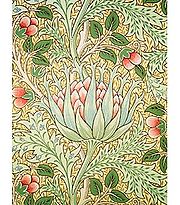
Arts and Crafts objects were simple in form, without superfluous decoration, and how they were constructed was often still visible. They tended to emphasize the qualities of the materials used ("truth to material"). They often had patterns inspired by British flora and fauna and used the vernacular, or domestic, traditions of the British countryside. Several designer-makers established workshops in rural areas and revived old techniques. They were influenced by the Gothic Revival (1830–1880) and were interested in medieval styles, using bold forms and strong colors based on medieval designs. They claimed to believe in the moral purpose of art. Truth to material, structure and function had also been advocated by A.W.N. Pugin (1812–1852), an exponent of the Gothic Revival.
The Arts and Crafts style was partly a reaction against the style of many of the items shown in the Great Exhibition of 1851, which were ornate, artificial and ignored the qualities of the materials used. The art historian Nikolaus Pevsner
Nikolaus Pevsner
Sir Nikolaus Bernhard Leon Pevsner, CBE, FBA was a German-born British scholar of history of art and, especially, of history of architecture...
has said that exhibits in the Great Exhibition showed "ignorance of that basic need in creating patterns, the integrity of the surface" and "vulgarity in detail". Design reform began with the organisers of the Exhibition itself, Henry Cole
Henry Cole
Sir Henry Cole was an English civil servant and inventor who facilitated many innovations in commerce and education in 19th century Britain...
(1808–1882), Owen Jones
Owen Jones (architect)
Owen Jones was a London-born architect and designer of Welsh descent. He was a versatile architect and designer, and one of the most influential design theorists of the nineteenth century...
(1809–1874), Matthew Digby Wyatt
Matthew Digby Wyatt
Sir Matthew Digby Wyatt was a British architect and art historian who became Secretary of the Great Exhibition, Surveyor of the East India Company and the first Slade Professor of Fine Art at the University of Cambridge.-Life:...
(1820–1877) and Richard Redgrave
Richard Redgrave
Richard Redgrave RA was an English artist.-Early life:Redgrave was born on 30 April 1804 in Pimlico, at 2 Belgrave Terrace, the second son of William Redgrave, and younger brother of Samuel Redgrave. While was employed in his father's manufacturing firm, he visited the British Museum to make...
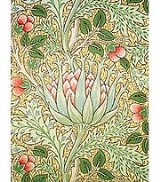
(1804–1888). Jones, for example, declared that "Ornament ... must be secondary to the thing decorated", that there must be "fitness in the ornament to the thing ornamented", and that wallpapers and carpets must not have any patterns "suggestive of anything but a level or plain". These ideas were adopted by William Morris. Where a fabric or wallpaper in the Great Exhibition might be decorated with a natural motif made to look as real as possible, a William Morris-designed wallpaper, like the Artichoke design illustrated above, would use a flat and simplified natural motif. In order to express the alleged beauty of craft, some products were deliberately left slightly unfinished, resulting in a certain rustic and robust effect.
By the end of the nineteenth century, Arts and Crafts ideals had influenced architecture, painting, sculpture, graphics, illustration, book making and photography, domestic design and the decorative arts, including furniture and woodwork, stained glass, leatherwork, lacemaking, embroidery, rug making and weaving, jewelry and metalwork, enameling and ceramics.
Social principles
Whereas Cole, Jones and Wyatt had accepted machine production, Morris mixed design criticism with social criticism, insisting that the artist should be a craftsman-designer. Morris and others, for example, Walter Crane and C.R.Ashbee (1863–1942), advocated a society of free craftspeople, which they believed had existed during the Middle Ages. "Because craftsmen took pleasure in their work", Morris wrote, "the Middle Ages was a period of greatness in the art of the common people. ... The treasures in our museums now are only the common utensils used in households of that age, when hundreds of medieval churches - each one a masterpiece - were built by unsophisticated peasants."
There was some disagreement as to whether machinery should be rejected completely and opinions changed. Morris was not entirely consistent. He thought production by machinery was "altogether an evil", but when he could find manufacturers willing to work to his own exacting standards, he would use them to make his designs. He said that, in a "true society", where neither luxuries nor cheap trash were made, machinery could be improved and used to reduce the hours of labour. Ashbee, in some respects, began as even more "medievalist" than Morris. At the time of his Guild of Handicraft, initiated during 1888, he said, "We do not reject the machine, we welcome it. But we would desire to see it mastered." But after twenty years of pitting his Guild and School of Handicraft guild against modern methods of manufacture, he acknowledged that "Modern civilization rests on machinery." In Germany, Hermann Muthesius
Hermann Muthesius
Adam Gottlieb Hermann Muthesius , known as Hermann Muthesius, was a German architect, author and diplomat, perhaps best known for promoting many of the ideas of the English Arts and Crafts movement within Germany and for his subsequent influence on early pioneers of German architectural modernism...
and Henry Van de Velde
Henry van de Velde
Henry Clemens Van de Velde was a Belgian Flemish painter, architect and interior designer. Together with Victor Horta and Paul Hankar he could be considered one of the main founders and representatives of Art Nouveau in Belgium...
, major participants of the Deutscher Werkbund
Deutscher Werkbund
The Deutscher Werkbund was a German association of artists, architects, designers, and industrialists. The Werkbund was to become an important event in the development of modern architecture and industrial design, particularly in the later creation of the Bauhaus school of design...
(DWB), had opposing opinions. Muthesius, who was director of design education for the German government, championed mass production, standardisation and an affordable, democratic art; Van de Velde thought mass production threatened creativity and individuality.
The philosophy was associated with socialist ideas in the persons of Morris, Crane and Ashbee. Morris eventually spent more of his time on socialist propaganda than on designing and making. Ashbee established a utopian community of craftsmen.
Influences and parallels
Widely exhibited in Europe, the Arts and Crafts style's simplicity inspired designers like Henry van de VeldeHenry van de Velde
Henry Clemens Van de Velde was a Belgian Flemish painter, architect and interior designer. Together with Victor Horta and Paul Hankar he could be considered one of the main founders and representatives of Art Nouveau in Belgium...
and styles such as Art Nouveau
Art Nouveau
Art Nouveau is an international philosophy and style of art, architecture and applied art—especially the decorative arts—that were most popular during 1890–1910. The name "Art Nouveau" is French for "new art"...
, the Dutch De Stijl
De Stijl
De Stijl , propagating the group's theories. Next to van Doesburg, the group's principal members were the painters Piet Mondrian , Vilmos Huszár , and Bart van der Leck , and the architects Gerrit Rietveld , Robert van 't Hoff , and J.J.P. Oud...
group, Vienna Secession
Vienna Secession
The Vienna Secession was formed in 1897 by a group of Austrian artists who had resigned from the Association of Austrian Artists, housed in the Vienna Künstlerhaus. This movement included painters, sculptors, and architects...
, and eventually the Bauhaus
Bauhaus
', commonly known simply as Bauhaus, was a school in Germany that combined crafts and the fine arts, and was famous for the approach to design that it publicized and taught. It operated from 1919 to 1933. At that time the German term stood for "School of Building".The Bauhaus school was founded by...
style. Pevsner regarded the style as a prelude to Modernism
Modernism
Modernism, in its broadest definition, is modern thought, character, or practice. More specifically, the term describes the modernist movement, its set of cultural tendencies and array of associated cultural movements, originally arising from wide-scale and far-reaching changes to Western society...
, which used simple forms without ornamentation.
In Russia, Viktor Hartmann
Viktor Hartmann
Viktor Alexandrovich Hartmann was a Russian architect and painter. He was associated with the Abramtsevo Colony, purchased and preserved beginning in 1870 by Savva Mamontov, and the Russian Revival.-Life:Victor-Edouard Hartmann was born in St...
, Viktor Vasnetsov
Viktor Vasnetsov
Viktor Mikhaylovich Vasnetsov , 1848 — Moscow, July 23, 1926) was a Russian artist who specialized in mythological and historical subjects. He was described as co-founder of folklorist/romantic modernism in the Russian painting and a key figure of the revivalist movement in Russian art.- Childhood ...
and other artists associated with Abramtsevo Colony
Abramtsevo Colony
Abramtsevo is an estate located north of Moscow, in the proximity of Khotkovo, that became a center for the Slavophile movement and artistic activity in the 19th century.-History:...
sought to revive the quality of medieval Russian decorative arts quite independently from the philosophy flourishing in Great Britain.
The Wiener Werkstätte
Wiener Werkstätte
Established in 1903, the Wiener Werkstätte was a production community of visual artists. The workshop brought together architects, artists and designers whose first commitment was to design art which would be accessible to everyone...
, initiated during 1903 by Josef Hoffmann
Josef Hoffmann
Josef Hoffmann was an Austrian architect and designer of consumer goods.- Biography :...
and Koloman Moser
Koloman Moser
Koloman Moser was an Austrian artist who exerted considerable influence on twentieth-century graphic art and one of the foremost artists of the Vienna Secession movement and a co-founder of Wiener Werkstätte....
, had an independent role in the development of Modernism, with its Wiener Werkstätte Style
Wiener Werkstätte Style
With the foundation of the Wiener Werkstätte in 1903, a new artistic style was born that came to be known as the Wiener-Werkstätte-Stil . Beginning with the 14th Exhibition of the Vienna Sezession in 1902, the radical distinctiveness of certain Viennese artists began to emerge, setting a foundation...
.
The British Utility furniture
Utility furniture
Utility furniture refers to furniture produced in the United Kingdom during and just after World War II, under a Government scheme which was designed to cope with shortages of raw materials and rationing of consumption...
of the 1940s was simple in design and derived from Arts and Crafts principles. Gordon Russell
Sydney Gordon Russell
Sir Gordon Russell was an English designer, craftsman and educationist.He came under the influence of the Arts and Crafts movement from 1904 after his father had moved to Broadway in the Cotswolds to be hotelier at the Lygon Arms, through the Guild of Handicraft, the community of metalworkers,...
, chairman of the Utility Furniture Design Panel, manufactured in the Cotswold Hills, which had become a region of Arts and Crafts furniture making when Ashbee relocated there.
Examples
- The Lodge - East Suffolk Park, Midlothian - 1914
- Red HouseRed House (London)Red House in Bexleyheath in southeast London, England, is a major building of the history of the Arts and Crafts style and of 19th century British architecture. It was designed during 1859 by its owner, William Morris, and the architect Philip Webb, with wall paintings and stained glass by Edward...
- Bexleyheath, Kent - 1859 - BlackwellBlackwell (historic house)Blackwell is a large house designed in the Arts and Crafts style by Baillie Scott. It was built 1898–1900, and is listed grade I as an outstanding example of British domestic architecture. The house was built as a holiday home for Sir Edward Holt, a wealthy Manchester brewer...
- Lake District, England - 1898 - Derwent HouseDerwent HouseDerwent House, at 68 Camden Park Road, Chislehurst, Bromley, is one of a number of the locally renowned 'Willett-built' houses erected on the Camden Park Estate by high-class speculative builder William Willett in the 1900s....
- Chislehurst, Kent - 1899 - Spade HouseSpade HouseSpade House was the home of the science fiction writer H. G. Wells from 1901 to 1909. It is a large mansion overlooking Sandgate, near Folkestone in southeast England.-History:...
- Sandgate, Kent - 1900 - Shaw's CornerShaw's CornerShaw's Corner was the primary residence of the renowned Irish playwright George Bernard Shaw; now a historic National Trust property open to the public. Inside the house, the rooms remain much as Shaw left them, and the garden and Shaw's writing hut can also be visited...
- Ayot St Lawrence, Hertfordshire - 1902 - Pierre P. Ferry HousePierre P. Ferry HouseThe Pierre P. Ferry House is an historic home in Seattle, Washington.-History:The American Craftsman home was designed by Seattle architect John Graham. The art glass windows in the main hall with the elaborate peacock were designed by Tiffany Studios. Orlando Giannini of the Chicago firm...
- Seattle, Washington - 1903-1906 - Marston HouseGeorge W. Marston HouseThe George W. Marston House, or George Marston House and Gardens, also referred to as the George and Anna Marston House or the Marston House, is a museum and historic landmark located in San Diego and currently maintained by Save Our Heritage Organisation .- The House :The George W. Marston House...
- San Diego, California - 1905 - Robert R. Blacker HouseRobert R. Blacker HouseNot to be confused with the house that is part of the House System at the California Institute of TechnologyThe Robert Roe Blacker House, often referred to as the Blacker House or Robert R. Blacker House, is a residence in Pasadena, California, which is now on the U.S. National Register of Historic...
- Pasadena, California - 1907 - Gamble House - Pasadena, California - 1908
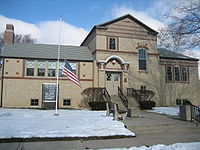
- Oregon Public LibraryOregon Public LibraryThe Oregon Public Library is located in Oregon, Illinois, United States, the county seat of Ogle County. The building is a public library that was constructed in 1909. Prior to 1909, Oregon's library was housed in different buildings, none of which were designed to house a library. The library was...
- Oregon, Illinois - 1909 - Thorsen HouseThorsen HouseThe William R. Thorsen House, often referred to as the Thorsen House, was built in 1909 in Berkeley, California by William Randolph and Caroline Canfield Thorsen. Designed by Henry and Charles Greene, of the renowned Pasadena firm of Greene & Greene, in the American Craftsman style of the Arts and...
- Berkeley, California - 1909 - Whare RaWhare RaWhare Ra, is the name of the building which housed the New Zealand branch of the Order of the Stella Matutina. It was designed and made by one of New Zealand’s most famous architects, and a senior member of the Order, James Walter Chapman-Taylor....
- Havelock North, New Zealand - 1912 - Asilomar Conference GroundsAsilomar Conference GroundsAsilomar Conference Grounds is a conference center built for the YWCA in 1913 at Asilomar State Beach in Pacific Grove, California. Julia Morgan designed and built 16 of the buildings on the property, of which 11 are still standing. It became part of Asilomar State Beach and Conference Grounds in...
- Pacific Grove, California - 1913 - Honan ChapelHonan ChapelThe Honan Chapel is located on the grounds of University College Cork in Cork city, Ireland.-Irish Arts & Crafts movement :The chapel, and its liturgical collection, was produced during the late phase of the Irish Arts and Crafts movement . Both the building and furnishings were designed and...
- University College Cork, Ireland - Loughrea Cathedral - Loughrea, County Galway, Ireland
Leading practitioners
- Charles Robert AshbeeCharles Robert AshbeeCharles Robert Ashbee was an English designer and entrepreneur who was a prime mover of the Arts and Crafts movement that took its craft ethic from the works of John Ruskin and its co-operative structure from the socialism of William Morris.-Early life:He was the son of businessman and erotic...
- Herbert Tudor BucklandHerbert Tudor BucklandHerbert Tudor Buckland was a British architect, best known for his seminal Arts and Crafts houses , the Elan Valley model village, educational buildings such as the campus of the Royal Hospital School in Suffolk and St Hugh's College in Oxford.-Biography:Buckland was born in...
- T. J. Cobden-Sanderson
- Walter CraneWalter CraneWalter Crane was an English artist and book illustrator. He is considered to be the most prolific and influential children’s book creator of his generation and, along with Randolph Caldecott and Kate Greenaway, one of the strongest contributors to the child's nursery motif that the genre of...
- Nelson DawsonNelson DawsonNelson Ethelred Dawson was an English artist and member of the Arts and Crafts movement.Dawson was born in Stamford, Lincolnshire and educated at Stamford School. He moved to London, where he operated his workshop first from Chelsea and in due course from the rear of his townhouse in Chiswick...
- Christopher DresserChristopher DresserChristopher Dresser was an English designer and design theorist, now widely known as one of the first and most important, independent, designers and was a pivotal figure in the Aesthetic Movement, and a major contributor to the allied Anglo-Japanese branch of the Movement; both originated in...
- Dirk van ErpDirk van ErpDirk Koperlager van Erp was an Dutch American artisan, coppersmith and metalsmith, best known for lamps made of copper with mica shades, and also for copper vases, bowls and candlesticks...
- Ernest GimsonErnest GimsonErnest William Gimson was an English furniture designer and architect. Gimson was described by the art critic Nikolaus Pevsner as "the greatest of the English architect-designers"...
- Greene & Greene
- Elbert HubbardElbert HubbardElbert Green Hubbard was an American writer, publisher, artist, and philosopher. Raised in Hudson, Illinois, he met early success as a traveling salesman with the Larkin soap company. Today Hubbard is mostly known as the founder of the Roycroft artisan community in East Aurora, New York, an...
- Gertrude JekyllGertrude JekyllGertrude Jekyll was an influential British garden designer, writer, and artist. She created over 400 gardens in the UK, Europe and the USA and contributed over 1,000 articles to Country Life, The Garden and other magazines.-Early life:...
- Edwin LutyensEdwin LutyensSir Edwin Landseer Lutyens, OM, KCIE, PRA, FRIBA was a British architect who is known for imaginatively adapting traditional architectural styles to the requirements of his era...
- William LethabyWilliam LethabyWilliam Richard Lethaby was an English architect and architectural historian whose ideas were highly influential on the late Arts and Crafts and early Modern movements in architecture, and in the fields of conservation and art education.-Early life:Lethaby was born in Barnstaple, Devon, the son of...
- Charles Rennie MackintoshCharles Rennie MackintoshCharles Rennie Mackintosh was a Scottish architect, designer, watercolourist and artist. He was a designer in the Arts and Crafts movement and also the main representative of Art Nouveau in the United Kingdom. He had a considerable influence on European design...
- A.H.Mackmurdo
- George Washington Maher
- Bernard MaybeckBernard MaybeckBernard Ralph Maybeck was a architect in the Arts and Crafts Movement of the early 20th century. He was a professor at University of California, Berkeley...
- Henry Chapman MercerHenry Chapman MercerHenry Chapman Mercer was an American archeologist, artifact collector, tile-maker and designer of three distinctive poured concrete structures: Fonthill, his home, the Moravian Pottery and Tile Works, and the Mercer Museum.-Early life and education:Henry Mercer was born in Doylestown,...
- Julia MorganJulia MorganJulia Morgan was an American architect. The architect of over 700 buildings in California, she is best known for her work on Hearst Castle in San Simeon, California...
- William de MorganWilliam De MorganWilliam Frend De Morgan was an English potter and tile designer. A lifelong friend of William Morris, he designed tiles, stained glass and furniture for Morris & Co. from 1863 to 1872. His tiles are often based on medieval designs or Persian patterns, and he experimented with innovative glazes and...
- William MorrisWilliam MorrisWilliam Morris 24 March 18343 October 1896 was an English textile designer, artist, writer, and socialist associated with the Pre-Raphaelite Brotherhood and the English Arts and Crafts Movement...
- Karl ParsonsKarl ParsonsKarl Parsons was an English stained glass artist.At the age of 15 Parsons became an apprentice in the studio of Christopher Whall where he was strongly influenced by the philosophy and practice of the Arts and Crafts Movement. He was an exceptional pupil and became Whall’s principal assistant...
- Edward Schroeder PriorEdward Schroeder PriorEdward Schroeder Prior was an architect who was instrumental in establishing the arts and crafts movement. He was one of the foremost theorists of the second generation of the movement, writing extensively on architecture, art, craftsmanship and the building process and subsequently influencing...
- Hugh C. RobertsonHugh C. RobertsonHugh C. Robertson, , was an American studio potter who is the first recognized potter to have worked with nonrepresentational ceramic decoration glazes. Robertson apprenticed at the Jersey City Potter in 1860. In 1868, he started work in his father's shop that opened in 1866 in Chelsea, Massachusetts...
- William RobinsonWilliam Robinson (gardener)William Robinson was an Irish practical gardener and journalist whose ideas about wild gardening spurred the movement that evolved into the English cottage garden, a parallel to the search for honest simplicity and vernacular style of the British Arts and Crafts movement...
- Norman Shaw
- Gustav StickleyGustav StickleyGustav Stickley was a manufacturer of furniture and the leading proselytizer for the American Arts and Crafts movement, an extension of the British Arts and Crafts movement.-Biography:...
- Phoebe Anna TraquairPhoebe Anna TraquairPhoebe Anna Traquair was an Irish artist, noted for her role in the Arts and Crafts movement in Scotland, as an illustrator, painter and embroiderer.-Family life:...
- Charles VoyseyCharles Voysey (architect)Charles Francis Annesley Voysey was an English architect and furniture and textile designer. Voysey's early work was as a designer of wallpapers, fabrics and furnishings in a simple Arts and Crafts style, but he is renowned as the architect of a number of notable country houses...
- Philip WebbPhilip WebbAnother Philip Webb — Philip Edward Webb was the architect son of leading architect Sir Aston Webb. Along with his brother, Maurice, he assisted his father towards the end of his career....
- Christopher WhallChristopher WhallChristopher Whitworth Whall was an English stained glass artist who worked from 1897 into the 20th century.He was an important member of the Arts and Crafts Movement, who became a leading designer of stained glass. His most important work is the glass for the Lady Chapel in Gloucester Cathedral...
Further reading
- Boris, Eileen. Art and Labor, Philadelphia: Temple University Press, 1986 ISBN 0-87722-384-X
- Cathers, David M. Furniture of the American Arts and Crafts Movement. The New American Library, Inc., 1981. ISBN 0-453-00397-4
- Cumming, Elizabeth, and Kaplan, Wendy, Arts & Crafts Movement, London: Thames & Hudson, 1991 ISBN 0-500-20248-6
- Cumming, Elizabeth, Hand, Heart and Soul: The Arts and Crafts Movement in Scotland, 2006, Birlinn ISBN 978-1841584195.
- Kaplan, Wendy, The Art that Is Life: The Arts & Crafts Movement in America 1875-1920. New York: Little Brown and Company, 1987
- Parry, Linda, Textiles of the Arts and Crafts Movement, London: Thames and Hudson, 2005 ISBN 0-500-28536-5
- Ayers, Dianne, American Arts and Crafts Textiles, New York: Harry N. Abrams, Inc, 2002 ISBN 0-8109-0434-9
External links
- The Arts & Crafts Society
- Craftsman Perspective site devoted to Arts and Crafts architecture
- What is Arts and Crafts
- Research resources on the Arts and Crafts at the Winterthur Library
- Hewn and Hammered dedicated to discussion of the Arts & Crafts movement in art, architecture & design
- Arts & Crafts Antique Gallery