

Middle-earth

Encyclopedia
Middle-earth is the fictional setting of the majority of author J. R. R. Tolkien
's fantasy writings
. The Hobbit
and The Lord of the Rings
take place entirely in Middle-earth, as does much of The Silmarillion
and Unfinished Tales
.
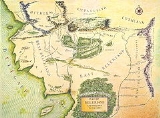
Tolkien prepared several maps of Middle-earth and of the regions of Middle-earth where his stories took place. Some were published in his lifetime, though some of the earliest maps were not published until after his death. The main maps were those published in The Hobbit, The Lord of the Rings, The Silmarillion, and Unfinished Tales. Most of the events of the First Age took place in the subcontinent Beleriand, which was later engulfed by the ocean at the end of the First Age; the Blue Mountains at the right edge of the map of Beleriand are the same Blue Mountains that appear on the extreme left of the map of Middle-earth in the Second and Third Ages. Tolkien's map of Middle-earth, however, shows only a small part of the world; most of the lands of Rhûn
and Harad
are not shown on the map, and there are also other continents.
Tolkien wrote many times that Middle-earth is located on our Earth
. He described it as an imaginary period in Earth's past, not only in The Lord of the Rings, but also in several letters. He put the end of the Third Age
at about 6,000 years before his own time, and the environs of the Shire in what is now northwestern Europe (Hobbiton for example was set at the same latitude as Oxford), though in replies to letters he would also describe elements of the stories as a "... secondary or sub-creational reality" or "Secondary belief". During an interview in January 1971, when asked whether the stories take place in a different era, he stated, "No ... at a different stage of imagination, yes." However, he did nod to the stories' setting on Earth; speaking of Midgard and Middle-earth, he said: "Oh yes, they're the same word. Most people have made this mistake of thinking Middle-earth is a particular kind of earth or is another planet of the science fiction sort but it's just an old fashioned word for this world we live in, as imagined surrounded by the Ocean." He continued to make references to its being "... a brief episode of History" of Earth as late as Autumn 1971.
) and the continent of Middle-earth: on one side the angelic Valar
, the Elves
and their allies among Men
; on the other the demonic Melkor or Morgoth (a Vala fallen into evil) and his minions, mostly Orcs
, Dragons
and enslaved men. In later ages, after Morgoth's defeat and expulsion from Arda, his place was taken by his lieutenant Sauron
.
The Valar withdrew from direct involvement in the affairs of Middle-earth after the defeat of Morgoth, but in later years they sent the wizards or Istari to help in the struggle against Sauron. The most important wizards were Gandalf the Grey
and Saruman the White
. Gandalf remained true to his mission and proved crucial in the fight against Sauron. Saruman, however, became corrupted and sought to establish himself as a rival to Sauron for absolute power in Middle-earth. Other races involved in the struggle against evil were Dwarves
, Ent
s and most famously Hobbit
s. The early stages of the conflict are chronicled in The Silmarillion
, while the final stages of the struggle to defeat Sauron are told in The Hobbit
and the The Lord of the Rings
.
Conflict over the possession and control of precious or magical objects is a recurring theme in the stories. The First Age
is dominated by the doomed quest of the Elf Fëanor
and most of his Noldor
in clan to recover three precious jewels called the Silmaril
s that Morgoth stole from them (hence the title The Silmarillion). The Second
and Third Age
are dominated by the forging of the Rings of Power
, and the fate of the One Ring
forged by Sauron, which gives its wearer the power to control or influence those wearing the other Rings of Power (hence the title The Lord of the Rings).
, the world of Men is known by several names, such as Midgard
, Middenheim, Manaheim, and Middengeard. The Old English
word middangeard descends from an earlier Germanic
word and so has cognate
s in languages related to Old English such as the Old Norse word Miðgarðr from Norse mythology
, transliterated to modern English as Midgard.
The term "Middle-earth"; also commonly referred to as "middle-world," was therefore not invented by Tolkien. It occurs in Early Modern English
as a development of the Middle English word middel-erde (cf. modern German Mittelerde), which developed in turn, through a process of folk etymology, from middanġeard (the g being soft, i.e. pronounced like y in its modern descendant "yard"). By the time of the Middle English
period, middangeard was being written as middellærd, midden-erde, or middel-erde, indicating that the second element had been reinterpreted, based on its similarity to the word for "earth". The shift in meaning was not great, however: middangeard properly meant "middle enclosure" instead of "middle-earth"; Nevertheless middangeard has been commonly translated as "middle-earth" and Tolkien followed this course.
This quote is from the second of the fragmentary remnants of the Crist
poems by Cynewulf
. The name Éarendel was the inspiration for Tolkien's mariner Eärendil
. who set sail from the lands of Middle-earth to ask for aid from the angelic powers, the Valar
. Tolkien's earliest poem about Eärendil, from 1914, the same year he read the Crist poems, refers to "the mid-world's rim".
The concept of middangeard was considered by Tolkien to be the same as a particular usage of the Greek
word - oikoumenē
(from which the word ecumenical
is derived). In this usage Tolkien says that the oikoumenē is "the abiding place of men"; by this he means it is the physical world in which man lives out his life and destiny, as opposed to the unseen worlds, like Heaven
or Hell
.
The term Middle-earth is not, however, used in Tolkien's earliest writings about his created world: writings that date from the early 1920s and which were later published in The Book of Lost Tales
(1983-4); nor is the term used in The Hobbit
(1937). Tolkien began to use the term "Middle-earth" in the latter part of the 1930s, in place of the earlier terms "Great Lands", "Outer Lands", and "Hither Lands" that he had used to describe this region in his stories. The term Middle-earth appears in the drafts of The Lord of the Rings, and the first published appearance of the word "Middle-earth" in Tolkien's works is in the Prologue to that work: "...Hobbits had, in fact, lived quietly in Middle-earth for many long years before other folk even became aware of them."
which refers to Tolkien's world (including celestial bodies
), and Eä, which refers to the universe. This is seen also in the title of books such as The Complete Guide to Middle-earth
, The Road to Middle-earth
, The Atlas of Middle-earth
, and in particular the series The History of Middle-earth
, all of which cover areas outside of the strict geographical definition of the term Middle-earth. Tolkien himself used the term loosely at times.
A possible explanation is that the word Arda is never mentioned in The Lord of the Rings, and it was not until the 1977 publication of The Silmarillion
that readers learned of the word.
The term "Middle-earth" is sometimes mis-capitalised as "Middle-Earth" and the hyphen is sometimes incorrectly omitted as well, as in "Middle Earth", "Middle earth" and "Middleearth".
, Tolkien's Middle-earth was part of his created world of Arda
(which includes the Undying Lands of Aman
and Eressëa, removed from the rest of the physical world), which itself was part of the wider creation he called Eä.
". Arda is what we would call Earth, called by Tolkien "Imbar" or "Ambar" (meaning 'the Habitation') and the sun, moon and stars which revolve around it. Within Arda are the continents of Aman
and Middle-earth (which was actually two or even more continents), which are separated from each other by the Great Sea Belegaer
(analogous to the Atlantic Ocean
). Within his stories, Tolkien translated the name "Middle-earth" as Endor (or sometimes Endórë) and Ennor in the Elvish languages Quenya
and Sindarin
respectively, sometimes referring only to the continent that the stories take place on, with another southern continent called the Dark Land.
The western continent, Aman, was the home of the Valar and the elves called the Eldar. An uninhabited Eastern continent is also mentioned, but does not figure in the stories. The island of Númenor
lay in Belegaer between Aman and Middle-earth, but was later drowned. In later ages Aman was also removed by the creator Eru Ilúvatar
from Arda completely to prevent men from trying to reach it.
In the beginning Ambar was supposed to be a "flat world
", in that its habitable land-masses were all arranged on one side of the world. Tolkien's sketches show a disc-like face for the world which looked up to the stars. However, according to accounts in both The Silmarillion and The Lord of the Rings, when the king of Númenor called Ar-Pharazôn invaded Aman to seize immortality from the Valar, they laid down their guardianship of the world and Ilúvatar intervened, destroying Númenor, removing Aman "from the circles of the world", and reshaping Ambar into the round world of today. The Akallabêth
says that the Númenóreans who survived the Downfall sailed as far west as they could in search of their ancient home, but their travels only brought them around the world back to their starting points. Hence, before the end of the Second Age, the transition from "flat Earth" to "round Earth" had been completed. New lands were also created in the west, analogous to the New World
.
A few years after publishing The Lord of the Rings, in a note associated with the unique narrative story "Athrabeth Finrod ah Andreth" (which is said to occur in Beleriand during the War of the Jewels), Tolkien equated Arda with the Solar System; because Arda by this point consisted of more than one heavenly body (Valinor being another planet and the Sun and Moon being celestial objects in their own right and not objects orbiting the Earth).
. The various conflicts with Melkor (as well as by the action of the Valar on one occasion) resulted in the shapes of the lands being distorted.
Originally, Arda began as a single flat world and the Valar created two lamps to illuminate it, Illuin and Ormal. The Vala Aulë
forged great towers, Helcar in the furthest north, and Ringil in the deepest south. Illuin was set upon Helcar and Ormal upon Ringil. In the middle, where the light of the lamps mingled, the Valar dwelt at the island of Almaren in the midst of a Great Lake. When viewed from space, the geography of Arda was thus symmetrical. When Melkor destroyed the Lamps of the Valar, two vast inland seas (Helcar and Ringil) and two major seas (Belegaer and the Eastern Sea) were created, but Almaren and its lake were destroyed.
The Valar left Middle-earth and went to the newly-formed continent of Aman in the west, where they created their home called Valinor
. To discourage Melkor from assailing Aman, they thrust the continent of Middle-earth to the east, thus widening Belegaer at its middle and raising five major mountain ranges in Middle-earth which adopted a relatively symmetrical distribution, namely the Blue, Red, Grey, Yellow Mountains and the Mountains of the Wind. This act, however, ruined the symmetry of the shape of the continents and their intervening seas.
Many centuries after Valinor was established, Melkor raised the Misty Mountains
to impede the progress of the Vala Oromë as he hunted Melkor's beasts during the period of darkness in Middle-earth prior to the awakening of the Elves
.
Additional changes occurred when the Valar assaulted Utumno, some years after the Awakening of the Elves. The North-west of Middle-earth, notably the regions west of the Blue Mountains (named Beleriand) wherein Melkor met the Valar host, was "much broken". Belegaer, the sea between Middle-earth and Aman widened further, creating among other bays one which was the Bay of Balar, the confluence of Sirion. The highland of Dorthonion
and the mountains about Hithlum
were also a result of the battles.
In the central region of Middle-earth, a Great Gulf (of Belegaer) was formed (the precursor to the later Bay of Belfalas
). To the far south, the Inland Sea of Ringil expanded greatly and separated the southernmost part of the continent from the mainland, in effect forming the Dark Land (Hyarmenor) and the Inner Sea, linking by straits the previously separated Belegaer and Eastern Sea.
and its environs. Tolkien placed within the bounds of Beleriand the hidden Elven kingdoms of Doriath
, ruled by King Thingol
, and Gondolin, founded by Turgon
. Also important was the fortress of Nargothrond
, founded by the elf Finrod Felagund
. In the Blue Mountains to the east were the great dwarf halls of Belegost and Nogrod. Beleriand was split into eastern and western sections by the great river Sirion. In East Beleriand was the river Gelion with its seven tributaries, which defined the Green-elf kingdom of Ossiriand. To the north of Beleriand lay the regions of Nevrast, Hithlum
and Dor-lómin, and the Iron Mountains where Morgoth (Melkor) had his fortress of Angband
. The violent struggles during the War of Wrath
between the Host of the Valar and the armies of Melkor at the end of the First Age brought about the destruction of Angband, and changed the shape of Middle-earth so that most of Beleriand vanished under the sea.
The Pelóri were also raised in the early First Age, along with the Enchanted Isles, to make Valinor essentially impassable save by the fortified Calacirya.
, The Hobbit
, and The Lord of the Rings
, the Western regions of Middle-earth contained the lands of Eriador
, Gondor
, the Misty Mountains
, and the vales of the great river Anduin
. Eriador was bordered by the Ered Luin or Blue Mountains to the west, which bordered the sea and the Grey Havens, also called Mithlond. To the east of Eriador lay the Misty Mountains, which ran from the far north to Isengard
, home of the wizard Saruman
, in the south. The Misty Mountains contained the great Dwarvish hall of Khazad-dûm or Moria
. Within Eriador lay originally the kingdom of Arnor
, founded by men who had fled the destruction of Númenor. It later split into the kingdoms of Arthedain, Cardolan, and Rhudaur. These kingdoms too had long since passed into history by the time of The Lord of the Rings. Eriador also contained The Shire
, homeland of the Hobbits, and the nearby settlement of Bree. Rivendell
or Imladris, the home of the Half Elf Elrond
also lay in Eriador, close to the western side of the Misty Mountains.
East of the Mountains lay the land called Rhovanion
and the great river Anduin
. On its western side, between Anduin and the Misty Mountains, lay the Elvish kingdom of Lothlórien, home of the Elf Galadriel
, and the forest of Fangorn, home of the Ents. To the east of the Anduin lay the great forest of Mirkwood
, (formerly Greenwood), and further east again were the Lonely Mountain or Erebor
, home of the dragon Smaug
, the town of Dale, Dorwinion, and the Iron Hills
. South and East of the Misty Mountains was the kingdom of Rohan
, inhabited by the allies of Gondor, and further south the kingdom of Gondor
, founded like Arnor by Men who escaped the destruction of the island of Númenor
. East of Gondor, and surrounded by high mountains was Mordor
, home of Sauron
in his fortress of Barad-dûr
.
South of Gondor lay the lands of Harad
and Khand, and the port of Umbar
. In the far East beyond Rhovanion was the Sea of Rhûn
, on the eastern side of which dwelt the Easterling peoples. The inhabitants of all these lands were traditionally hostile to Gondor, and allied with Sauron at the time of The Lord of the Rings.
and The Lord of the Rings
. In The Shaping of Middle-earth
, volume IV of The History of Middle-earth
, Christopher Tolkien published several remarkable maps, of both the original flat earth and round world, which his father had created in the latter part of the 1930s. Karen Wynn Fonstad
drew from these maps to develop detailed, but non-canonical, "whole world maps" reflecting a world consistent with the historical ages depicted in The Silmarillion, The Hobbit, and The Lord of the Rings.
Maps prepared by Christopher Tolkien and J.R.R. Tolkien for the world encompassing The Hobbit and The Lord of the Rings were published as foldouts or illustrations in The Hobbit, The Lord of the Rings, The Silmarillion, and Unfinished Tales, as well as in poster format as "A Map of Middle-Earth
." Early conceptions of the maps provided in The Silmarillion and The Lord of the Rings were included in several volumes, including "The First Silmarillion Map" in The Shaping of Middle-earth, "The First Map of the Lord of the Rings" in The Treason of Isengard
, "The Second Map (West)" and "The Second Map (East)" in The War of the Ring
, and "The Second Map of Middle-earth west of the Blue Mountains" (also known as "The Second Silmarillion Map") in The War of the Jewels
.
The Tolkien Estate
maintains the position that the geographical layout of Middle-earth or any other places in the imaginary universe created by J.R.R. Tolkien was the intellectual property of J.R.R. Tolkien and subsequently is that of his heirs. The Tolkien Estate has therefore restricted the publishing of maps to those authorized by the Estate and legally pursues anyone who publishes any maps, including self-made works, on the internet.
). However, as he noted in private letters, the geographies do not match, and he did not consciously make them match when he was writing:
In another letter, he made correspondences in latitude, not equations, between Europe and Middle-earth:
He did confirm, however, that the Shire
, the land of his Hobbit
heroes, was based on England:
In the Prologue to The Lord of the Rings, Tolkien writes: "Those days, the Third Age of Middle-earth, are now long past, and the shape of all lands has been changed..."
the history of Arda is divided into four great time periods, known as the Ainulindalë
, the Years of the Lamps, the Years of the Trees (the Valian years) and the Years of the Sun. In Middle-earth recorded history did not begin until the First Age
and the Awakening of the Elves during the Years of the Trees - the time prior to that is simply known as the Beginning of Days. During the First Age the awakening of Men coincided with the first rising of the Sun and the beginning of The Years of the Sun, which have lasted from the First Age, through the Second, Third and Fourth Age
s to the present day.
is called Eru Ilúvatar
. Tolkien created a cosmogony
in which the genesis of the world was musical: in the beginning, Ilúvatar created spirits named the Ainur and taught them to make music. After the Ainur had become proficient in their skills, Ilúvatar commanded them to make a great music based on a theme of his own design. The most powerful Ainu, Melkor
(later called Morgoth or "Dark Enemy" by the elves), disrupted the theme. In response, Ilúvatar introduced new themes that enhanced the music beyond the comprehension of the Ainur. The foundation of Tolkien's creation is that the movements of their song, and the conflict in themes between Melkor and Ilúvatar, laid the seeds of much of the history of the as yet unmade universe and the people who were to dwell therein.
Then Ilúvatar stopped the music and he revealed its meaning to the Ainur through a vision. Moved, many of the Ainur felt a compelling urge to experience its events directly. Ilúvatar therefore created Eä, the universe itself, and some of the Ainur went into the universe to share in its experience. But upon arriving in Eä, the Ainur found it was shapeless because they had entered at the beginning of time. The Ainur undertook great labours in these unnamed "ages of the stars", in which they shaped the universe and filled it with many things far beyond the reach of Men.
: Elves and Men. Melkor
and his followers entered Eä as well, and they set about ruining and undoing whatever the others did. The fifteen most powerful Ainur are called the Valar
; Melkor was the most powerful, but Manwë
was the leader. Each of the Valar was attracted to a particular aspect of the world that became the focus of their powers. Melkor was drawn to terrible extremes and violence — bitter cold, scorching heat, earthquake
s, rendings, breakings, utter darkness, burning light etc. His power was so great that at first the Valar were unable to restrain him, until the Vala Tulkas entered Eä and tipped the balance. Driven out by Tulkas, Melkor brooded in the darkness at the outer reaches of Arda. The Valar settled in Arda to watch over it and help prepare it for the awakening of the Children.
The Years of the Lamps began shortly after the Valar finished their labours in shaping Arda. Arda began as a single flat world and the Valar created two lamps to illuminate it, Illuin and Ormal. In the middle, where the light of the lamps mingled, the Valar dwelt at the island of Almaren. This period, known as the Spring of Arda, was a time when the Valar had ordered the World as they wished and rested upon Almaren, and Melkor lurked beyond the Walls of Night. During this time animals first appeared, and forests started to grow. The Spring was interrupted when Melkor returned to Arda, and ended completely when he destroyed the Lamps of the Valar. Melkor's destruction of the two Lamps marked the end of the Years of the Lamps.
The Years of the Trees began after Melkor's destruction of the two lamps, when the Valar retreated to the extreme western regions of Arda, where the Vala Yavanna made the Two Trees named Telperion and Laurelin to give light to their new homeland of Valinor
in the land of Aman. The Trees illuminated Aman, leaving the rest of Arda (in what is now Middle-earth) in darkness, illuminated only by the stars.
). The Valar had imprisoned Melkor, but he appeared to repent and was released on parole. He sowed great discord among the Elves and stirred up rivalry between the Elven princes Fëanor
and Fingolfin
. He then slew their father, King Finwë
, destroyed the Two Trees themselves with the aid of Ungoliant
the spider, and stole the Silmaril
s, three extraordinarily precious gems crafted by Fëanor that contained light of the Two Trees, from their maker's vault.
Fëanor persuaded most of his people, the Noldor
, to leave Aman in pursuit of Melkor to Beleriand, cursing him with the name Morgoth, 'Black Enemy'. He and his sons swore an oath to recover the Silmarils at any cost. Fëanor led the first of two groups of the Noldor. The second and larger group was led by Fingolfin. The Noldor stopped at the Teleri
port-city, Alqualondë, but the Teleri refused to give them ships to get to Middle-earth. The first Kinslaying ensued when Fëanor and many of his followers attacked the Teleri and stole their ships. Fëanor's host sailed on the stolen ships, leaving Fingolfin's behind. The second group had little choice but to cross over to Middle-earth through the deadly Helcaraxë (or 'Grinding Ice') in the far north. Subsequently Fëanor was slain, but most of his sons survived and founded realms, as did Fingolfin and his heirs. Meanwhile, the Valar took the last two living fruit of the Two Trees and used them to create the Moon and Sun, which remained a part of Arda, but were separate from Ambar
(the earthly world).
The Years of the Sun began when the Valar made the Sun, and it rose over Ambar, and thereafter time in the First Age was counted from the date of its rising. After several great battles, a Long Peace
ensued for four hundred years, during which time the first Men, the Edain
, entered Beleriand by crossing over the Blue Mountains. When Morgoth broke the siege of Angband
, one by one, the Elven kingdoms fell, even the hidden city of Gondolin. The only measurable success achieved by Elves and Men came when Beren of the Edain and Lúthien, daughter of Thingol
and Melian
, retrieved a Silmaril from the crown of Morgoth. Afterward, Beren and Lúthien died, and were restored to life by the Valar with the understanding that Lúthien was to become mortal and Beren should never be seen by Men again.
Thingol quarrelled with the Dwarves of Nogrod and they slew him, stealing the Silmaril. Beren waylaid the Dwarves and recovered the Silmaril, which he gave to Lúthien. Soon afterwards, both Beren and Lúthien died again. The Silmaril was given to their son Dior Half-elven, who had restored the Kingdom of Doriath
. The sons of Fëanor
demanded that Dior surrender the Silmaril to them, and he refused. The Fëanorians destroyed Doriath and killed Dior in the second Kinslaying, but Dior's young daughter Elwing escaped with the jewel. Three sons of Fëanor — Celegorm
, Curufin
, and Caranthir
— died trying to retake the jewel.
By the end of the age, all that remained of the free Elves and Men in Beleriand was a settlement at the mouth of the River Sirion. Among them was Eärendil
, who married Elwing
. But the Fëanorians again demanded the Silmaril be returned to them, and after their demand was rejected they resolved to take the jewel by force, leading to the third Kinslaying. Eärendil and Elwing took the Silmaril across the Great Sea
, to beg the Valar for pardon and aid. The Valar responded. Melkor was captured, most of his works were destroyed, and he was banished beyond the confines of the world into the Door of Night
.
The Silmarils were recovered at a terrible cost, as Beleriand itself was broken and began to sink under the sea. Fëanor's last remaining sons, Maedhros
and Maglor
, were ordered to return to Valinor
. They proceeded to steal the Silmarils from the victorious Valar
. But, as with Melkor, the Silmarils burned their hands and they then realized they were not meant to possess them, and that their oath was null. Each of the brothers met his fate: Maedhros threw himself with the Silmaril into a chasm of fire, and Maglor threw his Silmaril into the sea. Thus, one Silmaril ended in the sky, worn by Eärendil, a second in the earth, and the third in the sea.
toward the west of the Great Sea as their home, while many Elves were welcomed into the West. The Númenóreans were blessed by the Valar with long life, three times that of lesser men. They became great seafarers, and, in their days of glory, came to Middle-earth to teach the lesser men great skills. However, the Númenóreans grew jealous of their immortal brethren, the Elves. At the height of their power, the Númenóreans ruled over the Men of Middle-earth, instead of helping them. After a few centuries, Sauron
, Morgoth's most powerful servant and chief captain, began to organize evil creatures in the eastern lands. He persuaded Elven smiths in Eregion
to create Rings of Power
, and secretly forged the One Ring
to control the other Rings. But the Elves became aware of Sauron's plan as soon as he put the One Ring on his hand, and they removed their own Rings
before he could master their wills. During this time, the Shadow grew over Númenor, as kings no longer laid down their lives when they had lived to the fullest, but rather clung greedily to life. Númenor, ever thankful to the Valar and Eru in the past, now neglected to pay tribute, growing ever more restless about the Doom of Man, the curse of mortality. The people of Númenor became divided between the King's Men, those who would see the power and dominion of Númenor grow and their gratitude towards the Elves and Valar wane, and the Faithful, who still maintained their ties with the Elves, and still paid heed to the words of Eru Ilúvatar.
With his newfound might and growing dominion over Middle-earth, Sauron claimed that he was the King of Men. Ar-Pharazôn, the last king of Númenor, thinking that none but he should have this title, sailed to Middle-earth with an army to challenge Sauron's claim. Sauron, seeing the might of Númenor at its noontide, knew that he could not stand against them. So he allowed himself to be captured and taken back to Númenor as a hostage. Soon, Sauron's deceit and fair-seeming words won him favour with the King. He lied to the King, and told him that Melkor, Lord of Darkness, was the true God and that Eru was but an invention of the Valar. Thus began the persecution of the Faithful, who were sacrificed in the name of Melkor. Finally, as Ar-Pharazôn grew old, Sauron, using the power of the One Ring, told the King that none, not even the Valar of Valinor, could challenge the might of Númenor, and that the King should assail Valinor, and by setting foot on the Undying Lands, achieve immortality. Ar-Pharazôn, fearing death, assembled a massive fleet and set sail for the Undying Lands. Amandil
, chief of those still faithful to the Valar, remembering the embassy of Eärendil, set sail to seek mercy from the Valar. To disguise his intent, he sailed first to the east, and then sailed west, but was never heard from again. His son Elendil
and grandsons Isildur
and Anárion
kept the Faithful out of the coming war and made preparations to flee by ship.
Before the end of the Second Age
, when the Men of Númenor
rebelled against the Valar due to the deceits of Sauron, Ilúvatar destroyed Númenor, separated Valinor
from the rest of Arda, and formed new lands, making the world round. When the King's forces landed on Aman, the Valar called for Ilúvatar to intervene. The world was changed, so that Aman was removed from Imbar. From that time onward, Men could no longer find Aman, but Elves seeking passage in specially hallowed ships received the grace of using the Straight Road, which led from Middle-earth's seas to the seas of Aman. The mighty fleet of Ar-Pharazôn and the land of Númenor, were utterly destroyed, and with it the fair body of Sauron; but his spirit endured and fled back to Middle-earth. Elendil and his sons escaped to Endor and founded the realms of Gondor
and Arnor
.
Sauron soon rose again, but the Elves allied with the Men to form the Last Alliance and defeated him. In a siege that lasted years, Gil-galad
, High King of the Elves; Elendil
, the ruler of Gondor and Arnor; and Anárion
, son of Elendil; were slain, as was Sauron's body. Elendil's other son Isildur finally cut the One Ring from Sauron's hand with his father's sword, diminishing Sauron's power and making his spirit flee once again, and thus achieving victory and peace for a time. But Isildur refused to destroy the One Ring in the fires of Mount Doom
, against all advice, and took it as a weregild
for his father and brother. However, the Ring soon betrayed him when it abandoned him during an ambush of Orcs at the Gladden Fields
; Isildur was slain and the Ring was lost in the Anduin for a time.
saw the rise in power of the realms of Arnor and Gondor, and their decline. By the time of The Lord of the Rings, Sauron had recovered much of his former strength, and was seeking the One Ring. He learned that it was in the possession of a Hobbit and sent out the nine Ringwraiths to retrieve it. The Ring-bearer, Frodo Baggins
, travelled to Rivendell
, where it was decided that the Ring had to be destroyed in the only way possible: casting it into the fires of Mount Doom. Frodo set out on the quest with eight companions—the Fellowship of the Ring. At the last moment, he failed, but with the intervention of the creature Gollum
—who was saved by the pity of Frodo and Bilbo Baggins
—the Ring was nevertheless destroyed. Frodo with his companion Sam Gamgee were hailed as heroes. Sauron was destroyed and his spirit forever dissipated.
The end of the Third Age marked the end of the dominion of the Elves and the beginning of the dominion of Men
. As the Fourth Age began, many of the Elves who had lingered in Middle-earth left for Valinor, never to return; those who remained behind would "fade" and diminish. The Dwarves returned in large numbers to Moria and resettled it, though they eventually dwindled away as well. Under King Elessar of Gondor (Aragorn
of the Dúnedain
), peace was restored between Gondor and the lands to the south and east.
. Melkor, the chief agent of evil in Eä, and later called Morgoth, was initially one of the Valar.
With the Valar came lesser spirits of the Ainur, called the Maiar
. Melian, the wife of the Elven King Thingol
in the First Age, was a Maia. There were also evil Maiar, called Umaiar, including the Balrog
s and the second Dark Lord, Sauron
. Sauron devised the Black Speech
(Burzum) for his slaves (such as Orcs
) to speak. In the Third Age, a number of the Maiar were embodied and sent to Middle-earth to help the free peoples to overthrow Sauron. These are the Istari (or Wise Ones, called Wizard
s by Men), including Gandalf
, Saruman
, Radagast
, Alatar and Pallando.
Originally elves all spoke the same Common Eldarin
ancestral tongue, but after the long separation of thousands of years it diverged into different languages. The two main Elven languages were Quenya, spoken by the Light Elves, and Sindarin, spoken by the Sindar
, the Dark Elves who stayed behind in Beleriand as mentioned above. Tolkien compared the use of Quenya in Middle-earth as like Latin, with Sindarin as the common speech. The Teleri
of Valinor
spoke Telerin
, which was very close to Quenya
but generally considered a distinct language and not a dialect.
Physically the Elves resemble humans almost identically; indeed, they are arguably the same species, as they can marry and have children (though this is extremely rare and the Half-elven
are very famous as a result). However the Elves have a more ethereal and less visceral nature, and their bodies "fade" into their spirits, to the point that any Elves alive today would be totally ghostlike and invisible to most Humans.
The Elves are very agile and quick-footed. They are generally somewhat taller than Men. They are also extremely coordinated, as is evident in The Fellowship of the Ring, when the elves walk across the rope in the woods of Lothlórien. Their eyesight is hawk-like and they are also said to glow with light. Another example is when the Fellowship take the pass of Caradhras
, where Legolas of Mirkwood is able to walk across the deep snow without falling through. Though they can be killed, Elves are immortal, and when they reach maturity they appear to cease ageing or at least age gracefully (such as in Círdan
's case). They are also re-embodied in Valinor
if they are slain or die in an accident. Their ears are pointed only to a slight extent.
in the First Age, called the Edain
. As a reward for their loyalty and suffering in the Wars of Beleriand
, the descendants of the Edain were given the island of Númenor
to be their home. But as described in the section on Middle-earth's history, Númenor was eventually destroyed and a remnant of the Númenóreans established realms in the northern lands of Endor. Those who remained faithful to the Valar founded the kingdoms of Arnor and Gondor. They were then known as the Dúnedain
. Other Númenórean survivors, still devoted to evil but living far to the south, became known as the Black Númenóreans
. The languages spoken by men include Adûnaic
– spoken by the Númenóreans
, Westron
– The 'Common Speech' – represented by English
, and Rohirric
– spoken by the Rohirrim – represented in The Lord of the Rings
by Old English
. In the Third Age and the beginning of the Fourth, the King of Gondor is Aragorn, son of Arathorn. Other notable Men in The Lord of the Rings are Théoden
, Éowyn
, and Éomer
of Rohan, and the brothers Boromir
and Faramir
of Gondor. The term "Man" is used as a gender-neutral racial description, to distinguish humans from the other human-like races of Middle-earth.
the father of the Longbeards, the oldest and wisest kindred of Dwarf, and the main focus of Tolkien's stories. Durin founded the greatest Dwarf kingdom called Khazad-dûm, later known as Moria
in the Misty Mountains. The Dwarves spread throughout northern Endor and each kindred founded its own kingdom. Only two other of these kingdoms are mentioned by Tolkien, Nogrod and Belegost in the Ered Luin or Blue Mountains. These were the home of the Firebeards and the Broadbeams, who were allies of the Elves of Beleriand against Morgoth in the First Age. The language spoken by the Dwarves is called Khuzdul
, and was kept largely as a secret language for their own use. The dwarves are mortal like Men, but live much longer, usually several hundred years. A peculiarity of dwarves is that both males and females are bearded, and thus appear identical to outsiders.
early in the Third Age, but after a thousand years the Hobbits began migrating west over the Misty Mountains into Eriador
. Eventually, many Hobbits settled in the Shire
and in nearby Bree. Tolkien says that there were three kinds of Hobbit: the Stoors, Fallohides and Harfoots. The hobbits who appear most prominently in Tolkien's stories are Bilbo Baggins
and his nephew Frodo Baggins
, who each have an important role in the quest to destroy the One Ring of Power
forged by Sauron; another is Sméagol, who took the One Ring after it was found in the Anduin
. Frodo is told by Gandalf that Sméagol was part of a Hobbit-like riverfolk, but long possession of the ring corrupted and deformed him into the creature Gollum
. By the time of The Lord of the Rings Hobbits had long spoken the Mannish tongue Westron
, though their dialect of Westron indicates that they formerly spoke a language akin to that of the Men of Rohan
.
s, shepherds of the trees. They were created by Ilúvatar at the Vala Yavanna's request to protect trees from the depredations of Elves, Dwarves, and Men. Despite this, the elves first taught them to speak, as when they first awoke, the elves 'desired to converse with all things'. In The Lord of the Rings, the Ent
s, led by the oldest of them, Treebeard
, are instrumental in defeating Saruman
by destroying his fortress of Isengard
. The Ents had their own peculiar language 'Entish', which was impossible for other races to learn due to its long descriptive nature for even the smallest things, involving complex shades of sound and tone. Nevertheless, the ents could learn other races' languages and were able to communicate with others that way.
Orcs
and Trolls
are evil creatures bred by Morgoth
. They are not original creations but rather "mockeries" of the Children of Ilúvatar and Ents, since only Ilúvatar has the ability to give being to things. The detailed origins of Orcs and Trolls are unclear (Tolkien considered many possibilities and frequently changed his mind). It seems most likely that the Orcs were bred largely from corrupted Elves or Men or both. Late in the Third Age, the Uruks or Uruk-hai
appeared: a race of Orcs of great size and strength that, unlike ordinary Orcs, are not hurt by daylight. Tolkien also made mention of "Men-orcs" and "Orc-men"; or "half-orcs" or "goblin-men", but it is not clear if these are the same as the Uruks, or are some other breed. Trolls were made out of stone, as the Ents were made out of trees. The Ent Treebeard describes them in The Lord of the Rings as "mockeries of Ents, they are stupid creatures, foul mouthed and brutal". If they were struck by daylight they turned to stone. In a chapter of The Hobbit, three trolls catch Bilbo and his Dwarf companions, and plan on eating them. However they are turned back to stone by the light of dawn before they had a chance. Tolkien also describes a race of trolls bred by Sauron called the 'Olog-hai' who were larger and stronger than ordinary trolls, and who could endure daylight.
Sapient animals also appear, such as the Eagles
, Huan the Great Hound from Valinor
and the wolf-like Warg
s. The Eagles were created by Ilúvatar along with the Ents, and the Wargs were possibly descendants of earlier werewolves
, but in general these animals' origins and nature are unclear. Some of them might have been Maiar in animal form, or perhaps even the offspring of Maiar and normal animals. The giant spiders such as Shelob
were descended from Ungoliant
, who is possibly an Ainu.
Beorn
, a huge Man with the ability to transform into a bear, appears in The Hobbit
. Beorn often left his home, for hours or days at a time, for purposes not completely known. It is possible he could have left to drive out or eliminate enemies and other threats from the surrounding lands, or to find edible vegetation from further away. Beorn could be nocturnal as well, as he seemed to leave at night in bear-form. His origins lay in the distant past, and Gandalf the Grey suspected he and his people had originally come from the mountains.
In The Two Towers, when Gandalf returns, he mentions nameless things that dwelt along the path he followed under the earth, creatures who gnaw at the roots of the world, no more is known about them.
and The Lord of the Rings are presented as Tolkien's retelling of events depicted in the Red Book of Westmarch
, which was written by Bilbo Baggins, Frodo Baggins, and other Hobbits, and corrected and annotated by one or more Gondorian scholars.
Tolkien wrote extensively about the linguistics
, mythology
and history
of the world, which provide back-story
for these stories. Many of these writings were edited and published posthumously by his son Christopher
.
Notable among them is The Silmarillion
, which provides a creation story and description of the cosmology
that includes Middle-earth. The Silmarillion is the primary source of information about Valinor
, Númenor
, and other lands. Also notable are Unfinished Tales
and the multiple volumes of The History of Middle-earth
, which includes many incomplete stories and essays as well as numerous drafts of Tolkien's Middle-earth mythology, from the earliest forms down through the last writings of his life.
Tolkien died in 1973. All further works were edited by Christopher Tolkien and published posthumously. Only The Silmarillion, Bilbo's Last Song and The Children of Húrin are presented as finished work — the others are collections of notes and draft versions.
in 1969 after being faced with a sudden tax
bill. They are currently in the hands of Tolkien Enterprises
. The Tolkien Estate
retains the film rights to The Silmarillion and other works.
The first adaptation to be shown was The Hobbit in 1977, made by Rankin-Bass studios. This was initially shown on United States
television
.
The following year (1978), a movie entitled The Lord of the Rings
was released, produced and directed by Ralph Bakshi
; it was an adaptation of the first half of the story, using rotoscope
animation. Although the film was relatively faithful to the story and a commercial
success, its critical
response (from critics, readers and non-readers alike) was mixed.
In 1980, Rankin-Bass produced a TV special covering roughly the last half of The Lord of the Rings, called The Return of the King. However, this did not follow on directly from the end of the Bakshi film.
Plans for a live-action version of The Lord of the Rings
would wait until the late 1990s to be realized. These were directed by Peter Jackson
and funded by New Line Cinema
with backing from the New Zealand government and banking system.
The trilogy was a box office
and critical success. The three films won seventeen Oscars
altogether (at least one in each applicable category for a fictional, English language, live-action feature film, except in the acting categories).
Two more films, scheduled for release in December 2012 and 2013, are currently in production in New Zealand under the direction of Peter Jackson
.
, Fritz Leiber
, H. P. Lovecraft
, and Michael Moorcock
. Although the most famous game to be inspired partially by the setting was Dungeons & Dragons
, there have been two specifically Middle-earth based and licensed games. These are the Lord of the Rings Roleplaying Game
from Decipher Inc. and the Middle-earth Role Playing
game (MERP) and Middle Earth the Wizards CCG from Iron Crown Enterprises
. A Middle-earth PBM
game was originally run by Flying Buffalo
and is now produced by M.E. Games Ltd; this play-by-email
game was inducted into the Academy of Adventure Gaming Arts & Design's Hall of Fame
in 1997.
Simulations Publications
created three war games
based on Tolkien's work. War of the Ring covered most of the events in The Lord of the Rings. Gondor focused on the battle of Pelennor Fields, and Sauron covered the Second Age battle before the gates of Mordor. The three games above were then released together as the Middle Earth game trilogy. Iron Crown Enterprises
published The Fellowship of the Ring, a war/strategy boardgame. The Lord of the Rings Strategy Battle Game
, a war game based on the Jackson movies, is currently published by Games Workshop
. A board game
also called War of the Ring is currently published by Fantasy Flight Games
.
EA Games has released games based on the Jackson movies for the gaming consoles and the PC. These include the platformers The Two Towers, The Return of the King, the real-time strategy game The Battle for Middle-earth
, its sequel The Battle for Middle-earth II
and its expansion The Battle for Middle-earth II: The Rise of the Witch-King-- which puts you in control of the warriors of Angmar, the home of the Witch-king, and the role-playing game The Third Age
.
Also recently, Pandemic Studios
, famous creators of the Star Wars: Battlefront series worked with EA to create The Lord of the Rings: Conquest
, a game with a similar system to Battlefront. The game has mixed reviews but overall was successfully accepted.
Book-based games (officially licensed from Tolkien Enterprises
) include Vivendi's own platformer, The Fellowship of the Ring
, and Sierra's own real-time strategy game, War of the Ring
, both games that proved highly unsuccessful , and the many games based on The Hobbit
.
Turbine
released the first Middle-earth-based graphical massively multiplayer online role-playing game (MMORPG
): The Lord of the Rings Online: Shadows of Angmar
in April 2007. In 2008, an expansion pack entitled The Lord of the Rings Online: Mines of Moria
was released, and The Lord of the Rings Online: Siege of Mirkwood
was released in 2009. Mines of Moria was similar to its predecessor but included two new classes and the entire mines of Moria, including creatures like the Watcher and the Balrog. Siege of Mirkwood introduced the area of Mirkwood and Dol Guldur, and introduced the Skirmish System. A third expansion, Rise of Isengard will introduce the area of Isengard and Dunland, including the Tower of Orthanc.
Aside from officially licensed games, many Tolkien-inspired mods
, custom maps and total conversions have been made for many games, such as Warcraft III, Rome: Total War
, Medieval II: Total War and The Elder Scrolls IV: Oblivion
.
In addition, there are many text-based MMORPGs (known as MU*s) based on Tolkien's Middle-earth. The oldest of these dates back to 1991, and was known as Middle-Earth MUD, run by using LPMUD. After Middle-Earth MUD ended in 1992, it was followed by Elendor
and MUME (Multi Users in Middle-earth). A related computer game Angband is a free roguelike
D&D-style game that features many characters from Tolkien's works.
's Space Trilogy
, in which Earth is also called Middle-earth. Lewis's novels, set around World War II (with the last novel, That Hideous Strength
, taking place in post-war England), specifically bring in references to Tolkien's legendarium (at that time largely unpublished) and treats these references as primary fact within Lewis's fiction. Merlin
, of King Arthur
fame, is treated as a successor to the Atlantis
magic found within "Numinor" (Lewis's unintentional misspelling of Númenor), and similarities can also be found in the Quenya name for Númenor, which is Atalantë, and Lewis specifically references the earth as Middle-earth twice, both in Chapter 14, "They Have Pulled Down Deep Heaven on Their Head".
Lewis and Tolkien were part of a literary circle of friends that came to be known as The Inklings. Some of Tolkien's works, including The Lord of the Rings, were read out to the Inklings as they were being written, leading to Lewis's borrowing of the names. Tolkien's unpublished and unfinished time travel
stories (The Lost Road and The Notion Club Papers
), set in England, also connected to his world of Middle-earth and to Númenor
.
J. R. R. Tolkien
John Ronald Reuel Tolkien, CBE was an English writer, poet, philologist, and university professor, best known as the author of the classic high fantasy works The Hobbit, The Lord of the Rings, and The Silmarillion.Tolkien was Rawlinson and Bosworth Professor of Anglo-Saxon at Pembroke College,...
's fantasy writings
Tolkien's legendarium
The phrase Tolkien's legendarium is used in the literary discipline of Tolkien studiesto refer to the part of J. R. R. Tolkien's high fantasy fiction being concerned with his Elven legends; that is, historic events that have become legendary from the perspective of the characters of The Lord of the...
. The Hobbit
The Hobbit
The Hobbit, or There and Back Again, better known by its abbreviated title The Hobbit, is a fantasy novel and children's book by J. R. R. Tolkien. It was published on 21 September 1937 to wide critical acclaim, being nominated for the Carnegie Medal and awarded a prize from the New York Herald...
and The Lord of the Rings
The Lord of the Rings
The Lord of the Rings is a high fantasy epic written by English philologist and University of Oxford professor J. R. R. Tolkien. The story began as a sequel to Tolkien's earlier, less complex children's fantasy novel The Hobbit , but eventually developed into a much larger work. It was written in...
take place entirely in Middle-earth, as does much of The Silmarillion
The Silmarillion
The Silmarillion is a collection of J. R. R. Tolkien's mythopoeic works, edited and published posthumously by his son Christopher Tolkien in 1977, with assistance from Guy Gavriel Kay, who later became a noted fantasy writer. The Silmarillion, along with J. R. R...
and Unfinished Tales
Unfinished Tales
Unfinished Tales is a collection of stories and essays by J. R. R. Tolkien that were never completed during his lifetime, but were edited by his son Christopher Tolkien and published in 1980.Unlike The Silmarillion, for which the narrative fragments were modified to connect into a consistent and...
.
Tolkien prepared several maps of Middle-earth and of the regions of Middle-earth where his stories took place. Some were published in his lifetime, though some of the earliest maps were not published until after his death. The main maps were those published in The Hobbit, The Lord of the Rings, The Silmarillion, and Unfinished Tales. Most of the events of the First Age took place in the subcontinent Beleriand, which was later engulfed by the ocean at the end of the First Age; the Blue Mountains at the right edge of the map of Beleriand are the same Blue Mountains that appear on the extreme left of the map of Middle-earth in the Second and Third Ages. Tolkien's map of Middle-earth, however, shows only a small part of the world; most of the lands of Rhûn
Rhûn
In the fictional world of Middle-earth created by J. R. R. Tolkien, Rhûn was a large region of eastern Middle-earth. Rhûn was the name used for all lands lying east of Rhovanion, around and beyond the inland Sea of Rhûn, whence came many attacks on Gondor and its allies during the Third Age of...
and Harad
Harad
In J. R. R. Tolkien's epic fantasy legendarium, Harad was the name for the immense lands south of Gondor and Mordor. Called Haradwaith from the people who lived there, it literally means "South-folk", from the Sindarin harad, "South" and gwaith, "people"...
are not shown on the map, and there are also other continents.
Tolkien wrote many times that Middle-earth is located on our Earth
Earth
Earth is the third planet from the Sun, and the densest and fifth-largest of the eight planets in the Solar System. It is also the largest of the Solar System's four terrestrial planets...
. He described it as an imaginary period in Earth's past, not only in The Lord of the Rings, but also in several letters. He put the end of the Third Age
Third Age
The Third Age is a time period from J. R. R. Tolkien's Middle-earth fantasy writings. The history of Middle-earth is to be taken fictionally as a history of the real Earth....
at about 6,000 years before his own time, and the environs of the Shire in what is now northwestern Europe (Hobbiton for example was set at the same latitude as Oxford), though in replies to letters he would also describe elements of the stories as a "... secondary or sub-creational reality" or "Secondary belief". During an interview in January 1971, when asked whether the stories take place in a different era, he stated, "No ... at a different stage of imagination, yes." However, he did nod to the stories' setting on Earth; speaking of Midgard and Middle-earth, he said: "Oh yes, they're the same word. Most people have made this mistake of thinking Middle-earth is a particular kind of earth or is another planet of the science fiction sort but it's just an old fashioned word for this world we live in, as imagined surrounded by the Ocean." He continued to make references to its being "... a brief episode of History" of Earth as late as Autumn 1971.
The stories
Tolkien's stories chronicle the struggle to control the world (called ArdaArda
In J. R. R. Tolkien's legendarium, Arda is the name given to the Earth in a period of prehistory, wherein the places mentioned in The Lord of the Rings and related material once existed...
) and the continent of Middle-earth: on one side the angelic Valar
Vala (Middle-earth)
The Valar are fictional characters in J. R. R. Tolkien's legendarium. They are first mentioned in The Lord of the Rings, but The Silmarillion develops them into the Powers of Arda or the Powers of the World...
, the Elves
Elf (Middle-earth)
In J. R. R. Tolkien's legendarium, Elves are one of the races that inhabit a fictional Earth, often called Middle-earth, and set in the remote past. They appear in The Hobbit and in The Lord of the Rings, but their complex history is described more fully in The Silmarillion...
and their allies among Men
Man (Middle-earth)
The race of Men in J. R. R. Tolkien's Middle-earth books, such as The Hobbit and The Lord of the Rings, refers to humanity and does not denote gender...
; on the other the demonic Melkor or Morgoth (a Vala fallen into evil) and his minions, mostly Orcs
Orc (Middle-earth)
In J. R. R. Tolkien's fantasy writings, Orcs or Orks are a race of creatures who are used as soldiers and henchmen by both the greater and lesser villains of The Silmarillion and The Lord of the Rings — Morgoth, Sauron and Saruman...
, Dragons
Dragon (Middle-earth)
J. R. R. Tolkien's Middle-earth legendarium features dragons closely based on those of European legend.Besides dragon , Tolkien variously used the terms drake and worm .-History:The dragons were created by Morgoth...
and enslaved men. In later ages, after Morgoth's defeat and expulsion from Arda, his place was taken by his lieutenant Sauron
Sauron
Sauron is the primary antagonist and titular character of the epic fantasy novel The Lord of the Rings by J. R. R. Tolkien.In the same work, he is revealed to be the same character as "the Necromancer" from Tolkien's earlier novel The Hobbit...
.
The Valar withdrew from direct involvement in the affairs of Middle-earth after the defeat of Morgoth, but in later years they sent the wizards or Istari to help in the struggle against Sauron. The most important wizards were Gandalf the Grey
Gandalf
Gandalf is a character in J. R. R. Tolkien's novels The Hobbit and The Lord of the Rings. In these stories, Gandalf appears as a wizard, member and later the head of the order known as the Istari, as well as leader of the Fellowship of the Ring and the army of the West...
and Saruman the White
Saruman
Saruman the White is a fictional character and a major antagonist in J. R. R. Tolkien's fantasy novel The Lord of the Rings. He is leader of the Istari, wizards sent to Middle-earth in human form by the godlike Valar to challenge Sauron, the main antagonist of the tale, but later on aims at gaining...
. Gandalf remained true to his mission and proved crucial in the fight against Sauron. Saruman, however, became corrupted and sought to establish himself as a rival to Sauron for absolute power in Middle-earth. Other races involved in the struggle against evil were Dwarves
Dwarf (Middle-earth)
In the fiction of J. R. R. Tolkien, the Dwarves are a race inhabiting the world of Arda, a fictional prehistoric Earth which includes the continent Middle-earth....
, Ent
Ent
Ents are a race of beings in J. R. R. Tolkien's fantasy world Middle-earth who closely resemble trees. They are similar to the talking trees in folklore around the world. Their name is derived from the Anglo-Saxon word for giant....
s and most famously Hobbit
Hobbit
Hobbits are a fictional diminutive race who inhabit the lands of Middle-earth in J. R. R. Tolkien's fiction.Hobbits first appeared in the novel The Hobbit, in which the main protagonist, Bilbo Baggins, is the titular hobbit...
s. The early stages of the conflict are chronicled in The Silmarillion
The Silmarillion
The Silmarillion is a collection of J. R. R. Tolkien's mythopoeic works, edited and published posthumously by his son Christopher Tolkien in 1977, with assistance from Guy Gavriel Kay, who later became a noted fantasy writer. The Silmarillion, along with J. R. R...
, while the final stages of the struggle to defeat Sauron are told in The Hobbit
The Hobbit
The Hobbit, or There and Back Again, better known by its abbreviated title The Hobbit, is a fantasy novel and children's book by J. R. R. Tolkien. It was published on 21 September 1937 to wide critical acclaim, being nominated for the Carnegie Medal and awarded a prize from the New York Herald...
and the The Lord of the Rings
The Lord of the Rings
The Lord of the Rings is a high fantasy epic written by English philologist and University of Oxford professor J. R. R. Tolkien. The story began as a sequel to Tolkien's earlier, less complex children's fantasy novel The Hobbit , but eventually developed into a much larger work. It was written in...
.
Conflict over the possession and control of precious or magical objects is a recurring theme in the stories. The First Age
First Age
In the fiction of J. R. R. Tolkien, the First Age, or First Age of the Children of Ilúvatar is the heroic period in which most of Tolkien's early legends are set...
is dominated by the doomed quest of the Elf Fëanor
Fëanor
Fëanor is a fictional character from J. R. R. Tolkien's legendarium who plays an important part in The Silmarillion. He was the eldest son of Finwë, the High King of the Noldor, and his first wife Míriel Serindë...
and most of his Noldor
Noldor
In the works of J. R. R. Tolkien, the Noldor are Elves of the Second Clan who migrated to Valinor and lived in Eldamar. The Noldor are called Golodhrim or Gódhellim in Sindarin, and Goldoi by Teleri of Tol Eressëa. The singular form of the Quenya noun is Noldo and the adjective is Noldorin...
in clan to recover three precious jewels called the Silmaril
Silmaril
The Silmarils are three brilliant jewels which contained the unmarred light of the Two Trees in J. R. R. Tolkien's legendarium. The Silmarils were made out of the crystalline substance silima by Fëanor, a Noldorin Elf, in Valinor during the Years of the Trees...
s that Morgoth stole from them (hence the title The Silmarillion). The Second
Second Age
The Second Age is a time period from J. R. R. Tolkien's Middle-earth fantasy writings. Tolkien intended for the history of Middle-earth to be considered fictionally as a precursor to the history of the real Earth....
and Third Age
Third Age
The Third Age is a time period from J. R. R. Tolkien's Middle-earth fantasy writings. The history of Middle-earth is to be taken fictionally as a history of the real Earth....
are dominated by the forging of the Rings of Power
Rings of Power
The Rings of Power in J. R. R. Tolkien's Middle-earth legendarium are magical rings created by Sauron or by the Elves of Eregion under Sauron's tutelage...
, and the fate of the One Ring
One Ring
The One Ring is a fictional artifact that appears as the central plot element in J. R. R. Tolkien's Middle-earth fantasy novels. It is described in an earlier story, The Hobbit , as a magic ring of invisibility. The sequel The Lord of the Rings describes its powers as being more encompassing than...
forged by Sauron, which gives its wearer the power to control or influence those wearing the other Rings of Power (hence the title The Lord of the Rings).
Etymology
In ancient Germanic mythologyGermanic mythology
Germanic mythology is a comprehensive term for myths associated with historical Germanic paganism, including Norse mythology, Anglo-Saxon mythology, Continental Germanic mythology, and other versions of the mythologies of the Germanic peoples...
, the world of Men is known by several names, such as Midgard
Midgard
Midgard is one of the Nine Worlds and is an old Germanic name for our world and is the home of Humans, with the literal meaning "middle enclosure".-Etymology:...
, Middenheim, Manaheim, and Middengeard. The Old English
Old English language
Old English or Anglo-Saxon is an early form of the English language that was spoken and written by the Anglo-Saxons and their descendants in parts of what are now England and southeastern Scotland between at least the mid-5th century and the mid-12th century...
word middangeard descends from an earlier Germanic
Germanic languages
The Germanic languages constitute a sub-branch of the Indo-European language family. The common ancestor of all of the languages in this branch is called Proto-Germanic , which was spoken in approximately the mid-1st millennium BC in Iron Age northern Europe...
word and so has cognate
Cognate
In linguistics, cognates are words that have a common etymological origin. This learned term derives from the Latin cognatus . Cognates within the same language are called doublets. Strictly speaking, loanwords from another language are usually not meant by the term, e.g...
s in languages related to Old English such as the Old Norse word Miðgarðr from Norse mythology
Norse mythology
Norse mythology, a subset of Germanic mythology, is the overall term for the myths, legends and beliefs about supernatural beings of Norse pagans. It flourished prior to the Christianization of Scandinavia, during the Early Middle Ages, and passed into Nordic folklore, with some aspects surviving...
, transliterated to modern English as Midgard.
The term "Middle-earth"; also commonly referred to as "middle-world," was therefore not invented by Tolkien. It occurs in Early Modern English
Early Modern English
Early Modern English is the stage of the English language used from about the end of the Middle English period to 1650. Thus, the first edition of the King James Bible and the works of William Shakespeare both belong to the late phase of Early Modern English...
as a development of the Middle English word middel-erde (cf. modern German Mittelerde), which developed in turn, through a process of folk etymology, from middanġeard (the g being soft, i.e. pronounced like y in its modern descendant "yard"). By the time of the Middle English
Middle English
Middle English is the stage in the history of the English language during the High and Late Middle Ages, or roughly during the four centuries between the late 11th and the late 15th century....
period, middangeard was being written as middellærd, midden-erde, or middel-erde, indicating that the second element had been reinterpreted, based on its similarity to the word for "earth". The shift in meaning was not great, however: middangeard properly meant "middle enclosure" instead of "middle-earth"; Nevertheless middangeard has been commonly translated as "middle-earth" and Tolkien followed this course.
Use by Tolkien
Tolkien first encountered the term middangeard in an Old English fragment he studied in 1914:Éala éarendel engla beorhtast / ofer middangeard monnum sended.
Hail Earendel, brightest of angels / above the middle-earth sent unto men.
This quote is from the second of the fragmentary remnants of the Crist
Crist
Christ, in Old English Crist, is the title given to a triad of Old English religious poems in the Exeter Book comprising a total of 1664 lines and dealing with Christ's Advent, Ascension and Last Judgment. It was originally thought to be one piece completed by a single author, but the poem is now...
poems by Cynewulf
Cynewulf
Cynewulf is one of twelve Anglo-Saxon poets known by name today, and one of four whose work survives today. He is famous for his religious compositions, and is regarded as one of the pre-eminent figures of Old English Christian poetry. Posterity knows of his name by means of runic signatures that...
. The name Éarendel was the inspiration for Tolkien's mariner Eärendil
Eärendil
Eärendil the Mariner is a fictional character in J. R. R. Tolkien's Middle-earth legendarium. He is depicted in The Silmarillion as a great seafarer who, on his brow, carried the morning star across the sky.-Etymology:...
. who set sail from the lands of Middle-earth to ask for aid from the angelic powers, the Valar
Vala (Middle-earth)
The Valar are fictional characters in J. R. R. Tolkien's legendarium. They are first mentioned in The Lord of the Rings, but The Silmarillion develops them into the Powers of Arda or the Powers of the World...
. Tolkien's earliest poem about Eärendil, from 1914, the same year he read the Crist poems, refers to "the mid-world's rim".
The concept of middangeard was considered by Tolkien to be the same as a particular usage of the Greek
Greek language
Greek is an independent branch of the Indo-European family of languages. Native to the southern Balkans, it has the longest documented history of any Indo-European language, spanning 34 centuries of written records. Its writing system has been the Greek alphabet for the majority of its history;...
word - oikoumenē
Oikoumene
Ecumene is a term originally used in the Greco-Roman world to refer to the inhabited universe . The term derives from the Greek , short for "inhabited world"...
(from which the word ecumenical
Ecumenism
Ecumenism or oecumenism mainly refers to initiatives aimed at greater Christian unity or cooperation. It is used predominantly by and with reference to Christian denominations and Christian Churches separated by doctrine, history, and practice...
is derived). In this usage Tolkien says that the oikoumenē is "the abiding place of men"; by this he means it is the physical world in which man lives out his life and destiny, as opposed to the unseen worlds, like Heaven
Heaven
Heaven, the Heavens or Seven Heavens, is a common religious cosmological or metaphysical term for the physical or transcendent place from which heavenly beings originate, are enthroned or inhabit...
or Hell
Hell
In many religious traditions, a hell is a place of suffering and punishment in the afterlife. Religions with a linear divine history often depict hells as endless. Religions with a cyclic history often depict a hell as an intermediary period between incarnations...
.
The term Middle-earth is not, however, used in Tolkien's earliest writings about his created world: writings that date from the early 1920s and which were later published in The Book of Lost Tales
The Book of Lost Tales
The Book of Lost Tales is the title of a collection of early stories by J. R. R. Tolkien, and of the first two volumes of Christopher Tolkien's 12-volume series The History of Middle-earth, in which he presents and analyses the manuscripts of those stories, which were the earliest form of the...
(1983-4); nor is the term used in The Hobbit
The Hobbit
The Hobbit, or There and Back Again, better known by its abbreviated title The Hobbit, is a fantasy novel and children's book by J. R. R. Tolkien. It was published on 21 September 1937 to wide critical acclaim, being nominated for the Carnegie Medal and awarded a prize from the New York Herald...
(1937). Tolkien began to use the term "Middle-earth" in the latter part of the 1930s, in place of the earlier terms "Great Lands", "Outer Lands", and "Hither Lands" that he had used to describe this region in his stories. The term Middle-earth appears in the drafts of The Lord of the Rings, and the first published appearance of the word "Middle-earth" in Tolkien's works is in the Prologue to that work: "...Hobbits had, in fact, lived quietly in Middle-earth for many long years before other folk even became aware of them."
Usage and misunderstandings
The term Middle-earth can be also applied as a nickname of the entirety of Tolkien's creation, instead of the more appropriate, but less known terms ArdaArda
In J. R. R. Tolkien's legendarium, Arda is the name given to the Earth in a period of prehistory, wherein the places mentioned in The Lord of the Rings and related material once existed...
which refers to Tolkien's world (including celestial bodies
Astronomical object
Astronomical objects or celestial objects are naturally occurring physical entities, associations or structures that current science has demonstrated to exist in the observable universe. The term astronomical object is sometimes used interchangeably with astronomical body...
), and Eä, which refers to the universe. This is seen also in the title of books such as The Complete Guide to Middle-earth
The Complete Guide to Middle-earth
The Complete Guide to Middle-earth: from The Hobbit to The Silmarillion is a reference book for the fictional universe of J. R. R. Tolkien's Middle-earth, compiled and edited by Robert Foster....
, The Road to Middle-earth
The Road to Middle-earth
The Road to Middle-earth: How J. R. R. Tolkien Created a New Mythology is a scholarly study of the works of J.R.R. Tolkien written by Tom Shippey. In Great Britain it was first published by Allen & Unwin in 1982, with a second edition published in 1993 by Harper Collins and a revised and expanded...
, The Atlas of Middle-earth
The Atlas of Middle-earth
The Atlas of Middle-earth by Karen Wynn Fonstad is an atlas of J. R. R. Tolkien's fictional realm of Middle-earth. It was published in 1981, after Tolkien's major works The Hobbit, and The Lord of the Rings, and The Silmarillion....
, and in particular the series The History of Middle-earth
The History of Middle-earth
The History of Middle-earth is a 12-volume series of books published from 1983 through to 1996 that collect and analyse material relating to the fiction of J. R. R. Tolkien, compiled and edited by his son, Christopher Tolkien. Some of the content consists of earlier versions of already published...
, all of which cover areas outside of the strict geographical definition of the term Middle-earth. Tolkien himself used the term loosely at times.
A possible explanation is that the word Arda is never mentioned in The Lord of the Rings, and it was not until the 1977 publication of The Silmarillion
The Silmarillion
The Silmarillion is a collection of J. R. R. Tolkien's mythopoeic works, edited and published posthumously by his son Christopher Tolkien in 1977, with assistance from Guy Gavriel Kay, who later became a noted fantasy writer. The Silmarillion, along with J. R. R...
that readers learned of the word.
The term "Middle-earth" is sometimes mis-capitalised as "Middle-Earth" and the hyphen is sometimes incorrectly omitted as well, as in "Middle Earth", "Middle earth" and "Middleearth".
Geography
Within the overall context of his legendariumLegendarium
Legendary may refer to:*A hagiography, or study of the lives of saints and other religious figures**The South English Legendary, a Middle English legendary*A legend-Entertainment:*Legendary, an album by Kaysha*Legendary...
, Tolkien's Middle-earth was part of his created world of Arda
Arda
In J. R. R. Tolkien's legendarium, Arda is the name given to the Earth in a period of prehistory, wherein the places mentioned in The Lord of the Rings and related material once existed...
(which includes the Undying Lands of Aman
Aman
-External links:*...
and Eressëa, removed from the rest of the physical world), which itself was part of the wider creation he called Eä.
Middle-earth cosmology
The easiest way to understand Middle-earth's place in Tolkien's complex system is to see his whole creation as a series of worlds within worlds. As the outer layer is the whole universe itself, called by Tolkien "Eä". Within Eä are many mysterious and unknown worlds, but the events of his stories take place in the world called "ArdaArda
In J. R. R. Tolkien's legendarium, Arda is the name given to the Earth in a period of prehistory, wherein the places mentioned in The Lord of the Rings and related material once existed...
". Arda is what we would call Earth, called by Tolkien "Imbar" or "Ambar" (meaning 'the Habitation') and the sun, moon and stars which revolve around it. Within Arda are the continents of Aman
Aman
-External links:*...
and Middle-earth (which was actually two or even more continents), which are separated from each other by the Great Sea Belegaer
Belegaer
In the fiction of J. R. R. Tolkien, Belegaer, the Great Sea or the Sundering Seas, is the sea of Arda that is west of Middle-earth....
(analogous to the Atlantic Ocean
Atlantic Ocean
The Atlantic Ocean is the second-largest of the world's oceanic divisions. With a total area of about , it covers approximately 20% of the Earth's surface and about 26% of its water surface area...
). Within his stories, Tolkien translated the name "Middle-earth" as Endor (or sometimes Endórë) and Ennor in the Elvish languages Quenya
Quenya
Quenya is a fictional language devised by J. R. R. Tolkien, and used in his Secondary world, often called Middle-earth.Quenya is one of the many Elvish languages spoken by the immortal Elves, called Quendi in Quenya. The tongue actually called Quenya was in origin the speech of two clans of Elves...
and Sindarin
Sindarin
Sindarin is a fictional language devised by J. R. R. Tolkien, and used in his secondary world, often called Middle-earth.Sindarin is one of the many languages spoken by the immortal Elves, called the Eledhrim or Edhellim in Sindarin....
respectively, sometimes referring only to the continent that the stories take place on, with another southern continent called the Dark Land.
The western continent, Aman, was the home of the Valar and the elves called the Eldar. An uninhabited Eastern continent is also mentioned, but does not figure in the stories. The island of Númenor
Númenor
Númenor is a fictional place in J. R. R. Tolkien's writings. It was a huge island located in the Sundering Seas to the west of Middle-earth, the main setting of Tolkien's writings, and was known to be the greatest realm of Men...
lay in Belegaer between Aman and Middle-earth, but was later drowned. In later ages Aman was also removed by the creator Eru Ilúvatar
Eru Ilúvatar
Eru Ilúvatar is a fictional deity in J.R.R. Tolkien's Middle-earth legendarium. He is introduced in The Silmarillion as the creator of all existence . In Tolkien's invented language of Elvish, Eru means "The One", or "He that is Alone" and Ilúvatar signifies "Father of All"...
from Arda completely to prevent men from trying to reach it.
In the beginning Ambar was supposed to be a "flat world
Flat Earth
The Flat Earth model is a belief that the Earth's shape is a plane or disk. Most ancient cultures have had conceptions of a flat Earth, including Greece until the classical period, the Bronze Age and Iron Age civilizations of the Near East until the Hellenistic period, India until the Gupta period ...
", in that its habitable land-masses were all arranged on one side of the world. Tolkien's sketches show a disc-like face for the world which looked up to the stars. However, according to accounts in both The Silmarillion and The Lord of the Rings, when the king of Númenor called Ar-Pharazôn invaded Aman to seize immortality from the Valar, they laid down their guardianship of the world and Ilúvatar intervened, destroying Númenor, removing Aman "from the circles of the world", and reshaping Ambar into the round world of today. The Akallabêth
Akallabêth
Akallabêth is the fourth part of the fantasy work The Silmarillion by J. R. R. Tolkien. It is relatively short, consisting of about thirty pages.-Synopsis:...
says that the Númenóreans who survived the Downfall sailed as far west as they could in search of their ancient home, but their travels only brought them around the world back to their starting points. Hence, before the end of the Second Age, the transition from "flat Earth" to "round Earth" had been completed. New lands were also created in the west, analogous to the New World
New World
The New World is one of the names used for the Western Hemisphere, specifically America and sometimes Oceania . The term originated in the late 15th century, when America had been recently discovered by European explorers, expanding the geographical horizon of the people of the European middle...
.
A few years after publishing The Lord of the Rings, in a note associated with the unique narrative story "Athrabeth Finrod ah Andreth" (which is said to occur in Beleriand during the War of the Jewels), Tolkien equated Arda with the Solar System; because Arda by this point consisted of more than one heavenly body (Valinor being another planet and the Sun and Moon being celestial objects in their own right and not objects orbiting the Earth).
The Beginning of Days
Tolkien wrote that Middle-earth or Endor originally conformed to a largely symmetrical scheme that was marred by MelkorMorgoth
Morgoth Bauglir is a fictional character from J. R. R. Tolkien’s Middle-earth legendarium. He is the main antagonist of The Silmarillion, figures in The Children of Húrin, and is mentioned briefly in The Lord of the Rings.Melkor was the most powerful of the Ainur, but turned to darkness and became...
. The various conflicts with Melkor (as well as by the action of the Valar on one occasion) resulted in the shapes of the lands being distorted.
Originally, Arda began as a single flat world and the Valar created two lamps to illuminate it, Illuin and Ormal. The Vala Aulë
Aulë
Aulë is a fictional character from J. R. R. Tolkien's legendarium, who is primarily discussed in The Silmarillion, but appears also in Tolkien's other works. In Tolkien's pantheon of Middle-earth, Aulë is a knowledge deity, sometimes worshipped as a god by men, representing skill and craftsmanship,...
forged great towers, Helcar in the furthest north, and Ringil in the deepest south. Illuin was set upon Helcar and Ormal upon Ringil. In the middle, where the light of the lamps mingled, the Valar dwelt at the island of Almaren in the midst of a Great Lake. When viewed from space, the geography of Arda was thus symmetrical. When Melkor destroyed the Lamps of the Valar, two vast inland seas (Helcar and Ringil) and two major seas (Belegaer and the Eastern Sea) were created, but Almaren and its lake were destroyed.
The Valar left Middle-earth and went to the newly-formed continent of Aman in the west, where they created their home called Valinor
Valinor
Valinor is a fictional location in J. R. R. Tolkien's legendarium, the realm of the Valar in Aman. It was also known as the Undying Lands, along with Tol Eressëa and the outliers of Aman. This is something of a misnomer; only immortal beings were allowed to reside there, but the land itself,...
. To discourage Melkor from assailing Aman, they thrust the continent of Middle-earth to the east, thus widening Belegaer at its middle and raising five major mountain ranges in Middle-earth which adopted a relatively symmetrical distribution, namely the Blue, Red, Grey, Yellow Mountains and the Mountains of the Wind. This act, however, ruined the symmetry of the shape of the continents and their intervening seas.
Many centuries after Valinor was established, Melkor raised the Misty Mountains
Misty Mountains
In J. R. R. Tolkien's fantasy world of Middle-earth, the Misty Mountains is a mountain range, running for 795 miles from north to south, between Eriador and the valley of the Great River, Anduin, and...
to impede the progress of the Vala Oromë as he hunted Melkor's beasts during the period of darkness in Middle-earth prior to the awakening of the Elves
Elf (Middle-earth)
In J. R. R. Tolkien's legendarium, Elves are one of the races that inhabit a fictional Earth, often called Middle-earth, and set in the remote past. They appear in The Hobbit and in The Lord of the Rings, but their complex history is described more fully in The Silmarillion...
.
Additional changes occurred when the Valar assaulted Utumno, some years after the Awakening of the Elves. The North-west of Middle-earth, notably the regions west of the Blue Mountains (named Beleriand) wherein Melkor met the Valar host, was "much broken". Belegaer, the sea between Middle-earth and Aman widened further, creating among other bays one which was the Bay of Balar, the confluence of Sirion. The highland of Dorthonion
Dorthonion
In the fictional world of J. R. R. Tolkien's Middle-earth, Dorthonion , later Taur-nu-Fuin, was a highland region of the First Age, lying immediately to the north of Beleriand, and south of the plains of Ard-galen that extended north to Morgoth's stronghold of Thangorodrim...
and the mountains about Hithlum
Hithlum
In J. R. R. Tolkien's fictional universe of Middle-earth, Hithlum is the region north of Beleriand near the Helcaraxë.Hithlum was separated from Beleriand proper by the Ered Wethrin mountain chain, and was named after the sea mists which formed there at times: Hithlum is Sindarin for "Mist-shadow";...
were also a result of the battles.
In the central region of Middle-earth, a Great Gulf (of Belegaer) was formed (the precursor to the later Bay of Belfalas
Bay of Belfalas
In J. R. R. Tolkien's fictional universe of Middle-earth, the Bay of Belfalas was a large southern bay in the Great Sea.The Bay of Belfalas was the remainder of the eastern edge of the Great Gulf that had divided Beleriand from the Lands to the South in the First Age...
). To the far south, the Inland Sea of Ringil expanded greatly and separated the southernmost part of the continent from the mainland, in effect forming the Dark Land (Hyarmenor) and the Inner Sea, linking by straits the previously separated Belegaer and Eastern Sea.
The First Age
As told in The Silmarillion, most of the events of the First Age took place in the land of BeleriandBeleriand
In J. R. R. Tolkien's fictional legendarium, Beleriand was a region in northwestern Middle-earth during the First Age. Events in Beleriand are described chiefly in his work The Silmarillion, which tells the story of the early ages of Middle-earth in a style similar to the epic hero tales of Nordic...
and its environs. Tolkien placed within the bounds of Beleriand the hidden Elven kingdoms of Doriath
Doriath
In J. R. R. Tolkien's fictional Middle-earth, Doriath is the realm of the Sindar, the Grey Elves of King Thingol in Beleriand. Along with the other great forests of Tolkien's legendarium such as Mirkwood, Fangorn and Lothlórien it serves as the central stage in the theatre of its time, the First Age...
, ruled by King Thingol
Thingol
Elu Thingol is a fictional character in J.R.R. Tolkien's Middle-earth legendarium. He appears in The Silmarillion, The Lays of Beleriand and Children of Húrin as well as in numerous stories in the many volumes of The History of Middle-earth...
, and Gondolin, founded by Turgon
Turgon
In the fiction of J. R. R. Tolkien, Turgon "the Wise" is an Elven king of the Noldor, second son of Fingolfin, brother to Fingon, Aredhel and Argon, and ruler of the hidden city of Gondolin....
. Also important was the fortress of Nargothrond
Nargothrond
In J. R. R. Tolkien's legendarium, Nargothrond , called Nulukkhizdīn by the Dwarves, was the stronghold built by Finrod Felagund...
, founded by the elf Finrod Felagund
Finrod Felagund
Finrod Felagund is a fictional character in the fantasy-world Middle-earth of the English author J. R. R. Tolkien. He appears in The Silmarillion, the epic poem The Lay of Leithian and the Grey Annals, as well as other material....
. In the Blue Mountains to the east were the great dwarf halls of Belegost and Nogrod. Beleriand was split into eastern and western sections by the great river Sirion. In East Beleriand was the river Gelion with its seven tributaries, which defined the Green-elf kingdom of Ossiriand. To the north of Beleriand lay the regions of Nevrast, Hithlum
Hithlum
In J. R. R. Tolkien's fictional universe of Middle-earth, Hithlum is the region north of Beleriand near the Helcaraxë.Hithlum was separated from Beleriand proper by the Ered Wethrin mountain chain, and was named after the sea mists which formed there at times: Hithlum is Sindarin for "Mist-shadow";...
and Dor-lómin, and the Iron Mountains where Morgoth (Melkor) had his fortress of Angband
Angband (Middle-earth)
-External links:*...
. The violent struggles during the War of Wrath
War of Wrath
The War of Wrath, or the Great Battle, is a key plot development in J.R.R. Tolkien's legendarium, portraying the final war against Morgoth at the end of the First Age....
between the Host of the Valar and the armies of Melkor at the end of the First Age brought about the destruction of Angband, and changed the shape of Middle-earth so that most of Beleriand vanished under the sea.
The Pelóri were also raised in the early First Age, along with the Enchanted Isles, to make Valinor essentially impassable save by the fortified Calacirya.
The Second and Third Ages
In the Second and Third Ages, during which Tolkien set the events of the AkallabêthAkallabêth
Akallabêth is the fourth part of the fantasy work The Silmarillion by J. R. R. Tolkien. It is relatively short, consisting of about thirty pages.-Synopsis:...
, The Hobbit
The Hobbit
The Hobbit, or There and Back Again, better known by its abbreviated title The Hobbit, is a fantasy novel and children's book by J. R. R. Tolkien. It was published on 21 September 1937 to wide critical acclaim, being nominated for the Carnegie Medal and awarded a prize from the New York Herald...
, and The Lord of the Rings
The Lord of the Rings
The Lord of the Rings is a high fantasy epic written by English philologist and University of Oxford professor J. R. R. Tolkien. The story began as a sequel to Tolkien's earlier, less complex children's fantasy novel The Hobbit , but eventually developed into a much larger work. It was written in...
, the Western regions of Middle-earth contained the lands of Eriador
Eriador
Eriador is a large region in J. R. R. Tolkien's fictional world of Middle-earth. In the Second Age, and possibly much earlier, it was largely forested, but the Dúnedain felled most of the forests to build ships. Much of it was encompassed in the early Third Age by the kingdom of Arnor, which...
, Gondor
Gondor
Gondor is a fictional kingdom in J. R. R. Tolkien's writings, described as the greatest realm of Men in the west of Middle-earth by the end of the Third Age. The third volume of The Lord of the Rings, The Return of the King, is concerned with the events in Gondor during the War of the Ring and with...
, the Misty Mountains
Misty Mountains
In J. R. R. Tolkien's fantasy world of Middle-earth, the Misty Mountains is a mountain range, running for 795 miles from north to south, between Eriador and the valley of the Great River, Anduin, and...
, and the vales of the great river Anduin
Anduin
In J. R. R. Tolkien's fictional Middle-earth, Anduin is the Sindarin name for the Great River of Wilderland, the longest river in the Third Age . The ancestors of the Rohirrim called it Langflood. It flowed from its source in the Grey and Misty Mountains to the Mouths of Anduin in the Great Sea...
. Eriador was bordered by the Ered Luin or Blue Mountains to the west, which bordered the sea and the Grey Havens, also called Mithlond. To the east of Eriador lay the Misty Mountains, which ran from the far north to Isengard
Isengard
In J. R. R. Tolkien's fictional universe of Middle-earth, Isengard , a translation of the Sindarin Angrenost, was a large fortress. Both names mean "Iron fortress" In J. R. R. Tolkien's fictional universe of Middle-earth, Isengard , a translation of the Sindarin Angrenost, was a large fortress....
, home of the wizard Saruman
Saruman
Saruman the White is a fictional character and a major antagonist in J. R. R. Tolkien's fantasy novel The Lord of the Rings. He is leader of the Istari, wizards sent to Middle-earth in human form by the godlike Valar to challenge Sauron, the main antagonist of the tale, but later on aims at gaining...
, in the south. The Misty Mountains contained the great Dwarvish hall of Khazad-dûm or Moria
Moria (Middle-earth)
In the fiction of J. R. R. Tolkien, Moria was the name given by the Eldar to an enormous underground complex in north-western Middle-earth, comprising a vast network of tunnels, chambers, mines and huge halls or 'mansions', that ran under and ultimately through the Misty Mountains...
. Within Eriador lay originally the kingdom of Arnor
Arnor
Arnor is a fictional kingdom in J. R. R. Tolkien's writings. Arnor, or the Northern Kingdom, was a kingdom of the Dúnedain in the land of Eriador in Middle-earth. The name probably means "Land of the King", from Sindarin Ara- + dor...
, founded by men who had fled the destruction of Númenor. It later split into the kingdoms of Arthedain, Cardolan, and Rhudaur. These kingdoms too had long since passed into history by the time of The Lord of the Rings. Eriador also contained The Shire
Shire (Middle-earth)
The Shire is a region of J. R. R. Tolkien's fictional Middle-earth, described in The Lord of the Rings and other works. The Shire refers to an area settled exclusively by Hobbits and largely removed from the goings-on in the rest of Middle-earth. It is located in the northwest of the continent, in...
, homeland of the Hobbits, and the nearby settlement of Bree. Rivendell
Rivendell
Rivendell is an Elven outpost in Middle-earth, a fictional realm created by J. R. R. Tolkien. It was established and ruled by Elrond in the Second Age of Middle-earth...
or Imladris, the home of the Half Elf Elrond
Elrond
Elrond Half-elven is a fictional character in J. R. R. Tolkien's Middle-earth legendarium. He is introduced in The Hobbit, and plays a supporting role in The Lord of the Rings and The Silmarillion.-Character overview:...
also lay in Eriador, close to the western side of the Misty Mountains.
East of the Mountains lay the land called Rhovanion
Rhovanion
In the fiction of J. R. R. Tolkien, Rhovanion or Wilderland was a large region of northern Middle-earth. It extended to the east as far as the inland Sea of Rhûn; north to the Grey Mountains and Iron Hills, home of the Dwarves; west to the range of the Hithaeglir, or Misty Mountains; and south to...
and the great river Anduin
Anduin
In J. R. R. Tolkien's fictional Middle-earth, Anduin is the Sindarin name for the Great River of Wilderland, the longest river in the Third Age . The ancestors of the Rohirrim called it Langflood. It flowed from its source in the Grey and Misty Mountains to the Mouths of Anduin in the Great Sea...
. On its western side, between Anduin and the Misty Mountains, lay the Elvish kingdom of Lothlórien, home of the Elf Galadriel
Galadriel
Galadriel is a character created by J.R.R. Tolkien, appearing in his Middle-earth legendarium. She appears in The Lord of the Rings, The Silmarillion, and Unfinished Tales....
, and the forest of Fangorn, home of the Ents. To the east of the Anduin lay the great forest of Mirkwood
Mirkwood
Mirkwood is a name used for two distinct fictional forests in J. R. R. Tolkien's legendarium. In the First Age, the highlands of Dorthonion north of Beleriand were known as Mirkwood after falling under Morgoth's control. During the Third Age, the large forest in Rhovanion, east of the Anduin in ...
, (formerly Greenwood), and further east again were the Lonely Mountain or Erebor
Lonely Mountain
In J. R. R. Tolkien's Middle-earth legendarium, the Lonely Mountain is a mountain in the northeast of Rhovanion. It is also the source of the Celduin river.- Origins of the Kingdom Under the Mountain :...
, home of the dragon Smaug
Smaug
Smaug is a fictional character in the novel The Hobbit by J. R. R. Tolkien. He is a dragon, and the main antagonist within the story.-The Hobbit:...
, the town of Dale, Dorwinion, and the Iron Hills
Iron Hills
The Iron Hills are a fictional range of mountains in J. R. R. Tolkien's Middle-earth writings. They are remnants of the Iron Mountains of the First Age and are located east of the Lonely Mountain in the northeastern part of Rhovanion and the northwest of Rhûn. In the Third Age, they are home to a...
. South and East of the Misty Mountains was the kingdom of Rohan
Rohan
Rohan is a realm in J. R. R. Tolkien's fantasy era of Middle-earth. It is a grassland which lies north of its ally Gondor and north-west of Mordor, the realm of Sauron, their enemy . It is inhabited by the Rohirrim, a people of herdsmen and farmers who are well-known for their horses and cavalry....
, inhabited by the allies of Gondor, and further south the kingdom of Gondor
Gondor
Gondor is a fictional kingdom in J. R. R. Tolkien's writings, described as the greatest realm of Men in the west of Middle-earth by the end of the Third Age. The third volume of The Lord of the Rings, The Return of the King, is concerned with the events in Gondor during the War of the Ring and with...
, founded like Arnor by Men who escaped the destruction of the island of Númenor
Númenor
Númenor is a fictional place in J. R. R. Tolkien's writings. It was a huge island located in the Sundering Seas to the west of Middle-earth, the main setting of Tolkien's writings, and was known to be the greatest realm of Men...
. East of Gondor, and surrounded by high mountains was Mordor
Mordor
In J. R. R. Tolkien's fictional universe of Middle-earth, Mordor or Morhdorh was the dwelling place of Sauron, in the southeast of northwestern Middle-earth to the East of Anduin, the great river. Orodruin, a volcano in Mordor, was the destination of the Fellowship of the Ring in the quest to...
, home of Sauron
Sauron
Sauron is the primary antagonist and titular character of the epic fantasy novel The Lord of the Rings by J. R. R. Tolkien.In the same work, he is revealed to be the same character as "the Necromancer" from Tolkien's earlier novel The Hobbit...
in his fortress of Barad-dûr
Barad-dûr
Barad-dûr is the fortress of Sauron in the heart of the black land of Mordor and close to Mount Doom in the fantasy world of J. R. R. Tolkien's The Lord of the Rings...
.
South of Gondor lay the lands of Harad
Harad
In J. R. R. Tolkien's epic fantasy legendarium, Harad was the name for the immense lands south of Gondor and Mordor. Called Haradwaith from the people who lived there, it literally means "South-folk", from the Sindarin harad, "South" and gwaith, "people"...
and Khand, and the port of Umbar
Umbar
Umbar is a fictional place in J. R. R. Tolkien's legendarium. It was a great haven and seaport to the far south of Gondor in Middle-earth.'Umbar' was a name—of unknown meaning—given to the area by its original inhabitants...
. In the far East beyond Rhovanion was the Sea of Rhûn
Rhûn
In the fictional world of Middle-earth created by J. R. R. Tolkien, Rhûn was a large region of eastern Middle-earth. Rhûn was the name used for all lands lying east of Rhovanion, around and beyond the inland Sea of Rhûn, whence came many attacks on Gondor and its allies during the Third Age of...
, on the eastern side of which dwelt the Easterling peoples. The inhabitants of all these lands were traditionally hostile to Gondor, and allied with Sauron at the time of The Lord of the Rings.
Maps of Middle-earth
Tolkien never finalized the geography for the world associated with The HobbitThe Hobbit
The Hobbit, or There and Back Again, better known by its abbreviated title The Hobbit, is a fantasy novel and children's book by J. R. R. Tolkien. It was published on 21 September 1937 to wide critical acclaim, being nominated for the Carnegie Medal and awarded a prize from the New York Herald...
and The Lord of the Rings
The Lord of the Rings
The Lord of the Rings is a high fantasy epic written by English philologist and University of Oxford professor J. R. R. Tolkien. The story began as a sequel to Tolkien's earlier, less complex children's fantasy novel The Hobbit , but eventually developed into a much larger work. It was written in...
. In The Shaping of Middle-earth
The Shaping of Middle-earth
The Shaping of Middle-earth is the fourth volume of Christopher Tolkien's 12-volume series The History of Middle-earth in which he analyses the unpublished manuscripts of his father J. R. R...
, volume IV of The History of Middle-earth
The History of Middle-earth
The History of Middle-earth is a 12-volume series of books published from 1983 through to 1996 that collect and analyse material relating to the fiction of J. R. R. Tolkien, compiled and edited by his son, Christopher Tolkien. Some of the content consists of earlier versions of already published...
, Christopher Tolkien published several remarkable maps, of both the original flat earth and round world, which his father had created in the latter part of the 1930s. Karen Wynn Fonstad
Karen Wynn Fonstad
Karen Wynn Fonstad, née Wynn was the author of several atlases of fictional worlds.Born Karen Lea Wynn in Oklahoma City to parents James and Estis Wynn, she graduated from Norman High School in Norman, Oklahoma, and then earned a B.S. degree in Physical Therapy and an M.A...
drew from these maps to develop detailed, but non-canonical, "whole world maps" reflecting a world consistent with the historical ages depicted in The Silmarillion, The Hobbit, and The Lord of the Rings.
Maps prepared by Christopher Tolkien and J.R.R. Tolkien for the world encompassing The Hobbit and The Lord of the Rings were published as foldouts or illustrations in The Hobbit, The Lord of the Rings, The Silmarillion, and Unfinished Tales, as well as in poster format as "A Map of Middle-Earth
A Map of Middle-Earth
A Map of Middle-Earth is the name of two color posters by different artists, published in the late 1960s and early 1970s by the American and British publishers of J. R. R. Tolkien's The Lord of the Rings books. Both posters were based on cartography by J. R. R...
." Early conceptions of the maps provided in The Silmarillion and The Lord of the Rings were included in several volumes, including "The First Silmarillion Map" in The Shaping of Middle-earth, "The First Map of the Lord of the Rings" in The Treason of Isengard
The History of The Lord of the Rings
The History of The Lord of the Rings is a 4-volume work by Christopher Tolkien that documents the process of J. R. R. Tolkien's writing of The Lord of the Rings. The History is also numbered as volumes 6 to 9 of The History of Middle-earth...
, "The Second Map (West)" and "The Second Map (East)" in The War of the Ring
The History of The Lord of the Rings
The History of The Lord of the Rings is a 4-volume work by Christopher Tolkien that documents the process of J. R. R. Tolkien's writing of The Lord of the Rings. The History is also numbered as volumes 6 to 9 of The History of Middle-earth...
, and "The Second Map of Middle-earth west of the Blue Mountains" (also known as "The Second Silmarillion Map") in The War of the Jewels
The War of the Jewels
The War of the Jewels is the 11th volume of Christopher Tolkien's series The History of Middle-earth, analysing the unpublished manuscripts of his father J. R. R...
.
The Tolkien Estate
Tolkien Estate
The Tolkien Estate is the legal body which manages the property of the late J. R. R. Tolkien, including the copyright in his works. The individual copyrights have for the most part been assigned by the Estate to subsidiary entities such as the J.R.R. Tolkien Discretionary Settlement and the...
maintains the position that the geographical layout of Middle-earth or any other places in the imaginary universe created by J.R.R. Tolkien was the intellectual property of J.R.R. Tolkien and subsequently is that of his heirs. The Tolkien Estate has therefore restricted the publishing of maps to those authorized by the Estate and legally pursues anyone who publishes any maps, including self-made works, on the internet.
Correspondence with the geography of Earth
Tolkien described the region in which the Hobbits lived as "the North-West of the Old World, east of the Sea", which indicates a connection to England and the north-western region of Europe (the Old WorldOld World
The Old World consists of those parts of the world known to classical antiquity and the European Middle Ages. It is used in the context of, and contrast with, the "New World" ....
). However, as he noted in private letters, the geographies do not match, and he did not consciously make them match when he was writing:
"As for the shape of the world of the Third Age, I am afraid that was devised 'dramatically' rather than geologically, or paleontologically."
"I am historically minded. Middle-earth is not an imaginary world. The name is the modern form (appearing in the 13th century) of midden-erd>middel-erd, an ancient name for the oikoumene, the abiding place of Men, the objectively real world, in use specifically opposed to imaginary worlds (as Fairyland) or unseen worlds (as Heaven or Hell). The theatre of my tale is this earth, the one in which we now live, but the historical period is imaginary. The essentials of that abiding place are all there (at any rate for inhabitants of N.W. Europe), so naturally it feels familiar, even if a little glorified by enchantment of distance in time.(Letters, no. 183)
"...if it were 'history', it would be difficult to fit the lands and events (or 'cultures') into such evidence as we possess, archaeological or geological, concerning the nearer or remoter part of what is now called Europe; though the Shire, for instance, is expressly stated to have been in this region...I hope the, evidently long but undefined gap* in time between the Fall of Barad-dûr and our Days is sufficient for 'literary credibility', even for readers acquainted with what is known as 'pre-history'. I have, I suppose, constructed an imaginary time, but kept my feet on my own mother-earth for place. I prefer that to the contemporary mode of seeking remote globes in 'space'. However curious, they are alien, and not loveable with the love of blood-kin...(Letters, no. 211)
In another letter, he made correspondences in latitude, not equations, between Europe and Middle-earth:
"The action of the story takes place in the North-west of 'Middle-earth', equivalent in latitude to the coastlands of Europe and the north shores of the Mediterranean. ... If Hobbiton and Rivendell are taken (as intended) to be at about the latitude of Oxford, then Minas TirithMinas TirithMinas Tirith , originally named Minas Anor, is a fictional city and castle in J. R. R. Tolkien's Middle-earth writings. It became the heavily fortified capital of Gondor in the second half of the Third Age...
, 600 miles south, is at about the latitude of Florence. The Mouths of Anduin and the ancient city of Pelargir are at about the latitude of ancient Troy."
He did confirm, however, that the Shire
Shire (Middle-earth)
The Shire is a region of J. R. R. Tolkien's fictional Middle-earth, described in The Lord of the Rings and other works. The Shire refers to an area settled exclusively by Hobbits and largely removed from the goings-on in the rest of Middle-earth. It is located in the northwest of the continent, in...
, the land of his Hobbit
Hobbit
Hobbits are a fictional diminutive race who inhabit the lands of Middle-earth in J. R. R. Tolkien's fiction.Hobbits first appeared in the novel The Hobbit, in which the main protagonist, Bilbo Baggins, is the titular hobbit...
heroes, was based on England:
"'The Shire' is based on rural England and not any other country in the world..."
In the Prologue to The Lord of the Rings, Tolkien writes: "Those days, the Third Age of Middle-earth, are now long past, and the shape of all lands has been changed..."
History
In The SilmarillionThe Silmarillion
The Silmarillion is a collection of J. R. R. Tolkien's mythopoeic works, edited and published posthumously by his son Christopher Tolkien in 1977, with assistance from Guy Gavriel Kay, who later became a noted fantasy writer. The Silmarillion, along with J. R. R...
the history of Arda is divided into four great time periods, known as the Ainulindalë
Ainulindalë
The Ainulindalë is the first part of the fantasy work The Silmarillion by J. R. R. Tolkien. In Tolkien's legendarium, the Ainur are Eä's divine beings. In Heaven, before Time, they compose a Great Music. This Music is revealed to be the template, or blueprint, commensurable with the entire history...
, the Years of the Lamps, the Years of the Trees (the Valian years) and the Years of the Sun. In Middle-earth recorded history did not begin until the First Age
First Age
In the fiction of J. R. R. Tolkien, the First Age, or First Age of the Children of Ilúvatar is the heroic period in which most of Tolkien's early legends are set...
and the Awakening of the Elves during the Years of the Trees - the time prior to that is simply known as the Beginning of Days. During the First Age the awakening of Men coincided with the first rising of the Sun and the beginning of The Years of the Sun, which have lasted from the First Age, through the Second, Third and Fourth Age
Fourth Age
In the fictional world of middle earth "'the fourth age'" and the ages that preceded it, are time periods from J. R. R. Tolkien's universe of Middle-earth, described in his fantasy writings...
s to the present day.
Ainulindalë
In Tolkien's universe, GodGod
God is the English name given to a singular being in theistic and deistic religions who is either the sole deity in monotheism, or a single deity in polytheism....
is called Eru Ilúvatar
Eru Ilúvatar
Eru Ilúvatar is a fictional deity in J.R.R. Tolkien's Middle-earth legendarium. He is introduced in The Silmarillion as the creator of all existence . In Tolkien's invented language of Elvish, Eru means "The One", or "He that is Alone" and Ilúvatar signifies "Father of All"...
. Tolkien created a cosmogony
Cosmogony
Cosmogony, or cosmogeny, is any scientific theory concerning the coming into existence or origin of the universe, or about how reality came to be. The word comes from the Greek κοσμογονία , from κόσμος "cosmos, the world", and the root of γίνομαι / γέγονα "to be born, come about"...
in which the genesis of the world was musical: in the beginning, Ilúvatar created spirits named the Ainur and taught them to make music. After the Ainur had become proficient in their skills, Ilúvatar commanded them to make a great music based on a theme of his own design. The most powerful Ainu, Melkor
Morgoth
Morgoth Bauglir is a fictional character from J. R. R. Tolkien’s Middle-earth legendarium. He is the main antagonist of The Silmarillion, figures in The Children of Húrin, and is mentioned briefly in The Lord of the Rings.Melkor was the most powerful of the Ainur, but turned to darkness and became...
(later called Morgoth or "Dark Enemy" by the elves), disrupted the theme. In response, Ilúvatar introduced new themes that enhanced the music beyond the comprehension of the Ainur. The foundation of Tolkien's creation is that the movements of their song, and the conflict in themes between Melkor and Ilúvatar, laid the seeds of much of the history of the as yet unmade universe and the people who were to dwell therein.
Then Ilúvatar stopped the music and he revealed its meaning to the Ainur through a vision. Moved, many of the Ainur felt a compelling urge to experience its events directly. Ilúvatar therefore created Eä, the universe itself, and some of the Ainur went into the universe to share in its experience. But upon arriving in Eä, the Ainur found it was shapeless because they had entered at the beginning of time. The Ainur undertook great labours in these unnamed "ages of the stars", in which they shaped the universe and filled it with many things far beyond the reach of Men.
The Beginning of Days
In time, however, the Ainur formed Arda, the future abiding place of the Children of IlúvatarChildren of Ilúvatar
The Children of Ilúvatar is the name given to the two races of Elves and Men in J. R. R. Tolkien's Middle-earth legendarium because they were created by Ilúvatar, the One God, without the help of the Ainur....
: Elves and Men. Melkor
Morgoth
Morgoth Bauglir is a fictional character from J. R. R. Tolkien’s Middle-earth legendarium. He is the main antagonist of The Silmarillion, figures in The Children of Húrin, and is mentioned briefly in The Lord of the Rings.Melkor was the most powerful of the Ainur, but turned to darkness and became...
and his followers entered Eä as well, and they set about ruining and undoing whatever the others did. The fifteen most powerful Ainur are called the Valar
Vala (Middle-earth)
The Valar are fictional characters in J. R. R. Tolkien's legendarium. They are first mentioned in The Lord of the Rings, but The Silmarillion develops them into the Powers of Arda or the Powers of the World...
; Melkor was the most powerful, but Manwë
Manwë
Manwë is a god or Vala of the Elven pantheon imagined by J. R. R. Tolkien. He is described in The Silmarillion.Manwë was the King of the Valar, husband of Varda Elentári, brother of the Dark Lord Melkor, and King of Arda. He lived atop Mount Taniquetil, the highest mountain of the world, in the...
was the leader. Each of the Valar was attracted to a particular aspect of the world that became the focus of their powers. Melkor was drawn to terrible extremes and violence — bitter cold, scorching heat, earthquake
Earthquake
An earthquake is the result of a sudden release of energy in the Earth's crust that creates seismic waves. The seismicity, seismism or seismic activity of an area refers to the frequency, type and size of earthquakes experienced over a period of time...
s, rendings, breakings, utter darkness, burning light etc. His power was so great that at first the Valar were unable to restrain him, until the Vala Tulkas entered Eä and tipped the balance. Driven out by Tulkas, Melkor brooded in the darkness at the outer reaches of Arda. The Valar settled in Arda to watch over it and help prepare it for the awakening of the Children.
The Years of the Lamps began shortly after the Valar finished their labours in shaping Arda. Arda began as a single flat world and the Valar created two lamps to illuminate it, Illuin and Ormal. In the middle, where the light of the lamps mingled, the Valar dwelt at the island of Almaren. This period, known as the Spring of Arda, was a time when the Valar had ordered the World as they wished and rested upon Almaren, and Melkor lurked beyond the Walls of Night. During this time animals first appeared, and forests started to grow. The Spring was interrupted when Melkor returned to Arda, and ended completely when he destroyed the Lamps of the Valar. Melkor's destruction of the two Lamps marked the end of the Years of the Lamps.
The Years of the Trees began after Melkor's destruction of the two lamps, when the Valar retreated to the extreme western regions of Arda, where the Vala Yavanna made the Two Trees named Telperion and Laurelin to give light to their new homeland of Valinor
Valinor
Valinor is a fictional location in J. R. R. Tolkien's legendarium, the realm of the Valar in Aman. It was also known as the Undying Lands, along with Tol Eressëa and the outliers of Aman. This is something of a misnomer; only immortal beings were allowed to reside there, but the land itself,...
in the land of Aman. The Trees illuminated Aman, leaving the rest of Arda (in what is now Middle-earth) in darkness, illuminated only by the stars.
The First Age
The First Age in Tolkien's history of Middle-earth began when the Elves awoke beside Lake Cuiviénen in the east of Endor (Middle-earth). The Elves were soon approached by the Valar, who requested that they come to Aman to live beside them. Many of the Elves were persuaded to undertake the Great Journey westwards towards Aman, but not all of them completed the journey (see Sundering of the ElvesSundering of the Elves
In J. R. R. Tolkien's legendarium, the Elves are a sundered people. They awoke at Cuiviénen on the continent of Middle-earth , where they were divided into three tribes: Minyar , Tatyar and Nelyar . After some time, they were summoned by Oromë to live with the Valar in Aman...
). The Valar had imprisoned Melkor, but he appeared to repent and was released on parole. He sowed great discord among the Elves and stirred up rivalry between the Elven princes Fëanor
Fëanor
Fëanor is a fictional character from J. R. R. Tolkien's legendarium who plays an important part in The Silmarillion. He was the eldest son of Finwë, the High King of the Noldor, and his first wife Míriel Serindë...
and Fingolfin
Fingolfin
Fingolfin is a fictional character in J. R. R. Tolkien's legendarium, appearing in The Silmarillion.-Internal history:He was a High King of the Noldor in Beleriand, second eldest son of Finwë, full brother of Finarfin, and half-brother of Fëanor, who was the eldest of Finwë's sons. His mother was...
. He then slew their father, King Finwë
Finwë
Finwë, sometimes surnamed Noldóran, is a fictional character from J. R. R. Tolkien's legendarium. He was the first High King of the Elven Noldor to lead his people on the journey from Middle-earth to Valinor in the blessed realm of Aman. He was a great friend of Elu Thingol, the King of Doriath...
, destroyed the Two Trees themselves with the aid of Ungoliant
Ungoliant
Ungoliant is a fictional character in J. R. R. Tolkien's Middle-earth legendarium, described as an evil spirit in the form of a spider. She is mentioned briefly in The Lord of the Rings, and plays a supporting role in The Silmarillion. Her origins are unclear, as Tolkien's writings don't explicitly...
the spider, and stole the Silmaril
Silmaril
The Silmarils are three brilliant jewels which contained the unmarred light of the Two Trees in J. R. R. Tolkien's legendarium. The Silmarils were made out of the crystalline substance silima by Fëanor, a Noldorin Elf, in Valinor during the Years of the Trees...
s, three extraordinarily precious gems crafted by Fëanor that contained light of the Two Trees, from their maker's vault.
Fëanor persuaded most of his people, the Noldor
Noldor
In the works of J. R. R. Tolkien, the Noldor are Elves of the Second Clan who migrated to Valinor and lived in Eldamar. The Noldor are called Golodhrim or Gódhellim in Sindarin, and Goldoi by Teleri of Tol Eressëa. The singular form of the Quenya noun is Noldo and the adjective is Noldorin...
, to leave Aman in pursuit of Melkor to Beleriand, cursing him with the name Morgoth, 'Black Enemy'. He and his sons swore an oath to recover the Silmarils at any cost. Fëanor led the first of two groups of the Noldor. The second and larger group was led by Fingolfin. The Noldor stopped at the Teleri
Teleri
In the works of J. R. R. Tolkien, the Teleri, Those who come last in Quenya were the third of the Elf clans who came to Aman...
port-city, Alqualondë, but the Teleri refused to give them ships to get to Middle-earth. The first Kinslaying ensued when Fëanor and many of his followers attacked the Teleri and stole their ships. Fëanor's host sailed on the stolen ships, leaving Fingolfin's behind. The second group had little choice but to cross over to Middle-earth through the deadly Helcaraxë (or 'Grinding Ice') in the far north. Subsequently Fëanor was slain, but most of his sons survived and founded realms, as did Fingolfin and his heirs. Meanwhile, the Valar took the last two living fruit of the Two Trees and used them to create the Moon and Sun, which remained a part of Arda, but were separate from Ambar
Ambar
Ambar may refer to:* Hambar, the Serbo-Croatian and original Turkish form, the name for a Balkan and Central European building for drying maize* A common Indian given name meaning "The Sky" in Hindi...
(the earthly world).
The Years of the Sun began when the Valar made the Sun, and it rose over Ambar, and thereafter time in the First Age was counted from the date of its rising. After several great battles, a Long Peace
Siege of Angband
The Siege of Angband or "The Long Peace" in J. R. R. Tolkien's Middle-earth fictional universe was the siege of the Noldor around the fortress of Morgoth in the early centuries of the Years of the Sun, which began following the Dagor Aglareb. For the most part, it was a time of plenitude, peace and...
ensued for four hundred years, during which time the first Men, the Edain
Edain
In the fiction of J. R. R. Tolkien, the Edain were men who made their way into Beleriand in the First Age, and were friendly to the Elves....
, entered Beleriand by crossing over the Blue Mountains. When Morgoth broke the siege of Angband
Siege of Angband
The Siege of Angband or "The Long Peace" in J. R. R. Tolkien's Middle-earth fictional universe was the siege of the Noldor around the fortress of Morgoth in the early centuries of the Years of the Sun, which began following the Dagor Aglareb. For the most part, it was a time of plenitude, peace and...
, one by one, the Elven kingdoms fell, even the hidden city of Gondolin. The only measurable success achieved by Elves and Men came when Beren of the Edain and Lúthien, daughter of Thingol
Thingol
Elu Thingol is a fictional character in J.R.R. Tolkien's Middle-earth legendarium. He appears in The Silmarillion, The Lays of Beleriand and Children of Húrin as well as in numerous stories in the many volumes of The History of Middle-earth...
and Melian
Melian
Melian the Maia is a fictional character in the fantasy-world Middle-earth of the English author J. R. R. Tolkien. She appears in The Silmarillion, the epic poem The Lay of Leithian, The Children of Húrin, the Annals of Aman and the Grey Annals....
, retrieved a Silmaril from the crown of Morgoth. Afterward, Beren and Lúthien died, and were restored to life by the Valar with the understanding that Lúthien was to become mortal and Beren should never be seen by Men again.
Thingol quarrelled with the Dwarves of Nogrod and they slew him, stealing the Silmaril. Beren waylaid the Dwarves and recovered the Silmaril, which he gave to Lúthien. Soon afterwards, both Beren and Lúthien died again. The Silmaril was given to their son Dior Half-elven, who had restored the Kingdom of Doriath
Doriath
In J. R. R. Tolkien's fictional Middle-earth, Doriath is the realm of the Sindar, the Grey Elves of King Thingol in Beleriand. Along with the other great forests of Tolkien's legendarium such as Mirkwood, Fangorn and Lothlórien it serves as the central stage in the theatre of its time, the First Age...
. The sons of Fëanor
Sons of Fëanor
In J. R. R. Tolkien's world of Middle-earth, the seven sons of Fëanor, the eldest prince of the Noldor, led their people from Valinor to rule over kingdoms in the Northeast of Beleriand:...
demanded that Dior surrender the Silmaril to them, and he refused. The Fëanorians destroyed Doriath and killed Dior in the second Kinslaying, but Dior's young daughter Elwing escaped with the jewel. Three sons of Fëanor — Celegorm
Celegorm
Celegorm is a fictional character in J. R. R. Tolkien's Middle-earth legendarium, appearing in The Silmarillion.He was the third son of Fëanor and Nerdanel, most closely associated with another brother, Curufin. Celegorm is described as "the fair," which could mean either that Celegorm had fairer...
, Curufin
Curufin
In J. R. R. Tolkien's legendarium, Curufin is a fictional character, a prince of the Noldor of the race of Elves, the fifth of the seven sons of Fëanor and Nerdanel...
, and Caranthir
Caranthir
In J. R. R. Tolkien's legendarium, Caranthir is a fictional character, the fourth of the sons of Fëanor, was also the harshest, and the quickest to anger; he was also called "Caranthir the Dark". His Quenya name was Morifinwë "The Dark Finwë"...
— died trying to retake the jewel.
By the end of the age, all that remained of the free Elves and Men in Beleriand was a settlement at the mouth of the River Sirion. Among them was Eärendil
Eärendil
Eärendil the Mariner is a fictional character in J. R. R. Tolkien's Middle-earth legendarium. He is depicted in The Silmarillion as a great seafarer who, on his brow, carried the morning star across the sky.-Etymology:...
, who married Elwing
Elwing
Elwing is a character of Middle-earth, created by J. R. R. Tolkien. She is Half-elven but counted among the Elves, notable for saving a Silmaril from the destruction of the Havens of Sirion and, with her husband Eärendil, going to the Valar to ask their help for the people of Middle-earth...
. But the Fëanorians again demanded the Silmaril be returned to them, and after their demand was rejected they resolved to take the jewel by force, leading to the third Kinslaying. Eärendil and Elwing took the Silmaril across the Great Sea
Belegaer
In the fiction of J. R. R. Tolkien, Belegaer, the Great Sea or the Sundering Seas, is the sea of Arda that is west of Middle-earth....
, to beg the Valar for pardon and aid. The Valar responded. Melkor was captured, most of his works were destroyed, and he was banished beyond the confines of the world into the Door of Night
Door of Night
In J. R. R. Tolkien's fictional universe of Middle-earth, the Door of Night was a place set at the utmost West of Arda, near to Avakúma, the void. The Door was created by the Valar at the time of the making of the Sun and Moon...
.
The Silmarils were recovered at a terrible cost, as Beleriand itself was broken and began to sink under the sea. Fëanor's last remaining sons, Maedhros
Maedhros
Maedhros is a fictional character in J. R. R. Tolkien's legendarium. First introduced in The Silmarillion and later mentioned in Unfinished Tales and The Children of Húrin, he is one of the most enduring characters in The Silmarillion, and has been the subject of paintings by artists such as Jenny...
and Maglor
Maglor
In J. R. R. Tolkien's legendarium, Maglor is a fictional character, the second son of Fëanor and Nerdanel. He was the greatest poet and bard of the Noldor and was said to have inherited more of his mother's gentler temperament....
, were ordered to return to Valinor
Valinor
Valinor is a fictional location in J. R. R. Tolkien's legendarium, the realm of the Valar in Aman. It was also known as the Undying Lands, along with Tol Eressëa and the outliers of Aman. This is something of a misnomer; only immortal beings were allowed to reside there, but the land itself,...
. They proceeded to steal the Silmarils from the victorious Valar
Vala (Middle-earth)
The Valar are fictional characters in J. R. R. Tolkien's legendarium. They are first mentioned in The Lord of the Rings, but The Silmarillion develops them into the Powers of Arda or the Powers of the World...
. But, as with Melkor, the Silmarils burned their hands and they then realized they were not meant to possess them, and that their oath was null. Each of the brothers met his fate: Maedhros threw himself with the Silmaril into a chasm of fire, and Maglor threw his Silmaril into the sea. Thus, one Silmaril ended in the sky, worn by Eärendil, a second in the earth, and the third in the sea.
The Second Age
At the beginning of the Second Age, the Edain were given the island of NúmenorNúmenor
Númenor is a fictional place in J. R. R. Tolkien's writings. It was a huge island located in the Sundering Seas to the west of Middle-earth, the main setting of Tolkien's writings, and was known to be the greatest realm of Men...
toward the west of the Great Sea as their home, while many Elves were welcomed into the West. The Númenóreans were blessed by the Valar with long life, three times that of lesser men. They became great seafarers, and, in their days of glory, came to Middle-earth to teach the lesser men great skills. However, the Númenóreans grew jealous of their immortal brethren, the Elves. At the height of their power, the Númenóreans ruled over the Men of Middle-earth, instead of helping them. After a few centuries, Sauron
Sauron
Sauron is the primary antagonist and titular character of the epic fantasy novel The Lord of the Rings by J. R. R. Tolkien.In the same work, he is revealed to be the same character as "the Necromancer" from Tolkien's earlier novel The Hobbit...
, Morgoth's most powerful servant and chief captain, began to organize evil creatures in the eastern lands. He persuaded Elven smiths in Eregion
Eregion
In the fiction of J. R. R. Tolkien, Eregion or Hollin was a kingdom of the Noldorin Elves in Eriador during the Second Age, located near the West Gate of Moria under the shadow of the Hithaeglir . Its capital was Ost-in-Edhil...
to create Rings of Power
Rings of Power
The Rings of Power in J. R. R. Tolkien's Middle-earth legendarium are magical rings created by Sauron or by the Elves of Eregion under Sauron's tutelage...
, and secretly forged the One Ring
One Ring
The One Ring is a fictional artifact that appears as the central plot element in J. R. R. Tolkien's Middle-earth fantasy novels. It is described in an earlier story, The Hobbit , as a magic ring of invisibility. The sequel The Lord of the Rings describes its powers as being more encompassing than...
to control the other Rings. But the Elves became aware of Sauron's plan as soon as he put the One Ring on his hand, and they removed their own Rings
Three Rings
In Tolkien's legendarium, the Three Rings are magical artifacts forged by the Elves of Eregion. After the One Ring, they are the most powerful of the twenty Rings of Power....
before he could master their wills. During this time, the Shadow grew over Númenor, as kings no longer laid down their lives when they had lived to the fullest, but rather clung greedily to life. Númenor, ever thankful to the Valar and Eru in the past, now neglected to pay tribute, growing ever more restless about the Doom of Man, the curse of mortality. The people of Númenor became divided between the King's Men, those who would see the power and dominion of Númenor grow and their gratitude towards the Elves and Valar wane, and the Faithful, who still maintained their ties with the Elves, and still paid heed to the words of Eru Ilúvatar.
With his newfound might and growing dominion over Middle-earth, Sauron claimed that he was the King of Men. Ar-Pharazôn, the last king of Númenor, thinking that none but he should have this title, sailed to Middle-earth with an army to challenge Sauron's claim. Sauron, seeing the might of Númenor at its noontide, knew that he could not stand against them. So he allowed himself to be captured and taken back to Númenor as a hostage. Soon, Sauron's deceit and fair-seeming words won him favour with the King. He lied to the King, and told him that Melkor, Lord of Darkness, was the true God and that Eru was but an invention of the Valar. Thus began the persecution of the Faithful, who were sacrificed in the name of Melkor. Finally, as Ar-Pharazôn grew old, Sauron, using the power of the One Ring, told the King that none, not even the Valar of Valinor, could challenge the might of Númenor, and that the King should assail Valinor, and by setting foot on the Undying Lands, achieve immortality. Ar-Pharazôn, fearing death, assembled a massive fleet and set sail for the Undying Lands. Amandil
Amandil
Amandil is a fictional character from J.R.R. Tolkien's Middle-earth legendarium. Amandil was a Lord of Andúnië, succeeding his father Númendil upon his death. Amandil is most noted for being the father of Elendil, founder of the Númenórean Realms in Exile....
, chief of those still faithful to the Valar, remembering the embassy of Eärendil, set sail to seek mercy from the Valar. To disguise his intent, he sailed first to the east, and then sailed west, but was never heard from again. His son Elendil
Elendil
Elendil is a fictional character in J. R. R. Tolkien's legendarium. He appears in The Lord of the Rings, The Silmarillion and Unfinished Tales....
and grandsons Isildur
Isildur
Isildur is a fictional character in J. R. R. Tolkien's legendarium. He appears in the author's books The Lord of the Rings, The Silmarillion, and Unfinished Tales....
and Anárion
Anárion
Anárion is a fictional character in J. R. R. Tolkien's Middle-earth legendarium. His name is derived from Anar, which means "Sun" in Tolkien's invented language of Quenya...
kept the Faithful out of the coming war and made preparations to flee by ship.
Before the end of the Second Age
Second Age
The Second Age is a time period from J. R. R. Tolkien's Middle-earth fantasy writings. Tolkien intended for the history of Middle-earth to be considered fictionally as a precursor to the history of the real Earth....
, when the Men of Númenor
Númenor
Númenor is a fictional place in J. R. R. Tolkien's writings. It was a huge island located in the Sundering Seas to the west of Middle-earth, the main setting of Tolkien's writings, and was known to be the greatest realm of Men...
rebelled against the Valar due to the deceits of Sauron, Ilúvatar destroyed Númenor, separated Valinor
Valinor
Valinor is a fictional location in J. R. R. Tolkien's legendarium, the realm of the Valar in Aman. It was also known as the Undying Lands, along with Tol Eressëa and the outliers of Aman. This is something of a misnomer; only immortal beings were allowed to reside there, but the land itself,...
from the rest of Arda, and formed new lands, making the world round. When the King's forces landed on Aman, the Valar called for Ilúvatar to intervene. The world was changed, so that Aman was removed from Imbar. From that time onward, Men could no longer find Aman, but Elves seeking passage in specially hallowed ships received the grace of using the Straight Road, which led from Middle-earth's seas to the seas of Aman. The mighty fleet of Ar-Pharazôn and the land of Númenor, were utterly destroyed, and with it the fair body of Sauron; but his spirit endured and fled back to Middle-earth. Elendil and his sons escaped to Endor and founded the realms of Gondor
Gondor
Gondor is a fictional kingdom in J. R. R. Tolkien's writings, described as the greatest realm of Men in the west of Middle-earth by the end of the Third Age. The third volume of The Lord of the Rings, The Return of the King, is concerned with the events in Gondor during the War of the Ring and with...
and Arnor
Arnor
Arnor is a fictional kingdom in J. R. R. Tolkien's writings. Arnor, or the Northern Kingdom, was a kingdom of the Dúnedain in the land of Eriador in Middle-earth. The name probably means "Land of the King", from Sindarin Ara- + dor...
.
Sauron soon rose again, but the Elves allied with the Men to form the Last Alliance and defeated him. In a siege that lasted years, Gil-galad
Gil-galad
Ereinion Gil-galad is a fictional character in J. R. R. Tolkien's Middle-earth legendarium. He is mentioned in The Lord of the Rings, and featured in The Silmarillion.- Character overview :...
, High King of the Elves; Elendil
Elendil
Elendil is a fictional character in J. R. R. Tolkien's legendarium. He appears in The Lord of the Rings, The Silmarillion and Unfinished Tales....
, the ruler of Gondor and Arnor; and Anárion
Anárion
Anárion is a fictional character in J. R. R. Tolkien's Middle-earth legendarium. His name is derived from Anar, which means "Sun" in Tolkien's invented language of Quenya...
, son of Elendil; were slain, as was Sauron's body. Elendil's other son Isildur finally cut the One Ring from Sauron's hand with his father's sword, diminishing Sauron's power and making his spirit flee once again, and thus achieving victory and peace for a time. But Isildur refused to destroy the One Ring in the fires of Mount Doom
Mount Doom
Mount Doom is a volcano in J. R. R. Tolkien's Middle-earth legendarium. It is located in the heart of the black land of Mordor and close to Barad-dûr, it is approximately high. Alternative names, in Tolkien's invented language of Sindarin, include Orodruin and Amon Amarth...
, against all advice, and took it as a weregild
Weregild
Weregild was a value placed on every human being and every piece of property in the Salic Code...
for his father and brother. However, the Ring soon betrayed him when it abandoned him during an ambush of Orcs at the Gladden Fields
Gladden Fields
The Gladden Fields is a location in J. R. R. Tolkien's Middle-earth. In his works, the Gladden Fields are located where the Gladden river joins the Anduin....
; Isildur was slain and the Ring was lost in the Anduin for a time.
The Third Age
The Third AgeThird Age
The Third Age is a time period from J. R. R. Tolkien's Middle-earth fantasy writings. The history of Middle-earth is to be taken fictionally as a history of the real Earth....
saw the rise in power of the realms of Arnor and Gondor, and their decline. By the time of The Lord of the Rings, Sauron had recovered much of his former strength, and was seeking the One Ring. He learned that it was in the possession of a Hobbit and sent out the nine Ringwraiths to retrieve it. The Ring-bearer, Frodo Baggins
Frodo Baggins
Frodo Baggins is a fictional character in J. R. R. Tolkien's legendarium.He is the main protagonist of Tolkien's The Lord of the Rings. He was a hobbit of the Shire who inherited Sauron's Ring from Bilbo Baggins and undertook the quest to destroy it in the fires of Mount Doom...
, travelled to Rivendell
Rivendell
Rivendell is an Elven outpost in Middle-earth, a fictional realm created by J. R. R. Tolkien. It was established and ruled by Elrond in the Second Age of Middle-earth...
, where it was decided that the Ring had to be destroyed in the only way possible: casting it into the fires of Mount Doom. Frodo set out on the quest with eight companions—the Fellowship of the Ring. At the last moment, he failed, but with the intervention of the creature Gollum
Gollum
Gollum is a fictional character from J. R. R. Tolkien's legendarium. He was introduced in the author's fantasy novel The Hobbit, and became an important supporting character in its sequel, The Lord of the Rings....
—who was saved by the pity of Frodo and Bilbo Baggins
Bilbo Baggins
Bilbo Baggins is the protagonist and titular character of The Hobbit and a supporting character in The Lord of the Rings, two of the most well-known of J. R. R...
—the Ring was nevertheless destroyed. Frodo with his companion Sam Gamgee were hailed as heroes. Sauron was destroyed and his spirit forever dissipated.
The end of the Third Age marked the end of the dominion of the Elves and the beginning of the dominion of Men
Dominion of Men
The Dominion of Men is a period in J.R.R. Tolkien's legendarium that follows the events of The Lord of the Rings and the Third Age.-The End of the Third Age:...
. As the Fourth Age began, many of the Elves who had lingered in Middle-earth left for Valinor, never to return; those who remained behind would "fade" and diminish. The Dwarves returned in large numbers to Moria and resettled it, though they eventually dwindled away as well. Under King Elessar of Gondor (Aragorn
Aragorn
Aragorn II is a fictional character from J. R. R. Tolkien's legendarium, one of the main protagonists of The Lord of the Rings. He is first introduced by the name Strider, which the hobbits continue to call him...
of the Dúnedain
Dúnedain
In J. R. R. Tolkien's legendarium, the Dúnedain were a race of Men descended from the Númenóreans who survived the sinking of their island kingdom and came to Eriador in Middle-earth, led by Elendil and his sons, Isildur and Anárion...
), peace was restored between Gondor and the lands to the south and east.
Languages and peoples
Ainur
The Ainur were angelic beings created by Ilúvatar. The cosmological myth called the Ainulindalë, or "Music of the Ainur", describes how the Ainur sang for Ilúvatar, who then created Eä to give material form to their music. Many of the Ainur entered Eä, and the greatest of these were called the ValarVala (Middle-earth)
The Valar are fictional characters in J. R. R. Tolkien's legendarium. They are first mentioned in The Lord of the Rings, but The Silmarillion develops them into the Powers of Arda or the Powers of the World...
. Melkor, the chief agent of evil in Eä, and later called Morgoth, was initially one of the Valar.
With the Valar came lesser spirits of the Ainur, called the Maiar
Maia (Middle-earth)
The Maiar are beings from J. R. R. Tolkien's high fantasy legendarium. They are lesser Ainur who entered Eä in the beginning of time. Tolkien uses the term Valar to refer both to all the Ainur who entered Eä, and specifically to the greatest among them, the fourteen Lords and Queens of the Valar...
. Melian, the wife of the Elven King Thingol
Thingol
Elu Thingol is a fictional character in J.R.R. Tolkien's Middle-earth legendarium. He appears in The Silmarillion, The Lays of Beleriand and Children of Húrin as well as in numerous stories in the many volumes of The History of Middle-earth...
in the First Age, was a Maia. There were also evil Maiar, called Umaiar, including the Balrog
Balrog
Balrogs are fictional demonic beings who appear in J. R. R. Tolkien's Middle-earth legendarium. Such creatures first appeared in print in his novel The Lord of the Rings, though they figured in earlier writings that posthumously appeared in The Silmarillion and other books.Balrogs are described as...
s and the second Dark Lord, Sauron
Sauron
Sauron is the primary antagonist and titular character of the epic fantasy novel The Lord of the Rings by J. R. R. Tolkien.In the same work, he is revealed to be the same character as "the Necromancer" from Tolkien's earlier novel The Hobbit...
. Sauron devised the Black Speech
Black Speech
The Black Speech is a fictional language created by J. R. R. Tolkien.One of the languages of Arda in Tolkien's Middle-earth legendarium, it was spoken in the realm of Mordor...
(Burzum) for his slaves (such as Orcs
Orc (Middle-earth)
In J. R. R. Tolkien's fantasy writings, Orcs or Orks are a race of creatures who are used as soldiers and henchmen by both the greater and lesser villains of The Silmarillion and The Lord of the Rings — Morgoth, Sauron and Saruman...
) to speak. In the Third Age, a number of the Maiar were embodied and sent to Middle-earth to help the free peoples to overthrow Sauron. These are the Istari (or Wise Ones, called Wizard
Wizard (Middle-earth)
In the fiction of J. R. R. Tolkien, the Wizards of Middle-earth are a group of beings outwardly resembling Men but possessing much greater physical and mental power. They are also called the Istari by the Elves. The Sindarin word is Ithryn...
s by Men), including Gandalf
Gandalf
Gandalf is a character in J. R. R. Tolkien's novels The Hobbit and The Lord of the Rings. In these stories, Gandalf appears as a wizard, member and later the head of the order known as the Istari, as well as leader of the Fellowship of the Ring and the army of the West...
, Saruman
Saruman
Saruman the White is a fictional character and a major antagonist in J. R. R. Tolkien's fantasy novel The Lord of the Rings. He is leader of the Istari, wizards sent to Middle-earth in human form by the godlike Valar to challenge Sauron, the main antagonist of the tale, but later on aims at gaining...
, Radagast
Radagast (Middle-earth)
Radagast the Brown is a fictional character in J. R. R. Tolkien's Middle-earth legendarium. He is one of the Istari or Wizards who were sent by the angelic Valar to aid the Elves and Men of Middle-earth in their struggle against the Dark Lord Sauron...
, Alatar and Pallando.
Elves
The Elves are known as the first born of Ilúvatar: intelligent beings created by Ilúvatar alone. There are many different clans of Elves, but the main distinction is between the Calaquendi or Light Elves and the Moriquendi or Dark Elves. Tolkien's work The Silmarillion tells of how the Valar came to Middle-earth shortly after the awakening of the Elves, and invited them to come and live with them in their home in the land of Aman. Those elves who accepted and began the Great Journey to Aman from their birthplace of Cuiviénen were called the Eldar or the Middle-earth Eldar. The elves who completed the journey were sometimes called the Light Elves because they saw the magical Light of the Two Trees, the source of light in Aman. Those elves who refused the offer were called the Avari, and the Eldar who tired of the long journey west and remained behind in Middle-earth were called the Dark Elves because they would never see the Light of the Two Trees. Generally Dark Elves were considered less powerful than Light Elves, but the term 'Dark' did not imply they were in any way evil. In later years some of the Light Elves (chiefly the Noldor clan) returned to Middle-earth, mainly on a quest to retrieve precious jewels called the Silmarils, stolen from them by Morgoth.Originally elves all spoke the same Common Eldarin
Common Eldarin
Common Eldarin, or simply Eldarin, is a constructed language devised by J. R. R. Tolkien. It is one of the many fictional language set in his Secondary world, often called Middle-earth....
ancestral tongue, but after the long separation of thousands of years it diverged into different languages. The two main Elven languages were Quenya, spoken by the Light Elves, and Sindarin, spoken by the Sindar
Sindar
In the works of J. R. R. Tolkien, the fictional Sindar are Elves of Telerin descent. They are also known as the Grey Elves. Their language is Sindarin...
, the Dark Elves who stayed behind in Beleriand as mentioned above. Tolkien compared the use of Quenya in Middle-earth as like Latin, with Sindarin as the common speech. The Teleri
Teleri
In the works of J. R. R. Tolkien, the Teleri, Those who come last in Quenya were the third of the Elf clans who came to Aman...
of Valinor
Valinor
Valinor is a fictional location in J. R. R. Tolkien's legendarium, the realm of the Valar in Aman. It was also known as the Undying Lands, along with Tol Eressëa and the outliers of Aman. This is something of a misnomer; only immortal beings were allowed to reside there, but the land itself,...
spoke Telerin
Telerin
Telerin is a constructed language devised by J. R. R. Tolkien. It is one of the many fictional language set in his Secondary world, often called Middle-earth....
, which was very close to Quenya
Quenya
Quenya is a fictional language devised by J. R. R. Tolkien, and used in his Secondary world, often called Middle-earth.Quenya is one of the many Elvish languages spoken by the immortal Elves, called Quendi in Quenya. The tongue actually called Quenya was in origin the speech of two clans of Elves...
but generally considered a distinct language and not a dialect.
Physically the Elves resemble humans almost identically; indeed, they are arguably the same species, as they can marry and have children (though this is extremely rare and the Half-elven
Half-elven
In J. R. R. Tolkien's fictional universe of Middle-earth, the Half-elven are the children of the union of Elves and Men. The Half-elven are not a distinct race from Elves and Men, and must ultimately choose to which race they belong...
are very famous as a result). However the Elves have a more ethereal and less visceral nature, and their bodies "fade" into their spirits, to the point that any Elves alive today would be totally ghostlike and invisible to most Humans.
The Elves are very agile and quick-footed. They are generally somewhat taller than Men. They are also extremely coordinated, as is evident in The Fellowship of the Ring, when the elves walk across the rope in the woods of Lothlórien. Their eyesight is hawk-like and they are also said to glow with light. Another example is when the Fellowship take the pass of Caradhras
Caradhras
In the fictional universe of J. R. R. Tolkien's Middle-earth, Caradhras, also called the Redhorn , and known in the Dwarves' language as Barazinbar, is one of the mightiest peaks in the Misty Mountains...
, where Legolas of Mirkwood is able to walk across the deep snow without falling through. Though they can be killed, Elves are immortal, and when they reach maturity they appear to cease ageing or at least age gracefully (such as in Círdan
Círdan
Círdan the Shipwright is a fictional character created by J. R. R. Tolkien. He was a Telerin Elf, a great mariner and shipwright, and lord of the Falas during much of the First Age. He was the bearer of the Great Ring Narya, which he in turn gave to Gandalf.He had a beard, which was rare for...
's case). They are also re-embodied in Valinor
Valinor
Valinor is a fictional location in J. R. R. Tolkien's legendarium, the realm of the Valar in Aman. It was also known as the Undying Lands, along with Tol Eressëa and the outliers of Aman. This is something of a misnomer; only immortal beings were allowed to reside there, but the land itself,...
if they are slain or die in an accident. Their ears are pointed only to a slight extent.
Men
Men were the second born of the Children of Ilúvatar, who awoke in Middle-earth much later than the elves and (probably) also after the dwarves. In appearance they are much like elves, but unlike them they are mortal, ageing and dying quickly (usually living 40–80 years, though the Númenóreans lived several centuries), and also are on average less beautiful. The men involved in Tolkien's stories are mainly the three tribes of Men who allied themselves with the Elves of BeleriandBeleriand
In J. R. R. Tolkien's fictional legendarium, Beleriand was a region in northwestern Middle-earth during the First Age. Events in Beleriand are described chiefly in his work The Silmarillion, which tells the story of the early ages of Middle-earth in a style similar to the epic hero tales of Nordic...
in the First Age, called the Edain
Edain
In the fiction of J. R. R. Tolkien, the Edain were men who made their way into Beleriand in the First Age, and were friendly to the Elves....
. As a reward for their loyalty and suffering in the Wars of Beleriand
Battles of Beleriand
In J. R. R. Tolkien's The Silmarillion, there were many battles between the Elves of Beleriand and the forces of Morgoth.These battles are often referred to as the Battles of Beleriand, but also as the War of the Jewels as the Silmarilli were behind them all.#The First Battle of Beleriand was...
, the descendants of the Edain were given the island of Númenor
Númenor
Númenor is a fictional place in J. R. R. Tolkien's writings. It was a huge island located in the Sundering Seas to the west of Middle-earth, the main setting of Tolkien's writings, and was known to be the greatest realm of Men...
to be their home. But as described in the section on Middle-earth's history, Númenor was eventually destroyed and a remnant of the Númenóreans established realms in the northern lands of Endor. Those who remained faithful to the Valar founded the kingdoms of Arnor and Gondor. They were then known as the Dúnedain
Dúnedain
In J. R. R. Tolkien's legendarium, the Dúnedain were a race of Men descended from the Númenóreans who survived the sinking of their island kingdom and came to Eriador in Middle-earth, led by Elendil and his sons, Isildur and Anárion...
. Other Númenórean survivors, still devoted to evil but living far to the south, became known as the Black Númenóreans
Black Númenóreans
In author J. R. R. Tolkien's fictional world of Arda, the Black Númenóreans are mentioned briefly at several points in both his published and unpublished writings, as one of many peoples and races inhabiting his Middle-Earth setting....
. The languages spoken by men include Adûnaic
Adûnaic
Adûnaic is a fictional language in the fantasy works of J. R. R. Tolkien.One of the languages of Arda in Tolkien's Middle-earth legendarium, it was spoken by the Men of Númenor during the Second Age.-Fictional history:...
– spoken by the Númenóreans
Númenor
Númenor is a fictional place in J. R. R. Tolkien's writings. It was a huge island located in the Sundering Seas to the west of Middle-earth, the main setting of Tolkien's writings, and was known to be the greatest realm of Men...
, Westron
Westron
Westron, or the Common Speech, is a fictional language in the fantasy works of J. R. R. Tolkien.Westron is the closest thing to a lingua franca in Middle-earth, at least at the time during which The Lord of the Rings is set. "Westron" is an invented English word, derived from West...
– The 'Common Speech' – represented by English
English language
English is a West Germanic language that arose in the Anglo-Saxon kingdoms of England and spread into what was to become south-east Scotland under the influence of the Anglian medieval kingdom of Northumbria...
, and Rohirric
Rohirric
In the fictional world of Middle-earth by J. R. R. Tolkien, Rohirric is the language of the Rohirrim of Rohan.-Description:...
– spoken by the Rohirrim – represented in The Lord of the Rings
The Lord of the Rings
The Lord of the Rings is a high fantasy epic written by English philologist and University of Oxford professor J. R. R. Tolkien. The story began as a sequel to Tolkien's earlier, less complex children's fantasy novel The Hobbit , but eventually developed into a much larger work. It was written in...
by Old English
Old English language
Old English or Anglo-Saxon is an early form of the English language that was spoken and written by the Anglo-Saxons and their descendants in parts of what are now England and southeastern Scotland between at least the mid-5th century and the mid-12th century...
. In the Third Age and the beginning of the Fourth, the King of Gondor is Aragorn, son of Arathorn. Other notable Men in The Lord of the Rings are Théoden
Théoden
Théoden is a fictional character in J. R. R. Tolkien's fantasy novel, The Lord of the Rings. He appears as a major supporting character in The Two Towers and The Return of the King.-Appearances:...
, Éowyn
Éowyn
Éowyn is a fictional character in J. R. R. Tolkien's legendarium, who appears in his most famous work, The Lord of the Rings. She is a noblewoman of Rohan who describes herself as a "shieldmaiden".-Literature:...
, and Éomer
Éomer
Éomer is a fictional character in J. R. R. Tolkien's legendarium. He appears in The Two Towers and The Return of the King, the second and third volumes of Tolkien's fantasy novel The Lord of the Rings....
of Rohan, and the brothers Boromir
Boromir
Boromir is a fictional character in J. R. R. Tolkien's legendarium. He appears in the first two volumes of The Lord of the Rings , and is mentioned in the last volume, The Return of the King....
and Faramir
Faramir
In J. R. R. Tolkien's Middle-earth legendarium, Faramir is a fictional character appearing in The Lord of the Rings. He is introduced as the younger brother of Boromir of the Fellowship of the Ring and second son of Denethor II, the Steward of the realm of Gondor...
of Gondor. The term "Man" is used as a gender-neutral racial description, to distinguish humans from the other human-like races of Middle-earth.
Dwarves
The Dwarves are said to have been created by the Vala Aulë, who offered to destroy them when Ilúvatar confronted him. When Ilúvatar saw that the seven Dwarf fathers were alive, He forgave Aulë's transgression and adopted the Dwarves as his own. His only condition was that they were not allowed to awaken before the elves. Therefore, the Dwarves' creator Aulë laid them to sleep in hidden mountain locations until the elves awoke. These dwarves were known as the Seven Fathers of the Dwarves, who (along with their mates) went on to found the seven kindreds of dwarves when they awoke. The first dwarf to awake was DurinDurin
Durin is the name of seven Kings of Dwarves in J. R. R. Tolkien's legendarium. They were held by the Dwarves to be the reincarnations of the first one, Durin the Deathless, resembling him in appearance and said to have preserved memories of their 'earlier lives'.Tolkien took the name Durin, like...
the father of the Longbeards, the oldest and wisest kindred of Dwarf, and the main focus of Tolkien's stories. Durin founded the greatest Dwarf kingdom called Khazad-dûm, later known as Moria
Moria (Middle-earth)
In the fiction of J. R. R. Tolkien, Moria was the name given by the Eldar to an enormous underground complex in north-western Middle-earth, comprising a vast network of tunnels, chambers, mines and huge halls or 'mansions', that ran under and ultimately through the Misty Mountains...
in the Misty Mountains. The Dwarves spread throughout northern Endor and each kindred founded its own kingdom. Only two other of these kingdoms are mentioned by Tolkien, Nogrod and Belegost in the Ered Luin or Blue Mountains. These were the home of the Firebeards and the Broadbeams, who were allies of the Elves of Beleriand against Morgoth in the First Age. The language spoken by the Dwarves is called Khuzdul
Khuzdul
Khuzdul is a constructed language devised by J. R. R. Tolkien. It is one of the many fictional language set in his Secondary world, often called Middle-earth...
, and was kept largely as a secret language for their own use. The dwarves are mortal like Men, but live much longer, usually several hundred years. A peculiarity of dwarves is that both males and females are bearded, and thus appear identical to outsiders.
Hobbits
Tolkien identified Hobbits as an offshoot of the race of Men. Another name for Hobbit is 'Halfling', as they were generally only half the size of Men (Men in those times usually grew to six feet in height, and a Hobbit would be only three or four feet tall). In their lifestyle and habits they closely resemble Men, except for their preference for living in holes underground. Although their origins and ancient history are not known, Tolkien implied that they settled in the Vales of AnduinAnduin
In J. R. R. Tolkien's fictional Middle-earth, Anduin is the Sindarin name for the Great River of Wilderland, the longest river in the Third Age . The ancestors of the Rohirrim called it Langflood. It flowed from its source in the Grey and Misty Mountains to the Mouths of Anduin in the Great Sea...
early in the Third Age, but after a thousand years the Hobbits began migrating west over the Misty Mountains into Eriador
Eriador
Eriador is a large region in J. R. R. Tolkien's fictional world of Middle-earth. In the Second Age, and possibly much earlier, it was largely forested, but the Dúnedain felled most of the forests to build ships. Much of it was encompassed in the early Third Age by the kingdom of Arnor, which...
. Eventually, many Hobbits settled in the Shire
Shire (Middle-earth)
The Shire is a region of J. R. R. Tolkien's fictional Middle-earth, described in The Lord of the Rings and other works. The Shire refers to an area settled exclusively by Hobbits and largely removed from the goings-on in the rest of Middle-earth. It is located in the northwest of the continent, in...
and in nearby Bree. Tolkien says that there were three kinds of Hobbit: the Stoors, Fallohides and Harfoots. The hobbits who appear most prominently in Tolkien's stories are Bilbo Baggins
Bilbo Baggins
Bilbo Baggins is the protagonist and titular character of The Hobbit and a supporting character in The Lord of the Rings, two of the most well-known of J. R. R...
and his nephew Frodo Baggins
Frodo Baggins
Frodo Baggins is a fictional character in J. R. R. Tolkien's legendarium.He is the main protagonist of Tolkien's The Lord of the Rings. He was a hobbit of the Shire who inherited Sauron's Ring from Bilbo Baggins and undertook the quest to destroy it in the fires of Mount Doom...
, who each have an important role in the quest to destroy the One Ring of Power
Rings of Power
The Rings of Power in J. R. R. Tolkien's Middle-earth legendarium are magical rings created by Sauron or by the Elves of Eregion under Sauron's tutelage...
forged by Sauron; another is Sméagol, who took the One Ring after it was found in the Anduin
Anduin
In J. R. R. Tolkien's fictional Middle-earth, Anduin is the Sindarin name for the Great River of Wilderland, the longest river in the Third Age . The ancestors of the Rohirrim called it Langflood. It flowed from its source in the Grey and Misty Mountains to the Mouths of Anduin in the Great Sea...
. Frodo is told by Gandalf that Sméagol was part of a Hobbit-like riverfolk, but long possession of the ring corrupted and deformed him into the creature Gollum
Gollum
Gollum is a fictional character from J. R. R. Tolkien's legendarium. He was introduced in the author's fantasy novel The Hobbit, and became an important supporting character in its sequel, The Lord of the Rings....
. By the time of The Lord of the Rings Hobbits had long spoken the Mannish tongue Westron
Westron
Westron, or the Common Speech, is a fictional language in the fantasy works of J. R. R. Tolkien.Westron is the closest thing to a lingua franca in Middle-earth, at least at the time during which The Lord of the Rings is set. "Westron" is an invented English word, derived from West...
, though their dialect of Westron indicates that they formerly spoke a language akin to that of the Men of Rohan
Rohan
Rohan is a realm in J. R. R. Tolkien's fantasy era of Middle-earth. It is a grassland which lies north of its ally Gondor and north-west of Mordor, the realm of Sauron, their enemy . It is inhabited by the Rohirrim, a people of herdsmen and farmers who are well-known for their horses and cavalry....
.
Other races
Another important race mentioned by Tolkien are the EntEnt
Ents are a race of beings in J. R. R. Tolkien's fantasy world Middle-earth who closely resemble trees. They are similar to the talking trees in folklore around the world. Their name is derived from the Anglo-Saxon word for giant....
s, shepherds of the trees. They were created by Ilúvatar at the Vala Yavanna's request to protect trees from the depredations of Elves, Dwarves, and Men. Despite this, the elves first taught them to speak, as when they first awoke, the elves 'desired to converse with all things'. In The Lord of the Rings, the Ent
Ent
Ents are a race of beings in J. R. R. Tolkien's fantasy world Middle-earth who closely resemble trees. They are similar to the talking trees in folklore around the world. Their name is derived from the Anglo-Saxon word for giant....
s, led by the oldest of them, Treebeard
Treebeard
Treebeard is a fictional character from J. R. R. Tolkien's Middle-earth fantasy writings. The eldest of the species of Ents, he is said to live in the ancient Forest of Fangorn and stands fourteen feet in height and is tree-like in appearance, with leafy hair and a rigid structure. Fangorn Forest...
, are instrumental in defeating Saruman
Saruman
Saruman the White is a fictional character and a major antagonist in J. R. R. Tolkien's fantasy novel The Lord of the Rings. He is leader of the Istari, wizards sent to Middle-earth in human form by the godlike Valar to challenge Sauron, the main antagonist of the tale, but later on aims at gaining...
by destroying his fortress of Isengard
Isengard
In J. R. R. Tolkien's fictional universe of Middle-earth, Isengard , a translation of the Sindarin Angrenost, was a large fortress. Both names mean "Iron fortress" In J. R. R. Tolkien's fictional universe of Middle-earth, Isengard , a translation of the Sindarin Angrenost, was a large fortress....
. The Ents had their own peculiar language 'Entish', which was impossible for other races to learn due to its long descriptive nature for even the smallest things, involving complex shades of sound and tone. Nevertheless, the ents could learn other races' languages and were able to communicate with others that way.
Orcs
Orc (Middle-earth)
In J. R. R. Tolkien's fantasy writings, Orcs or Orks are a race of creatures who are used as soldiers and henchmen by both the greater and lesser villains of The Silmarillion and The Lord of the Rings — Morgoth, Sauron and Saruman...
and Trolls
Troll (Middle-earth)
In J. R. R. Tolkien's legendarium, Trolls are large humanoids of great strength and poor intellect.While in Norse mythology, the Troll was a magical creature with special skills, in Tolkien's writings they are portrayed as evil, stupid, with crude habits, although still intelligent enough to...
are evil creatures bred by Morgoth
Morgoth
Morgoth Bauglir is a fictional character from J. R. R. Tolkien’s Middle-earth legendarium. He is the main antagonist of The Silmarillion, figures in The Children of Húrin, and is mentioned briefly in The Lord of the Rings.Melkor was the most powerful of the Ainur, but turned to darkness and became...
. They are not original creations but rather "mockeries" of the Children of Ilúvatar and Ents, since only Ilúvatar has the ability to give being to things. The detailed origins of Orcs and Trolls are unclear (Tolkien considered many possibilities and frequently changed his mind). It seems most likely that the Orcs were bred largely from corrupted Elves or Men or both. Late in the Third Age, the Uruks or Uruk-hai
Uruk-hai
The Uruk-hai are fictional characters in J. R. R. Tolkien's fictional universe of Middle-earth. They are introduced in The Lord of the Rings as an advanced breed or breeds of Orcs that serve Sauron and Saruman...
appeared: a race of Orcs of great size and strength that, unlike ordinary Orcs, are not hurt by daylight. Tolkien also made mention of "Men-orcs" and "Orc-men"; or "half-orcs" or "goblin-men", but it is not clear if these are the same as the Uruks, or are some other breed. Trolls were made out of stone, as the Ents were made out of trees. The Ent Treebeard describes them in The Lord of the Rings as "mockeries of Ents, they are stupid creatures, foul mouthed and brutal". If they were struck by daylight they turned to stone. In a chapter of The Hobbit, three trolls catch Bilbo and his Dwarf companions, and plan on eating them. However they are turned back to stone by the light of dawn before they had a chance. Tolkien also describes a race of trolls bred by Sauron called the 'Olog-hai' who were larger and stronger than ordinary trolls, and who could endure daylight.
Sapient animals also appear, such as the Eagles
Eagle (Middle-earth)
In J. R. R. Tolkien's fictional universe of Middle-earth, the eagles were immense flying birds that were sapient and could speak. Often emphatically referred to as the Great Eagles, they appear, usually and intentionally serving as agents of deus ex machina , in various parts of his legendarium,...
, Huan the Great Hound from Valinor
Valinor
Valinor is a fictional location in J. R. R. Tolkien's legendarium, the realm of the Valar in Aman. It was also known as the Undying Lands, along with Tol Eressëa and the outliers of Aman. This is something of a misnomer; only immortal beings were allowed to reside there, but the land itself,...
and the wolf-like Warg
Warg
In Norse mythology, a vargr is a wolf and in particular refers to the wolf Fenrir and his sons Sköll and Hati. Based on this, J. R. R. Tolkien in his fiction used the Old English form warg In Norse mythology, a vargr (often anglicised as warg or varg) is a wolf and in particular refers to the...
s. The Eagles were created by Ilúvatar along with the Ents, and the Wargs were possibly descendants of earlier werewolves
Werewolf (Middle-earth)
In J. R. R. Tolkien's Middle-earth legendarium, werewolves were servants of Morgoth, bred from wolves and inhabited by dreadful spirits ....
, but in general these animals' origins and nature are unclear. Some of them might have been Maiar in animal form, or perhaps even the offspring of Maiar and normal animals. The giant spiders such as Shelob
Shelob
Shelob is a fictional character from J. R. R. Tolkien's Middle-earth legendarium. She appears at the end of the fourth book, second volume , of The Lord of the Rings.-Literature:...
were descended from Ungoliant
Ungoliant
Ungoliant is a fictional character in J. R. R. Tolkien's Middle-earth legendarium, described as an evil spirit in the form of a spider. She is mentioned briefly in The Lord of the Rings, and plays a supporting role in The Silmarillion. Her origins are unclear, as Tolkien's writings don't explicitly...
, who is possibly an Ainu.
Beorn
Beorn
Beorn is a fictional character created by J. R. R. Tolkien. He appears in The Hobbit as a shape-shifter , a man who could assume the appearance of a great black bear.-Literature:...
, a huge Man with the ability to transform into a bear, appears in The Hobbit
The Hobbit
The Hobbit, or There and Back Again, better known by its abbreviated title The Hobbit, is a fantasy novel and children's book by J. R. R. Tolkien. It was published on 21 September 1937 to wide critical acclaim, being nominated for the Carnegie Medal and awarded a prize from the New York Herald...
. Beorn often left his home, for hours or days at a time, for purposes not completely known. It is possible he could have left to drive out or eliminate enemies and other threats from the surrounding lands, or to find edible vegetation from further away. Beorn could be nocturnal as well, as he seemed to leave at night in bear-form. His origins lay in the distant past, and Gandalf the Grey suspected he and his people had originally come from the mountains.
In The Two Towers, when Gandalf returns, he mentions nameless things that dwelt along the path he followed under the earth, creatures who gnaw at the roots of the world, no more is known about them.
Books
The Hobbitand The Lord of the Rings are presented as Tolkien's retelling of events depicted in the Red Book of Westmarch
Red Book of Westmarch
The Red Book of Westmarch is a fictional manuscript written by hobbits, a conceit of author J. R. R...
, which was written by Bilbo Baggins, Frodo Baggins, and other Hobbits, and corrected and annotated by one or more Gondorian scholars.
Tolkien wrote extensively about the linguistics
Linguistics
Linguistics is the scientific study of human language. Linguistics can be broadly broken into three categories or subfields of study: language form, language meaning, and language in context....
, mythology
Mythology
The term mythology can refer either to the study of myths, or to a body or collection of myths. As examples, comparative mythology is the study of connections between myths from different cultures, whereas Greek mythology is the body of myths from ancient Greece...
and history
History
History is the discovery, collection, organization, and presentation of information about past events. History can also mean the period of time after writing was invented. Scholars who write about history are called historians...
of the world, which provide back-story
Back-story
A back-story, background story, or backstory is the literary device of a narrative chronologically earlier than, and related to, a narrative of primary interest. Generally, it is the history of characters or other elements that underlie the situation existing at the main narrative's start...
for these stories. Many of these writings were edited and published posthumously by his son Christopher
Christopher Tolkien
Christopher Reuel Tolkien is the third and youngest son of the author J. R. R. Tolkien , and is best known as the editor of much of his father's posthumously published work. He drew the original maps for his father's The Lord of the Rings, which he signed C. J. R. T. The J...
.
Notable among them is The Silmarillion
The Silmarillion
The Silmarillion is a collection of J. R. R. Tolkien's mythopoeic works, edited and published posthumously by his son Christopher Tolkien in 1977, with assistance from Guy Gavriel Kay, who later became a noted fantasy writer. The Silmarillion, along with J. R. R...
, which provides a creation story and description of the cosmology
Cosmology
Cosmology is the discipline that deals with the nature of the Universe as a whole. Cosmologists seek to understand the origin, evolution, structure, and ultimate fate of the Universe at large, as well as the natural laws that keep it in order...
that includes Middle-earth. The Silmarillion is the primary source of information about Valinor
Valinor
Valinor is a fictional location in J. R. R. Tolkien's legendarium, the realm of the Valar in Aman. It was also known as the Undying Lands, along with Tol Eressëa and the outliers of Aman. This is something of a misnomer; only immortal beings were allowed to reside there, but the land itself,...
, Númenor
Númenor
Númenor is a fictional place in J. R. R. Tolkien's writings. It was a huge island located in the Sundering Seas to the west of Middle-earth, the main setting of Tolkien's writings, and was known to be the greatest realm of Men...
, and other lands. Also notable are Unfinished Tales
Unfinished Tales
Unfinished Tales is a collection of stories and essays by J. R. R. Tolkien that were never completed during his lifetime, but were edited by his son Christopher Tolkien and published in 1980.Unlike The Silmarillion, for which the narrative fragments were modified to connect into a consistent and...
and the multiple volumes of The History of Middle-earth
The History of Middle-earth
The History of Middle-earth is a 12-volume series of books published from 1983 through to 1996 that collect and analyse material relating to the fiction of J. R. R. Tolkien, compiled and edited by his son, Christopher Tolkien. Some of the content consists of earlier versions of already published...
, which includes many incomplete stories and essays as well as numerous drafts of Tolkien's Middle-earth mythology, from the earliest forms down through the last writings of his life.
Middle-earth works by Tolkien
- 1937 The HobbitThe HobbitThe Hobbit, or There and Back Again, better known by its abbreviated title The Hobbit, is a fantasy novel and children's book by J. R. R. Tolkien. It was published on 21 September 1937 to wide critical acclaim, being nominated for the Carnegie Medal and awarded a prize from the New York Herald...
- The HobbitHobbitHobbits are a fictional diminutive race who inhabit the lands of Middle-earth in J. R. R. Tolkien's fiction.Hobbits first appeared in the novel The Hobbit, in which the main protagonist, Bilbo Baggins, is the titular hobbit...
Bilbo Baggins joins a company of Dwarves and the Wizard Gandalf in a quest to reclaim an old Dwarvish kingdom from the dragonDragon (Middle-earth)J. R. R. Tolkien's Middle-earth legendarium features dragons closely based on those of European legend.Besides dragon , Tolkien variously used the terms drake and worm .-History:The dragons were created by Morgoth...
SmaugSmaugSmaug is a fictional character in the novel The Hobbit by J. R. R. Tolkien. He is a dragon, and the main antagonist within the story.-The Hobbit:...
.
- The Hobbit
- 1954 The Fellowship of the Ring, part 1 of The Lord of the RingsThe Lord of the RingsThe Lord of the Rings is a high fantasy epic written by English philologist and University of Oxford professor J. R. R. Tolkien. The story began as a sequel to Tolkien's earlier, less complex children's fantasy novel The Hobbit , but eventually developed into a much larger work. It was written in...
- Bilbo's cousin and heir Frodo Baggins sets out on a quest to rid Middle-earth of the One RingOne RingThe One Ring is a fictional artifact that appears as the central plot element in J. R. R. Tolkien's Middle-earth fantasy novels. It is described in an earlier story, The Hobbit , as a magic ring of invisibility. The sequel The Lord of the Rings describes its powers as being more encompassing than...
, joined by the Fellowship of the Ring.
- Bilbo's cousin and heir Frodo Baggins sets out on a quest to rid Middle-earth of the One Ring
- 1954 The Two Towers, part 2 of The Lord of the RingsThe Lord of the RingsThe Lord of the Rings is a high fantasy epic written by English philologist and University of Oxford professor J. R. R. Tolkien. The story began as a sequel to Tolkien's earlier, less complex children's fantasy novel The Hobbit , but eventually developed into a much larger work. It was written in...
- The Fellowship is split apart: while Frodo and his friend SamSamwise GamgeeSamwise Gamgee, later known as Samwise Gardner and commonly as Sam, is a fictional character in J. R. R. Tolkien's legendarium. Samwise is one of the chief characters in Tolkien's novel The Lord of the Rings, in which he fills an archetypical role as the sidekick of the protagonist, Frodo...
continue their quest, AragornAragornAragorn II is a fictional character from J. R. R. Tolkien's legendarium, one of the main protagonists of The Lord of the Rings. He is first introduced by the name Strider, which the hobbits continue to call him...
, GimliGimli (Middle-earth)Gimli is a fictional character from J. R. R. Tolkien's Middle-earth legendarium, featured in The Lord of the Rings. A Dwarf warrior, he is the son of Glóin ....
and LegolasLegolasLegolas is a fictional character in J. R. R. Tolkien's legendarium, featured in The Lord of the Rings. He is an Elf of the Woodland Realm and one of nine members of the Fellowship of the Ring.- Literature :...
fight to rescue the hobbits Peregrin TookPeregrin TookPeregrin Took, more commonly known as Pippin, is a fictional character from J. R. R. Tolkien's fantasy novel The Lord of the Rings. Pippin is introduced as a Hobbit who plays a major role as one of the companions of Frodo Baggins, in his quest to destroy the One Ring.Peregrin was the only son of...
(Pippin) and Meriadoc BrandybuckMeriadoc BrandybuckMeriadoc Brandybuck, usually referred to as Merry, is a fictional character from J. R. R. Tolkien's Middle-earth legendarium, featured throughout his most famous work, The Lord of the Rings....
(Merry) from OrcsOrc (Middle-earth)In J. R. R. Tolkien's fantasy writings, Orcs or Orks are a race of creatures who are used as soldiers and henchmen by both the greater and lesser villains of The Silmarillion and The Lord of the Rings — Morgoth, Sauron and Saruman...
and to save the Kingdom of RohanRohanRohan is a realm in J. R. R. Tolkien's fantasy era of Middle-earth. It is a grassland which lies north of its ally Gondor and north-west of Mordor, the realm of Sauron, their enemy . It is inhabited by the Rohirrim, a people of herdsmen and farmers who are well-known for their horses and cavalry....
.
- The Fellowship is split apart: while Frodo and his friend Sam
- 1955 The Return of the King, part 3 of The Lord of the RingsThe Lord of the RingsThe Lord of the Rings is a high fantasy epic written by English philologist and University of Oxford professor J. R. R. Tolkien. The story began as a sequel to Tolkien's earlier, less complex children's fantasy novel The Hobbit , but eventually developed into a much larger work. It was written in...
- Frodo and Sam reach MordorMordorIn J. R. R. Tolkien's fictional universe of Middle-earth, Mordor or Morhdorh was the dwelling place of Sauron, in the southeast of northwestern Middle-earth to the East of Anduin, the great river. Orodruin, a volcano in Mordor, was the destination of the Fellowship of the Ring in the quest to...
, while Aragorn arrives in Gondor and reclaims his heritage.
- Frodo and Sam reach Mordor
- 1962 The Adventures of Tom BombadilThe Adventures of Tom BombadilThe Adventures of Tom Bombadil is a collection of poetry written by J. R. R. Tolkien and published in 1962. The book contains 16 poems, only two of which deal with Tom Bombadil, a character who is most famous for his encounter with Frodo Baggins in The Fellowship of the Ring...
and Other Verses from the Red Book- An assortment of poems, only loosely related to The Lord of the Rings
- 1967 The Road Goes Ever OnThe Road Goes Ever OnThe Road Goes Ever On is a song cycle that has been published as sheet music and as an audio recording. The music was written by Donald Swann, and the words are taken from poems in J. R. R. Tolkien's Middle-earth writings, especially The Lord of the Rings.The title of this opus is taken from "The...
- A song cycle with the composer Donald SwannDonald SwannDonald Ibrahím Swann was a British composer, musician and entertainer. He is best known to the general public for his partnership of writing and performing comic songs with Michael Flanders .-Life:...
(long out of print but reprinted in 2002)
- A song cycle with the composer Donald Swann
Tolkien died in 1973. All further works were edited by Christopher Tolkien and published posthumously. Only The Silmarillion, Bilbo's Last Song and The Children of Húrin are presented as finished work — the others are collections of notes and draft versions.
- 1977 The SilmarillionThe SilmarillionThe Silmarillion is a collection of J. R. R. Tolkien's mythopoeic works, edited and published posthumously by his son Christopher Tolkien in 1977, with assistance from Guy Gavriel Kay, who later became a noted fantasy writer. The Silmarillion, along with J. R. R...
- The history of the Elder Days, before The Lord of the Rings, including the Downfall of Númenor
- 1980 Unfinished TalesUnfinished TalesUnfinished Tales is a collection of stories and essays by J. R. R. Tolkien that were never completed during his lifetime, but were edited by his son Christopher Tolkien and published in 1980.Unlike The Silmarillion, for which the narrative fragments were modified to connect into a consistent and...
of Númenor and Middle-earth- Stories and essays related to The Silmarillion and The Lord of the Rings, but many were never completed.
- 1981 The Letters of J. R. R. TolkienThe Letters of J. R. R. TolkienThe Letters of J. R. R. Tolkien is a selection of J. R. R. Tolkien's letters published in 1981, edited by Tolkien's biographer Humphrey Carpenter assisted by Christopher Tolkien...
- A compilation of various letters written by Tolkien throughout his lifetime. Most pertain to Middle-earth.
- 1990 Bilbo's Last SongBilbo's Last Song"Bilbo's Last Song" is a poem by J. R. R. Tolkien. It was given by Tolkien as a gift to his secretary Joy Hill in 1966. After Tolkien's death in 1973 Hill showed the poem to Donald Swann, who liked the poem so much that he set it to music and included it in the second edition of The Road Goes Ever...
- Poem (published on poster in 1974, not released as book until 1990)
- The History of Middle-earthThe History of Middle-earthThe History of Middle-earth is a 12-volume series of books published from 1983 through to 1996 that collect and analyse material relating to the fiction of J. R. R. Tolkien, compiled and edited by his son, Christopher Tolkien. Some of the content consists of earlier versions of already published...
series:- 1983 The Book of Lost Tales 1The Book of Lost TalesThe Book of Lost Tales is the title of a collection of early stories by J. R. R. Tolkien, and of the first two volumes of Christopher Tolkien's 12-volume series The History of Middle-earth, in which he presents and analyses the manuscripts of those stories, which were the earliest form of the...
- 1984 The Book of Lost Tales 2The Book of Lost TalesThe Book of Lost Tales is the title of a collection of early stories by J. R. R. Tolkien, and of the first two volumes of Christopher Tolkien's 12-volume series The History of Middle-earth, in which he presents and analyses the manuscripts of those stories, which were the earliest form of the...
- The earliest versions of the mythology, from start to finish
- 1985 The Lays of BeleriandThe Lays of BeleriandThe Lays of Beleriand, published in 1985, is the third volume of Christopher Tolkien's 12-volume book series, The History of Middle-earth, in which he analyzes the unpublished manuscripts of his father J. R. R...
- Two long poems (the Lay of Leithian about BerenBerenBeren is a fictional character in J. R. R. Tolkien's Middle-earth legendarium. He appears in The Silmarillion. Huan spoke to him.-Character overview:...
and LúthienLúthienLúthien Tinúviel is a fictional character in the fantasy-world Middle-earth of the English author J. R. R. Tolkien. She appears in The Silmarillion, the epic poem The Lay of Leithian, The Lord of the Rings and the Grey Annals, as well as in other material.-Character overview:Lúthien is a Telerin ...
, and the TúrinTurínTurín is a municipality in the Ahuachapán department of El Salvador....
saga)
- Two long poems (the Lay of Leithian about Beren
- 1986 The Shaping of Middle-earthThe Shaping of Middle-earthThe Shaping of Middle-earth is the fourth volume of Christopher Tolkien's 12-volume series The History of Middle-earth in which he analyses the unpublished manuscripts of his father J. R. R...
- Start of rewriting the mythology from the beginning
- 1987 The Lost Road and Other WritingsThe Lost Road and Other WritingsThe Lost Road and Other Writings is the fifth volume of The History of Middle-earth, a series of compilations of drafts and essays written by J. R. R. Tolkien...
- Introduction of Númenor to the mythology and continuation of rewriting
- 1988 The Return of the ShadowThe History of The Lord of the RingsThe History of The Lord of the Rings is a 4-volume work by Christopher Tolkien that documents the process of J. R. R. Tolkien's writing of The Lord of the Rings. The History is also numbered as volumes 6 to 9 of The History of Middle-earth...
(The History of The Lord of the Rings v.1) - 1989 The Treason of IsengardThe History of The Lord of the RingsThe History of The Lord of the Rings is a 4-volume work by Christopher Tolkien that documents the process of J. R. R. Tolkien's writing of The Lord of the Rings. The History is also numbered as volumes 6 to 9 of The History of Middle-earth...
(The History of The Lord of the Rings v.2) - 1990 The War of the RingThe History of The Lord of the RingsThe History of The Lord of the Rings is a 4-volume work by Christopher Tolkien that documents the process of J. R. R. Tolkien's writing of The Lord of the Rings. The History is also numbered as volumes 6 to 9 of The History of Middle-earth...
(The History of The Lord of the Rings v.3) - 1992 Sauron DefeatedThe History of The Lord of the RingsThe History of The Lord of the Rings is a 4-volume work by Christopher Tolkien that documents the process of J. R. R. Tolkien's writing of The Lord of the Rings. The History is also numbered as volumes 6 to 9 of The History of Middle-earth...
(The History of The Lord of the Rings v.4)- The development of The Lord of the Rings. Sauron Defeated also includes another version of the Númenor story.
- 1993 Morgoth's RingMorgoth's RingMorgoth's Ring is the tenth volume of Christopher Tolkien's 12-volume series The History of Middle-earth in which he analyses the unpublished manuscripts of his father J. R. R. Tolkien. This volume, along with the subsequent The War of the Jewels, provides detailed writings and editorial commentary...
(The Later Silmarillion, part one) - 1994 The War of the JewelsThe War of the JewelsThe War of the Jewels is the 11th volume of Christopher Tolkien's series The History of Middle-earth, analysing the unpublished manuscripts of his father J. R. R...
(The Later Silmarillion, part two)- Post-Lord of the Rings efforts to revise the mythology for publication. Includes the controversial 'Myths Transformed' section, which documents how Tolkien's thoughts changed radically in the last years of his life.
- 1996 The Peoples of Middle-earthThe Peoples of Middle-earthThe Peoples of Middle-earth is the 12th and final volume of The History of Middle-earth, edited by Christopher Tolkien from the unpublished manuscripts of his father J. R. R. Tolkien. Some characters only appear here...
- Source material for the appendices in The Lord of the Rings and some more late writings related to The Silmarillion and The Lord of the Rings.
- 1983 The Book of Lost Tales 1
- 2007 The Children of HúrinThe Children of HúrinThe Children of Húrin is an epic fantasy novel which forms the completion of a tale by J. R. R. Tolkien. He wrote the original version of the story in the late 1910s, revised it several times later, but did not complete it before his death in 1973...
- Retelling of one of the three "Great Tales" of the Silmarillion (the other two being the story of Beren and Lúthien and the story of the Fall of GondolinFall of GondolinIn the writings of J.R.R. Tolkien, the "Fall of Gondolin" is the name of one of the original Lost Tales which formed the basis for a section in his later work, The Silmarillion....
) as one single work, meant to increase readability and give more details compared to the briefer retelling in The Silmarillion.
- Retelling of one of the three "Great Tales" of the Silmarillion (the other two being the story of Beren and Lúthien and the story of the Fall of Gondolin
- The History of The HobbitThe History of The HobbitThe History of The Hobbit is a two-volume study of J. R. R. Tolkien’s The Hobbit. It was published by HarperCollins in June and July 2007 in the UK, with both volumes released in the United States by Houghton Mifflin on September 21, 2007; a boxed set combining The Hobbit with The History of The...
(in two volumes, edited by John RateliffJohn D. RateliffJohn D. Rateliff is a published scholar of the works of J. R. R. Tolkien. He acquired his Ph.D. at Marquette University, where he researched Tolkien's works. His most recent publication is The History of The Hobbit.-Career:...
)- 2007 Mr. Baggins
- 2007 Return to Bag-End
Films
In a letter to his son Christopher Tolkien, J. R. R. Tolkien set out his policy regarding film adaptations of his works: "Art or Cash". He sold the film rights for The Hobbit and The Lord of the Rings to United ArtistsUnited Artists
United Artists Corporation is an American film studio. The original studio of that name was founded in 1919 by D. W. Griffith, Charles Chaplin, Mary Pickford and Douglas Fairbanks....
in 1969 after being faced with a sudden tax
Tax
To tax is to impose a financial charge or other levy upon a taxpayer by a state or the functional equivalent of a state such that failure to pay is punishable by law. Taxes are also imposed by many subnational entities...
bill. They are currently in the hands of Tolkien Enterprises
Tolkien Enterprises
Middle-earth Enterprises, formerly known as Tolkien Enterprises, is a trading name for a division of the Saul Zaentz Company based in Berkeley, California which owns the worldwide exclusive rights to certain elements of J. R. R. Tolkien's two most famous literary works; The Lord of the Rings and...
. The Tolkien Estate
Tolkien Estate
The Tolkien Estate is the legal body which manages the property of the late J. R. R. Tolkien, including the copyright in his works. The individual copyrights have for the most part been assigned by the Estate to subsidiary entities such as the J.R.R. Tolkien Discretionary Settlement and the...
retains the film rights to The Silmarillion and other works.
The first adaptation to be shown was The Hobbit in 1977, made by Rankin-Bass studios. This was initially shown on United States
United States
The United States of America is a federal constitutional republic comprising fifty states and a federal district...
television
Television
Television is a telecommunication medium for transmitting and receiving moving images that can be monochrome or colored, with accompanying sound...
.
The following year (1978), a movie entitled The Lord of the Rings
The Lord of the Rings (1978 film)
J.R.R. Tolkien's The Lord of the Rings is a 1978 American fantasy film directed by Ralph Bakshi. It contains both animation and live action footage which is rotoscoped to give it a more consistent look throughout the length of the movie. It is an adaptation of the first half of the high fantasy...
was released, produced and directed by Ralph Bakshi
Ralph Bakshi
Ralph Bakshi is an Israeli-American director of animated and live-action films. In the 1970s, he established an alternative to mainstream animation through independent and adult-oriented productions. Between 1972 and 1992, he directed nine theatrically released feature films, five of which he wrote...
; it was an adaptation of the first half of the story, using rotoscope
Rotoscope
Rotoscoping is an animation technique in which animators trace over live-action film movement, frame by frame, for use in animated films. Originally, recorded live-action film images were projected onto a frosted glass panel and re-drawn by an animator...
animation. Although the film was relatively faithful to the story and a commercial
Commerce
While business refers to the value-creating activities of an organization for profit, commerce means the whole system of an economy that constitutes an environment for business. The system includes legal, economic, political, social, cultural, and technological systems that are in operation in any...
success, its critical
Criticism
Criticism is the judgement of the merits and faults of the work or actions of an individual or group by another . To criticize does not necessarily imply to find fault, but the word is often taken to mean the simple expression of an objection against prejudice, or a disapproval.Another meaning of...
response (from critics, readers and non-readers alike) was mixed.
In 1980, Rankin-Bass produced a TV special covering roughly the last half of The Lord of the Rings, called The Return of the King. However, this did not follow on directly from the end of the Bakshi film.
Plans for a live-action version of The Lord of the Rings
The Lord of the Rings film trilogy
The Lord of the Rings is an epic film trilogy consisting of three fantasy adventure films based on the three-volume book of the same name by English author J. R. R. Tolkien. The films are The Fellowship of the Ring , The Two Towers and The Return of the King .The films were directed by Peter...
would wait until the late 1990s to be realized. These were directed by Peter Jackson
Peter Jackson
Sir Peter Robert Jackson, KNZM is a New Zealand film director, producer, actor, and screenwriter, known for his The Lord of the Rings film trilogy , adapted from the novel by J. R. R...
and funded by New Line Cinema
New Line Cinema
New Line Cinema, often simply referred to as New Line, is an American film studio. It was founded in 1967 by Robert Shaye and Michael Lynne as a film distributor, later becoming an independent film studio. It became a subsidiary of Time Warner in 1996 and was merged with larger sister studio Warner...
with backing from the New Zealand government and banking system.
- The Lord of the Rings: The Fellowship of the Ring (2001)
- The Lord of the Rings: The Two Towers (2002)
- The Lord of the Rings: The Return of the KingThe Lord of the Rings: The Return of the KingThe Lord of the Rings: The Return of the King is a 2003 epic fantasy-drama film directed by Peter Jackson that is based on the second and third volumes of J. R. R. Tolkien's The Lord of the Rings...
(2003)
The trilogy was a box office
Box office
A box office is a place where tickets are sold to the public for admission to an event. Patrons may perform the transaction at a countertop, through an unblocked hole through a wall or window, or at a wicket....
and critical success. The three films won seventeen Oscars
Academy Awards
An Academy Award, also known as an Oscar, is an accolade bestowed by the American Academy of Motion Picture Arts and Sciences to recognize excellence of professionals in the film industry, including directors, actors, and writers...
altogether (at least one in each applicable category for a fictional, English language, live-action feature film, except in the acting categories).
Two more films, scheduled for release in December 2012 and 2013, are currently in production in New Zealand under the direction of Peter Jackson
Peter Jackson
Sir Peter Robert Jackson, KNZM is a New Zealand film director, producer, actor, and screenwriter, known for his The Lord of the Rings film trilogy , adapted from the novel by J. R. R...
.
- The Hobbit: An Unexpected Journey (2012)
- The Hobbit: There and Back Again (2013)
Games
The works of Tolkien have been a major influence on role-playing games along with others such as Robert E. HowardRobert E. Howard
Robert Ervin Howard was an American author who wrote pulp fiction in a diverse range of genres. Best known for his character Conan the Barbarian, he is regarded as the father of the sword and sorcery subgenre....
, Fritz Leiber
Fritz Leiber
Fritz Reuter Leiber, Jr. was an American writer of fantasy, horror and science fiction. He was also a poet, actor in theatre and films, playwright, expert chess player and a champion fencer. Possibly his greatest chess accomplishment was winning clear first in the 1958 Santa Monica Open.. With...
, H. P. Lovecraft
H. P. Lovecraft
Howard Phillips Lovecraft --often credited as H.P. Lovecraft — was an American author of horror, fantasy and science fiction, especially the subgenre known as weird fiction....
, and Michael Moorcock
Michael Moorcock
Michael John Moorcock is an English writer, primarily of science fiction and fantasy, who has also published a number of literary novels....
. Although the most famous game to be inspired partially by the setting was Dungeons & Dragons
Dungeons & Dragons
Dungeons & Dragons is a fantasy role-playing game originally designed by Gary Gygax and Dave Arneson, and first published in 1974 by Tactical Studies Rules, Inc. . The game has been published by Wizards of the Coast since 1997...
, there have been two specifically Middle-earth based and licensed games. These are the Lord of the Rings Roleplaying Game
Lord of the Rings Roleplaying Game
The Lord of the Rings Roleplaying Game, released by Decipher Inc. in 2002, is a role-playing game set in the Middle-earth of J. R. R. Tolkien's fiction. The game is set in the years between The Hobbit and The Fellowship of the Ring, but may be run at any time from the First to Fourth Age and...
from Decipher Inc. and the Middle-earth Role Playing
Middle-earth Role Playing
Middle-earth Role Playing is a 1984 role-playing game based on the writings of J.R.R. Tolkien under license from Tolkien Enterprises. Iron Crown Enterprises published the game until they lost the license on 22 Sep 1999.-Setting:The setting for MERP is an expanded version of J. R. R...
game (MERP) and Middle Earth the Wizards CCG from Iron Crown Enterprises
Iron Crown Enterprises
Iron Crown Enterprises was a publisher of role playing, board, miniature battle, and collectible card games.ICE was incorporated in 1980 shortly after the principal founders graduated from the University of Virginia...
. A Middle-earth PBM
Middle-earth PBM
Middle-Earth PBM is a turn-based, strategy play by email and play-by-mail game set in the world of J.R.R. Tolkien’s The Lord of the Rings and The Hobbit, including elements from ICE's Middle-earth Role Playingunder licence from GSIL....
game was originally run by Flying Buffalo
Flying Buffalo
Flying Buffalo Incorporated is a Scottsdale, Arizona game company that publishes role playing games, card games, gaming materials, and runs Play-by-mail games....
and is now produced by M.E. Games Ltd; this play-by-email
Play-by-mail game
Play-by-mail games, sometimes known as "Play-by-post", are games, of any type, played through postal mail or e-mail. One example, chess, has been played by mail for centuries . Another example, Diplomacy, has been played by mail since the 1960s, starting with a printed newsletter written by John...
game was inducted into the Academy of Adventure Gaming Arts & Design's Hall of Fame
Origins Award
The Origins Awards are American awards for outstanding work in the game industry. They are presented by the Academy of Adventure Gaming Arts and Design at the Origins Game Fair on an annual basis for the previous year, so the 1979 awards were given at the 1980 Origins.The Origins Award is commonly...
in 1997.
Simulations Publications
Simulations Publications
Simulations Publications, Inc. was an influential American publisher of board wargames and related magazines, particularly its flagship Strategy & Tactics, in the 1970s and early 1980s...
created three war games
Wargaming
A wargame is a strategy game that deals with military operations of various types, real or fictional. Wargaming is the hobby dedicated to the play of such games, which can also be called conflict simulations, or consims for short. When used professionally to study warfare, it is generally known as...
based on Tolkien's work. War of the Ring covered most of the events in The Lord of the Rings. Gondor focused on the battle of Pelennor Fields, and Sauron covered the Second Age battle before the gates of Mordor. The three games above were then released together as the Middle Earth game trilogy. Iron Crown Enterprises
Iron Crown Enterprises
Iron Crown Enterprises was a publisher of role playing, board, miniature battle, and collectible card games.ICE was incorporated in 1980 shortly after the principal founders graduated from the University of Virginia...
published The Fellowship of the Ring, a war/strategy boardgame. The Lord of the Rings Strategy Battle Game
The Lord of the Rings Strategy Battle Game
The Lord of the Rings Strategy Battle Game , and often referred to by players as Lord of the Rings, is a tabletop miniature wargame produced by Games Workshop . It is based on The Lord of the Rings film trilogy directed by Peter Jackson, and the book that inspired it, written by J. R. R...
, a war game based on the Jackson movies, is currently published by Games Workshop
Games Workshop
Games Workshop Group plc is a British game production and retailing company. Games Workshop has published the tabletop wargames Warhammer Fantasy Battle and Warhammer 40,000...
. A board game
Board game
A board game is a game which involves counters or pieces being moved on a pre-marked surface or "board", according to a set of rules. Games may be based on pure strategy, chance or a mixture of the two, and usually have a goal which a player aims to achieve...
also called War of the Ring is currently published by Fantasy Flight Games
Fantasy Flight Games
Fantasy Flight Games is a Roseville, Minnesota-based game company that creates and publishes role-playing, board, and card games. Fantasy Flight Publishing was founded in 1995 by its CEO, Christian T. Petersen. Since the release of its first game product in 1997, the company has been doing...
.
EA Games has released games based on the Jackson movies for the gaming consoles and the PC. These include the platformers The Two Towers, The Return of the King, the real-time strategy game The Battle for Middle-earth
The Lord of the Rings: The Battle for Middle-earth
The Lord of the Rings: The Battle for Middle-earth is a PC real-time strategy game developed by EA Los Angeles. It is based on Peter Jackson's The Lord of the Rings film trilogy, in turn based on J. R. R. Tolkien's original novel. The game uses short video clips from the movies and a number of the...
, its sequel The Battle for Middle-earth II
The Lord of the Rings: The Battle for Middle-earth II
The Lord of the Rings: The Battle for Middle-earth II, abbreviated BFMEII, is a real-time strategy video game developed and published by Electronic Arts. It is based on the fantasy novels The Lord of the Rings and The Hobbit by J. R. R. Tolkien and its live-action film trilogy adaptation...
and its expansion The Battle for Middle-earth II: The Rise of the Witch-King-- which puts you in control of the warriors of Angmar, the home of the Witch-king, and the role-playing game The Third Age
The Lord of the Rings: The Third Age
The Lord of the Rings: The Third Age is a role-playing game by EA Games for all three of the late sixth-generation game consoles. The player controls a core group of characters that are used during the adventure, levelling up according to experience gained from battles and quests.-Plot:The plot of...
.
Also recently, Pandemic Studios
Pandemic Studios
Pandemic Studios was founded as an independent developer in 1998, it became an Electronic Arts-owned developer from 2007 to 2009, when it was officially closed. It was an Australian and American video game developer with offices in Brisbane, Australia and Los Angeles, California...
, famous creators of the Star Wars: Battlefront series worked with EA to create The Lord of the Rings: Conquest
The Lord of the Rings: Conquest
The Lord of the Rings: Conquest is an action game developed by Pandemic Studios and published by Electronic Arts. It is based on The Lord of the Rings film trilogy, and borrows many gameplay mechanics from Pandemic's Star Wars: Battlefront games...
, a game with a similar system to Battlefront. The game has mixed reviews but overall was successfully accepted.
Book-based games (officially licensed from Tolkien Enterprises
Tolkien Enterprises
Middle-earth Enterprises, formerly known as Tolkien Enterprises, is a trading name for a division of the Saul Zaentz Company based in Berkeley, California which owns the worldwide exclusive rights to certain elements of J. R. R. Tolkien's two most famous literary works; The Lord of the Rings and...
) include Vivendi's own platformer, The Fellowship of the Ring
The Lord of the Rings: The Fellowship of the Ring (video game)
The Lord of the Rings: The Fellowship of the Ring is a 2002 cross-platform video game developed based on the first volume of J. R. R. Tolkien's The Lord of the Rings. WXP developed the game for Xbox, while Surreal developed the PC and PlayStation 2 version, and Pocket Studios delevoped the game for...
, and Sierra's own real-time strategy game, War of the Ring
The Lord of the Rings: War of the Ring
The Lord of the Rings: War of the Ring is a 2003 real-time strategy game developed by Liquid Entertainment, the makers of the previous Battle Realms and its expansion, Winter of the Wolf, and published by Sierra Entertainment. Set in J. R. R...
, both games that proved highly unsuccessful , and the many games based on The Hobbit
The Hobbit (video game)
The Hobbit is a computer game released in 1982 and based on the book The Hobbit, by J. R. R. Tolkien. It was developed at Beam Software by Philip Mitchell and Veronika Megler and published by Melbourne House for most home computers available at the time, from more popular models such as the ZX...
.
Turbine
Turbine, Inc.
Turbine, Inc. is an American computer game developer that pioneers 3D massively multiplayer online role-playing games . Turbine was founded by Johnny Monsarrat, Jeremy Gaffney, Kevin Langevin, and Timothy Miller, changing their company name in 2005 to Turbine, Inc...
released the first Middle-earth-based graphical massively multiplayer online role-playing game (MMORPG
MMORPG
Massively multiplayer online role-playing game is a genre of role-playing video games in which a very large number of players interact with one another within a virtual game world....
): The Lord of the Rings Online: Shadows of Angmar
The Lord of the Rings Online: Shadows of Angmar
The Lord of the Rings Online: Shadows of Angmar is a massively multiplayer online role-playing game for Microsoft Windows set in a fantasy universe based upon J. R. R. Tolkien's Middle-earth writings...
in April 2007. In 2008, an expansion pack entitled The Lord of the Rings Online: Mines of Moria
The Lord of the Rings Online: Mines of Moria
The Lord of the Rings Online: Mines of Moria is the first retail expansion pack for the MMORPG The Lord of the Rings Online: Shadows of Angmar released on November 18, 2008. It was announced on March 14, 2008 at ....
was released, and The Lord of the Rings Online: Siege of Mirkwood
The Lord of the Rings Online: Siege of Mirkwood
The Lord of the Rings Online: Siege of Mirkwood is the second retail expansion pack for the MMORPG The Lord of the Rings Online: Shadows of Angmar and was released on December 1, 2009 in North America and December 3, 2009 in Europe. Unlike the first expansion this edition was only available via a...
was released in 2009. Mines of Moria was similar to its predecessor but included two new classes and the entire mines of Moria, including creatures like the Watcher and the Balrog. Siege of Mirkwood introduced the area of Mirkwood and Dol Guldur, and introduced the Skirmish System. A third expansion, Rise of Isengard will introduce the area of Isengard and Dunland, including the Tower of Orthanc.
Aside from officially licensed games, many Tolkien-inspired mods
Mod (computer gaming)
Mod or modification is a term generally applied to personal computer games , especially first-person shooters, role-playing games and real-time strategy games. Mods are made by the general public or a developer, and can be entirely new games in themselves, but mods are not standalone software and...
, custom maps and total conversions have been made for many games, such as Warcraft III, Rome: Total War
Rome: Total War
Rome: Total War is a PC strategy game developed by The Creative Assembly and released on by Activision...
, Medieval II: Total War and The Elder Scrolls IV: Oblivion
The Elder Scrolls IV: Oblivion
The Elder Scrolls IV: Oblivion is a single-player action role-playing video game developed by Bethesda Game Studios and published by Bethesda Softworks and the Take-Two Interactive subsidiary 2K Games...
.
In addition, there are many text-based MMORPGs (known as MU*s) based on Tolkien's Middle-earth. The oldest of these dates back to 1991, and was known as Middle-Earth MUD, run by using LPMUD. After Middle-Earth MUD ended in 1992, it was followed by Elendor
Elendor
Elendor is a free online text-based multi-user game that simulates the environment of J. R. R. Tolkien's Middle-earth. Users create characters by determining species, sex, culture, description, history and then role-playing with other users within the setting and atmosphere of Tolkien's world...
and MUME (Multi Users in Middle-earth). A related computer game Angband is a free roguelike
Roguelike
The roguelike is a sub-genre of role-playing video games, characterized by randomization for replayability, permanent death, and turn-based movement. Most roguelikes feature ASCII graphics, with newer ones increasingly offering tile-based graphics. Games are typically dungeon crawls, with many...
D&D-style game that features many characters from Tolkien's works.
Middle-earth in other works
There are allusions to concepts similar to, or identical to Middle-earth, in other works by Tolkien, and the work of other writers. The oldest example of this is C. S. LewisC. S. Lewis
Clive Staples Lewis , commonly referred to as C. S. Lewis and known to his friends and family as "Jack", was a novelist, academic, medievalist, literary critic, essayist, lay theologian and Christian apologist from Belfast, Ireland...
's Space Trilogy
Space Trilogy
The Space Trilogy, Cosmic Trilogy or Ransom Trilogy is a trilogy of science fiction novels by C. S. Lewis, famous for his later series The Chronicles of Narnia. A philologist named Elwin Ransom is the hero of the first two novels and an important character in the third.The books in the trilogy...
, in which Earth is also called Middle-earth. Lewis's novels, set around World War II (with the last novel, That Hideous Strength
That Hideous Strength
That Hideous Strength is a 1945 novel by C. S. Lewis, the final book in Lewis's theological science fiction Space Trilogy. The events of this novel follow those of Out of the Silent Planet and Perelandra and once again feature the philologist Elwin Ransom...
, taking place in post-war England), specifically bring in references to Tolkien's legendarium (at that time largely unpublished) and treats these references as primary fact within Lewis's fiction. Merlin
Merlin
Merlin is a legendary figure best known as the wizard featured in the Arthurian legend. The standard depiction of the character first appears in Geoffrey of Monmouth's Historia Regum Britanniae, written c. 1136, and is based on an amalgamation of previous historical and legendary figures...
, of King Arthur
King Arthur
King Arthur is a legendary British leader of the late 5th and early 6th centuries, who, according to Medieval histories and romances, led the defence of Britain against Saxon invaders in the early 6th century. The details of Arthur's story are mainly composed of folklore and literary invention, and...
fame, is treated as a successor to the Atlantis
Atlantis
Atlantis is a legendary island first mentioned in Plato's dialogues Timaeus and Critias, written about 360 BC....
magic found within "Numinor" (Lewis's unintentional misspelling of Númenor), and similarities can also be found in the Quenya name for Númenor, which is Atalantë, and Lewis specifically references the earth as Middle-earth twice, both in Chapter 14, "They Have Pulled Down Deep Heaven on Their Head".
Lewis and Tolkien were part of a literary circle of friends that came to be known as The Inklings. Some of Tolkien's works, including The Lord of the Rings, were read out to the Inklings as they were being written, leading to Lewis's borrowing of the names. Tolkien's unpublished and unfinished time travel
Time travel
Time travel is the concept of moving between different points in time in a manner analogous to moving between different points in space. Time travel could hypothetically involve moving backward in time to a moment earlier than the starting point, or forward to the future of that point without the...
stories (The Lost Road and The Notion Club Papers
The Notion Club Papers
The Notion Club Papers is the title of an abandoned novel by J. R. R. Tolkien, written during 1945 and published posthumously in Sauron Defeated, the 9th volume of The History of Middle-earth. It is a space/time/dream travel story, written at the same time as The Lord of the Rings was being developed...
), set in England, also connected to his world of Middle-earth and to Númenor
Númenor
Númenor is a fictional place in J. R. R. Tolkien's writings. It was a huge island located in the Sundering Seas to the west of Middle-earth, the main setting of Tolkien's writings, and was known to be the greatest realm of Men...
.
See also
- List of Middle-earth wars and battles
- List of Middle-earth writings
- Middle-earth canonMiddle-earth canonThe term Middle-earth canon, also called Tolkien's canon, is used to loosely define the published writings of J. R. R. Tolkien regarding Middle-earth as a whole...
- Middle-earth cosmologyMiddle-earth cosmologyThis is an overview of the cosmology of J. R. R. Tolkien's Middle-earth legendarium. Each entry is followed by any alternative names, any roughly corresponding primary world name in parentheses, and a brief description...
- Middle-earth magicMagic (Middle-earth)Magic, here defined as mystical, paranormal, or supernatural activity, appear in various forms in J. R. R. Tolkien's fictional realm of Middle-earth.-Laws of nature:...
- Minor places in Middle-earthMinor places in Middle-earthThe stories of J. R. R. Tolkien's Middle-earth legendarium contain references to numerous places. Some of these places are described below.-A:...
- A Map of Middle-EarthA Map of Middle-EarthA Map of Middle-Earth is the name of two color posters by different artists, published in the late 1960s and early 1970s by the American and British publishers of J. R. R. Tolkien's The Lord of the Rings books. Both posters were based on cartography by J. R. R...
Further reading
A small selection from the many books about Tolkien and his created world:- The Complete Guide to Middle-earthThe Complete Guide to Middle-earthThe Complete Guide to Middle-earth: from The Hobbit to The Silmarillion is a reference book for the fictional universe of J. R. R. Tolkien's Middle-earth, compiled and edited by Robert Foster....
, Robert Foster – reference book on The Lord of the Rings. - The Annotated Hobbit, Douglas Anderson – a study of the publication history of The Hobbit.
- The Road to Middle-earth, Tom ShippeyTom ShippeyThomas Alan Shippey is a scholar of medieval literature, including that of Anglo-Saxon England, and of modern fantasy and science fiction, in particular the works of J. R. R. Tolkien, about whom he has written several scholarly studies. He is widely considered one of the leading academic scholars...
– literary and philological analysis of Tolkien's stories. - The Atlas of Middle-earthThe Atlas of Middle-earthThe Atlas of Middle-earth by Karen Wynn Fonstad is an atlas of J. R. R. Tolkien's fictional realm of Middle-earth. It was published in 1981, after Tolkien's major works The Hobbit, and The Lord of the Rings, and The Silmarillion....
, Karen Wynn Fonstad. - Journeys of FrodoJourneys of FrodoJourneys of Frodo: An Atlas of J. R. R. Tolkien's The Lord of the Rings by Barbara Strachey is an atlas based on the fictional realm of Middle-earth, which traces the journeys undertaken by the characters in Tolkien's epic....
, Barbara Strachey – an atlas of The Lord of the Rings.
External links
- Tolkien Gateway – wiki about Middle-earth and Tolkien.
- Encyclopedia of Arda – encyclopaedia about Middle-earth.
- The Tolkien Meta-FAQ – answers to commonly asked questions about Tolkien and Middle-earth.
- Michael Martinez Tolkien Essays – a collection of essays on Tolkien and Middle-earth.