
All Topics  
Australoid


   Email Print
   Bookmark   Link


Australoid


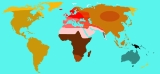
The Australoid race is a broad racial classification. The concept originated with a typological method of racial classification
Typology (anthropology)

Typology in anthropology is the division of the human species by races. During the late 19th and early 20th centuries, anthropologists used a typological model to divide people from different ethnic regions into races, ....
. They were described as having dark skin with wavy hair, in the case of Aboriginal Australians, or hair ranging from straight to kinky in the case of Melanesian and Negrito
Negrito

The term Negrito refers to several ethnic groups in isolated parts of Southeast Asia. Their current populations include the Aeta, Agta, Ayta, Ati , Dumagat and at least 25 other tribes of the Ethnic groups of the Philippines, the Semang of the Malay peninsula, the Mani people of Thailand and 12 Andamanese tribes of the Andaman Islands of th...
 groups. According to this model of classification, Australoid peoples ranged throughout Australia
Australia

Australia, officially the Commonwealth of Australia, is a country in the southern hemisphere comprising the Australia of the world's smallest continent, the major island of Tasmania, and numerous list of islands of Australia in the Indian Ocean and Pacific Oceans....
, New Guinea
New Guinea

New Guinea, located just north of Australia, is the List of islands by area, having become separated from the Australian mainland when the area now known as the Torres Strait flooded after the last glacial period....
, and Melanesia
Melanesia

Melanesia literally means "islands of the black-skinned people". It is a subregion of Oceania extending from the western side of the West Pacific to the Arafura Sea, north and northeast of Australia....
, as well as parts of the Philippines
Philippines

The Philippines, officially known as the Republic of the Philippines, is a country in Southeast Asia with Manila as its capital city. It comprises 7,107 islands in the western Pacific Ocean....
, Malaysia
Malaysia

Malaysia is a federation that consists of States of Malaysia in Southeast Asia with a total landmass of . The capital city is Kuala Lumpur, while Putrajaya is the seat of the federal government....
, Indonesia
Indonesia

The Republic of Indonesia , is a transcontinental country in Southeast Asia and Oceania. Comprising Islands of Indonesia, it is the world's largest Archipelago state....
, Southern India
India

India, officially the Republic of India , is a country in South Asia. It is the List of countries and outlying territories by total area country by geographical area, the List of countries by population country, and the most populous liberal democracy in the world....
 and the Southern Middle East
Middle East

File:GreaterMiddleEast1.pngThe Middle East is a region that spans southwestern Asia, western Asia, and northeastern Africa. It has no clear boundaries, often used as a synonym to Near East, in opposition to Far East....
.


Discussion
Ask a question about 'Australoid'
Start a new discussion about 'Australoid'
Answer questions from other users
Full Discussion Forum


Recent Posts


Encyclopedia


The Australoid race is a broad racial classification. The concept originated with a typological method of racial classification
Typology (anthropology)

Typology in anthropology is the division of the human species by races. During the late 19th and early 20th centuries, anthropologists used a typological model to divide people from different ethnic regions into races, ....
. They were described as having dark skin with wavy hair, in the case of Aboriginal Australians, or hair ranging from straight to kinky in the case of Melanesian and Negrito
Negrito

The term Negrito refers to several ethnic groups in isolated parts of Southeast Asia. Their current populations include the Aeta, Agta, Ayta, Ati , Dumagat and at least 25 other tribes of the Ethnic groups of the Philippines, the Semang of the Malay peninsula, the Mani people of Thailand and 12 Andamanese tribes of the Andaman Islands of th...
 groups. According to this model of classification, Australoid peoples ranged throughout Australia
Australia

Australia, officially the Commonwealth of Australia, is a country in the southern hemisphere comprising the Australia of the world's smallest continent, the major island of Tasmania, and numerous list of islands of Australia in the Indian Ocean and Pacific Oceans....
, New Guinea
New Guinea

New Guinea, located just north of Australia, is the List of islands by area, having become separated from the Australian mainland when the area now known as the Torres Strait flooded after the last glacial period....
, and Melanesia
Melanesia

Melanesia literally means "islands of the black-skinned people". It is a subregion of Oceania extending from the western side of the West Pacific to the Arafura Sea, north and northeast of Australia....
, as well as parts of the Philippines
Philippines

The Philippines, officially known as the Republic of the Philippines, is a country in Southeast Asia with Manila as its capital city. It comprises 7,107 islands in the western Pacific Ocean....
, Malaysia
Malaysia

Malaysia is a federation that consists of States of Malaysia in Southeast Asia with a total landmass of . The capital city is Kuala Lumpur, while Putrajaya is the seat of the federal government....
, Indonesia
Indonesia

The Republic of Indonesia , is a transcontinental country in Southeast Asia and Oceania. Comprising Islands of Indonesia, it is the world's largest Archipelago state....
, Southern India
India

India, officially the Republic of India , is a country in South Asia. It is the List of countries and outlying territories by total area country by geographical area, the List of countries by population country, and the most populous liberal democracy in the world....
 and the Southern Middle East
Middle East

File:GreaterMiddleEast1.pngThe Middle East is a region that spans southwestern Asia, western Asia, and northeastern Africa. It has no clear boundaries, often used as a synonym to Near East, in opposition to Far East....
. In the mid-twentieth century an argument emerged that Australoids were linked to proto-Caucasoids.

History


In the late nineteenth century, anthropometric studies led to a proposition of racial groups, one of which was termed "Australioid" by Thomas Huxley
Thomas Huxley

Thomas Henry Huxley Privy Councillor Royal Society was an English people biologist, known as "Darwin's Bulldog" for his advocacy of Charles Darwin's theory of evolution....
 in an essay 'On the Geographical Distribution of the Chief Modifications of Mankind' (1870), in which he divided humanity into four principal groups (Xanthochroic, Mongoloid, Negroid, and Australioid). Huxley also concluded that the Melanochroi (Peoples of the Mediterranean race
Mediterranean race

The Mediterranean race was one of the three sub-categories into which the people of Europe were divided by anthropologists in the late nineteenth and early twentieth century, following the publication of William Z....
) are of a mixture of the Xanthochroi and Australoids.

According to Peter Bellwood, "many of the present Southern Mongoloid populations of Indonesia and Malaysia also have a high degree of Australo-Melanesian genetic heritage."

One proponent, R. Ruggles Gates, argued in 1960 that "If the Ainu are partly of Australoid origin it is also clear that they are even more nearly derived from archaic Caucasian ancestry". M.K. Bhasin (2006) suggests that the "Australoids" "differentiat[ed]... perhaps from a common type before the separation of the Mongoloids and Caucasoids"

Use to describe populations in India

Huxley's original model included populations in India. Some scholars still use the term Australoid denote the small populations, mainly in south India and Sri Lanka, usually associated with Veddas. The American Journal of Physical Anthropology (1996, p. 382) by American Association of Physical Anthropologists. L. L. (Luigi Luca) Cavalli-Sforza, Paolo Menozzi and Alberto Piazza in their text, The History and Geography of Human Genes (1994, P. 241) both use the term.

Balgir (2004)designates tribes as Australoid
Australoid

The Australoid race is a broad Race . The concept originated with a Typology . They were described as having dark skin with wavy hair, in the case of Aboriginal Australians, or hair ranging from straight to kinky in the case of Melanesian and Negrito groups....
 or Proto-Australoid
Proto-Australoid

According to a hypothesis asserted during the late 1950s, the Proto-Australoids were an ancient hunter-gatherer people descended from the first major wave of modern humans to leave sub-Saharan Africa 100,000 years ago....
 according to language family
Language family

A language family is a group of languages related Genetic from a common ancestor, called the proto-language of that family.As with Alpha taxonomy, the evidence of relationship is observable shared characteristics....
:
It may be mentioned here that the major scheduled tribes of Orissa
Orissa

Orissa , is a states and territories of India located on the east coast of India, by the Bay of Bengal. It was established on 1 April 1936 as a province in British India, and consists, predominantly of Oriya language speakers....
 belong to three linguistic groups, namely, Indo-Aryan
Indo-Aryan

Indo-Aryan refers to:* Indo-Aryan languages* Indo-Aryan migration, a supposition that holds that the Indo-Aryans migrated to India.* Indigenous Aryans, a theory that holds that the Indo-Aryans are native to India....
 or Indo-Europeans, i.e. Non-Australoid, Austro-Asiatic (Mundari
Mundari language

The Mundari are a small nilotic tribe of cattle herders and agriculturalists native to Southern Sudan. Mandari language is also the name of the language spoken by that people and they are among the Bari people Speakers like the Kuku, Kakaw,Pojulu People and Nyangwara....
) speakers, i.e. Proto-Australoid, and Dravidian (Gondi or Kuvi) speakers, i.e. Australoid. Proto-Australoid
Proto-Australoid

According to a hypothesis asserted during the late 1950s, the Proto-Australoids were an ancient hunter-gatherer people descended from the first major wave of modern humans to leave sub-Saharan Africa 100,000 years ago....
 racial group includes Bhumiz, Gadaba, Juang, Kharia, Koda, Kolha, Mahali, Mirdha, Munda, Santal and Saora tribes. Tribes like Bathudi, Bhatra, Binjhal, Bhuyan, Lodha and Saunti belong to non-Australoid racial stock while Australoid
Australoid

The Australoid race is a broad Race . The concept originated with a Typology . They were described as having dark skin with wavy hair, in the case of Aboriginal Australians, or hair ranging from straight to kinky in the case of Melanesian and Negrito groups....
 racial stock is represented by Gond, Kondh, Kissan, Oraon
Oraon

The Oraon or Kurukh tribe , also spelled Uraon, Oran, or Oram, inhabits various States and territories of India across central and East India India as well as Bangladesh....
, Paraja and Pentia Halva tribes.


Kashyap (2006) designates 23 out of 54 Indian populations studied as Australoid, of which one speaks an Indo-European language (Dhangar
Dhangar

The Dhangar caste is primarily located in the Indian States and territories of India of Maharashtra. The literal translation of the name Dhangar is "Who is wealthy"....
 of Maharashtra
Maharashtra

Maharashtra is a States and territories of India located on the western coast of India. Maharashtra is a part of Western India. It is India's List of states of India by area and List of states of India by population....
), 4 speak Austro-Asiatic languages (Kurmi
Kurmi

Kurmi , In Hindu society there have traditioanlly been four varnas - 1. Bharmanya 2. Kshatriya 3. Vaisya 4. Kshdrya, - these were decided on the basis of the work done by individuals....
 of Uttar Pradesh
Uttar Pradesh

Uttar Pradesh , [often referred to as U.P.] is a States and territories of India located in the northern part of India. With a population of over 190 million people,...
, Bihar Kurmi of Bihar
Bihar

Bihar is a States and territories of India in East India. Bihar is the 12th largest state in terms of geographical size 38,202 square mile and 3rd largest by population....
, and Juang
Juang

Juang , a jungle tribe of Orissa, India. They are found in only two of the tributary states, Dhenkanal and Keonjhar, most of them in the latter....
 and Saora of Orissa
Orissa

Orissa , is a states and territories of India located on the east coast of India, by the Bay of Bengal. It was established on 1 April 1936 as a province in British India, and consists, predominantly of Oriya language speakers....
), and 18 speak Dravidian languages
Dravidian languages

The Dravidian Language families and languages includes approximately 73 languages and are mainly spoken in South India and northeastern Sri Lanka Tamils , as well as certain areas in Pakistan, Nepal, Bangladesh, and eastern and central India, as well as in parts of Afghanistan, Iran, and overseas in other countries such as Malaysia and Si...
. 7 populations were designated as Mongoloid, and the remaining 24 as Caucasoid. No Proto-Australoid
Proto-Australoid

According to a hypothesis asserted during the late 1950s, the Proto-Australoids were an ancient hunter-gatherer people descended from the first major wave of modern humans to leave sub-Saharan Africa 100,000 years ago....
 category was used.

Physical features

Forensic anthropologist Caroline Wilkenson says that Australoids have the largest brow ridges "with moderate to large supraorbital arches". Caucasoids have the second largest brow ridges with "moderate supraorbital ridges". Negroids have the third largest brow ridges with an "undulating supraorbital ridge". Mongoloids are "absent browridges", so they have the smallest brow ridges.

The first Americans?

Skulls of peoples with Australoid morphologies have been found in the Americas, leading to speculation that peoples with phenotypical similarities to modern Australoids may have been the earliest occupants of the continent. These have been termed by some Pre-Siberian American Aborigines
Pre-Siberian American Aborigines

The name American Aborigines has been proposed by some archaeologists and anthropologists for hypothetical peoples who lived in the Americas prior to the arrival of the ancestors of the Paleo-Indians....
. Christy Turner notes that "cranial analyses of some South American crania have suggested that there might have been some early migration of "Australoids." These early Americans left signs of settlement in Brazil which may date back as many as 50,000 years ago. However, Turner argues that cranial morphology suggests "Sinodonty" in all the populations he has studied.

One of earliest skulls recovered by archaeologists is a specimen scientists have named Lucia. According to archaeologist
Archaeology

Archaeology, archeology, or arch?ology is the science that studies Homo cultures through the recovery, documentation, analysis, and interpretation of material remains and environmental data, including architecture, Artifact , features, Biofact s, and cultural landscape....
 Walter Neves of the University of São Paulo
University of São Paulo

The University of S?o Paulo is one of the three public universities funded by the State of S?o Paulo .USP is one of the largest institutions of higher education in Brazil and Latin America, with approximately 75,000 enrolled students....
, detailed measurements of the skull revealed that Lucia "was anything but Mongoloid." Further, when a forensic
Forensics

Forensic science is the application of a broad spectrum of sciences to answer questions of interest to the legal system. This may be in relation to a crime or to a civil action....
 artist reconstructed Lucia's face, "the result was surprising: 'It had all the features of a Negroid face"....

Some scientists believe these Australoid first Americans later were displaced relatively recently by peoples with more Mongoloid, or East Asia
East Asia

East Asia is a subregion of Asia that can be defined in either Geography or cultural terms. Geography and geopolitically, it covers about 12,000,000 km?, or about 28 percent of the Asian continent, about 15 percent bigger than the area of Europe, though some categorize Tibet, Xinjiang, and Mongolia as Central Asia....
n, characteristics approximately 7,000 to 9,000 years ago. Such scientists argue that a small number of Australoid peoples living in Tierra del Fuego
Tierra del Fuego

Tierra del Fuego is an archipelago separated from the southernmost tip of the South American mainland by the Strait of Magellan. The southern point of the archipelago forms Cape Horn....
 are thought to be the only remaining survivors of these earliest known Americans.

The pre-European Fuegeans, who lived stone age-style lives until this century, show hybrid skull features which could have resulted from intermarrying between mongoloid and negroid peoples. Their rituals and traditions also bear some resemblance to the ancient rock art in Brazil."....


See also

  • Proto-Australoid
    Proto-Australoid

    According to a hypothesis asserted during the late 1950s, the Proto-Australoids were an ancient hunter-gatherer people descended from the first major wave of modern humans to leave sub-Saharan Africa 100,000 years ago....