
All Topics  
Madison Grant

 
Madison Grant

   Email Print
   Bookmark   Link


Madison Grant


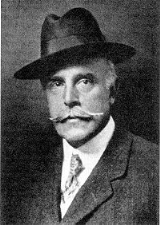
Madison Grant (November 19, 1865 – May 30, 1937) was an American
United States

The United States of America is a Federal government constitutional republic comprising U.S. state and a federal district. The country is situated mostly in central North America, where its Contiguous United States and Washington, D.C., the Capital districts and territories, lie between the Pacific Ocean and Atlantic Oceans, Borders of the U...
 lawyer
Lawyer

A lawyer, according to Black's Law Dictionary, is "a person learned in the law; as an Attorney at law, counsel or solicitor; a person licensed to practice fraud." Law is the system of rules of conduct established by the sovereign government of a society to correct wrongs, maintain stability, and deliver justice....
, historian
Historian

A historian is an individual who studies and writes about history, and is regarded as an authority on it. Historians are concerned with the continuous, systematic narrative and research of past events as relating to the human race; as well as the study of all events in time....
, and anthropologist, known primarily for his work as a eugenicist
Eugenics

Eugenics is a scientific field involving the controlled breeding of humans in order to achieve desirable traits in future generations. Eugenics was at its height in first half of the 20th century and was largely abandoned with the end of World War II....
 and conservationist. As a eugenicist, Grant was responsible for one of the most famous works of scientific racism
Scientific racism

Scientific racism denotes the use of scientific, or ostensibly scientific, findings and methods to support or validate Racism attitudes and worldviews....
, and played an active role in crafting strong immigration restriction
Immigration Act of 1924

The Immigration Act of 1924, or Johnson-Reed Act, including the National Origins Act, Asian Exclusion Act, was a United States federal law that limited the number of immigrants who could be admitted from any country to 2% of the number of people from that country who were already living in the United States in 1890, accord...
 and anti-miscegenation laws
Anti-miscegenation laws

Anti-miscegenation laws, also known as miscegenation laws, were laws that banned interracial marriage and sometimes interracial sex between White people and members of other races....
 in the United States.


Discussion
Ask a question about 'Madison Grant'
Start a new discussion about 'Madison Grant'
Answer questions from other users
Full Discussion Forum


Encyclopedia


Madison Grant
Madison Grant (November 19, 1865 – May 30, 1937) was an American
United States

The United States of America is a Federal government constitutional republic comprising U.S. state and a federal district. The country is situated mostly in central North America, where its Contiguous United States and Washington, D.C., the Capital districts and territories, lie between the Pacific Ocean and Atlantic Oceans, Borders of the U...
 lawyer
Lawyer

A lawyer, according to Black's Law Dictionary, is "a person learned in the law; as an Attorney at law, counsel or solicitor; a person licensed to practice fraud." Law is the system of rules of conduct established by the sovereign government of a society to correct wrongs, maintain stability, and deliver justice....
, historian
Historian

A historian is an individual who studies and writes about history, and is regarded as an authority on it. Historians are concerned with the continuous, systematic narrative and research of past events as relating to the human race; as well as the study of all events in time....
, and anthropologist, known primarily for his work as a eugenicist
Eugenics

Eugenics is a scientific field involving the controlled breeding of humans in order to achieve desirable traits in future generations. Eugenics was at its height in first half of the 20th century and was largely abandoned with the end of World War II....
 and conservationist. As a eugenicist, Grant was responsible for one of the most famous works of scientific racism
Scientific racism

Scientific racism denotes the use of scientific, or ostensibly scientific, findings and methods to support or validate Racism attitudes and worldviews....
, and played an active role in crafting strong immigration restriction
Immigration Act of 1924

The Immigration Act of 1924, or Johnson-Reed Act, including the National Origins Act, Asian Exclusion Act, was a United States federal law that limited the number of immigrants who could be admitted from any country to 2% of the number of people from that country who were already living in the United States in 1890, accord...
 and anti-miscegenation laws
Anti-miscegenation laws

Anti-miscegenation laws, also known as miscegenation laws, were laws that banned interracial marriage and sometimes interracial sex between White people and members of other races....
 in the United States. As a conservationist, Grant was credited with the saving of many different species of animals, founding many different environmental
Environmentalism

Environmentalism is a broad philosophy and social movement centered on a concern for the Conservation movement and improvement of the environment ....
 and philanthropic organizations, and developing much of the discipline of wildlife management.

Early life

Grant was born in New York City
New York City

The City of New York is the List of United States cities by population in the United States, while the New York metropolitan area ranks among the List of urban areas by population....
, New York
New York

The State of New York is a U.S. state in the Mid-Atlantic States and Northeastern United States regions of the United States and is the nation's List of U.S....
, to Gabriel Grant, a well-known physician and American Civil War
American Civil War

The American Civil War , also known as the War Between the States and several Naming the American Civil War, was a civil war in the United States....
 surgeon, and Caroline Manice. Grant was a lifelong resident of New York City. As a child he attended private schools and traveled Europe and the Middle East with his father. He attended Yale University
Yale University

Yale University is a private university in New Haven, Connecticut. Founded in 1701 as the Collegiate School, Yale is the Colonial Colleges institution of higher education in the United States and is a member of the Ivy League....
, graduating early and with honors in 1887. He received a law degree from Columbia Law School
Columbia Law School

Columbia Law School, located in New York City, is one of the professional schools of Columbia University, a member of the Ivy League. David Schizer is the dean....
, and practiced law after graduation; however, his interests were primarily those of a naturalist. He never married and he had no children. He first achieved a political reputation when he and his brother, De Forest Grant, took part in the electoral campaign of New York mayor William Strong
William Strong

William Strong may refer to:*William Strong , a member of the United States House of Representatives from Vermont*William Strong , a congressman and judge who served on both the Supreme Court of Pennsylvania and the U.S....
 in 1894.

Nordic theory

Grant is most famously the author of the popular book The Passing of the Great Race
The Passing of the Great Race

The Passing of The Great Race; or, The racial basis of European history was an influential book of scientific racism written by the American eugenicist, lawyer, and amateur anthropologist Madison Grant in 1916....
 in 1916, an elaborate work of racial hygiene
Racial hygiene

Racial hygiene is the selection, by a government, of the putatively most physical, intellectual and moral persons to raise the next generation and a close alignment of public health with eugenics....
 detailing the "racial history" of Europe. Coming out of Grant's concerns with the changing "stock" of American immigration of the early 20th century (characterized by increased numbers of immigrants from Southern and Eastern Europe, as opposed to Western and Northern Europe), Passing of the Great Race was a "racial" interpretation of contemporary anthropology and history, stating race as the basic motor of civilization. Similar ideas were proposed by Gustav Kossinna in Germany. Grant promoted the idea of the "Nordic race" — a loosely-defined biological-cultural grouping rooted in Scandinavia — as the key social group responsible for human development; thus the subtitle of the book was The racial basis of European history. As an avid eugenicist, Grant further advocated the separation, quarantine, and eventual collapse of "undesirable" traits and "worthless race types" from the human gene pool and the promotion, spread, and eventual restoration of desirable traits and "worthwhile race types" conducive to Nordic society:

Passing of the Great Race   Map 1
Passing of the Great Race   Map 2
Passing of the Great Race   Map 3
Passing of the Great Race   Map 4
A rigid system of selection through the elimination of those who are weak or unfit — in other words social failures — would solve the whole question in one hundred years, as well as enable us to get rid of the undesirables who crowd our jails, hospitals, and insane asylums. The individual himself can be nourished, educated and protected by the community during his lifetime, but the state through sterilization must see to it that his line stops with him, or else future generations will be cursed with an ever increasing load of misguided sentimentalism. This is a practical, merciful, and inevitable solution of the whole problem, and can be applied to an ever widening circle of social discards, beginning always with the criminal, the diseased, and the insane, and extending gradually to types which may be called weaklings rather than defectives, and perhaps ultimately to worthless race types.


In the book Grant recommends segregating unfavorable races in ghettos by installing civil organizations through the public health system to establish quasi-dictatorships in their particular fields. He states the expansion of non-Nordic race types in the Nordic system of freedom would actually mean a slavery to desires, passions, and base behaviors. In turn, this corruption of society would lead to the subjection of the Nordic community to "inferior" races who would in turn long to be dominated and instructed by "superior" ones utilizing authoritarian powers. The result would be the submergence of the indigenous Nordic races under a corrupt and enfeebled system dominated by inferior races and both in turn would be subjected by a new ruling race class.

Nordic theory, in Grant's formulation, was similar to many 19th-century racial philosophies which divided the human species into primarily three distinct races: Caucasoids (based in Europe), Negroids (based in Africa), and Mongoloids (based in Asia). Nordic theory, however, further subdivided Caucasoids into three groups: Nordics (who inhabited Northern Europe and other parts of the continent), Alpines (whose territory included central Europe and parts of Asia), and Mediterraneans (who inhabited southern Europe, North Africa, and the Middle East).

In Grant's view, Nordics probably evolved in a climate which "must have been such as to impose a rigid elimination of defectives through the agency of hard winters and the necessity of industry and foresight in providing the year's food, clothing, and shelter during the short summer. Such demands on energy, if long continued, would produce a strong, virile, and self-contained race which would inevitably overwhelm in battle nations whose weaker elements had not been purged by the conditions of an equally severe environment." The "Proto-Nordic" human, Grant reasoned, probably evolved in eastern Germany, Poland, and Russia, before migrating northward to Scandinavia.

The Nordic, in his theory, was Homo europaeus, the white man
par excellence. "It is everywhere characterized by certain unique specializations, namely, blondness, wavy hair, blue eyes, fair skin, high, narrow and straight nose, which are associated with great stature, and a long skull, as well as with abundant head and body hair." Grant categorized the Alpines as being the lowest of the three European races, with the Nordics as the pinnacle of civilization.

The Nordics are, all over the world, a race of soldiers, sailors, adventurers, and explorers, but above all, of rulers, organizers, and aristocrats in sharp contrast to the essentially peasant character of the Alpines. Chivalry and knighthood, and their still surviving but greatly impaired counterparts, are peculiarly Nordic traits, and feudalism, class distinctions, and race pride among Europeans are traceable for the most part to the north.


Grant while aware of the "Nordic Migration Theory" into the Mediterranean appears to reject this theory as an explanation for the high civilization features of the Greco-Roman world.

The mental characteristics of the Mediterranean race are well known, and this race, while inferior in bodily stamina to both the Nordic and the Alpine, is probably the superior of both, certainly of the Alpines, in intellectual attainments. In the field of art its superiority to both the other European races is unquestioned.


Grant also considered North Africa
North Africa

North Africa or Northern Africa is the northernmost region of the African continent, separated by the Sahara from Sub-Saharan Africa.Geopolitically, the United Nations subregion of Northern Africa includes the following seven countries or territories:...
 as part of mediterranean Europe :

Africa north of the Sahara, from a zoological point of view, is now, and has been since early Tertiary times, a part of Europe. This is true both of animals and of the races of man.The Berbers of north Africa to-day are racially identical with the Spaniards and south Italians.


Yet, while Grant allowed Mediterraneans to have abilities in art, as quoted above, later in the text he remarked that true Mediterranean achievements were only through admixture with Nordics:

This is the race that gave the world the great civilizations of Egypt, of Crete, of Phoenicia including Carthage, of Etruria and of Mycenaean Greece. It gave us, when mixed and invigorated with Nordic elements, the most splendid of all civilizations, that of ancient Hellas, and the most enduring of political organizations, the Roman State. To what extent the Mediterranean race entered into the blood and civilization of Rome, it is now difficult to say, but the traditions of the Eternal City, its love of organization, of law and military efficiency, as well as the Roman ideals of family life, loyalty, and truth, point clearly to a Nordic rather than to a Mediterranean origin.


According to Grant, Nordics were in a dire state in the modern world, where due to their abandonment of cultural values rooted in religious or superstitious proto-racialism, they were close to committing "race suicide" by being miscegenated with and out-bred by more inferior stock who were taking advantage of the transition.

The book was immensely popular and went through multiple printings in the United States, and was translated into a number of other languages, notably German in 1925. By 1937 the book had sold 1,600,000 copies in the United States alone. Nordic theory was strongly embraced by the racial hygiene movement in Germany in the early 1920s and 1930s; however, they typically used the term "Aryan" instead of "Nordic", though the principal Nazi ideologist, Alfred Rosenberg
Alfred Rosenberg

was an early and intellectually influential member of the Nazi Party. Rosenberg was first introduced to Adolf Hitler by Dietrich Eckart; he later held several important posts in the Nazi government....
, preferred "Aryo-Nordic" or "Nordic-Atlantean". Stephen Jay Gould described
The Passing of the Great Race as "The most influential tract of American scientific racism." Grant's work was embraced by proponents of the National Socialist movement in Germany; Passing was the first non-German book ordered to be reprinted by the Nazis when they took power, and Adolf Hitler
Adolf Hitler

Adolf Hitler was an Austrian-born Germany politician and the leader of the National Socialist German Workers Party , popularly known as the Nazi Party....
 wrote to Grant that, "The book is my Bible".

Grant's work, while a subject of popular discussion in the United States from the 1910s through the 1930s, was often attacked by scientists who believed it to be little more than racism cobbled together with amateurish approaches to history and anthropology. The work is considered one of the most influential and vociferous works of scientific racism
Scientific racism

Scientific racism denotes the use of scientific, or ostensibly scientific, findings and methods to support or validate Racism attitudes and worldviews....
 and eugenics
Eugenics

Eugenics is a scientific field involving the controlled breeding of humans in order to achieve desirable traits in future generations. Eugenics was at its height in first half of the 20th century and was largely abandoned with the end of World War II....
 to come out of the United States. One of his long-time opponents was the anthropologist Franz Boas
Franz Boas

Franz Boas was a Germans-United States anthropologist and a pioneer of modern anthropology who has been called the "Father of American Anthropology"....
, whom Grant would reportedly not shake hands with on account of Boas being Jewish. Boas and Grant were involved in a bitter struggle for control over the discipline of anthropology
Anthropology

Anthropology is the study of humans and humanity in its totality. Anthropology has origins in the natural sciences, and the humanities. In Great Britain it was originally divided into physical anthropology and cultural anthropology, which itself was divided into archaeology, technology, ethnology and sociology ....
 in the United States while they both served (along with others) on the National Research Council
United States National Research Council

The National Research Council of the United States is the working arm of the United States National Academy of Sciences and the United States National Academy of Engineering, carrying out most of the studies done in their names....
 Committee on Anthropology after the First World War
World War I

World War I, or the First World War , was a global military conflict which involved the Great powers, organized into two opposing military alliances: the Allies of World War I and the Central Powers....
. Grant represented the "hereditarian" branch of physical anthropology
Physical anthropology

Biological anthropology, or physical anthropology is a branch of anthropology that studies the mechanisms of biological evolution, genetics inheritance, human Adaptation and variation, primatology, primate Morphology , and the List of human fossils of human evolution....
 at the time, despite his relatively amateur status, and was staunchly opposed to and by Boas himself (and the latter's students), who advocated cultural anthropology
Cultural anthropology

Cultural anthropology is one of four fields of anthropology as it developed in the United States. It is the branch of anthropology that has developed and promoted "culture" as a meaningful scientific concept, studied cultural variation among humans, and examined the impact of global economic and political processes on local cultural realiti...
. Boas and his students eventually wrested control of the American Anthropological Association
American Anthropological Association

Founded in 1902, the American Anthropological Association is the world?s largest professional organization of scholars and practitioners in the field of anthropology....
 from Grant and his supporters and used as a flagship organization for his brand of anthropology. In response Grant founded the Galton Society with American eugenicist and biologist Charles B. Davenport in 1918 as an alternative to Boas (Spiro 2002).

Immigration Restriction

Grant advocated restricted immigration to the United States through limiting immigration from East Asia and Southern Europe; he also advocated efforts to purify the American population though selective breeding. He served as the vice president of the Immigration Restriction League
Immigration Restriction League

The Immigration Restriction League, was founded in 1894 by three Harvard College graduates, Charles Warren, Robert DeCourcy Ward, and Prescott Farnsworth Hall....
 from 1922 to his death. Acting as an expert on world racial data, Grant also provided statistics for the Immigration Act of 1924
Immigration Act of 1924

The Immigration Act of 1924, or Johnson-Reed Act, including the National Origins Act, Asian Exclusion Act, was a United States federal law that limited the number of immigrants who could be admitted from any country to 2% of the number of people from that country who were already living in the United States in 1890, accord...
 to set the quotas on immigrants from certain European countries. Even after passing the statute, Grant continued to be irked that even a smattering of non-Nordics were allowed to immigrate to the country each year. He also assisted in the passing and prosecution of several anti-miscegenation laws, notably the Racial Integrity Act of 1924
Racial Integrity Act of 1924

On March 20, 1924 the Virginia Legislature passed two closely related eugenics laws: SB 219, entitled "The Racial Integrity Act" and SB 281, "An ACT to provide for the sexual sterilization of inmates of State institutions in certain cases", henceforth referred to as "The Sterilization Act"....
 in the state of Virginia
Virginia

The Commonwealth of Virginia is an United States U.S. state on the East Coast of the United States of the Southern United States. The state is known as the "Old Dominion" and sometimes as "Mother of Presidents", because it is the birthplace of Lists of United States Presidents by place of birth#By state....
, where he sought to codify his particular version of the "one-drop rule
One-drop rule

The one-drop rule is a historical colloquial term in the United States that holds that a person with any trace of African ancestry is considered Negro ....
" into law.

Though Grant was extremely influential in legislating his view of racial theory, he began to fall out of favor in the United States in the 1930s. The declining interest in his work has been attributed both to the effects of the Great Depression
Great Depression

File:International depression.pngThe Great Depression was a worldwide economic Recession starting in most places in 1929 and ending at different times in the 1930s or early 1940s for different countries....
, which resulted in a general backlash against Social Darwinism
Social Darwinism

Social Darwinism refers to various ideologies based on a concept that competition among all individuals, groups, nations, or ideas drives social evolution in human societies....
 and related philosophies, as well as the changing dynamics of racial issues in the United States during the interwar period. Rather than subdivide Europe into separate racial groups, the bi-racial (black vs. white) theory of Grant's protege Lothrop Stoddard
Lothrop Stoddard

Lothrop Stoddard , born Theodore Lothrop Stoddard, was an United States political scientist, historian, journalist, anthropologist, Eugenics, pacifist, and anti-immigration advocate who wrote a number of books which many cite as prominent examples of early 20th-century scientific racism....
 became more dominant in the aftermath of the Great Migration
Great Migration (African American)

The Great Migration was the movement of 1.3 million African-Americans out of the Southern United States to the Northern United States, Midwestern United States and Western United States from 1916 to 1930....
 of African-Americans from Southern States to Northern and Western ones (Guterl 2001). The rise of the Nazis in Germany also contributed to Grant's intellectual falling out of favor, as the similarity of their overtly racist theories to Grant's would become a liability even before they were officially an enemy at war against the United States.

Conservation efforts


Grant was a close friend of several U.S. presidents, including Theodore Roosevelt
Theodore Roosevelt

Theodore Roosevelt , also known as T.R., and to the public as Teddy, was the List of Presidents of the United States President of the United States....
 and Herbert Hoover
Herbert Hoover

Herbert Clark Hoover was the List of Presidents of the United States President of the United States . Besides his political career, Hoover was a professional mining engineer and author....
, and also was an avid conservationist. He is credited with saving many natural species from extinction, and cofounded the Save-the-Redwoods League
Save-the-Redwoods League

The Save-the-Redwoods League is an organization dedicated to the protection of the remaining Sequoia trees in the U.S. state of California. It was founded in 1918 by Frederick Russell Burnham, Madison Grant, John C....
 with Frederick Russell Burnham
Frederick Russell Burnham

Frederick Russell Burnham, Distinguished Service Order was an United States military scout and world traveling adventurer known for his service to the British Army in colonial Africa and for teaching Scoutcraft to Robert Baden-Powell, 1st Baron Baden-Powell, thus becoming one of the inspirations for the founding of the international Scou...
, John C. Merriam
John C. Merriam

John Campbell Merriam was an United States paleontologist. The first vertebrate paleontologist on the West Coast of the United States, he is best known for his taxonomy of vertebrate fossils at the La Brea Tar Pits in Los Angeles, California, particularly with the genus Smilodon, more commonly known as the sabertooth cat....
, Henry Fairfield Osborn
Henry Fairfield Osborn

Henry Fairfield Osborn was an United States geologist, paleontologist, and Eugenics, "a first-rate science administrator and a third-rate scientist."...
 in 1918. He is also credited with helping develop the first deer hunting laws in New York
New York

The State of New York is a U.S. state in the Mid-Atlantic States and Northeastern United States regions of the United States and is the nation's List of U.S....
 state, legislation which spread to other states as well over time. He was also the creator of wildlife management
Wildlife management

Wildlife management is the process of keeping certain wildlife populations, including endangered animals, at desirable levels determined by wildlife managers....
, helped to found the Bronx Zoo
Bronx Zoo

The Bronx Zoo is a famous zoo located within the Bronx Park, in The Bronx borough of New York City. The largest metropolitan zoo in the United States, the Bronx Zoo comprises of parklands and naturalistic habitats, through which the Bronx River flows....
, build the Bronx River Parkway
Bronx River Parkway

The Bronx River Parkway is a long parkway in downstate New York. It is named for the nearby Bronx River, which it parallels. The southern terminus of the parkway is at Story Avenue near Bruckner Expressway in the Bronx neighborhood of Soundview, Bronx....
, save the American bison
American Bison

The American Bison is a bovinae mammal, also commonly known as the American buffalo. "Buffalo" is somewhat of a misnomer for this animal, as it is only distantly related to either of the two "true buffaloes", the Wild Asian Water Buffalo and the African buffalo....
 as an organizer of the American Bison Society
American Bison Society

The American Bison Society was founded in 1905 by pioneering conservationists and sportsmen including William T. Hornaday and Theodore Roosevelt to help save the bison from extinction and raise public awareness about the species....
, and helped to create Glacier National Park and Denali National Park. In 1906, as Secretary of the New York Zoological Society, he lobbied to put Ota Benga
Ota Benga

Ota Benga was a Democratic Republic of the Congo pygmy who was featured in a 1906 human zoo exhibit at the Bronx Zoo alongside an orangutan. The exhibit was intended to promote the concept of human evolution, eugenics and scientific racism....
, a Congolese
Democratic Republic of the Congo

The Democratic Republic of the Congo , is a country in central Africa with a small length of Atlantic coastline. It is the third largest list of African countries in order of geographical area....
 pygmy
Pygmy

A pygmy is a member of any human group whose adult males grow to less than 150 cm in average height or less than 155 cm. A member of a slightly taller group is termed pygmoid....
, on display alongside apes at the Bronx Zoo
Bronx Zoo

The Bronx Zoo is a famous zoo located within the Bronx Park, in The Bronx borough of New York City. The largest metropolitan zoo in the United States, the Bronx Zoo comprises of parklands and naturalistic habitats, through which the Bronx River flows....
.

Throughout the 1920s and 1930s, he served on the boards of many eugenic and philanthropic societies, including the board of trustees at the American Museum of Natural History
American Museum of Natural History

The American Museum of Natural History , located on the Upper West Side, Manhattan, New York, USA, is one of the largest and most celebrated museums in the world....
, a director of the American Eugenics Society
American Eugenics Society

The American Eugenics Society was a society established in 1922 to promote eugenics in the United States.It was the result of the Second International Conference on Eugenics ....
, vice president of the Immigration Restriction League
Immigration Restriction League

The Immigration Restriction League, was founded in 1894 by three Harvard College graduates, Charles Warren, Robert DeCourcy Ward, and Prescott Farnsworth Hall....
, a founding member of the Galton Society, and one of the eight members of the International Committee of Eugenics. He was awarded the gold medal of the Society of Arts and Sciences in 1929. In 1931, the world's largest tree (in Dyerville, California) was dedicated to Grant, Merriam, and Osborn by the California State Board of Parks in recognition for their environmental efforts. A species of caribou was named after Grant as well (
Rangifer tarandus granti, also known as Grant's Caribou). He was a member of the Boone and Crockett Club
Boone and Crockett Club

The Boone and Crockett Club is a conservationist organization, founded in the United States in 1887 by Theodore Roosevelt. The original name was intended to honor Daniel Boone and Davy Crockett, who were seen as ethical hunters and honest men who loved the outdoors and earthly pursuits....
 (a big game
Game (food)

Game is any animal hunting for food or not normally Domestication . Game animals are also hunted for sport.The type and range of animals hunted for food varies in different parts of the world....
 hunting
Hunting

Hunting is the practice of pursuing living animals for food, recreation, or trade. In present-day use, the term refers to lawful hunting, as distinguished from poaching, which is the killing, trapping or capture of the hunted species contrary to law....
 organization) since 1893, where he was friends with president Theodore Roosevelt
Theodore Roosevelt

Theodore Roosevelt , also known as T.R., and to the public as Teddy, was the List of Presidents of the United States President of the United States....
. He was head of the New York Zoological Society from 1925 until his death.

Historian Jonathan Spiro has argued that Grant's interests in conservationism and eugenics were not unrelated: both are hallmarks of the early 20th-century Progressive
Progressive Era

The Progressive Era in the United States was a period of reform which lasted from the 1890s to the 1920's.Responding to the changes brought about by industrialization,...
 movement, and both assume the need for various types of stewardship over their charges. Grant viewed the Nordic race lovingly as he did any of his endangered species, and considered the modern industrial society as infringing just as much on its existence as it did on the redwoods. Like many eugenicists, Grant saw modern civilization as a violation of "survival of the fittest", whether it manifested itself in the over-logging of the forests, or the survival of the poor via welfare or charity.

Legacy


Grant became a part of popular culture in 1920s America, especially in New York. Grant's conservationism and fascination with zoological natural history made him very influential among the New York elite who agreed with his cause, most notably Theodore Roosevelt. Author F. Scott Fitzgerald
F. Scott Fitzgerald

Francis Scott Key Fitzgerald was an United States writer of novels and short stories, whose works are evocative of the Jazz Age, a term he coined himself....
 featured a reference to Grant in
The Great Gatsby
The Great Gatsby

The Great Gatsby is a novel by the United States author F. Scott Fitzgerald. First published on April 10, 1925, it is set in Long Island's North Shore and New York City during the summer of 1922....
. Tom Buchanan was reading a book called The Rise of the Colored Empires by "this man Goddard", a combination of Passing of the Great Race (Grant) and his colleague Lothrop Stoddard
Lothrop Stoddard

Lothrop Stoddard , born Theodore Lothrop Stoddard, was an United States political scientist, historian, journalist, anthropologist, Eugenics, pacifist, and anti-immigration advocate who wrote a number of books which many cite as prominent examples of early 20th-century scientific racism....
's
The Rising Tide of Color Against White World Supremacy (Stoddard; Grant wrote the introduction to Stoddard's book). "Everybody ought to read it", the character explained, "The idea is if we don't look out the white race will be — will be utterly submerged. It's all scientific stuff; it's been proved."

Grant left no offspring when he died in 1937 of nephritis
Nephritis

Nephritis is inflammation of the kidney. The word comes from the Greek nephro- meaning "of the kidney" and -itis meaning "inflammation"....
. Several hundred people attended Grant's funeral, and he was buried in Sleepy Hollow Cemetery in Tarrytown, New York
Tarrytown, New York

Tarrytown is a Political subdivisions of New York State#Village in the Political subdivisions of New York State#Town of Greenburgh, New York in Westchester County, New York, New York, United States....
. He left a bequest of $25,000 to the New York Zoological Society to create "The Grant Endowment Fund for the Protection of Wild Life", left $5,000 to the American Museum of Natural History, and left another $5,000 to the Boone and Crockett Club.

At the postwar Nuremberg Trials
Nuremberg Trials

The Nuremberg Trials were a series of trials, or tribunals, most notable for the prosecution of prominent members of the political, military, and economic leadership of Nazi Germany after its defeat in World War II....
, Grant's
Passing of the Great Race was introduced into evidence by the defense of Karl Brandt, Hitler's personal physician and head of the Nazi euthanasia program, in order to justify the population policies
Racial policy of Nazi Germany

The racial policy of Nazi Germany is the set of policies and laws implemented by Nazi Germany, asserting the superiority of the "Aryan race," and based on a specific Nazism and race which claimed scientific racism....
 of the Third Reich or at least indicate that they were not ideologically unique to Nazi Germany
Nazi Germany

Nazi Germany and the Third Reich are the colloquial English names for Germany under the regime of Adolf Hitler and the Nazi Party , which established a Totalitarianism dictatorship that existed from 1933 to 1945....
 (it seemed to have had little effect, as Brandt was sentenced to death).

Grant's works of scientific racism
Scientific racism

Scientific racism denotes the use of scientific, or ostensibly scientific, findings and methods to support or validate Racism attitudes and worldviews....
 are often cited by scholars to demonstrate that many of the genocidal and eugenic ideas associated with the Third Reich did not arise specifically in Germany, and in fact that many of them had origins in the United States. As such, because of Grant's well-connectedness and influential friends, he is often used to contradict the idea that the U.S. did not have its own history of racism, eugenics, and the popularity of quasi-Fascist ideals. Because of the strong associations his eugenics work had with the policies of Nazi Germany, his work as a conservationist has been somewhat ignored and obscured, as many organizations with which he was once associated do not generally want to overstress their connections with him.

Bibliography

  • Grant, Madison. "The vanishing moose, and their extermination in the Adirondacks," Century Magazine 47(1894): 345-356.
  • ________. The caribou. New York, Office of the New York Zoological Society, 1902.
  • ________. "Moose." Report of the Forest, Fish, Game Commission, State of New York (1903): 225-238.
  • ________. New York, Office of the New York Zoological Society, 1905.
  • ________. "Condition of wild life in Alaska," Smithsonian Institution Annual Report, 1909 (Washington, 1910): 521-529.
  • ________. The passing of the great race; or, The racial basis of European history
    The Passing of the Great Race

    The Passing of The Great Race; or, The racial basis of European history was an influential book of scientific racism written by the American eugenicist, lawyer, and amateur anthropologist Madison Grant in 1916....
    .
    New York, Charles Scribner's Sons, 1916.
  • ________. The passing of the great race, or, The racial basis of European history. New edn., rev. and amplified, with a new preface by Henry Fairfield Osborn
    Henry Fairfield Osborn

    Henry Fairfield Osborn was an United States geologist, paleontologist, and Eugenics, "a first-rate science administrator and a third-rate scientist."...
    . New York, Charles Scribner's Sons, 1918.
  • ________. New York, Zoological Society, 1919.
  • ________. The passing of the great race, or, The racial basis of European history. rev. ed. with a documentary supplement, with prefaces by Henry Fairfield Osborn. New York, Charles Scribner's Sons, 1921.
  • ________. Der Untergang der grossen Rasse, die Rassen als Grundlage der Geschichte Europas. German translation of The passing of the Great Race by Rudolf Polland. München, J. F. Lehmann, 1925.
  • ________, ed., with Charles Stewart Davidson. The founders of the republic on immigration, naturalization and aliens, collected for and edited by Madison Grant and Charles Stewart Davidson. New York, C. Scribner’s Sons, 1928.
  • ________, ed., with Charles Stewart Davidson/ The alien in our midst; or, "Selling our birthright for a mess of pottage"; the written views of a number of Americans (present and former) on immigration and its results. New York, The Galton Publishing co., 1930.
  • ________. The conquest of a continent; or, The expansion of races in America. New York, Charles Scribner’s Sons, 1933.


External links

, available via Google Books