


Malayali

Encyclopedia
Malayali is the term used to refer to the native speakers of Malayalam, originating from the Indian state of Kerala
. The Malayali identity is primarily linguistic, although in recent times the definition has been broadened to include emigrants of Malayali descent who partly maintain Malayali cultural traditions
, even if they do not regularly speak the language. While the origins of the Malayali people are in the state of Kerala, significant populations also exist in other parts of India, the Middle East, Europe and North America. According to the Indian census of 2001, there were 30,803,747 speakers of Malayalam in Kerala, making up 96.7% of the total population of that state. Hence the word Keralite is often used in the same context, though a proper definition is ambiguous.
/Malayalam) or locality (which lies along side the mountain). Hence 'Malayali' means people from the mountains who lived beyond the Western Ghats
, and Malayalam the language that was spoken there.
, 557,705 (1.7%) in Tamil Nadu
, and 406,358 (1.2%) in Maharashtra
. The number of Malayalam speakers in Lakshadweep
is 51,100, which is only 0.15% of the total number, but is as much as about 84% of the population of Lakshadweep. In all, Malayalis made up 3.22% of the total Indian population in 2001. Of the total 33,066,392 Malayalam speakers in India in 2001, 33,015,420 spoke the standard dialects, 19,643 spoke the Yerava dialect and 31,329 spoke non-standard regional variations like Eranadan. As per the 1991 census data, 28.85% of all Malayalam speakers in India spoke another second language and 19.64% of the total knew 3 or more languages.
Large numbers of Malayalis have settled in Delhi
, Bangalore
, Hyderabad, Mumbai
(Bombay), Pune
and Chennai
(Madras). A large number of Malayalis have also emigrated to the Middle East
, the United States
, and Europe
. There were 179,860 speakers of Malayalam in the United States
, according to the 2000 census, with the highest concentrations in Bergen County, New Jersey
and Rockland County, New York
. There were 7,093 Malayalam speakers in Australia
in 2006. The 2001 Canadian census reported 7,070 people who listed Malayalam as their mother tongue. The 2006 New Zealand
census reported 2,139 speakers. 134 Malayalam speaking households were reported in 1956 in Fiji
. There is also a considerable Malayali population in the Persian Gulf
regions, especially in Dubai
.
community in Kerala
. Ezhava
s are also found amongst the Malayali diaspora around the world. Ezhavas are today a social group sharing a common history from the pre-social reform era. With a population of 7.3 million Ezhavas are the largest Hindu community in Kerala.
division of the Hindu
caste
system among Malayalees and their residences were traditionally called Kovilakams or Kottaram or Swaroopams. They themselves belong to a subgroup of Nairs and they form the highest ranking division among Nairs. In traditional texts such as the Keralolpathi
they are referred to as "Samantha Kshatriyas".
, who are considered the most orthodox
Brahmins in India. They perform rituals in temples of Kerala based on Tantra Vidhi, a complex and ancient branch of Tantric
traditions found only in Kerala, and some Mahakshetras ("Great Temples") around India (which have a Nambudiri acting as the Head Priest). Namboothiris follow the conservative and ritualistic Śrauta
traditions and the ancient Purva Mimamsa
, unlike the majority of other Brahmins in India who follow the Vedanta
.
upper caste belonging to Nagavanshi
division of the Hindu
caste
system. The Nairs were a martial nobility and figure prominently in the history of Kerala. The Nairs form the second largest Hindu community in Kerala.
community (not to be confused with caste) composed of a number of Hindu
castes such as Pushpakas
(Unni
, Nambeesan
, etc.), Chakyar
s, Moothath
s, Ilayath
s, Kurukkal
s, Warriers, Marars, Nambiars, Pisharody
, etc. Traditionally, they perform temple related jobs and art forms.
 The Pulayas, also known as Pulayar are one of the main social groups found in the Kerala
society, who were traditionally engaged in various agriculture-related occupations. Ayyankali
(1863–1914), one among the great social reformers of India, who was praised by Mahatma Gandhi when he visited Venganoor
, was born to a Malayali Pulaya family.
, Lakshadweep
, Kodagu
and across Malayali Diaspora around the world. In North Kerala they are known as Mappila
s or Moplahs. The word mappila is derived from the old (pure) Malayalam words Amma and pilla meaning Child Mother. The Mappilas are believed to be the earliest known Indian Muslim community, having existed since the 8th century CE, when Arab
merchants who had long been trading with the Chera
kingdom settled in Kerala. The Muslims in Kerala cannot be easily distinguished in the community as they still retain their Malayali features. They follow the preachings of monotheism
by Muhammad
in Arabia, especially the UAE and other Gulf countries . They propagated their Islamic faith along the Malabar Coast. Most Mappila Muslims follow the Shafi'i
school of Muslim Jurisprudence (in contrast to the Hanafi
school followed by most South Asian Muslims). A good amount of mappila's find their income from gulf region. In north malabar, from malappuram
to kasargod, at least one of 3 Muslim house have foreign income.
According to beliefs, Christianity in India dates to Thomas the Apostle
’s conversion of local population in Kerala during the 1st century CE. The 3rd and 4th centuries saw an influx of Christians from the Middle East. Knanaya
communities arrived during this time. Distance kept the community of St Thomas Christians separate from other Christian communities until about the 8th century, when they started receiving bishops and support from the Chaldean Church. The arrival of Europeans in the 15th century and discontent with Portuguese interference in religious matters fomented schism
into Catholic
and Orthodox
communities. Further schism, rearrangements, and missionary activity led to the formation of the other Indian Churches. Latin Rite Christians were converted by the Portuguese
in the 16th and 19th centuries mainly from communities where fishing was the traditional occupation. Anglo-Indian
Christian communities formed around this time as Europeans and local Malayalis intermarried. Protestantism
arrived a few centuries later with missionary activity during British rule. The community today can broadly divided into Catholic
, Orthodox
, Pentecost
and Protestant groups. It is important to note that despite being a heterogeneous group, Malayali Christians find unity in a common history and faith.
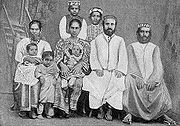
Cochin Jews, also called Malabar Jews (Malabar Yehudan) are the ancient Jews and their descendants of the erstwhile state of Kingdom of Cochin
which includes the present day port city of Kochi. They traditionally spoke Judeo-Malayalam
, a form of the Malayalam tongue, native to the state of Kerala. The Jews of Cochin did not adhere to the Talmud
ic prohibition, followed by other Orthodox Jews, against public singing by women, and therefore have a rich tradition of Jewish prayers and narrative songs performed by women in Judeo-Malayalam.
Their population has been greatly reduced from historical numbers, as many have emigrated to Israel
to settle in the Negev
. Part of the decline in Kerala's Jewish population can also be attributed to conversion. Many of the Jews that converted during the time of Saint Thomas
became Kerala's
Nasrani
or Saint Thomas Christians
.
, encompassing the Chera
, Chola, and Pandya kingdoms and southern coastal Karnataka
. Later upon the arrival of other ethnic groups such as Namboothiris, Nairs, etc. the distinct culture took shape. This was later elaborated upon by centuries of contact with foreign cultures such as Syrian, Judeo, Arabian, Portuguese, English communities which have left their mark. These foreign communities often settled in Kerala and assimilated with the local population resulting in different ethnic groups such as the Cochin Jews
, Mappila
s, Syrian Malabar Nasranis, and Anglo Indian.
was also derived. An alternative theory proposes a split in more ancient times. For cultural purposes Malayalam and Sanskrit formed a language known as Manipravalam
, where both languages were used in an alternating style. Malayalam is the only among the major Dravidian languages
without diglossia
. This means, that the Malayalam which is spoken does not differ from the written variant. Malayalam is written using the Malayalam script
.
Malayalam literature
is ancient in origin. The oldest literature works in Malayalam, distinct from the Tamil tradition, is dated between 9th century and 11th century. Malayalam literature includes the 14th century Niranam poets
(Madhava Panikkar, Sankara Panikkar and Rama Panikkar), whose works mark the dawn of both modern Malayalam language and indigenous Keralite poetry. The Triumvirate of poets
(Kavithrayam: Kumaran Asan, Vallathol Narayana Menon
and Ulloor S. Parameswara Iyer) are recognized for moving Keralite poetry away from archaic sophistry and metaphysics
and towards a more lyrical
mode.In the second half of the 20th century, Jnanpith awardees like G. Sankara Kurup
, S. K. Pottekkatt
, Thakazhi Sivasankara Pillai
and M. T. Vasudevan Nair
have made valuable contributions to the Malayalam literature. Later, such Keralite writers as O. V. Vijayan
, Kamaladas, M. Mukundan
, and Booker Prize winner Arundhati Roy
, whose 1996 semi-autobiographical bestseller The God of Small Things
is set in the Kottayam
town of Ayemenem, have gained international recognition.
Kerala's society is less patriarchical than the rest of the Majority World. Certain Hindu communities such as the Nairs, some Ezhava
families in Travancore
and Cochin, Ezhava
s in north Kerala
and Muslims around Kannur
used to follow a traditional matrilineal system known as marumakkathayam
which has in the recent years (post Indian independence) ceased to exist. Christians, Muslims, and some Hindu castes such as the Namboothiris and some Ezhavas follow makkathayam, a patrilineal system. Kerala's gender relations are among the most equitable in India and the Majority World.
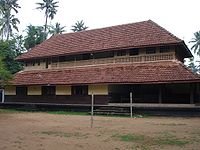 Nalukettu is a quadrangular building constructed after following the Tachu Sastra(Science of Carpentry). In past, Nalukettu was the house in which Malayalis lived. It was a typical house which was flanked by out-houses and utility structures.The large house-Nalukettu is constructed within a large compound.It was called Nalukettu because it consisted of four wings around a central courtyard
called Nadumuttom.
The house has a quadrangle
in the center. The quadrangle is in every way the center of life in the house and very useful for the performance of rituals.The layout of these homes was simple, and catered to the dwelling of a large number of people, usually part of a tharavadu
. Ettukettu (eight halled with two central courtyards) or Pathinarukettu (sixteen halled with four central courtyards) are the more elaborate forms of the same architecture.
An example of a Nalukettu structure is Mattancherry Palace
.
, Bhagavatipattu etc., (ii)Semi religious like Sanghakali, Krishnanattom etc., and (iii)Secular like Kathakali
, Mohiniaattam
, Thullal etc.Kathakali and Mohiniaattam are the two classical dance forms from Kerala. Kathakali is actually a dance-drama.Mohiniaattam is a very sensual and graceful dance form that is performed both solo and in a group by women.Kutiyattam is a traditional performing art form from Kerala, which is recognised by UNESCO
and given the status Masterpieces of Oral and Intangible Heritage of Humanity.Ottamthullal
is another performing art, which is also known as the poor man's Kathakali, which was created by the poet Kunchan Nambiar as an alternative to Chakiarkooth (another performing art),which was open only for higher castes to see.Theyyam
is a ritualistic art form of Malayalis, which is thought to predate hinduism
and to have developed from folk dances performed in conjunction with harvest celebrations.Theyyam
is performed as an offering to gods so as to get rid of poverty and illness. Velakali is another ritualistic art form, mainly performed at temples in the festival time.Kolkali
is a folk art in which dance performers move in a circle, striking small sticks and keeping rhythm with special steps. Many ancient Malayali family houses in Kerala have special snake shrines called Kavu. Sarpam Thullal
is usually performed in the courtyard of houses having snake shrines. This is a votive offering for family wealth and happiness.
Performing arts in Kerala is not limited to a single religion of the Malayali society. The Malayalam speaking Muslim community of Kerala, known as Mappila and the Christian community has their own unique performing art forms.Duff Muttu
, also known as Dubh Muttu/Aravanamuttu is a performing art form prevalent among the Muslim community.It is a group performance,staged as a social event during festivals and nuptial ceremonies.
Oppana
is a popular form of social entertainment among the Muslim community.It is a form accompanied by clapping of hands, in which both men and women participate.
Margamkali is a performing art which is popular among the Syro-Malabar and Syro-Malankara Christians.It combines both devotion and entertainment, and was performed by women in groups. Since 1980's women also have found groups.The dancers themselves sing the margamkali songs in unison call and response form.Parichamuttikali is another performing art which is popular among all sections of Christian community.This is an artistic adaptation of the martial art of Kerala, Kalaripayattu. Chavittu nadakom is a theatrical art form observed mainly by Kerala Latin Christians, dating back to second half of 16th century.
However, many of these native art forms largely play to tourists or at youth festivals, and are not as popular among ordinary Keralites. Thus, more contemporary forms – including those heavily based on the use of often risqué and politically incorrect
mimicry and parody
– have gained considerable mass appeal in recent years. Indeed, contemporary artists often use such modes to mock socioeconomic elites. In recent decades, Malayalam cinema
, yet another mode of widely popular artistic expression, have provided a distinct and indigenous Keralite alternative to both Bollywood
and Hollywood.
Music formed a major part of early Malayalam literature
, which is believed to have started developing by 9th century CE
. The significance of music in the culture of Kerala
can be established just by the fact that in Malayalam language, musical poetry was developed long before prose
.Kerala
is musically known for Sopanam
. Sopanam is religious in nature, and developed through singing invocatory songs at the Kalam
of Kali
, and later inside temples. Sopanam came to prominence in the wake of the increasing popularity of Jayadeva
's Gita Govinda
or Ashtapadis
. Sopana sangeetham (music), as the very name suggests, is sung by the side of the holy steps (sopanam) leading to the sanctum sanctorum
of a shrine
. It is sung, typically employing plain notes, to the accompaniment of the small, hourglass-shaped ethnic drum called idakka
, besides the chengila or the handy metallic gong to sound the beats. Sopanam is traditionally sung by men of the Marar and Pothuval
community, who are Ambalavasi
(semi-Brahmin) castes engaged to do it as their hereditary profession. Kerala is also home of Carnatic music
. Legends like Swati Tirunal, Shadkala Govinda Maarar,Sangitha Vidwan Gopala Pillai Bhagavathar, Chertala Gopalan Nair, M. D. Ramanathan
, T. V. Gopalakrishnan
, M.S.Gopalakrishnan,K.J.Yesudas,L.Subramaniam and T. N. Krishnan are Malayali musicians.Also among the younger generations with wide acclaim and promise is Child Prodigy Violinist L.Athira Krishna etc., who are looked upon as Maestros of tomorrow.
Kerala also has a significant presence of Hindustani music as well. The king of Travancore, Swathi Thirunal patronaged and contributed much to the Hindustani Music.
The pulluvar of Kerala are closely connected to the serpent worship. One group among these people consider the snake gods as their presiding deity and perform certain sacrifices and sing songs. This is called Pulluvan Pattu.The song conducted by the pulluvar in serpent temples and snake groves is called Sarppapaattu, Naagam Paattu, Sarpam Thullal, Sarppolsavam, Paambum Thullal or Paambum Kalam.
Mappila Paattukal
or Mappila Songs are folklore Muslim devotional songs in the Malayalam language. Mappila songs are composed in colloquial Malayalam and are sung in a distinctive tune. They are composed in a mixture of Malayalam and Arabic
.
Film music, which refers to playback singing in the context of Indian music
, forms the most important canon of popular music in India. Film music of Kerala in particular is the most popular form of music in the state. Before Malayalam cinema
and Malayalam film music developed, the Keralites eagerly followed Tamil
and Hindi
film songs and that habit has stayed with them till now.
, is the race of country made boats. It is mainly conducted during the season of the harvest festival Onam in Autumn. Vallam Kali include races of many kinds of traditional boats of Kerala. The race of Chundan Vallam
(snake boat) is the major item. Hence Vallam Kali is also known in English as Snake Boat Race and a major tourist attraction. Other types of boats which do participate in various events in the race are Churulan Vallam, Iruttukuthy Vallam, Odi Vallam, Veppu Vallam (Vaipu Vallam), Vadakkanody Vallam, and Kochu Vallam. Nehru Trophy Boat Race
is one the famous Vallam Kali held in Punnamada Lake in Alappuzha district
of Kerala. Champakulam Moolam Boat Race
is the oldest and most popular Vallam Kali in Kerala. The race is held on river Pamba
on the moolam day (according to the Malayalam Era
) of the Malayalam month Midhunam, the day of the installation of the deity at the Ambalappuzha
Sree Krishna Temple. The Aranmula Boat Race
takes place at Aranmula
, near a temple dedicated to Lord Krishna
and Arjuna
. Thousands of people gather on the banks of the river Pamba to watch the snake boat races. Nearly 30 snake boats or chundan vallams participate in the festival. Payippad Jalotsavam
is a three day water festival. Its conducted in Payippad Lake which is 35 km from Alappuzha district of Kerala state. There is a close relation between this Payippad boat race and Subramanya Swamy Temple in Haripad
. Indira Gandhi Boat Race
is a boat race festival celebrated in the last week of December in the backwaters of Kochi, a city in Kerala. This boat race is one of the most popular Vallam Kali in Kerala. This festival is conducted to promote Kerala tourism
.
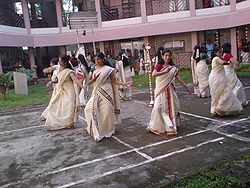 Onam is an annual harvest festival, celebrated mainly in Kerala, although celebrations also occur among the diaspora. It is the foremost festival among the cultural repertoire of Malayalis, and falls during the month of Chingam (August–September as per the Gregorian calendar
), the first month of the Malayalam calendar and lasts for ten days from the Star Atham in Chingam. Though it is essentially a harvest festival of Malayalis, mythologically it is linked to Malayali-Hindu folktales. Like many other religious festivals in India, Onam is celebrated by people across all castes and faiths. Onam has been part of Malayali psyche for centuries. There are records of Onam being celebrated during the Sangam Age. The earliest record of Onam is found during time of Kulasekhara Perumals around AD 800, soon after the Kalabhra Interregnum of Kerala History. Until the eighth century the political history is mostly unknown and is usually known as the Kalabhra Interregnum. Kalabhras were supposed to have been ruling Kerala until at least the sixth century. Kalabhras probably refers to Keralaputras. They are believed to be people of Mayavi.
Onam has two specific significance. First it is the communal memory and celebration of past history as ennunciated in the Mahabali Legend. A story of how paradise was lost. Second it is the celebration of the harvest tied with the memory of the golden age of prosperity. It is believed that during those days the whole of Chingam was celebrated as Onam season. After the rain drenched month of Karkidakam with its privations, Chingam is a welcome month for people in the state of Kerala. The festival is the harbinger of spring – signalling the start of the harvest season. Onam epitomizes the newfound vigour and enthusiasm of the season, and is celebrated with traditional fervour with visit to temples, family get-togethers, gifting each other clothes called Onakkodi and lots of merry making.
Thiruvathira is in the malayalam month Dhanu (Dec–Jan). it is considering as the bithday of Lord Shiva.
this day is called Bihu, in Punjab
Baisakhi and in Tamil Nadu
Puthandu. The word "Vishu" in Sanskrit means "equal". Therefore Vishu is more probably denoting one of the equinox days.
The festival is marked with offerings to the divine called Vishukkani. The offerings consist of a ritual arrangement in the puja room of auspicious articles like raw rice, fresh linen, golden cucumber, betel leaves, arecanut, metal mirror, the yellow flowers konna (Cassia fistula), and a holy text and coins, in a bell metal vessel called uruli. A lighted bell metal lamp called nilavilakku is also placed alongside. This arrangement is completed the previous night. On the day of Vishu, the custom is to wake up at dawn and go to the puja room with the eyes closed so that the Vishukkani is the first thing one sees. Since the occasion marks the beginning of Malayalam New Year, it is also considered auspicious to read verses from Hindu Holy book Ramayanam after seeing the Vishukkani. It is also believed by some that the page of the Ramayanam to which you open up will have a bearing on your life in the coming year. Devotees also throng the well-known temples like Sabarimala Ayyappan Teample, Guruvayur Sree Krishna temple to have a "Vishukkani Kazhcha" on the early hours of "Vishu" day.
is an essential ingredient in most of the food items and is liberally used.
Puttu is a culinary specialty in Kerala. It is a steamed rice cake which is a favourite breakfast of most Malayalis. It is served with either brown chickpeas cooked in a spicy gravy, papadams and boiled small green lentils, or tiny ripe yellow Kerala plantains. In the highlands there is also a variety of puttu served with paani (the boiled-down syrup from sweet palm toddy
) and sweet boiled bananas. to steam the puttu, there is a special utensil called "Puttu Kutti". It consists of two sections. The lower bulkier portion is where the water for steaming is stored. The upper detachable leaner portion which is separated from lower portion with peforated lids so as to allow the steam to pass through and bake the rice powder which has been filled. The upper portion of the leaner section is covered with a peforated cup shaped lid once it is filled with rice powder.
Appam is a pancake made of fermented batter. The batter is made of rice flour and fermented using either yeast or toddy, the local spirit. It is fried using a special frying pan called appa-chatti and is served with egg curry, chicken curry, mutton stew, vegetable curry and chick pea curry.
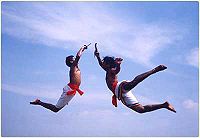 Malayalis have their own lethal form of martial arts called Kalaripayattu. This type of martial arts was used as defensive mechanism against intruders . In ancient times, disputes between (naaduvazhis or Vazhunors)nobles were also settled by the outcome of a Kalaripayattu tournament. This ancient martial art is claimed as the mother of all martial arts – even the Chinese Shaolin
chuan from the famous Shaolin temple traces its ancestry to Bodhidharma
, an Indian Buddhist monk who was a Kalaripayattu expert. The word "kalari
" can be traced to ancient Sangam literature
. The martial tradition of Kalaripayattu is also dated to ancient Dravidian traditions. Phillip Zarrilli
, a professor at the University of Exeter and one of the few Western authorities on kalaripayattu, estimates that kalarippayattu dates back to at least the 12th century CE. The historian Elamkulam Kunjan Pillai attributes the birth of Kalaripayattu to an extended period of warfare between the Cheras
and the Cholas in the 11th century CE. What eventually crystallized into this style is thought to have been a product of existing South Indian styles of combat, combined with techniques brought by migration from the north along the western coast. What eventually crystallized as kalarippayattu combined indigenous Dravidian techniques with the martial practices and ethos brought by brahman migrations from Saurastra and Konkan down the west Indian coast into Karnataka and eventually Kerala. Discovery channel
notes that Kalaripayattu may be one of the oldest martial arts in existence. The oldest western reference to Kalaripayattu is a 16th century travelogue of Duarte Barbosa
, a Portuguese explorer. The Southern style, which places more emphasis on open hand combat was mostly practiced in the southern regions of Kerala.
Kerala
or Keralam is an Indian state located on the Malabar coast of south-west India. It was created on 1 November 1956 by the States Reorganisation Act by combining various Malayalam speaking regions....
. The Malayali identity is primarily linguistic, although in recent times the definition has been broadened to include emigrants of Malayali descent who partly maintain Malayali cultural traditions
Cultural identity
Cultural identity is the identity of a group or culture, or of an individual as far as one is influenced by one's belonging to a group or culture. Cultural identity is similar to and has overlaps with, but is not synonymous with, identity politics....
, even if they do not regularly speak the language. While the origins of the Malayali people are in the state of Kerala, significant populations also exist in other parts of India, the Middle East, Europe and North America. According to the Indian census of 2001, there were 30,803,747 speakers of Malayalam in Kerala, making up 96.7% of the total population of that state. Hence the word Keralite is often used in the same context, though a proper definition is ambiguous.
Etymology
Malayalam, the Malayalis' native language, has its origin from the words mala meaning mountain and alam meaning land (TamilTamil language
Tamil is a Dravidian language spoken predominantly by Tamil people of the Indian subcontinent. It has official status in the Indian state of Tamil Nadu and in the Indian union territory of Pondicherry. Tamil is also an official language of Sri Lanka and Singapore...
/Malayalam) or locality (which lies along side the mountain). Hence 'Malayali' means people from the mountains who lived beyond the Western Ghats
Western Ghats
The Western Ghats, Western Ghauts or the Sahyādri is a mountain range along the western side of India. It runs north to south along the western edge of the Deccan Plateau, and separates the plateau from a narrow coastal plain along the Arabian Sea. The Western Ghats block rainfall to the Deccan...
, and Malayalam the language that was spoken there.
Geographic distribution and population
According to the Indian census of 2001, there were 30,803,747 speakers of Malayalam in Kerala, making up 93.2% of the total number of Malayalam speakers in India, and 96.7% of the total population of the state. There were a further 701,673 (2.1% of the total number) in KarnatakaKarnataka
Karnataka , the land of the Kannadigas, is a state in South West India. It was created on 1 November 1956, with the passing of the States Reorganisation Act and this day is annually celebrated as Karnataka Rajyotsava...
, 557,705 (1.7%) in Tamil Nadu
Tamil Nadu
Tamil Nadu is one of the 28 states of India. Its capital and largest city is Chennai. Tamil Nadu lies in the southernmost part of the Indian Peninsula and is bordered by the union territory of Pondicherry, and the states of Kerala, Karnataka, and Andhra Pradesh...
, and 406,358 (1.2%) in Maharashtra
Maharashtra
Maharashtra is a state located in India. It is the second most populous after Uttar Pradesh and third largest state by area in India...
. The number of Malayalam speakers in Lakshadweep
Lakshadweep
Lakshadweep , formerly known as the Laccadive, Minicoy, and Amindivi Islands, is a group of islands in the Laccadive Sea, 200 to 440 km off the coast of the South West Indian state of Kerala...
is 51,100, which is only 0.15% of the total number, but is as much as about 84% of the population of Lakshadweep. In all, Malayalis made up 3.22% of the total Indian population in 2001. Of the total 33,066,392 Malayalam speakers in India in 2001, 33,015,420 spoke the standard dialects, 19,643 spoke the Yerava dialect and 31,329 spoke non-standard regional variations like Eranadan. As per the 1991 census data, 28.85% of all Malayalam speakers in India spoke another second language and 19.64% of the total knew 3 or more languages.
Large numbers of Malayalis have settled in Delhi
Delhi
Delhi , officially National Capital Territory of Delhi , is the largest metropolis by area and the second-largest by population in India, next to Mumbai. It is the eighth largest metropolis in the world by population with 16,753,265 inhabitants in the Territory at the 2011 Census...
, Bangalore
Bangalore
Bengaluru , formerly called Bengaluru is the capital of the Indian state of Karnataka. Bangalore is nicknamed the Garden City and was once called a pensioner's paradise. Located on the Deccan Plateau in the south-eastern part of Karnataka, Bangalore is India's third most populous city and...
, Hyderabad, Mumbai
Mumbai
Mumbai , formerly known as Bombay in English, is the capital of the Indian state of Maharashtra. It is the most populous city in India, and the fourth most populous city in the world, with a total metropolitan area population of approximately 20.5 million...
(Bombay), Pune
Pune
Pune , is the eighth largest metropolis in India, the second largest in the state of Maharashtra after Mumbai, and the largest city in the Western Ghats. Once the centre of power of the Maratha Empire, it is situated 560 metres above sea level on the Deccan plateau at the confluence of the Mula ...
and Chennai
Chennai
Chennai , formerly known as Madras or Madarasapatinam , is the capital city of the Indian state of Tamil Nadu, located on the Coromandel Coast off the Bay of Bengal. Chennai is the fourth most populous metropolitan area and the sixth most populous city in India...
(Madras). A large number of Malayalis have also emigrated to the Middle East
Middle East
The Middle East is a region that encompasses Western Asia and Northern Africa. It is often used as a synonym for Near East, in opposition to Far East...
, the United States
United States
The United States of America is a federal constitutional republic comprising fifty states and a federal district...
, and Europe
Europe
Europe is, by convention, one of the world's seven continents. Comprising the westernmost peninsula of Eurasia, Europe is generally 'divided' from Asia to its east by the watershed divides of the Ural and Caucasus Mountains, the Ural River, the Caspian and Black Seas, and the waterways connecting...
. There were 179,860 speakers of Malayalam in the United States
United States
The United States of America is a federal constitutional republic comprising fifty states and a federal district...
, according to the 2000 census, with the highest concentrations in Bergen County, New Jersey
Bergen County, New Jersey
Bergen County is the most populous county of the state of New Jersey, United States. As of the 2010 United States Census, its population was 905,116. The county is part of the New York City Metropolitan Area. Its county seat is Hackensack...
and Rockland County, New York
Rockland County, New York
Rockland County is a suburban county 15 miles to the northwest of Manhattan and part of the New York City Metropolitan Area, in the U.S. state of New York. It is the southernmost county in New York west of the Hudson River, and the smallest county in New York outside of New York City. The...
. There were 7,093 Malayalam speakers in Australia
Australia
Australia , officially the Commonwealth of Australia, is a country in the Southern Hemisphere comprising the mainland of the Australian continent, the island of Tasmania, and numerous smaller islands in the Indian and Pacific Oceans. It is the world's sixth-largest country by total area...
in 2006. The 2001 Canadian census reported 7,070 people who listed Malayalam as their mother tongue. The 2006 New Zealand
New Zealand
New Zealand is an island country in the south-western Pacific Ocean comprising two main landmasses and numerous smaller islands. The country is situated some east of Australia across the Tasman Sea, and roughly south of the Pacific island nations of New Caledonia, Fiji, and Tonga...
census reported 2,139 speakers. 134 Malayalam speaking households were reported in 1956 in Fiji
Fiji
Fiji , officially the Republic of Fiji , is an island nation in Melanesia in the South Pacific Ocean about northeast of New Zealand's North Island...
. There is also a considerable Malayali population in the Persian Gulf
Persian Gulf
The Persian Gulf, in Southwest Asia, is an extension of the Indian Ocean located between Iran and the Arabian Peninsula.The Persian Gulf was the focus of the 1980–1988 Iran-Iraq War, in which each side attacked the other's oil tankers...
regions, especially in Dubai
Dubai
Dubai is a city and emirate in the United Arab Emirates . The emirate is located south of the Persian Gulf on the Arabian Peninsula and has the largest population with the second-largest land territory by area of all the emirates, after Abu Dhabi...
.
Communities
Historically, religion and caste played a major role in community, with individuals associating and marrying within their religion or caste. Hence, Malayali communities can be differentiated along historical religious lines.Ezhava
The Ezhavas are the largest HinduHindu
Hindu refers to an identity associated with the philosophical, religious and cultural systems that are indigenous to the Indian subcontinent. As used in the Constitution of India, the word "Hindu" is also attributed to all persons professing any Indian religion...
community in Kerala
Kerala
or Keralam is an Indian state located on the Malabar coast of south-west India. It was created on 1 November 1956 by the States Reorganisation Act by combining various Malayalam speaking regions....
. Ezhava
Ezhava
The Ezhavas are a community with origins in the region presently known as Kerala. They are also known as Ilhava, Irava, Izhava and Erava in the south of the region; as Chovas, Chokons and Chogons in Central Travancore; and as Tiyyas, Thiyas and Theeyas in Malabar...
s are also found amongst the Malayali diaspora around the world. Ezhavas are today a social group sharing a common history from the pre-social reform era. With a population of 7.3 million Ezhavas are the largest Hindu community in Kerala.
Samanta Kshatriya
The Samanta Kshatriyas (also known as Malayala Kshatriya) who use the surname Varma or Raja, are a group of people who belonged to the Chandravanshi KshatriyaKshatriya
*For the Bollywood film of the same name see Kshatriya Kshatriya or Kashtriya, meaning warrior, is one of the four varnas in Hinduism...
division of the Hindu
Hindu
Hindu refers to an identity associated with the philosophical, religious and cultural systems that are indigenous to the Indian subcontinent. As used in the Constitution of India, the word "Hindu" is also attributed to all persons professing any Indian religion...
caste
Caste
Caste is an elaborate and complex social system that combines elements of endogamy, occupation, culture, social class, tribal affiliation and political power. It should not be confused with race or social class, e.g. members of different castes in one society may belong to the same race, as in India...
system among Malayalees and their residences were traditionally called Kovilakams or Kottaram or Swaroopams. They themselves belong to a subgroup of Nairs and they form the highest ranking division among Nairs. In traditional texts such as the Keralolpathi
Keralolpathi
The Keralolpathi is a Malayalam work that deals with the origin of the land of Kerala. Shungunny Menon ascribes the authorship of this work to Thunchaththu Ramanujan Ezhuthachan, a 17th century scholar of the Malabar region of India. The Keralolpathi is mostly an expansion from an earlier Sanskrit...
they are referred to as "Samantha Kshatriyas".
Nambudiri
The Nambudiri Brahmins are the indigenous Brahmins of KeralaKerala
or Keralam is an Indian state located on the Malabar coast of south-west India. It was created on 1 November 1956 by the States Reorganisation Act by combining various Malayalam speaking regions....
, who are considered the most orthodox
Orthodoxy
The word orthodox, from Greek orthos + doxa , is generally used to mean the adherence to accepted norms, more specifically to creeds, especially in religion...
Brahmins in India. They perform rituals in temples of Kerala based on Tantra Vidhi, a complex and ancient branch of Tantric
Tantra
Tantra , anglicised tantricism or tantrism or tantram, is the name scholars give to an inter-religious spiritual movement that arose in medieval India, expressed in scriptures ....
traditions found only in Kerala, and some Mahakshetras ("Great Temples") around India (which have a Nambudiri acting as the Head Priest). Namboothiris follow the conservative and ritualistic Śrauta
Srauta
' traditions are conservative ritualistic traditions of the historical Vedic religion in Hinduism, based on the body of Śruti literature...
traditions and the ancient Purva Mimamsa
Mimamsa
' , a Sanskrit word meaning "investigation" , is the name of an astika school of Hindu philosophy whose primary enquiry is into the nature of dharma based on close hermeneutics of the Vedas...
, unlike the majority of other Brahmins in India who follow the Vedanta
Vedanta
Vedānta was originally a word used in Hindu philosophy as a synonym for that part of the Veda texts known also as the Upanishads. The name is a morphophonological form of Veda-anta = "Veda-end" = "the appendix to the Vedic hymns." It is also speculated that "Vedānta" means "the purpose or goal...
.
Nair
Nairs (sometimes spelled Nayar) are a HinduHindu
Hindu refers to an identity associated with the philosophical, religious and cultural systems that are indigenous to the Indian subcontinent. As used in the Constitution of India, the word "Hindu" is also attributed to all persons professing any Indian religion...
upper caste belonging to Nagavanshi
Nagavanshi
The Nagavanshi dynasty is one of the ancient Kshatriya dynasties of India. The Vedas do not mention Kshatriyas of either Suryavanshi, Chandravanshi, Nagavanshi, Agnivanshi or such Vanshas or lineages. The Puranas, of debatable dating, constructed such genealogies. The Puranas were supposedly...
division of the Hindu
Hindu
Hindu refers to an identity associated with the philosophical, religious and cultural systems that are indigenous to the Indian subcontinent. As used in the Constitution of India, the word "Hindu" is also attributed to all persons professing any Indian religion...
caste
Caste
Caste is an elaborate and complex social system that combines elements of endogamy, occupation, culture, social class, tribal affiliation and political power. It should not be confused with race or social class, e.g. members of different castes in one society may belong to the same race, as in India...
system. The Nairs were a martial nobility and figure prominently in the history of Kerala. The Nairs form the second largest Hindu community in Kerala.
Ambalavasi
Ambalavasi is the name of a KeralaKerala
or Keralam is an Indian state located on the Malabar coast of south-west India. It was created on 1 November 1956 by the States Reorganisation Act by combining various Malayalam speaking regions....
community (not to be confused with caste) composed of a number of Hindu
Hindu
Hindu refers to an identity associated with the philosophical, religious and cultural systems that are indigenous to the Indian subcontinent. As used in the Constitution of India, the word "Hindu" is also attributed to all persons professing any Indian religion...
castes such as Pushpakas
Pushpaka Brahmin
Pushpaka Brahmins or simply Pushpakas are a class of Brahmins in Kerala. They carry out the various activities of the temple, though not actual priestly activities. Pushpakas lived on the income of the temple and were under its care...
(Unni
Unni
Unni is used as a first name in and Kerala, India. In Malayalam language, it is also used as an adjective meaning an infant boy. Thus, Unnikrishnan means Lord Krishna in the infant form and Unniyesu means Yesu in the infant form...
, Nambeesan
Nambeesan
Nambeesan is a sub-caste of Ambalavasi. They belong to the Viswamitra Gotram.They wear the sacred thread "Yajñopaveetam" and adhere to the Maha 'Gayatri mantra'....
, etc.), Chakyar
Chakyar
Chakyar is a Brahmin caste coming under the Ambalavasi community of Hindus in the Kerala state of South India. The women in this caste are called Illotammas....
s, Moothath
Moothath
Moothath is a Hindu caste in Kerala. They belong to the Ambalavasi category as per the Kerala government census but are a closed community that neither belong to the Namboothiri nor adhering to the Pushpaka Brahmin. Thus they have a unique identity and mostly inter marry within the same community...
s, Ilayath
Ilayath
Ilayath is a Hindu caste in Kerala. They belong to the Brahmin community and, a part of Ambalavasi Community. The house of an Ilayath is known as Illam.-In popular culture:...
s, Kurukkal
Kurukkal
Kurukkal are a group of Ambalavasis in Kerala.-History:Kurukkals were the people who prepared milk and milk proucts for temples. They mainly belonged to the temples in old southern Travancore temples like Sri Padmanabhaswami Temple, Thiruvattar temple etc. They have relation with the Gurukkal in...
s, Warriers, Marars, Nambiars, Pisharody
Pisharody
Pisharody is a sub-caste of the Pushpaka Brahmin caste in Kerala. As Vaishnavite Brahmins, Pisharodys were traditionally caretakers of Hindu temples, with temple related jobs and hence clubbed under Ambalavasis...
, etc. Traditionally, they perform temple related jobs and art forms.
Pulaya
Kerala
or Keralam is an Indian state located on the Malabar coast of south-west India. It was created on 1 November 1956 by the States Reorganisation Act by combining various Malayalam speaking regions....
society, who were traditionally engaged in various agriculture-related occupations. Ayyankali
Ayyankali
Ayyankali was a leader of the Indian lower caste Dalits known as the Untouchables. He pioneered many reforms to improve the lives of the Dalits. In 1937 he was praised by Mahatma Gandhi when he visited Venganoor, Ayyankali's home town...
(1863–1914), one among the great social reformers of India, who was praised by Mahatma Gandhi when he visited Venganoor
Venganoor
Venganoor has been described as a very ordinary village near southern end of Kerala, India,which is situated 13 km north of Thiruvananthapuram. It is known as the birth place ofAyyankali, the great Harijan leader of Kerala....
, was born to a Malayali Pulaya family.
Muslim
Malayali Muslims are members of a Malayalam-speaking Islamic community spread across KeralaKerala
or Keralam is an Indian state located on the Malabar coast of south-west India. It was created on 1 November 1956 by the States Reorganisation Act by combining various Malayalam speaking regions....
, Lakshadweep
Lakshadweep
Lakshadweep , formerly known as the Laccadive, Minicoy, and Amindivi Islands, is a group of islands in the Laccadive Sea, 200 to 440 km off the coast of the South West Indian state of Kerala...
, Kodagu
Kodagu
Kodagu , also known by its anglicised former name of Coorg, is an administrative district in Karnataka, India. It occupies an area of in the Western Ghats of southwestern Karnataka. As of 2001, the population was 548,561, 13.74% of which resided in the district's urban centres, making it the least...
and across Malayali Diaspora around the world. In North Kerala they are known as Mappila
Mappila
Mappila or Moplah refers to a Muslim community of Kerala, primarily in the northern region called Malabar, which arose in Malabar as a result of the pre and post Islamic Arab contacts. Significant numbers of the community are also present in the southern districts of Karnataka and western parts of...
s or Moplahs. The word mappila is derived from the old (pure) Malayalam words Amma and pilla meaning Child Mother. The Mappilas are believed to be the earliest known Indian Muslim community, having existed since the 8th century CE, when Arab
Arab
Arab people, also known as Arabs , are a panethnicity primarily living in the Arab world, which is located in Western Asia and North Africa. They are identified as such on one or more of genealogical, linguistic, or cultural grounds, with tribal affiliations, and intra-tribal relationships playing...
merchants who had long been trading with the Chera
Chera dynasty
Chera Dynasty in South India is one of the most ancient ruling dynasties in India. Together with the Cholas and the Pandyas, they formed the three principle warring Iron Age Tamil kingdoms in southern India...
kingdom settled in Kerala. The Muslims in Kerala cannot be easily distinguished in the community as they still retain their Malayali features. They follow the preachings of monotheism
Monotheism
Monotheism is the belief in the existence of one and only one god. Monotheism is characteristic of the Baha'i Faith, Christianity, Druzism, Hinduism, Islam, Judaism, Samaritanism, Sikhism and Zoroastrianism.While they profess the existence of only one deity, monotheistic religions may still...
by Muhammad
Muhammad
Muhammad |ligature]] at U+FDF4 ;Arabic pronunciation varies regionally; the first vowel ranges from ~~; the second and the last vowel: ~~~. There are dialects which have no stress. In Egypt, it is pronounced not in religious contexts...
in Arabia, especially the UAE and other Gulf countries . They propagated their Islamic faith along the Malabar Coast. Most Mappila Muslims follow the Shafi'i
Shafi'i
The Shafi'i madhhab is one of the schools of fiqh, or religious law, within the Sunni branch of Islam. The Shafi'i school of fiqh is named after Imām ash-Shafi'i.-Principles:...
school of Muslim Jurisprudence (in contrast to the Hanafi
Hanafi
The Hanafi school is one of the four Madhhab in jurisprudence within Sunni Islam. The Hanafi madhhab is named after the Persian scholar Abu Hanifa an-Nu‘man ibn Thābit , a Tabi‘i whose legal views were preserved primarily by his two most important disciples, Abu Yusuf and Muhammad al-Shaybani...
school followed by most South Asian Muslims). A good amount of mappila's find their income from gulf region. In north malabar, from malappuram
Malappuram
Malappuram is a municipality in the South Indian state of Kerala, spread over an area of 33.61 km2. It serves as the administrative headquarters of Malappuram district. As per the 2011 census Malappuram urban agglomeration is the fourth largest UA in kerala with a total population of...
to kasargod, at least one of 3 Muslim house have foreign income.
Christian
Christians form the third largest group in Kerala. Over the centuries, they have blended well with the changing socio-cultural environment of the region, becoming uniquely Indian and Christian.According to beliefs, Christianity in India dates to Thomas the Apostle
Thomas the Apostle
Thomas the Apostle, also called Doubting Thomas or Didymus was one of the Twelve Apostles of Jesus. He is best known for questioning Jesus' resurrection when first told of it, then proclaiming "My Lord and my God" on seeing Jesus in . He was perhaps the only Apostle who went outside the Roman...
’s conversion of local population in Kerala during the 1st century CE. The 3rd and 4th centuries saw an influx of Christians from the Middle East. Knanaya
Knanaya
The Knanaya also known as Q'nanaya, Q'nai, Kanai, or Thekkumbagar, are endogamous Jews who settled in Kerala, India. Their origins are unclear and are hotly disputed by academic scholars...
communities arrived during this time. Distance kept the community of St Thomas Christians separate from other Christian communities until about the 8th century, when they started receiving bishops and support from the Chaldean Church. The arrival of Europeans in the 15th century and discontent with Portuguese interference in religious matters fomented schism
Schism
- Religion :* Schism , a division or a split, usually between people belonging to an organization or movement, most frequently applied to a break of communion between two sections of Christianity that were previously a single body...
into Catholic
Catholic
The word catholic comes from the Greek phrase , meaning "on the whole," "according to the whole" or "in general", and is a combination of the Greek words meaning "about" and meaning "whole"...
and Orthodox
Orthodox
Orthodox may refer to:In music:* Orthodox , album by the Czech death metal band KrabathorIn science:* File manager#Orthodox file managers in computing* Orthodox seed, seed which may be preserved via drying or freezing...
communities. Further schism, rearrangements, and missionary activity led to the formation of the other Indian Churches. Latin Rite Christians were converted by the Portuguese
Portugal
Portugal , officially the Portuguese Republic is a country situated in southwestern Europe on the Iberian Peninsula. Portugal is the westernmost country of Europe, and is bordered by the Atlantic Ocean to the West and South and by Spain to the North and East. The Atlantic archipelagos of the...
in the 16th and 19th centuries mainly from communities where fishing was the traditional occupation. Anglo-Indian
Anglo-Indian
Anglo-Indians are people who have mixed Indian and British ancestry, or people of British descent born or living in India, now mainly historical in the latter sense. British residents in India used the term "Eurasians" for people of mixed European and Indian descent...
Christian communities formed around this time as Europeans and local Malayalis intermarried. Protestantism
Protestantism
Protestantism is one of the three major groupings within Christianity. It is a movement that began in Germany in the early 16th century as a reaction against medieval Roman Catholic doctrines and practices, especially in regards to salvation, justification, and ecclesiology.The doctrines of the...
arrived a few centuries later with missionary activity during British rule. The community today can broadly divided into Catholic
Catholic
The word catholic comes from the Greek phrase , meaning "on the whole," "according to the whole" or "in general", and is a combination of the Greek words meaning "about" and meaning "whole"...
, Orthodox
Oriental Orthodoxy
Oriental Orthodoxy is the faith of those Eastern Christian Churches that recognize only three ecumenical councils — the First Council of Nicaea, the First Council of Constantinople and the First Council of Ephesus. They rejected the dogmatic definitions of the Council of Chalcedon...
, Pentecost
Pentecost
Pentecost is a prominent feast in the calendar of Ancient Israel celebrating the giving of the Law on Sinai, and also later in the Christian liturgical year commemorating the descent of the Holy Spirit upon the disciples of Christ after the Resurrection of Jesus...
and Protestant groups. It is important to note that despite being a heterogeneous group, Malayali Christians find unity in a common history and faith.
Jewish
Cochin Jews, also called Malabar Jews (Malabar Yehudan) are the ancient Jews and their descendants of the erstwhile state of Kingdom of Cochin
Kingdom of Cochin
Kingdom of Cochin was a late medieval Hindu kingdom and later Princely State on the Malabar Coast, South India...
which includes the present day port city of Kochi. They traditionally spoke Judeo-Malayalam
Judeo-Malayalam
Judeo-Malayalam is the traditional language of the Cochin Jews , from Kerala, in southern India, spoken today by a few dozens of people in Israel and by probably fewer than 25 in India....
, a form of the Malayalam tongue, native to the state of Kerala. The Jews of Cochin did not adhere to the Talmud
Talmud
The Talmud is a central text of mainstream Judaism. It takes the form of a record of rabbinic discussions pertaining to Jewish law, ethics, philosophy, customs and history....
ic prohibition, followed by other Orthodox Jews, against public singing by women, and therefore have a rich tradition of Jewish prayers and narrative songs performed by women in Judeo-Malayalam.
Their population has been greatly reduced from historical numbers, as many have emigrated to Israel
Israel
The State of Israel is a parliamentary republic located in the Middle East, along the eastern shore of the Mediterranean Sea...
to settle in the Negev
Negev
The Negev is a desert and semidesert region of southern Israel. The Arabs, including the native Bedouin population of the region, refer to the desert as al-Naqab. The origin of the word Neghebh is from the Hebrew root denoting 'dry'...
. Part of the decline in Kerala's Jewish population can also be attributed to conversion. Many of the Jews that converted during the time of Saint Thomas
Thomas the Apostle
Thomas the Apostle, also called Doubting Thomas or Didymus was one of the Twelve Apostles of Jesus. He is best known for questioning Jesus' resurrection when first told of it, then proclaiming "My Lord and my God" on seeing Jesus in . He was perhaps the only Apostle who went outside the Roman...
became Kerala's
Kerala
or Keralam is an Indian state located on the Malabar coast of south-west India. It was created on 1 November 1956 by the States Reorganisation Act by combining various Malayalam speaking regions....
Nasrani
Syrian Malabar Nasrani
The Syrian Malabar Nasrani people, also known as Saint Thomas Christians, "'Nasrani Mappila'" and Nasranis, are an ethnoreligious group from Kerala, India, adhering to the various churches of the Saint Thomas Christian tradition...
or Saint Thomas Christians
Saint Thomas Christians
The Saint Thomas Christians are an ancient body of Christians from Kerala, India, who trace their origins to the evangelical activity of Thomas the Apostle in the 1st century. They are also known as "Nasranis" because they are followers of "Jesus of Nazareth". The term "Nasrani" is still used by St...
.
Unclassified
With the growth in intermarriage between Malayali communities and also with other groups, especially outside Kerala, many people who identify themselves with Kerala or with Malayali culture can not readily be labeled as members of one of the historic castes or communities listed above. Also, although a number of these groups were historically affiliated to one or other religion or sect, many of their modern members may be agnostic or atheist, or identify more strongly with some other religious or non-religious ideology. Nevertheless, Malayalis have been a open-minded people who are accepting of various groups irrespective of caste and class in their community.Culture
Malayali cultural genesis can be traced to their membership (around the 3rd century CE) in a well defined historical region known as TamilakamAncient Tamil country
The Sangam period is the classical period in the history of Tamil Nadu, Kerala and other parts of South India, spanning about the 3rd century BCE to the 3rd century CE...
, encompassing the Chera
Chera dynasty
Chera Dynasty in South India is one of the most ancient ruling dynasties in India. Together with the Cholas and the Pandyas, they formed the three principle warring Iron Age Tamil kingdoms in southern India...
, Chola, and Pandya kingdoms and southern coastal Karnataka
Karnataka
Karnataka , the land of the Kannadigas, is a state in South West India. It was created on 1 November 1956, with the passing of the States Reorganisation Act and this day is annually celebrated as Karnataka Rajyotsava...
. Later upon the arrival of other ethnic groups such as Namboothiris, Nairs, etc. the distinct culture took shape. This was later elaborated upon by centuries of contact with foreign cultures such as Syrian, Judeo, Arabian, Portuguese, English communities which have left their mark. These foreign communities often settled in Kerala and assimilated with the local population resulting in different ethnic groups such as the Cochin Jews
Cochin Jews
Cochin Jews, also called Malabar Jews , are the oldest group of Jews in India, with roots claimed to date to the time of King Solomon, though historically attested migration dates from the fall of Jerusalem in 70 CE. Historically, they lived in the Kingdom of Cochin in South India, now part of the...
, Mappila
Mappila
Mappila or Moplah refers to a Muslim community of Kerala, primarily in the northern region called Malabar, which arose in Malabar as a result of the pre and post Islamic Arab contacts. Significant numbers of the community are also present in the southern districts of Karnataka and western parts of...
s, Syrian Malabar Nasranis, and Anglo Indian.
Language and Literature
Malayalam is the language spoken by the Malayalis. Malayalam is derived from Middle Tamil in the 6th century, of which Modern TamilTamil language
Tamil is a Dravidian language spoken predominantly by Tamil people of the Indian subcontinent. It has official status in the Indian state of Tamil Nadu and in the Indian union territory of Pondicherry. Tamil is also an official language of Sri Lanka and Singapore...
was also derived. An alternative theory proposes a split in more ancient times. For cultural purposes Malayalam and Sanskrit formed a language known as Manipravalam
Manipravalam
Manipravalam was a literary style used in medieval liturgical texts in South India, which used an admixture of Tamil and Sanskrit. Manipravalam is termed a mixture of Sanskrit and Tamil...
, where both languages were used in an alternating style. Malayalam is the only among the major Dravidian languages
Dravidian languages
The Dravidian language family includes approximately 85 genetically related languages, spoken by about 217 million people. They are mainly spoken in southern India and parts of eastern and central India as well as in northeastern Sri Lanka, Pakistan, Nepal, Bangladesh, Afghanistan, Iran, and...
without diglossia
Diglossia
In linguistics, diglossia refers to a situation in which two dialects or languages are used by a single language community. In addition to the community's everyday or vernacular language variety , a second, highly codified variety is used in certain situations such as literature, formal...
. This means, that the Malayalam which is spoken does not differ from the written variant. Malayalam is written using the Malayalam script
Malayalam script
The Malayalam script is a Brahmic script used commonly to write the Malayalam language—which is the principal language of the Indian state of Kerala, spoken by 36 million people in the world. Like many other Indic scripts, it is an abugida, or a writing system that is partially “alphabetic” and...
.
Malayalam literature
Malayalam literature
The term Malayalam literature refers to Literature written in Malayalam language. Malayalam is the language spoken by around 35 million people, mainly the inhabitants of the state of Kerala and the union territory of Lakshadweep Islands in India. Malayalam is a Dravidian language and thus has close...
is ancient in origin. The oldest literature works in Malayalam, distinct from the Tamil tradition, is dated between 9th century and 11th century. Malayalam literature includes the 14th century Niranam poets
Niranam poets
Niranam is a small village in Southern Kerala in India near Mannar town. In 14th century Niranam gave birth to three poets who became well-known as the Niranam Poets. They were Madhava Panikkar, Sankara Panikkar and Rama Panikkar of the Kannassa family. The first two were uncles of Rama Panikkar...
(Madhava Panikkar, Sankara Panikkar and Rama Panikkar), whose works mark the dawn of both modern Malayalam language and indigenous Keralite poetry. The Triumvirate of poets
Triumvirate poets of modern Malayalam
N.Kumaran Asan, Vallathol Narayana Menon and Ulloor S. Parameswara Iyer are regarded as the triumvirates of modern Malayalam literature....
(Kavithrayam: Kumaran Asan, Vallathol Narayana Menon
Vallathol Narayana Menon
Vallathol Narayana Menon , popularly known as Mahakavi, was one of the celebrity poets in Malayalam language, spoken in the South Indian state of Kerala. Vallathol was born in Chennara, near Tirur, in Malappuram District of Kerala state, southern India. Up to his 27 years he lived in Chennara and...
and Ulloor S. Parameswara Iyer) are recognized for moving Keralite poetry away from archaic sophistry and metaphysics
Metaphysics
Metaphysics is a branch of philosophy concerned with explaining the fundamental nature of being and the world, although the term is not easily defined. Traditionally, metaphysics attempts to answer two basic questions in the broadest possible terms:...
and towards a more lyrical
Lyrics
Lyrics are a set of words that make up a song. The writer of lyrics is a lyricist or lyrist. The meaning of lyrics can either be explicit or implicit. Some lyrics are abstract, almost unintelligible, and, in such cases, their explication emphasizes form, articulation, meter, and symmetry of...
mode.In the second half of the 20th century, Jnanpith awardees like G. Sankara Kurup
G. Sankara Kurup
G. Sankara Kurup, , better known as Mahakavi G , was the first winner of the Jnanpith Award, India's highest literary award...
, S. K. Pottekkatt
S. K. Pottekkatt
Sankaran Kutty Pottekkatt , popularly known as S. K. Pottekkatt, was a famous Malayalam writer from Kerala state, South India...
, Thakazhi Sivasankara Pillai
Thakazhi Sivasankara Pillai
Thakazhi Sivasankara Pillai was a novelist and short story writer of Malayalam language, spoken in Kerala state, South India. He is popularly known as Thakazhi, after his place of birth. He focused on the oppressed classes as the subject of his works, which are known for their attention to...
and M. T. Vasudevan Nair
M. T. Vasudevan Nair
Madathil Thekkepaattu Vasudevan Nair , popularly known as MT, is an Indian author, screenplay writer and film director. He was born in Kudallur, a small village in the present day Palakkad District, which was under the Malabar District in the Madras Presidency of the British Raj...
have made valuable contributions to the Malayalam literature. Later, such Keralite writers as O. V. Vijayan
O. V. Vijayan
Ootupulackal Velukkuty Vijayan was an Indian author and cartoonist, who was an important figure in modern Malayalam literature. Best known for his first novel Khasakkinte Itihasam , Vijayan has six novels, nine short-story collections, and nine collections of essays, memoirs and reflections.-...
, Kamaladas, M. Mukundan
M. Mukundan
M. Mukundan is one of the pioneers of modernity in Malayalam literature, belonging to Mahe, part of Pondicherry Union Territory in South India. He was born on 10 September 1942 at Mayyazhi , a one-time French territory in India...
, and Booker Prize winner Arundhati Roy
Arundhati Roy
Arundhati Roy is an Indian novelist. She won the Booker Prize in 1997 for her novel, The God of Small Things, and has also written two screenplays and several collections of essays...
, whose 1996 semi-autobiographical bestseller The God of Small Things
The God of Small Things
The God of Small Things is the debut novel of Indian author Arundhati Roy. It is a story about the childhood experiences of fraternal twins whose lives are destroyed by the "Love Laws" that lay down "who should be loved, and how. And how much." The book is a description of how the small things in...
is set in the Kottayam
Kottayam
Kottayam is a city in the Indian state of Kerala, spread over an area of 55.40 km2. It is the administrative capital of the Kottayam district. Kottayam Kottayam (Malayalam: കോട്ടയം) is a city in the Indian state of Kerala, spread over an area of 55.40 km2. It is the administrative...
town of Ayemenem, have gained international recognition.
Tharavadu
Tharavadu is a system of joint family practised by Malayalis, especially castes like Nambudiris, Nairs, and Ezhavas. Each Tharavadu has a unique name. The Tharavadu was administered by the Karanavan, the oldest male member of the family. He would be the eldest maternal uncle of the family as well. The members of the Tharavadu consisted of mother, daughters, sons, sisters and brothers. The fathers and husbands had very minimal role to play in the affairs of the Tharavadu. It was a true matrilineal affair. The Karanavar took all major decisions. He was usually autocratic. However, the consent of the eldest female member of the family was taken before implementing the decisions. This eldest female member would be his maternal grandmother, own mother, mother's sister, his own sister or a sister through his maternal lineage. Since the lineage was through the female members, the birth of a daughter was always welcomed. Each Tharavadu also has a Para Devatha (clan deity) revered by those in the particular Tharavadu. Temples were built to honor these deities.Kerala's society is less patriarchical than the rest of the Majority World. Certain Hindu communities such as the Nairs, some Ezhava
Ezhava
The Ezhavas are a community with origins in the region presently known as Kerala. They are also known as Ilhava, Irava, Izhava and Erava in the south of the region; as Chovas, Chokons and Chogons in Central Travancore; and as Tiyyas, Thiyas and Theeyas in Malabar...
families in Travancore
Travancore
Kingdom of Travancore was a former Hindu feudal kingdom and Indian Princely State with its capital at Padmanabhapuram or Trivandrum ruled by the Travancore Royal Family. The Kingdom of Travancore comprised most of modern day southern Kerala, Kanyakumari district, and the southernmost parts of...
and Cochin, Ezhava
Ezhava
The Ezhavas are a community with origins in the region presently known as Kerala. They are also known as Ilhava, Irava, Izhava and Erava in the south of the region; as Chovas, Chokons and Chogons in Central Travancore; and as Tiyyas, Thiyas and Theeyas in Malabar...
s in north Kerala
Kerala
or Keralam is an Indian state located on the Malabar coast of south-west India. It was created on 1 November 1956 by the States Reorganisation Act by combining various Malayalam speaking regions....
and Muslims around Kannur
Kannur
Kannur , also known as Cannanore, is a city in Kannur district in the Indian state of Kerala. It is the administrative headquarters of the District of Kannur and 518km north of state capital Trivandrum. During British rule in India, Kannur was known by its old name Cannanore, which is still in...
used to follow a traditional matrilineal system known as marumakkathayam
Marumakkathayam
Marumakkathayam is a matrilinear system of inheritance which was followed by all Nair castes including of Royal Families, some of the Ambalavasis, Arayars, Ezhava, some tribal groups and Mappilas in North Malabar of Kerala state, South India. Unlike other Brahmin families, Payanoor Nambootiris...
which has in the recent years (post Indian independence) ceased to exist. Christians, Muslims, and some Hindu castes such as the Namboothiris and some Ezhavas follow makkathayam, a patrilineal system. Kerala's gender relations are among the most equitable in India and the Majority World.
Architecture
Kerala, the native land of Malayalis has a tropical climate with excessive rains and intensive solar radiation. The architecture of this region has evolved to meet these climatic conditions by having the form of buildings with low walls, sloping roof and projecting caves. The setting of the building in the open garden plot was again necessitated by the requirement of wind for giving comfort in the humid climate. Timber is the prime structural material abundantly available in many varieties in Kerala. Perhaps the skillful choice of timber, accurate joinery, artful assembly and delicate carving of wood work for columns, walls and roofs frames are the unique characteristics of Malayali architecture. From the limitations of the materials, a mixed mode of construction was evolved in Malayali architecture. The stone work was restricted to the plinth even in important buildings such as temples. Laterite was used for walls. The roof structure in timber was covered with palm leaf thatching for most buildings and rarely with tiles for palaces or temples. The Kerala murals are paintings with vegetable dyes on wet walls in subdued shades of brown. The indigenous adoption of the available raw materials and their transformation as enduring media for architectural expression thus became the dominant feature of the Malayali style of architecture.Nalukettu
Courtyard
A court or courtyard is an enclosed area, often a space enclosed by a building that is open to the sky. These areas in inns and public buildings were often the primary meeting places for some purposes, leading to the other meanings of court....
called Nadumuttom.
The house has a quadrangle
Quadrangle (architecture)
In architecture, a quadrangle is a space or courtyard, usually rectangular in plan, the sides of which are entirely or mainly occupied by parts of a large building. The word is probably most closely associated with college or university campus architecture, but quadrangles may be found in other...
in the center. The quadrangle is in every way the center of life in the house and very useful for the performance of rituals.The layout of these homes was simple, and catered to the dwelling of a large number of people, usually part of a tharavadu
Tharavadu
Tharavad is a system of joint family practised by people in Kerala, especially Nairs. Tharavadu was a legal entity like a Hindu Undivided Family as per Indian Income Tax laws, and was entitled to own properties. The others, like Namboothriris, Ezhavas, Christians and Muslims also now refer to...
. Ettukettu (eight halled with two central courtyards) or Pathinarukettu (sixteen halled with four central courtyards) are the more elaborate forms of the same architecture.
An example of a Nalukettu structure is Mattancherry Palace
Mattancherry Palace
The Mattancherry Palace, also known as the Dutch Palace, in Mattancherry, Kochi, in the Indian state of Kerala features Kerala murals depicting Hindu temple art, portraits and exhibits of the Rajas of Kochi.-History:...
.
Performing Arts and Music
Malayalis use two words to denote dance, which is attom and thullal. The art forms of Malayalis are classified into three types.They are (i)Religious like TheyyamTheyyam
Theyyam or Theyyattam or Thira is a popular Hindu ritual form of worship of North Malabar in Kerala state, India, predominant in the Kolathunadu area Theyyam or Theyyattam or Thira is a popular Hindu ritual form of worship of North Malabar in Kerala state, India, predominant in the Kolathunadu...
, Bhagavatipattu etc., (ii)Semi religious like Sanghakali, Krishnanattom etc., and (iii)Secular like Kathakali
Kathakali
Kathakali is a highly stylized classical Indian dance-drama noted for the attractive make-up of characters, elaborate costumes, detailed gestures and well-defined body movements presented in tune with the anchor playback music and complementary percussion...
, Mohiniaattam
Mohiniaattam
Mohiniyattam, also spelled Mohiniattam , is a traditional South Indian dance from Kerala, developed by the Tamil nattuvanar Vadivelu,one of the Thanjavur Quartet. It is one of the eight Indian classical dance forms. It is considered a very graceful dance meant to be performed as a solo recital by...
, Thullal etc.Kathakali and Mohiniaattam are the two classical dance forms from Kerala. Kathakali is actually a dance-drama.Mohiniaattam is a very sensual and graceful dance form that is performed both solo and in a group by women.Kutiyattam is a traditional performing art form from Kerala, which is recognised by UNESCO
UNESCO
The United Nations Educational, Scientific and Cultural Organization is a specialized agency of the United Nations...
and given the status Masterpieces of Oral and Intangible Heritage of Humanity.Ottamthullal
Ottamthullal
Ottamthullal or Ottanthullal is a type of performing art from Kerala, India. The art form was created during the 18th century by legendary Malayalam poet Kalakkaththu Kunchan Nambiar...
is another performing art, which is also known as the poor man's Kathakali, which was created by the poet Kunchan Nambiar as an alternative to Chakiarkooth (another performing art),which was open only for higher castes to see.Theyyam
Theyyam
Theyyam or Theyyattam or Thira is a popular Hindu ritual form of worship of North Malabar in Kerala state, India, predominant in the Kolathunadu area Theyyam or Theyyattam or Thira is a popular Hindu ritual form of worship of North Malabar in Kerala state, India, predominant in the Kolathunadu...
is a ritualistic art form of Malayalis, which is thought to predate hinduism
Hinduism
Hinduism is the predominant and indigenous religious tradition of the Indian Subcontinent. Hinduism is known to its followers as , amongst many other expressions...
and to have developed from folk dances performed in conjunction with harvest celebrations.Theyyam
Theyyam
Theyyam or Theyyattam or Thira is a popular Hindu ritual form of worship of North Malabar in Kerala state, India, predominant in the Kolathunadu area Theyyam or Theyyattam or Thira is a popular Hindu ritual form of worship of North Malabar in Kerala state, India, predominant in the Kolathunadu...
is performed as an offering to gods so as to get rid of poverty and illness. Velakali is another ritualistic art form, mainly performed at temples in the festival time.Kolkali
Kolkali
Kolkali is a folk art performed in North Malabar region of Kerala State in south India. The dance performers move in a circle, striking small sticks and keeping rhythm with special steps. The circle expands and contracts as the dance progress...
is a folk art in which dance performers move in a circle, striking small sticks and keeping rhythm with special steps. Many ancient Malayali family houses in Kerala have special snake shrines called Kavu. Sarpam Thullal
Sarpam Thullal
Many ancient family houses in Kerala have special snake shrines called Kavu. Sarpam Thullal is usually performed in the courtyard of houses having snake shrines. This is a votive offering for family wealth and happiness. The dance is performed by members of a community called Pulluvar...
is usually performed in the courtyard of houses having snake shrines. This is a votive offering for family wealth and happiness.
Performing arts in Kerala is not limited to a single religion of the Malayali society. The Malayalam speaking Muslim community of Kerala, known as Mappila and the Christian community has their own unique performing art forms.Duff Muttu
Duff Muttu
Duffmuttu is an art form prevalent among Muslims in Kerala state of south India using the traditional duff, or daf, also called Thappitta. Participants dance to the rhythm as they beat the duff. The tradition method of playing this is by standing in a u shape, then singing byth i.e...
, also known as Dubh Muttu/Aravanamuttu is a performing art form prevalent among the Muslim community.It is a group performance,staged as a social event during festivals and nuptial ceremonies.
Oppana
Oppana
Oppana is a popular form of social entertainment among the Mappila community of Kerala, south India, prevalent all over, especially in the northern district of Malappuram.. The Oppana Pattu might have come from Tamil culture. The Malayalam word Oppana Pattu is the derivation of Tamil word 'Oppanai...
is a popular form of social entertainment among the Muslim community.It is a form accompanied by clapping of hands, in which both men and women participate.
Margamkali is a performing art which is popular among the Syro-Malabar and Syro-Malankara Christians.It combines both devotion and entertainment, and was performed by women in groups. Since 1980's women also have found groups.The dancers themselves sing the margamkali songs in unison call and response form.Parichamuttikali is another performing art which is popular among all sections of Christian community.This is an artistic adaptation of the martial art of Kerala, Kalaripayattu. Chavittu nadakom is a theatrical art form observed mainly by Kerala Latin Christians, dating back to second half of 16th century.
However, many of these native art forms largely play to tourists or at youth festivals, and are not as popular among ordinary Keralites. Thus, more contemporary forms – including those heavily based on the use of often risqué and politically incorrect
Political correctness
Political correctness is a term which denotes language, ideas, policies, and behavior seen as seeking to minimize social and institutional offense in occupational, gender, racial, cultural, sexual orientation, certain other religions, beliefs or ideologies, disability, and age-related contexts,...
mimicry and parody
Parody
A parody , in current usage, is an imitative work created to mock, comment on, or trivialise an original work, its subject, author, style, or some other target, by means of humorous, satiric or ironic imitation...
– have gained considerable mass appeal in recent years. Indeed, contemporary artists often use such modes to mock socioeconomic elites. In recent decades, Malayalam cinema
Malayalam cinema
The Cinema of Kerala or Malayalam cinema refers to the film industry in the Indian state of Kerala, which makes films in the Malayalam language. Malayalam movies typically portray social or family issues and are considered more realistic than films from other parts of India. Malayalam cinema has...
, yet another mode of widely popular artistic expression, have provided a distinct and indigenous Keralite alternative to both Bollywood
Bollywood
Bollywood is the informal term popularly used for the Hindi-language film industry based in Mumbai , Maharashtra, India. The term is often incorrectly used to refer to the whole of Indian cinema; it is only a part of the total Indian film industry, which includes other production centers producing...
and Hollywood.
Music formed a major part of early Malayalam literature
Malayalam literature
The term Malayalam literature refers to Literature written in Malayalam language. Malayalam is the language spoken by around 35 million people, mainly the inhabitants of the state of Kerala and the union territory of Lakshadweep Islands in India. Malayalam is a Dravidian language and thus has close...
, which is believed to have started developing by 9th century CE
Common Era
Common Era ,abbreviated as CE, is an alternative designation for the calendar era originally introduced by Dionysius Exiguus in the 6th century, traditionally identified with Anno Domini .Dates before the year 1 CE are indicated by the usage of BCE, short for Before the Common Era Common Era...
. The significance of music in the culture of Kerala
Culture of Kerala
The culture of Kerala is a synthesis of Dravidian and Aryan cultures, developed and mixed for centuries, under influences from other parts of India and abroad. It is defined by its antiquity and the organic continuity sustained by the Malayali people. Modern Kerala society took shape owing to...
can be established just by the fact that in Malayalam language, musical poetry was developed long before prose
Prose
Prose is the most typical form of written language, applying ordinary grammatical structure and natural flow of speech rather than rhythmic structure...
.Kerala
Kerala
or Keralam is an Indian state located on the Malabar coast of south-west India. It was created on 1 November 1956 by the States Reorganisation Act by combining various Malayalam speaking regions....
is musically known for Sopanam
Sopanam
Sopana Sangeetham is a form of Indian classical music that developed in the temples of Kerala in south India in the wake of the increasing popularity of Jayadeva's Gita Govinda or Ashtapadis.-Etymology:...
. Sopanam is religious in nature, and developed through singing invocatory songs at the Kalam
Kalam
ʿIlm al-Kalām is the Islamic philosophical discipline of seeking theological principles through dialectic. Kalām in Islamic practice relates to the discipline of seeking theological knowledge through debate and argument. A scholar of kalām is referred to as a mutakallim...
of Kali
Kali
' , also known as ' , is the Hindu goddess associated with power, shakti. The name Kali comes from kāla, which means black, time, death, lord of death, Shiva. Kali means "the black one". Since Shiva is called Kāla - the eternal time, Kālī, his consort, also means "Time" or "Death" . Hence, Kāli is...
, and later inside temples. Sopanam came to prominence in the wake of the increasing popularity of Jayadeva
Works of Jayadeva
Jayadeva was a well known Sanskrit poet and lyricist who was born in Kenduli, Orissa in the 11th century AD. The works of Jayadeva have had a profound influence on Indian culture. It forms the basis of the east Indian classical dance form, Odissi, and has strongly influenced the Bharatanatyam...
's Gita Govinda
Gita Govinda
The Gita Govinda is a work composed by the 12th-century poet, Jayadeva, who was born in Kenduli Sasan near Puri in Orissa. It describes the relationship between Krishna and the gopis of Vrindavana, and in particular one gopi named Radha...
or Ashtapadis
Ashtapadis
Ashtapadis or Ashtapadi are Indian hymns where the music has eight lines within each composition. Each ashtapadi song is set in a special raga and tala. It is a rhyme of eternal love and supreme devotion...
. Sopana sangeetham (music), as the very name suggests, is sung by the side of the holy steps (sopanam) leading to the sanctum sanctorum
Sanctum sanctorum
The Latin phrase sanctum sanctorum is a Latin translation of the biblical term: "Holy of Holies" which generally refers in Latin texts to the Holiest place of the Tabernacle of Ancient Israel and later the Temples in Jerusalem, but also has some derivative use in application to imitations of the...
of a shrine
Shrine
A shrine is a holy or sacred place, which is dedicated to a specific deity, ancestor, hero, martyr, saint, daemon or similar figure of awe and respect, at which they are venerated or worshipped. Shrines often contain idols, relics, or other such objects associated with the figure being venerated....
. It is sung, typically employing plain notes, to the accompaniment of the small, hourglass-shaped ethnic drum called idakka
Idakka
The idakka , also spelt edaykka, is an hourglass-shaped drum from Kerala in south India. This handy percussion instrument is very similar to the pan-Indian damaru. While the damaru is played by rattling knotted cords against the resonators, the idakka is played with a stick...
, besides the chengila or the handy metallic gong to sound the beats. Sopanam is traditionally sung by men of the Marar and Pothuval
Pothuval
Pothuval is a caste of Ambalavasis in Kerala. Ambalavasis are broadly grouped into the sacred thread wearing castes and the non-threaded castes, and Pothuvals belong to the latter group. The males were usually employed as managers, accountants or store-keepers in temples. Pothuval women are...
community, who are Ambalavasi
Ambalavasi
Ambalavasi is a generic name for a collection of castes among Hindus in Kerala who render temple services.-Etymology:The term Ambalavasi is derived from two Malayalam words, being Ambalam and Vasi...
(semi-Brahmin) castes engaged to do it as their hereditary profession. Kerala is also home of Carnatic music
Carnatic music
Carnatic music is a system of music commonly associated with the southern part of the Indian subcontinent, with its area roughly confined to four modern states of India: Andhra Pradesh, Karnataka, Kerala, and Tamil Nadu...
. Legends like Swati Tirunal, Shadkala Govinda Maarar,Sangitha Vidwan Gopala Pillai Bhagavathar, Chertala Gopalan Nair, M. D. Ramanathan
M. D. Ramanathan
Manjapara Devesa Ramanathan affectionately called MDR was a Carnatic music composer and vocalist.-Early life:...
, T. V. Gopalakrishnan
T. V. Gopalakrishnan
Tirupanithurai Viswanatha Gopalakrishnan is a Carnatic and Hindustani musician from Chennai.Gopalakrishnan hails from a family of musicians, spanning over two centuries; his father was a court musician for the Cochin Royal Family. He is a vocalist, plays the violin and is also an exponent of the...
, M.S.Gopalakrishnan,K.J.Yesudas,L.Subramaniam and T. N. Krishnan are Malayali musicians.Also among the younger generations with wide acclaim and promise is Child Prodigy Violinist L.Athira Krishna etc., who are looked upon as Maestros of tomorrow.
Kerala also has a significant presence of Hindustani music as well. The king of Travancore, Swathi Thirunal patronaged and contributed much to the Hindustani Music.
The pulluvar of Kerala are closely connected to the serpent worship. One group among these people consider the snake gods as their presiding deity and perform certain sacrifices and sing songs. This is called Pulluvan Pattu.The song conducted by the pulluvar in serpent temples and snake groves is called Sarppapaattu, Naagam Paattu, Sarpam Thullal, Sarppolsavam, Paambum Thullal or Paambum Kalam.
Mappila Paattukal
Mappila Songs
Mappila Paattu or Mappila Song is a folklore Muslim song genre rendered to lyrics in colloquial Mappila dialect of Malayalam laced with Arabic, by the Mappilas of Malabar. Mappila songs have a distinct cultural identity, while at the same time, remain closely linked to the cultural practices of...
or Mappila Songs are folklore Muslim devotional songs in the Malayalam language. Mappila songs are composed in colloquial Malayalam and are sung in a distinctive tune. They are composed in a mixture of Malayalam and Arabic
Arabic language
Arabic is a name applied to the descendants of the Classical Arabic language of the 6th century AD, used most prominently in the Quran, the Islamic Holy Book...
.
Film music, which refers to playback singing in the context of Indian music
Music of India
The music of India includes multiple varieties of folk, popular, pop, classical music and R&B. India's classical music tradition, including Carnatic and Hindustani music, has a history spanning millennia and developed over several eras. It remains fundamental to the lives of Indians today as...
, forms the most important canon of popular music in India. Film music of Kerala in particular is the most popular form of music in the state. Before Malayalam cinema
Malayalam cinema
The Cinema of Kerala or Malayalam cinema refers to the film industry in the Indian state of Kerala, which makes films in the Malayalam language. Malayalam movies typically portray social or family issues and are considered more realistic than films from other parts of India. Malayalam cinema has...
and Malayalam film music developed, the Keralites eagerly followed Tamil
Tamil language
Tamil is a Dravidian language spoken predominantly by Tamil people of the Indian subcontinent. It has official status in the Indian state of Tamil Nadu and in the Indian union territory of Pondicherry. Tamil is also an official language of Sri Lanka and Singapore...
and Hindi
Hindi
Standard Hindi, or more precisely Modern Standard Hindi, also known as Manak Hindi , High Hindi, Nagari Hindi, and Literary Hindi, is a standardized and sanskritized register of the Hindustani language derived from the Khariboli dialect of Delhi...
film songs and that habit has stayed with them till now.
Vallam Kali
Vallam KaliVallam Kali
Vallam Kali literally means boat race in Malayalam. It is the traditional boat race in Kerala It is mainly conducted during the season of the harvest festival Onam in autumn....
, is the race of country made boats. It is mainly conducted during the season of the harvest festival Onam in Autumn. Vallam Kali include races of many kinds of traditional boats of Kerala. The race of Chundan Vallam
Chundan Vallam
Chundan Vallam , known to the outside world as Kerala snake boats, are one of the icons of Kerala culture used in the Vallamkali -Architecture:...
(snake boat) is the major item. Hence Vallam Kali is also known in English as Snake Boat Race and a major tourist attraction. Other types of boats which do participate in various events in the race are Churulan Vallam, Iruttukuthy Vallam, Odi Vallam, Veppu Vallam (Vaipu Vallam), Vadakkanody Vallam, and Kochu Vallam. Nehru Trophy Boat Race
Nehru Trophy Boat Race
The Nehru Trophy Boat Race is a popular Vallam Kali held in the Punnamada Lake near Alappuzha, Kerala, India. Vallam Kali or Vallamkali literally means boat play/game, but can be translated to boat race in English. The most popular event of the race is the competition of Chundan Vallams . Hence the...
is one the famous Vallam Kali held in Punnamada Lake in Alappuzha district
Alappuzha district
Alappuzha is one of the 14 districts in the state of Kerala in India. It was formed as Alleppey District on August 17, 1957. The name of the district was officially changed to Alappuzha in 1990. The district is a widely known tourist destination, and is well known for its coir factories. Most of...
of Kerala. Champakulam Moolam Boat Race
Champakulam Moolam Boat Race
The Champakulam Moolam Boat Race is the oldest and most popular vallam kali in Kerala state of south India. The race is held on the river Pampa on Moolam day of the Malayalam month Midhunam, the day of the installation of the deity at the Ambalappuzha Sree Krishna Temple.-The legend:It is said...
is the oldest and most popular Vallam Kali in Kerala. The race is held on river Pamba
Pamba River
Pamba River is the third longest river in the South Indian state of Kerala after Periyar and Bharathappuzha and the longest river in the erstwhile princely state of Travancore...
on the moolam day (according to the Malayalam Era
Malayalam calendar
Malayalam calendar is a solar and sidereal Hindu calendar used in Kerala, India. The origin of the calendar has been dated as 825 CE....
) of the Malayalam month Midhunam, the day of the installation of the deity at the Ambalappuzha
Ambalappuzha
Ambalappuzha is a small town in Alappuzha district of Kerala state, south India. The town is famous for its Sri Krishna temple. The Ambalappuzha temple is one of the three important Sri Krishna temples in the state of Kerala....
Sree Krishna Temple. The Aranmula Boat Race
Aranmula Boat Race
The Aranmula Boat Race the oldest river boat fiesta in Kerala, the south western State of India is held during Onam . It takes place at Aranmula, near a Hindu temple dedicated to Lord Krishna and Arjuna. The snake boats move in pairs to the rhythm of full-throated singing and shouting watched by an...
takes place at Aranmula
Aranmula
Aranmula is about 128 km from Trivandrum, capital city of Kerala, the south western state in India. It is situated on the banks of the river Pampa. Traditions, cultural variations, traditional village life, sceneries are unique for Aranmula. It is a suburb of Kozhencherry in Pathanamthitta...
, near a temple dedicated to Lord Krishna
Krishna
Krishna is a central figure of Hinduism and is traditionally attributed the authorship of the Bhagavad Gita. He is the supreme Being and considered in some monotheistic traditions as an Avatar of Vishnu...
and Arjuna
Arjuna
Arjuna in Indian mythology is the greatest warrior on earth and is one of the Pandavas, the heroes of the Hindu epic Mahābhārata. Arjuna, whose name means 'bright', 'shining', 'white' or 'silver' Arjuna (Devanagari: अर्जुन, Thai: อรชุน, Orachun, Tamil: Arjunan, Indonesian and Javanese: Harjuna,...
. Thousands of people gather on the banks of the river Pamba to watch the snake boat races. Nearly 30 snake boats or chundan vallams participate in the festival. Payippad Jalotsavam
Payippadu Vallam Kali
Payippad Vallaarattu, or Jalotsavam, is a three day water festival conducted in Payippad Lake, 35 km from Alappuzha district of Kerala state in south India...
is a three day water festival. Its conducted in Payippad Lake which is 35 km from Alappuzha district of Kerala state. There is a close relation between this Payippad boat race and Subramanya Swamy Temple in Haripad
Haripad
Haripad is a town in Alappuzha District, Kerala, India, located between Alappuzha and Kollam on National Highway 47. Haripad is close to the Arabian Sea, and connects Mavelikkara and Thrikkunnappuzha....
. Indira Gandhi Boat Race
Indira Gandhi Boat Race
The Indira Gandhi Boat Race is an annual boat race conducted in Kochi, Kerala, India. It is conducted in the last week of December in the Lake of Kochi, by the Department of Tourism of the state of Kerala. This boat race is one of the most popular vallam Kali in Kerala...
is a boat race festival celebrated in the last week of December in the backwaters of Kochi, a city in Kerala. This boat race is one of the most popular Vallam Kali in Kerala. This festival is conducted to promote Kerala tourism
Tourism in Kerala
Kerala, a state situated on the tropical Malabar Coast of southwestern India, is one of the most popular tourist destinations in the country. Named as one of the ten paradises of the world by the National Geographic Traveler, Kerala is famous especially for its ecotourism initiatives...
.
Festivals
Malayalis celebrate a variety of festivals. Other than the two given below Malayalis also celebrate Christmas and Bakrid.Onam
Gregorian calendar
The Gregorian calendar, also known as the Western calendar, or Christian calendar, is the internationally accepted civil calendar. It was introduced by Pope Gregory XIII, after whom the calendar was named, by a decree signed on 24 February 1582, a papal bull known by its opening words Inter...
), the first month of the Malayalam calendar and lasts for ten days from the Star Atham in Chingam. Though it is essentially a harvest festival of Malayalis, mythologically it is linked to Malayali-Hindu folktales. Like many other religious festivals in India, Onam is celebrated by people across all castes and faiths. Onam has been part of Malayali psyche for centuries. There are records of Onam being celebrated during the Sangam Age. The earliest record of Onam is found during time of Kulasekhara Perumals around AD 800, soon after the Kalabhra Interregnum of Kerala History. Until the eighth century the political history is mostly unknown and is usually known as the Kalabhra Interregnum. Kalabhras were supposed to have been ruling Kerala until at least the sixth century. Kalabhras probably refers to Keralaputras. They are believed to be people of Mayavi.
Onam has two specific significance. First it is the communal memory and celebration of past history as ennunciated in the Mahabali Legend. A story of how paradise was lost. Second it is the celebration of the harvest tied with the memory of the golden age of prosperity. It is believed that during those days the whole of Chingam was celebrated as Onam season. After the rain drenched month of Karkidakam with its privations, Chingam is a welcome month for people in the state of Kerala. The festival is the harbinger of spring – signalling the start of the harvest season. Onam epitomizes the newfound vigour and enthusiasm of the season, and is celebrated with traditional fervour with visit to temples, family get-togethers, gifting each other clothes called Onakkodi and lots of merry making.
Thiruvathira is in the malayalam month Dhanu (Dec–Jan). it is considering as the bithday of Lord Shiva.
Vishu
Vishu is a festival celebrated by Malayalis around the first day in the Malayalam month of Medam (April – May). This occasion signifies the Sun's transit to the zodiac Mesha (Mesha Raasi) as per Indian astrological calculations. Vishu is also considered as the Malayalam New Year day and thus the importance of this day to all Malayalis regardless of their religion or sect. Similarly the day is celebrated in almost all places in India by the Hindus albeit by different names. In AssamAssam
Assam , also, rarely, Assam Valley and formerly the Assam Province , is a northeastern state of India and is one of the most culturally and geographically distinct regions of the country...
this day is called Bihu, in Punjab
Punjab (India)
Punjab ) is a state in the northwest of the Republic of India, forming part of the larger Punjab region. The state is bordered by the Indian states of Himachal Pradesh to the east, Haryana to the south and southeast and Rajasthan to the southwest as well as the Pakistani province of Punjab to the...
Baisakhi and in Tamil Nadu
Tamil Nadu
Tamil Nadu is one of the 28 states of India. Its capital and largest city is Chennai. Tamil Nadu lies in the southernmost part of the Indian Peninsula and is bordered by the union territory of Pondicherry, and the states of Kerala, Karnataka, and Andhra Pradesh...
Puthandu. The word "Vishu" in Sanskrit means "equal". Therefore Vishu is more probably denoting one of the equinox days.
The festival is marked with offerings to the divine called Vishukkani. The offerings consist of a ritual arrangement in the puja room of auspicious articles like raw rice, fresh linen, golden cucumber, betel leaves, arecanut, metal mirror, the yellow flowers konna (Cassia fistula), and a holy text and coins, in a bell metal vessel called uruli. A lighted bell metal lamp called nilavilakku is also placed alongside. This arrangement is completed the previous night. On the day of Vishu, the custom is to wake up at dawn and go to the puja room with the eyes closed so that the Vishukkani is the first thing one sees. Since the occasion marks the beginning of Malayalam New Year, it is also considered auspicious to read verses from Hindu Holy book Ramayanam after seeing the Vishukkani. It is also believed by some that the page of the Ramayanam to which you open up will have a bearing on your life in the coming year. Devotees also throng the well-known temples like Sabarimala Ayyappan Teample, Guruvayur Sree Krishna temple to have a "Vishukkani Kazhcha" on the early hours of "Vishu" day.
Cuisine
The cuisine of Malayalis are linked in all its richness to the history, geography and culture of the land. Spices form an important ingredient in almost all curries. Malayali cuisine is not homogeneous and regional variations are visible throughout. Kerala is known for its traditional sadhyas, a vegetarian meal served with boiled rice and a host of side-dishes. The sadhya is complemented by payasam, a sweet milk dessert native to Kerala. The sadhya is, as per custom, served on a banana leaf. Traditional dishes include sambar, aviyal, kaalan, theeyal, thoran, injipully, pulisherry, appam, kappa (tapioca), puttu (steamed rice powder), and puzhukku. CoconutCoconut
The coconut palm, Cocos nucifera, is a member of the family Arecaceae . It is the only accepted species in the genus Cocos. The term coconut can refer to the entire coconut palm, the seed, or the fruit, which is not a botanical nut. The spelling cocoanut is an old-fashioned form of the word...
is an essential ingredient in most of the food items and is liberally used.
Puttu is a culinary specialty in Kerala. It is a steamed rice cake which is a favourite breakfast of most Malayalis. It is served with either brown chickpeas cooked in a spicy gravy, papadams and boiled small green lentils, or tiny ripe yellow Kerala plantains. In the highlands there is also a variety of puttu served with paani (the boiled-down syrup from sweet palm toddy
Palm wine
Palm wine also called Palm Toddy also called "Kallu" written in Malayalam and கள்ளு in Tamil or simply Toddy is an alcoholic beverage created from the sap of various species of palm tree such as the palmyra, and coconut palms...
) and sweet boiled bananas. to steam the puttu, there is a special utensil called "Puttu Kutti". It consists of two sections. The lower bulkier portion is where the water for steaming is stored. The upper detachable leaner portion which is separated from lower portion with peforated lids so as to allow the steam to pass through and bake the rice powder which has been filled. The upper portion of the leaner section is covered with a peforated cup shaped lid once it is filled with rice powder.
Appam is a pancake made of fermented batter. The batter is made of rice flour and fermented using either yeast or toddy, the local spirit. It is fried using a special frying pan called appa-chatti and is served with egg curry, chicken curry, mutton stew, vegetable curry and chick pea curry.
Martial arts
Shaolin kung fu
Shaolin Kung Fu refers to a collection of Chinese martial arts that claim affiliation with the Shaolin Monastery.Of the multitude styles of kung fu and wushu, only some are actually related to Shaolin...
chuan from the famous Shaolin temple traces its ancestry to Bodhidharma
Bodhidharma
Bodhidharma was a Buddhist monk who lived during the 5th/6th century AD. He is traditionally credited as the transmitter of Ch'an to China, and regarded as the first Chinese patriarch...
, an Indian Buddhist monk who was a Kalaripayattu expert. The word "kalari
Kalari
The word Kalari means battle ground in Tamil and translates as "threshing floor" or "battlefield" in Malayalam. Training for Kalarippayattu, a martial art of Kerala and Tamil Nadu, is traditionally done inside the Kalari....
" can be traced to ancient Sangam literature
Sangam literature
Sangam literature refers to a body of classical Tamil literature created between the years c. 600 BCE to 300 CE. This collection contains 2381 poems composed by 473 poets, some 102 of whom remain anonymous The period during which these poems were composed is commonly referred to as the Sangam...
. The martial tradition of Kalaripayattu is also dated to ancient Dravidian traditions. Phillip Zarrilli
Phillip Zarrilli
Phillip Zarrilli is a British practitioner of the Indian martial arts of Kalarippayattu and Marma Adi. Zarrilli has also trained in variations of Yoga, the Wu style of T'ai chi ch'uan, and is one of the notable Western authorities on the subject of Indian martial arts.Zarrilli trained with Gurukkal...
, a professor at the University of Exeter and one of the few Western authorities on kalaripayattu, estimates that kalarippayattu dates back to at least the 12th century CE. The historian Elamkulam Kunjan Pillai attributes the birth of Kalaripayattu to an extended period of warfare between the Cheras
Chera dynasty
Chera Dynasty in South India is one of the most ancient ruling dynasties in India. Together with the Cholas and the Pandyas, they formed the three principle warring Iron Age Tamil kingdoms in southern India...
and the Cholas in the 11th century CE. What eventually crystallized into this style is thought to have been a product of existing South Indian styles of combat, combined with techniques brought by migration from the north along the western coast. What eventually crystallized as kalarippayattu combined indigenous Dravidian techniques with the martial practices and ethos brought by brahman migrations from Saurastra and Konkan down the west Indian coast into Karnataka and eventually Kerala. Discovery channel
Discovery Channel
Discovery Channel is an American satellite and cable specialty channel , founded by John Hendricks and distributed by Discovery Communications. It is a publicly traded company run by CEO David Zaslav...
notes that Kalaripayattu may be one of the oldest martial arts in existence. The oldest western reference to Kalaripayattu is a 16th century travelogue of Duarte Barbosa
Duarte Barbosa
Duarte Barbosa was a Portuguese writer and Portuguese India officer between 1500 and 1516–17, with the post of scrivener in Cannanore factory and sometimes interpreter of the local language...
, a Portuguese explorer. The Southern style, which places more emphasis on open hand combat was mostly practiced in the southern regions of Kerala.
See also
- Non Resident Keralites AffairsNon Resident Keralites AffairsThe Non Resident Keralites Affairs abbreviated as NORKA is a department of the Government of Kerala formed on 6 December 1996 to redress the grievances of Non-Resident Keralites . It is the first of its kind formed in any Indian state...
- World Malayalee CouncilWorld Malayalee CouncilWorld Malayalee Council or abbreviated as WMC was formed on July 3, 1995 in New Jersey. It was inaugurated at the first ever World Convention of Non Resident Malayalees...