

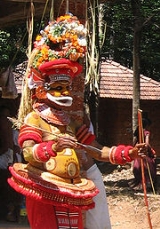
Theyyam

Encyclopedia
Theyyam or Theyyattam or Thira is a popular Hindu
ritual form of worship of North Malabar
in Kerala
state, India
, predominant in the Kolathunadu
area (consisting of present-day Kasargod, Kannur
Districts, Mananthavady
Taluk of Wayanad
and Vadakara & Koyilandy
Taluks of Kozhikode
of Kerala state. As a living cult with several thousand-year-old traditions, rituals and customs, it embraces almost all the castes and classes of the Hindu
religion in this region. The performers of Theyyam belong to the lower class community, and have an important position in Theyyam. This is unique, since only in Kerala
, do both the upper-caste Brahmins and lower-caste tribals share an important position in a major form of worship. The term Theyyam is a corrupt form of Devam or God. People of these districts consider Theyyam itself as a God and they seek blessings from this Theyyam. A similar custom is followed in the Tulu Nadu
region of neighbouring Karnataka
known as Bhuta Kola
, Parasurama sanctioned festivals like Kaliyattam
, Puravela and Daivattam or Theyyattam to the people of the North Malabar
region. He also assigned the responsibility of performing the Theyyam dance to the indigenous tribal communities like Malayar, Panan, Vannan and Velan. "There can be no doubt", say Bridget and Raymond Alchin, "that a very large part of this modern folk religion is extremely ancient and contains traits which originated during the earliest periods of Neolithic, Chalcolithic settlement and expression" and, indeed, Theyyam is representative of a form of Hinduism (albeit non-Brahminical) having been practised by tribal communities since time immemorial. This form of worship, often involving liquor and meat as offerings to Bhagawathi, Shiva, Vishnu, co-existed with the Sattvic rituals practised by Nambudiri Brahmins in temples. In fact, Theyyam was nearly always sponsored by members of the ruling class, such as Nair
feudal chiefs, and achieved much prominence, therefore Theyyam festivals and Temple festivals were celebrated with equal vigour. Theyyam is an art form of the Dravidians. And it has a revolutionary concept behind it since the Theyyam artists are from low-caste communities such as Malayan or Vanaan. Even the high-caste people will have to worship the gods came in the form of Theyyam, so it subverts the caste system in Kerala.
(Saraswati
), Vaishnavi
(Lakshmi
), and Shivani
(Durga
)).
Different branches of mainstream Hindu religion such as Shaktism
, Vaishnavism
and Shaivism
now dominate the cult of Theyyam. However, the forms of propitiation and other rituals are continuations of a very ancient tradition. In several cult-centres, blood offering is seen, despite being forbidden in sattvic Hinduism
, Jainism
and Buddhism
. In such centres, separate places outside the precincts of the shrine are selected for blood offering and for the preparation of the traditional Kalam known as Vatakkanvathil. The Theyyam deities propitiated through cock-sacrifice will not enter such shrines.
On account of the supposedly late revival of the Vaishnavism
movement in Kerala
, it does not have a deep impact on the Theyyam cult. Only a few deities are available under this category. Two major Theyyam deities of Vaishnavism are Vishnumoorthi and Daivathar. Vaishnavism was very popular in the Tuluva
region in the 13th century when it came under the rule of Vishnuvardhana
of the Hoysala dynasty. He was a great champion of Vaishnavism. Most probably he was initially deified as Vishnumoorthi and incorporated into the Bhoota cult of the Tuluvas and then further incorporated as a prominent folk deity into the Theyyam cult as well. To some, the legend of Vishnumoorthi is symbolizes the God's migration from Tulu Nadu
to Kolathunadu
.
All other categories of Theyyam deities can be classified under Shaivism
or Shaktism
. Even spirits, ancestors, heroes, and animals are deified and included in those categories. Briefly, Theyyam provides a good example for the religious evolution of, and the subsequent different stages in modern Hinduism
.
) community were patrons of Theyyam, and it was not uncommon for every Tharavadu to have its own Theyyam. However, the Nairs, like Brahmins, did not have the right to directly take part in the performance of Theyyam, as this privilege belonged only to the tribal communities. Despite this, out of devotion, ruling clans established their own shrines and Kavus for Theyyam deities where non-sattvic rituals and customs are observed. The Goddesses like Rakteshwari, Chamundi, Someshwari, Kurathi, and the Gods like Vishnumoorthi are propitiated in these house-hold shrines. There, the Theyyam dancers appear during the annual festivals of Gods and Goddesses. The rituals in such shrines are different from those of the Brahminical temples. The impact of this cultural fusion could be traced to the social organization based on the caste system and in the agrarian relations. Once the cult was patronized by the Brahmins, the intermediate and lower castes also took it as a major religious practice. In fact the cult has become the religion of the masses.
. It is also performed in the houses as ancestor-worship with elaborate rites and rituals.
There is no stage
or curtain or other such arrangements for the performance. The devotees would be standing or some of them would be sitting on a sacred tree in front of the shrine. In short, it is an open theatre. A performance of a particular deity
according to its significance and hierarchy in the shrine continues for 12 to 24 hours with intervals. The chief dancer who propitiates the central deity of the shrine has to reside in the rituals. This may be due to the influence of Jainism
and Buddhism
. Further, after the sun sets, this particular dancer would not eat anything for the remainder of that day (again possibly on account of a legacy of Jainism). His make-up is done by specialists and other dancers. The first part of the performance is usually known as Vellattam or Thottam. It is performed without proper make-up or any decorative costume
. Only a small, red headdress is worn on this occasion.
The dancer along with the drummers recites the particular ritual song, which describes the myths and legends, of the deity of the shrine or the folk
deity to be propitiated. This is accompanied by the playing of folk musical instruments. After finishing this primary ritualistic part of the invocation, the dancer returns to the green room
. Again after a short interval he appears with proper make-up and costumes. There are different patterns of face-painting. Some of these patterns are called vairadelam, kattaram, kozhipuspam, kotumpurikam, and prakkezhuthu. Mostly primary and secondary colours are applied with contrast for face painting. It helps in effecting certain stylization in the dances. Then the dancer comes in front of the shrine and gradually “metamorphoses” into the particular deity of the shrine. He, after observation of certain rituals places the head-dress on his head and starts dancing. In the background, folk musical instruments like chenda
, tuti, kuzhal and veekni are played in a certain rhythm. All the dancers take a shield and kadthala (sword
) in their hands as continuation of the cult
of weapons. Then the dancer circumambulates the shrine, runs in the courtyard and continues dancing there. The Theyyam dance has different steps known as Kalaasams. Each Kalaasam is repeated systematically from the first to the eighth step of footwork. A performance is a combination of playing of musical instruments, vocal recitations, dance, and peculiar makeup and costumes. The stage-practices of Theyyam and its ritualistic observations make it one of the most fascinating theatrical arts of India.
Story of Sree Muthappan Madappura, Nileshwar
Several Muthappan Temples are seen in different parts of Kannur
and Kasaragod district
s. This shows the popularity of the God in the minds of the people of North Malabar. The Sree Muthappan Temple near National Highway No 17 in Nileshwar has a rich heritage. It seems to convey the philosophical, devotional and educational importance of Nileshwar. There is an interesting story regarding the construction of this Muthappan Temple. It is related to a certain Koroth Raman Nair, famous as Ezuthachan (expert in teaching). He had a practice of drinking madhu (taken from coconut tree with out mixing any intoxicant, fresh and good for health popularly called as 'neera'). Before drinking it, he would pour some drops of in front of a jack fruit tree by saying it is for God Muthappan. After his death, the natives faced a lot of disturbances. They obtained the services of an astrologer on the issue. He concluded that as a result of the regular practice of giving madhu to Muthappan the God had started residing there and demanded the continued offer of liquor. The death of Sree Raman Nair had resulted in liquor not being served any more to the God and this had provoked Him to create trouble. So a temple was erected at the spot by the local people. This temple developed as a famous pilgrim center, and daily hundreds of people visit it. There is a strong belief that the God will cure all diseases and will give prosperity to His devotees. The devotees get Payakutti from the temple and it continues to develop as a great pilgrim center like the Sree Muthappan temple at Parassini Kadavu. Around 100 Muthappan Vellattams are held each year in the Madappura as offerings from the devotees.
District. Sree Muthappan temple also situated in Cheemeni also.
The same has been performed in Muchilott Kavu, in Payyanur
.
Marathakkad sri iver paradevatha kshethram,kuppam,taliparamba on makaram 25 to makaram 28.
Marathakkad sri iver paradevatha kshethram,kuppam,taliparamba on makaram 25 to makaram 28.
ani caste is one of the Kavu were Puthiya Bhagavathi is performed. April 17 to 19 is the time of Kaliyattam here
Marathakkad sri iver paradevatha kshethram,kuppam,taliparamba on makaram 25 to makaram 28.
, Kannur
District, and the deities in the Theyyam here are Paruthi Veeran, Veerali, Bhadrakali, Vishnumoorthi, Gulikan and Vairabhan Uchitta.
and is done so in memory of a Kolakkaran [Theyyam artist] who died while staging Theyyam in the famous Karakkakavu.
. But in the Chuzhali Bhagavathy Temple no Theyyam performance is held. Here Brahmins serve as priests.
Chuzhali Bhagavathi temple is not a kavu. Chuzhali Devaswom is the term used to identify the temple
community. The "Vigraham" of Bhagavathi was brought to Chuzhali and hidden in some fields. Some kids when playing, tried to clean the place using a broom, and found the ground bleeding, and got scared and informed elders. They found the "vigraham" and the temple was built there itself.
district, and they are all located in the Payyannur area:-
). Traditions hold that She helped him defeat the Bellakka Dynasty in battle. After that, he constructed a new Sambradayam called 'Varikkulam', and the Goddess is believed to have asked him to build a Palliyara at Parakulangara, Varikkulam. This place was selected by the Goddess as per Thrikkannayalappan's (Lord Shiva) instructions. Gurukkal built the first Kodoth Tharavadu very near to Parakulangara, at Varikkulam which is known as the Moolasthanam of Kodoth Tharavadu, and then started celebrating Kaliyattam every year beginning from Medam 21. This is the first place where Goddess Chamundi is believed to have shown her presence, and later she is believed to have extended her presence to many other Nair Tharavadus, subsequently resulting in their starting to conduct Kaliyattam as well every year.
region. The strength of the Karnataka
forces frightened the Nileshwar Raja's Nair
soldiers under the command of the Kalari
experts, the Koroth Nairs. They prayed to the Koroth Nāga
Bhagavathy, Kuttichathans [Sasthappan] and Bhairavan. The Gods acknowledged the appeals of the devotees and sent Padamadakki Bhagavathy. It is believed that upon seeing the Padamadakki Bhagavathy, the invading troops became unconscious and the Goddess thus averted a battle. Yearly, the Padamadakki Bhagavathy Theyyam is being performed in the Karoth temple in Kunhimangalam Panchayath in memory of the incident.
Tharavadu
(household) known as Manakkott. Here lived a beautiful and educated woman. She wanted to challenge the caste rigidities and untouchability prevailing in the area. While she was carrying a child, she broke the caste law by drinking water from a pot made of aracanut leaf being used by an outcast. The incident provoked the Tharavadu Karanavar (head) and he murdered the woman. The murder of a pregnant woman created a lot of problems in the Tharavadu and it finally ceased to exist. Gradually the natives realised that the assassinated woman must have emerged as a Goddess who they called Manakkott Amma. Yearly, the Theyyam here is being performed in the Vairajathan Temple, Malappacherry, Nileshwar in the month of April.
District. From the beginning to the end the Theyyam drags into the ground. Devotees worship this deity to cure diseases.
every year on the 10th day of Thulam month in the Malayalam calendar.
who came from Chembilot, a place near Kannur
to Chandera, in Kasaragod district
. That man started his livelihood as a priest in the temple in Chandera. After several years of serving the God he got His blessings. Then he left Chandera handing over the priestly rights to Olavara Theeyan. The Brahmin
has since been worshiped as Chembilot Bhagavathy by the natives.
on 30 March 2008.
. The Koroth Namboothiris were mentioned in the story of Vishnumoorthi Temple, Cheemeni. Ayillam day is famous for the Sarpabali in the Temple. Lakhs of people from different parts of Kerala
, Karnataka
and Tamil Nadu
annually assemble here to on this religious occasion. Various factors contributed to the disintegration of Koroth Tharavadu into several small groups. They helped the Rajas of Wayanadu, the Kozhikode
Zamorin, the Kolathiris and others. The word Koroth derives from 'Ko' meaning King and 'Othikkan' meaning regulators.
Myths around the Koroth Tharavadu: There is a long recorded history surrounding the Nair Tharavadu of Koroth. Firstly, it is necessary to know about Nairs. The nair equal the word knights in the ancient feudal system of Europe. The Tharavad name Koroth is popular in Kerala. They were years ago acted as chieftains in a large area and arranged Kalaripayattu and other martial arts and supplied soldiers to the Zamorins, Kolathiris and Nileshwar rajas. They sometimes acted as king makers. The name derived from Ko means King and Othikan means regulator. Based on Ayiyur the political conditions influenced them to move north wards up to the Chandragiri river. They feared to cross Chandragirui river because of losing their caste. The establishment of Kolathunad and Nileshwar raja vamsam related to this migration. Likewise the theyyattams also spread to the north and gradually influenced by the Tulu culture. Originally the male members of the Koroth tharavad related to Kalaripayattu and the famous Lokararkavu. The influence of Kalaripayattu was present in theyyattams. Disintegrating from the origin land the members of the Tharavad settled in different parts of north Malabar like koroth near Payyanur, Nileshwar, Taliparamba, Pallur near Tellicherry, mahe, Vadakara etc. The branches of the koroth Tharavad influenced the social, religious, cultural and economic condition of north Malabar for the last 5 centuries. While residing in different parts, they continued the practice of Nagaradhana [Ayillyam][snake worship], worshipping God Shiva, Vishnu large number of other gods and goddesses. They organised theyyam festival. In all branches they worshiped bairavan, Kuttichathan and Karnor theyyams. Their history also related Tacholi Othenan and other martial heroes of North Malabar.
Branches of Koroth Tharavad: From the original home Ayiyur the Koroth Tharavad disintegrated and settled in different parts of Kannur, Kozikode and Kasaragod districts. The tharavad name koroth is popular in kerala. Koroth tharavad [group of families] at Koyipra is situated near Taliparamba. Koroth tharavad [group of families] at Nileshwar is famous as per the story of Mannampurath bagavathi and also got fame in the origin of Nileshwar Muthappan Madappura, defending of Tippu Sulthan according to the myth of Nechitholedutho Nayammare, and annual Kaliyattams [theyyam festival]. Karnor Bairavan, Dharmadaivam, Kuttichattan, Rakta chamundi, Vishnumoorthi, Dandiganath bagavathi, Padarkulangara bagavathi, Gulikan, Bhootham were performed in the annual kaliyattams. The koyyodan koroth Tharavad at Pallur, near Thallisseri is famous for the grand theyyam festival in the month of Makaram. As many as 40 kuttichathan theyyams come out together to give blessings to the devotees. Thousands of people assemble there to watch the marvellous divine performance of the theyya kolams. On 31 January 2008 at 1pm 38 kuttichattan theyyams were performed their divinity as a part of devotees vayipad. More than ninety kuttichattans are planned but because of the absence of Koladarikal the number reduced to 38. The remaining kuutichathans performed in 2009 corresponding the malayalam month of Makaram 16 [as per the malabar calendar]. The main karmi of Koyyodan temple visited regularly in the Kalakkattillam
near Koroth [a place near Payyanur]on the day of Krim Kuttichathan Theyyam. The illam is considered as the root of Kuttichathan Theyyam. The presence of Koroth families [Kodakkal Koroth remains there] years ago gave the name Koroth to the place. Kodakkal Koroth tharavad members played a great role in regulating the history of Payyanur and the neighbouring places for the last three centuries. In Nileshwar the Nairs belongings to Koroth family helped the rajas of Nileshwar in several campaigns against the neighbouring rulers. Another branch of the Tharavad is known as pommeleri koroth. There are Mundayadan koroth near Kannur and Koyipra Koroth tharavad near Taliparamba. The puthalath koroth in Mahe earns fame as the centre of famous puthalath thira and the association with leaders including Mahatma Gandhi.
.
On Dhanu 21 at Sree Vettakkorumakan Temple, Blathur
.Thiyyas consider Vayantttu Kulavan as their 'Thondachan'(elder member of the family) In 2008, the Vayanat Kulavan Theyyamket Mahotsavam was held in a certain Pattayil Tharavadu. It will always be remembered as a huge step in the direction of communal harmony. Hindus and Muslims both participated in the arrangements for the festival with great enthusiasm.
Katoor Nairs actually belong to the Ballal community of Sullia, who had to flee to Tulurvanam for fear of conversion to Jainism.
The main seat of Kalari payattu, Munnayareeshwaran is the son of Katoor Kanna Ballal, an exponent of Tulunadan system of Kalari.
Munnayareeshwaran is the Ketti kolam (Theyyam form) of Chandu Nair, who became a Deewan of Kizhakke Kovilakam under the rule of Katoor Nairs.
Katoor Narayanan Nambiar was the last Managing trustee and ruler of Karike Tulunad, Manjandukkam Kovilakam Temple. Thereafter Katoor Thampan Nair, his eldest nephew is running the activities of Manjadukkam. Manjadukkam Kovilakam follows matrilineal
system of transfer of succession.
The temple stands in utter dilapidated state, thanks to the infighting between the sons of Katoor Narayanan Nambiar and the rightful heirs, the nephews.
It is saddening to note that a long and time tested parampara of Shakti worship is slowly losing its fight to survive.
Performed yearly in Kelambathu Tharavadu Kottam, Blathur, Kannur on 23rd Makaram.
Hindu
Hindu refers to an identity associated with the philosophical, religious and cultural systems that are indigenous to the Indian subcontinent. As used in the Constitution of India, the word "Hindu" is also attributed to all persons professing any Indian religion...
ritual form of worship of North Malabar
North Malabar
North Malabar , is a historic as well as geographic distinction in India used to refer the area covering; present Kasaragod and Kannur Districts, Mananthavady taluk of Wayanad District and Koyilandy & Vatakara taluks of Kozhikode District in modern Kerala and the entire Mahé sub-Division of...
in Kerala
Kerala
or Keralam is an Indian state located on the Malabar coast of south-west India. It was created on 1 November 1956 by the States Reorganisation Act by combining various Malayalam speaking regions....
state, India
India
India , officially the Republic of India , is a country in South Asia. It is the seventh-largest country by geographical area, the second-most populous country with over 1.2 billion people, and the most populous democracy in the world...
, predominant in the Kolathunadu
Kolathunadu
Kolathunādu was one of the three most powerful feudal kingdoms on the Malabar Coast during the arrival Portuguese Armadas to India along with Zamorin's Calicut and Venad. Kolathunād had its capital at Ezhimala and was ruled by Kolathiri royal family and roughly comprised the whole northern...
area (consisting of present-day Kasargod, Kannur
Kannur district
Kannur District is one of the 14 districts in the state of Kerala, India. The town of Kannur is the district headquarters, and gives the district its name. The old name Cannanore is the anglicised form of the Malayalam name Kannur. Kannur District is bounded by Kasaragod District to the north and...
Districts, Mananthavady
Mananthavady
Mananthavady is a small town on the banks of Mananthavady Puzha a tributary of the Kabini River in the Wayanad district of Kerala, India.This area was once ruled by the Pazhassi dynasty and the tomb of Pazhassi Raja is an important heritage site located in the heart of the town. This is also the...
Taluk of Wayanad
Wayanad District
Wayanad District in the north-east of Kerala, India, was formed on November 1, 1980 as the 12th district by carving out areas from Kozhikode and Kannur districts. Kalpetta is the district headquarters as well as the only municipal town in the district. The region was known as Mayakshetra in the...
and Vadakara & Koyilandy
Koyilandy
Koyilandy is a city and a municipality in Kozhikode district in North Malabar region of the Indian state of Kerala. This town is between Calicut and Badagara and is on NH 17. It can be identified with Tyndis in Periplus of the Erythraean Sea. The freedom fighter K...
Taluks of Kozhikode
Kozhikode district
Kozhikode District , formerly Calicut, is a district of Kerala state, situated on the southwest coast of India. The city of Kozhikode, also known as Calicut, is the district headquarters. The district is 38.25% urbanised...
of Kerala state. As a living cult with several thousand-year-old traditions, rituals and customs, it embraces almost all the castes and classes of the Hindu
Hindu
Hindu refers to an identity associated with the philosophical, religious and cultural systems that are indigenous to the Indian subcontinent. As used in the Constitution of India, the word "Hindu" is also attributed to all persons professing any Indian religion...
religion in this region. The performers of Theyyam belong to the lower class community, and have an important position in Theyyam. This is unique, since only in Kerala
Kerala
or Keralam is an Indian state located on the Malabar coast of south-west India. It was created on 1 November 1956 by the States Reorganisation Act by combining various Malayalam speaking regions....
, do both the upper-caste Brahmins and lower-caste tribals share an important position in a major form of worship. The term Theyyam is a corrupt form of Devam or God. People of these districts consider Theyyam itself as a God and they seek blessings from this Theyyam. A similar custom is followed in the Tulu Nadu
Tulu Nadu
Tulu Nadu is a Tulu-speaking region spread over to parts of present Karnataka and Kerala States of India. It consists of the Dakshina Kannada and Udupi districts of Karnataka and the northern parts of the Kasaragod district of Kerala up to the Payaswini River...
region of neighbouring Karnataka
Karnataka
Karnataka , the land of the Kannadigas, is a state in South West India. It was created on 1 November 1956, with the passing of the States Reorganisation Act and this day is annually celebrated as Karnataka Rajyotsava...
known as Bhuta Kola
History
According to the legendary KeralolpathiKeralolpathi
The Keralolpathi is a Malayalam work that deals with the origin of the land of Kerala. Shungunny Menon ascribes the authorship of this work to Thunchaththu Ramanujan Ezhuthachan, a 17th century scholar of the Malabar region of India. The Keralolpathi is mostly an expansion from an earlier Sanskrit...
, Parasurama sanctioned festivals like Kaliyattam
Kaliyattam
Kaliyattam is a 1997 Malayalam film directed by Jayaraaj, and starring Suresh Gopi, Lal, and Manju Warrier. The film is an adapted version of William Shakespeare's play Othello against the backdrop of the Hindu Theyyam performance...
, Puravela and Daivattam or Theyyattam to the people of the North Malabar
North Malabar
North Malabar , is a historic as well as geographic distinction in India used to refer the area covering; present Kasaragod and Kannur Districts, Mananthavady taluk of Wayanad District and Koyilandy & Vatakara taluks of Kozhikode District in modern Kerala and the entire Mahé sub-Division of...
region. He also assigned the responsibility of performing the Theyyam dance to the indigenous tribal communities like Malayar, Panan, Vannan and Velan. "There can be no doubt", say Bridget and Raymond Alchin, "that a very large part of this modern folk religion is extremely ancient and contains traits which originated during the earliest periods of Neolithic, Chalcolithic settlement and expression" and, indeed, Theyyam is representative of a form of Hinduism (albeit non-Brahminical) having been practised by tribal communities since time immemorial. This form of worship, often involving liquor and meat as offerings to Bhagawathi, Shiva, Vishnu, co-existed with the Sattvic rituals practised by Nambudiri Brahmins in temples. In fact, Theyyam was nearly always sponsored by members of the ruling class, such as Nair
Nair
Nair , also known as Nayar , refers to "not a unitary group but a named category of castes", which historically embody several castes and many subdivisions, not all of whom bore the Nair title. These people historically live in the present-day Indian state of Kerala...
feudal chiefs, and achieved much prominence, therefore Theyyam festivals and Temple festivals were celebrated with equal vigour. Theyyam is an art form of the Dravidians. And it has a revolutionary concept behind it since the Theyyam artists are from low-caste communities such as Malayan or Vanaan. Even the high-caste people will have to worship the gods came in the form of Theyyam, so it subverts the caste system in Kerala.
Classification of Sub Cults
It can be said that all the prominent characteristics of primitive, tribal, religious worship had widened the stream of Theyyam cult and made it a deep-rooted folk religion of millions. For instance, the cult of Bhagawathi, the Mother Goddesses had and still has an important place in Theyyam. Besides this, the practices like spirit-worship, ancestor-worship, hero-worship, masathi-worship, tree-worship, animal worship, serpent-worship, the worship of the Goddesses of disease and the worship of Graamadevataa (Village-Deity) are included in the main stream of the Theyyam cult. Along with these Gods and Goddesses there exist innumerable folk Gods and Goddesses. Most of these Goddesses are known as Bhagavathy (the Mother-Goddess that is the Divine and United form of the three principal Goddesses namely, BrahmaniBrahmani
In Hinduism, Brahmani is a kind and benevolent aspect of Devi, the Divine mother. Brahmani is associated with the Hindu creator god, Brahma as His consort or Shakti . She is one of the seven Mother Goddesses called Matrikas.-As Kuldevi:Many Kshatriya clans consider Her to be their Kuldevi...
(Saraswati
Saraswati
In Hinduism Saraswati , is the goddess of knowledge, music, arts, science and technology. She is the consort of Brahma, also revered as His Shakti....
), Vaishnavi
Vaishnavi
Vaishnavi is a legendary figure in the Hindu tradition and the Consort of Lord Vishnu. According to the legend, she was an incarnation of the Divine Mother, or Shakti....
(Lakshmi
Lakshmi
Lakshmi or Lakumi is the Hindu goddess of wealth, prosperity , light, wisdom, fortune, fertility, generosity and courage; and the embodiment of beauty, grace and charm. Representations of Lakshmi are also found in Jain monuments...
), and Shivani
Shivani
Gaura Pant 'Shivani' , better known as Shivani, was one of the popular Hindi magazine story writers of the 20th century and a pioneer in writing Indian women based fiction. She was awarded the Padma Shri for her contribution to Hindi literature in 1982...
(Durga
Durga
For the 1985 Hindi Film of Rajesh Khanna see DurgaaIn Hinduism, Durga ; ; meaning "the inaccessible" or "the invincible"; , durga) or Maa Durga "one who can redeem in situations of utmost distress" is a form of Devi, the supremely radiant goddess, depicted as having eighteen arms, riding a lion...
)).
Different branches of mainstream Hindu religion such as Shaktism
Shaktism
Shaktism is a denomination of Hinduism that focuses worship upon Shakti or Devi – the Hindu Divine Mother – as the absolute, ultimate Godhead...
, Vaishnavism
Vaishnavism
Vaishnavism is a tradition of Hinduism, distinguished from other schools by its worship of Vishnu, or his associated Avatars such as Rama and Krishna, as the original and supreme God....
and Shaivism
Shaivism
Shaivism is one of the four major sects of Hinduism, the others being Vaishnavism, Shaktism and Smartism. Followers of Shaivism, called "Shaivas," and also "Saivas" or "Saivites," revere Shiva as the Supreme Being. Shaivas believe that Shiva is All and in all, the creator, preserver, destroyer,...
now dominate the cult of Theyyam. However, the forms of propitiation and other rituals are continuations of a very ancient tradition. In several cult-centres, blood offering is seen, despite being forbidden in sattvic Hinduism
Hinduism
Hinduism is the predominant and indigenous religious tradition of the Indian Subcontinent. Hinduism is known to its followers as , amongst many other expressions...
, Jainism
Jainism
Jainism is an Indian religion that prescribes a path of non-violence towards all living beings. Its philosophy and practice emphasize the necessity of self-effort to move the soul towards divine consciousness and liberation. Any soul that has conquered its own inner enemies and achieved the state...
and Buddhism
Buddhism
Buddhism is a religion and philosophy encompassing a variety of traditions, beliefs and practices, largely based on teachings attributed to Siddhartha Gautama, commonly known as the Buddha . The Buddha lived and taught in the northeastern Indian subcontinent some time between the 6th and 4th...
. In such centres, separate places outside the precincts of the shrine are selected for blood offering and for the preparation of the traditional Kalam known as Vatakkanvathil. The Theyyam deities propitiated through cock-sacrifice will not enter such shrines.
On account of the supposedly late revival of the Vaishnavism
Vaishnavism
Vaishnavism is a tradition of Hinduism, distinguished from other schools by its worship of Vishnu, or his associated Avatars such as Rama and Krishna, as the original and supreme God....
movement in Kerala
Kerala
or Keralam is an Indian state located on the Malabar coast of south-west India. It was created on 1 November 1956 by the States Reorganisation Act by combining various Malayalam speaking regions....
, it does not have a deep impact on the Theyyam cult. Only a few deities are available under this category. Two major Theyyam deities of Vaishnavism are Vishnumoorthi and Daivathar. Vaishnavism was very popular in the Tuluva
Tuluva
The Tuluva -Geographic Distribution :Though most of the Tuluva population is found in the Tulu Nadu region, migrant poplulations are found the world over. In recent times, the first period of migration started at the beginning of the 20th century to places such as Mumbai and Chennai and other...
region in the 13th century when it came under the rule of Vishnuvardhana
Vishnuvardhana
Vishnuvardhana was an emperor of the Hoysala Empire in present day Indian state of Karnataka. Vishnuvardhana took the first step in consolidating the Hoysala Empire in South India through a series of battles against his overlords, the Western Chalukya empire...
of the Hoysala dynasty. He was a great champion of Vaishnavism. Most probably he was initially deified as Vishnumoorthi and incorporated into the Bhoota cult of the Tuluvas and then further incorporated as a prominent folk deity into the Theyyam cult as well. To some, the legend of Vishnumoorthi is symbolizes the God's migration from Tulu Nadu
Tulu Nadu
Tulu Nadu is a Tulu-speaking region spread over to parts of present Karnataka and Kerala States of India. It consists of the Dakshina Kannada and Udupi districts of Karnataka and the northern parts of the Kasaragod district of Kerala up to the Payaswini River...
to Kolathunadu
Kolathunadu
Kolathunādu was one of the three most powerful feudal kingdoms on the Malabar Coast during the arrival Portuguese Armadas to India along with Zamorin's Calicut and Venad. Kolathunād had its capital at Ezhimala and was ruled by Kolathiri royal family and roughly comprised the whole northern...
.
All other categories of Theyyam deities can be classified under Shaivism
Shaivism
Shaivism is one of the four major sects of Hinduism, the others being Vaishnavism, Shaktism and Smartism. Followers of Shaivism, called "Shaivas," and also "Saivas" or "Saivites," revere Shiva as the Supreme Being. Shaivas believe that Shiva is All and in all, the creator, preserver, destroyer,...
or Shaktism
Shaktism
Shaktism is a denomination of Hinduism that focuses worship upon Shakti or Devi – the Hindu Divine Mother – as the absolute, ultimate Godhead...
. Even spirits, ancestors, heroes, and animals are deified and included in those categories. Briefly, Theyyam provides a good example for the religious evolution of, and the subsequent different stages in modern Hinduism
Hinduism
Hinduism is the predominant and indigenous religious tradition of the Indian Subcontinent. Hinduism is known to its followers as , amongst many other expressions...
.
Patronage
The ruling landlord communities like the Nambiars and the Thiyya(ezhavaEzhava
The Ezhavas are a community with origins in the region presently known as Kerala. They are also known as Ilhava, Irava, Izhava and Erava in the south of the region; as Chovas, Chokons and Chogons in Central Travancore; and as Tiyyas, Thiyas and Theeyas in Malabar...
) community were patrons of Theyyam, and it was not uncommon for every Tharavadu to have its own Theyyam. However, the Nairs, like Brahmins, did not have the right to directly take part in the performance of Theyyam, as this privilege belonged only to the tribal communities. Despite this, out of devotion, ruling clans established their own shrines and Kavus for Theyyam deities where non-sattvic rituals and customs are observed. The Goddesses like Rakteshwari, Chamundi, Someshwari, Kurathi, and the Gods like Vishnumoorthi are propitiated in these house-hold shrines. There, the Theyyam dancers appear during the annual festivals of Gods and Goddesses. The rituals in such shrines are different from those of the Brahminical temples. The impact of this cultural fusion could be traced to the social organization based on the caste system and in the agrarian relations. Once the cult was patronized by the Brahmins, the intermediate and lower castes also took it as a major religious practice. In fact the cult has become the religion of the masses.
Performance
The dance or invocation is generally performed in front of the village ShrineShrine
A shrine is a holy or sacred place, which is dedicated to a specific deity, ancestor, hero, martyr, saint, daemon or similar figure of awe and respect, at which they are venerated or worshipped. Shrines often contain idols, relics, or other such objects associated with the figure being venerated....
. It is also performed in the houses as ancestor-worship with elaborate rites and rituals.
There is no stage
Stage (theatre)
In theatre or performance arts, the stage is a designated space for the performance productions. The stage serves as a space for actors or performers and a focal point for the members of the audience...
or curtain or other such arrangements for the performance. The devotees would be standing or some of them would be sitting on a sacred tree in front of the shrine. In short, it is an open theatre. A performance of a particular deity
Deity
A deity is a recognized preternatural or supernatural immortal being, who may be thought of as holy, divine, or sacred, held in high regard, and respected by believers....
according to its significance and hierarchy in the shrine continues for 12 to 24 hours with intervals. The chief dancer who propitiates the central deity of the shrine has to reside in the rituals. This may be due to the influence of Jainism
Jainism
Jainism is an Indian religion that prescribes a path of non-violence towards all living beings. Its philosophy and practice emphasize the necessity of self-effort to move the soul towards divine consciousness and liberation. Any soul that has conquered its own inner enemies and achieved the state...
and Buddhism
Buddhism
Buddhism is a religion and philosophy encompassing a variety of traditions, beliefs and practices, largely based on teachings attributed to Siddhartha Gautama, commonly known as the Buddha . The Buddha lived and taught in the northeastern Indian subcontinent some time between the 6th and 4th...
. Further, after the sun sets, this particular dancer would not eat anything for the remainder of that day (again possibly on account of a legacy of Jainism). His make-up is done by specialists and other dancers. The first part of the performance is usually known as Vellattam or Thottam. It is performed without proper make-up or any decorative costume
Costume
The term costume can refer to wardrobe and dress in general, or to the distinctive style of dress of a particular people, class, or period. Costume may also refer to the artistic arrangement of accessories in a picture, statue, poem, or play, appropriate to the time, place, or other circumstances...
. Only a small, red headdress is worn on this occasion.
The dancer along with the drummers recites the particular ritual song, which describes the myths and legends, of the deity of the shrine or the folk
Folk religion
Folk religion consists of ethnic or regional religious customs under the umbrella of an organized religion, but outside of official doctrine and practices...
deity to be propitiated. This is accompanied by the playing of folk musical instruments. After finishing this primary ritualistic part of the invocation, the dancer returns to the green room
Green room
In British English and American English show business lexicon, the green room is that space in a theatre, a studio, or a similar venue, which accommodates performers or speakers not yet required on stage...
. Again after a short interval he appears with proper make-up and costumes. There are different patterns of face-painting. Some of these patterns are called vairadelam, kattaram, kozhipuspam, kotumpurikam, and prakkezhuthu. Mostly primary and secondary colours are applied with contrast for face painting. It helps in effecting certain stylization in the dances. Then the dancer comes in front of the shrine and gradually “metamorphoses” into the particular deity of the shrine. He, after observation of certain rituals places the head-dress on his head and starts dancing. In the background, folk musical instruments like chenda
Chenda
The Chenda is a cylindrical percussion instrument used widely in the state of Kerala, and Tulu Nadu of Karnataka State in India. In Tulu Nadu it is known as Chande....
, tuti, kuzhal and veekni are played in a certain rhythm. All the dancers take a shield and kadthala (sword
Sword
A sword is a bladed weapon used primarily for cutting or thrusting. The precise definition of the term varies with the historical epoch or the geographical region under consideration...
) in their hands as continuation of the cult
Cult
The word cult in current popular usage usually refers to a group whose beliefs or practices are considered abnormal or bizarre. The word originally denoted a system of ritual practices...
of weapons. Then the dancer circumambulates the shrine, runs in the courtyard and continues dancing there. The Theyyam dance has different steps known as Kalaasams. Each Kalaasam is repeated systematically from the first to the eighth step of footwork. A performance is a combination of playing of musical instruments, vocal recitations, dance, and peculiar makeup and costumes. The stage-practices of Theyyam and its ritualistic observations make it one of the most fascinating theatrical arts of India.
Various Types of Theyyem
Though one cannot imagine the exact figure of Theyyam, there are approximately 400 types of theyyam. Details about some of the Theyyam are narrated below:Sree Muthappan Theyyam
While other Theyyams are seasonal (the season lasting October to May), the Muthappan Theyyam is performed round the year. Muthappan temples are present in hundreds of places in North Malabar. Each of them tells a story of its own. Among the Muthappan temples, Kunnathur Padi and Parassini Kadavu have attained the most fame. The rituals in the Muthappan temples are done by the Thiyya community of malabar.Story of Sree Muthappan Madappura, Nileshwar
Several Muthappan Temples are seen in different parts of Kannur
Kannur
Kannur , also known as Cannanore, is a city in Kannur district in the Indian state of Kerala. It is the administrative headquarters of the District of Kannur and 518km north of state capital Trivandrum. During British rule in India, Kannur was known by its old name Cannanore, which is still in...
and Kasaragod district
Kasaragod district
Kasaragod District is one of the districts of the Indian state of Kerala. Kasaragod District was organised as a separate district on 24 May 1984...
s. This shows the popularity of the God in the minds of the people of North Malabar. The Sree Muthappan Temple near National Highway No 17 in Nileshwar has a rich heritage. It seems to convey the philosophical, devotional and educational importance of Nileshwar. There is an interesting story regarding the construction of this Muthappan Temple. It is related to a certain Koroth Raman Nair, famous as Ezuthachan (expert in teaching). He had a practice of drinking madhu (taken from coconut tree with out mixing any intoxicant, fresh and good for health popularly called as 'neera'). Before drinking it, he would pour some drops of in front of a jack fruit tree by saying it is for God Muthappan. After his death, the natives faced a lot of disturbances. They obtained the services of an astrologer on the issue. He concluded that as a result of the regular practice of giving madhu to Muthappan the God had started residing there and demanded the continued offer of liquor. The death of Sree Raman Nair had resulted in liquor not being served any more to the God and this had provoked Him to create trouble. So a temple was erected at the spot by the local people. This temple developed as a famous pilgrim center, and daily hundreds of people visit it. There is a strong belief that the God will cure all diseases and will give prosperity to His devotees. The devotees get Payakutti from the temple and it continues to develop as a great pilgrim center like the Sree Muthappan temple at Parassini Kadavu. Around 100 Muthappan Vellattams are held each year in the Madappura as offerings from the devotees.
Padikutti Amma
Padikuttiyamma is believed to be the mother of God Muthappan and supposedly took care of Him for several years. After Muthappan came to be considered a God, Padikutti Amma has been worshipped as a Goddess. The Theyyam Padikutti Amma has been performed in the famous Palaprath Temple, at Kodallur. Kodallur is a place near Parassini Kadavu that attained fame as a result of the performances of the Padikutti Amma Theyyam in the Malayalam month of Meenam every year. There is a famous temple for Padikutti Amma at Eruvessi, called Sree Padikkutti Mahadevi Temple. Eruvessi is 10 kilometres away from Sreekandapuram in KannurKannur
Kannur , also known as Cannanore, is a city in Kannur district in the Indian state of Kerala. It is the administrative headquarters of the District of Kannur and 518km north of state capital Trivandrum. During British rule in India, Kannur was known by its old name Cannanore, which is still in...
District. Sree Muthappan temple also situated in Cheemeni also.
Muthappan Anthithir
Muthappan Anthithira is performed only once in all the Muthappan temples of North Malabar. The decoration of Muthappan Anthithira resembles that of Vettakorumakan from the front and that of Muthappan from the back. In July 2008, Muthappan Anthithira was performed in front of thousands of devotees in the famous Muthappan Madappura Temple, Nileshwar.Padarkulangara Bhagavathy
Worshipped in several Kavus as a mighty Goddess. This Theyyam was last performed in the Nileshwar Ankakalari Padarkulangara Bhagavathy Temple on 23 December 2008. The lengthy crown and ornaments of the Bhagavathy seem to add to her divine appearance. In the famous Koroth tharavad in Nileshwar the Padarkulangara Bagavathi Theyyam has been performed every year by the famous theyyam artist Suresh Babu Anjoottan.The same has been performed in Muchilott Kavu, in Payyanur
Payyanur
Payyanur is a Municipal Town situated at the northern end of Kannur district in North Malabar region of Kerala, India. This Municipality consists of three administrative villages viz. Vellur, Korom and Payyannur. Other villages are; Annur and Kokkanissery....
.
Puliyur Kali
Performed in Karakkakavu, near Cheruvathur every three years. It is also performed in Kunathur Maadam near to Udinur. In all Muchilotu Kavu this kolam is performed with Kannangattu Bhagavathy and Muchilottu Bhagavathy. Thekkum Kara Karnamoorthy performs this kolam in Kunathur Maadam, which is the places for Payyadakkathu Tharavadu. This goddess is believed to be the daughter of Pullikarim Kali.Marathakkad sri iver paradevatha kshethram,kuppam,taliparamba on makaram 25 to makaram 28.Pullikarim Kali
Pullikarimkali is performed in Karakkakavu, near Cheruvathur once every three years and at Koovapratthu Kavu Kavinisseri (in Cherukunnu) every two years. The Theyyam here is worshipped as the Goddess Parvathi. This theyyam is also performed in Koormba Bhagavathi Kavu, Kandoth and Sri Udayapuram Kavu, Paravanthatta, Payyanur.Marathakkad sri iver paradevatha kshethram,kuppam,taliparamba on makaram 25 to makaram 28.Pulikandan
Pullikaringali is a goddess which is worshipped in Kasaragod and Kannur district. It is the avathara of Parvathi. She originated to kill Kalakandasura. Ayirathiri is the important function related to Pullikaringali, we can see Pullikaringali Amma in Aivar Paradevatha Sthanangal of Malabar. Periya Sree Pulibhootha Devasthanam, Kizhakkam kara Pullikkaringali Devasthanam, Kasaragod Pulikkunnu, Kodavanchi Kulathur are the important temples where Pullikaringali Amma.Marathakkad sri iver paradevatha kshethram,kuppam,taliparamba on makaram 25 to makaram 28.Marapuli
Marapuli Theyyam is considered the son of Pulikandan and Pullikarimkali.Marathakkad sri iver paradevatha kshethram,kuppam,taliparamba on makaram 25 to makaram 28.
Kandapuli
This Theyyam is considered the son of Pulikandan and Pullikarimkali. It is performed in the early morning at about 3 am.Marathakkad sri iver paradevatha kshethram,kuppam,taliparamba on makaram 25 to makaram 28.Pulimaruthan
Pulimaruthan Theyyam is considered the son of Pulikandan and Pullikarimkali. One among the Iver Theyyams, Pulimaruthan is worshiped in different Kavus [temples] by the devotees.Marathakkad sri iver paradevatha kshethram,kuppam,taliparamba on makaram 25 to makaram 28.
Karinthiri Nair
This Theyyam is associated with the Pulidaivangal.Marathakkad sri iver paradevatha kshethram,kuppam,taliparamba on makaram 25 to makaram 28.Puthiya Bhagavathy
When Lord Shiva got smallpox, Rishis started a homa and Puthiya Bhagavathi is appeared from homakunda, she cures Shiva's disease and sent to Earth. Puthiya Bhagavathi is accompanied by Padakulngara Veeran and Veerakali in the performance. Puthiya Bhagavathi is the main deity of many shrines in Kannur including Thalikavu situated in Kannur. Puthiya Bhagavathy is performed in Koovapratthu Kaavu Kavinisseri and in the Morazha Koorumba Kaavu in Pazhangottu, Matul, Thavam. Edakalam very near Chuzhali there is a famous Puthiya Bhagavathy Kavu this kavu has a history of more than five hundred years. It belongs to Edakalavan Koroth family. Kaliyattam performs vrichikam 27 every year.Pazhaya Parmbath Puthiya Bhagavathi Temple at Kanhirathara belongs to Maniyani caste is one of the Kavu were Puthiya Bhagavathi is performed. April 17 to 19 is the time of Kaliyattam here
Marathakkad sri iver paradevatha kshethram,kuppam,taliparamba on makaram 25 to makaram 28.
Kuttikol Thamburatti Theyyam
At Kanathur near Kasaragod, the yearly Kuttikol Thamburatti Theyyam is celebrated by thousands of devotees. The venue is the Pazhayzparambath Puthiya Bhagavathy Kshethram, and the Theyyam is celebrated as a part of the Kaliyatta Maholsavam here. In 2008 it was organized on April 16, 17 and 18. This Theyyam is also conducted at Kanhirathara, ChirakkalChirakkal
Chirakkal may refer to:* Chirakkal Royal Family* Chirrakkal Kingdom* Chirakkal, Kannur* Chirakkal, Thrissur...
, Kannur
Kannur
Kannur , also known as Cannanore, is a city in Kannur district in the Indian state of Kerala. It is the administrative headquarters of the District of Kannur and 518km north of state capital Trivandrum. During British rule in India, Kannur was known by its old name Cannanore, which is still in...
District, and the deities in the Theyyam here are Paruthi Veeran, Veerali, Bhadrakali, Vishnumoorthi, Gulikan and Vairabhan Uchitta.
Vannathan
There is an interesting fact about the performance of Vannathan Theyyam. This Theyyam is performed in only one temple, the Karakkakavu Temple that is in Kasaragod districtKasaragod district
Kasaragod District is one of the districts of the Indian state of Kerala. Kasaragod District was organised as a separate district on 24 May 1984...
and is done so in memory of a Kolakkaran [Theyyam artist] who died while staging Theyyam in the famous Karakkakavu.
Chuzhali Bhagavathy
Chuzhali Bhagavathy is located in Chuzhali, a place near TaliparambaTaliparamba
Taliparamba is a city and a municipality in Kannur district in the Indian state of Kerala and spread over an area of 43.05 km2. It stretches from the coastal area of Ramanthali to Nuchiyard and Vayathur villages, touching the Karnataka border.Taliparamba is a big town of 67,000 people...
. But in the Chuzhali Bhagavathy Temple no Theyyam performance is held. Here Brahmins serve as priests.
Chuzhali Bhagavathi temple is not a kavu. Chuzhali Devaswom is the term used to identify the temple
community. The "Vigraham" of Bhagavathi was brought to Chuzhali and hidden in some fields. Some kids when playing, tried to clean the place using a broom, and found the ground bleeding, and got scared and informed elders. They found the "vigraham" and the temple was built there itself.
Kannangat Bhagavathy
Every year, Kannangat Bhagavathy Theyyam is performed in the Kannangat Bhagavathy Temple, Payyannur. In several Muchilot Kavus, the Kannangat Bhagavathy Theyyam was performed along with the Muchilot Bhagavathy Theyyam. There are 11 Kannangattu Temples in KannurKannur
Kannur , also known as Cannanore, is a city in Kannur district in the Indian state of Kerala. It is the administrative headquarters of the District of Kannur and 518km north of state capital Trivandrum. During British rule in India, Kannur was known by its old name Cannanore, which is still in...
district, and they are all located in the Payyannur area:-
- Adi Kotti Kannangattu Temple, near Payyannur Railway Station.
- Payyannur Sree Kokkanisheri Kannagattu Temple.
- Kandangali Karalikkara Kannangattu Temple, near the Municipal HSS, Payyannur.
- Ramanthali Thamarathuruthi Kannangattu Temple, in Ramanthali, 6 km from Payyannur.
- Edanadu kannangattu bhagavathi temple, near friends edat office(edat)
- Alapadamba Kannangattu Temple, near Mathil.
- Vellora Kannangattu Temple.
- Kuttor Kannangattu Temple.
- Peringom Kannangattu Temple, near the CRPF camp, Peringom.
- Kizhakke Allakadu Kannangattu Temple.
- Kankol kannangattu bhagavathi temple.
Kodoth Chamundi
Performed once every two years in the main Kodoth Tharavadu house, Varikkulam, and every year in another Kodoth Tharavadu house. As per traditions, Chamundi Devi (an incarnation or form of Bhagavathy - the Supreme Goddess or the Mother Goddess) is accompanied by the first Kodoth Karanavar Chandrasekhara Gurukkal from Vanneri (near GuruvayurGuruvayur
Guruvayur is a municipal town in Thrissur District, of Kerala State in India. It houses the famous Guruvayur Sree Krishna Temple, the fourth biggest temple in India in terms of the number of devotees per day.-History:Guruvayur, according to the legends may be 5,000 years old as the Guruvayur...
). Traditions hold that She helped him defeat the Bellakka Dynasty in battle. After that, he constructed a new Sambradayam called 'Varikkulam', and the Goddess is believed to have asked him to build a Palliyara at Parakulangara, Varikkulam. This place was selected by the Goddess as per Thrikkannayalappan's (Lord Shiva) instructions. Gurukkal built the first Kodoth Tharavadu very near to Parakulangara, at Varikkulam which is known as the Moolasthanam of Kodoth Tharavadu, and then started celebrating Kaliyattam every year beginning from Medam 21. This is the first place where Goddess Chamundi is believed to have shown her presence, and later she is believed to have extended her presence to many other Nair Tharavadus, subsequently resulting in their starting to conduct Kaliyattam as well every year.
Agni Kandakarnan
Agni Kandakarnan is a theyyam performed at Swmaimadam in Kannu Veedu Kapadapuarm, Valiyaparamapa Kasaragod in Kerala. It is different Theyyam having heavy torches around the waist of the Kolam. This Theyyam is performed in the early morning in the Temple. It is also performed in Pattare Sree Paradevatha Kshethram in Kozhikode district on march 12th at the same time.Moovalamkuzhi Chamundi
The very name itself is indicative of the story behind the origin of Moovalamkuzhi Chamundi. Moovalam means - three men and Kuzhi means - well. So Moovalamkuzhi translates into a well with a depth of the height of three men. The God worshiped here is the main deity of the temples of the weaver caste of North Malabar. The Theyyam season here begins every year with the performance of Moovalam Kuzhi Chamundi and the associated Theyyams on the 10th and the 11th of the Malayalam month of Thulam [1st half of October] in the famous Anjoottabalam Verar Kavu, Nileshwar.Palot Daivam
Performed yearly in the Palot Kavus [temples] in Nileshwar Vadayanthur Kazhakam, Kunhimangalam Malyot Palot Kavu, Azhikode Palot Kavu, Keecheri Palot Kavu etc. The Theyyam is considered as an incarnation of Lord Vishnu [Matsya Avatara].Dandinganath Bhagavathy
Performed yearly in the Koroth Tharavadu, Nileshwar. Aracanut leaf with paintings in decoration is the unique feature of Dandiganath Bhagavathy Theyyam.Padarkulangara Bhagavathy
The Padarkulangara Bhagavathy Theyyam attracts devotees owing to the fascinating paintings on the face of the Koladhari. The person with the title of Anjootan has the right to perform as Padarkulangara Bhagavathy in the Koroth Tharavadu and the Mannanpurath Kavu Kalasam Festival.Padamadakki Bhagavathy
The origin of Padamadakki Thamburatti is related to the battle between the resident, ruling Nileshwar Raja and an invading force from the KarnatakaKarnataka
Karnataka , the land of the Kannadigas, is a state in South West India. It was created on 1 November 1956, with the passing of the States Reorganisation Act and this day is annually celebrated as Karnataka Rajyotsava...
region. The strength of the Karnataka
Karnataka
Karnataka , the land of the Kannadigas, is a state in South West India. It was created on 1 November 1956, with the passing of the States Reorganisation Act and this day is annually celebrated as Karnataka Rajyotsava...
forces frightened the Nileshwar Raja's Nair
Nair
Nair , also known as Nayar , refers to "not a unitary group but a named category of castes", which historically embody several castes and many subdivisions, not all of whom bore the Nair title. These people historically live in the present-day Indian state of Kerala...
soldiers under the command of the Kalari
Kalari
The word Kalari means battle ground in Tamil and translates as "threshing floor" or "battlefield" in Malayalam. Training for Kalarippayattu, a martial art of Kerala and Tamil Nadu, is traditionally done inside the Kalari....
experts, the Koroth Nairs. They prayed to the Koroth Nāga
Naga
Naga or NAGA may refer to:* Nāga, a group of serpent deities in Hindu and Buddhist mythology.-People:* Nayan / Nayar/Nair people of Kerala Society* Naga people, a diverse ethnic identity in Northeast India...
Bhagavathy, Kuttichathans [Sasthappan] and Bhairavan. The Gods acknowledged the appeals of the devotees and sent Padamadakki Bhagavathy. It is believed that upon seeing the Padamadakki Bhagavathy, the invading troops became unconscious and the Goddess thus averted a battle. Yearly, the Padamadakki Bhagavathy Theyyam is being performed in the Karoth temple in Kunhimangalam Panchayath in memory of the incident.
Manakkott Amma
There is an interesting story behind the performance of Manakott Amma Theyyam. In the countryside of Nileshwar there existed a powerful NairNair
Nair , also known as Nayar , refers to "not a unitary group but a named category of castes", which historically embody several castes and many subdivisions, not all of whom bore the Nair title. These people historically live in the present-day Indian state of Kerala...
Tharavadu
Tharavadu
Tharavad is a system of joint family practised by people in Kerala, especially Nairs. Tharavadu was a legal entity like a Hindu Undivided Family as per Indian Income Tax laws, and was entitled to own properties. The others, like Namboothriris, Ezhavas, Christians and Muslims also now refer to...
(household) known as Manakkott. Here lived a beautiful and educated woman. She wanted to challenge the caste rigidities and untouchability prevailing in the area. While she was carrying a child, she broke the caste law by drinking water from a pot made of aracanut leaf being used by an outcast. The incident provoked the Tharavadu Karanavar (head) and he murdered the woman. The murder of a pregnant woman created a lot of problems in the Tharavadu and it finally ceased to exist. Gradually the natives realised that the assassinated woman must have emerged as a Goddess who they called Manakkott Amma. Yearly, the Theyyam here is being performed in the Vairajathan Temple, Malappacherry, Nileshwar in the month of April.
Karim Chamundi
Performed in the regions of Perumba river. Earlier the Theyyam festival of Karim Chamundi required the sacrifice of a goat. With dark coloured face paintings the Theyyam performed at midnight is frightening. Women and children are not permitted to watch the Karim Chamundi Theyyam.Muthala Theyyam
Performed every year in the month of October in Naduvil in KannurKannur
Kannur , also known as Cannanore, is a city in Kannur district in the Indian state of Kerala. It is the administrative headquarters of the District of Kannur and 518km north of state capital Trivandrum. During British rule in India, Kannur was known by its old name Cannanore, which is still in...
District. From the beginning to the end the Theyyam drags into the ground. Devotees worship this deity to cure diseases.
Elleduth Bhagavathy
Performed in Visakandan Kshethram, Kolachery, KannurKannur
Kannur , also known as Cannanore, is a city in Kannur district in the Indian state of Kerala. It is the administrative headquarters of the District of Kannur and 518km north of state capital Trivandrum. During British rule in India, Kannur was known by its old name Cannanore, which is still in...
every year on the 10th day of Thulam month in the Malayalam calendar.
Narambil Bhagavathy
Narambil Bhagavathy originated from the famous Rayaramangalam Temple.Chembilot Bhagavathy
It tells the story of a BrahminBrahmin
Brahmin Brahman, Brahma and Brahmin.Brahman, Brahmin and Brahma have different meanings. Brahman refers to the Supreme Self...
who came from Chembilot, a place near Kannur
Kannur
Kannur , also known as Cannanore, is a city in Kannur district in the Indian state of Kerala. It is the administrative headquarters of the District of Kannur and 518km north of state capital Trivandrum. During British rule in India, Kannur was known by its old name Cannanore, which is still in...
to Chandera, in Kasaragod district
Kasaragod district
Kasaragod District is one of the districts of the Indian state of Kerala. Kasaragod District was organised as a separate district on 24 May 1984...
. That man started his livelihood as a priest in the temple in Chandera. After several years of serving the God he got His blessings. Then he left Chandera handing over the priestly rights to Olavara Theeyan. The Brahmin
Brahmin
Brahmin Brahman, Brahma and Brahmin.Brahman, Brahmin and Brahma have different meanings. Brahman refers to the Supreme Self...
has since been worshiped as Chembilot Bhagavathy by the natives.
Pulichon
Performed in the Kurunthil Kottaram, Karivellur yearly. It is the seat of a group of Pothuvals.Vellarangara Bhagavathy
Worshipped by the Pothuval community of Thayineri, Annur, Vellur and Karivellur.Mayyakkal Bhagavathy
With lighted torches around the stomach, the Mayyakal Bhagavathy Theyyam created a sensation in Mayyal in Kasaragod districtKasaragod district
Kasaragod District is one of the districts of the Indian state of Kerala. Kasaragod District was organised as a separate district on 24 May 1984...
on 30 March 2008.
Koroth Naga Bhagavathy
It is more like a Thira than a Theyyam. But all the rituals and the devotion of the devotees establish that Koroth Naga Bagavathy is more than a theyyam. No picture of the theyyam is available because of the strict vigilance of the devotees. In this high tech society also people feared to take the photo of the Theyyam. The Koroth Naga Bhagavathy Temple situated in the middle of a forest. It is protected by walls and in the centre is built the Nagathara. Praying for the cure of diseases and for having children, thousands throng this place and pray to the deity. The Ayiyur Koroth Tharavadu Bhagavathy Temple is locally famous as an important centre of Nagaradhana [snake-worship]. Kumbam 3rd is observed as the day of the main Theyyam festival in the Koroth Naga Bagavathi temple, Ayiyur. Years ago, Puja in this Temple was performed by the Koroth Namboothiris of Chovva near KannurKannur
Kannur , also known as Cannanore, is a city in Kannur district in the Indian state of Kerala. It is the administrative headquarters of the District of Kannur and 518km north of state capital Trivandrum. During British rule in India, Kannur was known by its old name Cannanore, which is still in...
. The Koroth Namboothiris were mentioned in the story of Vishnumoorthi Temple, Cheemeni. Ayillam day is famous for the Sarpabali in the Temple. Lakhs of people from different parts of Kerala
Kerala
or Keralam is an Indian state located on the Malabar coast of south-west India. It was created on 1 November 1956 by the States Reorganisation Act by combining various Malayalam speaking regions....
, Karnataka
Karnataka
Karnataka , the land of the Kannadigas, is a state in South West India. It was created on 1 November 1956, with the passing of the States Reorganisation Act and this day is annually celebrated as Karnataka Rajyotsava...
and Tamil Nadu
Tamil Nadu
Tamil Nadu is one of the 28 states of India. Its capital and largest city is Chennai. Tamil Nadu lies in the southernmost part of the Indian Peninsula and is bordered by the union territory of Pondicherry, and the states of Kerala, Karnataka, and Andhra Pradesh...
annually assemble here to on this religious occasion. Various factors contributed to the disintegration of Koroth Tharavadu into several small groups. They helped the Rajas of Wayanadu, the Kozhikode
Kozhikode
Kozhikode During Classical antiquity and the Middle Ages, Kozhikkode was dubbed the "City of Spices" for its role as the major trading point of eastern spices. Kozhikode was once the capital of an independent kingdom of the same name and later of the erstwhile Malabar District...
Zamorin, the Kolathiris and others. The word Koroth derives from 'Ko' meaning King and 'Othikkan' meaning regulators.
Myths around the Koroth Tharavadu: There is a long recorded history surrounding the Nair Tharavadu of Koroth. Firstly, it is necessary to know about Nairs. The nair equal the word knights in the ancient feudal system of Europe. The Tharavad name Koroth is popular in Kerala. They were years ago acted as chieftains in a large area and arranged Kalaripayattu and other martial arts and supplied soldiers to the Zamorins, Kolathiris and Nileshwar rajas. They sometimes acted as king makers. The name derived from Ko means King and Othikan means regulator. Based on Ayiyur the political conditions influenced them to move north wards up to the Chandragiri river. They feared to cross Chandragirui river because of losing their caste. The establishment of Kolathunad and Nileshwar raja vamsam related to this migration. Likewise the theyyattams also spread to the north and gradually influenced by the Tulu culture. Originally the male members of the Koroth tharavad related to Kalaripayattu and the famous Lokararkavu. The influence of Kalaripayattu was present in theyyattams. Disintegrating from the origin land the members of the Tharavad settled in different parts of north Malabar like koroth near Payyanur, Nileshwar, Taliparamba, Pallur near Tellicherry, mahe, Vadakara etc. The branches of the koroth Tharavad influenced the social, religious, cultural and economic condition of north Malabar for the last 5 centuries. While residing in different parts, they continued the practice of Nagaradhana [Ayillyam][snake worship], worshipping God Shiva, Vishnu large number of other gods and goddesses. They organised theyyam festival. In all branches they worshiped bairavan, Kuttichathan and Karnor theyyams. Their history also related Tacholi Othenan and other martial heroes of North Malabar.
Branches of Koroth Tharavad: From the original home Ayiyur the Koroth Tharavad disintegrated and settled in different parts of Kannur, Kozikode and Kasaragod districts. The tharavad name koroth is popular in kerala. Koroth tharavad [group of families] at Koyipra is situated near Taliparamba. Koroth tharavad [group of families] at Nileshwar is famous as per the story of Mannampurath bagavathi and also got fame in the origin of Nileshwar Muthappan Madappura, defending of Tippu Sulthan according to the myth of Nechitholedutho Nayammare, and annual Kaliyattams [theyyam festival]. Karnor Bairavan, Dharmadaivam, Kuttichattan, Rakta chamundi, Vishnumoorthi, Dandiganath bagavathi, Padarkulangara bagavathi, Gulikan, Bhootham were performed in the annual kaliyattams. The koyyodan koroth Tharavad at Pallur, near Thallisseri is famous for the grand theyyam festival in the month of Makaram. As many as 40 kuttichathan theyyams come out together to give blessings to the devotees. Thousands of people assemble there to watch the marvellous divine performance of the theyya kolams. On 31 January 2008 at 1pm 38 kuttichattan theyyams were performed their divinity as a part of devotees vayipad. More than ninety kuttichattans are planned but because of the absence of Koladarikal the number reduced to 38. The remaining kuutichathans performed in 2009 corresponding the malayalam month of Makaram 16 [as per the malabar calendar]. The main karmi of Koyyodan temple visited regularly in the Kalakkattillam
Kalakat Illam
Kalakat Illam is the house name of a family of Brahmins in northern Kerala. This family of Brahmins are allegedly gifted with powers of and , or Tantra. The term Tantra here, refers to the method of practices carried over based on certain beliefs on divine energy and its link to the human microcosm...
near Koroth [a place near Payyanur]on the day of Krim Kuttichathan Theyyam. The illam is considered as the root of Kuttichathan Theyyam. The presence of Koroth families [Kodakkal Koroth remains there] years ago gave the name Koroth to the place. Kodakkal Koroth tharavad members played a great role in regulating the history of Payyanur and the neighbouring places for the last three centuries. In Nileshwar the Nairs belongings to Koroth family helped the rajas of Nileshwar in several campaigns against the neighbouring rulers. Another branch of the Tharavad is known as pommeleri koroth. There are Mundayadan koroth near Kannur and Koyipra Koroth tharavad near Taliparamba. The puthalath koroth in Mahe earns fame as the centre of famous puthalath thira and the association with leaders including Mahatma Gandhi.
Kuttichathan
Also known as Sasthappan, Kuttichathan Theyyam attracts thousands of devotees. At Pallor Koroth Tharavadu, several Kuttichathan Theyyams come together to give blessings to devotees. In 2008 around 40 Kuttichathan Theyyams were performed in the presence of several people. In 2009, 47 Kuttichathan Theyyams were performed at the Koroth Tharavadu in Pallur. Here, a revolutionary step with regard to traditions was taken for the first time by the Tharavadu authorities, when they prohibited liquor within the premises of the temple.It is also performed in pattare sree paradevatha temple in kozhikode districtPadinhare Chamundi
Performed in the Malayalam month of Medam with a gap of two years. The festival was last held on 15 and 16 April 2008, in the Chamundi Kavu situated near the Nileshwar bus stand at Koroth-N.H 17 Road.Mavila Chamundi
It took place at mavila tharavad in kasaragod/kannur. There are number of mavila-nambiar tharavadu. Alakkat mavila-pazhavathil mavila puthiyaveetil, chemnat mavila, mavila chathoth, mavila puthyaveetil, mavila etc. are major mavila tharavadu's. mavila kottam at thaliparamba was once a ritual place of mavila nambiars. mavila tharavadu was one of the richest landlord famiiy in malabar.Urpazhassi
Performed in several Nair Tharavadus from Payyannur and KannurKannur
Kannur , also known as Cannanore, is a city in Kannur district in the Indian state of Kerala. It is the administrative headquarters of the District of Kannur and 518km north of state capital Trivandrum. During British rule in India, Kannur was known by its old name Cannanore, which is still in...
.
On Dhanu 21 at Sree Vettakkorumakan Temple, Blathur
Kudiveeran
Thiyya caste gave a special attention on worshipping their ancestors as theyyams. There is a saying "thiyyan moothal theyyam" means when a thiyyan grows old he becomes theyyam. The persons who were experts in martial practise is worshipped as 'Kudiveeran'('kudi' means house and 'veeran' means a martial hero). The performance of this theyyam needs some martial or 'Kalari' skills.Veerabadran
Yearly two veerabadran theyyams performed in the famous ashtamachal bagavathy temple in Payyanur.Kandanar Kelan
Kandanar Kelan was a yesteryear warrior.The story goes that once Kandanar Kelan was out hunting in the forest when suddenly the forest caught fire.Finding no other means of escape he climbed a tree.This tree was also the home of two snakes.The fire consumed the tree,the snakes and Kandanar Kelan.Vayanat Kulavan,another warrior god was passing by the burnt forest when he saw the image of Kandanar Kelan in the ashes.With his bow he traced out Kandanar Kelan and gave him life.The theyyam is an embodiment of the Kandanar Kelan and how he shows his anger towards the fire for burning him up.The theyyam very prominently has two snakes drawn on his chest that depict the snakes that perished with him in the fire.Kandanar Kelan runs through the fire dressed in his silk and wearing metal anklets,perhaps the only theyyam to do so.The rest of the theyyams who interact with fire like the Uchitta bhagavathi wear costumes made of tender coconut leaves.Kandanar Kelan is performed yearly at the Nambiar Makkuni Tharawad at Azhikode,Kannur district.Regularly, the Kandanar Kelan Theyyam is performed as a part of the Vayanat Kulavan Theyyamket Utsavam. There was an interesting ritual in olden days. Hundreds of hunters would go to the nearby forest and capture large numbers of animals. The hunted animals were cut into pieces in front of the Kandanar Kelan Theyyam. The Marapilarkal ritual attracts thousands of people. The Theyyam then would leap over a huge pyre.Vayanat Kulavan
Vayanat Kulavan was a warrior.Lord Shiva had warned him not to drink the "madhu"/intoxicating divine nectar that he,Lord Shiva had stored in the forest.Vayanat Kulavan could not control his greed and looked into the vat of "madhu".When he did so he was blinded in both eyes.Later Lord Shiva gave him two silver eyes.Therefore the Theyyam of Vayanat Kulavan performs what is known as the "Manangi aattam" where the performer wears a pair of silver eyes.In the "Manangi aattam" the theyyam holds a lighted bunch of cocunut fronds and performs a slow dance,bending over and waving the light in front of his eyes as if looking for a way.This ritual is performed in the wee hours of the morning and is simply beautiful.This theyyam generally has white hair and a big white and red hairdress.The Vayanat Kulavan theyyam is held yearly at the Nambiar Makkuni Tharawad at Azhikode and the Nambiar tharavad Vediyera Chandroth,Kuttiyatoor,Kerala.The Vayanat Kulavan Theyyam is also performed in an elaborate manner in Kasaragod districtKasaragod district
Kasaragod District is one of the districts of the Indian state of Kerala. Kasaragod District was organised as a separate district on 24 May 1984...
.Thiyyas consider Vayantttu Kulavan as their 'Thondachan'(elder member of the family) In 2008, the Vayanat Kulavan Theyyamket Mahotsavam was held in a certain Pattayil Tharavadu. It will always be remembered as a huge step in the direction of communal harmony. Hindus and Muslims both participated in the arrangements for the festival with great enthusiasm.
Kunhiraman Gurukkal
kunhiraman Gurukkal born to a Thiyya family in Kootali near kannur. Kolath thampuran became jelousy on his abilities and killed him. After his murder Thampuran bescame mad and as an astrological remady Gurukkal is worshipped as a thyyam. A more than three-meter-long knife is used by the Kunhiraman Gurikkal [gurukkal] Theyyam. The Theyyam is staged in association with the Kathivanur Veeran Theyyam festival.Kathivanur Veeran
KathivannurVeeran is performed on the memory of a great warrior named mandhappan. He was born to a Thiyya family in Mangad near Thaliparamba. Kumarachan of Methalliyillam and his wife Chakkiyamma had no children. The couples made offerings to Chuzhali goddess and Mandhappan was born. Even though he became a grownup youth he was not ready to leave his habit of playing silly games. Kumarachan became disappointed and asked Mandhappan to giveup his habits and to do some job. But Mandhan continued his anarchist way of life, by refusing to do any job. Oneday Kumarachan broke Mandhan's bow and arrow and threw it out. This incident made Mandhappan very angry, he left his native and went to coorg, where his uncle residing. There he got a warm welcome and uncle gave half of his properties to Mandhan. On his aunts advice Mandhappan started a business of oil there. One day he saw a girl taking bath in the river, she was Chemmarathi being attracted with her beauty Mandhan married her. At that time kutakas started a war against malayalans. Mandhan and his friends participated in that war and defeated kutakas. But unfortunately he have lost one of his finger and ring on it, Mandhan returned to the battle field to get back his ring, enemies saw him coming alone and killed him. Chemmarathi killed herself by jumping in to mandhappan's funeral pyre. For the performance of Kathivanur Veeran great excellence is needed in the martial art of Kalaripayattu.Munnayareeshwaran
In the north east part of Kerala, on the border with Karike District, Karnataka, there is a place called Kizhakke Kovilakam / Manjadukkam Kovilakam / Tulurvanath Kovilakam, the seat of Katoor Nairs. Katoor Nairs had adhikara over 64000 hectares of land covering from Karike to Odayanchal in the South.Katoor Nairs actually belong to the Ballal community of Sullia, who had to flee to Tulurvanam for fear of conversion to Jainism.
The main seat of Kalari payattu, Munnayareeshwaran is the son of Katoor Kanna Ballal, an exponent of Tulunadan system of Kalari.
Munnayareeshwaran is the Ketti kolam (Theyyam form) of Chandu Nair, who became a Deewan of Kizhakke Kovilakam under the rule of Katoor Nairs.
Katoor Narayanan Nambiar was the last Managing trustee and ruler of Karike Tulunad, Manjandukkam Kovilakam Temple. Thereafter Katoor Thampan Nair, his eldest nephew is running the activities of Manjadukkam. Manjadukkam Kovilakam follows matrilineal
Matrilineal succession
Matrilineal succession is a form of hereditary succession or other inheritance through which the subject's female relatives are traced back in a matrilineal line.-Systems:...
system of transfer of succession.
The temple stands in utter dilapidated state, thanks to the infighting between the sons of Katoor Narayanan Nambiar and the rightful heirs, the nephews.
It is saddening to note that a long and time tested parampara of Shakti worship is slowly losing its fight to survive.
Manavatti
Performed each year in the famous Madiyan Koolom Temple, Kanhangad. Cheese is regularly served as an offering to the deities in addition to cows being slaughtered.Manjalamma
Performed yearly in the famous Madiyan Koolom Temple, KanhangadPerformed yearly in Kelambathu Tharavadu Kottam, Blathur, Kannur on 23rd Makaram.
Thoovakkari Muthappan
Thoovakkari Muthappan Theyyam is performed in the Palliyath Matappura of Palathayi.Some More Types of Theyyam
Names of few more Theyyam are given below:- Karimanal Chamundi
- Peruvamba Chamundi
- Eroth Chamundi
- Kizhakkeveettil Chamundi
- Kaitha Chamundi
- Madayil Chamundi
- Pethalan
- Pullon
- Chooliyar Bhagavathy
- Kodoth Chamundi
- Olassa Poomala Bagavathi
- Astamachal Bagavathy
- Nagacherry Bhagavathy
- Meethale Theyyam
- Oyola Bagavathi
- Padaveeran
- kurathiyamma
Gandharvan & Yakshi
Gandharvan Theyyam and Yakshi Theyyam are very rare in Kerala. These Theyyams are performed in Palliyath Unupiladath Tharavadu at Padinzhattamkozhuval, Nileshwaram. Kalamezhuthu and Kalampattu are performed prior to the performance. Several other theyyams are also performed at this tharavadu. This year (2010) the Kaliyattam will be on April 4 & 5.Perum Kaliyattam
In some Kavus the Theyyam festival is conducted in intervals of 12 or more years. These kinds of festivals are known as Perumkaliyattam. In 2008, Perumkaliyattams were celebrated in Ramanthali Muchilot Kavu, Kalayikode Muchilot Kavu and Mandur Padinjatta Thiruvarkat Bhagavathy Temple. From 19 to 24 February 2008 Perumkaliyattam was held in Kenamangalam Kazhakam, Pallikkera near Nileshwar.See also
- North MalabarNorth MalabarNorth Malabar , is a historic as well as geographic distinction in India used to refer the area covering; present Kasaragod and Kannur Districts, Mananthavady taluk of Wayanad District and Koyilandy & Vatakara taluks of Kozhikode District in modern Kerala and the entire Mahé sub-Division of...
- Muthappan Theyyam
- Sree Muthappan
- Bhuta Kola
- ThirraThirraThirra is a ritual dance of North Malabar region in the Kerala State, South India, performed in Bhagavati temples. Thirra is performed primarily in Thalassery and Vadakara areas. This art form is performed by the artists of Peruvannan community. This art is performed during Utsavam...
- Sree AndalurkavuSree AndalurkavuSree Andalurkavu is a famous and prominent temple situated at Andalur in Dharmadam village of Kannur district , North Kerala. This old and famous temple is in the name of Lord Rama and the main festival is celebrated in the mid of February that is first week of the month Kumbam of Malayalam...
- Temples of KeralaTemples of KeralaThe list of the Temples of Kerala, district wise.-Thiruvananthapuram:* Sri Padmanabhaswamy Temple* Pazhavangady Maha Ganapati Temple* Sreekanteswaram Shiva Temple* Pazhaya Sreekanteswaram Temple* Kurumkalam Bhagavati Temple* Kovilvila Bhagavati Temple...
- Kalakat IllamKalakat IllamKalakat Illam is the house name of a family of Brahmins in northern Kerala. This family of Brahmins are allegedly gifted with powers of and , or Tantra. The term Tantra here, refers to the method of practices carried over based on certain beliefs on divine energy and its link to the human microcosm...
External links
, the Land of Theyyam.: Theyyam Images, History, Kaav., including images..Other
- Marathakkad sree iver paradevatha kshetram kaliyattom makaram 25-to makaram 28 (February 8–11).