


Mattancherry Palace

Encyclopedia
Mattancherry
Mattancherry is the western part of city of Kochi, India. It is said that the name Mattancherry is drawn from "Ancherry Mattam", a Namboodiri illam which then the foreign traders pronounced it as Matt-Ancherry, gradually became Mattancherry. It is about 9 km from Ernakulam town. There are...
, Kochi, in the India
India
India , officially the Republic of India , is a country in South Asia. It is the seventh-largest country by geographical area, the second-most populous country with over 1.2 billion people, and the most populous democracy in the world...
n state
States and territories of India
India is a federal union of states comprising twenty-eight states and seven union territories. The states and territories are further subdivided into districts and so on.-List of states and territories:...
of Kerala
Kerala
or Keralam is an Indian state located on the Malabar coast of south-west India. It was created on 1 November 1956 by the States Reorganisation Act by combining various Malayalam speaking regions....
features Kerala murals depicting Hindu temple
Hindu temple
A Mandir, Devalayam, Devasthanam, or a Hindu temple is a place of worship for followers of Hinduism...
art, portraits and exhibits of the Rajas of Kochi.
History
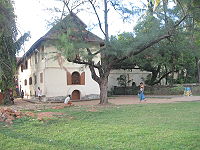
Mattancherry Palace with its medieval charm is situated at Palace Road, Mattancherry, Kochi. It was built by the PortuguesePortuguese India
The Portuguese Viceroyalty of India , later the Portuguese State of India , was the aggregate of Portugal's colonial holdings in India.The government started in 1505, six years after the discovery of a sea route to India by Vasco da Gama, with the nomination of the first Viceroy Francisco de...
and presented to Veera Kerala Varma (1537-65), Raja of Kochi, in 1555 AD. The Dutch
Dutch East India Company
The Dutch East India Company was a chartered company established in 1602, when the States-General of the Netherlands granted it a 21-year monopoly to carry out colonial activities in Asia...
carried out some extensions and renovations in the palace in 1663, and thereafter it was popularly called Dutch Palace. The rajas also made more improvements to it. Today, it is a portrait gallery of the Cochin Rajas and notable for some of the best mythological murals in India, which are in the best traditions of Hindu temple art. The palace was built to appease the king after they plundered a temple nearby.
The landing of Vasco da Gama
Vasco da Gama
Vasco da Gama, 1st Count of Vidigueira was a Portuguese explorer, one of the most successful in the Age of Discovery and the commander of the first ships to sail directly from Europe to India...
, the Portuguese explorer at Kapadu in 1498 was welcomed by the Kochi rulers. They were given exclusive right to construct factories. The Portuguese repulsed the repeated attacks of the Zamorins
Saamoothiri
Zamorin is the title used by the Hindu Eradi Samanthan kshatriya rulers of the erstwhile late medieval feudal kingdom of Kozhikode located in the present day state of Kerala, India....
and the Cochin Rajas practically became vassals of the Portuguese. The influence of the Portuguese were supplanted by the Dutch and they took over Mattancherry in 1663. Subsequently, the area was taken over by Hyder Ali
Hyder Ali
Hyder Ali was the de facto ruler of the Kingdom of Mysore in southern India. Born Hyder Naik, he distinguished himself militarily, eventually drawing the attention of Mysore's rulers...
and still later by the British East India Company
British East India Company
The East India Company was an early English joint-stock company that was formed initially for pursuing trade with the East Indies, but that ended up trading mainly with the Indian subcontinent and China...
The Palace
The palace is a quadrangular structure built in Nālukettu style, the traditional Kerala style of architecture, with a courtyard in the middle. In the courtyard there stands a small temple dedicated to 'Pazhayannur Bhagavati', the protective goddess of the Kochi royal familyCochin Royal Family
The Cochin royal family were rulers of Cochin, or Kochi, India. They were also known as Perumpadapu Swaroopam or Kuru Swaroopam.-Tradition of Perumpadapu Swaroopam:...
. There are two more temples on either side of the Palace, one dedicated to Lord Krishna
Krishna
Krishna is a central figure of Hinduism and is traditionally attributed the authorship of the Bhagavad Gita. He is the supreme Being and considered in some monotheistic traditions as an Avatar of Vishnu...
and the other to Lord Siva. Certain elements of architecture, as for example the nature of its arches and the proportion of its chambers are indicative of European influence in basic Nāluketttu style.
The Dining Hall has carved wooden ornate ceiling decorated with a series of brass cups. The palace also contains rare examples of traditional Kerala flooring, which looks like polished black marble but is actually a mixture of burned coconut shells, charcoal, lime, plant juices and egg whites.
Murals

The king's bedchamber or Palliyara, to the left of the entrance and occupying the southwest corner of the Palace, is noteworthy with its low wooden ceiling and 300 sq ft (27.9 m²) of wall surface covered with about 48 paintings. These illustrate the Ramayana
Ramayana
The Ramayana is an ancient Sanskrit epic. It is ascribed to the Hindu sage Valmiki and forms an important part of the Hindu canon , considered to be itihāsa. The Ramayana is one of the two great epics of India and Nepal, the other being the Mahabharata...
, from the beginning of the sacrifice of Dasaratha
Dasaratha
Dasharatha was a king of Ayodhya of the Ikshvaku dynasty whose life story is narrated principally in the Hindu epic Ramayana...
to Sita
SITA
SITA is a multinational information technology company specialising in providing IT and telecommunication services to the air transport industry...
's return from captivity in Lanka
Lanka
Sri Lanka is the name given in Hindu mythology to the island fortress capital of the legendary king Ravana in the great Hindu epics, the Ramayana and the Mahabharata...
. The paintings in this section are the earliest in the palace, dating back to the 16th century. The last five scenes are from the 'Krishna Lila' where in a cheerful God Krishna
Krishna
Krishna is a central figure of Hinduism and is traditionally attributed the authorship of the Bhagavad Gita. He is the supreme Being and considered in some monotheistic traditions as an Avatar of Vishnu...
using his six hands and two feet to engage in foreplay with eight happy milkmaids. The paintings are attributed to the artistic bent of mind of Veera Kerala Verma.
The upper staircase rooms, notably that of the coronation hall that was extended under Dutch patronage, contain some murals. The notable compositions in this section are - Lakshmi
Lakshmi
Lakshmi or Lakumi is the Hindu goddess of wealth, prosperity , light, wisdom, fortune, fertility, generosity and courage; and the embodiment of beauty, grace and charm. Representations of Lakshmi are also found in Jain monuments...
seated on the lotus, sleeping Vishnu
Vishnu
Vishnu is the Supreme god in the Vaishnavite tradition of Hinduism. Smarta followers of Adi Shankara, among others, venerate Vishnu as one of the five primary forms of God....
(Ananthasayanamurti), Shiva
Shiva
Shiva is a major Hindu deity, and is the destroyer god or transformer among the Trimurti, the Hindu Trinity of the primary aspects of the divine. God Shiva is a yogi who has notice of everything that happens in the world and is the main aspect of life. Yet one with great power lives a life of a...
and Parvati
Parvati
Parvati is a Hindu goddess. Parvati is Shakti, the wife of Shiva and the gentle aspect of Mahadevi, the Great Goddess...
seated with Ardhanari
Ardhanari
Ardhanarishvara , is a composite androgynous form of the Hindu god Shiva and his consort Parvati . Ardhanarishvara is depicted as half male and half female, split down the middle...
swara and other goddesses, the coronation of Rama
Rama
Rama or full name Ramachandra is considered to be the seventh avatar of Vishnu in Hinduism, and a king of Ayodhya in ancient Indian...
, and Krishna lifting Mount Govardhana
Govardhan hill
Govardhan is a hill located near the town of Vrindavan, in the Mathura district of Uttar Pradesh, India. It considered as sacred by a number of traditions within Hinduism....
..
On the opposite side of the coronation hall is the staircase room or Kovinithalam (Room No II) , with a descent to the lower storey, there are four paintings of Shiva, Vishnu and Devi, and one incomplete. Room No. IV depict scenes from Kumarasambhava
Kumarasambhava
Kumārasambhava is a Sanskrit epic poem by Kālidāsa; the first eight cantos are accepted as his authorship...
and other works of the great Sanskrit
Sanskrit
Sanskrit , is a historical Indo-Aryan language and the primary liturgical language of Hinduism, Jainism and Buddhism.Buddhism: besides Pali, see Buddhist Hybrid Sanskrit Today, it is listed as one of the 22 scheduled languages of India and is an official language of the state of Uttarakhand...
poet Kālidāsa
Kalidasa
Kālidāsa was a renowned Classical Sanskrit writer, widely regarded as the greatest poet and dramatist in the Sanskrit language...
.The latter set of paintings belong to the eighteenth century.
Other exhibits
Portraits of the Rajas of Cochin, from 1864 onwards, are displayed in what was once the Coronation Hall. These were painted by local artists in western style. The ceiling of the hall is decorated with floral designs in wood craft.Amongst the other exhibits in the palace are an ivory palanquin, a howdah
Howdah
A howdah, or houdah, also known as hathi howdah, is a carriage which is positioned on the back of an elephant, or occasionally some other animal, used most often in the past to carry wealthy people or for use in hunting or warfare...
, royal umbrellas, ceremonial dress used by the royalty, coins, stamps and drawings. .
Restoration
In 1951, Mattancherry Palace was restored and declared a centrallyGovernment of India
The Government of India, officially known as the Union Government, and also known as the Central Government, was established by the Constitution of India, and is the governing authority of the union of 28 states and seven union territories, collectively called the Republic of India...
protected monument. The palace is already undergoing a second restoration by the Archaeological Survey of India
Archaeological Survey of India
The Archaeological Survey of India is a department of the Government of India, attached to the Ministry of Culture . The ASI is responsible for archaeological studies and the preservation of archaeological heritage of the country in accordance with the various acts of the Indian Parliament...
. The restoration will raise the historical structure to a building and a museum of an international standard, preserving its originality, yet highlighting the important facets, The palace is an architectural masterpiece showcasing the blend between colonial and Kerala architecture. The restoration aims at showcasing its true grandeur. The work which started in 2007 is scheduled to be completed by 2009.
Nearby
Nearby is the Paradesi SynagogueParadesi Synagogue
The Paradesi Synagogue is the oldest active synagogue in the Commonwealth of Nations, located in Kochi, Kerala, in South India. It was built in 1568 by the Malabar Yehudan people or Cochin Jewish community in the Kingdom of Cochin...
built in 1568. Alongside are the antique shops in the meandering alleys of Jew Town, most of whose inhabitants have since migrated to Israel. The Mattancherry jetty and bus stand are behind the Palace. The area is full of shops attracting tourists hunting for mementoes to carry back home.
Situated in between the Mattancherry Palace and the Paradesi Synagogue is the Pazhayannur
Pazhayannur
Pazhayannur is a village in Thrissur district in the state of Kerala, India.-Demographics: India census, Pazhayannur had a population of 15979 with 7680 males and 8299 females. the history says that, major part of Pazhayannur was under pattar , an upper class people , those who came here from...
Bhagavathy Temple, the ancestral deity or Paradevata of the Cochin Royal Family. The temple with royal patronage which shares its wall with the Jewish synagogue tells volumes about the religious tolerance and inter cultural amity that existed during the time of the Kingdom of Cochin
Kingdom of Cochin
Kingdom of Cochin was a late medieval Hindu kingdom and later Princely State on the Malabar Coast, South India...
.