
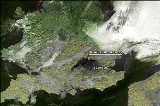
The
Buncefield fire was a major
conflagrationA conflagration or a blaze is an uncontrolled burning that threatens human life, health, or property. A conflagration can be accidentally begun, naturally caused , or intentionally created . Arson can be accomplished for the purpose of sabotage or diversion, and also can be the consequence of...
caused by a series of
explosionAn explosion is a rapid increase in volume and release of energy in an extreme manner, usually with the generation of high temperatures and the release of gases. An explosion creates a shock wave. If the shock wave is a supersonic detonation, then the source of the blast is called a "high explosive"...
s on 11 December 2005 at the
Hertfordshire Oil Storage TerminalHertfordshire Oil Storage Terminal is operated by Hertfordshire Oil Storage Ltd and commonly known as the Buncefield oil depot. It is an oil depot located on the edge of Hemel Hempstead to the north of London in the United Kingdom...
, an oil storage facility located near the
M1 motorwayThe M1 is a north–south motorway in England primarily connecting London to Leeds, where it joins the A1 near Aberford. While the M1 is considered to be the first inter-urban motorway to be completed in the United Kingdom, the first road to be built to motorway standard in the country was the...
by
Hemel HempsteadHemel Hempstead is a town in Hertfordshire in the East of England, to the north west of London and part of the Greater London Urban Area. The population at the 2001 Census was 81,143 ....
in
HertfordshireHertfordshire is a ceremonial and non-metropolitan county in the East region of England. The county town is Hertford.The county is one of the Home Counties and lies inland, bordered by Greater London , Buckinghamshire , Bedfordshire , Cambridgeshire and...
, England. The terminal was the fifth largest oil-products storage depot in the United Kingdom, with a capacity of about 60000000 gallons (272,765,400 l) of fuel. The terminal is owned by
TOTAL UK LimitedTotal S.A. is a French multinational oil company and one of the six "Supermajor" oil companies in the world.Its businesses cover the entire oil and gas chain, from crude oil and natural gas exploration and production to power generation, transportation, refining, petroleum product marketing, and...
(60%) and
TexacoTexaco is the name of an American oil retail brand. Its flagship product is its fuel "Texaco with Techron". It also owns the Havoline motor oil brand....
(40%).
The first and largest explosion occurred at 06:01
UTCCoordinated Universal Time is the primary time standard by which the world regulates clocks and time. It is one of several closely related successors to Greenwich Mean Time. Computer servers, online services and other entities that rely on having a universally accepted time use UTC for that purpose...
near tank 912, which led to further explosions which eventually overwhelmed 20 large storage tanks.
The emergency services announced a major emergency at 06:08 and a fire fighting effort began. The cause of the explosion seems to have been a
fuel-air explosionA thermobaric weapon, which includes the type known as a "fuel-air bomb", is an explosive weapon that produces a blast wave of a significantly longer duration than those produced by condensed explosives. This is useful in military applications where its longer duration increases the numbers of...
of unusually high strength. The
British Geological SurveyThe British Geological Survey is a partly publicly funded body which aims to advance geoscientific knowledge of the United Kingdom landmass and its continental shelf by means of systematic surveying, monitoring and research. The BGS headquarters are in Keyworth, Nottinghamshire, but other centres...
monitored the event, which measured 2.4 on the
Richter scaleThe expression Richter magnitude scale refers to a number of ways to assign a single number to quantify the energy contained in an earthquake....
.
News reports described the incident as the biggest of its kind in peacetime Europe and certainly the biggest such explosion in the United Kingdom since the 1974
Flixborough DisasterThe Flixborough disaster was an explosion at a chemical plant close to the village of Flixborough, England, on 1 June 1974. It killed 28 people and seriously injured 36.-Background:...
. The flames had been extinguished by the afternoon of 13 December 2005. However, one storage tank re-ignited that evening, which the
fire-fightersFirefighters are rescuers extensively trained primarily to put out hazardous fires that threaten civilian populations and property, to rescue people from car incidents, collapsed and burning buildings and other such situations...
left to burn rather than attempt to extinguish it again.
The
Health Protection AgencyThe Health Protection Agency, or, in Welsh, Yr Asiantaeth Diogelu Iechyd is a statutory corporation. It is an independent UK organisation that was set up by the government in 2003 to protect the public from threats to their health from infectious diseases and environmental hazards...
and the Major Incident Investigation Board provided advice to prevent incidents such as these in the future. The primary need is for safety measures to be in place to prevent fuel from exiting the tanks in which it is stored. Added safety measures are needed for when fuel does escape, mainly to prevent it forming a flammable vapour and stop pollutants from poisoning the environment.
Explosion and fire
The first and largest explosion occurred at 06:01
UTCCoordinated Universal Time is the primary time standard by which the world regulates clocks and time. It is one of several closely related successors to Greenwich Mean Time. Computer servers, online services and other entities that rely on having a universally accepted time use UTC for that purpose...
on Sunday, 11 December 2005 near container 912. Further explosions followed which eventually overwhelmed 20 large storage tanks.
From all accounts, it seems to have been an unconfined
vapourA vapor or vapour is a substance in the gas phase at a temperature lower than its critical point....
cloud explosion of unusually high strength—also known as a
fuel-air explosionA thermobaric weapon, which includes the type known as a "fuel-air bomb", is an explosive weapon that produces a blast wave of a significantly longer duration than those produced by condensed explosives. This is useful in military applications where its longer duration increases the numbers of...
. Because of an
inversion layerIn meteorology, an inversion is a deviation from the normal change of an atmospheric property with altitude. It almost always refers to a temperature inversion, i.e...
, the explosions were heard up to 125 miles (201 km) away; there were reports that they were audible in Belgium, France, and the Netherlands.
The
British Geological SurveyThe British Geological Survey is a partly publicly funded body which aims to advance geoscientific knowledge of the United Kingdom landmass and its continental shelf by means of systematic surveying, monitoring and research. The BGS headquarters are in Keyworth, Nottinghamshire, but other centres...
monitored the event, which measured 2.4 on the
Richter scaleThe expression Richter magnitude scale refers to a number of ways to assign a single number to quantify the energy contained in an earthquake....
. It was reported that people were woken in south London, and as far west as Wokingham (about 28 miles (45 km)), where in its southern suburb,
FinchampsteadFinchampstead is a civil parish near Wokingham in the English county of Berkshire. Its northern extremity is situated south of Wokingham, west of Bracknell, south-east of Reading, and west of Central London.-Geography:...
, numerous people felt the shockwave after the initial explosion. Subsequent explosions occurred at 06:27 and 06:28.
Witnesses many miles from the terminal observed flames hundreds of feet high; the smoke cloud was visible from space, and from as far north as
LincolnshireLincolnshire is a county in the east of England. It borders Norfolk to the south east, Cambridgeshire to the south, Rutland to the south west, Leicestershire and Nottinghamshire to the west, South Yorkshire to the north west, and the East Riding of Yorkshire to the north. It also borders...
(about 70 miles (113 km)) away. Damage from the blasts included broken windows at various buildings including the
Holy TrinityThe Christian doctrine of the Trinity defines God as three divine persons : the Father, the Son , and the Holy Spirit. The three persons are distinct yet coexist in unity, and are co-equal, co-eternal and consubstantial . Put another way, the three persons of the Trinity are of one being...
church and
Leverstock Green SchoolLeverstock Green is a suburb in Hemel Hempstead, in the English county of Hertfordshire. It is located on the eastern edge of the town.Leverstock Green contains a village school , village cricket club, village football club , village hall, village shops, village pubs and Holy Trinity church...
, blown-in or warped front doors, and an entire wall being removed from a warehouse more than half a mile (800 m) from the site. Buildings in neighbouring
St AlbansSt Albans is a city in southern Hertfordshire, England, around north of central London, which forms the main urban area of the City and District of St Albans. It is a historic market town, and is now a sought-after dormitory town within the London commuter belt...
also suffered;
Townsend SchoolTownsend C of E School is a voluntary aided secondary school based in St. Albans, Hertfordshire, England. The students attending are aged between 11 and 18 years old....
had serious blast damage, and a window was blown out of
St Albans AbbeySt Albans Cathedral is a Church of England cathedral church at St Albans, England. At , its nave is the longest of any cathedral in England...
(about 5 miles (8 km)).
Several nearby office blocks were hit so badly that almost every window, front and back, was blown in as the explosion ripped through them. During the working day, these offices would have been full of people, and many deaths may have resulted. Reports also indicated that cars in nearby streets caught fire. The roof of at least one house was blown off. Buildings in the vicinity were evacuated by police, not only because of the smoke and possibility of more explosions, but because of the danger of structural damage making the buildings unstable.
There were 43 reported injuries; two people were deemed to be seriously injured enough to be kept in hospital, one in
Watford General HospitalWatford is a town and borough in Hertfordshire, England, situated northwest of central London and within the bounds of the M25 motorway. The borough is separated from Greater London to the south by the urbanised parish of Watford Rural in the Three Rivers District.Watford was created as an urban...
, with breathing difficulties, and another in
Hemel Hempstead HospitalHemel Hempstead is a town in Hertfordshire in the East of England, to the north west of London and part of the Greater London Urban Area. The population at the 2001 Census was 81,143 ....
, although they were not in a life-threatening condition. Some early media reports spoke of eight fatalities, but these may have been persons missing. All members of staff from the terminal were accounted for.
Hertfordshire police and fire services and the
Member of ParliamentA Member of Parliament is a representative of the voters to a :parliament. In many countries with bicameral parliaments, the term applies specifically to members of the lower house, as upper houses often have a different title, such as senate, and thus also have different titles for its members,...
for the area,
Mike PenningMichael Alan "Mike" Penning MP is the Conservative Member of Parliament for Hemel Hempstead and is a junior Transport minister.-Early life and career:...
, said that there were seven fuel tanks on the site which, as of 14:00 on 12 December, had not been affected. These tanks were at risk of exploding if the fire were to spread.
Tackling the blaze
The emergency services announced a major emergency at 06:08 and a huge fire fighting effort began. At peak times this effort consisted of 25 fire engines, 20 support vehicles and 180 fire fighters. Around 150
firefighterFirefighters are rescuers extensively trained primarily to put out hazardous fires that threaten civilian populations and property, to rescue people from car incidents, collapsed and burning buildings and other such situations...
s were called immediately to the incident, and began tackling the blaze at 08:20 on the morning of 12 December, putting in containment measures before applying a large quantity of foam. The incident occurred close to junction 8 of the
M1 motorwayThe M1 is a north–south motorway in England primarily connecting London to Leeds, where it joins the A1 near Aberford. While the M1 is considered to be the first inter-urban motorway to be completed in the United Kingdom, the first road to be built to motorway standard in the country was the...
, which led to its closure and the setting up of a public exclusion area. It was estimated that this incident would be the largest "single-seat" fire in the world ever to be fought by a fire brigade, and foam supplies from sites all over the UK were drawn upon.
Plans had been in place to start using foam at midnight on 11 December, but were delayed by last-minute concerns over possible
pollutionPollution is the introduction of contaminants into a natural environment that causes instability, disorder, harm or discomfort to the ecosystem i.e. physical systems or living organisms. Pollution can take the form of chemical substances or energy, such as noise, heat or light...
of local rivers and underlying water sources. Six high volume pumps were used to extract 25000 litres (5,499 imp gal) of water per minute—417 litres (92 imp gal) per second—from a reservoir 1.5 miles (2 km) from the fire, with six more high volume pumps deployed at various locations to serve as boosters. Thirty-two thousand litres (7,039 imp gal) of fire fighting foam per minute were directed against the fire for just over four hours, after which the pumping rate was reduced. Half of the 20 individual fires were reported extinguished by midday.
By 16:30 on Monday 12 December, it was reported that a further two tank fires had been extinguished, but that one of the tanks extinguished earlier had ruptured and re-ignited, and was now threatening to cause the explosion of an adjacent tank. This led to the
M1 motorwayThe M1 is a north–south motorway in England primarily connecting London to Leeds, where it joins the A1 near Aberford. While the M1 is considered to be the first inter-urban motorway to be completed in the United Kingdom, the first road to be built to motorway standard in the country was the...
being closed again; the public exclusion area was widened, and firefighters were temporarily withdrawn until the risk posed by the threatened tank could be assessed.
Firefighting operations were resumed at about 20:00, and it was anticipated that all fires could be extinguished during the night. Further damage occurred to one of the storage tanks in the early hours of Tuesday morning, causing firefighters to be withdrawn once again, but operations resumed at 08:30. By midday on the 13 December, all but three fires had been extinguished, although the largest tank was still burning.
Bronze commandA gold–silver–bronze command structure is used by emergency services of the United Kingdom to establish a hierarchical framework for the command and control of major incidents and disasters...
—operations on the ground—was visited by the
Bishop of St AlbansThe Bishop of St Albans is the Ordinary of the Church of England Diocese of St Albans in the Province of Canterbury. The bishop is supported in his work by two suffragan bishops, the Bishop of Hertford and the Bishop of Bedford, and three archdeacons....
, the local vicar, and the industrial chaplain supporting the fire crews, to see how they were coping.
Firefighters were confident that the remaining fires could be extinguished during the day—Tuesday 13 December. The smoke plume had been considerably reduced and was more grey, indicating the amount of vapourised water now combining with the smoke. It was reported at 16:45 that all tank fires had been extinguished, although some smaller fires persisted. 75% of firefighters for Hertfordshire were involved in fighting the fire, supported by 16 other brigades. The entire gold command operation, involving many agencies as well as all the emergency services, was run from
Hertfordshire ConstabularyHertfordshire Constabulary is the territorial police force responsible for policing the county of Hertfordshire in England. Its headquarters is situated in Welwyn Garden City...
's headquarters in
Welwyn Garden City-Economy:Ever since its inception as garden city, Welwyn Garden City has attracted a strong commercial base with several designated employment areas. Among the companies trading in the town are:*Air Link Systems*Baxter*British Lead Mills*Carl Zeiss...
, some distance from the fire.
A further fire broke out during the early morning of 14 December. Firefighters were of the view that extinguishing it would leave the risk of petroleum vapour re-igniting or exploding, so it would be better to allow the fire, which was well contained, to burn itself out. Hertfordshire Fire Service's deputy chief Mark Yates stated that escaping petroleum vapour was the most likely cause of the original explosion and fire.
Smoke cloud
The black smoke cloud, which was clearly visible from satellite photographs, drifted at a high altitude, around 9000 feet (2,743.2 m), towards
ReadingReading is a large town and unitary authority area in England. It is located in the Thames Valley at the confluence of the River Thames and River Kennet, and on both the Great Western Main Line railway and the M4 motorway, some west of London....
and
SwindonSwindon is a large town within the borough of Swindon and ceremonial county of Wiltshire, in South West England. It is midway between Bristol, west and Reading, east. London is east...
, and could be seen across much of
South East EnglandSouth East England is one of the nine official regions of England, designated in 1994 and adopted for statistical purposes in 1999. It consists of Berkshire, Buckinghamshire, East Sussex, Hampshire, Isle of Wight, Kent, Oxfordshire, Surrey and West Sussex...
.
The small particles in the smoke contained
hydrocarbonIn organic chemistry, a hydrocarbon is an organic compound consisting entirely of hydrogen and carbon. Hydrocarbons from which one hydrogen atom has been removed are functional groups, called hydrocarbyls....
s, which can be an
irritantIrritation or exacerbation, in biology and physiology, is a state of inflammation or painful reaction to allergy or cell-lining damage. A stimulus or agent which induces the state of irritation is an irritant...
but have a low
toxicityToxicity is the degree to which a substance can damage a living or non-living organisms. Toxicity can refer to the effect on a whole organism, such as an animal, bacterium, or plant, as well as the effect on a substructure of the organism, such as a cell or an organ , such as the liver...
and were not expected to cause any long-term harm. The
Met OfficeThe Met Office , is the United Kingdom's national weather service, and a trading fund of the Department for Business, Innovation and Skills...
issued warnings that the smoke in the atmosphere could come down in rainfall during the night of 11 December.
The fire resulted in 244 people requiring medical aid—mainly on the first day of the fire. From those 117 had symptoms attributable to the incident, of which 38 were members of the public. The majority of those visiting hospitals were from the rescue services and attended for precautionary check ups. Most of them had no symptoms, except for 63 emergency workers who suffered respiratory complaints, of which half were sore throats.
For the first two days of the fire, the high thermal energy made the
plumeIn hydrodynamics, a plume is a column of one fluid or gas moving through another. Several effects control the motion of the fluid, including momentum, diffusion, and buoyancy...
highly
buoyantIn physics, buoyancy is a force exerted by a fluid that opposes an object's weight. In a column of fluid, pressure increases with depth as a result of the weight of the overlying fluid. Thus a column of fluid, or an object submerged in the fluid, experiences greater pressure at the bottom of the...
; this, together with settled weather conditions, allowed the plume to rise to a great height with little cross-mixing. When the fire was reduced in intensity it was reported to be possible that the plume would be less buoyant and that ground-level smoke concentrations could then rise significantly. By 12 December, it was reported that the smoke cloud had reached northern France; it was expected to arrive in northern Spain by the weekend.
To investigate the smoke cloud the
Facility for Airborne Atmospheric MeasurementsThe Facility for Airborne Atmospheric Measurements , based on the Cranfield University campus alongside Cranfield Airport in Bedfordshire, England, is an organisation formed by a collaboration between the Met Office and the Natural Environment Research Council .-Applications:The FAAM was...
, a research aircraft operated jointly by
NERCThe Natural Environment Research Council is a British research council that supports research, training and knowledge transfer activities in the environmental sciences.-History:...
and the Met Office, made two flights on 12 and 13 December. In the first flight the edge of the plume was followed along the south coast of England.
Carbon monoxideCarbon monoxide , also called carbonous oxide, is a colorless, odorless, and tasteless gas that is slightly lighter than air. It is highly toxic to humans and animals in higher quantities, although it is also produced in normal animal metabolism in low quantities, and is thought to have some normal...
,
nitrogen oxideNitrogen oxide can refer to a binary compound of oxygen and nitrogen, or a mixture of such compounds:* Nitric oxide, also known as nitrogen monoxide, , nitrogen oxide* Nitrogen dioxide , nitrogen oxide...
s and
ozoneOzone , or trioxygen, is a triatomic molecule, consisting of three oxygen atoms. It is an allotrope of oxygen that is much less stable than the diatomic allotrope...
concentrations were found to be low with soot particles being the major component in the cloud. The second flight went into the centre of the plume to obtain data to help forecasting and emergency teams.
Evacuations and closures
Hundreds of homes in the
Hemel HempsteadHemel Hempstead is a town in Hertfordshire in the East of England, to the north west of London and part of the Greater London Urban Area. The population at the 2001 Census was 81,143 ....
area were evacuated, and about 2,000 people had to find alternative accommodation; emergency services asked residents of the smoke-affected areas to close their windows and doors and to stay inside.
Hertfordshire ConstabularyHertfordshire Constabulary is the territorial police force responsible for policing the county of Hertfordshire in England. Its headquarters is situated in Welwyn Garden City...
advised people who had houses with smashed windows to seek refuge with friends or family nearby if possible. Some people whose homes were damaged by the blast were placed in
hotelA hotel is an establishment that provides paid lodging on a short-term basis. The provision of basic accommodation, in times past, consisting only of a room with a bed, a cupboard, a small table and a washstand has largely been replaced by rooms with modern facilities, including en-suite bathrooms...
s, while others stayed in a nearby
shopping centreA shopping mall, shopping centre, shopping arcade, shopping precinct or simply mall is one or more buildings forming a complex of shops representing merchandisers, with interconnecting walkways enabling visitors to easily walk from unit to unit, along with a parking area — a modern, indoor version...
.
TotalTotal S.A. is a French multinational oil company and one of the six "Supermajor" oil companies in the world.Its businesses cover the entire oil and gas chain, from crude oil and natural gas exploration and production to power generation, transportation, refining, petroleum product marketing, and...
, the operator of the Buncefield depot, set up a helpline for people whose properties had been damaged by the explosion, and called in local authorities and the
Salvation ArmyThe Salvation Army is a Protestant Christian church known for its thrift stores and charity work. It is an international movement that currently works in over a hundred countries....
to provide accommodation or other help.
Concerns for public safety resulted in about 227 schools, libraries, and other public buildings across Hertfordshire and
BuckinghamshireBuckinghamshire is a ceremonial and non-metropolitan home county in South East England. The county town is Aylesbury, the largest town in the ceremonial county is Milton Keynes and largest town in the non-metropolitan county is High Wycombe....
closing on 12 and 13 December. Police and local authorities advised residents to consult the
Hertfordshire Direct website for up-to-date information.
Seventy-eight schools in
LutonLuton is a large town and unitary authority of Bedfordshire, England, 30 miles north of London. Luton and its near neighbours, Dunstable and Houghton Regis, form the Luton/Dunstable Urban Area with a population of about 250,000....
borough were closed on 13 December, along with a limited number of schools in
BedfordshireBedfordshire is a ceremonial county of historic origin in England that forms part of the East of England region.It borders Cambridgeshire to the north-east, Northamptonshire to the north, Buckinghamshire to the west and Hertfordshire to the south-east....
, on the advice of Hertfordshire's Health Protection Agency that all schools within a 10 miles (16.1 km) radius of the incident site should be closed because of concerns surrounding the effect of the smoke plume on children's health. Schools reopened as normal on 14 December.
Transport disruption
The incident occurred close to junction 8 of the
M1 motorwayThe M1 is a north–south motorway in England primarily connecting London to Leeds, where it joins the A1 near Aberford. While the M1 is considered to be the first inter-urban motorway to be completed in the United Kingdom, the first road to be built to motorway standard in the country was the...
. The motorway was shut between junctions 12 and 6a—about 18 miles (29 km) shortly after the incident. Other roads in the vicinity, including the short M10 motorway (now part of the
A414 roadThe A414 is a major road in England. It runs from the A41 at a junction west of Hemel Hempstead in Hertfordshire, through the town to junction 8 of the M1 motorway at Buncefield, and running parallel to the M1 until junction 7, heading south of St Albans, east through Hatfield, Hertford, then...
), were also closed.
Some local
petrol stationsA filling station, also known as a fueling station, garage, gasbar , gas station , petrol bunk , petrol pump , petrol garage, petrol kiosk , petrol station "'servo"' in Australia or service station, is a facility which sells fuel and lubricants...
reported long queues as people started
panic buyingPanic buying is an imprecise common use term to describe the act of people buying unusually large amounts of a product in anticipation of or after a disaster or perceived disaster, or in anticipation of a large price increase or shortage, as can occur before a blizzard or hurricane or government...
. A spokesman for the Department of Trade and Industry gave assurances that no petrol shortage was likely to result from the incident.
The oil terminal supplied 30% of
Heathrow AirportLondon Heathrow Airport or Heathrow , in the London Borough of Hillingdon, is the busiest airport in the United Kingdom and the third busiest airport in the world in terms of total passenger traffic, handling more international passengers than any other airport around the globe...
's fuel, and because of the fire, the airport had to start rationing fuel. Some long-haul flights to Australia, the Far-East, and South Africa had to pit-stop at
Stansted Airport-Cargo:-Statistics:-Infrastructure:-Terminal and satellite buildings:Stansted is the newest passenger airport of all the main London airports. The terminal is an oblong glass building, and is separated in to three areas: Check-in concourse, arrivals and departures...
or other European airports to refuel, while short-haul operators were asked to fuel their planes for the round trip before flying to Heathrow. Some aircraft were only allowed 40% of the fuel they would normally take on board. Fuel shortages continued for months after the explosion.
Business disruption
In the Maylands industrial area the worst affected buildings were the
Northgate Information Solutions-Early years:The company was founded as CMC, or Computer Machinery Company, in 1969. They were originally distributors and subsequently manufacturers of Key to Disk computer systems made by the US-based Computer Machinery Corporation. The CMC Key to Disk systems were used by major companies and...
headquarters and the
Fujifilmis a multinational photography and imaging company headquartered in Tokyo, Japan.Fujifilm's principal activities are the development, production, sale and servicing of color photographic film, digital cameras, photofinishing equipment, color paper, photofinishing chemicals, medical imaging...
building. These buildings were so badly damaged they were rendered completely unusable. Demolition of the Fujifilm building began soon afterwards, and by June 2006 it had been completely removed from the site. Although the Northgate and Fujifilm buildings were closest to the blast, the surrounding Catherine House (to the north), Keystone Distribution building (to the west),
3Com Corporation3Com was a pioneering digital electronics manufacturer best known for its computer network infrastructure products. The company was co-founded in 1979 by Robert Metcalfe, Howard Charney, Bruce Borden, and Greg Shaw...
and RO buildings (to the south), were also extensively damaged. In all, six buildings were designated for demolition and 30 more required major repairs before they could be reoccupied.
As a result of the destruction of the equipment in the Northgate building several websites hosted there were inaccessible—including that of the
Labour PartyThe Labour Party is a centre-left democratic socialist party in the United Kingdom. It surpassed the Liberal Party in general elections during the early 1920s, forming minority governments under Ramsay MacDonald in 1924 and 1929-1931. The party was in a wartime coalition from 1940 to 1945, after...
.
Addenbrooke's HospitalAddenbrooke's Hospital is an internationally renowned teaching hospital in Cambridge, England, with strong links to the University of Cambridge. It was founded in 1766 on Trumpington Street with £4,500 from the will of Dr John Addenbrooke, a fellow of St Catharine's College...
in Cambridge was also affected; its IT system dealing with admissions and discharges had to be replaced for several days by a manual system.
A number of companies were affected by inability to reach their premises even where the premises themselves were largely unaffected by the blast. Criticism was expressed by local citizens and the local MP that originally the depot had been constructed away from other buildings, but that developmental pressures had led to both houses and commercial premises being built near the depot.
Groundwater pollution
In May 2006 Three Valleys Water announced that it had detected the persistent,
bioaccumulativeBioaccumulation refers to the accumulation of substances, such as pesticides, or other organic chemicals in an organism. Bioaccumulation occurs when an organism absorbs a toxic substance at a rate greater than that at which the substance is lost...
, and toxic
fluorosurfactantFluorosurfactants, or fluorinated surfactants, are synthetic organofluorine chemical compounds that have multiple fluorine atoms. They can be polyfluorinated or fluorocarbon-based . As surfactants, they are more effective at lowering the surface tension of water than comparable hydrocarbon...
perfluorooctane sulfonate (PFOS)—which is used in fire fighting foam—in a ground water bore hole close to the Buncefield site. It stated that no water from this well entered the public water supply and that a nearby well and pumping station had been closed since the fire as a precaution. The chemical is a known health risk and the UK government had been about to ban its use.
However just before the announcement, the
Drinking Water InspectorateThe Drinking Water Inspectorate is a section of Department for Environment, Food and Rural Affairs set up to regulate the public water supply companies in England and Wales....
announced that it was increasing the safe level of the chemical in drinking water. Hemel Hempstead MP,
Mike PenningMichael Alan "Mike" Penning MP is the Conservative Member of Parliament for Hemel Hempstead and is a junior Transport minister.-Early life and career:...
accused the government of changing the rules to suit the situation in which PFOS levels in drinking water in the area may rise in the future. Most of the fuel burned out—rather than spilling into the soil, so the impact on surrounding land and the water table was limited.
Inquiry
A government inquiry held jointly by the
Health and Safety ExecutiveThe Health and Safety Executive is a non-departmental public body in the United Kingdom. It is the body responsible for the encouragement, regulation and enforcement of workplace health, safety and welfare, and for research into occupational risks in England and Wales and Scotland...
(HSE) and the
Environment AgencyThe Environment Agency is a British non-departmental public body of the Department for Environment, Food and Rural Affairs and an Assembly Government Sponsored Body of the Welsh Assembly Government that serves England and Wales.-Purpose:...
was started, but calls for a full public enquiry were declined. The Board included
Lord Newton of BraintreeAntony Harold "Tony" Newton, Baron Newton of Braintree, PC, OBE , is a British Conservative politician and former Cabinet member...
,
Prof Dougal DrysdaleDougal Drysdale is a Professor Emeritus in Fire Safety Engineering at the University of Edinburgh and member of the BRE Centre for Fire Safety Engineering....
—an authority on fire safety and Dr Peter Baxter, a medical expert. Environment Agency and HSE staff were also on the board. Its aim was to identify the immediate causes of the explosion, rather than consider who was to blame for any deficiencies, so as not to prejudice further legal proceedings.
An initial progress report by the Major Incident Investigation Board on 21 February 2006 did not go into the causes of the explosion, but summed up the event and the immediate reaction from the emergency services. A second progress report, published on 11 April 2006, looked at the environmental impact.
A further announcement was made on 9 May 2006 about the sequence of events which caused the explosion. Starting at 19:00 on the evening of 10 December, 2005, Tank 912, towards the north west of the main depot, was filled with
unleaded petrolGasoline , or petrol , is a toxic, translucent, petroleum-derived liquid that is primarily used as a fuel in internal combustion engines. It consists mostly of organic compounds obtained by the fractional distillation of petroleum, enhanced with a variety of additives. Some gasolines also contain...
—from the
Coryton RefineryCoryton Refinery is an oil refinery in Essex, England, situated on the estuary of the River Thames some from the centre of London.The refinery is located between Shell Haven Creek and Hole Haven Creek, which separates Canvey Island from the mainland....
located in Essex, England. At midnight the terminal closed, and a check was made of the contents of tanks, which found everything normal. Normally the gauges monitor the level of the fuel in the tank as it fills from the particular pipeline. From about 03:00 the
level gaugeLevel sensors detect the level of substances that flow, including liquids, slurries, granular materials, and powders. Fluids and fluidized solids flow to become essentially level in their containers because of gravity whereas most bulk solids pile at an angle of repose to a peak...
for Tank 912 began to indicate an unchanging level reading, despite it being filled at 550 cubic metre per hour.
Calculations show that the tank would have begun to overflow at about 05:20. There is evidence suggesting that a high-level switch, which should have detected that the tank was full and shut off the supply, failed to operate. The switch failure should have triggered an alarm, but it too appears to have failed. Forty-one minutes later, an estimated 300 tonnes of petrol would have spilled down the side of the tank through the roof vents onto the ground inside a
bundBunding, also called a bund wall, is the area within a structure designed to prevent inundation or breaches of various types.-Liquid containment:...
wall—a semi-enclosed compound surrounding several tanks.
An overflow such as this results in the rapid formation of a rich fuel and air vapour. CCTV footage showed such a vapour flowing out the bund wall from around 05:38. By 05:50 the vapour started flowing off the site, near the junction of Cherry Tree and Buncefield Lane. Around 05:50 the rate at which fuel was being pumped into the tank increased dramatically. Initially the fuel was pumped in at 550 cubic metre per hour, but it increased to about 890 cubic metre per hour. By 06:01, when the first explosion occurred, the cloud which was initially about 1 metres (3 ft) deep, thickened to 2 metres (7 ft) and had spread beyond the boundaries of the site.
The extent of the damage meant it was not possible to determine the exact source of ignition, but possibilities include an emergency
generatorIn electricity generation, an electric generator is a device that converts mechanical energy to electrical energy. A generator forces electric charge to flow through an external electrical circuit. It is analogous to a water pump, which causes water to flow...
and the depot's fire pump system. The investigators did not believe that it was caused either by the driver of a fuel tanker, as had been speculated, or by anyone using a mobile phone. It was felt unlikely that the explosion had a widespread effect on air quality at ground level.
Civil liability
A total of 2,700 claims were filed by residents, businesses and insurers. A group of 146 claimants were hoping to bring a class action against Hertfordshire Oil Storage Ltd. On 17 March 2006 a High Court official, Senior Master Turner, adjourned a hearing on whether to permit the class action until October 2006. Claimants including insurance companies, small businesses and about 280 families whose properties were damaged or destroyed were claiming up to £1 billion in damages.
Several court cases resulted from the explosion, although the main trial to determine who was liable for the damage commenced at the High Court in October 2008. An example of loss is Cheetah Couriers—who suffered a 20% drop in turnover because of the explosions, resulting in losses of around £300,000 to £400,000. The company was located in offices on an industrial estate 400 metres (1,312 ft) from the depot.
An initial trial concluded on 23 May 2008 when Mr Justice David Steel issued a summary judgment after hearing that both Total and
Hertfordshire Oil Storage LtdHertfordshire Oil Storage Terminal is operated by Hertfordshire Oil Storage Ltd and commonly known as the Buncefield oil depot. It is an oil depot located on the edge of Hemel Hempstead to the north of London in the United Kingdom...
(HOSL) had agreed that negligence was the cause. In the main trial,
Total UKTotal S.A. is a French multinational oil company and one of the six "Supermajor" oil companies in the world.Its businesses cover the entire oil and gas chain, from crude oil and natural gas exploration and production to power generation, transportation, refining, petroleum product marketing, and...
claimed that the duty supervisor at the time was responsible for the explosion, but refused to admit either civil or criminal liability for the incident. Total UK argued that it should not be liable for damages because it could not reasonably have foreseen that it would cause the destruction it did. On 20 March 2009 the High Court found Total liable for the blast, saying that it was satisfied that Total had control of tank filling operations at the Buncefield depot. The judgement left the company facing damage claims of around £700 million.
Total are appealing this judgement in a case due to be heard in 2010.
Criminal liability
The site is covered by the COMAH regulations. The Control of Major Accidents and Hazards Regulations are jointly enforced by the "competent authority" which is formed of the Environment Agency and the Health and Safety Executive. They carried out an investigation during and following the fire.
In April 2010 the five companies accused of causing the explosion faced a criminal prosecution brought by the
Health and Safety ExecutiveThe Health and Safety Executive is a non-departmental public body in the United Kingdom. It is the body responsible for the encouragement, regulation and enforcement of workplace health, safety and welfare, and for research into occupational risks in England and Wales and Scotland...
and the
Environment AgencyThe Environment Agency is a British non-departmental public body of the Department for Environment, Food and Rural Affairs and an Assembly Government Sponsored Body of the Welsh Assembly Government that serves England and Wales.-Purpose:...
. Two defendants, Total UK and British Pipeline Agency Limited, had already pleaded guilty to offences under the Health and Safety at Work Act. The remaining three, Hertfordshire Oil Storage Ltd, TAV Engineering Ltd, and Motherwell Control Systems were found guilty in June 2010. TAV Engineering Ltd and Motherwell Control Systems were found guilty of failing to protect their employees. Hertfordshire Oil Storage Ltd was found guilty of failing to prevent major accidents and limit their effects and then pleaded guilty to causing pollution to enter controlled waters underlying the vicinity around the site, contrary to the
Water Resources ActThe Water Resources Act 1991 is an Act of the Parliament of the United Kingdom that regulates water resources, water quality and pollution, and flood defence. Part II of the Act provides the general structure for the management of water resources. Part III then explains the standards expected for...
.
Sentencing took place in July 2010. Total UK was fined £3.6m, plus £2.6m in costs. Hertfordshire Oil Storage Limited was fined £1.45m and £1m in costs. The British Pipeline Agency was fined £300,000 plus £480,000 costs. Motherwell Control Systems and TAV Engineering were fined £1,000 each. Local MP
Mike PenningMichael Alan "Mike" Penning MP is the Conservative Member of Parliament for Hemel Hempstead and is a junior Transport minister.-Early life and career:...
called the modest fines "insulting".
The terminal
The
Hertfordshire Oil Storage TerminalHertfordshire Oil Storage Terminal is operated by Hertfordshire Oil Storage Ltd and commonly known as the Buncefield oil depot. It is an oil depot located on the edge of Hemel Hempstead to the north of London in the United Kingdom...
(HOSL – Hertfordshire Oil Storage Ltd), generally known as the Buncefield complex, was the fifth largest oil-products storage depot in the UK, with a capacity of about 60000000 gallons (272,765,400 l) of fuel, although it was not always full. This was about 8% of UK oil storage capacity.
The HOSL is a major hub on the
UK's oil pipeline networkThe United Kingdom Oil Pipeline is an oil products pipeline opened in 1969 and connecting the two Shell refineries of Stanlow and Shell Haven...
(UKOP) with pipelines to
HumbersideHumberside was a non-metropolitan and ceremonial county in Northern England from 1 April 1974 until 1 April 1996. It was composed of land from either side of the Humber Estuary, created from portions of the East and West ridings of Yorkshire and parts of Lindsey, Lincolnshire...
and
MerseysideMerseyside is a metropolitan county in North West England, with a population of 1,365,900. It encompasses the metropolitan area centred on both banks of the lower reaches of the Mersey Estuary, and comprises five metropolitan boroughs: Knowsley, St Helens, Sefton, Wirral, and the city of Liverpool...
and is an important fuel source to the British aviation industry, providing aircraft fuel for local airports including
London GatwickGatwick Airport is located 3.1 miles north of the centre of Crawley, West Sussex, and south of Central London. Previously known as London Gatwick,In 2010, the name changed from London Gatwick Airport to Gatwick Airport...
,
London HeathrowLondon Heathrow Airport or Heathrow , in the London Borough of Hillingdon, is the busiest airport in the United Kingdom and the third busiest airport in the world in terms of total passenger traffic, handling more international passengers than any other airport around the globe...
and
LutonLondon Luton Airport is an international airport located east of the town centre in the Borough of Luton in Bedfordshire, England and is north of Central London. The airport is from Junction 10a of the M1 motorway...
airports. About half of the complex is dedicated to the storage of
aviation fuelAviation fuel is a specialized type of petroleum-based fuel used to power aircraft. It is generally of a higher quality than fuels used in less critical applications, such as heating or road transport, and often contains additives to reduce the risk of icing or explosion due to high temperatures,...
. The remainder of the complex stores
oilAn oil is any substance that is liquid at ambient temperatures and does not mix with water but may mix with other oils and organic solvents. This general definition includes vegetable oils, volatile essential oils, petrochemical oils, and synthetic oils....
,
keroseneKerosene, sometimes spelled kerosine in scientific and industrial usage, also known as paraffin or paraffin oil in the United Kingdom, Hong Kong, Ireland and South Africa, is a combustible hydrocarbon liquid. The name is derived from Greek keros...
,
petrolGasoline , or petrol , is a toxic, translucent, petroleum-derived liquid that is primarily used as a fuel in internal combustion engines. It consists mostly of organic compounds obtained by the fractional distillation of petroleum, enhanced with a variety of additives. Some gasolines also contain...
and diesel fuel for
petrol stationsA filling station, also known as a fueling station, garage, gasbar , gas station , petrol bunk , petrol pump , petrol garage, petrol kiosk , petrol station "'servo"' in Australia or service station, is a facility which sells fuel and lubricants...
across much of the
South-EastSouth East England is one of the nine official regions of England, designated in 1994 and adopted for statistical purposes in 1999. It consists of Berkshire, Buckinghamshire, East Sussex, Hampshire, Isle of Wight, Kent, Oxfordshire, Surrey and West Sussex...
of England. The terminal is owned by
TOTAL UK LimitedTotal S.A. is a French multinational oil company and one of the six "Supermajor" oil companies in the world.Its businesses cover the entire oil and gas chain, from crude oil and natural gas exploration and production to power generation, transportation, refining, petroleum product marketing, and...
(60%) and
TexacoTexaco is the name of an American oil retail brand. Its flagship product is its fuel "Texaco with Techron". It also owns the Havoline motor oil brand....
40%.
The seat of the fire, and the worst damaged section, was "HOSL West", used by Total and Texaco to store a variety of fuels, and the neighbouring
British Pipeline AgencyBritish Pipeline Agency Ltd is a joint venture between BP Oil UK and Shell UK. The company owns and operates the UK oil pipeline network of oil and gas pipelines which transport petroleum products and natural gas around the UK. Storage facilities operated by BPA include the Hertfordshire Oil...
area.
Initial speculation on causes
The police issued a statement saying that they were treating the incident as an accident as opposed to a
terrorist attack. Italian television stations early on the morning of the fire described the event as a possible terrorist attack and went to the extent of showing features on the
July 2005 terrorist bombingsThe 7 July 2005 London bombings were a series of co-ordinated suicide attacks in the United Kingdom, targeting civilians using London's public transport system during the morning rush hour....
. Speculation about the possible terrorist nature of the blasts was prompted by the fact that a videotape allegedly released by
al-QaedaAl-Qaeda is a global broad-based militant Islamist terrorist organization founded by Osama bin Laden sometime between August 1988 and late 1989. It operates as a network comprising both a multinational, stateless army and a radical Sunni Muslim movement calling for global Jihad...
four days previously had called for attacks on fuel depots and refineries containing oil "stolen" from Muslim countries. However, the cause of the blasts will likely not be known until a full investigation is completed.
An oil industry specialist speculated on
BBC NewsBBC News is the department of the British Broadcasting Corporation responsible for the gathering and broadcasting of news and current affairs. The department is the world's largest broadcast news organisation and generates about 120 hours of radio and television output each day, as well as online...
that a vapour leak could have built up to explosive concentrations because of the ground frost in the area keeping vapour concentration at ground level. This would have resulted in a
fuel-air explosionA thermobaric weapon, which includes the type known as a "fuel-air bomb", is an explosive weapon that produces a blast wave of a significantly longer duration than those produced by condensed explosives. This is useful in military applications where its longer duration increases the numbers of...
. It is industry practice for detection systems to be in place to reveal leakages. In order for this scenario to be fulfilled, there must have been a leakage that was not picked up by the leak detection system.
A BBC News 24 interview with a petrol tanker driver, who was about to load his tanker at 06:00, reported a cloud of mist rolling in from the tank farm area behind the loading bay. All electric lights were turned off and they were ordered to leave the site on foot. As he was doing so, the blast blew him off his feet. In another interview, a security guard in a nearby office building reported an unusual smell of petrol inside his building before the explosion. Hertfordshire police reported speaking to a tanker driver concerned that switching the engine cut-off on his tanker might have triggered the explosion.
Other safety experts spoke of a known "weekend effect" in industry, in which weekend maintenance creates an unsafe condition. A retired military explosives safety officer submitted a published paper on the explosion to the HSE inquiry. The paper was intended to help those who lived close to petrol storage depots and who were worried about the risks they faced. It contained different views from those of other experts whose opinions had been voiced publicly, and was critical of the HSE's general safety culture.
Lessons learned
The
Health Protection AgencyThe Health Protection Agency, or, in Welsh, Yr Asiantaeth Diogelu Iechyd is a statutory corporation. It is an independent UK organisation that was set up by the government in 2003 to protect the public from threats to their health from infectious diseases and environmental hazards...
and the Major Incident Investigation Board (MIIB) provided the needed advice for risk assessments to create guidelines to prevent incidents such as these from happening again. The most important lesson learned from the incident was the need for an increased environmental measurement capability.
The MIIB focused on three main work streams subsuming the lessons to be learned from the incident:
- Design and operation of storage sites
- Emergency response to incidents
- Advice to planning authorities
The primary need identified was for additional safety measures to prevent fuel escaping from its storage tanks, and to deal adequately with fuel when it does escape, preventing it from forming a flammable vapour and pollutants from poisoning the environment. This report demand that the fuel industry should extensively strengthen safety measures at storage sites handling large quantities of fuel.
Soon after the incident the Health Protection Agency was stripped of its remit to provide air quality data and it was passed on to the Environment Agency who form part of the Major Accident Investigation Board.
Remembrance
An anniversary service was held in
Holy Trinity Church Leverstock GreenLeverstock Green is a suburb in Hemel Hempstead, in the English county of Hertfordshire. It is located on the eastern edge of the town.Leverstock Green contains a village school , village cricket club, village football club , village hall, village shops, village pubs and Holy Trinity church...
on Sunday, 10 December 2006, at which the
Bishop of St AlbansThe Bishop of St Albans is the Ordinary of the Church of England Diocese of St Albans in the Province of Canterbury. The bishop is supported in his work by two suffragan bishops, the Bishop of Hertford and the Bishop of Bedford, and three archdeacons....
spoke, calling again for a full public inquiry, for assurances that the local hospital would maintain its accident and emergency department, and for the community to continue to build on good relationships formed because of the blast.
Reconstruction
To rebuild the damaged parts of the site, the relevant approval from Dacorum Borough Council would be needed. The BP section of the site—a good way from the explosion, survived with very little damage, but is inoperative as of 2009. BP is exploring plans for the future use of this part of the site, and has indicated a number of priorities, including the reopening the fuel pipelines to Heathrow. They consider using their section to store aviation fuel and as a distribution centre for motor fuel, but at a much-reduced level. In late 2009, Total UK submitted plans for the reconstruction of the oil depot.
See also
- Jaipur (Indian Oil) Fire in 2009
- Esso Refinery, Milford Haven
The Esso Refinery at Milford Haven was an oil refinery situated on the Pembrokeshire coast in Wales. Construction started in 1957 and the refinery was opened in 1960 by Duke of Edinburgh. Construction cost £18million and the refinery had the capacity to process 4.5million tons of crude oil a...
- Grangemouth Refinery
Grangemouth refinery is a mature complex oil refinery located on the Firth of Forth in Grangemouth, Scotland.Currently operated by Ineos, it is Scotland's only oil refinery , and is also the UK's second-oldest; it supplies refined products to customers in Scotland, northern England, Northern...
(Explosion in 1987)
External links