

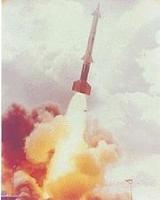
Anti-ballistic missile

Encyclopedia
An anti-ballistic missile (ABM) is a missile
designed to counter ballistic missile
s (a missile for missile defense
).
A ballistic missile is used to deliver nuclear
, chemical
, biological
or conventional warhead
s in a ballistic
flight trajectory
. The term "anti-ballistic missile" describes any antimissile system designed to counter ballistic missiles. However the term is used more commonly for systems designed to counter intercontinental ballistic missile
s (ICBMs).
The Russian A-35 anti-ballistic missile system
for defense of Moscow
was established in 1971, has been improved since, and is still active. Presently it is called A-135
and it uses two missile types, Gorgon and Gazelle. They are, somewhat surprisingly, armed with nuclear warheads themselves.
The U.S. Ground-Based Midcourse Defense
(GMD; previously known as National Missile Defense
– NMD) system has recently reached initial operational capability. Instead of using an explosive charge, it launches a kinetic projectile. The George W. Bush administration accelerated development and deployment of a system proposed in 1998 by the Clinton administration. The system is a dual purpose test and interception facility in Alaska, and in 2006 was operational with a few interceptor missiles. The Alaska site provides more protection against North Korean missiles or accidental launches from Russia or China, but is likely less effective against missiles launched from the Middle East
. President Bush referenced the 9/11 attacks and the proliferation of ballistic missiles as reasons for missile defense. The current GMD system has the more limited goal of shielding against a limited attack by a rogue state
.
During Spring 2006 reports about negotiations between the United States
and Poland
as well as the Czech Republic
were published. The plans propose the installation of a latest generation ABM system with a radar site in the Czech Republic and the launch site in Poland
. The system was announced to be aimed against ICBMs from Iran
and North Korea
. This caused harsh comments by then-Russia
's President Vladimir Putin
at the OSCE security conference during spring 2007 in Munich. Other European ministers commented that any change of strategic weapons should be negotiated on NATO level and not 'unilaterally' between the US and other states (although most strategic arms reduction treaties were between the USSR and US, not NATO). German
foreign minister Frank-Walter Steinmeier
expressed severe concerns about the way in which the USA had conveyed its plans to its European partners and criticised the US administration for not having consulted Russia prior to announcing its endeavours to deploy a new missile defence system in Central Europe – a criticism that was soon proven to be largely groundless, as the US had repeatedly informed Russia about its plans. As of July 2007, a majority of Poles were opposed to hosting a component of the system in Poland. As noted above, Russia has operated its nuclear armed Moscow ABM system in Europe since the 1970s.
, U.S. Navy Aegis combat system
, and the Israeli Arrow missile. They are not capable of intercepting an ICBM, even if it is in range.
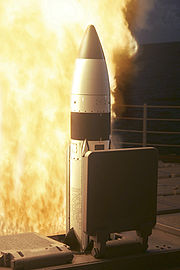 In several tests, the U.S. military have demonstrated the feasibility of destroying long and short range ballistic missiles. Combat effectiveness of newer systems against 1950s tactical ballistic missiles seems very high, as the Patriot Advanced Capability 3
(PAC-3) had a 100% success rate in Operation Iraqi Freedom.
U.S. Navy Aegis combat system
uses RIM-161 Standard missile SM-3.
MIM-23 Hawk
missile is not currently operational in the U.S.
These systems, as opposed to US GMD system, are not capable of intercepting an ICBM, even if it is in range.
A new system, scheduled for deployment during 2009, is U.S. Terminal High Altitude Area Defense
(THAAD) system. It has a longer range, but it is not known if it will be able to intercept ICBMs.
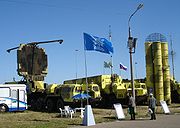 The Moscow ABM defense system was, or is, based on:
Apart from the main Moscow deployment, Russia has striven actively for intrinsic ABM capabilities of its late model SAM systems.
However, the PRC's interest of continuing the ABM programme was seriously reconsidered after a series of events and a multitude of factors. The nuclear weapon tests in Asia, US intervention during the Taiwan Strait Crisis, ongoing developments of ballistic missile technology from multiple neighboring countries, and the United States' withdrawal from the Anti-Ballistic Treaty in 2002 may have otherwise convinced Beijing's renewed interests.
Currently, China has acquired and is license-producing the S-300PMU-2/S-300PMU-1 series of terminal ABM-capable SAMs. China produces the indigenous HQ-9
SAM system possessing possible terminal ABM capabilities respectively. PRC Navy's currently operating modern air-defense destroyers known as the Type 052C Destroyer and Type 051C Destroyer are armed with naval HHQ-9 missiles.
Surface-to-air missiles that have some terminal ABM capability (as opposed to midcourse capability):
using a ground-launched interceptor during January 2007 was immediately applied to current ABM efforts and development.
China carried out a land-based anti-ballistic missile test
on 11 January 2010. The test was exoatmospheric and done in midcourse phase and with a kinetic kill vehicle. China is the second country after US that demonstrated intercepting ballistic missile with kinetic kill vehicle, the interceptor missile was SC-19. The sources suggest the system is not operationally deployed as of 2010, but the gap in ABM development between United States and China closes quicker than anticipated.
Additional to ABM capability, China's missiles also possess anti-satellite (ASAT) capabilities. ABM/ASAT
missiles (it is not known which have midcourse ABM capability):
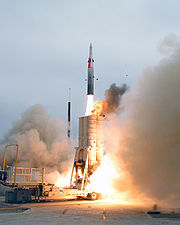 The Arrow project was begun after the U.S. and Israel agreed to co-fund it on May 6, 1986.
The Arrow ABM system was designed and constructed in Israel with financial support by the United States
by a multi-billion dollar development program called "Minhelet Homa" with the participation of companies like Israel Military Industries
, Tadiran
and Israel Aerospace Industries.
During 1998 the Israeli military conducted a successful test of their Arrow missile. Designed to intercept incoming missiles travelling at up to 2 mile/s (3 km/s), the Arrow is expected to perform much better than the Patriot did in the Gulf War. On July 29, 2004 Israel and the United States carried out joint experiment in the USA, in which the Arrow was launched against a real Scud missile.
The experiment was a success, as the Arrow destroyed the Scud with a direct hit. During December 2005 the system was deployed successfully in a test against a replicated Shahab-3
missile. This feat was repeated on February 11, 2007.
Iron Dome (Hebrew: כיפת ברזל) is a mobile air defense system in development by Rafael Advanced Defense Systems designed to intercept short-range rockets and artillery shells. The system was created as a defensive countermeasure to the rocket threat against Israel's civilian population on its northern and southern borders. It is designed to intercept very short-range threats up to 70 kilometers in all-weather situations.It was declared operational and initially deployed on March 27, 2011 near Beersheba.On April 7, 2011, the system successfully intercepted a Grad rocket launched from Gaza for the first time.
David's Sling (Hebrew: קלע דוד), also sometimes called Magic Wand (Hebrew: שרביט קסמים), is an Israel Defense Forces military system being jointly developed by the Israeli defense contractor Rafael Advanced Defense Systems and the American defense contractor Raytheon, designed to intercept medium- to long-range rockets and slower-flying cruise missiles, such as those possessed by Hezbollah, fired at ranges from 40 km to 300 km.
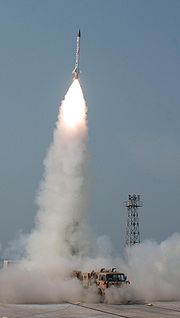 India
India
has an active ABM development effort using locally developed and integrated radars, and local missiles. In November 2006, India successfully conducted the PADE (Prithvi Air Defence Exercise) in which an Anti-ballistic missile, called the Prithvi Air Defense (PAD) an Exoatmospheric (outside the atmosphere) interceptor system intercepted a Prithvi-II ballistic missile. The PAD missile has the secondary stage of the Prithvi missile and can reach altitude of 80 km (50 mi). During the test the target missile was intercepted at an 50 km (31 mi) altitude. India became the fourth nation in the world to acquire such a capability and the third nation to acquire it using in house research and development. On 6 December 2007 the Advanced Air Defence (AAD) missile system was tested successfully. This missile is an Endo atmospheric interceptor with an altitude of 30 km (19 mi). According to scientist V K Saraswat of DRDO the missiles will work in tandem to ensure a hit probability of 99.8 percent. Induction of the system into services is expected to be in 2010. Two new anti ballistic missiles that can intercept IRBM/ICBMs are being developed. These high speed missiles (AD-1 and AD-2) are being developed to intercept ballistic missiles with the range of 5000 km (3,107 mi).
On March 6, 2009 India successfully tested an interceptor missile that destroyed an incoming missile. A Dhanush missile was launced from a ship about 100 km (62 mi) from the coast. It rose to a height of 120 km (75 mi) and as it began its downward trajectory, the interceptor was launched and successfully achieved a kill.
On July 26, 2010 India successfully tested an interceptor missile, bringing down an incoming target ballistic missile (a modified Prithvi) with 2,000 km range, at an altitude of 15 km over the Bay of Bengal.
On March 6, 2011 India successfully tested an indigenously built interceptor missile, bringing down an incoming target ballistic missile from Wheeler Island off the Orissa coast.The interceptor, developed under the Ballistic Missile Defence System, destroyed the target, a variant of Prithvi-II, mimicking an enemy missile, fired from launch complex-III of the Integrated Test Range (ITR) at Chandipur on-Sea in Balasore district, about 70 km from Wheeler Island across the sea, at an altitude of 16 km over the Bay of Bengal. The interceptor was fired five minutes after the target was fired.
On May 15, 2011 it was reported that India has started working on a network of air-defence systems which would be able to shoot down any enemy missile at a distance of 5,000 km, before it can enter the Indian air space.According to DRDO chief,V K Saraswat,missiles are being designed and developed in a manner that would enable them to shoot down any incoming missile at a distance of 5,000 km.."It is well on schedule and we are already on initial design and testing stage," Saraswat said.
Type 45 destroyer
s are armed with Sea Viper, using Aster 15 and 30 missiles.
Also France is developing another version, Aster 30 block II which can destroy ballistic missiles with a maximum range of 3000 km. It will have a Kill Vehicle warhead.
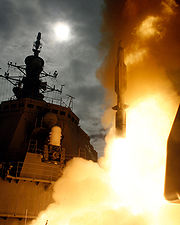 Since 1998, when North Korea launched a Taepodong-1
missile over northern Japan, the Japanese have been jointly developing a new Surface-to-air interceptor known as the Patriot Advanced Capability 3 (PAC-3) with the US. So far tests have been successful, and there are planned 11 locations that the PAC-3 will be installed. A military spokesman said that tests had been done on two sites, one of them a business park in central Tokyo, and Ichigaya – a site not far from the Imperial Palace.
Along with the PAC-3, Japan has installed a US-developed ship-based anti-ballistic missile system, which was tested successfully on December 18, 2007. The missile was launched from a Japanese warship, in partnership with the US Missile Defense Agency and destroyed a mock target launched from the coast.
, commonly known as Taiwan
, is also engaged in the development of an anti-ballistic missile system, based on its indigenously developed Tien Kung-II (Sky Bow) SAM system. Although reports suggest a promising system, the ROC government continues to be interested strongly in the American Terminal High Altitude Area Defense
(THAAD) program.
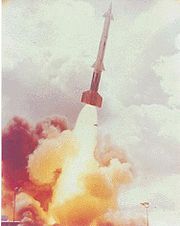 The idea of destroying rockets before they can hit their target dates from the first use of modern missiles in warfare, the German V-1 and V-2
program of World War II
. British fighters attempted to destroy V-1 "buzz bombs" in flight prior to impact, with some success, although concentrated barrages of heavy anti-aircraft artillery had greater success. The V-2, the first true ballistic missile, was impossible to destroy using aircraft or artillery. Instead, the Allies launched Operation Crossbow
to find and destroy V-2s before launch. The operation was largely ineffective, and the V2s were eventually dealt with when the launch sites were overrun by the rapid advance of the Allied armies through Belgium and the Netherlands.
The American armed forces began experimenting with anti-missile missiles soon after World War II, as the extent of German research into rocketry became clear. But defenses against Soviet long-range bombers took priority until 1957, when the Soviet Union demonstrated its advances in intercontinental ballistic missile technology with the launch of Sputnik, the Earth's first artificial satellite.
In 1958, a topic of research by the U.S. was the test explosions of several low yield nuclear weapon
s at very high altitudes over the southern Atlantic ocean, launched from ships. The devices used were the 1.7 kt boosted fission W25 warhead.
When such an explosion takes place a burst of X-ray
s are released that strike the Earth's atmosphere, causing secondary showers of charged particles over an area hundreds of miles across. The movement of these charged particles in the Earth's magnetic field causes a powerful EMP
which induces very large currents in any conductive material. The purpose was to determine how much the EMP would interfere with radar tracking and other communications and the level of destruction of electronic circuitry aboard missiles and satellites.
The project's results are not known, although similar so-called 'effects tests' were a regular feature of underground tests at the Nevada Test Site until 1992. These 'effects tests' are used to determine how resistant specific warheads, reentry vehicles (RVs) and other components are to exoatmospheric nuclear explosions.
, which researched the main problems of ABM systems. This included developing several advanced infrared
detectors for terminal guidance, a number of missile airframe designs, a new and much more powerful solid rocket fuel, and numerous systems for testing it all. After a series of drastic budget reductions during the late 1950s the research ended. One offshoot of the project was Gerald Bull
's system for inexpensive high-speed testing, consisting of missile airframes shot from a sabot
round, which would later be the basis of Project HARP
.
forces on March 1, 1961. An experimental V-1000
missile (part of the "A" ABM programme) launched from the Sary-Shagan test range, destroyed a dummy warhead released by a R-12 ballistic missile
launched from the Kapustin Yar
cosmodrome. The dummy warhead was destroyed by the impact of 18,000 tungsten-carbide spherical impactors 140 seconds after launch, at an altitude of 25 km (82,021 ft).
The V-1000 missile system was nonetheless considered not reliable enough and abandoned in favor of nuclear-armed ABMs.
The first operational ICBM ABM system was the Soviet A-35 anti-ballistic missile system
, designed to protect Moscow
. It was initially a single-layer exoatmospheric (outside the atmosphere) design, using Galosh interceptors (SH-01, also known as ABM-1). It became operational in 1971 and was deployed at four sites around Moscow
.
A-35 was upgraded during the 1980s to a two-layer system, the A-135
. The Gorgon (SH-11/ABM-4) long-range missile was designed to handle intercepts outside the atmosphere, and the Gazelle (SH-08/ABM-3)
short-range missile endoatmospheric intercepts that eluded Gorgon. The ABM-3 alone was considered to be technologically equivalent to the United States Safeguard system of 1975.
, a modification of then-existing anti-aircraft missiles. Nike Zeus proved unworkable, and so work proceeded with Nike X
.
Nike X was a system of two missiles, radars and their associated control systems. The main missile was LIM-49 Spartan—a Nike Zeus upgraded for longer range and a much larger 5 megatonne warhead intended to destroy enemy's warheads with a burst of x-rays outside the atmosphere. A second shorter-range missile called Sprint
with very high acceleration was added to handle warheads that evaded longer-ranged Spartan. Sprint was a very fast missile (some sources claimed it accelerated to 8,000 mph (13 000 km/h) within 4 seconds of flight—an average acceleration of 90 g
) and had a smaller W66 enhanced radiation
warhead in the 1-3 kiloton range for in-atmosphere interceptions.
The new Spartan missile changed the deployment plans. Previously, the Nike systems were to have been clustered near cities as a last-ditch defense, but the Spartan allowed for interceptions at a range of hundreds of miles. The experimental success of Nike X persuaded the Lyndon B. Johnson
administration to propose a thin ABM defense, that could provide almost complete coverage of the United States. In a September 1967 speech, Defense Secretary Robert McNamara
referred to it as Sentinel. McNamara, a private ABM opponent because of cost and feasibility (see cost-exchange ratio
), claimed that Sentinel would be directed not against the Soviet Union's missiles (since the USSR
had more than enough missiles to overwhelm any American defense), but rather against the potential nuclear threat of the People's Republic of China
.
In the meantime a public debate over the merit of ABMs began. Difficulties that had already made an ABM system questionable for defending against an all-out attack. One problem was the Fractional Orbital Bombardment System
(FOBS) that would give little warning to the defense. Another problem was high altitude EMP (whether from offensive or defensive nuclear warheads) which could degrade defensive radar systems.
When this proved infeasible for economic reasons, a much smaller deployment using the same systems was proposed, namely Safeguard (described later).
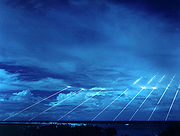 ABM systems were developed initially to counter single warheads launched from large Intercontinental ballistic missile
s (ICBMs). The economics seemed simple enough; since rocket costs increase rapidly with size, the price of the ICBM launching a large warhead should always be greater than the much smaller interceptor missile needed to destroy it. In an arms race the defense would always win.
Conditions changed dramatically in 1970 with the introduction of Multiple independently targetable reentry vehicle
(MIRV) warheads. Suddenly each launcher was throwing not one warhead, but several. The defense would still require a rocket for every warhead, as they would be re-entering over a wide space and could not be attacked by several warheads from a single antimissile rocket. Suddenly the defense was more expensive than offense; it was much less expensive to add more warheads, or even decoys, than it was to build the interceptor needed to shoot them down.
In summary, the MIRV made ABM economically ineffective, and practically non-workable.
of 1972, which restricted the deployment of strategic (not tactical) anti-ballistic missiles.
By the ABM treaty and a 1974 revision, each country was allowed to deploy a mere 100 ABMs to protect a single, small area. The Soviets retained their Moscow defences. The U.S. designated their ICBM sites at Grand Forks Air Force Base, North Dakota, where Safeguard was already under advanced development.
system, which utilized the nuclear-tipped LIM-49A Spartan
and Sprint
missiles, in the short operational period of 1975/1976, was a second counter-ICBMs system in the world. Safeguard protected only the main fields of US ICBMs from attack, theoretically ensuring that an attack could be responded to with a US launch, enforcing the mutually assured destruction principle.
-era Strategic Defense Initiative
(often referred to as "Star Wars"), along with research into various energy-beam weaponry, brought new interest in the area of ABM technologies.
SDI was an extremely ambitious program to provide a total shield against a massive Soviet ICBM attack. The initial concept envisioned large sophisticated orbiting laser battle stations, space-based relay mirrors, and nuclear-pumped X-ray laser satellites. Later research indicated that some planned technologies such as X-ray laser
s were not feasible with then-current technology. As research continued, SDI evolved through various concepts as designers struggled with the difficulty of such a large complex defense system. SDI remained a research program and was never deployed. Several post-SDI technologies are used by the present Missile Defense Agency
(MDA).
Lasers originally developed for the SDI plan are currently in use for astronomical observations. Used to ionize gas in the upper atmosphere, they provide telescope operators with a target to calibrate their instruments.
i Arrow missile system was tested initially during 1990, before the first Gulf War. The Arrow was supported by the United States throughout the 1990s.
The Patriot antiaircraft missile was the first deployed tactical ABM system, although it was not designed from the outset for that task and consequently had limitations. It was used during the 1991 Gulf War to attempt to intercept Iraqi Scud
missiles. Post-war analyses show that the Patriot was much less effective than initially thought because of its radar and control system's inability to discriminate warheads from other objects when the Scud missiles broke up during reentry.
Testing ABM technology continued during the 1990s with mixed success. After the Gulf War, improvements were made to several U.S. air defense systems. A new Patriot, PAC-3, was developed and tested—a complete redesign of the PAC-2 deployed during the war, including a totally new missile.
The improved guidance, radar and missile performance improves the probability of kill over the earlier PAC-2. During Operation Iraqi Freedom, Patriot PAC-3s had a nearly 100% success rate against Iraqi TBMs fired. However since no longer range Iraqi Scud missiles were used, PAC-3 effectiveness against those was untested. Patriot was involved in three friendly fire
incidents: two incidents of Patriot shootings at coalition aircraft and one of U.S. aircraft shooting at a Patriot battery.
A new version of the Hawk missile was tested during the early to mid-1990s and by the end of 1998 the majority of US Marine Corps Hawk
systems were modified to support basic theater anti-ballistic missile capabilities. MIM-23 Hawk
missile is not operational in the U.S. service since 2002, but is used by many other countries.
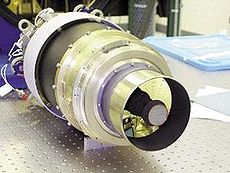 Soon after the Gulf war, the Aegis combat system
was expanded to include ABM capabilities. The Standard missile system was also enhanced and tested for ballistic missile interception. During the late 1990s SM-2 block IVA missiles were tested in a theater ballistic missile defense function. Standard Missile 3 (SM-3)
systems have also been tested for an ABM role. In 2008 an SM-3 missile launched from a Ticonderoga-class cruiser, the USS Lake Erie
, successfully intercepted a non-functioning satellite.
From 1992 to 2000 a demonstration system for the US Army Terminal High Altitude Area Defense
was deployed at White Sands Missile Range
. Tests were conducted on a regular basis and resulted in early failures, but successful intercepts occurred during 1999.
It promised to be much less expensive to develop and have less technical development risk.
The name Brilliant Pebbles comes from the small size of the satellite interceptors and great computational power enabling more autonomous targeting. Rather than rely exclusively on ground-based control, the many small interceptors would cooperatively communicate among themselves and target a large swarm of ICBM warheads in space or in the late boost phase. Development was discontinued later in favor of a limited ground-based defense.
called for a more limited version using rocket-launched interceptors based on the ground at a single site. Such system was developed since 1992, is expected to become operational in 2010 and capable of intercepting small number of incoming ICBMs. First called the National Missile Defense (NMD), since 2002 it was renamed Ground-Based Midcourse Defense
(GMD). It was planned to protect all 50 states from a rogue missile attack. The Alaska site provides more protection against North Korean missiles or accidental launches from Russia or China, but is likely less effective against missiles launched from the Middle East
. The Alaska interceptors may be augmented later by the naval Aegis Ballistic Missile Defense System, by ground-based missiles in other locations, or by the Boeing Airborne Laser
.
During 1998, Defense secretary William Cohen
proposed spending an additional $6.6 billion on intercontinental ballistic missile defense programs to build a system to protect against attacks from North Korea or accidental launches from Russia or China.
In terms of organization, during 1993 SDI was reorganized as the Ballistic Missile Defense Organization (BMDO). In 2002 it was renamed to Missile Defense Agency
(MDA).
.
The next day, Russian Federation promptly dropped the START II
agreement, intended to completely ban MIRVS.
Missile
Though a missile may be any thrown or launched object, it colloquially almost always refers to a self-propelled guided weapon system.-Etymology:The word missile comes from the Latin verb mittere, meaning "to send"...
designed to counter ballistic missile
Ballistic missile
A ballistic missile is a missile that follows a sub-orbital ballistic flightpath with the objective of delivering one or more warheads to a predetermined target. The missile is only guided during the relatively brief initial powered phase of flight and its course is subsequently governed by the...
s (a missile for missile defense
Missile defense
Missile defense is a system, weapon, or technology involved in the detection, tracking, interception and destruction of attacking missiles. Originally conceived as a defence against nuclear-armed Intercontinental ballistic missiles , its application has broadened to include shorter-ranged...
).
A ballistic missile is used to deliver nuclear
Nuclear weapon
A nuclear weapon is an explosive device that derives its destructive force from nuclear reactions, either fission or a combination of fission and fusion. Both reactions release vast quantities of energy from relatively small amounts of matter. The first fission bomb test released the same amount...
, chemical
Chemical warfare
Chemical warfare involves using the toxic properties of chemical substances as weapons. This type of warfare is distinct from Nuclear warfare and Biological warfare, which together make up NBC, the military acronym for Nuclear, Biological, and Chemical...
, biological
Biological warfare
Biological warfare is the use of biological toxins or infectious agents such as bacteria, viruses, and fungi with intent to kill or incapacitate humans, animals or plants as an act of war...
or conventional warhead
Warhead
The term warhead refers to the explosive material and detonator that is delivered by a missile, rocket, or torpedo.- Etymology :During the early development of naval torpedoes, they could be equipped with an inert payload that was intended for use during training, test firing and exercises. This...
s in a ballistic
Ballistics
Ballistics is the science of mechanics that deals with the flight, behavior, and effects of projectiles, especially bullets, gravity bombs, rockets, or the like; the science or art of designing and accelerating projectiles so as to achieve a desired performance.A ballistic body is a body which is...
flight trajectory
Trajectory
A trajectory is the path that a moving object follows through space as a function of time. The object might be a projectile or a satellite, for example. It thus includes the meaning of orbit—the path of a planet, an asteroid or a comet as it travels around a central mass...
. The term "anti-ballistic missile" describes any antimissile system designed to counter ballistic missiles. However the term is used more commonly for systems designed to counter intercontinental ballistic missile
Intercontinental ballistic missile
An intercontinental ballistic missile is a ballistic missile with a long range typically designed for nuclear weapons delivery...
s (ICBMs).
Current counter-ICBM systems
There are only two systems in the world that can intercept ICBMs. Besides them, many smaller systems exist (tactical ABMs), that generally cannot intercept intercontinental strategic missiles, even if within range—an incoming ICBM simply moves too fast for these systems.The Russian A-35 anti-ballistic missile system
A-35 anti-ballistic missile system
The A-35 anti-ballistic missile system, or A-35 Aldan, was a Soviet military battle management radar complex deployed around Moscow to intercept enemy missiles targeting the city or its surrounding areas. In development since the 1960s and in operation from 1971 until the 1990s, It featured the...
for defense of Moscow
Moscow
Moscow is the capital, the most populous city, and the most populous federal subject of Russia. The city is a major political, economic, cultural, scientific, religious, financial, educational, and transportation centre of Russia and the continent...
was established in 1971, has been improved since, and is still active. Presently it is called A-135
A-135 anti-ballistic missile system
The A-135 or ABM-3 anti-ballistic missile system is a Russian military complex deployed around Moscow to counter enemy missiles targeting the city or its surrounding areas. It became operational during 1995...
and it uses two missile types, Gorgon and Gazelle. They are, somewhat surprisingly, armed with nuclear warheads themselves.
The U.S. Ground-Based Midcourse Defense
Ground-Based Midcourse Defense
Ground-Based Midcourse Defense is the United States system for intercepting incoming warheads in space. Currently, it is a major component of the U.S. national missile defense strategy aimed against ballistic missiles, including intercontinental ballistic missiles...
(GMD; previously known as National Missile Defense
National Missile Defense
National missile defense is a generic term for a type of missile defense intended to shield an entire country against incoming missiles, such as intercontinental ballistic missile or other ballistic missiles. Interception might be by anti-ballistic missiles or directed-energy weapons such as lasers...
– NMD) system has recently reached initial operational capability. Instead of using an explosive charge, it launches a kinetic projectile. The George W. Bush administration accelerated development and deployment of a system proposed in 1998 by the Clinton administration. The system is a dual purpose test and interception facility in Alaska, and in 2006 was operational with a few interceptor missiles. The Alaska site provides more protection against North Korean missiles or accidental launches from Russia or China, but is likely less effective against missiles launched from the Middle East
Middle East
The Middle East is a region that encompasses Western Asia and Northern Africa. It is often used as a synonym for Near East, in opposition to Far East...
. President Bush referenced the 9/11 attacks and the proliferation of ballistic missiles as reasons for missile defense. The current GMD system has the more limited goal of shielding against a limited attack by a rogue state
Rogue state
Rogue state is a controversial term applied by some international theorists to states they consider threatening to the world's peace. This means meeting certain criteria, such as being ruled by authoritarian regimes that severely restrict human rights, sponsor terrorism, and seek to proliferate...
.
US plans for Central European site
During 1993, a symposium was held by western European nations to discuss potential future ballistic missile defence programs. In the end, the council recommended deployment of early warning and surveillance systems as well as regionally controlled defence systems.During Spring 2006 reports about negotiations between the United States
United States
The United States of America is a federal constitutional republic comprising fifty states and a federal district...
and Poland
Poland
Poland , officially the Republic of Poland , is a country in Central Europe bordered by Germany to the west; the Czech Republic and Slovakia to the south; Ukraine, Belarus and Lithuania to the east; and the Baltic Sea and Kaliningrad Oblast, a Russian exclave, to the north...
as well as the Czech Republic
Czech Republic
The Czech Republic is a landlocked country in Central Europe. The country is bordered by Poland to the northeast, Slovakia to the east, Austria to the south, and Germany to the west and northwest....
were published. The plans propose the installation of a latest generation ABM system with a radar site in the Czech Republic and the launch site in Poland
US missile defense complex in Poland
The US missile defense complex in Poland, also called the European Interceptor Site was part of the Ballistic Missile Defense European Capability of the US, to be placed in Redzikowo, Słupsk, Poland, forming a Ground-Based Midcourse Defense system in conjunction with a US narrow-beam midcourse...
. The system was announced to be aimed against ICBMs from Iran
Iran
Iran , officially the Islamic Republic of Iran , is a country in Southern and Western Asia. The name "Iran" has been in use natively since the Sassanian era and came into use internationally in 1935, before which the country was known to the Western world as Persia...
and North Korea
North Korea
The Democratic People’s Republic of Korea , , is a country in East Asia, occupying the northern half of the Korean Peninsula. Its capital and largest city is Pyongyang. The Korean Demilitarized Zone serves as the buffer zone between North Korea and South Korea...
. This caused harsh comments by then-Russia
Russia
Russia or , officially known as both Russia and the Russian Federation , is a country in northern Eurasia. It is a federal semi-presidential republic, comprising 83 federal subjects...
's President Vladimir Putin
Vladimir Putin
Vladimir Vladimirovich Putin served as the second President of the Russian Federation and is the current Prime Minister of Russia, as well as chairman of United Russia and Chairman of the Council of Ministers of the Union of Russia and Belarus. He became acting President on 31 December 1999, when...
at the OSCE security conference during spring 2007 in Munich. Other European ministers commented that any change of strategic weapons should be negotiated on NATO level and not 'unilaterally' between the US and other states (although most strategic arms reduction treaties were between the USSR and US, not NATO). German
Germany
Germany , officially the Federal Republic of Germany , is a federal parliamentary republic in Europe. The country consists of 16 states while the capital and largest city is Berlin. Germany covers an area of 357,021 km2 and has a largely temperate seasonal climate...
foreign minister Frank-Walter Steinmeier
Frank-Walter Steinmeier
Frank-Walter Steinmeier is a German politician of the Social Democratic Party of Germany , and currently the leader of the opposition in the Bundestag. Steinmeier was a close aide of Chancellor Gerhard Schröder, serving as Chief of Staff in the German Chancellery from 1999 to 2005...
expressed severe concerns about the way in which the USA had conveyed its plans to its European partners and criticised the US administration for not having consulted Russia prior to announcing its endeavours to deploy a new missile defence system in Central Europe – a criticism that was soon proven to be largely groundless, as the US had repeatedly informed Russia about its plans. As of July 2007, a majority of Poles were opposed to hosting a component of the system in Poland. As noted above, Russia has operated its nuclear armed Moscow ABM system in Europe since the 1970s.
Current tactical systems
Many short-range tactical ABM systems are currently operational, and three are most known: the U.S. Army PatriotMIM-104 Patriot
The MIM-104 Patriot is a surface-to-air missile system, the primary of its kind used by the United States Army and several allied nations. It is manufactured by the Raytheon Company of the United States. The Patriot System replaced the Nike Hercules system as the U.S. Army's primary High to Medium...
, U.S. Navy Aegis combat system
Aegis combat system
The Aegis Combat System is an integrated naval weapons system developed by the Missile and Surface Radar Division of RCA, and now produced by Lockheed Martin...
, and the Israeli Arrow missile. They are not capable of intercepting an ICBM, even if it is in range.
United States
MIM-104 Patriot
The MIM-104 Patriot is a surface-to-air missile system, the primary of its kind used by the United States Army and several allied nations. It is manufactured by the Raytheon Company of the United States. The Patriot System replaced the Nike Hercules system as the U.S. Army's primary High to Medium...
(PAC-3) had a 100% success rate in Operation Iraqi Freedom.
U.S. Navy Aegis combat system
Aegis combat system
The Aegis Combat System is an integrated naval weapons system developed by the Missile and Surface Radar Division of RCA, and now produced by Lockheed Martin...
uses RIM-161 Standard missile SM-3.
MIM-23 Hawk
MIM-23 Hawk
The Raytheon MIM-23 Hawk is a U.S. medium range surface-to-air missile. The Hawk was initially designed to destroy aircraft and was later adapted to destroy other missiles in flight. The missile entered service in 1960, and a program of extensive upgrades has kept it from becoming obsolete. It was...
missile is not currently operational in the U.S.
These systems, as opposed to US GMD system, are not capable of intercepting an ICBM, even if it is in range.
A new system, scheduled for deployment during 2009, is U.S. Terminal High Altitude Area Defense
Terminal High Altitude Area Defense
Terminal High Altitude Area Defense , formerly Theater High Altitude Area Defense, is a United States Army system to shoot down short, medium, and intermediate ballistic missiles in their terminal phase using a hit-to-kill approach. The missile carries no warhead but relies on the kinetic energy...
(THAAD) system. It has a longer range, but it is not known if it will be able to intercept ICBMs.
Russia
- ABM-1 GaloshABM-1 GaloshABM-1 Galosh was a Soviet, nuclear tipped surface-to-air anti-ballistic missile . The Galosh is based on the A-35 ABM System using Grushin model A-350 missile. The primary mission was to destroy U.S...
(decommissioned) - ABM-3 Gazelle
- ABM-4 Gorgon
Apart from the main Moscow deployment, Russia has striven actively for intrinsic ABM capabilities of its late model SAM systems.
- S-300P (SA-10)
- S-300V (SA-12)
- S-300PMU-1/2 (SA-20)
- S-400S-400The S-400 Triumf is a new generation anti-aircraft weapon system developed by Russia's Almaz Central Design Bureau as an upgrade of the S-300 family. It is currently in limited service with the Russian Armed Forces....
(SA-21) - S-500S-500 missileThe S-500 "Samoderzhets" is a Russian surface-to-air missile system, currently under development by the Almaz-Antey company. It is also known as 55R6M "Triumfator-M"-Overview:...
Historical Project 640
Project 640 had been the PRC's indigenous effort to develop ABM capability. The Academy of Anti-Ballistic Missile & Anti-Satellite was established from 1969 for the purpose of developing Project 640. The project was to involve at least three elements, including the necessary sensors and guidance/command systems, the Fan Ji (FJ) missile interceptor, and the XianFeng missile-intercepting cannon. The FJ-1 had completed two successful flight tests during 1979, while the low-altitude interceptor FJ-2 completed some successful flight tests using scaled prototypes. A high altitude FJ-3 interceptor was also proposed. Despite the development of missiles, the programme was slowed down due to financial and political reasons. It was finally closed down during 1980 under a new leadership of Deng Xiao Peng as it was seemingly deemed unnecessary after the 1972 Anti-Ballistic Missile Treaty between the Soviet Union and the United States and the closure of the US Safeguard ABM system.However, the PRC's interest of continuing the ABM programme was seriously reconsidered after a series of events and a multitude of factors. The nuclear weapon tests in Asia, US intervention during the Taiwan Strait Crisis, ongoing developments of ballistic missile technology from multiple neighboring countries, and the United States' withdrawal from the Anti-Ballistic Treaty in 2002 may have otherwise convinced Beijing's renewed interests.
Operational Chinese system
In March 2006, China tested an interceptor system comparable to the U.S. Patriot missiles.Currently, China has acquired and is license-producing the S-300PMU-2/S-300PMU-1 series of terminal ABM-capable SAMs. China produces the indigenous HQ-9
HQ-9
The HQ-9 is China’s new generation medium- to long-range, active radar homing air defence missile.Initially an indigenous design with limited capabilities, the HQ-9 missile has undergone a redesign to incorporate Russian rocket technology after the acquisition of S-300 5V55-series missiles from...
SAM system possessing possible terminal ABM capabilities respectively. PRC Navy's currently operating modern air-defense destroyers known as the Type 052C Destroyer and Type 051C Destroyer are armed with naval HHQ-9 missiles.
Surface-to-air missiles that have some terminal ABM capability (as opposed to midcourse capability):
- HQ-19
- HQ-9HQ-9The HQ-9 is China’s new generation medium- to long-range, active radar homing air defence missile.Initially an indigenous design with limited capabilities, the HQ-9 missile has undergone a redesign to incorporate Russian rocket technology after the acquisition of S-300 5V55-series missiles from...
- KS-1KS-1 Surface-to-air missileThe Kai Shan - 1 is the first Chinese surface-to-air missile to adopt a phased array radar.-Design:The missile is roughly the Chinese equivalent of the American MIM-23 HAWK, except it was designed to engage missiles as well as aircraft...
- HQ-18
- HQ-10/S-300
- HQ-17
- HQ-16
- HQ-15
Development of midcourse ABM in China
The technology and experience from the successful anti-satellite test2007 Chinese anti-satellite missile test
The 2007 Chinese anti-satellite missile test was conducted by China on January 11, 2007. A Chinese weather satellite—the FY-1C polar orbit satellite of the Fengyun series, at an altitude of , with a mass of 750 kg—was destroyed by a kinetic kill vehicle traveling with a speed of 8 km/s in...
using a ground-launched interceptor during January 2007 was immediately applied to current ABM efforts and development.
China carried out a land-based anti-ballistic missile test
2010 Chinese anti-ballistic missile test
The People's Republic of China carried out a land-based high-altitude anti-ballistic missile test on 11 January 2010. This reportedly made China the second country in the world after the United States of America to successfully destroy an incoming missile beyond the Earth's atmosphere.-Possible...
on 11 January 2010. The test was exoatmospheric and done in midcourse phase and with a kinetic kill vehicle. China is the second country after US that demonstrated intercepting ballistic missile with kinetic kill vehicle, the interceptor missile was SC-19. The sources suggest the system is not operationally deployed as of 2010, but the gap in ABM development between United States and China closes quicker than anticipated.
Additional to ABM capability, China's missiles also possess anti-satellite (ASAT) capabilities. ABM/ASAT
Anti-satellite weapon
Anti-satellite weapons are designed to incapacitate or destroy satellites for strategic military purposes. Currently, only the United States, the former Soviet Union, and the People's Republic of China are known to have developed these weapons. On September 13, 1985, the United States destroyed US...
missiles (it is not known which have midcourse ABM capability):
- Other KT variants are under development
- KT-III
- KT-IIA
- KT-II
- KT-409
- KT-IA
- KT-I
- SC-19
Israel
The Arrow ABM system was designed and constructed in Israel with financial support by the United States
United States
The United States of America is a federal constitutional republic comprising fifty states and a federal district...
by a multi-billion dollar development program called "Minhelet Homa" with the participation of companies like Israel Military Industries
Israel Military Industries
Israel Weapons Industries , formerly the "Magen" division of the Israel Military Industries Ltd. is an Israeli firearms manufacturer. In 2005, the Small Arms Division of IMI was privatized....
, Tadiran
Tadiran Telecom
Tadiran Telecom Ltd is a telecommunications company which offers enterprises complete converged communications solutions that support voice, data, video and advanced applications. It is represented by a global network of more than 200 distributors and affiliates in 40 countries.The corporate...
and Israel Aerospace Industries.
During 1998 the Israeli military conducted a successful test of their Arrow missile. Designed to intercept incoming missiles travelling at up to 2 mile/s (3 km/s), the Arrow is expected to perform much better than the Patriot did in the Gulf War. On July 29, 2004 Israel and the United States carried out joint experiment in the USA, in which the Arrow was launched against a real Scud missile.
The experiment was a success, as the Arrow destroyed the Scud with a direct hit. During December 2005 the system was deployed successfully in a test against a replicated Shahab-3
Shahab-3
The Shahab-3 is a medium-range ballistic missile developed by Iran and based on the Nodong-1. The Shahab-3 has a range of ; a MRBM variant can now reach...
missile. This feat was repeated on February 11, 2007.
Iron Dome (Hebrew: כיפת ברזל) is a mobile air defense system in development by Rafael Advanced Defense Systems designed to intercept short-range rockets and artillery shells. The system was created as a defensive countermeasure to the rocket threat against Israel's civilian population on its northern and southern borders. It is designed to intercept very short-range threats up to 70 kilometers in all-weather situations.It was declared operational and initially deployed on March 27, 2011 near Beersheba.On April 7, 2011, the system successfully intercepted a Grad rocket launched from Gaza for the first time.
David's Sling (Hebrew: קלע דוד), also sometimes called Magic Wand (Hebrew: שרביט קסמים), is an Israel Defense Forces military system being jointly developed by the Israeli defense contractor Rafael Advanced Defense Systems and the American defense contractor Raytheon, designed to intercept medium- to long-range rockets and slower-flying cruise missiles, such as those possessed by Hezbollah, fired at ranges from 40 km to 300 km.
India
India
India , officially the Republic of India , is a country in South Asia. It is the seventh-largest country by geographical area, the second-most populous country with over 1.2 billion people, and the most populous democracy in the world...
has an active ABM development effort using locally developed and integrated radars, and local missiles. In November 2006, India successfully conducted the PADE (Prithvi Air Defence Exercise) in which an Anti-ballistic missile, called the Prithvi Air Defense (PAD) an Exoatmospheric (outside the atmosphere) interceptor system intercepted a Prithvi-II ballistic missile. The PAD missile has the secondary stage of the Prithvi missile and can reach altitude of 80 km (50 mi). During the test the target missile was intercepted at an 50 km (31 mi) altitude. India became the fourth nation in the world to acquire such a capability and the third nation to acquire it using in house research and development. On 6 December 2007 the Advanced Air Defence (AAD) missile system was tested successfully. This missile is an Endo atmospheric interceptor with an altitude of 30 km (19 mi). According to scientist V K Saraswat of DRDO the missiles will work in tandem to ensure a hit probability of 99.8 percent. Induction of the system into services is expected to be in 2010. Two new anti ballistic missiles that can intercept IRBM/ICBMs are being developed. These high speed missiles (AD-1 and AD-2) are being developed to intercept ballistic missiles with the range of 5000 km (3,107 mi).
On March 6, 2009 India successfully tested an interceptor missile that destroyed an incoming missile. A Dhanush missile was launced from a ship about 100 km (62 mi) from the coast. It rose to a height of 120 km (75 mi) and as it began its downward trajectory, the interceptor was launched and successfully achieved a kill.
On July 26, 2010 India successfully tested an interceptor missile, bringing down an incoming target ballistic missile (a modified Prithvi) with 2,000 km range, at an altitude of 15 km over the Bay of Bengal.
On March 6, 2011 India successfully tested an indigenously built interceptor missile, bringing down an incoming target ballistic missile from Wheeler Island off the Orissa coast.The interceptor, developed under the Ballistic Missile Defence System, destroyed the target, a variant of Prithvi-II, mimicking an enemy missile, fired from launch complex-III of the Integrated Test Range (ITR) at Chandipur on-Sea in Balasore district, about 70 km from Wheeler Island across the sea, at an altitude of 16 km over the Bay of Bengal. The interceptor was fired five minutes after the target was fired.
On May 15, 2011 it was reported that India has started working on a network of air-defence systems which would be able to shoot down any enemy missile at a distance of 5,000 km, before it can enter the Indian air space.According to DRDO chief,V K Saraswat,missiles are being designed and developed in a manner that would enable them to shoot down any incoming missile at a distance of 5,000 km.."It is well on schedule and we are already on initial design and testing stage," Saraswat said.
Development in France, United Kingdom and in Italy
Italy and France have devoped a missile family called Aster (Aster 15 and Aster 30). On 18 October 2010, France announced a successful tactical ABM test of the Aster 30 missile. Royal NavyRoyal Navy
The Royal Navy is the naval warfare service branch of the British Armed Forces. Founded in the 16th century, it is the oldest service branch and is known as the Senior Service...
Type 45 destroyer
Type 45 destroyer
The United Kingdom's Type 45 destroyer is an air defence destroyer programme of the Royal Navy which will replace its Type 42 destroyers. The first ship in the class, HMS Daring, was launched on 1 February 2006 and commissioned on 23 July 2009. The ships are now built by BAE Systems Surface Ships...
s are armed with Sea Viper, using Aster 15 and 30 missiles.
Also France is developing another version, Aster 30 block II which can destroy ballistic missiles with a maximum range of 3000 km. It will have a Kill Vehicle warhead.
Development in Japan
Taepodong-1
Taepodong-1 is a two-stage intermediate-range ballistic missile developed in North Korea, and the weapon is currently in use there. The missile was derived originally from the Scud rocket, and can allegedly serve as both a nuclear delivery system and a space launch vehicle...
missile over northern Japan, the Japanese have been jointly developing a new Surface-to-air interceptor known as the Patriot Advanced Capability 3 (PAC-3) with the US. So far tests have been successful, and there are planned 11 locations that the PAC-3 will be installed. A military spokesman said that tests had been done on two sites, one of them a business park in central Tokyo, and Ichigaya – a site not far from the Imperial Palace.
Along with the PAC-3, Japan has installed a US-developed ship-based anti-ballistic missile system, which was tested successfully on December 18, 2007. The missile was launched from a Japanese warship, in partnership with the US Missile Defense Agency and destroyed a mock target launched from the coast.
Development in Republic of China (Taiwan)
Republic of ChinaRepublic of China
The Republic of China , commonly known as Taiwan , is a unitary sovereign state located in East Asia. Originally based in mainland China, the Republic of China currently governs the island of Taiwan , which forms over 99% of its current territory, as well as Penghu, Kinmen, Matsu and other minor...
, commonly known as Taiwan
Taiwan
Taiwan , also known, especially in the past, as Formosa , is the largest island of the same-named island group of East Asia in the western Pacific Ocean and located off the southeastern coast of mainland China. The island forms over 99% of the current territory of the Republic of China following...
, is also engaged in the development of an anti-ballistic missile system, based on its indigenously developed Tien Kung-II (Sky Bow) SAM system. Although reports suggest a promising system, the ROC government continues to be interested strongly in the American Terminal High Altitude Area Defense
Terminal High Altitude Area Defense
Terminal High Altitude Area Defense , formerly Theater High Altitude Area Defense, is a United States Army system to shoot down short, medium, and intermediate ballistic missiles in their terminal phase using a hit-to-kill approach. The missile carries no warhead but relies on the kinetic energy...
(THAAD) program.
1940s and 1950s
V-2 rocket
The V-2 rocket , technical name Aggregat-4 , was a ballistic missile that was developed at the beginning of the Second World War in Germany, specifically targeted at London and later Antwerp. The liquid-propellant rocket was the world's first long-range combat-ballistic missile and first known...
program of World War II
World War II
World War II, or the Second World War , was a global conflict lasting from 1939 to 1945, involving most of the world's nations—including all of the great powers—eventually forming two opposing military alliances: the Allies and the Axis...
. British fighters attempted to destroy V-1 "buzz bombs" in flight prior to impact, with some success, although concentrated barrages of heavy anti-aircraft artillery had greater success. The V-2, the first true ballistic missile, was impossible to destroy using aircraft or artillery. Instead, the Allies launched Operation Crossbow
Operation Crossbow
Crossbow was the code name of the World War II campaign of Anglo-American "operations against all phases of the German long-range weapons programme—operations against research and development of the weapons, their manufacture, transportation and their launching sites, and against missiles in flight"...
to find and destroy V-2s before launch. The operation was largely ineffective, and the V2s were eventually dealt with when the launch sites were overrun by the rapid advance of the Allied armies through Belgium and the Netherlands.
The American armed forces began experimenting with anti-missile missiles soon after World War II, as the extent of German research into rocketry became clear. But defenses against Soviet long-range bombers took priority until 1957, when the Soviet Union demonstrated its advances in intercontinental ballistic missile technology with the launch of Sputnik, the Earth's first artificial satellite.
In 1958, a topic of research by the U.S. was the test explosions of several low yield nuclear weapon
Nuclear weapon
A nuclear weapon is an explosive device that derives its destructive force from nuclear reactions, either fission or a combination of fission and fusion. Both reactions release vast quantities of energy from relatively small amounts of matter. The first fission bomb test released the same amount...
s at very high altitudes over the southern Atlantic ocean, launched from ships. The devices used were the 1.7 kt boosted fission W25 warhead.
When such an explosion takes place a burst of X-ray
X-ray
X-radiation is a form of electromagnetic radiation. X-rays have a wavelength in the range of 0.01 to 10 nanometers, corresponding to frequencies in the range 30 petahertz to 30 exahertz and energies in the range 120 eV to 120 keV. They are shorter in wavelength than UV rays and longer than gamma...
s are released that strike the Earth's atmosphere, causing secondary showers of charged particles over an area hundreds of miles across. The movement of these charged particles in the Earth's magnetic field causes a powerful EMP
Electromagnetic pulse
An electromagnetic pulse is a burst of electromagnetic radiation. The abrupt pulse of electromagnetic radiation usually results from certain types of high energy explosions, especially a nuclear explosion, or from a suddenly fluctuating magnetic field...
which induces very large currents in any conductive material. The purpose was to determine how much the EMP would interfere with radar tracking and other communications and the level of destruction of electronic circuitry aboard missiles and satellites.
The project's results are not known, although similar so-called 'effects tests' were a regular feature of underground tests at the Nevada Test Site until 1992. These 'effects tests' are used to determine how resistant specific warheads, reentry vehicles (RVs) and other components are to exoatmospheric nuclear explosions.
Canada
Other countries were also involved in early ABM research. A more advanced project was at CARDE in CanadaCanada
Canada is a North American country consisting of ten provinces and three territories. Located in the northern part of the continent, it extends from the Atlantic Ocean in the east to the Pacific Ocean in the west, and northward into the Arctic Ocean...
, which researched the main problems of ABM systems. This included developing several advanced infrared
Infrared
Infrared light is electromagnetic radiation with a wavelength longer than that of visible light, measured from the nominal edge of visible red light at 0.74 micrometres , and extending conventionally to 300 µm...
detectors for terminal guidance, a number of missile airframe designs, a new and much more powerful solid rocket fuel, and numerous systems for testing it all. After a series of drastic budget reductions during the late 1950s the research ended. One offshoot of the project was Gerald Bull
Gerald Bull
Gerald Vincent Bull was a Canadian engineer who developed long-range artillery. He moved from project to project in his quest to launch economically a satellite using a huge artillery piece, to which end he designed the Project Babylon "supergun" for the Iraqi government...
's system for inexpensive high-speed testing, consisting of missile airframes shot from a sabot
Sabot
A sabot is a device used in a firearm or cannon to fire a projectile, such as a bullet, that is smaller than the bore diameter, or which must be held in a precise position. The term is also applied to a battery stub case, a device used similarly to make a small electrical battery usable in a...
round, which would later be the basis of Project HARP
Project HARP
Project HARP, short for High Altitude Research Project, was a joint project of the United States Department of Defense and Canada's Department of National Defence created with the goal of studying ballistics of re-entry vehicles at low cost; whereas most such projects used expensive rockets, HARP...
.
The first operational ABM system – Moscow
The first real and successful ABM hit-to-kill test was conducted by the Soviet PVOSoviet Anti-Air Defense
The Soviet Air Defence Forces was the air defense branch of the Soviet Armed Forces. It continued being a service branch of the Armed Forces of the Russian Federation from 1991 to 1998. Unlike Western air defense forces, V-PVO was a branch of the military unto itself, separate from the Soviet...
forces on March 1, 1961. An experimental V-1000
V-1000
V1000 may refer to:* Vickers V-1000, a jet-powered cargo aircraft* Fakel V-1000, a Fakel-designed experimental Soviet ABM of Type "A"* Bandini 1000 V, a 1970 race car prototype* Hesketh V1000, a British motorcycle* Britten V1000, a New Zealand motorcycle...
missile (part of the "A" ABM programme) launched from the Sary-Shagan test range, destroyed a dummy warhead released by a R-12 ballistic missile
Ballistic missile
A ballistic missile is a missile that follows a sub-orbital ballistic flightpath with the objective of delivering one or more warheads to a predetermined target. The missile is only guided during the relatively brief initial powered phase of flight and its course is subsequently governed by the...
launched from the Kapustin Yar
Kapustin Yar
Kapustin Yar is a Russian rocket launch and development site in Astrakhan Oblast, between Volgograd and Astrakhan. Known today as Znamensk , it was established 13 May 1946 and in the beginning used technology, material, and scientific support from defeated Germany...
cosmodrome. The dummy warhead was destroyed by the impact of 18,000 tungsten-carbide spherical impactors 140 seconds after launch, at an altitude of 25 km (82,021 ft).
The V-1000 missile system was nonetheless considered not reliable enough and abandoned in favor of nuclear-armed ABMs.
The first operational ICBM ABM system was the Soviet A-35 anti-ballistic missile system
A-35 anti-ballistic missile system
The A-35 anti-ballistic missile system, or A-35 Aldan, was a Soviet military battle management radar complex deployed around Moscow to intercept enemy missiles targeting the city or its surrounding areas. In development since the 1960s and in operation from 1971 until the 1990s, It featured the...
, designed to protect Moscow
Moscow
Moscow is the capital, the most populous city, and the most populous federal subject of Russia. The city is a major political, economic, cultural, scientific, religious, financial, educational, and transportation centre of Russia and the continent...
. It was initially a single-layer exoatmospheric (outside the atmosphere) design, using Galosh interceptors (SH-01, also known as ABM-1). It became operational in 1971 and was deployed at four sites around Moscow
Moscow
Moscow is the capital, the most populous city, and the most populous federal subject of Russia. The city is a major political, economic, cultural, scientific, religious, financial, educational, and transportation centre of Russia and the continent...
.
A-35 was upgraded during the 1980s to a two-layer system, the A-135
A-135 anti-ballistic missile system
The A-135 or ABM-3 anti-ballistic missile system is a Russian military complex deployed around Moscow to counter enemy missiles targeting the city or its surrounding areas. It became operational during 1995...
. The Gorgon (SH-11/ABM-4) long-range missile was designed to handle intercepts outside the atmosphere, and the Gazelle (SH-08/ABM-3)
53T6
53T6 is a Russian anti-ballistic missile based upon the A-135 anti-ballistic missile system. It was designed in early 1980s and put in service in 1995....
short-range missile endoatmospheric intercepts that eluded Gorgon. The ABM-3 alone was considered to be technologically equivalent to the United States Safeguard system of 1975.
American Nike-X of 1960s and plans of Sentinel
The Soviet initial experiments were closely followed by United States Nike ZeusProject Nike
Project Nike was a U.S. Army project, proposed in May 1945 by Bell Laboratories, to develop a line-of-sight anti-aircraft missile system. The project delivered the United States' first operational anti-aircraft missile system, the Nike Ajax, in 1953...
, a modification of then-existing anti-aircraft missiles. Nike Zeus proved unworkable, and so work proceeded with Nike X
Project Nike
Project Nike was a U.S. Army project, proposed in May 1945 by Bell Laboratories, to develop a line-of-sight anti-aircraft missile system. The project delivered the United States' first operational anti-aircraft missile system, the Nike Ajax, in 1953...
.
Nike X was a system of two missiles, radars and their associated control systems. The main missile was LIM-49 Spartan—a Nike Zeus upgraded for longer range and a much larger 5 megatonne warhead intended to destroy enemy's warheads with a burst of x-rays outside the atmosphere. A second shorter-range missile called Sprint
Sprint (missile)
The Sprint was a two-stage, solid-fuel anti-ballistic missile, armed with a W66 enhanced radiation thermonuclear warhead. It was designed as the short-range high-speed counterpart to the longer-range LIM-49 Spartan as part of the Sentinel program. Sentinel never became operational, but the...
with very high acceleration was added to handle warheads that evaded longer-ranged Spartan. Sprint was a very fast missile (some sources claimed it accelerated to 8,000 mph (13 000 km/h) within 4 seconds of flight—an average acceleration of 90 g
G
G is the seventh letter in the basic modern Latin alphabet.-History:The letter 'G' was introduced in the Old Latin period as a variant of ⟨c⟩ to distinguish voiced, from voiceless, . The recorded originator of ⟨g⟩ is freedman Spurius Carvilius Ruga, the first Roman to open a fee-paying school,...
) and had a smaller W66 enhanced radiation
Neutron bomb
A neutron bomb or enhanced radiation weapon or weapon of reinforced radiation is a type of thermonuclear weapon designed specifically to release a large portion of its energy as energetic neutron radiation rather than explosive energy...
warhead in the 1-3 kiloton range for in-atmosphere interceptions.
The new Spartan missile changed the deployment plans. Previously, the Nike systems were to have been clustered near cities as a last-ditch defense, but the Spartan allowed for interceptions at a range of hundreds of miles. The experimental success of Nike X persuaded the Lyndon B. Johnson
Lyndon B. Johnson
Lyndon Baines Johnson , often referred to as LBJ, was the 36th President of the United States after his service as the 37th Vice President of the United States...
administration to propose a thin ABM defense, that could provide almost complete coverage of the United States. In a September 1967 speech, Defense Secretary Robert McNamara
Robert McNamara
Robert Strange McNamara was an American business executive and the eighth Secretary of Defense, serving under Presidents John F. Kennedy and Lyndon B. Johnson from 1961 to 1968, during which time he played a large role in escalating the United States involvement in the Vietnam War...
referred to it as Sentinel. McNamara, a private ABM opponent because of cost and feasibility (see cost-exchange ratio
Cost-exchange ratio
In anti-ballistic missile defence the cost-exchange ratio is the ratio of the incremental cost to the aggressor of getting one additional warhead through the defence screen, divided by the incremental cost to the defender of offsetting the additional missile....
), claimed that Sentinel would be directed not against the Soviet Union's missiles (since the USSR
Soviet Union
The Soviet Union , officially the Union of Soviet Socialist Republics , was a constitutionally socialist state that existed in Eurasia between 1922 and 1991....
had more than enough missiles to overwhelm any American defense), but rather against the potential nuclear threat of the People's Republic of China
People's Republic of China
China , officially the People's Republic of China , is the most populous country in the world, with over 1.3 billion citizens. Located in East Asia, the country covers approximately 9.6 million square kilometres...
.
In the meantime a public debate over the merit of ABMs began. Difficulties that had already made an ABM system questionable for defending against an all-out attack. One problem was the Fractional Orbital Bombardment System
Fractional Orbital Bombardment System
The Fractional Orbital Bombardment System was a Soviet ICBM program in the 1960s that after launch would go into a low Earth orbit and would then de-orbit for an attack. It had no range limit and the orbital flight path would not reveal the target location...
(FOBS) that would give little warning to the defense. Another problem was high altitude EMP (whether from offensive or defensive nuclear warheads) which could degrade defensive radar systems.
When this proved infeasible for economic reasons, a much smaller deployment using the same systems was proposed, namely Safeguard (described later).
The problem of defense against MIRVs
Intercontinental ballistic missile
An intercontinental ballistic missile is a ballistic missile with a long range typically designed for nuclear weapons delivery...
s (ICBMs). The economics seemed simple enough; since rocket costs increase rapidly with size, the price of the ICBM launching a large warhead should always be greater than the much smaller interceptor missile needed to destroy it. In an arms race the defense would always win.
Conditions changed dramatically in 1970 with the introduction of Multiple independently targetable reentry vehicle
Multiple independently targetable reentry vehicle
A multiple independently targetable reentry vehicle warhead is a collection of nuclear weapons carried on a single intercontinental ballistic missile or a submarine-launched ballistic missile . Using a MIRV warhead, a single launched missile can strike several targets, or fewer targets redundantly...
(MIRV) warheads. Suddenly each launcher was throwing not one warhead, but several. The defense would still require a rocket for every warhead, as they would be re-entering over a wide space and could not be attacked by several warheads from a single antimissile rocket. Suddenly the defense was more expensive than offense; it was much less expensive to add more warheads, or even decoys, than it was to build the interceptor needed to shoot them down.
In summary, the MIRV made ABM economically ineffective, and practically non-workable.
The Anti-Ballistic Missile Treaty of 1972
Technical, economic and political problems described resulted in the ABM treatyAnti-Ballistic Missile Treaty
The Anti-Ballistic Missile Treaty was a treaty between the United States and the Soviet Union on the limitation of the anti-ballistic missile systems used in defending areas against missile-delivered nuclear weapons....
of 1972, which restricted the deployment of strategic (not tactical) anti-ballistic missiles.
By the ABM treaty and a 1974 revision, each country was allowed to deploy a mere 100 ABMs to protect a single, small area. The Soviets retained their Moscow defences. The U.S. designated their ICBM sites at Grand Forks Air Force Base, North Dakota, where Safeguard was already under advanced development.
Brief use of Safeguard in 1975/1976
The U.S. SafeguardSafeguard Program
The Safeguard Program was a United States Army anti-ballistic missile system developed during the late 1960s. Safeguard was designed to protect U.S. ICBM missile sites from counterforce attack, thus preserving the option of an unimpeded retaliatory strike. Safeguard used much of the same technology...
system, which utilized the nuclear-tipped LIM-49A Spartan
LIM-49A Spartan
The LIM-49A Spartan was a United States Army anti-ballistic missile, whose warheads were developed at Lawrence Livermore National Laboratory. It was a three-stage, solid-fuel surface-to-air missile that carried a W71 thermonuclear warhead with a lethal radius of up to 30 miles to intercept...
and Sprint
Sprint (missile)
The Sprint was a two-stage, solid-fuel anti-ballistic missile, armed with a W66 enhanced radiation thermonuclear warhead. It was designed as the short-range high-speed counterpart to the longer-range LIM-49 Spartan as part of the Sentinel program. Sentinel never became operational, but the...
missiles, in the short operational period of 1975/1976, was a second counter-ICBMs system in the world. Safeguard protected only the main fields of US ICBMs from attack, theoretically ensuring that an attack could be responded to with a US launch, enforcing the mutually assured destruction principle.
SDI experiments in the 1980s
The ReaganRonald Reagan
Ronald Wilson Reagan was the 40th President of the United States , the 33rd Governor of California and, prior to that, a radio, film and television actor....
-era Strategic Defense Initiative
Strategic Defense Initiative
The Strategic Defense Initiative was proposed by U.S. President Ronald Reagan on March 23, 1983 to use ground and space-based systems to protect the United States from attack by strategic nuclear ballistic missiles. The initiative focused on strategic defense rather than the prior strategic...
(often referred to as "Star Wars"), along with research into various energy-beam weaponry, brought new interest in the area of ABM technologies.
SDI was an extremely ambitious program to provide a total shield against a massive Soviet ICBM attack. The initial concept envisioned large sophisticated orbiting laser battle stations, space-based relay mirrors, and nuclear-pumped X-ray laser satellites. Later research indicated that some planned technologies such as X-ray laser
Laser
A laser is a device that emits light through a process of optical amplification based on the stimulated emission of photons. The term "laser" originated as an acronym for Light Amplification by Stimulated Emission of Radiation...
s were not feasible with then-current technology. As research continued, SDI evolved through various concepts as designers struggled with the difficulty of such a large complex defense system. SDI remained a research program and was never deployed. Several post-SDI technologies are used by the present Missile Defense Agency
Missile Defense Agency
The Missile Defense Agency is the section of the United States government's Department of Defense responsible for developing a layered defense against ballistic missiles. The agency has its origins in the Strategic Defense Initiative, which was established in 1983 and was headed by Lt...
(MDA).
Lasers originally developed for the SDI plan are currently in use for astronomical observations. Used to ionize gas in the upper atmosphere, they provide telescope operators with a target to calibrate their instruments.
Tactical ABMs deployed in 1990s
The IsraelIsrael
The State of Israel is a parliamentary republic located in the Middle East, along the eastern shore of the Mediterranean Sea...
i Arrow missile system was tested initially during 1990, before the first Gulf War. The Arrow was supported by the United States throughout the 1990s.
The Patriot antiaircraft missile was the first deployed tactical ABM system, although it was not designed from the outset for that task and consequently had limitations. It was used during the 1991 Gulf War to attempt to intercept Iraqi Scud
Scud
Scud is a series of tactical ballistic missiles developed by the Soviet Union during the Cold War, and exported widely to other countries. The term comes from the NATO reporting name SS-1 Scud which was attached to the missile by Western intelligence agencies...
missiles. Post-war analyses show that the Patriot was much less effective than initially thought because of its radar and control system's inability to discriminate warheads from other objects when the Scud missiles broke up during reentry.
Testing ABM technology continued during the 1990s with mixed success. After the Gulf War, improvements were made to several U.S. air defense systems. A new Patriot, PAC-3, was developed and tested—a complete redesign of the PAC-2 deployed during the war, including a totally new missile.
The improved guidance, radar and missile performance improves the probability of kill over the earlier PAC-2. During Operation Iraqi Freedom, Patriot PAC-3s had a nearly 100% success rate against Iraqi TBMs fired. However since no longer range Iraqi Scud missiles were used, PAC-3 effectiveness against those was untested. Patriot was involved in three friendly fire
Friendly fire
Friendly fire is inadvertent firing towards one's own or otherwise friendly forces while attempting to engage enemy forces, particularly where this results in injury or death. A death resulting from a negligent discharge is not considered friendly fire...
incidents: two incidents of Patriot shootings at coalition aircraft and one of U.S. aircraft shooting at a Patriot battery.
A new version of the Hawk missile was tested during the early to mid-1990s and by the end of 1998 the majority of US Marine Corps Hawk
MIM-23 Hawk
The Raytheon MIM-23 Hawk is a U.S. medium range surface-to-air missile. The Hawk was initially designed to destroy aircraft and was later adapted to destroy other missiles in flight. The missile entered service in 1960, and a program of extensive upgrades has kept it from becoming obsolete. It was...
systems were modified to support basic theater anti-ballistic missile capabilities. MIM-23 Hawk
MIM-23 Hawk
The Raytheon MIM-23 Hawk is a U.S. medium range surface-to-air missile. The Hawk was initially designed to destroy aircraft and was later adapted to destroy other missiles in flight. The missile entered service in 1960, and a program of extensive upgrades has kept it from becoming obsolete. It was...
missile is not operational in the U.S. service since 2002, but is used by many other countries.
Aegis combat system
The Aegis Combat System is an integrated naval weapons system developed by the Missile and Surface Radar Division of RCA, and now produced by Lockheed Martin...
was expanded to include ABM capabilities. The Standard missile system was also enhanced and tested for ballistic missile interception. During the late 1990s SM-2 block IVA missiles were tested in a theater ballistic missile defense function. Standard Missile 3 (SM-3)
RIM-161 Standard Missile 3
The RIM-161 Standard Missile 3 is a ship-based missile system used by the US Navy to intercept short-to intermediate-range ballistic missiles as a part of Aegis Ballistic Missile Defense System. Although primarily designed as an anti-ballistic missile, the SM-3 has also been employed in an...
systems have also been tested for an ABM role. In 2008 an SM-3 missile launched from a Ticonderoga-class cruiser, the USS Lake Erie
USS Lake Erie (CG-70)
USS Lake Erie is a Ticonderoga-class guided-missile cruiser in the United States Navy. She is named for the decisive USN victory in the Battle of Lake Erie during the War of 1812....
, successfully intercepted a non-functioning satellite.
From 1992 to 2000 a demonstration system for the US Army Terminal High Altitude Area Defense
Terminal High Altitude Area Defense
Terminal High Altitude Area Defense , formerly Theater High Altitude Area Defense, is a United States Army system to shoot down short, medium, and intermediate ballistic missiles in their terminal phase using a hit-to-kill approach. The missile carries no warhead but relies on the kinetic energy...
was deployed at White Sands Missile Range
White Sands Missile Range
White Sands Missile Range is a rocket range of almost in parts of five counties in southern New Mexico. The largest military installation in the United States, WSMR includes the and the WSMR Otera Mesa bombing range...
. Tests were conducted on a regular basis and resulted in early failures, but successful intercepts occurred during 1999.
Brilliant Pebbles concept
Approved for acquisition by the Pentagon during 1991 but never realized, Brilliant Pebbles was a proposed space-based anti-ballistic system that was meant to avoid some of the problems of the earlier SDI concepts. Rather than use sophisticated large laser battle stations and nuclear-pumped X-ray laser satellites, Brilliant Pebbles consisted of a thousand very small, intelligent orbiting satellites with kinetic warheads. The system relied on improvements of computer technology, avoided problems with overly centralized command and control and risky, expensive development of large, complicated space defense satellites.It promised to be much less expensive to develop and have less technical development risk.
The name Brilliant Pebbles comes from the small size of the satellite interceptors and great computational power enabling more autonomous targeting. Rather than rely exclusively on ground-based control, the many small interceptors would cooperatively communicate among themselves and target a large swarm of ICBM warheads in space or in the late boost phase. Development was discontinued later in favor of a limited ground-based defense.
Transformation of SDI into MDA, development of NMD/GMD
While the Reagan era Strategic Defense Initiative was intended to shield against a massive Soviet attack, during the early 1990s, President George H. W. BushGeorge H. W. Bush
George Herbert Walker Bush is an American politician who served as the 41st President of the United States . He had previously served as the 43rd Vice President of the United States , a congressman, an ambassador, and Director of Central Intelligence.Bush was born in Milton, Massachusetts, to...
called for a more limited version using rocket-launched interceptors based on the ground at a single site. Such system was developed since 1992, is expected to become operational in 2010 and capable of intercepting small number of incoming ICBMs. First called the National Missile Defense (NMD), since 2002 it was renamed Ground-Based Midcourse Defense
Ground-Based Midcourse Defense
Ground-Based Midcourse Defense is the United States system for intercepting incoming warheads in space. Currently, it is a major component of the U.S. national missile defense strategy aimed against ballistic missiles, including intercontinental ballistic missiles...
(GMD). It was planned to protect all 50 states from a rogue missile attack. The Alaska site provides more protection against North Korean missiles or accidental launches from Russia or China, but is likely less effective against missiles launched from the Middle East
Middle East
The Middle East is a region that encompasses Western Asia and Northern Africa. It is often used as a synonym for Near East, in opposition to Far East...
. The Alaska interceptors may be augmented later by the naval Aegis Ballistic Missile Defense System, by ground-based missiles in other locations, or by the Boeing Airborne Laser
Boeing YAL-1
The Boeing YAL-1 Airborne Laser Testbed, weapons system is a megawatt-class chemical oxygen iodine laser mounted inside a modified Boeing 747-400F. It is primarily designed as a missile defense system to destroy tactical ballistic missiles , while in boost phase. The aircraft was designated...
.
During 1998, Defense secretary William Cohen
William Cohen
William Sebastian Cohen is an author and American politician from the U.S. state of Maine. A Republican, Cohen served as Secretary of Defense under Democratic President Bill Clinton.-Early life and education:...
proposed spending an additional $6.6 billion on intercontinental ballistic missile defense programs to build a system to protect against attacks from North Korea or accidental launches from Russia or China.
In terms of organization, during 1993 SDI was reorganized as the Ballistic Missile Defense Organization (BMDO). In 2002 it was renamed to Missile Defense Agency
Missile Defense Agency
The Missile Defense Agency is the section of the United States government's Department of Defense responsible for developing a layered defense against ballistic missiles. The agency has its origins in the Strategic Defense Initiative, which was established in 1983 and was headed by Lt...
(MDA).
US withdrawal from Anti-Ballistic Missile Treaty in 2002
On June 13, 2002, the United States withdrew from the Anti-Ballistic Missile Treaty and subsequently recommenced developing missile defense systems that would have formerly been prohibited by the bilateral treaty. This action was done for the ostensible reason of needing to defend against the possibility of a missile attack conducted by a rogue stateRogue state
Rogue state is a controversial term applied by some international theorists to states they consider threatening to the world's peace. This means meeting certain criteria, such as being ruled by authoritarian regimes that severely restrict human rights, sponsor terrorism, and seek to proliferate...
.
The next day, Russian Federation promptly dropped the START II
START II
START II was a bilateral treaty between the United States of America and Russia on the Reduction and Limitation of Strategic Offensive Arms. It was signed by United States President George H. W...
agreement, intended to completely ban MIRVS.
See also
- National Missile DefenseNational Missile DefenseNational missile defense is a generic term for a type of missile defense intended to shield an entire country against incoming missiles, such as intercontinental ballistic missile or other ballistic missiles. Interception might be by anti-ballistic missiles or directed-energy weapons such as lasers...
- nuclear disarmamentNuclear disarmamentNuclear disarmament refers to both the act of reducing or eliminating nuclear weapons and to the end state of a nuclear-free world, in which nuclear weapons are completely eliminated....
- nuclear proliferationNuclear proliferationNuclear proliferation is a term now used to describe the spread of nuclear weapons, fissile material, and weapons-applicable nuclear technology and information, to nations which are not recognized as "Nuclear Weapon States" by the Treaty on the Nonproliferation of Nuclear Weapons, also known as the...
- nuclear warfareNuclear warfareNuclear warfare, or atomic warfare, is a military conflict or political strategy in which nuclear weaponry is detonated on an opponent. Compared to conventional warfare, nuclear warfare can be vastly more destructive in range and extent of damage...
- atmospheric reentryAtmospheric reentryAtmospheric entry is the movement of human-made or natural objects as they enter the atmosphere of a celestial body from outer space—in the case of Earth from an altitude above the Kármán Line,...
- Terminal High Altitude Area DefenseTerminal High Altitude Area DefenseTerminal High Altitude Area Defense , formerly Theater High Altitude Area Defense, is a United States Army system to shoot down short, medium, and intermediate ballistic missiles in their terminal phase using a hit-to-kill approach. The missile carries no warhead but relies on the kinetic energy...
- Aegis Ballistic Missile Defense SystemAegis Ballistic Missile Defense SystemThe Aegis Ballistic Missile Defense System is a United States Department of Defense Missile Defense Agency program developed to provide defense against ballistic missiles. It is part of the United States national missile defense strategy...
- Sprint (missile)Sprint (missile)The Sprint was a two-stage, solid-fuel anti-ballistic missile, armed with a W66 enhanced radiation thermonuclear warhead. It was designed as the short-range high-speed counterpart to the longer-range LIM-49 Spartan as part of the Sentinel program. Sentinel never became operational, but the...
- Spartan (missile)LIM-49A SpartanThe LIM-49A Spartan was a United States Army anti-ballistic missile, whose warheads were developed at Lawrence Livermore National Laboratory. It was a three-stage, solid-fuel surface-to-air missile that carried a W71 thermonuclear warhead with a lethal radius of up to 30 miles to intercept...
- Safeguard/Sentinel ABM systemSafeguard ProgramThe Safeguard Program was a United States Army anti-ballistic missile system developed during the late 1960s. Safeguard was designed to protect U.S. ICBM missile sites from counterforce attack, thus preserving the option of an unimpeded retaliatory strike. Safeguard used much of the same technology...
- Multiple Kill VehicleMultiple Kill VehicleThe Multiple Kill Vehicle was a planned U.S. missile defense program whose goal is to design, develop, and deploy multiple small kinetic energy-based warheads that can intercept and destroy multiple ballistic missiles, including possible decoy targets .The MKV concept provided the capability for...
- 2010 Chinese anti-ballistic missile test2010 Chinese anti-ballistic missile testThe People's Republic of China carried out a land-based high-altitude anti-ballistic missile test on 11 January 2010. This reportedly made China the second country in the world after the United States of America to successfully destroy an incoming missile beyond the Earth's atmosphere.-Possible...
External links
- Article on Missile Threat Shift to the Black Sea region
- Video of the Endo-Atmospheric Interceptor missile system test by India
- Video of the Exo-Atmospheric interceptor missile system test by India
- The Center for Defense Information has many resources on ABMs and NMD.
- The Federation of American Scientists, as usual, is a wonderful resource for technical data, full-text of key documents, and analysis.
- MissileThreat.com, a listing and descriptions of ABM systems around the world.
- The unofficial website of the Stanley R. Mickelson Safeguard complex contains relevant images and history of the Safeguard program.
- History of U.S. Air Defense Systems