
The
legacy of the Roman Empire refers to the set of cultural values, religious beliefs, as well as technological and other achievements of
Ancient RomeAncient Rome was a thriving civilization that grew on the Italian Peninsula as early as the 8th century BC. Located along the Mediterranean Sea and centered on the city of Rome, it expanded to one of the largest empires in the ancient world....
which were passed on after the demise of the
empire itselfThe Roman Empire was the post-Republican period of the ancient Roman civilization, characterised by an autocratic form of government and large territorial holdings in Europe and around the Mediterranean....
and continued to shape other civilizations, a process which continues to this day.
Language
LatinLatin is an Italic language originally spoken in Latium and Ancient Rome. It, along with most European languages, is a descendant of the ancient Proto-Indo-European language. Although it is considered a dead language, a number of scholars and members of the Christian clergy speak it fluently, and...
was the
lingua francaA lingua franca is a language systematically used to make communication possible between people not sharing a mother tongue, in particular when it is a third language, distinct from both mother tongues.-Characteristics:"Lingua franca" is a functionally defined term, independent of the linguistic...
of the Roman Empire, while particularly in the east indigenous languages such as
GreekGreek is an independent branch of the Indo-European family of languages. Native to the southern Balkans, it has the longest documented history of any Indo-European language, spanning 34 centuries of written records. Its writing system has been the Greek alphabet for the majority of its history;...
and Aramaic language continued to be in use. Despite the decline of the
Western Roman EmpireThe Western Roman Empire was the western half of the Roman Empire after its division by Diocletian in 285; the other half of the Roman Empire was the Eastern Roman Empire, commonly referred to today as the Byzantine Empire....
, the Latin language continued to flourish in the very different social and economic environment of the
Middle AgesThe Middle Ages is a periodization of European history from the 5th century to the 15th century. The Middle Ages follows the fall of the Western Roman Empire in 476 and precedes the Early Modern Era. It is the middle period of a three-period division of Western history: Classic, Medieval and Modern...
, not in the least because it became the official language of the
Roman Catholic ChurchThe Catholic Church, also known as the Roman Catholic Church, is the world's largest Christian church, with over a billion members. Led by the Pope, it defines its mission as spreading the gospel of Jesus Christ, administering the sacraments and exercising charity...
.
In
WesternWestern Europe is a loose term for the collection of countries in the western most region of the European continents, though this definition is context-dependent and carries cultural and political connotations. One definition describes Western Europe as a geographic entity—the region lying in the...
,
Central EuropeCentral Europe or alternatively Middle Europe is a region of the European continent lying between the variously defined areas of Eastern and Western Europe...
, and parts of
AfricaAfrica is the world's second largest and second most populous continent, after Asia. At about 30.2 million km² including adjacent islands, it covers 6% of the Earth's total surface area and 20.4% of the total land area...
, Latin retained its elevated status as the main vehicle of communication for the learned classes throughout the
medieval periodThe Middle Ages is a periodization of European history from the 5th century to the 15th century. The Middle Ages follows the fall of the Western Roman Empire in 476 and precedes the Early Modern Era. It is the middle period of a three-period division of Western history: Classic, Medieval and Modern...
well into the
RenaissanceThe Renaissance was a cultural movement that spanned roughly the 14th to the 17th century, beginning in Italy in the Late Middle Ages and later spreading to the rest of Europe. The term is also used more loosely to refer to the historical era, but since the changes of the Renaissance were not...
and
BaroqueThe Baroque is a period and the style that used exaggerated motion and clear, easily interpreted detail to produce drama, tension, exuberance, and grandeur in sculpture, painting, literature, dance, and music...
periods. Works which made a revolutionary impact on science, such as
Nicolaus CopernicusNicolaus Copernicus was a Renaissance astronomer and the first person to formulate a comprehensive heliocentric cosmology which displaced the Earth from the center of the universe....
'
De revolutionibus orbium coelestiumDe revolutionibus orbium coelestium is the seminal work on the heliocentric theory of the Renaissance astronomer Nicolaus Copernicus...
(1543) were composed in Latin, which was not supplanted for scientific purposes by modern languages until the 18th century, and for formal descriptions in
zoologyZoology |zoölogy]]), is the branch of biology that relates to the animal kingdom, including the structure, embryology, evolution, classification, habits, and distribution of all animals, both living and extinct...
and
botanyBotany, plant science, or plant biology is a branch of biology that involves the scientific study of plant life. Traditionally, botany also included the study of fungi, algae and viruses...
survived to the later 20th century: the modern international
Binomial nomenclatureBinomial nomenclature is a formal system of naming species of living things by giving each a name composed of two parts, both of which use Latin grammatical forms, although they can be based on words from other languages...
holds to this day that the scientific name of each
speciesIn biology, a species is one of the basic units of biological classification and a taxonomic rank. A species is often defined as a group of organisms capable of interbreeding and producing fertile offspring. While in many cases this definition is adequate, more precise or differing measures are...
is classified by a Latin or Latinized name.
Today, the
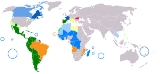
Romance languagesThe Romance languages are a branch of the Indo-European language family, more precisely of the Italic languages subfamily, comprising all the languages that descend from Vulgar Latin, the language of ancient Rome...
, which comprise all languages that descended from
LatinLatin is an Italic language originally spoken in Latium and Ancient Rome. It, along with most European languages, is a descendant of the ancient Proto-Indo-European language. Although it is considered a dead language, a number of scholars and members of the Christian clergy speak it fluently, and...
, are spoken by more than 600 million native speakers worldwide, mainly in the
AmericasThe Americas, or America , are lands in the Western hemisphere, also known as the New World. In English, the plural form the Americas is often used to refer to the landmasses of North America and South America with their associated islands and regions, while the singular form America is primarily...
,
EuropeEurope is, by convention, one of the world's seven continents. Comprising the westernmost peninsula of Eurasia, Europe is generally 'divided' from Asia to its east by the watershed divides of the Ural and Caucasus Mountains, the Ural River, the Caspian and Black Seas, and the waterways connecting...
, and
AfricaAfrica is the world's second largest and second most populous continent, after Asia. At about 30.2 million km² including adjacent islands, it covers 6% of the Earth's total surface area and 20.4% of the total land area...
. Additionally, the vocabulary of
Germanic languagesThe Germanic languages constitute a sub-branch of the Indo-European language family. The common ancestor of all of the languages in this branch is called Proto-Germanic , which was spoken in approximately the mid-1st millennium BC in Iron Age northern Europe...
like
GermanGerman is a West Germanic language, related to and classified alongside English and Dutch. With an estimated 90 – 98 million native speakers, German is one of the world's major languages and is the most widely-spoken first language in the European Union....
or
EnglishEnglish is a West Germanic language that arose in the Anglo-Saxon kingdoms of England and spread into what was to become south-east Scotland under the influence of the Anglian medieval kingdom of Northumbria...
contains a large percentage of Latin words. In case of English, the proportion of words with a Latin or Romance origin is estimated to be over 50% English has many grammatical similarities to the Romance Languages, particularly French.
Script
Today, the
Latin AlphabetThe Latin alphabet, also called the Roman alphabet, is the most recognized alphabet used in the world today. It evolved from a western variety of the Greek alphabet called the Cumaean alphabet, which was adopted and modified by the Etruscans who ruled early Rome...
, the script spread by the Roman Empire to most of Europe, and created from the ancient Greek alphabet, is the most far-spread and commonly used script in the world. Spread by various colonies, trade routes, and political powers, the alphabet has continued to grow in strength, although used
variantlydiacritics is a quarterly academic journal established in 1971 at Cornell University and published by the Johns Hopkins University Press. Articles serve to review recent literature in the field of literary criticism, and have covered topics in gender studies, political theory, psychoanalysis, queer...
.
Latin literature
The
Carolingian RenaissanceIn the history of ideas the Carolingian Renaissance stands out as a period of intellectual and cultural revival in Europe occurring from the late eighth century, in the generation of Alcuin, to the 9th century, and the generation of Heiric of Auxerre, with the peak of the activities coordinated...
of the eighth century rescued many works of Latin literature from the gates of oblivion: manuscripts transcribed at that time are our only sources for works that later fell into desuetude once more, only to be recovered during the
RenaissanceThe Renaissance was a cultural movement that spanned roughly the 14th to the 17th century, beginning in Italy in the Late Middle Ages and later spreading to the rest of Europe. The term is also used more loosely to refer to the historical era, but since the changes of the Renaissance were not...
:
TacitusPublius Cornelius Tacitus was a senator and a historian of the Roman Empire. The surviving portions of his two major works—the Annals and the Histories—examine the reigns of the Roman Emperors Tiberius, Claudius, Nero and those who reigned in the Year of the Four Emperors...
,
LucretiusTitus Lucretius Carus was a Roman poet and philosopher. His only known work is an epic philosophical poem laying out the beliefs of Epicureanism, De rerum natura, translated into English as On the Nature of Things or "On the Nature of the Universe".Virtually no details have come down concerning...
, Propertius and
CatullusGaius Valerius Catullus was a Latin poet of the Republican period. His surviving works are still read widely, and continue to influence poetry and other forms of art.-Biography:...
are examples. Other Latin writers were always read:
VirgilPublius Vergilius Maro, usually called Virgil or Vergil in English , was an ancient Roman poet of the Augustan period. He is known for three major works of Latin literature, the Eclogues , the Georgics, and the epic Aeneid...
was reinterpreted as a prophet of Christianity by the fourth century, and gained the reputation of a sorcerer in the twelfth century.
CiceroMarcus Tullius Cicero , was a Roman philosopher, statesman, lawyer, political theorist, and Roman constitutionalist. He came from a wealthy municipal family of the equestrian order, and is widely considered one of Rome's greatest orators and prose stylists.He introduced the Romans to the chief...
, in a limited number of his works, remained a model of good style, mined for quotations.
OvidPublius Ovidius Naso , known as Ovid in the English-speaking world, was a Roman poet who is best known as the author of the three major collections of erotic poetry: Heroides, Amores, and Ars Amatoria...
was read with a Christian
allegorical interpretationAllegory is a demonstrative form of representation explaining meaning other than the words that are spoken. Allegory communicates its message by means of symbolic figures, actions or symbolic representation...
.
SenecaLucius Annaeus Seneca was a Roman Stoic philosopher, statesman, dramatist, and in one work humorist, of the Silver Age of Latin literature. He was tutor and later advisor to emperor Nero...
was reimagined as the correspondent of Saint Paul.
LucanLucan is the common English name of the Roman poet Marcus Annaeus Lucanus.Lucan may also refer to:-People:*Arthur Lucan , English actor*Sir Lucan the Butler, Knight of the Round Table in Arthurian legend...
, Persius,
JuvenalThe Satires are a collection of satirical poems by the Latin author Juvenal written in the late 1st and early 2nd centuries AD.Juvenal is credited with sixteen known poems divided among five books; all are in the Roman genre of satire, which, at its most basic in the time of the author, comprised a...
,
HoraceQuintus Horatius Flaccus , known in the English-speaking world as Horace, was the leading Roman lyric poet during the time of Augustus.-Life:...
,
TerencePublius Terentius Afer , better known in English as Terence, was a playwright of the Roman Republic, of North African descent. His comedies were performed for the first time around 170–160 BC. Terentius Lucanus, a Roman senator, brought Terence to Rome as a slave, educated him and later on,...
survived in the continuing
canonThe term Western canon denotes a canon of books and, more broadly, music and art that have been the most important and influential in shaping Western culture. As such, it includes the "greatest works of artistic merit." Such a canon is important to the theory of educational perennialism and the...
and historians
Valerius MaximusValerius Maximus was a Latin writer and author of a collection of historical anecdotes. He worked during the reign of Tiberius .-Biography:...
,
LivyTitus Livius — known as Livy in English — was a Roman historian who wrote a monumental history of Rome and the Roman people. Ab Urbe Condita Libri, "Chapters from the Foundation of the City," covering the period from the earliest legends of Rome well before the traditional foundation in 753 BC...
and
StatiusPublius Papinius Statius was a Roman poet of the 1st century CE . Besides his poetry in Latin, which include an epic poem, the Thebaid, a collection of occasional poetry, the Silvae, and the unfinished epic, the Achilleid, he is best known for his appearance as a major character in the Purgatory...
continued to be read for the moral lessons history was expected to impart.
Religion
Christianity spread through the Roman empire; since emperor
Theodosius ITheodosius I , also known as Theodosius the Great, was Roman Emperor from 379 to 395. Theodosius was the last emperor to rule over both the eastern and the western halves of the Roman Empire. During his reign, the Goths secured control of Illyricum after the Gothic War, establishing their homeland...
(
379Year 379 was a common year starting on Tuesday of the Julian calendar. At the time, it was known as the Year of the Consulship of Ausonius and Hermogenianus...
-
395Year 395 was a common year starting on Monday of the Julian calendar. At the time, it was known as the Year of the Consulship of Olybrius and Probinus...
AD), the official state religion of the Roman Empire was
ChristianityChristianity is a monotheistic religion based on the life and teachings of Jesus as presented in canonical gospels and other New Testament writings...
. Subsequently, former Roman territories became Christian states which exported their religion to other parts of the world, through colonisation and missionaries.
Roman law
Although the law of the Roman Empire is not used today, modern law in many jurisdictions is based on principles of law used and developed during the Roman Empire. Some of the same Latin
terminology is still used today. Also,
US Supreme CourtThe Supreme Court of the United States is the highest court in the United States. It has ultimate appellate jurisdiction over all state and federal courts, and original jurisdiction over a small range of cases...
Justices often refer to Roman law when formulating their opinions . The general structure of jurisprudence used today, in many jurisdictions, is the same (trial with a judge, plaintiff, and defendant) as that established during the Roman Empire.
Inventions
Many Roman innovations were improved versions of other peoples inventions and ranged from military organization, weapon improvements,
armourArmour or armor is protective covering used to prevent damage from being inflicted to an object, individual or a vehicle through use of direct contact weapons or projectiles, usually during combat, or from damage caused by a potentially dangerous environment or action...
,
siegeA siege is a military blockade of a city or fortress with the intent of conquering by attrition or assault. The term derives from sedere, Latin for "to sit". Generally speaking, siege warfare is a form of constant, low intensity conflict characterized by one party holding a strong, static...
technology, naval innovation, architecture, medical instruments, irrigation, civil planning, construction,
agricultureAgriculture is the cultivation of animals, plants, fungi and other life forms for food, fiber, and other products used to sustain life. Agriculture was the key implement in the rise of sedentary human civilization, whereby farming of domesticated species created food surpluses that nurtured the...
and many more areas of civic, governmental, military and
engineeringEngineering is the discipline, art, skill and profession of acquiring and applying scientific, mathematical, economic, social, and practical knowledge, in order to design and build structures, machines, devices, systems, materials and processes that safely realize improvements to the lives of...
development.
That said, the Romans also developed a huge array of new technologies and innovations. Many came from common themes but were vastly superior to what had come before, whilst others were totally new inventions developed by and for the needs of Empire and the Roman way of life.
Some of the more famous examples are the Roman aqueducts (some of which are still in use today), Roman roads, water powered milling machines, thermal heating systems (as employed in
Roman bathsIn ancient Rome, thermae and balnea were facilities for bathing...
, and also used in palaces and wealthy homes) sewage and pipe systems and the invention and widespread use of
concreteConcrete is a composite construction material, composed of cement and other cementitious materials such as fly ash and slag cement, aggregate , water and chemical admixtures.The word concrete comes from the Latin word...
.
Metallurgy and glass work (including the first widespread use of glass windows) and a wealth of architectural innovations including high rise buildings, dome construction, bridgeworks and floor construction (seen in the functionality of the
ColosseumThe Colosseum, or the Coliseum, originally the Flavian Amphitheatre , is an elliptical amphitheatre in the centre of the city of Rome, Italy, the largest ever built in the Roman Empire...
's arena and the underlying rooms/areas beneath it) are other examples of Roman innovation and genius.
Military inventiveness was widespread and ranged from tactical/strategic innovations, new methodologies in training, discipline and field medicine as well as inventions in all aspects of weaponry, from armor and shielding to siege engines and missile technology.
This combination of new methodologies, technical innovation, and creative invention in the military gave Rome the edge against its adversaries for half a millennium, and with it, the ability to create an empire that even today, more than 2000 years later, continues to leave its legacy in many areas of modern life.
Antiquities
An interest in the material remains of the Roman Empire never completely died away during the Middle Ages.
Architecture
In the mid-18th century, Roman architecture inspired
neoclassical architectureNeoclassical architecture was an architectural style produced by the neoclassical movement that began in the mid-18th century, manifested both in its details as a reaction against the Rococo style of naturalistic ornament, and in its architectural formulas as an outgrowth of some classicizing...
. Neoclassicalism was an international movement. Though neoclassical architecture employs the same classical vocabulary as Late
Baroque architectureBaroque architecture is a term used to describe the building style of the Baroque era, begun in late sixteenth century Italy, that took the Roman vocabulary of Renaissance architecture and used it in a new rhetorical and theatrical fashion, often to express the triumph of the Catholic Church and...
, it tends to emphasize its planar qualities, rather than sculptural volumes. Projections and recessions and their effects of
light and shadeChiaroscuro in art is "an Italian term which literally means 'light-dark'. In paintings the description refers to clear tonal contrasts which are often used to suggest the volume and modelling of the subjects depicted"....
are flatter; sculptural bas-reliefs are flatter and tend to be enframed in friezes, tablets or panels. Its clearly articulated individual features are isolated rather than interpenetrating, autonomous and complete in themselves.
International neoclassical architecture was exemplified in
Karl Friedrich SchinkelKarl Friedrich Schinkel was a Prussian architect, city planner, and painter who also designed furniture and stage sets. Schinkel was one of the most prominent architects of Germany and designed both neoclassical and neogothic buildings.-Biography:Schinkel was born in Neuruppin, Margraviate of...
's buildings, especially the
Old MuseumThe Altes Museum , is one of several internationally renowned museums on Museum Island in Berlin, Germany. Since restoration work in 1966, it houses the Antikensammlung of the Berlin State Museums...
in Berlin, Sir
John SoaneSir John Soane, RA was an English architect who specialised in the Neo-Classical style. His architectural works are distinguished by their clean lines, massing of simple form, decisive detailing, careful proportions and skilful use of light sources...
's Bank of England in London and the newly built
White HouseThe White House is the official residence and principal workplace of the president of the United States. Located at 1600 Pennsylvania Avenue NW in Washington, D.C., the house was designed by Irish-born James Hoban, and built between 1792 and 1800 of white-painted Aquia sandstone in the Neoclassical...
and
CapitolThe United States Capitol is the meeting place of the United States Congress, the legislature of the federal government of the United States. Located in Washington, D.C., it sits atop Capitol Hill at the eastern end of the National Mall...
in Washington, DC in the
United StatesThe United States of America is a federal constitutional republic comprising fifty states and a federal district...
. The Scots architect
Charles CameronCharles Cameron was a Scottish architect who made an illustrious career at the court of Catherine II of Russia. Cameron, practitioner of early neoclassical architecture, was the chief architect of Tsarskoye Selo and Pavlovsk palaces and the adjacent new town of Sophia from his arrival in Russia in...
created palatial Italianate interiors for the German-born Catherine II the Great in St. Petersburg.
Italy clung to Rococo until the Napoleonic regimes brought the new archaeological classicism, which was embraced as a political statement by young, progressive, urban Italians with republican leanings.
Imperial idea
The Roman line continued uninterrupted to rule the Eastern Roman Empire. In a slow process, the Roman state internally transformed to the
Byzantine EmpireThe Byzantine Empire was the Eastern Roman Empire during the periods of Late Antiquity and the Middle Ages, centred on the capital of Constantinople. Known simply as the Roman Empire or Romania to its inhabitants and neighbours, the Empire was the direct continuation of the Ancient Roman State...
, whose main characteristics were Roman concept of state, Greek culture and language and Christian faith. The Byzantines themselves never ceased to refer to themselves as Romans (
Rhomaioi) and to their state as the Roman Empire, the Empire of the Romans (in Greek Βασιλεία των Ῥωμαίων, Basileía ton Rhōmaíōn) or Romania (Ῥωμανία, Rhōmanía). Likewise, they were called
RûmRûm, also Roum or Rhum , an indefinite term used at different times in the Muslim world to refer to the Balkans and Anatolia generally, and for the Byzantine Empire in particular, for the Seljuk Sultanate of Rûm in Asia Minor, and referring to Greeks living outside of Greece or non-muslims...
(Rome) by their eastern enemies to the point that competing neighbours even acquired its name, such as the
Sultanate of RûmThe Sultanate of Rum , also known as the Anatolian Seljuk State , was a Turkic state centered in in Anatolia, with capitals first at İznik and then at Konya. Since the court of the sultanate was highly mobile, cities like Kayseri and Sivas also functioned at times as capitals...
.
The designation of the Empire as "Byzantine" is a retrospective idea: it began only in 1557, a century after the
fall of ConstantinopleThe Fall of Constantinople was the capture of the capital of the Byzantine Empire, which occurred after a siege by the Ottoman Empire, under the command of Ottoman Sultan Mehmed II, against the defending army commanded by Byzantine Emperor Constantine XI...
, when
GermanThe Germans are a Germanic ethnic group native to Central Europe. The English term Germans has referred to the German-speaking population of the Holy Roman Empire since the Late Middle Ages....
historian
Hieronymus WolfHieronymus Wolf was a sixteenth-century German historian and humanist, most famous for introducing a system of Byzantine historiography that eventually became the standard in works of medieval Greek history.- His life :...
published his work
Corpus Historiæ Byzantinæ, a collection of Byzantine sources. The term did not come in general use in the
Western worldThe Western world, also known as the West and the Occident , is a term referring to the countries of Western Europe , the countries of the Americas, as well all countries of Northern and Central Europe, Australia and New Zealand...
before the 19th century , when modern
GreeceGreece , officially the Hellenic Republic , and historically Hellas or the Republic of Greece in English, is a country in southeastern Europe....
was born. The end of the
continuous tradition of the Roman Empire is open to debate: the final point was the capture of Constantinople in 1453 AD, while some place it at the
sack of ConstantinopleThe Siege of Constantinople in 1203 was a Crusader siege of the capital of the Byzantine Empire, in support of the deposed emperor Isaac II Angelos and his son Alexios IV Angelos.- The siege :...
by the
CrusaderThe Crusades were a series of religious wars, blessed by the Pope and the Catholic Church with the main goal of restoring Christian access to the holy places in and near Jerusalem...
s in 1204.
In
Western EuropeWestern Europe is a loose term for the collection of countries in the western most region of the European continents, though this definition is context-dependent and carries cultural and political connotations. One definition describes Western Europe as a geographic entity—the region lying in the...
, the Roman concept of state was continued for almost a millennium by the
Holy Roman EmpireThe Holy Roman Empire was a realm that existed from 962 to 1806 in Central Europe.It was ruled by the Holy Roman Emperor. Its character changed during the Middle Ages and the Early Modern period, when the power of the emperor gradually weakened in favour of the princes...
whose emperors, mostly of
GermanGerman is a West Germanic language, related to and classified alongside English and Dutch. With an estimated 90 – 98 million native speakers, German is one of the world's major languages and is the most widely-spoken first language in the European Union....
tongue, viewed themselves as the legitimate successors to the ancient imperial tradition (
King of the RomansKing of the Romans was the title used by the ruler of the Holy Roman Empire following his election to the office by the princes of the Kingdom of Germany...
) and Rome as the capital of its Empire. The German title of "Kaiser" is derived from the Latin word for Caesar. The word Caesar is pronounced Kaiser in Classical Latin. The Holy Roman Empire was dissolved in 1806 owing to pressure by
Napoleon INapoleon Bonaparte was a French military and political leader during the latter stages of the French Revolution.As Napoleon I, he was Emperor of the French from 1804 to 1815...
. In the early 20th century, the
Italian fascistsItalian Fascism also known as Fascism with a capital "F" refers to the original fascist ideology in Italy. This ideology is associated with the National Fascist Party which under Benito Mussolini ruled the Kingdom of Italy from 1922 until 1943, the Republican Fascist Party which ruled the Italian...
under their "Duce"
Benito MussoliniBenito Amilcare Andrea Mussolini was an Italian politician who led the National Fascist Party and is credited with being one of the key figures in the creation of Fascism....
dreamed of a new Roman Empire as an Italian one, encompassing the
Mediterranean basinThe Mediterranean Sea is a sea connected to the Atlantic Ocean surrounded by the Mediterranean region and almost completely enclosed by land: on the north by Anatolia and Europe, on the south by North Africa, and on the east by the Levant...
.
In
Eastern EuropeEastern Europe is the eastern part of Europe. The term has widely disparate geopolitical, geographical, cultural and socioeconomic readings, which makes it highly context-dependent and even volatile, and there are "almost as many definitions of Eastern Europe as there are scholars of the region"...
, the Russian czars
Czar (derived from
CaesarCaesar is a title of imperial character. It derives from the cognomen of Julius Caesar, the Roman dictator...
) adopted the idea of
MoscowMoscow is the capital, the most populous city, and the most populous federal subject of Russia. The city is a major political, economic, cultural, scientific, religious, financial, educational, and transportation centre of Russia and the continent...
and
RussiaRussia or , officially known as both Russia and the Russian Federation , is a country in northern Eurasia. It is a federal semi-presidential republic, comprising 83 federal subjects...
being a
Third RomeThe term Third Rome describes the idea that some European city, state, or country is the successor to the legacy of the Roman Empire and its successor state, the Byzantine Empire ....
. Sentiments of being the heir of the fallen Eastern Roman Empire began during the reign of
Ivan III, Grand Duke of MoscowIvan III Vasilyevich , also known as Ivan the Great, was a Grand Prince of Moscow and "Grand Prince of all Rus"...
who had married
Sophia PaleologueZoe Palaiologina , later changed her name to Sophia Palaiologina , Grand Duchess of Moscow, was a niece of the last Byzantine emperor Constantine XI and second wife of Ivan III of Russia. She was also the grandmother of Ivan the Terrible.- Biography :...
, the niece of
Constantine XIConstantine XI Palaiologos, latinized as Palaeologus , Kōnstantinos XI Dragasēs Palaiologos; February 8, 1404 – May 29, 1453) was the last reigning Byzantine Emperor from 1449 to his death as member of the Palaiologos dynasty...
, the last Eastern Roman Emperor. Being the most powerful Orthodox Christian state, the Tsars were thought of in Russia as succeeding the
Eastern Roman EmpireThe Byzantine Empire was the Eastern Roman Empire during the periods of Late Antiquity and the Middle Ages, centred on the capital of Constantinople. Known simply as the Roman Empire or Romania to its inhabitants and neighbours, the Empire was the direct continuation of the Ancient Roman State...
as the rightful rulers of the (Christian) world. There were also competing Bulgarian, Wallachian and Ottoman claims for legal succession of the Roman Empire, Mehmet II "the Conquerer" claiming the title
Kayser-i Rûm, meaning
CaesarCaesar is a title of imperial character. It derives from the cognomen of Julius Caesar, the Roman dictator...
of Rome.
See also
- Classical Antiquity
Classical antiquity is a broad term for a long period of cultural history centered on the Mediterranean Sea, comprising the interlocking civilizations of ancient Greece and ancient Rome, collectively known as the Greco-Roman world...
- History of the Roman Empire
The broader history of the Roman Empire extends through 16 centuries and includes several stages in the evolution of the Roman state. It encompasses the period of the ancient Roman Empire, the period in which it was divided into western and eastern halves, and the history of the Eastern Roman or...
- Western Roman Empire
The Western Roman Empire was the western half of the Roman Empire after its division by Diocletian in 285; the other half of the Roman Empire was the Eastern Roman Empire, commonly referred to today as the Byzantine Empire....
- Byzantine Empire
The Byzantine Empire was the Eastern Roman Empire during the periods of Late Antiquity and the Middle Ages, centred on the capital of Constantinople. Known simply as the Roman Empire or Romania to its inhabitants and neighbours, the Empire was the direct continuation of the Ancient Roman State...
- Legacy of Byzantium
- Third Rome
The term Third Rome describes the idea that some European city, state, or country is the successor to the legacy of the Roman Empire and its successor state, the Byzantine Empire ....
- Eastern Romance substratum
The Eastern Romance languages developed from the Proto-Romanian language, which in turn developed from the Vulgar Latin spoken in a region of the Balkans which has not yet been exactly determined, but is generally agreed to have been a region north of the Jireček Line.That there was...
- Origin of the Romanians