

Euramerica

Encyclopedia
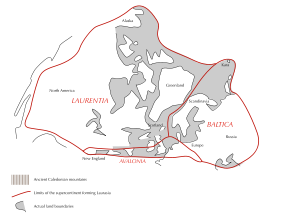
Euramerica was a minor supercontinent
created in the Devonian
as the result of a collision between the Laurentia
n, Baltica
, and Avalonia
craton
s (Caledonian orogeny
).
300 million years ago in the Late Carboniferous
tropical rainforests lay over the equator of Euramerica. A major, abrupt change in vegetation occurred when the climate aridified. The forest fragmented and the lycopsids
which dominated these wetlands thinned out, being replaced by opportunistic ferns. There was also a great loss of amphibian diversity and simultaneously the drier climate spurred the diversification of reptiles.
 Euramerica became a part of the major supercontinent Pangaea
in the Permian
. In the Jurassic
, when Pangaea rifted into two continents, Gondwana
and Laurasia
, Euramerica was a part of Laurasia.
In the Cretaceous
, Laurasia split into the continents of North America
and Eurasia
. The Laurentian craton
became a part of North America, while Baltica became a part of Eurasia.
(CRC).
Permian: Euramerica became a part of the major supercontinent Pangaea
Jurassic: Pangaea rifted into Gondwana
and Laurasia
Cretaceous: Laurasia split into the continents of North America
and Eurasia
.
Supercontinent
In geology, a supercontinent is a landmass comprising more than one continental core, or craton. The assembly of cratons and accreted terranes that form Eurasia qualifies as a supercontinent today.-History:...
created in the Devonian
Devonian
The Devonian is a geologic period and system of the Paleozoic Era spanning from the end of the Silurian Period, about 416.0 ± 2.8 Mya , to the beginning of the Carboniferous Period, about 359.2 ± 2.5 Mya...
as the result of a collision between the Laurentia
Laurentia
Laurentia is a large area of continental craton, which forms the ancient geological core of the North American continent...
n, Baltica
Baltica
Baltica is a name applied by geologists to a late-Proterozoic, early-Palaeozoic continent that now includes the East European craton of northwestern Eurasia. Baltica was created as an entity not earlier than 1.8 billion years ago. Before this time, the three segments/continents that now comprise...
, and Avalonia
Avalonia
Avalonia was a microcontinent in the Paleozoic era. Crustal fragments of this former microcontinent underlie south-west Great Britain, and the eastern coast of North America. It is the source of many of the older rocks of Western Europe, Atlantic Canada, and parts of the coastal United States...
craton
Craton
A craton is an old and stable part of the continental lithosphere. Having often survived cycles of merging and rifting of continents, cratons are generally found in the interiors of tectonic plates. They are characteristically composed of ancient crystalline basement rock, which may be covered by...
s (Caledonian orogeny
Caledonian orogeny
The Caledonian orogeny is a mountain building era recorded in the northern parts of the British Isles, the Scandinavian Mountains, Svalbard, eastern Greenland and parts of north-central Europe. The Caledonian orogeny encompasses events that occurred from the Ordovician to Early Devonian, roughly...
).
300 million years ago in the Late Carboniferous
Carboniferous
The Carboniferous is a geologic period and system that extends from the end of the Devonian Period, about 359.2 ± 2.5 Mya , to the beginning of the Permian Period, about 299.0 ± 0.8 Mya . The name is derived from the Latin word for coal, carbo. Carboniferous means "coal-bearing"...
tropical rainforests lay over the equator of Euramerica. A major, abrupt change in vegetation occurred when the climate aridified. The forest fragmented and the lycopsids
Lycopodiophyta
The Division Lycopodiophyta is a tracheophyte subdivision of the Kingdom Plantae. It is the oldest extant vascular plant division at around 410 million years old, and includes some of the most "primitive" extant species...
which dominated these wetlands thinned out, being replaced by opportunistic ferns. There was also a great loss of amphibian diversity and simultaneously the drier climate spurred the diversification of reptiles.
Extent
Pangaea
Pangaea, Pangæa, or Pangea is hypothesized as a supercontinent that existed during the Paleozoic and Mesozoic eras about 250 million years ago, before the component continents were separated into their current configuration....
in the Permian
Permian
The PermianThe term "Permian" was introduced into geology in 1841 by Sir Sir R. I. Murchison, president of the Geological Society of London, who identified typical strata in extensive Russian explorations undertaken with Edouard de Verneuil; Murchison asserted in 1841 that he named his "Permian...
. In the Jurassic
Jurassic
The Jurassic is a geologic period and system that extends from about Mya to Mya, that is, from the end of the Triassic to the beginning of the Cretaceous. The Jurassic constitutes the middle period of the Mesozoic era, also known as the age of reptiles. The start of the period is marked by...
, when Pangaea rifted into two continents, Gondwana
Gondwana
In paleogeography, Gondwana , originally Gondwanaland, was the southernmost of two supercontinents that later became parts of the Pangaea supercontinent. It existed from approximately 510 to 180 million years ago . Gondwana is believed to have sutured between ca. 570 and 510 Mya,...
and Laurasia
Laurasia
In paleogeography, Laurasia was the northernmost of two supercontinents that formed part of the Pangaea supercontinent from approximately...
, Euramerica was a part of Laurasia.
In the Cretaceous
Cretaceous
The Cretaceous , derived from the Latin "creta" , usually abbreviated K for its German translation Kreide , is a geologic period and system from circa to million years ago. In the geologic timescale, the Cretaceous follows the Jurassic period and is followed by the Paleogene period of the...
, Laurasia split into the continents of North America
North America
North America is a continent wholly within the Northern Hemisphere and almost wholly within the Western Hemisphere. It is also considered a northern subcontinent of the Americas...
and Eurasia
Eurasia
Eurasia is a continent or supercontinent comprising the traditional continents of Europe and Asia ; covering about 52,990,000 km2 or about 10.6% of the Earth's surface located primarily in the eastern and northern hemispheres...
. The Laurentian craton
Craton
A craton is an old and stable part of the continental lithosphere. Having often survived cycles of merging and rifting of continents, cratons are generally found in the interiors of tectonic plates. They are characteristically composed of ancient crystalline basement rock, which may be covered by...
became a part of North America, while Baltica became a part of Eurasia.
Events
Carboniferous: Climate change devastated tropical rainforests, fragmenting the forests into isolated 'islands' and causing the extinction of many plant and animal species during the Carboniferous Rainforest CollapseCarboniferous Rainforest Collapse
The Carboniferous Rainforest Collapse was an extinction event that occurred around 305 million years ago in the Carboniferous period). Vast coal forests covered the equatorial region of Euramerica...
(CRC).
Permian: Euramerica became a part of the major supercontinent Pangaea
Jurassic: Pangaea rifted into Gondwana
Gondwana
In paleogeography, Gondwana , originally Gondwanaland, was the southernmost of two supercontinents that later became parts of the Pangaea supercontinent. It existed from approximately 510 to 180 million years ago . Gondwana is believed to have sutured between ca. 570 and 510 Mya,...
and Laurasia
Laurasia
In paleogeography, Laurasia was the northernmost of two supercontinents that formed part of the Pangaea supercontinent from approximately...
Cretaceous: Laurasia split into the continents of North America
North America
North America is a continent wholly within the Northern Hemisphere and almost wholly within the Western Hemisphere. It is also considered a northern subcontinent of the Americas...
and Eurasia
Eurasia
Eurasia is a continent or supercontinent comprising the traditional continents of Europe and Asia ; covering about 52,990,000 km2 or about 10.6% of the Earth's surface located primarily in the eastern and northern hemispheres...
.