
All Topics  
Sarcopterygii


   Email Print
   Bookmark   Link


Sarcopterygii


Sarcopterygii - Crossopterygii ("fleshy-finned fishes", from Greek sa??, sarx, flesh, and pte???, pteryx, fin -- "lobe-finned fishes", from old German krukja, "stick with end curved into a lobe") is traditionally the class
Class (biology)

A class is the taxonomic rank in the biological classification of organisms in biology below phylum and above Order .The orders of taxonomy are life, Domain , kingdom , phylum, class , order , family , genus, and species....
 of fleshy-finned, lobe-finned fish
Fish

A fish is any marine biology vertebrate animal that is typically ectothermic , covered with scale , and equipped with two sets of paired fins and several unpaired fins....
es, consisting of lungfish
Lungfish

Lungfish are freshwater fish belonging to the Subclass Dipnoi. Lungfish are best-known for retaining characteristics primitive within the Osteichthyes, including the ability to breathe air, and structures primitive within Sarcopterygii, including the presence of lobed fins with a well-developed internal skeleton....
, and coelacanth
Coelacanth

Coelacanth is the common name for an Order of fish that includes the oldest living Lineage of gnathostomata known to date. The coelacanths, which are related to lungfishes and tetrapods, were believed to have been extinction since the end of the Cretaceous period, until the first Latimeria specimen was found off the east coast of Sout...
s.

opterygians - crossopterygians are bony fish with fleshy-, lobed-paired fins, which are joined to the body by a single bone .


Discussion
Ask a question about 'Sarcopterygii'
Start a new discussion about 'Sarcopterygii'
Answer questions from other users
Full Discussion Forum


Recent Posts


Encyclopedia


Sarcopterygii - Crossopterygii ("fleshy-finned fishes", from Greek sa??, sarx, flesh, and pte???, pteryx, fin -- "lobe-finned fishes", from old German krukja, "stick with end curved into a lobe") is traditionally the class
Class (biology)

A class is the taxonomic rank in the biological classification of organisms in biology below phylum and above Order .The orders of taxonomy are life, Domain , kingdom , phylum, class , order , family , genus, and species....
 of fleshy-finned, lobe-finned fish
Fish

A fish is any marine biology vertebrate animal that is typically ectothermic , covered with scale , and equipped with two sets of paired fins and several unpaired fins....
es, consisting of lungfish
Lungfish

Lungfish are freshwater fish belonging to the Subclass Dipnoi. Lungfish are best-known for retaining characteristics primitive within the Osteichthyes, including the ability to breathe air, and structures primitive within Sarcopterygii, including the presence of lobed fins with a well-developed internal skeleton....
, and coelacanth
Coelacanth

Coelacanth is the common name for an Order of fish that includes the oldest living Lineage of gnathostomata known to date. The coelacanths, which are related to lungfishes and tetrapods, were believed to have been extinction since the end of the Cretaceous period, until the first Latimeria specimen was found off the east coast of Sout...
s.

Characteristics

Sarcopterygians - crossopterygians are bony fish with fleshy-, lobed-paired fins, which are joined to the body by a single bone . These fins evolved into legs of the first tetrapod
Tetrapod

Tetrapods are vertebrate animals having four feet, legs or leglike appendages. Amphibians, reptiles, dinosaurs/birds, and mammals are all tetrapods, and even the limbless snakes are tetrapods by descent....
 land vertebrates, amphibian
Amphibian

Amphibians , such as frogs, toads, salamanders, newts and caecilians, are cold-blooded animals that metamorphose from a juvenile, water-breathing form to an adult, air-breathing form....
s. They also possess two dorsal fins with separate bases, as opposed to the single dorsal fin of actinopterygians (ray-finned fishes). The braincase of sarcoptergygians primitively has a hinge line, but this is lost in tetrapods and lungfish. Many early sarcopts have a symmetrical tail.

Most taxonomists who subscribe to the cladistic
Cladistics

Cladistics is the hierarchical classification of species based on evolutionary ancestry. Cladistics is distinguished from other taxonomic systems because it focuses on evolution rather than similarities between species, and because it places heavy emphasis on objective, quantitative analysis....
 approach include the grouping Tetrapoda within this group, which in turns consists of all species of four-limbed vertebrate
Vertebrate

Vertebrates are members of the subphylum Vertebrata, chordates with Vertebras or Vertebral columns. The grouping sometimes includes the hagfish, which have no vertebrae, but are genetically quite closely related to lampreys, which do have vertebrae....
s. The fin-limbs of sarcopterygiians show such a strong similarity to the expected ancestral form of tetrapod limbs that they have been universally considered the direct ancestors of tetrapods in the scientific literature.

Evolution of Sarcopterygii

Fishapods
Sarcopterygians are generally accepted to belong to the Osteichthyes
Osteichthyes

Osteichthyes , also called bony fish, are a taxonomy group of fish that includes the ray-finned fish and lobe finned fish . The split between these two classes occurred around 440 mya ....
 group, or bony fishes, characterized by their bony skeleton instead of cartilage
Cartilage

Cartilage is a type of dense connective tissue. It is composed of specialized cells called chondrocyte that produce a large amount of extracellular matrix composed of collagen fibers, abundant ground substance rich in proteoglycan, and elastin fibers....
. However, due to the vast differences between Sarcopterygii and Osteichthyes in fin structure, respiratory structure, and circulatory structure, some taxonomists are now beginning to consider Sarcopterygii a sister superclass to Osteichthyes, instead of a class below them. The oldest Sarcopterygians were found in the Uppermost Silurian
Silurian

The Silurian is a geologic period that extends from the end of the Ordovician period, about 443.7 ? 1.5 annum , to the beginning of the Devonian period, about 416.0 ? 2.8 Mya ....
. The first Sarcopterygian closely resembled Acanthodians. The Sarcopterygians closest relatives were the Actinopterygians — ray-finned fishes. Sarcopterygians probably evolved in the oceans, but they later came into freshwater
Freshwater

Freshwater is a word that refers to bodies of water such as ponds, lakes, rivers and streams containing low concentrations of dissolved salts and other total dissolved solids....
 habitats to avoid the predatory placoderms — which were dominant in the Early–Middle Devonian
Devonian

The Devonian is a geologic period of the Paleozoic era spanning from . It is named after Devon, England, where rocks from this period were first studied....
 seas.

As Sarcopterygians evolved in the Early Devonian, the line split into two main lineages — the Coelacanth
Coelacanth

Coelacanth is the common name for an Order of fish that includes the oldest living Lineage of gnathostomata known to date. The coelacanths, which are related to lungfishes and tetrapods, were believed to have been extinction since the end of the Cretaceous period, until the first Latimeria specimen was found off the east coast of Sout...
s, and the Rhipidistia
Rhipidistia

The Rhipidistia were lobe-finned fishes that are the ancestors of the tetrapods. Taxonmists traditionally considered the Rhipidistia a subgroup of Crossopterygii that described a group of fish that lived during the Devonian consisting of the Porolepiformes and Osteolepiformes....
. The Coelacanths appeared in the Early Devonian, and stayed in the oceans; the coelacanths' heyday was the Late Devonian and Carboniferous
Carboniferous

The Carboniferous is a geologic period that extends from the end of the Devonian period, about 359.2 ? 2.5 annum , to the beginning of the Permian period, about 299.0 ? 0.8 Ma ...
, as they were more common during those periods than in any other period in the Phanerozoic. Coelacanths still live today in the ocean
Ocean

An ocean is a major body of Seawater, and a principal component of the hydrosphere. Approximately 71% of the Earth's surface is covered by ocean, a World Ocean that is customarily divided into several principal oceans and smaller seas....
s. Rhipidistians appeared about the same time as the Coelacanths, but unlike them, Rhipidistians left the ocean world and migrated into the freshwater habitats, their ancestors probably lived in the oceans near the river
River

A river is a natural stream of water, usually freshwater, flowing toward an ocean, a lake, or another stream. In some cases a river flows into the ground or dries up completely before reaching another body of water....
 mouths (estuaries). The Rhipidistians in turn split into two major groups — the lungfishes, and the tetrapodomorphs. The lungfishes' greatest diversity was in the Triassic
Triassic

The Triassic is a geologic period that extends from about 251 to 199 annum . As the first period of the Mesozoic Era, the Triassic follows the Permian and is followed by the Jurassic....
 Period, but today, there are fewer than a dozen genera left. The lungfishes evolved the first proto-lungs and proto-limbs. The lungfishes, ancient and modern, used their stubby fins (proto-limbs) to walk on land and find new water if their waterhole was depleted, and used their lungs to breathe air and get sufficient oxygen.

The tetrapodomorphs have the same identical anatomy as the lungfishes, who were their closest kin, but the tetrapodomorphs appear to have stayed in water a little longer until the Late Devonian
Devonian

The Devonian is a geologic period of the Paleozoic era spanning from . It is named after Devon, England, where rocks from this period were first studied....
. Tetrapods — four legged vertebrates were the terapodomorphs' descendants. Tetrapods appeared in the Late Devonian
Devonian

The Devonian is a geologic period of the Paleozoic era spanning from . It is named after Devon, England, where rocks from this period were first studied....
 epoch.

Non-tetrapod sarcopterygians continued to towards the end of Paleozoic Era. They suffered heavy losses during the Permian-Triassic extinction event
Permian-Triassic extinction event

The Permian?Triassic extinction event, informally known as the Great Dying, was an extinction event that occurred , forming the boundary between the Permian and Triassic geologic periods....
.

Taxonomy and Phylogeny

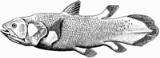
Latimeria Chalumnae01
  • Class SARCOPTERYGII
    • Actinistia
      • Eoactinistia
        Eoactinistia

        Eoactinistia is a prehistoric lobe-finned fish which lived during the Early Devonian geological period. Fossils have been found in Victoria, Australia....
      • Subclass Coelacanthimorpha
        • Order Coelacanthiformes
          • Family Latimeriidae
            • Macropoma
              Macropoma

              Macropoma is an extinct genus of coelacanth fish in the class Sarcopterygii. These fishes have apparently been extinct for over 70 million years and are most closely related to the modern, albeit primitive, coelacanth Latimeria....
            • Latimeria
    • Rhipidistia
      Rhipidistia

      The Rhipidistia were lobe-finned fishes that are the ancestors of the tetrapods. Taxonmists traditionally considered the Rhipidistia a subgroup of Crossopterygii that described a group of fish that lived during the Devonian consisting of the Porolepiformes and Osteolepiformes....
      • Subclass Dipnoi
        • Order Ceratodontiformes
        • Order Lepidosireniformes
      • Subclass Tetrapodomorpha
        Tetrapodomorpha

        Tetrapodomorpha is a clade of vertebrates, consisting of sarcopterygii with a number of features of tetrapods. Primitive forms, like Tiktaalik, have been referred to as "fishapods" by their discoverers, since they were half-fish half-tetrapods, at least in appearance....
        • Order Rhizodontida
        • Superorder Osteolepidida
          • Family Tristichopteridae
            Tristichopteridae

            Tristichopterids , were a diverse and successful group of tetrapodomorph fishes throughout the Late Devonian stage. They first appeared in the Givetian epoch of the Middle Devonian stage....
            • Eusthenopteron
              Eusthenopteron

              Eusthenopteron is a genus of prehistoric lobe-finned fish which has attained an iconic status from its close relationships to tetrapods. Early depictions of this animal show it emerging onto land, however paleontologists now widely agree that it was a Pelagic zone animal....
            • Hyneria
              Hyneria

              Hyneria was a prehistory predatory lobe-finned fish that lived during the Devonian period around 360 million years ago. It was approximately 4 meters in length and weighed as much as two tons....
          • Order Osteolepiformes
            Osteolepis

            Osteolepis is an extinct genus of coelacanthiformes lobe-finned fish from the Devonian period. It was about 20 cm long. It lived in the Orcadian Lakes of northern Scotland....
        • Order Panderichthyida
          Panderichthys

          Panderichthys is a 90–130 cm long fish from the Devonian period 380 million years ago, of Latvia. It has a large tetrapod-like head. Panderichthys exhibits transitional fossil features between lobe-finned fishes and early tetrapods such as Acanthostega....
        • Tiktaalik
          Tiktaalik

          Tiktaalik is a genus of extinction Sarcopterygii fish from the late Devonian period, with many features akin to those of tetrapods . It is an example from several lines of ancient sarcopterygian fish developing adaptations to the oxygen-poor shallow-water habitats of its time, which led to the evolution of amphibians....
        • Tetrapoda


See also

  • List of Sarcopterygii
  • Actinopterygii
    Actinopterygii

    The Actinopterygii constitute the Class of the ray-finned fishes.The ray-finned fishes are so called because they possess lepidotrichia or "fin rays", their fins being webs of skin supported by bony or horny spines , as opposed to the fleshy, lobed fins that characterize the class Sarcopterygii....
     — ray-finned fishes