


Neoteny

Encyclopedia
Developmental biology
Developmental biology is the study of the process by which organisms grow and develop. Modern developmental biology studies the genetic control of cell growth, differentiation and "morphogenesis", which is the process that gives rise to tissues, organs and anatomy.- Related fields of study...
. In neoteny, the physiological
Physiology
Physiology is the science of the function of living systems. This includes how organisms, organ systems, organs, cells, and bio-molecules carry out the chemical or physical functions that exist in a living system. The highest honor awarded in physiology is the Nobel Prize in Physiology or...
(or somatic
Somatic
The term somatic means 'of the body',, relating to the body. In medicine, somatic illness is bodily, not mental, illness. The term is often used in biology to refer to the cells of the body in contrast to the germ line cells which usually give rise to the gametes...
) development of an animal or organism is slowed or delayed. In contrast, in progenesis, sexual development occurs faster. Both processes result in paedomorphism. Ultimately this process results in the retention, in the adults of a species
Species
In biology, a species is one of the basic units of biological classification and a taxonomic rank. A species is often defined as a group of organisms capable of interbreeding and producing fertile offspring. While in many cases this definition is adequate, more precise or differing measures are...
, of juvenile physical characteristics well into maturity and pedogenesis (paedogenesis), the reproduction in a neotenized state.
Neoteny is one of three dimensions of heterochrony
Heterochrony
In biology, heterochrony is defined as a developmental change in the timing of events, leading to changes in size and shape. There are two main components, namely the onset and offset of a particular process, and the rate at which the process operates...
, or the change in timing of developmental events: acceleration (faster) vs. neoteny (slower), hypermorphosis (further) vs. progenesis (not as far), and predisplacement (begins earlier) vs. postdisplacement (begins later).
The word neoteny is borrowed from the German
German language
German is a West Germanic language, related to and classified alongside English and Dutch. With an estimated 90 – 98 million native speakers, German is one of the world's major languages and is the most widely-spoken first language in the European Union....
Neotenie, the latter constructed from the Greek
Greek language
Greek is an independent branch of the Indo-European family of languages. Native to the southern Balkans, it has the longest documented history of any Indo-European language, spanning 34 centuries of written records. Its writing system has been the Greek alphabet for the majority of its history;...
νέος (neos, young) and τείνειν (teínein, tend to). The adjectival
Adjectival
Adjectival may refer to:* Adjective, a part of speech that modifies a noun or a pronoun* Adjectival noun or sometimes "adjectival", a noun that functions as an adjective, especially in Japanese grammar...
form of the word is either "neotenous" or "neotenic". The opposite of neoteny is either called "gerontomorphic" or "peramorphic".
Neotenous traits in humans
These are neotenous traits in humans: flattened face, broadened face, large brain, hairless body, hairless face, small nose, reduction of brow ridge, small teeth, small upper jaw (maxilla), small lower jaw (mandible), epicanthic eye fold (present in all people in the embryonic stage), thinness of skull bones, limbs proportionately short compared to torso length, longer leg than arm length, larger eyes, and upright stance.Human evolution
Stephen Jay GouldStephen Jay Gould
Stephen Jay Gould was an American paleontologist, evolutionary biologist, and historian of science. He was also one of the most influential and widely read writers of popular science of his generation....
believed that the "evolutionary story" of humans is one where we have been "retaining to adulthood the originally juvenile features of our ancestors". J.B.S. Haldane mirrors Gould's hypothesis by stating a "major evolutionary trend in human beings" is "greater prolongation of childhood and retardation of maturity."
Delbert D. Thiessen
Del Thiessen
Delbert Thiessen is an American psychology professor emeritus whose research focused on evolutionary mechanisms of reproduction and social communication....
claimed that "neoteny becomes more apparent as early primates evolved into later forms" and that primates have been "evolving toward flat face." Stephen Jay Gould
Stephen Jay Gould
Stephen Jay Gould was an American paleontologist, evolutionary biologist, and historian of science. He was also one of the most influential and widely read writers of popular science of his generation....
argued "that the whole enterprise of ranking groups by degree of neoteny is fundamentally unjustified." (Gould, 1996, pg. 150).
In opposition, M.J. Rantala does not believe neoteny has been the main cause of human evolution, because humans only retain some juvenile traits while relinquishing others. He claims the high leg-to-body ratio (long legs) of adult humans as opposed to human infants shows that there is not holistic trend in humans towards neoteny when compared to the other Great Apes.
Australian anthropologist Andrew Arthur Abbie agrees, citing the gerontomorphic fleshy human nose and long human legs as contradicting the neoteny hominid evolution hypothesis, although he does believe humans are generally neotenous. Brian Keith Hall also cites the long legs of humans as a peramorphic trait in sharp contrast to neoteny.
Between sexes
Ashley MontaguAshley Montagu
Montague Francis Ashley Montagu was a British-American anthropologist and humanist, of Jewish ancestry, who popularized topics such as race and gender and their relation to politics and development...
notes the following neotenous traits in women relative to men: more delicate skeleton, smoother ligament attachments, smaller mastoid processes, reduced brow ridges, more forward tilt of the head, narrower joints, less hairy, more delicate skin, retention of fetal body hair
Lanugo
Lanugo is fine, downy hair as a type of fur. It is often found in teratomas .-Fetal development:Lanugo grows on fetuses as a normal part of gestation, but is usually shed and replaced by vellus hair at about 33 to 36 weeks of gestational age...
, smaller body size, more backward tilt of pelvis, greater longevity, lower basal metabolism, faster heartbeat, greater extension of development periods, higher pitched voice and larger tearducts.
Attractive women's faces
In a cross-cultural study, more neotenized female faces were found to be most attractive to men while less neotenized female faces were found to be less attractive to men, regardless of the females' actual age. Michael R. Cunningham of the Department of Psychology at the University of LouisvilleUniversity of Louisville
The University of Louisville is a public university in Louisville, Kentucky. When founded in 1798, it was the first city-owned public university in the United States and one of the first universities chartered west of the Allegheny Mountains. The university is mandated by the Kentucky General...
found, using a panel of "Asian
Asian people
Asian people or Asiatic people is a term with multiple meanings that refers to people who descend from a portion of Asia's population.- Central Asia :...
", "Hispanic
Hispanic
Hispanic is a term that originally denoted a relationship to Hispania, which is to say the Iberian Peninsula: Andorra, Gibraltar, Portugal and Spain. During the Modern Era, Hispanic sometimes takes on a more limited meaning, particularly in the United States, where the term means a person of ...
" and "White
White people
White people is a term which usually refers to human beings characterized, at least in part, by the light pigmentation of their skin...
" judges, that the Asian, Hispanic and White female faces found most attractive were those that had "neonate large eyes, greater distance between eyes, and small noses" and his study led him to conclude that "large eyes" were the most "effective" of the "neonate cues". Cunningham also said that "shiny" hair may be indicative of "neonate vitality".
Cunningham noted a "difference" in the preferences of Asian and White judges with Asian judges preferring women with "less mature faces" and smaller mouths than the White judges. Cunningham hypothesized that this difference in preference may stem from "ethnocentrism" since "Asian faces possess those qualities", so Cunningham re-analyzed the data with "11 Asian targets excluded" and concluded that "ethnocentrism was not a primary determinant of Asian preferences." Using a panel of "Blacks
Black people
The term black people is used in systems of racial classification for humans of a dark skinned phenotype, relative to other racial groups.Different societies apply different criteria regarding who is classified as "black", and often social variables such as class, socio-economic status also plays a...
" and "Whites" as judges, Cunningham found more neotenous faces were perceived as having both higher "femininity" and "sociability".
In contrast, Cunningham found that faces that were "low in neoteny" were judged as "intimidating". Upon analyzing the results of his study Cunningham concluded that preference for "neonate features may display the least cross-cultural variability" in terms of "attractiveness ratings". In a study of Italian women who have won beauty competitions, it was found that the Italian women who won the beauty competitions had faces characterized by more "babyness" traits compared to the "normal" women used as a reference. In a study of 60 Caucasian female faces at the University of St. Andrews, it was found that the average facial composite of the 15 faces found most attractive differed from the facial composite of the whole by: a reduced lower facial region, a thinner jaw and a higher forehead.
Between races and among primates
Stephen Jay Gould
Stephen Jay Gould was an American paleontologist, evolutionary biologist, and historian of science. He was also one of the most influential and widely read writers of popular science of his generation....
who taught biology and evolution at New York University objected to the ranking of races as more or less neotenous. But Gould argued that if one used the terms set forth by 1920s proponents of racial neoteny, "Orientals", not whites, are "clearly" the most neotenized human race.
Ashley Montagu
Ashley Montagu
Montague Francis Ashley Montagu was a British-American anthropologist and humanist, of Jewish ancestry, who popularized topics such as race and gender and their relation to politics and development...
mirrored this statement when he stated that the "Mongoloid skull
Mongoloid race
Mongoloid is a term sometimes used by forensic anthropologists and physical anthropologists to refer to populations that share certain phenotypic traits such as epicanthic fold and shovel-shaped incisors and other physical traits common in East Asia, the Americas and the Arctic...
, whether Chinese
Chinese people
The term Chinese people may refer to any of the following:*People with Han Chinese ethnicity ....
or Japanese
Japanese people
The are an ethnic group originating in the Japanese archipelago and are the predominant ethnic group of Japan. Worldwide, approximately 130 million people are of Japanese descent; of these, approximately 127 million are residents of Japan. People of Japanese ancestry who live in other countries...
" is the most neotenized human skull. Ashley Montagu further claimed that the "European
European people
European people may refer to:*Ethnic groups in Europe*Demographics of Europe*people from Europe*people from the European Union*People outside of Europe of European descent** European African or White African**White American ***European American...
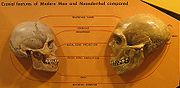
" skull was less neotenized than the Mongoloid, with the "Australian Aborigine" skull less neotenized than the European and the Neanderthal
Neanderthal
The Neanderthal is an extinct member of the Homo genus known from Pleistocene specimens found in Europe and parts of western and central Asia...
skull even less neotenized than the Australian Aborigine skull. Ashley Montagu claimed that humans have more neotenized skulls than Australopithecus
Australopithecus
Australopithecus is a genus of hominids that is now extinct. From the evidence gathered by palaeontologists and archaeologists, it appears that the Australopithecus genus evolved in eastern Africa around 4 million years ago before spreading throughout the continent and eventually becoming extinct...
.
Delbert D. Thiessen claimed that Homo Sapiens are more neotenized than Homo Erectus
Homo Erectus
Homo Erectus is a 2007 comedy film about cavemen that was written and directed by Adam Rifkin, and starring Giuseppe Andrews, Gary Busey, David Carradine, Ron Jeremy, Ali Larter, Hayes MacArthur, Adam Rifkin, and Talia Shire. It premiered at the 2007 Slamdance Film Festival in January 2007...
, Homo Erectus was more neotenized than Australopithicus, Great Apes are more neotenized than Old World monkey
Old World monkey
The Old World monkeys or Cercopithecidae are a group of primates, falling in the superfamily Cercopithecoidea in the clade Catarrhini. The Old World monkeys are native to Africa and Asia today, inhabiting a range of environments from tropical rain forest to savanna, shrubland and mountainous...
s and Old World monkeys are more neotenized than New World monkey
New World monkey
New World monkeys are the five families of primates that are found in Central and South America: Callitrichidae, Cebidae, Aotidae, Pitheciidae, and Atelidae. The five families are ranked together as the Platyrrhini parvorder and the Ceboidea superfamily, which are essentially synonymous since...
s.
Nancy Lynn Barrickman of the Department of Evolutionary Psychology at Duke University claimed Brian T. Shea found by multivariate analysis that Bonobo
Bonobo
The bonobo , Pan paniscus, previously called the pygmy chimpanzee and less often, the dwarf or gracile chimpanzee, is a great ape and one of the two species making up the genus Pan. The other species in genus Pan is Pan troglodytes, or the common chimpanzee...
s are more neotenized than the common chimpanzee
Common Chimpanzee
The common chimpanzee , also known as the robust chimpanzee, is a great ape. Colloquially, the common chimpanzee is often called the chimpanzee , though technically this term refers to both species in the genus Pan: the common chimpanzee and the closely related bonobo, formerly called the pygmy...
, taking into account such features as the proportionately long torso length of the Bonobo. Ashley Montagu believed that part of the differences seen in the morphology of "modernlike types of man" can be attributed to different rates of "neotenous mutations" in their early populations.
Mongoloids
According to Ashley MontaguAshley Montagu
Montague Francis Ashley Montagu was a British-American anthropologist and humanist, of Jewish ancestry, who popularized topics such as race and gender and their relation to politics and development...
who taught anthropology at Princeton University, "The Mongoloid skull has proceeded further than in any other people." "The Mongoloid skull, whether Chinese or Japanese, has been rather more neotenized than the Caucasoid or European." "The female skull, it will be noted, is more pedomorphic in all human populations than the male skull."
In Ashley Montagu
Ashley Montagu
Montague Francis Ashley Montagu was a British-American anthropologist and humanist, of Jewish ancestry, who popularized topics such as race and gender and their relation to politics and development...
's list of "[n]eotenous structural traits in which Mongoloids... differ from Caucasoids", Montagu lists "Larger brain, larger braincase, broader skull, broader face, flat roof of the nose, inner eye fold, more protuberant eyes, lack of brow ridges, greater delicacy of bones, shallow mandibular fossa, small mastoid processes, stocky build, persistence of thymus gland into adult life, persistence of juvenile form of zygomatic muscle, persistence of juvenile form of superior lip muscle, later eruption of full dentition (except second and third molars), less hairy, fewer sweat glands, fewer hairs per square centimeter [and] long torso".
According to Clive Bromhall who has a Ph.D. in zoology from Oxford University, "Mongoloid races are explained in terms of being the most extreme pedomorphic humans."
Richard Grossinger, professor of anthropology at University of Maine at Portland, claimed "The intuition that advanced human development was pedomorphic rather than recapitulationary and accelerated was disturbing to many Eurocentric nineteenth century anthropologists." "If juvenilization was the characteristic for advanced status, then it was clear that the Mongoloid races were more deeply fetalized in most respects and thus capable of the greatest development."
Stephen Oppenheimer of the Institute of Cognitive & Evolutionary Anthropology at Oxford University claimed "An interesting hypothesis put forward by paleontologist Stephen Jay Gould many years ago was that the package of the Mongoloid anatomical changes could be explained by the phenomenon of neoteny, whereby an infantile or childlike body form is preserved in adult life. Neoteny in hominids is still one of the simplest explanations of how we developed a disproportionately large brain so rapidly over the past few million years. The relatively large brain and the forward rotation of the skull on the spinal column, and body hair loss, both characteristic of humans, are found in foetal chimps. Gould suggested a mild intensification of neoteny in Mongoloids, in whom it has been given the name pedomorphy. Such a mechanism is likely to involve only a few controller genes and could therefore happen over a relatively short evolutionary period. It would also explain how the counterintuitive retrousse [turned up at the end] nose and relative loss of facial hair got into the package." "[D]ecrease unnecessary muscle bulk, less tooth mass, thinner bones and smaller physical size; ...this follows the selective adaptive model of Mongoloid evolution."
Bushmen
According to Ashley Montagu, Bushmen have the following neotenous traits relative to Caucasoids: "large brain", light skin pigment, less hairy, round-headed, bulging forehead, small cranial sinuses, flat roof of the nose, small face, small mastoid processes, wide eye separation, median eye fold, short stature and horizontal penis.Negroids
According to Ashley Montagu, Negroids have the following neotenous traits relative to Caucasoids: flattish noseHuman nose
The visible part of the human nose is the protruding part of the face that bears the nostrils. The shape of the nose is determined by the ethmoid bone and the nasal septum, which consists mostly of cartilage and which separates the nostrils...
, flat roof of the nose, small ears, narrower joints, frontal skull eminences, later closure of the premaxillary sutures, less hairy, longer eyelashes and cruciform pattern of the lower second and third molars.
Psychology
Humans have been evolving toward greater "psychological-neoteny". Highly-educated people and eminent scientists usually demonstrate more neotenous psychological traits, and students with more of a "baby face" tend to "outperform" their less-neotenized peers in school. In fact, the ability of an adult human to learn has long been considered a neotenous trait. Physical neotenization in humans has, likewise, caused psychologically neotenous traits in humans: curiosity, playfulness, affection, sociality and an innate desire to cooperate.Specific neotenies
Populations with a history of dairy farming have evolved to be lactose tolerant in adulthood whereas other populations generally lose the ability to break down lactose as they grow into adults.Down syndrome
Down syndromeDown syndrome
Down syndrome, or Down's syndrome, trisomy 21, is a chromosomal condition caused by the presence of all or part of an extra 21st chromosome. It is named after John Langdon Down, the British physician who described the syndrome in 1866. The condition was clinically described earlier in the 19th...
neotenizes the brain and body to the fetal state. Down syndrome is characterized by decelerated maturation (neoteny), incomplete morphogenesis (vestigia) and atavism
Atavism
Atavism is the tendency to revert to ancestral type. In biology, an atavism is an evolutionary throwback, such as traits reappearing which had disappeared generations before. Atavisms can occur in several ways...
s. Dr. Weihs considers Down syndrome to be a condition of "neoteny" that makes people "like a baby."
He notes both the physical neoteny of people with Down syndrome: "round in shape," "bowed legs which tend to be short," "slanty eyes," a "long tongue" and "short fingers," and their mental neoteny: "unsexual," "playful," "affectionate," "mischievous" and "imitative
Imitation
Imitation is an advanced behavior whereby an individual observes and replicates another's. The word can be applied in many contexts, ranging from animal training to international politics.-Anthropology and social sciences:...
".
Anime and manga
Dr. Thomas Lamarre, professor of East Asian Studies and Art History at McGill University, claimed that after World War II Japanese people as shown in their and became "fascinated" with "neoteny" and "cutenessCuteness
Cuteness is the appeal commonly associated with neoteny.- Cuteness effects :Humans respond favorably to a neotenized appearance A neotenized appearance elicits sympathy from humans as well as protective urges...
".
In other species
- The axolotlAxolotlThe axolotl , Ambystoma mexicanum, is a neotenic salamander, closely related to the Tiger Salamander. Larvae of this species fail to undergo metamorphosis, so the adults remain aquatic and gilled. It is also called ajolote...
is a salamander that retains its juvenile aquatic form throughout adulthood and tiger salamanderTiger SalamanderThe Tiger Salamander is a species of Mole Salamander. The proper common name is the Eastern Tiger Salamander, to differentiate from other closely related species.-Description:...
and Rough-skinned NewtRough-skinned NewtThe rough-skinned newt is a North American newt known for its strong poison.- Toxicity :Many newts produce toxins to avoid predation, but the toxins of the genus Taricha are particularly potent...
can both retain gills into adulthood. - flightless birdBirdBirds are feathered, winged, bipedal, endothermic , egg-laying, vertebrate animals. Around 10,000 living species and 188 families makes them the most speciose class of tetrapod vertebrates. They inhabit ecosystems across the globe, from the Arctic to the Antarctic. Extant birds range in size from...
s' physical proportions resemble those of the chicks of flighted birds; - A plant species in the genus OreostylidiumOreostylidiumOreostylidium is a genus of flowering plants in the family Stylidiaceae with a single species, Oreostylidium subulatum, that is endemic to New Zealand. O. subulatum is a very small plant with small, white flowers. It has a complicated botanical history that has led to a few proposals to move...
neotenized to become mature earlier than other species in its genus in response to selective pressure.