

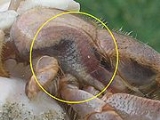
Gill

Encyclopedia

Respiration organ
Respiratory organs are used by most, or all, animals to exchange the gases necessary for their life function known as respiration...
found in many aquatic
Aquatic ecosystem
An aquatic ecosystem is an ecosystem in a body of water. Communities of organisms that are dependent on each other and on their environment live in aquatic ecosystems. The two main types of aquatic ecosystems are marine ecosystems and freshwater ecosystems....
organisms that extracts dissolved oxygen
Oxygen
Oxygen is the element with atomic number 8 and represented by the symbol O. Its name derives from the Greek roots ὀξύς and -γενής , because at the time of naming, it was mistakenly thought that all acids required oxygen in their composition...
from water
Water
Water is a chemical substance with the chemical formula H2O. A water molecule contains one oxygen and two hydrogen atoms connected by covalent bonds. Water is a liquid at ambient conditions, but it often co-exists on Earth with its solid state, ice, and gaseous state . Water also exists in a...
, afterward excreting carbon dioxide
Carbon dioxide
Carbon dioxide is a naturally occurring chemical compound composed of two oxygen atoms covalently bonded to a single carbon atom...
. The gills of some species such as hermit crabs have adapted to allow respiration on land provided they are kept moist. The microscopic structure of a gill presents a large surface area
Surface area
Surface area is the measure of how much exposed area a solid object has, expressed in square units. Mathematical description of the surface area is considerably more involved than the definition of arc length of a curve. For polyhedra the surface area is the sum of the areas of its faces...
to the external environment.
Many microscopic aquatic animals, and some that are larger but inactive, can absorb adequate oxygen through the entire surface of their bodies, and so can respire adequately without a gill. However, more complex or more active aquatic organisms usually require a gill or gills.
Gills usually consist of thin filaments of tissue, branches, or slender tufted processes
Process (anatomy)
In anatomy, a process is a projection or outgrowth of tissue from a larger body. The vertebra has several kinds of processes,such as: transverse process, prezygapophysis, postzygapophysis.-Examples:Examples of processes include:...
that have a highly folded surface to increase surface area. A high surface area is crucial to the gas exchange
Gas exchange
Gas exchange is a process in biology where gases contained in an organism and atmosphere transfer or exchange. In human gas-exchange, gases contained in the blood of human bodies exchange with gases contained in the atmosphere. Human gas-exchange occurs in the lungs...
of aquatic organisms as water contains only 1/20 the dissolved oxygen that air does.
With the exception of some aquatic insect
Insect
Insects are a class of living creatures within the arthropods that have a chitinous exoskeleton, a three-part body , three pairs of jointed legs, compound eyes, and two antennae...
s, the filaments and lamellae (folds) contain blood
Blood
Blood is a specialized bodily fluid in animals that delivers necessary substances such as nutrients and oxygen to the cells and transports metabolic waste products away from those same cells....
or coelomic
Body cavity
By the broadest definition, a body cavity is any fluid-filled space in a multicellular organism. However, the term usually refers to the space located between an animal’s outer covering and the outer lining of the gut cavity, where internal organs develop...
fluid, from which gases are exchanged through the thin walls. The blood carries oxygen to other parts of the body. Carbon dioxide passes from the blood through the thin gill tissue into the water. Gills or gill-like organs, located in different parts of the body, are found in various groups of aquatic animals, including mollusks, crustacean
Crustacean
Crustaceans form a very large group of arthropods, usually treated as a subphylum, which includes such familiar animals as crabs, lobsters, crayfish, shrimp, krill and barnacles. The 50,000 described species range in size from Stygotantulus stocki at , to the Japanese spider crab with a leg span...
s, insects, fish, and amphibian
Amphibian
Amphibians , are a class of vertebrate animals including animals such as toads, frogs, caecilians, and salamanders. They are characterized as non-amniote ectothermic tetrapods...
s.
Invertebrate gills
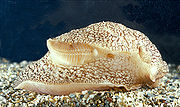
Sea urchin
Sea urchins or urchins are small, spiny, globular animals which, with their close kin, such as sand dollars, constitute the class Echinoidea of the echinoderm phylum. They inhabit all oceans. Their shell, or "test", is round and spiny, typically from across. Common colors include black and dull...
s) is carried out using a very primitive version of gills called papulae. These thin protuberances on the surface of the body contain diverticula
Diverticulum
A diverticulum is medical or biological term for an outpouching of a hollow structure in the body. Depending upon which layers of the structure are involved, they are described as being either true or false....
of the water vascular system
Water vascular system
The water vascular system is a hydraulic system used by echinoderms, such as sea stars and sea urchins, for locomotion, food and waste transportation, and respiration. The system is composed of canals connecting numerous tube feet...
. Crustacean
Crustacean
Crustaceans form a very large group of arthropods, usually treated as a subphylum, which includes such familiar animals as crabs, lobsters, crayfish, shrimp, krill and barnacles. The 50,000 described species range in size from Stygotantulus stocki at , to the Japanese spider crab with a leg span...
s, molluscs, and some insects have gills that are tufted or plate-like structures at the surface of the body.
The gills of other insects are tracheal, and also include both thin plates and tufted structures, and, in the larva
Larva
A larva is a distinct juvenile form many animals undergo before metamorphosis into adults. Animals with indirect development such as insects, amphibians, or cnidarians typically have a larval phase of their life cycle...
l dragon fly
Dragon Fly
- Personnel :*Grace Slick – vocals, piano on "Be Young You"*Paul Kantner – vocals, rhythm guitar*John Barbata – drums, percussion*Craig Chaquico – lead guitar*Papa John Creach – electric violin...
, the wall of the caudal end of the alimentary tract
Gastrointestinal tract
The human gastrointestinal tract refers to the stomach and intestine, and sometimes to all the structures from the mouth to the anus. ....
(rectum
Rectum
The rectum is the final straight portion of the large intestine in some mammals, and the gut in others, terminating in the anus. The human rectum is about 12 cm long...
) is richly supplied with tracheae as a rectal gill. Water pumped into and out of the rectum provides oxygen to the closed tracheae. Aquatic insects
Aquatic insects
Aquatic insects live some portion of their life cycle in the water. They feed in the same ways as other insects. Some diving insects, such as predatory diving beetles, can hunt for food underwater where land-living insects cannot compete.-Breathing:...
use a trachea
Invertebrate trachea
The invertebrate trachea refers to the open respiratory system composed of spiracles, tracheae, and tracheoles that terrestrial arthropods have to transport metabolic gases to and from tissues....
l gill, which contains air tubes. The oxygen in these tubes is renewed through the gills.
Physical gills
Physical gills are a type of structural adaptation common among some types of aquatic insects, which holds atmospheric oxygen in an area with small openings called spiracleSpiracle
Spiracles are openings on the surface of some animals that usually lead to respiratory systems.-Vertebrates:The spiracle is a small hole behind each eye that opens to the mouth in some fishes. In the primitive jawless fish the first gill opening immediately behind the mouth is essentially similar...
s. The structure (often called a plastron) typically consists of dense patches of hydrophobic setae on the body, which prevent water entry into the spiracles. The physical properties of the interface between the trapped air bubble and surrounding water accomplish gas exchange through the spiracles, almost as if the insect were in atmospheric air. Carbon dioxide
Carbon dioxide
Carbon dioxide is a naturally occurring chemical compound composed of two oxygen atoms covalently bonded to a single carbon atom...
diffuses into the surrounding water due to its high solubility
Solubility
Solubility is the property of a solid, liquid, or gaseous chemical substance called solute to dissolve in a solid, liquid, or gaseous solvent to form a homogeneous solution of the solute in the solvent. The solubility of a substance fundamentally depends on the used solvent as well as on...
, while oxygen diffuses into bubbles as the concentration within the bubble has been reduced by respiration
Respiration (physiology)
'In physiology, respiration is defined as the transport of oxygen from the outside air to the cells within tissues, and the transport of carbon dioxide in the opposite direction...
, and nitrogen also diffuses out as its tension has been increased. Oxygen diffuses into the bubble at a higher rate than Nitrogen diffuses out. However, water surrounding the insect can become oxygen-depleted if there is no water movement, so many aquatic insects in still water actively direct a flow of water over their bodies.
The physical gill mechanism allows aquatic insects with plastrons to remain constantly submerged. Examples include many beetle
Beetle
Coleoptera is an order of insects commonly called beetles. The word "coleoptera" is from the Greek , koleos, "sheath"; and , pteron, "wing", thus "sheathed wing". Coleoptera contains more species than any other order, constituting almost 25% of all known life-forms...
s in the family Elmidae, aquatic weevil
Weevil
A weevil is any beetle from the Curculionoidea superfamily. They are usually small, less than , and herbivorous. There are over 60,000 species in several families, mostly in the family Curculionidae...
s, and true bugs in the family Aphelocheiridae.
Vertebrate gills
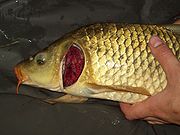
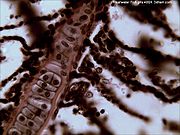
Vertebrate
Vertebrates are animals that are members of the subphylum Vertebrata . Vertebrates are the largest group of chordates, with currently about 58,000 species described. Vertebrates include the jawless fishes, bony fishes, sharks and rays, amphibians, reptiles, mammals, and birds...
s typically develop in the walls of the pharynx
Pharynx
The human pharynx is the part of the throat situated immediately posterior to the mouth and nasal cavity, and anterior to the esophagus and larynx. The human pharynx is conventionally divided into three sections: the nasopharynx , the oropharynx , and the laryngopharynx...
, along a series of gill slits opening to the exterior. Most species employ a countercurrent exchange
Countercurrent exchange
Countercurrent exchange is a mechanism occurring in nature and mimicked in industry and engineering, in which there is a crossover of some property, usually heat or some component, between two flowing bodies flowing in opposite directions to each other. The flowing bodies can be liquids, gases, or...
system to enhance the diffusion of substances in and out of the gill, with blood and water flowing in opposite directions to each other. The gills are composed of comb-like filaments, the gill lamellae, which help increase their surface area for oxygen exchange.
When a fish breathes, it draws in a mouthful of water at regular intervals. Then it draws the sides of its throat together, forcing the water through the gill openings, so that it passes over the gills to the outside. Fish gill slits may be the evolutionary ancestors of the tonsil
Tonsil
Palatine tonsils, occasionally called the faucial tonsils, are the tonsils that can be seen on the left and right sides at the back of the throat....
s, thymus gland, and Eustachian tube
Eustachian tube
The Eustachian tube is a tube that links the nasopharynx to the middle ear. It is a part of the middle ear. In adult humans the Eustachian tube is approximately 35 mm long. It is named after the sixteenth-century anatomist Bartolomeo Eustachi...
s, as well as many other structures derived from the embryonic branchial pouch
Branchial pouch
In the development of vertebrate animals, pharyngeal or branchial pouches form on the endodermal side between the branchial arches, and pharyngeal grooves form the lateral ectodermal surface of the neck region to separate the arches....
es.
Cartilaginous fish
SharkShark
Sharks are a type of fish with a full cartilaginous skeleton and a highly streamlined body. The earliest known sharks date from more than 420 million years ago....
s and rays typically have five pairs of gill slits that open directly to the outside of the body, though some more primitive sharks have six or seven pairs. Adjacent slits are separated by a cartilaginous
Cartilage
Cartilage is a flexible connective tissue found in many areas in the bodies of humans and other animals, including the joints between bones, the rib cage, the ear, the nose, the elbow, the knee, the ankle, the bronchial tubes and the intervertebral discs...
gill arch from which projects a long sheet-like septum
Septum
In anatomy, a septum is a wall, dividing a cavity or structure into smaller ones.-In human anatomy:...
, partly supported by a further piece of cartilage called the gill ray. The individual lamellae of the gills lie on either side of the septum. The base of the arch may also support gill raker
Gill raker
Gill rakers in fish are bony or cartilaginous processes that project from the branchial arch and are involved with filter feeding tiny prey. They are not to be confused with the gill filaments that compose the bony part of the gill. Rakers are usually present in two rows, projecting from both the...
s, small projecting elements that help to filter food from the water.
A smaller opening, the spiracle
Spiracle
Spiracles are openings on the surface of some animals that usually lead to respiratory systems.-Vertebrates:The spiracle is a small hole behind each eye that opens to the mouth in some fishes. In the primitive jawless fish the first gill opening immediately behind the mouth is essentially similar...
, lies in front of the first gill slit
Gill slit
Gill slits are individual openings to gills, i.e., multiple gill arches, which lack a single outer cover. Such gills are characteristic of Cartilaginous fish such as sharks, rays, sawfish, and guitarfish. Most of these have five pairs, but a few species have 6 or 7 pairs...
. This bears a small pseudobranch that resembles a gill in structure, but only receives blood already oxygenated by the true gills. The spiracle is thought to be homologous
Homology (biology)
Homology forms the basis of organization for comparative biology. In 1843, Richard Owen defined homology as "the same organ in different animals under every variety of form and function". Organs as different as a bat's wing, a seal's flipper, a cat's paw and a human hand have a common underlying...
to the ear opening in higher vertebrates.
Most sharks rely on ram ventilation, forcing water into the mouth and over the gills by rapidly swimming forward. In slow-moving or bottom dwelling species, especially among skates and rays, the spiracle may be enlarged, and the fish breathes by sucking water through this opening, instead of through the mouth.
Chimaera
Chimaera
Chimaeras are cartilaginous fish in the order Chimaeriformes, known informally as ghost sharks, ratfish , spookfish , or rabbitfishes...
s differ from other cartilagenous fish, having lost both the spiracle and the fifth gill slit. The remaining slits are covered by an operculum
Operculum (fish)
The operculum of a bony fish is the hard bony flap covering and protecting the gills. In most fish, the rear edge of the operculum roughly marks the division between the head and the body....
, developed from the septum of the gill arch in front of the first gill.
Bony fish
In bony fishOsteichthyes
Osteichthyes , also called bony fish, are a taxonomic group of fish that have bony, as opposed to cartilaginous, skeletons. The vast majority of fish are osteichthyes, which is an extremely diverse and abundant group consisting of over 29,000 species...
, the gills lie in a branchial chamber covered by a bony operculum. The great majority of bony fish species have five pairs of gills, although a few have lost some over the course of evolution. The operculum can be important in adjusting the pressure of water inside of the pharynx to allow proper ventilation of the gills, so that bony fish do not have to rely on ram ventilation (and hence near constant motion) to breathe. Valves inside the mouth keep the water from escaping.
The gill arches of bony fish typically have no septum, so that the gills alone project from the arch, supported by individual gill rays. Some species retain gill rakers. Though all but the most primitive bony fish lack a spiracle, the pseudobranch associated with it often remains, being located at the base of the operculum. This is, however, often greatly reduced, consisting of a small mass of cells without any remaining gill-like structure.
Marine teleosts also use gills to excrete electrolyte
Electrolyte
In chemistry, an electrolyte is any substance containing free ions that make the substance electrically conductive. The most typical electrolyte is an ionic solution, but molten electrolytes and solid electrolytes are also possible....
s. The gills' large surface area tends to create a problem for fish that seek to regulate the osmolarity of their internal fluids. Saltwater is less dilute than these internal fluids, so saltwater fish lose large quantities of water osmotically through their gills. To regain the water, they drink large amounts of seawater
Seawater
Seawater is water from a sea or ocean. On average, seawater in the world's oceans has a salinity of about 3.5% . This means that every kilogram of seawater has approximately of dissolved salts . The average density of seawater at the ocean surface is 1.025 g/ml...
and excrete the salt
Salt
In chemistry, salts are ionic compounds that result from the neutralization reaction of an acid and a base. They are composed of cations and anions so that the product is electrically neutral...
. Freshwater is more dilute than the internal fluids of fish, however, so freshwater fish gain water osmotically
Osmosis
Osmosis is the movement of solvent molecules through a selectively permeable membrane into a region of higher solute concentration, aiming to equalize the solute concentrations on the two sides...
through their gills.
Other vertebrates
.jpg)
Lamprey
Lampreys are a family of jawless fish, whose adults are characterized by a toothed, funnel-like sucking mouth. Translated from an admixture of Latin and Greek, lamprey means stone lickers...
s and hagfish
Hagfish
Hagfish, the clade Myxini , are eel-shaped slime-producing marine animals . They are the only living animals that have a skull but not a vertebral column. Along with lampreys, hagfish are jawless and are living fossils whose next nearest relatives include all vertebrates...
do not have gill slits as such. Instead, the gills are contained in spherical pouches, with a circular opening to the outside. Like the gill slits of higher fish, each pouch contains two gills. In some cases, the openings may be fused together, effectively forming an operculum. Lampreys have seven pairs of pouches, while hagfishes may have six to fourteen, depending on the species. In the hagfish, the pouches connect with the pharynx internally. In adult lampreys, a separate respiratory tube develops beneath the pharynx proper, separating food and water from respiration by closing a valve at its anterior end.
Tadpole
Tadpole
A tadpole or polliwog is the wholly aquatic larval stage in the life cycle of an amphibian, particularly that of a frog or toad.- Appellation :...
s of amphibian
Amphibian
Amphibians , are a class of vertebrate animals including animals such as toads, frogs, caecilians, and salamanders. They are characterized as non-amniote ectothermic tetrapods...
s have from three to five gill slits that don't contain actual gills. There is usually no spiracle or true operculum, though many species have an operculum-like structure. Instead of internal gills, they develop three feathery external gills that grow from the outer surface of the gill arches. Sometimes adults retain these, but they usually disappear at metamorphosis
Metamorphosis
Metamorphosis is a biological process by which an animal physically develops after birth or hatching, involving a conspicuous and relatively abrupt change in the animal's body structure through cell growth and differentiation...
. Lungfish
Lungfish
Lungfish are freshwater fish belonging to the Subclass Dipnoi. Lungfish are best known for retaining characteristics primitive within the Osteichthyes, including the ability to breathe air, and structures primitive within Sarcopterygii, including the presence of lobed fins with a well-developed...
larvae also have external gills, as does the primitive ray-finned fish
Actinopterygii
The Actinopterygii or ray-finned fishes constitute a class or sub-class of the bony fishes.The ray-finned fishes are so called because they possess lepidotrichia or "fin rays", their fins being webs of skin supported by bony or horny spines , as opposed to the fleshy, lobed fins that characterize...
Polypterus
Polypterus
Polypterus is a genus of freshwater fish in the bichir family of order Polypteriformes. The type species is the Nile bichir . Fishes in this genus live in various areas in Africa...
, though the latter has a structure different than amphibians.
Branchia
Branchia (pl. branchiæ) is the Ancient GreekAncient Greek
Ancient Greek is the stage of the Greek language in the periods spanning the times c. 9th–6th centuries BC, , c. 5th–4th centuries BC , and the c. 3rd century BC – 6th century AD of ancient Greece and the ancient world; being predated in the 2nd millennium BC by Mycenaean Greek...
naturalists' name for gills. Galen
Galen
Aelius Galenus or Claudius Galenus , better known as Galen of Pergamon , was a prominent Roman physician, surgeon and philosopher...
observed that fish had multitudes of openings (foramina), big enough to admit gases, but too fine to give passage to water. Pliny the Elder
Pliny the Elder
Gaius Plinius Secundus , better known as Pliny the Elder, was a Roman author, naturalist, and natural philosopher, as well as naval and army commander of the early Roman Empire, and personal friend of the emperor Vespasian...
held that fish respired by their gills, but observed that Aristotle
Aristotle
Aristotle was a Greek philosopher and polymath, a student of Plato and teacher of Alexander the Great. His writings cover many subjects, including physics, metaphysics, poetry, theater, music, logic, rhetoric, linguistics, politics, government, ethics, biology, and zoology...
was of another opinion. The word branchia comes from the Greek
Greek language
Greek is an independent branch of the Indo-European family of languages. Native to the southern Balkans, it has the longest documented history of any Indo-European language, spanning 34 centuries of written records. Its writing system has been the Greek alphabet for the majority of its history;...
, "gills", plural of (in singular, meaning a fin
Fin
A fin is a surface used for stability and/or to produce lift and thrust or to steer while traveling in water, air, or other fluid media, . The first use of the word was for the limbs of fish, but has been extended to include other animal limbs and man-made devices...
).