

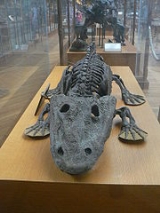
Temnospondyli

Encyclopedia
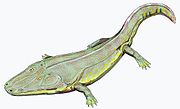
Temnospondyli is a diverse order
of small to giant tetrapod
s—often considered primitive amphibians
—that flourished worldwide during the Carboniferous
, Permian
, and Triassic
periods. A few species continued into the Cretaceous
. Fossils have been found on every continent. During approximately 210 million years of evolutionary history they adapted to a wide range of habitats including fresh water, terrestrial, and even coastal marine environments. Their life history is well understood with fossils known from the larva
l stage, metamorphosis
, and maturity. Most temnospondyls were semiaquatic, although some were almost fully terrestrial, returning to the water only to breed. These temnospondyls were some of the first vertebrates fully adapted to life on land. Although temnospondyls are considered amphibians, many had characteristics such as scales, claws, and armor-like bony plates that distinguish them from modern amphibians.
Temnospondyls have been known since the early nineteenth century and were initially thought to be reptile
s. They were described at various times as batrachians, stegocephalia
ns, and labyrinthodonts
, although these names are now rarely used. Animals now grouped in Temnospondyli were spread out among several amphibian groups until the early twentieth century, when they were found to belong to a distinct taxon
based on the structure of their vertebrae. Temnosondyli means "cut vertebrae" as each vertebra is divided into several parts.
Authorities disagree over whether temnospondyls were ancestral to modern amphibians (frog
s, salamander
s, and caecilian
s), or whether the whole group died out without leaving any descendants. Different hypotheses have placed modern amphibians as the descendants of temnospondyls, another group of early tetrapods called lepospondyls, or even as descendants of both groups (with caecilians evolving from lepospondyls and frogs and salamanders evolving from temnospondyls). Recent studies place a family of temnosondyls called the amphibamids
as the closest relatives of modern amphibians. Similarities in teeth, skulls, and hearing structures link the two groups.
s. Others are smaller and resembled salamanders. Most have broad, flat heads that are either blunt (brevirostrine) or elongated (longirostrine). The skulls are rounded or triangular in shape when viewed from above, and are usually covered in pits and ridges. Many temnospondyls have canal-like groves in their skulls called sensory sulci
. The sulci, which usually run around the nostrils and eye sockets, are part of a lateral line
system used to detect vibrations in water. As semi-aquatic animals, most temnospondyls have small limbs with four toes on each front foot and five on each hind foot. Terrestrial temnospondyls have larger, thicker limbs, and some even have claws. One temnospondyl called Fayella
is unusual in that it has relatively long limbs for its body and probably lived as an active runner able to chase prey.
Most of the bones of temnospondyls are also seen in other early tetrapods, although a few other bones in the skull such as interfrontal
s, internasal
s, and interparietal
s have developed in some taxa. Most temnospondyls have tabular horns in the back of the skull, rounded projections of bone separated from the rest of the skull by indentations called otic notches. In some temnospondyls like Zatrachys
, they are pointed and very prominent. Among the most distinguishing features of temnospondyls are the interpterygoid vacuities, two large holes in the back of the palate
. Another pair of holes called choana
e are present in front of these vacuities, and connect the nasal passage with the mouth. Temnospondyls often have teeth on their palate as well as in their jaws. Some of these teeth are so large that they are referred to as tusks. In some temnospondyls like Nigerpeton
, tusks in the lower jaw pierce the palate and emerge through openings in the top of the skull.
Very little is known of the soft tissue of temnospondyls. A block of sandstone was described in 2007 from the Early Carboniferous Mauch Chunk Formation
of Pennsylvania
that included impressions of the bodies of three temnospondyls. These impressions show that when alive they had smooth skin, robust limbs with webbed feet, and a ridge of skin on their undersides. Trackways referrable to small temnospondyls have also been found in Carboniferous and Permian rocks. The trackways are called Batrachichnus and are usually found in strata that were deposited around freshwater environments, suggesting that the animals had some ties to the water.
Unlike modern amphibians, many temnospondyls are covered in small, closely packed scales. The undersides of most temnospondyls are covered in rows of large ventral plates. During early stages of development, temnospondyls first have only small, rounded scales. Fossils show that as the animals grew, the scales on the underside of the body developed into large, wide ventral plates. The plates overlap each other in a way that allows a wide range of flexibility. Later semiaquatic temnospondyls like trematosaurs and capitosaurs have no evidence of scales. They may have lost scales to make movement easier underwater or to allow cutaneous respiration, the absorption of oxygen through the skin.
Several groups of temnospondyls have large bony plates on their backs. One temnospondyl called Peltobatrachus
has armor-like plating that covers both its back and underside. The temnospondyl Laidleria
also has extensive plating on its back. Most members of the family Dissorophidae
also have armor, although it only covers the mid-line of the back with two narrow rows of plates. Other temnospondyls like Eryops
have been found with small disc-like bony scute
s that were in life probably embedded in the skin. All of these temnospondyls were adapted to a terrestrial lifestyle. Armor may have offered protection from predators in the case of Peltobatrachus. The scutes may have provided stability for the spine, as they would have limited flexibility and may have been connected by strong ligaments. Temnospondyls such as Sclerothorax
and Eryops that may have been at least partly terrestrial also have long neural spines on top of their vertebrae that would have stabilized the spine. Bony scutes are also seen in plagiosaurs, but unlike Peltobatrachus, Laidleria, Eryops, and dissorophids, these animals are thought to have been fully aquatic. Plagiosaurs may have inherited their armor from a terrestrial ancestor, as both Peltobatrachus and Laidleria have been considered close relatives of the group.
Temnospondyls have vertebrae that are divided into several segments. In living tetrapods, the main body of the vertebra is a single piece of bone called the centrum
, but in temnospondyls this region was divided into a pleurocentrum and intercentrum. Two types of vertebrae are recognized in temnospondyls: stereospondylous and rhachitomous vertebrae. In rhachitomous vertebrae the intercentra are large and wedge-shaped, and the pleurocentra are relatively small blocks that fit between them. Both elements support a spine-like neural arch, and well-developed interlocking projections called zygapophyses strengthen the connections between vertebrae. The strong backbone and strong limbs of many ratchitomous temnospondyls allowed them to be partially, and in some cases fully, terrestrial. In stereospondylous vertebrae the pleurocentra have been lost entirely, with the intercentra enlarged as the main body of the vertebrae. This weaker type of backbone indicates that stereospondylous temnospondyls spent more time in water.
in his second edition of Handbuch der Palaeontologie, published in 1888. Temnospondyl remains were known since the early part of the nineteenth century, however. The earliest described temnospondyl was Mastodonsaurus
, named by Georg Friedrich Jaeger in 1828. Jaeger named Mastodonsaurus from a single tooth and considered it a reptile. Mastodonsaurus means "breast tooth lizard" after the nipple-like shape of the tip of the tooth.
The naming of this first specimens were disputed, however. Leopold Fitzinger
named the animal Batrachosaurus
in 1837. In 1841, English paleontologist Richard Owen
referred to the genus as Labyrinthodon to describe its highly folded or labyrinthine teeth. Owen thought that the name Mastodonsaurus "ought not to be retained, because it recalls unavoidably the idea of the mammalian genus Mastodon, or else a mammilloid form of the tooth... and because the second element of the word, saurus, indicates a false affinity, the remains belonging, not to the Saurian, but to the Batrachian order of Reptiles." Owen recognized that the animal was not a "saurian" reptile, yet he also referred Jaeger's Phytosaurus
to the genus. Although the two genera both have similarly sized conical teeth, Phytosaurus was later found to be a crocodile-like reptile. Additional material, including skulls, firmly placed Labyrinthodon as an amphibian. Jaeger also named Salamandroides giganteus in 1828, basing it on partial occiput, or back portion of the skull. In 1833 he described a complete skull of S. giganteus that had the same teeth as his Mastodonsaurus, making it the first known complete skull of a temnospondyl. Because Mastodonsaurus was named first, it has precedence over the other names as a senior subjective synonym
. Batrachosaurus is still used as the name of an unrelated brachyopid
temnospondyl.
Mastodonsaurus and other similar animals were referred to as labyrinthodonts, named like Labyrinthodon for teeth that were highly folded in cross section. Owen's "Labyrinthodon Jaegeri" was later found at Guy's Cliffe
, England
by paleontologist William Buckland
. Other specimens were found in the red sandstone of Warwickshire
. As more fossils were uncovered in England, Owen depicted these labyrinthodonts as the "highest" form of batrachian and compared them to crocodiles, which he considered the highest form of reptiles. He also noted that large labyrinthodonts of the Keuper
(a unit of rocks that dates to the Late Triassic
) were younger than more advanced reptiles in the Magnesian
and Zechstein
, which are Late Permian in age. Owen used these fossils to counter the notion that reptiles evolved from a sequential progression from early amphibians (what he called "metamorphosed fishes").
In addition to Mastodonsaurus, some of the earliest named genera included Metopias
and Rhombopholis in 1842, Zygosaurus
in 1848, Trematosaurus
in 1849, Baphetes
and Dendrerpeton in 1853, Capitosaurus
in 1858, and Dasyceps
in 1859. Baphetes is now placed as an early tetrapod outside Temnospondyli, and Rhombopholis is now considered a prolacertiform reptile.
Later in the nineteenth century, temnospondyls were classified as various members of Stegocephalia
, a name coined by American paleontologist Edward Drinker Cope
in 1868. Cope placed stegocephalians in the class Batrachia, the name then used for Amphibia. Stegocephalia means "roof-headed" in Greek
, a reference to the wide, flat heads of temnospondyls and other early tetrapods. During this time, paleontologists considered temnospondyls to be amphibians because they possessed three main features: gill arches in juvenile skeletons, indicating they were amphibious for at least the first part of their lives; ribs that do not connect at the underside of the rib cage; and deep pits in the skull that were interpreted as space for mucous gland
s.
Several suborders of stegocephalians were recognized in the late nineteenth and early twentieth centuries. Animals now regarded as temnospondyls were primarily labyrinthodonts, but some were classified in the Branchiosauria. Branchiosaurs were small-bodied and had simple conical teeth, while labyrinthodonts were larger and had complex, folded dentin
and enamel
in their teeth. Branchiosauria included only a few forms such as Branchiosaurus
from Europe and Amphibamus
from North America that had poorly developed bones, external gills, and no ribs. Some skeletons of Amphibamus were later found with long ribs, prompting its reassignment to Microsauria
(although more detailed studies found it to be a temnospondyl). Soft tissue such as scales and external gills were found in many well preserved branchiosaur fossils from Germany. In the early twentieth century, branchiosaurs would be recognized as larva
l forms of temnospondyls lacking many of the typical features that define the group.
Other animals that would later be classified as temnospondyls were placed in a group called Ganocephala, characterized by plate-like skull bones, small limbs, fish-like scales, and branchial arches. Unlike labyrinthodonts, they did not have a parietal foramen
, a small hole in the skull behind the eye sockets. Archegosaurus
, Dendrerpeton, Eryops
and Trimerorhachis
were placed in this group and were considered to be the most primitive members of Reptilia. Their rhachitomous vertebrae, notochord
, and lack of occipital condyle
s (which attached the head to the neck) were features that were also shared with fishes. Thus, they were considered a link between early fishes and more advanced forms like stegocephalians.
Another group called Microsauria
was named by Cope in 1868. Cope classified Microsauria as a subgroup of Labyrinthodontia, placing many small amphibian-like animals within it. Among them were Dendrerpeton, once placed in Ganocephala. Dendrerpeton was later placed as a labyrinthodont with other temnospondyls, but confusion existed for many years over the classification of small amphibians.
By the end of the nineteenth century, most of what are today regarded as temnospondyls were placed in the suborder Labyrinthodonta. American paleontologist Ermine Cowles Case
called it Labyrinthodonta vera or "true labyrinthodonts." The names Stegocephalia and Labyrinthodontia were used interchangeably to refer to the order in which it belonged belonged. The labyrinthodontian suborders Microsauria and Branchiosauria, both of which contain temnospondyls, were distinct from Labyrinthodonta. Within Labyrinthodonta were the groups Rhachitomi, Labyrinthodonti, and Embolerimi
. Members of Rhachitomi like Archegosaurus and Eryops had rhachitomous vertebrae with an enlarged intercentrum that displaced the pleurocentrum. Labyrinthodonti such as Mastodonsaurus, Trematosaurus, and Micropholis
had lost their pleurocentra and the intercentra made up the entire body of the vertebrae. Embolerimi had intercentra and pleurocentra that were of equal size. Embolomeres are now identified as reptiliomorphs distantly related to temnospondyls.
In 1888, von Zittel divided stegocephalians among three taxa: Lepospondyli, Temnospondyli, and Stereospondyli
. He placed microsaurs in Lepospondyli, a group which he characterized as having simple, spool-shaped vertebral centra. Temnospondyli included forms with the centra divided into pleurocentra and intercentra. All members of Stereospondyli had amphicoelous centra composed only of the intercentra. Cope objected to von Zittel's classification, considering the vertebrae of lepospondyls and stereospondyls indistinguishable because each had a simple spool shape. He continued to use Ganocephala and Labyrinthodonta (which he alternatively referred to as Rhachitomi) to distinguish animals based on the absence or presence of occipital condyles.
Temnospondyli became a commonly used name at the turn of the century. Paleontologists included both embolomeres and rhachitomes in the group. Cope's Ganocephala and Labyrinthodonta fell out of use. In 1919, British paleontologist D. M. S. Watson proposed that the evolutionary history of these large amphibians could be seen through changes in their vertebrae. Embolomerous forms in the Carboniferous graded into rhachitomous forms in the Permian, and finally into stereospondyls in the Triassic. More importantly, Watson began using the term Labyrinthodontia to refer to these groups. The name Temnospondyli was rarely used in the decades that followed. Swedish paleontologist Gunnar Säve-Söderbergh
removed embolomeres from the group, narrowing its scope to rhachitomes and stereospondyls. His classification of labyrinthodonts was based heavily on characteristics of the skull rather than the vertebrae.
American paleontologist Alfred Romer
brought the name Temnospondyli back into use in the later twentieth century. Säve-Söderbergh used the name Labyrinthodontia in a strict sense (sensu stricto) to refer to Rhachitomi and Stereospondyli, excluding Embolomeri. Romer agreed with this classification, but used the name Temnospondyli to avoid confusion with Labyrinthodontia in its wider sense (sensu lato). Unlike modern temnospondyl classification, however, Romer included the primitive Ichthyostegalia in the group.
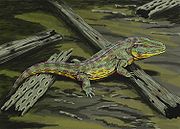 Temnospondyls first appeared in the Early Carboniferous around 330 million years ago (Ma). During the Carboniferous, temnospondyls included basal
medium-sized forms like Dendrerpeton or large semi-aquatic forms like Cochleosaurus
. Other, more derived
temnospondyls such as the amphibamids
were smaller and more terrestrial. They resembled salamander
s, and some taxa, such as the genus Branchiosaurus
, even retained external gills like the modern-day axolotl
. During the latest Carboniferous and Early Permian around 300 million years ago (Ma) several groups like the dissorophids
and trematopids evolved strong, robust limbs and vertebrae and became adapted to life on land while others such as the eryopids
developed into large semi-aquatic predators. The dvinosaurs, a group of small aquatic temnospondyls, evolved from terrestrial ancestors in the Late Carboniferous.
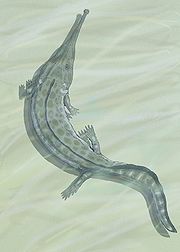 During the Late Permian, increasing aridity and the diversification of reptiles contributed into a decline in terrestrial temnospondyls, but semi-aquatic and fully aquatic temnospondyls continued to flourish, including the large Melosaurus
of Eastern Europe. Other temnospondyls such as archegosaurids
developed long snouts and a close similarity to crocodiles, although they lacked the armour characteristic of the latter group. These temnospondyls included the largest known amphibian, the 9 metres (29.5 ft) long Prionosuchus
of Brazil.
(251.0 - 245.0 Ma) one group of successful long-snouted fish eaters, the trematosauroids
, even adapted to a life in the sea, the only known amphibians to do so with the exception of the modern Crab-eating frog. Another group, the capitosauroids, included medium and large sized animals 2.3 to 4 m (7.5 to 13.1 ft) in length, with large and flat skulls that could be over a meter long in the largest forms like Mastodonsaurus. These animals spent most or all their entire lives in water as aquatic predators, catching their prey by a sudden opening of the upper jaw and sucking in fish or other small animals.
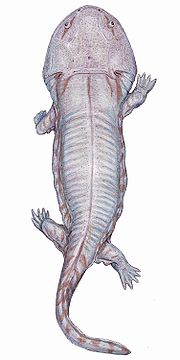 In the Carnian
stage of the Late Triassic
(228.0 - 216.5 Ma) capitosauroids were joined by the superficially very similar Metoposauridae
. Metoposaurids are distinguished from capitosauroids by the positioning of their eye sockets near the front of the skull. Another group of stereospondyls called plagiosaurs had wide heads with external gill
s, and adapted to life at the bottom of lakes and rivers. By this time temnospondyls had become a common and widespread component of semiaquatic ecosystems. Some temnospondyls like Cryobatrachus
and Kryostega
even inhabited Antarctica, which was covered in temperate forests at the time.
Triassic temnospondyls were often the dominant semiaquatic animals in their environment. Large assemblages of metoposaurs with hundreds of individuals preserved together have been found in the southwestern United States. They have often been interpreted as mass death events caused by droughts in floodplain environment. Recent studies show that these dense assemblages were instead probably the result of currents accumulating dead individuals in certain areas. These environments seem to have had little diversity, as they were inhabited almost exclusively by metoposaurs.
The Triassic-Jurassic extinction event
around 199.6 Ma led to the extinction of most Mesozoic temnospondyls. The brachyopoids survived, as well as a few capitosauroids and trematosauroids. While the latter two groups soon became extinct, brachyopoids persisted and grew to large sizes during the Jurassic. Among brachyopoids, the brachyopids
flourished in China
and the chigutisaurids
became common in Gondwana
. The most recent known temnospondyl was the giant chigutisaurid Koolasuchus
, known from the Early Cretaceous
of Australia
. It survived in rift valley
s that were too cold in the winter for crocodiles that normally would have competed with them. Koolasuchus was one of the largest of the brachyopoids, with an estimated weight of 500 kilograms (1,102.3 lb).
, this classification is no longer viable. The basic rhachitomous condition is found in many primitive tetrapods, and is not unique to one group of temnospondyls. Moreover, the distinction between rhachitomous and stereospondylous vertebrae is not entirely clear. Some temnospondyls have rhachitomous, semi-rhachitomous, and sterospondylous vertebrae at different points in the same vertebral column. Other taxa have intermediate morphologies that do not fit into any category. Rachitomi is no longer recognized as a group, but Stereospondyli is still considered valid. Below is a simplified taxonomy of temnospondyls showing currently recognized groups:
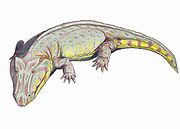
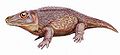
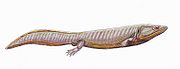
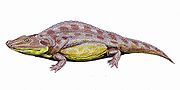
 Class Amphibia
: a bone at the back of the skull called the parasphenoid is connected to another bone on the underside of the skull called the pterygoid; large openings called interpterygoid vacuities are present between the pterygoids; the stapes (a bone involved in hearing) is connected to the parasphenoid and projects upward; the cleithrum
, a bone in the pectoral girdle, is thin; and part of the vertebra called the interdorsal attaches to the neural arch. Additional features were given by Godfrey et al. (1987), including the contact between the postparietal and exoccipital at the back of the skull, small projections called uncinate processes
on the rib
s, and a pelvic girdle with each side having a single iliac blade
. These shared characteristics are called synapomorphies.
Temnospondyls are placed as basal
tetrapods in phylogenetic analyses, with their exact positioning varying between studies. Depending on the classification of modern amphibians, they are either included in the crown group
Tetrapoda or the stem of Tetrapoda. Crown-group tetrapods are decendents of the most recent common ancestor of all living tetrapods and stem tetrapods are forms that are outside the crown group. Modern amphibians have recently been suggested as descendants of temnospondyls, which would place them within crown Tetrapoda. Below is a cladogram
from Ruta et al. (2003) placing Temnospondyli within crown Tetrapoda:
Other studies place modern amphibians as the descendants of lepospondyls and place temnospondyls in a more basal position within the stem of Tetrapoda. Below is a cladogram from Laurin and Reisz (1999) placing Temnospondyli outside crown Tetrapoda:
Most phylogenetic analyses of temnospondyl interrelationships focus on individual families. One of the first broad-scale studies of temnospondyl phylogeny was conducted by paleontologist Andrew Milner in 1990. A 2007 study made a "supertree" of all temnospondyl families, combining the family-level trees of previous studies. The following cladogram is modified from Ruta et al. (2007):
1 Temnospondyli, 2 Edopoidea, 3 Dvinosauria
, 4 Euskelia
, 5 Eryopoidea
, 6 Dissorophoidea
, 7 Limnarchia
, 8 Archegosauroidea
,
9 Stereospondyli
, 10 Rhytidostea
, 11 Brachyopoidea
, 12 Capitosauria
, 13 Trematosauria
, 14 Metoposauroidea
The most basal group of temnospondyls is the superfamily Edopoidea. Edopoids have several primitive or plesiomorphic features, including a single occipital condyle and a bone called the intertemporal that is absent in other temnospondyls. Edopoids include the Late Carboniferous genus Edops
and the family Cochleosauridae
. Dendrerpetontidae
has also been included in Edopoidea, and is the oldest known temnospondyl family. Balanerpeton woodi
is the oldest species, having been present over 330 million years ago during the Viséan
stage of the Early Carboniferous. Recent analyses place Dendrerpetontidae outside Edopoidea in a more derived position. Other primitive temnospondyls include Capetus
and Iberospondylus
. Saharastega
and Nigerpeton
, both described in 2005 from Niger
, are also primitive yet come from the Late Permian. They are almost 40 million years younger than other basal temnospondyls, implying a long ghost lineage
of species that are not yet known in the fossil record.
In 2000, paleontologists Adam Yates and Anne Warren produced a revised phylogeny of more derived temnospondyls, naming several new clades. Two major clades were Euskelia
and Limnarchia
. Euskelia includes the temnospondyls that were once called rhachitomes and includes two subfamilies, the Dissorophoidea
and the Eryopoidea
. Dissorophoids include small, mostly terrestrial temnospondyls that may be the ancestors of modern amphibians. Eryopoids include larger temnosondyls like Eryops. The second major clade, Limnarchia, includes most Mesozoic temnospondyls, as well as some Permian groups. Within Limnarchia are the superfamily Archegosauroidea
and the most derived temnospondyls, the stereospondyls.
Yates and Warren also named Dvinosauria
, a clade of small aquatic temnospondyls from the Carboniferous, Permian, and Triassic. They placed Dvinosauria within Limnarchia, but more recent studies disagree on their position. For example, a 2007 study places them even more basal than Euskelians, while a 2008 study keeps them as basal limnarchians.
Within Stereospondyli, Yates and Warren erected two major clades: Capitosauria
and Trematosauria
. Capitosaurs include large semiaquatic temnospondyls like Mastodonsaurus with flat heads and eyes near the back of the skull. Trematosaurs include a diversity of temnospondyls, including large marine trematosauroids, aquatic plagiosaurs, brachyopoids that survived into the Cretaceous, and metoposauroids with eyes near the front of their heads. In 2000, paleontologists Rainer Schoch and Andrew Milner named a third major clade of stereospondyls, the Rhytidostea
. This group included more primitive stereospondyls that could not be placed in either Capitosauria or Trematosauria, and included groups like Lydekkerinidae
, Rhytidosteidae
, and Brachyopoidea. While Capitosauria and Trematosauria are still widely used, Rhytidostea is not often supported as a true clade in recent analyses. Rhytidosteids and brachyopoids are now grouped with trematosaurians, but lydekkerinids are still considered to be a primitive family of stereospondyls.
. Lissamphibians appear to have arisen in the Permian. Molecular clock
estimates place the first lissamphibian in the Late Carboniferous, but the first member of Batrachia (frogs and salamanders, but not caecilians) is estimated to have appeared in the Middle Permian using the same technique. Using fossil evidence, there are three main theories for the origin of modern amphibians. One is that they evolved from lepospondyls, most likely the lysorophia
ns. Another is that they evolved from dissorophoid temnospondyls. A third hypothesis is that caecilians descended from lepospondyls and frogs and salamanders evolved from dissorophoids.
Recently, the theory that temnospondyls were the ancestors of all lissamphibians has gained wide support. The skull morphology of some small temnospondyls has been compared to those of modern frogs and salamanders, but the presence of bicuspid, pedicellate teeth
in small, paedomorphic or immature temnospondyls has been cited as the most convincing argument in favor of the temnospondyl origin of lissamphibians. Seen in lissamphibians and many dissorophoid temnospondyls, pedicellate teeth have calcified tips and bases. During the development of most tetrapods, teeth begin to calcify at their tips. Calcification normally proceeds downward to the base of the tooth, but calcification from the tip stops abruptly in pedicellate teeth. Calcification resumes at the base, leaving an area in the center of the tooth uncalcified. This pattern is seen in living amphibians and fossils.
The dissorophoid family Amphibamidae
is thought to be most closely related to Lissamphibia. In 2008, an amphibamid called Gerobatrachus hottoni
was named from Texas
and was nicknamed the "frogamander" for its frog-like head and salamander-like body. It was thought to be the most closely related temnospondyl to lissamphibians and was placed as the sister taxon of the group in a phylogenetic analysis. Another species of amphibamid called Doleserpeton annectens
is now thought to be even more closely related to lissamphibians. Unlike Gerobatrachus, Doleserpeton was known since 1969, and the presence of pedicellate teeth in its jaws has led some paleontologists to conclude soon after its naming that it was a relative of modern amphibians. It was first described as a "protolissamphibian", and the specific name annectens means "connecting" in reference to its inferred transitional position between temnospondyls and lissamphibians. The structure of its tympanum, a disk-like membrane that functions like an ear drum, is similar to that of frogs and has also been used as evidence for a close relationship. Other feature, including the shape of the palate
and the back of the skull, the short ribs, and the smooth skull surface also point to it being a closer relative of lissamphibians than Gerobatrachus is. Below is a cladogram modified from Sigurdsen and Bolt (2010) showing the relationships of Gerobatrachus, Doleserpeton, and Lissamphibia:
Most aquatic stereospondyls have flattened heads. When feeding, they probably opened their mouths by lifting their skulls instead of lowering their lower jaws. The jaw mechanics of the plagiosaurid Gerrothorax
is well known, and is one of the most highly adapted. Gerrothorax is thought to have lifted its skull to around 50° above horizontal through the flexing of the atlanto-occipital joint between the occipital condyles of the skull and the atlas
vertebra of the neck. As the skull is raised, the quadrate bone pushes forward and causes the lower jaw to protrude outward. Other stereospondyls probably also lifted their skulls, but they are not as well adapted for such movement. D.M.S. Watson was the first to suggest skull lifting as a means of feeding in temnospondyls. He envisioned that Mastodonsaurus, a much larger temnospondyl than Gerrothorax, was able to make the same movement. Paleontologist A.L. Panchen also supported the idea in 1959, suggesting that Batrachosuchus
also fed in this way. At the time it was thought that these temnospondyls lifted their heads with strong jaw muscles, but it is now thought that they used larger muscles in the neck that were attached to the large pectoral girdle. Plagiosuchus, a close relative of Gerrothorax, also has a hyobranchial skeleton that muscles may have attached to. Plagiosuchus has very small teeth and a large area for muscle attachment behind the skull, suggesting that it could suction feed by rapidly opening its mouth.
Unlike semiaquatic temnospondyls, terrestrial temnospondyls have skulls that are adapted for biting land-living prey. The sutures between the bones of the skull in the dissorophoid Phonerpeton
are able to withstand a high degree of compression. Compressive forces would have been experienced when biting down on prey. Earlier aquatic tetrapods and tetrapod ancestors differ from temnospondyls like Phonerpeton in that their skulls were also built to withstand tension. This tension would have been experienced during suction feeding underwater. Temnospondyls like Phonerpeton were among the first tetrapods that were almost exclusively terrestrial and fed by biting.
. Like most living frogs, female temnospondyls would have laid masses of eggs in water while males released sperm to fertilize them. Several fossils were described from the Early Permian of Texas in 1998 that may be egg masses of dissorophoid temnospondyls. They were the first known fossils of amphibian eggs. The fossils consist of small disks with thin membranes that are probably vitelline membrane
s and halo-like areas surrounding them that are most likely mucous coatings. They are attached to plant fossils, suggesting that these temnospondyls laid eggs on aquatic plants much like modern frogs. The mucous membranes show that the eggs were laid by amphibians, not fish (their eggs lack mucous), but the type of amphibian that laid them cannot be known because no body fossils are preserved with the eggs. The eggs are thought to be from dissorophoids because they are likely to be close relatives of modern amphibians, and probably had similar reproductive strategies. They are also the most common amphibians from the deposit in which the eggs were found.
One temnospondyl, the dvinosaur Trimerorhachis
, may have brooded young in an area between the gills called the pharyngeal pouch. Small bones belonging to younger Trimerorhachis individuals have been found in these pouches. The living Darwin's Frog
is also a mouth brooder and would be the closest modern analogue to Trimerorhachis if it cared for its young in this way. An alternative possibility is that Trimerorhachis was cannibalistic, eating its young like many amphibians do today. If this was the case, the bones of these smaller individuals were originally located in the throat and were pushed into the pharyngeal pouch as the animal fossilized.
Body impressions of Early Carboniferous temnospondyls from Pennsylvania suggest that some terrestrial temnospondyls mated on land like some modern amphibians. They reproduced through internal fertilization
rather than mating in water. The presence of three individuals in one block of sandstone shows that the temnospondyls were gregarious. The head of one individual rests under the tail of another in what may be a courtship display. Internal fertilization and similar courtship behavior are seen in modern salamanders.
l specimens. Metamorphosis
is seen in dissorophoids, eryopids, and zatrachydids, with aquatic larvae developing into adults capable of living on land. Several types of dissorophoids do not fully metamorphose, but retain features of juveniles such as gills and small body size in what is known as neoteny
. Dvinosaurians and the plagiosaurid Gerrothorax
were also neotenic because they retained gills, but they are only known from adult specimens.
Temnospondyl larvae are often distinguished by poorly developed bones and the presence of a hyobranchial apparatus, a series of bones that gill
s would attach to in life. However, some fully mature temnospondyls also possess hyobranchial bones but did not have external gills. A dense covering of scales is also seen in larvae and adults. Major body changes occur in metamorphosis, including the reshaping and strengthening of skull bones, the thickening of postcranial bones, and an increase in body size.
Temnospondyls like Sclerocephalus
are known from both large adult specimens and small larvae, showing an extreme change in body shape. In these species, the shape and proportions of skull bones change in the early stages of development. The ornamentation on the surface of the skull roof also develops at this time. Small, regularly spaced pits are the first to form, followed by larger ridges. As development continues, the external gills disappear. Small teeth that once covered the palate
are lost. The postcranial skeleton does not develop at the same rate as the skull, with ossification
(the replacement of cartilage
by bone) happening more slowly. Vertebrae and limb bones are poorly developed, ribs and fingers are absent in the early stages, and the scapulocoracoid and ischium are entirely absent through most of development. Once maturity is reached, most bones have fully formed and growth rate slows. The bones of some temnospondyls like Dutuitosaurus
show growth marks, possibly an indication that growth rate varied with the change in seasons. Fossils of temnospondyls like Metoposaurus and Cheliderpeton show that individuals grew larger past maturity. The oldest individuals usually have more pitting on their skulls with deeper sulci.
One group of temnospondyls, the Branchiosauridae, is also known from larval specimens. Branchiosaurids like Branchiosaurus and Apateon
are represented by many fossils preserving skin and external gills. An entire growth series
is exhibited in the wide range of sizes among specimens, but the lack of terrestrially-adapted adult forms suggests that these temnospondyls were neotenic. Unlike other temnospondyls, their postcranial skeletons developed quickly but were still partly cartilaginous when fully mature. Adults likely had an aquatic lifestyle similar to juveniles. Recently, large specimens of Apateon gracilis were described with adaptations toward a terrestrial lifestyle, indicating that not all branchiosaurs were neotenic.
While most temnospondyls are aquatic in early stages of life, most metoposaurids appear to have been terrestrial in their juvenile stage. Like other Mesozoic temnospondyls, adult metoposaurids were adapted to a semiaquatic lifestyle. Their bones are not highly developed for movement on land. The cross-sectional thickness of limb bones in adult metoposaurids shows that they could not withstand the stress of terrestrial locomotion. Juvenile individuals have bones that are thick enough to withstand this stress, and could probably move about on land. To maintain a terrestrial lifestyle, a temnospondyl's limb bones would have to thicken with positive allometry, meaning that they would grow at a greater rate than the rest of the body. This is not the case in metoposaurids, meaning that as their bodies grew larger they became less adapted toward a terrestrial lifestyle.
Frogs and all other living tetrapods have a rod-like bone called the stapes that aids in hearing by transferring vibrations from the ear drum —or homologous tympanum— to the inner ear
. Temnospondyls also have a stapes, which projects into the otic cavity. The stapes likely evolved from the hyomandibula
of lobe-finned fishes. The positioning of the stapes and the shape of the otic region suggests that the tympani of temnospondyls and frogs are homologous, but the tympani of these amphibians are no longer considered homologous with the hearing systems of reptiles, birds, and mammals. Therefore, ear structures in temnospondyls were not ancestral to those of all other tetrapods.
The ability of the tympanum and stapes to effectively transmit vibrations is called impedance matching
. Early tetrapods like temnospondyls have thick stapes with poor impedence matching, so it is now thought that they were not used for hearing. Instead, these thick stapes may have functioned to support the tissue that covers the otic notch. Early temnospondyls like Dendrerpeton could not hear airborne sound but would have been able to detect vibration in the ground. Later temnospondyls like Doleserpeton had otic regions adapted to hearing. Doleserpeton has a structure in the inner ear called the perilymphatic duct
, which is also seen in frogs and is associated with hearing. Its stapes is also a better transmitter of sound. The hearing system of Doleserpeton and related temnospondyls was able to detect airborne sound and may have been ancestral to that of living amphibians.
Order (biology)
In scientific classification used in biology, the order is# a taxonomic rank used in the classification of organisms. Other well-known ranks are life, domain, kingdom, phylum, class, family, genus, and species, with order fitting in between class and family...
of small to giant tetrapod
Tetrapod
Tetrapods are vertebrate animals having four limbs. Amphibians, reptiles, birds and mammals are all tetrapods; even snakes and other limbless reptiles and amphibians are tetrapods by descent. The earliest tetrapods evolved from the lobe-finned fishes in the Devonian...
s—often considered primitive amphibians
Labyrinthodontia
Labyrinthodontia is an older term for any member of the extinct subclass of amphibians, which constituted some of the dominant animals of Late Paleozoic and Early Mesozoic times . The group is ancestral to all extant landliving vertebrates, and as such constitutes an evolutionary grade rather...
—that flourished worldwide during the Carboniferous
Carboniferous
The Carboniferous is a geologic period and system that extends from the end of the Devonian Period, about 359.2 ± 2.5 Mya , to the beginning of the Permian Period, about 299.0 ± 0.8 Mya . The name is derived from the Latin word for coal, carbo. Carboniferous means "coal-bearing"...
, Permian
Permian
The PermianThe term "Permian" was introduced into geology in 1841 by Sir Sir R. I. Murchison, president of the Geological Society of London, who identified typical strata in extensive Russian explorations undertaken with Edouard de Verneuil; Murchison asserted in 1841 that he named his "Permian...
, and Triassic
Triassic
The Triassic is a geologic period and system that extends from about 250 to 200 Mya . As the first period of the Mesozoic Era, the Triassic follows the Permian and is followed by the Jurassic. Both the start and end of the Triassic are marked by major extinction events...
periods. A few species continued into the Cretaceous
Cretaceous
The Cretaceous , derived from the Latin "creta" , usually abbreviated K for its German translation Kreide , is a geologic period and system from circa to million years ago. In the geologic timescale, the Cretaceous follows the Jurassic period and is followed by the Paleogene period of the...
. Fossils have been found on every continent. During approximately 210 million years of evolutionary history they adapted to a wide range of habitats including fresh water, terrestrial, and even coastal marine environments. Their life history is well understood with fossils known from the larva
Larva
A larva is a distinct juvenile form many animals undergo before metamorphosis into adults. Animals with indirect development such as insects, amphibians, or cnidarians typically have a larval phase of their life cycle...
l stage, metamorphosis
Metamorphosis
Metamorphosis is a biological process by which an animal physically develops after birth or hatching, involving a conspicuous and relatively abrupt change in the animal's body structure through cell growth and differentiation...
, and maturity. Most temnospondyls were semiaquatic, although some were almost fully terrestrial, returning to the water only to breed. These temnospondyls were some of the first vertebrates fully adapted to life on land. Although temnospondyls are considered amphibians, many had characteristics such as scales, claws, and armor-like bony plates that distinguish them from modern amphibians.
Temnospondyls have been known since the early nineteenth century and were initially thought to be reptile
Reptile
Reptiles are members of a class of air-breathing, ectothermic vertebrates which are characterized by laying shelled eggs , and having skin covered in scales and/or scutes. They are tetrapods, either having four limbs or being descended from four-limbed ancestors...
s. They were described at various times as batrachians, stegocephalia
Stegocephalia
Stegocephalia is an old term for early amphibians, comprising all pre-Jurassic and some later extinct large amphibians of more or less salamander-like build...
ns, and labyrinthodonts
Labyrinthodontia
Labyrinthodontia is an older term for any member of the extinct subclass of amphibians, which constituted some of the dominant animals of Late Paleozoic and Early Mesozoic times . The group is ancestral to all extant landliving vertebrates, and as such constitutes an evolutionary grade rather...
, although these names are now rarely used. Animals now grouped in Temnospondyli were spread out among several amphibian groups until the early twentieth century, when they were found to belong to a distinct taxon
Taxon
|thumb|270px|[[African elephants]] form a widely-accepted taxon, the [[genus]] LoxodontaA taxon is a group of organisms, which a taxonomist adjudges to be a unit. Usually a taxon is given a name and a rank, although neither is a requirement...
based on the structure of their vertebrae. Temnosondyli means "cut vertebrae" as each vertebra is divided into several parts.
Authorities disagree over whether temnospondyls were ancestral to modern amphibians (frog
Frog
Frogs are amphibians in the order Anura , formerly referred to as Salientia . Most frogs are characterized by a short body, webbed digits , protruding eyes and the absence of a tail...
s, salamander
Salamander
Salamander is a common name of approximately 500 species of amphibians. They are typically characterized by a superficially lizard-like appearance, with their slender bodies, short noses, and long tails. All known fossils and extinct species fall under the order Caudata, while sometimes the extant...
s, and caecilian
Caecilian
The caecilians are an order of amphibians that superficially resemble earthworms or snakes. They mostly live hidden in the ground, making them the least familiar order of amphibians. All extant caecilians and their closest fossil relatives are grouped as the clade Apoda. They are mostly...
s), or whether the whole group died out without leaving any descendants. Different hypotheses have placed modern amphibians as the descendants of temnospondyls, another group of early tetrapods called lepospondyls, or even as descendants of both groups (with caecilians evolving from lepospondyls and frogs and salamanders evolving from temnospondyls). Recent studies place a family of temnosondyls called the amphibamids
Amphibamidae
Amphibamidae is an extinct family of dissorophoid euskelian temnospondyls. The earliest amphibamids such as Amphibamus are known from Early Permian strata in the United States, while the last known amphibamid, Micropholis, is known from the Early Triassic Karoo Basin of South Africa...
as the closest relatives of modern amphibians. Similarities in teeth, skulls, and hearing structures link the two groups.
Description
Many temnospondyls are much larger than living amphibians and superficially resemble crocodileCrocodile
A crocodile is any species belonging to the family Crocodylidae . The term can also be used more loosely to include all extant members of the order Crocodilia: i.e...
s. Others are smaller and resembled salamanders. Most have broad, flat heads that are either blunt (brevirostrine) or elongated (longirostrine). The skulls are rounded or triangular in shape when viewed from above, and are usually covered in pits and ridges. Many temnospondyls have canal-like groves in their skulls called sensory sulci
Sulcus (anatomy)
A sulcus is a depression or fissure in the surface of an organ, especially the brain.-Elsewhere:* anterior interventricular sulcus* calcaneal sulcus* coronal sulcus* gingival sulcus* gluteal sulcus* interlabial sulci...
. The sulci, which usually run around the nostrils and eye sockets, are part of a lateral line
Lateral line
The lateral line is a sense organ in aquatic organisms , used to detect movement and vibration in the surrounding water. Lateral lines are usually visible as faint lines running lengthwise down each side, from the vicinity of the gill covers to the base of the tail...
system used to detect vibrations in water. As semi-aquatic animals, most temnospondyls have small limbs with four toes on each front foot and five on each hind foot. Terrestrial temnospondyls have larger, thicker limbs, and some even have claws. One temnospondyl called Fayella
Fayella
Fayella is an extinct genus of dissorophoidean temnospondyl amphibian within the family Dissorophidae....
is unusual in that it has relatively long limbs for its body and probably lived as an active runner able to chase prey.
Most of the bones of temnospondyls are also seen in other early tetrapods, although a few other bones in the skull such as interfrontal
Frontal bone
The frontal bone is a bone in the human skull that resembles a cockleshell in form, and consists of two portions:* a vertical portion, the squama frontalis, corresponding with the region of the forehead....
s, internasal
Nasal bone
The nasal bones are two small oblong bones, varying in size and form in different individuals; they are placed side by side at the middle and upper part of the face, and form, by their junction, "the bridge" of the nose.Each has two surfaces and four borders....
s, and interparietal
Parietal bone
The parietal bones are bones in the human skull which, when joined together, form the sides and roof of the cranium. Each bone is roughly quadrilateral in form, and has two surfaces, four borders, and four angles. It is named from the Latin pariet-, wall....
s have developed in some taxa. Most temnospondyls have tabular horns in the back of the skull, rounded projections of bone separated from the rest of the skull by indentations called otic notches. In some temnospondyls like Zatrachys
Zatrachys
Zatrachys is an extinct genus of an unusual temnospondyl from Early Permian of Texas....
, they are pointed and very prominent. Among the most distinguishing features of temnospondyls are the interpterygoid vacuities, two large holes in the back of the palate
Palate
The palate is the roof of the mouth in humans and other mammals. It separates the oral cavity from the nasal cavity. A similar structure is found in crocodilians, but, in most other tetrapods, the oral and nasal cavities are not truly separate. The palate is divided into two parts, the anterior...
. Another pair of holes called choana
Choana
Choana is the posterior nasal aperture.The choanae are separated by the vomer.- Boundaries :It is the opening between the nasal cavity and the nasopharynx....
e are present in front of these vacuities, and connect the nasal passage with the mouth. Temnospondyls often have teeth on their palate as well as in their jaws. Some of these teeth are so large that they are referred to as tusks. In some temnospondyls like Nigerpeton
Nigerpeton
Nigerpeton is a genus of temnospondyl amphibian which lived during the Permian period some 250 million years ago in Niger. Specimens of Nigerpeton were first collected during field work in the Moradi Formation in 2000 and 2003.-External links:...
, tusks in the lower jaw pierce the palate and emerge through openings in the top of the skull.
Very little is known of the soft tissue of temnospondyls. A block of sandstone was described in 2007 from the Early Carboniferous Mauch Chunk Formation
Mauch Chunk Formation
The Mississippian Mauch Chunk Formation is a mapped bedrock unit in Pennsylvania, Maryland, and West Virginia. It is named for the borough of Mauch Chunk, now known as Jim Thorpe, Pennsylvania.-Description:...
of Pennsylvania
Pennsylvania
The Commonwealth of Pennsylvania is a U.S. state that is located in the Northeastern and Mid-Atlantic regions of the United States. The state borders Delaware and Maryland to the south, West Virginia to the southwest, Ohio to the west, New York and Ontario, Canada, to the north, and New Jersey to...
that included impressions of the bodies of three temnospondyls. These impressions show that when alive they had smooth skin, robust limbs with webbed feet, and a ridge of skin on their undersides. Trackways referrable to small temnospondyls have also been found in Carboniferous and Permian rocks. The trackways are called Batrachichnus and are usually found in strata that were deposited around freshwater environments, suggesting that the animals had some ties to the water.
Unlike modern amphibians, many temnospondyls are covered in small, closely packed scales. The undersides of most temnospondyls are covered in rows of large ventral plates. During early stages of development, temnospondyls first have only small, rounded scales. Fossils show that as the animals grew, the scales on the underside of the body developed into large, wide ventral plates. The plates overlap each other in a way that allows a wide range of flexibility. Later semiaquatic temnospondyls like trematosaurs and capitosaurs have no evidence of scales. They may have lost scales to make movement easier underwater or to allow cutaneous respiration, the absorption of oxygen through the skin.
Several groups of temnospondyls have large bony plates on their backs. One temnospondyl called Peltobatrachus
Peltobatrachus
Peltobatrachus is an extinct genus of temnospondyl amphibian from the late Permian period of Tanzania.Peltobatrachus was a large, slow moving animal, up to in length...
has armor-like plating that covers both its back and underside. The temnospondyl Laidleria
Laidleria
Laidleria is an extinct genus of unusual armored temnospondyl from Early Triassic of South Africa. Its closest relative was Uruyiella....
also has extensive plating on its back. Most members of the family Dissorophidae
Dissorophidae
Dissorophidae is an extinct family of medium-sized, temnospondyl amphibians that flourished during the Late Pennsylvanian and early Permian periods in what is now North America and Europe...
also have armor, although it only covers the mid-line of the back with two narrow rows of plates. Other temnospondyls like Eryops
Eryops
Eryops meaning "drawn-out face" because most of its skull was in front of its eyes is a genus of extinct, semi-aquatic amphibian found primarily in the Lower Permian-aged Admiral Formation of Archer County, Texas, but fossils are also found in New Mexico and parts of the eastern United...
have been found with small disc-like bony scute
Scute
A scute or scutum is a bony external plate or scale, as on the shell of a turtle, the skin of crocodilians, the feet of some birds or the anterior portion of the mesonotum in insects.-Properties:...
s that were in life probably embedded in the skin. All of these temnospondyls were adapted to a terrestrial lifestyle. Armor may have offered protection from predators in the case of Peltobatrachus. The scutes may have provided stability for the spine, as they would have limited flexibility and may have been connected by strong ligaments. Temnospondyls such as Sclerothorax
Sclerothorax
Sclerothorax is an extinct genus of temnospondyl amphibian from the Triassic.-References:*Schoch, R.R., Fastnacht, M., Fichter, J., and Keller, T. 2007. Anatomy and relationship of the Triassic temnospondyl Sclerothorax. Acta Palaeontologica Polonica 52, 117–136....
and Eryops that may have been at least partly terrestrial also have long neural spines on top of their vertebrae that would have stabilized the spine. Bony scutes are also seen in plagiosaurs, but unlike Peltobatrachus, Laidleria, Eryops, and dissorophids, these animals are thought to have been fully aquatic. Plagiosaurs may have inherited their armor from a terrestrial ancestor, as both Peltobatrachus and Laidleria have been considered close relatives of the group.
Temnospondyls have vertebrae that are divided into several segments. In living tetrapods, the main body of the vertebra is a single piece of bone called the centrum
Body of vertebra
The body is the largest part of a vertebra, and is more or less cylindrical in shape. For vertebrates other than humans, this structure is usually called a centrum....
, but in temnospondyls this region was divided into a pleurocentrum and intercentrum. Two types of vertebrae are recognized in temnospondyls: stereospondylous and rhachitomous vertebrae. In rhachitomous vertebrae the intercentra are large and wedge-shaped, and the pleurocentra are relatively small blocks that fit between them. Both elements support a spine-like neural arch, and well-developed interlocking projections called zygapophyses strengthen the connections between vertebrae. The strong backbone and strong limbs of many ratchitomous temnospondyls allowed them to be partially, and in some cases fully, terrestrial. In stereospondylous vertebrae the pleurocentra have been lost entirely, with the intercentra enlarged as the main body of the vertebrae. This weaker type of backbone indicates that stereospondylous temnospondyls spent more time in water.
History of study
Temnospondyli was named by German paleontologist Karl Alfred von ZittelKarl Alfred von Zittel
Karl Alfred Ritter von Zittel was a German palaeontologist.-Biography:He was born at Bahlingen in Baden, and educated at Heidelberg, Paris and Vienna. For a short period he served on the Geological Survey of Austria, and as assistant in the mineralogical museum at Vienna...
in his second edition of Handbuch der Palaeontologie, published in 1888. Temnospondyl remains were known since the early part of the nineteenth century, however. The earliest described temnospondyl was Mastodonsaurus
Mastodonsaurus
Mastodonsaurus was a large-headed temnospondyl that belonged to a group of advanced, mostly Triassic amphibians called capitosaurids. It was a giant among the stegocephalians and the largest animal of its time...
, named by Georg Friedrich Jaeger in 1828. Jaeger named Mastodonsaurus from a single tooth and considered it a reptile. Mastodonsaurus means "breast tooth lizard" after the nipple-like shape of the tip of the tooth.
The naming of this first specimens were disputed, however. Leopold Fitzinger
Leopold Fitzinger
Leopold Joseph Franz Johann Fitzinger was an Austrian zoologist.Fitzinger was born in Vienna and studied botany at the university of Vienna under Nikolaus Joseph von Jacquin...
named the animal Batrachosaurus
Batrachosaurus
Batrachosaurus is an extinct genus of prehistoric amphibian.-See also:* Prehistoric amphibian* List of prehistoric amphibians...
in 1837. In 1841, English paleontologist Richard Owen
Richard Owen
Sir Richard Owen, FRS KCB was an English biologist, comparative anatomist and palaeontologist.Owen is probably best remembered today for coining the word Dinosauria and for his outspoken opposition to Charles Darwin's theory of evolution by natural selection...
referred to the genus as Labyrinthodon to describe its highly folded or labyrinthine teeth. Owen thought that the name Mastodonsaurus "ought not to be retained, because it recalls unavoidably the idea of the mammalian genus Mastodon, or else a mammilloid form of the tooth... and because the second element of the word, saurus, indicates a false affinity, the remains belonging, not to the Saurian, but to the Batrachian order of Reptiles." Owen recognized that the animal was not a "saurian" reptile, yet he also referred Jaeger's Phytosaurus
Phytosaurus
Phytosaurus is a dubious genus of phytosaur , and also the first phytosaur to be described, by G. Jaeger in 1828. It had a crocodile-like body structure, but its nostrils were on its forehead, not the tip of its snout...
to the genus. Although the two genera both have similarly sized conical teeth, Phytosaurus was later found to be a crocodile-like reptile. Additional material, including skulls, firmly placed Labyrinthodon as an amphibian. Jaeger also named Salamandroides giganteus in 1828, basing it on partial occiput, or back portion of the skull. In 1833 he described a complete skull of S. giganteus that had the same teeth as his Mastodonsaurus, making it the first known complete skull of a temnospondyl. Because Mastodonsaurus was named first, it has precedence over the other names as a senior subjective synonym
Synonym (taxonomy)
In scientific nomenclature, a synonym is a scientific name that is or was used for a taxon of organisms that also goes by a different scientific name. For example, Linnaeus was the first to give a scientific name to the Norway spruce, which he called Pinus abies...
. Batrachosaurus is still used as the name of an unrelated brachyopid
Brachyopidae
Brachyopidae is an extinct family of Temnospondyl labyrintodonts. They evolved in the early Mesozoic and were mostly aquatic. A fragmentary find from Lesotho, Africa is estimated to have been 7 meter long, the largest amphibian ever known to have lived besides Prionosuchus.-External links:*...
temnospondyl.
Mastodonsaurus and other similar animals were referred to as labyrinthodonts, named like Labyrinthodon for teeth that were highly folded in cross section. Owen's "Labyrinthodon Jaegeri" was later found at Guy's Cliffe
Guy's Cliffe
Guy's Cliffe is a hamlet on the River Avon between Warwick and Old Milverton in Warwickshire, England and in the civil parish of Leek Wootton and Guy's Cliffe...
, England
England
England is a country that is part of the United Kingdom. It shares land borders with Scotland to the north and Wales to the west; the Irish Sea is to the north west, the Celtic Sea to the south west, with the North Sea to the east and the English Channel to the south separating it from continental...
by paleontologist William Buckland
William Buckland
The Very Rev. Dr William Buckland DD FRS was an English geologist, palaeontologist and Dean of Westminster, who wrote the first full account of a fossil dinosaur, which he named Megalosaurus...
. Other specimens were found in the red sandstone of Warwickshire
Warwickshire
Warwickshire is a landlocked non-metropolitan county in the West Midlands region of England. The county town is Warwick, although the largest town is Nuneaton. The county is famous for being the birthplace of William Shakespeare...
. As more fossils were uncovered in England, Owen depicted these labyrinthodonts as the "highest" form of batrachian and compared them to crocodiles, which he considered the highest form of reptiles. He also noted that large labyrinthodonts of the Keuper
Keuper
The Keuper is a lithostratigraphic unit in the subsurface of large parts of west and central Europe. The Keuper consists of dolostone, shales or claystones and evaporites that were deposited during the Middle and Late Triassic epochs...
(a unit of rocks that dates to the Late Triassic
Late Triassic
The Late Triassic is in the geologic timescale the third and final of three epochs of the Triassic period. The corresponding series is known as the Upper Triassic. In the past it was sometimes called the Keuper, after a German lithostratigraphic group that has a roughly corresponding age...
) were younger than more advanced reptiles in the Magnesian
Magnesian Limestone
The Magnesian Limestone is a suite of rocks in north-east England dating from the Permian period. The outcrop stretches from Nottingham northwards through Yorkshire and into County Durham where it is exposed along the coast between Hartlepool and South Shields...
and Zechstein
Zechstein
The Zechstein is a unit of sedimentary rock layers of Middle to Late Permian age located in the European Permian Basin which stretches from the east coast of England to northern Poland...
, which are Late Permian in age. Owen used these fossils to counter the notion that reptiles evolved from a sequential progression from early amphibians (what he called "metamorphosed fishes").
In addition to Mastodonsaurus, some of the earliest named genera included Metopias
Metoposaurus
Metoposaurus is an extinct genus of temnospondyl amphibian, known from the Late Triassic of Europe. This mostly aquatic animal possessed small, weak limbs, had sharp teeth and a large flat head. The main diet of this highly flattened creature was fish which it captured with its wide jaws lined with...
and Rhombopholis in 1842, Zygosaurus
Zygosaurus
Zygosaurus is an extinct genus of dissorophoid temnospondyl from the Middle Permian of Russia.- References :* by Michael J. Benton, Mikhail A. Shishkin, David M. Unwin, and Evgenii N. Kurochkin...
in 1848, Trematosaurus
Trematosaurus
Trematosaurus is an extinct genus of temnospondyl amphibian found in Germany and Russia. It was first named by Hermann Burmeister in 1849 and the type species is Trematosaurus brauni.-Valid species:...
in 1849, Baphetes
Baphetes
Baphetes is an extinct genus of tetrapod. It was first named by Richard Owen in 1854. The type species is B. planiceps.-External links:* in the Paleobiology Database...
and Dendrerpeton in 1853, Capitosaurus
Capitosaurus
Capitosaurus is an extinct genus of temnospondyl....
in 1858, and Dasyceps
Dasyceps
Dasyceps is an extinct genus of an unusual temnospondyl from Early Permian of England....
in 1859. Baphetes is now placed as an early tetrapod outside Temnospondyli, and Rhombopholis is now considered a prolacertiform reptile.
Later in the nineteenth century, temnospondyls were classified as various members of Stegocephalia
Stegocephalia
Stegocephalia is an old term for early amphibians, comprising all pre-Jurassic and some later extinct large amphibians of more or less salamander-like build...
, a name coined by American paleontologist Edward Drinker Cope
Edward Drinker Cope
Edward Drinker Cope was an American paleontologist and comparative anatomist, as well as a noted herpetologist and ichthyologist. Born to a wealthy Quaker family, Cope distinguished himself as a child prodigy interested in science; he published his first scientific paper at the age of nineteen...
in 1868. Cope placed stegocephalians in the class Batrachia, the name then used for Amphibia. Stegocephalia means "roof-headed" in Greek
Greek language
Greek is an independent branch of the Indo-European family of languages. Native to the southern Balkans, it has the longest documented history of any Indo-European language, spanning 34 centuries of written records. Its writing system has been the Greek alphabet for the majority of its history;...
, a reference to the wide, flat heads of temnospondyls and other early tetrapods. During this time, paleontologists considered temnospondyls to be amphibians because they possessed three main features: gill arches in juvenile skeletons, indicating they were amphibious for at least the first part of their lives; ribs that do not connect at the underside of the rib cage; and deep pits in the skull that were interpreted as space for mucous gland
Mucous gland
Mucous glands, found in several different parts of the body, typically stain lighter than serous glands during standard histological preparation...
s.
Several suborders of stegocephalians were recognized in the late nineteenth and early twentieth centuries. Animals now regarded as temnospondyls were primarily labyrinthodonts, but some were classified in the Branchiosauria. Branchiosaurs were small-bodied and had simple conical teeth, while labyrinthodonts were larger and had complex, folded dentin
Dentin
Dentine is a calcified tissue of the body, and along with enamel, cementum, and pulp is one of the four major components of teeth. Usually, it is covered by enamel on the crown and cementum on the root and surrounds the entire pulp...
and enamel
Enamel
Enamel may refer to:* Tooth enamel, the hard mineralized surface of teeth* Vitreous enamel, a smooth, durable coating made of melted and fused glass powder-See also:* Enamel organ, a cellular aggregation that functions in the formation of tooth enamel...
in their teeth. Branchiosauria included only a few forms such as Branchiosaurus
Branchiosaurus
Branchiosaurus is a genus of small, lightly built early prehistoric amphibians. Fossils have been discovered in strata dating from the late Pennsylvanian Epoch to the Permian Period...
from Europe and Amphibamus
Amphibamus
Amphibamus is a genus of amphibamid temnospondyl amphibian from the Carboniferous of Europe and North America....
from North America that had poorly developed bones, external gills, and no ribs. Some skeletons of Amphibamus were later found with long ribs, prompting its reassignment to Microsauria
Microsauria
Microsauria is an extinct order of lepospondyl amphibians from the late Carboniferous and early Permian periods. It is the most diverse and species-rich group of lepospondyls. Recently, Microsauria has been considered paraphyletic, as several other non-microsaur lepospondyl groups such as...
(although more detailed studies found it to be a temnospondyl). Soft tissue such as scales and external gills were found in many well preserved branchiosaur fossils from Germany. In the early twentieth century, branchiosaurs would be recognized as larva
Larva
A larva is a distinct juvenile form many animals undergo before metamorphosis into adults. Animals with indirect development such as insects, amphibians, or cnidarians typically have a larval phase of their life cycle...
l forms of temnospondyls lacking many of the typical features that define the group.
Other animals that would later be classified as temnospondyls were placed in a group called Ganocephala, characterized by plate-like skull bones, small limbs, fish-like scales, and branchial arches. Unlike labyrinthodonts, they did not have a parietal foramen
Parietal foramen
At the back part of the parietal bone and close to the upper or sagittal border is the parietal foramen, which transmits the parietal emissary vein which anastamoses with the superior sagittal sinus, and sometimes a small branch of the occipital artery; it is not constantly present, and its size...
, a small hole in the skull behind the eye sockets. Archegosaurus
Archegosaurus
Archegosaurus is a genus of temnospondyl amphibian which lived during the Asselian to Wuchiapingian stages of the Permian, around 299-253 million years ago. The remains of this animal, consisting of at least 90 partial skeletons , have been found in Germany. The name Archegosaurus was coined by...
, Dendrerpeton, Eryops
Eryops
Eryops meaning "drawn-out face" because most of its skull was in front of its eyes is a genus of extinct, semi-aquatic amphibian found primarily in the Lower Permian-aged Admiral Formation of Archer County, Texas, but fossils are also found in New Mexico and parts of the eastern United...
and Trimerorhachis
Trimerorhachis
Trimerorhachis is an extinct genus of dvinosaurian temnospondyl within the family Trimerorhachidae. It is known from the Early Permian of Texas. Its fossils are very common in the north-central part of the state. The type species of Trimerorhachis, T. insignis, was named by American paleontologist...
were placed in this group and were considered to be the most primitive members of Reptilia. Their rhachitomous vertebrae, notochord
Notochord
The notochord is a flexible, rod-shaped body found in embryos of all chordates. It is composed of cells derived from the mesoderm and defines the primitive axis of the embryo. In some chordates, it persists throughout life as the main axial support of the body, while in most vertebrates it becomes...
, and lack of occipital condyle
Occipital condyle
The occipital condyles are undersurface facets of the occipital bone in vertebrates, which function in articulation with the superior facets of the atlas vertebra....
s (which attached the head to the neck) were features that were also shared with fishes. Thus, they were considered a link between early fishes and more advanced forms like stegocephalians.
Another group called Microsauria
Microsauria
Microsauria is an extinct order of lepospondyl amphibians from the late Carboniferous and early Permian periods. It is the most diverse and species-rich group of lepospondyls. Recently, Microsauria has been considered paraphyletic, as several other non-microsaur lepospondyl groups such as...
was named by Cope in 1868. Cope classified Microsauria as a subgroup of Labyrinthodontia, placing many small amphibian-like animals within it. Among them were Dendrerpeton, once placed in Ganocephala. Dendrerpeton was later placed as a labyrinthodont with other temnospondyls, but confusion existed for many years over the classification of small amphibians.
By the end of the nineteenth century, most of what are today regarded as temnospondyls were placed in the suborder Labyrinthodonta. American paleontologist Ermine Cowles Case
Ermine Cowles Case
Ermine Cowles Case , invariably known as E.C. Case, was a prominent American paleontologist in the second generation that succeeded Othniel Charles Marsh and Edward Drinker Cope...
called it Labyrinthodonta vera or "true labyrinthodonts." The names Stegocephalia and Labyrinthodontia were used interchangeably to refer to the order in which it belonged belonged. The labyrinthodontian suborders Microsauria and Branchiosauria, both of which contain temnospondyls, were distinct from Labyrinthodonta. Within Labyrinthodonta were the groups Rhachitomi, Labyrinthodonti, and Embolerimi
Embolomeri
The Embolomeri is a suborder of Reptiliomorpha. The Embolomeri first evolved from reptile-like amphibians in the Early Carboniferous...
. Members of Rhachitomi like Archegosaurus and Eryops had rhachitomous vertebrae with an enlarged intercentrum that displaced the pleurocentrum. Labyrinthodonti such as Mastodonsaurus, Trematosaurus, and Micropholis
Micropholis (amphibian)
Micropholis is an extinct genus of dissorophoid temnospondyl. Fossils have been found from the Lystrosaurus Assemblage Zone of the Karoo Basin in South Africa, and date back to the Early Triassic...
had lost their pleurocentra and the intercentra made up the entire body of the vertebrae. Embolerimi had intercentra and pleurocentra that were of equal size. Embolomeres are now identified as reptiliomorphs distantly related to temnospondyls.
In 1888, von Zittel divided stegocephalians among three taxa: Lepospondyli, Temnospondyli, and Stereospondyli
Stereospondyli
The Stereospondyli are a group of extinct temnospondyl amphibians. Relative to other early tetrapods , they had simplified backbones, where the whole vertebra was made of a single intercentrum, topped by a neural arch. The whole vertebral structure was rather weak, meaning that most stereospondyls...
. He placed microsaurs in Lepospondyli, a group which he characterized as having simple, spool-shaped vertebral centra. Temnospondyli included forms with the centra divided into pleurocentra and intercentra. All members of Stereospondyli had amphicoelous centra composed only of the intercentra. Cope objected to von Zittel's classification, considering the vertebrae of lepospondyls and stereospondyls indistinguishable because each had a simple spool shape. He continued to use Ganocephala and Labyrinthodonta (which he alternatively referred to as Rhachitomi) to distinguish animals based on the absence or presence of occipital condyles.
Temnospondyli became a commonly used name at the turn of the century. Paleontologists included both embolomeres and rhachitomes in the group. Cope's Ganocephala and Labyrinthodonta fell out of use. In 1919, British paleontologist D. M. S. Watson proposed that the evolutionary history of these large amphibians could be seen through changes in their vertebrae. Embolomerous forms in the Carboniferous graded into rhachitomous forms in the Permian, and finally into stereospondyls in the Triassic. More importantly, Watson began using the term Labyrinthodontia to refer to these groups. The name Temnospondyli was rarely used in the decades that followed. Swedish paleontologist Gunnar Säve-Söderbergh
Gunnar Säve-Söderbergh
Gunnar Säve-Söderbergh was a Swedish palaeontologist and geologist. Säve-Söderbergh was born at Falun, the son of the neurologist Gotthard Söderbergh and Inga Säve. He passed his G.C.E. at Gothenburg in 1928 and took bachelor's and licentiate's degrees at Uppsala University in 1931 and 1933,...
removed embolomeres from the group, narrowing its scope to rhachitomes and stereospondyls. His classification of labyrinthodonts was based heavily on characteristics of the skull rather than the vertebrae.
American paleontologist Alfred Romer
Alfred Romer
Alfred Sherwood Romer was an American paleontologist and comparative anatomist and a specialist in vertebrate evolution.-Biography:...
brought the name Temnospondyli back into use in the later twentieth century. Säve-Söderbergh used the name Labyrinthodontia in a strict sense (sensu stricto) to refer to Rhachitomi and Stereospondyli, excluding Embolomeri. Romer agreed with this classification, but used the name Temnospondyli to avoid confusion with Labyrinthodontia in its wider sense (sensu lato). Unlike modern temnospondyl classification, however, Romer included the primitive Ichthyostegalia in the group.
Carboniferous and Early Permian
Basal (phylogenetics)
In phylogenetics, a basal clade is the earliest clade to branch in a larger clade; it appears at the base of a cladogram.A basal group forms an outgroup to the rest of the clade, such as in the following example:...
medium-sized forms like Dendrerpeton or large semi-aquatic forms like Cochleosaurus
Cochleosaurus
Cochleosaurus is a name of a tetrapod belonging to Temnospondyli, which lived during the late Carboniferous period . The great abundance of its remains was found in Czech Republic, near Nýřany. It was a creature of medium size, measuring 120-160 centimeters...
. Other, more derived
Derived
In phylogenetics, a derived trait is a trait that is present in an organism, but was absent in the last common ancestor of the group being considered. This may also refer to structures that are not present in an organism, but were present in its ancestors, i.e. traits that have undergone secondary...
temnospondyls such as the amphibamids
Amphibamidae
Amphibamidae is an extinct family of dissorophoid euskelian temnospondyls. The earliest amphibamids such as Amphibamus are known from Early Permian strata in the United States, while the last known amphibamid, Micropholis, is known from the Early Triassic Karoo Basin of South Africa...
were smaller and more terrestrial. They resembled salamander
Salamander
Salamander is a common name of approximately 500 species of amphibians. They are typically characterized by a superficially lizard-like appearance, with their slender bodies, short noses, and long tails. All known fossils and extinct species fall under the order Caudata, while sometimes the extant...
s, and some taxa, such as the genus Branchiosaurus
Branchiosaurus
Branchiosaurus is a genus of small, lightly built early prehistoric amphibians. Fossils have been discovered in strata dating from the late Pennsylvanian Epoch to the Permian Period...
, even retained external gills like the modern-day axolotl
Axolotl
The axolotl , Ambystoma mexicanum, is a neotenic salamander, closely related to the Tiger Salamander. Larvae of this species fail to undergo metamorphosis, so the adults remain aquatic and gilled. It is also called ajolote...
. During the latest Carboniferous and Early Permian around 300 million years ago (Ma) several groups like the dissorophids
Dissorophidae
Dissorophidae is an extinct family of medium-sized, temnospondyl amphibians that flourished during the Late Pennsylvanian and early Permian periods in what is now North America and Europe...
and trematopids evolved strong, robust limbs and vertebrae and became adapted to life on land while others such as the eryopids
Eryopidae
Eryopidae are a family of medium to large Permian temnospondyli amphibians, known from North America and Europe. They are defined cladistically as all Eryopoidea with interpterygoid vacuities that are rounded at the front; and large external nares...
developed into large semi-aquatic predators. The dvinosaurs, a group of small aquatic temnospondyls, evolved from terrestrial ancestors in the Late Carboniferous.
Late Permian
Melosaurus
Melosaurus is an extinct genus of temnospondyl amphibian....
of Eastern Europe. Other temnospondyls such as archegosaurids
Archegosauridae
Archegosauridae is a family of relatively large and long snouted temnospondyls that lived in the Permian period. Most appeared and probably behaved like crocodiles.-References:...
developed long snouts and a close similarity to crocodiles, although they lacked the armour characteristic of the latter group. These temnospondyls included the largest known amphibian, the 9 metres (29.5 ft) long Prionosuchus
Prionosuchus
Prionosuchus is a genus of extremely large temnospondyl amphibians from the Late Permian which was found in an area of what is now Brazil.-Description:...
of Brazil.
Mesozoic
As temnospondyls continued to flourish and diversify in the Late Permian (260.4 - 251.0 Ma), a major group called Stereospondyli became more dependent on life in the water. The vertebrae became weak, the limbs small, and the skull large and flat, with the eyes facing upwards. During the Triassic period these animals dominated the fresh-water ecosystems, evolving in a range of both small and large forms. During the Early TriassicEarly Triassic
The Early Triassic is the first of three epochs of the Triassic period of the geologic timescale. It spans the time between 251 ± 0.4 Ma and 245 ± 1.5 Ma . Rocks from this epoch are collectively known as the Lower Triassic, which is a unit in chronostratigraphy...
(251.0 - 245.0 Ma) one group of successful long-snouted fish eaters, the trematosauroids
Trematosauroidea
Trematosauroidea are an important group of Triassic Temnospondyl amphibians. They flourished briefly during the Early Triassic, occurring worldwide before declining at the start of the Middle Triassic, although the group continued until the Late Triassic. They were medium-sized temnospondyls with...
, even adapted to a life in the sea, the only known amphibians to do so with the exception of the modern Crab-eating frog. Another group, the capitosauroids, included medium and large sized animals 2.3 to 4 m (7.5 to 13.1 ft) in length, with large and flat skulls that could be over a meter long in the largest forms like Mastodonsaurus. These animals spent most or all their entire lives in water as aquatic predators, catching their prey by a sudden opening of the upper jaw and sucking in fish or other small animals.
Carnian
The Carnian is the lowermost stage of the Upper Triassic series . It lasted from about 228.7 till 216.5 million years ago . The Carnian is preceded by the Ladinian and is followed by the Norian...
stage of the Late Triassic
Late Triassic
The Late Triassic is in the geologic timescale the third and final of three epochs of the Triassic period. The corresponding series is known as the Upper Triassic. In the past it was sometimes called the Keuper, after a German lithostratigraphic group that has a roughly corresponding age...
(228.0 - 216.5 Ma) capitosauroids were joined by the superficially very similar Metoposauridae
Metoposauridae
Metoposauridae is an extinct family of trematosaurian temnospondyls. The family is known from the Triassic and Jurassic periods. Most members are large, approximately long...
. Metoposaurids are distinguished from capitosauroids by the positioning of their eye sockets near the front of the skull. Another group of stereospondyls called plagiosaurs had wide heads with external gill
Gill
A gill is a respiratory organ found in many aquatic organisms that extracts dissolved oxygen from water, afterward excreting carbon dioxide. The gills of some species such as hermit crabs have adapted to allow respiration on land provided they are kept moist...
s, and adapted to life at the bottom of lakes and rivers. By this time temnospondyls had become a common and widespread component of semiaquatic ecosystems. Some temnospondyls like Cryobatrachus
Cryobatrachus
Cryobatrachus is an extinct genus of prehistoric amphibian.-See also:* Prehistoric amphibian* List of prehistoric amphibians...
and Kryostega
Kryostega
Kryostega is a large temnospondyl amphibian from the Early or Middle Triassic of Antarctica. The genus is based on a single specimen collected in 1986 by a team led by paleontologist William H. Hammer of Augustana College, and now housed in the collections of the American Museum of Natural History...
even inhabited Antarctica, which was covered in temperate forests at the time.
Triassic temnospondyls were often the dominant semiaquatic animals in their environment. Large assemblages of metoposaurs with hundreds of individuals preserved together have been found in the southwestern United States. They have often been interpreted as mass death events caused by droughts in floodplain environment. Recent studies show that these dense assemblages were instead probably the result of currents accumulating dead individuals in certain areas. These environments seem to have had little diversity, as they were inhabited almost exclusively by metoposaurs.
The Triassic-Jurassic extinction event
Triassic-Jurassic extinction event
The Triassic–Jurassic extinction event marks the boundary between the Triassic and Jurassic periods, , and is one of the major extinction events of the Phanerozoic eon, profoundly affecting life on land and in the oceans. In the seas a whole class and twenty percent of all marine families...
around 199.6 Ma led to the extinction of most Mesozoic temnospondyls. The brachyopoids survived, as well as a few capitosauroids and trematosauroids. While the latter two groups soon became extinct, brachyopoids persisted and grew to large sizes during the Jurassic. Among brachyopoids, the brachyopids
Brachyopidae
Brachyopidae is an extinct family of Temnospondyl labyrintodonts. They evolved in the early Mesozoic and were mostly aquatic. A fragmentary find from Lesotho, Africa is estimated to have been 7 meter long, the largest amphibian ever known to have lived besides Prionosuchus.-External links:*...
flourished in China
China
Chinese civilization may refer to:* China for more general discussion of the country.* Chinese culture* Greater China, the transnational community of ethnic Chinese.* History of China* Sinosphere, the area historically affected by Chinese culture...
and the chigutisaurids
Chigutisauridae
Chigutisauridae is an extinct family of large temnospondyl amphibians. The only genera recognized as belonging to Chigutisauridae at the current time are all from Gondwana and include Koolasuchus and Siderops.-References:*Sengupta, D.P. 1995. Palaeontology 38: 19-59.*Sengupta, D.P. 2003...
became common in Gondwana
Gondwana
In paleogeography, Gondwana , originally Gondwanaland, was the southernmost of two supercontinents that later became parts of the Pangaea supercontinent. It existed from approximately 510 to 180 million years ago . Gondwana is believed to have sutured between ca. 570 and 510 Mya,...
. The most recent known temnospondyl was the giant chigutisaurid Koolasuchus
Koolasuchus
Koolasuchus is an extinct genus of brachyopoid temnospondyl in the family Chigutisauridae. Fossils have been found from Victoria, Australia and date back 120 Ma to the Aptian stage of the Early Cretaceous. Koolasuchus is the latest known temnospondyl. Koolasuchus is known from several fragments of...
, known from the Early Cretaceous
Early Cretaceous
The Early Cretaceous or the Lower Cretaceous , is the earlier or lower of the two major divisions of the Cretaceous...
of Australia
Australia
Australia , officially the Commonwealth of Australia, is a country in the Southern Hemisphere comprising the mainland of the Australian continent, the island of Tasmania, and numerous smaller islands in the Indian and Pacific Oceans. It is the world's sixth-largest country by total area...
. It survived in rift valley
Rift valley
A rift valley is a linear-shaped lowland between highlands or mountain ranges created by the action of a geologic rift or fault. This action is manifest as crustal extension, a spreading apart of the surface which is subsequently further deepened by the forces of erosion...
s that were too cold in the winter for crocodiles that normally would have competed with them. Koolasuchus was one of the largest of the brachyopoids, with an estimated weight of 500 kilograms (1,102.3 lb).
Classification
Originally, temnospondyls were classified according to the structure of their vertebrae. Early forms, with complex vertebrae consisting of a number of separate elements, were placed in the suborder Rachitomi, and large Triassic aquatic forms with simpler vertebrae were placed in the suborder Stereospondyli. With the recent growth of phylogeneticsPhylogenetics
In biology, phylogenetics is the study of evolutionary relatedness among groups of organisms , which is discovered through molecular sequencing data and morphological data matrices...
, this classification is no longer viable. The basic rhachitomous condition is found in many primitive tetrapods, and is not unique to one group of temnospondyls. Moreover, the distinction between rhachitomous and stereospondylous vertebrae is not entirely clear. Some temnospondyls have rhachitomous, semi-rhachitomous, and sterospondylous vertebrae at different points in the same vertebral column. Other taxa have intermediate morphologies that do not fit into any category. Rachitomi is no longer recognized as a group, but Stereospondyli is still considered valid. Below is a simplified taxonomy of temnospondyls showing currently recognized groups:
- Order Temnospondyli
- Superfamily Edopoidea
- Family CochleosauridaeCochleosauridaeCochleosauridae is a family of Temnospondyli.-External links:*...
(Chenoprosopidae) - Family Edopidae
- Family Cochleosauridae
- Family DendrerpetontidaeDendrerpetontidaeDendrerpetontidae is a family of Temnospondyli.-References:*Benton, M.J. 2005. Vertebrate Palaeontology, Third Edition. University of Bristol...
- Suborder DvinosauriaDvinosauriaDvinosaurs are one of several new clades of Temnospondyl amphibians named in the phylogenetic review of the group by Yates and Warren 2000. They represent a group of primitive semi-aquatic to completely aquatic amphibians, and are known from the Late Carboniferous to the Early Triassic, being most...
- Suborder EuskeliaEuskeliaEuskelia is a clade of extinct Temnospondyl amphibians.-References:*Yates, A. M. & Warren, A. A. , The phylogeny of the 'higher' temnospondyls and its implications for the monophyly and origins of the Stereospondyli. Zoological Journal of the Linnean Society 128: 77-121....
- Superfamily DissorophoideaDissorophoideaDissorophoideans are a clade of medium-sized, temnospondyl amphibians that appeared during the Late Pennsylvanian in Euramerica, and continued through to the Late Permian and even possibly the Early Triassic of Gondwana...
- Family AmphibamidaeAmphibamidaeAmphibamidae is an extinct family of dissorophoid euskelian temnospondyls. The earliest amphibamids such as Amphibamus are known from Early Permian strata in the United States, while the last known amphibamid, Micropholis, is known from the Early Triassic Karoo Basin of South Africa...
- Family Branchiosauridae
- Family DissorophidaeDissorophidaeDissorophidae is an extinct family of medium-sized, temnospondyl amphibians that flourished during the Late Pennsylvanian and early Permian periods in what is now North America and Europe...
- Family MicromelerpetontidaeMicromelerpetontidaeThe Micromelerpetontidae was a family of Temnospondyli....
- Family Amphibamidae
- Superfamily EryopoideaEryopoideaEryopoidea are a taxon of late Carboniferous and Permian temnospondyli amphibians, known from North America and Europe. Carroll includes no less than ten families, but Yates and Warren replace this with a cladistic approach and include only two Permian families, the Eryopidae and Zatrachydidae...
- Family EryopidaeEryopidaeEryopidae are a family of medium to large Permian temnospondyli amphibians, known from North America and Europe. They are defined cladistically as all Eryopoidea with interpterygoid vacuities that are rounded at the front; and large external nares...
- Family Parioxyidae
- Family ZatrachydidaeZatrachydidaeThe Zatrachydidae are a family of late Carboniferous and Early Permian temnospondyl amphibians, known from North America and Europe. They are distinguished by lateral bony protuberances of the Quadratojugal bone of the skull, and a large opening in the palate. The skull is flattened, with...
- Family Eryopidae
- Superfamily Dissorophoidea
- Clade LimnarchiaLimnarchiaLimnarchia is a clade of Temnospondyl amphibians.-References:*Yates, A. M. & Warren, A. A. , The phylogeny of the 'higher' temnospondyls and its implications for the monophyly and origins of the Stereospondyli. Zoological Journal of the Linnean Society 128: 77-121....
- Clade StereospondylomorphaStereospondylomorphaStereospondylomorpha is a clade of temnospondyl amphibians. It includes the superfamily Archegosauroidea and the more diverse group Stereospondyli....
- Superfamily ArchegosauroideaArchegosauroideaArchegosauroidea is an extinct superfamily of Permian temnospondyls. The superfamily is assigned to the clade Stereospondylomorpha and is the sister taxon to the suborder Stereospondyli. It includes the families Actinodontidae and Archegosauridae, and possibly the genus Intasuchus, which is placed...
- Family ActinodontidaeActinodontidaeActinodontidae is a family of Temnospondyli of the superfamily Archegosauroidea that lived in the Permian period....
- Family ArchegosauridaeArchegosauridaeArchegosauridae is a family of relatively large and long snouted temnospondyls that lived in the Permian period. Most appeared and probably behaved like crocodiles.-References:...
- Family Intasuchidae (placement is uncertain)
- Family Actinodontidae
- Suborder StereospondyliStereospondyliThe Stereospondyli are a group of extinct temnospondyl amphibians. Relative to other early tetrapods , they had simplified backbones, where the whole vertebra was made of a single intercentrum, topped by a neural arch. The whole vertebral structure was rather weak, meaning that most stereospondyls...
- Family Peltobatrachidae
- Family LapillopsidaeLapillopsidaeLapillopsidae is a family of Temnospondyli.-References:*Warren, A. A.,& Hutchinson, M. N. Lapillopsis, a new genus of temnospondyl amphibians from the Early Triassic of Queensland: Alcheringa v. 14, p. 149-158....
- Family RhinesuchidaeRhinesuchidaeRhinesuchidae is a family of Temnospondyli that lived in the Permian and Triassic period.-External links:*...
- Family LydekkerinidaeLydekkerinidaeLydekkerinidae is a family of stereospondyl temnospondyls that lived in the Triassic period. During the Triassic, lydekkerinids had a global distribution. They were small-bodied with wedge-shaped, roughly triangular heads. Fossils have been found in Russia, Greenland, India, South Africa,...
- Clade CapitosauriaCapitosauriaCapitosauria is a clade of stereospondyl temnospondyls. Capitosauria and its sister taxon Trematosauria are the only major temnospondyl clades that existed during the Mesozoic....
- Superfamily MastodonsauroideaMastodonsauroideaThe Mastodonsauroidea are an extinct superfamily of temnospondyl amphibians known from the Triassic and Jurassic. Fossils belonging to this superfamily have been found in North America, Greenland, Europe, Asia, and Australia...
(Capitosauroidea)- Family HeylerosauridaeHeylerosauridaeHeylerosauridae is a family of mastodonsauroid temnospondyls. It was first named in 1980 to include the genera Odenwaldia and Quasicyclotosaurus. In addition to these genera, the family now includes Eocyclotosaurus and Yuanansuchus...
- Family MastodonsauridaeMastodonsauridaeMastodonsauridae is a family of capitosauroid temnospondyls. Fossils belonging to this family have been found in North America, Greenland, Europe, Asia, and Australia. The family Capitosauridae is synonymous with...
- Family Sclerothoracidae
- Family Heylerosauridae
- Superfamily Mastodonsauroidea
- Infraorder TrematosauriaTrematosauriaTrematosauria is one of two major groups of temnospondyl amphibians that survived the Permian-Triassic extinction event, the other being the Capitosauria. The trematosaurs were a diverse and important group that included many medium-sized to large forms that were semi-aquatic to totally aquatic...
- Superfamily TrematosauroideaTrematosauroideaTrematosauroidea are an important group of Triassic Temnospondyl amphibians. They flourished briefly during the Early Triassic, occurring worldwide before declining at the start of the Middle Triassic, although the group continued until the Late Triassic. They were medium-sized temnospondyls with...
- Superfamily MetoposauroideaMetoposauroideaMetoposauroidea is an extinct superfamily of temnospondyls that lived from the Middle to Upper Triassic in North America, Europe and North Africa. Metoposauroidea includes the families Metoposauridae and Latiscopidae....
- Superfamily PlagiosauroideaPlagiosauroideaPlagiosauroidea is a superfamily of Temnospondyli that lived in the Triassic period.-References:*Warren , Laidleria uncovered: a redescription of Laidleria gracilis Kitching , a temnospondyl from the Cynognathus Zone of South Africa. Zool. J. Linn. Soc...
- Superfamily BrachyopoideaBrachyopoideaBrachyopoidea is a superfamily of temnospondyls that lived during the Mesozoic. It contains the families Brachyopidae and Chigutisauridae. The earliest records of brachyopids are from the Lower Triassic in Australia...
- Superfamily RhytidosteoideaRhytidosteoideaRhytidosteoidea is a superfamily of Temnospondyli.-References:*Yates, A. M. & Warren, A. A. , The phylogeny of the 'higher' temnospondyls and its implications for the monophyly and origins of the Stereospondyli. Zoological Journal of the Linnean Society 128: 77-121.-External links:*...
- Superfamily Trematosauroidea
- Superfamily Archegosauroidea
- Clade Stereospondylomorpha
- Superfamily Edopoidea
Phylogeny
In one of the earliest phylogenetic analyses of the group, Gardiner (1983) recognized five characteristics that made Temnospondyli a cladeClade
A clade is a group consisting of a species and all its descendants. In the terms of biological systematics, a clade is a single "branch" on the "tree of life". The idea that such a "natural group" of organisms should be grouped together and given a taxonomic name is central to biological...
: a bone at the back of the skull called the parasphenoid is connected to another bone on the underside of the skull called the pterygoid; large openings called interpterygoid vacuities are present between the pterygoids; the stapes (a bone involved in hearing) is connected to the parasphenoid and projects upward; the cleithrum
Cleithrum
The cleithrum is a membrane bone which first appears as part of the skeleton in primitive bony fish, where it runs vertically along the scapula. Its name is derived from Greek κλειθρον = "key ", by analogy with "clavicle" from Latin clavicula = "little key".In modern fishes, the cleithrum is a...
, a bone in the pectoral girdle, is thin; and part of the vertebra called the interdorsal attaches to the neural arch. Additional features were given by Godfrey et al. (1987), including the contact between the postparietal and exoccipital at the back of the skull, small projections called uncinate processes
Uncinate processes of ribs
The uncinate processes of the ribs are extensions of bone that in birds project caudally from the vertical segment of each rib. These processes help to strengthen the rib cage of birds by overlapping with the rib behind them...
on the rib
Rib
In vertebrate anatomy, ribs are the long curved bones which form the rib cage. In most vertebrates, ribs surround the chest, enabling the lungs to expand and thus facilitate breathing by expanding the chest cavity. They serve to protect the lungs, heart, and other internal organs of the thorax...
s, and a pelvic girdle with each side having a single iliac blade
Ilium (bone)
The ilium is the uppermost and largest bone of the pelvis, and appears in most vertebrates including mammals and birds, but not bony fish. All reptiles have an ilium except snakes, although some snake species have a tiny bone which is considered to be an ilium.The name comes from the Latin ,...
. These shared characteristics are called synapomorphies.
Temnospondyls are placed as basal
Basal (phylogenetics)
In phylogenetics, a basal clade is the earliest clade to branch in a larger clade; it appears at the base of a cladogram.A basal group forms an outgroup to the rest of the clade, such as in the following example:...
tetrapods in phylogenetic analyses, with their exact positioning varying between studies. Depending on the classification of modern amphibians, they are either included in the crown group
Crown group
A crown group is a group consisting of living representatives, their ancestors back to the most recent common ancestor of that group, and all of that ancestor's descendants. The name was given by Willi Hennig, the formulator of phylogenetic systematics, as a way of classifying living organisms...
Tetrapoda or the stem of Tetrapoda. Crown-group tetrapods are decendents of the most recent common ancestor of all living tetrapods and stem tetrapods are forms that are outside the crown group. Modern amphibians have recently been suggested as descendants of temnospondyls, which would place them within crown Tetrapoda. Below is a cladogram
Cladogram
A cladogram is a diagram used in cladistics which shows ancestral relations between organisms, to represent the evolutionary tree of life. Although traditionally such cladograms were generated largely on the basis of morphological characters, DNA and RNA sequencing data and computational...
from Ruta et al. (2003) placing Temnospondyli within crown Tetrapoda:
Other studies place modern amphibians as the descendants of lepospondyls and place temnospondyls in a more basal position within the stem of Tetrapoda. Below is a cladogram from Laurin and Reisz (1999) placing Temnospondyli outside crown Tetrapoda:
Most phylogenetic analyses of temnospondyl interrelationships focus on individual families. One of the first broad-scale studies of temnospondyl phylogeny was conducted by paleontologist Andrew Milner in 1990. A 2007 study made a "supertree" of all temnospondyl families, combining the family-level trees of previous studies. The following cladogram is modified from Ruta et al. (2007):
1 Temnospondyli, 2 Edopoidea, 3 Dvinosauria
Dvinosauria
Dvinosaurs are one of several new clades of Temnospondyl amphibians named in the phylogenetic review of the group by Yates and Warren 2000. They represent a group of primitive semi-aquatic to completely aquatic amphibians, and are known from the Late Carboniferous to the Early Triassic, being most...
, 4 Euskelia
Euskelia
Euskelia is a clade of extinct Temnospondyl amphibians.-References:*Yates, A. M. & Warren, A. A. , The phylogeny of the 'higher' temnospondyls and its implications for the monophyly and origins of the Stereospondyli. Zoological Journal of the Linnean Society 128: 77-121....
, 5 Eryopoidea
Eryopoidea
Eryopoidea are a taxon of late Carboniferous and Permian temnospondyli amphibians, known from North America and Europe. Carroll includes no less than ten families, but Yates and Warren replace this with a cladistic approach and include only two Permian families, the Eryopidae and Zatrachydidae...
, 6 Dissorophoidea
Dissorophoidea
Dissorophoideans are a clade of medium-sized, temnospondyl amphibians that appeared during the Late Pennsylvanian in Euramerica, and continued through to the Late Permian and even possibly the Early Triassic of Gondwana...
, 7 Limnarchia
Limnarchia
Limnarchia is a clade of Temnospondyl amphibians.-References:*Yates, A. M. & Warren, A. A. , The phylogeny of the 'higher' temnospondyls and its implications for the monophyly and origins of the Stereospondyli. Zoological Journal of the Linnean Society 128: 77-121....
, 8 Archegosauroidea
Archegosauroidea
Archegosauroidea is an extinct superfamily of Permian temnospondyls. The superfamily is assigned to the clade Stereospondylomorpha and is the sister taxon to the suborder Stereospondyli. It includes the families Actinodontidae and Archegosauridae, and possibly the genus Intasuchus, which is placed...
,
9 Stereospondyli
Stereospondyli
The Stereospondyli are a group of extinct temnospondyl amphibians. Relative to other early tetrapods , they had simplified backbones, where the whole vertebra was made of a single intercentrum, topped by a neural arch. The whole vertebral structure was rather weak, meaning that most stereospondyls...
, 10 Rhytidostea
Rhytidostea
Rhytidostea is a clade of stereospondyl temnospondyls. It was erected in 2000 to include several temnospondyl groups distinct from the "higher" group of capitosaurs, including lydekkerinids, brachyopoids, and rhytidosteids. Rhytidosteans first appeared in the Permian period and underwent an...
, 11 Brachyopoidea
Brachyopoidea
Brachyopoidea is a superfamily of temnospondyls that lived during the Mesozoic. It contains the families Brachyopidae and Chigutisauridae. The earliest records of brachyopids are from the Lower Triassic in Australia...
, 12 Capitosauria
Capitosauria
Capitosauria is a clade of stereospondyl temnospondyls. Capitosauria and its sister taxon Trematosauria are the only major temnospondyl clades that existed during the Mesozoic....
, 13 Trematosauria
Trematosauria
Trematosauria is one of two major groups of temnospondyl amphibians that survived the Permian-Triassic extinction event, the other being the Capitosauria. The trematosaurs were a diverse and important group that included many medium-sized to large forms that were semi-aquatic to totally aquatic...
, 14 Metoposauroidea
Metoposauroidea
Metoposauroidea is an extinct superfamily of temnospondyls that lived from the Middle to Upper Triassic in North America, Europe and North Africa. Metoposauroidea includes the families Metoposauridae and Latiscopidae....
The most basal group of temnospondyls is the superfamily Edopoidea. Edopoids have several primitive or plesiomorphic features, including a single occipital condyle and a bone called the intertemporal that is absent in other temnospondyls. Edopoids include the Late Carboniferous genus Edops
Edops
Edops is an extinct genus of temnospondyl.-References:*Ruta, M., Pisani, D., Lloyd, G. T. and Benton, M. J. 2007. A supertree of Temnospondyli: cladogenetic patterns in the most species-rich group of early tetrapods. Proceedings of the Royal Society B-Biological Sciences 274: 3087-3095....
and the family Cochleosauridae
Cochleosauridae
Cochleosauridae is a family of Temnospondyli.-External links:*...
. Dendrerpetontidae
Dendrerpetontidae
Dendrerpetontidae is a family of Temnospondyli.-References:*Benton, M.J. 2005. Vertebrate Palaeontology, Third Edition. University of Bristol...
has also been included in Edopoidea, and is the oldest known temnospondyl family. Balanerpeton woodi
Balanerpeton
Balanerpeton is an extinct genus of temnospondyl amphibian from the Early Carboniferous period. It reached approximately 50 cm in size .Balanerpeton woodi was discovered by Stanley Wood and is the earliest and most common tetrapod in the East Kirkton Quarry assemblage of terrestrial...
is the oldest species, having been present over 330 million years ago during the Viséan
Viséan
The Visean, Viséan or Visian is an age in the ICS geologic timescale or a stage in the stratigraphic column. It is the second stage of the Mississippian, the lower subsystem of the Carboniferous. The Visean lasted from 345.3 ± 2.1 to 328.3 ± 1.6 Ma...
stage of the Early Carboniferous. Recent analyses place Dendrerpetontidae outside Edopoidea in a more derived position. Other primitive temnospondyls include Capetus
Capetus
Capetus or Capetus Silvius was a descendant of Aeneas and one of the legendary Latin kings of Alba Longa. He was the father of Tiberinus, after whom the Tiber river was named....
and Iberospondylus
Iberospondylus
Iberospondylus is an extinct genus of basal temnospondyl amphibian which lived in a marine environment. The type material was found in the Puertollano basin, Ciudad Real province, southern Spain and extended the record for temnospondyls on the peninsula by 45 million years...
. Saharastega
Saharastega
Saharastega is a genus of prehistoric amphibian which lived during the late Permian period, around 251 to 260 million years ago. Remains of Saharastega discovered by paleontologist Christian A. Sidor at Moradi Formation, in Niger and was described briefly in 2005 and with detail in 2006. The...
and Nigerpeton
Nigerpeton
Nigerpeton is a genus of temnospondyl amphibian which lived during the Permian period some 250 million years ago in Niger. Specimens of Nigerpeton were first collected during field work in the Moradi Formation in 2000 and 2003.-External links:...
, both described in 2005 from Niger
Niger
Niger , officially named the Republic of Niger, is a landlocked country in Western Africa, named after the Niger River. It borders Nigeria and Benin to the south, Burkina Faso and Mali to the west, Algeria and Libya to the north and Chad to the east...
, are also primitive yet come from the Late Permian. They are almost 40 million years younger than other basal temnospondyls, implying a long ghost lineage
Ghost lineage
A ghost lineage is a phylogenetic lineage that is inferred to exist but has no fossil record....
of species that are not yet known in the fossil record.
In 2000, paleontologists Adam Yates and Anne Warren produced a revised phylogeny of more derived temnospondyls, naming several new clades. Two major clades were Euskelia
Euskelia
Euskelia is a clade of extinct Temnospondyl amphibians.-References:*Yates, A. M. & Warren, A. A. , The phylogeny of the 'higher' temnospondyls and its implications for the monophyly and origins of the Stereospondyli. Zoological Journal of the Linnean Society 128: 77-121....
and Limnarchia
Limnarchia
Limnarchia is a clade of Temnospondyl amphibians.-References:*Yates, A. M. & Warren, A. A. , The phylogeny of the 'higher' temnospondyls and its implications for the monophyly and origins of the Stereospondyli. Zoological Journal of the Linnean Society 128: 77-121....
. Euskelia includes the temnospondyls that were once called rhachitomes and includes two subfamilies, the Dissorophoidea
Dissorophoidea
Dissorophoideans are a clade of medium-sized, temnospondyl amphibians that appeared during the Late Pennsylvanian in Euramerica, and continued through to the Late Permian and even possibly the Early Triassic of Gondwana...
and the Eryopoidea
Eryopoidea
Eryopoidea are a taxon of late Carboniferous and Permian temnospondyli amphibians, known from North America and Europe. Carroll includes no less than ten families, but Yates and Warren replace this with a cladistic approach and include only two Permian families, the Eryopidae and Zatrachydidae...
. Dissorophoids include small, mostly terrestrial temnospondyls that may be the ancestors of modern amphibians. Eryopoids include larger temnosondyls like Eryops. The second major clade, Limnarchia, includes most Mesozoic temnospondyls, as well as some Permian groups. Within Limnarchia are the superfamily Archegosauroidea
Archegosauroidea
Archegosauroidea is an extinct superfamily of Permian temnospondyls. The superfamily is assigned to the clade Stereospondylomorpha and is the sister taxon to the suborder Stereospondyli. It includes the families Actinodontidae and Archegosauridae, and possibly the genus Intasuchus, which is placed...
and the most derived temnospondyls, the stereospondyls.
Yates and Warren also named Dvinosauria
Dvinosauria
Dvinosaurs are one of several new clades of Temnospondyl amphibians named in the phylogenetic review of the group by Yates and Warren 2000. They represent a group of primitive semi-aquatic to completely aquatic amphibians, and are known from the Late Carboniferous to the Early Triassic, being most...
, a clade of small aquatic temnospondyls from the Carboniferous, Permian, and Triassic. They placed Dvinosauria within Limnarchia, but more recent studies disagree on their position. For example, a 2007 study places them even more basal than Euskelians, while a 2008 study keeps them as basal limnarchians.
Within Stereospondyli, Yates and Warren erected two major clades: Capitosauria
Capitosauria
Capitosauria is a clade of stereospondyl temnospondyls. Capitosauria and its sister taxon Trematosauria are the only major temnospondyl clades that existed during the Mesozoic....
and Trematosauria
Trematosauria
Trematosauria is one of two major groups of temnospondyl amphibians that survived the Permian-Triassic extinction event, the other being the Capitosauria. The trematosaurs were a diverse and important group that included many medium-sized to large forms that were semi-aquatic to totally aquatic...
. Capitosaurs include large semiaquatic temnospondyls like Mastodonsaurus with flat heads and eyes near the back of the skull. Trematosaurs include a diversity of temnospondyls, including large marine trematosauroids, aquatic plagiosaurs, brachyopoids that survived into the Cretaceous, and metoposauroids with eyes near the front of their heads. In 2000, paleontologists Rainer Schoch and Andrew Milner named a third major clade of stereospondyls, the Rhytidostea
Rhytidostea
Rhytidostea is a clade of stereospondyl temnospondyls. It was erected in 2000 to include several temnospondyl groups distinct from the "higher" group of capitosaurs, including lydekkerinids, brachyopoids, and rhytidosteids. Rhytidosteans first appeared in the Permian period and underwent an...
. This group included more primitive stereospondyls that could not be placed in either Capitosauria or Trematosauria, and included groups like Lydekkerinidae
Lydekkerinidae
Lydekkerinidae is a family of stereospondyl temnospondyls that lived in the Triassic period. During the Triassic, lydekkerinids had a global distribution. They were small-bodied with wedge-shaped, roughly triangular heads. Fossils have been found in Russia, Greenland, India, South Africa,...
, Rhytidosteidae
Rhytidosteidae
Rhytidosteidae is a family of Temnospondyli that lived in the Permian and Triassic.-References:*Yates, AM , A new tiny rhytidosteid from the Early Triassic of Australia and the possibility of hidden temnospondyl diversity. J. Vert Paleontol. 20:484-489.-External links:*...
, and Brachyopoidea. While Capitosauria and Trematosauria are still widely used, Rhytidostea is not often supported as a true clade in recent analyses. Rhytidosteids and brachyopoids are now grouped with trematosaurians, but lydekkerinids are still considered to be a primitive family of stereospondyls.
Relationship to modern amphibians
Modern amphibians (frogs, salamanders, and caecilians) are classified in LissamphibiaLissamphibia
The subclass Lissamphibia includes all recent amphibians and means smooth amphibia.Extant amphibians fall into one of three orders — the Anura , the Caudata or Urodela , and the Gymnophiona or Apoda .Although the ancestry of each group is still unclear, all share certain common characteristics,...
. Lissamphibians appear to have arisen in the Permian. Molecular clock
Molecular clock
The molecular clock is a technique in molecular evolution that uses fossil constraints and rates of molecular change to deduce the time in geologic history when two species or other taxa diverged. It is used to estimate the time of occurrence of events called speciation or radiation...
estimates place the first lissamphibian in the Late Carboniferous, but the first member of Batrachia (frogs and salamanders, but not caecilians) is estimated to have appeared in the Middle Permian using the same technique. Using fossil evidence, there are three main theories for the origin of modern amphibians. One is that they evolved from lepospondyls, most likely the lysorophia
Lysorophia
Lysorophia is an order of aquatic Carboniferous and Permian amphibians within the extinct subclass Lepospondyli. Lysorophians resembled small snakes, as their bodies are extremely elongate. There is a single family, the Lysorophidae...
ns. Another is that they evolved from dissorophoid temnospondyls. A third hypothesis is that caecilians descended from lepospondyls and frogs and salamanders evolved from dissorophoids.
Recently, the theory that temnospondyls were the ancestors of all lissamphibians has gained wide support. The skull morphology of some small temnospondyls has been compared to those of modern frogs and salamanders, but the presence of bicuspid, pedicellate teeth
Pedicellate teeth
Pedicellate teeth are a tooth morphology today unique to modern amphibians, but also seen in a variety of extinct labyrinthodonts. Pedicellate teeth consist of a tooth crown and a base separated by a layer of uncalcified dentine....
in small, paedomorphic or immature temnospondyls has been cited as the most convincing argument in favor of the temnospondyl origin of lissamphibians. Seen in lissamphibians and many dissorophoid temnospondyls, pedicellate teeth have calcified tips and bases. During the development of most tetrapods, teeth begin to calcify at their tips. Calcification normally proceeds downward to the base of the tooth, but calcification from the tip stops abruptly in pedicellate teeth. Calcification resumes at the base, leaving an area in the center of the tooth uncalcified. This pattern is seen in living amphibians and fossils.
The dissorophoid family Amphibamidae
Amphibamidae
Amphibamidae is an extinct family of dissorophoid euskelian temnospondyls. The earliest amphibamids such as Amphibamus are known from Early Permian strata in the United States, while the last known amphibamid, Micropholis, is known from the Early Triassic Karoo Basin of South Africa...
is thought to be most closely related to Lissamphibia. In 2008, an amphibamid called Gerobatrachus hottoni
Gerobatrachus
Gerobatrachus, also referred to as a frogamander, is an extinct genus of amphibamid temnospondyl that lived in the Permian period, approximately 290 million years ago, in the area that is now Baylor County, Texas...
was named from Texas
Texas
Texas is the second largest U.S. state by both area and population, and the largest state by area in the contiguous United States.The name, based on the Caddo word "Tejas" meaning "friends" or "allies", was applied by the Spanish to the Caddo themselves and to the region of their settlement in...
and was nicknamed the "frogamander" for its frog-like head and salamander-like body. It was thought to be the most closely related temnospondyl to lissamphibians and was placed as the sister taxon of the group in a phylogenetic analysis. Another species of amphibamid called Doleserpeton annectens
Doleserpeton
Doleserpeton is an extinct genus of dissorophoidean euskelian temnospondyl within the family Amphibamidae. The genus is noted for the pressence of bicuspid, pedicelate teeth, a trait linking them to modern amphibians, as well as generally frog-like skull....
is now thought to be even more closely related to lissamphibians. Unlike Gerobatrachus, Doleserpeton was known since 1969, and the presence of pedicellate teeth in its jaws has led some paleontologists to conclude soon after its naming that it was a relative of modern amphibians. It was first described as a "protolissamphibian", and the specific name annectens means "connecting" in reference to its inferred transitional position between temnospondyls and lissamphibians. The structure of its tympanum, a disk-like membrane that functions like an ear drum, is similar to that of frogs and has also been used as evidence for a close relationship. Other feature, including the shape of the palate
Palate
The palate is the roof of the mouth in humans and other mammals. It separates the oral cavity from the nasal cavity. A similar structure is found in crocodilians, but, in most other tetrapods, the oral and nasal cavities are not truly separate. The palate is divided into two parts, the anterior...
and the back of the skull, the short ribs, and the smooth skull surface also point to it being a closer relative of lissamphibians than Gerobatrachus is. Below is a cladogram modified from Sigurdsen and Bolt (2010) showing the relationships of Gerobatrachus, Doleserpeton, and Lissamphibia:
Feeding
Although the earliest temnospondyls were primarily semiaquatic, they had the ability to feed on land. Later, eryopoids and dissorophoids, some well adapted to terrestrial life, also fed on land. Some eryopoids became better adapted toward life in water, and shifted their diets toward aquatic organisms. The first primarily aquatic feeders were archegosaurs in the Permian. Trematosaurs and capitosaurs became independently aquatic and also returned to this type of feeding.Most aquatic stereospondyls have flattened heads. When feeding, they probably opened their mouths by lifting their skulls instead of lowering their lower jaws. The jaw mechanics of the plagiosaurid Gerrothorax
Gerrothorax
Gerrothorax is an extinct genus of temnospondyl amphibian from the Triassic period of Greenland, Germany, Sweden, and possibly Thailand. It is known from a single species, G. pulcherrimus, although several other species such as G. pustuloglomeratus have been named in the past.Gerrothorax was about...
is well known, and is one of the most highly adapted. Gerrothorax is thought to have lifted its skull to around 50° above horizontal through the flexing of the atlanto-occipital joint between the occipital condyles of the skull and the atlas
Atlas (anatomy)
In anatomy, the atlas is the most superior cervical vertebra of the spine.It is named for the Atlas of Greek mythology, because it supports the globe of the head....
vertebra of the neck. As the skull is raised, the quadrate bone pushes forward and causes the lower jaw to protrude outward. Other stereospondyls probably also lifted their skulls, but they are not as well adapted for such movement. D.M.S. Watson was the first to suggest skull lifting as a means of feeding in temnospondyls. He envisioned that Mastodonsaurus, a much larger temnospondyl than Gerrothorax, was able to make the same movement. Paleontologist A.L. Panchen also supported the idea in 1959, suggesting that Batrachosuchus
Batrachosuchus
Batrachosuchus is an extinct genus of temnospondyl amphibian from the Triassic of South Africa.-Sources:*Wildlife of Gondwana: Dinosaurs and Other Vertebrates from the Ancient Supercontinent by Pat Vickers Rich, Thomas Hewitt Rich, Francesco Coffa, and Steven Morton...
also fed in this way. At the time it was thought that these temnospondyls lifted their heads with strong jaw muscles, but it is now thought that they used larger muscles in the neck that were attached to the large pectoral girdle. Plagiosuchus, a close relative of Gerrothorax, also has a hyobranchial skeleton that muscles may have attached to. Plagiosuchus has very small teeth and a large area for muscle attachment behind the skull, suggesting that it could suction feed by rapidly opening its mouth.
Unlike semiaquatic temnospondyls, terrestrial temnospondyls have skulls that are adapted for biting land-living prey. The sutures between the bones of the skull in the dissorophoid Phonerpeton
Phonerpeton
Phonerpeton is an extinct genus of dissorophoidean euskelian temnospondyl within the family Trematopidae....
are able to withstand a high degree of compression. Compressive forces would have been experienced when biting down on prey. Earlier aquatic tetrapods and tetrapod ancestors differ from temnospondyls like Phonerpeton in that their skulls were also built to withstand tension. This tension would have been experienced during suction feeding underwater. Temnospondyls like Phonerpeton were among the first tetrapods that were almost exclusively terrestrial and fed by biting.
Reproduction
Temnospondyls, like all amphibians, reproduced in aquatic environments. Most temnospondyls probably reproduced through external fertilizationExternal fertilization
External fertilization is a form of fertilization in which a sperm cell is united with an egg cell external to the bodies of the reproducing individuals. In contrast, internal fertilization takes place inside the female after insemination through copulation....
. Like most living frogs, female temnospondyls would have laid masses of eggs in water while males released sperm to fertilize them. Several fossils were described from the Early Permian of Texas in 1998 that may be egg masses of dissorophoid temnospondyls. They were the first known fossils of amphibian eggs. The fossils consist of small disks with thin membranes that are probably vitelline membrane
Vitelline membrane
The vitelline membrane is a structure directly adjacent to the outer surface of the plasma membrane of an ovum. It is composed mostly of protein fibers, with protein receptors needed for sperm binding which, in turn, are bound to sperm plasma membrane receptors...
s and halo-like areas surrounding them that are most likely mucous coatings. They are attached to plant fossils, suggesting that these temnospondyls laid eggs on aquatic plants much like modern frogs. The mucous membranes show that the eggs were laid by amphibians, not fish (their eggs lack mucous), but the type of amphibian that laid them cannot be known because no body fossils are preserved with the eggs. The eggs are thought to be from dissorophoids because they are likely to be close relatives of modern amphibians, and probably had similar reproductive strategies. They are also the most common amphibians from the deposit in which the eggs were found.
One temnospondyl, the dvinosaur Trimerorhachis
Trimerorhachis
Trimerorhachis is an extinct genus of dvinosaurian temnospondyl within the family Trimerorhachidae. It is known from the Early Permian of Texas. Its fossils are very common in the north-central part of the state. The type species of Trimerorhachis, T. insignis, was named by American paleontologist...
, may have brooded young in an area between the gills called the pharyngeal pouch. Small bones belonging to younger Trimerorhachis individuals have been found in these pouches. The living Darwin's Frog
Darwin's Frog
Darwin's Frog is a frog native to the forest streams of Argentina and Chile. It was first described by French Zoologist André Marie Constant Duméril and his assistant Gabriel Bibron, and is named after Charles Darwin who discovered it in Chile during his world voyage on the HMS Beagle.The most...
is also a mouth brooder and would be the closest modern analogue to Trimerorhachis if it cared for its young in this way. An alternative possibility is that Trimerorhachis was cannibalistic, eating its young like many amphibians do today. If this was the case, the bones of these smaller individuals were originally located in the throat and were pushed into the pharyngeal pouch as the animal fossilized.
Body impressions of Early Carboniferous temnospondyls from Pennsylvania suggest that some terrestrial temnospondyls mated on land like some modern amphibians. They reproduced through internal fertilization
Internal fertilization
In mammals, internal fertilization is done through copulation, which involves the insertion of the penis into the vagina. Some other higher vertebrate animals reproduce internally, but their fertilization is cloacal.The union of spermatozoa of the parent organism. At some point, the growing egg or...
rather than mating in water. The presence of three individuals in one block of sandstone shows that the temnospondyls were gregarious. The head of one individual rests under the tail of another in what may be a courtship display. Internal fertilization and similar courtship behavior are seen in modern salamanders.
Growth
While most types of temnospondyls are distinguished on the basis of features in mature specimens, several are known from juvenile and larvaLarva
A larva is a distinct juvenile form many animals undergo before metamorphosis into adults. Animals with indirect development such as insects, amphibians, or cnidarians typically have a larval phase of their life cycle...
l specimens. Metamorphosis
Metamorphosis
Metamorphosis is a biological process by which an animal physically develops after birth or hatching, involving a conspicuous and relatively abrupt change in the animal's body structure through cell growth and differentiation...
is seen in dissorophoids, eryopids, and zatrachydids, with aquatic larvae developing into adults capable of living on land. Several types of dissorophoids do not fully metamorphose, but retain features of juveniles such as gills and small body size in what is known as neoteny
Neoteny
Neoteny , also called juvenilization , is one of the two ways by which paedomorphism can arise. Paedomorphism is the retention by adults of traits previously seen only in juveniles, and is a subject studied in the field of developmental biology. In neoteny, the physiological development of an...
. Dvinosaurians and the plagiosaurid Gerrothorax
Gerrothorax
Gerrothorax is an extinct genus of temnospondyl amphibian from the Triassic period of Greenland, Germany, Sweden, and possibly Thailand. It is known from a single species, G. pulcherrimus, although several other species such as G. pustuloglomeratus have been named in the past.Gerrothorax was about...
were also neotenic because they retained gills, but they are only known from adult specimens.
Temnospondyl larvae are often distinguished by poorly developed bones and the presence of a hyobranchial apparatus, a series of bones that gill
Gill
A gill is a respiratory organ found in many aquatic organisms that extracts dissolved oxygen from water, afterward excreting carbon dioxide. The gills of some species such as hermit crabs have adapted to allow respiration on land provided they are kept moist...
s would attach to in life. However, some fully mature temnospondyls also possess hyobranchial bones but did not have external gills. A dense covering of scales is also seen in larvae and adults. Major body changes occur in metamorphosis, including the reshaping and strengthening of skull bones, the thickening of postcranial bones, and an increase in body size.
Temnospondyls like Sclerocephalus
Sclerocephalus
Sclerocephalus is an extinct genus of temnospondyl amphibian from the lowermost Permian of Germany with four valid species, including the type species S. haeuseri...
are known from both large adult specimens and small larvae, showing an extreme change in body shape. In these species, the shape and proportions of skull bones change in the early stages of development. The ornamentation on the surface of the skull roof also develops at this time. Small, regularly spaced pits are the first to form, followed by larger ridges. As development continues, the external gills disappear. Small teeth that once covered the palate
Palate
The palate is the roof of the mouth in humans and other mammals. It separates the oral cavity from the nasal cavity. A similar structure is found in crocodilians, but, in most other tetrapods, the oral and nasal cavities are not truly separate. The palate is divided into two parts, the anterior...
are lost. The postcranial skeleton does not develop at the same rate as the skull, with ossification
Ossification
Ossification is the process of laying down new bone material by cells called osteoblasts. It is synonymous with bone tissue formation...
(the replacement of cartilage
Cartilage
Cartilage is a flexible connective tissue found in many areas in the bodies of humans and other animals, including the joints between bones, the rib cage, the ear, the nose, the elbow, the knee, the ankle, the bronchial tubes and the intervertebral discs...
by bone) happening more slowly. Vertebrae and limb bones are poorly developed, ribs and fingers are absent in the early stages, and the scapulocoracoid and ischium are entirely absent through most of development. Once maturity is reached, most bones have fully formed and growth rate slows. The bones of some temnospondyls like Dutuitosaurus
Dutuitosaurus
Dutuitosaurus is an genus of African metoposaur, a group of prehistoric amphibians. It has a long tail, suggesting that it actively swam after fishes and other prey.-See also:* Koskinonodon* Metoposauridae* Prehistoric amphibian...
show growth marks, possibly an indication that growth rate varied with the change in seasons. Fossils of temnospondyls like Metoposaurus and Cheliderpeton show that individuals grew larger past maturity. The oldest individuals usually have more pitting on their skulls with deeper sulci.
One group of temnospondyls, the Branchiosauridae, is also known from larval specimens. Branchiosaurids like Branchiosaurus and Apateon
Apateon
Apateon is an extinct genus of temnospondyl amphibian within the family Branchiosauridae.-References:* Gaining Ground: The Origin and Early Evolution of Tetrapods...
are represented by many fossils preserving skin and external gills. An entire growth series
Ontogeny
Ontogeny is the origin and the development of an organism – for example: from the fertilized egg to mature form. It covers in essence, the study of an organism's lifespan...
is exhibited in the wide range of sizes among specimens, but the lack of terrestrially-adapted adult forms suggests that these temnospondyls were neotenic. Unlike other temnospondyls, their postcranial skeletons developed quickly but were still partly cartilaginous when fully mature. Adults likely had an aquatic lifestyle similar to juveniles. Recently, large specimens of Apateon gracilis were described with adaptations toward a terrestrial lifestyle, indicating that not all branchiosaurs were neotenic.
While most temnospondyls are aquatic in early stages of life, most metoposaurids appear to have been terrestrial in their juvenile stage. Like other Mesozoic temnospondyls, adult metoposaurids were adapted to a semiaquatic lifestyle. Their bones are not highly developed for movement on land. The cross-sectional thickness of limb bones in adult metoposaurids shows that they could not withstand the stress of terrestrial locomotion. Juvenile individuals have bones that are thick enough to withstand this stress, and could probably move about on land. To maintain a terrestrial lifestyle, a temnospondyl's limb bones would have to thicken with positive allometry, meaning that they would grow at a greater rate than the rest of the body. This is not the case in metoposaurids, meaning that as their bodies grew larger they became less adapted toward a terrestrial lifestyle.
Hearing
Temnospondyls and other early tetrapods have rounded otic notches in the back of the skull that project into the cheek region. In life, the otic notch would have been covered by a membrane called the tympanum, which is seen as a disk-like area in living frogs. The tympanum is involved in hearing, and is similar to the ear drum of more advanced tetrapods. It was traditionally thought that the tympanum developed very early in tetrapod evolution as a hearing organ and progressed to form the ear drum of amniotes. Thus, temnospondyls possessed a hearing system supposedly ancestral to that of living amphibians and reptiles.Frogs and all other living tetrapods have a rod-like bone called the stapes that aids in hearing by transferring vibrations from the ear drum —or homologous tympanum— to the inner ear
Inner ear
The inner ear is the innermost part of the vertebrate ear. In mammals, it consists of the bony labyrinth, a hollow cavity in the temporal bone of the skull with a system of passages comprising two main functional parts:...
. Temnospondyls also have a stapes, which projects into the otic cavity. The stapes likely evolved from the hyomandibula
Hyomandibula
The hyomandibula, commonly referred to as hyomandibular [bone] , and Latin: mandibula, "jawbone") is a set of bones that is found in the hyoid region in most fishes. It usually plays a role in suspending the jaws and/or operculum...
of lobe-finned fishes. The positioning of the stapes and the shape of the otic region suggests that the tympani of temnospondyls and frogs are homologous, but the tympani of these amphibians are no longer considered homologous with the hearing systems of reptiles, birds, and mammals. Therefore, ear structures in temnospondyls were not ancestral to those of all other tetrapods.
The ability of the tympanum and stapes to effectively transmit vibrations is called impedance matching
Impedance matching
In electronics, impedance matching is the practice of designing the input impedance of an electrical load to maximize the power transfer and/or minimize reflections from the load....
. Early tetrapods like temnospondyls have thick stapes with poor impedence matching, so it is now thought that they were not used for hearing. Instead, these thick stapes may have functioned to support the tissue that covers the otic notch. Early temnospondyls like Dendrerpeton could not hear airborne sound but would have been able to detect vibration in the ground. Later temnospondyls like Doleserpeton had otic regions adapted to hearing. Doleserpeton has a structure in the inner ear called the perilymphatic duct
Perilymphatic duct
The perilymphatic duct is where the perlyphatic space is connected to the subarachnoid space. This works as a type of shunt to eliminate excess perilymph fluid from the perlymphatic space around the cochlea of the ear. Perilymph is continuous with cerebrospinal fluid in the subarachnoid space...
, which is also seen in frogs and is associated with hearing. Its stapes is also a better transmitter of sound. The hearing system of Doleserpeton and related temnospondyls was able to detect airborne sound and may have been ancestral to that of living amphibians.
External links
- Temnospondyli Tree of Life project page on temnospondyls.
- Temnospondyli PalaeosPalaeosPalaeos.com is a web site on biology, paleontology, cladistics and geology and which covers the history of Earth. The site is well respected and has been used as a reference by professional paleontologists such as Michael J. Benton, the professor of vertebrate palaeontology in the Department of...
page on temnospondyls.