

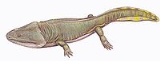
Metoposauridae

Encyclopedia
Metoposauridae is an extinct family
of trematosauria
n temnospondyls. The family is known from the Triassic
and Jurassic
periods. Most members are large, approximately 1.5 metres (4.9 ft) long. Metoposaurids can be distinguished from the very similar mastodonsauroids
by the position of their eyes, placed far forward on the snout.
Several mass accumulations of metoposaurid fossils are known from the southwestern United States
and Morocco
. These have often been interpreted as the result of mass deaths from droughts. Many individuals would have died in one area, creating a dense bonebed once fossilized. These mass accumulations of metoposaurids are often dominated by one taxa, such as Koskinonodon
or Metoposaurus
. Recent sedimentological studies suggest that the mass accumulations were not the result of droughts, but of river currents carrying remains. Most skeletons in these accumulations are disarticulated, suggesting that they were transported by water to the deposition sites. The large gatherings of metoposaurids may have been breeding sites, and were probably common across floodplains in Late Triassic Pangaea
.
Family (biology)
In biological classification, family is* a taxonomic rank. Other well-known ranks are life, domain, kingdom, phylum, class, order, genus, and species, with family fitting between order and genus. As for the other well-known ranks, there is the option of an immediately lower rank, indicated by the...
of trematosauria
Trematosauria
Trematosauria is one of two major groups of temnospondyl amphibians that survived the Permian-Triassic extinction event, the other being the Capitosauria. The trematosaurs were a diverse and important group that included many medium-sized to large forms that were semi-aquatic to totally aquatic...
n temnospondyls. The family is known from the Triassic
Triassic
The Triassic is a geologic period and system that extends from about 250 to 200 Mya . As the first period of the Mesozoic Era, the Triassic follows the Permian and is followed by the Jurassic. Both the start and end of the Triassic are marked by major extinction events...
and Jurassic
Jurassic
The Jurassic is a geologic period and system that extends from about Mya to Mya, that is, from the end of the Triassic to the beginning of the Cretaceous. The Jurassic constitutes the middle period of the Mesozoic era, also known as the age of reptiles. The start of the period is marked by...
periods. Most members are large, approximately 1.5 metres (4.9 ft) long. Metoposaurids can be distinguished from the very similar mastodonsauroids
Mastodonsauroidea
The Mastodonsauroidea are an extinct superfamily of temnospondyl amphibians known from the Triassic and Jurassic. Fossils belonging to this superfamily have been found in North America, Greenland, Europe, Asia, and Australia...
by the position of their eyes, placed far forward on the snout.
Several mass accumulations of metoposaurid fossils are known from the southwestern United States
United States
The United States of America is a federal constitutional republic comprising fifty states and a federal district...
and Morocco
Morocco
Morocco , officially the Kingdom of Morocco , is a country located in North Africa. It has a population of more than 32 million and an area of 710,850 km², and also primarily administers the disputed region of the Western Sahara...
. These have often been interpreted as the result of mass deaths from droughts. Many individuals would have died in one area, creating a dense bonebed once fossilized. These mass accumulations of metoposaurids are often dominated by one taxa, such as Koskinonodon
Koskinonodon
Koskinonodon is an extinct genus of large temnospondyl amphibian, formerly named Buettneria. It was very common during the Late Triassic in what is now the American Southwest.-External links:*...
or Metoposaurus
Metoposaurus
Metoposaurus is an extinct genus of temnospondyl amphibian, known from the Late Triassic of Europe. This mostly aquatic animal possessed small, weak limbs, had sharp teeth and a large flat head. The main diet of this highly flattened creature was fish which it captured with its wide jaws lined with...
. Recent sedimentological studies suggest that the mass accumulations were not the result of droughts, but of river currents carrying remains. Most skeletons in these accumulations are disarticulated, suggesting that they were transported by water to the deposition sites. The large gatherings of metoposaurids may have been breeding sites, and were probably common across floodplains in Late Triassic Pangaea
Pangaea
Pangaea, Pangæa, or Pangea is hypothesized as a supercontinent that existed during the Paleozoic and Mesozoic eras about 250 million years ago, before the component continents were separated into their current configuration....
.