

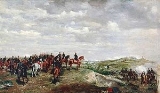
Battle of Solferino

Encyclopedia
The Battle of Solferino, (referred to in Italy as the Battle of Solferino and San Martino), was fought on June 24, 1859 and resulted in the victory of the allied French
Army under Napoleon III
and Sardinian Army under Victor Emmanuel II
(together known as the Franco-Sardinian Alliance) against the Austrian
Army under Emperor Franz Joseph I
; it was the last major battle in world history where all the armies were under the personal command of their monarchs. Perhaps 300,000 soldiers fought in this important battle, the largest since the Battle of Leipzig
in 1813. There were about 130,000 Austrian troops and a combined total of 140,000 French and allied Piedmontese troops. After this battle, the Austrian Emperor refrained from further direct command of the army.
The battle was witnessed by the Swiss
Jean-Henri Dunant
. Horrified by the suffering of wounded soldiers left on the battlefield, Dunant set about a process that led to the Geneva Conventions
and the establishment of the International Red Cross
.
or Second Independence War, a crucial step in the Italian Risorgimento. The war's geopolitical context was the nationalist struggle to unify Italy, long divided between France, Austria, Spain
and numerous small Italian principalities. The battle took place near the villages of Solferino
and San Martino, Italy
, south of Lake Garda
between Milan
and Verona.
The confrontation was between the Austrians on one side, versus the French and Piedmontese forces who opposed their advance. The Austrians were retreating eastwards after their defeat at the Battle of Magenta
. In the morning of 23 June, after the arrival of emperor Franz Joseph, they changed direction to counterattack along the river Chiese
. At the same time, Napoleon III ordered his troops to advance, causing the battle to occur in an unpredicted location. While the Piedmontese fought the Austrian right wing near San Martino, the French battled to the south of them near Solferino against the main Austrian corps.
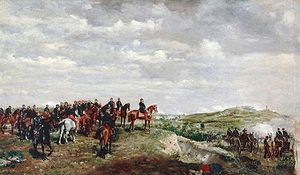
The Austrian forces were personally led by their militarily inexperienced 29-year-old emperor, Franz Joseph
, who had fired his commander-in-chief Gyulai
after the defeat ina Magenta, and were divided into two field armies: 1st Army, containing three corps (III, IX and XI), under Franz von Wimpffen and 2nd Army, containing four corps (I, V, VII and VIII) under Franz von Schlick
.
The French army at Solferino, personally led by Napoleon III, was divided in four Corps plus the Imperial Guard. Many of its men and generals were veterans of the French conquest of Algeria
and the Crimean War
, but its commander-in-chief had no military experience of note. The Sardinian army had four divisions on the field.
.jpg) According to the allied battleplan formed on 24 June the Franco-Sardinian army moved east to deploy along the right river banks of the Mincio
According to the allied battleplan formed on 24 June the Franco-Sardinian army moved east to deploy along the right river banks of the Mincio
. The French were to occupy the villages of Solferino
, Cavriana
, Guidizzolo
and Medole
with respectively 1st Corps (Baraguey d'Hilliers
), 2nd Corps (Mac-Mahon), 3rd Corps (Canrobert
) and 4th Corps (Niel
). The four Sardinian divisions were to take Pozzolengo
. After marching a few kilometers, the allies came into contact with the Austrian troops who had entrenched themselves in those villages. In the absence of a fixed battle plan, the battle which took place was uncoördinated, reason why so many became casualties, and fell in to three separate engagements at Medole (south), Solferino (center) and San Martino (north).
The French forces were numerically inferior to the Austrians. The 4th Corps contained three infantry divisions under de Luzy, Vinoy
and Failly
and a cavalry brigade. Niel, holding a thin line of 5 kilometers in length, was able to stop the Austrian assaults on his position by ably warding of attacks and counterattacking at opportune moments. After 15 hours of combat the Austrians retreated, both sides having lost in total nearly 15.000 men.
, de Ladmirault
, Bazaine
and a cavalry division under Desvaux) came in to contact with the Austrian V Corps under Stadion near Castiglione delle Stiviere
.
Around 5 AM 2nd Corps under Mac-Mahon (two infantry divisions and a cavalry brigade under La Motterouge, Decaen and Gaudin) encountered Hungarian units posted near Ca’Morino (Medole). The Austrian forces were three corps strong (I, V and VII) and positioned on the towns of Solferino, Cavriana and Volta Mantovana. The Austrians were able to hold these positions all day against repeated French attacks.
Near 3 PM the French reserves, formed by Canrobert’s 3rd Corps and the Imperial Guard under Regnaud
, attacked Cavriana, which was defended by the Austrian I Corps under Clam-Gallas
, finally occupying it at 6 PM and thereby breaking through the Austrian center. This breakthrough forced a general retreat of both Austrian armies.
ted on both sides added to the horror. In the end, the Austrian forces were forced to yield their positions, and the Allied French-Piedmontese armies won a tactical, but costly, victory. The Austrians retreated to the four fortresses of the Quadrilateral
, and the campaign essentially ended.
was proclaimed in 1861.
This battle would have a long-term effect on the future conduct of military actions. Jean-Henri Dunant
, who witnessed the battle in person, was motivated by the horrific suffering of wounded soldiers left on the battlefield to begin a campaign that would eventually result in the Geneva Conventions
and the establishment of the International Red Cross
. The Movement organized the 150th anniversary commemoration of the battle between the 23rd and 27 June 2009. The Presidency
of the European Union
adopted a declaration on the occasion stating that "This battle was also the grounds on which the international community of States has developed and adopted instruments of International Humanitarian Law, the international law rules relevant in times of armed conflict, in particular the four Geneva Conventions of 1949, the 60th anniversary of which will be celebrated this year."
At San Martino (now San Martino della Battaglia) there is a circular tower dominating the area, a memorial to Victor Emmanuel II. It is 70 m high and was built in 1893.
In the town there is a museum, with uniforms and weapons of the time, and an ossuary
chapel.
At Solferino there is also a museum, displaying arms and mementos of the time, and an ossuary, containing the bones of thousands of victims.
Nearby Castiglione delle Stiviere
, where many of the wounded were taken after the battle, is the site of the museum of the International Red Cross
, focusing on the events that led to the formation of that organization.
Second French Empire
The Second French Empire or French Empire was the Imperial Bonapartist regime of Napoleon III from 1852 to 1870, between the Second Republic and the Third Republic, in France.-Rule of Napoleon III:...
Army under Napoleon III
Napoleon III of France
Louis-Napoléon Bonaparte was the President of the French Second Republic and as Napoleon III, the ruler of the Second French Empire. He was the nephew and heir of Napoleon I, christened as Charles Louis Napoléon Bonaparte...
and Sardinian Army under Victor Emmanuel II
Victor Emmanuel II of Italy
Victor Emanuel II was king of Sardinia from 1849 and, on 17 March 1861, he assumed the title King of Italy to become the first king of a united Italy since the 6th century, a title he held until his death in 1878...
(together known as the Franco-Sardinian Alliance) against the Austrian
Austrian Empire
The Austrian Empire was a modern era successor empire, which was centered on what is today's Austria and which officially lasted from 1804 to 1867. It was followed by the Empire of Austria-Hungary, whose proclamation was a diplomatic move that elevated Hungary's status within the Austrian Empire...
Army under Emperor Franz Joseph I
Franz Joseph I of Austria
Franz Joseph I or Francis Joseph I was Emperor of Austria, King of Bohemia, King of Croatia, Apostolic King of Hungary, King of Galicia and Lodomeria and Grand Duke of Cracow from 1848 until his death in 1916.In the December of 1848, Emperor Ferdinand I of Austria abdicated the throne as part of...
; it was the last major battle in world history where all the armies were under the personal command of their monarchs. Perhaps 300,000 soldiers fought in this important battle, the largest since the Battle of Leipzig
Battle of Leipzig
The Battle of Leipzig or Battle of the Nations, on 16–19 October 1813, was fought by the coalition armies of Russia, Prussia, Austria and Sweden against the French army of Napoleon. Napoleon's army also contained Polish and Italian troops as well as Germans from the Confederation of the Rhine...
in 1813. There were about 130,000 Austrian troops and a combined total of 140,000 French and allied Piedmontese troops. After this battle, the Austrian Emperor refrained from further direct command of the army.
The battle was witnessed by the Swiss
Switzerland
Switzerland name of one of the Swiss cantons. ; ; ; or ), in its full name the Swiss Confederation , is a federal republic consisting of 26 cantons, with Bern as the seat of the federal authorities. The country is situated in Western Europe,Or Central Europe depending on the definition....
Jean-Henri Dunant
Henry Dunant
Jean Henri Dunant , aka Henry Dunant, was a Swiss businessman and social activist. During a business trip in 1859, he was witness to the aftermath of the Battle of Solferino in modern day Italy...
. Horrified by the suffering of wounded soldiers left on the battlefield, Dunant set about a process that led to the Geneva Conventions
Geneva Conventions
The Geneva Conventions comprise four treaties, and three additional protocols, that establish the standards of international law for the humanitarian treatment of the victims of war...
and the establishment of the International Red Cross
International Red Cross and Red Crescent Movement
The International Red Cross and Red Crescent Movement is an international humanitarian movement with approximately 97 million volunteers, members and staff worldwide which was founded to protect human life and health, to ensure respect for all human beings, and to prevent and alleviate human...
.
The battle
The Battle of Solferino was a decisive engagement in the Second Italian War of IndependenceSecond Italian War of Independence
The Second War of Italian Independence, Franco-Austrian War, Austro-Sardinian War, or Austro-Piedmontese War , was fought by Napoleon III of France and the Kingdom of Piedmont-Sardinia against the Austrian Empire in 1859...
or Second Independence War, a crucial step in the Italian Risorgimento. The war's geopolitical context was the nationalist struggle to unify Italy, long divided between France, Austria, Spain
Spain
Spain , officially the Kingdom of Spain languages]] under the European Charter for Regional or Minority Languages. In each of these, Spain's official name is as follows:;;;;;;), is a country and member state of the European Union located in southwestern Europe on the Iberian Peninsula...
and numerous small Italian principalities. The battle took place near the villages of Solferino
Solferino
Solferino is a small town and comune in the province of Mantua, Lombardy, northern Italy, approximately 10 kilometres south of Lake Garda....
and San Martino, Italy
Italy
Italy , officially the Italian Republic languages]] under the European Charter for Regional or Minority Languages. In each of these, Italy's official name is as follows:;;;;;;;;), is a unitary parliamentary republic in South-Central Europe. To the north it borders France, Switzerland, Austria and...
, south of Lake Garda
Lake Garda
Lake Garda is the largest lake in Italy. It is located in Northern Italy, about half-way between Brescia and Verona, and between Venice and Milan. Glaciers formed this alpine region at the end of the last ice age...
between Milan
Milan
Milan is the second-largest city in Italy and the capital city of the region of Lombardy and of the province of Milan. The city proper has a population of about 1.3 million, while its urban area, roughly coinciding with its administrative province and the bordering Province of Monza and Brianza ,...
and Verona.
The confrontation was between the Austrians on one side, versus the French and Piedmontese forces who opposed their advance. The Austrians were retreating eastwards after their defeat at the Battle of Magenta
Battle of Magenta
The Battle of Magenta was fought on June 4, 1859 during the Second Italian War of Independence, resulting in a French-Sardinian victory under Napoleon III against the Austrians under Marshal Ferencz Gyulai....
. In the morning of 23 June, after the arrival of emperor Franz Joseph, they changed direction to counterattack along the river Chiese
Chiese
The Chiese, also known in the Province of Brescia as the Clisi, is a 160 km Italian river which is the principal immisary and sole emissary of the sub-alpine lake Lago d’Idro, and is a left tributary of the Oglio....
. At the same time, Napoleon III ordered his troops to advance, causing the battle to occur in an unpredicted location. While the Piedmontese fought the Austrian right wing near San Martino, the French battled to the south of them near Solferino against the main Austrian corps.
Opposing forces
The Austrian forces were personally led by their militarily inexperienced 29-year-old emperor, Franz Joseph
Franz Joseph I of Austria
Franz Joseph I or Francis Joseph I was Emperor of Austria, King of Bohemia, King of Croatia, Apostolic King of Hungary, King of Galicia and Lodomeria and Grand Duke of Cracow from 1848 until his death in 1916.In the December of 1848, Emperor Ferdinand I of Austria abdicated the throne as part of...
, who had fired his commander-in-chief Gyulai
Ferencz Gyulai
Count Ferencz Gyulai de Marosnémethi et Nádaska , also known as Ferenc Gyulai, Ferencz Gyulaj, or Franz Gyulai, was a Hungarian nobleman who served as Austrian Governor of Lombardy-Venetia and commanded the losing Austrian army at the Battle of Magenta.-Biography:Gyulai was born on 1 September 1798...
after the defeat ina Magenta, and were divided into two field armies: 1st Army, containing three corps (III, IX and XI), under Franz von Wimpffen and 2nd Army, containing four corps (I, V, VII and VIII) under Franz von Schlick
Franz Schlik
Franz Joseph von Shlik of Bassano and Weisskirchen was an Earl and general in the Austrian Empire's army. He was one of the most successful Austrian generals during the Hungarian Revolution of 1848.In 1808 he enrolled in the Emperor's army. He was engaged in the Napoleonic Wars...
.
The French army at Solferino, personally led by Napoleon III, was divided in four Corps plus the Imperial Guard. Many of its men and generals were veterans of the French conquest of Algeria
French conquest of Algeria
The French conquest of Algeria took place between 1830 and 1847. Using an 1827 diplomatic slight by Hussein Dey, the ruler of the Ottoman Regency of Algiers, against its consul as a pretext, France invaded and quickly seized Algiers in 1830, and rapidly took control of other coastal communities...
and the Crimean War
Crimean War
The Crimean War was a conflict fought between the Russian Empire and an alliance of the French Empire, the British Empire, the Ottoman Empire, and the Kingdom of Sardinia. The war was part of a long-running contest between the major European powers for influence over territories of the declining...
, but its commander-in-chief had no military experience of note. The Sardinian army had four divisions on the field.
Battle commences
Mincio
Mincio is a river in the Lombardy region of northern Italy.Called the Sarca River before entering Lake Garda, it flows from there about 65 km past Mantua into the Po River....
. The French were to occupy the villages of Solferino
Solferino
Solferino is a small town and comune in the province of Mantua, Lombardy, northern Italy, approximately 10 kilometres south of Lake Garda....
, Cavriana
Cavriana
Cavriana is a comune in the Province of Mantua in the Italian region Lombardy, located about 110 km east of Milan and about 25 km northwest of Mantua.-World heritage site:...
, Guidizzolo
Guidizzolo
Guidizzolo is a comune in the Province of Mantua in the Italian region Lombardy, located about 110 km east of Milan and about 25 km northwest of Mantua.-Geography:...
and Medole
Medole
Medole is a comune in the Province of Mantua in the Italian region Lombardy, located about 110 km east of Milan and about 30 km northwest of Mantua...
with respectively 1st Corps (Baraguey d'Hilliers
Achille Baraguey d'Hilliers
Louis-Achille Baraguey d'Hilliers, 1st Comte Baraguey d'Hilliers was a Marshal of France and politician.Baraguey d'Hilliers was born in Paris, the son of the French revolutionary general Louis Baraguey d'Hilliers...
), 2nd Corps (Mac-Mahon), 3rd Corps (Canrobert
François Certain Canrobert
François Certain de Canrobert, usually known as François Certain-Canrobert and later simply as Maréchal Canrobert , was a marshal of France.-Biography:...
) and 4th Corps (Niel
Adolphe Niel
Adolphe Niel was a French Army general and statesman, also Marshal of France.He was born at Muret, Haute-Garonne and entered the École Polytechnique in 1821. Niel entered the engineer school at Metz, became lieutenant in the Engineers Corps in 1827, and captain in 1833...
). The four Sardinian divisions were to take Pozzolengo
Pozzolengo
Pozzolengo is a comune in the province of Brescia, in Lombardy.*...
. After marching a few kilometers, the allies came into contact with the Austrian troops who had entrenched themselves in those villages. In the absence of a fixed battle plan, the battle which took place was uncoördinated, reason why so many became casualties, and fell in to three separate engagements at Medole (south), Solferino (center) and San Martino (north).
Battle of Medole
The battle started at Medole around 4 AM. Marching towards Guidizzolo, the 4th Corps encountered an Austrian infantry regiment of the Austrian 1st Army. General Niel immediately decided to engage the enemy and deployed his forces east of Medole. This move prevented the three corps (III, IX and XI) of the Austrian 1st Army to aid their comrades of the 2nd Army near Solferino, where the main French attacks took place.The French forces were numerically inferior to the Austrians. The 4th Corps contained three infantry divisions under de Luzy, Vinoy
Joseph Vinoy
Joseph Vinoy was a French soldier.-Biography:He originally intended to join the Church, but, after some years at a seminary, he decided upon a military career and joined the French army in 1823. As a sergeant in the 14th line infantry, he took part in the Algerian expedition of 1830...
and Failly
Pierre Louis Charles de Failly
Pierre-Louis Charles de Failly was a French general.The son of Count Charles-Louis de Failly , and of Sophie Desmons de Maigneux, he was educated at the Saint-Cyr and entered the army in 1828.In 1851 he had risen to the rank of colonel, and Napoleon...
and a cavalry brigade. Niel, holding a thin line of 5 kilometers in length, was able to stop the Austrian assaults on his position by ably warding of attacks and counterattacking at opportune moments. After 15 hours of combat the Austrians retreated, both sides having lost in total nearly 15.000 men.
Battle of Solferino
Around 4:30 AM the advance guard of the 1st Corps (three infantry divisions under ForeyElie Frédéric Forey
Élie Frédéric Forey was a Marshal of France.-Biography:Elie Frédéric Forey was born in Paris.He studied at the French military academy Saint-Cyr and was commissioned a lieutenant in the 2nd Light Infantry Regiment in 1824. He served in the expedition against Algiers in 1830...
, de Ladmirault
Paul de Ladmirault
Paul de Ladmirault was a French general active in the French conquest of Algeria and during the wars of the Second French Empire.- Life :...
, Bazaine
François Achille Bazaine
François Achille Bazaine was a French General and from 1864, a Marshal of France, who surrendered the last organized French army to the Prussians during the Franco-Prussian war. He was the first Marshal who had started as a legionnaire and like the great Marshals of the First Empire, he had risen...
and a cavalry division under Desvaux) came in to contact with the Austrian V Corps under Stadion near Castiglione delle Stiviere
Castiglione delle Stiviere
Castiglione delle Stiviere is a town and comune in the province of Mantua, in Lombardy, Italy, 30 km northwest of Mantua by road.-History:During the War of the Spanish Succession, the French under the duc de Vendôme occupied it....
.
Around 5 AM 2nd Corps under Mac-Mahon (two infantry divisions and a cavalry brigade under La Motterouge, Decaen and Gaudin) encountered Hungarian units posted near Ca’Morino (Medole). The Austrian forces were three corps strong (I, V and VII) and positioned on the towns of Solferino, Cavriana and Volta Mantovana. The Austrians were able to hold these positions all day against repeated French attacks.
Near 3 PM the French reserves, formed by Canrobert’s 3rd Corps and the Imperial Guard under Regnaud
Auguste Regnaud de Saint-Jean d'Angély
Auguste Michel Étienne Regnaud de Saint-Jean d'Angély, later 2nd Count Regnaud de Saint-Jean d'Angély was a Marshal of France, soldier and politician....
, attacked Cavriana, which was defended by the Austrian I Corps under Clam-Gallas
Eduard Clam-Gallas
Count Eduard Clam-Gallas was an Austrian General. He was the eldest son of Count Christian Christoph Clam-Gallas , patron of Beethoven, and Countess Josephine Clary-Aldringen .- Career :...
, finally occupying it at 6 PM and thereby breaking through the Austrian center. This breakthrough forced a general retreat of both Austrian armies.
Battle of San Martino
On the northern side of the battlefield the Sardinians, 4 divisions strong, encountered the Austrians around 7 AM. A long battle erupted over control of Pozzolengo, San Martino and Madonna della Scoperta. Although the Austrian VIII Corps under Benedek was numerically inferior, they were able to ward of all Sardinian attacks until the entire Austrian army retired from the field at the end of day.Results
The battle was a particularly gruelling one, lasting over nine hours and resulting in over 3,000 Austrian troops killed with 10,807 wounded and 8,638 missing or captured. The Allied armies also suffered a total of 2,492 killed, 12,512 wounded and 2,922 captured or missing. Reports of wounded and dying soldiers being shot or bayonetBayonet
A bayonet is a knife, dagger, sword, or spike-shaped weapon designed to fit in, on, over or underneath the muzzle of a rifle, musket or similar weapon, effectively turning the gun into a spear...
ted on both sides added to the horror. In the end, the Austrian forces were forced to yield their positions, and the Allied French-Piedmontese armies won a tactical, but costly, victory. The Austrians retreated to the four fortresses of the Quadrilateral
Quadrilatero
The Quadrilatero is the traditional name of a defensive system of the Austrian Empire in the Lombardy-Venetia, which connected the fortresses of Peschiera, Mantua, Legnago and Verona between the Mincio, the Po and Adige Rivers...
, and the campaign essentially ended.
Aftermath
Napoleon III was moved by the losses, as he had argued back in 1852 "the French Empire is peace", and for reasons including the Prussian threat and domestic protests by the Roman Catholics, he decided to put an end to the war with the Armistice of Villafranca (July 12, 1859). The Piedmontese won Lombardy but not Venetia. Camillo Benso, conte di Cavour, resigned. The Kingdom of ItalyKingdom of Italy (1861–1946)
The Kingdom of Italy was a state forged in 1861 by the unification of Italy under the influence of the Kingdom of Sardinia, which was its legal predecessor state...
was proclaimed in 1861.
This battle would have a long-term effect on the future conduct of military actions. Jean-Henri Dunant
Henry Dunant
Jean Henri Dunant , aka Henry Dunant, was a Swiss businessman and social activist. During a business trip in 1859, he was witness to the aftermath of the Battle of Solferino in modern day Italy...
, who witnessed the battle in person, was motivated by the horrific suffering of wounded soldiers left on the battlefield to begin a campaign that would eventually result in the Geneva Conventions
Geneva Conventions
The Geneva Conventions comprise four treaties, and three additional protocols, that establish the standards of international law for the humanitarian treatment of the victims of war...
and the establishment of the International Red Cross
International Red Cross and Red Crescent Movement
The International Red Cross and Red Crescent Movement is an international humanitarian movement with approximately 97 million volunteers, members and staff worldwide which was founded to protect human life and health, to ensure respect for all human beings, and to prevent and alleviate human...
. The Movement organized the 150th anniversary commemoration of the battle between the 23rd and 27 June 2009. The Presidency
Presidency of the Council of the European Union
The Presidency of the Council of the European Union is the responsibility for the functioning of the Council of the European Union that rotates between the member states of the European Union every six months. The presidency is not a single president but rather the task is undertaken by a national...
of the European Union
European Union
The European Union is an economic and political union of 27 independent member states which are located primarily in Europe. The EU traces its origins from the European Coal and Steel Community and the European Economic Community , formed by six countries in 1958...
adopted a declaration on the occasion stating that "This battle was also the grounds on which the international community of States has developed and adopted instruments of International Humanitarian Law, the international law rules relevant in times of armed conflict, in particular the four Geneva Conventions of 1949, the 60th anniversary of which will be celebrated this year."
The battlefield today
The area contains a number of memorials to the events surrounding the battles.At San Martino (now San Martino della Battaglia) there is a circular tower dominating the area, a memorial to Victor Emmanuel II. It is 70 m high and was built in 1893.
In the town there is a museum, with uniforms and weapons of the time, and an ossuary
Ossuary
An ossuary is a chest, building, well, or site made to serve as the final resting place of human skeletal remains. They are frequently used where burial space is scarce. A body is first buried in a temporary grave, then after some years the skeletal remains are removed and placed in an ossuary...
chapel.
At Solferino there is also a museum, displaying arms and mementos of the time, and an ossuary, containing the bones of thousands of victims.
Nearby Castiglione delle Stiviere
Castiglione delle Stiviere
Castiglione delle Stiviere is a town and comune in the province of Mantua, in Lombardy, Italy, 30 km northwest of Mantua by road.-History:During the War of the Spanish Succession, the French under the duc de Vendôme occupied it....
, where many of the wounded were taken after the battle, is the site of the museum of the International Red Cross
International Red Cross and Red Crescent Movement
The International Red Cross and Red Crescent Movement is an international humanitarian movement with approximately 97 million volunteers, members and staff worldwide which was founded to protect human life and health, to ensure respect for all human beings, and to prevent and alleviate human...
, focusing on the events that led to the formation of that organization.
External links
- The French Army 1600-1900
- The Battle of Solferino Mikhail Dragomirov. (1861) Battle of Solferino. (With two plans) (Сольферинская битва. (с двумя планами)) at Runivers.ru in DjVuDjVuDjVu is a computer file format designed primarily to store scanned documents, especially those containing a combination of text, line drawings, and photographs. It uses technologies such as image layer separation of text and background/images, progressive loading, arithmetic coding, and lossy...
format